-
Serial Review: Doorways in the Sand by Roger Zelazny (Part 3/3)
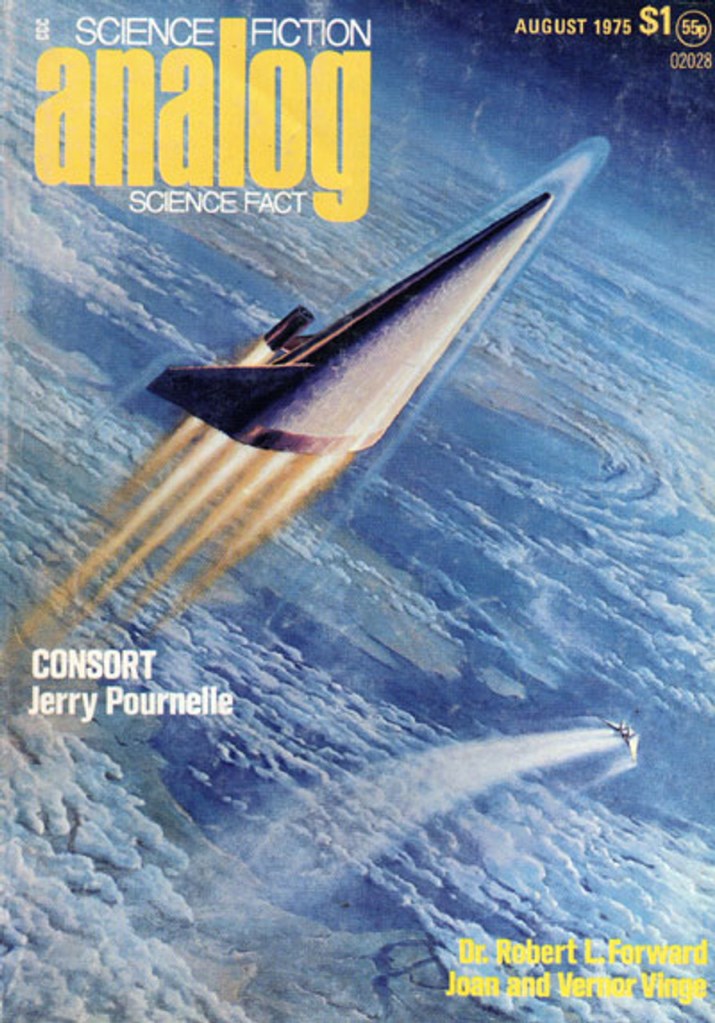
(Cover by Andrei Sokolov. Analog, August 1975.) The Story So Far
Fred Cassidy has been going to college for the past 13 years and has not gotten a degree yet, because he doesn’t want one. He’s been exploiting a loophole in his uncle’s will, which says that he’s to mooch off an allowance until he gets his degree. Well. Aside from his latest academic adviser pushing him out the door, he has a much bigger problem on his hands, which is that a precious alien artifact called the star-stone has gone missing, and Fred’s the only person who can get it back. Why? Because Fred and his former roommate, Hal, had a replica of the stone, which through a convoluted series of events involving Paul Byler, Fred’s former geology professor, had gotten swapped out with the real thing. Multiple parties want the stone, including a much-angered Paul, a couple of hired goons, and some interplanetary alien cops. Mind you that these aliens are not all of the same race, but rather are members of a coalition of intelligent races that came into contact with humanity and made a deal with us. As part of a non-aggression deal the alien coalition had given the UN a couple artifact, including the stone, while the UN handed over the genuine Mona Lisa and the British Crown Jewels. Of course, since the stone’s gone missing, said non-aggression deal threatens to go down the shitter. Fred finds allies in two alien cops named Ragma and Charv, whom we first meet disguised as mammals out of the Australian outback. There’s another still-friendly but less useful alien in disguise named Sibla, who tries probing Fred’s mind but has a hard time doing so, on account of Fred being drunk. Getting plastered is useful for when you’re up against possibly nefarious telepaths.
Another ally of Fred’s is a mysterious voice that communicates with him inside his head, but only when he’s drunk; on the one hand this might be an elaborate hallucination, but also the presence is coming from somewhere. The presence advises Fred to get a hold of the Rhennius machine, which is the other artifact the alien coalition had given to humanity. Activating the Rhennius machine has something to do with the presence and may be a clue to getting the star-stone. Fred runs into Merimee, an eccentric scientist (like Paul) who’s also an old buddy of Fred’s uncle’s. Turns out the Rhennius machine reverses one’s perceptions, including sight and even taste. Signs appear to be written backward (a neat little typographical trick on Zelazny’s part) and what tasted good before now tastes bad (and vice versa). In what now must seem like a permanent stupor, ironically relieved by drinking copious amounts of alcohol, Fred crashes at Hal’s place after the latter confesses to having a spat with his wife Mary. The problem, the two lads find out, is that Mary has been kidnapped by the aforementioned hired goons. The second installment with a threeway confrontation between Fred/Hal, the goons, and Paul, who has shown up with an agenda of his own. Mary, for someone who probably has little to no idea what’s going on, is taking this all rather well. Meanwhile, Fred takes a bullet to the chest for his troubles, so how he survives this is a good question.
Enhancing Image
When I finished this novel I thought of it as being Zelazny’s beer-and-wine novel, because of how much drinking there is; but at the same time it should be mentioned that there’s ultimately as much casual smoking here as in other ’60s and ’70s Zelazny works. (He eventually quit smoking, but up until the ’80s Zelazny seemed to share the popular French view on smoking.) Doorways in the Sand is less intellectual than some earlier Zelazny novels, and indeed comes off as less sober, not helped by us being stuck in Fred’s shoes the whole time—yes, even during the recap sections. This is the kind of book you would read to see the New Wave’s influence on SF writing in a less demanding and less serious mode. The irony is that because it’s less serious than, say, the average Robert Silverberg novel from around the same time, this novel has aged better than most of its peers. The comedy is of an old-school slapstick sort, including the occasional pun; and while there’s a bit of language, there isn’t much of it, not to mention that there’s also very little in the way of sex stuff, which otherwise reared its head a little too often in novels from the ’70s. Even for 1975 the conceit of the plot is rather old-fashioned, but it’s heightened by Zelazny’s sense of humor and his playing with typography and perspective. Also helping is Fred being one of Zelazny’s more charming protagonists, admittedly having to compete with some of the more insufferable and egotistical protagonists in New Wave-era SF. Fred is a lazy bum who wants to mooch off his uncle’s allowance forever, but at the same time he likes to have fun and he’s not in favor of rubbing his education in people’s faces.
Now as to how Fred survived the end of the last installment, the explanation is basically this: his heart wasn’t in the right place. He was shot in what would have been his heart, but it had accidentally missed. What’s no less miraculous is that not only does Fred survive but he seems to have acquired Wolverine healing powers, since the gaping wound in his chest has healed itself in beyond record time. This has to do with the Rhennius machine, but it also has to do with the stone and where it is. The big twist of the novel is twofold: that the stone is actually sentient, and that it’s been lurking inside Fred during the events of the novel as a symbiote. The star-stone, also called Speicus, is like an organic computer that processes information, hence its ability to communicate with Fred. As to how Fred got the stone inside him in the first place, it has to do with a party and—you guessed it—a little too much drinking. Fred’s only able to recall this happening at all while under a mix of interrogation and the star-stone being “turned on,” (in context it’s one of Zelazny’s classic puns) because he was almost dead drunk at the time. The stone is a benign parasite whose livelihood depends on its host also being alive, hence its working to protect Fred. Bit of a deus ex machina for how Fred is able to survive everything that’s happened to him, but I would mind if it more if it was a more serious story, but thankfully Doorways in the Sand is not a very serious novel. We’re talking about a novel where a guy with a fetish for climbing heights (I’m not kidding) has been getting by as a college undergrad for 13 years because his uncle’s in cold sleep—that is, until said uncle returns from his nap in this installment.
This is a novel about finding an important dingus, but it’s also a novel about education. Doorways in the Sand is not a bildungsroman, namely because Fred is an adult (he’s about thirty years old), but this is still ultimately about a man’s education. Fred is so determined to be a student forever that he almost quite literally has to have his degree (it’s actually a PhD and not a bachelor’s degree, the college finding a loophole to give him a degree without having him properly graduate) and a job handed to him. If this novel is about anything (granted that it certainly is not About Something™, in that it does not ask serious questions or make observations about the human condition), it’s about knocking down the wall between what we think of as “education,” which is really an institution separated from the outside world, and of course said outside world. Fred has to gain some real-world experience in an unusually hard way, which involved nearly getting killed a few times (as I said in a previous installment review, Fred fulfills one of the classic detective tropes by getting the shit beaten out of him), but ultimately this trial-by-combat worked out for him. He has a PhD and a job with the UN, and as he says close to the novel’s end, “The fool delivered the final blow.” Fittingly for a comic novel, the “fool” comes out on top. On a totally surface level, like how one might enjoy gourmet chocolate (just watch those calories), this is one of Zelazny’s most satisfying novels.
A Step Farther Out
In his review of Doorways in the Sand, Spider Robinson expressed mild disappointment with what was then Zelazny’s latest novel while also acknowledging that it was quite good—had nearly anyone else’s name been attached to it. After Zelazny’s run of winning awards and critical appraisal left and right in the ’60s, the ’70s were shakier ground for him, partly because of his Amber series, but also, following the burning-out of the New Wave movement in the early ’70s, Zelazny’s SF no longer seemed so impressive. It’s a shame, because when taken as the somewhat unserious novel that it is, Doorways in the Sand is quite fun. Zelazny himself was fond of it, and if you’re looking for a zany and fast-moving SF-detective novel then it’s easy to see his fondness for it.
See you next time.
-
Novella Review: “Fool to Believe” by Pat Cadigan

(Cover by Hisaki Yasuda. Asimov’s, February 1990.) Who Goes There?
Pat Cadigan is one of the most important writers behind the cyberpunk movement in the ’80s and early ’90s, although she doesn’t come up in conversation nearly as often as William Gibson or Bruce Sterling, probably because she’s more adept at short lengths than as a novelist. She actually made her debut a good bit before her rise to prominence in the ’80s, being an editor for one issue of the sword-and-sorcery magazine Chacal, as well as the SFF magazine Shayol. Speaking of Gibson, one strange way the two have crossed paths is that Cadigan wrote a novelization of Alien 3—not the film or the film’s script, but Gibson’s script which had gone unused, in the midst of that movie’s notoriously troubled production. She has written several film novelizations over the years, including, of all things, a novelization of Jason X. But it’s her association with cyberpunk that has secured her legacy. She even edited one of the better anthologies focused on the movement, The Ultimate Cyberpunk. “Fool to Believe” itself would serve as the germ for Cadigan’s 1992 novel Fools, although she had written the former first with the initial intent of it being a standalone story.
Placing Coordinates
First published in the February 1990 issue of Asimov’s Science Fiction. “Fool to Believe” has never appeared in book form, possibly because Fools has rendered it obsolete; unfortunately Fools itself is very much out of print, so neither is all that accessible.
Enhancing Image
Sorry for the wait, but I decided to take a bit of a mini-vacation from working on this site. I was feeling burnt out a little, although I have to admit it doesn’t help that “Fool to Believe” is a vast and nigh-indecipherable story which uses its length to good effect. It’s easily the longest Cadigan story I’ve read so far, and aside from “Pretty Boy Crossover” it’s the straightest example of cyberpunk coming from her that I’ve read. Apparently “Fool to Believe” (and by extension Fools) is set in the same continuity as Cadigan’s first novel, Mindplayers, although while Gardner Dozois’s introduction says this, ISFDB does not acknowledge the two as being in the same series. Maybe somebody should get on that? This is a detective story, which is unsurprising given that cyberpunk is basically the bastard child of science fiction and detective fiction. When you read Neuromancer you’re seeing Raymond Chandler’s influence at work, including a propensity for murky plotting. I’m gonna be upfront and say I barely understood what the fuck was happening in “Fool to Believe,” it being the kind of story one really ought to read twice, and unfortunately I was only able to get through it once. If I had my physical copy of this issue of Asimov’s on me I might’ve been able to do a second reading, but most of my SFF magazines are still at my parents’ house. Oh well. Cadigan is hunting intellectual big game and she crams a lot (maybe too much) into sixty magazine pages. I can see why she decided at some point to expand the thing into a novel.
What is the plot? Or rather, what is the premise? This is a murder mystery, of sorts, although a murder strictly speaking hasn’t happened. An up-and-coming actor named Sovay has had his mind wiped, his body technically alive but now a hollowed-out shell that will probably get refitted with a new personality. Personalities mean about as much as bodies in this future, wherein on top of the usual organ transplants you also have personality transplants—sometimes voluntarily, but sometimes not. There’s the regular police, but then there’s the Brain Police, having been founded to deal with such crimes as the involuntary wiping of people’s brains. (In one of the more unsettling little touches of how the Brain Police work, they remove the hollowed-out Sovay’s eyeballs, since apparently people change eyes in this world almost like one would change shoes, and linking and wiping minds is done via the optic nerve.) The mystery then is who wiped Sovay’s mind and who bought his personality.
As Mersine explains:
The involuntary mindwipe—mindsuck—is just as gone, except the trappings of a live body remain to confound the survivors. A mindsuck is interred not in a grave but in a special quarantine to allow the development of a new mind and personality. Sometimes the new person is a lot like the old one. Most of the time, however, it’s only spottily reminiscent of the person that had been, as though the suck had freed an auxiliary person that had always been there, just waiting for the elimination of the primary personality.
Mersine herself is part of the Brain Police, so this case falls to her. Her job is to go undercover and coax information out of people working in the criminal underworld, specifically the black market for personalities. She’s fitted with a second personality for this job, an “imp” (a personality implant) named Marya, who’s a “memory-junkie” and so is familiar with how the black market works—or rather she has memories of the black market. Cadigan depicts the alternating of the two personalities in a simple but effective way, not only changing fonts (actually it might be the same font for Marya but bolded, I’m not sure) but changing tenses, with Mersine narrating in the past tense while Marya narrates in the present tense. This changing of tenses, especially for first-person narration, is an odd choice that takes some getting used to, but given what happens near the end of the story I can see why they’re different. The metaphysical implications of mindswapping and mindsucking in “Fool to Believe” are a bit disturbing, since typically we think of the human body and the human personality as separate, to an extent, but ultimately necessary to each other’s existence. What qualifies as the soul and where does it lurk? The ancient Egyptians thought it was in one’s heart, but modern medicine has taught us that a person can survive without the heart they were given at birth—indeed, they can continue to live and be “themselves” with damn near every organ replaced. Except for the brain. The human personality seems to boil down to a working brain and at least one of the senses, which for the purposes of “Fool to Believe” is the sense of vision. Thus this is a story about personality and perception.
There is not a plot so much as there is a network of characters whose interests intersect and run at odds with each other, thus giving the appearance of a plot. I’m not sure if this is a negative criticism or just stemming from me being a dumbass who didn’t read the story thoroughly enough, but while the setting of “Fool to Believe” is gripping and at times disturbing, the actual mystery surrounding Sovay is not. We have quite a few characters, but aside from Marya each of them is only drawn so vividly. We’ve got Rowan, Sovay’s wife (or widow, it’s ambiguous when it comes to cases like this), who from the beginning acts suspiciously and who might have been plotting behind her husband’s back. We have Coney Loe, who’s arguably the closest the story has to a villain, a “hype-head” who peddles mind-altering procedures like one peddles drugs. I should probably take this as an opportunity to talk about mental illness in the context of “Fool to Believe,” namely what used to be called multiple personality disorder. Damn near everybody here has some kind of mental disorder, but it depression, mania (there’s a parlor for experiencing religious mania called Sojourn For Truth, which I might add is a good pun), schizophrenia, or what is now called dissociative identity disorder. Mersine is basically made to have DID, if only temporarily, but the effect sharing a head with Marya has on her psyche is considerable. The two personalities, both being quite individual and assertive, regularly alternate as to who gets to be the dominant personality, and the switching is not always voluntary. Of course, since personalities can be transplanted from body to body, and even appear in multiple bodies at the same time, this raises the question of if Mersine has always been in control of the body she currently has.
There Be Spoilers Here
After figuring out the conspiracy behind Sovay’s mindsucking (basically having his mind held for ransom, which Rowan was willing to pay with anything or anyone to get back) and narrowly avoided getting mindsucked herself, Mersine/Marya has encountered an existential problem: neither of them is the original personality behind Mersine’s body. Mersine goes dormant, leaving Marya in charge of the body. She decides to quit the force, although technically she chooses not to renew her contract, since it was about to expire anyway. The case proved to be too much. In fairness, being on the Brain Police sounds like a huge—well, you can guess what I’m about to say. The sharing of the minds ends up being permanent. The only question then is, what happens next? I assume Fools answers that question, in that it follows Mersine/Marya after this case, but we’ll have to wait and see. I’m intrigued enough that I might seek it out.
A Step Farther Out
When I finished reading “Fool to Believe” I was worried I wouldn’t have much to write about, hence another reason why this review got delayed—not because there wasn’t enough to write about, but simply because I didn’t understand what I was dealing with well enough. Cadigan is a challenging writer at times, which makes me wonder what her novels (well, her originals, not the novelizations) read like. I do not recommend getting into her with “Fool to Believe,” instead going for something that’s shorter and more satisfying on a conventional level, like “Roadside Rescue” or “Pretty Boy Crossover.” This has also been an object lesson in how if I have a physical copy of a story on hand, I really should go for that rather than trudge through a digital copy.
See you next time.
-
Serial Review: Doorways in the Sand by Roger Zelazny (Part 2/3)

(Cover by John Schoenherr. Analog, July 1975.) The Story So Far
Fred Cassidy is an upright college undergrad—in fact he would be near the top of his class and due to graduate with honors, if not for the fact that he’s been an undergrad for 13 years. Uncle Albert, that is Fred’s uncle, has been in cold-sleep for years, and in his will (since Fred’s uncle is neither alive nor dead) he stipulates that Fred be given an allowance until his gets a degree. Fred was all too eager to exploit this. Fred’s newest academic adviser is just as eager to see Fred off, and it looks like the chips are down for Our Anti-Hero™. Not helping matters is that Fred’s former roommate, Hal, moved out to head off with Mary, his newfangled wife. Paul Byler, Fred’s former geology professor and a bit of a mad scientist, shows up at Fred’s dorm looking for the star-stone, an alien artefact that a coalition of intelligent alien races had given to the UN as a gift, or rather as part of an exchange. Fred and Hal had a replica of the star-stone in their dorm, but it seems that the real one, which the UN was supposed to have locked up tight, has gone missing. Fred earns the ire of Paul and later of a couple goons who are also after the star-stone. The ramifications of the dingus going missing turn out to be wide-reaching, since it doesn’t take long for a couple alien agents, named Ragma and Charv, to get on his case about it. Fred is the only person who might know where the stone has gone, the problem being he doesn’t know where it would be consciously; if anything it’s buried in his subconscious. The only ally, aside from Hal, that he’s gotten up to this point is a strange faceless and nameless presence that enters his mind during moments when he gets drunk. To be fair, he does get drunk quite often.
Enhancing Image
I should’ve mentioned Fred’s nameless and faceless friend from the first installment earlier, but somehow it had slipped my mind. Not sure how that happened, considering Zelazny plays with formatting when Fred and this ally of his have their conversation, presented like a teletype sheet. Since these conversations happen inside Fred’s mind, it makes sense for Zelazny to forego tagging dialogue in the conventional way. It’s fun! And it makes the book go by just a bit quicker, which is an achievement considering how fast-paced it already is. There’s no real B-plot, everything is from Fred’s POV, and characters will show maybe once or twice and then never again. The incident with the aforementioned alien agents (disguised as a kangaroo and a wombat, it sort of makes sense in context) gets swiped aside almost like it never happened, but this is not unusual for detective fiction, which Doorways in the Sand very much takes after. There’s a similar incident this installment with a telepathic alien named Sibla who’s disguised as a donkey, and who tries to help Fred—keyword being “tries.” By his own admission Sibla is not an agent in the field by training, but a cost accountant who was brought in at the last minute because the guy who was supposed to be here had called in sick. Cue the studio audience laugh track. Your enjoyment of this novel will partly depend on if you vibe with Zelazny’s sense of humor, which thankfully I do or else I wouldn’t be here.
Just when you think the stakes can’t get higher, the goons from the first installment have gone and kidnapped Mary, Hal’s wife. Hal and Mary had a spat earlier, so that at the end of the last installment Fred and Hal were hanging out at the latter’s place, getting drunk as two heterosexual buddies do. Hal checked Mary’s mom’s place, where she said she was going until their spat tided over, only to find out Mary had never reached her mom’s house. (In older Zelazny stories his characters have a nasty habit of smoking like chimneys, which isn’t the case with Doorways in the Sand, but they do drink a lot. This turns out to be useful for escaping detection from telepathic beings, since getting inebriated enough makes one’s mind harder to read.) Given that she’s being held at gunpoint and that both she and her husband are likely to be killed, Mary takes this all rather well—actually better than Hal does. For his part, Hal is kind of a dipshit: the only reason he even let Mary get kidnapped is that he was too petty to call her up shortly after they had their fight to say he was sorry. I say that these characters are entertaining and even relatable to an extent, but that’s not to say they’re boy scouts, or even all that smart. By the end of this installment Fred is seemingly no closer to getting the stone than he was at the beginning, not to mention he comes out of it with a bullet to the chest which I’m not sure how he’s supposed to survive. But of course he has to survive, because he’s been telling this story to us the whole time. The installment thus ends on just the right note, posing the question of how Fred is supposed to get out his latest nasty situation, and that’s how one structures a serial.
By the way, I wanted to bring up at some point that this has to be the first time I’ve seen the recap section for a serial installment come in the first person, from Fred’s POV. This is a nice touch, and it’s obvious that Zelazny wrote these recap passages (I assume that’s standard practice anyway, but you can tell Zelazny had written these recaps specifically with Fred’s voice in mind), which does make me lament that they’re probably not in the book version. It makes sense they wouldn’t be included, but this is also like the one time reading the serial version where I feel like something valuable (aside from illustrations) gets lost in translation.
A Step Farther Out
This was the shortest installment, to the point where I was a bit surprised when it ended, which isn’t necessarily a bad thing. Zelazny wrote this novel in a short span of time and by the seat of his pants, which on the one hand is apparent, but also I suspect the process by which Doorways in the Sand was written also gave it a manic energy that’s sorely lacking in a lot of other SF novels, even from the time. It’s not ponderous or all that deep, but it doesn’t take itself that seriously either. It’s like a couple of Reese’s peanut butter cups: it’s not nutritious, and you won’t feel any smarter after you’re done with it, but it makes you feel good inside.
See you next time.
-
Short Story Review: “Breakfast at Twilight” by Philip K. Dick
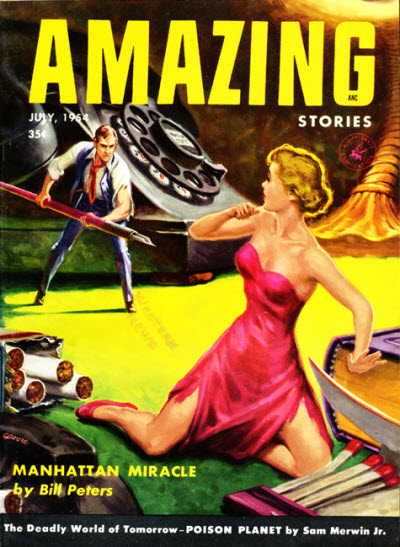
(Cover by Clarence Doore. Amazing Stories, July 1954.) Who Goes There?
Philip K. Dick is one of the most important SF authors to ever live, and this is despite dying at 53 with a string of failed marriages and financial hardship left behind him. He was the first genre SF writer to get a Library of America volume, preserving some of his novels with fancy hardcover editions. The Philip K. Dick Award, given annually to the best SF novel first published in paperback, is still going to this day. Stanislaw Lem considered Dick to be the only American SF writer at the time (we’re talking the ’60s and ’70s) worth taking seriously. Whereas most authors would see their reputations taken a dent or two in light of certain transgressions, with Dick his mental illness and bad habits (namely his misogynistic streak and toxic behavior with friends, especially later in his life) are part of the “charm” for Dick fans. Indeed the fact that Dick was a hot mess is the name of the game. But before he became one of the most acclaimed novelists in the field he was one of the most acclaimed (and prolific) short story writers. 121 short stories and novellas, about half of which were written over the span of just a few years. “Breakfast at Twilight” is a Cold War parable, and one of the most solid (he wrote several) that Dick wrote.
Placing Coordinates
First published in the July 1954 issue of Amazing Stories. It was then reprinted in the November 1966 issue of Fantastic. For anthology appearances we have Amazing Science Fiction Anthology: The Wild Years 1946-1955 (ed. Martin H. Greenberg). As for Dick collections there are almost too many to count, but the big one is Second Variety, also titled We Can Remember It for You Wholesale and Other Classic Stories, which is the second in the book series collecting Dick’s short fiction.
Enhancing Image
The McLeans are a normal family who live just outside the city. Tim is an accountant, his wife Mary keeps house, and then there are their three kids, those being their son Earl, along with two daughters whose names are not important enough. One fine morning they’re having breakfast and the kids head off to school, only to discover there’s no school to go to—indeed there doesn’t seem to be anyone around for miles. The sky has also gone dark and the air is thick with a mix of fog and ash. Looks like the McLeans aren’t going anywhere after all, and this ends up being doubly the case when a group of soldiers come knocking at their door. The soldiers, unsure of how a house has remained in this landscape intact, accuse the McLeans of being “geeps” in disguise at first, which is to say Soviet infantry. The Cold War has apparently gone hot, with the Soviets having effectively invaded the US via a mix of “geeps” and “roms,” the latter being “robot operated missiles,” what basically amount to armed drones. The captain of the troops considers burning the whole place down with the McLeans inside, given that they don’t have their papers or their masks; but at the same time the whole situation is so inexplicable that the captain decides to call in a “polic” (a political commissioner) to investigate. The McLeans find that their house has somehow been launched seven years into the future, to the year 1980, three years after the Cold War escalated.
(By the way, the introductory blurb in the story’s original appearance is inaccurate, as it says “a hundred years” into the future. This is way off, which makes me think Dick didn’t write it.)
“Breakfast at Twilight” is a nicely self-contained little piece that honestly reads like it could’ve worked just as well for radio or a half-episode TV episode; that it has apparently never been adapted to another medium is a little perplexing. We get one location plus a small group of characters: the McLeans, the soldiers, and then Douglas the political commissioner. Very Twilight Zone vibes with this one, although it was published five years before that series. Dick’s beige prose style works in his favor, as we waste no time in establishing the premise and what’s at stake, and while most of the dialogue is expositional, it’s a lot to digest in only about a dozen pages. Given that Dick wrote quite a few stories about how the Cold War might escalate, he was kind of a pro at this sort of thing; but whereas “Second Variety” and “The Defenders” are from military points of voice, and “The Minority Report” uses policing as an allegory for the Cold War, “Breakfast at Twilight” is more about how civilians might cope with an American that has been all but torn asunder by bombs and boots on the ground. The future that the McLeans see is not that far from where they once were, and understandably they’re horrified not only by the physical destruction of the environment, but the US sliding into fascism in the name of combatting Soviet communism. Dick’s politics were honestly all over the place, but one thing he remained consistent on was being against McCarthyism and general alarmism when it came to the Soviets. The US of the near-future is not only in shambles but has devolved into a fiercely anti-intellectual and utilitarian culture, in which even certain books have been burned publicly (Douglas suggests Tim ditch the Dostoevsky in his library).
The creepiest part is that we have no clue who is even winning in this war, with the implication that whoever comes out on top will have experienced a pyrrhic victory. Earl, who’s depicted as being the most pro-war of the family (that the rash and naive son would be the most enthusiastic is, of course, a dig at ’50s jingoism), asks the soldiers more than once who is winning in this war, and nobody answers him. It’s a big thing that goes unsaid, and while Dick is not the most subtle of writers, he’s capable of some really insightful moments that cut with a trained surgeon’s precision. Now, we get an explanation for how the McLeans’ house got sent forward (or is it backward?) in time, having to do with radio and nuclear radiation, but it’s a nonsensical “sci-fi” thing that’s only there because it has to be. Dick was not a “hard” SF writer in that he was not concerned with the mechanics, or rather he saw the semblance of mechanics as a means to an end. I would take more issue with the SFnal conceit here being more or less arbitrary if the results weren’t worth it. The dilemma the McLeans then face is whether to go with the soldiers and basically become slave labor for a fascist shithole, but at leasr being safe in the short term, or remaining in the house in the slim hope that it might shuffle back to its original point in time before the Soviets are due to bomb the joint tonight. So you’ve got a bad situation vs. possibly an even worse situation, but the McLeans decide to stay.
There Be Spoilers Here
Tim gathers the family in the basement and the family makes it out by the skin of their teeth, with the house being sent back in time spontaneously just like they’d hoped. This in itself is predictable, because like, either their plan was gonna work or it wasn’t. What happens once Tim and his family emerge from the wreckage of their home (everything above the basement had gotten blasted to shit), is however quite different, and also haunting. See, the problem is that while the family narrowly avoided getting bombed, the war that they suddenly found themselves in is still happening in the future; not only that, but the war has already started. It began years ago, only soon it’s gonna go hot. The war is already happening. We then get a kind of internal monologue from Tim, who may as well be Dick’s mouthpiece in this instance, and it’s a good one:
It’s war. Total war. And not just war for me. For my family. For just my house.
It’s for your house, too. Your house and my house and all the houses. Here and in the next block, in the next town, the next state and country and continent. The whole world, like this. Shambles and ruins. Fog and dank weeds growing in the rusting slag. War for all of us. For everybody crowding down into the basement, white-faced, frightened, somehow sensing something terrible.
It’s an ending that’s not as much of a downer as what happens in “Second Variety,” but it’s no less fatalistic. Imagine living in 2018 and suddenly getting sent to 2025, and having to catch up on… more than a few things. Then you’re sent back to 2018. What would you do? Can you do anything to ease the sense of oncoming horror? On paper it’s a standard ending for this type of story, but it’s elevated by Dick’s unique intensity of paranoia, which captures the borderline apocalyptic feeling people were experiencing in the ’50s and at other points.
A Step Farther Out
Dick wrote quite a few short stories that are gimmicky and/or forgettable, but “Breakfast at Twilight” is not one of those. This is a taut and serious-minded story about a future that was quite possible at the time, and even if the Cold War never escalated to a certain point like Dick feared, it’s a paranoia that speaks to any age in which the government and ruling class could screw everyone over at any moment. We are unfortunately being forced to live in “interesting times.” This is also an effective companion piece to “Second Variety,” arguably more so than with “The Defenders,” which Dick had more explicitly written in tandem with that story. Dick’s stories (same goes for his novels) tend to riff on the same basic ideas over and over, so that they can often be compared with each other.
See you next time.
-
Things Beyond: June 2025
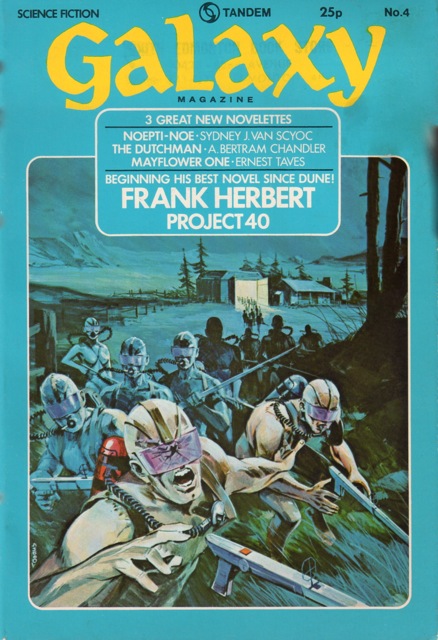
(Cover by Gerald Wood. Galaxy, Nov-Dec 1972.) Not much to say this month, except of course it is the start of Pride Month. For me Pride Month is every month of the year, so I don’t put that much significance in it; maybe I would if I went out more, attended some events in my city, which I should probably do. I’m only now realizing, as I’m finishing up this forecast post, that I could’ve also given more space to authors I know to be queer, but oh well. I focus more on old-timey SF (What even counts as “old-timey” at this point, like pre-2000?), and unfortunately there aren’t many confirmed-queer authors from before maybe the ’70s. You’ve got Frank M. Robinson, who was gay. Ditto for Samuel R. Delany. I’ve heard from a respectable source that Theodore Sturgeon was bisexual, but I’ve yet to dig into this and find actual evidence of it. Marion Zimmer Bradley was queer, but she was also a heinous sex criminal so I’m not sure about counting that. Joanna Russ was a lesbian, although I forget when she came out. You can see what my problem is there.
More so I thought about using this month to inject a bit more variety into my reviewing plate, so that it’s not all science fiction. Obviously I have to finish the Zelazny serial, which I’m liking quite a bit so far, but I also got the itch to tackle some sword-and-sorcery fantasy that isn’t Fritz Leiber or Robert E. Howard. Fuck it, John Jakes’s Brak the Barbarian. We’re also finally returning to Brian Aldiss’s Hothouse “series” with the third entry, this “series” being very much science-fantasy rather than straight SF. We’ve got a ’50s Cold War story from Philip K. Dick, who I love, and who in the ’50s seemed preoccupied with the possibility of nuclear annihilation. Relatable. Last but not least I’ve got a cyberpunk novella from Pat Cadigan, who on reflection I think is one of my favorite short fiction writers from the ’80s and ’90s. Then there’s Sonya Dorman, who I know I’ve read a few stories from in passing but I’ve not actively sought her out until now.
Going by decade, we’ve got one story from the 1950s, two from the 1960s, two from the 1970s, and one from the 1990s.
For the serials:
- Doorways in the Sand by Roger Zelazny. Serialized in Analog Science Fiction, June to August 1975. Zelazny is one of the most influential SFF writers of all time, his mark being apparent on the likes of George R. R. Martin and (God help us) Neil Gaiman; and yet despite a couple generations of writers (especially those of fantasy) owing a debt to Zelazny, much of his work remains obscure or simply out of print, including this standalone novel.
- Witch of the Four Winds by John Jakes. Serialized in Fantastic, November to December 1963. Jakes later found mainstream success writing historical fiction, but his early career was defined by SF and especially fantasy. During the sword-and-sorcery revival of the ’60s Jakes came in with his own sword-swinging hero, Brak the Barbarian. This serial got published in book form under the much worse title of Brak the Barbarian Versus the Sorceress.
For the novellas:
- “Fool to Believe” by Pat Cadigan. From the February 1990 issue of Asimov’s Science Fiction. When it comes to naming the architects of cyberpunk the first to come up are William Gibson and Bruce Sterling, but Cadigan was also instrumental in shaping the movement. She had actually made her debut in the late ’70s, but as she did not write her first novel for several years she initially made her name as one of the best short fiction writers in the field.
- “Undergrowth” by Brian W. Aldiss. From the July 1961 issue of The Magazine of Fantasy and Science Fiction. Aldiss started as a brave new talent in the UK before quickly (much faster than most of his peers, it must be said) making a name for himself in the US. “Undergrowth” is the third Hothouse story, out of five, all of which would then form the “novel” Hothouse. Aldiss won a Hugo for these stories collectively, as opposed to the novel version.
For the short stories:
- “Breakfast at Twilight” by Philip K. Dick. From the July 1954 issue of Amazing Stories. In the ’50s, before he turned more to writing novels, Dick was one of the most prolific and awesome short story writers in the field. Not everything he churned out was a hit, but he had a respectably high batting average. Of course it’s very hard for me to be objective with Dick since he’s one of my favorites.
- “Journey” by Sonya Dorman. From the November-December 1972 issue of Galaxy Science Fiction. Dorman was a poet as well as a short story writer who only wrote SF sporadically, and mostly for original anthologies, even appearing in Dangerous Visions. Most of her short fiction has been reprinted rarely or not at all, with “Journey” never appearing in book form as of yet.
Won’t you read with me?
-
Complete Novel Review: Wine of the Dreamers by John D. MacDonald

(Cover artist uncredited. Startling Stories, May 1950.) Who Goes There?
Everyone who makes it big has had to start somewhere, and the same can be said for John D. MacDonald, who became famous for his crime novels, be it standalones like Cape Fear (originally titled The Executioners) or his long-running Travis McGee series, about a detective who lives on a house boat. But before all those novels, MacDonald wrote a fair amount of SF in the late ’40s and early ’50s—a past he did not seem to be ashamed of, considering he also authorized a collection of his short SF in the ’70s, well after he had made it as a crime writer. Wine of the Dreamers would be either MacDonald’s first or second novel, and it’s certainly the first of a few SF novels he wrote. Why he started out with SF before soon moving to crime is unclear, but I would have to guess it has something to do with the bubble that was the market for SF in the few years right before and after 1950. If you’re a young writer looking to cut your teeth, like MacDonald was at the time, you could do much worse than writing SF, even at short lengths, since there was no shortage of outlets that took short SF. Aside from maybe catching a short story or two of his in passing this is the first thing by MacDonald I’ve read, which is not a typical starting point.
Placing Coordinates
First published in the May 1950 issue of Startling Stories. I got a PDF of the book version, and skimming through some sections quickly reveals that the magazine and book versions are rather different, with the former being abridged, although ISFDB and the SF Encyclopedia make no mention of this difference. Aside from an ebook edition the book version has not seen print in a couple decades.
Enhancing Image
I don’t have that much to say about Wine of the Dreamers, so I’ll put down my thoughts in note form and see where that takes us. My thoughts were a bit scattered as I was reading it and unfortunately, now that I’ve technically finished reading it and the dust has settled, I’m still struggling to process fully what MacDonald did here.
- The premise is simple enough, although it’s given a smokescreen of complexity by virtue of there being two sets of protagonists for the price of one. Firstly we have Dr. Bard Lane and the psychologist Sharan Inly on Earth, in a quasi-dystopian near future where the space race (which mind you we were only starting to see the first glimmers of in 1950) is still a matter of national concern. Sensational news media dominates print and radio, with horrors like murder, theft, and scandal seemingly around every corner. Gambling has also become more of a concern, which is prescient on MacDonald’s part considering we in the year 2025 have a huge gambling problem—albeit more in the form of sports betting and video game micro-transactions than casinos. Divorce is also on the rise, because of course it is.
- MacDonald has things to say about what were then society’s ills, or rather middle-class white America’s ills, without actually taking much of a political position. Like I couldn’t tell you if he was a Republican or Democrat at the time, although given this was before the late ’60s switching of the parties it wouldn’t have been much help anyway. In fairness to him, America really was in a liminal point in its cultural development: World War II had recently ended, leaving the US and Russia as the only really functioning international powers as far as Europe was concerned. The Allies had partitioned Germany, and even split Berlin in two, which itself turned out to be a humanitarian crisis. When MacDonald wrote Wine of the Dreamers circa 1949 it also would’ve been before the Korean War. TV was also only just starting to become commercially viable. If the scenes set on Earth do a good job at anything it’s capturing the uncertainty and paranoia of the immediate post-war years, without much room for so-called prosperity. It’s an America not too unlike ours.
- The secondary plot follows the titular dreamers, or the Watchers as they’re called, a small and closed-off society of humanity in the stars that can barely be considered a society, being on its last legs and so decadent. Raul Kinson and his sister Leesa are young and rebellious members of a culture that has long since given up on progress and excellence, with the Watchers spending much of their time in dream machines, where they imagine themselves as other intelligent beings on other planets—one of these planets being Earth. Of course, the problem is that the “dreams” the Watchers have are not dreams at all, but rather the Watchers telepathically take over the minds of unwilling and unsuspecting hosts, only the Watchers don’t know this. The novel’s central dilemma is what might happen to such a society if it became aware of the evils it casually indulges. Philip K. Dick could’ve done a mean job with such a premise, but MacDonald is a very different writer from Dick and so isn’t as interested in the philosophical or religious implications of the dream machines. MacDonald illustrates the loneliness and creepiness of the Watchers’ society well, but he doesn’t go far enough for my liking.
- So, the big thing that dates this novel, aside from it being very post-WWII, is the fixation with mental illness, or more specifically a neurotypical person’s conception of mental illness. This is gonna sound like it was done in bad taste, but the idea (I’m not kidding) is that the reason there have been so many freak incidents throughout modern history, with people seemingly going postal at random or being “possessed by devils,” is because of the Watchers abusing their powers and having way too much fun with the bodies they possess. Obviously we know this to not be true, and MacDonald would’ve known as well, but that didn’t stop him from coming up with a nonsense SFnal explanation for severe mental illness that shifts the blame away from capitalist society’s consistent demonizing of those with mental illness and puts it on a made-up outside force. As someone with a history of depression, this is hard for me to take. In the years immediately following the end of WWII there was evidently a resurgence of interest in psychology in middle-class America, and how people with mental aberrations might be treated. Wine of the Dreamers sees MacDonald hopping on that bandwagon.
- Of the two plots, which get more or less the same amount of attention, the one focusing on the Watchers is easily superior. This might be because I’m indifferent to the Earth plot involving a rocket launch that goes horribly wrong (because I’ve become increasingly indifferent to space flight and the prospect of colonizing other worlds), but I’m more interested in fictionalized societies that say something about our own, by way of allegory. From what little MacDonald had to say about this novel we know he intended it to have symbolic meaning. The Watchers are humans who have been away from Earth for thousands of years, and the culture they’ve built up has been mostly forgotten and degraded to the point where they’re basically a dying race. As MacDonald says, “when original purposes are forgotten, the uses of ritual can be destructive.” The dream machines were not meant for sadistic fun, but as a teaching mechanism for the isolated Watchers. It’s a shame then that at least in the magazine version we only get the bare-bones version of this conflict. I will say, at least as an advertisement for the book version (although that didn’t come out until a year later), the magazine version of Wine of the Dreamers does its job.
There Be Spoilers Here
Of course all’s well that ends well, although it was indeed the ending of the magazine version that made me raise an eyebrow and wonder if there was more to the story. Turns out I was right. There’s a kind of romantic square going on between our four main characters, with Raul and Leesa taking over Lane and Inly’s bodies respectively, with Raul falling for Inly and Leesa falling for Lane. This hint of romance is only that: a hint. (By the way, something we learn about the dream machines is that the “dreamer” can only occupy the mind of a host who’s of the same sex, which makes you wonder what would happen if a cisgender Watcher took over a trans person’s body. Just food for thought.) In the magazine version we’re told, as really an afterthought of an epilogue, that Our Heroes™ will be having a double wedding, which is incredible considering they haven’t known each other that long. Skimming through the book version this epilogue at least feels less thrown-together, since it gets a whole chapter to itself as opposed to a couple paragraphs. Either way the ending is weak, smacking of either MacDonald not knowing how else to end his story or of editorial interference that would not have been unusual for the time.
A Step Farther Out
It’s competent, although somehow I felt like I was only getting part of the picture with it. It could be that the book version, being longer, is the better experience, but that’s a question to ask the three living people who have read the book version of Wine of the Dreamers. What’s funny is that looking up reviews on Goodreads, at least one major review implied to have read the magazine version, which is considerably shorter. Had I known about the difference in advance I might not have chosen this novel for review. I’m not sure if MacDonald had written the magazine version first and then expanded it or what have you, since despite being a popular writer in mystery/crime circles we actually don’t have much in terms of interviews and essays from MacDonald; he was not that much of a public figure. At some point I’ll tackle his short SF, which might be more indicative of his talent. If you’re gonna read Wine of the Dreamers then I suggest seeking out the book version, although it’s very out of print.
See you next time.
-
Serial Review: Doorways in the Sand by Roger Zelazny (Part 1/3)

(Cover by John Schoenherr. Analog, June 1975.) Who Goes There?
His star power isn’t what it used to be, although a TV adaptation of the Amber series might rectify this (because greedy executives are still looking for the next Games of Thrones), but back in the ’60s and ’70s Roger Zelazny was one of the big names in SFF. Like Ursula K. Le Guin and Fritz Leiber he was a big deal in both science fiction and fantasy, with his debut novel This Immortal (also titled …And Call Me Conrad) tying with Dune for the Hugo that year. This Immortal is ostensibly science fiction, but borrows heavily from Greek mythology so as to give it the impression of fantasy. This is a tactic Zelazny would use elsewhere, including Lord of Light (another Hugo win) and Creatures of Light and Darkness. Zelazny did not think himself part of the New Wave, but did run with those people often enough that he not only appeared in Dangerous Visions but Creatures of Light and Darkness only saw publication when it did at Samuel R. Delany’s recommendation. (In a kind of hat-tipping gesture Delany would later name one of the sections in his massive novel Dhalgren after Zelazny’s novel.) Zelazny’s career can be basically broken into three stages: the ’60s, the ’70s, and the ’80s. He died in 1995, at the relatively young age of 58. In the ’70s Zelazny focused on his Amber series, but he still had enough time to write several standalone novels, with Doorways in the Sand being one of them. I didn’t even know this novel had gotten a Hugo nomination, probably because The Forever War won that year and nothing else stood a chance.
Placing Coordinates
Serialized in Analog Science Fiction, June to August 1975. It was published in book form the following year by Harper & Row. Until a few years ago it wasn’t in print for a while, but it got new paperback and hardcover editions from a small press that seems to be dedicated to bringing Zelazny’s works back into print. This is a noble gesture, considering that until recently the only way you could get in-print copies of the Amber novels was as one huge unwieldy omnibus volume.
Enhancing Image
Fred Cassidy is charming, intelligent, and also quite lazy: in other words he’s the typical Zelazny protagonist. Fred has done very well as an undergrad, on paper—the problem being that he’s been an undergrad for 13 years. It has something to do with the will his uncle left, which stipulates that Fred’s to be given an allowance until he finishes his undergrad studies, a fact which Fred was all too happy to exploit. Of course, his uncle hasn’t died yet—merely gone into a cold-sleep chamber, which he might not even awake from. The legal situation with the will is rather shaky. Dennis Wexroth, Fred’s academic adviser, is very displeased about the fact that Fred’s been coasting on his semi-dead uncle’s inheritance, not to mention that Fred’s been using programs that should be left open for “real” undergrads—people about a decade younger than him. To make matters even worse, Fred’s looking for a new roommate, on account of Hal Sidmore, his latest one, leaving to get married, like a responsible adult. (Well, it was considered responsible at the time; nowadays it’s almost unthinkable to get married right out of college.) But wait, there’s more! In their dorm Fred and Hal had a replica of the star-stone, an alien artifact that had been given to mankind as part of a trade deal several years ago. The star-stone will be the McGuffin of this novel, and the reason for that is that the real star-stone seems to have gone missing, posing a big problem for mankind.
When I started reading Zelazny I was an undergrad myself, and I was mostly clueless as to what his influences could’ve been. Nowadays I’m a lot more “cultured” than I was back then, so it now strikes me as obvious that Zelazny must’ve read his fair share of detective fiction—not that of the Arthur Conan Doyle sort, but rather Dashiell Hammett and Raymond Chandler. We’re talking literary noir. Someone (I think it was John W. Campbell) said that SF and detective fiction simply don’t mix, which of course didn’t stop him from serializing The Naked Sun, Isaac Asimov’s classic SF-detective novel. The typical Zelazny protagonist is very much like a hardboiled detective, complete with grimy first-person narration, and Fred is no exception. He even gets the classic detective protagonist treatment: getting the shit beaten out of him. First it’s Paul Byler, who used to be Fred’s geology professor and who comes off as a bit of a mad scientist. Paul beats Fred almost to a pulp and threatens him, thinking he had taken a replica of the star-stone that Paul had kept in his lab. It turns out, however, that Paul’s replica and the one Fred and Hal kept in their dorm are different. Later a couple of goons also beat up Fred, this time over the real star-stone. Via a convoluted fashion it seems that the real star-stone, which the UN was supposed to keep safely locked away, has gone missing. (The UN, as per usual, is unable to accomplish basic tasks.) Had Fred graduated from college years ago like he was supposed to, none of this would be his problem.
Apparently Zelazny had written Doorways in the Sand in a quick burst of energy with little if any revising, which would explain the breakneck pacing, but also the lack of descriptions for places and how people look. If you pointed a gun at my head and asked me what Fred or Hal or Paul looked like, you would have blood on your hands. Anything (barring the snarky aside, which is a Zelazny special anyway) that doesn’t tie into the central mystery did not make it paper, which results in a taut and easy-to-read novel. The book version’s only about 180 pages, which was considered a novel back then but which nowadays is reserved for overpriced Tor Dot Com chapbooks. For better or worse I also get the impression that Zelazny wrote this by the seat of his pants, since he basically strings Fred along for one punishment or strange event after another; one minute we’re in his dorm and the next we’re in the Australian outback. How did we get here? I forget. Speaking of Chandler, Zelazny must’ve taken cues from his method of writing a novel for Doorways in the Sand, which is to say: “When in doubt, have a man with a gun come through the door.” (I’m actually paraphrasing Chandler, not quoting.) Fred, who’s kind of a deadbeat and also irresponsible, would come off as more insufferable elsewhere, but in this novel almost everyone around him is worse. Even Hal is only marginally more functional, given that he has a bad habit of drinking and gambling, and also his newfangled marriage has already hit a rough spot. These people are either dysfunctional or villainous, but that’s the fun of it.
There Be Spoilers Here
The most memorable part of the first installment is the back end, when Fred is on the brink of death and also somehow in the Aussie desert, with a talking wombat and kangaroo for friends. Of course the wombat and kangaroo are aliens in disguise, named Ragma and Charv respectively, although that doesn’t make their first meeting any less strange. Ragma and Charv are alien cops who take Fred off-world for a time in the hopes that he can lead them to the star-stone, but of course he doesn’t know where it is. Zelazny is a fan of talking animals, or at least aliens who take on the form of talking animals. It’s funny, so you can understand why he does it. Once Fred’s back on Earth he chills at Hal’s place (Hal is drunk, naturally), and from there we get a classic detective-fiction cliffhanger. This novel is unusual in how it depicts aliens in that first contact had already been made years ago, but mankind and the coalition of aliens (it’s like the Covenant from Halo, minus the violent religious zealotry) are not exactly on friendly terms with each other. There’s a complicated agreement between the governments that could go south at pretty much any moment. It’s like the Cold War, which was still going in the ’70s but thankfully was not at a tipping point. We’ll see if this turns into a full-on Cold War allegory or if I’m just overthinking things, considering Zelazny doesn’t tend to “get political.”
A Step Farther Out
Doorways in the Sand placed second on the Hugo ballot, but there must’ve been a disparity in votes between it and The Forever War given that the latter is still famous whilst the only people I’ve seen talk about Zelazny’s novel are boomers who will soon shuffle off this mortal coil. It’s a shame, because assuming the quality doesn’t dip this will be the best serial I’ve read in a hot minute. Zelazny himself considered this novel one of his favorites, and I’m starting to understand why. There’s a joyful and kind of zany energy to it, being probably the least serious Zelazny novel I’ve read. You’d have to be a stick in the mud to not have fun here.
See you next time.
-
Short Story Review: “The Bronze Door” by Raymond Chandler
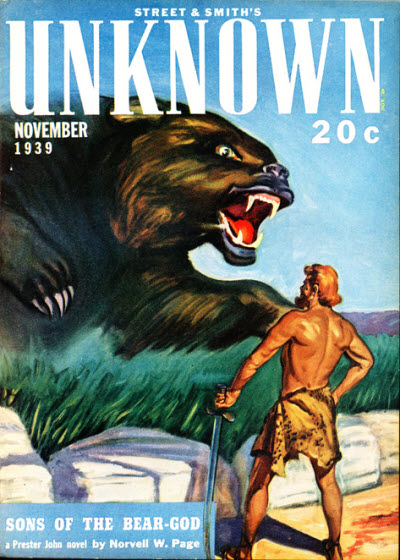
(Cover by Graves Gladney. Unknown, November 1939.) Who Goes There?
Crime fiction was and still is a genre kept in its own ghetto, like SF and fantasy, but as with those other genres it sometimes has broken into the literary mainstream. One of the big success stories of classic crime fiction is Raymond Chandler, who aside from writing some poetry had not tried his hand at writing professionally at all until he was in his forties. (This is a lesson in how if you’re such-and-such an age and wondering if it’s too late to try your hand at writing, don’t worry.) He was born in Chicago but came to be deeply affiliated with LA, which is no surprise given that that nearly all his novels take place in LA and its surroundings. He also spent some of his formative years in England, getting an education there, hence his US-UK dual citizenship. In fact Chandler’s knowledge of England plays into today’s story, which is not a detective story (although there is a detective in it), nor is it set in the US at all, but instead Victorian-era London. “The Bronze Door” is the only Chandler story to be published first in an SFF magazine, and it saw print the same year as The Big Sleep, his debut novel. Chandler had turned fifty by this point. He ended up writing only seven novels plus a rather modest supply of short fiction (he mostly stopped with the latter by around 1940), but it was enough.
Placing Coordinates
First published in the November 1939 issue of Unknown. It has the rare of actually appearing in a genre magazine twice, being reprinted in the October 1953 issue of The Magazine of Fantasy and Science Fiction. You can also find it in the Chandler volume Collected Stories.
Enhancing Image
James Sutton-Cornish is fat and middle-aged, and also given to day drinking, which angers his wife to the point where she can’t take it anymore. Mr. and Mrs. Sutton-Cornish have been living in the estate of the former’s ancestors, which really is the only thing that belongs to him; everything else belongs to the wife, including Teddy, their dog. “The rest was hers. Even the clothes he wore, the money in his bank account. But the house was still his—at least in name.” With their divorce underway, James heads out and goes into a bit of a stupor, and catches a cab—that being a horse-and-buggy, not a car. This strikes him as odd, but not that odd. “The Bronze Door” is presumably set in what was then the present day (the 1930s), and at one point James refers to “the war,” probably meaning World War I. But the cab seems to go back in time, at least to the Edwardian era, so that as James makes his way to Soho he also travels to an older, darker, grimier London. He doesn’t like this very much. He ends up at an auction house, and this is where he comes across the door of the title, which is a pretty weird contraption. It’s a metal door that can be placed anywhere and which opens one way, to—somewhere. Possibly nowhere. The theory we get from James is that the bronze door comes from the Golden Age of Islam, in which a sultan or whoever would use it as a method of hiding inconvenient concubines. (It’s Chandler, so of course sex comes up, but it’s also Unknown so it’s very tame.) James takes the door back home with him. Hilarity ensues.
Not that James was a good person to begin with (actually he and Mrs. Sutton-Cornish were arguably made for each other in that they’re both kinda evil), but “The Bronze Door” sees Our Anti-Hero™ slip into outright villainy by the simple abuse of a magical power. We see what the door does by some criminal who’s on the run going through it and simply vanishing into thin air, and it doesn’t take long for James to get a few ideas as to how the door might be applied to his benefit. Like getting rid of a bitchy ex-wife. There’s a tinge of misogyny here, as well as a homophobic remark that Chandler throws out there out of nowhere. At his home, James has portraits of now-gone family members, with the one sticking out being a general who was apparently an evil piece of shit, and also “fruity-looking” in the attire he wore for his portrait. Of course we’re supposed to infer that this general was depraved and debauched in some way, although in ways that Chandler is not really able to describe; for better or worse the general’s crimes are left up to the imagination. Given that Chandler’s writing can be pretty hardboiled and graphic for the time, I have to wonder if “The Bronze Door” was written as this tame or if it got put through the washer by John W. Campbell and his secretary. In the introduction for the F&SF reprint, the editors say that Chandler had actually written a lot of fantasy fiction over the years, but without the intent of seeing it published. The implication is that there’s this treasure trove of such fiction written by Chandler, but given that Chandler died in 1959 and that literally none of this alleged fiction has turned up, I have to wonder if they were misled, or if perhaps Chandler’s estate had his unpublished work locked away indefinitely. Needless to say this is not as hardboiled as Chandler’s usual stuff, and also given that he turned mostly to writing novels after this point it’s easy to see how he only had one other fantasy story published.
I mentioned earlier that while it’s not really a detective story, “The Bronze Door” does have a detective, in the form of Detective-sergeant Lloyd, who starts out as being on the trail of the criminal James has sent through the door, and who later sniffs around once one too many people in the area go missing without a trace. Lloyd is probably the closest we get in Chandler’s work to his take on Sherlock Holmes, although Lloyd is less a Sherlock parody and more your typical image of a late 19th or early 20th century British detective. (I should also probably mention again that the time period for “The Bronze Door” is rather vague, since it’s implied to take place in what was then the modern day, but there are also hints of a pre-WWI Britain. Chandler doesn’t explain it really, and this might be my biggest quibble with the story.) Generally Chandler could’ve done to explain more of the setting, or rather given us a more vivid picture, but what he does give us is splendid in the moment. Nobody does the simile quite like Chandler. There are descriptions of things here that I’d never even thought of before, let alone seen in writing. Philip Marlowe, the jaded protagonist of all of Chandler’s novels, has a way with words that tells us he’s more cultured than he appears, being a chronically drunk private detective, and Chandler does what he can to translate this prose-poetry to a very different setting with a very different kind of protagonist. If this were a more typical Chandler story then Lloyd would be the viewpoint character, since he’s the closest we get to a hero in this ordeal, but instead for the most part we’re stuck in the shoes of the no-good upper-class bum that is James.
There Be Spoilers Here
After James has gitten rid of the wife, and also her dog, one gets the sense that the walls are closing in on him. He’s “won” in the short term, but now he’s lonelier than ever, firing the few people working at his estate and spending the rest of the story as a cranky loner, sinking deeper into what is clearly insanity. There’s a hint of the gothic about “The Bronze Door,” with both the architecture of James’s estate and the implication that he’s falling prey to a strain of insanity that runs in his family. It’s somewhere between “The Fall of the House of Usher” and “The Rats in the Walls,” although it’s not quite a horror story. Naturally murder (in effect if not the exact result) will out, and eventually Lloyd tracks down James. The two have a bit of a fight, although it doesn’t last long, which makes since given we’re told Lloyd is a lot more physically fit than the decrepit James. The ending as a whole is not surprising, but a neat touch is that Lloyd gets some PTSD from James disappearing into the bronze door, it being a supernatural event that he can never bring himself to explain. It’s something that would freak out anyone outside of The X-Files, even someone as experienced as Lloyd. But hey, he gets a promotion and becomes an inspector by the end, so it’s not all bad. The fact that we never see what becomes of people who go through the bronze door makes it just a bit creepier. I should mention that Chandler, aside from being a raging alcoholic, seemed to have episodes of depression, most severely after his wife died, wherein he actually attempted suicide, so his fiction would be pessimistic.
A Step Farther Out
As you can see, “The Bronze Door” is a little detour in Chandler’s oeuvre, being a fantastic mystery, but not a mystery of the sort that Chandler was used to writing. Then there’s the setting, of which we never see the like again before or after with Chandler. It’s predictable, but also a solid story that’s elevated by Chandler being frankly a better prose stylist than most of the people contributing to Unknown. When you read Chandler you read for the flavor of the words more so than the plot. Not sure how Campbell managed to procure a story from someone who apparently had no experience with fantasy, but it’s a charming and somewhat eerie diversion that sees a master outside of his realm of expertise.
See you next time.
-
Serial Review: The Dream Millennium by James White (Part 3/3)

(Cover by Brian Boyle. Galaxy, December 1973.) The Story So Far
John Devlin used to be a doctor on Earth, but now he’s a passenger aboard a ship in search of a planet fit for human colonization; the voyage is expected to take centuries, probably a thousand years or so. The people aboard this ship spend 99% of their time in cold sleep, experiencing surprisingly vivid dreams that leave them feeling both disturbed and weary when they awake. The ship’s computer handles almost everything, but occasionally it awakes a passenger to do some exercise, recall their dreams, and also handle ship malfunctions if needed. There’s a scare towards the end of the first installment in which some intelligent aliens try to destroy the ship, but Devlin, on being awakened, is able to take control and outmaneuver the aliens, whom we’ll not see again—for now. There’s another malfunction in which one of the other passengers, in trying to see her boyfriend who’s also onboard, doesn’t get back into her chamber correctly and so dies slowly, although thankfully she’s unaware of what’s happening to her. This sad scene shows us Devlin’s past as a medical professional and that he knows a bit more than he lets on, although not enough to know exactly why these vivid dreams are happening. Through lengthy flashbacks we’re introduced to Patricia Morley, who’s a fellow passenger and also Devlin’s love interest. We’re also introduced to Brother Howard, a religious fanatic who only appears in flashbacks but who ends up being kind of a mouthpiece for White’s opinions on human nature, not to mention he has quite a bit to do with Devlin and Patricia’s voyage.
The Earth that Devlin and Patricia came from has gone to shit, which is to say it’s only marginally worse than Earth as it is now. The question driving the whole novel comes down to this: “Is humanity worth saving?” Both Devlin and White have a tug-of-war between genuine pessimism and hope that humanity might be able to move on from its dark past. Over the course of the novel Devlin has dreams of being people and even non-humans from the past, from a sauropod in the Jurassic to a medieval warrior king, to memories of his own life. Every dream somehow involves violence and death, sometimes simply due to circumstance, sometimes because of human malice. To paraphrase Marx, history doesn’t repeat, but it does rhyme. Brother Howard was once an astronaut of sorts, and in flashbacks he tries to prepare Devlin and Patricia for the horrors that await them. One can easily go insane in space. A fellow passenger had at some point gamed the system so that he could walk about outside of his chamber, only to commit suicide, with his eyes taped open.
Enhancing Image
I was worried White would fumble the last installment, or make it so that the more tedious moments of previous installments would be in vain, but thankfully he sticks the landing. I’m not sure how White went about writing The Dream Millennium; it’s possible that aside from a basic outline he wrote by the seat of his pants, which would’ve been far from unusual at the time. I suspect, although I have nothing to back this up with, that White had a beginning and ending in mind, but improvised with the middle portion, hence why there are some stretches here that come off as flabby and perhaps unnecessary. The medieval sequence, which takes up a chunk of the second installment, has some thematic significance, but is too drawn out and without anything to make us invested in the action. There’s a sequence early in the last installment where Devlin dreams that he’s a pilot whose airplane has been taken over by a team of hijackers that’s both more involving, more memorable, and also having more directly to do with the novel’s ideas about humanity’s capacity for violence. White’s fascination with violence, or rather his profound distaste for it, comes up again and again, both in his work generally and also in The Dream Millennium where Devlin and Patricia are constantly haunted by it.
The ship had been future-proofed up to a point, but after centuries (quite literally a millennium by the end of the novel) the cracks in the armor are beginning to show, so to speak. Devlin at one point finds, to a mix of horror and wonderment, just how old and dilapidated the ship has become, despite only maybe a few weeks of subjective time passing for him. In old-timey SF space technology will be new and shiny seemingly forever, but this is not the case in White’s fiction. Also, a few of the human crew have died already and a malfunction with the others’ chambers leaves only Devlin and Patricia awake at the end, in charge of a bunch of people stuck in deep sleep who will no longer be able to sit back while centuries pass by around them. They have to find a habitable planet real soon, more out of necessity than anything; it’s either that or death for all of them. You may also recall that at the end of the first installment Devlin narrowly avoids trouble with some intelligent aliens, who are rather quickly forgotten about; the good news is that this scene was not for nothing after all, since this same alien race, several centuries later in their time, figure back into the plot. It’s a bit of a deus ex machina, with how both the humans and aliens get a happy ending, but White makes it work by virtue of having used time dilation to his advantage. Indeed the ending reminded me a bit of A. E. van Vogt’s “Far Centaurus,” which uses time dilation for similar effect.
Even the flashbacks featuring Brother Howard, which probably take as much time on the page as the A-plot aboard the ship, if not more, lead to a pretty satisfying conclusion. Brother Howard used to be insane (as opposed to how he is now, which is just a bit cooky), on account of PTSD from being an astronaut, but through years of therapy he was able to return somewhat to normalcy. (In the days before manned spaceflight, and even during the height of the Space Race, there was a lot of speculation that astronauts would experience PTSD [although it wasn’t called that at the time] much like how soldiers did. The image of the astronaut-as-soldier was a powerful one, although it’s gone out of fashion in recent decades.) Brother Howard has been testing Devlin and Patricia so that he might recruit them for this extraordinary space voyage—a trip that would take more mental fortitude than most things; of course he finds Devlin and Patricia fit for the job. I’m not sure if it was necessary for Devlin and Patricia to be a romantic item, since the latter basically exists so that Devlin has a flesh-and-blood person to talk to on the ship, but it’s not like she’s a one-dimensional character. Aside from his aversion to violence it seems like White also avoids really bad misogynistic tendencies that some of his contemporaries were guilty of (looking at you, Silverberg). Overall this is a read that I would describe as refreshing, if also B-tier in quality.
A Step Farther Out
I think The Dream Millennium would’ve worked better as a novella, but given that I had read it sporadically over the span of a couple weeks, with digital scans of the magazine issues, it’s possible I won’t feel the same if I had a physical copy of the book version in my hands. White is kind of a unique and yet obscure talent in the context of when he wrote, especially in the ’50s through the ’70s, when casual violence still permeated genre SF and there was much undue optimism about mankind conquering the stars. White’s pacificism speaks to the latest generation of SF writers, even if his style is still on the workmanlike side.
See you next time.
-
Novella Review: “The Other Man” by Theodore Sturgeon

(Cover by Jack Coggins. Galaxy, September 1956.) Who Goes There?
Theodore Sturgeon was one of the great writers of SF and fantasy from the early ’40s until about a decade before his death in 1985, especially at short lengths. He’s also responsible for one of the all-time great Star Trek episodes, “Amok Time,” and was instrumental in building up the lore of the Vulcans. Sturgeon’s Law, also called Sturgeon’s Rule, goes like this: “90% of science fiction is crud, but then 90% of everything is crud.” This is more or less true. Sturgeon also had a pretty good criterion for determining what made for good SF, although he didn’t always follow said criterion: a good SF story should introduce a human problem that can only have an SFnal solution. Conversely you could have an SFnal problem with a human solution. This is not to say Sturgeon’s stories were strictly “problem” stories—far from it. His fantasy stories especially play fast and loose with genre conventions, although today’s story, “The Other Man,” is psychological SF in the sense that it deals with psychology, which is a soft science. Maybe the softest and squishiest science of all. SF focusing on psychology seemed to be all the rage in the ’50s, especially in Galaxy, which Sturgeon wrote consistently for at the time. Between his alcoholism, string of odd jobs, and troubled relationships, Sturgeon’s output came in peaks and valleys; he either wrote a lot or nothing at all. But the ’50s saw Sturgeon in his prime, and while “The Other Man” isn’t top-tier material it does show an ambitious writer who worked tirelessly, if also imperfectly.
Placing Coordinates
First published in the September 1956 issue of Galaxy Science Fiction. It’s been reprinted in SF: The Year’s Greatest Science-Fiction and Fantasy: Second Annual Volume (ed. Judith Merril) and the Sturgeon collections The Worlds of Theodore Sturgeon, The Stars Are the Styx, and And Now the News…
Enhancing Image
Fred (I don’t think we ever get his last name) is a combination of physician and therapist, in a future not so different from what was then the present in which psychology has been made just a bit less soft a science thanks to machinery. Unfortunately the machine in question, the psychostat, will only help him somewhat with his latest case. The problem is that Fred and one Hildy Jarrell (her nickname is Osa, so that’s what I’ll call her from now on) used to be lovers, but broke up five years ago. Now Osa’s married to Richard A. Newell, who’s a real nasty piece of work, and Osa wants Frank to help her current partner, as a kind of favor. This is probably the worst thing Osa could’ve done, having her ex work on her husband’s brain, but there’s a certain logic to it, not to mention that if she hadn’t made this weird choice then we wouldn’t have a story. Much of the conflict has to do with Fred’s own internal troubles, but also there’s the fact that Richard himself is not what you’d call a cooperative patient. Finally, to round out the cast, there’s Fred’s assistant, Ms. Thomas, who basically acts as the voice of reason and whose relationship with Fred is ambiguous. Are they just colleagues, or is there something else going on?
Thus we’re off to the races. The setup is simple and for a novella “The Other Man” goes by pretty quickly, but then it’s only maybe 19,000 words. I have a few issues with The Collection Short Fiction of Theodore Sturgeon, of which And Now the News… is a part, namely its mediocre proofreading and the occasional flub on series editor Paul Williams’s part, but Williams’s note on “The Other Man” is quite useful and enlightening. This novella could be considered a collaboration between Sturgeon and Robert Heinlein, in which the latter basically provided the premise for it while Sturgeon did the actual writing. This came about through a series of letters, and it’s interesting to read about if only because Sturgeon and Heinlein are quite different, in their personalities, politics, although not their work ethic, both being imaginative but also having often to be coaxed into getting the writing done. (Also, totally a tangent, but I’m a procrastinator who needs to be under at least a bit of pressure in order to write anything. Partly I blame the clinical depression, but even if I wasn’t often in a depressive episode I would still be prone to waiting until the last minute.) It’s also worth mentioning that for someone who at least publicly had the reputation of deriding psychology (there’s a memorable passage in Time Enough for Love in which Lazarus Long, one of Heinlein’s escapist characters, considers psychology to not be a real science), Heinlein still seemed to read a fair bit on it. Then there’s Sturgeon, who was interested in psychology but also its alternatives, to the point where he was apparently sympathetic to Dianetics in the ’50s (this was unfortunately not unusual among SF writers at the time). So “The Other Man” shows a meeting of the minds—one within the story, but it also shows such a meeting between two of the field’s great writers.
The problem with Richard, aside from being a gaping asshole, is that he has what used to be called multiple personality disorder (MPD), now called dissociative identity disorder (DID). The former was still the clinical term when Sturgeon wrote “The Other Man,” and as such his depiction of this mental disorder is rather out of date, although surprisingly (except for Sturgeon it’s unsurprising) Richard is not demonized for his mental illness. He has issues, is combative with Fred, and his relationship with Osa is on the skids, but this would probably be the case even if he didn’t have a separate identity that occasionally fronted—that separate identity being Anson. (It’s worth mentioning here that Sturgeon named Anson after Heinlein’s middle name, as a kind of tip of the hat.) Anson is “cherubic,” as I think Thomas describes him, but he’s also mentally challenged (that’s not the term Sturgeon uses, just be aware) so that despite being a grown man in personality he’s written as having the temper and vocabulary of a confused child. Fred’s able to make Anson front thanks to the psychostat, the idea being that the machine, using cycles, can break down parts of someone’s personality before putting it back together; in the case of there being more than one personality in a single body this proves to be a bit of a challenge. Fred is thus stuck with a dilemma, since medically he should eradicate Anson and in so doing “cure” Richard, but he’s also tempted to eradicate Richard’s personality and allow Anson to take over. Because this is basically a medical drama there has to be some kind of ethical dilemma.
Sturgeon combines SF technology with treatment of mental illness to explore the mystery of human nature, which both then and now is something that’s hard to parse. We know now that DID tends to be a response to severe trauma, so that a person’s identity has become fractured, but we’re not really sure why Richard is like this. The point that both Sturgeon and Fred are more concerned with is the duality of Richard and Anson as personalities, being like Siamese twins and so conjoined, but literally in the same body as opposed to sharing some skin or organs. The “other man” of the title is at least a double entendre since it could refer to Richard as “the other man” that Osa’s seeing, but also Anson is the “the other man” in Richard’s body. In Sturgeon’s world, people contain multitudes, whether they suffer from mental aberrations or not; his characters are some of the most complex and internally conflicted in old-timey SF. Fred himself is conflicted on what to do, since he’s trying to figure out what’s best for Richard, what’s best for Osa, and then finally what’s best for himself. Modern readers will be quick to notice that Fred is almost laughably unprofessional, to the point where it might strain one’s suspension of disbelief; as for me I have to admit I also found it a bit distracting, but then I also didn’t expect this story to be so insular and on such a small scale. We’re stuck with four (well, five if we count Anson) characters in what may as well be a single room, so that despite being a novella the action feels cramped.
There Be Spoilers Here
Fred and Thompson go through some options as to what might be done about Richard-Anson, with one being to have the two personalities work in shifts. This might not be a coincidence, since I’m 99% sure Sturgeon had read Wyman Guin’s “Beyond Bedlam” when that appeared in Galaxy five years earlier, but that might also just be serendipity. Mind you that aside from tackling 1950s ideas of mental illness, “Beyond Bedlam” and “The Other Man” don’t have much in common, with the former being about what might happen if a certain mental disorder were to become the new norm on a societal level, whereas the latter is far more inward-looking. Sturgeon preceded the New Wave by a couple decades, but “The Other Man” very much anticipates the New Wave’s preoccupation with “inner space,” in that it’s more concerned with human psychology than technology. Anyway, the solution ends up being that with the help of the psychostat Fred is able to merge Richard and Anson into one personality, a kind of mixing of the two so that Richard-Anson becomes a single identity, presumably with each man’s memories intact. It’s really a compromise, because otherwise one of them would have to go. At the end we’re treated to a thank-you letter from Osa, which if I was Fred I wouldn’t know how to feel about, given that she’s my ex and she’s fucking this guy I don’t like. At least it’s implied at the very end that Fred and Thomas’s strictly professional relationship is about to take a friendlier turn, so, all’s well that ends well? It’s a bittersweet ending, although it leans more on the sweetness.
A Step Farther Out
I’m constantly itching to cover more Sturgeon, although there are so many authors to choose from and life is short. This is because, depending on the time period, Sturgeon did write a lot and most of his work appeared in magazines, but also he’s such a multifaceted writer. There is no single Sturgeon story that sums up all his virtues, or which acts as a perfect gateway to his larger body of work. I could write about Sturgeon until I fucking die, and yet as far as I can tell we don’t have a proper book-length biography of him. This is terrible. “The Other Man” is B-tier Sturgeon, which means it’s still better than most SF from the ’50s.
See you next time.
-
Subscribe
Subscribed
Already have a WordPress.com account? Log in now.
 Science Fiction & Fantasy Remembrance