-
The Observatory: Canonical Today, Forgotten Tomorrow
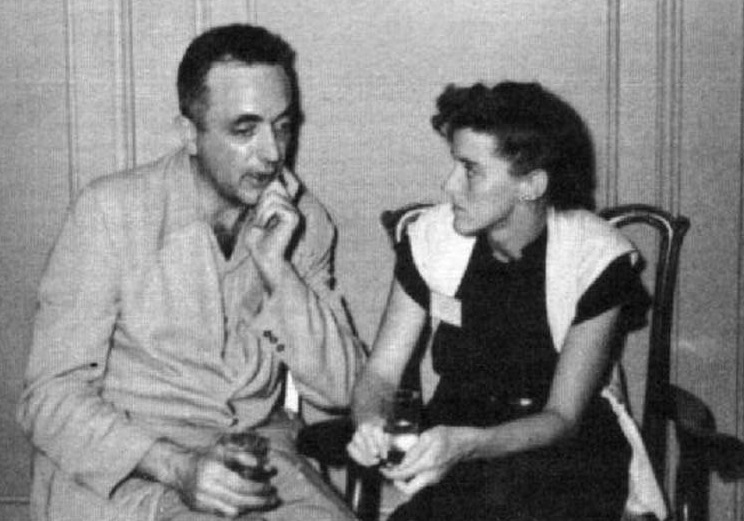
(Fritz Leiber and Katherine MacLean at the 1952 Worldcon.) When you read and review old science fiction as a hobby, at some point you have to ask a certain question: “How come so many of these authors from fifty to a hundred years ago, who if fan letters are to be believed were seen as giants in their day, are obscure now?” This inevitably leads to some really boring follow-up questions, such as “What belongs in the science fiction literary canon?” and “Can there even exist such a canon in the first place?” These are boring questions in themselves, if only because they’re so old that the questions have crow’s feet and grey hairs, but they do at least imply something about SF literature that is arguably unique to it, which is that, far more than with fantasy or horror, the SF “canon” is fluid. There are exceptions, but even these exceptions (which I’ll get into) are far from immune to criticism, especially from younger fans, to the point where even the most rock-solid canonical author’s reputation could erode to the point where they’re, at best, considered something of a sore subject. We actually see this happening with Robert Heinlein and Isaac Asimov in real time, and I think it’s only a matter of time before Arthur C. Clarke’s reputation takes a serious hit—more for what seem to be a few skeletons in his closet than the importance of his writing. The reality is that the people (well, usually men) most influential in the development of SF as its own genre are only human, which is a diplomatic way of saying that these people have issues. That SF fandom has been, in all honesty, more proactive in recent years about how it should deal with canonical works and authors than some others is a testament to the fandom’s—and by extension the genre’s—ability to adapt to changing circumstances.
Of the genres that involve fantastic or supernatural events, SF is the youngest, the most rebellious, and the most likely to question its own masters. Unlike fantasy and especially horror, which are (in my opinion) implicitly conservative genres in that they’re prone to defending the status quo against all sorts of change (the oldest fear, as Lovecraft puts it, is fear of the unknown), SF at least ideally wants the status quo to be shaken and even shattered. There’s a reason why most notable works of dystopian and utopian fiction are SF and not fantasy: they look on the status quo that is our world and cast either a hopeful or pessimistic light, or in the case of something like Ursula K. Le Guin’s The Dispossessed, a cautiously optimistic light. The single most famous work of fantasy (at least of the 20th century), The Lord of the Rings, is ultimately a story wherein the good guys bring back the status quo as much as they’re able to; it’s a story about a “rightful” monarch returning to the throne that he very obviously “deserves.” Yet perhaps its closest SFnal equivalent, the Dune series, shows the other side of the coin, wherein a young ruler-to-be fulfills a prophecy and the results are catastrophic. Frank Herbert had his own issues, namely his homophobia, but his staunch ambivalence towards authority figures clashes with Tolkien’s belief that there’s a “correct” ruler and that the status quo is something worth fighting for. SF, at its core, is about rejecting authority, which makes the considerable swath of conservative SF fans a bit perplexing. It might be more accurate to say SF is all about changes, whether they be for good or ill. In horror especially, though I love that genre dearly, pretty much any change that comes the protagonist’s way is to be taken as a threat; but for SF this is not so. The question is, then, what do you do with a genre that’s always changing? Or rather, what do you do with its relics?
When E. E. “Doc” Smith made his debut in 1928 with The Skylark of Space, it changed what was possible, for nobody had ever seen a spacefaring adventure of this scale before. “Space opera” was not even in our lexicon yet. There’d been stories about traveling beyond Earth, for example going to Earth’s moon, but there wasn’t anything in SF up to that point that was on the same scale of what Smith was doing. Soon what seemed like a one-off thing at first became a series, and then came the Lensman series, and then the rest was history—up to a point. From the tail end of the ’20s to his death in 1965, Smith was immensely popular with SF fandom; and yet he remained totally unknown outside of that ultimately small pocket of readers. When Smith died, the wind did not change direction, nor did the sun shine any less bright, nor did the seas wax and wane any differently. There used to be people who loved reading E. E. Smith, but they’re all dead now. His work stands now as a bunch of museum pieces, I would say for the simple reason that he was not a good writer; he was innovative, but that’s not the same thing as being good, although we have a bad habit of thinking a work of art must be good to also be innovative. When Alexei and Cory Panshin wrote The World Beyond the Hill: Science Fiction and the Quest for Transcendence, a big Hugo-winning book that took over a decade for them to write, they felt the need to defend Smith, for fear that his reputation was going down the shitter, which it was. The World Beyond the Hill came out in 1989, and since then the SF world has very much moved beyond Smith. This is a case where someone was treated as canonical by the end of their life, only to gather dust and at times derision for decades afterward, for the straightforward reason that the author’s work does not hold up to modern scrutiny. Time has been unkind to E. E. Smith and some others of his ilk.
So someone loses their canonical status because they’re simply not that good a writer. It happens. But then what happens when you have someone who by all rights should retain that canonical status, yet who nowadays is somewhat and unjustifiably forgotten? There are too many examples of such a phenomenon to list. I said before that SF is prone to questioning its masters, as well as doing a good job of tossing aside work that no longer rings as good or true; yet SF is equally prone to forgetting its best. One of the most glaring examples of this has to be Fritz Leiber, whose fantasy work is still in print, albeit not that easy to find, but whose SF has been relegated to the museum. I’ve written about Leiber enough here already so that I don’t wanna repeat myself too much, but it’s hard to overstate, from the late ’30s until close to his death in 1992, how game-changing Leiber was. Not only was he an innovator in heroic fantasy, his Fafhrd and Gray Mouser series even getting parodied in Terry Pratchett’s Discworld series, but he was one of the finest wordsmiths of his generation when it came to SF, fantasy, and horror. Indeed he’s one of the few authors who handled all three genres with more or less equal craftsmanship. He won multiple Hugos, both during his life and also one or two Retro Hugos, and he’s also one of the few people to be a Guest of Honor at Worldcon more than once, in 1951 and again in 1979. Yet nowadays you’d be hard-pressed to find Leiber’s books, even at your local used bookstore, with many of his books straight-up being out of print. If Amazon and Goodreads numbers are anything to go by (and admittedly you should take a pinch of salt with those sources), barely anyone today reads Leiber. This is rather hard to justify. Mind you that the man was not perfect, between his alcoholism and at times messy relationships, and the fact that not everything he wrote was good (The Wanderer is enough proof of that); but surely he deserves better than this.
Sometimes an author falling into obscurity has nothing to do with the quality of their work or the moral fiber of their character; actually if anything we’ve learned that you can be a real piece of shit as a human being and millions of people will still read your books. (We really have to confront people more aggressively on why they feel justified supporting J. K. Rowling in any way.) It seems to me that losing canonical status has at least as much to do with bad timing, or circumstances beyond the author’s control, as it does with the author’s own actions. It could also have to do with the fact that SF fandom today is almost unimaginably larger and more varied in its makeup than even a few decades ago. Being hot shit among SF readers in 1980 does not carry the same weight as being hot shit among SF readers in 2025, because now there are so many more people from different backgrounds who read SF regularly. Fans tolerated or didn’t even know about Asimov’s harassing of female authors and fans when he was alive, but rest assured he would not be able to get away with such foolishness today. This is a good thing, mind you. We’re doing a much better job of holding each other accountable now than before. This then presents another problem, though. How do you rescue works and authors who once had canonical status from oblivion? Another problem is, what do we do with authors who nowadays are elder statesmen? Will someone who is considered a big deal today still be remembered in another twenty-to-thirty years? Will we forget about Ted Chiang, or John Scalzi, or Martha Wells? Will there be some invisible executioner with a line of riflemen, ready to take aim and fire? Who gets to be remembered? How much control do you have over your own legacy? One can certainly do a thing or two to demolish your own chances at being remembered (or at least remembered fondly), but securing said reputation might as well be left up to the directions of the wind.
When August Derleth and Donald Wandrei founded Arkham House in 1939, it was for the express purpose of preserving Lovecraft’s works, by way of giving them fancy hardcover editions. Lovecraft had died in 1937, in poverty and as an obscure figure in the grand scheme of American letters, and there was a pretty good chance he would’ve retained that obscurity (at least for a while) if not for Derleth and Wandrei’s efforts. Arkham House soon expanded its scope and brought other authors from the Lovecraft circle into book form, giving them similarly needed facelifts. Now Lovecraft is recognized as one of the most important writers of the 20th century, even getting a Library of America hardcover volume collecting his most essential work, and “Lovecraftian” horror is synonymous with cosmic horror. Yet there are other authors, like Henry S. Whitehead and Frank Belknap Long, whom Derleth and Wandrei had rescued temporarily, only to still languish in obscurity decades later. Someone with resources might come along to dig up your work after you’ve died and give it the “proper” treatment, but that doesn’t necessarily mean you’ll be canonized posthumously. There are too many factors going into one’s own assessment as a writer. I know this is a very “boomer” opinion to have, even though I’m only turning thirty this year, but it seems to me that people around my age who are earnest about SF are, in questioning the supposed masters of yore, too quick to throw the baby out with the bath water. As a fan myself there’s not much I can do about this, but at least I’m trying here.
-
Serial Review: The Dream Millennium by James White (Part 2/3)

(Cover by Jack Gaughan. Galaxy, November 1973.) The Story So Far
John Devlin is one passenger out of many aboard a spaceship, which at the beginning of the novel is already nearly a century into its voyage in search of a planet suitable for human colonization. The trip is expected to take several centuries, possibly even a millennium or more of objective time; as such, the human crew spend about 99% of their time in cold sleep, only to be woken up periodically to be tested by the ship’s computer, or to take care of some malfunction that the computer can’t handle itself. During these periods of cold sleep, in which almost no time at all passes for Devlin while decades slip by outside, he has some pretty vivid dreams, including dreams of deep-sea prehistoric life, being a sauropod in the Jurassic era, and flashbacks to his own life before he got recruited for the voyage. During one of these times where he gets woken up to handle a malfunction, a fellow passenger named Yvonne Caldwell, barely old enough to even be on the ship, is dying in her chamber, having not gotten into its properly before cold sleep took over. Caldwell wanted to see her boyfriend, who’s also on the ship somewhere, and for better or worse she’s unaware that she’s dying pretty horribly. Devlin does his best to comfort her in her last moments before she passes, and this is our first big hint that Devlin was a doctor before he left that life behind and became a passenger here.
We get a rather extensive flashback to Devlin’s life on Earth not too long ago, and apparently life on Earth has gone to shit (well, it’s only marginally worse than what we’re dealing with now). Someone I did not bring up in my review of the first installment, because her subplot did not reel me in enough at the time, was Patricia Morley, whom Devlin got to know in this flashback and who actually is also a passenger on the spaceship. Despite being standoffish in personality and also having a bit of a fucked-up face (from self-harm), Morley is Devlin’s assigned love interest for the novel. She ends up being a more significant character than she appears at first, not least because by the end of the second installment she and Devlin have both gone basically rogue on the ship. There’s also the enigmatic Brother Howard, who only appears in flashbacks and who is ostensibly of a religious order, but he seems to know more than he lets on and there’s a good reason for this. It’s also during these sequences that White’s own background as an aspiring doctor who lived in Ireland during one of the most violent periods in the country’s history is brought to the forefront.
Enhancing Image
I think my big problem with The Dream Millennium is that it’s basically two storylines, each rich enough for maybe a novella but not enough to carry a full novel on its own, that are connected enough, but then there are also scenes that have, at least on a surface level, fuck-all to do with either of the main storylines. Here, in the second installment, there’s a whole sequence (it might’ve gotten two chapters, I forget) in which Devlin dreams of being a warrior prince in medieval times who wins against a neighboring kingdom, only to have a horrible marriage in the aftermath. There’s a marked difference between Devlin’s dreams of what seem to be past lives and his dream-memories of his own life, since the former are given very little context or background. The first few dreams, involving prehistoric life, are fine as written, but unless White has something up his sleeve, the medieval sequence could’ve been cut out without diminishing the two main storylines. It’s frustrating, because this is already not a long novel (paperback editions run a bit over 200 pages), but I feel like there’s some filler here. Indeed, while reading this installment, my heart sank as I went through the medieval section, fearing that it would take up the majority of the installment and that almost nothing would actually get done. Thankfully that wasn’t the case, but it’s a black mark on the reading experience, because even if it ends up being significant later, that doesn’t change that while I was reading it I barely understood what was happening and I found it hard to care about what I was able to understand. That sequence is mostly action, and it must be said that action is not White’s strong suit.
Thankfully this installment does eventually pick up. (This is one of those things where I have to wonder if I’d be as harsh on the novel’s weaker moments if I was reading it, ya know, as a novel and not as a serial. Like remember those aliens that showed up at the end of the last installment? Yeah, they left the story about as quickly as they entered. Weird.) We get yet another lengthy flashback to just before Devlin and Morley are recruited for the voyage, but while there’s much less violence than before, the connection these scenes have with Devlin’s current predicament on the ship is much more apparent. The mystery of who the fuck Brother Howard really is is given some much needed clarity, and the budding relationship between Devlin and Morley is developed enough to justify their teaming-up in the current events. Probably the most haunting scene of this installment is during one of Devlin’s waking periods, when he finds a dead passenger named Thomas Purdy, who apparently had tricked the ship’s computer into thinking he was still in his chamber so he could commit suicide outside of it—his eyes taped open so that he could not sleep. It’s become clear by this point that there’s a huge difference between cold sleep and normal sleep, although Devlin and Morley are still trying figure out how the ship’s systems induce those frighteningly vivid cold-sleep dreams. Devlin and Morley feel weirdly fatigued, both mentally and physically, from these cold-sleep dreams, despite their bodies resting for incredibly long periods of time—or at least time outside of cold sleep. For them, subjectively, only a few days have passed, even though it’s been centuries of objective time. This boils down to the question of whether the ship itself is a simulation, and where the dividing line between dreams and reality is.
I wonder if White maybe took some notes from Philip K. Dick, particularly A Maze of Death, which, without giving away that novel’s big twist, feels thematically akin to The Dream Millennium. White and Dick are both pessimistic about the human condition, although otherwise they don’t have much in common, with White’s sensibilities being decidedly more old-school while Dick was adjacent to the New Wave. But still, while The Dream Millennium could’ve been written a decade earlier, there’s a bleakness here (not to mention a lack of problematic elements) that make it feel more modern than some other SF of the time. You’d think it’d be easy for an SF novel from 1973 to not feel horribly dated, but you’d be surprised—or maybe not, depending on your experience.
A Step Farther Out
I’m gonna hold off final judgment until I’ve actually finished the novel, but so far The Dream Millennium has been a mixed bag. Structurally it’s rather nonlinear, but it also feels like a few disparate story ideas tossed together so that White could get a full novel out of it. Other than A Maze of Death it also reminds me of Piers Anthony’s Macroscope, which it must be said is an unusually good novel by Anthony’s standards. White’s a better writer than Anthony, but even for how short it is The Dream Millennium feels a bit cobbled-together. I’m gonna see (and hope) that White manages to stick the landing with the last installment.
See you next time.
-
Short Story Review: “Loneliness Universe” by Eugenia Triantafyllou
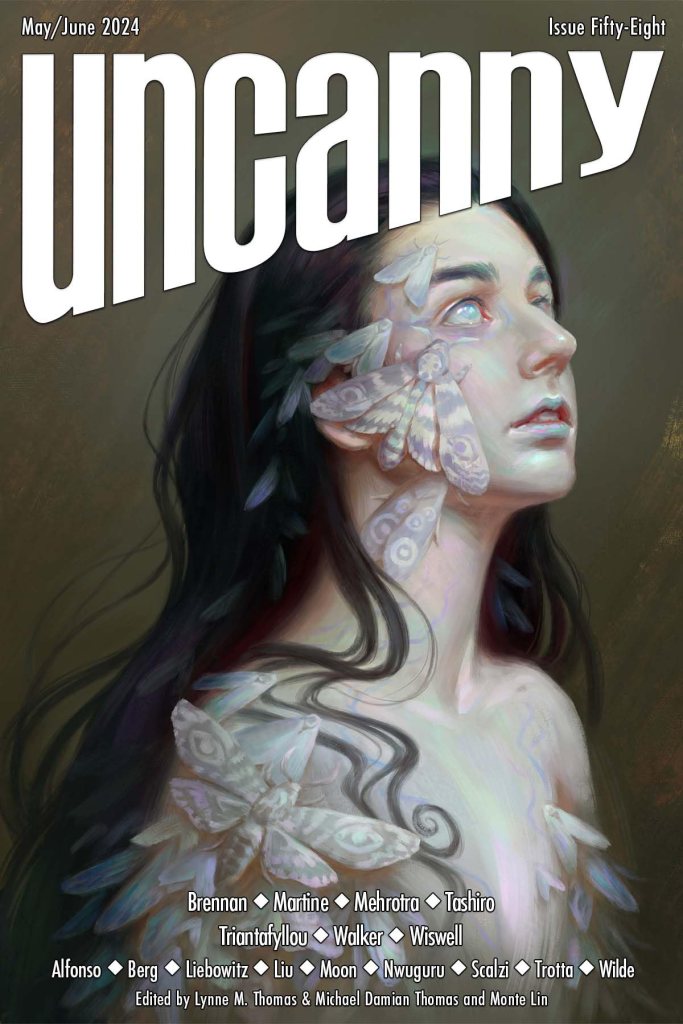
(Cover by Zara Alfonso. Uncanny, May-June 2024.) Who Goes There?
As you probably don’t know, I’m voting in this year’s Hugos, which makes it the second consecutive time I’ve done this. I’ll be brutally honest and say I get the supporting membership for all the free goodies it comes with more so than to take part in the grueling and overcrowded popularity contest that is the Hugos. One major plus, aside from the free stuff and indeed the thing that comes with all that free stuff, is that I’m finally given an excuse to dip my toes in more recent SFF. See, an unspoken rule of my site is that a story has to be at least one year (twelve months) old for me to consider it, since when it comes to literature I prefer to let the art marinate in the broth of time first before getting a taste of it. It’s a weird bias of mine that goes back to when I first started reading casually as a youngling, I can’t really explain it. Eugenia Triantafyllou’s “Loneliness Universe” is a Hugo finalist this year for Best Novelette, and it had already gotten a Nebula nomination. I’d been meaning to read some Triantafyllou for a minute, but have not been able to. I don’t really have an excuse. Triantafyllou is one of the most acclaimed short story writers in the field right now (she has not written a novel, at least as of yet), and like many other authors currently working she’s the sort of talent who probably had a tough go at it a few decades ago. The internet and especially online magazines have made it easier for people from outside the Anglosphere (Triantafyllou is from Greece, as she’ll have you know) to get their foot in the door, and this is very much a good thing. Despite being born and raised in Greece, Triantafyllou has pulled a Joseph Conrad and writes her fiction in English.
Now, I did not know, when I posted my review forecast on the first day of this month, that ON THE SAME DAY James Wallace Harris would post his review of this same story, so that “Loneliness Universe” is getting covered at least twice in the span of two weeks. I can say what drew me to this story, but I can’t say what would draw other people. It’s not perfect (I spotted a malapropism, and also a factual inaccuracy that distracted me), but its basic conceit is compelling enough that I’ve been stuck thinking about it for the past couple days. It’s also only nominally SFnal, really using an SFnal premise as a diving board for allegory rather than investigating a scientific phenomenon. It’s SF of such a mushy softness that it almost feels like fantasy, but this is a human narrative about a uniquely human state of mind that is sadly becoming all more commonplace. Fair warning: I’ll be talking about my autism, bouts of depression, and suicidal ideation with this one, since it’s that kind of story. It’s less that “Loneliness Universe” is exceptionally dark or bleak and more that Triantafyllou does a good job of pinpointing something I’ve been feeling for years now.
Placing Coordinates
First published in the May-June issue of Uncanny Magazine, so it’s just old enough for me to have considered for review. So far it has not been reprinted anywhere, but I’m sure that’ll change soon.
Enhancing Image
We start at the ending, with an email Nefeli sends to her old friend Cara, after the two tried but failed to meet in person, after years of silence between them. Nefeli’s wondering, after the fact, if their attempt at reconnecting would’ve worked out if not for the universe quite literally preventing them from occupying the same space. “But we’ll never know. Because despite what the scientists may say, I believe I broke the universe by coming to find you.” That last part’s probably not true, but Nefeli was patient zero for what turned out to be a world-spanning phenomenon. We’re given a general idea as to how things turned out, but Triantafyllou only gives us the details piece by piece. Some stories are a whodunnit, some are a howdidit, but “Loneliness Universe” is very much a howdidwegethere. In that sense it’s a hard story to spoil since we’re told upfront that shit’s not gonna work out—the question then being how they don’t work out. There is, of course, a big difference between having a very good meal set at your table and seeing the chef and his assistants work on said meal. The process is at least as important as the result. Indeed the process of making art (which includes cooking) is the art. So how did we get here?
Reconnecting with old friends after months or years of nothing is usually awkward, because (often correctly) there’s the sense that the part wanting to reconnect also wants something in return. What is there to say after the relationship had seemingly fizzled and reached its natural conclusion. Usually people just drift apart, or maybe it was an argument that did it. Nefeli and Cara are two old friends in Greece who had drifted apart, under, it must be said, less than ideal circumstances; but now Nefeli sees a chance to rekindle their friendship. The internet was in its toddler stage before (“the pre-internet days were rough”), but since the proliferation of social media the two have reconnected in their twenties (I feel old since they’re a few years younger than me), agreeing to meet up at a spot. What could go wrong? Quite a few things, although what goes wrong is something neither of them could’ve possibly predicted. Each thinks the other has stood her up, but no, they’re at the same place—just not the same version of that place. Like layers of film overlapping when one’s in the editing room. Nefeli and Cara are sitting on the same bench, at the same time, but they’re not occupying the same space. This is a problem. Soon enough it also applies to Nefeli’s brother, Antonis, whom she’s living with. Speaking of which, this story takes place over the course of a few months in 2015, and we know this because the emails Nefeli sends are dated; but otherwise you wouldn’t know it takes place in 2015, not helped by Antonis at one point mentioning he had a PS5, which wouldn’t come out for five more years. I have to assume this was a flub on Triantafyllou’s part.
(Remember 2015? A lot has happened since then. We didn’t worry about wearing masks in public. House of Cards was the biggest show on Netflix. Louis C.K. was a respected comedian. Vine was a thing. Elon Musk was just another “eccentric” rich asshole. The apparatus of neo-liberal capitalist “democracy” in the US was on shaky ground but didn’t look like it would crumble and give way to a kind of blue-collar trade-union-endorsed fascism propped up by technocracy.)
I’m actually not sure what the purpose of making “Loneliness Universe” a sort of period piece was; it could be that setting it in the present would’ve dated it much more severely, especially given that things (by that I mean mostly bad things) seem to be happening at a much faster pace now. Time itself seems to be moving differently. The internet has been changing our perception of time for about the past three decades, only doing more so with Web 3.0 and the more drastic splintering of the web. We know this because possibly the biggest precursor to “Loneliness Universe,” although not necessarily an influence (I don’t know if Triantafyllou has seen it), is the 2001 Japanese horror movie Pulse. Without giving away the third act of that movie, the premise is basically that ghosts are making their way into the world of the living through the internet, which sounds silly on paper, but in execution ends up being quite haunting. The world becomes more devoid of human life, being replaced by these static-filled entities that wander about the landscape, forever separated from every other one of their kind. The ghosts are not happy to be here, nor are they even really malevolent, but they’re isolated. To somewhat paraphrase a line from that movie, “Death is eternal loneliness.” Nefeli is first separated from her old friend, then her brother, then her parents, then everyone close to her in her life—except through the internet. Emails, text messages, an online game called TinyCastle they play together. But she’s unable to interact with these people in-person, and this is only the beginning.
However, being an undiagnosed (it’s hard to blame me, given current circumstances in the US, for not getting diagnosed as an adult) autistic person, I’ve been living with a more mild version of Nefeli’s situation for pretty much my whole life. Indeed, anyone who’s autistic and/or clinically depressed (and I’m both of those) can tell you that they already live day to day with this weird sense of disconnection from other people—a disconnection that’s easier to cope with over text and other online activities, but which becomes unbearable in-person. It must be tempting, if you’re a neurotypical, to see the dysfunction autistics experience as a result of the internet, or some other stupid reason (it’s painfully clear to me that a lot of neurotypicals see autism as some disease that must be cured, or prevented by way of eugenics), but really there’ve been autistic people for centuries. Really the paradox of the internet (that it allows people from different countries and even continents to connect with each other, while also balkanizing the same people into little niche groups and interests) has been fostering a dissonance in the minds of neurotypicals which people with autism have had to deal with since at least the time of Shakespeare. Yeah, you people get mad at us if our tone is even a bit “off” in public spaces, and then you wonder why we retreat into online chat rooms and game lobbies for acceptance. It’s not much of a mystery, ya know. I think what gives “Loneliness Universe” its power, despite my gripes with it, is that it allegorizes something that most people would otherwise have only the faintest idea of, that being the growing entropy someone like me senses every day—the theoretically infinite drifting-apart of time and space.
There Be Spoilers Here
“The scientists” (it’s pretty vague as to what this phenomenon is, not like it needed to be specific) are theorizing that the universe is operating in a wax-wane cycle, so that hopefully, before too long, people will start living on the same dimensional level again. Assuming it happens in the first place. For all Nefeli knows the universe will just get more and more spaced out, until everyone is like the ghosts in Pulse, forever separated from everyone else. We don’t know if things get better; the story ends on a rather open note. But then of course we had already seen the ending. What had started with Nefeli is now happening with everyone else. It doesn’t really make sense if you try to look at it scientifically, but it does make sense on an emotional level, because some of us are already living through this. When I said “Loneliness Universe” is only nominally SF, that’s what I mean; it’s only SF by virtue of not being a “realistic” story and at the same time it’s not a straightforward ghost story, although it kinda is one. It’s a techno-ghost story in which the ghosts are still alive, in that they are the living dead, and so are we by extension. We’re the living dead.
A Step Farther Out
Sorry that this has been bleak. Actually I’m not sorry. I would’ve written my review yesterday, but I was busy “crashing out,” as the current lingo has it. I laid in my bed for nearly an hour resisting the urge to head to the kitchen, take out one of my knives, and harm myself. I felt completely alone in the world, and it was not the first nor will it be the last time I get this feeling. I really hate it here. For what it’s worth, I do recommend “Loneliness Universe,” but it’s a lot. It’s supposed to be a lot. Sometimes we need art that makes us feel like shit.
See you next time.
-
Serial Review: The Dream Millennium by James White (Part 1/3)

(Cover by Brian Boyle. Galaxy, October 1973.) Who Goes There?
In the ’50s and for much of the ’60s the US and UK scenes of science fiction were kept somewhat apart, albeit with some cross-pollination with their authors. Some UK authors appeared in US magazines and vice versa, and one of these authors from the UK to find moderate success in the US was James White. White was one of the few Irish SF writers active at the time, and that perspective ended up being rather novel, even if White himself was only a B-tier writer all said and done. Whereas the standard view at the time was that war was either basically good or bad but “necessary,” White was not so convinced of the virtues of lawful violence. Having been born and raised in Belfast and living through horrific violence between Catholics and Protestants would probably have that effect on a lot of people, but for White especially it had an apparent influence on his writing. It shouldn’t be surprising, then, that White’s fiction tends to be more far more about saving lives than ending them. Interest in medicine (White wanted to become a doctor, but this career path was not to be) also plays a big role, most prominently with his Sector General series, maybe not the first but certainly the popularizer of the space hospital in SF. The Dream Millennium is not about a hospital, at least in an official capacity, although it does have elements of a space hospital.
Placing Coordinates
The Dream Millennium was serialized in Galaxy Science Fiction, October to December 1973. It got a paperback release from Ballantine the following year, seemingly without any significant changes. Unfortunately it’s been out of print since the ’80s.
Enhancing Image
John Devlin is a passenger aboard a ship that’s on its way to a neighboring star system, in search of a planet suitable for human life. The ship is run by computers and the trip can and probably will take centuries. A lot of authors, especially back then, would find some way to cheat and have their faster-than-light travel, but James White was not one of them. The human crew are kept in cold sleep for the vast majority of the trip, being periodically awakened for brief periods to, as the computer says in all caps, “SPEAK, EXERCISE, REMEMBER.” Devlin and the others have one hour during to stretch their legs, basically, although it’s worth noting these passengers are not awakened at the same time. For all intents and purposes Devlin is alone on the ship, with only the computer for company. The “REMEMBER” part of the instructions has to do with remembering dreams, which itself is like a cognition test. The idea is that since the passengers will be in cold sleep for decades at a time, they’ll be dreaming a lot, and when they wake up for their periodic examinations their ability to recall dreams will be taken as a sign. Now, when you sleep normally, specifically during REM sleep, your dreams can at times seem vivid and at the same time feel like they last only a few minutes, while you’re in the midst of REM sleep for at least a few hours. Time works very differently in dreams. It’s not hard to figure out what the novel’s title is supposed to mean.
Devlin is, let’s say an anti-hero. We’re not sure, at first, what his deal is, but he gives the impression of having a dark and troubled past; he’s also not an astronaut or anyone really interested in space, for that matter, but someone who had a different kind of job back on Earth. Apparently there have been efforts to colonize other worlds because Earth itself is in a sorry state. Even calling it colonization is a bit misleading since that implies a more ambitious effort, like the sort of thing technocrats are obsessed with (ya know, the glory of mankind and all that), but this expedition is being done out of necessity. White is a lot of things, but he’s not much of a romantic. Most of the time there’s no life on the ship to speak of, and when there is it’s regimented and short-lived. The best thing that can be said is at least the ship’s computer really does seem to have the passengers’ best interests in mind. But still, the living situation is bleak. Part 1 of this novel is largely concerned with the first few dream cycles Devlin has that he has to recall, which on the one hand will probably turn out to have symbolic and even plot relevance, but also since these are dreams (or in one case, flashbacks) there’s no sense of urgency, nor is there much actual forward momentum with the plot for the time being. Your enjoyment of this novel will hinge partly on how much you get out of New Wave-influenced surreal imagery, mixed with more pessimism with regards to the human condition than the average. This is not to say White is a misanthrope, but… you’ll see.
The Dream Millennium has to do with the evolution of man, not unlike 2001: A Space Odyssey, although it goes about things very differently from that novel/movie. Both are big in scale despite being set primarily on a cramped spaceship, but The Dream Millennium deals with events out of events, not to mention its timespan is much bigger. The first dream cycle Devlin has sees him as a trilobite in an unspeakably prehistoric period, and the second dream cycle sees him as a brontosaurus (big sauropod) during the Jurassic era. These are out-of-body experiences that don’t further the plot much, but they do provide stimulating experiences for Devlin that at the same time tell us a bit about his character. (I think White was also looking for an excuse to include dinosaurs in his space adventure novel, but that’s fine.) Despite being dreams and therefore harmless by nature, Devlin is not free from experiencing death and disease in these dream realms; it’s also ambiguous if these are just dreams or if they’re actually visions of past lives. A couple later events imply they might’ve been actual lived experiences. The most memorable scene in this first installment is right after Devlin’s second dream cycle, when there’s been a malfunction with one of the other sleep chambers a young woman’s lying in her chamber, dying horribly and not even sure what’s happening to her. Devlin tries comforting her and lies doing so (when someone’s on their deathbed you kinda have to lie to them at least a little bit to make them feel better), but the woman makes the odd confession of having had a dream that she was a dinosaur, similar to Devlin’s. This is despite the woman admitting to not having read up on prehistoric life like the computer told her to. She says she misses her boyfriend, and then she dies. It’s a surprisingly grim scene, but it’s also a tone-setter for the rest of the installment, which delves into matters of human misery.
It’s here about halfway through the first installment that we find out Devlin used to be a doctor on Earth, although it seems he’s no longer in that profession. You can take the man out of the profession but not the profession out of the man, though, because even if he’s not officially the ship’s doctor he still has the attitude of being one. It’s almost like White wanted to become a doctor, and that much of his SF reads like it could be made into a hospital drama with some tinkering. Despite working with similar material to 2001, The Dream Millennium operates on a very different worldview, so that you can tell James White and Arthur C. Clarke are very different people. In a way The Dream Millennium so far feels like an anti-2001, in that it focuses on the cramped and unromantic side of space travel, not to mention its view on the possibility of mankind ascending to gods of the universe is—let’s say more skeptical. There’s also much more of a focus on Devlin’s inner life, or what was called “inner space” at the time, that being juxtaposed with the virtual endlessness of outer space.
There Be Spoilers Here
We then get a lengthy series of flashbacks to a bit earlier in Devlin’s life, when he was a doctor, which oscillates between being genuinely harrowing and a bit too disjointed for my liking. The most memorable and harrowing (this is a rather dark book, it must be said) scene comes when Devlin’s trying to treat a dying boy who’s been brought in with a gunshot wound in his chest—a stray bullet, caught from a totally unrelated quarrel. What do you mean White lived through the Troubles? From what we see of Earth in this lengthy section, it’s a shithole, although it’s not much worse than life as we now know it—maybe a little more dystopian. I mean you can’t get much more dystopian than now, right? Another memorable scene is where Devlin, who describes himself as agnostic, gets into a kind of theological/existential argument with one Brother Howard, whom I’m sure we’ll meet again at some point. In the world of The Dream Millennium the question is not whether humanity can become masters of the universe but whether humanity can even save itself from decay and finally extinction. Have I mentioned that this is bleak? And then BAM, aliens are invading. Devlin’s not sure at first if this is really happening or if it’s some kind of trick, but no, highly advanced aliens are looking to overtake the ship. Now doesn’t this feel random? I wonder how Devlin’s gonna get himself out of this jam.
A Step Farther Out
Sorry this got delayed. I don’t really have an excuse, other than that I’ve just been struggling to write anything. Doing most everything has felt like a chore as of late, including reading stuff for my blog and other places. Then there’s the recent business with Worldcon (which YET AGAIN is getting steeped in controversy) and the fact that I’m voting this year (again), so that’s even more reading material. I’m enjoying The Dream Millennium enough so far that I hope I can get the review for the next installment out in a more timely fashion, but I can’t guarantee it.
See you next time.
-
Novella Review: “Yesterday’s Tomorrows” by Kate Wilhelm
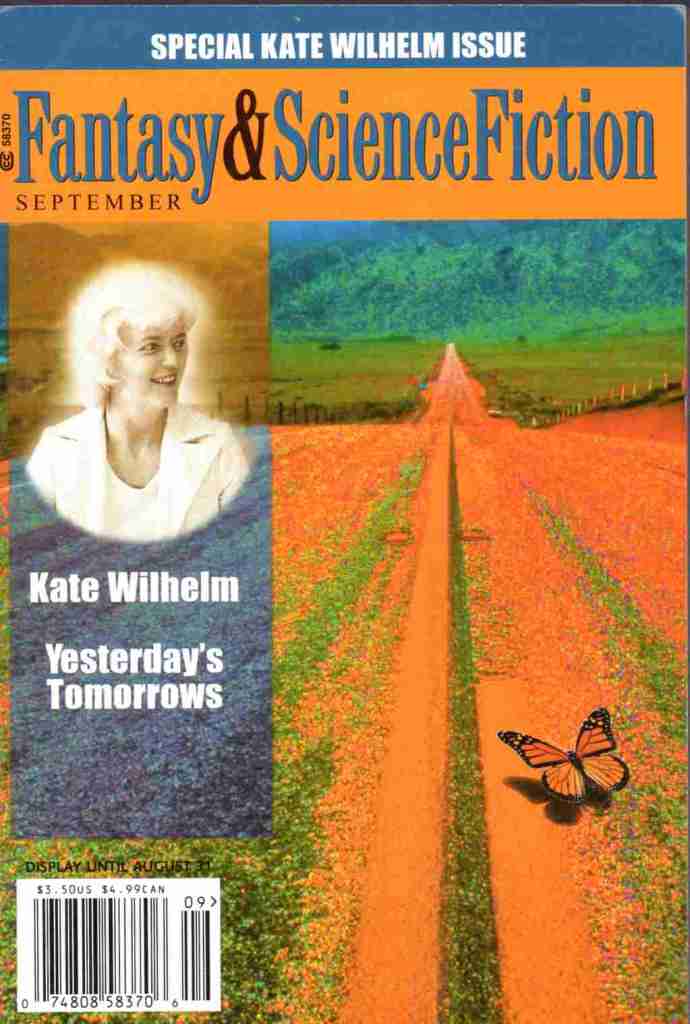
(Cover by Richard Wilhelm. F&SF, September 2001.) Who Goes There?
Like most of the New Wave authors who caused a stir in the latter half of the ’60s, Kate Wilhelm had actually made her debut a decade earlier, in 1956. It wasn’t until the New Wave, though, with the appearances of Dangerous Visions and Damon Knight’s Orbit series, that Wilhelm emerged as a major writer of short fiction especially. She won a Nebula for her story “The Planners,” although I never really understood the praise for this one. She appeared most often in original anthologies and especially in the Orbit series, which shouldn’t be surprising considering she was married to Damon Knight. Together they (along with Robin Scott Wilson) founded the Clarion Writers’ Workshop. In the late ’60s through the ’70s Wilhelm rarely appeared in magazines, but starting in the ’80s she made more magazines appearances; it could be because by the early ’80s the original anthology market had all but imploded, including the death of Orbit, and then there’s the high-paying science magazine Omni, which Wilhelm was a somewhat regular name in. By the time she got a special issue dedicated to her for F&SF she was a living legend in fandom, as both a writer and a teacher. Her son Richard did the cover for this issue, which I feel bad pointing out because said cover is… not very good, to put it one way. “Yesterday’s Tomorrows” is a “realistic” story with a tangentially SFnal element, showcasing a mature talent who’d been around for decades at this point.
Placing Coordinates
First published in the September 2001 issue of The Magazine of Fantasy and Science Fiction. It’s been reprinted only once, in the Wilhelm collection Masters of Science Fiction: Kate Wilhelm, Volume 1.
Enhancing Image
In a way this is a love story, as well as a road trip story. By sheer happenstance Hal Whitcomb, a divorced middle-aged guy, picks up Tilly Dunning off the side of the road. (Do people still hitchhike? I have to wonder.) Hal is 47 while Tilly is about to turn 31, although the latter looks younger than that, to where she can pass off as a college undergrad. Sparks fly between them pretty quickly, although Tilly has what you might call a troubled backstory, which forces the two to get more involved in each other’s lives than was thought possible. As Tilly says, “Last week I lost my job, lost my boyfriend, had my car stolen, and my grandmother died.” All of these things, except maybe the stolen car, tie into one men, or rather two men who knew each other once. Tilly is the granddaughter of the famous physicist Dr. Cherny, who would still be spoken of with reverence today if not for the circumstances of his death: he had apparently died while at a sex worker’s place, in the midst of an affair. He was found dead and naked, from heart failure, inside the woman’s apartment, although she claimed to have never met him before. Tilly’s grandmother suspected foul play, but there was no evidence found of such. Dr. Cherny had died shortly after speaking with one of his students, one Dr. Mandrill, who coincidentally Tilly also worked for, until she got fired. Tilly boyfriend, Peter, also works for Dr. Mandrill, but Mandrill fired Tilly and Peter dumped her. So there’s that. Mandrill fired Tilly for what amounted to insubordination, but Tilly’s suspecting there was more to it than that.
“Yesterday’s Tomorrows” doesn’t have that complicated a plot once you sort out the different perspectives Wilhelm hop between, but it’s given a smokescreen of complication by Wilhelm showing us what end up being two sides of the same corn, between Hal and Tilly. Despite being the first POV character, Hal is actually not that important, nor does he really do much. Tilly is really the focus here, between her backstory but also her conflicts, which are external as well as internal. She’s grieving for her grandmother, whom she was close with, but she’s also at odds over whether her grandmother (who had a paranoid streak, it must be said) was right about Cherny. Is Tilly really the granddaughter of a disgraced scientist, or is there more going on here than meets the eye? Like yeah, obviously there is, but this story has meat on its bones more from being a character study than the mytery behind the Mandrill Institute. Mandrill had studied in physics but switched gears to biology, on Cherny’s recommendation; but the circumstances of this recommendation, for why Cherny saw Mandrill as unfit for pursuing physics, are not made clear until much later. The thing is, this story has little to do with either biology or physics, although it does pay lip service to Quantum Physics 101. The butterfly effect. Schrödinger’s cat. You know how it is. There’s the matter of predestination and alternate futures. The SFnal connection is very faint, to the point where I wonder if at some point during writing Wilhelm panicked and realized she should probably insert a bit more stuff about quantum physics in there if she wanted to sell it to a genre publication. As with other Wilhelm stories I’ve read, “Yesterday’s Tomorrows” is more concerned with character development than it is with being science fiction.
Really this is a story about coincidences, or more specifically serendipity. Tilly just so happens to be the granddaughter of a famous (or infamous at this point) scientist, formerly employed to another famous scientist, and Hal just so happens to be working for some documentary filmmaker named Val (Hal and Val, now won’t that confuse you) who ends up being instrumental in Tilly digging into Mandrill’s past, as well as her own. Mandrill and Tilly’s famous scientist grandfather just so happened to know each other many years ago, when the former was a student, and Tilly’s grandmother’s suspicion that somebody had plotted to ruin Cherny’s reputation just so happens to have been correct. Seeing a pattern here? Wilhelm willingly violates a basic rule of good storytelling, in that “Yesterday’s Tomorrows” is like a ten-car pileup of coincidences; but then this focus on serendipity is also the point. Tilly believess herself to be weirdly unlucky, which given recent events is easy to understand, but she’s also being railroaded toward a certain revelation and a certain conclusion. Speaking of quantum physics, I’m now reminded of the first Half-Life game, which also explores predestination and railroaded sequences of events, albeit in a very different fashion. This is all better to think about after the fact than it is to read in the moment. The one review I could find of this novella that has any depth (it’s the Locus review of this very F&SF issue) described it as having elements of a thriller, but I would say it’s more like a scientific mystery. Wilhelm wants you to take part in putting pieces of the narrative together so that by the end you (hopefully) feel a sensse of accomplishment.
There Be Spoilers Here
When Tilly finally confronts Mandrill about his charlatanism and his past relationship with Dr. Cherny, Mandrill reveals that if anything he had killed the old professor by way of inaction. What happened was that Cherny had called Mandrill a fraud, and the young man didn’t like this very much. On the fateful night of Cherny’s death the man suffered a heart attack while with Mandrill, and Mandrill probably could’ve saved him, or called an ambulance, but instead he conspired to ruin the dying man’s reputation, in a way that admittedly ssounds more far-fetched than the official cause. Mandrill tries drugging Tilly and getting her to kill Peter, so as to kill two birds with one stone: get Peter out of the way so that Mandrill can take all the credit, and also to have Tilly locked away. The plan goes “wrong,” though, as Tilly reveals she had never taken the roofied drink Mandrill had given her. Peter is shot, but lives, and is able to discredit Mandrill’s attempt to frame Tilly. Everyone except for the obvious villain gets a happy ending. This all sounds like a lot for maybe the last ten pages of a sixty-page novella that’s mostly just been talking and ruminating up to this point. In one stroke Tilly gets to clear her grandfather’s name and also take her sweet revenge on Mandrill; she even gets with Hal at the end. Tilly theorizes that her grandmother, despite the shameful circumstances of her husband’s death, had a kind of That’s So Raven moment when Tilly was born, as she foresaw her granddaughter making things right again. Maybe.
A Step Farther Out
This one took longer to gestate than I had hoped. I spent two days getting through the novella itself (I don’t really have an excuse there), and then another two days spent trying to come up with thoughts about it. It’s not that “Yesterday’s Tomorrows” is bad by any means, although I have to admit that after several Wilhelm stories I’ve had to be wowed by any of them, although I’ve enjoyed a few. It could be because Wilhelm, as part of the New Wave, was one of the first in American genre SF to focus more on characters than science or even plot with her fiction, which has since become pretty much the standard for SF writing at short lengths. What was once special might now be commonplace, although there’s still a reason Wilhelm managed to stay in the game as long as she did.
See you next time.
-
Things Beyond: May 2025

(Cover by John Schoenherr. Analog, June 1975.) At the beginning of the year I said that I would be covering one short story or novella from Galaxy each month—but I said nothing about serials. The truth is that Galaxy was, alongside Astounding/Analog, the most consistent market for serialized novels and novellas at the time, so it would feel wrong to never acknowledge that part of the magazine’s history. As such we’re getting a novella and a serial from Galaxy this month; that they’re both from authors I admire probably helps.
Last month I covered a horror story by the crime/mystery author Dorothy Salisbury Davis, which gave me the idea of finding more SFF by people who normally write crime/mystery, which while also a genre that has a history in pulp magazines, is “realistic” fiction rather than SFF. One curiosity that struck me ever since I saw it years ago was the fantasy story “The Bronze Door” by Raymond Chandler, which marked one of only two times he appeared in an SFF magazine. Someone who wrote a good deal more SFF than Chandler would be John D. MacDonald, who wrote prolifically for the genre magazines in the late ’40s and early ’50s before shifting to crime fiction and making a killing on that. So for this month’s complete novel we’ve got the early MacDonald novel Wine of the Dreamers. Rounding out the novel-length stuff is a relatively obscure standalone SF novel by Roger Zelazny, who nowadays is more known for his fantasy.
For the women we have two people who are a few generations apart and coming from different continents, but who still, each in her own way, have come to write science fiction. Kate Wilhelm is actually a bit hard to find in magazines after the late ’60s, once she found her voice as a writer, but the September 2001 issue of F&SF was a special issue dedicated to Wilhelm, complete with a new novella. As for the Greek writer Eugenia Triantafyllou, I picked just about the newest story I reasonably could’ve (an unofficial rule of mine is that a story must be at least a year old for me to consider it for review), with “Loneliness Universe” being a finalist in this year’s Hugos. I’m voting in the Hugos, by the way.
That makes one story from the 1930s, two from the 1950s, two from the 1970s, one from the 2000s, and one from the 2020s.
For the serial:
- The Dream Millennium by James White. Serialized in Galaxy Science Fiction, October to December 1973. I’ve been meaning to read more James White, and thankfully several of his novels first appeared as serials. White first appeared in the UK, in New Worlds, before eventually finding some success in the US as well. Along with Bob Shaw he was one of the few Irish SF writers to appear regularly on both sides of the Atlantic back in those days.
- Doorways in the Sand by Roger Zelazny. Serialized in Analog Science Fiction, June to August 1975. Zelazny is one of the most influential SFF writers of all time, his mark being apparent on the likes of George R. R. Martin and (God help us) Neil Gaiman; and yet despite a couple generations of writers (especially those of fantasy) owing a debt to Zelazny, much of his work remains obscure or simply out of print, including this standalone novel.
For the novellas:
- “Yesterday’s Tomorrows” by Kate Wilhelm. From the September 2001 issue of The Magazine of Fantasy and Science Fiction. It’s easy to forget this, but Wilhelm started in the ’50s, only that she flew under the radar for about a decade. Like a caterpillar turning into a butterfly, though, Wilhelm seemed to metamorphize almost overnight into one of the most acclaimed SF authors from the late ’60s until her death in 2018. She was married to Damon Knight.
- “The Other Man” by Theodore Sturgeon. From the September 1956 issue of Galaxy Science Fiction. Sturgeon is one of my favorite authors, especially of short fiction. Sturgeon had started to write professionally with “mainstream” fiction, although this went nowhere and he quickly pivoted to SFF, much to our benefit. His productivity was peaks and valleys so that he was writing either a lot or nothing at all. He was most consistently productive in the ’50s.
For the short stories:
- “Loneliness Universe” by Eugenia Triantafyllou. From the May-June 2024 issue of Uncanny Magazine. Hugo and Nebula nominee for Best Novelette. Triantafyllou was born and raised in Greece, and continues to live abroad, but writes her fiction in English. She made her debut back in 2017, and has yet to write her first novel, although maybe she just much prefers writing short fiction.
- “The Bronze Door” by Raymond Chandler. From the November 1939 issue of Unknown. Possibly the most acclaimed crime writer of the 20th century, seriously only rivaled by Agatha Christie, Chandler’s known for his series of novels starring Philip Marlowe. Chandler famously didn’t start writing crime fiction until he was in his forties, and didn’t write his first novel until he was pushing fifty.
For the complete novel:
- Wine of the Dreamers by John D. MacDonald. From the May 1950 issue of Startling Stories. Fans of crime fiction would know MacDonald for his prolific (21 novels over a span of as many years) Travis McGee series, as well as the standalone novel Cape Fear (first titled The Executioners, but then retitled after the 1962 film adaptation), but he also wrote a good deal of science fiction in the late ’40s and early ’50s. It’s not unusual for authors to cut their teeth on working with one genre before moving to greener pastures, so that much like how Elmore Leonard started with Westerns before moving to crime fiction, the same happened with MacDonald. Wine of the Dreamers was either MacDonald’s first or second novel, it’s hard to say.
Won’t you read with me?
-
Serial Review: Red Nails by Robert E. Howard (Part 3/3)
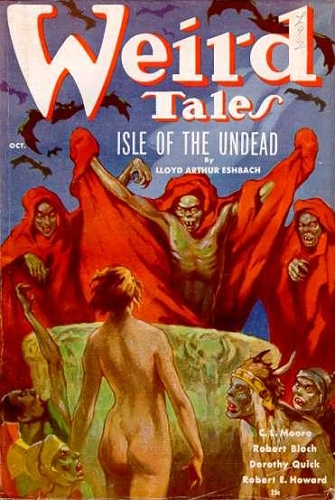
(Cover by J. Allen St. John. Weird Tales, October 1936.) The Story So Far
Valeria of the Red Brotherhood is a warrior-pirate who was aboard ship not too long ago, but jumped in order to escape an unwanted marriage proposal. She then joined an army of mercenaries, but left that as well, after killing one of the officers. She’s now a fugitive, but she’s not alone, for Conan was in the same army and also deserted, with the intent of following Valeria’s trail. Conan doesn’t wanna kill Valeria, indeed having killed the brother of the officer she had killed off-screen, but rather is curious about her—in more ways than one. Aside from being warriors, one thing Conan and Valeria have in common is that they’re very bad at taking orders. They’re having a “fun” time bickering when a dragon in the forest they’re hiding out in kills their horses, and looks to have them for lunch next. Using a spear and some poison fruit, Conan’s able to incapacitate (although probably not kill) the dragon, and the two make a run for it on foot. On the plains by the forest there’s a domed city, called Xuchotl, which once had an indigenous population but which is not thinly populated by two clans, who years ago had moved in and slaughtered the original residents. Yes, that is technically genocide. We’re told that the indigenous people of the city were no better than those who killed them, and in some ways might’ve been worse. Now it’s a war between the last members of the Tecuhltli and Xotalancas, clans named after their founders. No children have been born in these clans in quite a few years, and it seems each is a mini-civilization on its last legs.
With the help of a Tecuhltli named Techotl, Our Heroes™ get introduced to the Tecuhltli higher-ups, namely their “king” Olmec and his partner Tascela (in the previous installment I said they were married, but their relationship is actually more ambiguous than that), the latter appearing youthful and yet, it turns out, being centuries old. Olmec sort of hires Conan and Valeria in the hopes that they’ll help vanquish the remaining Xotalancas. (The red nails of the title refer to red nails that are stuck into a column in Olmec’s chamber, each representing a vanquished enemy.) This arrangement goes sideways, though, when later that day one of Tascela’s servants tries to put Valeria into a deep sleep with the help of a black lotus. Valeria doesn’t appreciate this very much, so she tortures the servant until she confesses what Tascela’s plan is, although she escapes into the catacombs, never to be seen again but likely to be killed off-screen by something. It’s at this point that Valeria hears swords clashing at the gates, which probably means the Xotalancas have chosen now to make their final assault.
Enhancing Image
A battle goes down, with the Tecuhltli being victorious, of course. They’ve killed the last of the Xotalancas, which ordinarily would mean everyone gets to live happily ever after, but as you know, Tascela has other plans. Olmec also has plans of his own, and ultimately the two rulers fight for a bit over who gets a piece of Valeria’s ass. Olmec wants to rape Valeria while Tascela somehow has even worse plans in mind. Of course, while Olmec is a burley bearded guy who can break someone’s spine in half, Tascela is a sorceress who many years ago had put a spell on Olmec so that he would be unable to lay much more than a finger on her. Is this the only Howard-written Conan story with both a heroine and a villainess? Unfortunately, by this point Valeria has become little more than the obligatory damsel who needs rescuing, although while she’s physically helpless she does have quite the mouth on her. We hear about some “profanities” coming from her and it’s easy to imagine her dropping several F bombs if not for censorship. I sort of get the criticism of Valeria not being enough of a badass heroine, but at the same time I do think she works as a kind of foil to Conan. I think it’s also worth mentioning that it’s easy to believe Howard had based Valeria on Novalyne Price, his girlfriend at the time, namely through her assertive attitude and penchant for cursing, as was apparently Novalyne’s habit when she wasn’t on the job. Clearly by the last couple years of his life Howard was moving in a direction that, while not exactly feminist, was more sympathetic to women as people. Remember that this is a guy who really could not imagine living in a world without his mother in it.
As if to compensate for the slow middle section of the novella, the back end of Red Nails is nonstop violence and conspicuously erotic imagery (I don’t mean that last part in a bad way). Howard said in at least one letter that he thought of Red Nails as his sexiest Conan story, and between the two BDSM-coded torture scenes it’s easy to believe him. Yes, a second BDSM-coded torture scene has hit the towers! This time it’s Valeria who’s on the slab, with the dark-skinned Tascela towering over her, in an image that provided the cover for the first installment. (I should probably have mentioned by now that Tascela is coded as being equivalent to ancient Egyptian royalty, going by how Howard describes her clothing and especially with how she’s illustrated in the version of Red Nails printed in The Best of Robert E. Howard Volume II.) Conan kills Olmec and comes in for the rescue, but it looks like Our Heroes™ are outnumbered when the thing from the catacombs emerges as a deus ex machina, in the form of Tolkemec, who had been banished there many years prior. Conan kills Tolkemec while Valeria takes the chance to stab Tascela in the back, who despite being able to replenish her youth and make people follow her every order is apparently made of tissue paper if someone manages to catch her off-guard. “I had to do that much, for my own self-respect!” says Valeria, as almost a meta statement on how given her damsel status for much of the story she had to take down someone. Why not her evil counterpart, then? It makes enough sense. It also acts as a bit of a twist on its own, if also as an anticlimax, since Tascela shows herself to not be much of a fight after all, at least physically.
As I was reading Mark Finn’s Blood & Thunder: The Life and Art of Robert E. Howard (a good one-volume biography, if also unfortunately sloppy in the proofreading department), and Finn makes a point that I’m sure is not new but which I thought useful for my own read of Red Nails: he considers Red Nails to be a thematic counterpart to Howard’s earlier Beyond the Black River, which might still be my favorite Conan story. Granted that Beyond the Black River benefits from a tighter narrative focus and the damsel being a man instead of a beautiful woman for Conan to make out with, the two novellas do each show one side of the same coin, with Beyond the Black River showing barbarism creeping up on civilization while Red Nails shows what Howard saw as the inherent evil of civilization. A more conventionally racist (mind you that Howard did have racist tendencies) narrative would’ve painted the original inhabitants of Xuchotl as backward “savages,” but from what we’re told about them they were actually quite an advanced and “civilized” people—at least on paper. But they were also decadent, and their collective villainy made way for the settlers that came in and slaughtered them. Now that the clans have been wiped out as well, Conan sees the city being truly bereft of human life now as no great loss. “It’s well the breed exterminated itself,” he says, which could be referring to the original inhabitants, the clans (who after had spawned from one people), or both. For both Conan and Howard, civilization is only temporary, and at some point will meet its end. This is the view of a philosophical pessimist, which one could argue is the most essential foundation for dark fantasy.
A Step Farther Out
I have to admit that when I finished Red Nails I felt a bittersweetness, because it was the last Conan story Howard wrote; even had he lived longer it’s unlikely he would’ve written more Conan, as he made it clear in letters at the time that he was getting tired of the character, and moreover he was getting tired of writing fantasy in general. That one can think this while only pushing thirty is something many of us would now think of as absurd, but Howard really meant it. About a year after he finished Red Nails he got in his car, took out a revolver, put it to the side of his head, and pulled the trigger. It’s ironic that he had basically intended this as the final Conan story, since it ends on a relatively upbeat note (I mean hey, all the bad people are dead) and implies more adventures between Conan and Valeria—only we never got to see those. Eventually I’ll cover more Howard, specifically work of his that isn’t Conan, assuming I don’t follow my leader.
See you next time.
-
Short Story Review: “The Muted Horn” by Dorothy Salisbury Davis

(Cover by Virgil Finlay. Fantastic Universe, May 1957.) Who Goes There?
Occasionally looking up an author through ISFDB can be misleading, if what that author wrote was mostly not SFF; such is the case with Dorothy Salisbury Davis, who over her extremely long life (she was born in 1916 and died in 1914) wrote almost too many mystery and crime novels to count. I don’t think I’ve ever seen one of these novels in the wild, but in the ’50s Davis was apparently big enough of a deal to be President of the Mystery Writers of America at the time when today’s story was published. Going off of her ISFDB profile, though, you’d think she wrote practically nothing, which is why you should always consult a second source for these things. “The Muted Horn” is very much an outlier in Davis’s body of work, in that while there’s a sense of mystery it’s ultimately a tale of supernatural horror. How it found its way into the predominantly SFnal Fantastic Universe is itself a mystery, but I assume this has to do with the lack of markets for short horror in the latter half of the ’50s.
Placing Coordinates
First published in the May 1957 issue of Fantastic Universe. It’s actually been reprinted more times than I would’ve thought, appearing in The Fantastic Universe Omnibus (ed. Hans Stefan Santesson), The Dark of the Soul (ed. Don Ward), and Ladies of Fantasy: Two Centuries of Sinister Stories by the Gentle Sex (ed. Gogo Lewis and Seon Manley).
Enhancing Image
Jeb Sayer is a young man tending the same farm that his family has kept for generations, somewhere in New England in what was probably then the present day, in a cozy little town called Tinton. Nathan Wilkinson, “town moderator, deacon of the church, and publisher of the oldest weekly in the state,” has stopped by the Sayer home in the hopes of making Jeb an elder in Tinton Church, but Jeb declines the offer. (It’s unclear what sect of Christianity this is.) The reason for Jeb declining is that he’s unsatisfied with being just another upstanding New England redneck in a dead-end town, and he has other plans, namely that he wants to marry Ellen, who he’s been dating for some time and who works in a record store. (Jeb understands that any woman who works in a record store is probably wife material.) He’s even thought about leaving Tinton before, and it doesn’t help that the town has, allegedly, supposedly, a dark history going back to the Puritan days, when it was a den full of scum and villainy, “so wicked that once the church elders had gone among the citizens in chains lest one of them fall into temptation.” Said chains have survived into the modern day, first in the church belfry and then moved to the cemetery by a younger Jeb, the chains being wrapped around the tombstones of dead vicars. Those chains will eventually come back, so put a pin in that.
This does raise a question, though: What does this have to do with a horn? Not much, actually. One problem I realized I had with this story, looking back on it, is that Salisbury introduces two supernatural horror elements which, at least on a surface level, don’t have anything to do with each other. We get the impression that there’s something off about Tinton, but then we’re introduced to this other, tangential thing in the form of an ancient horn that’s supposed to be golden but which has been covered so thickly with dust and gunk that it’s been “tarnished black.” It and a few other old instruments have been moved to the record store, and Ellen asks Jeb to clean to the horn. Fine. This ends up being a mistake, though. Of course a curiosity shop is involved, which even in the 1950s would’ve been a tired old horror trope. So how does Salisbury differentiate “The Muted Horn” from other similar stories that came before it?
Well…
The other problem, and this could be because while Salisbury was a professional when it came to crime fiction but inexperienced with writing supernatural horror, is that “The Muted Horn” doesn’t really stand out other than the conspicuousness of its being published where and when it was. Had Salisbury written “The Muted Horn” just five years earlier it would’ve appeared in Weird Tales without issue; unfortunately for Salisbury, and really for everyone writing horror at the time, Weird Tales was dead at this point. The market for short genre fiction in the late ’50s was not great generally (the shutdown of American News Company in 1957 was one reason for the magazine market all but imploding), but it was especially bad for short horror fiction. There was basically nothing specializing in horror or dark fantasy in the US at this time. Fantastic Universe occasionally published fantasy and horror but was primarily an SF magazine, and not a first-rate one at that. “The Muted Horn” stuck out to me when I was scrounging for ’50s stories written by lady authors, because it’s a rarity for the magazine it appeared in, but if it had appeared in Weird Tales in the early ’50s it probably would not have been on my radar. And really, if for some reason you do read this one, it’s for the novelty of the thing.
There Be Spoilers Here
Once Jeb cleans off the horn he started playing it, and well, some weird stuff happens. A hurricane blows through Tinton, except not really. Nobody has died, or at least not yet. The animals are acting weird, though. And lo, the chains in the cemetery are gone! SpOoOoOoKy. What could this mean? Does the horn have the power to quite literally raise the dead? Has Jeb inadvertently brought about the apocalypse? We don’t get a straight answer, the story just kinda ends there. Yeah, if you wanted to see the consequences of Jeb’s actions, you’ll be disappointed.
A Step Farther Out
It took me longer to write a review than I would’ve liked, not because I struggled to get through “The Muted Horn” but because when I finished it I realized I didn’t have much to say about it. It’s fine. It’s a perfectly average rural horror yarn that really anybody could’ve written, except it happened to be written by someone who was a pretty respected crime writer at the time. This did give me an idea, though, since Salisbury was by no means the only crime writer who occasionally dipped their toes in SFF. I don’t cover crime fiction here unless it’s also SFF in some way, but I can cover SFF works by crime fiction writers.
See you next time.
-
Serial Review: Red Nails by Robert E. Howard (Part 2/3)
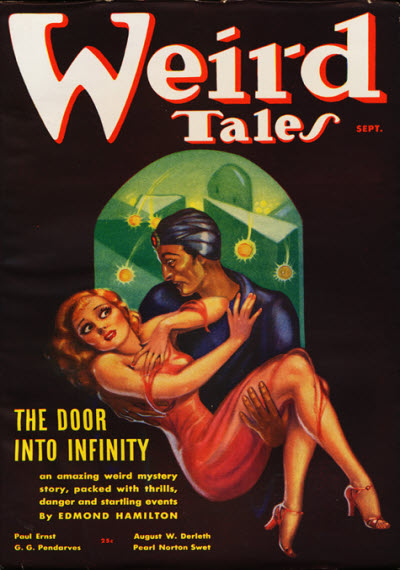
(Cover by Margaret Brundage. Weird Tales, Aug-Sept 1936.) The Story So Far
Valeria of the Red Brotherhood is a pirate-turned-mercenary who abandoned her ship to avoid an unwanted marriage proposal, only then to also desert the band of mercenaries she had joined, after killing one of the officers. She’s currently a fugitive, but she’s not alone, for it turns out Conan, who was in the same army as Valeria, also deserted and followed her trail—partly out of curiosity but also because he makes no secret of having the hots for the female warrior. (You gotta give Conan credit: the man is upfront about what he wants.) Valeria is not so smitten with the legendary Cimmerian. At the same time the two are probably better off together than each going their separate ways, for the moment. Their bickering is interrupted when a dragon of the forest they’ve taken refuge in devours their horses off-screen, with Our Heroes™ looking to be another meal. The dragon is not the fire-breathing dragon of medieval folklore, nor the slim serpent with wings of ancient China, but a dinosaur-like beast whose belly drags on the ground and who’s got more teeth than a dentist could possibly hope to count. With the help of a makeshift spear and the juice of a poison fruit, Conan incapacitates the dragon and Our Heroes™ flee the forest, into a wide plain and then into a massive interior city. Xuchotl is an ancient city that’s partly underground and totally encased by a dome, and at first it looks to be abandoned. When Conan splits from Valeria to do some investigating, the latter stumbles onto a couple of the city’s inhabitants and gets herself into a battle she really did not anticipate. The first installment ends with Valeria and Techotl, a member of the Tecuhltli, fending off some ravenous dogs. This first installment actually ends in the middle of the second chapter; I’m not sure if this is a criticism, I just wanted to point that out. The question then is: Where could Conan be?
Enhancing Image
Of course this had to be unintended, but I find it interesting that the first installment started and ended without Conan, only for the second installment (which is actually just the second chapter continued) to reintroduce him as fast as possible. Also, aside from the action scene at the beginning, this middle chunk of Red Nails will be much more focused on building character and the world of Xuchotl. There’s a lot less fighting and a lot more dialogue. This is not really a bad thing, since Xuchotl is one of the more imaginatively realized settings for a Conan story. Right after Howard wrote Red Nails, about a year before its publication, he admitted in letters that it would not only be his last Conan story but also probably the last fantasy story he ever wrote—mind you he was only 29 when he said this. The notion that someone so young could feel that they’ve said all they could say about a character, never mind a whole genre, might strike us as crazy, but I do believe that even had Howard lived to a nice old age it’s unlikely he at the very least would’ve written more Conan stories. Red Nails was the grand finale of the series, even if it doesn’t exactly feel like one; but also Howard really pulled out all the stops with the action, worldbuilding, and character moments. It’s also, it must be said, possibly the sexiest of the Conan stories, but that’s for me to give the details of in just a moment. For now we must be content with being introduced to the rest of the Tecuhltli, who stand opposed to the clan on the other end of the city, the Xotalancas. Turns out the city had already been built and had its own indigenous population when the founders of these clans had arrived. Given that said indigenous population is not longer here, you can guess what happened, although curiously the original people of Xuchotl are also said to have been brutal and decadent in their own right.
Thus Conan and Valeria find themselves caught in the middle of a war between dying clans (there are no children among the Tecuhltli and presumably the same goes for the enemy) that has been going on for fifty years, so that basically nobody alive now was around to witness how it had all started. When we meet the rulers of the Tecuhltli, Olmec and his wife Tascela, we get the feeling that something is very off, not least because Tascela looks to be young and beautiful but is, in fact, at least in her seventies, given that she was an adult when the war started and indeed the big reason for why it had started in the first place. How she has retained her youth is a mystery—for now. During Olmec’s big exposition dump about the history of the clans, Tascela also seems weirdly focused on Valeria, as if transfixed by her beauty. (It’s worth mentioning that while homosexuality was sometimes mentioned in mainstream fiction of the time, it was sort of taboo in the genre magazines, so that even the implication of it here is Howard teasing the reader.) Now, my dumb ass thought going in that the story’s title referred to red fingernails, but actually it’s referring to red nails impaled in the Tecuhltlis’ headquarters, each representing a slain enemy. Granted, the red nails could also refer, if only metaphorically, to Valeria, who after all is of the Red Brotherhood. For better or worse Conan is rendered the secondary protagonist while Valeria is the real hero(ine) of Red Nails; and in case there was any doubt of this she once again takes hold of the narrative in the fourth chapter, which is where the second installment ends and which is short but pretty memorable. Red Nails could be considered a logical successor as well as a companion piece to Beyond the Black River, which in some ways it’s very different from but also in other ways similar. We go from the frontier to what is basically a buried city, and the POV character who follows Conan is female instead of male, but their premises are similar enough.
Now, let’s talk about the torture scene, although it’s actually not the torture scene that provided the cover for the previous issue of Weird Tales. After their meeting with Olmec and Tascela, Conan and Valeria once again part ways for the moment, with the latter going to take a nice post-battle nap. She wakes suddenly, however, to find that Yasala, Tascela’s servant girl, had tried to pull a Bill Cosby on her with the help of a black lotus, a blossom “whose scent brings deep sleep.” Valeria is very cross about this, especially because Yasala refuses to explain herself. Valeria then does what any normal person would do and decides to strip Yasala naked and tie her down, for the purposes of strangely erotic torture with a lash. Now, as somebody who is not particularly into BDSM (although I’m not opposed to it), I have to admit that what follows is pretty hot, to the point where I would be surprised how it made its way into Weird Tales in the ’30s if not for the fact that paying kink lip service was actually far from uncommon for the magazine at this time. (There are, in fact, multiple Robert E. Howard stories that made the cover for this very reason, courtesy of Margaret Brundage.) Indeed, I can imagine that reading Weird Tales in the early-to-mid-’30s (the magazine cleaned up its act towards the end of the decade, at least when it came to the covers) and being introduced to BDSM this way. Shit must’ve blown some minds. Anyway, Valeria gives Yasala a good thrashing until the latter finally gives in, saying the Bill Cosby routine was part of Tascela’s scheme. Once Valeria unstraps her she throws some wine in Valeria’s face for her troubles and runs off the catacombs, where it’s implied she meets her death off-screen. Meanwhile Valeria hears the clashing of swords in another direction, implying that the Xotalancas are at the gates.
A Step Farther Out
Sorry for the delay, but I hope the wait was worth it. Red Nails is shaping up to be yet another top-tier Conan story, but we still have a good chunk of it to go. I’ve read enough Conan at this point, a lot of it outside the confines of this site, to separate the mediocre (because there are a few Conan stories where Howard was clearly phoning it in) from the good stuff. It helps a lot that Valeria herself is a very fun character, who in some alternate timeline probably could’ve gotten her own spinoff series. I’ve read into the possible inspirations behind Valeria, with the most likely contenders being C. L. Moore’s Jirel of Joiry, whose first couple stories Howard had very likely read by the time he wrote Red Nails; and then there’s Novalyne Price, Howard’s girlfriend at the time. The details of Howard and Price’s relationship are unspeakably depressing, so I won’t go into it, but it seems he had based Valeria’s tenacity on Price. (I’ve been reading Mark Finn’s Blood & Thunder: The Life and Art of Robert E. Howard, and there’s a good chance I’ll be done with it by the time I finish reviewing Red Nails.) My point is that I was looking for a palate cleanser after the dismaying experience that was reading the first installment of E. E. Smith’s Triplanetary, and I’m happy to say Red Nails is meeting my expectations.
See you next time.
-
Novella Review: “Wolves of Darkness” by Jack Williamson

(Cover by H. W. Wesso. Strange Tales, January 1932.) Who Goes There?
Despite the sheer length of his career and how much of SF history he was involved with, there’s been relatively little retrospective material on Jack Williamson. He made his debut in 1928 and kept writing, albeit with quiet periods in his career, until his death in 2006. By the time First Fandom arose in the late ’30s, Williamson was already considered something of a titan in fandom circles, yet he also outlived most of the young folks in First Fandom who looked up to him. Williamson’s obscurity could be tossed up to him being a B-tier writer who occasionally wrote A-tier material, and also because despite being pretty popular within SF fandom, especially in the ’30s and ’40s, his influence is nowhere near as pronounced as, say, Robert Heinlein’s or even A. E. van Vogt’s. As he more or less admits in his memoir, Wonder’s Child, Williamson didn’t think of himself as a capital-A Artist™, but rather he wrote genre fiction because he enjoyed it. In a way he was the longest-lived and most persistent of the pulpsters, having more in common with the likes of Robert E. Howard and Edgar Rice Burroughs than Heinlein. “Wolves of Darkness” itself is a curious if imperfect SF-horror blend that marked one of several turning points for Williamson as a writer. It was, up to that point, his biggest paycheck for a single story, it was made the cover story for the January 1932 issue of the short-lived Strange Tales, and it was also his first attempt at applying an SFnal rationalism to what was then considered purely the ground of fantasy: lycanthropy.
Placing Coordinates
First published in the January 1932 issue of Strange Tales. It was stranded there for 35 years, until it was reprinted in the November 1967 issue of Magazine of Horror. It’s also been reprinted in The Mammoth Book of Classic Science Fiction: Short Novels of the 1930s (ed. Isaac Asimov, Martin H. Greenberg, and Charles G. Waugh), Rivals of Weird Tales (ed. Stefan R. Dziemianowicz, Martin H. Greenberg, and Robert Weinberg), Echoes of Valor III (ed. Karl Edward Wagner), and the Williamson collection The Collected Stories of Jack Williamson: Volume Two.
Enhancing Image
Clovis McLaurin is a med student, so somewhere in his twenties, who makes his way to the rural Texas landscape on account of his weird scientist dad needing his assistance for some vague purpose. Dr. McLaurin had inherited a ranch plus some funds from his brother, and has apparently been using the combo of free home and secluded location to conduct experiments. Clovis convinces one the locals, Judsgon, in the town of Hebron, near enough to the ranch, to help him on his way, although traveling by night ends up being a huge mistake for both of them. We’re already told early on that the landscape in these here parts of the state seem to be tormented at night by a pack of wolves, or maybe a werewolf. The introductory blurb for “Wolves of Darkness” tells us that this story will have to do with lycanthropy, which is true enough, although Williamson’s treatment of it pretty unconventional by the standards of pulp fiction. It’s also worth mentioning that one major plus in this story’s favor is its sense of place, which is no doubt inspired by Williamson spending much of his life in rural areas. He was, in fact, born in what is now Arizona, before it had become a state (that’s how old he is), before his family moved to Texas and then New Mexico, literally in a covered wagon in the 1910s. Despite being ostensibly set in what was then modern times, “Wolves of Darkness” is a depiction of the southwest at a time when it was still in the early stages of modernization. It’s set in the 1920s or early ’30s, but could almost just as well takes place circa 1900, as if the past and present were converging. Incidentally Jack Williamson and Robert E. Howard were close contemporaries who were both from the southwest, and thus reading their work from the ’30s you can get an idea of what early modernization for that region was like, albeit from quite different perspectives: Howard had a very love-hate relationship with Texas while Williamson was more forgiving.
Anyway, Clovis
it’s such a weird name I’m sorryand Judson are attacked by wolves and a rather skimpily dressed lady with glowing green eyes—in fact the wolves have the same sort of uncannily green eyes, as depicted in the cover. Judson gets killed off-screen, but the woman and her wolf pack take Clovis back to the ranch as a captive. Clovis swears he recognizes the girl from somewhere, and realizes it’s at least the body of Stella Jetton, the daughter of Dr. Jetton, who is (or was) Dr. McLaurin’s colleague. The problem is that Stella doesn’t recognize Clovis, and going by her actions it’s more likely that some outside force has taken control of her body. This turns out to be the case, not just with Stella and the wolves but Dr. McLaurin himself, who is, let’s say not quite himself once Clovis meets him. Both the people and wolves Clovis meets all have green eyes, and all seem to be possessed of some fierce intelligence that while in the bodies of “lower” animals appears to give them extra intelligence, while in the bodies of people they become more animalistic. The big weakness of this outside force becomes apparent early on when Dr. McLaurin (or the thing inhabiting his body) tells Clovis that they really dislike light of any kind, so as to why the interior of the ranch is only shown in a dim red light. The beings who have taken over these bodies are nocturnal, or rather they come from a world that is deprived of light—a notion that seems outlandish, although there are many organisms in the depths of our own planet’s oceans that have never known sunlight. “Wolves of Darkness,” like much if not necessarily all of weird fiction, is basically about someone trespassing beyond the boundaries of the natural order and in so doing fucking around and finding out, as we say. In the case of this story it’s Dr. McLaurin who, prior to the beginning, had tampered with studies in possible alternate dimensions. This is what I mean by the story being SF rather than fantasy, since we’re given an SFnal explanation for why these things are happening.Even in 1932 the premise of humanity coming into contact with malicious alien life was by no means new, although what’s more novel here is that “Wolves of Darkness” is an early example of aliens of the body-snatching variety. We never see what they look like, although from what I can tell they’re more like energy beings of the sort of that appear regularly in Star Trek; rather we only see them as filtered through the organic Earth bodies they take over. The conflict thus boils down to Clovis being held hostage, to help the aliens make a machine that would basically facilitate an invasion of Earth, or die a horrific death. Of course, he figures he’s gonna die either way, but he’d much rather defeat the aliens and save Stella in the process (he’s not as concerned about saving his dad). I’ve read enough early Williamson that I can tell Clovis very much fits in the mold of what Williamson was doing at the time, which is to say Clovis is a typical early Williamson protagonist: he’s sort of shy and intellectual, but also antsy, and he has a hunger for adventure that puts him in dangerous situations despite his social insecurities. In a way this is wish-fulfillment, a fact which Williamson was not exactly secretive about when it came to his ’30s output. (Some writers intentionally keep the methods behind their madness hidden while others, especially in the age of social media, are a little too eager about sharing with us all the boring fucking processes of their work. Williamson, in Wonder’s Child, takes a pleasant middle ground and only gives us insight into what really mattered to him as both a writer and person. If I ever become a professional writer of fiction, please put a gun to my head if I start oversharing about the miserable and solitary process of writing and getting my stories accepted wherever.) The “romance” between Clovis and Stella (the two barely interact if we discount scenes where the latter is still possessed) is also indicative of pulp fiction, in that it’s totally unconvincing.
What’s more convincing is the thinly veiled sexual angst, which Williamson also points out in his memoir as being rooted in his own failed attempts at romance and sexual intimacy at that time. There’s a memorable scene in which Stella bites Clovis’s leg in retaliation and licks the blood, in a way which is animalistic but also evocative of a merciless dominatrix. Clovis carries that leg wound for the rest of the story, and it gets brought up a few times so as to remind us that Clovis is not in the best physical shape to run from these horrors, but it’s also a connection he has with this woman he is irrationally driven to save. The idea is that he really want to fuck Stella, although this sentiment is never made explicit, or rather it’s shrouded under the guise of “true love.” Their relationship is unconvincing when taken on its face, but is more convincing when read as repressed lust, helped by the fact that Stella is barely clothed for pretty much the whole thing. Another neat thing is that the energy beings are apparently able to inhabit any organic life, even those who are dead, resulting in a small army of green-eyed zombies, including the resurrected Judson. There’s a memorable little passage in which Williamson describes one of the zombies, apparently missing its head, with a pair of gaseous green eyes protruding from its neck stump. This is the kind of gory and unabashedly horrific stuff that would’ve been fine in Weird Tales but would probably not have been fine for Unknown a decade later. “Wolves of Darkness,” aside from just being too long (it’s a novella but has the plot and character depth of a novelette), is a slight challenge to recommend because it has elements of both pulpy weird fiction and more sophisticated SF and fantasy that would appear later.
There Be Spoilers Here
After a lengthy infodump, in which Clovis manages to put Stella under hypnosis and make the energy being recede from controlling her temporarily, and also a failed escape attempt, Our Hero™ knows what he must do. The aliens really hate light, to the point that enough exposure might be able to kill them, or at least make them retreat from the bodies they control. With the help of a few locals, some dynamite, and some matches, he kills the fuck out of some of the zombies and ultimately is able to turn the tables on the aliens. Of course everyone who fell under the possession of the aliens is dead now, including Clovis’s dad, a fact which he doesn’t seem to mind much, leaving Stella as the sole survivor. All’s well that ends well, I guess? It’s a weirdly upbeat ending, considering the death toll and also the strain it put on Clovis’s mental health; meanwhile Stella conveniently doesn’t remember being a meat puppet. Not one of the more convincing endings among Williamson’s fiction.
A Step Farther Out
A few years ago, when I really started to get into magazine fiction, I remember being instantly captivated by H. W. Wesso’s splendid cover for this issue of Strange Tales. I didn’t even know what Strange Tales was at the time; it was actually the horror/fantasy sister magazine to Astounding Stories, back when both were published by Clayton. Astounding almost didn’t make it, but Street & Smith came to the rescue, although Strange Tales was left to rot. Since it was the cover story for this issue, I’d been wanting to read “Wolves of Darkness” for a minute, and I’m glad I finally did. I will say that it does pale a bit in comparison with Williamson’s later attempt at putting an SFnal twist on lycanthropy, “Darker Than You Think,” which I had read a couple years ago, although I may revisit that for the sake of writing about it. “Wolves of Darkness” is a liminal piece in Williamson’s career that I’d recommend for anyone interested enough in the trajectory of the man’s career and/or the history of old-school weird fiction.
See you next time.
-
Subscribe
Subscribed
Already have a WordPress.com account? Log in now.
 Science Fiction & Fantasy Remembrance