-
Short Story Review: “Hear Me Now, My Sweet Abbey Rose” by Charles L. Grant

(Cover by Chesley Bonestell. F&SF, March 1978.) Who Goes There?
Every time I’ve encountered Charles L. Grant’s stuff I’ve been indifferent at best, which is a shame because he really did put in the work. From the ’70s until his untimely death (only a few days after his 54th birthday), Grant was a prolific practitioner of dark fantasy, spooky science fiction, and what he called “quiet” horror. Grant’s brand of horror doesn’t seek to gross out or even scare the reader in the conventional sense, but to invoke a certain uneasy atmosphere; this is one way of saying his stories can be very moody, in a way that for some reason does not appeal to me. Not to say he was a bad writer; he clearly exceled in his wheelhouse, just that I find said wheelhouse to be a case of style over substance. It says something that other than his Nebula-winning story “A Crowd of Shadows” I would say today’s story is my favorite from Grant, but I still didn’t care for it. Obviously some people did care, at least at the time: “Hear Me Now, My Sweet Abbey Rose” got a World Fantasy Award nomination. It’s also set in the perpetually haunted Connecticut town of Oxrun Station, a favorite fictional locale for Grant, although for some reason the folks at ISFDB have not yet added this story as an entry in that series despite it being explicitly set there.
Placing Coordinates
First published in the March 1978 issue of The Magazine of Fantasy and Science Fiction. It’s been reprinted in The Year’s Best Horror Stories: Series VII (ed. Gerald W. Page), Horrorstory: Volume Three (ed. Gerald W. Page and Karl Edward Wagner), and the Grant collection A Glow of Candles and Other Stories.
Enhancing Image
Nels Anderson has moved with his family to a farm in Oxrun Station, suppoedly to get some fresh country air but really as a way to distract Nels from business problems. He’s with his wife Kelly, and his three daughters, Grace, Abbey, and Bess; he loves all his daughters, of course, but it becomes apparent that Abbey, the middle child, is his favorite. The thing is that Abbey is no longer a child—none of them are. We’re talking eighteen to twenty. Nels’s daughters are at that age where they have every right to go chasing after boys, although Nels is not ready for this—not that he wants to admit it. The narrative is thus broken up between present-day life on the farm and unattributed conversations between Nels and Kelly, which seem to be flashbacks, in which the two mostly discuss their love life and their relationship with the kids. We learn they were hoping for a son, hence them having three daughters instead of one or two. We learn Rose is Abbey’s middle name, in a bit of obvious symbolism. We also learn Abbey sometimes have nightmares, about dying, which are serious enough that her parents express concern about them. As for life on the farm, Abbey is miserable, although she’s not quick to say so, life on the farm not being what she had hoped for. She wants to appease her dad but there’s only so much she can do. Thus we have a family drama which doesn’t seem to have any horror elements, or anything supernatural going on; since this was published in F&SF we can guess something will happen, but as is typical of his work, Grant is slow to show his hand.
It could be that I’ve seen this kind of story before and that a lot has changed since the ’70s (but also not enough has changed), but I wasn’t terribly interested in Nels’s dilemma with how he should treat Abbey. There is the faintest hint that Nels is possessive of his daughter because he’s in love with her himself, and this incestuous urge is too shameful to be spoken of, but if that was an implication on Grant’s part then there’s no payoff for it. A father who is unwilling to let his 19-year-old daughter live her own life is not in itself an uncommon case, but given the conversations the two have it’s implied that no man would satisfy Nels as Abbey’s daughter because he projects himself onto the boyfriend role. This is all but confirmed when three young men (one man for each daughter) come to the property, drunk, with one saying he’s here to take Grace on a date. Grace herself says that the men had previously harassed her and Bess, and would not take no for an answer. Now, in fairness if I was a parent and three complete strangers came to my home saying they were here for a date with my kids, I would be quite skeptical. Given that the boys are being threatening, and decidedly not sober, Nels has a choice: he can try to either deescalate, or give these boys an ass-kicking. He picks the latter. This choice is framed as not the wisest of things to do, but it’s also totally understandable, and frankly it’s hard to blame Nels for kicking the men off his property. Of course, since this is ostensibly a horror story we know things will only get worse, and that the three men will figure back into the plot somehow.
Maybe this would have been more effective had it not been so short (a dozen magazine pages that go by quickly) and had it seemed like Nels had more of a choice in the course of events. Like what is he supposed to do here? The obvious point Grant wants to make is that Nels obsesses over his daughters too much and Abbey in particular, but if there’s any abuse, we don’t see it. Apparently Abbey declined to go to a high-class college so she could stay close to her family, instead (if the flashback is anything to go by) going to a local community college, which we’re told is a bad thing. Okay. What exactly is wrong with going to community college? Could you maybe illustrate more clearly to us how Abbey’s codependant relationship with her dad has made her life worse? We are told, but not really shown, that Nels is doing the wrong thing. Maybe if he had an incestuous crush on his own daughter and is trying to keep her all to himself like that then there would be a real problem, but while (like I said) there’s the faintest hint of this being the case, Grant doesn’t follow through on it. The other thing is that Nels’s unhealthy relationship with his daughter is set up to have tragic and unforeseen consequences, albeit telegraphed through Abbey’s nightmares about her dying. We all have dreams about dying, but in the context of this story Abbey’s nightmares are taken as premonitions, as if there’s something different and supernatural about them, despite nothing being shown that this is the case. I could go on for a minute, but my point is that the story’s attempt at building dread is unearned.
There Be Spoilers Here
Nels’s harsh treatment of the three men comes back to bite the family, or so it seems. The five of them go on a picnic when, from somewhere distant, a shot rings out. Then another. Kelly is wounded in the shooting and Abbey is killed, perhaps as the latter had predicted she might be. Presumably one of the men had taken to sniping at the family, but nobody sees the shooter and the three men are never arrested, on account of having lullabies. What started as a vacation home becomes a tragic memory. It isn’t until the very end that the story turns supernatural—maybe. Nels refuses to leave the farm, with the rest of the family even leaving him behind. He is unable to go. He talks to a big tree, the one Abbey had clung too as he died, and he hears her voice in his head. “Turnabout, father, is not always fair,” she says. She wanted to leave the farm, but now she’s stuck here, as a spirit tied to the tree. Of course, there’s nothing to prove that this isn’t just Nels talking to himself in his mind. Again I’m left wondering, what was Nels supposed to do here? Have the family leave the farm early? Send Abbey back home? Grant interrogates his protagonist but does not provide an alternate course of action. I don’t get it.
A Step Farther Out
Nope, can’t say I was a fan.
See you next time.
-
Short Story Review: “Manatee Gal Ain’t You Coming Out Tonight” by Avram Davidson
(Cover by David Palladini. F&SF, April 1977.) Who Goes There?
As we approach the climax of this year-long tribute to F&SF, it’s about time we cover an author who was also one-time editor of that magazine. There’ve been a few writers who also picked up the editing torch with F&SF (Anthony Boucher and J. Francis McComas, Kristine Kathryn Rusch, and most recently Sheree Renée Thomas), but Avram Davidson might’ve been the most prepped to become editor, although his tenure would be short. He debuted in F&SF in 1954 with “My Boy Friend’s Name Is Jello” and would remain a quirky presence in that magazine (among others) for many years to come. By the time he became editor in 1962 he was already a Hugo winner, for his 1958 SF-horror story “Or All the Seas with Oysters.” Under Davidson F&SF took on a rather different character from both before and after, making it something of a black sheep era for the magazine. After he stepped down from editing Davidson went back to writing regularly, with a vengeance. Known mostly for standalone stories, Davidson started the episodic Jack Limekiller series in the ’70s, of which today’s story is the second entry. “Manatee Gal Ain’t You Coming Out Tonight” shows its age nowadays, and its big twist is obvious (perhaps by design), but it does have, as Edward L. Ferman says, quite the atmosphere.
Placing Coordinates
First published in the April 1977 issue of The Magazine of Fantasy and Science Fiction. It’s been reprinted in Year’s Finest Fantasy (ed. Terry Carr), Under South American Skies (ed. Gardner Dozois and Mike Resnick), Modern Classics of Fantasy (ed. Gardner Dozois), and the Davidson collections Limekiller! and The Avram Davidson Treasury.
Enhancing Image
The first question is, who is Jack Limekiller? He’s a Canadian expat, apparently from Toronto, which goes to explain a lot. The Limekiller stories have a strong international flavor, being set in “British Hidalgo” (there’s also an independent sister country called Spanish Hidalgo “though it had not been Spain’s for a century and a half”), a fictional South American country that, despite these stories being set very much post-World War II (although not much more specific than that), is still under British guardianship. What does Limekiller do for a living? Not sure. Supposedly he deals in trading, but for the whole course of this story he’s not doing work at all; on the contrary, he spends some of it thinking of ways to avoid his creditors. He has some debt he’s not currently able to pay off. The good news is that despite the inherent exploitation required in maintaining a colony like British Hidalgo, and also the fact (this is not a spoiler really) that “Manatee Gal” will turn into borderline Lovecraftian horror down the road, things are easy-going here. Limekiller’s main creditor will probably catch up with him, but not tonight, or tomorrow either. He’s a bit of a wish-fulfillment character, in that he is too individualistic (and maybe too drunk) to work a 9-to-5 job, but he’s still very cool and sociable, and we know in advance that he’ll come out of whatever weird situation Davidson tosses his way basically unscathed. Everybody around Limekiller, on the other hand…
Something tricky Davidson does in the first few pages is set up the first of a few mysteries, the only thing being we’re unlikely to take it as a mystery that needs solving. Bob Blaine, a notorious trader in these parts, has gone missing. This will not come up again until much later, so put a pin in that one. This is less about the plot and more about the place and characters. British Hidalgo is somewhere in South America but seems as home to Caribbeans and white Europeans, including folks like Limekiller. The most elusive of these characters would have to be John Samuel, a white Creole with one eye, and Captain Cudgel, a mysterious old man who frequents the same bar Limekiller goes to. Cudgel is more of a walking mystery while Samuel is a bit of an eccentric; it’s a shame I can barely understand what the latter is saying. A problem I encountered almost immediately here is that most of the characters have some kind of “accent,” and Davidson writes them out phonetically—maybe a little too much. Davidson traveled around a lot, in fact if I remember right he edited F&SF while living in Mexico, which posed a problem; but that doesn’t automatically give one license to give non-white (or also in this case, as with Samuel, white characters who are not from the US or Canada) goofy accents that are hard to parse. He even does the “t’ing” thing for Caribbean characters, except he applies that logic to seemingly every other word, the result being a meaty novelette that’s rather chatty, and much of that dialogue is hard to read.
“Manatee Gal” has a loose plot, made up more of episodes than a cohesive narrative, so with that said my favorite part is one that is only very loosely related to the overarching mystery, in which Limekiller (seemingly because he has nothing better to do) gets taken on a ride to Shiloh, the remnants of a Confederate colony that had been founded in British Hidalgo over a century, and which still hosts a small group of people who are making a decent living. The colony “had not been wiped out in a year or two, like the Mormon colonies in Mexico—there had been no Revolution here, no gringo-hating Villistas—it had just ebbed away.” But still there’s something left. Colonialism always leaves scars. Of course, Limekiller and Davidson don’t seriously question the ghost-like presence colonialism has on the land, the past haunting the present. The idea seems to be that these expats and settlers will eventually wither away, as with Shiloh, or get killed off (burn out or fade away, your choice), but then, while the dinosaurs did go extinct, they left a certain feathered animal behind as their legacy. British Hidalgo is a scarred land, and clearly haunted, but not just by supernatural creatures. The double-edged sword of Davidson’s setting is that because it’s fictitious it also means Davidson is free to put his thumb on the scales, so to speak. There is no place on Earth quite like British Hidalgo, which does lend a surreal quality to it, perfect for supernatural shenanigans, but also it’s ultimately a white author’s exotic fantasy land.
There Be Spoilers Here
Manatees get brought up from time to time throughout the story. Sea-cows. They’re cute, harmless marine mammals, but Davidson also raises kind of an odd question: There are all kinds of were-animals, not just werewolves, so why not a were-manatee? Someone who is amphibious, who can change between a person on land and a manatee in the water, just off the coast. They do eventually find Bob Blaine—or what’s left of him. Something had killed him. We never see the were-manatee, but the implication is that Samuel is the killer, although he is never seen again. Limekiller connects some dots and comes to the conclusion that such a creature could exist, here, in British Hidalgo. But of course that’s not his problem. Limekiller’s debt problem also clears itself up at the last minute, as a freak accident has led to his trading position (namely his boat) becoming very sought after again. All’s well ends well, more or less. Nothing will fundamentally change. We would see Limekiller again, even I don’t.
A Step Farther Out
I’ve not read a great deal of Avram Davidson for the simple reason I find him to be a little too quirky and at times misogynistic (basically the same reason I don’t often read R. A. Lafferty), and admittedly “Manatee Gal” might be too obtuse for a story with ultimately such a straightforward reveal. I also get the impression that, given Limekiller is wearing a thick coat of plot armor with this series, there’s no real sense of danger. Limekiller comes upon a mystery or two, connects a few dots, goes “Well that’s weird,” and moves on, perhaps taking comfort in the knowledge that said weirdness won’t happen to him. I also struggle to believe the exoticism of the locale would fly as well if published today, but judging by awards attention for this and future Limekiller stories there was clearly an audience for it back in ye olden times. I’m also pretty sure Lucius Shepard read it and got a few ideas, so you could say it’s influential in kind of a niche way.
See you next time.
-
Short Story Review: “My Boat” by Joanna Russ
(Cover by David Hardy. F&SF, January 1976.) Who Goes There?
It’s been a hot minute since I last talked about Joanna Russ on this site, although it has in fact not been long since I last wrote about her period. I reviewed her 1971 story “Poor Man, Beggar Man” for Young People Read Old SFF, and I wasn’t a fan of it. I have mixed feelings on Russ’s fiction (although not her criticism, which I generally love), in part because it seems to me that she wrote her fiction with the intention of it being more studied than enjoyed; and I think fiction, if nothing else, should be read for pleasure—even if it’s a morbid kind of pleasure, like reading horror for the sake of feeling scared or unnerved. The Russ stories I like most tend to be fun, but with a venomous bite that also lurks in her criticism. It’s why I have yet to read her supposed magnum opus, The Female Man, because frankly it doesn’t look like a very fun novel. Russ’s seriousness (with some sardonic humor) paid off in the long run, though, as ten years after her death she’s now one of the most studied and lauded of the New Wave writers, even recently getting a Library of America volume. As with some of Russ’s other fiction I enjoyed thinking about today’s story more than actually reading it, which is not to say I don’t recommend it. “My Boat” is ostensibly horror and set in the Cthulhu Mythos, but while it’s a bit of horror and a bit of fantasy, it could be described more accurately as fantastic metafiction. It’s a story about a story, more about the Mythos than set in it.
Placing Coordinates
First published in the January 1976 issue of The Magazine of Fantasy and Science Fiction. It has been reprinted in The 1977 Annual World’s Best SF (ed. Arthur W. Saha and Donald A. Wollheim), The Best from Fantasy and Science Fiction 22nd Series (ed. Edward L. Ferman), Sorcerers! (ed. Jack Dann and Gardner Dozois), Tales of the Cthulhu Mythos (editor uncredited), and the Russ collection The Zanzibar Cat.
Enhancing Image
Jim is a down-on-his-luck screenwriter on the phone with Milt, his agent, about a story—not a script story but something from Jim’s early life which for some reason he is compelled to share now. “It’s something that happened to me in high school in 1952 and I just want to tell someone. I don’t care if no station from here to Indonesia can use it; you just tell me whether I’m nuts or not, that’s all.” Two decades earlier, when Jim was 17, his high school became one of the first in the state to integrate; segregation had been the norm up to this point, and would continue to be the norm for most of the country for the coming decade. In 1952 the civil rights movement was still in utero; it was the year Ralph Ellison’s Invisible Man hit store shelves, but otherwise there was no MLP, no Malcolm X, James Baldwin had not yet broken through as a novelist, the “race issue” was talked about but there was no mobilization yet. Emmett Till was very much alive (he would be 83 today). Jim recalls that when his high school integrated only a handful of black kids came in initially, and Cissie Jackson was one of them—a scrawny 15-year-old girl who seemed like she wouldn’t amount to anything but who was, almost in spite of her physical limitations, a gifted actress. She was a drama club regular. She was also supposedly crazy. Her father had been murdered, which if anything made her more world-weary.
You know Malcolm X saw his father killed by white men when he was four and that made him a militant for life? Well, Cissie’s father had been shot down in front of her eyes when she was a little kid—we learned that later on—only it didn’t make her militant; it just made her so scared of everybody and everything that she’d withdraw into herself and wouldn’t speak to anybody for weeks on end. Sometimes she’d withdraw right out of this world and then they’d send her to the loony bin; believe me, it was all over school in two days. And she looked it; she’d sit up there in the school theater—oh, Milty, the Island high schools had money, you better believe it!—and try to disappear into the last seat like some little scared rabbit. She was only four eleven anyhow, and maybe eighty-five pounds sopping wet.
Then there’s a white friend of Jim’s, Alan, who was a bit of a weirdo, being into Lovecraft at a time when this was very much not a cool thing to like. Lovecraft’s legacy had already been more or less secured at this point, but Alan would’ve been almost certainly branded as an outcast, a 17-year-old boy who was into cosmic horror and weird fiction. Maybe it’s because they were both outcasts, albeit in different ways, but Alan and Cissie took a liking to each other, becoming friends with Jim as the third wheel. “She got better and better friends with Al, and when they let me tag along, I felt privileged. He loaned her some of those crazy books of his and I overheard things about her life, bits and pieces.” Cissie comes from a very religious household, with a very strict mother. Of course it’s hard to blame Cissie’s mom for being so uptight, being wife to a murdered husband and mother to a girl who is entering a newly integrated school. One quibble I have with this story, or I suppose one way it shows its age, is the way Cissie’s mental illness is discussed, or rather how it is not. It’s pretty clear Cissie has PTSD at the very least, although Jim doesn’t use that term and it wouldn’t have been part of his vocabulary. Despite being the character upon whom the plot hinges Cissie is kept totally closed off from us, as a person, which is part of the point, but it also—I guess “exoticizes” is a fine enough word for it. Her mental illness is exoticized and made to be part of the “weirdness” of the story, which I don’t think would go over well today. Some of her dialogue can also border on caricatured, although Russ means well, and anyway you could make the excuse that this is merely Jim’s recollecting of events. It’s possible Cissie did not talk like how Jim makes her sound.
I called “My Boat” fantastic metafiction, but it’s also very much allegorical, a fact that only becomes more apparent as the story progresses. Jim is telling Milt, his agent, this story as if it had literally happened, but it becomes increasingly clear to the reader (if not poor Milt) that Jim is sort of talking in code; maybe he really believes in the strange events he’s about to relate, but these events also stand in for something that would’ve happened in the normal world. The friendship sparked between Alan and Cissie might be developing into something more, which would’ve been taboo at the time, to the point where both could’ve been killed if their relationship was discovered. They trusted Jim enough to have him tag along as the third wheel, although by Jim’s own admission he was barely aware enough of racial strife at the time to understand what their relationship could’ve meant. Jim as a grown man in his thirties doesn’t seem to think fondly of his younger self, calling him a “run-of-the-mill, seventeen-year-old, white, liberal racist” who was simply not as open-minded as Alan. I wouldn’t say Jim is an autobiographical sketch of Russ, because aside from the gender difference there are too many other basic differences between the two (for one I’m sure Russ would shudder at the thought of writing for Hollywood), but he could be read as Russ criticizing her own upbringing. Russ was a leftist, but the thing is that most leftists were not brought up that way; maybe they were raised liberal, or like me they were raised conservative. Regardless adopting leftist politics is a long and rather winding process, and part of that process is admitting that the ideology of your parents is inadequate for dealing with real-world problems. Jim was raised liberal, but this did not prepare him for two of his friends falling in love.
This brings us to My Boat, which is the name of a rowboat with only one oar, a kind of secret place for Cissie and Alan, and which Jim is allowed to visit one day. Of course it turns out to be much more than a rowboat—rather it acts as a gateway into other parts of the world, across different periods of history, and even maybe to other worlds. In what is admittedly a confusing development Cissie and Alan take on different personae, becoming full-grown adults before Jim’s eyes and taking on the guises of historical figures. Cissie becomes the Queen of Sheba (although she says it’s Saba) while Alan becomes Francis Drake. A warrior queen and an explorer. Al’s fondness for Lovecraft, the way Lovecraft’s works expanded his imagination, allowed him to come along with Cissie, and in this sense Russ is celebrating Lovecraft. Mind you that even in the ’70s it was not unheard of to denounce Lovecraft as a reactionary, racist, etc., as Michael Moorcock’s essay “Starship Stormtroopers” came out a year after “My Boat.” Moorcock saw Lovecraft as massively overrated, never mind problematic, while Russ seems to understand Lovecraft’s limitations (as both a person and writer) while also showing that she’s read enough of his work out of what has to be a genuine fondness. “My Boat” is about a few things: racism, regret, memory, and of course how fiction might bleed into our reality—not as in the Cthulhu Mythos might become real but rather how the Mythos might inspire someone. Of course the Mythos wasn’t even called that until after Lovecraft’s death (courtesy of August Derleth), and “My Boat” is too metafictional (and I would say too not-horror) to be thrown in with the classic Mythos stories. It’s a story that struggles with categorization.
There Be Spoilers Here
The tragedy of the situation is that Jim turned down going along with Cissie and Alan on their magical boat. “I didn’t want that knowledge, Milt. I didn’t want to go that deep. It was the kind of thing most seventeen-year-olds don’t learn for years: Beauty. Despair. Mortality. Compassion. Pain.” The door had been closed on him, or rather he had refused to open it, much to his regret. He never saw Cissie again after that day. He did eventually see Alan again, twenty years later, the strange part being that Alan had not aged during that time: he was still that 17-year-old. (I wanna point out that there’s no science-fictional explanation for any of this, and that if what Jim says is true then this story is firmly in the realm of fantasy, not SF.) After Cissie and Alan went missing Jim got to meet Cissie’s mom, who was not the Aunt Jemima caricature he had in his head: she was scrawny and nerve-wracked, like her daughter, and very much human. Jim as an adult chastises his younger self’s unconscious racism. In recent years Jim has taken to reading up on Marxism and feminism, apparently having shifted more to the left end of the political spectrum. He’s also been reading Lovecraft. The ending is bittersweet, or rather bitter with a little ray of hope, that maybe it’s not too late for Jim to get back in touch with Cissie—wherever she’s gone. Surely she couldn’t have left him behind forever.
A Step Farther Out
Do you need to be familiar with Lovecraft’s works to “get” what “My Boat” is going for? Not really, although Russ makes references that would otherwise go over one’s head. For example I’ve not yet read The Dream-Quest of Unknown Kadath, so I’m not sure how Russ incorporates it into her narrative. I’m not exactly a fan of Lovecraft, so I mostly read “My Boat” on its own terms. It’s not really a horror story, and it isn’t scary except maybe in an existential sense; what it really does well is tell a story about an interracial couple, a mutual friend of the two young lovers, and give such an earthly story metafictional implications.
See you next time.
-
Short Story Review: “The Ghastly Priest Doth Reign” by Manly Wade Wellman

(Cover by Chesley Bonestell. F&SF, March 1975.) Who Goes There?
There’s something to be said about the longevity of Manly Wade Wellman’s career—not just the sheer length of it (half a century) but how long Wellman was able to retain respect and an inviting readership, from the ’30s until his death in 1986. Wellman was actually born outside the US, in Portuguese West Africa (what is now Angola), but his family moved to the US when he was very young and he would eventually adopt North Carolina as his home state—a fact that would influence much of his fiction. Like most interesting writers, Wellman is a man with some internal contradictions: he played football in college but wanted to write poetry; he was a neo-Confederate but some of his stories read as anti-racist, and he respected the cultural practices of the indigenous peoples in the land of his birth. He was also apparently biracial, being white but also with some Native American ancestry. At the time “The Ghastly Priest Doth Reign” came out, Wellman had been in the game for over forty years, yet he was about to win the inaugural World Fantasy Award for Best Collection with his horror collection Worse Things Waiting. Today’s story is pretty short, and minor Wellman (didn’t stop it from getting a World Fantasy Award nomination), but it also shows Wellman in his natural habitat, so to speak.
Placing Coordinates
First published in the March 1975 issue of The Magazine of Fantasy and Science Fiction. It’s been reprinted in The Best from Fantasy and Science Fiction 22nd Series (ed. Edward L. Ferman), 100 Fiendish Little Nightmares (ed. Stefan Dziemianowicz, Martin H. Greenberg, and Robert Weinberg), The World Fantasy Awards: Volume II (ed. Fritz Leiber and Stuart David Schiff), and the Wellman collections The Valley So Low: Southern Mountain Stories and The Devil Is Not Mocked and Other Warnings.
Enhancing Image
The opening paragraph of this story might be the very best part, truth be told, for its compression of backstory, elegance of style (Wellman is a much more delicate prose stylist than most of his generation), and who Wellman is asking us to sympathize with. Jack Bowdry has been tried but acquitted for murder, for the death of Kib Wordin, a local eccentric Jack accused of being a “witch-man” and whom Jack supposedly killed after Kib refused to leave town. Jack has killed a man before the story even gets started, in what may or may not have been self-defense, and so it may come as a surprise to the reader that he’s also gonna be Our Hero™. Well, more like anti-hero. Jack is mostly an easy-going rural type, set to get hitched to a much younger woman, Tolly, who’s 20 to Jack’s 34, although Tolly’s father is “more educated” and keeps quite a few books in him home, some of them being on rather arcane subject matter. Normally with this kind of folkloric horror story the protagonist would have to be eased into the idea of accepting witches, demons, and the like, but Jack starts out as superstitious, and luckily for him his superstitions have some weight in reality. He had killed Kib with a silver bullet, which may sound odd because we then expect Kib to have been a werewolf; thing is I’m not sure when the whole silver bullet thing became a mainstay in werewolf lore, because here Kib turns out to be a normal dude. Why silver, then? We’re also told at the beginning that Kib lived in a red cabin with a “creepy” tree nearby, a very old one, and that a witch-man had lived on that property before him.
And then another witch-man before that…
Because of this story’s brevity and the obviousness of its twist, it’s hard to talk about for too long, especially before getting into spoilers; but also we’re not here necessarily for the twist, or even the scares themselves, but the strong atmosphere Wellman evokes. Said atmosphere is sort of like the more dreamlike moments in William Faulkner’s writing, a vaguely hallucinatory Southern gothic vibe that retains a genuineness in no small part because Wellman had lived in North Carolina for two decades or so at this point. It’s very rustic, the kind of in-between place where white Christianity and indigenous beliefs would clash and mix together. Jack is a Christian who also believes that pagan beliefs are rooted in things which may actually have hold over this world. He is understandably concerned when he looks through his own modest library and finds a book he knows was not there before: Albertus Magnus, or White and Black Magic for Man and Beast. Somebody had also left a gold eagle here, like it’s an insignia. He consults his Bible, although rather than a specific passage he flips to three at random: Psalms, Acts, and Revelation. The line from Acts, “…cried out, Great is Diana of the Ephesians,” refers to Diana of the Roman pantheon. Of course in the Bible the old gods are denounced, but the line taken out of context sounds like genuine praise of Diana—of the old pagan ways. Diana is the goddess of hunting and nature, although as Jack notes, she’s not merciful like the Abrahamic God; rather she could be very petty, as the old gods tend to be. “Ain’t what sounds like a good goddess to worship,” Jack says. Little bit of humor there. He talks with Tolly about these strange things at his house and the signs his Bible gave him, and while it might’ve been tempting to make Tolly herself secretly a witch, she only knows some Expositionese because her father studies mythology and the occult. We never see the dad.
There Be Spoilers Here
Not content with having gotten away with murder, Jack takes an ax and journeys out to the cabin where Kib had lived, although not being seeing some strange shape (possibly human, possibly animal) scurry off his property. Jack and Tolly bury Albertus Magnus, as a good Christian is supposed to do with such a book, before Jack notices that the tree on the property does not look right. He tries chopping down the tree, but the tree does not agree with this procedure, in a scene that honestly reminds me of a certain infamous scene from The Evil Dead. Obviously the idea of a tree coming to life (well, more to life than it should) and exercising its tree-fingers was by no means a new idea, even in 1975. Thankfully Tolly comes in to help with a shotgun, which for some reason she added to with silver coins. What does the silver mean here? Is it supposed to have a special effect? Regardless the tree goes down, and takes the cabin with it. The first and more obvious twist is that the tree is the thing giving the property its bad aura, which makes sense since Diana is a nature goddess. The second twist, and this interests me the more I think about it, is that since Jack killed the witch-man who lived in the cabin he’s the next in line. The tree is fueled by worship, but it also demands an occasional sacrifice, and Jack has some darker qualities which could serve him well in a villainous role. Wellman here is admitting that his protagonist is by no means an angel, and that he could be tempted to server evil instead of good. Thankfully Jack resists, and ultimately is rewarded for it, as the ancient evil of the property retreats and some cloaked, unnamed figures (presumably worshipers of Diana) leave town.
A Step Farther Out
No big surprises with this one, but it was a very pleasant read. Wellman was in his seventies at this point, but still had a fine touch and a sense of environment—you could say a level of focus that most writers his age simply wouldn’t have anymore. Robert Heinlein was writing some of his very worst material and coasting on what was admittedly an impressive career when he was Wellman’s age. “The Ghastly Priest Doth Reign” is not really scary, but it’s good old-fashioned rural horror.
See you next time.
-
Short Story Review: “The Same Dog” by Robert Aickman
(Cover by Ron Walotsky. F&SF, December 1974.) Who Goes There?
If Stephen King is the most famous horror writer in living memory, someone even non-horror fans are familiar with, then Robert Aickman is everything King is not; or, conversely, King does what Aickman does not do. Aickman, as far as horror writers go, has a lot more in common with M. R. James and Henry James than King. It could be because he only had one novel published in his lifetime, or that he wrote a fine but not overwhelming amount of short fiction, or that his manner and sense of humor are very English, or the fact that prior to the 1970s his work did not get printed in the US at all; but Aickman has been, both in life and posthumously, an unsung hero of horror writing. He was born in 1914 and died in 1981, and it was only in the last decade of his life that he really got any recognition for what was an impressive line of short fiction. He appeared in F&SF several times throughout the ’70s, in both reprints and original material. His first original story for F&SF, “Pages from a Young Girl’s Journal,” won him the inaugural World Fantasy Award for Best Short Fiction, and stands out as (to my knowledge) his one attempt at the vampire story. But Aickman loved the ghost story by far, and “The Same Dog” is such an example. He didn’t call his stories “horror” or even “weird,” but preferred the term “strange,” which may sound pretentious, except his stories really can be strange. Today’s story is an ambiguous look at childhood trauma and memory, one where there may not even be a ghost at work.
Placing Coordinates
First published in the December 1974 issue of The Magazine of Fantasy and Science Fiction. It’s been reprinted in Lost Souls: A Collection of English Ghost Stories (ed. Jack Sullivan) and the Aickman collections Cold Hand in Mine and The Collected Strange Stories, Volume II.
Enhancing Image
Something that can catch people off guard with Aickman is his—maybe “candidness” is not the word, but Aickman’s stories can at times explore gender and sexuality in more depth and with greater force than is to be expected of an Englishman who was born the ssame year World War I started. Literally one page into “The Same Dog” and we already find a few things that are quite loaded. Hilary Brigstock is, despite his first name, a boy, a fact that his father seemed to resent, his father asserting “loudly on all possible occasions that the idea was a complete mistake, a product of etymological and historical ignorance and of typical modern sloppiness.” He is also the youngest of three brothers by far, being a whole dozen years younger than his immediate older brother. This is already strange, but then there’s the bit of family tragedy: Hilary’s mom died when he was very young, so he was left mostly at the mercy of his father and brothers. It’s quite possible Hilary’s parents had named him that in the hopes that they would finally have a daughter, as we’re told the Brigstocks have a history of being mostly male, or it could be his father was being honest in that he didn’t think the name would have feminine implications. Also, despite Mrs. Brigstock having died when Hilary was so young, his father would never remarry, which will strike him as a mystery well into adulthood. Even as a kid Hilary is forced to consider his own gender, and is compelled to think about the mystery that is his father’s sexuality. We usually don’t think about our parents’ sexuality, and we consider ourselves lucky that we don’t; but then Hilary doesn’t have a normal childhood.
Something that strikes me about Aickman is how he explores male sexuality, or rather an ugly side of it that most male authors wouldn’t touch—not because they’re graphic but because they explore male sexual trauma, sometimes allegorically, always psychologically it seems. I’m thinking of stories like “The Swords” and “Mark Ingestre: The Customer’s Tale,” which are about a boy or young man’s first sexual experience, which turns out to be traumatic for him. In the case of Hilary the trauma comes from a relationship with someone of the opposite sex that’s ended before it can really begin. In grade school he befriends a girl named Mary Rossiter, who ultimately will be his only friend of any significance from this period in his life, not to mention his first girl friend (not to say girlfriend). Hilary’s school being for both boys and girls might be a blessing for him, since otherwise he wouldn’t have had any girls even close to his age to interact with. “Even his younger cousins were all boys, as happens in some families.” Hilary and Mary soon become like two peas in a pod, and since this is in a time and place where parents tend to be lax about supervising their kids, they go off and have little adventures, away from the prying eyes of adults. I wanna take a second to note here that the time period of the story is sort of vague, with there being a reference to “the war” (very likely World War II), and of course cars and trains, but other than that this could take place anywhere from, say, the ’20s to the ’50s. There’s also a sort of irony to Hilary growing up in such a male-dominated family, since when Aickman was growing up he would’ve been living in an England that was still licking its wounds from World War I, with so many of its young men having been killed.
One day Hilary and Mary head off the beaten path, quite literally, and arrive at what seems to be a condemned mansion, except there’s a dog guarding the premises. The dog itself is pretty unusual-looking, at least from how Aickman describes it. Mind you that the two are just children still and that even a normal dog can prove deadly. Get this:
It was a big shapeless yellow animal, with long untidy legs, which shimmered oddly, perhaps as it sought a firm grip on the buried and slippery stones. The dog’s yellow skin seemed almost hairless. Blotchy and draggled, it resembled the wall outside. Even the dog’s eyes were a flat, dull yellow.
Something that irked me at first when I was reading this story in F&SF (aside from the many typos I noticed, maybe the magazine’s proofreader was sick that day) is that editor Edward L. Ferman basically gives away that Mary will die in the introductory blurb, as he says the story is about “the strange and tragic death of a childhood friend.” We can safely assume Mary is gonna eat shit, but the question is how, and that’s where Ferman’s introduction almost feels like a red herring. We think maybe the weird-looking dog will attack Our Heroes™ and kill Mary, but in fact Mary survives the encounter. We can infer, however, going by the title, that the dog will at some point, somehow, show up again, and this is one way Aickman leads us on. Something Aickman loves to do, and he does it in “The Same Dog” almost to a fault, is that he will leave the reader breadcrumbs, or rather the ghosts of breadcrumbs, without revealing where the hell we’re going. The breadcrumbs may lead to nowhere. There might not even be a mystery at the heart of it. As they’re leaving the premises, after the dog has mysteriously vanished (Hilary doesn’t see it leave, but Mary says she does), Hilary sees an old bald guy, possibly naked, for a fraction of a second. Maybe the mansion has not been totally abandoned? We never do find out who this man is, and neither does Hilary—just another little mytery stacked on top of a pile of mysteries from that day. It doesn’t help that this would be one of the last times Hilary sees Mary alive; not long after she is found dead, supposedly with little bite marks all over her body. The school is keeping hush about it.
Maybe Hilary and Mary would have gone on to become romantic when they were old enough. We can’t be sure. Hilary was clearly very fond of Mary, but given his age and the point at which their friendship came to a hault it’s hard to say if it would’ve turned into something else. “And Mary had been so much to Hilary that he had no other close friend in the school—probably no other friend there at all.” Aickman then goes on to say something quite cruel, if it’s to be taken at face value: “Perhaps Hilary was one of those men who are designed for one woman only.” Maybe Hilary, like his father, is only capable of having affections for one specific woman, never to be replaced; but whereas Hilary’s father at least got to enjoy marriage and raising a family, Hilary’s would-be soul mate gets snatched away by fate when both are children. It’s a scary notion, the idea that there is “the one” for you, but that fate might intervene such that you never meet each other, or that your relationship may be ended before it can blossom. You might be screwed by fate. Hilary is thus rendered functionally asexual—maybe. I’ll get more into that in a minute. As far as Aickman protagonists go Hilary is certainly a weird one: he’s introverted and “sensitive,” which is not unusual for an Aickman protagonist, but he’s also left, after Mary’s death, almost sexless and even genderless, neither quite masculine nor feminine, as if Mary’s untimely and mysterious death had shut a door closed in his self-conception. From here on there’s a part missing in Hilary’s being, and this, I think more than the dog, is what makes the story so eerie.
There Be Spoilers Here
So Hilary grows up. He even does a stint in the military, which he does surprisingly fine with, granted that this was during peacetime. His brothers have all married and moved on, except for him and his father. As if a switch had been flipped it’s suddenly been twenty years since Mary’s death, a fact which apparently Hilary doesn’t think about much—or more likely he has long since sought to repress. He’s deep in his twenties at this point, still unmarried, unlikely to marry, but he has Callcutt, an army buddy of his for company, and the two look after Hilary’s childhood home for a time. It’s unclear if the relationship between the two is strictly platonic or if perhaps there’s some casual homosexual shenanigans between them, but Aickman is certainly playing with the possibility with his choice of words. Even the way by which Hilary comes to tell Callcutt the story of Mary is phrased… a little conpicuously: “More secrets are improperly disclosed from boredom than from any other motive, and more intimacies imparted, with relief resulting, or otherwise.” Intimacies? Also, the two clearly know each other well, with Hilary calling Callcutt “Bogey,” as a kind of pet name, apparently a nickname he picked up via “some early incident in his military life” on which Aickman never elaborates. Like I said, breadcrumbs. We’re given quesstions and maybe some clues, but no answers.
Inspired by having told the story to another living soul, the two men retrace Hilary’s steps and return to the place of that abandoned mansion, although the surrounding area is no longer how Hilary remembers it. It’s worth mentioning that Aickman, from what I could gather, was politically conservative, but he was also a conservationist, in that strange right-wing sympathy with environmentalism that one finds in the UK, but which has no American equivalent I can think of. (I’m thinking of J. R. R. Tolkien and John Wyndham as examples.) Hilary and Aickman are unimpressed with how the landscape has been changed, and while the following passage I’m quoting is quite long, it’s also worth it, being an example of Aickman’s sardonic humor and power of observation:
It would no doubt be wrong to suggest that the municipal authority or statutory body or honorary trustees responsible for the conservation of an open space had in any major degree permitted the public heritage to diminish in area or beauty, but whereas formerly the conserved terrain had merged off into pastures and semiwild woodland, now it seemed to be encircled almost up to the last inch with houses. They were big expensive houses, but they had converted the wilderness of Hilary’s childhood into something more like a public park, very beaten down and with the usual close network of amateur footpaths, going nowhere in particular because serving no function.
The mansion itself has changed little; more disconcertently, the dog is still here… somehow, after twenty years. Hilary, on seeing the creature, is immediately convinced this dog is the same one as before, despite dogs not being able to live as long as this. Is the dog a ghost? It’s certainly not a hallucination, as Callcutt sees the thing as well, but there’s scarcely another explanation for it being here. The man from before is gone now, but in his place there stand a young woman in the window, high up, looking down on her visitors. Who could this be? Hilary, for nothing rational to back him up, suspects Mary is the woman in the window. Is she a ghost? Did she not die after all? Was her death faked? These are questions that must surely be tumbling through Hilary’s head, but he doesn’t get a chance to ask them before he and his buddy flee the scene. There is, however, one last curveball Aickman throws at us, another question he refuses to answer, which he only gives in the very last sentence.
The name of the property is Maryland.
A Step Farther Out
Pretty much every Aickman story is worth reading, not that he wrote too many of them. “The Same Dog” isn’t top-tier Aickman, largely because its elusiveness is confounding in ways such that it becomes almost more frustrating than unsettling; but still, this is a step above most other authors’ attempts at the ghost story. It succeeds not at scaring the reader in the conventional sense (because Aickman’s fiction aims for an effect that’s different from what we typically consider “scary,” hence, I think, why he preferred the term “strange”), but invoking a strong sense of mystery and psychological unease. “The Same Dog” can be read as deeply sad, with a few funny moments, but it’s certainly strange.
See you next time.
-
Short Story Review: “In the Pines” by Karl Edward Wagner

(Cover by Don Davis. F&SF, August 1973.) Who Goes There?
Karl Edward Wagner was born in 1945 and died in 1994, after many years of heavy drinking. He was one of the unsung heroes of both horror and heroic fantasy writing, being one of the most talented successors to Robert E. Howard. He was not a very prolific writer; his last novel, Killer, came out in 1985, co-written with fellow weird writer (and military SF pioneer) David Drake. I could go on a bit more, but I’ll let Wagner speak for himself, as he says in his introduction to today’s story:
I got into this game too late to write for Weird Tales. […] Started writing around 1960, finally got to the point where I was spending more energy writing and reading in the sf/fantasy genre than I was giving to my medical studies (at the university of North Carolina). Encouraged by a couple book sales, I broke away to write full-time. Friends have called my approach “acid gothic.” Maybe so—this story is gothic or schizophrenic as you see it.
“In the Pines” is indeed a gothic horror story without the castle, being in one way an old-fashioned ghost story but with touches that only someone of Wagner’s disposition could add. It’s a morality tale about alcoholism, forgiveness (or lack of it), and misogyny, so there’s a fair bit to unpack here. This was, as far as I can tell, Wagner’s only appearance in F&SF. He mostly stuck to fanzines and semi-pros.
Placing Coordinates
First published in the August 1973 issue of The Magazine of Fantasy and Science Fiction. It’s been reprinted in The Mammoth Book of Ghost Stories (ed. Richard Dalby), Summer Chills: Strangers in Strange Lands (ed. Stephen Jones), and the Wagner collections In a Lonely Place and Karl Edward Wagner: Masters of the Weird Tale.
Enhancing Image
Gerry and his wife Janet are on vacation, or rather a retreat, having ventured to a cabin in the woods (it wasn’t as stereotypical in horror writing then) called The Crow’s Nest, “a typical mountain cabin from the early ’20s, days when this had been a major resort area.” Neither wants to say it, but their marriage is on the skids, a year after Janet had gotten into a car accident with their son in the passenger seat. The young boy had not survived. With the death of his son and subsequent loss of his job, Gerry’s life seems to be tumbling downhill in slow-motion, not helped by Janet’s self-pitying attitude. Neither of them has gotten passed their little family tragedy, but maybe a change of scenery will do the trick. (It won’t.) Immediately we’re greet with what would’ve been a familiar premise even in the early ’70s, although it must be said that there’s a reason this premise continues to be done in some variation to this day. I do have to wonder if Stephen King read “In the Pines” back in the day, as he probably did. The similarities between “In the Pines” and The Shining are a bit hard to ignore with hindsight, what with a couple moving to a secluded resort location in the wake of something involving the child son causing a rift in the family dynamic (although, of course, Danny in The Shining is very much alive) and the husband struggling with alcoholism. Gerry, like his creator, drinks too much, although it doesn’t occur to him until deeper into the story that this is a bad idea. And of course there’s gonna be a ghost at work, as there should be.
I should probably also mention that yes, the title is a reference to a very old and well-known folk song, nonetheless one whose title is not consistent and whose author is unknown. Sometimes it’s called “In the Pines,” or “My Girl,” or as fans of Nirvana would know it, “Where Did You Sleep Last Night.” It’s a fittingly eerie tune, about a jealous lover, and it and Wagner both evoke a kind of rustic disquiet—a sort of redneck horror, if you will. In his introduction Wagner says his horror has been called acid gothic, but in the case of “In the Pines” it’d be more accurate to call it Southern gothic, or rural gothic. The hallucinatory aspect is downplayed here; it’s certainly more grounded to reality than another Wagner horror story I’ve read, “Endless Night,” which borders on being a prose poem. “In the Pines” is much more psychological, as befits the gothic tradition, and truth be told the supernatural element is, for my money, the least interesting and most problematic part of it. But we’ll get to that soon. Gerry is very much an anti-hero, and we’re stuck with him; the best thing that can be said about him is that he is a genuinely lonely person. If Gerry and Janet could have an honest conversation, or even separate amicably, things probably would work out for each of them—but then we wouldn’t have a story. The plot kicks in proper when Gerry finds a portrait, which in itself is not special (the cabin has several), except for the woman who was painted. The woman depicted seems to be from the ’20s, but the portrait was done in 1951, the woman seemingly being named “Renee” and the painter being one “E. Pittman.” Here we have three very different periods in time (the early ’20s, the early ’50s, and presumably the early ’70s) colliding in a way Gerry could not have expected, but perhaps against his better judgment he becomes obsessed with the portrait, and especially the woman.
This is a ghost story, but like most ghost stories it’s also a mystery of sorts, with Gerry retracing historical steps, doing some digging and finding out what had happened to Renee and Pittman. He asks a local shopkeeper about The Crow’s Nest, and the man says the cabin is not haunted but “unlucky.” Back in the ’20s Renee’s husband had caught her with another man and had presumably killed her, the problem being nobody ever found the body. Doesn’t matter. Not long after Renee’s disappearance both the husband and boyfriend died, under rather odd circumstances, the husband in a horrific car accident that basically decapitated him while the boyfriend got mauled by a bear while in the woods one night. Supposedly. In both cases there was a strangely little amount of blood involved for how gruesome the deaths were, as if someone had sucked out much of the blood from these men’s bodies. Pittman himself would commit suicide years later, in The Crow’s Nest, not long after having done Renee’s portrait, having apparently cut his own throat—the only problem being that his throat had been torn open, not cut. This last detail goes over Gerry’s head. What does become clear to him is that Pittman had seen Renee’s ghost, as he notes in his final diary entries, and by this point Gerry has already seen Renee in the cabin for the first time, although at first he thinks it’s just some optical trickery from having gazed at her portrait for too long. It’s ambiguous at first as to whether there is a ghost at work (think about how we usually never see Henry James’s ghosts, for example), but it soon becomes apparent that The Crow’s Nest is super-fucking-haunted. Not that this helps much, as Gerry only becomes more obsessed and his marriage deterioates.
Ostensibly the malign force here is Renee, who seemed to have killed both her husband and secret lover from beyond the grave, as well as Pittman despite the artist never having earned her scorn as far as we know, but the real (or at least more believable) villain is Gerry’s alcoholism. He goes through Scotch almost like it’s water over the course of the story, to the point where by the end he realizes he’s about to run out of it well in advance of when they’re supposed to leave the cabin. He realizes that he has fallen out of love with Janet, but is unwilling or unable to say anything civil that could lead to them separating peacefully. Then again, is the drinking the one thing keeping him back from voicing his discontent, or is it the main thing driving their marriage into the dirt? “This Scotch was the only thing that held their marriage together—made this situation tolerable.” So he thinks. But Gerry is a pretty unreliable protagonist. He’s also obviously not thinking clearly, because if he was then he would’ve either stopped fussing about the portrait or had the two of them leave the cabin early. Horror stories tend to be implicitly conservative in the sense that a message shared among many of them is that there are things we’re better off not knowing. Lovecraft did this to perfection in his best stories, but it’s a notion that’s very much pre-Lovecraft, indeed going back to the original wave of gothic literature. Wagner knows his horror history, even calling out Oliver Onions’s “The Beckoning Fair One” at one point, so he knows he’s working with some basic ideas of the genre. It’s the intensity, both the psychological intensity and the overbearing atmosphere of the pines, of the story that really drives it. And, it must be said, Wagner can be a bit of a poet; not all of his lines are bangers, but he’s a more graceful stylist than most.
There Be Spoilers Here
The problem I have with the mystery surrounding Renee is the implication that while sure, she may be an evil ghost now, she was also a real piece of work when she was alive. Gerry consults an elderly local priest, who in turn tells him to drop the whole thing, on account of Renee having been quite a bitch in life and only getting worse after she died. Gerry’s growing resentment of Janet and objectification of Renee (he claims to be falling in love with her despite the fact that she’s dead and also the fact that they’ve only talked in Gerry’s dreams so far) are clearly byproducts of an unspoken and unacknowledged misogyny in Gerry, but this is undercut by Renee being a malicious temptress, a trope that would’ve been old and a little regressive even in 1973. In a drunken haze Gerry wishes death on Janet, and Renee obliges, before taking Gerry for herself—to the grave. It’s a classic downer of an ending, in which the “hero” has doomed himself and everyone close to him, through hubris, through curiosity, and in this case an affliction called alcoholism that has gone untreated. You could say this was all a warning to the curious (sorry, M. R. James), and while it is a bit predictable, it’s still quite affecting in its grimness. It’s hard to not wonder if Wagner saw some of himself in Gerry and was fearful that, as Gerry had succumbed to his drinking, Wagner might succumb to his.
A Step Farther Out
Not my favorite Wagner horror yarn—not even the best one I’ve read recently, which would be the nigh-perfect “Where the Summer Ends.” But “In the Pines” is early Wagner, one of a small deluge of stories he got published in 1973/1974, and he would’ve only been 25 or 26 when he wrote it. Of course, one has to remember that while the skeleton of this story would’ve been nothing new, even at the time, it’s how Wagner puts his own unique touches on it, making a fine addition to a very old family lineage of ghost stories. He would go on to write more impressive tales of terror, but “In the Pines” was one of the first.
See you next time.
-
Short Story Review: “The Smell of Death” by Dennis Etchison
(Cover by Mel Hunter. F&SF, October 1971.) Who Goes There?
I’ve only read a few stories by Dennis Etchison, but it’s clear to me that a) he was a genuine student of the horror game, and b) he was part of that generation of writers who could not have imagined much success pre-1970, but who in the ’70s found a reasonable niche. Etchison never found mainstream success like Stephen King or Anne Rice, or even brushed with it like Peter Straub, in no small part because he wasn’t much of a novelist. Totally random, but he did write some film novelizations in the ’80s, including, of all things, a novel adaptation of Videodrome. (His first original novel didn’t come out until 1986, with Darkside.) But Etchison was clearly much more about the short story (as any horror fan should be), evidenced by both his sizable short fiction output and the fact that he was a pretty respected anthologist of other people’s work, winning the World Fantasy Award more than once as an editor. Etchison’s fiction encapsulates a kind of desolate Americana, in some parts exploitation cinema and other parts a byproduct of beatnik culture, as today’s story tells us. “The Smell of Death” is a slice of eerie Americana, a creeping horror story with a touch of science fiction, written during a time when the space race had already reached its climax and public interest was waning.
Placing Coordinates
First published in the October 1971 issue of The Magazine of Fantasy and Science Fiction. It’s been reprinted in English only once, in the Etchison collection Red Dreams.
Enhancing Image
A family is at a gas station, in the middle of nowhere, with a daughter in the back seat. The young girl is dying, as it becomes clear to the man the parents consult, “the man from the diner,” although the man doesn’t say this out loud. Why the parents ask for this man’s help and why they trust him to take care of their daughter is unclear, but we’re also told there’s no hospital for dozens of miles. The man, whom we learn is called Raven (this is certainly not to be taken as his real name), looks over the girl, who seems unaware of what is happening, her eyes forced shut by the sickness. Then something strange happens, in the it’s not clear, from how it’s phrased, if Raven is smelling the girl’s infection or is exhaling an infection of his own when he’s close to her. It doesn’t matter. He deliberately displaces a nerve in the girl’s neck and she dies, seemingly peacefully, as the parents don’t notice what has happened; as far as they know the man has been a help. “He hoped it would be a long time before they checked the back seat.” Etchison intentionally omits some context for this opening scene, and it doesn’t help that it doesn’t tie in directly with the rest of the plot; but it does succeed at introducing a creepy idea, that there’s a killer lurking on the highway, maybe California or maybe Nevada, but somewhere in the desert. Of course, Raven turns out to be not quite who we think he is.
What this story lacks in complexity, or even human character, it makes up for with character of a different sort: a kind of desolate beauty that would later be realized in Bruce Springsteen’s Nebraska, the movie Paris, Texas, and the works of the late Denis Johnson. Also some of Stephen King’s work. In the years following World War II and the rapidly growing suburban sprawl of the ’50s there seemed to be a much increased interest in highways, and places between towns and cities. Liminal spaces. Diners and gas stations on the side of the road, every which way distant from civilization. Incidentally Raven works at a diner and gas station; how he does this, what hours he works, where he lives, I’m not sure. I’m not sure Etchison thought this situation through entirely, and it only raises more questions the more we find out about “Raven” and his strange ability. Etchison would’ve been only 26 or 27 when he wrote this, and while he had been published several times before (“The Smell of Death” wasn’t even his first appearance in F&SF), I sense a lack of care for internal logic, the how and why of things, that normally would indicate a young writer who’s still growing into their shoes. Oh well, this is more about the vibes anyway. Fun fact, I actually read this story in its entirety twice before writing my review—not because I thought it was that good (it’s fine), but because I was convinced I had not picked up on enough things the first time worth talking about. I thought maybe I had missed something, when really I was just soaking in the flavor of the thing more the second time around, when I wasn’t take notes.
After the incident with the girl, Raven meets up with an unnamed reporter, a young guy who claims his car broke down a pretty long walk from here, and he needs a lift. Raven, understandably, is suspicious about this. The reporter is supposed to be looking for a guy named McCabe, an astronaut who was involved in a very weird and tragic incident some fifteen years ago and who has since seemingly vanished off the map. There was a test run for a squad of astronauts, for what would be a manned-satellite program, and Houston intentionally cut off communications with the team for 36 hours—the problem being that when those 36 hours were up, three of the four members were dead. A nerve in the neck had been dislocated. “Nerves, pressure points, all that stuff was part of the hand-to-hand training for the men who served in Special Forces in the war in Asia then, which includes McCabe, of course,” the reporter says. So, McCabe was suspected of murder, but before Houston command could do anything he took on a disguise and skipped town. Now, it soon becomes apparent (and also obvious to the reader), that Raven and McCabe are the same person, and that the reporter meeting Raven/McCabe on the road was no coincidence. This raises a few questions, like how McCabe has been able to live on his own for the past fifteen years, and also how nobody has recognized him despite him presumably not changing much physically from how he would’ve looked in what was surely a widely publicized event. Or maybe the government kept it under wraps to an extent. There’s some what I would think is important information Etchison refrains from giving us, which I do think is to the story’s detriment. It’s ten pages and could’ve been fleshed out more.
There Be Spoilers Here
After saving him from a possibly venomous snake McCabe decides to not kill the reporter after revealing his identity—at least not directly. He does try sabotaging the reporter’s car, under the guise of helping him (“It was the first time that he had had to do this, to leave a man to die to insure his own safety.), but this backfires. Why McCabe feels the need to go through this whole process is another unanswered question, since he could’ve just done the nerve trick on the reporter while he had him to himself and without any witnesses. Anyway, while working on the car, McCabe thinks back on what had killed his fellow crewmembers, and what’s curious is that while he had indeed killed them, they were already dying, due to what McCabe suspects was an airborne virus that had found its way into the cabin and to which McCabe was miraculously immune. The very end, however, as McCabe lies dying with his arm trapped under the lopsided car, implies that he was in fact the one carrying the virus—that he had at some point become contaminated and is immune to it because he’s the one spreading it. Or the whole “smell of death” thing could just be metaphorical. It could be that McCabe merely put his team members out of their misery, as they were dying of something he was not responsible for, and that he’s not been exactly a murderer but someone who “eases” people through their final moments. His one conscious decision to kill, this being the case with the reporter, leaves him at best with a severed arm at the end.
A Step Farther Out
Like I said, it’s fine. I’ve read better Etchison, although I can see how it has the right mix of horror and SF to fit in F&SF‘s pages. There’s a bit of violence but not much; it’s a lot more a character study, about a man who survived war, then a freak accident as an astronaut, and who seems cut off from the rest of society. It’s about as tragic as it is creepy, but it has the rough edges of a talented author’s early work.
See you next time.
-
Short Story Review: “Longtooth” by Edgar Pangborn
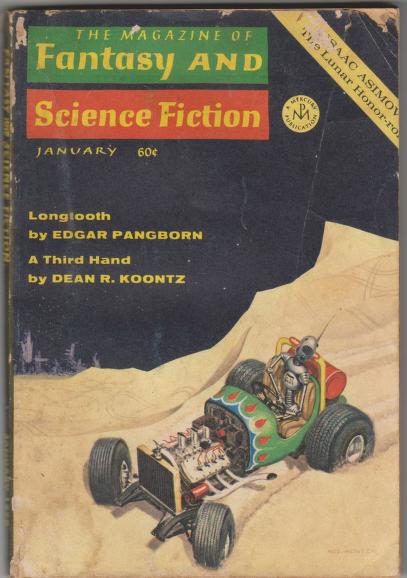
(Cover by Mel Hunter. F&SF, January 1970.) Who Goes There?
Edgar Pangborn’s career spanned about 25 years, encompassing more or less the third quarter of the 20th century. He took part in the market boom of the ’50s and then remained uniquely himself through the New Wave and post-New Wave periods, although his work got noticeably darker in hue, as is the case with today’s story. He was a New Yorker, although he did spend a few years farming in rural Maine before he entered the world of genre fiction, which more than likely inspired “Longtooth” as well. There’s not too much we know about Pangborn, not helped by the fact that he was never that prolific a writer and he didn’t exactly write bestsellers in his time. He did win the International Fantasy Award for his 1954 novel A Mirror for Observers, and was eventually given the Cordwainer Smith Rediscovery Award as a token of his overlooked talent. He was a lifelong bachelor, never had children, and he was probably gay, although there’s only some circumstantial evidence to suggest this. Nevertheless, Pangborn’s writing often has a stark loneliness about it (at times romanticizing said loneliness a little too much), and a gentleness that for the rather non-humanistic 1950s made him a bit of an outlier. “Longtooth” is a very rare venture into horror for Pangborn, but it still feels characteristic of him.
Placing Coordinates
First published in the January 1970 issue of The Magazine of Fantasy and Science Fiction. It’s since been reprinted in The Best from Fantasy and Science Fiction: Nineteenth Series (ed. Edward L. Ferman), A Treasury of Modern Fantasy (ed. Terry Carr and Martin H. Greenberg), The Best Horror Stories from the Magazine of Fantasy and Science Fiction (ed. Edward L. Ferman and Anne Jordan), Foundations of Fear (ed. David G. Hartwell), Strange Dreams (ed. Stephen R. Donaldson), and the Pangborn collection Good Neighbors and Other Strangers.
Enhancing Image
Ben and Harp are two New England hicks in their fifties, so a little past middle age. Ben is a widower and his son died tragically young, while Harp married Leda, the “problem” being that Leda is 28 while Harp is 56. The other problem is that Leda doesn’t wanna live in the country, but Harp is dead set on staying in the cabin his ancestors had built—never mind the harsh weather, or the lack of local prospects for someone of Leda’s age and disposition, or the fact that someone (or something) has been killing the chickens. Ben is narrating and he tells us that his “word is good,” which should immediately raise alarm bells for the reader. I’m starting to resent the term “unreliable narrator” partly because, as Gene Wolfe (or maybe it was Nabokov) had said, every narrator is unreliable, even if it’s an “omniscient” third-person narrator. There’s always information the reader is not given, which you could say is an inherent limitation of literature, but more often this openness of detail can be an asset. Ben is fairly old, and as we find out he also survived a heart attack and a stroke, although how that happened won’t be revealed until much later. The idea is that Ben is not so much a liar as the equally viable reason for a narrator being unreliable, in that his memory might be faulty. Pangborn is informing us upfront that we probably shouldn’t take the narrative at face value.
“Longtooth” is ostensibly a horror story, but it could also be considered a domestic drama, albeit one where the conflict between the domestic partners is more implied than shown. Harp and Leda don’t exactly have a happy marriage, not that Ben is quick to say anything about it. “You walked on eggs, with Harp,” as he says. The two had married seven years ago, and there’s a room decorated with things meant for a baby, including a crib; yet there’s no baby. Apparently the two tried to have kids, but it didn’t work out. The only thing they have that isn’t a farm animal is a fat old dacshund mix named Droopy. It doesn’t help that Leda had a reputation as the town bicycle before getting hitched with Harp, and even as a married woman she still gets gossiped about. (By the way, Darkfield is such a fucking spooky name for a town, in that rural New England fashion, that I have to wonder if Stephen King copped it at some point. He has almost certainly read “Longtooth.”) Leda also wants to get a job, but Harp won’t let her, or at least he’s not keen on the idea. And then there’s the age gap. Leda was 21 when they married, which, as someone who was 21 at one point, is mighty young, although there’s nothing illegal about the arrangement. The stranger part is that Harp (like Pangborn) was a bachelor deep into his forties, who had never married before or seemingly even had a long-term relationship, when he met Leda. One has to wonder why the two hit it off in the first place; it wasn’t for the money or status, Harp being a poor farmer, and Leda herself being of ill repute. “I suppose [Leda] had the usual 20th-Century mishmash of television dreams until some impulse or maybe false signs of pregnancy tricked her into marrying a man out of the 19th.”
But that’s just one mystery.
The other is that Harp confides in Ben that he’s seen the thing (for he struggles to call it a person) that’s been terrorizing his farm: a humanoid, unnaturally tall, more or less covered head to toe in fur, and with teeth big enough to tear a person’s head off with ease. Ben takes to calling this creature Longtooth. Of course Ben has never seen Longtooth himself, so he can only take Harp’s word on the matter; but Harp, for all his faults, is not a liar. So we’re told. At the very least Harp is convinced it’s not a bear, given he’s hunted those and knows damn well what they look like. But it would also be hard to believe that a man could live in the forests of Darkfield by himself, in which the area gets quite literally several feet of snow in the winter, as happens to be the case now. It becomes even harder to believe when, while Ben and Harp are outdoors, Longtooth breaks into the cabin through the window on the second floor, kills Droopy, and kidnaps Leda. What a Yeti-like creature could want with a human woman makes the two friends shudder, and they figure that even if they do find her she’ll most likely be dead. To their credit, though, and despite the fact that the story Harp would have to give is absurd on its face, they do call the local authorities. Ben and Harp (especially Harp) are not book-smart, but I do like it when even rustic characters like these try to make smart decisions. “Longtooth” is a meaty 15,000-word novelette, and while the plot is by no means complicated if taken literally, there’s a lot of setting detail and psychology, less about action and more about characters thinking about what actions to take. As expected with Pangborn, it has layers.
The authorities suspect Harp killed Leda and hid her body in the wilderness somewhere, and that Ben is in cahoots with Harp, but as Our Heroes™ are quick to point out, this would be a very hard task for two slightly-past-middle-age men, not least the window which had been broken from the outside. But then the idea of a Yeti kidnapping Leda is also ridiculous. It’s the improbable versus the impossible, and the only witnesses claim the latter is, in fact, possible. It’s possible that Harp and Ben have made the whole thing up and that some ordinary man kidnapped Leda, or that maybe Leda hadn’t been kidnapped at all, but as we’re told multiple times, neither of these men is given to making things up; they might have faulty memory, or only see part of the reality, but they don’t lie. Then again, the average person may consider it easy to believe an unusually tall and brawn man caused all this trouble rather than a Yeti with abnormally large teeth, yet Harp is convinced he saw such a creature. Maybe he wants to believe he’s seen such a creature? As Dr. Malcolm (not that Dr. Malcolm), a biologist and friend of Ben’s, points out, “Men can’t stand it not to have closed doors and a chance to push at them.” Harp, in his grief, may be mistaking something improbable for something utterly fantastical—or he may be trying to cover his own tracks. We’re stuck in Ben’s head the whole time, and even his motives are sort of up in the air; meanwhile Harp remains such a mystery to us, despite spending a lot of time with him and after some backstory. We’re not sure if we can trust this man who may have killed his wife.
There Be Spoilers Here
Of course, when Ben and Harp finally do find Leda, who is still alive, albeit deranged, something very strange happens. Upon finding her in the cave Longtooth had taken her to, Harp kills his wife, shooting her “between the eyes,” without any words spoken between them. Harp never gives a reason for why he does this and, just as strangely, Ben never questions it. Is this an honor killing? Did Harp think his young wife had been violated by the creature? Did he think she had utterly lost her mind and sought to put her out of her misery? Was it… somehow out of jealousy? We never get an answer, because soon Harp and Longtooth have a showdown and kill each other, Longtooth strangling Harp while Harp shoves his hunting knife in the creature’s side. Afterward the authorities fail to find the creature’s body, yet surely something or someone must’ve killed Harp. Ben, in the wake of all this, has a heart attack and a stroke, and miraculously survives both despite being on his own, in the freezing wilderness. Yet this might be only slightly less miraculous than a long-tooth Yeti in Maine. Ben has been in the hospital this whole time, and can barely move his body, but he’s mobile enough to write this memoir of sorts, or account—maybe to absolve himself of a crime, if there really was no Longtooth. The creepiness of the story comes partly from the creature’s inexplicable and uncanny existence, but Pangborn also uses ambiguity to unease the reader, raising questions and giving surprisingly few answers, in effect leaving a door open. It’s not viscerally scary, but its openness makes it discomforting.
A Step Farther Out
It took me a few hours to get through this one, which I know is quite slow for a short story, but mind you that a) I was taking notes, and b) I was reading a scanned copy of the F&SF issue, which is simply a more laborious process than reading a physical book. This is certainly a story that demands some notes, though, and also time to think about it. It feels both unusual for Pangborn and something that would’ve been in his wheelhouse, especially late in his career when he seemed to have become more weary of humanity. It’s creepy, but it’s also sad and in parts ambiguous. The whole strange ordeal might’ve really happened, or maybe not.
See you next time.
-
Things Beyond: October 2024

(Cover by David Palladini. F&SF, April 1977.) Let’s talk about horror.
Everyone has their preferences when it comes to genre, which makes sense; there are only so many hours in the day, and time plus one’s temperament equals a preference for literature that seeks to entrance, excite, and/or titillate. We also like to be scared sometimes, or at the very least uneased. I’ll be honest with you, when someone tells me they simply have no appetite for horror I’m tempted to give them the side-eye. As far as my own genre preferences go I would put horror only behind science fiction—and not by much. The key difference is that I can enjoy SF at really any length, whereas I very much believe horror is at its best at short story and novella lengths, which is an old-school belief not least because the novel has dominated horror since at least the ’80s.
The conventional narrative (and I do think this is more or less accurate) is that prior to the ’70s, horror had at most fleeting moments of mainstream recognition. There were exceptions, but they were exceptions that proved the rule. Maybe ever few years you got a horror novel that reached bestseller status. But then, in the ’70s, what had been a once-in-a-blue-moon thing became something of a trend, arguably started when William Peter Blatty’s The Exorcist and Richard Matheson’s Hell House both came out in 1971. In the film world the influx of horror can be explained by the advent of the MPAA rating system combined with independent studios like New World Pictures pumping out exploitation cinema by the truckload, but in the literary world the rise of horror is harder to explain—except for one thing. Stephen King had been writing since the late ’60s, but his debut novel Carrie became a bestseller when it was published in 1974, and the crazy part is that noy only did King (a snotty 26-year-old at the time) gain overnight success, he managed to sustain it with more hits. The meteor shower that was King in the ’70s brought a change to horror that it had not seen before, and frankly will probably never see again. Many writers (some of whom are more elegant than King) would hop on the horror bandwagon, but none can be said to have reached King’s level.
While the horror novel was in, the short story was not so much. For most of the ’70s The Magazine of Fantasy and Science Fiction was the only genre magazine to publish horror with any regularity. Magazine of Horror did mostly reprints, and by 1972 was no more, while Weird Tales had a brief revival in the early ’70s, only to go dormant again. So it was up to F&SF to pick up the slack. For the magazine’s 75th anniversary, and in covering short stories from the ’70s, we’ll be focusing more on horror, dark fantasy, and spooky science fiction. These are mostly the usual suspects when it comes to horror, but there are one or two surprises.
For the short stories:
- “Longtooth” by Edgar Pangborn. From the January 1970 issue. One of the most criminally overlooked SF writers of the ’50s through the ’70s, Pangborn wrote some pretty touching fiction that went against the rather hard-headed norm of the times. He would spend the last decade or so of his life on a post-apocalyptic continuity, but “Longtooth” is both a standalone and detour into horror.
- “The Smell of Death” by Dennis Etchison. From the October 1971 issue. Etchison started writing in the ’60s, but he gained more prominence in the following decade as the horror boom for film and novels had kind of a trickle-down effect. He would also later become acclaimed as an editor, on top of writing, winning the World Fantasy Award multiple times for his horror-centered anthologies.
- “In the Pines” by Karl Edward Wagner. From the August 1973 issue. Wagner debuted in 1970 and would remain a mainstay of horror and heroic fantasy until his untimely death in 1994. Last time we read Wagner it was one of his Kane stories, but “In the Pines” is an early example of his mastery of scares. I believe this also marks his only appearance in the pages of F&SF.
- “The Same Dog” by Robert Aickman. From the December 1974 issue. Aickman has a reputation as a writer’s writer, with good reason, being your favorite horror writer’s favorite horror writer. He debuted in the early ’50s but remained a hidden gem in the UK until the ’70s. Aickman would appear in F&SF several times throughout this decade, with “The Same Dog” being an original publication.
- “The Ghastly Priest Doth Reign” by Manly Wade Wellman. From the March 1975 issue. Wellman remained a presence in American fantasy writing for six decades, and especially in the latter half worked to evoke the rural mysteries of his adopted home state of North Carolina. For better or worse Wellman’s most authentic fiction is distinctly Southern in flavor, this story being one example.
- “My Boat” by Joanna Russ. From the January 1976 issue. Known much more for her SF and criticism, a fair amount of Russ’s fiction (especially early on) was horror, such that even some of her SF oozes with a certain existential dread. She even wrote a few stories set in the Cthulhu Mythos, of which “My Boat” is one. I suspect this will be a Lovecraft pastiche with a Russ-type twist or two.
- “Manatee Gal Ain’t You Coming Out Tonight” by Avram Davidson. From the April 1977 issue. This will be the first time we’ll be reading a story by one of F&SF‘s editors. Davidson was already a respected writer when he took over F&SF for a few years in the early ’60s, injecting the magazine with eccentricity. This story is actually the second in an episodic series starring Jack Limekiller.
- “Hear Me Now, My Sweet Abbey Rose” by Charles L. Grant. From the March 1978 issue. Grant got his start in the ’60s and would soon become one of the moodier and more experimental horror writers of the following decade, winning awards for his efforts. Truth be told, I’ve not been keen on the Grant I’ve read, but as I’ve said before, I’m usually open to giving authors another chance.
- “Red as Blood” by Tanith Lee. From the July 1979 issue. This is the third consecutive time Lee’s appearing on my October slate, although this won’t be the case next year for reasons I’ll give… in due time. But for now it’s safe to say I’ve warmed up to Lee, gradually, and can see how for decades she was a mainstay of horror and dark fantasy. “Red As Blood” marked her first appearance in F&SF.
Won’t you read with me?
-
Short Story Review: “David’s Daddy” by Rosel George Brown

(Cover by Burt Shonberg. Fantastic, June 1960.) Who Goes There?
Something about history is that it’s full of lost opportunities and near-misses, and this applies to genre history as well. Rosel George Brown is one of those writers who seemed on her way to becoming at the very least a major figure in feminist SF writing, but her premature death stopped this in its tracks. She was born in 1926 and died in 1967, of lymphoma, just as the New Wave was kicking into high gear and feminism was becoming more entrenched in the field. Women’s Lib and all that. Brown debuted in 1958 and wrote at a somewhat sporadic pace for the next nine years, probably because she had a day job as a teacher and she would’ve gotten most if not all of her writing done during summer vacation; that Brown was a teacher is particularly relevant to today’s story. Of course, it’s hard to say if Brown would’ve become a major figure had she lived longer, given that her output of short fiction had slowed down to a trickle in the last few years of her life, presumably to do what pretty much every female genre writer at the time did: focus on novels. She co-wrote Earthblood with Keith Laumer, plus two solo novels starring the detective Sibyl Sue Blue. “David’s Daddy” was part of the meteor shower of short stories Brown wrote at the start of her career, it being a nominally SFnal classroom drama.
Placing Coordinates
First published in the June 1960 issue of Fantastic. It’s been reprinted only twice, and one of those you can only access with the Wayback Machine. We have The 6th Annual of the Year’s Best S-F (ed. Judith Merril) and a digital reprint on the long-defunct Sci Fiction. Curiously all three editors who picked this story were women.
Enhancing Image
Lillian (I don’t think we ever get her last name) is evidently a young teacher who looks up to her older colleague, Ms. Fremen, primarily because Ms. Fremen has a perfect grip on her students. “The cadence was perfect. No face was sullen. No face rebellious.” Lillian is trying to learn “the Frown,” which she hopes can help get her students under control, to make them perfectly obedient. This is a telltale sign of the story being culturally set in the ’50s, even though it was published in 1960—granted that it would’ve been written a year or even two years earlier. The ’60s had not properly started yet. This was the age of (at least what the adults considered) out-of-control juvenile delinquency, a trend that seemed to continue through the JFK years. It’s this context, in which those of the silent generation (those born between, say, 1935 and 1945) sought to rebel against middle-class sprawl, that compelled Robert Heinlein to write Starship Troopers. Lillian, probably being around Brown’s own age at the time, is chiefly concerned not with her students’ happiness, or even their engagement with the material, but their capacity to follow orders. It’s easy to assume at first that we’re supposed to take Lillian’s draconian relationship with her students as a good thing, but we’re about to be shown (rather than told) that her desire for obedience at the expense of everything else is a character flaw.
“David’s Daddy” would be a totally non-genre slice-of-life narrative if not for two wrenches being thrown into the equation: the first is a boy named Jerome, one of Ms. Fremen’s students, who is implied to be telepathic. I’m not counting this as a spoiler since we’re introduced to Jerome and his weird gift early enough, but this is the one thing that makes the story SFnal, and only arguably at that. Ms. Fremen tells Lillian that Jerome has some kind of telepathic connection such that he is clairvoyant, although this gift is never given an SFnal explanation. I’m reminded of Stephen King’s Carrie, or more specifically how in the book Carrie’s telekinesis is explained as the byproduct of a very rare recessive gene (the book is, in fact, science fiction), whereas in the 1976 film we’re never given such an explanation. Jerome’s psi power may prove a problem in a different story, but in this story it will turn out to be an incalculably valuable asset. Not that Ms. Fremen or Lillian can make any sense of it. As Ms. Fremen says, in one of the story’s funniest lines, “I’ve been teaching for twenty years, […] I don’t have any imagination.” The other thing is that a strange man who looks like a bum has been loitering on school grounds, which Lillian finds concerning, yet apparently this is not enough to evacuate the school. “In this neighborhood, a good third of the daddies looked like bums. Hell, they are bums.” The bum in question, Mr. Mines, turns out to the father of David, one of the shyer kids in class. This does not make the situation better.
One thing I really like about “David’s Daddy” is how it balances a kind of breezy humor with what turns into a pretty serious situation—especially from a modern perspective, where school shootings have become depressingly commonplace. Evidently shootings on school grounds were not a major concern in the late ’50s, but bomb threats would’ve still been a thing, and some children did (as they do now) have to live with abusive parents. We never find out much about David or his daddy, but while the drunk-looking man is confirmed to be his father, the two don’t seem to have an idyllic relationship. Mr. Mines has come to school to pick up his son, for no clear reason given and well before class has ended. This in itself is concerning, only made more so because the school doesn’t seem to have any security to speak of. (Lillian considers telling Mr. Buras, the school principal, about the situation, but she’s doubtful he will actually do anything about it.) The whole thing is creepy, probably even more so with our current understanding of kids’ safety than it would’ve struck readers at the time. Brown writes Lillian as a flawed but relatable would-be heroine, with some self-deprecating humor about the thankless job of teaching thrown in. It’s a balancing act that she makes work in only ten pages.
The humorous and then creepy scenario takes a deadly serious turn, though: Mr. Mines has put a bomb somewhere in the school, and Jerome is the only person who might know where it is.
There Be Spoilers Here
Mr. Mines came to take David out of class before he bombed the place, but after Lillian distracts him enough it seems he’s grown content at the thought of killing his own son, along with his classmates. We never learn why Mr. Mines would do such a thing, other than that he is supposedly an alcoholic, maybe having grown tired of living as a bum. David’s relationship with his dad is only faintly implied, since David himself says very little, but the boy’s timidness generally and around his father especially implies an abusive relationship. So there’s a bomb, and Jerome with his psi power can track it down like a bloodhound—only he can’t do it alone. Lillian and Jerome have to work together to pinpoint the bomb before it’s too late, meaning Lillian has to trust the boy and his gift in order to save the day. Naturally they do, but it’s still a tense situation, one that requires Lillian be a model teacher and stop panic from spreading whilst keeping her own nerves in check. At one point the strain gets to her and breaks down in front of Jerome, a moment of emotional vulnerability that leaves her feeling ashamed. Teachers aren’t “supposed” to show emotions like that. “Children are terribly frightened when grown people lose control.” She ultimately finds that she can’t be the domineering statue of a woman she wants to be—she has to learn to be content simply as a woman with feelings. In a strange role reversal from what we usually see it’s the woman and not the man (or in this case boy) who has to accept emotional vulnerability.
A Step Farther Out
I said earlier that all the people who chose this story for publication were women, and I don’t think it’s a coincidence. While not a feminist story of the flavor we would see later in the ’60s, “David’s Daddy” is very much a story about women’s experiences, as told by someone who knew very well what it was like. The only adult male characters are either dangerous (Mr. Mines) or useless (Mr. Buras), while the well-adjusted female teachers have to cooperate with their students. The male students who figure into the plot (Jerome and David) are also not delinquents or all that macho; indeed they’re soft-spoken kids who are strangely bereft of what we think of as typically boyish behavior. I’ve read a few Brown stories and there’s this running theme of not so much reconciling the sexes or even arguing for women’s rights, but trying to explain women’s experiences in a field that was very much male-dominated. Yet I don’t get prudish or conservatives vibes from Brown like I do with say, Zenna Henderson, although both writers were preoccupied with teachers and their students.
See you next time.
-
Subscribe
Subscribed
Already have a WordPress.com account? Log in now.
 Science Fiction & Fantasy Remembrance