-
Things Beyond: May 2024
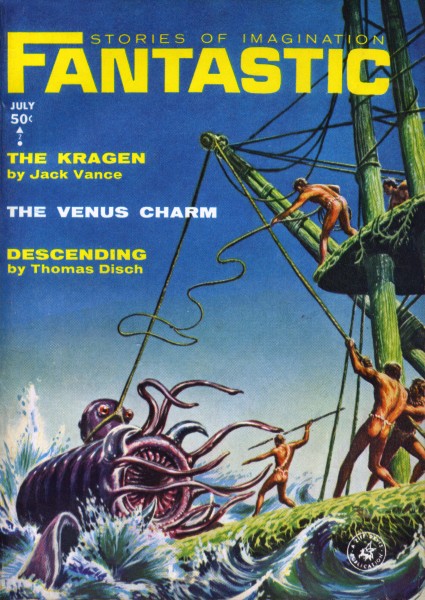
(Cover by Ed Emshwiller. Fantastic, July 1964.) Not much to say with regards to updates here, other than I’m looking into a tutoring gig and I seem to be starting a polycule, the latter of which I’ve heard is kinda like starting a rock band. If anyone wants to join, please let me know. There are no gimmicks for this month’s review forecast, except that we have a complete novel on our hands for the first time in what feels like forever, and we’ve got a few familiar faces returning to the site. I may have also intentionally picked Lucius Shepard and Aliette de Bodard stories with similar titles. One thing I’ve been thinking about that I’ve decided to act on is reviewing more reprints of classic stories; one every couple months seems like a good deal. The reason for this is at least twofold: I have a soft spot for the classics, but I also wanna cover authors from the pre-pulp years who contributed to genre fiction. This month I’ll be reviewing an SF story by Jack London, who is not known primarily for his SF but who indeed wrote a lot of it. Once again Jack Vance will be providing the novel, which is unsurprising since quite a few of his novels first appeared in magazines, either as serials or all in one piece like this month’s novel.
Don’t wanna keep you long; just letting you know we have another month packed with fiction that looks to be at least interesting, although it’s mostly SF with a couple fantasy stories thrown in.
For the novellas:
- “Birthright” by April Smith. From the August 1955 issue of If. Smith sadly is one of many women who wrote SF in the pre-New Wave days whom we know basically nothing about. We don’t know when she was born or when she died. She’s a ghost. She has one solo story, “Birthright,” to her credit, plus one collaboration. ISFDB classifies this story as a novelette, but running the Project Gutenberg text through a word processor shows it’s just over 17,500 words.
- “Polyphemus” by Michael Shea. From the August 1981 issue of The Magazine of Fantasy and Science Fiction. Shea had a varied career, lasting from the ’70s until his death in 2014. His work ran the gamut from SF to high fantasy to the Cthulhu Mythos. He won the World Fantasy Award multiple times for his fantasy and horror. His most famous story, “The Autopsy,” is an SF-horror hybrid, and “Polyphemus” looks to be a similar blend of the two genres.
For the short stories:
- “The Shadow and the Flash” by Jack London. From the June 1948 issue of Famous Fantastic Mysteries. First published in 1903. London was one of the most popular and prolific authors of the early 20th century, despite dying young. He’s best known for his adventure stories set in the Klondike, such as The Call of the Wild and White Fang, but he also wrote a surprising amount of science fiction.
- “The Witch of Orion Waste and the Boy Knight” by E. Lily Yu. From the September-October 2016 issue of Uncanny Magazine. Yu burst onto the scene with her story “The Cartographer Wasps and the Anarchist Bees,” which nabbed her several award nominations. She won the Astounding Award for Best New Writer the same year she graduated from Princeton, which is no small feat.
- “The Jaguar Hunter” by Lucius Shepard. From the May 1985 issue of The Magazine of Fantasy and Science Fiction. Speaking of late bloomers, Shepard didn’t start writing fiction as an adult until he was deep in his thirties, but he quickly emerged as one of the defining SFF writers of the ’80s. If you’ve read enough Shepard then you know he has a “type,” and this story looks to be typical Shepard.
- “Descending” by Thomas M. Disch. From the July 1964 issue of Fantastic. Feels like it’s been a long time since I covered Disch, with his novel Camp Concentration. Disch was one of the daring young writers to kick off the New Wave in the ’60s, although despite being a regular at Michael Moorcock’s New Worlds he actually first appeared in Fantastic, under Cele Goldsmith-Lalli’s editorship.
- “The Defenders” by Philip K. Dick. From the January 1953 issue of Galaxy Science Fiction. It’s been ten months since I last talked about Dick on here, which in my book is too long a wait. The thing about Dick is that he’s become frankly over-discussed in “serious” SF discussions, or at least his most famous novels. Thankfully this is not the case with many of his short stories, such as this one.
- “The Jaguar House, in Shadow” by Aliette de Bodard. From the July 2010 issue of Asimov’s Science Fiction. Of Vietnamese heritage, living in France, and writing predominantly in English, de Bodard has a curious cultural background, so it makes sense she would concoct one of the most curious future histories in modern SF. Spacefaring humanity here is decidedly non-white and non-American.
For the complete novel:
- Planet of the Damned by Jack Vance. From the December 1952 issue of Space Stories. The early ’50s were a formative period for Vance, who was showing himself to be one of the most imaginative talents at the time—albeit one whose efforts were mostly relegated to second-rate magazines. I’ve previously covered Big Planet, which was a breakthrough title for Vance, and now we’re on Vance’s follow-up novel, published just a few months later. Planet of the Damned has a rather convoluted publication history: as with Big Planet, the magazine version and not the first book version served as the basis for future “definitive” reprints. It’s also been printed as Slaves of the Klau and Gold and Iron.
Won’t you read with me?
-
Short Story Review: “The Growth of the House of Usher” by Brian Stableford

(Cover by Pete Lyon. Interzone, Summer 1988.) Who Goes There
Brian Stableford started out as a fan, and even made his professional debut while still a teenager back in the ’60s. His early start implied a fierce intellect, which he would then go on to vindicate by contributing to the field in several disparate ways—all of them rather intriguing. He was an author, sure, but he was also a prolific translator, possibly being the person most responsible for bringing modern French SF to an English readership; and on top of that he was an editor and genuine studier of the field, even contributing to the SF Encyclopedia. If you’re like me and you like to dig through genre history then you’ve very likely already gotten a taste of Stableford’s writing, if not necessarily his fiction. It makes sense, then, that today’s story is all about history—family history as well as genre history. It’s tempting to call “The Growth of the House of Usher” an Edgar Allan Poe pastiche, but that isn’t quite right. Does it live up to its famous namesake? Hmmm. Almost. Stableford made a solid go at it.
Placing Coordinates
First published in the Summer 1988 issue of Interzone, which for some reason is not on the Internet Archive. Most of Interzone‘s back issues up to like 2010 are on there, but not this one. It is on Luminist, but… whether I provide a link to Luminist depends on what mood I’m in. Like what even is it? Some weird new age thing? Anyway, this story was then reprinted in The Year’s Best Science Fiction: Sixth Annual Collection (ed. Gardner Dozois), Interzone: The 4th Anthology (ed. John Clute, Simon Ounsley, and David Pringle), and the Stableford collection Sexual Chemistry: Sardonic Tales of the Genetic Revolution.
Enhancing Image
It’s impossible to talk about this story without also talking about Poe’s, which I’ve read several times over the years and which I just (as I’m writing this) finished rereading it. So consider this a review and a half. Needless to say I’ll be spoiling both, although the Poe story is so famous that unless you live under a rock you already know the broad strokes of that one. I’ll be spoiling the Poe story early and with extreme prejudice.
Immediately there are some parallels. The unnamed (in both cases) narrator travels (by motorboat in the Stableford, by horse in the Poe) to the secluded manor of his friend whom he has not spoken with in years, Rowland Usher. Rowland is the last of the Ushers, a sickly man who never married or had offspring, and who evidently is grieving over the death of his sister. In the Poe, the sister (Madeline) died very recently, such that Roderick and the narrator are able to place her still-warm body in the family vault. (Turns out she’s not as dead as she appeared.) Unlike her Poe counterpart, though, Rowland’s sister (Magdalene) is super-dead; in fact she died several years prior to the story’s beginning, as a teenager. Not everything lines up, much to the narrator’s relief. “I think I might have been alarmed if Rowland had told me that his sister were still alive, and had I seen her flitting ethereally through the apartment just then. This would have been one parallel too many for my tired mind to bear.” But still, Rowland is dying, and has called on his old college friend to hear his last will and testament—and to understand the very odd experiment that is the Usher house.
“The Growth of the House of Usher” is very much a recursive story, probably even more so than the usual, in that not only does it openly take after a classic work, and not only does it expect the reader to already be familiar with the story it’s taking after, but the characters within the story are also aware that they’re inside a recursive tale. Rowland Usher had intentionally modeled the house after the Poe story, although interestingly more as a response to it than out of sheer respect. The new Usher house is also, in a weird way, alive. Rowland’s been a devotee of biology for years; it runs in the family. He’s been using this knowledge to run experiments, with his own house as what he hopes will be his finest achievement. This fixation on biology might come from the fact that the Ushers have been afflicted with a hereditary illness akin to cancer that’s now whittled their numbers down to one man. The women in the Usher family took this illness worse than the men, dying in the teens like Rowland’s sister did. In the Poe story, the physical defects in Roderick and his sister are implied to come from acute incest—the Usher family tree being less like a tree and more like a long blade of grass. Similarly Rowland and his sister were also in an incestuous relationship, although this is made explicit rather than implicit, with the narrator admitting that by the 22nd century the taboo against sibling incest had become more or less a non-issue.
Let’s talk about incest some more, since it figures so heavily into the basic “Usher” narrative, both literally and symbolically. Something to keep in mind about when Poe lived, in the first half of the 19th century, consensual incest was by no means uncommon—so long as it was between cousins. It was a regular practice in the US and UK, among the aristocracy and even in lower-income households. Poe himself was betrothed to his cousin Virginia, and while there’s been debate for decades as to whether the couple ever “consummated” or if it was more platonic, a) to think the couple’s relationship was not even romantic would be wishful thinking on the part of puritans, and b) the fact is that from we do know, Poe very much loved Virginia, and was stricken when she died—possible driven to despair. And yet one has to admit that “The Fall of the House of Usher,” arguably Poe’s greatest story and undoubtedly his biggest contribution to the Gothic tradition, is strangely transfixed on the prospect of a family being undone by long-term incest—even if said incest is only alluded to. Poe and Virginia had been married for a few years, with Poe only pushing thirty when he wrote “Usher,” and yet despite Virginia’s tuberculosis diagnosis still being a few years off it’s a story all about sickness. Of course, if you’ve read enough of Poe’s fiction then you start to figure he was always kinda Like That™, being obsessed with the sickly and morbid.
Poe’s influence on Stableford’s story is so strong that even the narrator talks in a way that mimic’s a typical Poe narrator, although it’s unclear if this pseudo-Victorian manner is just a quirk the narrator and Rowland have or if it had somehow become in vogue for educated Americans in the 22nd century, since there are basically no other human characters to speak of—at least none currently living. It’s also possible that reading a ton of Poe, Byron, and other Romantic-era writers during his stay at the Usher house had an influence on the narrator’s speech, since by his own admission he has started to even dream of Poe-esque terrors. “I—a scientist of the twenty-second century—was infected by the morbidity of the Gothic Imagination!” To make matters worse, the narrator catches a glimpse one night of a young and for some reason naked girl, “fourteen or fifteen,” coming out of Rowland’s bed chamber, but doesn’t get the chance to intercept her before she makes off into the night. In fairness to the narrator, he’s not even sure if this is really happening at first, and anyway it’s certainly hard to explain. Could this be Rowland’s dead sister? But Magdalene died years ago; even if she were still alive somehow she would be visibly older than this. It’s also this aspect of the story where I think Stableford goes too far, or rather he goes far without a constructive reason behind the transgression that I can discern. I had heard this story contains “creepy sex stuff” and I’m pretty sure the “stuff” with the teen girl is what’s being referred to here.
Since “The Growth of the House of Usher” is all about biology and genetics, it must also—by extension if nothing else—be about sex. This is a dangerous game for writers, especially SF writers. Prior to the ’50s there was almost no discussion or even mentioning of sex in genre SF (I say “the ’50s” and not “the ’60s” because, as a devotee of ’50s SF, I can tell you that authors at that time were often incredibly horny, only they didn’t show it in as crass a language as the New Wave folks), and so in the years following the laxing of censorship some authors took it upon themselves to go maybe too far in the other direction. The ’70s were an especially bad time for this sort of thing (read twenty post-New Wave SF stories at random and take a shot every time there’s a dubious relationship between a grown-ass adult and a teenager), marring what in some cases would otherwise be great fiction. I find it interesting that Stableford would turn the subtext of Poe’s “Usher” into text while also flipping the house of Usher itself on its head by turning a deeply unnatural work of architecture (indeed a house that’s implied to have its own genius loci) into a house that is made up of thousands of living organisms—a house that quite literally lives and breathes. At the same time the subplot with Rowland’s sister a) doesn’t quite mesh with the ambitious genetic engineering of the house, and b) almost smacks of wish-fulfillment rather than contributes to the psychology of the narrative. It enters a level of creepy that Stableford probably hadn’t intended.
There Be Spoilers Here
Being faced with the immanent death of himself and his bloodline, Rowland has put his research into building something that won’t sink into the swamp like Roderick’s mansion—indeed a living construct which will, with time, grow to even more extravagant heights. The house “was greater than ten thousand elephants, and that if it had been a single organism then it would have been the vastest that had ever existed on Earth.” It’s a wonder of the world, a marriage between genetics and engineering that, so we’re told at the very end, has only grown since Rowland’s death. And Rowland does die, unfortunately, on the night he tells the narrator all about his family history, his relationship with his late sister, the ways in which their father treated them as “guinea-pigs,” and what he hopes for the future—a future he knows he won’t be a part of. The narrator tries to take care of his friend’s affairs after his death; it’s not like Rowland had a next of kin to do this. Oh, and then there are the “mayflies,” which from what I understand are insectoid beings who appear human, indeed have DNA shared with Rowland’s late sister and thus resemble her. I don’t like to think about that, because it’s very weird, and not in a good way. I wish Stableford was still alive so I could ask him what he could’ve possibly meant by this. Like what was bro cooking? Again the weird stuff mars what is otherwise a good ending.
A Step Farther Out
I liked it for the most part, although part of that might be my love of Poe and genre history—loves which Stableford happens to share. I probably should’ve mentioned at the beginning that “The Growth of the House of Usher” spawned from a speculative non-fiction book Stableford wrote with David Langford, The Third Millennium: A History of the World AD 2000-3000, which would serve as the basis for a future history called the Biotech Revolution. “The Growth of the House of Usher” was the first story written for this future history, although what stories exactly are part of this future history is unclear since there’s not a complete overlap between stories included in Biotech Revolution collections and what ISFDB counts as part of the series. It’s a bit complicated, but it’s also intriguing.
See you next time.
-
Short Story Review: “Original Sin” by Vernor Vinge
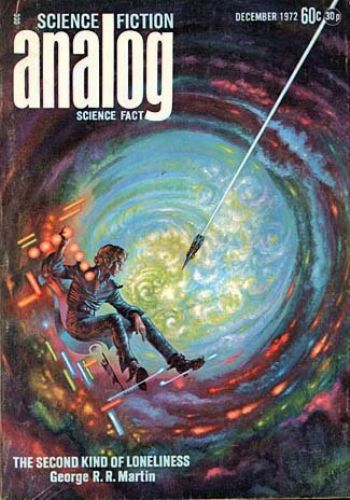
(Cover by Frank Kelly Freas. Analog, December 1972.) Who Goes There?
Vernor Vinge died last month, in what turned out to be a battle with Parkinson’s; and it was one of the most crushing losses for the field in a long time, because Vinge was one of the most creative mind of his generation. Despite not being a very prolific writer, and despite his work being all over the place in terms of quality, Vinge at his best was one of those rare talents, like Philip K. Dick and Harlan Ellison at their best, who genuinely pushed the field in new directions and made readers and fellow writers see new horizons. His novella “True Names” is a seminal work of cyberpunk that came out just before the word “cyberpunk” would be coined, and modern readers will find it holds up to an eerie degree today. His duology The Peace War and Marooned in Realtime might’ve been the first prolonged attempts at speculating on human life right before and after the technological singularity—a term Vinge did not invent, although he did popularize it. His loosely linked novels A Fire Upon the Deep and A Deepness in the Sky both won him Hugos, and more importantly they revolutionized the space opera during what was already a renaissance for the subgenre. Vinge is unwittingly responsible for a generation of Elon Musk fanboys—but let’s not hold that against him.
With the notable exception of “True Names,” Vinge is not known for his short fiction, although that didn’t stop him from winning the Hugo for Best Novella twice. “Original Sin” is pretty obscure, even as far as Vinge’s short fiction goes; so far I’ve seen a total of one solitary person talk about it, albeit positively. It’s early Vinge, and while it was published during Ben Bova’s tenure at Analog it might be a story John W. Campbell had bought right before his death; it reads like a classic Campbellian narrative—with a little twist. It’s flawed, in the way Vinge’s earlier writing tends to be flawed, but while it starts out rough it does have some points of interest.
Placing Coordinates
First published in the December 1972 issue of Analog, which is not on the Internet Archive but which can be found on Luminist. I happen to have a physical copy of this issue. “Original Sin” was then reprinted in the Vinge collections Threats… and Other Promises and The Collected Stories of Vernor Vinge. Would be nice if we got an updated version of the latter since it doesn’t include the several short stories and novellas Vinge put out afterward.
Enhancing Image
Humanity has not only reached beyond our solar system but encountered intelligent life in the process. It’s been about two centuries since humanity made contact with the Shimans, a sentient bipedal race that’s like a cross between a kangaroo and a shark. The Shimans are a vicious bunch, but also fiercely intelligent—such that within two centuries they went from being pre-agrarian barbarians to having tech and societal structure on par with late-20th century America. Really the only thing keeping the Shimans from progressing even faster is a very short lifespan. “The creatures were really desperate: no Shiman had ever lived longer than twenty-five Earth months.” Enter Professor Kekkonen, a very old (although he doesn’t look it) biologist and both friend and employee of Samuelson Enterprises. Evidently humans have invented a rejuvenating technology that gives people something close to immortality (assuming they don’t get killed), and the Shimans want that same tech. Problem is, “the Empire” (Earth has apparently become united—and imperialistic) doesn’t want Shimans to have said tech; so Kekkonen has been conducting his work on Shiman biology very much illegally, with the help of a bribed “Earthpol” agent. Shit hits the fan, though, when Earthpol gets a whiff of Kekkonen’s scent, with a massive pyramid-like ship hovering over the planet.
Vinge structured the story such that mostly we follow Kekkonen’s first-person narration, which itself I think is a mistake since we can infer right away that the professor gets out of this ordeal alive, and this is supposed to be basically an action narrative. I’m also not big on the voice Vinge gives Kekkonen: it’s too snarky for my taste. This first-person narration is broken up a few times with a third-person perspective that’s all in italics and which is written in a very different style, evoking an old-timey fable or, more accurately, the Bible. The problem here is that Vinge is not a poet; his style at its best can be considered decidedly utilitarian. With the major exception of another early story, “Long Shot,” which is closer to a narrative prose poem than a short story (I think it’s fairly effective as that), Vinge doesn’t capture the imagination with his language so much as his straightforward way of describing things which are in and of themselves mind-bending. We remember the Bobbles, the Tines, the virtual world in “True Names,” and so on, but because of the things themselves and not because of Vinge’s language. The Bible-esque passages regarding the life-death cycle of the Shimans was an earnest attempt, but it doesn’t work for me and this story would’ve been a few pages shorter if I had gotten my grubby hands on it.
I’ve mostly gotten the negatives out of the way, so let me juxtapose that with something I think “Original Sin” does really well, which is the aliens. Despite having two legs, aping human technology, and even being able to replicate human speech (one wonders how they do that given their rows of shark teeth), the Shimans are decidedly not human. The third and final main character, after Kekkonen and Tsumo (the bribed Earthcop), is Sirbat, a Shiman escort is comes out of this story the most interesting of the three in no small part because of his aloof nature. He speaks perfect English and is perfectly willing to cooperate with the humans, considering what’s in for his race, but one also gets the impression he’s constantly holding back a part of himself—probably an urge to eat his own comrades. One reason Earth is very worried at the prospect of Shimans gaining nigh-immortality is that the Shimans are vicious, yes, but they’re also voracious eaters; indeed cannibalism is part of their very biology, since baby Shimans escape the “womb” by devouring their own parent. I say “parent” and not “mother” because the Shimans are single-sex, reproduce asexually, and they seem to all be male, although Vinge is unclear if the Shimans actually identify as male or if male pronouns are simply what the humans use for the sake of convenience. So let’s say the Shimans are males that happen to give birth.
“Original Sin” is basically a problem story, or rather a question story: Is it ethically sound to give an alien civilization technology that could make said aliens an existential threat to other intelligent life in the universe? Is it right for humanity to keep a powerful technology to itself for fear that there may be competition—possibly even a rival for the position of supreme intelligent race? Vinge has always had a keen moral sense, or at least a strong moral curiosity, which you have to admit makes his endorsing of anarcho-capitalism fucking bewildering. (In fairness he seemed to think other forms of anarchism are valid, but felt that anarcho-capitalism, for some reason, was the “correct” option. I’m sorry, I’m getting distracted.) So Kekkonen is in a tough spot: he was hired by a longtime friend to do a job that may or may not result in humanity’s eventual destruction, and at the same time the cop that Samuelson had bribed in the first place is practically begging him to not go through with the experiment. The Shimans of course wanna live a hundred years instead of just two, and wouldn’t Kekkonen feel like an asshole for denying a whole race a longer lifespan? It’s a curious dilemma that acts as good brain food—even if it becomes clear by the end which side Vinge supports.
There Be Spoilers Here
Using this section to talk about Tsumo, who’s a bit of a mixed bag as a character. Vinge ain’t half bad at writing women usually, but he’s on shaky ground with this one. Her backstory is interesting: she had a husband who served as a Christian missionary on Shima, and nobody knows what happened to him—possibly killed and eaten by his own followers. (Should probably also mention Christianity has taken off among the Shimans, despite and possibly because of their ravenous nature.) So Tusmo has a certain vendetta against the Shimans, although she denies this has anything to do with not wanting the little bastards to have extremely long lifespans. At one point towards the end she even seduces Kekkonen and sleeps with him in an effort to stop him from finishing the experiment. Not sure if this was necessary on Vinge’s part. Anyway, it doesn’t work, because Kekkonen reveals that Samuelson wants the Shimans to become competitors with humanity. This all feels like almost an inversion of the Adam-and-Eve myth, hence the title. Adam and Eve give up their immortality for the sake of knowledge, whereas the Shimans are already knowledge-hungry (on top of just being hungry in general) but seek virtual immortality so as to remove the cap for that knowledge-seeking. The “original sin” of the title also refers to the Shimans’ biologically mandated genocide and patricide—the fact that they must eat their own parents and then most of each other.
A Step Farther Out
Do I recommend this story? Hmmm, not unless you’re already familiar with Vinge’s writing and you’re curious about his early work. I would not recommend it as one’s first Vinge story because it’s more apparently flawed than his more mature work, and unlike his first story, “Apartness” (review here), it’s more confused. I actually considered giving up and picking a different Vinge story early on, because this story really does not start on the right foot; but I’m glad I kept with it, because it did get better as it progressed. I could’ve picked a worse story to review in paying tribute to someone I think of as one of the true masters of the field.
See you next time.
-
Short Story Review: “Two Suns Setting” by Karl Edward Wagner

(Cover by Steve Hickman. Fantastic, May 1976.) Who Goes There?
Karl Edward Wagner is one of those recent discoveries for me who sadly I’ve not been able to read a lot more of as of yet, because his works are not exactly easy to find. Wagner is (I’ve been told) arguably the best of the generation of writers to hop on the sword-and-sorcery revival of the late ’60s and early ’70s. He debuted in 1970 with the novel Darkness Weaves with Many Shades…, which was also the first to star his nigh-immortal anti-hero Kane, seemingly based on the Cain of the Bible. In an interview for the fanzine Dagon, Wagner had this to say on his biggest contribution to heroic fantasy:
The idea of Kane came from all the villains that I saw as heroes, derived from reading books, comics and watching movies: the bad gunfighter who would get shot down, who was really faster than the good guy. Good always had to win so I thought I’d write about a villain who always wins. Villains always had to be either like Fu Manchu, or intensely intelligent super scientific geniuses, but they couldn’t really break somebody in half, or else they were big hulking creatures like Rondo Hatton. So I thought what happens if you got the super intelligent villain who could break somebody in half if he wanted to? That’s how Kane came about. He was a villain who was going to win at the end and be smart enough to control the situation when things got bad. If he had to mow down sixty other people he could handle that, that is if he didn’t summon up something supernatural in the process. I thought let’s do something totally all out, and that’s Kane.
“Two Suns Setting” is one of the more notable Kane stories, and even won Wagner his second British Fantasy Award for Best Short Story; the first was for his Lovecraftian horror story (and his most famous story overall) “Sticks.” This also marked Wagner’s first and only appearance in Fantastic, which is weird because you’d think Wagner and Fantastic in the ’70s, when it had become the most high-profile outlet for heroic fantasy, would make a perfect pair. Wagner mostly stuck to fanzines and semi-pros for his stories, which might explain why he’s not as widely read as he should be: few people would’ve been able to read his stuff at the time, but the few who did thought it A+ material. (The fact that he also died young, from severe alcoholism, no doubt helped doom him to obscurity.) He’s probably known more nowadays for his horror stories, which are also highly regarded and which have been reprinted more often than his Kane stories.
Placing Coordinates
First published in the May 1976 issue of Fantastic, which is on the Archive. It was then reprinted in The Year’s Best Fantasy Stories: 3 (ed. Lin Carter) and the Wagner collections Night Winds and Midnight Sun: The Complete Stories of Kane.
Enhancing Image
Normally I don’t talk about the quality of a story’s title, but I really like how this one both sets the tone and expectations for the reader. We can infer that the second sun in the title is a metaphorical one—perhaps a person’s life. We immediately get the sense that there will likely be a death in the narrative, but unlike most deaths in heroic fantasy tales which happen to side characters and mooks, this one will be more bitter, more funereal. Since Kane is a recurring protagonist who has something close to immortality we can guess ahead of time that Our Anti-Hero™ will make it out fine—whoever happens to be with him, not so sure. Anyway, about that special power. Obviously there’s a wish-fulfillment element with Kane aging extremely slowly, to the point of living for centuries whilst barely showing any change, but he can be killed. Kane committed some horrible crime in the past, possibly the killing of his brother although this is not told explicitly, that cursed him with a mark, so that passersby would know him by appearance. Even at this early stage in man’s history (the time of Genesis, when it seemed giants and other mythical beings roamed the earth), he has become infamous. At the beginning of the story he had just left Carsultyal, the first great human city, partly because of said infamy and partly out of boredom.
The spirit of discovery, of renaissance that had drawn him to Carsultyal in its earliest years was burned out now, so that boredom, his nemesis, had overtaken Kane once more. To be sure, he had been restless, his thoughts drawn more and more to the world beyond Carsultyal—lands yet to know the presence of man. But that he returned to his pathless wandering without much forethought could be judged in that Kane had left the city with little more than a few supplies, a double handful of gold coins, a fast horse, and a sword of tempered Carsultyal steel.
So Kane traverses the desert, without a clear destination in mind, aside from the immediate need to find food and water; his supplies are running low. Thankfully he comes across a fellow traveler who has set up camp—a giant named Dwasslir. Eighteen feet tall, the giant is cooking an entire mountain goat for himself. “Kane had seen, had spoken with giants in the course of his wanderings, although in recent decades they were seldom encountered.” Indeed, so Dwassllir admits, his race is surely but slowly dwindling—not for any particular reason it seems but, so Dwassllir suspects, the giants, being a race much older than man, have become collectively weary. Humans, still very young, have already built cities and encroached on nature’s domain, bringing civilization into the world. The giants don’t have cities, or much in the way of civilization, but as Dwassllir argues they are accustomed to living off the fat o’ the land; they don’t need civilization. Humans, being small and rather flimsy compared to their much bigger cousins, use civilization as a “crutch,” as the friendly giant says. Kane, who believes wholly in the glory of man despite being cursed, has found a philosophical opponent in the giant.
Even a giant who lives outside man’s domain and who presumably doesn’t have fast internet knows who Kane is simply by looking at him, which proves to be a bit of a problem for the latter. The two strike up something of a friendship, or at least friendly companionship as one would want while traveling, but Kane a) knows that if he pisses the giant off that the big guy could crush his skull with his bare hands like a musclebound bitch could crush a watermelon with her thighs, and b) is intrigued by a certain treasure Dwassllir mentions that he is in search of: the crown of King Brotemllain, an ancient giant ruler. “Although our wars and our kings are all past now, I believe that resurrection of this legendary symbol might unlock some of the old energy and vitality of my people,” says Dwassllir. He has long been in search of the king’s tomb, and thinks he is finally on the verge of holding this no-doubt valuable treasure in his hands—assuming Brotemllain’s tomb has not already been stripped clean by raiders. But then a royal giant’s burial place would have its own unique traps, different from what one would find in tomb built for humans.
The first half or so of the story has no action to speak of, and yet if I had to pick which is my favorite I would say it’s this one. I’m biased, and not given to action scenes much, but it helps also that Wagner is a deeply moody writer, showing a mastery of atmosphere that I had only been able to see in his horror writing prior to this, my first Kane story. I mean this as a compliment when I say “Two Suns Setting” could work as a stage production, since there are only two locations (the desert and later the tomb), two human actors (surely a very tall and muscly actor could convey Dwassllir’s enormity compared to Kane), and while there is some action that we’ll get to in a minute, this is primarily a character- and dialogue-driven narrative. It’s a kind of Socratic dialogue in which the philosophical problem of what constitutes achievement for a civilization is raised, with Kane believing the giants, having very little to show for their troubles in human terms, are a race that will be forgotten once they’ve died out, while Dwassllir thinks his people were once glorious and indeed still have the capacity for glory, despite the humans overtaking them. As if to prove this, Dwassllir will take Brotemllain’s crown, with Kane bearing witness to this moment of glory. It’s possible the giant will not even try selling the crown, but would rather keep it as a memento.
There Be Spoilers Here
Having found the tomb, the companions come pretty close to getting the crown, only for some of the architecture to give way (the tomb is old enough apparently that the stonework has become infirm), with the human and giant becoming separated. Interesting little moment leading up to this is that Kane contemplates murdering Dwassllir and taking the crown for himself, although this thought seems to vanish as suddenly as it had entered his mind. This is a startling passage, and it would be considered an out-of-character moment if not for the reader’s foreknowledge that Kane is capable of committing such a horrific deed and for such a petty reason as this. He’s a bit more of an anti-hero than Conan, who happily partakes in criminal activities but who usually tries to not take the life of innocents, whereas Kane, whether out of pragmatism or a bad mood, could stab an ally of his in the back. Right after this we’re confronted with the “monsters” of the story, as the rockslide has made a gaping hole or “aperture” to the world below. It seems the tomb was built on top of a vast underworld, where creatures live without any sunlight and having for some reason grown to enormous sizes—perhaps befitting a tomb of the giants. (By the way, people meme up Blighttown a lot, but Tomb of the Giants is a contender for the worst area in Dark Souls.) We have rats “the size of jackals,” along with something much more threatening in the form of a massive (and mostly blind) saber-toothed cat.
Kane, at first facing the big kitty alone, would surely have been toast if not for the cat having very poor eyesight, made worse by being unaccustomed to sunlight. Dwassllir comes in for the rescue, and it’s here that we get our obligatory climactic battle, man against beast, giant against giant. The fight itself is particularly badass, but more importantly for me, it clearly means something to one of the combatants. Dwassllir is literally fighting for his life, and so he can get his hands on the crown, but symbolically he’s also fighting this saber-tooth to prove a point to Kane—that the giants, in their prime, fought beasts like these and came out victorious. Even as he’s taking some pretty serious damage, by the end of it being mortally wounded, the giant still comes out seeming like a noble figure, as if he were the deserving successor to the throne on which Brotemllain’s skeleton sits. After crushing the cat’s ribcage and turning its head all the way around in what almost seems like a wrestling maneuver, Dwassllir goes to take what’s his. It’s unclear if this is due to the fact that Dwassllir is clearly dying or if he really was moved by the fight, but while Kane is perfectly capable of taking the crown for himself, he decides to hand it to the giant; he has earned it. It’s a bittersweet ending, made even more so by Kane wondering at the very end of Dwassllir, being already of a dwindling species, is maybe the last remnant of the “age of heroes.” Maybe this marks the end of an era.
A Step Farther Out
It’s almost deceptive in its simplicity. I think what I really liked about “Two Suns Setting,” aside from the beauty of Wagner’s language (especially in the first half of the story), is that it functions perfectly as a short story. It does what Edgar Allan Poe thought a good short story should do, which is provide the reader with a singular experience that’s transformative and yet which can be easily read in one sitting. Despite only taking about an hour or two to read, we come out of the experience feeling like something in the air or in ourselves has changed somehow. It’s essentially a two-act (the first in the desert, the second in the tomb) play starring two guys who not so much act as individuals as represent different states of existential dread. The action is engrossing (a rarity for me, mind you) because Wagner has set up the emotional and thematic stakes in advance, so that we understand the meaning behind the climactic fight beyond the mere physicality of it. And of course anything that gives me the itch to play Dark Souls again must be doing something right.
See you next time.
-
Novella Review: “Palely Loitering” by Christopher Priest

(Cover by Ron Walotsky. F&SF, January 1979.) Who Goes There?
Christopher Priest had a pretty long and dramatic career, and it pains me that (as far as I can remember) this is the first time I’ve read any of his fiction. I tried reading his novel Inverted World a couple months ago but had a false start with it; the timing wasn’t quite right. Inverted World is one of the cult classics of ’70s SF, even getting an NYRB paperback edition. (NYRB is like the Criterion Collection for book snobs, sorry but it’s true.) His novel The Prestige would be adapted for film by Christopher Nolan, which on the one hand must’ve brought some extra attention to Priest’s work but which he also didn’t seem to appreciate much—probably because Nolan told people to not read Priest’s book before watching his movie, which you have to admit is an asshole move. Speaking of assholes, I think the first time I heard of Priest was through the decades-long wait for Harlan Ellison’s The Last Dangerous Visions, the most famous SF book to never be published—until this year. I have thoughts on that. But Priest had spearheaded the controversy over Ellison seemingly refusing to finish his anthology with an essay called “The Last Deadloss Visions,” which got Priest a Hugo nomination. Incidentally, the final version of The Last Dangerous Visions had its publication announced shortly after Priest’s death. What timing, huh? I mean what are the odds J. Michael Straczynski would announce the upcoming release for TLDV one month after the death of its most ardent critic?
Anyway, “Palely Loitering” is my first Priest story, and while I’m ultimately mixed on it, I do have to admit it’s impressive. It’s a melancholy and mind-boggling time travel coming-of-age narrative that, given Locus classified it as a novella and the Hugos classified it as a novelette, seems to be one of those borderline cases in terms of length. I wish I had an ebook copy so I could run it through a word processor. I’m gonna be a bit liberal and side with Locus; it might come out to 18,000 or 18,500 words. People at the time were certainly impressed with “Palely Loitering,” as it won the British Science Fiction Award for Best Short Fiction.
Placing Coordinates
First published in the January 1979 issue of The Magazine of Fantasy and Science Fiction, which is on the Archive. It would reprinted in the Priest collection An Infinite Summer, named after the story Priest had given to Ellison for The Last Dangerous Visions and then retracted. It was anthologized in The Best Science Fiction Novellas of the Year #2 (ed. Terry Carr), The Mammoth Book of Time Travel SF (ed. Mike Ashley), and As Time Goes By (ed. Hank Davis).
Enhancing Image
Mykle starts out as a ten-year-old boy, moody even for his age, the sole son in a well-to-do British family who sometimes wants to get away from his sisters. It’s the future, in what is called the “Neuopean” Union (Priest never explains this), and the UK seems to be stuck, or at a crossroads between different eras. “We lived in the age of starflight, but by the time I was born mankind had long lost the desire to travel in space,” Mykle tells us. A big way to pass the time is to go to Flux Channel Park, a park in the Victorian British fashion that started out as a rather quirky invention. The Park was originally a “flux-field,” built for experimental space flight, which the government decided to have converted into a tourist attraction after the last ship to be launched from the flux-field did not return after several years. The Park is basically home to a time distortion field, with the Flux Channel having three bridges, each with different time properties. One bridge acts normally, while another would send you 24 hours into the past, and the third would send you 24 hours into the future. The flux-field, the “channel” itself, is not to be played with.
So of course Mykle jumps onto the flux-field.
The stunt lands him not 24 hours into the future but 32 years, wherein he meets an older (although not by that much) man who helps him get back to his own time. I’m not really spoiling anything by saying this older man is a future version of Mykle, which even Mykle admits is an obvious turn of events. “Although the answer seems obvious in retrospect it was some years before I realized it,” he says. The older Mykle is, as the younger one puts it, “pompous and over-bearing,” being preoccupied with a young woman he considers to be the most beautiful in the world—so beautiful that he dares not talk to her. Listen, I think a lot of us went through “simp” phases in our youths. At the same time young Mykle isn’t wrong when he thinks his older self is being self-serious, although the Mykle now narrating (whom we can infer is much older than either past self) is more sympathetic to the young man’s plight. Something to keep in mind when reading this story is that Mykle-as-narrator is telling us about events that would’ve happened many years in the past, and that he ends up referring to multiple past selves across different points.
“Palely Loitering” is interesting, historically, as a very telling work of ’70s British literature. Mind you that at this point, in the late ’70s, there was basically no market for short SFF to speak of in the UK; the major outlets like New Worlds and Science Fantasy had gone the way of the dodo, and while several notable SFF magazines would be born in the ’70s in the US, the same cannot be said for the UK scene. No doubt “Palely Loitering” would’ve been published in the UK first had there been a viable option, as it is quintessentially a British narrative, being obviously written in the wake of an economic recession, the waning of public interest in space flight (the last people would’ve walked on the moon about five years prior to Priest writing “Palely Loitering”), some of the worst flare-ups of violence in Ireland, and all setting the stage for the Thatcher administration which came about shortly after this story’s publication. There are scars in the British character still very much lingering from World War II three decades later. It’s little wonder then that those with enough money would try to jump into either the past or the future, and also that the fashion and manners of these people would be out of step with what we would expect from people of the future. Mykle’s own style of narrating is rather mannered, even for an Englishman—unless he were emulating the speech of an Englishman of the 1870s and not the 1970s.
I do have a few questions regarding the logistics of the flux-field and the Park, which Priest does not answer. Mykle breaks away from his family and jumps onto the flux-field itself pretty easily, apparently without any railing or fencing to stop people from landing on it. This seems like an obvious security oversight. If touching the flux-field directly lands you at some point in the distant future, then how would you hope to get back to your time? Mykle gets lucky with help from his future self, but most people wouldn’t be so lucky. How often would this sort of thing happen? For the sake of legal drama surely it must not be a common occurrence, and yet it’s hard to imagine people not constantly going off the beaten path out of curiosity and stepping on the flux-field often, damn the consequences. Wouldn’t it also be easy to run into past and future versions of yourself, given how the bridges work? Of course, this last point plays into the story: it does make sense, to a degree, for Mykle to meet past and future versions of himself, although then one wonders why we don’t see this happen with other people in the story. The Park seems like a Jurassic Park-level disaster waiting to happen, built with what Mark E. Smith would call “the highest British attention to the wrong detail.” But then maybe its dubiousness is also part of the point.
Of course, any story involving time travel will inevitably become a heady matter, what with how the rules of the story’s interpretation of time travel work. Sometimes meeting a different version of yourself would cause a time paradox and make the universe reset itself, or something like that, but time paradoxes are obviously common in the world of “Palely Loitering”—possibly even encouraged by the builders of the Flux Channel Park. Mykle’s chance meeting with the young-adult version of himself and seeing the woman (named Estyll) the latter is obsessed with plants a seed in his head, which will eventually make him map out the exact spot in the flux-field where he landed the first time so he can go back to that same point in the future. Despite seeing her again, however, as Mykle gets older he becomes more withdrawn, more introverted—in a way more pathetic. “As I grew older, and became more influenced by my favorite poets, it seemed not only more sad and splendid to glorify [Estyll] from a distance, but appropriate that my role in her life should be passive.” Slowly but surely he becomes the young man he had previously written off as a hopeless romantic. He is his father’s son.
Mykle’s sister drift in different directions as they get older, but more importantly there’s a tragedy in the family as the father dies before his time, and for better or worse Mykle’s father was an important man. Still only a teenager at first, Mykle matures and learns to run his dad’s business, eventually becoming one of the more important men in England—yet still he can’t bring himself to say another word to Estyll, seeing her as some kind of ideal even after he marries a different woman and by all accounts is happy with her. The obsessions never leaves his mind for long; it’s the kind of longing that probably doesn’t happen in real life and certainly doesn’t happen in the modern age, rather being the sort of longing Lord Byron and his ilk would’ve written about a whole century prior. It’s clear that Estyll does not fascinate Mykle strictly as a person, but rather symbolizes something which cannot be found in the present moment—only either in the past or the future, which the Park literally has bridges to. It’s tempting to think Proust helped inspire the story, especially Mykle’s ponderous and at times melodramatic narrative voice, but Priest is dead now and will not be answering anymore.
There Be Spoilers Here
Good news, the ship that mysterious vanished all those years ago is now returning! Bad news, it can only land on the flux-field and that means the Park will have to be dismantled! This happens when Mykle is now 42 years old, so 32 years after that fateful day when he jumped onto the flux-field and landed… 32 years into the future. Hmmm. The back end of this story is a bit convoluted, since it involves a middle-aged Mykle realizing that not only can multiple versions of himself exist in the same space but that these different versions don’t necessarily come from the same continuity. Yes, we’re getting into multiverse shenanigans with this one, although it wasn’t called that at the time and was pretty far off from becoming a worn-out concept. Looking at the cover for this issue of F&SF again, I realize it’s technically a spoiler, as the shadowy men in coats and hats are different versions of Mykle; but it’s out of context, so it’s fine. The ending, wherein Mykle basically plays matchmaker and gets an alternate past version of himself to finally go out with Estyll, is honestly moving, even despite the matchmaking antics being confusing to read in the moment. My heartstrings were pulled.
A Step Farther Out
Part of me wonders what this story would’ve read like had it been written by an American, but after a couple days of thinking on it that has more to do with my bias against Victorian-style narration than a fault with the story. It does get rather convoluted, but Priest got a lot done with this short novella, implying a whole future world whilst keeping the action more or less restricted to a single stage. It’s moody, just the right amount of bittersweet at the end, and perhaps most importantly for modern readers, it hasn’t aged much because of the deliberately anachronistic setting. After reading “Palely Loitering” I decided to read all of “The Last Deadloss Visions,” and these two tell me I might be a Priest fan in the making. I should get back to Inverted World, and maybe check out The Affirmation…
See you next time.
-
The Observatory: For M. R. James, the Past Is Never Dead

(Illustration by James McBryde, 1904.) (Contains spoilers for “The Ash-Tree,” “A Warning to the Curious,” and “‘Oh, Whistle, and I’ll Come to You, My Lad.’”)
Montague Rhodes James was born in 1862 and died in 1936, incidentally the same year as Rudyard Kipling; and with that, English literature lost two of its finest writers of the supernatural. It wasn’t the only thing they had in common: they were both conservatives of a breed that seemed to die out following the erosion of the British empire, both given to a distrust of women (Kipling more explicitly), both seeming to be relics of a prior age—a status which makes them a bit of a challenge for modern readers. More endearingly, both were consummate and compulsive storytellers. Kipling read stories to his children while James often wrote his stories with the intention of reading them aloud to his friends, which he would then do at Christmastime gatherings. They can’t help it; it’s like a second language for them. But whereas Kipling wrote almost every kind of story then conceivable (adventure, fantasy, science fiction, horror, you name it), James wrote only one kind of story: the ghost story. As he admits in “Stories I Have Tried to Write,” a brief but telling essay, “I never cared to try any other kind.” It’s a good thing he was perfect for such a niche job.
I’ve been reading some M. R. James as of late, or in a few cases rereading. I’ve said before that I’m a bit of a slow reader, and even then I struggle to retain information; but there’s also a pleasure in rereading something juicy, and James’s writing often demands closer examination. It’s occurred to me that James really was one of the best horror writers of his time, and he did this despite (by his own admission) being adept at only one specific kind of story. If you read five M. R. James stories in one day (which I wouldn’t recommend, because each requires at least some time to digest) then you will at some point feel like you’re reading five variations on the same story—the primordial M. R. James story which may not exist. “‘Oh, Whistle, and I’ll Come to You, My Lad’” and “A Warning to the Curious” were written more than a decade apart, but read like the offspring of the same mother—or, to evoke the things lurking in the ash tree at the climax of that story, siblings in the same brood, belonging to the same monstrous spider-queen. To make a more film-nerd comparison, James’s fiction is sort of like the movies of Yasujirō Ozu, in that both artists seemed preoccupied with toying with the same set of ideas, creating works that are similar enough to each other, with subtle and at times profound differences.
In James’s case there is a tangible obsession with the distant past—in many cases the positively ancient past. This wasn’t just a hobby for the man, mind you. James was one of those writers who wrote relatively little fiction (his complete set of ghost stories has been printed in volumes under 500 pages) because he had a day job that both covered his ass financially and was respectable. He spent pretty much his whole adult life in academia, at a few different colleges, from undergrad all the way to senior positions. He was a professional medievalist, and he did not fuck around when it came to uncovering artifacts and works of architecture. If he were alive today he might be one of those “lost media” YouTubers, but ya know, more cultured. Something to keep in mind about James is that, being a Briton and living in the UK most of his life (he did like to travel), he had a first-hand conception of the ancient that filthy Americans like myself simply don’t have. For Americans the “ancient” past goes back to about the 1600s, but for someone who’s traveled through the UK and continental Europe this conception of the past goes back several more centuries. In this sense his story “The Ash-Tree” might be one of his most well-known, at least for American readers, because of its dealings with Puritans and the persecution of alleged witches—things Americans are likely to know about. Fans of Nathaniel Hawthorne will be sure to seek out this one especially.
But more often than not the terrors that haunt James’s protagonists are unspeakably old and ethereal, perhaps more monster than man. Not only are the living characters unable to communicate with these apparitions, but they’re barely even able to understand their existence in the physical world. You may be thinking there are only so many ways one can write about ghosts, or even imagine ghosts; but even comparing James to Kipling, or Montague Rhodes to Henry (that other great ghost story writer), shows that there’s more than one way to skin a cat. Indeed, unlike the popular conception of ghosts up to the Edwardian period, James’s (I’m talking about M. R. now) ghosts are decidedly meaner, crueler, more unreasonable, and more impenetrable. Or, to quote H. P. Lovecraft in “Supernatural Horror in Literature,” in which he articulates James’s virtues better than I could:
In inventing a new type of ghost, [James] has departed considerably from the conventional Gothic tradition; for where the older stock ghosts were pale and stately, and apprehended chiefly through the sense of sight, the average James ghost is lean, dwarfish, and hairy—a sluggish, hellish night-abomination midway betwixt beast and man—and usually touched before it is seen. Sometimes the spectre is of still more eccentric composition; a roll of flannel with spidery eyes, or an invisible entity which moulds itself in bedding and shews a face of crumpled linen.
That latter description, by the way, applies to the ghost at the center of what is arguably James’s masterpiece, “‘Oh, Whistle, and I’ll Come to You, My Lad.’” This story, one of the finest ghost stories of all time, also happens to be a perfect encapsulation of James’s wants, fears, virtues, and limitations; it is a microcosm of everything relevant to and about M. R. James. We follow an academic, Professor Parkins, journeys to the coastal town of Burnstow (based on the real town of Felixstowe) for vacation, where he ends up golfing with a fellow at the same inn who mostly goes simply by “the Colonel.” Parkins gets word that there’s an attraction within walking distance of the inn that may be of interest to him: the site of a Templar preceptory, now mostly buried. The site would be at least 600 years old, and yet, England itself being such an old country, there might be something worth digging for. One day Parkins goes to the site as part of his beach walk, and digs out a whistle that, despite being caked in and clogged with dirt, remains miraculously intact. There’s writing on the whistle, in Latin, which Parkins can only partly make out, but which he translates as, “Who is this who is coming?” Having cleaned the whistle, and out of curiosity, he decides to use it. This is a mistake. The whistle’s owner has been dead for centuries, and yet upon Parkins’s discovering the whistle has been brought back into this world—first as a vague human-shaped specter that stalks Parkins on the beach and later taking possession of the aforementioned “crumpled linen.” This might be the only time in history the stereotypical bedsheet ghost is made threatening.
Everything is neatly laid out for us. We have an intellectual but sort of hapless protagonist, a pastoral locale that seems inviting but which houses an ancient evil (locations in James stories always seem either to be wide open spaces or storied buildings like cathedrals and old colleges, no in-between), a spirit of the distant past which is catapulted into the present by some cursed object, and ultimately an anti-intellectual message. For James, the past seems to always be just one bad move away from resurfacing, on a collision course with the present unbeknownst to the latter. The central character of “A Warning to the Curious” takes what is supposedly the last buried crown on England’s coasts, made to stave off foreign enemies, and draws the unwanted attention of something—and, even after returning the ancient crown to its rightful place, he pays for his transgression. Similarly the latest in a line of Puritan landowners falls prey to a witch’s curse that his ancestor had brought upon the family in “The Ash-Tree,” with the witch continuing to wreak vengeance long after her execution. According to James, the past is never dead—merely dormant. In cosmic horror a rule of thumb is to never alert the eldritch horror to your presence, but while James’s ghost stories are not cosmic, they do have a similar rule: do not wake that which is sleeping. All things considered, Parkins gets off lightly.
It’s funny to think that James would revolutionize the ghost story, since he was about as far removed from the revolutionary as is possible. He was a reactionary, a staunch anti-Modernist, a misogynist, and if contemporary accounts are to be believed, a bit of a man-child. He had no sense of worker solidarity, wasn’t remotely interested in making the world a better place, and seemed to be a walking goldmine of useless trivia (again, think “lost media” YouTuber); and yet it could be argued that this sheltered lifestyle, this state of being perpetually knee-deep in the past, had nurtured James’s writing rather than hindered it. Sure, you (possibly left-leaning reader—or maybe not) and I find the politics of, say, H. G. Wells, a lot more agreeable, but I don’t think Wells (at least young Wells) could’ve written such a menacing work of horror as “‘Oh, Whistle’” or “Count Magnus” or “Casting the Runes.” I’ve been having this thought, or rather question, tumbling around in my head lately: Is horror a conservative genre? Very loaded question, probably worthy of its own editorial at a later date. Historically some of the great horror writers were conservative, and certainly the best writers of ghost stories in particular have tended to be right-wing. It could be because conservatives go through life already being stalked by phantoms—by the specters of queerness, feminism, socialism, and what have you. M. R. James is a rare case where his artistry was often fabulous because of his backwards politics, and more specifically because of his crippling fear of the present.
-
Short Story Review: “The Swordsman Whose Name Was Not Death” by Ellen Kushner

(Cover by Bob Eggleton. F&SF, September 1991.) Who Goes There?
Author, anthologist, and (curiously) radio personality, Ellen Kushner has been active off and on since the early ’80s. As far as I can tell she’s one of those writers who basically works within the confines of a single genre—in this case fantasy. Her 1990 novel Thomas the Rhymer won the World Fantasy Award for Best Novel. Her Riverside universe is comprised of three novels plus a smattering of short fiction, of which today’s story is an example. “The Swordsman Whose Name Was Not Death” is a borderline sword-and-sorcery narrative and is, as Kristine Kathryn Rusch puts it in the introduction, “a coming of age story—with a twist.” Of course I won’t say what the twist is here, but this is one of those stories that’s arguably more pleasurable to think about with the gift of hindsight than it is to read in the moment. This is not necessarily a bad thing. It struck me enough that I’m now curious about picking up a couple of Kushner’s novels.
(Note: Truth be told, had I known about Kushner’s position on the ongoing genocide in Gaza, as well as her support of certain loathsome personalities, before I had written this review, I probably would not have chosen a story of hers, nor would I have gone through the trouble of buying a couple of her novels like I said I would. It’s relatively easy to put aside an author’s shitty politics when they’ve been dead for years, as is often the case with this site, but not so when one can support the author with shitty politics monetarily. It’s a mistake I hope not to repeat often.)
Placing Coordinates
First published in the September 1991 issue of The Magazine of Fantasy and Science Fiction, which is on the Archive. It was then reprinted digitally in Strange Horizons, although you’d have to use the Wayback Machine to find that now. More conveniently it was reprinted digitally in Fantasy Magazine, which you can find here. Sadly Fantasy Magazine closed its doors late last year, so there will probably come a point when the site will shut down and you’ll have to use the Wayback Machine as well. For print appearances we have The Year’s Best Fantasy and Horror: Fifth Annual Collection (ed. Ellen Datlow and Terry Windling), In Lands That Never Were: Tales of Swords and Sorcery from The Magazine of Fantasy & Science Fiction (ed. Gordon Van Gelder), and more recent editions of Swordspoint that include a few short stories set in the Riverside universe.
Enhancing Image
This story begins and ends with a wound. Richard St. Vier, master swordsman, has just taught some punk a lesson. This is a coming-of-age story, but not for Richard, who is already a fully-formed person and who for all I know could be the hero of another story set in the Riverside universe. Speaking of which, Riverside itself is sort of a red light district, “beyond reach of the law,” where Richard lives with his scholar friend Alec. The two make an odd couple, a brains-and-brawn pair that would probably strike people as funny in more civilized corners of the city, hence their residing in Riverside. “It would not have been a safe place for a man like Alec, who barely knew one end of a knife from another; but the swordsman St. Vier had made it clear what would happen to anyone who touched his friend.” It’s sort of unclear how platonic the two are, given some exchanges much later on, which would fit in with Kushner’s playing with sex and gender. Maybe they’re just roommates. Anyway, after the opening fight Richard is chilling when he’s confronted with a boy who’s probably barely in his teens, and whom he at first mistakes for a girl. The boy wants to work for the master swordsman as a servant, but Richard’s not interested. It’s clear the boy wants to become an apprentice, but Richard’s not biting.
In under 5,000 words we’re given a vivid picture of Riverside as a semi-historic low-fantasy setting, where magic doesn’t seem to play a part in the average person’s life, but at the same time this is certainly not the Renaissance of our world. It’s hostile and at the same time cozy, in a weird way. It could be because the stakes of this particular story are low. It’s essentially a slice-of-life narrative that will—without the reader realizing it—turn into something else, albeit without ever turning into an adventure. This is about relationships, about how characters perceive each other, and how the reader perceives these characters. There’s a bit of foreshadowing that I didn’t even catch the first time around with regards to the true identity of one of these characters. Despite being “friends” officially, jokey remarks between Richard and Alec imply maybe a friends-with-benefits relationships. (These two are so gay together it’s insane.) In short, it’s about deception, or at least lying by way of omission. Kushner is playing some tricks on the reader, but in a friendly, unpretentious way, which at first doesn’t seem serious but which provides some real food for thought. It helps that Kushner’s style is so breezy and so affable, such that it doesn’t surprise me this story would be reprinted online twice. When it appeared in the November 2011 issue of Fantasy Magazine it would’ve been two decades old, but it fits in neatly with short fantasy being published for the first time in the 2010s.
On returning home by himself, “in a cul-de-sac off the main street; part of an old townhouse, a discarded veteran of grander days,” Richard finds the lights are out on the first floor—but there’s someone inside. Not one to take chances, Richard takes out his sword and is about to enter slowly, only for a “small woman” to throw herself on him in desperation, pleading for protection. This is all pretty strange, Richard thinks, but out of sheer politeness he lets the girl into his apartment, albeit with caution. Eventually Alec comes home and assumes Richard really did get a servant, in a misunderstanding, but is pretty chill with the girl sharing the apartment for the night. (And oh my goodness, Richard and Alec are sleeping in the same bed, this is too much.) The next morning, however, and things are not what they had seemed before, for the girl turned out to be the teen boy mentioned earlier in disguise. I have to quote this exchange here since it a) it’s funny, and b) it neatly sums up the story’s gender-bending antics:
St. Vier eased himself onto his elbows. “Which are you, an heiress disguised as a snotty brat, or a brat disguised as an heiress?”
“Or,” Alec couldn’t resist adding, “a boy disguised as a girl disguised as a boy?”
It’s been a few days since I read “The Swordsman Whose Name Was Not Death,” partly because I had to let it simmer and also because I was feeling some mild burnout with writing, but since then I’ve come to appreciate how tightly knit this one is. For a story now over thirty years old it still feels “modern,” between the queerness, Kushner’s very readable style, and what turns out to be a striking thesis hidden in plain sight. (By the way, I suspect the queerness still holds up perfectly because Kushner herself is a queer writer, being bisexual.) Speaking of the thesis, you may be wondering, “If the damsel being a boy in disguise is the twist, then what would count as spoilers?” You see, that’s not the real twist…
There Be spoilers Here
Kushner bamboozled us, but goddamn it, she bamboozles us yet again! Alec’s joke earlier is almost correct, except it turns out the genders are reversed: it’s a girl disguised as a boy disguised as a girl. Now isn’t this confusing? The girl-as-boy, who trains with Richard and proves to not be a hopeless case but gets wounded in the process, has her true identity revealed. (You could theorize the girl is actually a trans boy, or at least an egg, but it’d only be a vague implication, and anyway there’s already enough going on that we probably don’t need further complications. At the same time this story was basically tailor-made for genderqueer readings.) Alec pulls a book with a blood stain on it out of the girl’s breast pocket, titled The Swordsman Whose Name Was Not Death (in a bit of a meta move), an erotic chivalric romance that, coincidentally, Alec’s sister also had. “It’s about some Noble girl who comes home from a ball and finds a swordsman waiting in her room for her. He doesn’t kill her; he fucks her instead. She loves it. The End.” In this case the swordsman doesn’t kill the girl, but he doesn’t fuck her either; yet there’s undoubtedly a symbolic deflowering as the girl gets her first taste of swordplay and bleeds for it. The metaphor is pretty blunt, but so effective that it made me reevaluate the story up to this point. Rusch wasn’t lying—it is indeed a coming-of-age narrative, a gender-bending symbolic taking of a girl’s virginity that’s at once traumatic and liberating. This is the kind of juicy material that made me buy two of Kushner’s books.
A Step Farther Out
At first I was wondering what Kushner was up to with this one, since at first it seemed like a pretty standard low-ish fantasy yarn with a stoic tough-guy swordsman at the center—only to find out the tough guy is not the point. Kushner plays with gender and symbolism in a way that is somehow both blunt (it’s pretty hard to miss) and yet timeless. It starts as one thing but then becomes a protracted metaphor for a young woman’s first sexual experience. An unexpected turn of events, but this is one of those surprises that caught me in its trap in the best of ways.
See you next time.
-
Short Story Review: “Traps” by F. Paul Wilson
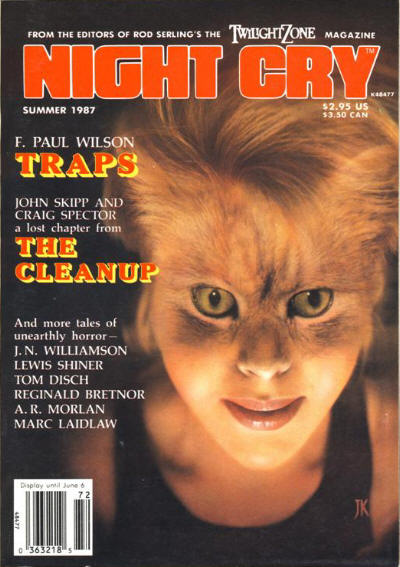
(Cover by J. K. Potter. Night Cry, Summer 1987.) Who Goes There?
A doctor by day and a bestselling author by night, F. Paul Wilson has had a long and pretty acclaimed career since he debuted in the early ’70s, being one of John W. Campbell’s last discoveries. His fiction can be basically divided into SF and horror, although the two are not mutually exclusive. He has the unique honor of earning both the Bram Stoker and Prometheus Award for Lifetime Achievement, for his horror and libertarian-themed SF respectively. His 1981 novel The Keep was adapted into an ill-fated Michael Mann film. “Traps” itself was apparently adapted into a short film, but I can’t find anything on it. This story is Wilson in pure horror mode, almost written in the allegorical mode but seemingly lacking a moral at its center. It’s an effective little short, and unsurprisingly it got a Stoker nomination. It could’ve worked as an episode of Tales from the Darkside, which is probably not a reference you were expecting.
Placing Coordinates
First published in the Summer 1987 issue of Night Cry, which was a reprint-oriented sister mag to Twilight Zone Magazine. It’s not on Internet Archive, but it is on Luminist. It then appeared in the Wilson collections Soft and Others and Ad Statum Perspicuum. For anthology appearances we have 100 Fiendish Little Frightmares (ed. Stefan Dziemianowicz, Martin H. Greenberg, and Robert Weinberg) and Piercing the Darkness: A Charity Anthology for the Children’s Literacy Initiative (ed. Craig Cook).
Enhancing Image
This story is not quite ten pages, so let’s get right into it. Hank is a do-gooding husband with twin daughters, and the family has recently moved into a rural-ish Jersey suburb where their house is one of maybe two on the street. (Incidentally the first house I lived in was similarly one of the first in a new development, and also in Jersey.) The scenery is nice, but the problem is with all the critters, which Hank is loathe to deal with. “He didn’t like killing anything. Even ants. Live and let live was fine with him, but he drew the line at the threshold of his house.” There’s especially been a mice problem, in the attic, with one of those hatches that unfurls a set of steps. Let’s face it, no one likes to go into the attic for whatever reason, although I would say the older the house the creepier the attic becomes. More history that way. In Hank’s case he’s had to take pains to set up mousetraps in the attic, and he has to do all this in secret so as to not traumatize his young daughters, who are big Mickey Mouse fans and who are set to go to Disney World very soon. “Kids had Disney World on the East Coast and Disneyland on the West. Katie and Kim would start out on their first pilgrimage Thanksgiving morning.” And yet there was still the mice problem.
The business is already morbid enough, but things get weird when Hank finds the traps are working—and also only the heads of the mice remain. The bodies are missing, or more accurately something must’ve taken the bodies. “Something had eaten the dead mice. Something bigger than a mouse.” And there’s an awful smell slowly growing from the attic that can’t just be rodent corpses. What’s neat about “Traps” is how economical it is: there’s barely any dialogue; there are only four characters to speak of, only one of whom really matters; we’re given a gruesome if technically mundane situation, only for there to be a twist in the routine; and we’re given a reason for why Hank would be going about this by himself. This all happens in the span of a few pages. Let’s talk about what David G. Hartwell, in his seminal anthology The Dark Descent, considered the three basic classes of horror: allegorical, psychological, and supernatural. Obviously, as Hartwell admits, the three are not mutually exclusive, and indeed with a lot of stories you’ll find some balance of two of these classes. “Traps” reads almost like an allegory, with some kind of moral message the reader is supposed to take away from it—only there doesn’t seem to be one. It does, however, work similarly to a fable you might read aloud to your children. Not that I’d recommend showing “Traps” to kids unless you wanna make sure they get no sleep for a few days; but then it could feasibly be understood by a younger readership, since Wilson’s style is straightforward, concise yet gripping, and while there’s violence it’s not too graphic.
Then there’s the psychological aspect. We can infer that whatever lurks in the attic is probably not a racoon or badger, but another part of the sense of looming doom is Hank listening for the mousetraps as they go off with a snap, often in the dead of night, and having to check the results the next morning. to make things worse, something has been sneaking into the attic through a vent, which Hank has to nail shut in the hopes this does the trick. At this point I would’ve forked over the money to hire an exterminator, but a) this is on short notice, since the family’s leaving for Disney World in a few days, and b) with hindsight it’s safe to say an exterminator wouldn’t have been able to help much with the thing in the attic. Our normal everyman Hank is thus faced with a dilemma: he could call someone take care of the issue, to the inconvenience and possible trauma of his family, or he could try taking care of the problem himself. Ultimately he goes with the latter, which turns out to be a very bad idea—which if you’re familiar with horror tropes you would’ve guessed already. “Traps” is the kind of setup-payoff horror story that’s determined to end on a bad note for the protagonist, but it’s the execution that matters most here.
There Be Spoilers Here
I said earlier that “Traps” fits primarily into the allegorical and psychological classes of horror, but this isn’t quite true as we do get a quick dose of that third class at the very end. Hank, seeing that something had come through the vent, is understandably worried about this. Unfortunately for Hank and even more unfortunately for his family, as he had left the hatch to the attic open, a monster, “big as a rottweiler, brown scruffy fur, a face that was all mouth with huge countless teeth, four clawed arms extended toward him as it held onto the beams above with still two more limbs,” killing him all but instantly. In the last seconds of his life realizes two things: that he’s being killed by some unspeakable horror he could not have possibly anticipated, and that he has unwittingly and probably doomed his family to being eaten by the same creature. This all happens in literally the last paragraph of the story, and I have to admit in the couple days since I read “Traps” this ending has stuck with me, for its suddenness and inexplicableness. There’s no reason (at least none I could pick up) for why there should be a six-limbed carnivore the size of a large dog and with about as many teeth as a shark should exist and be living in this family’s house specifically. It’s a complete break from reality that the story alludes to heavily and yet does not try to rationalize. The result is an ending that I find disturbing, for its implications but also for the sheer nightmarish quality of it.
A Step Farther Out
Wilson has been prolific for the past half-century and change, although sadly he has written relatively little short fiction. It’s a shame because the standalone horror stories I’ve read of Wilson’s have all been pretty strong. “Traps” is short, almost a vignette, but it has a finely laid out setup-and-payoff structure that makes the ending so disturbing, even if it’s also predictable. You can write horror that the reader can anticipate and get away with it so long as you effectively discomfort the reader as they await the inevitable. It’s stuck with me the more I’ve thought about it.
See you next time.
-
Short Story Review: “The Hounds of Tindalos” by Frank Belknap Long

(Cover by C. C. Senf. Weird Tales, March 1929.) Who Goes There?
Frank Belknap Long had an exceedingly long life and career, born in 1901 and writing from about 1920 to well into the ’80s. He was close friends with H. P. Lovecraft, and was the first author to contribute to the Cthulhu Mythos, although it wasn’t called that in Lovecraft’s lifetime. “The Hounds of Tindalos” was Long’s third Mythos story, despite Wikipedia calling it the first to not be written by Lovecraft. This one story would have a rather large influence on Mythos fiction to come, with the hounds themselves even appearing later in Lovecraft’s “The Whisperer in Darkness,” in one of several instances of Lovecraft inspiring and in turn being inspired by others in the so-called Circle. There’s even an anthology of Mythos stories by different writers featuring the hounds. By the ’40s Long would move away from cosmic horror and focus more on science fiction, and indeed “The Hounds of Tindalos” is an early example of Long marrying the weird with the scientific, creating a structurally flawed but pretty memorable SF-horror narrative with an iconic monster at the center. It’s one of the more influential cosmic horror stories, and that’s because Long effectively utilizes one of the scariest things known to man: basic geometry.
Placing Coordinates
First published in the March 1929 issue of Weird Tales. It was then reprinted as a “classic” in the July 1937 issue. It first appeared in book form in the Long collection of the same title, with a pretty gnarly Hannes Bok cover for the first edition. We also have Avon Fantasy Reader #16. For anthology appearances there’s Tales of the Cthulhu Mythos: Volume 1 (ed. August Derleth), The Spawn of Cthulhu (ed. Lin Carter), and The Science Fiction Century (ed. David G. Hartwell).
Enhancing Image
Frank is an average guy who happens to be buddies with a real eccentric in the form of Chalmers, a sort of scientist-mystic who has contrarian views regarding objective reality. His library is filled with books on alchemy and theology, and “pamphlets about medieval sorcery and witchcraft and black magic, and all of the valiant glamorous things that the modern world has repudiated.” Or as Charles Fort would’ve put it, the excluded. Chalmers rejects what would’ve been conventional scientific narratives in 1928, although to Frank’s mild relief he does see Einstein as a kindred spirit, “a profound mystic and explorer of the great suspected.” Chalmers has a hypothesis that time, the fourth dimension, is actually an illusion, there merely because without it the human mind would wither at being able to see everything happening simultaneously. To test this he has concocted a drug which, if successful, should have the effect of breaking down that barrier. He wants Frank to be there as witness, and to act if something goes wrong. This is like your friend trying LSD for the first time and having you stay in the room with them for hours on end as a sober spectator, although LSD had not yet been invented when Long wrote this story.
Drugs play a surprisingly large role in the history of cosmic horror writing, although in the ’20s and ’30s these things were treated with utmost skepticism, if not contempt. In the context of a cosmic horror narrative the ambivalence makes sense. Sure, Aldous Huxley would later argue for the positive potential of hallucinogens, but for fiction with an overall thesis of “There are things man is better off not knowing,” it makes sense to go on an anti-drug screed. I’m not sure what experience Long would be basing his writing of this fictional drug on, although it seems he had been reading the Tao Te Ching and found it inspirational—but not for religious reasons. Chalmers takes the drug, which takes effect “with extraordinary rapidity,” and to say he has a trip would be understating it. What Chalmers expected happens, in that he not so much hops across bodies through time but experiences all these different perspectives at the same time; it’s that he can only convey this information to Frank in a linear fashion. But there’s something much more concerning that rears its head in the midst of this trip, which only Chalmers can see (not so much see as comprehend) and which forces Frank to break him out of the trance.
Let’s talk about the hounds, since they’re the star of the show, which is saying a lot since they never technically appear. We never see the hounds because they don’t exist in three-dimensional space. As Chalmers says, “There are […] things that I can not distinguish. They move slowly through angles. They have no bodies, and they move slowly through outrageous angles.” They’re only called hounds because Chalmers really isn’t sure what else he can call them; they’re certainly not like any dog in the real world, and they might only be distantly related to something mythical like Cerberus. In line with Lovecraft’s own conception of morality, the hounds are evil, but only as understood by humans. They act simply according to their nature, which apparently is an unspeakably horrific one. Or, as Chalmers says:
“They are beyond good and evil as we know it. They are that which in the beginning fell away from cleanliness. Through the deed they became bodies of death, receptacles of all foulness. But they are not evil in our sense because in the spheres through which they move there is no thought, no morals, no right or wrong as we understand it.”
Because Chalmers broke through the barrier of time he also stepped into the hounds’ domain, which if you know your cosmic horror is always a fatal mistake. The worst thing you can do in this kind of story is to alert the eldritch horror to your presence. So, there are basically two kind of geometry: curves and angles—cleanliness and foulness. Which sounds a bit silly as I’m saying it, but I respect Long for trying to apply a scientific rigor to something which refuses to be understood in human terms, even if math is supposedly the language of the natural world. This melding of the weird and scientific might’ve helped inspire Lovecraft in his own later, more SFnal Mythos stories, such as At the Mountains of Madness and “The Shadow Out of Time.” I can’t say for sure because I’m a layman and not a scholar. If you’re a Lovecraft scholar then feel free to call me a dumbass. Anyway, what makes the hounds memorable, despite never being seen in-story (though this hasn’t stopped people from trying, such as the aforementioned Bok illustration), is that they’re threatening while also not being god-like figures like Cthulhu or Shub-Niggurath; these are animals basically, as their name indicates, but they’re not puppers you’d wanna pet.
Unlike some other contemporary attempts at writing cosmic horror, Long’s language is fairly unadorned; even Chalmers, who is given to monologuing, is not as verbose as the average Lovecraft narrator. Frank (who might be a stand-in for Long) is less a typical cosmic horror narrator and more riding shotgun to the poor sap who normally would be narrating. Long might’ve done this one-degree-of-separation tactic because Chalmers is such an eccentric and so detached from normal human behavior that the reader (the God-fearing Christian reader who might dabble in the occult as a tourist) might not have anything to latch on to. This decision seems like a good idea, but as we’re about to see, it does have a serious drawback, which in my opinion stops “The Hounds of Tindalos” from entering masterpiece territory and instead relegates it to the realm of “pretty good.” I mean, there are far worse things you can be than pretty good.
There Be Spoilers Here
The story is split into five chapters, of which the first is by far the longest; this first chapter puts us in Frank’s shoes and the result is one long scene that happens in one location. So far so good. The second chapter, much shorter, sees Frank and Chalmers plastering up the angels in the latter’s room, since the hounds have been alerted and, as said before, enter through angles. But then Long makes the odd decision to jettison us from Frank’s flesh prison (Frank himself basically disappears from the narrative), and to switch perspectives to what seems to be a third-person view—and then to switch perspectives yet again. All in the span of just a few pages. Perspective, especially in a short story, is an important thing to keep consistent, and it’s a rule Long violates without (I would think) just cause. Of course things don’t turn out well for Chalmers; when do they ever. I think the last cosmic horror story I read where the protagonist/narrator comes out of the ordeal more or less intact was Robert E. Howard’s “The Black Stone” (review here); and yes I do consider Chalmers the real protagonist of Long’s story. On the plus side, Chalmers’s death manages to be both gory and genuinely creepy: authorities find his body with his head removed and placed on his chest, and yet there’s not a drop of blood at the scene. And to make things weirder there’s protoplasm on the body. Certainly no human could’ve done such a clean job, one that seems physically impossible—unless your existence is deemed physically impossible by known science.
A Step Farther Out
As I’ve been getting more into horror fiction I think I’ve come to appreciate the efforts of the “old masters” more. The irony with Long is that he would outlive Lovecraft and Howard by decades, but he never garnered even close to the amount of respect and impact as them—in death or in life. When he died he was so poor that he was initially buried in a potter’s grave, and it was only because of several big names in the weird fiction scene banding together that allowed him a proper burial about a year later. Clearly there’s some respect there, but if Long gets mentioned nowadays it’s very likely because he was buddies with Lovecraft. I know I haven’t helped with that problem. “The Hounds of Tindalos” points toward a talent who does indeed take after Lovecraft but whose priorities might lie elsewhere. If anything the quality of this story has made me curious in Long’s later, more mature work, albeit I know he drifts away from the cosmic.
See you next time.
-
Novella Review: “A Woman’s Liberation” by Ursula K. Le Guin
(Cover by Bob Eggleton. Asimov’s, July 1995.) Who Goes There?
Ursula K. Le Guin: you may have heard of her. She’s one of the most acclaimed authors in all of modern SFF, at times daring and yet somehow free of controversy (for the most part, as I’ll explain). She got started fairly late, only starting to write SFF when she was already in her thirties, but given that she lived to be almost ninety her career would be exceedingly long and varied. She’s also one of those rare authors to leave a major impact on both SF and fantasy, primarily with her Hainish and Earthsea cycles. The former might be her best work, when taken as a whole. My relationship with Le Guin has changed a good deal over time, ever since I first read The Left Hand of Darkness a little over ten years ago. As I’ve drifted closer to her politics over the past few years and become more familiar with her work I’ve come to have more mixed feelings on her as an artist, which I know is almost like a paradox. I think Le Guin is often great, and that of the Great™ SFF writers she’s one of the most versatile; but she’s also an idealist who doesn’t seem given to passions other than said idealism.
I’m gonna use her Four (later Five) Ways to Forgiveness as an example. Three of these stories were published in Asimov’s, with “A Woman’s Liberation” being the final one. It’s not a direct sequel to the previous stories, “Forgiveness Day” and “A Man of the People,” but it definitely complements those stories and more specifically could be seen as the yang to the latter’s yin. They share a few characters, but more importantly “A Woman’s Liberation” feels like a flipped-perspective retelling of “A Man of the People.” I’m not sure if this would work better as its own thing or if read immediately after the previous story like it would be in the collection. I enjoyed “A Woman’s Liberation,” but somehow feel it’s a weaker installment.
Placing Coordinates
First published in the July 1995 issue of Asimov’s Science Fiction, which is on the Archive. It then appeared in Four Ways to Forgiveness and by extension Hainish Novels and Stories, Volume Two. For anthologies we have The Year’s Best Science Fiction, Thirteenth Annual Collection (ed. Gardner Dozois) and A Woman’s Liberation: A Choice of Futures by and About Women (ed. Sheila Williams and Connie Willis).
Enhancing Image
The story is the fictionalized memoir of a former slave named Rakam, who having been freed years ago is now writing about her early years. We know at the start that things will turn out well for her in the end, which is good to know because to say Rakam had a rough childhood would be understating it. She was raised on Werel, as a slave, although her pitch-black skin suggests (indeed other characters take note of it) that she might be of noble heritage. Right, so on Yeowe and Werel dark skin is considered more desirable while light-skinned people are considered “dusty,” which seems to be an inversion of the dark-light dynamic among blacks that goes back to the days of chattel slavery. I suppose Le Guin is trying to make a statement about the arbitrary nature of skin complexion and desirability. Anyway, Yeowe has had a successful slave rebellion; its people are now free—or at least the men are. Slavery is still alive and well on Werel.
Rakam’s first sexual experience is as basically a sex toy for Lady Tazeu, the matriarch of Shomeke. Lady Tazeu is a curious character: she treats Rakam gently, all things considered, but is quite possibly a pedophile and also has a jealous streak. Lord Shomeke and Lady Tazeu also have a son, Erod, who is a young abolitionist and, as it turns out, Rakam’s half-brother. When she reaches a certain age Rakam’s mother tells her that there’s a reason for her dark skin: she is Lord Shomeke’s illegitimate daughter. But if Lady Tazeu ever finds out about this then she never tells Rakam. Lord Shamake falls fatally ill and the manor is placed under quarantine, and Lady Tazeu kills him and then herself; whether she does this so as to put the man out of his misery or out of revenge is left unclear. With both of his parents dead, Erod takes over the manor, and he signs papers that will free the slaves and allot them each a bit of money. This has disastrous consequences, as many of the slaves are killed overnight by neighboring slave-owners who think a rebellion is underway. Rakam is freed of her bondage, only to be forced into more servitude. Despite having her freedom papers, said papers mean basically nothing. “The government would not interfere between owners and those they claimed as their assets.”
You may notice that similarly to “A Man of the People,” this is less a proper novella and more like a compressed novel, giving us only the essentials for this narrative of one person’s life. We follow Rakam from her birth to not long before she would’ve started writing her memoir. One major difference between this and the other Yeowe-and-Werel stories (the ones I’ve read, anyway) is that “A Woman’s Liberation” is written in the first person. Despite this change in mode, Rakam’s style is actually not that different from the third-person narrators of the other stories, the only real difference being that those other narrators are omniscient, whereas there are little gaps in Rakam’s narrative—information she was never able to obtain. “I did not learn to read or write until I was a grown woman, which is all the excuse I will make for the faults of my narrative.” She still comes off as firmly literate, though, despite being a late bloomer when it came to reading. This is indicative of Le Guin’s long-winded style that she had developed by the ’90s, simultaneously craftine labyrinthine paragraphs that cram more information into overall less space. I’m not sure what inspired the change, but the Le Guin of the ’90s is quite different from how she was in the ’70s.
Le Guin’s style evolved, but so did her worldview it seems. The Dispossessed remains the quintessential left-libertarian SF novel, but I think it’s fair to say it’s not a feminist novel—or at least women’s liberation is not a chief concern. (The short story “The Day Before the Revolution,” a sort of distant prequel to The Dispossessed, could by contrast be considered an explicitly feminist narrative, although Le Guin doesn’t quite connect the dots with feminism and anarchism.) With the stories that make up Four Ways to Forgiveness Le Guin makes it pretty explicit that the notion of human liberty is incomplete without feminism—indeed freedom under a hypothetical socialism would be freedom only for a fraction of the population if women’s liberation is not a high priority. Erod starts out as a sympathetic character, albeit one who makes an error out of shortsightedness that gets a lot of people killed, but when we meet him again some years later he’s shown to be a low-key misogynist, much to Rakam’s displeasure. (Not sure where to put this, but isn’t it convenient that despite finding Erod attractive in her youth and even being offered to him as a bed-warmer, the half-siblings never get intimate?) Good news I suppose is that Rakam does meet a few decent men in her life, including Ahas, a fellow slave at the manor, and much later we meet a face or two that should strike us as familiar…
The thing about Le Guin that makes her a favorite of literary types and classroom discussion is that she’s such a pious writer—she’s so virtuous that she seemingly has never done anything wrong in her life. Her politics are very far on the left, which should on paper make her a no-no for those who try to keep literary discussion “apolitical,” but she’s so gentle about said politics. She might’ve become aware of this purer-than-pure status because—and I’m not sure when exactly this happened—she gets super-horny in the later Hainish stories. Oh sure, sexuality is integral to The Left Hand of Darkness, but in a clinical, anthropological sense. Women’s sexuality is also at the heart of “The Day Before the Revolution,” but we have not yet reached maximum levels of horny. Then we get to Rakam’s story, which at its core is about her political and sexual awakening, the two coinciding and indeed feeding off each other. Consider this passage, in which Rakam (and I have to think this is also Le Guin responding to critics) explains why much of her memoir is concerned with sex:
Now you may say in disgust that my story is all of such things, and there is far more to life, even a slave’s life, than sex. That is very true. I can say only that it may be in our sexuality that we are most easily enslaved, both men and women. It may be there, even as free men and women, that we find freedom hardest to keep. The politics of the flesh are the roots of power.
Rakam has been freed, but while she is technically a freed woman on Werel, she’s still a slave sexually; up to about the halfway point of the story the only sex she’s known has been through rape. Her orientation is a grey area: she’s probably bisexual, or even more likely pansexual since she doesn’t seem to think along gender lines when it comes to attraction. Le Guin is funny when it comes to sexuality because, given that she was most likely straight (I don’t recall reading about her ever being attracted to anyone who was not a man, and anyway she was very happily monogamous), her interest in queer yearning and relationships often has this sense of detachment—like she empathizes, but maybe she doesn’t know what it’s like to live as a man who sometimes has crushes on other men, who is always anxious about these crushes because coming out to another man could result in something far worse than a rejection. With the exception of the unrequited romance in The Left Hand of Darkness, I don’t usually buy Le Guin’s characters being attracted to each other—which brings me to spoilers.
There Be Spoilers Here
I said earlier that that a few characters from “A Man of the People” reappear here, although you don’t have to have read that story to understand what’s happening. The first is Old Music, the Hainish bureaucrat who has appeared in all the previous Yeowe-and-Werel stories in small but pivotal roles; and here he comes again, this time to help Rakam get off Werel, although she doesn’t discover until after the fact that he was Old Music. Once Rakam gets to Yeowe, which as I’d said is a liberated planet, we meet “Mr. Yehedarhed,” who you may recognize as Havzhiva, a Sub-Envoy for the Ekumen and the protagonist of “A Man of the People.” Finally there’s Dr. Yeon, a major character from that story and perhaps Havzhiva’s closest friend. Being an outsider, Rakam only knows so much about these people, but if you’ve read “A Man of the People” then you know a lot has happened. Rakam impresses Havzhiva and convinces him to let her found a publishing house, and in the process the two fall in love—the first time Rakam’s ever fallen in love with someone and had that affection returned.
The development of Rakam and Havzhiva’s happens over the course of maybe ten magazine pages, and if that sounds rushed, that’s because it is. It could be that, taken on its own, we simply don’t know enough about Havzhiva to trust him; oh sure, we’ve read “A Man of the People” and can carry that information over to this related story, but Rakam doesn’t know all that shit. The big things Rakam gets to know about her love interest is that he’s an abolitionist, a women’s lib sympathizer, and that he took a knife to the gut the fucking day he landed on Yeowe. From Rakam’s perspective, Havzhiva is basically perfect—which makes him boring. Because “perfect” people are boring. Le Guin admitted to dislike writing evil characters, which is why you can count the number of total scumbags in her fiction on one hand; but conversely she has a tendency at times to write characters who are seemingly bereft of human flaws. Goody-goodies, ya know. Rakam has trust issues and anxiety (understandably), but Hazhiva in the context of this story is a bit of a cypher, which hurts the romance.
A Step Farther Out
As I was reading “A Woman’s Liberation” I couldn’t help but feel like something was missing—indeed it’s the same reservation I have with the other entries in this “story suite” but even more so here. It’s good fiction but not good science fiction. Of the Yeowe-and-Werel stories I’ve read this one is the least SFnal, in that it could be most easily rewritten as a realistic narrative. Le Guin was clearly inspired by real-world slave narratives when writing it, but I think the lack of original input is to its detriment. I also think that while it does work well in concert with “A Man of the People,” it does feel redundant to some degree. Granted, I might be saying the same thing about that other story had the two been published in reverse order. Ultimately the problem could be that they’re too similar. I’m curious for when I eventually read Four/Five Ways to Forgiveness and see how these stories work together when taken as pieces of a larger narrative.
See you next time.
-
Subscribe
Subscribed
Already have a WordPress.com account? Log in now.
 Science Fiction & Fantasy Remembrance