-
Complete Novel Review: Planet of the Damned by Jack Vance

(Cover by Earle Bergey. Space Stories, December 1952.) Who Goes There?
Jack Vance is one of the most influential 20th century SFF writers, and also not read nearly as much as you’d think. If the Goodreads numbers are to be believed. Vance debuted in 1945 but did not have his first major work published until 1950, with the novel (or collection of linked stories) The Dying Earth, one of the most important works of fantasy of all time. I do very much recommend The Dying Earth: it’s very short, and yet is packed with what would become Vance’s trademark baroque prose, his sarcastic sense of humor, and his seemingly limitless invention. Vance wrote the stories that make up The Dying Earth in the mid-’40s, but could not get them published for some time, and indeed these stories read like nothing else in American fantasy at the time—not even Vance’s SF from the same period. You may read, for instance, Big Planet and not suspect that the same guy wrote bejeweled far-future fantasy, if going off the prose style (or rather the lack of it) and nothing else. I had covered Big Planet last May, as a much-needed reread, but for this May I reached for one of Vance’s lesser known novels, one which is sort of a B-side to Big Planet.
Big Planet and Planet of the Damned were published mere months apart, and it’s likely they were also written in close succession. Unfortunately, as I had just implied, while Big Planet is the hit single, a real breakthrough for Vance as a world-builder, Planet of the Damned is the lower-effort B-side that smells of “second verse, same as the first.” But it’s not entirely lesser than its big (haha) brother, for there are a couple things Planet of the Damned at least tries to do better. Unfortunately this is not quite enough. Vance can either be pretty interesting or pretty dull (and honestly you have no way of knowing in advance), and this is a case of the latter.
Placing Coordinates
First published in the December 1952 issue of Space Stories, which is on the Archive. The publication of this novel is rather convoluted. The first book version is actually an abridgment, I assume so it could share one half of an Ace Double with Big Planet (that version of Big Planet was also shortened from the magazine version), and it was retitled Slaves of the Klau. We would eventually get a complete reprint of the magazine version, but it still kept the latter title. To make matters more confusing, Vance would revise it and retitle it again, this time as Gold and Iron, which is the version now in print. Have you lost track of it yet?
Enhancing Image
Humanity has come into contact with the Lekthwans, who have taken to sort of colonizing Earth benevolently, with the tradeoff being that humanity has gotten access to advanced Lekthwan technology. The Lekthwans themselves are basically humans but with golden skin, and by Earth standards are said to be conventionally attractive; it’s more their way of thinking that makes them alien, rather than their looks. The Lekthwans are sort of like proto-Vulcans, in that they see humans are lesser humanoids, given to irrationality and emotions and all those pesky things. At the very least the Lekthwans still have a sense of opulence, and they have their own conception of fun—which can’t be said for the other dominant humanoid race in the galaxy, the Klau. “The Klau are completely practical. Everything is planned for exact use, whether it makes people happy or not. There is no gaiety on the Klau worlds,” so a Lekthwan in the beginning tells us. Roy Barch is a grizzled tough guy working for Lekthwans on Earth who also happens to pine for his alien boss’s daughter, Komeitk Lelianr, who seems to take an interest in the human but who also makes it clear that said interest is not romantic. The opening section of the novel almost reads like a romance drama, and indeed bizarrely the novel could be considered a love story.
Barch and “Ellen” (the human name he gives Komeitk Lelianr) are the obligatory man-woman couple at the novel’s center, which on its own would’ve been pretty standard for early ’50s SF, but to Vance’s credit he does add a twist or two that doesn’t strictly have to do with the fact that Barch has a boner for a gold-skinned space babe. Vance is not known for his female characters, but while I’m on the side of listing positives, Ellen has to be one of Vance’s more clearly defined and assertive women, even if it shouldn’t come as a surprise how she’ll ultimately feel about Barch. Ellen is aloof and condescending in the manner typical of her race, but unlike a lot of ’50s SF women she isn’t given to screaming or shrewish rantings, nor is she a pulpy action heroine in the making; rather, uncharacteristically for the time, she comes off as the Eeyore to Barch’s Winnie the Pooh. (That’s a weird comparison, but I hope you get my meaning here.) She’s cold, even fatalistic—not because she’s cowardly but because she thinks that’s just the way the world works. When Barch takes Ellen on a “date” she more or less berates him for thinking of her as something to be gained, as opposed to someone he might share his life with. “You may feel passion, but you feel no love,” she says. And initially she might be right on that. Their relationship is one that evolves organically—or at least more so than most attempts at romance from this period of genre SF.
When the Klau raid Earth, killing most of the people around Our Heroes™ and taking the two as slaves to the labor planet Magarak, Ellen basically accepts it as her lot in life. The Klau hate the Lekthwans with a passion, but in their haste they seemed to confuse Ellen for a human, hence (probably) why she was taken prisoner. So Barch has to be the assertive one. Let’s talk about Roy Barch, or rather let’s not, since there isn’t much that can be said about him that doesn’t have to do with his relationship with Ellen or indeed his tenuous relationships with other aliens on Magarak. Barch is… more conventionally written, although that’s in the context of genre SF at the time; compared to some other Vance protagonists he’s rather unconventional. Vance’s heroes (or more often anti-heroes) tend to use their wit to get out of sticky situations, lacking the means to intimidate physically, whereas while Barch is by no means stupid, he’s certainly the brawn of the pair. He has suddenly found himself in a hostile environment, having escaped from a prison ship and taken refuge, along with Ellen, in a cave called Big Hole where other refugees hide out; and unlike someone like Cugel the Clever, Barch will have to twist some arms. And he has to deal with difference races with different cultural attitudes. “Thirteen different races, thirty-one different brains; thirteen basic mental patterns, thirty-one sub-varieties. An idea which aroused one would leave another indifferent.” Much of the novel will be concerned with this division.
I brought it up before, but unfortunately I’ll have to bring it up again since the two novels were written and published so close together, and are both planetary adventures; but Planet of the Damned sadly lacks what made Big Planet captivating, even given that novel’s flaws. In the slightly earlier novel we’re introduced to a planet with an eccentric gravitational pull, size, and geological makeup, and so we’re introduced to some eccentric locations, wildlife, and human societies. The locale is the point of the damn thing, never mind that the plot is just a string of events with a dwindling party of stock characters. Magarak is nowhere near as interesting as Big Planet, in part because Vance spends far less time describing it, which makes me wonder where much of the wordage for either novel goes. If Big Planet is maybe 60,000 words then Planet of the Damned is maybe 50,000 words or just under that. (I’m referring again to the magazine versions.) The shorter novel feels longer somehow. It took me a few days to get through Big Planet while I’d say it took me about a week to read Planet of the Damned, and I suspect it was more of a slog because there was less to chew on. Similarly to Big Planet, Planet of the Damned has a random-events plot in which there is not subplot to speak of and in which the end goal is pretty simple: get the hell back to Earth. I’ve noticed that Vance tends to structure his novels episodically, with a single overarching plot or a series of plots rather than the traditional plot-plus-subplots method.
Again, all the aliens are some flavor of humanoid, and there isn’t much in the way of encountering non-humanoid life. We get that Magarak is a shithole but we aren’t given much insight into its ecosystem or how humanoids have adapted to it. Now, you may recall there are side characters in Big Planet, some of whom are fairly memorable; the same can’t be said of the side characters in this novel. Vance implies depth and diversity with the ensemble, but we get next to no time with these characters as individuals. Clef presents himself as the closest the novel has to a flesh-and-blood antagonist, but he gets killed off rather early on. Consider that the motley crew of Big Hole at one point gets boiled down to a list:
There were the three Splangs, Tick, Chevrr, Chevrr’s small dark woman; there was Kerbol and his dour gray mate; Flatface and his two quarreling bald half-breeds; the Calbyssinians, whose sex still remained mysterious; Pedratz, taffy-colored and smelling like a bull; Sl, the double-goer; Lkandeli Szet, the musician; the six silent Modoks; five Byathids; Moses, the dwarf; the handsome youth Moranko; the cat-like Griffits, who had silently asserted rights to the first two of Clef’s women; there was [Roy Barch] and Komeitk Lelianr.
But to bring the positive vibes back, there is at least the hinting of diversity, which is something Vance can be quite good at. Vance himself was a conservative, a fact which can rear its head in his fiction at times, but he was open to depicting people and societies with values very different from his and with a minimum of judgment—or at least a minimum of sarcasm. Vance can be dryly funny, and while there are a few jokes I noticed here it’s still less humorous than more characteristic Vance material. Vance’s trademark ornate language is also absent here, as also happened with Big Planet, replaced with a much more unassuming and unadorned prose style that could be charitably called “standard ’50s SF prose.” Vance had already written The Dying Earth at this point, so it’d be inaccurate to call the blandness of style here the result of a young writer finding his voice; rather it seems like Vance is trying to pass off as a robust but disposable pulp writer.
There Be Spoilers Here
Big Planet takes place a few weeks if I remember right, whereas the plot of Planet of the Damned unravels over the course of months—and then years. The good news is that Barch and his comrades are able to construct a ship out of basically scrap metal that can get some of them off the planet, but the bad news is that at some point (I’m not sure when this would’ve happened) Barch and Ellen had sex and now she’s pregnant with his child. Apparently humans and Lekthwans are genetically similar enough that they can crossbreed; this is a bit of hand-waving, but at least it’s explained in-story as something that can happen. (At one point early on Ellen becomes a willing concubine for Clef, and it’s implied they also have sex, but due to Clef being Klau the child be his—so we’re told.) I wanna take a moment to applaud Vance for going just slightly past what would’ve been the norm with this, since it would’ve been uncommon for human characters to actually have sexual relations with aliens at this point in SF writing. There would’ve been a fair bit of titillation, but it was mostly a “look, but don’t touch” deal. This revelation pushes a wedge between Barch and Ellen and by the climax they have parted ways, and when Barch leaves the planet he doesn’t know where his not-quite-girlfriend is. Had the story ended at this point, with the slaves successfully rebelling against the Klau on Magarak, it would’ve been a perfectly bittersweet ending.
When Barch eventually returns to Earth he finds that he has become a sort of John Brown figure, a symbol of rebellion against the Klau; in that way he has become something of a celebrity. Unfortunately it’s also time now to reunite with Ellen, whom he has not seen in five years—and by extension his son, whom he has never seen before. “The child was a boy, and his skin was a pale clear gold. Komeitk Lelianr was quieter, thoughtful, though she looked a little older.” Barch and Ellen weren’t really a couple up to this point; there was always something in the way, either Ellen’s reluctance to treat Barch as an equal or simply bad circumstances. I would consider Planet of the Damned rather bland and depressingly average overall, but I do really like this ending. There’s this inversion where the main couple partake in what we think of as intimacy, but it’s only long after that initial encounter that they start to care enough about each other that they’re willing to take a big risk by raising their child together. It’s an interesting inversion of the traditional romance arc and it’s a good deal more mature than what most of the rest of the novel would lead you to believe. I would describe the ending as consciously optimistic, and that while he does phone it in for chunks of the novel, Vance does something kind of exceptional in the last handful of pages. I wonder if he had thought of the ending first and tried coming up with a serviceable plot that would get him from point A to point B.
A Step Farther Out
There’s some debate as to what counts as Vance’s first novel, since The Dying Earth is more of a short story collection, and The Five Gold Bands is more of a novella by modern standards (though for the sake of this site I’m counting it as a “complete novel”). Big Planet would then be Vance’s first “true” novel, in which case Planet of the Damned would be the sophomore slump. If you were a genre reader in the ’50s you could be reading much worse, but also there’s not much one can get from Planet of the Damned past a space adventure which even at the time must’ve seemed surface-level. It doesn’t show Vance as the unique voice that he was, nor does it build on the intricacies of Big Planet. A minor shame.
See you next time.
-
Short Story Review: “The Jaguar House, in Shadow” by Aliette de Bodard
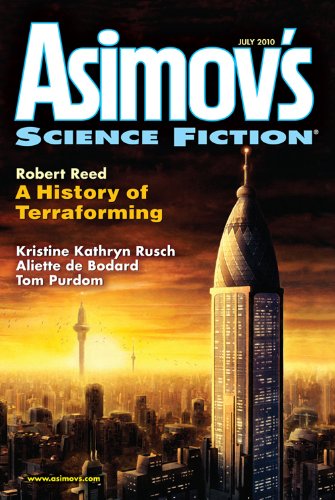
(Cover by Tomislav Tikulin. Asimov’s, July 2010.) Who Goes There?
Aliette de Bodard was born in the US, but raised in France to Vietnamese parents, such that French is her first language but she writes her fiction in English. This cultural mix perhaps inspired one of the most unique alternate/future histories to come about in the past couple decades. Her defining series, of which today’s story is a part, shows us an altered human history in which the Chinese discovered America before a certain Italian son of a bitch could get there, with the Americas changing in major ways politically and sociologically. “The Jaguar House, in Shadow” was de Bodard’s first story to garner a Hugo nomination, and indeed shows a leap forward in ambition, especially in terms of its structure. The story’s back-and-forth narrative ends up being a double-edged sword, but it remains an effective tale of friendship, betrayal, and revenge.
Placing Coordinates
First published in the July 2010 issue of Asimov’s Science Fiction, which is on the Archive. It has since been reprinted in English twice, in Nebula Awards Showcase 2012 (ed. James Patrick Kelly and John Kessel), and the de Bodard collection Of Wars, and Memories, and Starlight.
Enhancing Image
We start with a scene all in italics, and we’re not told who the viewpoint character is other than that it’s “she.” (Mind you all three of the main characters are women.) The beginning reminded me of the opium-induced haze at the start of Once Upon a Time in America, although in this case it’s magic mushrooms rather than opium, “teonanácatl.” We then flash back… then flash back again… then flash forward… then flash back… then forward again. That’s how it generally goes. We’re quickly faced with this story unique quality, for both good and ill, which is the jumping back and forth along a timeline, tracing the friendship between three friends and members of the Jaguar House: Onalli, Xochitl, and Tecipiani. Some stories in the Xuya universe are space opera, but this one is not: we’re firmly set on Earth, more specifically in Mexico—a Mexico that is quite different from what we now recognize. The actual year in which the story takes place is vague, and at first you might even think it’s some fantasy realm, with the mentioning of Houses, warriors, and some real cloak-and-dagger espionage; but also there are computers, and even nanomachines. Evidently true artificial intelligence has not come about yet, although Xochitl does speculate on it at one point, in perhaps the single most memorable passage in the story and one which seems deliberately to foreshadow the spacefaring antics of stories happening later in the timeline:
Xochitl wonders what kind of intelligence computers will develop, when they finally breach the gap between automated tasks and genuine sentience—all that research done in military units north of the border, eyeing the enemy to the south.
They’ll be like us, she thinks. They’ll reach for their equivalent of clubs or knives, claiming it’s just to protect themselves; and it won’t be long until they sink it into somebody’s chest.
Just like us.
The Jaguar House is one of what used to be several Houses in the region, each of which had fallen for one reason or another. This is a land of “true Mexica” meeting with would-be colonizers—not Europeans but south-east Asians, “though Onalli, who’s half and half, could almost pass for Asian herself.” The perspective shifts back and forth between Onalli and Xochitl, and at the same time we’re jumping between flashbacks, which makes it a challenge to discuss the story’s plot. I have to admit I also occasionally got Onalli and Xochitl confused, which is not helped by the two women not having easily distinguishable personalities. Going into “The Jaguar House, in Shadow,” I was expecting a novelette since that’s what this issue of Asimov’s classifies it as (by the way, the page number in the table of contents is wrong), but if it’s a novelette then it barely counts. Granted, these are a dense dozen or so magazine pages, but if anything I would’ve preferred if de Bodard had made it into a heartier novelette. Not every scene gets proper breathing space and the main characters are not given equal attention, although in the case of Tecipiani the ambiguity of her thoughts and feelings seems to have been intentional. “Tecipiani does what she believes in; but you’re never sure what she’s truly thinking,” Xochitl thinks.
The three start as knights of the House, but Tecipiani gets promoted to commander, to where she is giving her friends orders. Worse yet, there’s been tension brewing within the House—talks of rebellion against the Revered Speaker, who’s said to have become corrupt. Xochitl is involved in this would-be rebellion, with tragic results. Onalli is torn, ultimately, between two friends, one of whom is likely to be killed, the other quickly becoming little more than a stranger to her. It’s a good conflict, and could’ve feasibly worked in a medieval fantasy setting; but de Bodard is equally interested in the world these characters inhabit, which is decidedly science fiction. This is very much a “What if?” scenario. “What if the Puritans never landed in what is now New England? What if the colonial Chinese set up camp in the Americas ahead of even the Spanish? How much would technological development change? Who would be in charge?” It’s not wish-fulfillment. The Americas are not necessarily better off in Chinese hands, nor worse; but the differences would be profound. Maybe humanity really will start conquering the stars, but then maybe the problems of feudalism and oligarchy would remain. At one point, in a rather throwaway passage, there’s mention of “revivalists” among the pure Mexica who believe in human sacrifice, something which would be unthinkable in our timeline. It’s this sort of detail that keeps bringing me back to de Bodard’s Xuya stories.
There Be Spoilers Here
We’ve deduced by now that Tecipiani is the one in the beginning and ending scenes with the magic mushrooms—the one who turned her back on her friends in the name of realpolitik. We don’t know what happened with Onalli, after she had fled with a dying Xochitl in her arms. The story ends on a sign of uncertainty in everything, except for guilt. Tecipiani is unsure if the betrayal was worth it. The question lingering at the end is one of emotional loyalty, but also one of political loyalty: the state versus the individual. Which is more valuable, stability or freedom? Tecipiani’s mindset is that by keeping the Jaguar House afloat she can avert the bad ends that befell the other Houses, but in-story we’re not given much evidence to believe society would suddenly turn dystopic if the Jaguar House were to fall—i.e., if a vestige of “law and order” were to give way to anarchy. I could be biased, but if anything I saw the implication that the Jaguar House deserves to fall—that it has somehow become rotten from the inside, ready to sink into a swamp, like the House of Usher. The beginning is finally given context and at the same time the anachronic points of the story finally meet, like two ends of a circle. It’s at times confusing, but I have to say the climactic confrontation and the very end are well done.
A Step Farther Out
De Bodard would’ve been 25 or 26 when she wrote this one, still very early in her career, and while it shows the roughness of a young writer finding her voice it’s also an intriguing and emotionally effective thriller that would’ve introduced readers to a world decidedly different from ours, but not necessarily utopian or dystopian—just different. Even at this early point de Bodard’s control of mood and worldbuilding has to be admired. Her blending of SF and fantasy elements reminds me of Jack Vance on a good day. And speaking of Vance… he’s due next.
See you next time.
-
Short Story Review: “The Defenders” by Philip K. Dick

(Cover by Ed Emshwiller. Galaxy, January 1953.) Who Goes There?
Philip K. Dick is arguably both the funniest and scariest writer to emerge from the early ’50s genre SF boom. He wanted to write full-time for a living, and as a result he wrote at a mile a minute; he would wrote some 120 short stories, about a quarter of which would be published in 1953 alone. “The Defenders” is one of those stories. I’ll say upfront that this is not top-tier Dick, although it is curious for a few reasons and I do have to recommend it. For one, this was the first Dick story to make the cover of a magazine, hence the memorable Ed Emshwiller illustration. It’s also one of only two Dick stories to get adapted for the SF radio series X Minus One, the other being the bone-chilling (and darkly humorous) “Colony.” “The Defenders” and “Colony” were published in Galaxy Science Fiction, which had partnered with X Minus One such that the latter often adapted stories from the former’s pages. Despite being so prolific in the ’50s, Dick only appeared in Galaxy a handful of times while H. L. Gold was editor, apparently because (as often happened with Gold) the two did not get along. Gold had a reputation for meddling with authors’ manuscripts, and indeed there’s a sense of meddling with today’s story. Gold shouldn’t feel too bad, though: Dick would appear in Astounding only a single time.
Another couple things. “The Defenders” reads like a companion piece to “Second Variety,” which I reviewed a minute ago. Both stories cover basically the same topic, and given that they were published five months or so apart it’s safe to say Dick wrote them in close succession; but apart from having similar premises they’re very different stories. More importantly is that Dick would cannibalize the premise and twist of “The Defenders” for the much later novel The Penultimate Truth, and if you know the twist of that novel then you can safely guess the twist of this story. I won’t say what the twist is here, but it’s not hard to figure out.
Placing Coordinates
First published in the January 1953 issue of Galaxy Science Fiction, which is on the Archive. “The Defenders” wouldn’t see book publication until Invasion of the Robots (ed. Roger Elwood). Other anthology appearances include There Will Be War (ed. John F. Carr and Jerry Pournelle), Battlefields Beyond Tomorrow: Science Fiction War Stories (ed. Martin H. Greenberg and Charles G. Waugh), and Sense of Wonder: A Century of Science Fiction (ed. Leigh Ronald Grossman). It’s also in *checks notes* every other Dick collection you can think of. To make things even better, it’s fallen out of copyright, so you can read it on Project Gutenberg here.
Enhancing Image
The Cold War went hot eight years ago, with Americans and Soviets having since burrowed underground, hunkering in shelters while the robots, “leadys,” continue to fight the good fight on the surface. The humans would do the fighting themselves, but nuclear fallout from the war’s beginning has rendered the surface uninhabitable—we know this because of newsreel footage and newspaper photos taken of the surface, the leadys keeping humanity updated on a war that seemingly has no end point. “Nobody wanted to live this way, but it was necessary.” Don Taylor is part of his bunker’s military personnel, although despite being in touch with the top brass the higher-ups don’t have a better idea of what’s going on aboveground than Taylor does. (I should probably take a moment to mention that Taylor’s wife, Mary, is in the classic Dick mold, in that she’s rather shrewish. Do not do a drinking challenge where you take a shot every time Dick writes a miserable couple wherein the husband has to put up with his unpleasant wife or ex-wife. What do you mean Dick was already divorced once at this point?) The higher-ups sometimes interrogate leadys to get a more direct line to what’s going on above, but this only goes so far. Nobody, at least on this side, has been to the surface in eight years.
The leadys are the most curious part of the story that isn’t the twist, being shown in the Emshwiller cover. They’re called “leadys” because their lead shells protect them from the radiation on the surface, although they have to be decontaminated every time one is brought underground. It’s also unclear just how they work in the ethical sense, since they’re programmed to not knowingly harm humans—or at least humans on the right side of the conflict, depending. This raises the question of what exactly the leadys are good for, aside from maybe fighting other leadys. Dick seems to conform to Asimov’s three laws of robotics, but he doesn’t delve deep into the matter. The humans bring down a leady for questioning one day and find, to their surprise, that the leady is not radioactive, nor does its chassis have the intense heat of radiation. Don and his superiors figure something must be up, although they can’t be sure what, since as far as they’ve been torn war continues to wage on the surface. But then why no radiation? It’ll be risky, but it looks like humans will be going to the surface for the first time since the war went hot—in leaded clothing, of course. Taylor, his superiors, and a platoon of men plan to go up, but a team of leadys tries to stop them—a fruitless effort, given that the leadys are programmed to not kill humans and so have no way to keep them from going through the Tube.
It’s hard to discuss “The Defenders” without also discussing the twist, but I do wanna point out a couple other things. As is typical of Dick’s early work (with exceptions), the characters aren’t really characters in the Shakespearian sense so much as they exist because the narrative demands human players. Moss and Franks, Taylor’s superiors, are basically interchangeable. Past their immediate circumstances we get to learn nothing about these people. But that’s not necessarily a bad thing. Dick would become far more ambitious in psychoanalyzing his characters later on, but even at this very early stage there are a few Dick hallmarks that are comforting for the returning fan, sure, but they also serve a purpose. We know life underground is miserable because despite being in a position of authority, Taylor’s life still kinda sucks. The standard Dick protagonist leads an unfulfilled and claustrophobic existence, and this applies even to characters with power, as if to show the hollowness of wanting to acquire power for the sake of itself. Also, as is typical of Dick, the prose is often beige and economical. “The Defenders” just barely qualifies as a novelette, and it feels even shorter than that. Again, not a bad thing. I would’ve had a worse time with this story, given its setup-twist nature, had it overstayed its welcome. I also wanna say the X Minus One adaptation is perfectly decent, much like the source material; it mostly sticks to the short story, with ultimately inconsequential deviations.
There Be Spoilers Here
In one of his books of genre criticism (I forget which one), James Blish lists “The Defenders” as an example of a story whose very existence hinges on its twist, although he doesn’t elaborate on this particular story. He’s undoubtedly accurate with the call, though. If you read early Galaxy you’ll come across a lot of great short SF—indeed some of the best of its kind, certainly in the context of the early ’50s. There were also a lot of setup-punchline stories, and while these weren’t necessarily bad, they could be tiring. Robert Sheckley made a name for himself at the outset with this type of story, but even then it’s clear that he eventually got tired of the routine. Dick could also fall into this trap, and “The Defenders” might be the most setup-punchline of his story; no wonder it would be printed in Galaxy, with Gold having a fondness (really too fond) for just this type of story. And if you know The Penultimate Truth then you already knew what was coming. It turns out the war had basically been over for almost as long as the humans had been living underground. The leadys had been working on reconstructing the surface world whilst feeding the humans (on both sides) false information. That’s right, fake news was a thing in the ’50s! On the one hand this is very much a Dick idea, one he would even return to later; but the execution and implication tell me that either this twist was half-baked or Dick originally had something else in mind but changed it (or maybe Gold changed it) for the sake of appearing in Galaxy.
To elaborate, if there’s one thing Dick does unconvincingly in my experience it’s a happy ending. I’m thinking of Eye in the Sky, arguably the best of his ’50s novels, which while still being an entertaining and mind-bending read, has a tacked-on happy ending that fails to convince. The leadys destroy the Tube and prevent the team of humans from returning underground, leaving them to cooperate with the Soviets for what will probably be several years. “The working out of daily problems of existence will teach you how to get along in the same world,” the top leady says. This is all swell, but it also assumes the leadys really do have the humans’ best interests at heart, which strikes me as fundamentally uncharacteristic for Dick. Contrast this with “Second Variety,” in which the Cold War goes hot, there’s a nuclear holocaust, but the robots are more sinister there. In “The Defenders” the leadys are like a benevolent dictatorship, or Plato’s philosopher king wrapped in iron. You can see what the problem is. This is really out of step with Dick’s generally ambivalent attitude toward robots and automation at large; it’s like he tried to write an Asimov or Simak robot story. And yet it must be said that the twist on its own is good enough that you could do a lot more with it, so it’s unsurprising that Dick would cannibalize it. Still, I found myself feeling underwhelmed by the reveal.
A Step Farther Out
When Dick started out writing professionally he submitted to seemingly every market in the early ’50s, and with a few exceptions he appeared in nearly every genre magazine that would’ve been active in 1953. Sometimes he phoned it in and sometimes you get the feeling the Philip K. Dick we recognize was still in utero. “The Defenders” is very early Dick and feels less Dick-y than the stories previously covered, and of the three it’s easily my least favorite. I recommend it still, but more as a sign of the time and place in which it was written than as a sign of Dick’s genius; for that I’d point towards “Second Variety,” which as I said earlier starts out very similarly to “The Defenders” but goes in a much darker direction. “The Defenders” is an indicative Cold War SF story that happens to have been written by someone who would move on to bigger and better things—something seasoned Dickheads would not find so impressive.
See you next time.
-
Short Story Review: “Descending” by Thomas M. Disch
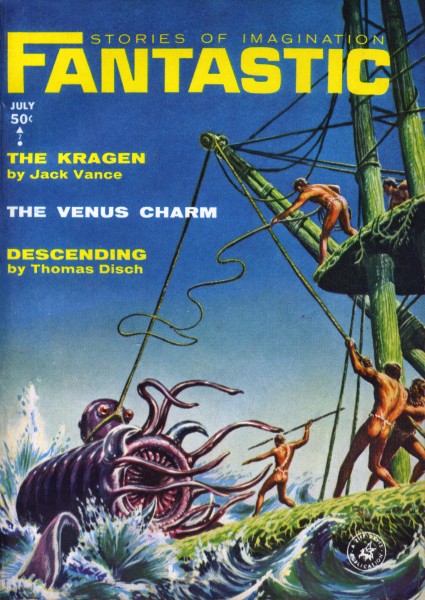
(Cover by Ed Emshwiller. Fantastic, July 1964.) Who Goes There?
Thomas M. Disch would go down as one of the leading writers of the New Wave era, appearing regularly in New Worlds, and you may even recall I covered the serialization of his 1967 novel Camp Concentration in that magazine’s pages last year. What tends to go ignored, however, is that despite his association with New Worlds it was really Fantastic and Amazing Stories under Cele Goldsmith-Lalli’s editorship that Disch first made his name. He had made his debut in Fantastic in 1962, only 22 years old, and his early work shows a frightening intellect that would see Disch as—along with Samuel R. Delany—an enfant terrible in the ’60s. By his thirtieth birthday he had already written a few novels and enough short stories to fill multiple volumes. Today’s story, “Descending,” possibly shows early Disch at his best; I’d even argue it’s a near-perfect story—except for one thing, which we’ll get to. While ostensibly classified as SF, “Descending” is less conventional science fiction and more existential horror crossed with one of Rudyard Kipling’s machine fables. It’s a real gem of a story.
Placing Coordinates
First published in the July 1964 issue of Fantastic, which is on the Archive. It was reprinted in the October 1992 issue of Amazing Stories, found here. Ironically “Descending” was reprinted online, but you can only access it via the Wayback Machine: it appeared in 2000 on Sci Fiction as a “classic” reprint. For For anthology reprints we have quite a few: 10th Annual Edition: The Year’s Best SF (ed. Judith Merril), Modern Science Fiction (ed. Norman Spinrad), Decade: The 1960s (ed. Brian W. Aldiss and Harry Harrison), and A Treasury of Modern Fantasy (ed. Terry Carr and Martin H. Greenberg). Unfortunately it looks like “Descending” has not been reprinted this century thus far. Can we fix this maybe?
Enhancing Image
Something that occurred to me only now is that we don’t get a name for the protagonist here. Indeed the only named character is the man’s landlady, Mrs. Beale, who appears briefly at the beginning. The man (what else do you call him?) is unemployed, behind on rent, and only able to buy stuff on credit; this was back when credit cards were a relatively new thing. Even his credit score is bad. Immediately we’re introduced to a kind of capitalist nightmare, with the protagonist being seemingly on the precipice of financial collapse, knowing he’d have to land a job soon or else hit the streets. “He had been a grasshopper for years. The ants were on to his tricks.” He’s been avoiding ruin for a minute now, but Disch sets up at the beginning that Our Anti-Hero™ is about to have a very bad day—possibly even a reckoning. It’s an ominous, paranoid start to the story, and things only get more unnerving from there. At a little under 5,000 words this story does not waste out time, but its briskness also feeds into its allegorical nature. It helps that Disch, even at this early stage (he would’ve been only 22 or 23 when he wrote “Descending”), was a fine-tuned prose stylist.
The man takes the subway to get to Underwood’s Department Store, to get some food and a couple books while he’s at it. (“What’s a department store?” is a question zoomers would be asking, and rightfully so, while also asking, “What are malls?”) He gets some groceries, including a pheasant (raw or pre-cooked he doesn’t know), plus copies of Vanity Fair and Middlemarch, of which the former he starts reading on his escalator ride from the top floor of the department store. Worth mentioning that Vanity Fair‘s subtitle is A Novel Without a Hero, and similarly “Descending” could be considered a short story without a hero, or even without characters in the traditional sense. The man is a schmuck, sure, but past that we get to know very little about him; he’s less a flesh-and-blood person and more a stand-in for man’s anxieties in an industrialized capitalist society. It’s also while reading Vanity Fair on the escalator that he realizes that he has been on this thing for, at the very least, half an hour at this point. Probably much longer. Indeed, he calculates he’d been going from escalator to escalator, ever downward, for over an hour, going from the top floor down to the basement—and then past it. He runs the numbers and it doesn’t look good. “He was in the one-hundred-fifty-second sub-basement. That was impossible.” Indeed it would be impossible, unless you’re in a nightmare.
“Descending” is obviously horror, but past that it’s hard to categorize. I tepidly count as it as SF because the role technology plays in the narrative, although it’s worth noting that we never get an SFnal rationale for why the department store escalators go down seemingly forever. This sort of thing just happens. Like I said earlier, it would be more accurate to call this story a machine fable rather than SF—one with a very dark hue. We also never encounter anyone on the escalators, such that the protagonist is unable to seek out an explanation from some third party, nor even to verbalize his anxiety to another human; it’s just him and the surreal depth of the escalators, which seem to only go down, not up. There are stairs, but at this point it would take hours to go back up to the surface that way. Aside from a water fountain every other floor the man only has his groceries to feed on; he even eventually eats the pheasant, without cooking it or anything. Gradually the man is reduced to a kind of savage. The hours turn into days. A small comfort is that with the total lack of life in the sub-basements he can relieve himself without shame. He’s torn between using the stairs, maybe in vain, to get to the surface, and wanting to see how far down the escalators go. It occurs to him that he’ll probably die here.
“Descending” is clearly an allegory, but this also raises a problem: an allegory for what? When we talk about fables and allegories we talk about something that was written to express a certain meaning, often textual if not thinly buried in subtext. This type of work is not as common now as it would’ve been in the 19th century and earlier, having emerged from actual fables (precursors to the modern short story) and epic poetry, but still there are modern examples. Steinbeck’s The Pearl is an allegory about the inherent violence of greed. Watership Down is basically a retelling of Exodus. Animal Farm is about how the Bolsheviks had murdered the Revolution in its crib. “Descending” is not as obvious about the substance of its allegorical intent, and this is where Disch starts to taunt the reader, hanging the story’s meaning like a carrot on a stick. The protagonist compares himself at different points to works of literature, including The Divine Comedy (very likely an inspiration for this story) and Robinson Crusoe, and it’s like Disch is baiting us into making a connection that ends up being hard to articulate. It’s a story about machinery, the vanity of a down-on-his-luck man, and capitalist automation, but it’s hard to parse what Dish is saying about these things. What makes it work is that even if we are to give up on untangling the substance of the fable, the primordial fear that Disch invokes is effective such that the struggle to make sense of it stops being a concern, much like how the protagonist stops trying to make sense of it. “Because he was hungry and because he was tired and because the futility of mounting endless flights of descending escalators was, as he now considered it, a labor of Sisyphus, he returned, descended, gave in.”
There Be Spoilers Here
I do have one gripe, which is the very end. The ending is not ambiguous so much as it’s worded ambiguously. The protagonist gives up and lies down on the escalator steps, and the last sentence raises a question as to what becomes of him. “That was the last thing he remembered.” Does he die, or lose his sanity? Does someone find him eventually? The wording implies he doesn’t die, but then why “remembered”? I wish writers would be more to-the-point when writing a character’s death. The thing here is that Disch had an amazing premise and knew what to do with it for 95% of the story, but then I’m pretty sure he didn’t know quite how to end it. Given the references to Sisyphus and Dante I feel like Disch could’ve ended on a note that’s at one point less ambiguous and at the same time a lot more audacious. The man wonders if he’ll reach the center of the earth if he keeps going down, but we never see the bottom of the machinery; maybe there is no bottom, like how in Mulholland Drive there may not be a mystery, once you try getting under the surrealism and free association. “Descending” doesn’t so much end as it comes to a stop, once the protagonist finds he can no longer go on and perhaps also when Disch finds he has run out of juice. It’s a little blemish on otherwise excellent writing, probably not enough to not make me give if five stars (if I gave ratings here).
A Step Farther Out
I suspect “Descending” was published in Fantastic because it’s one of those genre-bending stories that’s hard to tame. It’s been reprinted in SF and fantasy anthologies. It also had the misfortune of being published one year prior to the first Nebulas, as I think it would’ve been a shoe-in for a nomination there. (Seemingly every third short story printed in 1965 got a Nebula nomination, but “Descending” would’ve actually been deserving of it.) Disch was on a roll at this early period, and while he doesn’t quite stick the landing here, it’s such a good performance overall that I have to give it a hearty recommendation. Sometimes I struggle to write a review for something because I unfortunately felt I was not given much to talk about, but with “Descending” I had the opposite (and much better) problem: this story was almost too dense for me to write about it. Rest assured we’ll be returning to Disch before too long.
See you next time.
-
Novella Review: “Polyphemus” by Michael Shea
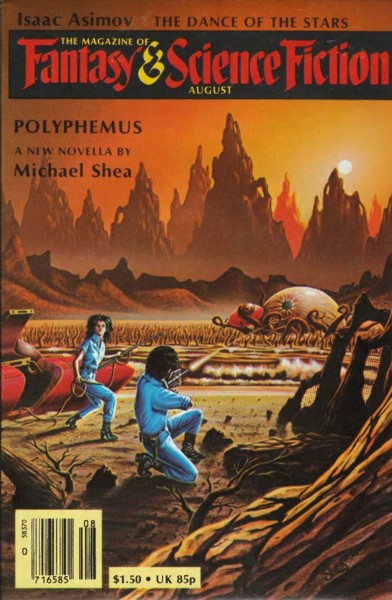
(Cover by Barclay Shaw. F&SF, August 1981.) Who Goes There?
Michael Shea had a pretty interesting career, being one of those authors who started out writing novels before branching out to short fiction; his first novel, A Quest for Simbilis, preceded his first short story by a few years. The result is that by the time of his first short stories he was already a seasoned writer, although I’m still surprised that his most famous story, “The Autopsy,” was only his third published. Today’s story is his fourth. I have to admit I feel bad, because I don’t have a great deal to say about “Polyphemus.” Not to say it’s a bad story—it’s a curious throwback that tries to combine Golden Age planetary adventure with scientific plausibility, plus a generis dose of symbolism and literary references. It can be thought of as almost a companion piece to “The Autopsy,” being concerned with alien biology and, to some extent, an SF-horror hybrid, although “Polyphemus” leans much more on the Sf side of the equation.
Placing Coordinates
First published in the August 1981 issue of The Magazine of Fantasy and Science Fiction, which is on the Archive. It’s been reprinted only a few times, in The 1982 Annual World’s Best SF (ed. Arthur W. Saha and Donald A. Wollheim), and the Shea collections Polyphemus and The Autopsy and Other Stories. The former has gotten a very recent reprint from Valancourt Books—so recent ISFDB hasn’t consistently listed yet.
Enhancing Image
Humans have begun colonizing the planet Firebairn, which is technically hospitable but not exactly welcoming, what with the volcanic activity and the sea life. We have a “sand-hog,” a ship with a few smaller scout boats attached, along with a crew of people hunting “delphs,” which are the native food of choice for the colonists. It’s here we run into our first problem with the story, which is that within the first few pages we’re introduced to over half a dozen characters, a few of whom have no personality to speak of. We have Captain Helion, technically the leader of the expedition although he ends up not being the protagonist. We have Nemo Jones, who does end up being the closest this story has to a protagonist, along with his love interest Sarissa Wayne. We have Japhet Sparks, the ship’s cartographer. We have Orson Waverly, a biologist who will come to be the story’s leading expert on that language we avid readers know: Expositionese. And there are several other named characters I don’t care to dwell on.
Mind you that this is a short novella, and we’re expected to become familiar with at least a few of these characters. Obviously the same can’t be said for some others, since early on we lose a couple redshirts to the monster Waverly comes to call Polyphemus—after the cyclops. It’s fitting, considering the giant tentacled alien the colonists face off with also has one eye, and turns out to be not a very intelligent creature, instead basing its power on size and a complex sensory network. Polyphemus is a carnivore and a competitor for the delph food supply, on top of seeing the humans as potential prey. Thus we have a basic conflict of those who want to kill the alien juxtaposed with Waverly, who wants to study Polyphemus more than kill it. Of course, trying to understand how the monster works on the inside may be the key to killing it, which is how we get into lengthy passages of scientific jargon, most of which (it shames me to say) flew over my head. It would be inaccurate to call this story “hard” SF, but it takes a modern (for the time) approach to what would’ve been an old-fashioned premise even in the early ’80s. Funny thing is that is “Polyphemus” is an update of an Campbellian space adventure published in 1941, there’s now more of a time gap between “Polyphemus” and now than “Polyphemus” and that hypothetical story. The “modernized” update now seems to be old-fashioned itself.
Let’s talk references. Polyphemus itself is named after a cyclops in Greek mythology; and speaking of Greek mythology, we have a piece of equipment called a medusa, which contributes to the climax. Nemo Jones is presumably named after Captain Nemo of 20,000 Leagues Under the Sea, although he has very little in common with his namesake. And of course any story of this nature is gonna invoke comparisons with Moby-Dick and, more recently (indeed it would’ve been recent when Shea wrote the story), Jaws. Here’s the problem: the actual whale-hunting in Moby-Dick takes up maybe a third of the novel. If you were to cut Moby-Dick down to “the essentials” you would be left with a brisk 250-page adventure on the high seas—and also a far less interesting novel. There’s so much character and world depth (never mind the beauty of Melville’s language) you would be missing out on that you may as well be reading a different novel. And at the same time “Polyphemus” is too long for having such a simple plot and such thinly drawn characters, which I understand sounds like a contradiction to what I had just said. Take for instance the romance subplot between Nemo and Sarissa: we know basically nothing about either of these characters, the result being that we aren’t allowed to care much if they live to reunite at the end. This could be fixed by either removing the subplot, if we were to shorten “Polyphemus” by several thousand words, or we could flesh it out if we expanded the story into a full novel—only that would raise more problems.
My point is that Shea was ambitious with this one, and yet somehow he also didn’t go far enough. It lacks the perfect self-containment (never mind the layers) of “The Autopsy,” but it’s also possible I’m just saying that now and might feel different later. It’s possible I’m underestimating this story and as such am not putting the necessary work into it.
There Be Spoilers Here
I wish I had more to say…
A Step Farther Out
A criticism I often throw at modern SF novels is that they could’ve been shorter; we don’t necessarily need something to be 500 pages. This also sometimes applies to novellas, such as “Polyphemus,” which is about 20,000 to 22,000 words but could’ve been finessed with to have been turned into a novelette, or about the same length as “The Autopsy.” There are a few too many characters and ultimately there’s not enough of a plot to chew on. Shea’s attempt at making the movie monster at the heart of the story seem scientifically plausible is worth commending, but ultimately Prometheus is still that—a movie monster. Similarly the characters are a case of spreading too little peanut butter over too wide a slice of bread, so that the humans at times also seem like their B-movie counterparts. It’s possible I’ll come away feeling different on an eventual future reread, but my first impression left me sort of at a loss. Sorry to say.
See you next time.
-
The Observatory: The Genocides, or, How to Rationalize Mass Murder with Science Fiction

(Cover by Ed Emshwiller. F&SF, October 1959.) I’m of the position that it’s perfectly fine to like art one finds “problematic,” which is how I’m able to say I like Robert Heinlein’s Starship Troopers while also finding the arguments he makes in that novel deeply flawed and at times repugnant. I’m saying this upfront as I wanna make it clear, before I get into the really dirty stuff, that this is not an essay in which I merely shit on such a famous novel, call Heinlein a fascist, and so on, which seems to have been a favorite pastime for left-leaning science fiction fans for the past sixty-odd years. Starship Troopers is, in a sense, evergreen, because it was controversial at the time of its publication and it continues to draw heated discussion from people who often either have not read it or have read it but misremember it to a tragic degree, even conflating details unique to the novel with the very loose film adaptation. I’ve read this novel twice, once when I was about sixteen and again a couple years ago, finding on that second reading that I had, in fact, forgotten most of it. Starship Troopers is one of the most famous and misremembered “canonical” SF novels; and unfortunately, no matter how you look at it, it also set a horrible precedent from which the genre still has not recovered. It’s totally possible the genre will never recover from such an impact so long as there are creative minds in the field (and by extension likeminded readers) who believe in Heinlein’s argument: that sometimes extermination is the only option.
Let’s wind back the clock a bit, since there’s a buffet of context for how such a unique and thorny novel like Starship Troopers happened. Such a work of art does not simply fall out of the sky, or emerge from the primordial slime that is the Freudian unconscious, but is basically the result and summation of an artist’s political evolution. Heinlein is one of the most complicated writers in all of science fiction and the fact that there are multiple biographies on him has done little to make his complexity more manageable. The reality is that Heinlein contains multitudes, and that when two people discuss Heinlein there’s a good chance each of them is not talking about quite the same person. Some basic facts that we all know: that Robert Anson Heinlein was born in Missouri in 1907; that he served in the Navy for five years when the country was in peacetime and was discharged because of severe illness; that illness would plague him pretty much all his adult life, to the point where he was on the brink of death more than once; that he married three times, the second (to Leslyn MacDonald) and third (Virginia Gerstenfeld) playing profound roles in his life; that he seemed interested in “free love” as early as the ’30s; that he started out as a New Deal Democrat and a fellow traveler to democratic socialist causes before drifting rightward; that he didn’t see publication until he was in his thirties, although he had written a whole novel before his first sale. But we’re just getting started.
The conventional narrative is that Heinlein started out as pretty liberal and then, over the course of the ’40s, became a right-winger, albeit one with some very unconventional ideas. He supported Barry Goldwater and later Ronald Reagan, and yet there are scenes in Stranger in a Strange Land and some later novels that would surely make a Reagan Republican break out in hives. In the late ’40s he got into a deal with Scribner’s to write SF aimed at younger readers, which turned out to be a splendid partnership for both parties: Scribner’s got what many now call Heinlein’s overall strongest work, and Heinlein got to feel the legitimacy of a mainstream publisher. The first of such novels, Rocket Ship Galileo, was published in 1947, and indeed 1947 turned out to be a major year for Heinlein on multiple fronts: it was the year he returned to writing fiction (after a five-year hiatus), made his deal with Scribner’s, appeared in the Saturday Evening Post for the first time (another big achievement for a genre writer), and divorced Leslyn so he could marry Virginia. (Heinlein and Virginia had met as part of their jobs during World War II, and it’s likely Virginia’s conservatism had influenced Heinlein in his changing politics.) Heinlein’s career is sometimes split into three or four phases, depending, but I go with the latter as I find there to be a break between his run at Scribner’s (1947-1958) and the publication of Starship Troopers. Of course, Starship Troopers began life as another “juvenile” for Scribner’s, but Heinlein had other plans.
Reading the juveniles, you get hints of Heinlein’s eccentric conservatism but there’s nothing in these books that would magically convince some teenager to vote for Trump (or whatever oligarch the Republicans cough up in four years); these are mostly “apolitical” reads. Even something overtly political like Between Planets only gives us a faint glimmer of the madness that is to come later. At first Starship Troopers seems to follow in the footsteps of those juveniles, being about a young man who comes of age and contributes to saving humanity (or perhaps not) in the process. Johnny Rico is like the protagonists of Heinlein’s juveniles, except for a couple things, like the fact that he’s not white but Filipino (you may recall he’s played by the lily-white Casper Van Dien in the movie), and the fact that he ultimately doesn’t do much of anything heroic. Come to think of it, Rico barely does anything in the book, which is one of several things that struck me on that second reading. Still, he’s a good American boy who doesn’t go chasing after girls, and while he starts out as mildly rebellious he comes to learn the “value” of military discipline. The book is essentially split into two sections we jump back and forth across: scenes where stuff happens and scenes where fucking nothing happens. Funnily enough, people tend to forget about the former and focus on the latter when discussing the political implications of this book. In a sense this is fair enough, since the scenes where Jean V. Dubois (the obvious Heinlein stand-in) quite literally lectures at Rico are where the book’s politics become hardest to ignore.
Dubois is not so much a character as he is Heinlein trying to articulate his position on what was, in the late ’50s, a simmering Cold War. He’s a teacher of “history and moral philosophy” who shit-talks Marx and pacifism, being one of many examples that dispels the myth of higher education being filled with leftists. (I remember I took a public speaking course in my last year of college, and our professor was also a local pastor and openly conservative. I wonder how he’s doing now.) See, the conflict at the heart of the novel is that humanity is at war with the “bugs,” a highly intelligent and ferocious alien race that, like this humanity of the future, is set to colonize the stars. There’s no room for diplomacy between the races—no middle ground. Dubois boils the war down to this: only one of these races can survive. The logical conclusion, then, is that the bugs must be exterminated. Genocide. Of course Dubois’s argument (and by extension Heinlein’s) is that since the bugs “clearly” want humanity exterminated as well, this is only fair. If we’re to take this argument and apply it to any real-world situation, the optics are very bad. It is worth mentioning, however, that Heinlein was responding to a nuclear disarmament campaign, and indeed the question of whether the US should continue above-ground hydrogen bomb testing was a tough one in the ’50s. If you know me at all then you can guess which side I fall on, and you can also tell it’s not the same side as Heinlein.

(A lily-white Casper Van Dien in Starship Troopers, 1997.) Before World War II had even ended, a race had begun between the US and Soviet Union to build not only the atomic bomb but a nuclear arsenal. Once the Cold War kicked in there was the question of the possibility of nuclear holocaust, but also whether either side of the Iron Curtain would dismantle its nuclear weapons program. A year prior to the publication of Starship Troopers, Heinlein wrote an essay titled “Who Are the Heirs of Patrick Henry?,” so named after one of the Founding Fathers, in which Heinlein argues in favor of nuclear testing. His concern with nuclear holocaust at the hands of them no-good Russians seemed to inspire his working on Starship Troopers, but it’s here that we quickly run into a problem. If the bugs are meant to be analogous to the Soviets, then what is Heinlein suggesting? That the Cold War turn hot? That we nuke Moscow? Sounds outlandish, but as of right now we’ve also had at least one major politician suggest that nuking the Gaza strip might be a good idea. Was Heinlein being a genocidal maniac, or was he muddying his own argument? I’m inclined towards the former, but I also think consequences matter about as much as intent, and the harsh reality is that, regardless of whether he meant it, the result is that Starship Troopers unequivocally argues in favor of genocide. It’s a novel that states, pretty explicitly, that brute force is the only way to resolve the conflict, and also that brute force has solved more problems than anything else in human history. Rico, as part of his arc, comes to believe this.
“Genocide” is a word that conservatives and many liberals hate, for reasons that make no sense to those who properly value human life. It’s a word that implies culpability on a mass scale, and as you know, reactionaries try not to believe in systems or the masses—only individual “bad actors.” The 20th century, which Heinlein was constantly in dialogue with, was also the century that codified our understanding of genocide—the systematic murder of an entire people. The Belgian murdering and mutilating of the Congolese, the American slaughtering and assimilating of native tribes, the Ottomans rounding up Armenians like cattle, the Germans exterminating the Herero and Nama peoples in Africa, indeed the Germans exterminating Jews, Romani, and others groups; and of course, the Israelis exterminating and displacing Palestinians since the ’40s. Genocide has also had a fruitful (far too fruitful) history in SF. The space operas of E. E. Smith and Edmond Hamilton often posit that mass murder on a planetary scale might be the only way to resolve the conflict of the week. In Star Wars, entire planets get blown to bits and Our Heroes™ react mildly, if they verbally acknowledge the enormous loss of life at all. Starship Troopers itself was a major forerunner to what we now call military SF, and its influence is such that you can see its DNA in everything from giant robot anime to Warhammer 40K. Even those who take the opposite position of Heinlein and respond to his novel are prone to do so using Heinlein’s tools. Thus the novel’s insane bloodlust is now part of SF’s own DNA, by virtue of being so popular and, ultimately, a compelling (if muddy) argument that makes it sound as if mass murder were perfectly reasonable.
Unfortunately the cat’s been out of the bag since 1959. Starship Troopers was serialized in The Magazine of Fantasy and Science Fiction in abridged form as Starship Soldier, then published in book form a month after the serial’s first installment by G. P. Putman’s Sons (Scribner’s had rejected the book and so Heinlein’s relationship with them ended). The book was immediately controversial but just as immediately amassed a devoted readership, resulting in it winning the Hugo for Best Novel the following year. It has never gone out of print. It remains one of the most famous SF novels of all time. The irony with Starship Troopers is that while it is very much in favor of militarism, to the point of imagining a “utopia” where only people who’ve served the government get the vote, it’s also in other ways a progressive novel for its time. Rico is non-white and isn’t written stereotypically at all. The society of the novel seems pretty egalitarian and even post-racial. Women serve in the military, which wasn’t even a thing in the US at the time. Even so, conservatives love this novel because it is gleefully pro-war and (I suspect) because it argues that even in a post-racial society, humanity has the right to relegate some race of intelligent beings to the status of “other”—or even “subhuman.” No doubt Israel’s defenders think of Palestinians as like Heinlein’s bugs; it’s a line of thought that humanity has been paying for, in blood. I think Starship Troopers is a good novel; I enjoy reading it; I also wish Heinlein, for our sakes, had never written it.
-
Short Story Review: “The Jaguar Hunter” by Lucius Shepard

(Cover by David Hardy. F&SF, May 1985.) Who Goes There?
Lucius Shepard had one of the more unusual career trajectories for an SFF writer of his generation, and it shows in his work. He was born in 1943 and apparently wrote some juvenilia as a highly precocious preteen, but didn’t start writing fiction as an adult until he was deep in his thirties, having spent the intervening years on a series of very odd jobs. (He was part of several small-time rock bands in the ’70s and even claimed to have been a gun runner at one point—so he claimed.) His stories often take place on Earth but outside the US, starring an American expatriate or a local of the land, the latter being the case with today’s story. Shepard traveled often and his experiences abroad certainly inspired his fiction. The inspiration seemed to come fast too, since once he started writing in earnest he rarely stopped (he took a break for much of the ’90s, but was otherwise prolific), such that between 1983 and 1985 he produced a healthy platter of short fiction plus a novel. His early output was so strong and consistent that it won him the Astounding Award for Best New Writer in 1985.
I’ve read enough Shepard at this point that I can sort of predict his movements, which you could interpret as an insult or the sign of an artist with a unique vision. It’s like calling Wes Anderson’s movies predictable. The thing with Shepard is that he has a “type,” i.e., a set of tropes and ideas he likes to return to again and again—with the flaws that come with them. I highly recommend “The Jaguar Hunter” as one’s first Shepard story because it neatly encapsulates what makes his writing different from what other genre authors were doing in the ’80s, for both good and ill. It’s a bit orientalist and more than a little misogynistic, but it also has a moodiness and an erotic intensity that identify it as a fable for adults. I found it a captivating read almost in spite of its problematic elements.
Placing Coordinates
First published in the May 1985 issue of The Magazine of Fantasy and Science Fiction, which is on the Archive. It was then reprinted in The Year’s Best Science Fiction: Third Annual Collection (ed. Gardner Dozois), The 1986 Annual World’s Best SF (ed. Arthur W. Saha and Donald A. Wollheim), Killing Me Softly: Erotic Tales of Unearthly Love (ed. Gardner Dozois), The Fantasy Hall of Fame (ed. Robert Silverberg), Tails of Wonder and Imagination (ed. Ellen Datlow), and the Shepard collections The Jaguar Hunter and The Best of Lucius Shepard.
Enhancing Image
Esteban and his wife lncarnación are not doing so well in their marriage: they don’t fuck much anymore, Esteban suspects lncarnación envies his looks and talent, and perhaps most importantly, the wife has a nasty habit of buying things she can’t afford. As such, Esteban owes Onofrio and his son Raimondo money for a TV his wife had bought—but he can clear that debt, and even earn a hearty paycheck on top of that, if he does a difficult job for them. A black jaguar has been stalking Barrio Carolina, not killing anyone just for the fun of it but only hunters who have been paid to go after it. We can infer here that the jaguar is acting in self-defense, not like that matters much to Esteban. This particular jaguar is tough, with a body count, but Esteban is a veteran hunter (albeit one who would prefer to not go back to hunting to make a buck), and he has a special technique that’s earned him kills in the past which other hunters are unlikely to use. So to clear the debt and maybe please his wife along the way (after all, sometimes baby needs a new pair of shoes and sometimes baby needs a new house), he ventures out, solo, expecting to meet his toughest enemy yet.
In the first few pages we have a clean setup, and it’s a pretty good one. The setting is Honduras, which I don’t think is explicitly stated in the text except for the fact that the currency is lempiras (“ten thousand lempiras” being Esteban’s check), but it’s apparently a country Shepard had visited, and Esteban himself is inspired by an actual hunter Shepard knew. The setting is vividly realized, like something out William Friedkin’s Sorcerer or early Kipling, even if it runs the risk of orientalism. This is a risk to be expected of any white American writer depicting places and cultures he may or may not have had any personal interaction with, which is a risk Shepard does sometimes run afoul of, although here I think he’s pretty good about it. What’s more conspicuous is the misogyny, which will only become more apparent as the story goes on and which is arguably baked into the story’s DNA. We get to know very little about lncarnación, but what little we’re told points to her being a massive shrew whom Esteban is probably better off without—and then there’s the other female character, who we’ll get to in a second. I suspect Shepard wrote Esteban as having standoffish relationships with women for symbolic purposes, which I’ll elaborate on, but the point is that this is not by any means a feminist narrative.
(I’m gonna digress for a second here to clarify where I stand on misogyny in fiction, because when I see fellow reviewers harp on it there’s this sense at times of coming from a holier-than-thou position, as if the writer has or had never indulged in misogynistic behavior. I think this is dishonest in some way, or at least gives the wrong impression. When I critique woman-hating in my fiction it’s from the viewpoint of someone who, unfortunately, spent his college years as what you might call an alt-righter or proto-fascist. Such a phase would have a major ripple effect on my life and to this day it creeps up in my interactions with people, especially women and non-white folks, in ways that unnerve me, even if this discomfort is unbeknownst to the other party. As such when I see misogynistic or generally bigoted writing I critique less from a “how dare they” position and more from the fact that I see a little dark part of myself in this writing.)
I’m putting this all up front because the rest is positive; to say this is an evocative story wouldn’t quite be doing it justice. Shepard is often called an SF writer, but “The Jaguar Hunter” starts off as realistic fiction before slowly becoming something else—not science fiction, but a kind of supernatural fantasy that would probably have a hard time getting published anywhere in the ’80s except for F&SF. We expect, going into this as an SFF story, that the black jaguar will not be just a jaguar—only the question then becomes what it could possibly be. (Incidentally I had a bad dream the other night where I thought I had encountered a jaguar in the hills, but someone [who?] beside me told me that this supposed jaguar was in fact, somehow, a bobcat with a night-black coat. A big cat masquerading as an even bigger cat? But why?) This is where the last main character comes into play, in the form of Miranda, a woman who lives by herself on the coat, in what is supposed to be the jaguar’s territory. Now, I don’t think I’m spoiling anything by saying Miranda and the jaguar are connected, because the instant she appeared I felt something was up. It’s one of those “twists” that’s so easy to predict that Shepard doesn’t even treat it as a twist, but rather part of something greater. That the woman and the jaguar turn out to be the same is not the big reveal but only the first major step in the narrative’s arc.
“The Jaguar Hunter” is in essence a love story—not between Esteban and Miranda but between Esteban and death. Esteban is a hunter who has been on quite a few expeditions in his time, and despite being wary of taking on the role once again at the story’s beginning he does take a certain pride in his work. He explains to Miranda (who turns out to be the very jaguar he’s after) in detail how he plans on taking down this fierce animal—by drugging himself and playing dead, only to stab the jaguar between the ribs once the beast gets close enough. Miranda, like a siren, tries to mislead Our Hero™, but Esteban is not swayed until the two meet under different circumstances. Esteban is super-horny for Miranda when they first meet, but it’s only when she reveals herself to be the jaguar in human form (or maybe both the human and jaguar forms are disguises for something else) that he completely falls for her. This is a curious duality, the woman standing in for both eroticism and death. Esteban told Onofrio that if he didn’t return with the jaguar in a week that something must’ve happened to him—and he’s not strictly wrong there. He spends over a week with Miranda, apparently having given up on lncarnación, the two in a state of paradise.
There Be Spoilers Here
Unfortunately paradise, like a euphoric state for a manic-depressive, does not last. Onofrio and Raimondo drive to the territory in search of Esteban, or what they think will be his corpse; they are not pleased when they find their hunter alive and apparently slacking on the job. Esteban kills Raimondo with a machete and provokes the wrath of Onofrio’s goons, and there’s seemingly no way out of this problem. The good(?) news is that Miranda is not an ordinary woman, nor even a werejaguar, but a member of a magical race perhaps akin to the fair folk, who can open portals between the realm of humans and the realm of these magical beings. The story ends on an ambiguous note, with a wounded Esteban jumping into a seemingly bottomless river, chasing after the portal Miranda had opened, in the hopes it will not have closed before he reaches it. Tellingly, we’re not told if Esteban succeeds or not. He’s between a rock and a hard place: if the portal is still open then Our Hero™ will be entering a world totally unknown to him, and which he might not be able to adapt to; and if the portal is closed then he’s a dead man, plain and simple. Shepard’s writing at its best captures what Joseph Conrad in Heart of Darkness called “the dream-sensation” (Shepard undoubtedly took inspiration from Conrad, although Conrad was the better writer), that borderline between the realistic and the mystical. “The Jaguar Hunter” crosses this borderline with a lustiness that befits Esteban and Miranda’s steamy affair, connecting sex and death with an explicitness that Conrad could not (and would not, even had censorship been more lax in his day) have tried. The result is grim, but magical.
A Step Farther Out
To give Shepard credit, he sticks to what he does well. “The Jaguar Hunter” is the prototypical Shepard story, in that it tackles his pet ideas, plus a grizzled protagonist, plus an exotic locale, all in a neat package. It hasn’t aged so much as its problematic elements were so from day one, but as a result it’s also tempting to call it timeless. I think it also helps that Shepard had the habit of writing about Vietnam, explicitly or in an allegorical fashion, and “The Jaguar Hunter” has nothing to do with Vietnam except taking place in a country with a similar climate. This is a story that blurs the line somewhat between fantasy and SF, although I’m much more inclined to go with the former label. If you’re curious about Shepard, this is a good start.
See you next time.
-
Short Story Review: “The Witch of Orion Waste and the Boy Knight” by E. Lily Yu

(Cover by Kirby Fagan. Uncanny, Sept-Oct 2016.) Who Goes There?
We don’t know much about E. Lily Yu. We don’t even know what the “E.” in her name stands for, or at least I can’t find a source on it; her own site doesn’t mention it. We don’t know when she was born either, but given that she graduated from Princeton in 2012 we can make an educated guess. Incidentally she received the Astounding Award for Best New Writer that same year, off the strength of a couple very strong short stories. Since then she has written one novel, a short story collection, plus an essay collection. “The Witch of Orion Waste and the Boy Knight” is a fable, or rather a fairy tale sort of in the style of Hans Christian Andersen, but with a more explicitly feminist bent. This one is a little upsetting to read, truth be told, because of how vividly it depicts an abusive relationship and a woman’s disillusionment; but it’s also written in a style that is (for the most part) in keeping with the tradition.
Placing Coordinates
First published in the September-October 2016 issue of Uncanny Magazine, which you can read here. It was then reprinted in The Best Science Fiction and Fantasy of the Year: Volume Eleven (ed. Jonathan Strahan), The Best American Science Fiction and Fantasy 2017 (ed. Charles Yu), The Best of Uncanny (ed. Lynne M. Thomas and Michael Damian Thomas), and the Yu collection Jewel Box. Pretty good for a more recent story.
Enhancing Image
The story is about a witch, “neither very old nor very young,” and as the narrator tells us, “she had not been born a witch.” She went through a few jobs first and took on the role of witch, learning the arts, living a secluded life in a hut on Orion Waste, so named after a fallen star. The setting is for the most part your typical medieval fantasy setting, albeit with a tinge of the post-apocalyptic and couched in a style of narration that makes it clear from the outset we’re reading a story. The witch herself seems close to being aware she’s playing a part in a fable, and there are a couple side characters who are mentioned as taking part in other stories—which of course we hear nothing about, but this is a fantasy world that is decidedly and completely removed from the real world. The style Yu employs here makes sense for both the material and for someone would’ve been very young still when she was writing it, as the fable is a mode that’s easy to learn but hard to master; it’s not as demanding as trying to emulate the Bible, or even Hemingway, but it takes a talented writer to squeeze fresh juice out of this fruit. As such Yu assumes (correctly) that the reader has at least a cursory knowledge of how traditional fairy tales work and proceeds from there while also having some fun with it, such as a light meta touch.
The witch takes on the companionship of a knight, with the former seeing the latter as worthy of admiration and the latter seeing the former as useful. Right away we get the feeling something isn’t right with this relationship, but the witch is blinded both by her feelings for the knight and the fact that she hesitates to use a certain tool that would’ve prevented this whole oncoming trouble. You see, the witch had inherited a magic bell, “forged from cuckoo spit, star iron, and lightning glass, which if warmed in the mouth showed, by signs and symbols, true things.” The problem is that using the bell renders the witch ill to the point of being bedridden, so it’s only something to be used in dire situations. It’s a shame, because the knight is not without his merits; he is brave, and he does try to take on the dragons that his profession calls for, but he proves to be simply not strong enough to take on these beasts alone. The witch goes through great pains to save the knight, but is not rewarded for it; instead the knight berates her, being clearly envious of her talent, and even later in the story threatens to kill her if she “takes the credit” again. The knight does not see the witch as fully human but rather as a utility, to be discarded if deemed too inconvenient or if her usefulness runs out. And yet the witch stands by the knight; she can’t bring herself to hate him, or even to articulate the ways in which he mistreats her.
The witch is a woman, but the knight never treats her as such. Historically, in the real world, witchcraft has been associated with women’s evil ways, and while witchcraft is not an exclusively female practice and women aren’t the only people to suffer from witch hunts (Giles Corey sure died for it), a woman being accused of witchcraft is like a woman under patriarchy being accused of promiscuity. To help make this point, Yu introduces us to the lady (mind you that none of these characters have names), whom the knight rescues after the witch has defeated another dragon. The lady is everything the knight expects out of a “good” woman: conventionally attractive and pure as snow, not given to wickedness. Unfortunately the lady is also a real bitch, and it doesn’t take long for her to whisper sweet nothings in the knight’s ear and convince him to kill the witch while she isn’t looking—something the witch luckily overhears. I will say that things at this point get a bit confusing since there aren’t any breaks between scenes and the third-person narrator seems to jump between characters’ perspectives carelessly by the time the lady is introduced. It doesn’t make the story difficult so much as unnecessarily hard to untangle at times; it gives the impression of unprofessionalism, or at least that one more go through the manuscript would’ve been nice. Ultimately these are quibbles, given the story’s power otherwise; just wanted to point them out since they stuck out to me initially.
There Be Spoilers Here
When I started reading this story I assumed the “boy knight” of the title would be an actual boy and not a man (how stupid of me), and yet I ended up not being that far off. The witch’s bell reveals that a curse had been put on the knight, such that while physically a man he’s still a young boy on the inside, which goes to explain his erratic behavior and lack of capacity to empathize with anyone. The lady, for her part, is also cursed, such that once she has her hands on someone she can’t have them, though it’s unclear at first what this could mean in practical terms. The witch pities both of them, although what’s interesting is that for both Yu and the witch the curses put on these people do not absolve them of their wrongdoings. The twist of the knight’s condition also comments on the immaturity inherent in misogyny, about how a misogynistic tendency always reveals a lack of maturity and capacity to empathize with other people in the misogynist. (Needless to say this also applies to transmisogyny.) I say this with clarity as someone with a long history of misogynistic tendencies that I’ve been trying to atone for in the past couple years. I used to be almost as bad as the knight. It’s not an easy thing to say, but it’s true, and it’s probably a personal factor that has gone to heighten this story’s effectiveness for me.
In a way the story’s climax is a bitter one. The knight is not cured of his curse, nor is he redeemed, but rather becomes another toy for the lady, who herself is said to be deeply unhappy. Things turn out well for the witch, though, who has gotten out of her toxic relationship and can now act only for herself again. Aging and wounded from her travels, she take up working at a shop, not saying much but being content in her work—only she’s met with one last visitor, a peddler “with a profitable knack for roaming between stories” who offers her a pair of red shoes. The ending is a bit of a head-scratcher if taken on a literal level, but since this is a fairy tale it’s easy to grasp the allegorical significance of the witch putting on the shoes and taking flight, after having suffered and yet retained a sense of purity. Unlike the mermaid of Hans Christian Andersen’s story, who must work in the afterlife to redeem herself, Yu’s witch is more akin to Thomas Hardy’s Tess in that she is a fundamentally good woman who has been done dirty. The very end sees the witch ascend to the heavens, but also out of the story.
A Step Farther Out
There’s a roughness to it, mainly in the lack of scene breaks and shifting in perspectives, that tells me it could’ve been even better had there been another rewrite. At the same time it’s telling that when logging this story for my reads-of-the-year spreadsheet I bolded the title, telling future me this is very much a story work recommending and remembering. “The Witch of Orion Waste and the Boy Knight” is a modern fairy tale that captures, in balanced measures, both the whimsical high fantasy and dark moralism of quite a few classic fairy tales. Yu understood the form well enough to not only emulate it successfully but to give it a little something extra. rest assured we’ll be returning to her eventually.
See you next time.
-
Short Story Review: “The Shadow and the Flash” by Jack London

(Cover by Virgil Finlay. Famous Fantastic Mysteries, June 1948.) Who Goes There?
We’re dealing with a reprint today, and fittingly it’s from the pages of Famous Fantastic Mysteries, which dealt mostly with reprints. We also have one of the “canonical” American authors with Jack London, who if you went through the American public education meatgrinder you very likely had to read at some point. London is a “literary” type who also wrote a good deal of adventure fiction and—though not as publicized—science fiction. Indeed London was one of the pioneering figures of American genre SF, to the point where he can be thought of as a precursor to the Gernsback revolution of the ’20s; it’s a wonder, then, why he was never reprinted in Gernsback’s Amazing Stories. He died young, in 1916 at forty years old, from a combination of drug abuse and severe (like eye-popping) alcoholism; but despite his early death he wrote at a mile a minute, such that while SF makes up only a fraction of his output, he still wrote enough of it (a few novels plus a couple dozen short stories) to fill multiple volumes.
“The Shadow and the Flash” was first published in The Bookman in 1903, the same year London put out his most famous work, the novella The Call of the Wild. London’s most famous stories, including The Call of the Wild, are mostly set in the Klondike, which London had actually ventured to as a gold prospector. Probably not incidentally these stories are also London’s least political, camouflaging his leftist streak; his most widely read (and said to be his best) SF novel is The Iron Heel, which is an explicitly socialist reaction to capitalist oligarchy. “The Shadow and the Flash” is not a political tract, but it does have a strong allegorical hue, working as a cautionary tale with regards to man’s relationship with the sciences. One could argue this in itself is a political statement, but London’s chief goal here is to entertain, which you have to admit he’s pretty good at.
Placing Coordinates
First published in 1903 and then reprinted in the June 1948 issue of Famous Fantastic Mysteries, which is on the Archive. It’s been collected in Moon-Face and Other Stories, The Scarlet Plague and Other Stories, The Science Fiction of Jack London, The Iron Heel & Other Stories, and honestly too many more to count. The most curious reprint might be Judith Merril’s first anthology, Shot in the Dark, which is comprised mostly of ’40s genre SF stories but which also contains a few pre-Gernsback items. It’s totally possible Merril became aware of the London story through its FFM appearance. Since London has been dead for a very long time his stuff is all in the public domain, so here’s the Project Gutenberg link.
Enhancing Image
The narrator begins by telling us about two of his friends, Lloyd Inwood and Paul Tichlorne, who are mutuals and somehow both very similar and total opposites, like yin and yang. “Both were high-strung, prone to excessive tension and endurance, and they lived at concert pitch.” The two were all but born to be rivals, a rivalry that goes back to the three dudes’ childhoods, and at one point they were even pining for the same girl, who sadly had to turn them both down on account of polygamy not being an option. I’m not kidding, she can’t choose between the men, claims to love both, but says that since polygamy is illegaly and polyamory is taboo, the trio must disperse. (Worth mentioning she uses the word “polyandry,” which is to say a woman taking on multiple male partners, whereas “polyamory” would not be coined until the 1990s. The more you know…) Point being Lloyd and Paul are two brilliant men, at least with regards to the sciences, who also happen to have a strong competitive streak and who hate each other’s guts. The narrator, being a comparatively average guy, is basically forced to watch as his oomfies get up to hijinks in the name of besting each other.
The rivalry culminates in a question Lloyd and Paul are set on answering: How does one achieve invisibility? The topic of invisibility seemed to hold a lot of water in London’s time, for reasons I can’t parse. Consider that over the course of the roughly 200-year history of science fiction as we recognize it, topics shift in and out of relevance—by that I mean areas of science (or more often pseudo-science) that writers gravitate toward. In the 1840s and ’50s hypnosis (or mesmerism as it was called then) was in vogue then, with Edgar Allan Poe and Nathaniel Hawthorne getting in on it, and indeed hypnosis would remain popular up to the dawn of the 20th century. Infamously there was an obnoxious influx of SF stories concerned with ESP in the ’30s through the ’50s, in no small part due to John W. Campbell’s obsession with it. (A point rarely brought up about “Who Goes There?” and something that wasn’t carried over to The Thing is that the alien is said to be able to mimic people’s personalities by way of ESP.) In the 1950s there was also the start of the UFO craze. In the 19th and early 20th centuries there seemed this fascination with invisibility—see such iconic stories as Fitz-James O’Brien’s “What Was It?,” Ambrose Bierce’s “The Damned Thing,” Algernon Blackwood’s “The Willows,” and of course Lovecraft’s “The Colour Out of Space.” Then we have this relatively obscure Jack London story, which tackles a possible scientific basis for invisibility.
The rivalling scientists complement each other more than either could anticipate, including down to how each tries to attain invisibility. Lloyd, for his part, aims for perfect blackness—an object so black that the human eye struggles to perceive it. This wouldn’t be a Jack London story without at least a bit of racism, so we’re met with a cringe-worthy scene where Lloyd takes the narrator to a boxing match and remarks that a black man, when in the shadows of the edges of the interior, seems practically invisible. So, a formula that would create perfect blackness so as to be imperceptible, although that does leave one problem Lloyd is unable to fix: the object’s shadow. Nothing he can do about that it seems, so it’s not “perfect” invisibility. Paul, on his end, tries a formula that would make an object perfectly transparent in the sense that light goes through it, and as such it would not only be invisible but cast no shadow—like a pane of glass, only more so. The problem, then, is different, in that like glass the invisible object is subject to color flashes, like a rainbow effect, such that the invisible object would give off brief flashes of color. Thus we have the title, the shadow and the flash—the imperfections in each man’s experiment. The narrator, not being a scientist, is astounded by all this, although he fears his friends may be verging on a point of no return—that these experiments could prove disastrous.
If “The Shadow and the Flash” is about anything it’s about the impossibility of attaining perfection, even if one tries bending the laws of known science. Each man’s invention is miraculous, but also flawed, without a solution that wouldn’t spawn yet another flaw. Each has what the other lacks. This follows a long tradition in science fiction of the sciences being a catalyst for man’s folly—an anti-science slant that goes back to Frankenstein and which can be often seen in the works of Michael Crichton. In this sense London’s story is very much a cautionary story; but at the same time it must be said there’s a tangible awe with how he and his scientists describe their discoveries, a thirst for knowledge that London seemed to share with his characters to some extent. Remember that London was an autodidact, a voracious reader who read up on seemingly every notable intellectual of the 19th century, for lack of a proper education; one can safely assume a strong curiosity is necessary for such a life. Like Lloyd and Paul, who are born risk-takers (we’re told of a childhood episode where the two nearly drowned themselves in one of their contests), London was an adventurer who probably didn’t imagine himself living to a fine old age. As such there’s an immediacy and ferocity in the writing that would make it read as exaggerated to a modern reader, but it would’ve fit well in a pulp magazine.
There Be Spoilers Here
The climax of this story is a bit of an odd one. The three meet up on a tennis court, wherein Lloyd and Paul are both invisible; mind you that both men are naked, and they seem to be pretty casual about this around the presumably straight narrator. (Fabric is too complex a material to make totally invisible, so it makes sense to strip and paint yourself with the experimental formula, right?) The two men get into a fight on the court (remember that this is two almost perfectly invisible men) that results, somehow, in them beating each other to death. It’s unclear how they could’ve killed each other at basically the same time or how they would’ve been able to even handle each other. There are a few logical questions that pop up throughout this story that it’s best to not think too hard about. For example we meet at one point a hunting dog Paul has made invisible and which the narrator accidentally fumbles into, except apparently the formula has made the dog perfectly silent as well as invisible, as it doesn’t make even the slightest sound until it makes direct contact with the narrator. I say this all in good fun, of course, because the science remains just plausible enough whilst providing a fast-paced and engrossing narrative. And anyway the narrator at least learns an important lesson. This whole tragedy could’ve been prevented had the boys agreed to be in an M/F/M throuple.
A Step Farther Out
Aside from a certain scene, “The Shadow and the Flash” holds up a surprising amount given its vintage. I mentioned at the beginning that it’s perplexing how London never appeared in Amazing Stories when that magazine was focused on reprints, since Hugo Gernsback was concerned with establishing a continuity with pre-pulp pioneers in the field like H. G. Wells and Edgar Allan Poe. Surely London’s contributions to SF are not to be overlooked! At the same time the fact that this story reads like proto-Gernsbackian and even proto-Campbellian goes to show how much American genre SF had changed between 1900 and 1950—or rather how much it didn’t change. It’s praise for the story but damning for the field as a whole.
See you next time.
-
Novella Review: “Birthright” by April Smith
(Cover by Kenneth Rossi. If, August 1955.) Who Goes There?
It’s May 3, 2024, and I’m being forced to live in interesting times. College students are protesting an ongoing genocide in a country that the federal government and American military contractors support, and the antediluvian head of state is calling for protests—not real protests, but more like when a bunch of people sit in a circle and chat like it’s a fucking book club or AA meeting. Conservatives want protesters’ skulls crushed, liberals also want protesters’ skulls crushed but are usually much more “polite” about wishing violence upon people who were born literally this century and who are committing the “crime” of being disgusted with American complicity in atrocities. And worst of all, it’s an election year. Is this 2024 or 1968? You may be thinking, “Brian, you’re being awfully political right now, and also you’re dating your review.” You’re right on both counts. In fact I dated it at the very start. Of course people might not know about this blog in five years, or even know what America is—or was.
Not that the above is strictly irrelevant either, since today’s story is also about the folly and immorality of empire, although its conclusion is much more optimistic than what I’ve been able to consider for the current real-world situation. I haven’t said anything about April Smith yet because unfortunately I can’t say anything about April Smith, although I can say a good deal about the fact that I have nothing to say about her. Smith has two stories to her name, with “Birthright” being her only solo work, and in neither case do we get any biographical information in the introductory blurb. We don’t know when she was born or when she (probably) died, where she grew up, what non-genre work she might’ve done, or even if “April Smith” is her real name. She is, like too many lady authors who were active in ’50s genre SF, a ghost of that era.
Placing Coordinates
First published in the August 1955 issue of If, which is on the Archive. It would not be reprinted in any form for over sixty years; for better or worse Smith let it fall out of copyright, so the full story is on Project Gutenberg. It would finally be reprinted in book form in Rediscovery: Science Fiction by Women (1953-1957), editor unknown.
Enhancing Image
Cyril Kirk is an ambitious young man, top of his class, and while some dudes might want a fancy car or a high-powered gaming laptop, Kirk wants a planet that he sees as worthy of patronage. And theoretically at least he has options: the Galactic Union contains dozens of worlds, mostly for the purposes of colonization and resource mining. Unfortunately Ross, Kirk’s superior, makes him a planetary advisor on one of the most obscure and least valuable worlds in the Union: Nemar. Even someone as well-read as Kirk can’t remember this planet off the top of his head, and further research doesn’t help much. “The documents on Nemar, all the information he could dig up, confirmed Ross’s statement that the planet held nothing of commercial value.” So he’s been assigned a planet that, at least as far as the Union is concerned, is basically worthless. It won’t be a short assignment either: five mandatory years, plus five optional, although Kirk suspects he won’t be using those extra years. He won’t be the only Terran on Nemar, but that won’t help him much either, since we soon learn the people he’ll be working with are as enthusiastic about making the natives useful as he is.
Once we land on Nemar, a few things become clear: the natives have no interest in contributing to the Union, and perhaps more importantly, they seem like they have no need to. I have to stop for a second here to say that “Birthright” is overtly a narrative about colonialism, about a member of the empire trying (and spoilers, failing) to “enlighten” the indigenous population. Overall it’s a pretty progressive-minded story, actually far more left-leaning for the ’50s than I had expected, but it does also play into Orientalist fantasies, what with the natives of Nemar being perpetually semi-nude (although they consider it to be normal attire), conventionally attractive yet exotic, and they’re described several times as “naive” and “childlike.” Nemar is clearly supposed to be like a paradise, like vacationing on one of the Hawai’ian island. Incidentally it’s noted at the beginning that the natives are basically homo sapiens, just with a unique skin complexion, and that Nemar itself is very similar to the tropics on Earth. If you were to adapt “Birthright” for film or TV (and you could do that without the headache of securing rights, since it’s public domain), you would probably shoot in Hawai’i, or maybe Samoa if you’re feeling a little more adventurous. My biggest gripe with the story, aside from its lack of a solid ending (will get to that), is that while it’s a cutting criticism of colonial arrogance, this criticism is also undermined by now-outdated racial politics.
While reading I was reminded most of Joseph Conrad, and also the movie Fitzcarraldo. Both Apocalypse Now and Fitzcarraldo are movies about arrogant white men in exotic locales, with the explicit and implicit comments on colonialism; and there’s also the fact that both are infamous “I will kill everyone on this set and then myself for the bit” movies. “Birthright” is nowhere near as daunting; if anything it comes close to being a fish-out-of-water comedy. Kirk has a native woman, Nanae, who looks after the house he’s been given, and he practically trips over his own cock trying not to ask for this woman’s hand in marriage upon first seeing her. He cannot come to terms with the fact that he is super-horny over Nanae and it embarrasses him, not least because fellow Terrans in the village (including Jeannette, an actual Earth woman) see his plight for what it is immediately. Indeed everyone seems to see right through Kirk except for Nanae, although it’s possible she knows and is too polite to say anything. The lax attitude of the other Terrans, who at this point are more expats than workers of the Union, also troubles Our Hero™, as if something in the air has changed them, made them forget their purpose here. “Somehow, the planet had infected them.” There must be some secret “weapon” the natives use to pacify the PAs, and Kirk’s gonna find out what it is.
Not to get nostalgic over an era I was not even close to being alive for, but I admire that at this time in SF history you could have stories with meaty ideas that were still only short stories or novellas. Nowadays it seems like if you wanna draw any attention in the field you have to write, bare minimum, a long novella (say close to 40,000 words) that would be too lengthy for magazine publication but just the right length for an overpriced Tor chapbook. “Birthright” just barely meets the SFWA criterion for novella length and, truth be told, it could’ve been a few thousand words longer; not saying this as a negative criticism. Smith’s style is breezy and on the side of minimalist. The story can be thought of less as a “story” and more like a series of Socratic dialogues, although these dialogues individually tend to be brief and there was never a point where I wondered if or when Smith would “get on with it.” This is not an action narrative; it’s about a man’s slow but sure transformation from an agent of the empire to someone who’s wondering if his bootlicking has been worth the effort—or even if it’s been well-intentioned. Nemar is basically a socialist utopia in the mode of what Ursula K. Le Guin might’ve envisioned (which has its own problems, but we’re not getting into that today), a society where there’s no fixed hierarchy, where parents respect their children, where money seems to be a non-issue, and where’s almost no industry to speak of.
There Be Spoilers Here
This leads to Kirk figuring out the planet’s “secret,” which is really that there is no secret. The natives have cultivated a society that’s founded on compassion, as opposed to most Union societies (and by extension our society) which are founded on protection of property. When Kirk tries to convince the village council on voting in favor of mining operations on the planet, the council votes no. The council’s rationale for this denial of industry is pretty hard to argue with, for both Kirk and the reader. An unnamed member of the council goes on by far the longest monologue in the story, and I may as well quote “all” of it here. I say “all” because the paragraph the monologue is a part of is even longer, if you can believe it:
“As you said, the mining is very hard, disagreeable work. We feel that when you begin to do disagreeable things for an end that is not valuable in itself, you are beginning to tread a dangerous path. There is no telling where it will end. One such situation leads to another. We might end up cooped up in a room all day, shut away from the sun and air, turning bolts on an assembly line to make machines, as we have heard often happens on Terra. […] Being surrounded by technical conveniences isn’t worth that. […] On Terra and on most of the other planets we have had word of, people seem to spend their time making all kinds of things that have no value in themselves, because they can be sold or traded. Other people spend their time trying to persuade people to buy these useless things. Still other people spend all day making records of how many of these things have been sold. No! This path is not for us. […] We don’t know how it came about that all these people spend their time at these unpleasant, useless things. They can’t have wanted it that way. No human being could want to spend his time doing silly, pointless things. How could you believe in yourself? How could you walk proudly? How could you explain it to your children? We must be careful not to make the mistake of taking the first step in that direction.”
So capitalism does not flourish on the planet, at least for now. Kirk is, at least professionally speaking, a failure; but at the same time he comes to realize he may have won on a personal and moral level—that by “giving in” to the ways of these people he seems on his way to redeeming himself. He accepts that he has become like a child again. He even ponders, at the very end, the possibility of earning Nanae’s affections and returning to Earth with her. This ending sentiment is fine, but also the story doesn’t so much “end” as it comes to a stop, which bothered me initially.
A Step Farther Out
I’m sort of dismayed it took seven decades for “Birthright” to appear in book form; surely this has nothing to do with the sexism of anthology editors in the ’50s until at least the ’80s. There are some pretty rotten stories from this era that have been reprinted multiple times, but not a genuinely interesting yarn like this one. It’s flawed in a couple ways, and I wish April Smith had continued trying her hand at genre writing (this was her second story and it would be her last, at least under the April Smith name), but it shows a level of ambition not too often found in ’50s genre writing. I get pretty sentimental about the ’50s in the context of genre SF because it really was like the Klondike gold rush for pulp writers, each author looking to make some kind of living off writing what was often perceived as childish at the time, looking to get lucky and even publish a bestseller. Most of the attempts would be failures, of course, but there are so many hidden gems from this period that I’m convinced that despite being so often mined for anthologies, we have not even come close to drying this particular well.
See you next time.
-
Subscribe
Subscribed
Already have a WordPress.com account? Log in now.
 Science Fiction & Fantasy Remembrance