-
Things Beyond: July 2024

(Cover by Ed Emshwiller. F&SF, March 1965.) As I’ve said elsewhere, we’re gonna be covering the ’60s in this year-long tribute to The Magazine of Fantasy and Science Fiction this month. Picking stories to review for July proved a challenge, but in a good way. Over its 75-year history F&SF has gone through several editors, which is normal, but the ’60s were almost certainly the most tumultuous time in the magazine’s history, for a few reasons. At the beginning of the decade Robert P. Mills was editor, and for the few years he edited F&SF Mills was very capable, arguably even on par with Anthony Boucher; but Mills was an agent and publisher first, and editing wasn’t something he wanted to do as a career. So the torch was passed to Avram Davidson, which sounds like an odd choice with hindsight, but it probably made perfect sense at the time. Davidson was a well-respected writer out of the “new” generation; he was more literary than most of his contemporaries, but he was also… quirkier. For practical reasons more than anything Davidson’s editorship could not last, and so the torch was passed once again, this time to Joseph W. Ferman, with his son Edward assisting him. Joseph lasted about a year before passing the torch to Ed; and this time, by the beginning of 1966, the torch would stay in place, as Ed Ferman would remain editor for the next 25 years. By the last ’60s F&SF had found a new and comfortable niche.
The rapid changing of editors also coincided with a rapid changing of material and reader expectations at this time. The ’60s were the decade of a lot of things: the Vietnam War escalating, racial and socio-economic strife reaching a breaking point, the assassinating of left-leaning public figures, the coming of the hippies. More innocuously it saw the birth of the New Wave, which was spearheaded in the UK by Michael Moorcock and a small army of forward-thinking British writers (although, if it makes you feel better, quite a few important contributors to the New Wave were American), reinventing New Worlds to make it a boundary-pushing powerhouse of a magazine. The US scene was a bit slow to catch up. John W. Campbell and Frederik Pohl lamented the New Wave, but the rascally movement would eventually find a sympathizing magazine in the US with F&SF. Understandably the fiction published in F&SF during this time was a good deal more eclectic than what happened in the ’50s, so it also makes sense the lineup of authors for this month would be a bit eccentric. We have a few of the usual suspects, but we also have… Lin Carter? And Russell Kirk…? We have a New Waver with Brian Aldiss, although the story chosen is decidedly anticipatory of the New Wave rather than part of it. For the most part we have science fiction here, with some horror thrown in; this was not a great time for fantasy in F&SF. Still, I think it’s at least an interesting roster.
Let’s see what’s on our plate.
For the short stories:
- “The Oldest Soldier” by Fritz Leiber. From the May 1960 issue. He’s baaaaack. Honestly it’s been too long—in fact it’s been exactly a year since we last covered Leiber. Of course in the interim I’ve not refrained from writing about him on a different outlet or two, and can you blame me? This time we have an entry in his Change War series, being one of the first examples of a time war in SF.
- “Hothouse” by Brian W. Aldiss. From the February 1961 issue. Aldiss has a career that goes shockingly far back for someone who died fairly recently, having debuted in the ’50s and almost overnight becoming a force to be reckoned with. Hothouse is usually considered a novel, but as a series of linked stories it won Aldiss a Hugo. This first entry in the “series” is a much-needed reread for me.
- “Subcommittee” by Zenna Henderson. From the July 1962 issue. There were quite a few female authors active in the early days of F&SF (more so than other SFF magazines), and one of the most prolific contributors was Henderson. Her fiction often involves families and the experiences of children, and she’s most known for her stories of “The People.” This story, however, is totally standalone.
- “The Voyage of the ‘Deborah Pratt’” by Miriam Allen deFord. From the April 1963 issue. DeFord has one of the most curious careers of any old-timey SF writer, and in 1963 she was almost certainly the oldest living contributor to F&SF, being in her seventies. Prior to taking up genre writing she wrote for socialist and feminist publications, as well as conducting research for Charles Fort.
- “Cynosure” by Kit Reed. From the June 1964 issue. Starting in the ’50s and remaining active until her death in 2017 (she lived to be 85), Reed’s work is often quirky, humorous, satirical, but also at times brutal. Her science was never hard, and her disposition makes one think of Shirley Jackson. Both are vicious when it comes to domestic portraits. In other words, Reed was perfect for F&SF.
- “Uncollected Works” by Lin Carter. From the March 1965 issue. Acclaimed, if also controversial, as an editor, and pretty notorious as a writer, Carter is probably most responsible for reviving interest in pre-Tolkien fantasy in the ’60s and ’70s. He’d been active as a fan since the ’40s, but “Uncollected Works” was his first solo professional story, and it garnered him a Nebula nomination.
- “Balgrummo’s Hell” by Russell Kirk. From the July 1967 issue. Kirk, at least when he was alive, was known more as a conservative political philosopher, and indeed Christianity is integral to both his fiction and non-fiction. But he was also a surprisingly accomplished writer of supernatural horror, and despite being very much an outsider he did sometimes appear in the pages of F&SF.
- “They Are Not Robbed” by Richard McKenna. From the January 1968 issue. McKenna gained mainstream recognition with his one novel, The Sand Pebbles, but it seems he used science fiction as a training ground, such that he appeared semi-regularly in the magazines—both before and after his death. McKenna died in 1964, but he apparently had a small trove of stories waiting to be published.
- “The Movie People” by Robert Bloch. From the October 1969 issue. Bloch is most known for writing Psycho, but his career started much earlier and much more embedded in the Lovecraftian tradition—indeed he and Lovecraft were correspondents when Bloch was a teenager. On top of writing bestsellers Bloch wrote for film and TV, even penning a few (horror-themed) Star Trek episodes.
Won’t you read with me?
-
Short Story Review: “The Secret Life of Bots” by Suzanne Palmer
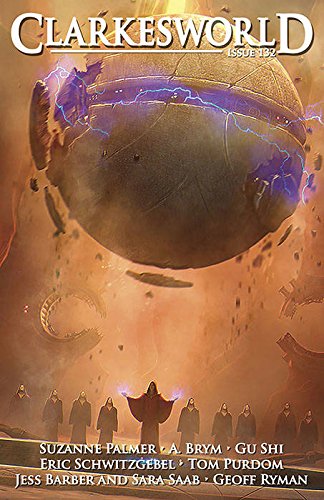
(Cover by Vladimir Manyukhin. Clarkesworld, September 2017.) Who Goes There?
Despite being in her fifties, Suzanne Palmer is part of the generation of SF writers to come about in the past decade and change, those whose work coincided with the expanding of the genre market online. (If you’re someone quite a bit older than me and anxious about starting a career in writing fiction, just know it’s not too late!) In Palmer’s case however she’s been a more frequent contributor to Asimov’s Science Fiction than any of the new outlets. She didn’t make her debut in Clarkesworld until 2017, with today’s story, but “The Secret Life of Bots” immediately struck a chord with readers as it would also win Palmer her first Hugo. It would even spawn a series of short stories starring the recommissioned robot Bot 9, all of which for some reason reference movies with their titles. This story is what you might call a comedic thriller crossed with a space opera; the stakes are high, but the lightness of character interactions keep it from becoming too serious. I don’t like it as much as readers clearly did at the time, but it’s an effective and undemanding read that’s sure to please the crowd.
Placing Coordinates
First published in the September 2017 issue of Clarkesworld, which you can read online. Despite being less than a decade old it’s been reprinted quite a few times (somehow I don’t have any of these reprints in my library), including The Best Science Fiction & Fantasy of the Year: Volume Twelve (ed. Jonathan Strahan), The Best Science Fiction of the Year: Volume 3 (ed. Neil Clarke), The Year’s Best Military & Adventure SF: Volume 4 (ed. David Afsharirad), and The New Voices of Science Fiction (ed. Hannu Rajaniemi and Jacob Weisman). The only major year’s-best anthology it did not make was the last entry in Gardner Dozois’s series.
Enhancing Image
Bot 9 wakes up, or rather is reactivated, after a long hiatus to find that business aboard the Ship (with a capital S) has gone really sideways in the interim.
Dust was omnipresent, and solid surfaces had a thin patina of anaerobic bacteria that had to have been undisturbed for years to spread as far as it had. Bulkheads were cracked, wall sections out of joint with one another, and corrosion had left holes nearly everywhere. Some appeared less natural than others.
There’s still a human crew, although not as many people as Bot 9 had expected, and of course there’s a whole army of bots of different classes who really do the work maintaining Ship: hullbots, silkbots, and so on. Ship, along with the bots it directs, is sentient, although it’s unclear just how sentient each of the bots is supposed to be. The bots are able to make complex decisions of their own accord, and even to go into “Improvisation,” but officially they’re to take orders from Ship, who then takes orders from the Captain. (The humans have names, but honestly it’s easy to forget they do and I’m not totally convinced Palmer should’ve bothered.) Ship is in quite the pickle, being on course to meet with a hostile alien ship, nicknamed Cannonball, which Ship is really in no condition to fight; and to make matters worse there’s some kind of alien creature aboard Ship that’s been wreaking havoc, called “the Incidental,” although Bot 9 posits a more accurate name would be “Snake-Earwig-Weasel.” Ship is quite literally falling apart and so are some of the bots, including a damaged hullbot named 4340 whom Bot 9 helps out and quickly befriends.
Ship and the bots often come off as more human than the actual humans, which might be the intention, although while reading this story my mind couldn’t help but trail off and ponder stupid questions, such as: “So if the bots are sentient, does this mean humanity has reintroduced non-prison slave labor in the future? Are the bots slaves?” The humans become a good deal less sympathetic if we’re to believe they knowingly invented sentient life, only to enslave it, though I might be too harsh on this. (Actually it’s impossible to be too harsh on the institution of slavery, but understand that this whole line of thought with the bots-as-slaves is meant to be taken semi-jokingly.) Ship and the bots tell us repeatedly they exist “to serve,” and obviously this blind servitude is set up to be subverted later in the story. Bot 9, being outdated and not even included in the newfangled “botnet” the other bots take part in (direct communication, like telepathy), starts out as an outsider; but it’s this status as outsider that may prove to be an asset, as Bot 9, for all its jank, has a surprising capacity for ingenuity. If we’re to take the bots as analogous to humans then Bot 9 reads as elderly/disabled, being released into a society of mostly abled-bodied members, who has to and ultimately does prove its worth despite the odds. This is potentially a can of worms, but on the bright side it’s refreshing to read SF where robots are explicitly not gendered, even if Ship is very much coded as feminine (motherly, patient, a foil to the bullish humans).
The mix of adventure and humor would very much appeal to readers, but another thing I couldn’t help but notice is that if you remove the occasional salty language you could have feasibly published this story in the ’40s. This is a Campbellian narrative to the extent that the humans, while at times irrational and helpless (not to mention slavers), are ultimately shown to have the best intentions, and ultimately the bots stay loyal to the interests of their human masters. After all, they’re all on Ship together; the humans’ problem will inevitably also be the bots’ problem. But also the bots, while charming and shown to be perfectly capable of making their own decisions, are less prone to rebellion or existential crises than Asimov’s own robots. Human and bot must collaborate in order to take care of the small problem of the Incidental and then the much larger problem of Cannonball. And of course the alien race is written as totally unknowable and hostile to human interests—capable of thinking as well as a man but certainly not like a man. This town ain’t big enough for the two of us. Diplomacy is impossible. The solution thus is that one side or the other must be annihilated. In a way the story’s view of contact between humanity and alien life is no more sophisticated (and no less hawkish) than Fredric Brown’s “Arena,” the only substantial difference being that Palmer’s story isn’t subliminally racist against the Japanese. I really like Brown’s story, for the record; you can find something problematic while also enjoying it. We’re all adults here.
There Be Spoilers Here
The big twist, admittedly, is a pretty effective one, helped by it also being perfectly logical. Ship is not equipped to take on an alien warship—at least not with the expectation of succumbing in the battle. A kamikaze attack might just work, though, if it holds off the aliens from invading Earth. During all this there’s been a McGuffin called a “Zero Kelvin Sock” which, if Ship can get close enough to Cannonball, basically acts as a fusion bomb which will destroy both ships. The humans have come to this decision and Ship is prohibited from objecting, but the bots have a different plan in mind which could save all of them while still making use of the device. Of course the plan ends up working, with Bot 9’s direction, which technically involves the bots committing mutiny (going against the Captain’s orders). The Captain wants Bot 9 destroyed for having led the mutiny, even though its plan saved the goddamn ship, but… the Captain doesn’t know what Bot 9 looks like, and there are some out-of-commission bots that could serve perfectly well as the “corpse.” You know how it is. Personally if someone wanted me executed for doing what is objectively the right thing then I would hold a mighty grudge against that person, but while the bots can think of themselves they seem to lack a sense of Old Testament-type justice. But, the point being we get our happy ending, which if you know about the sequels then you could’ve already guessed that in advance.
A Step Farther Out
It’s cute, but ultimately frivolous. It’s very much the sort of crowd-pleasing story that would win a Hugo, but if I can put my cynicism aside for a second I have to admit I was entertained. Sometimes you need a short story that’s challenging and layered, and which can be picked apart, but other times you need a story that’s perfectly unchallenging.
See you next time.
-
Novella Review: “Autubon in Atlantis” by Harry Turtledove

(Cover by David Mattingly. Analog, December 2005.) Who Goes There?
If any one author is to be associated with a subgenre, it wouldn’t be outrageous to associate Harry Turtledove with the alternate history subgenre. He didn’t invent it by any means (he explicitly pays respects to L. Sprague de Camp on that front), but Turtledove has, over the past four decades, worked more prolifically in alternate history than any other writer. If someone brings up what-if scenarios for the American Civil War wherein the Confederacy won it’s likely Turtledove will get mentioned at some point. He’s also a prolific Twitter user. Since Turtledove turned 75 this month I figured I should review something of his, and “Autubon in Atlantis” is a concise and decent (if not great) example of his specialty. As is to be expected, this is an alternate history story, really only nominally SF, in which the real-life 19th century naturalist John James Autubon returns to an Atlantis which is very much real, albeit lacking the magic in so many depictions. Seems like a random combination of subjects (I’m not even sure I’d heard of Autubon before this), but actually reading the novella, I got a whiff of autobiography, making it both personal and compelling.
Placing Coordinates
First published in the December 2005 issue of Analog Science Fiction, which is not available online. It’s since been reprinted in The Year’s Best Science Fiction: Twenty-Third Annual Collection (ed. Gardner Dozois) and the Turtledove collection Atlantis and Other Places.
Enhancing Image
The year is 1843, and John Autubon and his friend
Ed HarrisEdward Harris are about to leave a decidedly French-occupied New Orleans (it’s unclear if the United States were ever founded in this timeline) for an expedition. They board the steamer Maid of Orleans whereon Harris meets up with a woman with whom he seems to be in a friends-with-benefits relationship, although Autubon, being a good Catholic and loyally married, just rolls his eyes at his friend. (It’s worth mentioning that Harris was also a real person who really did accompany Autubon on his travels.) “Audubon admired a pretty lady as much as anyone—more than most, for with his painter’s eye he saw more than most—but was a thoroughly married man, and didn’t slide from admiration to pursuit.” This early stretch of the novella shows us the somewhat vitriolic friendship between the two middle-aged men, but also gives us a glimpse into this somewhat altered 1843, in which the Louisiana Purchase apparently never happened and Atlantis as a landmass not only exists but serves as a place for human settlement. Autubon and Harris complement each other such that the former is the brains while the latter is the brawn, Autubon being an artist while Harris fancies himself a hunter—an introvert and an extrovert respectively.Autubon sails to Atlantis to draw some local birds there, but he also voyages out with the expectation that this might be his final trip to Atlantis; he’s deep in his fifties at this point, and is paranoid that he hasn’t much longer to live. “Audubon wondered if he had ten years left, or even five, let alone a hundred.” The real-life Autubon would die in 1851, aged 65, which in those days would’ve been a fine old age; but given that he’s traveling with Harris, who was about a decade younger, it’s easy to understand how Autubon would feel insecure about his own age. We’re shown in several ways how Autubon and Harris act as foils for each other, and how the latter unintentionally makes Autubon think of the man he could’ve been; but Autubon simply doesn’t have the temperament to be a big game hunter or mountain man, nor even to sleep around were he not already married. This resentment builds somewhat over the course of the story but never boils over, and I’m not sure if that’s for the best or not. If this story has an Achilles’s heel, aside from the occasional clunkiness of Turtledove’s style (this is already a short novella, but you could probably cut a whole page or two of just redundancies), it’s the lack of actual drama or even tangible stakes. Turtledove tries to inject stakes into the thing once we get to Atlantis, but the result ends up being a lot more melancholic than thrilling—which I’m willing to concede may be the point. This story clocks in at about maybe 20,000 words but could’ve definitely been shortened to a novelette.
Aside from our two leads there are only a few incidental characters, such as Harris’s lady friend on the steamboat and later Gordon Coates, “the man who published his work in Atlantis,” who appears for a bit of exposition but is otherwise not much of a character. For the most part this is a two-man show, which in itself is not exactly a problem. Butcher’s Crossing is just four dudes in the wilderness for at least half of its 260-page duration and that worked out fine. Obviously the other “characters” that are supposed to fill the void are the local wildlife of Atlantis, namely the red-crested eagle and Canada geese, the latter usually being called honkers (I struggle to get my mind out of the gutter when the characters call these birds “honkers”), with the red-crested eagle going after other birds for food. Atlantis used to be more abundant with native life, but a mix of human settlement and rat infestation has endangered the natural order of things. “Atlantean creatures had no innate fear of man. The lack cost them dearly.” The “upside” to this is that going gaming, or hunting for the sake of drawing the native life, is not that dangerous. Still, it’s a nasty situation which sends Autubon into a crisis of conscience, on top of his anxiety over the fact that he’s no longer a spring chicken. The way Autubon works is he doesn’t try drawing live birds, but rather has them killed first and uses wiring to pose the corpses, such that he can draw a still subject and try to give the impression of what the bird would’ve looked like in life. In the days before photography became both widespread and practical this would’ve been the best way (or at least Autubon’s preferred way) of capturing wildlife for research, not to mention artwork.
So there’s the dilemma: in order to draw his subjects accurately Autubon has to kill them first. This in itself is far from ideal, but you also has an ecosystem that’s being endangered, with the red-crested eagle possibly being on the verge of extinction. Autubon’s passion as an artist and scientist butts heads with the reality that his work requires him to toy with lives which may be on the brink of extinction. This is, at its heart, the problem of all would-be settlers: the destruction of the natural environment which comes from human industry. I don’t think it’s a coincidence that the steamboat in the story’s opening stretch is framed in a rather unflattering light, as are the guns Autubon and Harris take for their expedition, including “newfangled” revolvers. This focusing on the environmental ramifications of colonialism is a double-edged sword. On the one hand it’s rather convenient that there’s no indigenous human popular on Atlantis, such that Our Heroes™ don’t have to worry about the abuses settlers inflict on indigenous peoples; maybe Turtledove did this to keep his leads sympathetic, or maybe it just wasn’t considered. But then by focusing wholly on man’s relationship with nature (of the man vs. man/man vs. self/man vs. nature options the story goes with the second and third), Turtledove is able to zero in on the inherent tragedy of Autubon’s profession; that he chooses to not provide a clear answer to this dilemma is not a mistake but simply a choice. As such the story ends up being less about plot and more about… vibes. Autubon’s brooding. You may or may not have a soft spot for such a thing.
There Be Spoilers Here
Given the story’s rather episodic and amorphous structure it’s actually hard to spoil, so I’ll leave just it at that.
A Step Farther Out
If science fiction can be considered a marriage between art and the sciences then “Autubon in Atlantis” is quintessentially a science fiction story, even if it reads closer to historical fiction or even late 19th century adventure fiction than SF. Undoubtedly it’s a throwback to an extent, with Turtledove even using some outdated terminology to better fit the setting (the third-person narrator calls black people in New Orleans “Negroes,” which can be jarring from a modern perspective, but would’ve been perfectly innocuous in 1843), and so I can’t say I’m surprised that it was published in Analog. Taking its faults into account, it’s still an effective story in that it raises lay interest in a historical subject most people would not know anything about. I certainly knew nothing about John Autubon before reading Turtledove’s story, but now I have this absurd feeling (as I’m sure Turtledove felt when writing it) that Audubon was a kindred spirit. This is basically what I think historical fiction should do: make people of the past seem like we could’ve gotten to know them—not as footnotes but as people.
See you next time.
-
Short Story Review: “In Shock” by Joyce Carol Oates
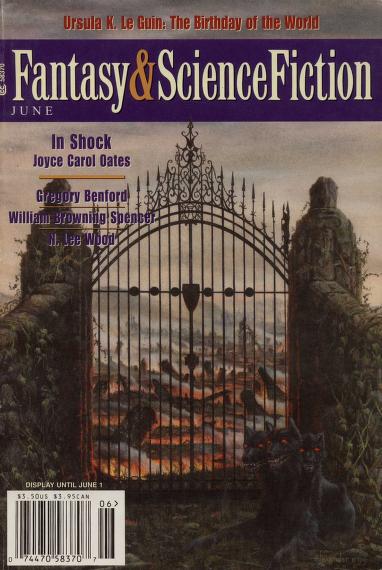
(Cover by Rob Alexander. F&SF, June 2000.) Who Goes There?
Joyce Carol Oates is the kind of author who quite possibly would never have appeared in the genre magazines if not for F&SF, what with its classy exterior and appeal with non-genre writers. Indeed Oates is one of the most celebrated living non-genre writers, having won the National Book Award for her novel them, as well as the O. Henry Award multiple times for her short fiction. More relevant to this blog is that a surprisingly large portion of her output is horror, especially at short length. She’s been nominated for the Bram Stoker Award multiple times and even won the Stoker for her non-supernatural horror novel Zombie. Even perhaps her most controversial novel, Blonde, whilst ostensibly historical fiction, could be classified as horror. She’s one of only two female contributors to the seminal horror anthology Dark Forces. “In Shock” is one of Oates’s horror short stories, and is arguably supernatural, although it doesn’t so much delve into the supernatural as strongly allude to it.
Placing Coordinates
First published in the June 2000 issue of F&SF, which is on the Archive. Despite getting a Stoker nomination, this story doesn’t seem to have been reprinted anywhere, at least if ISFDB is being accurate; with a mostly non-genre author like Oates it can be hard to tell.
Enhancing Image
Rachael is a divorcee in her mid-thirties who has lost a husband as well as a child. She got married to L_ (we’re only told the first letter of his name, as seems to be the case with all the men in Rachael’s life) and got pregnant when she was about 25, which in those days was not unusual. Unfortunately Rachael miscarried some months into her pregnancy and her relationship with L_ deteriorated—not that their relationship would’ve necessarily worked out had the child lived. Anyway, it’s been about a decade since then and she at least tries to think she’s moved on from all that. “She was a poet and a translator and she traveled a good deal and she’d ceased grieving for what was lost, and irretrievable, as she’d ceased being a woman, a wife, a mother-to-be.” Despite the third-person narration telling us Rachael had moved on, this is pretty obviously not true; if anything her past trauma seems to be the only thing she’s capable of thinking about, if dips into her stream of consciousness are anything to go by. Stream-of-consciousness narration is a pretty unusual technique in the realm of genre fiction, but it’s something Oates has a penchant for; more specifically it very much reads as Modernist in the Faulkner mode, in that we have italicized and unpunctuated bursts of thought that come and go without warning. The result is a bodyless and relatively sober narrator clashing with a delirious internal monologue. Get ready for a lot of sentence fragments.
This is essentially a story about a woman who’s become trapped in her own past. Rachael’s sense of identity has been stripped by her trauma to the point where she doesn’t even perceive herself as really a woman (a kind of insecurity that’s sadly a real-life phenomenon for women who have had miscarriages), such that her gender becomes almost arbitrary. The irony is that because she has lost so much faith in her value as a woman her gender has become a fixation; she doesn’t believe in her own womanhood, yet can’t stop thinking about it. This all comes to a head when she sees a preteen boy bicycling in the wake of a storm, the boy narrowly avoiding crashing because of tree debris, and she sees the boy about to bike over a pole wire that’s been knocked out, such that if the boy made contact with it he could be electrocuted and killed. Rachael stops this would-be accident, but in the process is electrocuted herself and knocked unconscious. She’s taken to the hospital where she’s told she’s lucky to be in alive, only coming out of it with some bruises and a case of shock. She’s told she had gone into shock, but the symptoms should wear off. Little does she know these symptoms are about to get much worse. The most disconcerting thing is that she asks hospital staff if there was a boy at the scene, only to be told there was no boy and no bike; yet she’s convinced she must’ve seen him. It was such a vivid sight, yet nobody who was around recalls there being a boy.
There are a few plausible options here, although Oates doesn’t give us an easy answer that would indicate any of them. It’s possible that Rachael had experienced a vivid visual hallucination and had imagined the boy; that the boy is a ghost, maybe even a manifestation of the Rachael’s unborn child (the boy is about as old as the child would’ve been); or that Rachael really did see a boy, save him, but then died in the process, in which case we have a nightmarish afterlife scenario. At the very least the boy is obviously meant to represent the child Rachael had lost symbolically. The accident is also undoubtedly a turning point in Rachael’s life, since she’s recovering from shock and the world around her seems to have gotten stranger since before the accident. Her trauma, which previously was kept internal, has been driven into the outside world, either literally or as a result of her mental illness. She meets up with some elderly neighbors of hers, the Chathams, asking if they’d seen the boy that day, and of course Mrs. Chatham says she didn’t. Mr. Chatham is an invalid, groaning loudly in another room, but Mrs. Chatham ignores this, as if her husband were not casually in pain. “How was it possible that Mrs. Chatham didn’t hear him?” Even by the standards of the elderly, Mrs. Chatham is an odd one, in that she’s oddly detached from everything. She might be a manifestation of what Rachael could become in a few decades: a jaded old lady.
(Safe to say that despite having just turned 86 [happy birthday] Oates is very much not jaded. Have you seen her Twitter?)
“In Shock” starts as realistic, if also Modernist and Faulkneresque as mentioned before, but after the accident it takes a sharp turn towards the mythological. On top of the mystery of the boy Rachael can’t stop thinking about Greek mythology, especially Hades and Cerberus, that three-headed hound who gatekept the underworld. This is what I mean by the story alluding to the supernatural without every unambiguously entering that territory, because of course we never see Hades or enter that gate which Cerberus is protecting; but what we do get is the next best thing. Modern industry, coal and electricity, become symbols of a kind of underworld in the wake of Rachael’s accident, such that she starts imagining herself as living in a kind of purgatory. She’s also into comparative literature and said to be very well-read (not that L_ gave her credit for it), so it makes sense that she would turn to literature as a way of coping with her trauma. There’s another character, Morris B_ (often called just B_), an older man and a professor of antiquity whom Rachael very much likes, possibly even loves. Despite having known each other for years they never entered a relationship, in what you might call a near miss. When they meet again following the accident Rachael is reluctant to tell B_ what had happened to her, and is also repulsed by what she now realizes is his aging body, his skin “appeared finely cracked like the glaze of ancient pottery, and a starburst of a lurid red birthmark was newly visible through his thinning hair.” She almost can’t stand the sight of him. What should be a nice reunion, to take her mind off what she’s just been through, has become rotten.
A possible point of inspiration for this story, although it’s never brought up in the text and I can’t even guarantee Oates has seen it, is the cult horror movie Carnival of Souls. Indeed “In Shock” almost feels like a remake of that movie, although I can’t guarantee this is the case and in all likelihood there’s no correspondence between the two. For those of you who aren’t into micro-budget indie horror movies from the ’60s, Carnival of Souls is about a woman who goes joy-riding with her friends when their car falls off a bridge and she emerges as the sole survivor. She moves, takes up playing the organ for local churches, gets a new apartment, but finds that ghosts are now following her seemingly everywhere she goes. We get many stories about places that are haunted, but only rarely do we get people who are haunted. Rachael, like the doomed heroine of Carnival of Souls, is herself haunted—by symbols if not actual ghosts. She meets up with a friend, Thea, who of course is also an academic, along with Thea’s daughter Cecie, who is also Rachael’s goddaughter. The meeting goes horribly wrong when Rachael sees (or thinks she sees) horrific scars on Cecie’s neck and is understandably (at least from her perspective) panicked about this, only for Thea to deny the scars are even there and kick Rachael out of the house. The true horror of this scene lies not in the child’s possible injury but in Rachael experiencing that which every person living with mental illness must endure: not being believed. The supernatural is more symbolic than literal, a stand-in for some sort of mental distress, like the seemingly unkillable dog in Faulkner’s “The Hound” being a stand-in for the protagonist’s guilt.
There Be Spoilers Here
This is a hard story to spoil since it ends inconclusively; any of semblance of a plot sort of evaporates by the end of it. This is not exactly a negative criticism. I’m not sure how you’re supposed to end this kind of story without giving an answer that would inevitably undermine the mysteriousness of it. Why do you think David Lynch presented us a mystery in Mulholland Drive and then proceeded to never solve it? Joyce probably doesn’t intend for us to solve the mystery but rather to give us an experience—a glimpse into the mind of someone following a near-death experience. I know what that’s like. In March this year I had an accident wherein I seemed to have choked on peanut butter (of all things) and passed out in the kitchen. My throat had cleared but I lost consciousness and landed flat on my face. I must’ve been out for only a minute or less but I had these dreams that were horribly vivid, and which seemed to last much longer than the allotted time. I was driven to the ER and spent a few hours there, where doctors found that aside from the injury to my face (pretty nearly lost a tooth there) and very low blood pressure I was fine to go home. I was, of course, also delirious. I remember almost nothing from that night. I don’t even remember being driven to the ER. I feel like I’ve not been quite the same since then. But then who is, after something like that. It’s that transformative state, of being violently thrown out of normalcy, that the story captures.
A Step Farther Out
Sorry if this seemed less like a review and more like an autobiographical tangent, but for what it’s worth I think Oates would approve of the digressions; after all, they do somewhat relate to the story. Sometimes the story is not really the point; sometimes what matters more is what you bring to the story. Again, apologies I missed this month’s editorial, but luckily I already know what I’ll be writing about next month so keep an eye out for that. As for the Oates, it’s an evocative short story that straddles the line between the psychological and the supernatural, understandably inspiring the Rob Alexander cover for that issue of F&SF. I do sometimes get the impression with Oates’s writing that it can be experimental for the sake of itself, but that’s not the case here.
See you next time.
-
Short Story Review: “Pictures Don’t Lie” by Katherine MacLean

(Cover by Ed Emshwiller. Galaxy, August 1951.) Who Goes There?
Despite having lived an incredibly long life (she was born in 1925 and died in 2019), Katherine MacLean wasn’t the most prolific of writers. She only wrote five novels, only two of which are solo efforts, and one of those is a fix-up. On the short fiction front she didn’t write a whole lot more, although she did have a streak in the ’50s; about half her short fiction was published that decade. MacLean was one of the few lady writers to appear regularly in Astounding (she even debuted there), but like a lot of other writers she hopped on the Galaxy bandwagon, appearing in that magazine’s first issue. “Pictures Don’t Lie” is a prototypical Galaxy-type story, and not unlike another early Galaxy story I reviewed recently, Philip K. Dick’s “The Defenders,” it’s founded on a Big Twist™. Unlike Dick’s story, however, MacLean’s remains effective even when taking the twist into account. Also like the Dick it was adapted for radio as an X Minus One episode, and has even been adapted elsewhere, including an EC Comics adaptation. It’s one of her most reprinted stories for a good reason.
Placing Coordinates
First published in the August 1951 issue of Galaxy Science Fiction. It was reprinted in Invaders of Earth (ed. Groff Conklin), The Great SF Stories #13 (ed. Isaac Asimov and Martin H. Greenberg), The Prentice Hall Anthology of Science Fiction and Fantasy (ed. Garyn G. Roberts), as well as the MacLean collection The Diploids. It’s also fallen out of copyright, so you can read it on Project Gutenberg.
Enhancing Image
Joseph R. Nathen is a radio decoder for the American military, which during the Cold War would mean having a job that could potentially involve the difference between a frozen conflict and a hot one. But Nathen has found something a lot more incredible than signals from the other side of the Iron Curtain: he’s found signals of non-human intelligent life. “Squawking,” as he calls it, which needs to be slowed down, but the squawking is certainly not human, yet at the same time can be understood. Radio gives way to TV and it didn’t take long for Nathen to get a TV signal of the alien ship. He wanted pictures. “Pictures are understandable in any language,” he says. Nathen ends up being right about this—but also tragically wrong. But we’re getting ahead of ourselves. There are only three real characters in this story: Nathen, a journalist named Jacob Luke who’s mostly referred to as the Times man (which Times?), and Nathen’s correspondent on the alien ship, nicknamed Bud. There are a few other characters, mostly journalists who are only called by the outlets they work for (the Herald, the News, and so on), and the dialogue is almost entirely expositional; good thing Nathen is fluent in Expositionese. If this story has a flaw that would turn some readers off it’s that it seems in love with its own attempts at explaining its premise—so dense in exposition as to be hard to digest.
(The X Minus One adaptation does a pretty good job of streamlining the narrative, by giving us a solid viewpoint character [with the Times man] but also massively dialing back the scientific explanation for how the humans and aliens are able to communicate.)
Nathen had used the TV line to send the aliens the Rite of Spring segment of Fantasia, which the aliens not only received in a couple weeks but apparently enjoyed. At first this sounds like a match made in heaven with regards to first contacts: the aliens are not only able to respond back but can communicate, and according to Nathen their planet is “Earth-like.” The aliens seem to be humanoid, and the Earth team is able to receive TV images of the aliens on the ship. The question then remains: What could go wrong? There are a few warning signs, but the humans are unable to make heads or tails of what these abnormalities could mean. For one, the aliens move at a deliriously fast speed. “Something about the way they move…” As Nathen explains, while the images themselves are clear, the speed at which these images are relayed is hard to gauge. “When I turn the tape faster, they’re all rushing, and you begin to wonder why their clothes don’t stream behind them, why the doors close so quickly and yet you can’t hear them slam, why things fall so fast. If I turn it slower, they all seem to be swimming.” Something isn’t right. But still, the aliens intend to land on Earth, right outside the military base where the story’s happening—and soon.
The twist of this story is telegraphed pretty hard, but only with hindsight. I had the good fortune of not knowing the twist beforehand, so I was left with the genuine question of what the catch is—because there has to be a catch with a story like this. MacLean is clever here in that she turns the screw at just the right pace so that if you’re fast enough you can anticipate the twist, but there’s a good chance you won’t; but then you might reread the story and give yourself a pat on the back for taking note of what now reads as obvious foreshadowing. The title is ironic. It borders on postmodern—not in literary technique, obviously, but in how it shows that objective reality, or rather our notion of it, can be untrustworthy. Our perception of reality is based on our senses. The humans and aliens have differently calibrated perceptions and as such they don’t perceive the same space in the same way. When the alien ship comes to Earth the humans don’t see any sign of it by the landing pad, and Bud says the ship can’t see the humans anywhere despite surely having landed on Earth. The atmosphere, Bud says, is too thick—much thicker and soupier than Nathen said. The humans posit that the aliens might’ve landed on Venus by accident (this was when Venus was thought of as a gaseous swamp and not a hellworld), but this can’t be the case. Something has gone wrong, but they don’t know what.
There Be Spoilers Here
The aliens are on Earth alright, and they’re even somewhere near the landing zone—but the humans can’t see the aliens. Bud says that the ship has come under attack and that the humans have to find the ship fast if there’s hope of saving them. It’s there that Nathen and the Times man realize the missing piece of the puzzle—and at the same time realize it’s probably too late to save the ship. It’s one of those great “we’re fucked” moments in old-timey SF, a real sense of having passed the point of no return, like locking your doors after your house has already been robbed, or realizing that one girl you liked had a crush on you as well and you only realize this years after the fact. MacLean gives us a real zinger of a final line, which encapsulates the bizarre tragedy of the situation, for why the humans can’t see the ship—at least not with the naked eye: “We’ll need a magnifying glass for that.” The aliens move at such an odd speed and the atmosphere around them is so thick because they are, in fact, microscopic. The pictures didn’t lie, but they didn’t tell the whole story either. The humans thought they had made contact with likeminded aliens when in fact they were giants who had made contact with beings even smaller than ants, and neither side could figure this out until it was too late. This is how you do a twist ending.
A Step Farther Out
“Pictures Don’t Lie” is basically a tragedy, not caused by technology but aided by it. Even by the early ’50s there’ve been a ton of first contact narratives, such that it would take a bit of ingenuity to write a story of this type that’s truly memorable. MacLean was still very young, and early in her career at this point, but she did have that touch of ingenuity. More impressively it’s a story that raises questions about the utility of the brand-spanking-new technology called television, about how such technology might contribute to first contact with aliens—and how even with this new tech something could go wrong. It’s also a question of size and perspective. We always imagine aliens like how they appear in Star Trek, humanoids that happen to be the same size as humans. MacLean posits we might find life on another planet—or possibly in a grain of sand.
See you next time.
-
Short Story Review: “Mood Bender” by Jonathan Lethem
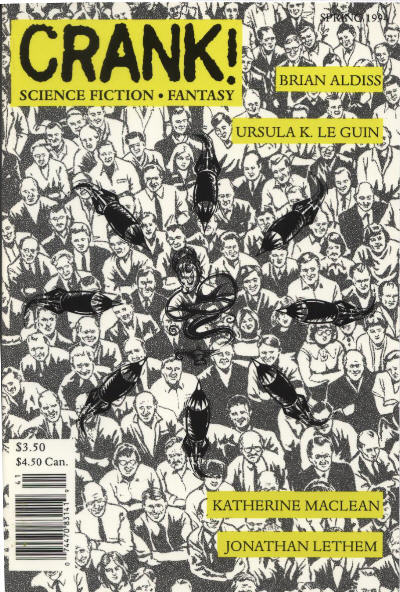
(Cover artist not credited. Crank!, Spring 1994.) Who Goes There?
I don’t often get the chance to talk about authors not totally embedded in the realm of genre SF, which makes someone like Jonathan Lethem a bit of a treat. Lethem is nowadays known as a “literary” writer, with non-SF works like Motherless Brooklyn and The Fortress of Solitude gaining him a foothold in the literary crowd, if not exactly the mainstream. But unlike some other writers who started out writing genre who then tried distancing themselves from genre trappings, Lethem never forgot his roots. Indeed for someone who’s not primarily known as an SF writer, at least half of Lethem’s novels are SF, including his first four novels. He’s also unabashedly a Philip K. Dick fan, even going to far as to edit Dick’s Exegesis for book publication. Today’s story was published the same year as Lethem’s debut novel, Gun, with Occasional Music, and like that novel it wears its Dick influence on its sleeve—not in a bad way, of course.
Placing Coordinates
First published in the Spring 1994 issue of Crank!, which is on the Archive. It’s been reprinted only once, in the anthology The Best of Crank! (ed. Bryan Cholfin). Much of Lethem’s short fiction has not been collected outside of anthologies, so this is not unusual.
Enhancing Image
This is a cautionary tales of sorts, about a salesman and an artist. The salesman is Pete Flost, and he sells robotic puppets to schoolkids. After school the kids swarm out like bugs and Flost, along with the competition, stands by with his trunk of merchandise. The puppets sell for very cheap, since they’re aimed at children—but that’s not where the money comes from. “Clients paid Desani and Sons large figures to equip the puppets with advertising programs, aimed at the buyers’ parents.” Flost works for Desani and Sons, who in turn work for advertisers. When in doubt, turn to ads. Flost has a digital wristband telling him his bank information; so do the kids. (Where do they get their money from? I would assume allowance.) The kids, like their adult counterparts, are fickle; they’re quickly learning how to think in a capitalist environment. Much to Flost’s dismay the turnout for his merchandise is underwhelming, and to make matters worse he then has to pay a ticket for speeding. Tellingly we’re not even told Flost’s name for the first few pages; he’s just “the salesman,” and indeed he’ll mostly be called that throughout the story. He’s a salesman down on his luck, and as a cog in the machine he’s not much more than that.
We cut to the artist, Zigmund Figment, who’s kind of a fraud, or as we say in a post-Hans Zimmer post-James Patterson post-Drake world, someone who makes art… with some uncredited help. That’s not the point. The irony is that despite being a salesman who sells “banal commercial narrative dolls” for a living, Flost is not a cynic; he means well. Meanwhile Figment is ruthlessly cynical—opportunistic, sure, but he also has open contempt for his own customers. It’s during a heated discussion with one of these customers that a random idea pops into Figment’s head: that he could make a killing selling something as cheap as disposable as those dolls. “There could be something there.” The dolls, acting alive but being non-sentient, are characters with their own programmed narratives, set to deactivate permanently after a 24-hour cycle. But suppose the character of one of these dolls was based on a person? And that’s how Figment comes into contact with Desani and Sons, and more specifically how he teams up with Flost—to use the salesman’s likeness for a doll Figment has in mind. The puppet salesman will serve as the basis for a salesman puppet.
On the one hand, this is a very Philip K. Dick story; it’s the kind of story he might’ve written had he lived through the Reagan years. I don’t mean this as a bad thing, even if it does smack of derivativeness. Lethem would move away from this heightened satirical brand of SF as he got older, and it’s not hard to see why; but also in some ways (though it pains me to say this as a fellow Dickhead) Lethem is a better writer than Dick. His sentences are less stilted and he’s able to pack almost a novel’s worth of detail into just a few pages, such that you could probably write a whole short story about just the dolls, but here they’re merely an accessory to the larger narrative. Dick was arguably the greatest critic of American capitalism among genre SF writers in his time, and Lethem continues this ruthlessness by presenting a shadowy and greedy landscape that lacks any semblance of spirituality—a film noir world without a detective. Flost is by no means a hero, but then Figment isn’t what you’d call a villain either; he’s merely a business-minded fellow who wants to take advantage of the system he was born into. He’s disgusted with the system (and with himself, really) but feels he has no power to change it. When Flost asks him why he’d wanna make a salesman puppet, Figment replies, “I’m looking for a medium that metaphorizes the temporal, presold, infantilizing, reflexive qualities of contemporary artistic expression, my own especially.” He knows it’s all a game.
“Mood Bender” is loose on plot but tight on character and substance; what it lacks in cohesion of events it makes up for in the density of its world and the sheer existential dread of its characters. Figment is a scumbag, casually rude to restaurant staff so he can get a discount, that sort of thing, but he’s also the man with the vision. That Figment is the assertive one of the two while Flost is weak-willed (a bit of a Willy Loman figure) speaks bleakly of both of them. Being an “artist” but not someone who wants to put in all the hours of work and solitude to make his art, Figment also hooks up with Ben Iffman, a friend of Flost’s and a designer for the puppets. “It wasn’t that Iffman’s designs necessarily sold more than anyone else’s, but handling them meant something to the salesman.” The problem is that this arrangement ends up working too well. Iffman catches on to Figment’s idea so fast he starts selling his puppets to the same clientele before Figment’s own plan can come to fruition. Without Iffman, and with his sales declining, Flost loses his job at Desani and Sons (although they don’t word it like that), and Figment for his troubles gets beat at his own game. As is typical of Lethem, the best laid plans of mice and men come to naught.
There Be Spoilers Here
Lethem asks a scary question: Are we somehow product? And if we’re product then does that mean we can be replaced? On his last day with Desani and Sons Flost is treated more like faulty machinery than a flesh-and-blood person who has to pay rent. Figment, who really always treated his art as both product and extensions of himself, gets what you might call his just desserts when people stop buying his shit. In the last stretch of the story, after both men have fallen from grace and been relegated to vagrancy, we see a robot priest—not sentient, but merely a machine that spouts pre-programmed platitudes. We have killed God—not with philosophy or even with machinery, but with dollars. The world in-story is in very bad shape. The only real refuge from this might be cold sleep, which curiously serves a similar function in Gun, with Occasional Music, as a kind of debtor’s prison. Run out of money and struggling to find a job? How about you slip into a coma. By the end of the story we’ve come back to the place we started at, with the schoolkids, only now Flost and Figment are drunkards poking fun at their own dashed hopes of success. Did I mention this is bleak?
A Step Farther Out
This is a good enough story that Lethem could’ve sold it to a higher-paying market—but then how many outlets published post-cyberpunk material like this in 1994? Lethem appeared in Asimov’s several times, but not in this case. Omni was on its way out. Interzone is British. There weren’t many markets for short SF at the time, which might be one reason Lethem hasn’t written much short SF; and when it came to novels he would eventually get to writing non-SF work, although the noir aspect very much remained. “Mood Bender” is short but brutal; it’s at times funny, but it’s by no means light reading. If you’re reading this then you’ve probably already ready some Lethem, but if not then it’s a good place to start.
See you next time.
-
Novella Review: “Oceanic” by Greg Egan
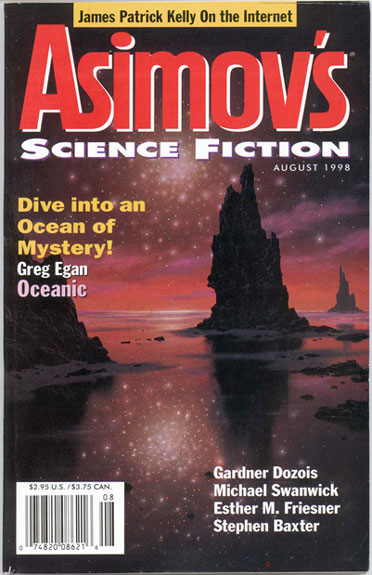
(Cover by John Foster. Asimov’s, August 1998.) Who Goes There?
We last covered Greg Egan with his 2002 quantum computing novella “Singleton,” which was very typical Egan; now we have something more atypical. Egan is one of the quintessential transhumanist writers in SF and one of the leading figures of the post-cyberpunk era in the ’90s; but “Oceanic” is not cyberpunk at all. Here we have a coming-of-age story on an alien planet, about a young man’s crisis of faith through both religion and sex, apparently inspired by Egan’s own disillusionment with Christianity in his youth as recounted in his autobiographical essay “Born Again, Briefly,” which I highly recommend reading as a kind of double feature with “Oceanic.” Indeed despite the exotic locale this reads as one of Egan’s most personal works, and while it isn’t cyberpunk it does manage to veer back into some go-to Egan themes. The gambit paid off, as it remains Egan’s single most decorated story, having won the Hugo for Best Novella as well as placed first in the Locus and Asimov’s readers’ polls for that year. It might also be my favorite Egan story I’ve read so far.
Placing Coordinates
First published in the August 1998 issue of Asimov’s Science Fiction, which is on the Archive. Gardner Dozois liked this story so much he bought it for Asimov’s, but then reprinted it in The Year’s Best Science Fiction: Sixteenth Annual Collection and The Best of the Best Volume 2: 20 Years of the Year’s Best Short Science Fiction Novels. It’s in the Egan collection Oceanic, and of course it’s also in The Best of Greg Egan. You can read it free online at Egan’s site, so you don’t have an excuse!
Enhancing Image
Sometimes when I’m reviewing a story I feel like I’m struggling to come up with things to say about it, but with “Oceanic” there’s no such problem—especially if you know how autobiographical it is. But first some context. We’re on the planet Covenant, over a thousand years after humanoids (I say “humanoids” because it doesn’t look like normal humans had come to the planet in the first place), and we follow Martin, who as narrator is writing what you might call a fictional memoir, recounting from the time he was about ten to when he was deep in his twenties. Martin and his family are “Freelanders,” in that they live on the vast waters of the planet, unlike the “Firmlanders” who live primarily on land. Martin’s family are Transitional, that is to say mildly religious, but Martin’s older brother, Daniel, joins the Deep Church, a fundamentalist sect, when he’s fifteen (David being five years Martin’s senior). Daniel tries to convert Martin, and in a scene ripped straight from Egan’s own life (his older brother having split from their Anglican family and converted to Catholicism as a teenager), the two kneel by Martin’s bed one night and pray to Beatrice, the Christ-like figure of the religion. But Martin hasn’t really been converted yet. “I wasn’t sure that I wanted Beatrice to change my mind, and I was afraid that this display of fervour might actually persuade Her.” The practice starts as more out of respect for Daniel than believing his faith, but Martin will soon go through a rite of passage that will turn him into a firm believer—for a while. This is all told with melancholy hindsight.
“Oceanic” is a coming-of-age narrative, or a bildungsroman, about a boy crossing the shadow-line (to steal Conrad) into maturity—a crossing that tends to be not one experience but several key turning points. The first major turning point for Martin is arguably not kneeling with Daniel that one night, but taking part in the Drowning, a ritual in which someone is submerged in the depths of Covenant’s waters—so far down that it would seem suicidal, and yet this near-death experience is euphoric, at least if the person accepts Beatrice in their heart. Martin is Drowned one day, with Daniel as his second, and this experience in the depths, by his lonesome, makes him feel like he’s somehow become one with Beatrice. A switch gets flipped inside his head. Getting Drowned is something only the Deep Church people do, as others see it as dangerous and an aberration, something fundamentalists do; but his Drowning causes a religious awakening in Martin. As he struggles in the depths he recounts the story of Beatrice and the “Angels” as written in the Scriptures. This is where things gets pretty strange, and dense, in the sense that Egan seems to have developed a whole origin story for the people of this planet—one that is clearly adjacent to Christianity, although there’s a transhumanist twist that’s more implied than explained. While submerged, Martin takes in a gulp of the seawater, and at this moment light floods his vision, leaving “a violet afterimage” once it recedes and Daniel brings him back to the surface, the Drowning successful.
The irony is that after this point Martin and Daniel’s relationship weakens, granted that part of this is to be expected given their age gap. Martin gets involved with Daniel’s Prayer Group, but soon grows tired of it. “What did I have in common with them, really?” The brothers grow apart. Daniel gets married young to a fellow Deep Church person named Agnes and the two lead a boring, traditional life thereafter. Some years pass and now Martin’s a teenager. It’s at this point that I should probably mention the eccentric biology of the humans in this story. Something I noticed only after the fact is that Egan refrains from giving physical descriptions of characters really, and this could be for a few reasons, but one reason I can think of is that the characters are physically androgynous—they, in fact, have physical traits of both male and female, and even functioning sex organs that would normally be unique to either. They’re true hermaphrodites, “women and men were made indistinguishable in the sight of God.” What gender someone identifies as really does come down to their self-perception rather than their sex. I’m bringing this up now because it’ll soften the blow for when we get to what is perhaps the most important scene in the story—and also the most unusual. When Daniel gets married Martin meets up with one of Agnes’s cousins, Lena, a Firmlander who nonetheless is very interested in the way Freelanders live. The two hit it off and enter a sort of casual relationship, and it doesn’t take long for sex to enter the picture.
So, in a bildungsroman, it’s not uncommon for the protagonist’s first sexual experience to serve as a turning point in the narrative, as a euphoric or traumatic experience. One’s first time is rarely all that. I myself didn’t lose my virginity till I was 21, and it was with someone I was not in a relationship with; it was a one-time thing, but the important thing is that we were nice to each other and there was certainly no pain in it. A lot of people aren’t so lucky. Poor Martin over here has one of the strangest first times possible—not because the sex with Lena goes wrong exactly but because there’s a certain part of the exchange nobody had thought to warn him about in advance. Remember how I said that the people of Covenant are hermaphrodites? Not only that, but the penis is apparently detachable. If sex happens between someone with a penis and someone with a vagina there’s a literal exchange of “the bridge,” so that after he climaxes inside Lena Martin finds, to his horror, that Lena now has his cock and that Martin, with blood on his groin, finds that a pussy has formed where his cock once was. (There’s no mention of testicles that I can recall—and no, don’t ask me to go back through to see if there is. I would have to think then that the testes are internal, somehow, but still functional. For better or worse Egan doesn’t go into great detail as to how the anatomy of these future humans could function. The effect is akin to one of Dali’s paintings, or one of the more nightmarish scenes in a Buñuel film.) Eventually Martin and Lena have sex a second time so that Martin can get his dick back; but the relationship has done sour because of that first time and they seemingly never talk again.
A lot is happening, so let’s rewind the film and take this step by step. We’re never outright told this I believe, but it’s implied pretty heavily, even early on, that the humans on Covenant are the descendants of the so-called Angels, who apparently had foregone flesh-and-blood bodies but then decided to build organic yet artificial bodies for themselves so that they could experience bodily pleasures and even mortality again. The Angels, being basically noncorporeal, are now spoken of as if they were literal angels, the “present” of the story being so far into our future that even the far future of the Angels is spoken of as if it were ancient history or myth. Egan has gone out of his to imagine a future humanity that in some ways is not so different from us, but then there’s the biology of these people. Martin losing his virginity is a traumatic event for more than one reason: it gives him gender dysphoria, makes him feel ashamed because he’s had not only had sex while unmarried but lost his “bridge” in the process, and it’s the first time in his life where the hard reality of biology shakes his faith. I probably should’ve also mentioned “Oceanic” nearly made the shortlist for the Tiptree Award. Now, transphobes might read this story and be repulsed by its implications, because it becomes obvious that, as is regularly the case with Egan’s fiction, biology is framed as tyrannical. Martin and his kind are not beholden to biology but victims of it. (I saw someone theorize that Greg Egan is actually a woman, and while it’s true we’ve never seen or heard Egan, I find this a bit far-fetched.) Indeed Martin deciding to study microbiology, under an affable but ultimately dead-end professor named Barat, will prove to make him only more miserable.
Something I’ve had to do in writing this review is go back through “Oceanic” and reread some passages, which I’m not prone to doing for these—in no small part because I know with certainty there are details I had missed on my first reading. On the one hand you could try boiling this story down to a “religion sucks” narrative, but that really would not be doing the world Egan has built justice, nor would it encapsulate the thematic depths. Granted that showing “Oceanic” to a transphobic Christian would disgruntle them, it’s more a dramatization of Egan’s own coming of age; this is his Go Tell It on the Mountain. A mild criticism I have of Egan’s writing is that when it comes to first-person narrators they tend to have more or less the same voice, which I have to take to some extent as Egan’s own voice: brooding, seemingly teetering on the line between macho and a little feminine, a sort of overly sensitive film noir detective cadence. Martin might be the most Egan-ish of Egan narrators, and yet rather than distract me this ended up being more of an asset than a negative—indeed Martin being the quintessential Egan narrator might well be the whole point. The result is that despite not having anything to do (at least directly, though it’s very much part of the backstory) with computing or quantum uncertainty, “Oceanic” manages to be thematically kin with Egan’s other work, even if on the surface it seems to hark to a kind of old-school planetary science fiction. As someone who’s not very literate in computer science (like most people) I thus found it accessible by Egan’s standards.
There Be Spoilers Here
As he ages Martin distances himself more from organized religion—first from the Deep Church and even the Transitionals, increasingly finding fault and hypocrisy in the arguments of theologians. Among his own scientific colleagues he finds himself siding more with the earnest atheists than with whom he sees as weak-willed believers. “Theology aside, the whole dynamics of the group was starting to get under my skin; maybe I’d be better off spending my time in the lab, impressing Barat with my dedication to his pointless fucking microbes.” And then tragedy strikes. Martin’s mom comes down with a severe illness, and by the time he gets to hospital she has already died. Daniel was there, but this ends up being the final straw for Martin’s perception of him, for according to Daniel’s own faith their mother is destined for Hell since she was never drowned; but upon confronting him about this bit of theology Martin finds that his fundamentalist older brother has softened—for his own sake if nobody else’s. “There was no truth in anything he said, anything he believed. It was all just an expression of his own needs.” By this point Martin has become one of those devout but rebelliously individualistic religious people, but even his personal faith has been eroding, slowly but surely. “The God of the gaps,” to use an edgy atheist phrase. What breaks the camel’s back turns out to be Martin’s own work in the microbes of Covenant’s oceans.
So, to make a long story short, the microbes in the planet’s water have this hallucinatory fucky-wucky effect if taken into one’s body in concentrated form. The humans on Covenant have adapted to these microbes in moderation, but it’s still dangerous to interact with too much, which would explain the religious experiences had by those who have Drowned. Martin’s religiousus experience, which he had kept close to his heart all these years even as his understanding of the natural world expanded, has a scientific explanation: he saw some freaky shit because he had inhaled a concentrated amount of these microbes. It’s like the SFnal version of how people who suffer from epilepsy are prone to having “religious” visions—or indeed people with schizophrenia who claim to be in touch with the divine. Biology has its way with Martin; it caresses him, withers him, takes the moon and the sun from him, takes what is in front of him and even behind from him, and at the end of the day it takes God from him.
I was lucky: I’d been born in an era of moderation. I hadn’t killed in the name of Beatrice. I hadn’t suffered for my faith. I had no doubt that I’d been far happier for the last fifteen years than I would have been if I’d told Daniel to throw his rope and weights overboard without me.
But that didn’t change the fact that the heart of it all had been a lie.
At age 25 Martin becomes an atheist, incidentally around the same age when Egan gave up his own faith. This is not a victory for atheism or any dumb bullshit like that, but rather a melancholy crossing of the shadow-line, from youth to manhood. Something is lost and gained, at the same time, like a passing of the torch. While “Oceanic” is by no means Egan’s first “mature” story (he had already written Permutation City and Disapora at this point, not to mention some pretty great short fiction), it’s a reflection on the artist (or the scientist, who anyway is adjacent to the artist) coming into his own. Maturity is not sunshine and rainbows.
A Step Farther Out
I ended up reading “Born Again, Briefly” after I had read “Oceanic” but before starting this review, which turned out to be a good idea since it helped explain the strong personal touch of this story. It’s also a bit of a mind-bender, but not for the reasons typically associated with Egan, in that you don’t have to be an amateur computer programmer to understand the point he’s trying to make. Still, it’s a dense novella that almost demands a second reading, for pleasure but also so one can soak in all the details. Egan could’ve gone farther with the gender aspect, but for 1998 it’s still pretty wild and forward-thinking. People forget that even in 1998, which for some of you was not that long ago, queer representation in SF was very… mixed. And also nearly always evidently from a cishet perspective. With that in mind, “Oceanic” has aged pretty gracefully; it also happens to be a story people new to Egan can read without issue.
See you next time.
-
Short Story Review: “Drunkboat” by Cordwainer Smith

(Cover by Lloyd Birmingham. Amazing Stories, October 1963.) Who Goes There?
Cordwainer Smith had such a colorful life that you could probably make a movie out of it. Where to even start? Real name Paul Linebarger, Smith was born to American missionaries who often traveled around the globe, such that Smith went from school to school and didn’t have much time to make any friends in his youth. Of all the places he visited China seemed to leave by far the biggest impression, with his father even being involved in Chinese politics in the early 20th century. Smith was Sun Yat-sen’s godson, although Sun Yat-sen died when Smith would’ve been only twelve. The Christianity of both his parents and godfather would also have an influence on Smith’s work, although he was by no means didactic about it. He came up with the name “Cordwainer Smith” to create a thick degree of separation between his life working in government and his SF writing. While he’s now most known for his SF, Smith (as Linebarger) wrote the first major text on psychological warfare, literally titled Psychological Warfare, as well as non-fiction works on East-Asian geopolitics. Under the pseudonym “Felix C. Forrest” (a reference to his Chinese name) he also wrote espionage novels, although good luck finding those nowadays.
Smith was one of the most idiosyncratic writers of his era, inside or outside of SF, and one has to wonder what more he could’ve done during the height of the New Wave (he died in 1966). His first SF story as an adult, “Scanners Live in Vain,” was published in 1950, but Smith wouldn’t get consistently published until the last half-dozen or so years of his life, in no small part thanks to Frederik Pohl. From circa 1961 onward Pohl had first dibs on Smith’s fiction, such that “Drunkboat” is one of the few Smith stories from this era to not be published in any of Pohl’s magazines—which means he must’ve rejected it. I can see why: it’s kind of a hot mess. But it’s the kind of noble failure that showcases a unique talent, and the individual components are very much worth your interest.
Placing Coordinates
First published in the October 1963 issue of Amazing Stories, which is on the Archive. It’s been reprinted quite a few times, in The 9th Annual of the Year’s Best SF (ed. Judith Merril), Amazing Stories: 60 Years of the Best Science Fiction (ed. Isaac Asimov and Martin H. Greenberg), and the heckin’ chonker The Science Fiction Century (ed. David G. Hartwell). Of course it’s also in The Rediscovery of Man: The Complete Short Science Fiction of Cordwainer Smith. Now, it’s come to my attention that most of Smith’s work has fallen out of copyright—in Canada. This story is on the Canadian version of Project Gutenberg. I’m not advising you do this, but if you (as a non-Canadian) were to use a VPN and disguise yourself as one of the filthy, unwashed denizens of Toronto…
Enhancing Image
This is a hard story to spoil, if only because Smith spoils it for us, right at the beginning. We’re told that Artyr Rambo (yes, that is his name) was a man looking for his beloved, Elizabeth, apparently separately by many light-years, and he would do anything to get to her, including hopping aboard a rocket ship “of an ancient design” with the letters IOM (Instrumentality of Mankind) on its side and jaunting his way over to the hospital where she’s being kept. We know from the start that Rambo succeeds, that he and Elizabeth are reunited, and that Rambo himself has since gone down as a legend. The story, as such, is written like an oral telling of something ancient, mythical, and probably fabricated, but which serves an inspirational purpose. We know how this story starts and ends, but without context and without what will turn out to be a frenzied middle that will take a fair bit of explaining. Rambo winds up naked and unconscious, but apparently alive, just outside the Old Main Hospital where Elizabeth is being kept—or rather her body is. (Death does not have the same ramifications at this point in the Instrumentality history as it does for us.) How he got there, without his rocket ship anywhere in sight, is the mystery that will drive the plot. But of course I’ve already mentioned “jaunting”…
“Drunkboat” starts basically as a hospital drama, with the doctors trying to get the comatose Rambo to response—then later realizing that trying to get a response from him may leave everyone worse off. One of the doctors, Grosbeck, even suggests killing Rambo once it becomes clear that there’s something monstrously wrong with the patient, but Vomact, the chief doctor, vetoes the decision. This will have disastrous consequences short-term, but his survival will turn Rambo into a legend and so revolutionize space flight. (Smith also adds in parenthetical asides, like this one, telling us about things that haven’t happens in-story yet, or things Rambo would not have known about at the time.) So there’s a problem. Rambo is comatose and yet seems to have powers beyond human understanding; he’s able to do things by some external force, which will eventually spark the story’s climax. (But aren’t I getting ahead of myself again?) A lot of damage could’ve been prevented had Rambo stayed conscious and been able to tell the doctors what he wanted. “Not till much later did people understand what Rambo had been trying to do—crossing sixty mere meters to reach his Elizabeth when he had already jumped an un-count of light-years to return to her.” Rambo, unbeknownst to everyone at the hospital, was a guinea pig for Crudelta, one of the Lords of the Instrumentality, and he was a test subject for discovering “space-three”—a test that proved to be, if anything, too successful. Space-three (it’s written a few different ways, but I’m calling it that for consistency’s sake) is a word that comes up in several Instrumentality stories, but here we actually get something like an explanation.
You may think this is all a bit confusing. It is. Smith crams a lot of his future history into this novelette, such that it feels longer than it is, if only by virtue of feeling overstuffed. We’re told, mostly in a casual way, that this is a distant future where humanity has spread across many planets, being ruled by the Instrumentality which is a technocratic aristocracy (or an aristocratic technocracy), complete with computers and robots. The underpeople, a coalition of half-human half-animal genetically engineered humanoids made for slave labor, are only mentioned in passing in “Drunkboat,” and if you were to read just this story you wouldn’t know that the underpeople are arguably the most important factor in Smith’s future history. You wouldn’t even know what the underpeople are just from reading “Drunkboat.” On the one hand this makes Smith’s writing hard to make sense of at times, and is a problem not unique to this story but rather something that makes the barrier of entry for Smith’s writing a rather high one; but then I love how there are details on the margins of the story that hint as a much larger universe—so large that a couple dozen short stories and novellas, plus a novel, Smith couldn’t “finish” the future history. He gives the impression of something impossibly distant in our future, yet something so old in his future that Rambo’s story is told like one of Homer’s epics. It doesn’t work totally here, but you have to admire the ambition.
Reading “Drunkboat,” the only example in SF it reminded me of that would’ve predated the story is one of the most influential and experimental of all ’50s SF novels: Alfred Bester’s The Stars My Destination. Granted that Rambo is not a snarling brute like Bester’s Gully Foyle, but still he causes a lot of damage (including a dozen people killed “irrevocably,” their bodies being vaporized and so irretrievable) in the name of a rather self-centered goal: getting back with Elizabeth. There’s also the question of jaunting, Bester’s word for teleporting across space in his novel that I’ll use here; Smith has a different word for it, but it’s basically the same thing. I’m not sure if Smith had read Bester’s novel, but he likely did, and who can blame him? Bester’s novel and the Instrumentality future history do share a fair bit in common: they see humanity using spaceships (and later teleporting) to conquer the stars, and yet the aristocracy is maybe more powerful than ever before. Corruption is everywhere. Human life is treated callously. In Smith’s world slavery has come back in a big way. Both robots and the underpeople are treated as expendable. There’s a pessimism (but also a Christian-coded hope of liberation) in Smith’s world that might’ve been off-putting in the ’50s (hence him struggling to find outlets then), but which anticipated the New Wave. I’m a lot more interested in the world of the story than the story itself. Maybe the story is not really the point.
There Be Spoilers Here
If “Drunkboat” had a fatal flaw, other than being cluttered, it’s that it switches gears abruptly a couple times, such that I’m not sure what I would classify it as other than SF generally. I said before it starts as a hospital drama, but then suddenly (and I think unconvincingly) it turns into proto-military SF before finally turning into sort of a courtroom drama. I would have less of a problem with this trajectory if the story was longer, possibly novella-length, but as is it’s a jumble wherein the components are easy to lose track of. It doesn’t help either that Rambo, the protagonist, is unconscious for most of the story. Granted, Frankenstein’s monster didn’t talk much either. Crudelta is a curious villain (if you can call him that), but he only really gets a chance to shine in the last stretch. Elizabeth barely even qualifies as a character, and when she gets a case of killed-and-then-revived amnesia (in-story a person getting killed and then brought back may as well be a different person since they get amnesia and are likely to form a different personality) it’s more like something inconvenient that Rambo has to get used to rather than tragic. (After reading a fair bit of Smith I do have to wonder if he was only capable of writing women as either shrewish, aloof, or submissive.) It’s implied that Crudelta will not face punishment for his inhuman treatment of Rambo, but that’s not really a criticism. After all, Rambo doesn’t have too much to complain about, for he has come back a demigod who can start a literal war with just his manipulation of space-three.
A Step Farther Out
The problem I encountered with “Drunkboat” was I found it a lot more fun to think about than to read. This is less a functioning self-contained story and more a neat bit of world-building that happens to have a really tangled plot at its center. If this is your first Instrumentality story then there are small details here that Smith doesn’t elaborate on and which will probably not make any sense to you. Even after having read a decent portion of Smith’s fiction (there isn’t a whole lot of it), my brain still ached a bit by the end. And yet I have to recommend “Drunkboat” as a curiosity. For both better and worse, nobody in the pre-New Wave days wrote like Cordwainer Smith, such that even his failures are worth it.
See you next time.
-
Short Story Review: “Friend” by James Patrick Kelly and John Kessel
(Cover by Thomas Kidd. F&SF, January 1984.) Who Goes There?
James Patrick Kelly and John Kessel have been friends and collaborators for about forty years at this point, although they started very much apart, and each man when taken on his own is a very different beast from the other. They’ve also been at times associated with the cyberpunk movement, but neither can really be called a cyberpunk author—especially Kessel, who by 1984 had already won a Nebula for the existential nightmare (and tribute to Melville) that is “Another Orphan.” As for Kelly, I had written about his similarly anxiety-inducing cyberpunk fable “Rat” for Young People Read Old SFF. It’s been long enough since I’ve written about either. “Friend” was their first collaboration, and it would be quickly followed by the novel Freedom Beach. Kelly and Kessel gave themselves a challenge with today’s story, which was to write a personal drama aboard a luxury space cruiser with a first-person narrator. For reasons I’ll get into it’s surprising the story works as well as it does, and that Kelly and Kessel—still early in their careers—managed to bring out the best in each other.
Placing Coordinates
First published in the January 1984 issue of The Magazine of Fantasy and Science Fiction, which is on the Archive. To my shock it has been reprinted only once in English—in The Year’s Best Science Fiction, Second Annual Collection (ed. Gardner Dozois).
Enhancing Image
Jake is a Friend on the Le Corbusier, a space cruiser. A Friend is a bit of an odd job—an amalgamation of counselor and security. “During a starcrossing, a Friend has sole responsibility for the safety of his passengers; no one, not the ship’s crew, its captain, or even the president of IPT may interfere.” Which sounds like a disaster waiting to happen, and indeed Jake is telling his story with a good deal of hindsight, after his “great loss.” In the future, it has become commonplace to travel between the stars, although it still takes a lot of money and there are still risks involved. Some get to stay conscious onboard as the ship jumps through space, but others are put in cryosleep—sometimes as a form of punishment—and those in cryo are not guaranteed to survive the voyage. The following story could be considered something of a love triangle, between Jake, Leila Jahiz, and Phillip Goodson. Leila is an aspiring ballet dancer while Goodson is VP of IPT and, once upon a time, was Jake’s superior as a Friend. Mind you that being a higher-up at IPT is no joke, considering they have a monopoly on commercial space flight. Jake always hated Goodson, which may or may not color how Our Hero™ frames Goodson in his narration. Maybe it would be unfair to call Jake an unreliable narrator, but without getting into spoilers too soon it might be in his interest to make himself look less bad in his own story.
So there’s the problem of “hitchhiking” during a starcrossing, which is basically someone who doesn’t have the money to rent space on the ship hitching with someone who does. To be fair, cold sleep is somewhat dangerous, so it’s not an appetizing alternative. The dilemma here is simple: Leila wants to hitch with Goodson and use his position to help her get into the dance troupe of her choosing—which of course means the best of the best. Leila, according to Jake anyway, is not so conventionally attractive, nor does she have the magic touch expected of the top dancers; but she’s tenacious, and despite his comments on her appearance Jake still very much has a thing for her when they meet a second time. They had previously met about a decade prior, when Leila was a teen hopeful and Jake was just starting his work as a counselor, before he had even become a Friend. The two had an affair while Leila was Jake’s client, which is—bad. “I had no intention of falling in love with her,” but he did, and upon seeing each other again those feelings have returned. Now, it’s not unusual for a Friend to have sex with crossers, but it’s supposed to be done as a way to keep people happy on the ship and is done with those who aren’t looking to hitchhike. Jake even gets hit on by an underage dancer, although thankfully he seems to turn her down—or at least it looks that way.
On the night I read “Friend” I went to bed thinking randomly about what it had reminded me of, because initially I couldn’t put my finger on it. Then it occurred to me that, coincidental or not, it reads like early John Varley. I mean this in a good way. Varley was one of the best new SFF writers to debut in the ’70s and his Eight Worlds stories especially are still a lot of fun to read, although the catch is that his stuff could get a little too horny. Leila is sleeping her way up the ladder, which to her credit is a fact she makes no attempt to hide. (Something that just occurred to me as I’m writing this is that the phrase “to blow off” means “to fuck” basically, in the context of the story. Some future-history jargon?) Again, if the two hadn’t known each other beforehand it wouldn’t even be unusual for Jake to Leila to have sex on the ship. A rival dancer, Brenda, goes to Jake for a quick fuck more than once, in fact—not because she finds Jake attractive particularly but because she needs to “blow off” steam, having not gained Goodson’s favor. And Jake, seeing that this is probably for the best, goes along with her. “As I had expected, Brenda was not so much interested in me as in saving face, and a brief affair with the Friend offered her an acceptable means.” Brenda did this in the hopes of catching Goodson’s attention, maybe making him jealous; but the move doesn’t seem to have paid off, as neither Leila nor Goodson confronts her about it. It does stir gossip on the ship, which Jake was expecting. “The community of crossers is small, and boredom is its greatest enemy.” It’s a tricky situation, when you’re stuck babysitting a bunch of rich assholes and sometimes you’re called on to do things that would normally be considered very unprofessional.
Two things really struck me about this story: its pacing and the uniformity + believability of Jake’s voice as a narrator. F&SF and ISFDB count “Friend” as a novelette, but it must barely count because it’s only about fourteen magazine pages and feels even shorter than that. Even so, despite couching the drama in a far-off location and having to do some legwork to flesh out the world, it’s a neatly self-contained narrative. Despite the brevity the three main characters are written as being flawed, but not two-dimensional, although Goodson is written (or perhaps thought of) as without redeeming qualities: he’s a real asshole, despite his name. As for Jake, it’s a minor miracle Kelly and Kessel were able to not only imagine such a character but write him consistently. I have not collaborated with a fellow author in… let’s say a very long time. So I’m not sure how one would go about co-writing a story, especially in the
late Cretaceouspre-internet age. I’m curious as to who wrote what, because despite his evident internal conflict Jake has a consistent voice and the other characters are vividly drawn. Did one focus on dialogue while the other on narration? It’s an effective character drama that shows both men in control of their abilities, which is not something that can often be said of collaborations. The tragedy of the situation is maybe predictable, but it’s still heartbreaking; this is not even lessened by the foreknowledge that Jake will lose—has, in fact, already lost.There Be Spoilers Here
So, perhaps predictably, Jake and Leila have sex. “This was not the political coupling that I had had with Brenda,” he admits. This is personal. The two still want each other, but Leila wants to reach the top even more than she wants to be with Jake—not that Jake really minds that. The real problem is now he has a conflict of interest, because as a Friend he should report Leila for conspiring to hitchhike—only doing so would not only ruin her chances at success but likely ruin their friendship. Jake thinks Goodson must be putting him up to something, and he’s not totally wrong about this—only he ends up being wrong in a way he failed to expect. Goodson more or less tricks Jake into ratting out Leila, a fact he realizes too late. The truth is that Goodson doesn’t give a shit about Leila, both as a person and a dancer, and was only using her to get back at Jake. Jake was hoping to hurt Goodson but he ends up hurting someone he actually likes, although he tries his best to keep the fact that he’s the rat from Leila; whether or not she ever finds out is left ambiguous. So Jake quits his job after the voyage, in shame. It’s not a complete loss. Over the next ten years he starts his own company, becomes successful at that, and Leila even gets into the prestigious dance troupe she always wanted—even if it happened several years later than she had hoped. But the two have not spoken in years, and it’s only at the very end, when Jake goes to see one of Leila’s performances for the first time, that there’s a ray of hope for him. Now that’s a good bittersweet ending.
A Step Farther Out
“Friend” could’ve certainly been printed in Asimov’s; it might’ve been submitted there first, who’s to say. In a way you can sense this is a borderline space opera that was written following John Varley’s influence on the field, and during that era when Hollywood studios were still scrambling for the next Star Wars; but while it may strike some as retrograde now I’d actually say it has aged more gracefully than most. “Friend” works as well as it does, I suspect, because at heart Kelly and Kessel are humanists. The story is certainly SFnal enough, but ultimately it’s a story with human characters who are by no means cardboard cutouts. Given that this was considered major enough to be the cover story of the F&SF issue it first appeared in, I’m a little dismayed it hasn’t been reprinted more.
See you next time.
-
Things Beyond: June 2024

(Cover by Rob Alexander. F&SF, June 2000.) Nothing unusual for this month, although we do have a couple authors who are not normally associated with SFF, let alone magazine SFF. One of the reasons I decided to make this year more focused on The Magazine of Fantasy and Science Fiction for its 75th anniversary is that, easily more than any of its contemporaries (and F&SF has outlived most of its competitors), is that it has managed to snag authors who otherwise would probably never appear in SFF magazines. It’s quite possible Jonathan Lethem would’ve tried his hand in the magazines regardless of whether F&SF ever existed, but the same can’t be said for Joyce Carol Oates.
I’ve recently been going through another mental health struggle (my bipolar episodes thankfully last hours at a time instead of days or weeks), but that’s not something to be elaborated on—at least not for this post. I may have something in mind having to do with mental illness in certain SF writers that you may or may not see later in the month.
Let’s see what we do have.
For the novellas:
- “Oceanic” by Greg Egan. From the August 1998 issue of Asimov’s Science Fiction. Hugo winner for Best Novella. Egan is one of the leading voices of post-cyberpunk, and while mixing SF with detective fiction was a thing pretty much since cyberpunk became a codified subgenre, Egan has gone farther than most in mixing hard science with film noir tropes. Last time we met Egan it was with his mind-bending novella about quantum physics, “Singleton,” but “Oceanic” seems to catch Egan in a very different mode.
- “Autubon in Atlantis” by Harry Turtledove. From the December 2005 issue of Analog Science Fiction. Prolific tweeter Harry Turtledove is known as a possibly even more prolific novelist, and while by no means did he invent the alternate history novel he has undoubtedly worked to define that subgenre more than anyone in recent years, especially regarding the American Civil War. “Autubon” is not a misspelling of “autobahn” but refers to the real-life naturalist John James Autubon, who stars in this alternate history story.
For the short stories:
- “Friend” by James Patrick Kelly and John Kessel. From the January 1984 issue of The Magazine of Fantasy and Science Fiction. Long-time friends and collaborators, brilliant both solo and together, Kelly and Kessel got their starts around the same time and happened to get involved in the cyberpunk movement, although it would be inaccurate to call either of them cyberpunk writers.
- “Drunkboat” by Cordwainer Smith. From the October 1963 issue of Amazing Stories. One of the most unique voices of his day, Smith, as you probably know, is the pseudonym of Paul Linebarger, a respected writer on psychological warfare and consultant on Asian geopolitics. He spent some of his childhood in China. Most of his stories, including this one here, are set in the same future history.
- “Mood Bender” by Jonathan Lethem. From the Spring 1994 issue of Crank!. A “literary” author who has never forgotten his roots, Lethem started out in the late ’80s as a genre writer, and indeed his first four novels were all SF before he gained mainstream attention with Motherless Brooklyn in 1999. As with Greg Egan, Lethem has a knack for combining SF with film noir elements.
- “Pictures Don’t Lie” by Katherine MacLean. From the August 1951 issue of Galaxy Science Fiction. MacLean debuted just in time for the magazine boom of the ’50s and the first great era for female SF writers. She lived an extraordinarily long time and her career is a distinguished one. “Pictures Don’t Lie” is one of MacLean’s most reprinted stories, and has even been adapted multiple times.
- “In Shock” by Joyce Carol Oates. From the June 2000 issue of The Magazine of Fantasy and Science Fiction. Noted tweetsmith Joyce Carol Oates also happens to be one of the most acclaimed living American authors, having won the National Book Award, the Bram Stoker Award, among others. Most of her work is “literary,” but she’s also a somewhat prolific (and quite skilled) writer of horror.
- “The Secret Life of Bots” by Suzanne Palmer. From the September 2017 issue of Clarkesworld. Hugo winner for Best Novelette. Palmer was born in 1968 but didn’t make her genre debut until 2012; despite this she has quickly built a reputation as one of the leading authors in the field. She’s been a prolific contributor to Asimov’s especially, but this story marked her first appearance in Clarkesworld.
As you can see this nearly all SF, except for the Oates which is horror, but it’ll also be the last “normal” forecast until September. In July we’re doing all F&SF stories, this time from the ’60s (I covered the ’50s in March), and for August I have a special author tribute in mind.
Won’t you read with me?
-
Subscribe
Subscribed
Already have a WordPress.com account? Log in now.
 Science Fiction & Fantasy Remembrance