-
Short Story: “The Movie People” by Robert Bloch
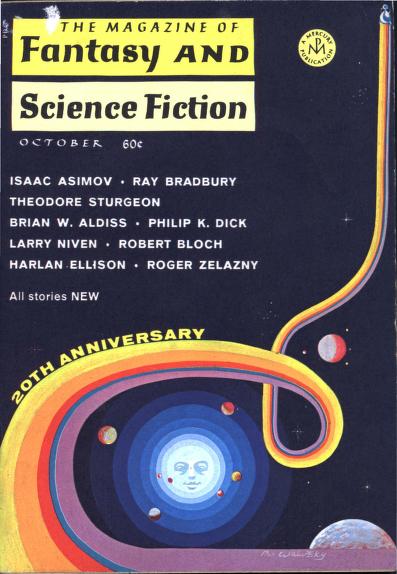
(Cover by Ron Walotsky. F&SF, October 1969.) Who Goes There?
We’ve reached the end of the month, as well as the end of my marathon covering F&SF as it was in the ’60s, which as it turns out was a pretty weird time for the magazine! In that ten-year period F&SF went through four editors, and you can tell different hands were at the wheel at different points, because for better or worse this was a transitory period. Robert Bloch himself comes off as a rather transitory writer, in that he always seemed to be going for some new angle, never staying in the same place for long. Bloch has one of the more unusual career trajectories of any genre writer, and you can also partly blame him for our modern obsession with true crime. In the ’30s Bloch became (if I remember right) the youngest member of the Lovecraft circle, even corresponding with Lovecraft himself, despite Bloch being a snotty teenager at the time. While he would drift away from Lovecraftian horror, Bloch remained mostly a horror writer, although interestingly today’s story is not horror at all. Of course you know him for Psycho, and he was also a prolific screenwriter for film and TV, namely a few classic Star Trek episodes. I’ve read enough of Bloch at this point to know he loved the movies, to the point where he might’ve been as inspired by horror in cinema as horror in literature; but again, “The Movie People” is quite different. Bloch was born in Chicago but would eventually settle in Los Angeles, and today’s story is a bittersweet ode to his adopted city.
Placing Coordinates
First published in the October 1969 issue of The Magazine of Fantasy and Science Fiction, which is on the Archive. It was then reprinted in New Worlds of Fantasy #2 (ed. Terry Carr), Hollywood Unreel: Fantasies About Hollywood and the Movies (ed. Martin H. Greenberg and Charles G. Waugh), Silver Scream (ed. David J. Schow), plus the Bloch collections The Best of Robert Bloch and The Complete Stories of Robert Bloch, Volume 3.
Enhancing Image
This story could be considered, to some extent, autobiographical. It’s circa 1970 and the narrator may as well be a stand-in for Bloch, living in LA and friends with a guy, Jimmy Rogers, who’s about a generation older than him. Jimmy is an old man now, but back in the 1920s he had started making cash as a regular extra in silent movie productions, along with his girlfriend at the time, June Logan. The narrator, in no small part to console his friend in his old age, goes with Jimmy to The Silent Movie, “the only place in town where you can still go and see The Mark of Zorro. There’s always a Chaplin comedy, and usually Laurel and Hardy, along with a serial starring Pearl White, Elmo Lincoln, or Houdini.” It’s what it says on the tin, playing silent movies at a time when silent movies would’ve been relegated to TV airings, on the occasion they were played at all. While he would’ve still been a kid when silent movies got usurped by sound productions, Bloch apparently held them in high regard, with the 1925 version of The Phantom of the Opera specifically being a gateway drug for his getting into horror. We’re clearly supposed to sympathize with Jimmy, since his original job had been taken over and his industry changed forever—never mind the fact that June has been dead for four decades now.
One of the first things I thought while reading “The Movie People” was that in 1969 this nostalgic treatment of Hollywood in the years before the invention of synchronized sound would not have been as old hat then as now, although there was still precedent for it at the time. (I’m ashamed to say I still have not seen Singin’ in the Rain.) Your knowledge of film history may or may not improve the experience, since Bloch assumes you have at least a cursory knowledge of Hollywood during the silent era, but then if you’re familiar with the historical material you can already predict the arc of the narrative and the sentimentality behind it. We learn about Jimmy and June’s relationship, which was kind of a Star Is Born scenario in which Jimmy couldn’t rise above being an extra and June was clearly on her way up the ladder—and no doubt would’ve continued her way up, had she not died in a freak accident. It was 1930 and June was on the set for an early sound production. The crew was experimenting with a traveling boom mic, what has long since become the standard for film productions, only it was newfangled then. “Somehow, during a take, it broke loose and the boom crashed, crushing June Logan’s skull.” It’s a pretty on-the-nose metaphor for the changing of the guard sound film brought about, ruining careers and hitting immigrants in the industry the hardest. Read some film history and filmmakers and historians will always treat The Jazz Singer as if it were one of the horsemen of the apocalypse (it’s also kind of a shitty movie). The late ’20s in Hollywood (other film industries lagged behind in adopting sound) marked the end of an era.
Bloch is a lot of things, but he’s not subtle. The man himself seemed aware of this, as he all but says in his lecture “Imagination and Modern Science Fiction,” for my money one of Bloch’s very best pieces of writing. It’s savage, insightful, and very funny, although while he did write some SF, Bloch was never much of an SF writer. “The Movie People” is not really horror either, being that rare example of a ghost story which does not try to evoke dread or terror, but instead melancholy. The thing is that The Silent Movie seems to be haunted—maybe. It’s unclear where the supernatural is coming from, but the short of it is that Jimmy has started to notice June has been appearing on the margins of old silent movies, including ones she would not have taken part in; for example he sees her in The Birth of a Nation, which came out nearly a decade before June’s first film role. (I could go on a whole tirade about how The Birth of a Nation went from being a deeply controversial but massively successful movie at the time of its release, to sort of just being accepted as part of the American film canon, to now being treated like that one aunt or uncle who thinks Trump actually won the 2020 election. But I won’t.) Despite not having seen her alive in forty years Jimmy can still pick her out from a crowd, and is convinced there must be some ghostly hijinks going on with these films such that he can see dead people in the roles of extras. Of course the narrator doesn’t believe this, but he wants to be there for his friend—perhaps even more so now, since he’s convinced Jimmy is seeing things in his old age.
There Be Spoilers Here
On the set of his latest “role,” Jimmy gets a mysterious letter which then falls into the narrator’s hands, and it’s a surprisingly long letter especially when you consider it was somehow written by a dead person. *It could be a hoax of course, but this is a ghost story and we have to take everything at face value, never mind that Jimmy’s suspicions about the ghosts in the silent movies are proven true at the very end.) It’s a letter from June, telling her long-lost boyfriend that he can join her and others as an extra from beyond the grave. There are rules to be followed and some advice given (humorously she tells him to stay away from “the slapstick comedies”), but Jimmy is given the chance to be with June again. Naturally he takes it. The ending is bittersweet, because on the one hand Jimmy dies on-set, but it’s not tragic or brutal death at all; indeed he looks “very much as though he were smiling in his sleep” when they find him. One thing that confuses me, and this is something I’ve started to notice more when giving fiction the deep-read treatment, is that the narrator acts like Jimmy was being delusional as he is recounting his story, despite already knowing that Jimmy’s speculation about The Silent Movie being haunted has merit. Why would a narrator act like they don’t know certain information when they already know that info? It’s a common fallacy with writing first-person narrators. Anyway, that final scene where the narrator goes to The Silent Movie and sees Jimmy and June waving at him in one of Intolerance‘s famous crowd scenes is sweet. (I’ve yet to see Intolerance either, it’s a glaring blind spot for me.)
A Step Farther Out
I’m quite biased about the history behind this story, being an actual film major who’s seen a decent amount of 1920s cinema at this point, but I came away from “The Movie People” with mixed feelings. The thing is that Bloch is an ironist at heart; he’s kind of a bastard. His fiction usually falls on a spectrum between horror and comedy, with his most effective work being either darkly humorous or horrific with a touch of playful irony. “The Movie People” basically falls outside of this spectrum altogether as it’s a story more or less without irony; it’s totally sincere. I’m not sure if this is Bloch’s wheelhouse. It’s a cute diversion that tries to tug at the reader’s heartstrings a bit, but I would’ve preferred this material be put in the hands of a writer more delicate than Bloch. But that’s just me.
See you next time.
-
Short Story Review: “They Are Not Robbed” by Richard McKenna

(Cover by Ed Emshwiller. F&SF, January 1968.) Who Goes There?
Richard McKenna was kind of an outsider, although this would only become apparent with hindsight. He had a long career in the navy before deciding to take up writing as his new profession, debuting in 1958 with the nominally fantastical (it’s not SF) “Casey Agonistes,” which drew on his military experience, but more importantly introduced a whimsical and rather offbeat voice to the field. Unfortunately he would only live to see six of his short stories published in his lifetime, dying unexpectedly in November 1964 at only 51 years old. He seemed to dedicate most of his writing energy to what would be his first and only novel, The Sand Pebbles, a historical novel which hinted at McKenna’s success as a mainstream writer; and indeed he lived to see it become a bestseller, although he sadly did not live long enough to see it get turned into a major motion picture starring Steve McQueen. Even had McKenna lived longer, writing SF was probably always gonna stay a side hustle for him at the most; and yet it’s hard to not think of what more he could’ve done had he been given more time. “They Are Not Robbed” is one of a half-dozen or so stories found in McKenna’s trunk after his death, and I have to assume he had finished it despite being it a bit overlong and overstuffed. It’s not perfect, but it has some standout qualities that indicate a possibly great talent gone too soon.
Placing Coordinates
First published in the January 1968 issue of The Magazine of Fantasy and Science Fiction, which is on the Archive. It has only been reprinted in English once, in Uncollected Stars (ed. Piers Anthony, Martin H. Greenberg, Barry N. Malzberg, and Charles G. Waugh).
Enhancing Image
It’s circa 1980 and Earth has been invaded—sort of. The aliens are called Star Birds, for lack of a better name, since they don’t communicate verbally and they can be barely even perceived with the human eye. Rather than try to talk with humans directly the Star Birds have opted to hire “Agents,” who tend to be young women without friends or parents, these Agents being trained to understand the aliens. The thing is that these Agents, along with a small number of other people, have what is called Tau energy, which makes them kin to the aliens. Of course the problem is that people with this energy, the “Tau people,” are quickly treated as outcasts by the rest of the populace—not entirely for bad reasons, as Tau energy has reality-warping properties that could make it a real danger in the wrong hands. There’s no cultural exchange between the humans and aliens, although the aliens have left a kind of “gift” in several locations around the world, called “Purchasing Offices” which “bought raw neural energy or else recorded dynamic patterns of neural energy.” What the aliens gain by basically having people’s brains scanned is a mystery. A very old Aldous Huxley is the one famous person cited who volunteered one of these Purchasing Offices, and he did get paid for it, although the aliens seem to pay people who go to the Purchasing Offices different amounts arbitrarily.
I feel like I’m frontloading exposition here, but so does McKenna. It’s only fair. By the way, McKenna must’ve written this story prior to November 1963, as Huxley would die that month—incidentally on the same day as John F. Kennedy and C. S. Lewis. The implication is that McKenna had the story finished well before his death but was unable to sell it, I suspect for a few reasons. One is that “They Are Not Robbed” would’ve been a bit risqué for early ’60s SF, what with unambiguous references to sex and a touch of nudity, although by 1968 such softcore material was no longer so unusual in most markets. I also have to admit this is a very odd story, in a way that seemed to anticipate the New Wave, such that I have to wonder how McKenna would’ve done had he lived even five more years. The protagonist is also a fair bit different from what would’ve been the norm in the early ’60s, with Christopher Lane being a workingman and a bit of a slacker, who as of late has found himself in a weird quasi-polyamorous relationship with a vapid girl named Alma, who also seems to be in a relationship with a guy named Buckley. “Both Alma and Buckley worked in Sales at Acme. Once she had been Buckley’s girl, now she was somehow Lane’s, at least on Thursdays.” They’re not in a serious relationship, and while Alma’s not a bad person or anything she’s more there to kill time. Worth mentioning that despite taking place in the ’80s this story very much feels entrenched in Greenwich Village culture of the early ’60s, such that it must’ve almost felt like a time capsule even when it was published.
Even the coming of the Star Birds doesn’t shake up Lane’s life—at least not directly. But he gets to know one of their Agents, Martha, in a relationship that will come to dominate the story. This is a bit perplexing since Martha herself isn’t much of a character, which is at least partly by design given her position as an Agent. There’s clearly supposed to be a contrast between Alma’s hollow materialism and Martha’s mysticism, although I have to say neither woman is given that much development. Lane himself is not the most charismatic of leads either, so it’s a good thing the story isn’t really about him—it’s about the bigger picture. We’re given some insight into how Tau people are treated after the aliens have landed, which is to say very badly; it’s actually disturbing how quickly the general populace almost become a bunch of bloodthirsty mobs, with the lynch noose becoming a common symbol among anti-Tau people, like the cross for Christians. (Another telltale sign this was written in the early ’60s is that while not explicitly mentioned, McKenna seemed to have written this with the civil rights movement lurking in the background, never exactly rearing its head but I’m pretty sure informing the text.) Society is slowly becoming divided, or rather humanity is slowly being split in two, between the Tau minority and non-Tau majority, and Lane associating with the former could present some real dangers. Not overnight, but gradually Lane’s world is being turned upside down for the sake of a mysterious woman he has fallen head over heels for, and things only get weirder when the Tau energy reveals that the world we see is not strictly the only one that exists, for there is another.
I’ve been struggling to write about “They Are Not Robbed” for the past couple days, and I think the big reason for that is that I don’t entirely understand this story; it’s rather hard to describe. It’s a first contact narrative, but it then turns into something else, and the closest point of comparison I can think of off the top of my head would be McKenna’s own “The Secret Place,” which is also a bizarre love story I’ve never been entirely able to wrap my head around. Despite his short work being at least nominally SF McKenna strikes me as more of a fantasist, in that he doesn’t seem terribly interested in the why of the SFnal elements of his fiction. The Tau energy at the heart of “They Are Not Robbed” is hard to explain because McKenna doesn’t go to great lengths at all to explain how it works. The result is a story that’s surreal, and effective insofar as it’s trying to evoke a sense of mystery and mysticism, but it’s also confusing. It reads as more or less finished, but could’ve benefited from one more round of revision, namely to tighten up the length (it must be a solid 12,000 words and could’ve been shorter) and make the narrative more focused. The budding romance between Lane and Martha is fine, but it takes an odd turn when we’re introduced to two new ideas, neither of which is much elaborated on: the existence of “time-lands” for Tau people, which exist in a separate but parallel space with Earth of the present moment; and then there are the “doublegangers,” or the doubles of the Tau people who must never cross paths with their originals or else something bad would happen.
There Be Spoilers Here
It’s good news that as a new Tau person Lane has been introduced to the time-lands, because the Purchasing Offices have gradually been vanishing around the world; apparently the Star Birds are removing these stations and will soon be on their way. There will come a point, soon, when there will be no way to traverse between the worlds, at least from Earth’s side. This is the point where the story ultimately reveals what it’s about, which is to say the evolution of the human race. A select number of humans have been chosen as successors to the Star Birds, or another way to interpret it is that the Star Birds are in fact the descendants of humans from a far-off future who have traveled back in time to kickstart their own creation. It’s not totally clear at the end which is supposed to be the case, but either seems possible. Hell, just about anything seems possible. With the doublegangers left on Earth it will be like the Tau people had never left, only their doublegangers are “normal.” Eventually society will return to what it once was. As the scientist who led the study of Tau energy says, “You will leave them your simulacrum, and it will be just what they have wished you to be. They lose only what they hate. They are not robbed.” “They” of course being non-Tau people. The twist being that the Star Birds fostered a small race of superhumans would have been fine on paper circa 1963, but just five years later would’ve been old hat—again, on paper. The execution is what makes this a curious story, even if I find the execution to be unpolished.
A Step Farther Out
Would I suggest this as an introduction to McKenna’s SF? No. Then again if you know of McKenna at all then there’s a good chance you’ve already read “The Secret Place” at the least, which “They Are Not Robbed” feels like a more SFnal counterpart to—not saying “continuation” because I’m not sure which story McKenna would’ve written first. But as a curiosity I would recommend it, as it’s indeed quite strange and does serve as a snapshot of a specific cultural moment in American history, which would’ve already been in the rearview mirror by the time it was published. More than anything I lament McKenna not living longer to hone his craft, and maybe to have taken part in the New Wave, a movement that might’ve suited him. But as things are the New Wave saw only the ghost of the man. One of those missed opportunities in SF history.
See you next time.
-
Short Story Review: “Balgrummo’s Hell” by Russell Kirk
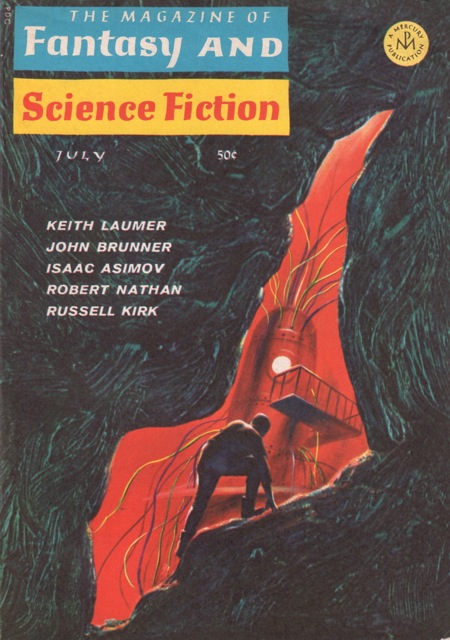
(Cover by Jack Gaughan. F&SF, July 1967.) Who Goes There?
In his lifetime Russell Kirk was known firstly as a conservative political theorist, at a time when American conservatism was still capable of producing intellectuals. His 1953 non-fiction book The Conservative Mind was a seminal political text in its day, although, having been written and published when the Old Right still held sway in government, it now has been seemingly forgotten in a post-Reagan/post-Trump landscape. Kirk was good friends with T. S. Eliot, a fellow conservative and one of the leading members of the Modernist movement; and this may have influenced Kirk to try his hand at literature that would very much stand on its own merits, regardless of the reader’s political biases. Nearly all the fiction Kirk wrote would be supernatural horror, as like M. R. James he seemed uninterested in writing fiction of any other kind, and he would even win the World Fantasy Award for Best Short Fiction for his story “There’s a Long, Long Trail A-Winding.” Kirk also appeared semi-regularly in F&SF, and indeed it’s very likely he would’ve never appeared in the genre magazines if not for F&SF‘s mix of classiness and friendliness towards short horror fiction. “Balgrummo’s Hell” is a (relatively) modern take on what would’ve already been a very old tradition in 1967: the Gothic supernatural tale.
Placing Coordinates
First published in the July 1967 issue of The Magazine of Fantasy and Science Fiction, which is on the Archive. It’s been reprinted in The Best from Fantasy and Science Fiction: Seventeenth Series (ed. Edward L. Ferman), The Best Horror Stories from the Magazine of Fantasy and Science Fiction (ed. Edward L. Ferman and Anne Jordan), and the Kirk collections The Princess of All Lands and Ancestral Shadows: An Anthology of Ghostly Tales, the latter seemingly collecting all of Kirk’s ghost stories.
Enhancing Image
Rafe Hogan is a thief, and a pretty good one at that. His latest location for a heist is a secluded mansion in Scotland: Balgrummo Lodging. It’s not exactly a solo job, as his sort-of-girlfriend Nan had gotten hired as a nurse for the mansion and has given Hogan some valuable information as to the treasures lurking inside—namely that the mansion is home to a lot of paintings that would go for a pretty penny on the market, if anyone were to sell them. God knows there’s very little else of value inside, as Alec Fillan Inchburn, the tenth and last baron (he never had children) of Balgrummo Lodging, has sold off everything else of real value for the sake of paying off debts. Alec is extremely old, having not ventured outside his mansion in half a century, having committed an unnamed crime in the years right before World War I and having since been put under a kind of unofficial house arrest. Alec’s only associates now are his niece Euphemia “Effie” Inchburn, T. M. Gillespie, “chairman of the trustees of Lord Balgrummo’s Trust,” and a lone bodyguard at the mansion, Jock Jamieson. There are also nurses who have passed through, to aid the elderly Lord Balgrummo, but Hogan can’t figure for the life of him how these women would’ve lasted more than a week at a time. There aren’t even any guard dogs on the premises. “‘The brutes don’t live long at the Lodging,’ Gillespie had muttered in an obscure aside.” Overall it sounds like this heist shouldn’t be too taxing.
The heist itself only takes up a fraction of the story, most of the wordage being spent on the setup for the heist and the backstory for the mansion, the latter especially contributing to a sense of impending doom—yet we’re kept in the dark as to what kind of doom awaits us. Overall it’s a nonlinear structure, and I’m not totally sure it works out. As far as the action goes it borders on being a one-man show, as once Hogan gets past Jamieson he wanders through the mansion by his lonesome, at night. Kirk might’ve been aware that the actual plot he had conceived would not be able to sustain a short novelette, so he jumps back and forth in time, or rather has Hogan think back on conversations he’d had with Gillespie and Effie, both of whom are fluent in Expositionese. Normally I would fault the exposition-heavy dialogue more, but since the purpose of sucking up to Alec’s associates is to gather info, it makes sense Hogan would be recalling backstory, of which there is a lot. If I had to call “Balgrummo’s Hell” a single word it would be “atmospheric,” which is often used as very polite shorthand for when nothing happens in a story, but at least the vibes are right. It doesn’t help that Hogan is not by any stretch a “hero,” although in his defense he could be more of an outright villain: for example he contemplates murdering Lord Balgrummo while the old man seems to be comatose, but dismisses such a thought as unnecessary cruelty. He’s not exactly a likable protagonist, though, and knowing how Kirk’s worldview operates it becomes too easy to figure out that Our Anti-Hero™ is practically begging to get his just desserts. How he gets his comeuppance is a different story.
“Balgrummo’s Hell” is basically a story about two men who are damned—only one of them doesn’t know it. Something is not right about Balgrummo Lodging, but we’re not told exactly what had happened to make it fall into such decrepitude. There’s a haunting early passage where Hogan is doing location scouting in the neighborhood the mansion is found on, in which the rot of the place seems to have spread like a virus, the rot creeping like a darkness on what is already decaying Scottish urbane landscape. Kirk is a good writer, even if after having read a few of his short stories I don’t consider him that good a storyteller.
Observe:
Beyond the linoleum-factory, he had come upon a remarkably high old stone dyke, unpleasant shards of broken glass set thick in cement all along its top. Behind the wall he had made out the limbs and trunks of limes and beeches, a forest amidst suburbia. Abruptly, a formal ancient pend or vaulted gateway had loomed up. On either side, a seventeenth-century stone beast-effigy kept guard, life-size almost: a lion and a griffin, but so hacked and battered by young vandals as to be almost unrecognizable. The griffin’s whole head was lacking.
I have qualms with the payoff for the mystery, which I’ll get to, but you have to admit Kirk sets things up beautifully. We’re given a location that’s in the midst of crumbling, yet like a dying animal it has become vicious in its own way. Balgrummo Lodging is practically a living thing in itself. We know going in that this is supernatural horror, but the actual supernatural element is alluded to rather than show for almost the entire story, and for me that’s where the sense of dread really comes from. For most of the story nothing strictly supernatural happens, but we know something is wrong. This sense of dread only becomes heightened once Hogan meets Lord Balgrummo face to face, or rather comes upon Lord Balgrummo’s near-lifeless body in his study, the old man having deteriorated physically to the point where he seems unaware of what’s happening around him. One has to wonder how he’s still alive after all this. “But was this penny-dreadful monster of fifty years ago, with his white beard now making him sham-venerable in this four-poster, still among the living?” Yet Alec may well be kept alive by a torment which for him is the never-ending present—a kind of hell that, in line with Kirk’s traditional Catholic conception of punishment, is not a recollection of a horrible past but rather an obliteration of both past and future, so that the present never stops. The explanation for Alec’s condition, courtesy of a flashback with Gillespie, borders on sermonizing, which at this point I’ve come to expect. You can blame it on me being an agnostic, but Kirk’s skill for me is often held back by his sermonizing.
There Be Spoilers Here
Hogan has gone into Lord Balgrummo’s chamber to take a key which only Lord Balgrummo has, which turns out to be a mistake. It’s at this point that we’re told what the supernatural element is, and it ends up being an odd reveal because Hogan had already learned this information before entering the mansion—it’s just that the reader is only learning about it in the climax of the story. I blame myself for not guessing early on, because it’s not a hard twist to figure out; if anything, aside from his tendency to sermonize, Kirk’s biggest flaw as a writer is that he’s not very original when it comes to incorporating horror elements. The reveal that Alec had gotten involved in some horrible pagan ritual may have been a decent twist in 1887, but not so in 1967; nowadays it comes off as tired, but also a little culturally insensitive. So Effie tells us in a flashback:
“[Alec] was out in Nigeria before people called it Nigeria, you know, and in Guinea, and all up and down that coast. He began collecting materials for a monograph on African magic—raising the dead, and summoning devils, and more. Presently he was dabbling in the spells, not merely collecting them—so my father told me, forty years ago. After Uncle Alec came home, he didn’t stop dabbling.”
Lord Balgrummo fucked around and found out, and so for decades now has spent his life in perpetual torment, a torture which will continue until his body expires—and possibly may even continue after his physical death. Whether or not Hogan gets off better is up for debate. The story ends more or less how you think it will, although given the suddenness of the reveal it feels more like a stop than a proper ending. Like I said, Kirk is much better at setting up the mystery than giving us an answer for it, which come to think of it is not unusual for mysteries. I was intrigued for most of the story, but at the end I felt weirdly empty from it.
A Step Farther Out
Gothic narratives always interest me, even if the narrative turns out to be totally derivative and not worth my time. “Balgrummo’s Hell” is worth your time, depending on your appetite for an old-fashioned haunted house story with a religious moral at its center. Kirk clearly held the Gothic tradition in reverence, and line-for-line he’s a more elegant writer than most genre writers in the ’60s—whether he’s able to sustain that elegance for a whole story is yet for me to see. Maybe it has to do with my being allergic to being moralized at. Maybe I’m just not Catholic enough.
See you next time.
-
Short Story Review: “Uncollected Works” by Lin Carter
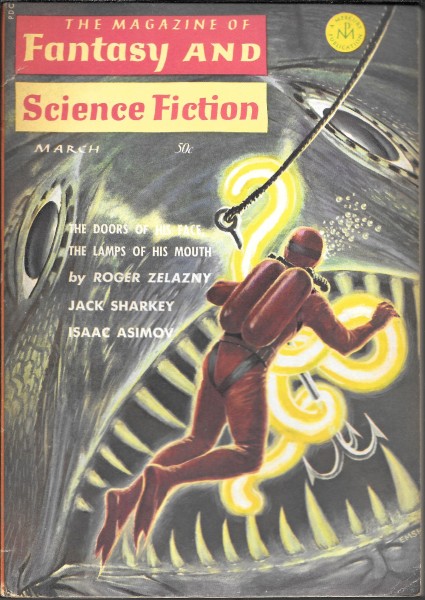
(Cover by Ed Emshwiller. F&SF, March 1965.) Who Goes There?
Today I’ll be tackling an SF story by Lin Carter, which might be a bit unfair since Carter wasn’t much of an SF writer. He started out as a fan when he was a teenager, and in the ’50s would start writing genre fiction at the semi-pro level, although he never went on to become an acclaimed writer; on the contrary, Carter would become notorious as one of the worst fantasy writers of the ’60s and ’70s. But then writing wasn’t where his talent lay anyway. While he would be derided for his writing, Carter became arguably the most important fantasy editor of the ’70s, between his role as consulting editor for the Ballantine Adult Fantasy series and his editing of original and reprint anthologies. “Uncollected Works” was Carter’s first solo professional story, and honestly you could’ve convinced me it was written by someone else, since it’s ostensibly SF and doesn’t have the same overbearing style of his later work. It’s also quite different from later Carter fiction in that it’s not half bad! I had a fun time with it, even if it’s not to be taken too seriously. It would earn Carter his first (and only) Nebula nomination, which itself is not too big an achievement considering every other writer active in 1965 got a nomination that first year of the Nebulas.
Placing Coordinates
First published in the March 1965 issue of The Magazine of Fantasy and Science Fiction. “Uncollected Works” has only been collected (aha) twice, in World’s Best Science Fiction: 1966 (ed. Terry Carr and Donald A. Wollheim) and the Carter collection Beyond the Gates of Dream. I dare say it’s slightly underrated.
Enhancing Image
This story is technically told in the first person, although at times it reads like second-person since the narrator, an elderly literary critic, is being interviewed by some journalist, and you the reader are in the journalist’s position. So the unnamed narrator is talking directly at us. As someone who used to write short fiction (and may well do so again), I’ve been sort of conditioned to think about how a story is written, down to questions the average reader wouldn’t be asking, such as, “Who is this first-person narrator talking to?” This is all told as a one-sided conversation, with the journalist’s side of the interview being masked by ellipses; we can only infer what we as the reader/journalist are saying. This is the sort of thing you have to consider when writing a short story, and as the narrator admits, writing fiction is not easy work at all. “Pounding a typewriter is hard work, young man, I assure you! Ditch-digging, by comparison, demands far less of one, or so I have been told.” Carter is being a little cheeky here, since obviously he wrote fiction (among other things) for a living and knew perfectly well how grueling it was, even if his narrator claims to not have that experience. There’s also some bitter irony in that Carter’s narrator is an old and respected critic, who is considered at least important enough to be interviewed (consider how many genre SF writers were either never interviewed or were only interviewed very late in their careers), while Carter would die in semi-obscurity and as something of an outcast.
To make a long story short, Carter would not have a very happy life; he died relatively young of cancer, and by that point the fandom around fantasy which he helped build in the US had left him behind. It’s a bittersweet life which produced a bittersweet short story here, although I wanna make it clear the narrator is by no means Carter’s avatar; for one thing the narrator was very much involved in Modernist literature, in the first decades of the 20th century, while I can’t say with certainty that Carter cared for the Modernists at all. The narrator laments Ezra Pound not winning the Nobel, which is a curious sentiment considering Pound was a fascist and his reputation as a poet was and remains divisive. (I mean hey, William Butler Yeats was at the very least a fascist sympathizer and he won the Nobel, so I suppose why not.) On top of past regrets he mentions, the narrator brings up some literary works that sounds made-up, and indeed they’re works that won’t be published yet—the “great” literature of the future the old man won’t live to read. At first we’re led to believe this is all just a figure of speech, but it turns out the narrator is being much more literal. Soon he mentions a story from his youth, while he was staying in Paris—an encounter with a strange older man he only calls “The Gentleman in Green.” They have lunch together and the Gentleman, who has clearly made a good living for himself, considers himself an inventor; he’s been able to live off the royalties of more than a few patents. There is one invention the Gentleman is especially proud of, though, and it came from a new field of mechanics: “Bibliochanics.” The invention itself is called Bibliac, a kind of super-computer, and there is only one of it in the world—the first and last of its kind.
The Gentleman had built Bibliac as a kind of mechanical computer, which can generate letters free of human input, but whose ramblings can be scanned and read with a separate monitor. Bibliac could be thought of as a precursor to the likes of ChatGPT and other chatbots—not true AIs but programs with a prompt-reaction system. Prompt goes in, shit comes out. There are jobs now where you, as someone who can actually write coherent sentences, “work” with chatbots so that they can “learn” to write like actual humans—only now with stolen material. (Do you feel like we’re living in the best of all possible worlds?) Bibliac is less an automatic typewriter and more like a million automatic typewriters feeding into one system, which, ya know, there’s that old saying about how if you had a million monkeys with typewriters you would, at some point, get Shakespeare. The overwhelming majority of the writing would be gibberish, but eventually you would get coherent English and maybe even Shakespeare’s sonnets. Carter seems to have taken this old saying (although maybe it wasn’t so old in 1965) and run with it, since Bibliac similarly prints out gibberish—or at least what looks like gibberish. It takes some time for the Gentleman (this would’ve all happened in the past, mind you) to figure out what Bibliac is actually doing. Upon consulting a linguist friend in academia the Gentleman makes a huge discovery—that the first coherent words generated by Bibliac are Sumerian, one of the oldest known human languages.
“Of course,” says the Gentleman, “no one had ever bothered to work out the logical implications of the fifty-million-monkeys paradox. It would not begin with Montaigne, but with the very beginnings of written literature!” To be fair, neither does Carter totally. There are some logical problems here, which is why I call this story “ostensibly” SF, as it borders on fantasy. Really it’s too soft for most SF but still too rigorous and grounded in reality for fantasy, which you could say makes it perfect for F&SF. (Maybe also Fantastic, but F&SF would’ve paid more.) So, Bibliac progresses through literature, language by language (we’re talking written language), but how does it know to use which alphabet? There are almost as many different alphabets as there are languages. Is kanji included? How would the Gentleman be able to read 99% of this? He claims Bibliac even types out written works that are now lost media, such as the complete works of Sappho, but how would he know it’s Sappho? And would he even be able to read it? The Gentleman has devised a system to scan and sort coherent language from gibberish, but even with this filter it would surely be a nightmare and a half to read all this shit. Surely it’s not work for just one person, yet the Gentleman has been more or less working Bibliac by himself, in an experiment that has now lasted years. Holes like these are inevitable, since SF by its nature has to be founded on at least One Big Lie™, but you see how this can be distracting on reflection, and how “Uncollected Works” borders on fantasy.
There Be Spoilers Here
As for the Gentleman in Green, he was never to be seen again after this chance meeting, having gotten run over and probably killed by a bicyclist right after leaving the narrator. The narrator isn’t sure if he survived, but he never got a name and it’s been decades since that meeting. And yet, so the narrator claims, even without the Gentleman’s input, Bibliac continues to run; by now it will have gone many years ahead into the future of written language, printing out works that have yet to be written by human hands. At the beginning the narrator lists a few future works of literature, but it turns out these were not mere hypotheticals, but real works that the Gentleman had told him about, and which will be written at some point in “our” lifetime, if not the narrator’s. It’s a bittersweet ending, perhaps more sincere than to be expected from so patently ridiculous a story. Of course we don’t even know if what the Gentleman said was true, or even if the narrator is being truthful, but, in that strange convention unique to genre fiction, we have to take these characters at their word. (It’s funny: in “realistic” fiction we’ve become accustomed to unreliable narrators and the possibility of characters keeping secrets, but in genre fiction we’re expected to take everything at face value.) Of course the narrator doesn’t want us to repeat what he’s told us, about Bibliac and its borderline magical power. “…But, if you will, remember those names. Paxton. Chiminez. De Montaubon. Jones, Von Bremen. Sir Edward Marlinson. Tierney.” Some of the great writers of the future. Maybe that’s what Carter really cared about, even for someone who mostly didn’t write science fiction: the future.
A Step Farther Out
Maybe I liked “Uncollected Works” as much as I did because I wasn’t expecting it. I was expecting garbage, truth be told, and instead got a story that’s pretty likable and welcoming, even interesting, if not totally logical. I’ve recently become sort of a fan of Carter’s work as an editor, and obviously as a fan writer myself I feel I should give him some credit, but it must be said that not all of his fiction is bad—maybe just most of it.
See you next time.
-
Short Story Review: “Cynosure” by Kit Reed

(Cover by Ed Emshwiller. F&SF, June 1964.) Who Goes There?
Kit Reed debuted in the late ’50s, actually part of the generation of women to come after that initial wave in F&SF‘s early years; had she been older or started earlier she would’ve fit right in with the first generation of F&SF‘s “housewives.” But Reed’s career would go beyond the ’50s—way beyond. She would keep writing until her death in 2017, and while she would write the occasional novel, she remains more recognized for her short fiction, and while she was not the prolific writer ever, she did consistently stick with the short story, even when market forces would’ve suggested shifting to novels. I’ve read several of Reed’s stories at this point and I would describe the ones I’ve read as “domestic satire,” including today’s story. Reed’s satires of the nuclear family and the emptiness of middle-class suburbia are more playful than vicious, in that I get the sense that while she had a cynical side she also didn’t resent her station in life. “Cynosure” is entertaining and to some extent an effective satire, but I think it could’ve been even better had it been a little less cartoonish and a little more merciless.
Placing Coordinates
First published in the June 1964 issue of The Magazine of Fantasy and Science Fiction, which is on the Archive. It has since been reprinted in Marriage and the Family Through Science Fiction (ed. Val Clear, Martin H. Greenberg, Joseph D. Olander, and Patricia Warrick), The Penguin Book of Modern Fantasy by Women (ed. Richard Glyn Jones and A. Susan Williams), and Rediscovery: Science Fiction by Women (1964-1968) (editor not credited), along with the Reed collections The Killer Mice and Weird Women, Wired Women. So you have a few options!
Enhancing Image
Norma Thayer is a housewife, although she’s not exactly a wife anymore, her husband having filed for divorce and left her “when there wasn’t even an Other Woman to take the blame.” Now she lives with her ten-year-old daughter Polly Anne, plus a dog and a cat. This is a lot of responsibility for one woman, especially since Norma and her daughter have just moved into a new neighborhood, maybe in the hopes of turning a new leaf. Norma thinks of herself as a dutiful housewife, never mind being a divorcee; she does all the cooking and cleaning, and on top of that she does her best to keep up with the latest suburban fashion and household appliances. Unfortunately her next-door neighbor, Mrs. Brainerd, remains unimpressed. I was actually confused at first as to whether Mrs. Brainerd is supposed to be a human or an android, since futuristic technology is certainly on the table (as we’ll find out) and Mrs. Brainerd is described as “made of steel” in her introductory scene; but after delving more into the story this description is apparently to be taken metaphorically. Mrs. Brainerd is not actually an android, although she does turn out to have a knack for perfectionism that leads one to think of her as robotic. Despite being demanding and unlikable, Mrs. Brainerd stands as everything Norma aspires to be: she’s “small, slender, lipsticked, and perfumed,” and like Norma she tries to keep up with all the latest gizmos and gossip—except unlike Norma she does this perfectly. How is a single woman supposed to compete with this? How can she handle a kid, a dog, and a cat, and keep a house clean? Unless…
If you’ve read some Kit Reed before then you can guess where this is going. Actually the satirical use of future tech reminds me of Robert Sheckley, had he been a bit less of a misogynist. During one of her pets’ messy accidents (“You Know What”) Norma just so happens to find an advertisement in one of her magazines, which is weird because from what I can tell we’re not told what the name of the product is. Is it supposed to be Cynosure? (By the way, a “cynosure” is basically the center of attention. I’m not sure I’d ever heard of it before, and actually going into the story I assumed it’d be some kind of mythological reference. No dice.) The gizmo at the heart of the story has an unassuming, such that it doesn’t register as future tech—except for its function. “It was a box, small and corrugated, and inside, wrapped in excelsior, was a small, lavender enamel-covered machine. A nozzle and hose, also lavender, were attached.” I imagine it looking like a cross between a vacuum and a leaf blower. The idea is that the dingus lathers material in a liquid which renders the material frozen in place, until it’s unfrozen with a counteracting liquid that comes with the package. And yes, such a liquid would also work on living things. This is one of those inventions where I’m not sure how regulations gave it the green light, or how there wouldn’t be a massive recall once the exploits with such a machine would become obvious. Still, let’s not think too hard about that.
I’ve read that even Reed’s SF can come off as almost like fantasy, and I can see why. The scientific—never mind practical—properties of the gizmo are a little dubious. It may as well be magic. Rather than hard-nosed SF “Cynosure” is much more like a tech fable, as well as a snapshot of life for middle-class whites in the mid-’60s, written before John F. Kennedy’s assassination but published after—only to collide with the Beatles arriving in the US. This is a side of American culture in the ’60s that history has all but forgotten about, if only because nobody remembers the conformists, and Norma is very much a conformist. The need for conformity in the suburbs was and continues to be a fruitful well for ambivalent and satirical storytelling, to the point where poking fun at suburban conformity has itself become a cliche. Of course we hate the suburbs—after all, a lot of us were raised there. I sure was. I recognize Norma in people I grew up with, or rather the parents of those people, the parents (the moms especially) who “kept up appearances,” even if they were getting divorced. It’s tempting, when reading Norma’s interactions with Mrs. Brainerd, to project some homoerotic jealousy onto the relationship; but this was probably not intended. Norma probably doesn’t even see Mrs. Brainerd as a potential friend, but as an ideal to strife for, Mrs. Brainerd posing as the perfect conformist. She doesn’t seem to have a life outside of her “job” as a housewife, her attitude being abrasive but in the service of conformity rather than individuality. Mrs. Brainerd is a robot—metaphorically if not literally. Which does make the ending satisfying!
There Be Spoilers Here
Mrs. Brainerd has been visibly disappointed in her visits, but Norma thinks that with the gizmo she can get everything just right for her neighbor. To her credit, she comes pretty close! She even freezes Polly Anne with the stuff so as to keep her in place during the visit—a tactical move that you have to admit is a bit drastic, but don’t worry, she’s not dead. But still Mrs. Brainerd remains unimpressed. Why? The cake the two women are having has got “that greasy feel.” Well tough shit, huh? Norma has one of those moments—perhaps a bit of a mental break—that would, in different circumstances, result a disgruntled office worker paying management an “unexpected visit.” Don’t worry, the gizmo doesn’t kill Mrs. Brainerd either, although I have to wonder what would happen when she’s eventually unfrozen—if she is unfrozen. Does Norma simply leave her like this? I have a few questions. The vengeance in sweet, though, as Norma and her family pile dirt on the frozen Mrs. Brainerd and the dog even “Did It” on her feet, her face contorted in terror and disgust all the while. There’s a snappiness and just enough of a viciousness in Reed’s style that it’s easy to get wrapped up in Norma’s revenge on her neighbor and possibly even see her as heroic, despite Norma being an anti-heroine at best. Humiliating her neighbor is undoubtedly sadistic to some extent, and yet it’s also framed as a liberating act. Had Norma killed Mrs. Brainerd outright it might’ve crossed the threshold in unintended villainy, but because of the reversable effects of the gizmo it’s easy to think of the ending as like something out of a children’s cartoon.
A Step Farther Out
Purely as a comedy it’s effective enough, but I wish it had been darker, more unsparing. It could be because I grew up in the kind of household described here (except my dad is still very much present in my life, if that means anything), but while the ending is satisfying in its way I was hoping (indeed expecting) Reed to go farther than she did. There’s frustration and vengeance, but ultimately it feels like it was all in good fun. Give Joanna Russ or James Tiptree, Jr. this premise and they could’ve given us some of the bleakest SF of the ’60s. Reed is perhaps an undervalued writer, and especially given her long and winding career it’s easy to think she would explore darker avenues elsewhere. Who’s to say she didn’t?
See you next time.
-
The Observatory: Nathaniel Hawthorne’s Mad Scientists

(Portrait of Nathaniel Hawthorne, by Charles Osgood. Circa 1841.) (Contains spoilers for “The Birthmark,” “Rappaccini’s Daughter,” and “The Artist of the Beautiful.”)
We’re here to talk about some “classic literature,” which I understand tends to fall outside genre confines for a lot of people. After all, genre SF, or indeed science fiction as a codified genre, did not exist in Nathaniel Hawthorne’s lifetime; and yet he, along with a few contemporaries, contributed massively to what we now call science fiction. Hawthorne is one of the undisputed canonical American authors, and he was also one of the first, having been born on July 4th, 1804, at a time when the US had not even started really to foster its first generation of “canonical” literature. When Hawthorne started writing his first major work in the 1830s the literary landscape in the US was basically at the stature of a toddler; and despite having already written a novel (one that nobody talks about and which Hawthorne went out of his way to disown), he would dedicate two decades of his life to mastering just the short story. The Scarlet Letter is one of the most famous (if divisive) American novels of all time, but when it was published in 1850 Hawthorne had already garnered a reputation as a master of short fiction; and like his direct contemporary Edgar Allan Poe he often wrote stories that would now be considered horror, fantasy, and/or SF. There’s a reason Lovecraft, in his “Supernatural Horror in Literature,” singled out Hawthorne as a major pioneer in weird fiction, even calling his borderline supernatural novel The House of the Seven Gables a masterpiece.
If I were to talk about Hawthorne’s horror fiction then I would really have my work cut out for me, given how much of his material is horror; but today we’re here to talk about three of his short stories, all of which could be considered SF, and all of which involve some kind of mad-scientist figure. The truth is that had Mary Shelley not beaten him to the punch by a few decades then the popular conception of the mad scientist would probably be much more based on Hawthorne’s conceptions—and to a degree those conceptions have still left a footprint on the popular consciousness. Had things gone a bit differently we might call a scientist who plays God a Rappaccini instead of a Frankenstein. The three stories—”The Birthmark,” “Rappaccini’s Daughter,” and “The Artist of the Beautiful”—were all published over a span of two years (1843 and 1844), and the SF Encyclopedia singles them out as masterpieces of early SF. There’s a good reason for this. While not officially connected with each other in any way, the three stories are thematically conjoined at the hip, on top of featuring variations of the same character type: the scientist in search of perfection. These are also stories that happen to show Hawthorne at the top of his game, being some of his most tightly composed and insightful work, and showing a seriousness that would be missing in the early days of genre SF a century later. Mind you that this is not a review: I very much recommend all three stories. We’re gonna be doing some analysis, specifically in how Hawthorne conceptualizes scientist characters at a time when “the sciences” as different fields of discipline were only then starting to splinter, and indeed some hadn’t even been founded yet. This was a time before Darwin’s theory of evolution and our modern understanding of genetics, for example, such that “science” in 1843 might now sound almost like mysticism.
I read each of these stories in order of how they appeared in the Hawthorne collection Mosses from an Old Manse, so let’s talk about “The Birthmark” (or “The Birth-Mark” as it’s also titled) first. This is one of Hawthorne’s most reprinted stories, and given its simplicity and economy of style it’s easy to see why it’d be one of the more popular choices. There are only two main characters (plus a singular supporting character I’ll get to in a minute), trapped together in basically one room. Aylmer is a research scientist, living at some point in the late 18th century, with his wife Georgiana, a perfectly submissive woman who nonetheless is insecure about a hand-shaped birthmark on her cheek which renders her, at least to her husband, just imperfect enough as to be tragic. We’re told Georgiana is as conventionally attractive a woman as one can think, almost perfect in her beauty—almost. This single imperfection (clearly supposed to be the hand of Nature on her cheek) is enough to make Aylmer neurotic, and to propose a series of experiments in order to remove the birthmark, which Georgiana agrees to. Aylmer’s assistant, Aminadab, suggests that the experiment would be a bad idea, but remains loyal to his master. Aminadab is a curious figure, since he has to be one of the first examples of the mad scientist’s impish assistant in SF, serving as a predecessor to the likes of Fritz in the 1931 Frankenstein movie and Igor elsewhere. (Remember, Dr. Frankenstein did not have such an assistant in the novel.) Of course, Aminadab is not very impish; if anything he serves as a symbol of “earthy” wisdom to contrast with Aylmer’s blinding bookishness. Aylmer is not evil by any means, but he turns out to be tragically misguided, perhaps driven by the fact that he loves his work more than his wife, or as the narrator posits, he is unable to untangle his love for his wife from his love for science.
“The Birthmark” is a parable that has quite a bit going on within its almost brutally simple confines. It’s a story about man’s vain pursuit to overthrow Nature (and for Hawthorne it’s always Nature with a capital N), which will become a bit of a running theme here. It’s also about the futile pursuit of obtaining perfection, which of course Aylmer and Georgiana can’t have. Aylmer’s borderline abuse of his wife and the narrative’s sympathy for Georgiana’s insecurity arguably reads as proto-feminist, especially now that we’ve become much more aware of women having unrealistic beauty expectations thrust upon them; indeed the seeming “need” for perfect beauty is so prevalent that despite the quasi-Shakespearean dialogue and dense expository paragraphs, very little has aged about any of these stories in terms of their concerns. Of course Aylmer is able to remove the birthmark, but Georgiana quickly becomes ill and dies on the operating table; obviously if we’re being pedantic the removal of the birthmark shouldn’t have been able to kill her, but it’s meant to be symbolic. Prior to the climax, Georgiana alluded to being connected with the birthmark in some spiritual fashion, such that if the birthmark were extinguished then her a soul might go with it—a possibility Aylmer doesn’t quite heed. For a brief moment he renders Georgiana “perfect,” but as will become apparent if one reads his other fiction, Hawthorne thinks of perfection as something that can only last for a single moment—if it’s possible at all. Aylmer is a tragic hero in that he has good intentions, or at least thinks he has good intentions, but is unable to do away with Nature’s imperfection.
Now we have possibly Hawthorne’s most famous short story with “Rappaccini’s Daughter,” which despite being a fair bit longer than either of the other stories is still very much a parable. I should probably mention that I suspect the biggest reason why more people don’t enjoy Hawthorne nowadays is that he was not a realist; he often wrote in the allegorical mode, itself having apparently gone out of fashion in recent decades. Nobody likes being moralized at, and Hawthorne did quite a bit of moralizing; but he was also very good at it, such that his skill goes undervalued now. It’s quite possible that had Frankenstein not been published a quarter-century earlier that our conception of what a “mad scientist” even looks like might’ve been more informed by Hawthorne’s Rappaccini—an ironic fact, considering Rappaccini himself barely appears in his own story and we don’t even get any dialogue from him until the climax. We do, however, see a great deal of Rappaccini’s work, including his experimental botanical garden, an “Eden of poisonous flowers,” and his daughter Beatrice, who manages said Eden. We move off to Italy, where a young man named Giovanni gets caught in a rivalry between two physicians, Baglioni and Rappaccini, and Giovanni himself becomes deeply fascinated with Beatrice. I could be wrong, but this might be the earliest example of the “mad scientist’s beautiful daughter” trope in fiction; I certainly struggle to think of anything that could’ve predated it. There is a problem with Beatrice, aside from the fact that she’s socially inept: she’s poisonous, such that even her breath can kill. After years of exposure to the garden Beatrice has become immune to the poisonous plants around her—the tradeoff being that she has become poisonous to everything else. Well, nobody’s perfect.
Of Hawthorne’s mad scientists, Rappaccini is by far the most villainous and the least human, so it’s fitting he’s the only one who serves as a proper antagonist. Rappaccini’s sinister nature is amplified by the fact that we get to know very little about how this whole situation came to be. We never find out what became of Mrs. Rappaccini and we never get a clear answer as to why Rappaccini would use his own daughter as a kind of living experiment, or why he built his garden so that it would resemble a kind of inverted Eden—a place where nothing is allowed to live except that which kills. Maybe the point of making Beatrice immune to the poisonous plants of the garden was to make her, quite literally, immune to what Rappaccini considers the evils of the world—the killing things which Nature produces. Beatrice has become so perfectly immune, and herself so perfectly poisonous, that the result is idealistic—if only in a way that would strike the average person as perverse. Not that Hawthorne’s writing tends to be subtle, but “Rappaccini’s Daughter” might be one of his most overtly religious works in how intensely (and masterfully) it harks to Biblical mythology, to such a degree that even the verbose style of the prose seems to be the spawn of Milton and the King James Bible. (Naturally there are also references to The Divine Comedy.) Rappaccini is a man who clearly thinks of himself as akin to God—a demiurge who has created an inverted and treacherous Eden of his own. If Rappaccini is the demiurge, a counterfeit God, then Baglioni is like the snake in Eden, but made ultimately good, such that his foiling of his rival involves making Giovanni immune to Beatrice’s own poison—an antidote that, tragically, results in her death. The villainous striving for perfection, the “paradise” of the garden, has been lost.

(Cover by E. M. Stevenson. Weird Tales, July 1926.) The last of these stories is not as famous as the others, nor was it reprinted in genre magazines as a classic—all a shame, since it’s arguably the strongest of the bunch. I was stunned a bit when I had first read “The Artist of the Beautiful” a year or so ago, which as its title suggests is an incredibly tender parable. It must be said, though, that the protagonist of this one is not, strictly speaking, a scientist. Owen Warland is young watchmaker who has just finished his apprenticeship under Peter Hovenden, a capable but conventional-thinking watchmaker who doesn’t see the value in Owen’s idealism. Working on little machines is all well and good, but Owen wants to make something beautiful, something with real aesthetic value that will stick in the mind long after its practical function has expired. In other words, he wants to be an artist. In “The Birthmark” we saw the scientist-as-destroyer; in “Rappaccini’s Daughter” we saw a villainous take on the scientist-as-creator; but in “The Artist of the Beautiful” we see the scientist-as-artist. Indeed it’s here, in this tightly constructed little story, that Hawthorne most neatly marries art with the sciences. Owen’s growing obsession with making something small and yet perfect could serve as analogous with Hawthorne’s own obsession with perfecting the short story. After all, “the beautiful idea has no relation to size.” This proves to be a very hard task for Owen, though, and he gives up a lot to achieve his vision, having lost his chance with Peter Hovenden’s daughter Annie and having become an outcast. There are false starts, and he even gives up watchmaking to focus on his secret project, mooching off an inheritance in the meantime. For all intents and purposes, Owen shuts out the human world; but the same can’t be said of Nature, which he becomes more fascinated with…
The scientists of the previous two stories thought that in some way they could conquer Nature—Aylmer to remove Nature’s imperfections and Rappaccini to bend Nature to serve his own ends. If Owen is redeemed by anything it’s his willingness to acknowledge Nature’s—maybe “superiority” is not the right word, but Nature’s status as the immovable object, not to be destroyed or pushed aside by human hands. So rather than try to conquer Nature, Owen instead takes inspiration from it, perhaps with the expectation that he won’t be able to reach perfection—but he can get very close, if only for a prolonged moment. Even if only a few people get to see his creation before it falls apart in their hands. The mechanical butterfly, an early example of a robot in fiction, is tiny, yet perfectly designed. It has no practical utility, but it exists seemingly for the sake of being a wonderful little work of art, not to mention what would’ve been a technological marvel. Post-industrial technology rarely comes up in Hawthorne’s fiction, partly because he actually lived through the industrial revolution and partly because his fiction tends to take place in what would’ve been the distant past, even from the perspective of 1840s New England. Owen’s mechanical butterfly thus stands out as a rare example for Hawthorne of what we even today would call modern technology, but it’s also an example of science and art coming together to imitate Nature—not to replace it but to take inspiration from it. The ending is bittersweet, as Owen’s creation which he had toiled over for months crumbles, but it strikes me as a kind of spiritual victory for the “scientist” here. If Aylmer was misguided and Rappaccini villainous, then Owen, the scientist-as-artist, comes out the victor.
Hawthorne wrote more SF than just these three stories, of course, although SF would still only take up a small fraction of his output, for I think at heart he was really a horror writer. There is some overlap between the genres he played with, though, and it shouldn’t be too surprising that “The Birthmark” and “Rappaccini’s Daughter” were reprinted in Weird Tales. Poe certainly wrote more SF, but far more than Poe I think Hawthorne set a standard for how we (people who, for the most part anyway, are not scientists at all) think about scientist characters in SF. Poe’s protagonists are often misfits, adventurers, schemers, and other archetypes Poe may or may not have admired; but Hawthorne’s protagonists tend to be more bookish, dour, isolated from human contact, like the man himself. No doubt Hawthorne saw some of himself in Owen Warland, and he may have even seen a bit of himself in Aylmer. More than with scientists as people, though, Hawthorne was arguably the first (after Mary Shelley, obviously) to write science fiction in which the sciences matter even close to as much as the action and themes of the story. In “Rappaccini’s Daughter” alone we have a physician who is also a botanist, and while he stays offscreen for most of the story we do see clearly the fruits of his labor. In the days before we even knew of Darwinian evolution, Hawthorne had given us some ideas as to what a world ruled by scientists, by the seeking-after-knowledge above all else, might look like—and it didn’t look very promising.
-
Short Story Review: “The Voyage of the ‘Deborah Pratt’” by Miriam Allen deFord
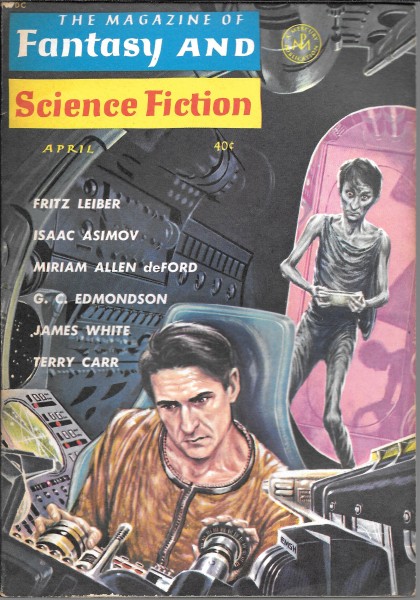
(Cover by Ed Emshwiller. F&SF, April 1963.) Who Goes There?
I think I mentioned earlier that I had never read a Miriam Allen deFord story before, which as it turns out is not true. I had read deFord’s savage little story “The Malley System” as part of Dangerous Visions, which is a perfectly dangerous little parable befitting that anthology, despite deFord being the oldest contributor by a good margin. DeFord was born in 1888, which would make her a few years older than the likes of H. P. Lovecraft and Clark Ashton Smith; and yet despite her age, as well as not writing fiction regularly until the ’50s, she was by no means a square. This could be because deFord is one of the few openly leftist writers active in the field at the time, with her writing for feminist and socialist outlets going back to the years immediately following World War I. She was also, incidentally, a researcher for Charles Fort, which gave her a connection to genre SF long before she actually started writing SF herself. DeFord’s work is certainly worthy of further study, not least because today’s story, while very short, is a haunting fable that, while ostensibly SF, functions more as ghostly allegory. “The Voyage of the ‘Deborah Pratt’” is not to be missed.
Placing Coordinates
First published in the April 1963 issue of The Magazine of Fantasy and Science Fiction, which is on the Archive. It’s since been reprinted in the deFord collection Elsewhere, Elsewhen, Elsehow, as well as Terrors, Torments and Traumas (ed. Helen Hoke) and Rediscovery: Science Fiction by Women (1964-1968) (editor not credited).
Enhancing Image
The narrator is some four generations removed from the story he’s telling, and by his own admission it “may be partly myth.” There is some truth to it, of course: Jemmy Todd really was the narrator’s grandfather’s grandfather, and Quashee was a real person. Jemmy and Quashee were friends from childhood, but there was one problem: Quashee was a slave. Or rather, Quashee was brought in on a ship as a slave, although as the narrator tells it Jemmy family did buy his freedom at some point. Immediately we’re told that the story we’re about to hear may not be entirely true—not because the narrator is unreliable but because it’s simply part of the passage of time, that things that happened over a century ago will get mixed up as one generation recites to the next—assuming the thing is remembered at all. We’re being told this story in what would’ve presumably then been modern times, but the story itself would take place in the very early 19th century, when slavery was legal in several states in the US, though there was a growing abolitionist movement. The “Deborah Pratt” of the title is a brig that was stationed in New Bedford, the port town where we spend the opening stretch of Moby-Dick and where slavery was illegal at the time. The “Deborah Pratt” and its captain, Captain Pratt, Jemmy’s uncle, brought in slaves across the Atlantic illegally; the ship had to be quite clean of slaves when it returned to New Bedford. Jemmy was an orphan, and as Captain Pratt was the only man able to take the boy in, Jemmy spent time aboard this slave ship. But due to circumstances that could have been foreseen the illicit purpose of the “Deborah Pratt” was to end soon.
(Just a note here, and I’m saying this as a compulsive writer and an amateur editor at heart; but should a ship’s name be italicized or in quotation marks? Usually I see it as the former, but if for example a ship’s name is part of a book title—itself italicized—then the ship’s name will be in quotation marks. But if not part of an italicized title then it seems the ship’s name should be without quotation marks. In the case of deFord’s story it seems she should’ve italicized “Deborah Pratt,” but for the sake of consistency I’m foregoing the italicizing in my review.)
While Captain Pratt worked with his crew, Jemmy would hang around the slaves, especially Quashee, one of the children among them and about Jemmy’s age. The two boys, despite not having a language in common, get along well. “They would laugh together over nothing, draw pictures with sticks in the ground, talk to each other by signs and gestures. There was nobody else around of their own age or near it, so they gravitated together.” This is a small bright spot in what is otherwise a grueling existence, and deFord is merciless with what little wordage she affords herself, as while “The Voyage of the ‘Deborah Pratt’” is not a horror story per se it does gaze, unblinkingly, into what is by its nature an abyss. The slaves are chained together and stripped of their clothing. Those who die mid-voyage are tossed overboard, and even living slaves will be tossed over the side if the “Deborah Pratt” is threatened with being caught with its illegal cargo. For the crew the Africans on the ship don’t represent human life but a monetary investment. The most horrifying passages are not SFnal but historical. You may be wondering, then, how this story takes a turn for the SFnal, and since this story is so short I really have no choice but to tell you now: it’s a blinding disease, a virus which may or may not exist. Something strange and quite disconcerting starts happening with the slaves, in that the adults seem to be losing their eyesight at a rapid pace, their eyes showing “blood-shot whites and sores running with thick, sticky, yellow mucus.” The ship’s solitary doctor doesn’t like the look of this one bit.
DeFord does something unusual with characterization, in that the narrator and (ostensible) protagonist are different people, yet they’re both passive in the story—the unnamed narrator because he’s simply retelling what he’s heard and Jemmy because he was a literal child at the time who didn’t quite know what was happening. The active characters then are Captain Pratt and the doctor, the latter spending much of his time very melancholy and very drunk. The doctor is a curious figure, as he’s clearly ambivalent with the business of slavery but nonetheless chooses to work aboard a slave ship; of course “officially” it’s not for slave-trading, but he’s perfectly aware of where the big money comes from. He even proves perceptive when it comes to the slaves’ mysterious and contagious blindness, saying they’re not really hurting from the failing eyesight but what he calls “nostalgia.” Which came first, the homesickness or the blindness? Did this virus come from Africa or is it not something that can be understood purely through science? The doctor informs the captain that he can’t find a cure for this virus, indeed that it seems to be incurable—and that it can spread easily. So we’re on a ship, in the middle of the ocean, with a virus that could render everyone onboard blind and helpless. The problem is that the slaves cost money, and even if they were to be thrown over now it would be quite costly. (I of course don’t have to mention that doing so would also be a crime against humanity, on top of the slave-trading.) The whites aboard are stuck with their infectious cargo, and things are only about to get worse.
There Be Spoilers Here
Quashee becomes both unchained and allowed to stray from his fellow Africans, which turns out to have spared him from the virus; but then it’s unclear if the virus only has an effect on adults. The adult slaves, which is to say every slave aboard the “Deborah Pratt” aside from Quashee, make the decision among themselves to commit suicide by throwing themselves over the edge as a group. Having lost their sight, both their vision and sight of their homeland, the slaves seem to have come to the conclusion that it’s better to die like this than be brought to the soil of slavers, where they might well be killed for their disability anyway. It’s a disturbing scene, not least because the slaves killing themselves does not stop the virus from spreading to the white crew, and by the time the ship is rescued by a British vessel on the high seas the whole crew (excepting Jemmy) has been rendered “totally and incurably blind.” The conclusion of the story is apparently factual, as the narrator was able to find contemporary newspaper articles on this event happening, although it’s left ambiguous if the crew was rendered blind because of some hitherto unknown virus or if it was perhaps something else. Still, the experience turns Jemmy into an abolitionist; he remains stationed in New Bedford with fellow abolitionists, and even helps in the Underground Railroad. The strange happenings aboard the “Deborah Pratt” had radicalized him. I wonder if something similar had happened with deFord to turn her to socialism as a young adult? Is there, in some metaphorical sense, a tinge of autobiography with this story?
A Step Farther Out
You could gripe about this story, that in-story it’s told by a white man, both from and for a white man’s perspective, and as written by a white women. The black slaves are not given words to speak, to express their anguish verbally, and even Quashee is not really a character. It’s a story about the inherent evil of black slavery, but it’s (probably) not written with the descendants of black slaves in mind. This is a criticism, however, that really can only be made from the standpoint of the present, now over sixty years removed from the story’s publication. As a story presumably written for white readers “The Voyage of the ‘Deborah Pratt’” is stunning in its economy, its ferociousness, and its unsparing use of SF-as-allegory to paint a venomous picture in fewer than ten pages. If the best of deFord is like this then rest assured I’ll be covering her again.
See you next time.
-
Short Story Review: “Subcommittee” by Zenna Henderson

(Cover by Mel Hunter. F&SF, July 1962.) Who Goes There?
In the ’50s and early ’60s there was a group of writers, who really aside from their gender had little in common, whom James Blish called pejoratively the “housewives” of F&SF. Judith Merril, Margaret St. Clair, Kit Reed, Carol Emshwiller, Rosel George Brown, and not the least of these, Zenna Henderson. She did appear elsewhere, but nearly all of her fiction appeared in the pages of F&SF, and unlike some of her contemporaries she didn’t turn to writing novels once market forces demanded it. I’ve read a few Henderson stories before, but until now I’ve not given much thought as to what goes into her writing. You could say time has been somewhat uncharitable to Henderson’s work; aside from her work being out of print, her output went down after the early ’70s, possibly because the field had changed so radically that there was no place for someone of her disposition. It’s hard to say. ISFDB lists only two interviews with Henderson, both from the ’70s, and the interviewer is the same fucking guy (Paul Walker, but not that one) in both cases. “Subcommittee” is a somewhat feminist story that probably would not have been impressive ten years after publication. Here we have a first contact story that’s unquestionably Henderson, for both good and ill: it’s a subversion of militaristic alien encounter narratives of the era, even if it still comes off as implicitly conservative. You’ll see what I mean.
Placing Coordinates
First published in the July 1962 issue of The Magazine of Fantasy and Science Fiction. It was reprinted in The 8th Annual of the Year’s Best S-F (ed. Judith Merril), Gentle Invaders (ed. Hans Stefan Santesson), Young Extraterrestrials (ed. Isaac Asimov, Martin H. Greenberg, and Charles G. Waugh), New Eves: Science Fiction About the Extraordinary Women of Today and Tomorrow (ed. Forrest J. Ackerman, Janrae Frank, and Jean Marie Stine), as well as the Henderson collections The Anything Box and Believing: The Other Stories of Zenna Henderson.
Enhancing Image
A human (read: American) fleet has come into contact with a fleet of alien ships, or rather the alien ships have brought the party to the humans. The Linjeni are a somewhat humanoid race, albeit covered in fur, like a race of Sasquatches. Serena is a wife and mother, whose husband Thorn is one of the generals aboard the human fleet, and so far things are not looking too good. The problem is that nobody has any idea what the other side is trying to communicate, and while the civilians on both sides are kept safe on a nearby beach, the civilians of both sides are separated by a fence. Officially Serena is not allowed to communicate with the civilians on the other side, and vice versa. The Linjeni are here for a reason—maybe for innocuous reasons, maybe to pick a fight with the humans. Serena already has her work cut out for her, but she soon discovers her son Splinter (get it? Thorn? Splinter?) has dug a hole under the fence so he can hang out with Doovie, a child of the alien race, in secret. On the one hand it’s hard to blame Splinter for wanting such attention, since as Serena points out he’s the only human child in the human party; but still, making direct contact with the Linjeni could have very bad consequences; this being a Henderson story, however, we can guess in advance that the consequences can’t be too bad. Personally I’d be more concerned about contracting or spreading disease when interacting with an alien race, but who am I to judge?
Despite being published in the ’60s “Subcommittee” very much feels like a leftover from the ’50s, and while I do love me some ’50s genre SF I can’t say I was taken with this one. Despite featuring a few main characters there’s only one character in the Shakespearean sense, in that she has some kind of inner life, which would be Serena. We actually get some insight into what Serena is thinking, although it isn’t much. Splinter is a gosh-wow caricature, a pretty common sort that would’ve been the standard for writing children characters in the field then, while the aliens lack individual personalities. Even “Mrs. Pink” (nicknamed for her pink fur), Serena’s counterpart, is a character who sort of exists simply for the sake of the plot. Now, as for the adult male characters, there are only two: Thorn, and another general of the fleet whose name is unimportant. The men, when we do see them, are irrational, panicky creatures whose whole thought processes are hijacked by fears of all-out war with the aliens. These too are caricatures, although I do think Henderson intended for us to take them as such anyway, as opposed to as real characters. The men have to be warmongers so that Serena can not only come out looking all the better but devise a solution, with a little help from her son of course. This is a problem story with two basic questions: “How can we start to understand the aliens’ language?” and “What do these aliens want?” These questions are naturally conjoined at the hip: once you answer the first you can then answer the second.
Once they brought up knitting I knew it was over. Serena becomes an accomplice to Splinter and starts making friends with Mrs. Pink and the other female aliens. At first they aren’t able to communicate with even the most basic words, but thankfully actions will usually do the trick where words fail, and so it doesn’t take long for the humans and aliens to find a common ground. This is all done, of course, in secret, behind Thorn’s back, since he wouldn’t understand things women do together when they’re bored, and anyway, an ill-timed revealing of the connection between the races could prove catastrophic. Still one thing is certain: the Linjeni are not the enemy. I’m about to go on a rant about this story’s politics, but before I do that I wanna give credit where credit is due, in that this is very much an anti-xenophobia narrative. Hostility towards the aliens is consistently framed as misguided at best. When I say Henderson’s brand of “feminism” is actually conservative I don’t mean this in how we modern Americans understand “conservatism,” which is xenophobic and anti-intellectual—a crippling fear of the abnormal. Henderson doesn’t fear the abnormal so much as she embraces the normal, to the point of trying to connect with marginalized groups on the basis of “normalcy.” She worked with interned Japanese-Americans during World War II, which probably contributed to her accepting view of minority groups—assuming we’re supposed to take the Linjeni as a stand-in for minority groups.
There Be Spoilers Here
It turns out the Linjeni are a dying race, and the reason they’ve come to Earth is that our planet is incredibly rich in salt water (indeed it takes up the majority of the planet’s surface), and salt is something the Linjeni need to survive. Their own planet has run dry on the stuff, and the survivors have become a collective of vagabonds. “The Linjeni must have come seeking asylum—or demanding it. Neighbors who were afraid to ask—or hadn’t been given time to ask.” If the human fleet were to strike now they would be committing genocide, unbeknownst to the men aboard. The moral implications of the situation might’ve been more fleshed out in the hands of a different writer (but then, maybe not), but regardless we aren’t given much time to dwell on this before Serena and Splinter swoop in to save the day, managing to reason with the human fleet’s high command and prevent what would’ve been a very costly war. (I should mention at some point that this story moves fairly quickly, which I guess is a positive. It’s classified as a novelette, but if so it barely counts.) The nuclear family is such a sacred model (Henderson supposes) that it can serve as common ground for two sentient races who can barely understand each other through words. Of course it would be astronomically good luck (or bad) for humanity to make contact with a fellow intelligent race in the universe, but to have said race not only be somewhat humanoid but conventionally monogamous? That must be like hitting the jackpot ten times over. Imagine the odds. Of course I’m being a little unfair here, but our emotions are never fair and always in the direction of the wind, and reading the climax of this story I couldn’t help but feels like I’d been cheated in some way.
A Step Farther Out
It’s… cute. So naturally I wasn’t a fan. Sorry. (I will admit I’m one of those few unhappy people who found This Is How You Lose the Time War to be too saccharine for my liking.) It’s easy to poke fun at, but then so is anything that is earnest, and I do think Henderson (between this and her other stories I’ve read) was being earnest if nothing else. It must’ve been really something, in the ’60s, to go from the invention of The Pill™ at the start of the decade to, by the end of it, seeing feminism not only advance rapidly but splinter into some very interesting and intellectually demanding schools of thought. Henderson’s “feminism,” if it can really be called that, is totally lacking in intersectionality, and its cloying admiration of the nuclear family model now reads as like nails on a chalkboard. And yet, I don’t think a male chauvinist, especially of the time, could’ve written “Subcommittee,” which in itself should be worth something.
See you next time.
-
Short Story Review: “Hothouse” by Brian W. Aldiss

(Cover by Ed Emshwiller. F&SF, February 1961.) Who Goes There?
Brian W. Aldiss debuted in the mid-’50s, and within just a few years he emerged as one of the most eye-catching talents in genre SF, on both sides of the Atlantic. Being a British writer he naturally started with the UK magazines, but once he found a home in F&SF stateside it was clear he was a talent not to be fucked with. He would have one of the longest and most acclaimed (at least among fellow writers) careers of any genre SF writer, having started in the ’50s but seamlessly becoming a crucial figure in the New Wave a decade later. He wrote one of the first notable histories of the field, Billion Year Spree, then later massively revised it and co-wrote with David Wingrove to make Trillion Year Spree, the latter winning him (and Wingrove) a Hugo. Of course Aldiss had already won a Hugo, this one for fiction, under circumstances so unusual as to not be repeated. See, people usually count Hothouse as a novel, although it’s really a fix-up of related stories; and the “novel,” as a series of linked stories, won Aldiss the 1962 Hugo for Short Fiction. It remains the only example of a short fiction Hugo going to a group of stories. Admittedly had Hothouse (initially titled The Long Afternoon of Earth in the US) been counted as a novel then Aldiss would’ve stood no chance against the titan that was Heinlein’s Stranger in a Strange Land. I’ve read “Hothouse” before, although I’m rereading it and reviewing it now because I remember basically nothing from that first encounter. I’ve not read the other stories yet, but rest assured I’ll be covering them on this site in due time.
Placing Coordinates
First published in the February 1961 issue of The Magazine and Science Fiction. Obviously you can find “Hothouse” in its novel form, but as a standalone story it’s also been reprinted in Mutants: Eleven Stories of Science Fiction (ed. Robert Silverberg), The Great Science Fiction Series (ed. Martin H. Greenberg, Joseph Olander, and Frederik Pohl), The Great SF Stories #23 (ed. Isaac Asimov and Martin H. Greenberg), and a Silverberg anthology that’s gone by two titles, Robert Silverberg’s Worlds of Wonder and Science Fiction: 101. That last one comes with commentary on each story which at the very least may prove interesting to you, if not helpful as a would-be short fiction writer.
Enhancing Image
The epigraph of this story is a couplet from the Andrew Marvell poem titled “To His Coy Mistress,” a borderline erotic love poem in which, seemingly, the narrator’s beloved is conflated with a tree—maybe not just a tree but the tree. All the trees of the world. It’s a proto-environmentalist poem that you’ve very likely seen quoted elsewhere if you’re a seasoned SF reader, since Ursula K. Le Guin quotes the same couplet for her short story “Vaster Than Empires and More Slow.” If I had a nickel for every time this poem has been quoted in 20th century science fiction I would have at least two nickels—which may not sound like a lot, but it’s weird that it happened at least twice! Of course in the case of the Aldiss story the tree of Marvell’s poem is indeed a single tree that has grown so as to become a vast forest by itself. “On this great continent where the humans lived, only one banyan tree grew now. It had become first King of the forest, then it had become the forest itself. It had conquered the deserts and the mountains and the swamps.” The single banyan tree has conquered the “day” half of the world, serving as the base for what has now become mostly varieties of plant life, from fungi to strange bulking plants called “traversers” that can easily be confused for enormous spiders. Earth and the moon have become locked in place in relation to each other, such that one half of the world is literally always day while the other is always without light, and the traversers have even somehow built a network of webs that acts as a path between Earth and the moon. The only non-plant life on land is a few species of insect, which nonetheless have grown truly massive, along with a small pocket of mankind.
You may notice that this premise sounds a bit outlandish even by Looney Tunes standards. The idea of Earth and its moon becoming locked in place, with there even being life on the latter, is patently scientifically implausible, which I suspect is why in Robert P. Mills’s introductory blurb for “Hothouse” he calls it “science fantasy.” It would be a fatal error to read Aldiss’s story as straight SF, as apparently James Blish did; but as I’ll get to in a moment, it’s not totally unfair to blame Blish for his dissatisfaction with “Hothouse”—not for the implausibility of the premise itself, but because Aldiss goes out of his way to try to make it sound plausible. The third-person narration often reads like a script for a nature documentary, albeit a bit more flowery (aha) than the usual. We meet a tribe of humans, comprised of adults and children (in the world of the story you basically stop being considered a child once you’re physically old enough to breed, (which has its own implications…), and it only takes a couple pages for one of the children to get swallowed up by a massive plant akin to a Venus fly trap. “It is the way,” as the elders say. Life both is and is not cheap here; given the smallness of the tribe every life counts, but also there are more children than adults because not all the children are expected to make it to adulthood. Not so much safety in numbers as an insurance policy. There are more children than adults, but there are also more women than men. The adult women make the important decisions while the men are basically walking sperm banks; this could be construed as feminist if not for the fact that the humans are both deeply tied to tradition and have basically no rights to speak of. After all, civilization as we know it does not exist. It’s a tyrannical little tribe, functioning as it does for the “good” of the race, which after all could easily go extinct.
Humans are so likely to be lost entirely to the vegetation or insects that rather than try to bury what can be retrieved the tribe does a burial rite for a fallen member’s “soul,” a doll “roughly carved of wood” that then stood in for the once-living person. After having done this for the child who’d been killed at the beginning of the story, the elders and the children of the tribe decide to part ways—the elders being old enough to “go up” and the children now being old enough to look after themselves. The life expectancy in this future world must be insanely short—like in the days of hunter-gatherer groups. It makes sense, now that the few humans left have become prey far more often than predator, and Aldiss is a mean-enough bastard that he’s not above killing off children or well-meaning characters. Even in this first story characters can die suddenly, so it’s best to not get too attached to anyone. Nevertheless, we do have characters with names, and possibly even personalities—although we don’t have much to go on there. We have a bit of an ensemble for this first story, but the closest we get to a protagonist would be Lily-yo, the matriarch of the tribe and the one who decides that maybe it would be for the best if she and a few fellow elders took a one-way ticket to the moon, along the traversers’ web, a journey which may or may not kill them. Only two males are left out of the children, Gren and Veggy, and as we can infer these humans really need their walking sperm banks. (I’ve read that Gren becomes an important character as the series goes on, but in this first story he’s little more than an accessory, and easy to forget about.) So of the adults going up we have Lily-yo, Haris, Flor, Jury, Daphe, and Hy. I may be forgetting someone, so sorry about that.
We have carnivorous plants, but we also have giant insects with the tigerflies, treebees, plantants, and termights. (Can you guess what the termights are supposed to be.) The insects feed off each other, the humans, and even the traversers. I know this is supposed to be unfathomably far in the future, but I have to wonder what could’ve happened to produce such a fucked up ecosystem as this; not only are basic physics out the window, but so is Darwinian evolution seemingly. And yet, a good chunk of the story’s word count is Aldiss explaining the dynamics of this ecosystem, as if it were not based on an already-implausible premise. Taken purely as science fiction it’s nonsensical, but it also fights against being taken as fantasy—at least fantasy as the genre was understood in 1961. The telling of the story is as if we’re being given a glimpse into the lives of future humans who actually bear little relation to us, and who have become almost like the animals you’d see in a nature documentary. When Lily-yo and company have gotten to the moon they find themselves mutates via solar radiation, and also find that Daphe and Hy did not survive the journey. It is the way. We’re given no insight into the thinking of these characters, such that they become purely kinetic beings, all living and dying on action, and so we’re not that emotionally invested when a few do inevitably kick the bucket. But there’s another side to this, in that Aldiss’s treatment of his characters is so heartless that it reinforces the cutthroat nature of this story’s world. It’s kill or be killed. When the surviving adults reach the moon they find they’ve become mutated, which would normally be a negative—only here it means they might’ve found an advantage over their nenemies. And maybe an ally.
There Be Spoilers Here
The traversers had constructed a passage to the moon, and brought life with them. “More thoroughly than another dominant species had once managed to do, the traversers colonised the moon.” I find it funny to think “Hothouse” takes place in the same universe as the real-world moon landing, although that wouldn’t happen for another eight years, not to mention the physics don’t line up at all. How would humanity have gotten to the moon with this story’s physics? With a really big slingshot? Anyway, the adults of the tribe find traversers, along with other plant life (yes, breathable air), on the moon, but they also find the flymen. It’s not obvious at first, but the flymen are in fact mutated humans, with angel-like wings that make them suited to the moon’s lighter gravity. Growing wings is one mutation made possible by solar radiation; there are mutations that are less useful. There are non-winged humans among the flymen called Captives who nonetheless serve an important function in this moon society, called “the True World.” But there’s still a problem: replenishing the human race. Age has something to do with it, but the likelier culprit for the lack of children on the moon is that the radiation tended to render the incoming humans impotent, “the rays that made their wings grow made their seed die,” so that the only practical solution is to retrieve more humans from Earth. The leader of the flymen, Band Appa Bondi, is one such human who had been spirited away to the moon as a child. Don’t get attached to him.
Also don’t get attached to Jury; she gets killed offscreen. It is the way. The climax of “Hothouse” sees Band Appa Bondi and the remainder of Lily-yo’s gang heading back to Earth to retrieve the children, only to be met with an army of tigerfly larvae—all of whom happen to be hungry, Band Appa Bondi gets killed unceremoniously in the battle and Our Heroes™ don’t even pay it a second thought. It’s hard to overstate how both outlandish and hardboiled this story is; it’s an odd but compelling combination. “Hothouse” very much ends on a sequel hook—not really a cliffhanger but as a sign of things to come. I remember Silverberg, in his Science Fiction: 101 anthology, had to evaluate “Hothouse” quite differently from the other stories included since it’s the only one that wasn’t written as a standalone; like sure, you could read it as a standalone, if you’re a little freak, but what’s the point in that. What’s the point of developing a fictional world as vividly (if outlandishly) as Aldiss does here and relegating that to a one-off story? What is this, Jack Vance? Aldiss is a good deal more cerebral than Vance. I like Aldiss, but I get the impression he knew he was the smartest person in the room nine times out of ten, and I’m subconsciously envious of this as a certified dumbass. I sometimes get the impression Aldiss may be too smart for me. As such “Hothouse” may be the quintessential Aldiss story in that it leaves me evenly split between ambivalent and intrigued—both because I’m keenly aware he’s doing something unique, and he knows it too.
It is the way.
A Step Farther Out
I appreciate “Hothouse” a lot more on a reread, although I’m not sure I can say it’s “my thing.” It’s already a longish novelette, but it’s dense. It’s easy to see how a hardcore SF reader would be frustrated by it, but it’s also easy to see how in 1961 readers would’ve been impressed with it; it’s not quite New Wave, not least because it lacks any kind of psychological insight into its human characters, but it’s very much a stepping stone to the New Wave era. I also feel that despite sometimes being printed on its own that this is palpably the first entry in a series, as the ending shows, such that I feel like I won’t be honest with myself if I don’t cover “Nomansland” in a few months. Indeed “Nomansland” was already in the can when “Hothouse” was published, since Mills mentions having bought it in the introduction. This is not my favorite Aldiss, but it’s very much worth following.
See you next time.
-
Short Story Review: “The Oldest Soldier” by Fritz Leiber

(Cover by Mel Hunter. F&SF, May 1960.) Who Goes There?
Fritz Leiber has one of the most varied and compelling outputs of any SFF writer, and his influence on future generations is often easy to overlook by virtue of his versatility. There’s also the fact that while he would win two Hugos (actually three if we count the Retro Hugos) for Best Novel, he really was better at the short story, which is a form that usually doesn’t get you big sales and notoriety. Still, despite this as well as some personal-life issues (he had a recurring problem with alcoholism, which at a few points led him to give up writing for a time), Leiber was surely a legend. He’s an old favorite on this site. 1960 marked his 50th birthday, and by this point he had already won a Hugo for his short novel The Big Time, which in turn helped spawn an episodic series—not the first instance of a “time war” in SF, but certainly an early example with the Change War series. “The Oldest Soldier” is an entry in said series, although it can be understood perfectly as a standalone and indeed the term “Change War” isn’t even mentioned. More curiously this is an SF-horror hybrid, a fact I did not know beforehand, which thereby shows Leiber dabbling in the genre he was arguably best at: horror. Not gory horror or erotic horror, but a kind of bleak existential horror that could only come from someone who grew up in the city (in this case Chicago) and who seemed to fear it as much as he loved it.
Placing Coordinates
First published in the May 1960 issue of The Magazine of Fantasy and Science Fiction, which is on the Archive. It was first reprinted in The Mind Spider and Other Stories, as one half of an Ace Double with The Big Time. For a more modern Leiber collection there’s Snakes & Spiders: The Definitive Change War Collection. For anthology appearances there’s Another World (ed. Gardner Dozois), Another Round at the Spaceport Bar (ed. Darrell Schweitzer and George H. Scithers), and Time Troopers (ed. Hank Davis and Christopher Ruocchio). It’s been reprinted more often than one would expect, given it’s good but definitely minor Leiber.
Enhancing Image
The first stretch of the story might lead you to think what you’re reading will not even be SF. We’re in a bar (Sol’s) in Chicago, and it seems to be sometime in the 1950s—certainly after the Korean War. The protagonist/narrator is Fred, who might well be a stand-in for Leiber. The two have very similar backstories, with Fred explaining his upbringing in Chicago in the early 20th century and having pacifistic sentiments in his youths, although by the time of World War II that gave way to something more pragmatic. Fred and Leiber seem to be of the opinion that when fascism knocks that militarism may well be necessary, although Fred might’ve taken this to a more extreme degree than his creator did. He went from being a pacifist to becoming fixated on soldiering and military “honor,” which of course led to him reading a ton of military-related fiction, even early examples of military SF like “Heinlein’s space cadets and Bullard and other brave rangers of the spaceways.” Leiber does this thing where he acknowledges the existence of his own contemporaries in the worlds he creates (he does this most obnoxiously in The Wanderer), and he’s especially fond of name-dropping Robert Heinlein. It’s worth mentioning that Leiber and Heinlein were direct contemporaries (they even made their genre debuts the same year) and that they both very much admired each other, despite having very different politics. Leiber’s pandering to the genre SF readership can come off as self-serving at times, and I’d be lying if I didn’t also get that impression here; but at least it provides context for Fred’s behavior.
Fred decided to hang out with some war veterans who drink together at Sol’s, like it’s fucking Cheers. There’s even a guy named Woody! Woody, Mike, Pierre, “the Lieutenant,” and of course there’s Max, who is our second main character. Max is the titular oldest soldier—but it’s not because of his physical age. If you know about the Change War series in advance then you can infer right away that Max is a time soldier, someone who jumps back and forth in time, often to alter the past in subtle ways—which side he’s on is left unclear. Anyway, the Spiders and Snakes of the Change War are more or less interchangeable, both of them being morally rather ambivalent; that’s the point. Leiber doesn’t think very highly of war. Max is a curious character and how Fred writes about him shows a bit of a problem that can (and often does) arise from writing in the first person. See, at the beginning Fred calls Max a “screwball,” although he doesn’t really mean it as an insult. He even goes on a monologue about the appeal of screwballs, which I suspect is an opinion Leiber shares. The problem more is that he calls Max a guy “with a dream or gag,” which given that he’s writing with hindsight (he knows something about Max we don’t know yet) is an odd thing to say. Max is a bit weird, sure, but his claims about fighting with Martians in the distant future turn out to be probably true. Of course we as genre readers are basically preconditioned to take Max’s claims at face value, so to hear Fred contradict himself like this is jarring if one thinks about it. It’s a fallacy with first-person past-tense narration that’s so common that even old pros like Leiber fall for it. Anyway, it’s more a quip than anything.
So Fred and Max strike up an odd friendship wherein the former feeds into the latter’s tales of military exploits, the “time-and-space-soldier gag,” since at first Fred didn’t believe Max’s stories. Who would? But on walking to Max’s place one night Fred realizes… they’re being followed. Out of the corner of his eye he can see a black dog with flaming red eyes. The malicious dog is a motif that appears from time to time in Leiber’s horror fiction, and actually this isn’t even the first time on this site that I’ve reviewed such a story. In the case of “The Oldest Soldier” it’s much more unexpected, because, this being SF, we’re led to believe there wouldn’t be anything so mystical or Faustian as a black dog stalking Our Heroes™ on the street. They know they’re being followed, Max perhaps even more aware than Fred of this. Before we know it we’re halfway through the story, and it’s at this point that I have to confess something: this is a bit of a hard story to summarize. Not a great deal happens, but it’s hard to complain in the moment because, as tends to be the case, simply reading Leiber is a pleasure in itself. I have a few reasons for believing Fred is something of an author avatar, one of them being his way with language. Take this passage, for example, after Our Heroes™ have changed course and gone to Fred’s place, where Max is working on something that might get him out of this situation, Fred reflecting on his own unbelief in Max being a time-traveling soldier—an unbelief which in fact hid an intense belief in his friend’s stories:
I realized fully then that my first skeptical thoughts had been the sheerest automatic escapism and that, just as I’d told Max, I believed with my whole mind in the black dog. I believed in the whole business insofar as I could imagine it. I believed that there are undreamed of powers warring in this universe. I believed that Max was a stranded time-traveller [sic] and that in my bedroom he was now frantically operating some unearthly device to signal for help from some unknown headquarters. I believed that the impossible and the deadly was loose in Chicago.
Fred’s language oscillates between a slangy, kind of Beatnik dialect, and a shocking capacity for poetic description that manages to avoid sounding overly flowery. Incidentally I refuse to believe Leiber wasn’t at least slightly influenced by the Beatnik movement in the late ’50s. Indeed the opening stretch of the story reads like it could be not SF but instead a literary type of story, about down-to-earth veterans taking comfort in each other’s company in the years following the Korean War. Max would not be the only eccentric veteran by any means. In this sense it’s a very of-its-time story, technically published in 1960 but culturally indicative of the ’50s, which after all did not actually end in any meaningful sense until maybe 1963. The world of “The Oldest Soldier” is decidedly pre-Vietnam, pre-hippies, pre-Beatles, but is also very much the same world in which Joseph Heller was writing Catch-22. You may notice this has a lot more to do with the atmosphere, heightened via Leiber’s prose, than with the actual plot, which on its own is rather simple, if also ambiguous since Fred is an outsider who’s only able to tell us what he’s able to understand. Which brings us to…
There Be Spoilers Here
Max is able to escape whatever was following him, although Fred has no clue how this could’ve happened—at least at first. Max had given Fred a slip of paper that reveals writing on it only after the fact, through some method Fred can’t figure out (it may as well be magic to him), saying that thankfully Max did manage to vanish—into the past or the future is anyone’s guess. Something interesting about the climax is that while Max is working on his escape, Fred keeps watch and tries to ease his nerves by sitting at his typewriter, just outside Max’s room, and starts typing away—not anything coherent, but just phrases and passages that come to his mind, devoid of context. He’s not physically strong enough to fend off a black dog, but he can write. I have to think Leiber is trying to say something with this, that Fred is able to stall for Max and keep eye on him by doing the thing Leiber did for a living. If nothing else, you should write—even if it’s your suicide note. Someone said that, I forget who now. Fred being a writer is another thing that connects him to Leiber, and taking all this into account I have to think this might be—oddly enough—one of Leiber’s more autobiographical works. You get to know a good deal about Leiber if you read enough of his fiction: his penchant for drinking, his way with the ladies, his fondness for cats and chess, his aforementioned pandering to SF fandom which seems to come from a genuine place. You can find little cookie crumbs of Leiber’s inner life in his fiction—even in a story like this, which is little more than a mood piece, although average Leiber is pretty good by most writers’ standards. I enjoy average Leiber more than most authors.
A Step Farther Out
Like I said at the beginning, “The Oldest Soldier” is an unexpected hybrid, fusing the Change War continuity with a kind of urban terror Leiber had been cooking to perfection for about two decades at this point. We don’t talk about Leiber nearly enough, but we especially don’t talk enough about him as a horror writer. His skill for building a sense of dread is unparalleled when he’s on the ball. Actually I would say that between SF, fantasy, and horror, that he’s most consistent with that third genre. “The Oldest Soldier” is perhaps nominally SF (we don’t see any time machines or blasters), but the latter half is an effective urban thriller.
See you next time.
-
Subscribe
Subscribed
Already have a WordPress.com account? Log in now.
 Science Fiction & Fantasy Remembrance