-
Short Story Review: “There Used to Be Olive Trees” by Rich Larson
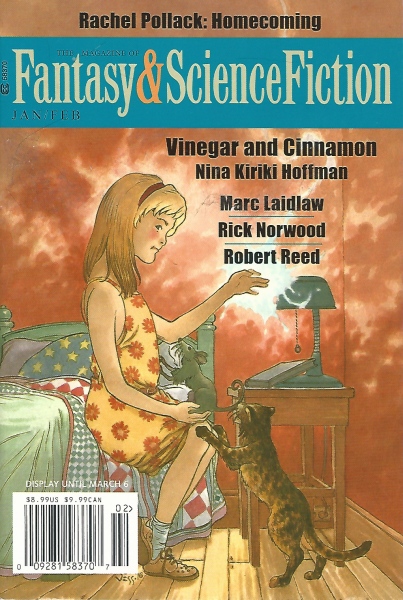
(Cover by Charles Vess. F&SF, Jan-Feb 2017.) Who Goes There?
Rich Larson is probably the youngest author I’ve covered on this site; he’s only a few years older than me, but he’s been mighty busy for the past decade and change, mostly in the realm of short fiction. His debut back in the early 2010s coincided with the proliferation of online magazines, in a boom for the market not seen since the ’50s. (Ironically today’s story appeared in one of the old guard.) While he has not yet garnered a Hugo or Nebula nomination it’s only a matter of time before his work is given major awards recognition, as he has made first in the Asimov’s readers’ poll multiple times and has been featured in multiple best-of-the-year anthologies. His 2015 story “Ice” was adapted into a Love, Death + Robots episode, and his most recent novel, Ymir, came out in 2022. By Larson’s own admission much of his fiction can be considered a continuation of cyberpunk, with some transhumanist elements. “There Used to Be Olive Trees” is a coming-of-age narrative set in the far future, on an Earth that seems to be recovering from a worldwide catastrophe; and while it isn’t cyberpunk exactly it does have one or two elements of that subgenre.
Placing Coordinates
First published in the January-February 2017 issue of The Magazine of Fantasy and Science Fiction, which is not available online. If you want a copy you’ll have to hunt for a used copy or take your chances with F&SF‘s website. It’s been reprinted in The Year’s Best Science Fiction: Thirty-Fifth Annual Collection (ed. Gardner Dozois) and Wilde Stories 2018: The Year’s Best Gay Speculative Fiction (ed. Steve Berman).
Enhancing Image
Valentin is 16 years old and is one of the lucky few in “the Town” to have been fitted with an implant, or “godchip,” on his forehead, which should allow him to make contact with the Town’s “machine god.” The problem is that for those with implants there’s a test, or “prueba,” a kind of rite of passage one’s expected to pass with the first or second try; for Valentin he’s on his fourth attempt, which is unheard of. For reasons totally beyond him he’s been unable to talk with the Town’s god, and so he’s been sent out into the wilderness again, with just some provisions and most usefully his “nanoshadow,” a skin suit that will help him with the harsh climate. This sounds like a lot of setup for a story that will ultimately involve only two characters, more or less, plus a character (Javier, Valentin’s overseer) who is mentioned but remains offscreen, and it does seem a bit frontloaded! This is a solid novelette and it feels both simple and a little overly complicated, since once we meet the second main character the narrative turns into a Jack London-esque surviving-in-the-wilderness tale with technology playing a peripheral role. Soon after leaving the Town, Valentin meets a “wilder,” one of those people who lives outside what remains of civilization, a fellow teen boy named Pepe. The two don’t get along at first, which is understandable since Valentin’s implant and equipment make him a juicy target for wilders more vicious than Pepe.
Minding that Larson would’ve only been 23 or 24 when he wrote this, it’s a fine job that has enough meat on its bones to imply a larger world. I said Larson is a cyberpunk fan, and there are a few cues taken from that subgenre here, despite it falling much more into post-apocalyptic SF. The nanoshadow, which Valentin is unable to use for most of the story, would very much fit in with a cyberpunk narrative—the big difference being that the dystopian cityscape that would normally be host to cyberpunk is mostly no more. The Spain of the story has long since been ruined, and even in the wilderness there isn’t a lot that could sustain human life. Understandably, for someone who has spent his whole life in what amounts to a bubble, Valentin takes a fascination to Pepe, and this fascination might well be reciprocated. I’m not counting it as a spoiler, because something doesn’t sit right with me when it comes to treating characters’ sexualities as plot revelations, so I’ll say here that the reluctant friendship formed between Valentin and Pepe burns slowly into something romantic—or maybe just sexual. It’s hard to say. Our insights into Valentin’s mind tell us he finds Pepe very much attractive, but it’s never elaborated on if this has to do with Pepe’s looks or if it’s merely the fact that he’s interacting with someone around his own age who doesn’t see him as just a “prophet” in training. The queerness is shown but not discussed at all, and I’m not sure how to feel about this. Maybe taboos regarding homosexuality have become a non-issue now that the world has basically ended. Values change with time and circumstances. It’s not a bad depiction of queerness, but I wish there was more to it.
The plot borders on nonexistent, but we do have goals for both of the main characters which happen to intertwine. Valentin has to go to what is called the autofab, to speak with the god of the Town, and Pepe also wants to go to the autofab—only not for the same reason. At some point in the past humanity invented truly sentient AI, and these AI personalities may have become too powerful, to the point where they can interfere with the material world with a mere thought—or, in the case of Valentin and other prophets, with a bit of coaxing. Knowledge of how these AIs came about seems relegated to the Town and other strongholds of civilization, although interestingly I don’t recall us getting an explanation of how Earth came to be ruined and if the AIs had something to do with it. This story was written a few years before “AI” (machine learning) became a hot-button issue, so I have to wonder if Larson would’ve gone about the AI things if he had written this more recently. It makes sense that a humanity that’s mostly been thrown back to barbarism would see AIs as gods, but as with the relationship between Valentin and Pepe this idea feels underdeveloped. I’ve read that when it comes to first drafts Larson likes to write the whole thing in one long sitting, which admittedly is how I tend to go about my own writing (he who casts the first stone yadda yadda), but “There Used to Be Olive Trees” reads like it could’ve been polished more.
There Be Spoilers Here
When we do finally meet the “god” in the autofab, it comes off as sort of an anti-climax. The world opens up at the end a bit, but aside from Valentin’s own personal uncertainty as a prophet the story doesn’t end so much as it comes to a sudden halt. His relationship with Pepe goes unresolved, and the phrasing at the very end implies the possibility of a sequel, although as far as I can tell Larson never wrote one.
A Step Farther Out
“There Used to Be Olive Trees” is a robust and somewhat queer story that doesn’t have any glaring problems, but conversely it’s the kind of story I would consider unexceptional. It doesn’t help that while the title implies climate catastrophe and it’s something that clearly lingers in the background of the narrative, climate change is not really a topic that comes up for the characters, nor does the desolation of the setting seem to have much weight on their minds. Similarly the relationship between Valentin and Pepe is allowed to develop, but only up to a point, and I do have to wonder if the story’s queerness, or rather it’s playing with gender, could’ve been much expanded on, for the characters’ sakes but also to tie their budding relationship more into the plot. It’s a functional story that ultimately falls short an inch or two of its potential.
See you next time.
-
Short Story Review: “The Year Without Sunshine” by Naomi Kritzer
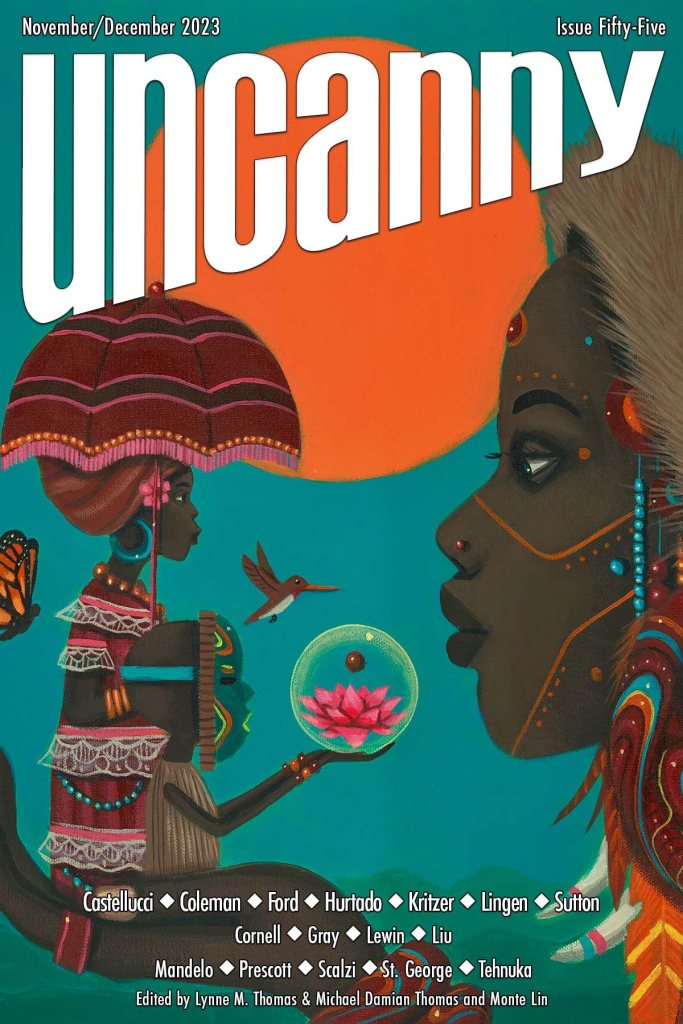
(Cover by Paul Lewin. Uncanny, Nov-Dec 2023.) Who Goes There?
Naomi Kritzer debuted at the tail end of the ’90s, and for a while seemed to fly under the radar; but in the 2010s her career saw a rise to prominence the likes of which is unusual for someone who had been in the game for a hot minute. She won a Hugo for her 2015 story “Cat Pictures Please,” one of the defining SF short stories of the 2010s in my opinion, and in the past decade she’s enriched the field with a keen understanding of human communities, sociology, and psychology. Her fiction can often read as only nominally SF in the sense that the world depicted is mostly the one we now recognize, only then changed by a single but major factor; conversely you could argue the grounded nature of much of her fiction, the plausibly speculative nature of it, would make it very definitively SFnal. “The Year Without Sunshine,” which won the Nebula for Best Novelette earlier this year and more recently the Hugo for the same category, is an example of such SF, to the point where the SFnal element of the story is not immediately apparent. This is a dark but also quite hopeful depiction of a future which is not far off at all—not tomorrow, but maybe next year.
Placing Coordinates
First published in the November-December 2023 issue of Uncanny Magazine, which you can read here. Since it’s such a recent story it has not been reprinted anywhere so far.
Enhancing Image
The problem firstly is that the sun seems to have been blocked out by a perpetual cloud; how far-reaching this environmental change is and what even caused it remain unclear. The secondary problem is that power’s gone out—not for a few hours or days but for weeks at a time. We’ve all gone through power outages, but most of us don’t know what it’s like to be without electricity and internet for long enough that more “primitive” methods of communication and sustaining power become necessary in a life-or-death sense. Alexis, the narrator, is not in any immediate danger, although getting in touch with her neighbors makes her realize that one or two people in her neighborhood need electricity to survive. One older couple, Clifford and Susan, live with the latter hooked up to oxygen, Susan suffering from emphysema. Clifford had bought a small generator for Susan’s oxygen concentrator, but once that generator runs out of fuel Susan’s probably not gonna live much longer. Thus the plot hinges on Alexis and other neighbors coming together to find some way for Susan to stay on oxygen, in a society without power, connection to the outside world, and even with the government rationing medicine such that anything deemed less than absolutely essential becomes a rarity. This is a simple plot, if you think about it, but Kritzer makes it work.
The very beginning of the story almost reads like a red herring, with the action taking place in Minneapolis, in circumstances that almost (but not quite) read like what people in that city had to go through back in 2020, between COVID lockdown and the George Floyd protests. Indeed I’m convinced Kritzer could not have written “The Year Without Sunshine” any earlier than the end of 2020, and in that sense this is a story that very much feels of its time—up to a point. Of course it turns out the pickle Alexis and company find themselves in is a bit more severe and all-encompassing than a virus; incidentally COVID is alluded to at the beginning, but I don’t recall it being mentioned by name. After the power and internet go out for long enough one of Alexis’s neighbors, Tanesha, sets up a “WHATSUP” booth, where people can leave notes for each other, but also trade items and services, “coffee for condoms, cat food for diapers, a bike repair for a plumbing repair.” Because it turns out everyone has something of value to someone else, and everyone has at least one skill that would make them valuable to a community. Ostensibly this is a story about climate disaster, but it gradually reveals itself to be about building community; to some extent it reminds me of Stephen King’s The Mist, but I’m gonna go out on a limb and say Kritzer has a lot more faith in organizing and direct action than King does. Should note that “The Year Without Sunshine” might be the most overtly left-leaning story I’ve covered here in a minute, which isn’t to say it’s preachy, but it does help if your politics are in the same general area as Kritzer’s. Good thing, I suppose, that her politics are similar to mine, at least if her fiction is anything to go on.
“The Year Without Sunshine” could’ve easily been thinly disguised theory-as-narrative, but Kritzer trusts us to understand what she’s going for with how her characters interact with each other and how they try to make things work in a world that seems on the verge of ending. Granted that Alexis has an “eat the rich” shirt (which, in a humorous moment, she reflects that she shouldn’t be wearing casually in a city where there are trigger-happy right-wingers), it’s not hard to figure out that Our Heroine™ is somewhere on the left; but she spends very little time theorizing and much more on trying to find a practical solution to a practical problem. We see how society has broken down somewhat after the sun and internet have gone out, and how the implicit divide between the city proper and the suburbs have become more stark. I say this as someone who’s spent pretty much his whole life in the suburbs, so I can be self-deprecating about it, but let’s say suburbanites don’t come off well in this story. There’s a haunting scene where Alexis and company venture out to the edge of the suburbs, in search of resources, and they don’t like what they find:
The roads were quiet—mostly bikes and walkers, a few city buses. Everyone, including us, had parked cars sideways to block the streets leading into their neighborhoods, then left them there, then had the gasoline salvaged or looted out of them so the cars definitely weren’t going anywhere. Traffic on the roads picked up when we got to the edge of the suburbs, even though all the gas stations were still closed. Also, in addition to the car barricades, we saw something hanging from the streetlight that for a second I thought was a body. It wasn’t a body: it was a mannequin, though, so it was definitely supposed to look like a body. It had a sign around its plastic neck saying LOOTER.
Quite a few people are willing to band together, even just to help one of their own—but evidently not everyone. “The Year Without Sunshine” doesn’t have a “villain,” properly speaking, but the good guys find themselves stuck between two antagonistic forces, first the government and then those in the community who see themselves as better than their neighbors—the social Darwinists who think property matters more than human life. We all know those people. I’m sure it’s a coincidence, but I think it’s funny that such an overtly left-libertarian story would win a Hugo at a Worldcon held in Scotland. The government’s presence dissolves over the course of the story to the point where there doesn’t seem to be any law enforcement or oversight at the end, or at least such presence becomes more peripheral as the community becomes more of a proper commune—and pretty much all this happens in the service of helping one person with a severe disability. It’s also worth mentioning that while Susan’s disability serves as the crux of the conflict, she’s still very much allowed to exist as her own person, as opposed to a woe-is-me signal for the able-bodied characters—something which still happens too often in fiction. In a commune (and a commune should be the desired final outcome for leftists, mind you, with the state having dissolved or gone into exile), the more capable should look after the less capable, but even the less capable have ways of contributing.
There are debates, of course. People have started using bikes way more often, and you can even generate enough power for a small generator if you have enough people biking, like hamsters on wheels, but how would you convince people to do such a thing without pay? As Alexis finds out, it’s actually not that hard to convince several people to take shifts for such a thing if it means helping someone else materially. She thought some form of payment would be necessary (in a world where paper money was not basically worthless), “but it turned out to be exactly like ripping up yards to plant potatoes, people were willing to just do it.” A tougher question was how the commune would protect their resources, because nothing is free and resources have become more finite than before. Should they use lethal force to protect resources? Should the commune form its own militia? As nice as pacifism is as an ideal it’s not very practical, sad to say. Something has to give. I’m not totally convinced the commune in this story is realistically able to find a quasi-pacifist solution like it does here (basically using non-aggression as a foundation and refraining from using guns as a first resort), but it does feed into the story’s overall optimism about people working together, even in a borderline apocalyptic scenario. Science fiction historically has sorely been lacking in humanism, but that’s really a topic for another time, the point being that Kritzer’s brand of libertarianism or anarchism very much goes against the norm in American SF.
There Be Spoilers Here
I don’t wanna spoil this one much, as it’s so recent, but I will say that while the conflict does eventually escalate it doesn’t go in quite the direction you might assume. Safe to say Kritzer’s view of humanity is more optimistic than average, and also despite what the grimness of the story’s title would imply. Read it for yourself and see!
A Step Farther Out
I don’t like to review stories I deem too new; an unofficial rule here is I would prefer to wait at least a year after a story’s publication. “The Year Without Sunshine” is not quite a year old yet, so I’m making an exception with this. I’ll be honest and say that I don’t like to give in to recency bias, not to mention that with recent works by authors who are very much alive and active there’s an implicit urge to coddle the work in question, especially if you’re getting paid for your review. Well nobody’s fucking paying me. When I was catching up on stuff for this year’s Hugos, which I was voting for, I have to admit I wasn’t impressed with what would be Kritzer’s other Hugo-winning story this year, “Better Living Through Algorithms.” I thought it was fine, but nothing special. “The Year Without Sunshine” does, however, go to much farther lengths, being more thought-provoking but also tapping more into Kritzer’s trademark humanism. It barely counts as SF, depending on how you look at it, but for how it sums up what the 2020s have been like so far I think it’s essential reading.
See you next time.
-
Short Story Review: “Dusty Zebra” by Clifford D. Simak

(Cover by Ed Emshwiller. Galaxy, September 1954.) Who Goes There?
Clifford Simak had already been around for two decades when Galaxy premiered with the October 1950 issue, and this brave new magazine seemed to give the veteran writer’s career a second wind—or at the very least coincided with it. The ’50s would be a golden age for Simak (like with a lot of fellow genre writers), with the early ’50s alone seeing four novels from him (as opposed to just one in the previous twenty years combined), including his masterpiece City. Simak wrote a truly enormous amount of short fiction this decade, on top of the novels, and his outlet of choice was Galaxy. The reasons as to why Simak preferred Galaxy over the competition aren’t totally clear; it could be (I think I recall this) that he came to find John W. Campbell’s meddling to be too exhausting, although he still occasionally contributed to Astounding/Analog in the ’50s and ’60s. Simak has been sort of pigeonholed as a vaguely conservative writer, mostly due to his focusing on rural settings and peoples (that he’s a pastoralist can’t be denied), but a deeper reading of his fiction and reading the tragically few interviews we have with him show him to be a more complicated person. (We’re talking about someone who claimed to reread The Grapes of Wrath every year.) “Dusty Zebra” sounds at first like it might be a straightforward bartering-saves-the-day narrative, similar to Simak’s own “The Big Front Yard” (reviewed here), but it’s more of a humorous cautionary tale.
Also, I’m sorry that this is being posted later in the day than what would be ideal. My daily life has not been great.
Placing Coordinates
First published in the September 1954 issue of Galaxy Science Fiction, which is on the Archive. It has been reprinted in Alpha 9 (ed. Robert Silverberg) and the Simak collections The Worlds of Clifford Simak and Dusty Zebra and Other Stories.
Enhancing Image
Joe is a business-minded family man, whose son Bill happens to be even more business-minded (ripping off other schoolkids by trading junk for things with actual value), and one day while looking for stamps in his work desk he finds out something very odd: there’s a tiny dot on the desk, and if an object passes through it it goes—somewhere. Seemingly vanishes into thin air. And yet something takes its place. Joe puts random crap on the dot and gets back neat little gadgets, like a pen that also transforms into a fishing rod, and especially there’s the dust-collector, a kind of vacuum that sucks up dust and makes it disappear. Where does the dust go? Not sure. Joe encourages Bill’s schoolyard trading, so it makes sense that he would be interested in what turns out to be an trans-dimensional portal, the only problem then being that while Joe has business sense he doesn’t have technical sense; so in comes Lewis, the next door neighbor, who can explain the gadgetry and mechanics of the strange little dot. (Something you may notice about Simak is that a lot of the time his protagonists are not scientists at all, but they happen to be friends with someone who is scientifically minded and who can explain the SFnal elements of the story.) Before long Joe and Lewis form a business partnership around the trading, complete with a deliberately convoluted contract, and of course Joe tries to lessen Lewis’s share at every opportunity. Simak protagonists are often well-meaning, but they can also at times fall on the anti-hero end of the spectrum, which Joe very much is; not that he’s evil or anything, but he’s a capitalist at heart, maybe a little less human than the average Simak protagonist.
The recurring trade-off throughout the stories is that for some reason the person (called “the Trader”) on the other side of the portal really likes these cheap zebra bracelets that Joe happened to have, and in return for this seemingly useless trinket the humans get a dust-collector in return. The humans find that they can trade in the useless garbage for some pretty useful items, which can then be turned for a profit. We never do learn where the dot came from, who’s responsible for it, or even what the Trader looks like. This is all rather inexplicable, although there’s just enough scientific mumbo jumbo thrown in to keep this away from being fantasy. A lot of Simak’s stories can be thought of less as hard-nosed SF and more like machine fables, in which technology figures into the setting and moral of the story, but the actual plausibility of the tech is a distant second. The dot-as-portal is ridiculous, and also this seems like a very easy way to send over a deadly weapon, or an object that could carry diseases. If we’re to take the Trader as an alien, though, it makes sense that such a figure would be more or less benign in Simak’s book. I often think of Simak as an anti-Lovecraft figure, in that when Simak characters encounter the unknown it’s very rare for the unknown to pose a serious threat. Simak’s aliens, including the Trader, are often curious creatures who can be reasoned with on some level, such as, for instance, bartering being the common ground between humanity and the aliens in “The Big Front Yard.” I assumed “Dusty Zebra” would be a similarly straightforward first-contact story in which bartering is shown as a force for good; and while the bartering itself turns out to be fine, the get-rich-quick scheme Joe and Lewis concoct will have consequences neither of them would’ve wanted or expected.
So about the zebra bracelets. How do the humans and the Trader, well, trade? How do they understand each other? Short answer is, they don’t—at least not beyond a picture book language that even a toddler can understand; but this rudimentary language turns out to be just enough. Joe and company get the bright idea to use one of Bill’s picture books (one showing items as standing in for letters of the alphabet, so A is for apple, etc.) to show the Trader what they have for inventory, and the Trader sends the book back with the desired item marked. One problem: they forgot (or didn’t notice) that the item on the Z page is a zebra—and the Trader wants one of those. Now you may be thinking, that’s a whole-ass animal. Where you would even get one for sale? But as Joe says, after taking some “advice” from Bill, “[The Trader] doesn’t know a zebra is an animal, or, if he does, how big it is!” This is of course an example of ripping someone in a deal off, but as Joe rationalizes, if the Trader can’t tell the difference then what harm is being done? “If the Trader had any qualms about what was happening, he gave no sign of it. He seemed perfectly happy to send us dust collectors so long as we sent him zebras.” This is a partnership that seems to be working, for now. A certain question does linger, though: Where does all the dust that the dust-collectors pick up go? Conceivably it has to go somewhere, and the Trader doesn’t seem to be getting the dust back…
There Be Spoilers Here
Our Anti-Heroes™ have been making a killing on the gadgets, only the problem is that they can’t figure out how to reverse engineer them so as to manufacture them themselves. To really make a killing on the dust-collectors you would need at least a few thousand, but how would you get them? The Trader apparently wants more zebra bracelet charms in exchange for the dust-collectors, and those charms have since been discontinued. In what is admittedly a far-fetched turn of events Joe (this is after making a great deal of money) is able to make a deal with the charm manufacturer, and soon enough the house gets filled with literally thousands of the damn things. The good news is that they get more dust-collectors! In fact too many of them. So, there seems to be a third party in this, or so Joe suspects: clearly the dust must be going somewhere, and in the last stretch of the story it all comes back—pounds of the stuff across multiple households. Joe’s house alone gets filled with dust that seems to have come from another dimension, but maybe not the Trader’s. Then the dot vanishes. We never do find out why the Trader cuts off communication or what he could be doing with all those zebra charms. Maybe he (or they) realized he had gotten ripped off and decided some payback was needed. Or maybe there’s another dimension all the dust goes to and they didn’t like that very much. Point being that a combination of lawsuits and being unable to replicate the gadgets brings Joe and company pretty much back to square one by the end. I like how there’s some mystery retained with the Trader by the end, so that not only did the humans pay for their profit-seeking but that they’re also left wondering what could be going on in those other dimensions.
A Step Farther Out
In a way this is minor Simak, in that it doesn’t take itself very seriously. It’s also not very SFnal, indeed bordering on fantasy—possibly even cosmic horror. Or rather cosmic humor. It’s a story about some entertaining if also unlikable people who think they can get something with minimal effort and reap the benefits. Had this been a Henry Kuttner or C. M. Kornbluth story the ending would’ve been much more unforgiving towards the humans, but ultimately it was written to be in good fun. Simak is not dead-serious that often, but just because he tends to be on the lighthearted (or at least forgiving) side doesn’t mean he can’t make a solid point. I actually think we still don’t give him enough credit.
See you next time.
-
Novella Review: “Surfacing” by Walter Jon Williams
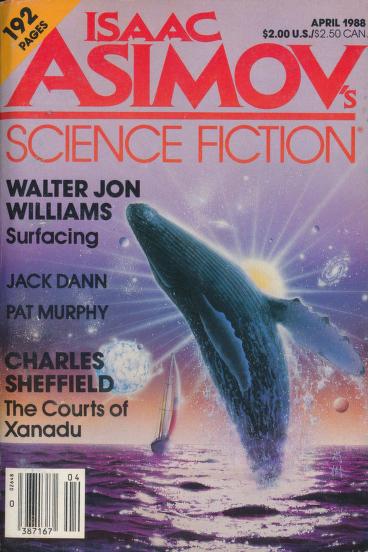
(Cover by Hisaki Yasuda. Asimov’s, April 1988.) Who Goes There?
Walter Jon Williams made his debut at the start of the ’80s, and unlike most writers he began as a novelist before moving into short stories. He was already in his thirties when he sold his first short story, but the good news is that he was so adept at it from the outset that by the end of the ’80s he had emerged as one of the field’s major talents at short lengths. I especially recommend his 1987 story “Dinosaurs,” which is not about dinosaurs at all, but rather a far-future humanity that’s become so alien from us that they may as well be a different race. His affiliation with the cyberpunk movement (which coincided with his own emergence) gives one the impression he couldn’t have come about earlier than the ’80s, although Williams is not purely a cyberpunk writer. Williams’s writing is elegant and yet moody enough that it makes sense he would’ve written a distant sequel to a Roger Zelazny story, Williams’s “Elegy for Angels and Dogs” being a sequel to Zelazny’s classic “The Graveyard Heart.” “Surfacing” is itself a moody and rather dense novella, about alien contact, language, mental illness, and a future humanity that seems on its way to conquering the stars. It also has whales, and who can say no to that?
Placing Coordinates
First published in the April 1988 issue of Asimov’s Science Fiction, which is on the Archive. It was reprinted in The Year’s Best Science Fiction: Sixth Annual Collection (ed. Gardner Dozois), The Mammoth Book of Modern Science Fiction: Short Novels of the 1980s (ed. Isaac Asimov, Martin H. Greenberg, and Charles G. Waugh), The Best of the Best Volume 2: 20 Years of the Year’s Best Short Science Fiction Novels (ed. Gardner Dozois), and The Best of Walter Jon Williams.
Enhancing Image
Anthony is a 26-year-old scientist on some far-off planet, although he’s not along, for he’s brought humpback whales as translators of a sort—or as middle men. These whales, one of whom is named Two Notches (actually his name is longer than that, but let’s keep it simple), were imported to this planet, but have adapted to it splendidly. Anthony has very few in the way of humanoid friends, but he gets along with the humpbacks, even having a translation system via computer that allows him to talk to them; turns out the whales have a name for Anthony as well, “He Who Has Brought Us to the Sea of Rich Strangeness.” The real reason Anthony is here, though, is to study the Deep Dwellers, and possibly even to see one in its entirety. The Dwellers are like the giant squid on Earth: a truly massive marine animal that was once thought to be merely legend, but whose existence has been scientifically proven as of late. The problem is that nobody is totally sure what a Dweller looks like, only having parts of dead Dwellers to go on. The Dweller, so it’s suspected, is whale-like, but also with tentacles—and larger than even the blue whale. Thus the humpbacks are the closest the Dwellers would have to relatives (however distant) that can also communicate with humans. Anthony doesn’t mind the solitude of being on a boat by himself all day, not being much of a fan of other people.
Can you tell this was written in the years following the sudden popularity of whales? Incidentally the Roger Payne album Songs of the Humpback Whale (sold over a hundred thousand copies despite literally being whale noises) coincided with the hippie movement right before it went into decline, with “Save the Whales” becoming one of the big movements of the ’70s. Read some disco-era SF and notice how suddenly people give a fuck about whales. It’s a bit weird, with hindsight. Otherwise this story doesn’t show its age at all, and even then, why complain about a planetary SF adventure where whales are on the side of the good guys? Anthony himself is less appealing. On the one hand it makes sense someone who spends hours of his day, every day, with animals would be a bit misanthropic. (Meet any veterinarian and there’s a good chance they’re pessimistic enough about the human condition to make Mark Twain blush.) I can also see how Gardner Dozois, the editor of Asimov’s at the time, would’ve latched onto “Surfacing” enough to reprint it twice, as Anthony is a very Dozois-like protagonist. I do think that because Anthony is such a downer, a moodiness that infects the rest of the story, the downbeat nature of the story now reads as a bit been-there-done-that. I don’t think we, in [CURRENT YEAR], have yet properly reckoned with the fact that Dozois is the most influential SF editor of the past forty years, and that the reason why so much short SF is downbeat (to the point of tedium) is like that is at least partly because of his influence. My point is that I can tell you I would’ve liked “Surfacing” more in 1988.
At the beginning of the story we get a newsfeed of a famous Kyklops, named Telamon, making a tour of the planet. The Kyklops are basically a race of energy beings, like of many such races found in the Star Trek universe; they lack solid bodies of their own, instead using the bodies of others like puppets, including humans. This is important to keep in mind for later, although given how quickly this little scene comes and goes it’s easy to forget about its importance. Maybe this was by design, but I do wish the Kyklops were set up better so that them becoming relevant to the plot much later feels less random, since the first time we see them it comes off as insignificant and the reader is likely to forget.
While Anthony is easily the main character, and the setting rather desolate, this is not a one-man show—more like a two-people show. Anthony meets Philana, who despite being only 21 (this is especially conspicuous in a world where, for reasons I don’t recall being given, humans can now live centuries at a time) has own her yacht, which she uses to talk to the whales as well—particularly the females, which it turns out is a special skill. Anthony can talk to males and Philana the females. Each has what the other lacks. By the way, I said that aside from the timely fixation on whales this story doesn’t show its age, but that’s not entirely true.
Get a load of this:
It was harder to talk with the females; although they were curious and playful, they weren’t vocal like the bulls; their language was deeper, briefer, more personal. They made no songs. It was almost as if, solely in the realm of speech, the cows were autistic. Their psychology was different and complicated, and Anthony had had little success in establishing any lasting communication. The cows, he had realized, were speaking a second tongue: the humpbacks were essentially bilingual, and Anthony had only learned one of their languages.
No comment needed.
Okay, there’s a lot to unpack with that one passage, but let’s not.
I said before that Williams’s writing can at times come off as Zelazny-esque, and “Surfacing” has a relatively subtle example of this with the budding relationship between Anthony and Philana, the brooding young man with the spritely young woman, with allusions to mythology (locals call the Dwellers Leviathans) that you’d expect from Zelazny; yet there’s something to be said for how capable Philana is, despite her age. Of course, it turns out that Philana’s skills and her apparent wealth have a catch, or rather came at a hefty price. More on that later. “Surfacing” is at one point a love story, and also about trying to make contact with an alien species—possibly even more than one. Anthony has a direct line to the humpbacks but unfortunately the same can’t be said for the Dwellers, whose language is much trickier. A neat thing Williams does here is he shows us lines from the Dwellers that are basically dialogue trees, with branching paths and ambiguities with what words could mean. The Dwellers also have an issue with pronouns, not because of gender but because they have this problem with subjectivity. It would’ve been a pain in the ass to print, not to mention these dialogue trees take up a lot of space on the page, so I can see why Williams only does them a handful of times. Still, it’s neat. It helps that we get to know little about the Dwellers until the very end.
I’m getting ahead of myself.
There Be Spoilers Here
Philana is a puppet for Telamon, that Kyklops mentioned earlier, which comes to Anthony as a real shock considering the first time he sees Telamon take over Philana’s body the two are having sex, and Anthony isn’t sure why Philana starts acting very strangely—and violently. Telamon is “a decadent,” as Philana puts it, which is to say he’s a bit of a sadist and pervert. He does things often out of boredom. Telamon becomes the closest the story has to a villain, although he doesn’t really enter the plot until the back half. The thing about the Kyklops is that they’re energy beings, but they’re also basically immortal, and unspeakably old. Telamon (or Jockstrap as Anthony takes to calling him) is so much older than his human host that the gap is all but unfathomable. So you have a dirty old man who can’t be killed through conventional means and who can also teleport matter at will, sending the pesky Anthony anywhere he likes—indeed he can kill Anthony with a mere thought. Obviously this is a losing battle; aside from dishing out some snark there’s very little Anthony can do. To make matters worse, Telamon can take over Philana’s body whenever he likes, and the best Anthony can hope for is to look for the signs. There are at least a couple ways of looking at Philana and Telamon’s relationship. We can understand Philana as, metaphorically anyway, someone living with mental illness, more specifically a personality disorder that gives her blackouts when Telamon’s in control; for better or worse she doesn’t remember these episodes. Telamon can also be thought of as like Philana’s abusive sugar daddy, since he does provide for her, at what many would consider too hefty a price.
So Anthony can’t beat Telamon directly, fine; but he can outmatch his rival in a way that has to do with what he loves doing most. I was rather confused at first by this story’s open-ended climax, since it’s not clear what we’re meant to take away from Anthony contacting the Dweller he’s been studying and coaxing it into rising to the surface—a maneuver that may or may not kill the damn thing, never mind Anthony and Philana. We already figured Dwellers were massive, but this turned out to be something else, with the Dweller being host to a variety of deep-sea organisms. “The Dweller was so big, Anthony saw, it constituted an entire ecosystem.” As frightened as they are astounded, Our Heroes™ make contact with a creature whose entirety no one had ever seen before. What happens after this point is totally unclear. Maybe Telamon will give up Philana, on account of Anthony proving himself an exceptional scientist, doing something Telamon himself never could. The plotline with Anthony studying the Dwellers gets resolved satisfactorily, but the same can’t be said for the “love triangle” (if you really wanna call it that), which perhaps deliberately is left hanging.
A Step Farther Out
Occasionally you’ll get an SF story about the ocean, but Williams is one of the few writers I’ve seen to tackle the inherent alienness of the high seas. There’s a dash of Moby-Dick in there (as there should be with any oceanic narrative written after 1920), but Williams combines a high-seas adventure (with WHAAAAALES) with psychology such that ultimately this is not a story that would be possible without a few SFnal elements. I’ve had a few days to think about it, and I’d say it’s worth a look if you’re up for summerly reading—while we still have a month of summer left.
See you next time.
-
The Observatory: So Godzilla Minus One Wasn’t Nominated at the Hugos, I’m Totally Not Bitter About This Information

(From Godzilla Minus One/Minus Color, 2024.) So the Hugos just happened. If you have the time and money you can see these things in-person for yourself, like the relatively lucky few who got to fly out to Glasgow this year. There are other awards given at Worldcon that are not Hugos despite being given at the same ceremony, namely the Astounding Award and the Lodestar. I’ve done a piece or two on the Hugos before, and while this is by no means an awards-oriented blog, the Hugos are inherently interesting if you’re into fandom because they give an impression as to what fellow genre enthuiasts are digging at the moment. The Hugo winners and nominees of each year serve as time capsules of a sort, since tastes change over time and there are circumstances behind each Worldcon that might influence who gets the phallic trophy and who misses the final ballot by a single vote. Speaking of which, I had a supporting membership for this year’s Worldcon, so I got to vote! One of the movies for the Best Dramatic Pressentation (Long Form) Hugo I nominated was Godzilla Minus One, one of my favorite movies from last year, and which made history by winning the Oscar for Best Visual Effects earlier this year. The film opened theatrically in the US back in December, and while it was originally supposed to have a very limited theatrical run here, reception was so strong that it ended up getting decent coverage. Yet, at least for the Hugos, this turned out to not be enough, as it missed the final ballot by one vote.
Not that I expected Godzilla Minus One to win, but the fact that it missed the final ballot in favor of *checks notes* Nimona? and The Wandering Earth II? I thought Nimona was… fine. I watched The Wandering Earth and thought it was terrible, and got about ten minutes into its sequel before realizing I wouldn’t survive it. Was not a fan of Barbie, which I know is a hot take. Spider-Man: Across the Spider-Verse is objectively a masterpiece of animation, but the bad PR surrounding it following its release meant it was an unlikely choice (I do suspect said bad PR contributed to it not winning the Oscar for Best Animated Feature, on top of one of the directors not being nominated due to some asinine rule about how many people on a film can be nominated in that category). I loved Poor Things, but while it was an awards darling it’s a little too niche—and not niche in such a way that would cater to Hugo voters. Then there’s the winner, Dungeons & Dragons: Honor Among Thieves, which I liked a good deal more than I expected to! I think I put it second or third on my slate, but I would say of the nominated films this might’ve been the most respectable choice. (I also put Oppenheimer on my slate, although I always knew that was a long shot since it’s not a genre movie but rather a movie partly about the sciences.) I expected Barbie to win and to have myself promptly groan at its winning, but then I remembered there’s a vocal minority of people who think it severely overrated. Barbie winning as many Oscars as Godzilla Minus One (the former underperformed while the latter was an underdog) should’ve been a winning sign. Again, missed the final ballot by a single vote!
Something about the Hugos and Worldcon generally is that this is supposed to be an international affair, which is why Worldcon is held in different countries (although next year’s Worldcon and the one after that are both gonna happen in the US, so…), with just last year’s Worldcon happening in China. The problem is that while there have been concerted efforts to avoid this, Worldcon is still very Anglocentric—only now it seems to be split between the Anglosphere and China. The Wandering Earth II certainly only made the final ballot becaue of Chinese backing (the quality of the film really doesn’t indicate it as awards-worthy), which is a shame because unless I’m forgetting something it would be only the fourth or fifth non-English movie to get nominated for Best Dramatic Presentation since the Long Form subcategory was introduced in 2003. The way it works is that Short Form is basically reserved for episodes of TV (on paper it’s for media under an hour long) while Long Form is for feature films and whole seasons of TV (with like one or two exceptions if you go digging around). Now, I see a big problem with movies competing with TV seasons, since we’re having to compares, say, a two-hour movie with eight hours of TV, but that’s not really what I’m here to talk about today. Thing is, like I said, out of the dozens of movies nominated for Best Dramatic Presentation (Long Form), only a handful were made outside the Anglosphere, and only one managed to win, which was Pan’s Labyrinth back in 2007. Pan’s Labyrinth was such a titan of a movie, a critical darling that got mainstream recognition at the time, to the point where it was kind of a breakthrough moment for Mexican cinema on the international stage. It was that extremely rare non-English movie to have sway with English-speaking veiwers; in other words, it’s the exception that proves the rule.
Godzilla Minus One got quite a bit of mainstream attention in the Anglosphere, although not enough to tip the scales such that it was able to get nominated, while The Wandering Earth II got in through a concerted effort from a section of fandom. Fandom politics! Don’t you love it? Of course the question becomes, “Why should a movie have to get enough exposure in the Anglosphere to get attention at the Hugos? Isn’t this whole thing supposed to ignore national barriers?” Sure, but statistically we know that to not be the case. The past decade has also seen a kind of snowball effect with Chinese SF fandom such that the Chinese portion has almost as much sway now as voters from the US. You could say this is better than nothing, but it also threatens to form a divide rather than collaboration between people from opposite ends of the world. The numerous issues around the Chengdu Worldcon don’t help, but I don’t even feel like getting into that; if I went into what went wrong we would be here all day. The point is that while the people in charge have been trying to make Worldcon more inclusive and international with each year (a good thing), some wrinkles still need to be ironed out, and there are some limitations I fear we don’t have a solution to, namely the fact that if a movie isn’t in English and isn’t readily available in North America before the voting deadlines, you’re shit out of luck. If we were to list genre movies from abroad that should’ve been shoe-ins for at least a nomination, but didn’t make it because not enough people in the Anglosphere would’ve even known about them at the time, the list would be almost infinite. Instead we have something like Wonder Woman (2017), which wasn’t even worthy of a nomination, let alone winning. Does anyone know if The Old Guard is any good?
Yet even if we were to knock down country and language barriers, there’s still the question of capitalism. If you didn’t catch Godzilla Minus One during its ssomewhat brief theatrical run in the US you then had to wait for VOD or streaming. A big reason I suspect Nimona made the final ballot was because, yes, enough people liked it, but it’s also a Netflix original. Availability was never an issue. In fairness, Godzilla Minus One is more readily available than most international films, and while we’re on the topic of Netflix, you can watch it as well as the Minus Color version there, the standard version having been added to Netflix in June—a few months after the nominating period for this year’s Hugos had ended. This is bullshit! I even wrote a quasi-review for this movie back in December, as a way to promote it to fellow fans since it was still in theaters at the time. Clearly this was not enough. This movie became enough of a dark horse in the months between its theatrical run and the Oscars to take home an award, but Hugo voters did not quite get behind it enough. Do we have ourselves to blame for this? Have we gotten to the point where even if a movie gets a decent theatrical run it’s still kneecapped if it doesn’t have enough of a theatrical run or if it doesn’t land on streaming soon enough? Dungeons & Dragons: Honor Among Thieves released way back in March 2023, and while its box office numbers were ehhh, it did get good reviews and audience word-of-mouth was promising; perhaps more importantly it landed on streaming by the end of May, and even now it’s pretty easy to find. Honor Among Thieves had a whole year to amass a cult following, such that it was able to make the final ballot and finally to win the Hugo, and it’s a worthy winner!
You could say I’m peeved that arguably the best entry in a long-running film series since the first installment was denied an honor, and you’d be right. Godzilla Minus One came to those of us lucky enough to see as something of a revelation, masterfully towing the line between moral allegory, historical melodrama, and yes, a giant monster spectacle. Even as a long-time Godzilla fan I was stunned by what this movie managed to accomplish, and lemme tell you I was fucking stoked when it took home that Oscar. A somewhat niche but passionate sect of genre fandom felt vindicated that night. Incidentally Godzilla Minus One is the only non-English film to win the Oscar for Best Visual Effects, in the 80+ years this category has existed. Again, I’m sure it wouldn’t have won, but it would’ve been nice if it had joined the very small group of non-English films to be recognized at the Hugos with a nomination. As Worldcon becomes more worldly (aha) we may see fewer egregious snubs like this in the future—so I hope.
-
Short Story Review: “The Evening and the Morning and the Night” by Octavia E. Butler

(Cover by Stanislaw Fernandes. Omni, May 1987.) Who Goes There?
Some authors are reborn posthumoussly, in that their reputations get a shot of adrenaline following their deaths, but Octavia E. Butler’s story is a bit more complicated than that since she was already a respected writer—at least within the field. Butler was one of literally a handful of black American writers to be writing SF in the ’70s and ’80s, and as Butler hersself admitted the barrier to entry was so high for those of her race that the few black writers to “make it” in the field at the time sort of had to be very talented. Butler is most known for her novels, which she actually wrote more of than short stories (she also loved sequels, which is unfortunate since she didn’t live to write some of them), although this didn’t stop her from winning back-to-back Hugos for her short fiction. It was in the years following her death, though, that Butler has become reevaluated as one of the very best writers in modern SF, to the point where she recently got a Library of America volume. (Basically if you get an LOA volume you are, at the very least, canonical so far as stuffy academics are concerned.) In fairness, while it’s easy to see Butler’s recent ascension to mainstream literary godhood as (like with Ursula K. Le Guin, sad to say) a bit overblown, she was quite a good writer. Case in point, today’s story, which after the Ballard story I reviewed a few days ago stands in the running as one of the bleakest SF stories of all time. “The Evening and the Morning and the Night” is brutal.
Placing Coordinates
First published in the May 1987 issue of Omni. Honestly this is the worst way you can read this story, because Omni is physically quite hard to read. It was then reprinted in The Year’s Best Science Fiction: Fifth Annual Collection (ed. Gardner Dozois), Omni Visions One (ed. Ellen Datlow), The Penguin Book of Modern Fantasy by Women (ed. Richard Glyn Jones and A. Susan Williams), Dark Matter: A Century of Speculative Fiction from the African Diaspora (ed. Sheree Renée Thomas), and of course it’s in Bloodchild and Other Stories.
Enhancing Image
This story is nominally SF, and I say that because it’s only SF on account of the disease at the heart of it being of Butler’s own creation. In the near-future, an experimental drug called Hedeonco, “the magic bullet, the cure for a large percentage of the world’s cancer and a number of serious viral diseases,” has a horrific side effect called Duryea-Gode disease, which is hereditary and degenerative. People with DGD rarely make it past the age of forty. Lynn, the protagonist, has DGD on account of having inherited it from both of her parents; and things only get worse when her father brutally kills her mother in a murder-suicide. People with DGD are defined by a physical and mental decline, but also the preculiar symptom of having a inclination for self-mutilation. In the afterword to this story (which you can find in Bloodchild and Other Stories, not the Omni printing), Butler says she was interested in the idea of a disease which makes you feel like a stranger in your own body, or a disease which makes you feel like your body is a prison. She lists a few real-life diseases as inspiration for DGD, including Huntington’s disease, although curiously she does not mention HIV or AIDS. Maybe it goes without saying, considering Butler would’ve written this story in the wake of the public announcement of HIV/AIDS, after the Reagan administration had deliberately kept it secret for four years. (Reminder that being pro-Reagan makes you at least passively supportive of homophobic policies.) AIDS and queerness don’t come up in Butler’s story, but it’s hard to not read into the subtext of how DGD people are treated, even being made to wear emblems that designate them as having DGD (for social but also medical reasons), like they’re lepers.
Lynn is of college age and knows she has maybe twenty more years before she probably kills herself in a gory fashion, which doesn’t mean she can’t contribute meaningfully to the world. After the deaths of her parents she gets sent to Dilg, an institute run by and for DGDs, a hospital and research institute rolled into one. There she meets Alan Chi, whom she takes a liking to, being someone who also inherited DGD from both his parents. “I thought Chi was a Chinese name, and I wondered. But he told me his father was Nigerian and that in Ibo the word meant a kind of guardian angel or personal God.” Symbolism much? Jokes aside, Lynn and Alan do find comfort in each other, having been excluded from normal society and being left with a disease that predestines them for short and very painful lives. The people at Dilg range from fully functioning researchers, or “elder” DGDs who have managed (so far) to retain their mental faculties, to patients who have quite literally gouged their own eyes out, as happens to be the case with Alan’s mother. One of the elders Lynn and Alan meet is Beatrice, a woman Lynn suspects is about sixty, which (we’re told) is very old indeed for someone with DGD, yet Beatrice seems like a normal person. There’s a reason for this, we’ll get to that in spoilers. It’s actually hard to sum up the plot since there isn’t much of one, despite this being a novelette; normally this would be a negative criticism, but while she doesn’t stuff her story with events, Butler more than makes up for it with character insight and a creepy fullness in how the world of the story is described. “The Evening and the Morning and the Night” is about disease and mental illness, but it’s also about control. There’s a tug-of-war going on between DGDs and the outside world, but also within the community DGDs have made for themselves. This is a truly speculative narrative about a made-up but perfectly plausible disease and its consequences.
Science fiction, I do think more than other genre, can be defined by it capacity to ask questions and pose hypotheticals. If we’re to judge the quality of SF by the questions it asks then “The Evening and the Morning and the Night” would be an all-timer, because Butler asks some genuinely disturbing questions and refuses to give easy answers. I said this is a story about disease, mental illness, and control, but it’s also about free will. The term “free will” is kinda loaded, because we know our capacity for “free will” is constrained by several factors, not the least of them being our own physiology. Butler basically asks, “Is the body really a prison? Is our capacity to act and even think determined by what our bodies will allow us?” Will DGD prevent Lynn and Alan from leading happy and fulfilling lives? Probably. God knows Lynn saw some people very close to her, including her own parents, have their lives completely derailed by a disease which they really had no say in. Some of the brightest minds in human history were ruined by disease or mental illness. Butler herself suffered from depression and high blood pressure, the latter contributing to what was probably a stroke that killed her when she was only 58. Have I mentioned this is an extremely depressing story? It’s concerned with agency, control, mortality, and how people with certain ailments are excluded from larger society; again it’s hard to not think of how people with AIDS were treated like lepers, not to mention all the misinformation floating about, once the AIDS epidemic became public knowledge. People who are not perfectly able-bodied are deemed “less useful” in the capitalist meat-grinder, and in such a society DGDs really only have each other to turn to. Like recognizes like. It’s like how, in my case, I gravitate towards other people with mood disorders, namely depression, bipolar, and borderline personality disorder. We’re social animals, and if we’re excluded somehow from “the norm” then we look for communities.
Again Butler asks, “Are we slaves to our own bodies?” Mind you that this is not a transhumanist story, but it does seem to plant the seeds for what would later become transhumanist SF (not to mention genderqueer SF, which is certainly related if not the same thing). If the body is a prison then we have an obligation to break out of it.
There Be Spoilers Here
The reason why Beatrice has so far retained her appearance of normalcy and how she’s able to “control” other DGDs at Dilg has to do with pheromones. I mentioned that DGD is hereditary, but it also has to do with which parent passed down the disease and the sex of the offspring. Beatrice, like Lynn and Alan, is the offspring of two parents who also had DGD, but Lynn in particular shares Beatrice’s “gift” for controlling other DGDs. As Beatrice explains “the scent,” which she and Lynn have:
“Men who inherit the disease from their fathers have no trace of the scent. They also tend to have an easier time with the disease. But they’re useless to use as staff here. Men who inherit from their mothers have as much of the scent as men get. They can be useful here because the DGDs can at least be made to notice them. The same for women who inherit from their mothers but not their fathers. It’s only when two irresponsible DGDs get together and produce girl children like me or Lynn that you get someone who can really do some good in a place like this.”
So Lynn and Alan are in a bit of a catch-22: if they end up getting married and have kids, they’re incentivized to produce a girl, who would be able to contribute to Dilg and help with the little DGD community; but also it would be irresponsible to produce more DGDs since there’s no cure for the dissease and knowingly passing DGD on to one’s offspring is condemning them to a painful and probably short life. Dilg is meant to serve DGDs, but it’s also run by DGDs, which means the institute requires fresh supplies of capable DGDs to run it. Dilg would not exist without DGD, both because of the disease’s very existence, but also the people who live with it. Beatrice is an exceptionally well-trained DGD who uses her “scent” to work with less lucid DGDs, like Alan’s mother, but she’s also the exception that proves the rule. It’s unclear, at the end, if Lynn will follow in Beatrice’s footsteps or if she will try to live as close to a normal life as she can. This is a case where I think an open ending is ultimately for the best.
A Step Farther Out
Excellent. Of course Omni has this reputation for publishing very high-quality fiction, despite printing so little of it (it took me ten month to cover another story from Omni because frankly there are relatively few stories from its pages that I have no read before), and I think said reputation is more or less justified. This also marked Butler’s only appearance in Omni, and she really made the most of it. Check out “The Evening and the Morning and the Night” if you don’t mind a discomforting read.
See you next time.
-
Short Story Review: “The Voices of Time” by J. G. Ballard
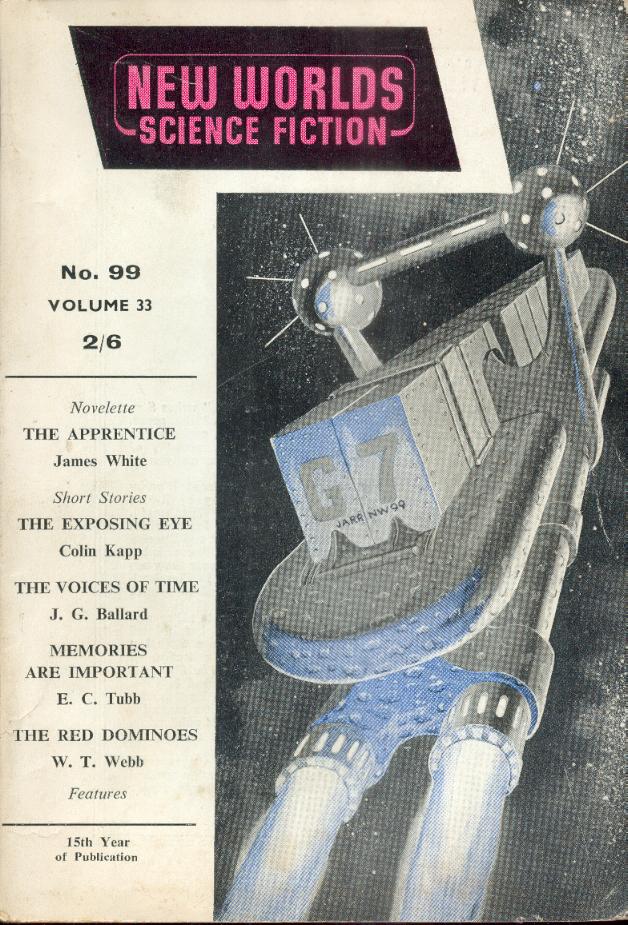
(Cover by Jarr. New Worlds, October 1960.) Who Goes There?
J. G. Ballard was born in 1930 in Shanghai, to British parents, and his experiences in a Japanese POW camp during World War II would much later be dramatized in Empire of the Sun. Before Empire of the Sun brought Ballard mainstream attention, though, he was a controversial figure, and before that one of the architects of the New Wave. He debuted in 1956, simultaneously in New Worlds and Science Fantasy, and while he wouldn’t be published in the American magazines for several more years, his early work quickly got reprinted in American reprint anthologies. The closest American equivalent to Ballard I can think of at the time might’ve been C. M. Kornbluth, who sadly was unlikely to have heard of Ballard before his death. Ballard later became a kind of writer’s writer, the kind of genre writer who gained acceptance with the literary crowd with provocative but only borderline SFnal novels like Crash and High-Rise. He was one of the field’s great misanthropes. “The Voices of Time” was published right before Ballard’s thirtieth birthday, being very much a story that anticipated the New Wave—not the sex and violence of the New Wave, but rather the attempts at literary intricacy, the psychology of the New Wave. This is a deceptively complex story with a black hole for a heart.
Placing Coordinates
First published in the October 1960 issue of New Worlds. It has been reprinted in Spectrum III (ed. Kingsley Amis and Robert Conquest), One Hundred Years of Science Fiction (ed. Damon Knight), Alpha Two (ed. Robert Silverberg), Modern Science Fiction (ed. Norman Spinrad), The Great SF Stories #22 (ed. Isaac Asimov and Martin H. Greenberg), The Big Book of Science Fiction (ed. Ann and Jeff VanderMeer), and of course in The Complete Stories of J. G. Ballard.
Enhancing Image
Robert Powers used to be a neurologist at “the Clinic,” but has since resigned on account of falling victim to a “narcoma syndrome” which has, over the past five years, sent thousands of people into comas from which there doesn’t seem to be hope for recovery. The Clinic itself has practically been overrun with hundreds of sleeping beauties, and as Powers sleeps more and more each day on average (something like eleven or twelve hours), he knows the time will come when he becomes one of the comatose. Subjectively he may as well have a terminal condition. Anderson, former colleague at the Clinic and now Powers’s own doctor, takes pity on him but notices there’s also a serene quality about Powers, as if he has become “like a Conrad beachcomber more or less reconciled to his own weaknesses.” Of course this is a reference to Joseph Conrad’s seafaring stories, like Lord Jim and Almayer’s Folly, and like the protagonists of those novels Powers is a doomed man—although unlike his predecessors he pretty well knows it. He might be following the footsteps of Whitby, a biologist at the Clinic who recently committed suicide, leaving his lab unattended and after having carved an elaborate symbol at the bottom of a drained swimming pool near the lab. There’s also Kaldren, a patient at the Clinic whom Powers had experimented on such that he has the opposite problem of everyone else: he never sleeps. And there’s Kaldren’s girlfriend, who he calls Coma (I have to think that’s not her real name), “the girl from Mars,” who befriends Powers.
“The Voices of Time” has been reprinted many times and seems to be one of those stories that exists as fodder for classroom discussions (assuming the teacher/professor is based enough to be teaching classic SF), partly I think because of its symbolic density. There are a lot of symbols shoved in here, some obvious, some not as obvious. “Coma” is obviously meant to be ironic, as she’s one of the few people at the Clinic who’s still awake; but then you have Kaldren, which sounds like cauldron—like a witch’s cauldron. Kaldren is perhaps the most aloof character in this small ensemble, as he’s kind of a mischievous figure, passively tormenting Powers, the Dr. Frankenstein who had messed with his brain. Kaldren passes the time by doing several things, one of them being that he likes to draw a series of numbers, apparently taken from a recording of a lost moon expedition, the last digits revealing the long series of numbers to be a countdown. According to Kaldren’s study of the recording, “by the time this series reaches zero the universe will have just ended.” (By the way, the Mercury Seven, the moon expedition which had apparently encountered alien life on the moon and went missing thereafter, is named after a real group of astronauts, called the Mercury Seven, which would’ve been announced probably a few months before Ballard wrote this story. One of the Mercury Seven, Gus Grissom, would later die in the Apollo 1 disaster.) We never do find out what happened to Mercury Seven, or where the aliens went, but we get the impression that whatever message they had for us was not a good one. Kaldren plays with the recording to kill time, while Powers does the same by venturing into his dead colleague’s lab and seeing what he had been working on—which may turn out to be a mistake, given the irradiated horrors awaiting him.
“The Voices of Time” has multiple moving parts, but if I had to boil it down to one word it has to be “entropy.” Entropy is a pretty hard word to define, and as a layman I’m not really qualified to get knee-deep in it, but in the context of Ballard’s story it has to do with the winding-down of the universe—not an explosion or even a crunch, but a very slow lapsing into eternal slumber. The universe is slowing down into lethargy, and this extends to not just humanity but all life on Earth. Whitby had experimented on animal and plant life with X-rays, irradiating these forms and awaking what he called a pair of “silent genes,” whose effects would be unpredictable but very interesting. The life forms Powers encounters in the lab, from a hyper-intelligent chimp who nonetheless has to wear a special helmet to avoid migraines, to an overgrown frog with a leaden shell which “vaguely resembled an armadillo’s.” In a more conventional SF story of the time these creatures would have at least been blessed with powers and a certain resiliency, but alas they are in pain, and dying. Whitby’s experiments with radiation had apparently fostered a little circus of freaks, the animals’ painful existence making them nightmarish but also pitiable. The “silent genes” unlocked previously untapped potential, sure, but this turned out to not be for the better. Whitby himself seemed aware of his mistake, and while we’re not told why he committed suicide, it’s not hard to guess, going off recorded convos between him and Powers.
“It’s always been assumed that the evolutionary slope reaches forever upwards, but in fact the peak has already been reached, and the pathway now leads downwards to the common biological grave. It’s a despairing and at present unacceptable vision of the future, but it’s the only one. Five thousand centuries from now our descendants, instead of being multi-brained star-men, will probably be naked prognathous idiots with hair on their foreheads, grunting their way through the remains of this Clinic like Neolithic men caught in a macabre inversion of time. Believe me, I pity them, as I pity myself.”
I shouldn’t have to tell you that this story is hard to read, partly because of the ideas Ballard plays with, but it’s also insanely depressing. I had read “The Voices of Time” a few days ago but waited to write about it, so I could take more notes but also it’s such a miserable fucking time. This is not unusual for Ballard, although even the dark humor that would define his most (in)famous work is mostly absent here. This is a story about life in the universe becoming old and tired, but it’s also a curious subversion of what would’ve been, even in 1960, a very old topic: the forced evolution of life via radiation. On paper “The Voices of Time” would have been nothing out of the ordinary for 1940, or even 1930. The notion that humans could become “enhanced” via radiation goes back to the time of Edmond Hamilton’s “The Man Who Evolved,” in 1931, and goes back even further. Ballard would’ve been keenly aware of his genre’s history in the 20th century; despite being claimed by the literary crowd as one of their own he really was a student of genre SF. The thing is that Ballard, even at this early stage, was a much more sophisticated writer than Hamilton, or basically anyone who wrote genre fiction in the ’30s and ’40s. He hunted intellectual big game with extreme prejudice, and I have to admit there are passages in “The Voices of Time,” such as the above quote from Whitby, that are quite haunting—for their implications but also the beauty of their language. This is the kind of story I ideally should’ve read more than once before reviewing it.
There Be Spoilers Here
Powers spends much of the story retracing Whitby’s steps with his experiments, as something to do while he still has the capacity to stay awake; but he has also taken on an even weirder project: recreating the “mandala” at the bottom of that drained swimming pool on a larger scale, by using an abandoned airfield. (It’s unclear where this story takes place, but given the largely desert landscape it could be California or Nevada. It certainly doesn’t sound like anywhere in England that I can think of.) Something that has only just occurred to me, and it embarrasses me a bit to say this, is that while we’re given an SFnal explanation for Powers’s decline, it’s pretty obvious to me now that he suffers from clinical depression. Lethargy is a common symptom of depression, and while Powers never brings up suicide with regards to himself, it’s apparent from the beginning that he has resigned himself to what would be, at least from his perspective, the end of his life. It shouldn’t be surprising, then, that at the end of the story, after having replicated Whitby’s mandala, Powers takes his own life in a rather unique fashion—by using Whitby’s experimental radiation on himself. To cop the final words from Herman Melville’s “Benito Cereno,” Powers “did, indeed, follow his leader.” One can only hope he felt as little pain as possible. It’s a fittingly bleak ending to one of SF’s bleakest stories, and a taste of the more explicit dystopias Ballard would become known for.
A Step Farther Out
I enjoyed thinking about this story more than actually reading it, although a big reason for that is the fact that I’m a dumbass and that I had to reread certain passages to get even a clue of what Ballard was doing. I always take notes when reading stuff for this site, but “The Voices of Time” is more demanding than most of what I’ve covered on here; indeed it demands that one take notes and try to think about it. It borders on “pretentious,” but it’s also easy to see how this would’ve been mind-bending for genre readers in 1960. At first you think you’re getting a standard “mad scientist” narrative, possibly even a throwback, but Ballard is five steps ahead of you and so delivers something that doesn’t quite read like anything else from the time—at least not in the genre magazines.
See you next time.
-
Short Story Review: “Retrograde Summer” by John Varley

(Cover by David Hardy. F&SF, February 1975.) Who Goes There?
When it comes to SF in the ’70s, you kinda have to talk about John Varley unless you’re one of those people who only reads novels. Varley made his debut in the August 1974 issues of F&SF and Vertex simultaneously, so this actually marks the 50th anniversary of his debut. (Those issues would’ve been on newsstands in July, but let me have this one.) So Varley pretty quickly made a name for himself as one of the most exciting new writers in the field, and for those first few years it was just with short stories. More specifically his stories about what he would call the Eight Worlds did and honestly still do read as fresh, if also products of their time to an extent. Varley would win three Hugos and two Nebulas, but none of these were for his Eight Worlds stories and indeed none of those stories won any awards, to my recollection. Not sure why. Even The Ophiuchi Hotline, Varley’s debut novel (he had apparently written one before but couldn’t get it published because it sucked), which is a pretty gnarly read and which serves as a sort of climax to those original Eight Worlds stories, only got a Locus poll spot. “Retrograde Summer” was Varley’s third published story and the second to take place in the Eight Worlds continuity; it also nabbed him his first Nebula nomination. Compared to some later entries in this series it’s on the tame side, but you can imagine reading “Retrograde Summer” in 1975 and finding it a mind-bending experience.
Placing Coordinates
First published in the February 1975 issue of The Magazine of Fantasy and Science Fiction, which is on the Archive. It was then reprinted in The Best Science Fiction of the Year #5 (ed. Terry Carr), Worldmakers: SF Adventures in Terraforming (ed. Gardner Dozois), and the Varley collections The Persistence of Vision and Good-Bye, Robinson Crusoe and Other Stories. Not to flex or anything, but that latter Varley collection was a limited edition, all copies signed, and I happen to have one. Was not exactly cheap. What’s neat about The John Varley Reader and Good-Bye, Robinson Crusoe and Other Stories is that there’s zero overlap between them. “Retrograde Summer” is also one of the few stories published in F&SF to appear there twice, as it was reprinted in the June-July 2009 issue.
Enhancing Image
Perhaps it’s fitting that the first Varley story I cover here is set on the first planet in our solar system: Mercury.
Timothy is a 17-year-old aspiring pilot on Mercury, living with his mom Dorothy, has a special visitor coming in from Earth’s moon: Jubilant, his sister, whom he has never met before. Jubilant is older “by three E-years,” making her the big sister, and the two don’t exactly get along at first sight. This is all a bit of an odd experience since Timothy isn’t sure how Jubilant is his sister, and as we learn about family arrangements for this future humanity it’s hard to blame his confusion. The awkwardness isn’t helped by Jubilant’s total unfamiliarity with life on Mercury, and like other “loonies” she has to adjust to the gravitational pull of even this small planet. (“I’d hate to be a loonie; just about anywhere they go, they’re too heavy.) Mercury has not been terraformed; instead humans have adapted themselves to the planet’s incredibly harsh climate, shielding themselves from the sun through various means while also having skin-tight suits (or null-suits as they’re called in the Eight Worlds) that are basically full-body condoms. Something clever and revolutionary Varley did at the time was that he posited humans would be able to conquer the solar system, not through terraforming that would take literal centuries but by changing themselves in order to live in environments not suited for organic life, via technology, genetic tampering, or a combo of those things. It’s not totally plausible, but it’s a twist on space colonization that I’ve seen surprisingly few authors go for post-Varley, and honestly it reads as borderline transhumanist.
Some more context, because the thing with the Eight Worlds stories is that there isn’t a single one which gives us all the details as to how this future humanity works, which might be why none of these stories won awards despite being very fun and interesting. They’re greater than the sum of their parts is what I’m saying. For instance, we’re not told in this story why people aren’t living on Earth anymore; it’s because mankind basically got kicked off Earth by an alien race so much more powerful that it wasn’t even a contest. The bad news is that millions of people died in the ensuing exile, but the good news is that mankind got to inherit the rest of the solar system, including Earth’s moon. Call it a mixed bag. This is a future where cloning is not uncommon, where people can achieve nigh-immortality via memory uploading, where you can get three arms or a fully functioning tail, and where changing one’s sex is seen as perhaps a minor surgical procedure. Timothy himself lived most of his life so far as a woman, only “Changing” a couple years ago, and Dorothy points out that Jubilant looks very much like how Timothy did when he was a she. Right, so I should probably also mention that Varley’s idea of sex and gender, while very permissive for the ’70s, also now seems a bit… backwards. Not “backwards” as in morally dubious (although there is a bit of that), but more that Varley seemed to think of the relationship between sex and gender as reversed from how it actually works. Characters in the Eight Worlds change their gender when they change their sex, as opposed to aligning their sexual characteristics to fit more with their gender, which after all is self-perception. Let’s say there’s a lot to unpack here from a genderqueer perspective.
As for actual quibbles I have with the story, I have a couple, although nothing major. For one I find Varley’s fondness for first-person narration to not always work, depending on the story’s tone and the likability of the narrator. Timothy is a perfectly fine character who works as someone who stands on the shadow-line between childhood and adulthood, but there is a small problem in him being the narrator since we already know in advance that he’ll come out of this problem fine; because “Retrograde Summer” is at least ostensibly an adventure narrative, a tale of survival in which siblings take the situation as their cue to bond. It doesn’t help either that it’s quite hard for people in the Eight Worlds to die permanently, thanks to the aforementioned cloning and memory banks. Thus other means of generating tension are required, and in the case of this story there’s already enough tension between the family members, since Timothy gets the strong impression that Dorothy is keeping secrets from him as to his exact relationship with his sister. It’s hard to blame him, considering Timothy and Jubilant turn out to be a bit more related than the former had previously thought. Before I get to that, I do wanna mention that I like how Varley is able to info-dump on us as to how society on Mercury works whilst making it quite entertaining. Timothy and his mom live on a hilltop, which has a symbolic function but which also serves a practical function given the planet’s tendency for earthquakes. “If you live at the top of a rise, you have a better chance of being near the top of the rubble when it slides down. Besides, my mother and I both liked the view.” It’s like living in California.
Basically this is a story about entering adulthood, which is perhaps predictable, but it’s vividly drawn, helped maybe by the fact that Varley was a burned-out former hippie (or fellow traveler to hippies) who would’ve only been 26 when he wrote this. Timothy is a bit precocious, but he’s convincing as a teen character I think because Varley is writing about a time in one’s life that wouldn’t have been too far away in the rearview mirror for him. There’s an energy and sheer youthfulness to Varley’s early fiction that he wasn’t able to recapture as he got older, but here it’s in a pretty raw state. This is a bit of a double-edged sword, though, since while Varley had a knack for writing child and teen characters, there were also—let’s say problematic things in those early stories that would rub one’s modern sensibilities the wrong way. Starting in the New Wave years more or less there began this troubling tendency in genre SF where relations between grown-ass adults and minors were written about in a way that would (or at least should) give the average person goosebumps, and Varley had to be one of the worst offenders of this back in the ’70s—a discomforting notion that blemished some of what would otherwise be his strongest fiction. “Retrograde Summer” doesn’t have such nonsense, thankfully, although this is still a future society where legally emancipated minors are not too uncommon. Jubilant herself had “divorced her mother when she was ten E-years old,” which as Timothy notes is still a peculiarity, although Jubilant had emancipated herself from her mother on the moon on the basis of “religious insanity.”
If this sounds like a lot, we’re only just getting started.
There Be Spoilers Here
So what counts as religious insanity in the context of the Eight Worlds? As Jubilant tells us, after she and Timothy inevitably get trapped in an earthquake, Dorothy used to be “genotypically” a man… and also their dad. The thing about families in Eight Worlds societies is that they don’t exist anymore, or at least the nuclear family model is considered taboo. It’s one child per parent, and the idea is that each parent would raise their child more or less by themself. You might have a mother, but you wouldn’t have a “father.” That Dorothy used to be a man but also used to be the “father” in a couple that practiced the fringe religious belief of raising children together as a couple (gasp) comes as a shock to Timothy. Oh, and there’s another thing: Timothy is a clone. Jubilant was born first, and in fact Timothy was a clone grown from Jubilant while the latter was still a toddler; so the reason the two look so similar when both are women is that they’re genetically the same person. After finding this out Timothy says it’s a shame the two can’t have sex together while trapped under the rubble, and I can’t tell if this is meant to be a joke on either of their parts. After finding out they’re not siblings (at least not in the traditional sense) there’s some romantic/sexual tension, but it goes unresolved. Does fucking your clone count as incest? Mind you that Varley would write clones boinking each other in some later Eight Worlds stories with the appropriate amount of gusto. Incest enjoyers will get a bit of a kick out of the sexual tension here. Anyway, Timothy and Jubilant are old enough and close enough in age that it wouldn’t really be a problem, at least compared to some of the more questionable relationships in Varley’s fiction (Heinlein has a lot to answer for).
I will say I was surprised to find this classified as a novelette, as I’m sure it barely counts; it’s actually shorter than I was expecting. Our Heroes™ spend the back end of the story doing very little, out of necessity given they’re trying to conserve oxygen; but basically once Timothy starts coming to terms with his status as Jubilant’s clone they’re rescued, just like that. It’s bad storytelling when the conflict is resolved passively, such as here, but it’s the kind of mistake that’s easy to forgive or gloss over given how engrossing Varley’s writing is, even when he’s doing exposition. It’s just that the ending comes too quickly and easily, and there are a couple loose ends, such as how their relationship might develop after this point. Are they into each other or not? It’s unclear. It’s also unclear how this bomb of a revelation will change Timothy’s perception of his mother, but I get we don’t necessarily need to know that. This is a coming-of-age narrative, more about Timothy crossing the shadow-line from childhood to young adulthood than even the real danger of the earthquake. If you read enough of these Eight Worlds stories you realize that main characters are rarely in tangible danger, so instead Varley works to build character and the world around the characters. Unlike (if I’m being brutally honest) a lot of modern short SF, however, which too often strikes me as just moody and no-fun-allowed, Varley’s early writing was fun. I was disappointed by the suddenness of this story’s ending because I wanted more of it, which as I’ve said elsewhere is usually the best complaint one can have about a work of art.
A Step Farther Out
It’s good, even if it ends abruptly. I’ve also read enough of Varley’s short fiction at this point, pretty much all of which came after “Retrograde Summer,” that this didn’t exactly hold any surprises for me. That’s not even a question of the story showing its age, because if this is your first Varley story and you’re reading it in [THE CURRENT YEAR] then you might still find it a little spicy. If anything it’s an indicator of, let’s say more eccentric stories in the Eight Worlds series, that were to come later.
See you next time.
-
Novella Review: “No Life of Their Own” by Clifford D. Simak

(Cover by Wallace Wood. Galaxy, August 1959.) Who Goes There?
Few authors hit the ground running, making their debut more or less fully formed creatively, but then even fewer authors can be said to have had their creative peak three decades into their careers. Clifford Simak is one such rarity, as he made his genre debut in 1931, only to start putting out really good work consistently by the ’50s. The stories that would make up his 1952 “novel” City were mostly written in the ’40s, but it was in the ’50s that Simak set a high bar both in the quality and quantity of his work. He wrote at a mile a minute at this time, mostly short fiction for the newfangled Galaxy, which he had taken such a quick liking to that his novel Time and Again (serialized as Time Quarry) had its first installment in Galaxy‘s inaugural issue. Rarely do an author and a magazine have such chemistry together, but in the ’50s and early ’60s the two were all but inseparable. Simak was born on August 3rd, 1904, so 120 years ago today. His career spanned from the early ’30s to the early ’80s, right as the cyberpunk movement was kicking into gear. Nowadays he reads as a breath of fresh air compared to the more urban and macho works of his contemporaries, as he was a diehard Midwesterner and pastoralist. “No Life of Their Own” similarly is very Midwestern and very pastoral, and for better or worse (I would say better) it serves as a good entry point for Simak’s unique charm.
Placing Coordinates
First published in the August 1959 issue of Galaxy Science Fiction, which is on the Archive. It’s been reprinted in Tomorrow’s Children (ed. Isaac Asimov) and the Simak collections All the Traps of Earth and Other Stories and No Life of Their Own and Other Stories.
Enhancing Image
It’s unclear how old Steve the narrator is when he’s recounting this story, but we’re told of one summer vacation during his childhood when life on the farm got mighty strange—as in stranger than normal. Steve and his parents are your average farmers in the American heartland, although lately the family’s luck hasn’t been good. “The tomato crop had failed and two of the cows had died and a bear had robbed the bees and busted up the hives and the tractor had broken down and cost $78.90 to get fixed.” Their neighbors aren’t doing much better for the most part, not least because said neighbors aren’t from around these parts—indeed, they’re not even from this planet. Steve doesn’t have human boys his age to play with, so instead he hangs out with the kids of alien families, who themselves are of different species. We never learn the real names of these other kids, but we get nicknames since Steve finds their real names too hard to pronounce: we have Fancy Pants, Nature Boy, and Butch. Fancy Pants, as you can guess, thinks a little highly of himself and even gets around by levitating, as is the norm for his race. Nature Boy is of a furry but still humanoid race and gets along with the local wildlife. Butch is the son of a well-to-do man who worked as an optometrist on his home planet but who has moved to Earth to try his luck at farming. Thing is, the only farmer in the “neighborhood” who’s been having good luck is the only other human farmer mentioned, Andy Carter, whom nobody likes and who apparently has a foul temper.
The plot is a bit loose, so first I’d like to focus on some of the details, as I think they paint a more vivid portrait than the actual events of the story. This is a concise example of how Simak likes to write aliens, which is to say he likes to write aliens who are basically humanoid and who can be understood by humans on at least some level. The aliens in “No Life of Their Own,” even the more “villainous” ones (which we’ll get to), are especially akin to humans, and it probably doesn’t hurt that here the families of the boys Steve befriends are clearly stand-ins for real-world migrant workers. Mind you that when Simak started writing SF in the ’30s the migrant worker was typically thought of as a white American from the rural Midwest who has traveled to California, or somewhere else along either coast. We’re talking about a sympathetic view of immigrants possibly informed by The Grapes of Wrath and other works that were quite left-leaning and pro-worker—and which in the ’30s were also successful with readers. “No Life of Their Own” was published in 1959 but very much evokes rural life in the ’30s and earlier, which makes sense since Simak grew up in Wisconsin in the early years of the 20th century. Come to think of it, I do wonder if Simak was influenced by John Steinbeck, especially given how Steinbeckian(?) this story feels. It’s a somewhat idealized depiction of farm life, but that’s justified I think given how Simak had actually lived through it and how ultimately this is about one man looking back on an episode of his childhood. This is not a story about racism exactly, although it’s very much an anti-xenophobia narrative in which the humans and several alien races all find common ground—including the “halflings” who kick the plot into gear.
The boys discover that Andy Carter unknowingly has a group of short humanoid aliens (hence them being called halflings) helping him tend the land, the only problem then being that the adults, for some reason, can’t see them. They ask Butch’s dad about it and for better or worse he knows how these halflings work—that they’re kind of a nuisance back where Butch’s dad comes from and that they’re basically a race of mimics, latching onto a “host” and taking after that person’s appearance. Thing is, these halflings always work in groups, or rather in little tribes, and if they latch onto one person than everyone else close in proximity will suffer. “For,” says Butch’s dad, “it is an axiom that fortune for one man is misfortune for the rest.” We then get two problems, a practical and ethical one: What do we do about these halflings? and, Is it right to interfere with the Carter farm like this? Of course Carter doesn’t know he’s getting free help, but he’ll sure as shit notice the difference once the halflings are somehow removed from the picture. This brings up another problem: Can the halflings be reasoned with? Would it be possible to negotiate? Given that this is Simak I don’t think I’d be spoiling things by saying yes, the halflings are ultimately reasonable creatures. (I struggle to think of aliens in Simak’s fiction that can’t be reasoned with in human terms at all.) So the halflings exist on some weird dimensional level that make them transparent, although Butch’s dad is at least able to design a pair of glasses that would allow kids to see them; after all, this is still rooted in science, not magic. Well, maybe a bit of magic. The kids can see the halflings with these special glasses, but adults still can’t see them. As Butch’s dad explains to Steve’s dad, “You and I are too fixed in reality.” So, what to do about the halflings?
Before we get into real spoilers, a few other things to note. While farm life as shown here is written in kind of a rose-tinted fashion, Simak’s evocation of childhood feels genuine, helped by the boys being written such that they come off as actual kids—if not necessarily “alien” in the case of Steve’s friends. The boys like to pull pranks and rough-house, which actually causes the plot to escalate, and they also look up to their dads. This is very much a boy’s world, with the only female character showing up (that I recall) being Steve’s mom, who serves as comfort for him in the back end when Our Heroes™ are at their lowest point. This is also about a time and place when corporal punishment (namely belting) was still very much the norm, and Steve doesn’t think anything of his dad beating him, even with hindsight. Just as curiously, while these are rural folks, futuristic technology is by no means absent, as the boys have a few gadgets to play with, including a “live-it” which seems to be a VR headset (virtual reality here being a reasonable extrapolation on what would’ve been the TV boom in the ’50s), and also a “hopper,” which as far as I can tell is some kind of teleportation device. There’s a weird little episode in the middle involving a cat getting caught in one of these hoppers, which I thought a needless digression, although it does foreshadow a more serious mishap regarding this bit of tech. Generally this is a story more rooted in characters and ideas than the plot, which on the one hand you could argue it could’ve been tightened up to become a novelette, but also my counterpoint is that the vibes are kind of immaculate. Simak’s stories are often quite pleasant, if not always memorable (he does phone it in sometimes), but this is a fairly memorable story of his.
There Be Spoilers Here
Fancy Pants getting payback at Nature Boy for a prank involving a skunk leads to Nature Boy getting teleported to the dimension the halflings are in, rendering him invisible—at least without the glasses. The families panic over this, understandably, but they hatch a plan to rescue Nature Boy—and maybe get their hands on one of the halflings while their at it. The halflings are what cause this whole plot to kick off, but I like the idea that petty antics between kids are what heighten the stakes. Anyway, The plan is (naturally) a success, and they even manage to get a word with one of the halflings, who not only resembles Carter but also talks like him. This is a bit disturbing, but Our Heroes™ quickly learn that the halflings can’t help who they mimic really. What the halflings really want, as it turns out, are those live-it sets, one for each of them. The halflings mimic other people’s actions, because they seem preconditioned for it but also they like watching other people; it’s their main pastime. The live-it is like an immersive and personal TV set, therefore the halflings see it as pretty neat. Simak makes a pretty curious suggestion here about technology and entertainment, as said through Fancy Pants’s dad. It’s not necessarily “correct,” but it’s interesting.
“There was a time when the human race found it necessary to congregate in families and tribes for companionship and entertainment. Then the race got the record player and the radio and TV and there was less need for get-togethers. A man had entertainment of his own in his home. He need not move beyond his living room to be entertained. So the spectator and group sports simply petered out.”
Simak lived through the birth of radio and TV, and while these mediums started as aimed at groups or families, something to play in the kitchen or living room (you would only have on TV set in the whole house then), he postulated (I think at least somewhat correctly) that these modes of “entertainment” would become more personalized, so that everyone would have their own radio or TV set. What used to be a group activity will become more individualistic. The conflict at the heart of “No Life of Their Own” is resolved by the farmers making a deal with the halflings, to give them live-it sets and have them disperse so that they wouldn’t group around a single property. It’s hard to gauge how Simak feels about his own solution for the problem, because it does solve the problem, but also he seems ambivalent about the prospect of people not coming together as often for entertainment, or more generally for shared experiences. There’s a little tinge of bitterness to what is otherwise a happy ending (well, except for Fancy Pants, who gets “grounded”), which I think makes it memorable.
A Step Farther Out
Despite being the title story in one volume of that recent series collecting all of Simak’s short fiction, I do wish “No Life of Their Own” got reprinted more often. This is typical Simak in broad strokes, but it’s the little things (especially when you’ve read enough Simak like me) that pulled me in and kept me thinking about it after I had finished reading it. It’s a short novella that, like “The Big Front Yard,” more or less gives you a crash course in what you can expect from Simak and what makes him different from other genre SF writers of the time. There are some surprisingly incisive statements here about technology and race relations that are lurking beneath a charming and somewhat childlike pastoralism.
See you next time.
-
Things Beyond: August 2024

(Cover by Hisaki Yasuda. Asimov’s, April 1988.) Not much to update on for this month, although I did decide to shake things up for slightly for what I’ll be covering. See, for a while I was gonna do a whole tribute month for Clifford Simak, like I did for Fritz Leiber almost two years ago; but truth be told I’m not sure if I’ll do a whole month of reviews for one author like that again. It can be fatiguing to read a ton from one author, even one as diverse in his output as Leiber; and I can tell you Simak is not as diverse. I do have a compromise, though, since it’s gonna be the man’s 120th birthday in two days and I wanted to do something special. So instead of one Simak story we’re getting two. Not only that, but I’m making an exception for my “one story per magazine a month” rule (excepting F&SF this year, as you know) so as to pick two Simak stories from the pages of Galaxy Science Fiction. Simak was such a prolific contributor to Galaxy that I feel it’s only right to double dip here.
Another quirky choice I decided to pull was this month’s complete novel, which is not only a certified classic of “literary” fiction but a fantasy novel that people tend to not think of as such. Whether The Man Who Was Thursday “really” counts as fantasy was a point of contention even when it was printed in Famous Fantastic Mysteries, with people in the letters column loving the novel but questioning its fantasy credentials. But fuck you, I’m counting it. Aside from Simak we have a fairly diverse roster of writers, none of whom I’ve previously covered on here. We also have a few stories I would consider appropriate for summer reading, in that they take place in warm climates and/or involve aquatic life.
Let’s see here…
For the novellas:
- “No Life of Their Own” by Clifford D. Simak. From the August 1959 issue of Galaxy Science Fiction. For the story I picked to cover on Simak’s birthday I figured I may as well pick a story that also had an August release date. When Simak restarted his writing career in the late ’30s he would be a regular at Astounding Science Fiction for the next decade, but in the ’50s it quickly became apparent Galaxy would be his new go-to outlet. Incidentally the ’50s also saw Simak’s most prolific period as a short fiction writer.
- “Surfacing” by Walter Jon Williams. From the April 1988 issue of Asimov’s Science Fiction. Williams had started out as a “mainstream” writer in the early ’80s, but by the latter half of that decade he had moved to writing SF. His rise to prominence happened to coincide with the cyberpunk movement. Bit of a funny story: this is a semi-reread for me, since I got about halfway through “Surfacing” a year or so ago, but due to circumstances outside of my control I wasn’t able to finish it at the time. I’m correcting that now.
For the short stories:
- “Retrograde Summer” by John Varley. From the February 1975 issue of The Magazine of Fantasy and Science Fiction. Varley debuted in 1974 and within just a couple years rose as arguably the most imaginative and exhilarating new writer in the field. His Eight Worlds stories especially (of which “Retrograde Summer” is one) pointed towards a writer who was a breath of fresh air at the time.
- “The Voices of Time” by J. G. Ballard. From the October 1960 issue of New Worlds. Ballard would later see mainstream recognition, of a sort, with his highly controversial novel Crash and the semi-autobiographical Empire of the Sun. In the ’60s, however, Ballard was known as one of the quintessential figures in the New Wave. This story is an example of early Ballard, from before the New Wave.
- “The Evening and the Morning and the Night” by Octavia E. Butler. From the May 1987 issue of Omni. Butler was a respected author in her lifetime, winning multiple awards, but her reputation seems to have gotten a second wind in the years following her death. She was a somewhat prolific novelist, but she wrote very few short stories—which didn’t mean there was a dip in quality.
- “Dusty Zebra” by Clifford D. Simak. From the September 1954 issue of Galaxy Science Fiction. Simak had been with Galaxy from literally that magazine’s first issue, with the serialization of his novel Time Quarry (or Time and Again), and from there he was a constant presence. Given the subject matter, “Dusty Zebra” may or may not be a precursor to Simak’s more famous “The Big Front Yard.”
- “The Year Without Sunshine” by Naomi Kritzer. From the November-December 2023 issue of Uncanny Magazine. Kritzer has been around for a while—actually way longer than you’d think, considering she only started getting real awards attention in the 2010s. This story here just won the Nebula, and is currently a finalist for the Hugo, making it the most recent story I’ll have covered.
- “There Used to Be Olive Trees” by Rich Larson. From the January-February 2017 issue of The Magazine of Fantasy and Science Fiction. I remember reading a few Larson stories in the past and assuming he was older than he really was, which says something about his skill. Larson made his debut in the early 2010s while still a teenager, and has been writing at a mile a minute ever since.
For the complete novel:
- The Man Who Was Thursday by G. K. Chesterton. From the March 1944 issue of Famous Fantastic Mysteries. First published in 1908. This is kind of a treat for myself, since not only is this a reread but The Man Who Was Thursday is also one of my favorite novels. Chesterton is known for his Father Brown detective series, and for being a celebrated Catholic apologist; but before his conversion he wrote one of the pioneering (and still one of the weirdest) espionage novels with this month’s pick. Interestingly this seems to be one of the rare cases of a “complete” novel in FFM actually being unabridged, the only omission being a poem at the beginning dedicated to a friend of Chesterson’s which is not part of the novel itself.
Won’t you read with me?
-
Subscribe
Subscribed
Already have a WordPress.com account? Log in now.
 Science Fiction & Fantasy Remembrance