-
Things Beyond: April 2024

(Cover by Frank Kelly Freas. Analog, December 1972.) As has unfortunately become commonplace, there have been a few deaths in the family. Christopher Priest and Brian Stableford died in February and Vernor Vinge little over a week ago. This last one hit me by far the hardest. Obviously there are some people I’m not mentioning, but unfortunately unless I really wanted to I can’t cover everyone. There’s too much. The past month or so has been rough for me. I had a nasty fall a few weeks ago and I seem to have acquired mild PTSD from it. Half of my face got messed up and I ended up spending some time in the ER. Obviously I’m doing better now. Yet somehow I don’t feel totally “right.”
Hopefully some good (or at least interesting) fiction will help me! We have a nice mix: two SF novellas, plus two SF short stories, two fantasy, and two horror. Or at least these stories seem to fit predominantly into those genres; obviously they’re not mutually exclusive.
For the novellas:
- “A Woman’s Liberation” by Ursula K. Le Guin. From the July 1995 issue of Asimov’s Science Fiction. One of the most universally beloved of all SFF writers, Le Guin started relatively late but would enjoy a very long and acclaimed career. She’s one of the few authors to enjoy about equal reverence for both her SF and fantasy. Her Hainish Cycle, especially The Left Hand of Darkness and The Dispossessed, might constitute her best and most important work overall. “A Woman’s Liberation” is set in the same universe as those novels, and is a loose sequel to “Forgiveness Day” and “A Man of the People.”
- “Palely Loitering” by Christopher Priest. From the January 1979 issue of The Magazine of Fantasy and Science Fiction. British Science Fiction Award winner for Best Short Fiction. Priest died in February, after a career spanning more than half a century. His 1974 novel Inverted World is something of a cult classic. His 1995 novel The Prestige was turned into a movie by Christopher Nolan. ISFDB classifies “Palely Loitering” as a novelette, but at about forty pages in F&SF I suspect it counts as a novella. It got a Hugo nomination for Best Novelette but placed third in the Locus poll for Best Novella.
For the short stories:
- “The Hounds of Tindalos” by Frank Belknap Long. From the March 1929 issue of Weird Tales. Long had a ridiculously long (ha) career, spanning from the 1920s to his death in 1994. He was a close friend of H. P. Lovecraft and the two seemed to take inspiration from each other, with “The Hounds of Tindalos” being one of the first Cthulhu Mythos stories not written by Lovecraft.
- “Traps” by F. Paul Wilson. From the Summer 1987 issue of Night Cry. A doctor by day and a bestselling author by night, Wilson is the only person to have earned both the Bram Stoker and Prometheus Award for Lifetime Achievement. He likes to hop between science fiction and horror, with the two not being mutually exclusive. “Traps” itself was a Stoker nominee for Best Short Story.
- “The Swordsman Whose Name Was Not Death” by Ellen Kushner. From the September 1991 issue of The Magazine of Fantasy and Science Fiction. Kushner got started in the ’80s writing Choose Your Own Adventure books before turning to proper fantasy literature and even radio. This story is set in the same universe as her novel Swordspoint but, as far as I can tell, is not a sequel.
- “Two Suns Setting” by Karl Edward Wagner. From the May 1976 issue of Fantastic. British Fantasy Award winner for Best Short Story. Wagner was a devotee of both horror and sword-and-sorcery fantasy. His Kane series very much follows in Robert E. Howard’s footsteps, but Wagner at his best was a genuine poet as well. “Two Suns Setting” was his first (and I think only) appearance in Fantastic.
- “Original Sin” by Vernor Vinge. From the December 1972 issue of Analog Science Fiction. Despite debuting in 1965 and remaining active until about half a decade ago, Vinge’s output is fairly small; but, given the five Hugo wins, he certainly did something right. “Original Sin” is one of Vinge’s more obscure stories, but I went with it on the recommendation of a certain colleague.
- “The Growth of the House of Usher” by Brian Stableford. From the Summer 1988 issue of Interzone. Stableford passed away in February after a very long and winding career. (Incidentally Priest, Vinge, and Stableford all debuted within a few years of each other.) He was a prolific translator of French SF and contributed to the SF Encyclopedia, on top of a massive amount of fiction.
Won’t you read with me?
-
Short Story Review: “Day at the Beach” by Carol Emshwiller
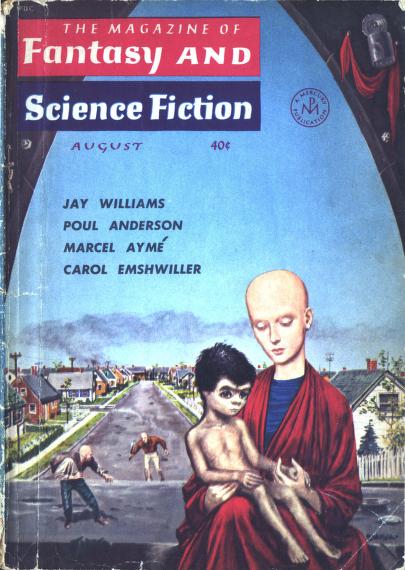
(Cover by Ed Emshwiller. F&SF, August 1959.) Who Goes There?
Carol Emshwiller came a bit late to the whole writing-fiction thing, not even writing her first novels until she was in her sixties, but she would have one of the longest and most acclaimed careers of any modern SF writer. She started in the mid-’50s and remained more or less active until her death in 2019; the crazy part is that she would remain a high-quality writer over that sixty-year span. She steppd away from writing for much of the ’60s but returns just in time to contribute to Dangerous Visions, with one of its better stories, “Sex and/or Mr. Morrison.” Despite having started in the ’50s, Emshwiller changed her colors like a chameleon and fit right in with the New Wave crowd—and then changed again for the post-New Wave years. This is a degree of versatility most writers couldn’t manage.
I should probably mention at this point that Carol was the wife of legendary illustrator (later experimental filmmaker) Ed Emshwiller. Yeah. In one of the cuter instances of both halves of a couple being successful creative types, Ed sometimes illustrated Carol’s stories, including the cover depicting “Day at the Beach” that you see above. (It would have to be the cover because F&SF made it a policy to not have interior illustrations for stories.) “Day at the Beach,” while short and simple in a way, has enough evocative imagery that such a cover might’ve been earned; you could do a lot worse than this one. It’s a post-nuclear fable that reminds me of Cormac McCarthy’s The Road, in its grimness but also its central message.
Placing Coordinates
First published in the August 1959 issue of The Magazine of Fantasy and Science Fiction, which is on the Archive. It was reprinted in The Year’s Best S-F: 5th Annual Edition (ed. Judith Merril), An ABC of Science Fiction (ed. Tom Boardman, Jr.), Future Love: A Science Fiction Anthology (ed. Victoria Williams), Beyond Armageddon: Twenty-One Sermons to the Dead (ed. Martin H. Greenberg and Walter M. Miller, Jr. [?!]), and the Emshwiller collection The Collected Stories of Carol Emshwiller Vol. 1. Unfortunately, if what I’ve heard is true, the proofreading for that last one is really bad.
Enhancing Image
We meet Myra, a housewife who has “neither eyebrows nor lashes nor even a faint, transparent down along her cheeks.” She is in fact totally hairless, and so is her husband Ben. Their son, named Littleboy, is however a different story, being “the opposite of his big, pink and hairless parents, with thick and fine black hair growing low over his forehead and extending down the back of his neck.” Littleboy is three-and-a-half years old and we’re told that things were normal not long before then, when nuclear war broke out; it’s implied Littleboy was in utero when Myra and Ben got a generous dose of radiation. Emshwiller is light on the details: we’re never told who fired the first shot, which countries went to war (although we can guess(), or how much of civilization is left after the fallout. Presumably not much. I say “post-nuclear” but it’s fair to call “Day at the Beach” a post-apocalyptic tale. And then Myra gets the idea to take her family to the beach. It’s a nice sunny Saturday—or at least she thinks it’s a Saturday; she’s unsure.
We aren’t told a lot about what life in such a future is like. We know oil is apparently a precious and fought-over commodity, like in Mad Max, and that the family is used to having to defend itself through violent means, as we’ll see later. What do they do for food? It’s not dwelled on. “Day at the Beach” is about ten pages long, and if anything it could be longer, which is the best kind of negative criticism. It’s a slice-of-life narrative in the allegorical mode, which as I said before reminds me of The Road, albeit with a lot less cannibalism. (There isn’t any on-screen cannibalism, don’t worry.) It’s a story about making way for the next generation, of “carrying the fire” as McCarthy liked to put it, in spite of horrendous circumstances. Myra and Ben are disfigured from the radiation and Littleboy is undoubtedly a mutant, but they don’t love him any less for it. Even Littleboy’s unconventional name alludes to the story’s allegorical nature, with the child being a stand-in for the next generation. As Anthony Boucher says in the introduction, it’s about “the endurance and adaptability of the human spirit.”
The family has a simple goal in mind, which is to hang out at the beach—alone. They don’t seem to have any mutuals, no oomfies or pookies to call on for such an occasion; but then maybe solitude in the midst of nature is what Myra and Ben want. It’s a tranquel scene, although I have to say I’m not sure if letting Littleboy go swimming in the buff was the norm for really young children in the ’50s or if it’s a casualness brought on by the end of civilization and public decency laws. Probably the latter. It does feed into the sense of tranquility, and of a kind of purity. They may not be a sight for sore eyes (although I must admit that going by her depiction in Ed’s cover, Myra rocks the bald look), but that doesn’t make them any less kind to each other. In the years during and following World War II there was much speculation on what life might be like in the wake of nuclear fallout, from Judith Merril’s “That Only a Mother” to Walter M. Miller’s A Canticle for Leibowitz. The idea of humanity becoming mutated, with negative or possibly even positive effects, from the bombs was a popular one. Actually the “human mutants” stock is still high, if the continuing popularity of the Fallout series (now with its own TV show) is anything to go by.
Emshwiller seems to suggest that while life is rough, and some harsh decisions must be made, and although our descendants may look different from us, they (probably) won’t be any less human. Governments may fall and capitalism might (hopefully) end at some point (as Lovecraft says, “even death may die”), but the average person, with even a little bit of luck, will persist. Like the Okies in The Grapes of Wrath (indeed the migrant workers who now suffer on the receiving end of border violence), the survivors of nuclear catastrophe will not go quietly into the night. In a way it can be thought of as a response (although Emshwiller probably didn’t intend this, and anyway I have no way of proving it) to Merril’s most famous story—a ray of hope to the stark terror of “That Only a Mother.”
There Be Spoilers Here
I’m tired.
A Step Farther Out
So that’s it. End of the month. I didn’t end on the strongest note, but the Emshwiller is a good example of F&SF‘s range of fiction and willingness to take on more poetic material. In 1959 (incidentally this was the only story Emshwiller saw published in 1959) there were really only a couple options for “Day at the Beach.” Maybe Galaxy would’ve taken it. The genre SF market had shrunk massively; certainly it was no longer the market of near-endless possibilities that it would’ve been at the start of the decade. F&SF was arguably the only American SFF magazine that was doing really well at this point. The late ’50s and early ’60s were a low period for short fiction writers, and this was especially true the women. A lot of female writers would leave the field around 1960 in search of greener pastures, no doubt in part due to the market shrinking massively, and Emshwiller would be one of those women who stepped away from the scene.
But she would return.
See you next time.
-
Short Story Review: “The Omen” by Shirley Jackson
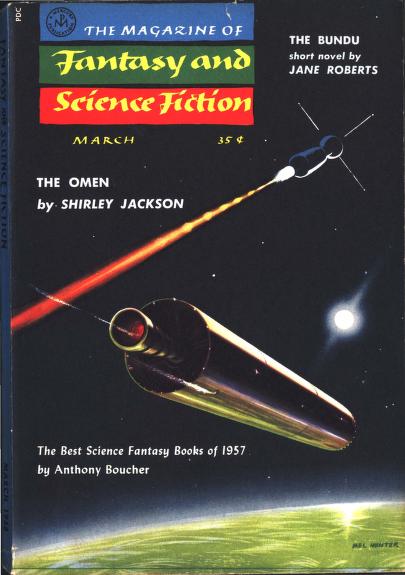
(Cover by Mel Hunter. F&SF, March 1958.) Who Goes There?
One of the most famous authors in 20th century American literature, Shirley Jackson occupies the same space as Ray Bradbury in the sense that she broke into the mainstream by sticking to slick outlets. In 1948 her short story “The Lottery” was published in The New Yorker and sparked an enormous amount of press and controversy, and “The Lottery” has since been canonized as one of those classic short stories high school English students are subjected to. But Jackson wrote much more than “The Lottery,” even if we’re counting just her short fiction; but she also was the rare successful horror novelist prior to 1970, with classics like The Haunting of Hill House and We Have Always Lived in the Castle. Unfortunately she didn’t live to see the horror renaissance of the ’70s, as she died in 1965, at 48 years old, after years of what should’ve struck people at the time as concerning levels of drug and alcohol abuse. In a way she was a victim of her own success, since being a famous lady writer who made more money than her husband contributed to the strain in her marriage, which was a miserable ordeal.
It would be fair, I think, to call Jackson a horror writer first and foremost; certainly her horror writing is what made her legacy. She did sometimes not write horror, as is the case with today’s story, “The Omen,” one of Jackson’s few appearances in F&SF—indeed one of maybe a handful of appearances she made in the genre outlets. No doubt F&SF‘s dignified appearance, fast-and-loose philosophy with genre boundaries, plus (I suspect) some charm on Anthony Boucher’s part, had some role in wrangling a thoroughly slick author like Jackson. “The Omen” is pretty obscure, especially for Jackson, and admittedly it’s not a hidden masterpiece by any stretch of the imagination; but it does show another side to Jackson, albeit with some of the venom we come to expect with her.
Placing Coordinates
First published in the March 1958 issue of The Magazine of Fantasy and Science Fiction, which is on the Archive. It was then reprinted in The Best from Fantasy and Science Fiction, Eighth Series (ed. Anthony Boucher) and the Jackson collection Just an Ordinary Day, a volume of stories which hitherto had either gone unpublished or uncollected in a previous Jackson collection. It’s possible there’s a reprint that ISFDB doesn’t register, since Jackson is sometimes considered a non-genre author, but I find it believable that “The Omen” has only been reprinted twice.
Enhancing Image
Granny is nice old woman in her eighties, who gets along with her daughter, son-in-law, and grandkids—and on the day of the story she also gets hit with an unexpected but very welcome bit of money. She gets an envelope, inside of which is a check for $13.74, “with a covering letter saying that the sender had owed it to Granny’s husband for nearly fifty years, and so was paying it now to his widow, with interest.” Now, in today’s economy $13.74 is piss, but circa 1957 it would’ve been a good deal of money, especially for an old lady. You could do quite a bit with $13.74. She makes a list of things to get her family members, including a perfume brand named Carnation and a stuffed blue cat—only problem being it takes her all of five minutes to lose the list. Anyway, Granny is not the main character, but a much younger woman named Edith, who is in a long-term relationship with some guy named Jerry but who is hesitant to marry him—not because of Jerry, but Edith’s abusive and domineering (redundant) mother.
The omen of the story’s title is Edith making a mistake and finding Granny’s shopping list instead of taking her own bag. Being destitute and a little supersticious, Edith takes the shopping list to be a sort of guide that’ll help her return home, and even maybe help her make up her mind on the Jerry situation. Let’s talk about genre, and about F&SF‘s policy in the ’50s, especially after J. Francis McComas stepped down. Usually fiction printed in F&SF would be SF, fantasy, or a hybrid, but on occasion Boucher would buy a story that can’t really be called SFF, yet is also maybe too strange to have seen print in the slick outlets. Jackson’s first original story in F&SF, “One Ordinary Day, with Peanuts,” doesn’t have any discernable fantastic elements, and indeed ISFDB classifies it as non-genre; yet it might’ve been too hard to classify (it isn’t horror, and yet there’s something vaguely sinister in its twist) for higher paying markets. “The Omen” arguably is not fantasy at all, depending on how you interpret the list. Is this a case of something like magical realism, or is it a bunch of coincidences? Are the omens good or bad, and does it matter on a cosmic scale?
I personally am counting “The Omen” as fantasy because
I have toI think Jackson’s implying that some cosmic force is pointing Edith in the right direction, even though she can’t be sure of it. She can’t know the context for the “Carnation” on the list, instead taking it to mean finding a literal carnation flower, and so she happens to meet a man on the street with one carnation on his breast who’s on his way to getting married. The soon-to-be-married man is also taking part in a contest involving a certain woman and $100 in groceries, which Edith gets wrapped up in. A comedy of mistaken identity ensues. I think the man with the carnation is a seed planeted in Edith’s mind that will later influence her to be more assertice in her relationship with Jerry, but I might be overthinking it. Jackson could at times be a writer of shocking subtlety, although I don’t think “The Omen” is an example of such; it seems to be Jackson taking herself and her world (New York) less seriously. Edith’s journey is a sort of spoof odyssey wherein Our Heroine™ is someone of modest means and probably average intelligence who maybe tricks herself into thinking she’s stumbled into a fantastical situation. Your mileage may vary.Reading this, I couldn’t help but think about Jackson’s life, the circumstances of her writing, and a kind of unexpected but perfectly logical contemporary comparison: Flannery O’Connor. The two were in some ways very different: O’Connor was a diehard Catholic while I struggle to believe the woman who wrote We Have Always Lived in the Castle believed in an all-loving deity. But they were also pessimists with a biting sense of humor and an equally biting sense of justice, and even though Jackson often wrote horror at a time when the genre was pulp-adjacent, I do think she was at least almost as morally serious as O’Connor. (Sadly they also both died young.) This is why I’m not sure what to make of “The Omen,” which depicts a downtrodden woman who is, quite possibly, on the cusp of liberating herself from one abuser to falling into the hands of another. The few times we hear from Jerry are not flattering. It could also be that I’m projecting Jackson’s own deeply unhappy marriage onto a character of hers, but I can’t help but get the impression that Edith, while on the surface being presented with a way out with Jerry, may be stuck between a rock and a hard place.
There Be Spoilers Here
Edith soon finds a cafe, Kitty’s Lunch, where the owner herself had, “with odd humor, chosen to adorn the window of Kitty’s Lunch with a large painted blue cat.” The cafe also happens to have a payphone Edith can use, and she just happens to have enough money for a cup of coffee and a phone call. And don’t feel too bad for Granny, who you may recall lost her list and subsequently forgot everything she was supposed to get. But everything works out. I could be wrong, though, but the ending feels phony to me, which I know is an odd way of putting it. I don’t think Jackson believes in her own happy ending. Granny, at the very end, even calls the outcome of events “sentimental,” which is a word that I can’t imagine Jackson would use without puking in her own mouth a tiny bit; Jackson doesn’t do sentimentality. Is this impression of fakeness intentional or just a failure at being sincere? It’s a question Jackson’s not keen on answering.
A Step Farther Out
“The Omen” is a lesser known Jackson story, because of its relatively lighthearted tone but also I don’t think it shows Jackson at her best. We know Shirley Jackson could be a really vicious and subversive writer for her time, but “The Omen” reads as the eternal pessimist indulging in sentimentality. You could even argue it’s non-genre and that not only should it have not been printed in F&SF but that I shouldn’t have covered it for this genre blog of mine, but I’ll be generous and work off the assumption that the hints of supernatural intervention should be taken at face value. It’s a curiosity that shows Jackson’s range, but it’s not something I’d recommend unless you’re a Jackson completionist.
See you next time.
-
Short Story Review: “MS. Found in a Chinese Fortune Cookie” by C. M. Kornbluth
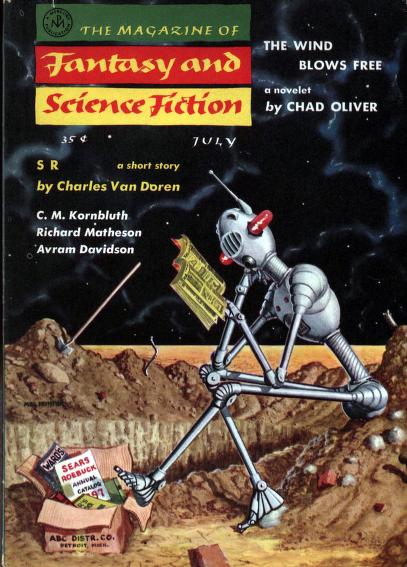
(Cover by Mel Hunter. F&SF, July 1957.) Who Goes There?
The ’50s—especially the first half—were a goldmine for satirical writing in genre SF, with writers like Robert Sheckley, William Tenn, and Philip K. Dick acting as court jesters for the scene; and then there was possibly the most talented of the satirists (or at least he could’ve been, had he lived longer), which was C. M. Kornbluth. Despite having died at the horribly young age of 34, of a weak heart, Kornbluth was prolific and at the time of his death he had been writing fiction for nearly twenty years. He debuted in 1939, about 15 years old, and wrote at a mile a minute (often under pseudonyms) until 1942, when he got pulled into the war effort. He would eventually return to writing circa 1949, just in time for the magazine boom that was about to take place, and he never looked back. He wrote quite a few novels, alone and in collaboration with Frederik Pohl, but his best stuff was short-form, which only got more ambitious as he aged.
“MS. Found in a Chinese Fortune Cookie” is arguably not even science fiction, but it is very much about science fiction, and about science fiction writers. It’s a self-reflexive dual narrative that, in only about ten pages, shows Kornbluth hunting intellectual big game. At first I wasn’t quite sure what to make of it, since it really is a weird fucking story; but, having sat on it for a few days now, I feel more qualified to talk about it. This is the kind of story that rewards the reader for already being familiar with the author’s work, but while it is fannish, it’s not exactly a flattering depiction of being into genre SF at a time when the genre got no respect.
Placing Coordinates
First published in the July 1957 issue of The Magazine of Fantasy and Science Fiction, which is on the Archive. It was then reprinted in The Best from Fantasy and Science Fiction, Seventh Series (ed. Anthony Boucher), the only book publication of this story Kornbluth lived to see. It appeared in the Kornbluth collections The Marching Morons and Other Science Fiction Stories, Thirteen O’Clock and Other Zero Hours, and His Share of Glory: The Complete Short Science Fiction of C. M. Kornbluth.
Enhancing Image
There are two threads, which I’ll call the primary and secondary narrative. The primary is a series of messages hidden inside fortune cookies (hence the title), written by one Cecil Corwin, science fiction writer; and the secondary is asides written by C. M. Kornbluth, whom you may have heard of. Corwin has apparently gone insane and vanished off the face of the earth, with only these secret messages detailing what happened to him, in his own words, while Kornbluth, being a long-time friend and Corwin’s literary executor, gives us some much-needed context. Thus we have the “Corwin Papers”—notes you’d find in place of those platitudes that are normally found inside delicious fortune cookies. It’d be accurate to title the story “MS. Found in Chinese Fortune Cookies,” but I understand that doesn’t quite as good. Still, we have two protagonists: Corwin and Kornbluth.
This is all a bit strange, not least because “Cecil Corwin” is one of the aforementioned pseudonyms Kornbluth used back when he started writing. I’m not sure how many readers in 1957 would’ve known this, but Anthony Boucher almost certainly knew, as did some other folks who knew Kornbluth personally. The implication is that Corwin and Kornbluth are meant to be taken as the same person, or maybe as two sides of the same persona, or maybe as two personalities inhabiting the same body a la A Scanner Darkly. Immediately we’re thrown into the deep end of metafictional hijinks, in a maneuver that probably would’ve made Jorge Luis Borges proud (although Kornbluth had almost no way of knowing about Borges in his lifetime). There are some other characters mentioned, very likely based on real people, whose names have been changed undoubtedly for legal reasons and because Kornbluth doesn’t wanna make too many enemies.
Corwin is a writer who thinks he has found what he calls The Answer—the one secret to life, the universe, and everything, which would end human suffering and initiate the kingdom of Heaven on Earth. Despite being on the brink of monumental success, Corwin suspects he might also be on the precipice of insanity. “Of course The Answer looked logical and unassailable, but so no doubt did poor Charlie McGandress’ project to unite mankind through science fiction fandom, at least to him.” I get the impression Kornbluth (the author) was trying desperately not to bring up L. Ron Hubbard or Scientology by name, but you’d have to be blind as a bat to not notice the allusions to what were then fandom hijinks. And in fairness to Corwin, he’s not wrong when he suspects that trying to write out The Answer will get him into serious trouble. Indeed the conspiracy surrounding The Answer is the closest the story gets to SF territory, which reminds me of the centuries-long feud at the heart of The Crying of Lot 49. I wonder if Thomas Pynchon has read Kornbluth?
I wouldn’t recommend “MS. Found in a Chinese Fortune Cookie” to people unfamiliar with Kornbluth for a few reasons: it assumes you know who Kornbluth is, that you have at least a cursory knowledge of SF fandom politics in the ’50s; and also, structurally, this is a tangled mess of a story. We’re given two unreliable narrators for the price of one. Immediately we’re signaled to doubt Corwin because he says, “They say I am mad, but I am not mad”—only to chide himself for opening on such a cliched line. Then there’s Kornbluth (the character), who cuts out parts of Corwin’s writing for a few given reasons, but the result is that the notes are left even more fractured than they would’ve been originally. Kornbluth (the character) will also sometimes cut in to voice his disagreement with something Corwin says, either because he genuinely believes what he’s saying or because he wants to make sure not to get caught in the conspiracy that would drive Corwin to write these messages. Needless to say the plot is hard to spoil, because of its layers but also the fact that the story is inextricably linked with Kornbluth’s career within the history of genre SF.
There is a key to this story, in a way, although it wouldn’t be published until after Kornbluth’s death. For people like myself who are actively interested in “old” science fiction there’s a little volume called The Science Fiction Novel: Imagination and Social Criticism (ed. Earl Kemp), published in 1959, which collects four lectures given by as many SFF writers, those being Robert Heinlein, C. M. Kornbluth, Alfred Bester, and Robert Bloch. These lectures were originally given a couple years earlier, which Kornbluth giving his in January 1957 at the University of Chicago. The name of the lecture is damning: “The Failure of the Science Fiction Novel as Social Criticism.” The idea, basically, is that while there have been works of SF that work as social criticism, there are too few such examples in a sea of pure entertainment; and, maybe more damningly, said examples fail to leave a tangible impression on the public consciousness. Aside from some excessive psychoanalyzing of George Orwell, it’s a good read.
At one point Kornbluth talks about Wilson Tucker’s 1952 novel The Long Loud Silence, a novel which he feels is effective as social criticism, but an abject failure in sparking any societal change. Unlike Harriet Beecher Stowe’s Uncle Tom’s Cabin and Upton Sinclair’s The Jungle, which (Kornbluth says) really did change how some people thought and acted (in the case of The Jungle it directly inspired government policy), The Long Loud Silence made no such impression; not only that, but it didn’t become a bestseller and is indeed now an obscure novel—forgotten. In trying to explain how this happened, Kornbluth goes further to explain what it was like being a “science fiction writer” in the ’50s, at a time when the market was more vibrant than ever before but which the mainstream dared not touch:
[The Long Loud Silence] was ignored because publishers think of their books in rigid categories. Tucker’s book fell into the category “science fiction.” Books in the category “science fiction” get no promotion or advertising to speak of, they get misleading jacket blurbs, and a sale of five thousand copies is considered a realistic target. The idea is to sell it to the science fiction readers, clear expenses, make a little money on the paperback reprint, pat the author on the back and tell him to write another book, boy, we love your stuff.
Even 1984, which was a bestseller and which Kornbluth praises immensely, had failed to spark any societal change. One of the most famous novels in the English language, often quoted (and misunderstood), and yet despite its immense popularity 1984 remains a novel of ideas that have never materialized. There has not been (to my knowledge) a libertarian socialist society that exists now past the extreme local level, let alone one that takes direct inspiration from Orwell’s warning. (The point of the novel, of course, was the scare readers away from capitalism and socialistic fascism [or fascistic socialism] and encourage a socialist change wherein people of all skin colors and class backgrounds would be allowed to flourish.) If even the most famous SF novel on the planet cannot do what mainstream literature has done, then why are we here? What is the purpose of writing science fiction other than for the lulz and the funzies? Is SF hopes to stand on the same level as mainstream literature then (Kornbluth says) there has to be a work on part with Uncle Tom’s Cabin in terms of societal impact. (That Uncle Tom’s Cabin is now often held as an “important” but poorly aged protest novel that one doesn’t read for pleasure is beside the point.)
The increasing existential dread for the SF writer is one both Corwin and Kornbluth sense, although unlike Kornbluth (the author), Corwin thinks he has found the answer—even The Answer. In a sense you could say this story is autobiographical, because I do think Corwin’s anxiety about the seeming unimportance of the SF writer mirrors Kornbluth’s own. It’s like what he says about the relationship between the reader and the SF writer (although you could argue this goes for any writer of fiction): “There’s a touch of intellectual sadism in us. We like to dominate the reader as a matador dominates the bull; we like to tease and mystify and at last show what great souls we are by generously flipping up the shade and letting the sunshine in.” Science fiction—the reading and writing of it—is like a game. But Corwin and Kornbluth argue this must not or at least should not be so—that science fiction should serve more purpose than as entertainment.
There Be Spoilers Here
[REDACTED]
A Step Farther Out
When Kornbluth died in March 1958 he was on his way to succeeding Anthony Boucher as editor of F&SF, and one can’t help but wonder where the magazine might’ve gone under his direction. Certainly he was becoming increasingly concerned with the bottom-tier position science fiction occupied in the zeitgeist, having at that point been relegated mostly to monster movies and speculation on new technology. The complexity and seriousness (despite its absurd premise) of “MS. Found in a Chinese Fortune Cookie” point toward Kornbluth trying to open a door—a door that would prematurely slam shut. I’m reminded of the SF Encyclopedia’s entry on Edgar Allan Poe, who like Kornbluth died young, before he could reach his full potential: “If his career had lasted longer, he might have awoken us more inescapably to his vision; as it stands, we must awaken ourselves to him.” The same can be said of Kornbluth.
See you next time.
-
Short Story Review: “Steel” by Richard Matheson
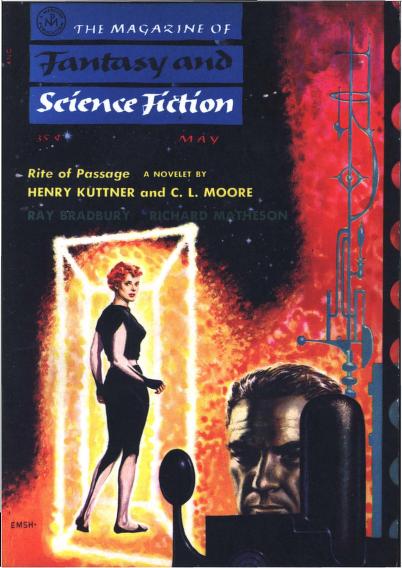
(Cover by Ed Emshwiller. F&SF, May 1956.) Who Goes There?
While never quite breaking into the mainstream like Ray Bradbury, Richard Matheson clearly copped a few notes from the Bradbury notebook and, over time, became one of the more accomplished authors in the field. He debuted in 1950 with “Born of Man and Woman,” which despite being written when he was 22 or 23 remains one of his most famous stories. He quickly amassed an impressive body of short fiction, but it was his 1954 novel I Am Legend that remains his most famous work, being one of the few truly influential depictions of vampires to come out of the 20th century. His other major novels include The Shrinking Man, Hell House, and Somewhere in Time, but it’s his efforts as a short story writer and screenwriter that hold my attention the most. He wrote the short story and screenplay (I’m not sure which came first) for Duel, Steven Spielberg’s first movie. He was the second most prolific writer for The Twilight Zone—only behind Rod Serling, of course. Unlike close contemporary and fellow Twilight Zone writer Charles Beaumont, he lived to see much recognition in his lifetime.
“Steel” was itself turned into a Twilight Zone episode, adapted by Matheson, with Lee Marvin as the lead; it’s one of the better episodes in the original series, I would say. If you’ve seen the episode (as I have) then you’ve already seen the story told in the source material, albeit compressed. Unsurprisingly Matheson did not stray much from his own story. Unlike “Little Girl Lost,” which I reviewed before and which Matheson also turned into a Twilight Zone episode, I’d consider “Steel” to be major Matheson. I’m not sure why it has been reprinted relatively few times.
Placing Coordinates
First published in the May 1956 issue of The Magazine of Fantasy and Science Fiction, which is on the Archive. It later appeared in The Twilight Zone: The Original Stories (ed. Martin H. Greenberg, Richard Matheson, and Charles G. Waugh) and the collections Duel: Terror Stories by Richard Matheson and Steel and Other Stories. That last one seems to be a tie-in for the movie Real Steel, which is a much looser adaptation than the Twilight Zone episode. Yeah, “Steel” has been adapted more than once.
Enhancing Image
The premise is simple. It’s the year 1980, and human boxers have been replaced by human-like robots for several years now. We follow Kelly, his mechanic friend Pole, and their fighting robot Maxor. Unfortunately Maxor is a B-two, out of date for a few years now what with B-nines set to release, and he’s barely holding together at the seams.
“The trigger spring in his left arm’s been rewired so many damn times it’s almost shot. He’s got no protection on that side. The left side of his face’s all beat in, the eye lens is cracked. The leg cables is \vorn, they’re pulled slack, the tension’s gone to hell. Christ, even his gyro’s off.”
The three have traveled far for a match, and while they’re set to get an amount of money for even one round in the ring, Maxor might fall apart before he can land a single punch. Kelly himself used to be a boxer, before the robots came in, but he’s middle-aged now, balding, and reminiscing on his glory days. “Called me ‘Steel’ cause I never got knocked down once. Not once. I was even number nine in the ranks once,” he says. When they finally get to the prep room and Maxor has a major malfunction, Kelly’s left with seemingly no options: if his robot doesn’t work then he and Pole don’t get paid at all and they return home with their tails between their legs. Doesn’t help the two have been pretty tight on money. However, Kelly reasons, the robots already look uncannily similar to real humans, and because these are pre-internet days and because Maxor’s been out of the limelight for a minute, nobody in the crowd is likely to recognize him. Kelly comes up with a crazy idea, but with some finesse it just might work.
Let’s talk about sports a bit. I’m supremely indifferent sports, even e-sports despite being a Gamer™ and despite having been a wrestler for nearly a decade. I was that strangest of amalgamations in middle school through most of high school: the nerd-jock. I was an athlete but also a late bloomer when it came to reading, and I had to make due with a rare eye condition, scoliosis, and (very likely) autism. It takes some fine storytelling for me to get into a sports narrative, and yet I have to say of all the sports subjects, boxing might have the easiest time with this, being closest kin to wrestling, a deeply intimate and individualistic sport. It probably helps that boxing has been blessed with some of the best fictional depictions in film and literature, from Rocky and Raging Bull to Leonard Gardner’s Fat City. The trend continues with “Steel,” both the story and the Twilight Zone episode. I’m not sure if Matheson is a fan of boxing (he’s almost certainly not an expert), but that doesn’t matter because this is a story about one man who, whether he knows it or not consciously, desperately wants to relive his glory days—to feel like the toughest man in the world again.
At the same time it’s about the need for the human element in sports, and how replacing the human spirit with robotics is no adequate substitute. For decades, indeed since the 19th century, there’s been a fear, especially among the working class, that automation will replace human labor and that humans may even be forced to train the machines that will leave them out of a job. I was scrolling through copy-editing positions the other day (I’m looking for a second job at the moment) and I saw a couple that were for some AI company, wherein the position called for competent human writers to spend hours tinkering with chatbots so that these machines can write coherent sentences. They want people to come in and train simulacra to do their own jobs for them. Obviously this will not do, for a number of reasons. Even in the world of “Steel,” while boxing between robots is popular, there are limitations: the models up to now are unable to even get back on their feet if they’re knocked down. “A felled B-fighter stayed down. The new B-nine, it was claimed by the Mawling publicity staff, would be able to get up, which would make for livelier and longer bouts.” The people want robots, but what they truly want is the real deal.
(As a random note, I find it slightly funny that Matheson, for no discernable reason, moved the year down from 1980 to 1974 when writing the Twilight Zone script, despite the episode airing in 1963—just over a decade before it’s set to take place. Obviously Matheson could not have possibly expected lifelike robots to not only be invented but replace human participants in sports by then. It’s a good thing science fiction is meant to comment on the perpetual present moment rather than predict the future, contrary to what a lot of people seem to think.)
Matheson gets a lot of work done in about twenty pages: he introduces a future America that’s different but not too different, a friendship between two guys that goes back years, a whole history of one of the guys as a former athlete, and a tense do-or-die sports narrative. You don’t have to be into boxing to find enjoyment or meaning in it, which I’d argue goes the same for any sports writing: it should be able to engross someone who previously had next to no interest or knowledge in the sport. We know a fight’s coming, and admittedly the fight in the story’s climax is the least engrossing for me personally, but a) that’s not the point, and b) it’s a personal thing of mine when it comes to action writing, so I’m not holding it against the story too much. I knew where things were going in advance, and while I wasn’t surprised at any point, that’s not a fair criticism to make from someone who had already seen a faithful adaptation. My point is that Matheson is often good, and when he’s good he’s great.
There Be Spoilers Here
The ending is bittersweet, although how bitter or sweet you think it is depends on how much you believe Kelly’s optimism. He poses as Maxor and predictably gets his ass beaten—almost killed, actually. It’s amazing he survived, going up against a robot made to fight other robots, and even more amazing the ruse worked. Kelly and Pole only get half the money they were owed since Kelly went down in the first round, but again, Kelly got away with the bamboozle, he got some money out of it, and, if only for a minute (possibly the longest minute of his life), he got to feel like a boxer again. Obviously Kelly is too injured to try such a stunt again, and they only got enough money for bus fare and to repair the outdated Maxor; but who knows, people have come back from worse than this. I personally see it as a triumphant ending, despite Kelly’s initial dismay at the low payment, because it’s a spiritual victory for Kelly, even if it’s not quite what he wanted. The former boxer has, for a brief moment, snatched his passion from the jaws of automation; and this can only be a victory.
A Step Farther Out
There’s a reason “Steel” has been adapted multiple times now, and that’s because it is fundamentally a well-done—one might even say well-oiled machine of a short story. It’s structurally sound, has a beginning, middle, and end, has a small cast of characters we can readily identify with; and perhaps most importantly, at least according to what Theodore Sturgeon thought constituted a great SF story, it poses a question about the human condition that would not be possible without an SFnal element in the equation. It’s about nostalgia, in a way, but it’s also about alienation, in both the general and Marxist senses of the word—about the need to feel connected with one’s own labor. Even ignoring all of this, paying no attention to its possible meanings, it’s just a fun read ultimately.
See you next time.
-
Short Story Review: “Free Dirt” by Charles Beaumont
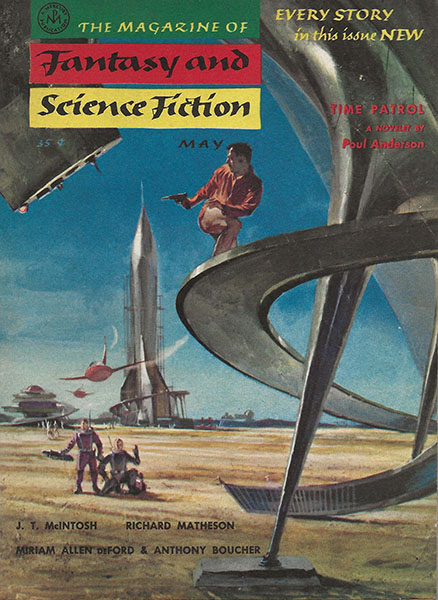
(Cover by Stanley Meltzoff. F&SF, May 1955.) Who Goes There?
Charles Beaumont was one of a generation of SFF writers who may have started out in the pulps, but who quickly adopted a style that allowed them to enter the slicks—possibly even attract mainstream attention. Beaumont debuted in the January 1951 issue of Amazing Stories with “‘The Devil, You Say?’,” which he would much later adapt into one of the more iconic episodes of The Twilight Zone, for which he was a prolific contributor. Like Ray Bradbury and Richard Matheson, Beaumont played fast and loose with genre conventions, but ultimately one could consider him a horror writer. It should come as no surprise that he would write a few scripts for Roger Corman movies, including an adaptation of his own novel (his only solo novel, sadly), The Intruder. In the ’50s and early ’60s he was one of the best short story writers, and his list of classic stories (“Perchance to Dream,” “The Jungle,” “The Howling Man,” etc.) is impressive.
No doubt Beaumont would’ve kept going, maybe even made his big break as a screenwriter, had a horrific illness (likely a combination of Alzheimer’s and Pick’s disease) not eaten away at his brain in the last few years of his life. He apparently looked and acted like a man who was pushing ninety when he died in 1967, at 38 years old. Beaumont’s early death is surely one of the more tragic losses in the field’s history, made worse because he stopped writing right before the New Wave kicked in. But today’s story, “Free Dirt,” shows a young and hungry Beaumont, arguably at the height of his powers as a short story craftsman. Here we’re presented with a ruthless and ironic horror yarn in the allegorical mode.
Placing Coordinates
First published in the May 1955 issue of The Magazine of Fantasy and Science Fiction, which is on the Archive. It has since been reprinted in The Graveyard Reader (ed. Groff Conklin), The Best Horror Stories from the Magazine of Fantasy and Science Fiction (ed. Edward L. Ferman and Anne Jordan), and now can be found pretty easily in the Beaumont collection Perchance to Dream: Selected Stories.
Enhancing Image
Mr. Aorta (what an odd name) is a scoundrel. I don’t mean in the sense that he chases after women or loves gambling, but that Mr. Aorta is a cheapskate to the point where he’ll dupe other people into not making him pay for anything. Beaumont set out to write a thoroughly detestable protagonist, but he had a challenge on his hands: making someone utterly loathsome without also making him a rapist or murderer. Now, Mr. Aorta is a thief, but being a thief doesn’t necessarily make you a bad person; rather it’s his devotion to cheating other people out of their dues that makes him a shithead. He sees thievery as like a craft. Consider how he has gotten not having to pay train fare down to a science: “Get in the middle of the crowd, look bewildered, inconspicuous, search your pockets earnestly, the while edging from the vision of the conductor—then, take a far seat and read a newspaper.” He doesn’t seem to have a job, instead living off all but picking other people’s pockets, even going so far as to impersonate a homeless man and ask for change whilst having his own house. You have to admit, this is rather monstrous behavior, and Beaumont does a great job at setting up his loathsome character for failure.
We know Mr. Aorta is greedy by his actions, but also by how he looks: he is described as grotesquely fat. I’m not even sure if this counts as a negative criticism, but I wanted to acknowledge it, since obesity has been used for centuries as shorthand for a few different meanings, though they are by no means exclusive. It depends on context, of course. More often an obese person is framed as being greedy and/or glutenous, especially with a penchant for overeating; more abstractly it can symbolize the infinite wealth-seeking of capitalist industry (when we talk about “fat cats” we’re talking about fat guys in fancy suits chomping cigars). More optimistically it can symbolize happiness or contentedness: Santa Claus is always depicted as rotund and the Buddha is sometimes depicted as quite massive, despite the historic Buddha certainly not having those proportions. In Beaumont’s story, Mr. Aorta is a miser in the truest sense of the word; he is the gold-hoarding dragon on top of the mountain; he is the penny-pinching capitalist taken to almost an unrealistic extreme. I wanna say this kind of fat-shaming is a product of the story’s age, but sadly you and I know fat-shaming continues to be almost a universal quirk of human behavior; even leftists, who really should know better, are not immune to it.
So how does Mr. Aorta get his just desserts? Because even from Anthony Boucher’s introduction we’re told that this is the story of a man who has, let’s say a deeply flawed worldview (that everything not nailed down belongs to him implicitly), and that this man is about to learn a very hard lesson. In that sense “Free Dirt” is nigh impossible to spoil, because both the author and editor allude to the protagonist’s comeuppance at the start. How does Mr. Aorta come to pick up mounds of free (cemetery) dirt by the truckload and what could possibly compel him? Obviously it’s the word on the sign: free. “What is the meaning, the essence of free? Why, something for nothing. And, as has been pointed out, to get something for nothing was Mr. Aorta’s chiefest pleasure in this mortal life.” Mr. Aorta borrows his neighbor Mr. Santucci’s (he has a first name, but I’m omitting it for the sake of consistency) truck and periodically dumps the free dirt in his backyard, where he intends to grow a garden with it. Think of all that free, furtive soil, never mind that it came from a cemetery, pay no mind to that. If this was a realistic story nothing untoward would happen to Mr. Aorta, but because he has the misfortune of living inside a supernatural allegory, he’s about to find out—too late—that he has made a grievous error.
There Be Spoilers Here
The garden scheme works—until it doesn’t. The free dirt bears Mr. Aorta vegetables until it stops, until the garden starts to degenerate. Desperate, he goes from taking cemetery dirt that was on offer to straight-up grave-digging—not graverobbing, but taking soil from dug but unoccupied graves in that cemetery. Little does he know he’s also digging his own grave. One night, in the backyard, his garden having been obliterated, he sees a solitary reminder of what his scheme was supposed to produce. “A white fronded thing, a plant, perhaps only a flower; but there, certainly, and all that was left.” He reaches for the flower, but soon finds himself at the bottom of a pit, just deep enough (and Mr. Aorta being physically weak enough) that he can’t quite get out of it. The comes the kicker: God has his vengeance. The flower, just out of his reach, now resembles “a hand, a big human hand, waxy and stiff and attached to the earth.” Then the dirt starts being piled on him. It’s a nasty way to go, being buried alive, but it’s about to get weirder.
Enough time has passed without word from Mr. Aorta that Mr. Santucci becomes concerned, despite not being exactly fond of the man. He turns out to not be in his garden where we would expect, but in his dining room—dead. Mr. Santucci and his wife think he had simply eaten until his stomach ruptured, but the autopsy finds that Mr. Aorta’s stomach is filled—several pounds’ worth, maybe—with dirt. How could he have eaten that much dirt, or indeed more than a little of it? The idea of choking on dirt is horrifying enough. But then if he died in the garden like we were led to believe then how did he get back inside his house? These are troubling questions and Beaumont’s not giving us the answers. “He tried to get rid of the idea, but when the doctors found Mr. Aorta’s stomach to contain many pounds of dirt—and nothing else—Mr. Santucci slept badly, for almost a week.” Clearly we’re not supposed to expect a realistic or plausible answer, but simply to accept that the dirt is somehow cursed and that God (or some other power not to be toyed with) has reaked vengeance on Mr. Aorta. It’s an allegory—a fairy tale about a man being undone by his own greed.
A Step Farther Out
It’s been a few days since I had read this story (bit of a long explanation), so the visceral discomfort I felt with the ending has since softened. With that said, its effectiveness is undeniable. The style is indicative of slick fiction of the ’50s, and in that sense it shows its age, but with a bit of finesse it could feasibly be published today. Beaumont seemed preoccupied with the inner darkness of man, whether it be greed or the inability to connect with one’s brethren, and “Free Dirt” is a succinct example of Beaumont as a moralist—not the good-tempered Sunday school teacher but the righteous vengeance of the Old Testament God.
See you next time.
-
The Observatory: In Dune, All Colonizers Are Bastards

(From Dune: Part Two, 2024.) (I wrote a lengthy Letterboxd review of Dune: Part Two when I first saw it, and since I figured I would make many of the same points here as there I could reuse that review—with some revisions. Needless to say I’ll be spoiling both parts of Denis Villeneuve’s Dune, as well as Frank Herbert’s Dune and Dune Messiah.)
You can’t seriously discuss Dune without spoiling it, but then Dune is kinda hard to spoil. If you’ve read the book or seen the ill-fated David Lynch adaptation then you already know the plot beats—up to a point. Even if you weren’t already familiar with the source material, the broad strokes of the plot aren’t hard to predict. Dune has been a sacred cow among genre fans for over half a century, and I’m pretty sure its success lies less in the story it tells (although I’m informed the series gets increasingly unhinged) and more in the manner of the telling. I’d argue Frank Herbert was not a great line-for-line writer, but he had a knack for worldbuilding, such that any adaptation of Dune has the unenviable task of making all this lore digestible. Dune: Part One (I’m calling it that now) was reasonably faithful to the book, albeit with some streamlining; but while, broadly speaking, Part Two does the same, there are some major deviations that have a ripple effect, resulting in an ending that feels profoundly different from the book’s, not to mention leads much more smoothly into Dune Messiah. Of course, there are changes that necessitate the inevitable Dune Messiah movie being quite different from its source material right out the gate.
Denis Villeneuve and his co-writer Jon Spaihts turn what was, on a casual reading, a very happy ending in Herbert’s book into something much more sinister. Paul Atreides transforms into a villain the likes of which even Baron Harkonnen could only dream of being. This has always been true, really, because the jihad Paul inspires kills billions through war and famine, and this has always been the case. The implications are very different, though. In the books the jihad grows into something far beyond Paul’s control, picking up an inertia that he’s blind to until it’s too late. Dune Messiah is Paul realizing he has inadvertently become Space Hitler™. (Have we mentioned this is basically a retelling of Oedipus Rex, minus the mother-fucking?) In Villeneuve’s Dune, Paul not only becomes Space Hitler™ by the point at which the first book ends (in the book he retains his heroism), but becomes Space Hitler™ knowing in advance that his actions will lead to mass death on an interplanetary scale. And he doesn’t seem to care anymore. He has given in completely to the “prophecy” which he and his mother Jessica actively played into, has given up Chani, and willingly becomes ruler of the known universe because, at the end, he is a bastard.
Dune: Part Two might be the most fatalistic blockbuster ever made. With Hollywood filmmaking there’s always a sense of the outcome being preordained, of the good guys winning and whatnot, but this movie turns such an expectation on its head by making it clear to the audience partway through that Paul, the hero of the story, will turn evil. Paul learning the ways of the Fremen takes about five years in the book; enough time passes that he and Chani have a son. But in the movie the timespan is crunched from five years to maybe five months. This time crunch is controversial among fans of the book, and I can see the argument, but ultimately I think it works in favor of the film’s sense of fatalism. The results of the time crunch are profound: Paul and Chani never have Leto (the first time), Paul’s sister Alia isn’t even born by the movie’s end, and the Fremen becoming violently militant becomes less something that happens without Paul even noticing at first and more a train coming right towards him at full speed. The jihad becomes a rocket that has not quite reached its target but is getting there, second by second, guaranteed to hit its mark.
This is not a perfect movie, but it is very interesting, especially for someone who has read the first two Dune books. I know Villeneuve wants to adapt Messiah but then stop there, and I suspect how he’s gonna wrap things up neatly there so as to make a trilogy out of this adaptation. It’s funny because by making Chani a denier of the prophecy, by not having her be all but married to Paul, indeed by having them break up at the end (she looks so dejected; it really is one of the most vivid depictions of heartbreak I’ve seen in a major Hollywood production), she seems to be set up as the real hero of Messiah. Which hey, might be good for her in the long run! If you’ve read Messiah then you know things do not turn out well for Chani, so her getting cucked here might be for the best. I will say, having Chani only show up at the end of Part One and having their relationship start from there means the romance in Part Two is a bit rushed. It’s a quibble, but I understand if people get bent out of shape over it.
Speaking of which, it boggles my mind that this is only about ten minutes longer than Part One, since way more happens. If people thought Part One was slow (I didn’t) then Part Two should be understood as course correction. This is a packed 166 minutes. This is still like 25 minutes shorter than Avatar: The Way of Water but feels about the same length (because nothing happens in that movie, for all its length). Incidentally, this is an anti-Avatar, thematically. You could like both movies, but understand that Avatar and its sequel play the white savior narrative completely straight while Dune very much subverts said narrative. Paul is the foreigner who will save the Fremen, fulfill their prophecy, and help them take back their home planet. Oh, he’ll save them alright—at the expense of much of life in the known universe. I know people have memed about it, but this is the most sinister character arc in a Hollywood Blockbuster since the Star Wars prequels; but ya know, with writing that doesn’t suck and without the audience already knowing the hero-turning-villain will ultimately redeem himself. I’m honestly unsure if Paul will reckon with the damage he’s done in the Dune Messiah movie.
What’s funny is that looking back on both parts, the most decent members of House Atreides are Duke Leto and Duncan Idaho, both of whom die in Part One (although I assume the latter will return in Dune Messiah). Leto dies about halfway through Part One, having been ambushed by the Harkonnens in the middle of the night. What’s interesting about Leto is that despite his position of authority he does seem like a genuinely good man: he loves Jessica as if she were his legal wife, he cares for his son deeply despite Paul technically being a bastard, he doesn’t seem to have any beef with the Fremen, and he really does wanna make the best of a bad situation by setting up a colony on Arrakis. He wants to colonize the planet “the right way,” and dies for it, his efforts getting wiped out literally overnight. The films posit there is no “right way” to colonize; if you fail then so much the worse for you, but if you succeed then mass death is virtually guaranteed. Westerners have been trying to colonize parts of the world since the 16th century, resulting in the eradication of indigenous peoples (we see one such example in progress with the Palestinian genocide), yet despite centuries of evidence to the contrary we still think there’s a “right” way.
Do I like Part Two more than Part One? Hmmmm. I still think my favorite stretch out of all of Villeneuve’s Dune is the first hour of Part One. Ya know, the stretch of that movie that has no fucking action to speak of and which people complain is too slow. I know, weird, but the best moments in these movies show Villeneuve as someone who keenly understands visual storytelling, worldbuilding, and also just science fiction as an ethos. He’s a genuine fan of the genre and you can feel it in each of his SF movies. I still think Arrival is his best (it’s arguably the best SF movie of the 2010s), but I’m also curious how he will try to make Rendezvous with Rama compelling for modern movie audiences. (I like the novel a lot, but modernizing it and giving it a sense of actual stakes will be a challenge.) He will get at least a Best Director nomination at the Oscars next year and I will eat a fucking shoe Werner Herzog-style if he doesn’t.
-
Short Story Review: “Mousetrap” by Andre Norton

(Cover by Kirberger. F&SF, June 1954.) Who Goes There?
For readers of a certain generation, Robert Heinlein’s juveniles got them into science fiction at an early age; for others (and indeed the two are by no means mutually exclusive), it was Andre Norton. Born Alice Mary Norton, she had her name changed legally to Andre Alice Norton when she started to write in the ’30s, although she didn’t make her SFF debut until 1947. She also sometimes wrote under the pseudonym “Andrew North.” With a career that spans more than half a century, Norton was incredibly prolific, with her Witch World series alone probably taking up a whole shelf or two. Along with the likes of Fritz Leiber and Poul Anderson she made an impression writing both science fiction and fantasy.
I’ll be the first to admit I have not yet read any of Norton’s novels, and have only read a few of her short stories. Funnily enough, for how much she wrote overall, Norton wrote comparitively little short fiction, and even less of it appeared in the magazines. “Mousetrap” is a very short Martian odyssey from Norton, so fittingly I won’t be keeping you long with this review. It’s one of those vignettes that carries a nasty little sting in its tail. It’s also the kind of soft SF that easily found a home in F&SF‘s pages in the ’50s—not fantasy, but not something to think seriously about.
Placing Coordinates
First published in the June 1954 issue of The Magazine of Fantasy and Science Fiction, which is on the Archive. Some of Norton’s work has fallen into the public domain, but “Mousetrap” has not. You can find it in The Many Worlds of Andre Norton, The Book of Andre Norton (same collection, different title), Wizards’ Worlds, and The Prentice Hall Anthology of Science Fiction and Fantasy (ed. Garyn G. Roberts). Oh, and it was included in The SFWA Grand Masters, Volume Two (ed. Frederik Pohl).
Enhancing Image
Mars has become like a wonderland for explorers, for several reasons, but a big one is we know we’re not alone in the universe. People haven’t found talking aliens exactly, but they’ve found the petrified bodies of alien creatures, “sand monsters,” that stand in the desert, encased with some details of their anatomy hidden. Only problem is taking one of these monsters to some research center. The monsters, “which can withstand the dust storms, the extremes of desert cold and heat, crumble away if so much as a human finger tip is poked into their ribs.” The bright side is being able to hold one of these monsters together means big money. (Bit of an aside, but I would have to go digging for an earlier usage of “Space Marines.” I’m sure this is not the first time, but mind you this was before “military SF” was even a concept.) Enter our three main characters: the narrator, Sam Levatts, and Len Collins. Sam is a local drunk, but he’s courageous, and he knows more about these monsters than the average person. Thus Operation Mousetrap, an effort to nab one of these monsters, is underway.
Some days ago by and the expedition Sam and Len go on doesn’t turn out well. Sam shows the narrator a picture he had taken of one particular sand monster: what appears to be a humanoid woman, with wings. Is she is a human mutant or some humanoid alien we don’t know about? Impossible to tell, but the narrator admits she’s lovely; unfortunately she’s also dust now. Len, in an effort to secure the winged woman, had destroyed her. This is important to remember, since does set up a certain action Sam takes at the story’s end. It also raises a question: Where do these monsters come from? They seem to be of different species, possibly not native to Mars, yet you can barely find anything in the desert, let along a secret civilization of humanoid aliens. Norton implies a lot while saying little. As the narrator says, “the desert dry lands haven’t been one quarter explored,” and similarly “Mousetrap” is a very short (I would say 3,000 words or less) story leaves much territory unexplored. This is not necessarily a bad thing: while the narrative of the narrator and the explorers is self-contained, with a neat twist ending, the setting is vast. There’s not much worldbuilding you can cram into such a small space, but Norton manages.
Something else that stuck out to me was Norton’s style, which struck me as overtly masculine—with a little twist or two in there. Boucher and McComas are upfront in their introduction in calling Norton a woman, which is important because this was still early in her career and people were still prone to thinking “Andre” was a man. I forget if it was a review the came out the same year as “Mousetrap” or a year later, but P. Schuyler Miller, in writing about one of Norton’s anthologies, apologizes for having misgendered her previously. What a nice guy. Still, this is a deeply masculine narrative: there aren’t any female characters with lines, and as the narrator points out, the few women who have come to Mars tend to not be much to look at. Yet the female monster Sam is obsessed with is practically deified, and perhaps more tellingly, her femininity is deified, her body sporting “the distinctly graceful curves we have come to associate with the stronger half of the race.” In old literautre I’m so used to women being called the “fairer” or “weaker” sex that I had to reread this passage to make sure I got the narrator’s remark right. For the narrator it’s perhaps a moment of self-deprication, but Norton it feels like an ironic stattement.
And as we find out in the short span of this story, men do seem to be (at least in some ways) the weaker sex in Norton’s world. Sam is a drunkard, Len is a manipulator, and the narrator is maybe a little too content to stay in his bar (the Flame Bird), away from the adventure of the desert. The winged woman, a symbol (at least for Sam) of feminine perfection, is undone by a man’s touch, and so much be avenged. The title takes on a double meaning as the petrified monsters aren’t the only things being trapped. It’s not exactly a funny story (ultimately it’s a dramatic tale of revenge), but it’s written with a biting irony Boucher and McComas would’ve liked; of anything it reminds me of a minor Henry Kuttner story.
There Be Spoilers Here
I mentioned earlier there is certainly alien life on Mars, although it doesn’t have to be humanoid or even something with limbs. Sometimes it’s just a little green lump—a blob—that looks harmless to the uninitiated. Sam knows these parts better than Len and decides to use this to his advantage. Appatently, aliens of all shapes and sizes have gone through the desert and come across these green blobs, maybe even touched them out of curiosity. The blob turns Len into “a featureless anthropoidic figure of reddish stuff,” like the winged woman in the picture, and Sam uses Len’s own gooing equipment to stabilize the petrified Len. Sam is so cold in basically killing a man that the narrator is too stupified to object—and anyway, he might get a bit of the profit. The natives of Mars, though looking harmless, have a very strange defense mechanism. I had to reread the last page or so to understand fully what happened here (it is maybe too brief for its own good), but I’d be lying if I said Norton’s “solution” to the problem of the sand monsters wasn’t inventive. The introduction’s comparison to Stanley G. Weinbaum’s “A Martian Odyssey” makes sense, if only because the conclusion feels like something Weinbaum would’ve imagined.
A Step Farther Out
Not much to say about this one, other than I admire Norton’s ability to imply a future world while also showing very little of it. The Mars of “Mousetrap” feels fleshed-out despite the fact that this is a one-off story that’s only half a dozen pages long. We’ll never return to this setting again, yet it seems like part of a much larger universe. It’s almost like Norton had a talent for such things, hence why she mostly wrote series.
See you next time.
-
Short Story Review: “The Silken-Swift” by Theodore Sturgeon

(Cover by Mel Hunter. F&SF, November 1953.) Who Goes There?
Theodore Sturgeon was, for one or two spans of time, arguably the best American SFF writer in the business. It can be hard to judge Sturgeon’s career as a whole since he had periods of inactivity, and health problems seemed to prevent him from writing much in the last decade or so of his life; but when he was on the ball, he was on it. Unlike most authors in the pulp days, who tended to specialize in SF or fantasy, Sturgeon was great at both, and sometimes his fiction can be hard to categorize. Sadly he never broke into the mainstream like Ray Bradbury, despite some brushes with notoriety, such as his involvement with Star Trek. (His second episode for the original series, “Amok Time,” is one of my favorites.) He is the one who coined Sturgeon’s Law, although it was originally called Sturgeon’s Rule: 90% of science fiction is crud, but then 90% of everything is crud. This rule, however, does not apply to Sturgeon’s own work. He was, for my money, one of the best short story writers of the 20th century.
The ’50s can be thought of as Sturgeon’s heyday, and 1953 especially might’ve shown Sturgeon at the very peak of his powers. We saw his novel More Than Human, often considered his best (though I think the last third is comparatively weak) and which won the International Fantasy Award; and there were such iconic short stories such as “A Saucer of Loneliness” and “The World Well Lost.” “The Silken-Swift” is not as well-known as those stories, likely because it’s fantasy (which has always had an uphill battle when it comes to short fiction) and a more demanding read. It’s totally possible to read “The Silken-Swift” casually and not understand what’s happening at first. This is Sturgeon’s writing at its most controlled and layered, and unsurprisingly he would later regard it as one of his personal favorites. He wrote it as basically a fairy tale for adults, and it was such a success that it’s still one of the best of its kind. This is a Sturgeon who has reached full maturity as both a person and artist.
Placing Coordinates
First published in the November 1953 issue of The Magazine of Fantasy and Science Fiction, which is on the Archive. In A Saucer of Loneliness, Paul Williams says this story’s magazine publication happened simultaneously with its inclusion in the Sturgeon collection E Pluribus Unicorn, although ISFDB doesn’t give a publication month for the latter. However, the introduction in F&SF says it precedes the collection by a month, with “The Silken-Swift” being a teaser for E Pluribus Unicorn. Where else has it appeared? Unicorns! (ed. Jack Dann and Gardner Dozois), The Fantasy Hall of Fame (ed. Robert Silverberg), Masterpieces of Fantasy and Enchantment (ed. David G. Hartwell and Kathryn Cramer), and The Oxford Book of Fantasy Stories (ed. Tom Shippey), to name a few.
Enhancing Image
The story incorporates a poem not written by Sturgeon, titled “Unicorn.” It was written by Christine Hamilton and seemed to have been unpublished prior to “The Silken-Swift.” Now who is Christine Hamilton, you may ask? I assumed maybe she was one of Sturgeon’s wives or mistresses, but she was actually Sturgeon’s mother, and she was herself a writer, albeit mostly unpublished. It’s cute that Sturgeon would incorporate his mom’s poetry into a story that is ultimately about womanhood—not that Sturgeon considered himself a feminist, as far as I can tell, but he did sometimes write about women’s struggles under patriarchy. He didn’t write about systemic injustice so much as things like hypocrisy and arbitrary restrictions on how women “ought” to live their lives. He seemed to think highly of “The Silken-Swift” among his own works because its theme was (and sadly will probably always be) prescient. I don’t think it’s a coincidence that out of Sturgeon’s heyday, this story might’ve aged the most gracefully.
So, the plot. I won’t get too deep into it, since it’s a dense narrative and there seems to be some confusion (from reactions I’ve seen) as to what actually happens in “The Silken-Swift.” I also had a concussion a few days ago and am still recovering from that, so sadly I won’t be writing about this as much as I would’ve liked. We have three main characters: Rita, a squire’s daughter who lives in a manor; Barbara, a vegetable saleswoman who lives near said manor; and Del, a brash man “whose corded, cabled body was golden-skinned, and whose hair flung challenges back to the sun.” Rita and Barbara live in the Bogs, right outside town, with a “pool of purest water” by the manor; be sure to remember this last part. At the beginning, Del is sort of lured to the manor while the squire himself and the servants have gone out, leaving just Rita, who takes Del in—although not to do with him what he expects. The two have a good time at first, but before Del can get to second base, Rita plays a rather cruel trick on him (she apparently has been toying with witchcraft) by blinding him. Her reasoning is that no man shall have her—that she will remain a virgin so that one day she can catch a unicorn; this is taking teasing to extreme levels, you have to admit.
After Rita’s catch-and-release routine with Del, she kicks him, still blinded, out of the manor, and it’s here that we meet our other female protagonist. It’s also here that Sturgeon does something very strange for a work of prose fiction, although it does tie into the poem at the story’s center: he repeats himself, a whole paragraph, literally word-for-word. We’re introduced to Barbara twice. I had this feeling of recurrence when reading, so I had to copy-paste these two introductions just to see if my brain (which had just been rattled, mind you) was fucking with me.
The first time:
Deep in the Bogs, which were brackish, there was a pool of purest water,
shaded by willows and wide-wondering aspen, cupped by banks of a moss
most marvelously blue. Here grew mandrake, and there were strange
pipings in midsummer. No one ever heard them but a quiet girl whose
beauty was so very contained that none of it showed. Her name was Barbara.Then the second time:
Deep in the Bogs, which were brackish, there was a pool of purest water,
shaded by willows and wide-wondering aspens, cupped by banks of a moss
most marvelously blue. Here grew mandrake, and there were strange pipings in midsummer. No one ever heard them but a quiet girl whose beauty was so very contained that none of it showed. Her name was Barbara.This tactic might not work for some people, and it might seem like padding (this is not exactly a long story in the first place), but it fits with what Sturgeon is going for, which is a sort of narrative prose poem. Sturgeon can at times try too hard with his style, but this might be the single best use of poetry (actual poetry on top of poetic prose) in his writing. The setting is definitely medieval fantasy, but aside from the squire’s manor and the elusive unicorn at the heart of the story this feels detached from any one time frame; it doen’t feel like a stereotypical medieval fantasy setting because there’s basically none of the iconography we’ve come to associate with such a setting. The Bogs are a place that could exist, and the three central characters feel like they could be modeled on real people, despite very much fitting into archetypes appropriate for an allegory. “The Silken-Swift” is ultimately an allegory, if a rather indirect one, with a clear message that floats to the surface despite details of the plot being obscured. Simply put, it’s a story that has not aged, which can’t be said for the vast majority of literature, although fantasy does have a much easier time detaching from the circumstances of its making than science fiction.
As for Barbara’s side of the story, this is where people seem to get confused, and admittedly Sturgeon uses some obtuse language to skirt around a horrific event that, if written today, would probably be described in more visceral terms. Something I realized while reading is that Rita and Barbara are like mirror images of each other, to the point where they could be related. They’re similar enough, or at least sound similar enough, that a blinded Del confuses Barbara for Rita; this will turn out to have very bad consequences for Barbara, since Del, having just been kicked out of the manor and not knowing where he is, is out for revenge. Barbara does her best to care for an injured Del (who, as far as she knows, is just a dude who had something bad happen to him), but Del does something. Is it rape? Probably. It happens so quickly and is so indirectly described that you could miss it on a casual reading, which is one gripe I do have with this story (because nothing is perfect): either out of artfulness, getting around censorship, or likely both, Sturgeon’s language can be a little opaque.
Get this:
Once she cried out.
Once she sobbed.
“Now,” he said, “you’ll catch no unicorns. Get away from me.” He
cuffed her.“You’re mad. You’re sick.” she cried.
“Get away,” he said ominously.
Terrified, she rose. He took the cloak and hurled it after her. It almost
toppled her as she ran away, crying silently.You might not even know something had happened if you’re not reading carefully; but credit where credit’s due, Sturgeon implies a great deal in just a few lines. If Barbara was a virgin before then she apparently isn’t one now. Del does something pretty heinous, but it’s also hard to gauge how in control of his own actions he is, given he’s evidently still under the effects of Rita’s witchcraft and is so delirious that he thinks Barbara is Rita; but also the fact that he wanted to rape Rita in retaliation for the witchcraft is inexcusable. Barbara becomes a victim of Del’s abuse and, more indirectly, of Rita’s treachery; but despite all this she retains her sense of virtue, which is important to remember. Unicorns have often been treated in mythology as embodiments of purity, and indeed associated with purity; in the case of “The Silken-Swift” this purity is assumed to mean one’s virginity. Sturgeon, however, asks a simple question: What really counts as “pure?” Rita thinks herself pure, but she’s also a major bitch; meanwhile Barbara is the victim of sexual assault, yet is no less “pure” for it.
I wanna say the message of the story (because like all allegories it does have a clear message, for all its indirectness of style) is the one way you could date it, but unfortunately the message is evergreen. Women’s “purity” is still obsessed over in practically every major society you can think of, regardless of how authoritarian or libertarian the society’s governing system is, and regardless of the majority religion. Misogyny is always here, and might always be here on a systemic level. Among the many ways trans women are dehumanized is to frame them as sex-hungry monsters who prey on “innocent” cisgender women; and of course there’s no such thing as a “pure” trans person, because if you “violate” gender norms then you have already lost that claim to purity. (Never mind that a truly horrifying number of genderqueer people are victims of sexual assault.) Even some liberal-minded people feel threatened somehow if a women has had “too many” sexual partners in the past—if they aren’t reserved enough for their current partner. Sturgeon says this is all bullshit, and while yes the implication of sexual assault is not kid-friendly, this really is, in its subject matter and complexity, a fairy tale “for grown-ups,” as Sturgeon said of it many years later.
There Be Spoilers Here
I don’t even wanna get into spoilers, honestly.
Read it for yourself.
A Step Farther Out
Earlier in my review I said “The Silken-Swift” has not aged, which is not the same thing as saying a work of literature has aged gracefully. Most literature, indeed most great literature, is firmly rooted in the circumstances under which it was written, whether it be the author’s personal baggage or societal norms of the time and place. This in itself is no disgrace. Dhalgren could’ve only been written in the late ’60s through the post-burnout ’70s. The Crying of Lot 49 could’ve only been written during that short period in the ’60s following John F. Kennedy’s assassination and the Beatles landing in America, but before the Vietnam War escalated. Even fantasy, which tends to be more timeless than other genres, is not always excempt. The Once and Future King was clearly written in reaction to the horrors of the Great War and, later, World War II. But “The Silken-Swift,” in both its conception and its message, is timeless; you can’t put a date or place on it. Sturgeon, despite being most known for his SF, was really more comfortable as a fantasist, and I think this is a prime example of such talent.
See you next time.
-
Short Story Review: “The Shout” by Robert Graves

(Cover by George Salter. F&SF, April 1952.) Who Goes There?
Robert Graves was, like Ernest Hemingway and J. R. R. Tolkien, is a writer whose subject matter of choice is inexptricably linked with having survived the horrors of World War I. His wartime experiences would more or less shape his career as a writer, resulting most tangibly in his first commercial success, his memoir Good-Bye to All That. Also like Hemingway, Graves was a hot mess: his first marriage was a disaster, and he had an intense homosexual relationship (he was a messy bisexual like yours truly) in his youth that did not end well. Then there was the PTSD from his time in the war, which no doubt strained things. He was involved in a sort of love triangle, between his first wife and fellow writer Laura Riding, in the ’20s when he and Riding were still early in their careers. Incidentally (or maybe not), Graves would write “The Shout” during a rather fraught period in his relationsip with Riding. Be sure to put a pin in that one.
Graves considered himself an Artist™, someone who was genuinely interested in the classics, and unlike the vast majority of writers he achieved real commercial success. Good-Bye to All That was popular, but I, Claudius and its sequel Claudius the God became major bestsellers that are still talked about and considered some of the best fiction of the 20th century. Undertandable! These two novels are great, and they are what convinced me to read “The Shout,” which is easily the most famous out of Graves’s relatively small body of short fiction. It even got adapted into a film of the same name, which is decent but which I think loses much of the story’s psychological density; or rather much got lost in translation.
Placing Coordinates
“The Shout” was first published in 1929 as a chapbook. It was reprinted in the April 1952 issue of The Magazine of Fantasy and Science Fiction, which is on the Archive. It has the unusual honor of appearing in F&SF twice, the second time being in the May 1959 issue, which you can find here. Prior to its first F&SF appearance it saw book publication in the Graves collection Occupation: Writer. It’s been anthologized quite a few times over the years, but seems to have gone scarce recently.
Enhancing Image
An unnamed narrator visits an asylum and has a chat with Charles Crossley, who we’re told is highly intelligent but has one or two delusions. Immediately we know something is up because Crossley thinks he was arrested for the murders of three people, and as we find much later on he recounts these happening; but apparently they didn’t. Or did they? The other delusion, “which is more humorous,” is that he thinks his soul has been broken into four pieces. How did this happen? How did he get thrown into a mental hospital? Crossley is all too happy to tell us, and about a certain couple who, not coincidentally, the narrator is friends with. In fact all three partiers know each other. Most of the story is Crossley’s monologuing to the narrator, and this is important to remember because Graves is gonna play some tricks on us. Unreliable narrators get brought up constantly in literature classes, and Crossley is a good example.
Through Crossley’s narration we’re introduced to Richard and Rachel, and right away I was weirded out a bit because Rachel is my therapist’s name. Anyway, they’re pretty comfortable with each other, married in sort of the European sense (they admit having crushes on other people, but never actually commit adultery), to the point where they discuss their dreams with each other regularly. The latest one is a doozy, not least because somehow they both the same dream at the same time. “We not only live together and talk together and sleep together, but it seems we now even dream together,” Richard says wistfully, although the dream will turn out to be foreboding. A man with a black handkerchief wanders the sand dunes on the outskirts of town, and this man turns out to be Crossley in the waking world. Richard and Crossley meet after church one day and, after tormenting some kids, Crossley wedges his way into the couple’s lives. He’s charming, and yet also uncanny. He claims to have spent eighteen years in the Australian outback, hanging out with the indigenous population, and in that time learning a few tricks—the biggest of these being a “terror shout.” One degree of it will drive you mad, another will kill you.
Crossley claims to have used the shout before, but Richard is skeptical. Rachel, not so much. In a sense you’ve seen this plot before: strange outsider reeks havoc on the lives of an unassming middle-upper class family, no doubt the author saying something about class or sexuality or whatever. If you’ve seen Pier Paolo Pasolini’s Theorem, or more recently Saltburn, you can guess the trajectory of the plot—only you would still be wrong to a degree. I think the love triangle aspect, in which Crossley inevitably cucks Richard and keeps Rachel to himself (though she later claims she was just joshing), is the least interesting part of it, it does make sense when you consider Graves’s chaotic love life at the time. He admitted to seeing himself as Richard in the triangle, with Laura Riding presumably being the inspiration for Crossley. Curious that the woman in the real-world equation is replaced with a man. The tension between Richard and Crossley is certainly not what you would think of as between two straight men, although maybe I’m projecting Graves’s queerness here. Richard’s interest in getting a demonstration of Crossley’s shout could be thought of as like a man propositioning another man for a sexual act. Richard surviving the shout (he puts wax in his ears ahead of time, unbeknownst to Crossley) marks the turning point of the story, but it also serves as a point of no return—as if Richard and Crossley have had sex by some strange proxy, and indeed it’s here that the story becomes hard to decipher.
So about the stones. There are stones scattered across the sand dunes, which Richard finds may not just be ordinary stones. Following the shout, he picks up a stone and it’s like his mind is suddenly filled with information he couldn’t possibly have known before. “He began to think about shoemaking, a trade of which he had known nothing, but now every trick was familiar to him.” He tosses the stone out of fright and just like that, his knowledge of shoemaking leaves him. Things get even weirder when he later talks with the town shoemaker and the other man recalls the sensation of having been thrown suddenly by some unseen force. If what Richard suspect is right then every person in town is connected with a stone in the sand dunes, as if each person’s soul were not in their own body but kept away in these inanimate objects. This means Richard and Rachel have their own stones that their souls are linked to, and maybe the same can be said of Crossley. This reads as insane, if taken literally, but remember that Crossley is now telling us this as someone whose stone has been broken into pieces. The stone breaking could be a metaphor for severe mental trauma, which Graves would know a thing or two about. I know a few people whose personalities have fractured from PTSD, and when understood that way Crossley’s case does not seem as outlandish. But still, it’s surreal.
There Be Spoilers Here
Cucking Richard is good a good idea, especially if he finds the stone your soul is connected to. Crossley loses his mind and is promptly arrested for having killed three people in Australia—only we know he wasn’t arrested. At the asylum, Crossley suddenly loses it again and threatens to use the shout when a doctor detains him—and then something very weird happens. A storm kicks up and the narrator narrowly survives what seems to be a burst of lightning that touches down, killing both Crossley and the doctor. It’s unclear if the shout is what killed the doctor or the lightning bolt, since he’s found with his fingers in his ears. Did Crossley somehow conjure lightning or was it a hell of a coincidence? But then we get to the weirdest part. The narrator meets up with Richard and Rachel (the real couple, divorced from Crossley’s perspective), and they react with horror to the doctor dying (they knew him) but barely react to Crossley dying. They claim to have met him only once, casually, as he was putting on a magic show. Unsurprisingly perhaps, Crossley did not have intimate knowledge of the couple like he claimed to have.
Normally this would be where such a story would end, but Graves gives us one last little mindfuck of a line that I’ve been thinking about since then. Rachel says that Richard didn’t like Crossley’s magic show, and Richard (again, the real Richard) says, “‘No, I couldn’t stand the way he looked at you all the time.” Last line of the story and we’re left with a lingering quetion or two. How much was Crossley making up? Did more happen between the three of them than the couple at the end are letting on? Is Richard more prone to jealousy than Crossley made him out to be? Certainly it would be insecure of him to be hung up on how a stage magician looked at his wife. It’s impossible to say because we don’t meet the real Richard and Rachel until the very end and they only have a couple lines; at the same time those lines are telling. Crossley claimed Rachel visited him at the asylum but at the end the two don’t seem to have ever met him past the one time, unless we take Richard’s “all the time” remark to imply it wasn’t just the one time—that they really were intimate with each other. It’s intentionally confusing, and obviously that won’t sit well with all readers, but I’m a sucker for this kind of literary mind game.
A Step Farther Out
On the one hand I’m not sure how effective this story is as horror. The shout itself is not exactly scary (it’s even less scary in the movie, but that might a problem of trying to do it justice visually), and the supernatural element is more confusing than frightening. On the other hand, I’ve thought a lot about this story over the past few days. From a literary perspective, when trying to take in all the ambiguities (not to mention observations on mental illness) Graves packed into such a small space, it’s almost a masterpiece. I think it’s fascinating. It’s a good example of F&SF reprinting material by mainstream authors that fit in with the magazine’s MO.
See you next time.
-
Subscribe
Subscribed
Already have a WordPress.com account? Log in now.
 Science Fiction & Fantasy Remembrance