-
Short Story Review: “Everquest” by Naomi Kanakia
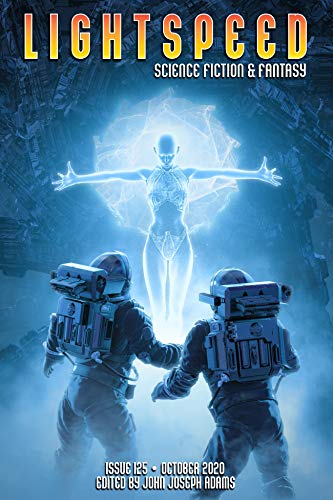
(Cover by GrandeDuc. Lightspeed, October 2020.) Who Goes There?
Naomi Kanakia is an Indian-American writer who has written extensively about queer issues, one of many writers to enter the field in the past decade or so who could not have been as open about their views on the world even twenty years ago. ISFDB doesn’t say this because these are non-genre works, but she has a couple YA novels out with another one, Just Happy to Be Here, due in early 2024 from HarperTeen. After reading today’s story I do recommend checking out an interview she did with Lightspeed about “Everquest.” Now, prior to reading this story I was under the impression it was science fiction, but upon reading it I discovered it was fantasy, and it’s even categorized as such in Lightspeed. Discussing how it is fantasy would be getting into spoilers, though, as it at first glance it’s simply a story of one lonely person’s connection with a certain video game.
Placing Coordinates
First published in the October 2020 issue of Lightspeed, which you can read online for free here. It was subsequently reprinted in the anthology We’re Here: The Best Queer Speculative Fiction 2020 (ed. C. L. Clark and Charles Payseur), which is so far its only book appearance.
Enhancing Image
“Everquest” is a short story, just over 3,000 words, so I won’t be keeping you long. It’ll take me longer for me to write this review than it would to read the story—although it certainly couldn’t have taken so little time to conceive. This is a densely packed little narrative about displacement in more than one sense of the word: being displaced from one’s home country, even displaced from one’s own body. Gopal is “a fat, acne-ridden dude” who at the story’s outset is barely in his teens and who has already accrued some online experience that one would normally regret to think about later in life, getting “married” in some online game to some random guy who would soon ghost him. “Gopal never thought about whether this made him gay or straight or trans or bi.” It’s unclear what Gopal’s orientation is and the narrative never bothers to clear it up because, really, it’s not that important; what’s more important is that Gopal does not see—or at least he does not want to see—himself as a man. Gopal plays a woman, when given the option, in every game he plays. Some would take this as merely an adolescent boy playing as girls so he can ogle them, but then—maybe not.
It becomes clear, at least early on and to the reader if not to the character, that Gopal is trans. I’m gonna be referring to Gopal as “he” here because that’s how the third-person narration refers to him, and I do think Kanakia is making a point by never having Gopal start the transition—at least not Gopal the flesh-and-blood person. Rather than try to transform himself he projects a more ideal image of himself through his game avatar—in this case Gayatri, a wood elf, in Everquest. (By the way, Everquest is never referred to by name within the story, although it’s kinda like how the spaceship the protagonist fantasizes about in James Tiptree’s “Beam Us Home” is very clearly meant to be the Enterprise.) As someone who has never played a second of Everquest and who has basically no interest in MMORPGs (for me personally it holds about as water as train simulators), I didn’t feel lost with what Kanakia was going for or what drew Gopal to the game. Anyone who has a played an RPG, or just a game that lets you customize your player character, has at least some inkling of what Gopal is going through. We’re thrown into the world of a vast role-playing game quickly and with so few words, but you don’t have to be a Gamer™ to grasp the meaning of those words.
I feel like I cheated by saying this, but reading the aforementioned interview drew my attention to something I probably would not have minded, as someone from a nominally Christian background, which is that “Everquest” is about self-actualization as mythmaking. There’s a juxtaposition between Hindu mythology and “mythology” in video games—ya know, like urban legends, memes, acts of daring do. It’s not a coincidence that Gayatri is a name from Hindu mythology, even if Gopal would say it is if you were to ask him. “He chose the name because it sounded pretty.” The connection sticks, though, and true enough Gayatri, the virtual wood elf, will become a sort of mythological figure in her own right. But more on that in a minute. It’s a strange connection because it’s like the name is an unconscious hand-me-down from Gopal’s Indian heritage, despite the fact that he doesn’t seem to be proud of his heritage, or of himself at all. Some things you can’t leave behind so easily. We attach meanings to names, whether we mean to or not. The important thing is that despite working with shitty internet, and being barely able to play the game, he does create one thing he’s proud of: Gayatri. He’s so proud of her he might wanna become her.
I sometimes reread passages of a story I’m reviewing, either because I was confused on a certain point or I found a line I thought especially memorable. There’s a lot of joy in rereading; people should do it more often. In the case of “Everquest” I was doing this a fair bit, which is easy because it’s such a short story, but also Kanakia crams a lot in here in often coloquial language. By her own admission she’s not one for lyrical prose. I can relate. At the same time this is a borderline fable whose intent is maybe a little muddled with a “modern” and at times salty lexicon. I was confused as to the time period this takes place despite it almost certainly beginning in the early 2000s, because the jargin seemed (at least to my ear) some years removed. I could be wrong. Maybe certain terminology was in use back in the kindergarten days of the internet. It’s just that I feel like by employing a style that is very of-its-time Kanakia dates the story more than was necessary; after all, why try to make it sounds cool and hip if this is just the reality we’ll be living for the foreseeable future. “Everquest” is about someone coming close to but not quite reaching a point of self-actualization in the early 2000s, when really it could be set in the 2010s, or the 2020s—or the future.
There Be Spoilers Here
For most of the story I was wondering when it might become fantastical or speculative, because up until the climax nothing strictly unusual has happened. You have a guy who gets sucked into a video game, to the point where he sees his avatar as like a reflection of his own character; then he gets taken away from the video game because his parents are concerned that he’s not in touch with the real world. You’ve heard this story before. But then Gopal, now an older man, after having been away from the game for years, gets an enigmatic email to have his account reactivated. (Because, you know, these MMORPGs are subscription-based. If you aren’t paying or you get locked out of your account, you can’t play online.) Then something very strange happens: Gopal dies. I mean he doesn’t just die, he basically starves to death, covered in his own shit, after playing the game for too long. Which is very cliche, really. I mean in the wrong context it sounds like ssomething a boomer would write for an anti-video game PSA.
But then… Gayatri keeps going. Without Gopal’s input. Without strings. Miraculously, and pretty inexplicably (hence this being fantasy and not SF, since we’re not given a rationalization for what is really a supernatural event), Gayatri becomes a real woman—within the confines of a game whose last servers will eventually shut down. It’s a finite second life. It’s bittersweet, but also a triumph in a weird way. Gopal doesn’t transcend reality to become his avatar so much as he gives up on his physical body to allow Gayatri to become real; him dying allows her to live. Not so much a transformation as a passing of the torch. I’m not sure if the final passage involving Gopal’s mom was necessary; it strikes me as a bit of sentiment, an attempt to tie a neat little bow on a narrative that could’ve benefitted from something else—maybe something more transcendent.
A Step Farther Out
In a sense this is fantasy; in another sense it’s inseparable from real life. The ending is the only thing keeping “Everquest” from being a “literary” character study, or a non-fantastical fable. While Gayatri taking on a life of her own in the game world is certainly beyond everyday reality, it doesn’t go beyond the threshold by much. Kanakia understands that people who were raised on the internet will inevitably develop online personas, and that these personas may even outlive the flesh-and-blood people who created them—figuratively, if not literally. The ending’s sentimentalism sort of downplays the eeriness of the game’s now-barren landscape and there’s this sense that a starker transhumanist narrative had been denied, so I can see why Kanakia is unsure about it. For a final criticism, and I think this is the best negative criticism one can give a story—I wish it was longer.
See you next time.
-
Serial Review: Falling Free by Lois McMaster Bujold (Part 1/4)
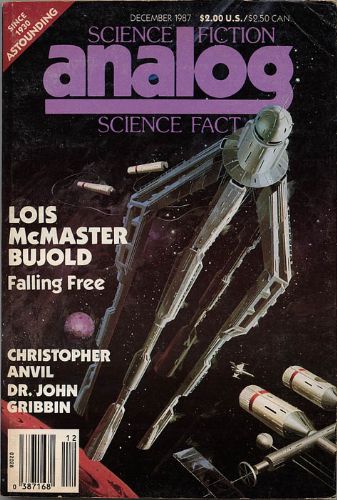
(Cover by Vincent Di Fate. Analog, December 1987.) Who Goes There?
I only first read Lois McMaster Bujold about a year ago, with the novella “The Mountains of Mourning,” a work that impressed me but didn’t bring me to dive deep into Bujold’s oeuvre so quickly. A lot of this has to do with Bujold’s work largely being connected to some series, or in the case of today’s novel the vast and not-so-chronological Vorkosigan universe. It would take too long to explain the backstory for this series, and anyway I haven’t read enough of it yet to be intimately familiar. Generally speaking it’s a space opera series which in parts follows members of the notorious Vorkosigan family, namely Cordelia and her son Miles. This series has won Bujold five out of her six Hugos (she is tied with Robert Heinlein for most Hugo wins for Best Novel, although Heinlein leads if we count Retro Hugos), and Falling Free, while not as renowned as some other entries, still won the Nebula for Best Novel. I’m enjoying it so far but I have to say this kind of novel winning the Nebula is a bit of an odd choice.
The premise is eye-catching right away, though, and I can already see how it would’ve gotten inducted into the Prometheus Hall of Fame, it being chiefly concerned with the rights of a race of genetically engineered humans. The quaddies, so called, are normal humans in most ways except they’ve been engineered to have four arms and no legs (or rather arms for legs), so as to make them more nimble in zero gravity; in fact they’re so monkey-like in their “natural habitat” that they’re sometimes called “chimps.” Yes, a company breeding a race of people for the sake of specialized labor sounds like a moral black hole, but that’s only the start of it!
Placing Coordinates
The first installment is in the December 1987 issue of Analog Science Fiction, which is NOT on the Archive but which can be found on Luminist. It’s still in print from Baen, both on its own and as part of the omnibus Miles, Mutants, and Microbes, which includes the novella “Labyrinth” and the later novel Diplomatic Immunity. Falling Free takes place a good deal before Miles’s birth but does apparently set up the backstory for “Labyrinth,” in which Miles meets the quaddies.
Enhancing Image
Leo Graf is a veteran engineer and inspector who has come to the Cay Habitat (named after its founder), a facility near the planet Rodeo, “the armpit of the universe,” on what amounts to a teaching assignment. Up to now the details had been kept foggy; Leo knows about “the Cay Project” but not what it entails. Dr. Cay himself had died a year ago, and in his place stands Bruce Van Atta, one of Leo’s former students, although it takes time for Leo to remember where they could have met before. What he manages to remember of Van Atta does not fill him with enthusiasm. “Was this sleek go-getter the same idiot he had kicked impatiently upstairs to Administration just to get him out from underfoot on the Morita Station project—ten, twelve years ago now?” And now this yuppie of the future is Leo’s supervisor for the Cay Project. What could go wrong here?
The question, though, remains as to whom Leo will be teaching while on the Habitat—a question that gets answered more suddenly and frightfully than Our Hero™ could’ve anticipated. We soon meet one of the young engineers on the Habitat, Tony, who is smart, spritely, willing to learn, about what you would hope for out of someone both young (only twenty years old) and talented. There is one problem: Tony doesn’t have any legs. Rather, he has an extra pair of arms where his legs would be, which nearly sends Leo into abject panic. Apparently nobody had told him in advance about the quaddies, the unusual denizens of the Habitat, and the people he is supposed to teach about welding in zero gravity. Leo thinks this condition is some kind of deformity, but Van Atta informs him that no, the quaddies (so they’re called) are supposed to be like this; they were genetically engineered by GalacTech, Leo’s company as well as the ones behind the Cay Project, in secret. This new race of people, who were at first created in test tubes but who have now taken to breeding naturally, “self-replicating” as Van Atta puts it, are designed to live and work in deep space.
Indeed Tony, who mind you is barely out of his teens and still one of the oldest of the quaddies, is already a father, raising his infant son Andy with his girlfriend Claire. All three are company property. The quaddies, strictly speaking, are not people, but assets of GalacTech; theoretically the company could have them killed without legal qualms if not for the fact that doing so would be blowing a lot of money. Leo’s viscerally troubled by the physiology of the quaddies but soon he becomes far more troubled by the fact that his own company has invented a new form of slave labor. Actually it’s a wonder that he’s not more disgusted by what’s going on, but then his job also depends on him keeping a cool head—or trying to. Things get thornier when we meet Dr. Sondra Yei, who has been working closely with the quaddies and conditioning them to not indulge in certain lines of thinking. At face value Yei is here to help prepare the quaddies for a life permanently cut off from 99% of humanity, but, although her intent doesn’t seem to be malicious, she seems to be here to reinforce a slave mentality.
Bujold doesn’t strike me as an ironist, but there’s a vicious bit of irony about Leo teaching the quaddies about safety procedures about shady company practices when they are literally the products of exploitation. How do you inform an audience about exploitation when said audience is slave labor and not even considered human by their creators? This sounds like a huge red flag, or rather a sign that maybe Leo should high-tail it out of there, but the conflict here is that yes, the situation is abhorrent, but Leo is also a devoted engineer who has been granted the opportunity to instruct a generation of people who were literally born and raised to be engineers. “The degree of censorship imposed upon the quaddies implied by Yei’s brief description made his skin crawl—and yet, the idea of a text that devoted whole sections to great engineering works made him want to stand up and cheer.” I know a few engineers and they’re all goddamn freaks; they see instruction manuals as a form of entertainment. Incidentally, despite the extreme dubiousness of the Cay Project, a love engineering still shines through, both in Leo’s thoughts and Bujold’s third-person narration. I mean if you put aside the slavery thing it’s really a technical marvel.
Leo being the protagonist is a logical choice since he’s the outsider in the narrative, a newcomer to the Habitat who at first doesn’t exactly side with either the people running the show or the quaddies, although it doesn’t take him long to sympathize far more with the latter. It helps that the quaddies are so innocent, despite the oldest of them already starting families and knowing a thing or two about sex and all that. Silver, a mutual friend of Tony and Claire’s, might be the most interesting of the ones we meet in how there is much more than meets the eye with her, but we’ll get to her more in the spoilers section. The characters—at least the ones we’re introduced to in this first installment—are largely at least understandable (you can understand someone’s motivations while still disagreeing with them), with only Van Atta being basically irredeemable. Of course Van Atta is a stand-in for the moral vacuum that is GalacTech. Actually I’m surprised a novel this ambivalent about corporate leeway was printed in Analog, but then again Bujold is a Baen regular despite apparently being liberal.
Right, so I should probably bring up why this novel blipped on my radar in the first place. True, I’d been meaning to get into Bujold, and a Nebula win is nothing to sneeze at, but I find it amusing that the people over at the Libertarian Futurist Society said, “Yes, this novel about the exploitation of a race of genetically engineered humans is the kind of shit we’re looking for in our mostly right-libertarian fiction.” I mean they have sometimes picked works by liberals and left-libertarians, but Falling Free doesn’t immediately stick out like, say, The Dispossessed, which is overtly a left-libertarian narrative. It’s less that Bujold is clearly arguing for the rights of man, whether that man has two arms or four (which I suspect is why it got picked anyway), and more the dimness with which she frames the creation of the quaddies. Van Atta may well be a Heinlein-esque figure in a different context, but here we see him as power-hungry and uncaring. If the story’s intend is to make us uncomfortable and even complicit in the mistreatment of the quaddies, but so far I think it’s a job well done.
There Be Spoilers Here
One problem with keeping a group of people in perfect isolation is that it’s impossible to do such a thing if there are outside forces; the other problem is that human nature is always at play, even if the humans came from test tubes. Tony and Claire wanna stay together, naturally, both because they love each other and for the sake of their son. The higher-ups don’t see it that way. In one has to be the most upsetting scene in the first installment, Dr. Yei informs the couple that they will soon be separated—not because they’ve done anything wrong but as some kind of “reward.” Claire’s done such a good job as a mother that she’s been granted permission for a second pregnancy ahead of schedule—with someone other than Tony as the father. “There is a Project-wide push to increase productivity. In all areas,” so Dr. Yei says. As for Tony, he will be shipped off and paired with a different quaddie woman for breeding. Dr. Yei justifies this monstrous procedure with the “Well it wasn’t my idea” justification; after all it was Dr. Cay’s idea and Dr. Cay is now dead, so who’s to blame really?
Meanwhile Silver has been getting intimate with normal humans on the sly—implicitly with Van Atta (or, more accurately, it’s implied she tolerates Van Atta’s behavior) and explicitly with Ti Gulik, one of the shuttle pilots who flies between the Habitat and Rodeo. There’s a great scene where Ti gives Silver a few books and a blouse as gifts, but Silver can’t accept the blouse since it would undoubtedly set off alarms that someone from outside the Habitat has been courting her. Sex between normal humans and quaddies is forbidden, or at least that’s an unspoken rule. Something that only just now occurred to me is that Van Atta clearly sees the quaddies as subhuman, even calling them “chimps” as times, but that doesn’t stop him from having an illicit affair with one—like a slave driver back in the old South. This comes back to bite him in a curious way at the end of the first installment. You see, the boss is coming in for a dog-and-pony show and three of the company’s prized assets have gone missing.
Knowing they’re to be forcefully separated, Tony and Claire take Andy with them as they hop on one of the shuttles (Ti’s shuttle, as it turns out) heading out as stowaways, they think heading for an orbiting station but which, due to a mix-up, is heading “Downside”—to Rodeo. The gravity nearly kills them but they manage to survive the trip, except now their problems are only just beginning. We get the deeply uneasy feeling that someone will get killed from all this. Bujold knows how to end an installment, with tensions having reached a fever pitch in all the plot threads; more impressively, I’m genuinely unsure as to where the novel will go from here. Granted, it could also be because I’ve been high-strung as of late, but I’ve found this to be an unusually tense and bleak novel for what is ostensibly hard SF.
A Step Farther Out
Falling Free was Bujold’s fourth novel, written during what must’ve been a white heat as it was her fourth novel in three years. True enough, she’s not trying to reinvent the English language here; this is not a novel you would read as a bit of prose poetry. The Nebula is often stereotyped as the award given to more “artsy” works, being a writer’s award, but there are a lot of populist novels that prove the exception (if there ever was a rule) and Falling Free is one of those accessible Nebula winners. Doesn’t matter, because unless Bujold fumbles the ball later on, I’m sold. I’ve been thinking about this novel for the past couple days and I’ll still be thinking about it when I read the next installment in a couple more.
See you next time.
-
Novella Review: “A Man of the People” by Ursula K. Le Guin

(Cover by Mark Harrison. Asimov’s, April 1995.) Who Goes There?
Ursula K. Le Guin made her genre debut in 1962, and for the next 55 years would stand as one of SFF’s most universally beloved writers. By 1970 she had started the two series that would cement her legacy: the Earthsea series and the Hainish cycle. The latter, when taken collectively, might be Le Guin’s crowning achievement, giving us such memorable novels as The Left Hand of Darkness and The Dispossessed, as well as some of her best short fiction, including “Vaster Than Empires and More Slow.” Le Guin put the series on hold in the latter half of the ’70s, and generally the ’80s saw her write only sporadically; but then in the ’90s she made a grand return, not just to the Hainish cycle but to Earthsea as well. “A Man of the People” is part of a quartet (or quintet, as I’ll explain in a moment) of stories set in the Hainish universe, and more specifically around two planets.
Placing Coordinates
First published in the April 1995 issue of Asimov’s Science Fiction, which is on the Archive. Has never been anthologized. It was then reprinted in the collection Four Ways to Forgiveness, which also includes the previously reviewed “Forgiveness Day,” although “A Man of the People” is not a direct sequel to that story. The Library of America, apparently with Le Guin’s approval, would expand the collection to make it Five Ways to Forgiveness, as part of the two-volume Hainish cycle box set. The expanded collection includes the novella “Old Music and the Slave Women,” which was published several years after the other stories.
Enhancing Image
The protagonist has a name that’s too long, so from now on let’s call him Havzhiva. Havzhiva grew up on Hain, in a town on a quasi-island called Stse, which is sort of isolated from the rest of the world both geographically and culturally. The local customs are a bit odd. One’s “father” is actually one’s uncle, while the biological father has nothing to do with the child’s upbringing by default, and in Havzhiva’s case his mother is also often absent, “always fasting or dancing or traveling.” Sexuality plays a big part in Stse life and people are put through a sort of rite of passage at a young age, with pairings between teenagers being the norm. Havzhiva’s first love interest is Iyan Iyan, a childhood friend, although their relationship doesn’t last too long. Growing up, it’s pretty clear that Havzhiva is a restless youth, one of those characters who can’t wait to come of age.
Coming-of-age narratives like this tend to have a scene early on where the protagonist’s eyes, through some chance encounter, are suddenly opened to the wonders (and perils) of the larger world. In this case the key that unlocks Havzhiva’s ambition is a female historian who comes to Stse on business, who informs Our Hero™ that there is even such a thing as a historian—indeed that there is such a thing as history. While the customs of Stse may be the be-all-end-all for the people who live there, these customs have no meaning for the larger world. As the historian says, “There are two kinds of knowledge, local and universal. There are two kinds of time, local and historical.” It’s here that Havzhiva realizes that everywhere you look there’s history, and for Le Guin, history is both past and present; or to quote William Faulkner, “The past is never dead.” All this inspired Havzhiva to leave his hometown—to leave behind his mother, his friends, Iyan Iyan, all of it.
Havzhiva flies off to the planet Ve to study, to follow the historian’s footsteps, which ends up being another eye-opening experience. It doesn’t take long for him for take on another partner, this time Tiu, who is kind and in many ways a good partner; they have a mutual understanding. This doesn’t last either. Last time it was because Havzhiva moved out of town, but this time it’s because Tiu wants to go to Earth, or Terra as they call it. Time dilation dictates that by the time Tiu gets to Earth Havzhiva (and indeed everyone she knew then) will have turned to dust. Something I like about this story, which covers a couple decades in someone’s life, is that relationships come and go, sort of fading in and out of focus, like how relationships in real life tend to be. You might be friends, or even lovers with someone, only for you to drift apart, sometimes not talking for years, sometimes never saying another word to each other. More than in most other short works I’ve read of hers, Le Guin focuses on the relationships between people here, making up for the lack of an urgent plot.
Something I’ve noticed about Le Guin in the ’90s is that she’s sort of like how Henry James was in the 1900s. Both writers, having long since proved their mastery of conventional narrative forms, reach a stage where they become less concerned with plot and with being “concise” in favor of exploring vast thematic and psychological landscapes through language; they also both took on a penchant for complicated sentence structures and paragraphs that take up entire pages. Read one of the stories in Five Ways to Forgiveness and then go back to The Left Hand of Darkness or The Word for World Is Forest. A few things have changed, in how Le Guin tackles storytelling, but also with what concerns her. Le Guin, in ’60s and ’70s, wasn’t what you’d call a Feminist™ writer in the sense that her stories were not, with a few exceptions, chiefly concerned with women’s liberation; rather she put forth a utopian anarchist egalitarianism that some deemed inadequate. “A Man of the People,” by contrast, is overtly a feminist narrative.
Having a man as the protagonist for such a narrative is a bit odd, but it does complement the other two novellas that were published in Asimov’s and which make up the collection, given the dual male and female protagonists of “Forgiveness Day” and the apparent female protagonist of “A Woman’s Liberation.” It’s also worth mentioning that while he is undoubtedly the hero, Havzhiva’s life, with only one or two exceptions, is shaped by the women he knows, from his mother to his partners to the historian who inspired him in the first place to, finally, Yeron, a nurse on the planet Yeowe, which itself had recently gone through a slave revolt. Right, some backstory is in order. The stories in Five Ways to Forgiveness focus on the planets Werel and Yeowe, the former having until recently owned the latter as a slave planet. There’s a lot to touch on, but to avoid repeating myself I suggest reading my review of “Forgiveness Day” to get more filled in on the details.
Speaking of which, if you’ve read “Forgiveness Day” then you may notice a recurring character in Old Music, the enigmatic Hainish man who acts as Havzhiva’s contact once the latter becomes an envoy. For a second it looks like we might get a repeat of that story, what with the protagonist also being an envoy (although in “Forgiveness Day” it was on Werel), but Le Guin takes Havzhiva’s story in a different direction. The action of the slave revolt was kept offscreen in that story and is kept equally so here, this time because Havzhiva space-jumps past it. “At the time he left Ve, Werel’s colony planet Yeowe had been a slave world, a huge work camp. By the time he arrived on Werel, the War of Liberation was over, Yeowe had declared its independence, and the institution of slavery on Werel itself was beginning to disintegrate.” Now, when he takes a flight to Yeowe, a planet where the war has been fought and won, Havzhiva will surely get a warm welcome as a peaceful employee of the Ekumen from the recently freed natives, right?
Wrong.
There Be Spoilers Here
So how does an envoy meet a nurse? By getting knifed in the gut by some xenophobic cretin and left to bleed out, of course. It tooks all of two minutes upon landin on Yeowe for Havzhiva to be subjected to an assassination attempt, which is the closest this story has to a high-tension; otherwise it’s mostly people talking. It’s how we’re introduced to Yeon, a nurse but formerly a doctor who laments living as a second-class citizen, despite having been freed from slavery. The brutal reality Havzhiva discovers on the planet is that even thought the men are free, the women are still treated as little more than animals. There’s a rather lengthy reason given for this (Le Guin the social anthropologist coming out), involving the history of the culture and how, due to the slave colony being male-exclusive at first, there’s a deep-rooted patriarchy that has to be overcome.
Latter day Le Guin knows how to deliver real walls of text while often making such a style work, and my favorite instance of this in “A Man of the People” comes when Yeon throws a behemoth of a monologue at Our Hero™, basically telling him what work is to be done. It’s thought-provoking, in no small part because of how it ties into what must’ve been an increasing concern for Le Guin, which is the autonomy of women in society and how even rebels can be slaves to misogyny. This isn’t even the whole paragraph, by the way, just the dialogue:
“I am your nurse, Mr. Envoy, but also a messenger. When I heard you’d been hurt, forgive me, but I said, ‘Praise the Lord Kamye and the Lady of Mercy!’ Because I had not known how to bring my message to you, and now I knew how. […] I ran this hospital for fifteen years. During the war. I can still pull a few strings here. […] I’m a messenger to the Ekumen, […] from the women. Women here. Women all over Yeowe. We want to make an alliance with you… I know, the government already did that. Yeowe is a member of the Ekumen of the Worlds. We know that. But what does it mean? To us? It means nothing. Do you know what women are, here, in this world? They are nothing. They are not part of the government. Women made the Liberation. They worked and they died for it just like the men. But they weren’t generals, they aren’t chiefs. They are nobody. In the villages they are less than nobody, they are work animals, breeding stock. Here it’s some better. But not good. I was trained in the Medical School at Besso. I am a doctor, not a nurse. Under the Bosses, I ran this hospital. Now a man runs it. Our men are the owners now. And we’re what we always were. Property. I don’t think that’s what we fought the long war for. Do you, Mr. Envoy? I think what we have is a new liberation to make. We have to finish the job.”
Back to Le Guin’s beliefs, because having at least a cursory knowledge of them is important to understand her work and how it retains its cohesion across half a century. Le Guin is a lot of things. She’s an anthropologist, a feminist, a humanist, a compulsive storyteller, and a utopian anarcho-pacifist. Her anti-capitalist sentiments are more pronounced at some times than others, but with the Five Ways to Forgiveness stories these sentiments are at the forefront, alongside feminism. But let’s not forget that pacifist aspect. Violence, in a Le Guin story, is always something to be avoided. Arguably the only irredeemable character in a Le Guin story, Don Davidson in The Word for World Is Forest, is a man who subsists on seemingly nothing but violence and conquest. Thus, while the work of a revolution has been done, there’s another—much quieter—revolution that’s to take place. This second revolution will not involve guerilla warfare but the changing of men’s minds, a project that will of course take many years.
And that’s where Havzhiva comes in.
Having accepted the people of Yeowe, even with their faults, Havzhiva becomes a hero by understanding the people he wants to help without condescending to them. Although he may be revolted by the rabid misogyny of those in charge, he doesn’t write them off as lost causes. As we meet a middle-aged Havzhiva and an elderly Yeon at the end of the story, we’re reminded that Yeowe, culturally, remains a work in progress—but there’s hope. For Le Guin there’s almost always hope, but even more so than usual this story presents a ray of hope for the future.
A Step Farther Out
I liked “A Man of the People” as I was reading it, which didn’t take long since it’s a short novella (only about 18,500 words), but reflecting on it for a day has made me like it considerably more. Whereas “Forgiveness Day” struck me as being a bit at odds with itself, a bit undisciplined for a novella, “A Man of the People” reads more like a compressed novel, with only the most important scenes kept in. Structurally I think this is a tighter venture, no doubt partly benefitting from having one protagonist instead of two, and ultimately I found there was more to chew on. Of the three novellas that originally made up Four Ways to Forgiveness, “A Man of the People” got the least amount of awards attention and got reprinted the fewest times—which isn’t saying much, as these are all acclaimed stories. But I dare say this one might be a touch underrated.
See you next time.
-
Things Beyond: November 2023

(Cover by William Timmins. Astounding, March 1943.) How’ve you been? I’ve been not great. Long story short, October was a rough patch for me; there were a couple weeks in there where I didn’t even enjoy working on this blog. It sucks, because one of the reaons I started SFF Remembrance was I thought it would be therapeutic, and it usually is! But it’s not 100% guaranteed to work. Now, despite not having to write about any longer works, October was also a busy month for me, partly because of work but also it was my own fault. For the past several years I’ve done a month-long movie marathon in October and I’ve been continuing that tradition, even with the extra workload of this blog.
I ended up getting a sleep med prescription, since I had a really awful bout of insomnia combined with depression there. Anyway, good news is we’re back to our regularly scheduled programming. Last month was focused on horror and weird fiction, but for November we’re returning to pure uncut science fiction from start to finish. I like to write about short fantasy since it’s a field that my colleagues are not prone to covering, but science fiction is my home turf. We’ve got a mix of names I’ve covered before with a few newcomers, and in one case someone who has only been active for the past decade. I know my tastes skew towards the classics, but I do like to go out of my way to cover new voices in the field at timess.
Let’s see what’s on my plate.
For the serial:
- Falling Free by Lois McMaster Bujold. Serialized in Analog Science Fiction, December 1987 to February 1988. Bujold is tied for the most Hugo wins for Best Novel (although Heinlein has the lead if we count Retro Hugos), and she also won a Nebula for Falling Free. Aside from the award-winning novella “The Mountains of Mourning” I’ve not read any Bujold, which shames me because I can tell she’s not your average writer of space opera and military SF. This novel, a fairly early effort from Bujold, is set in her incredibly vast Vorkosigan universe, which includes the aforementioned novella as well as the Hugo-winning novels The Vor Game, Barrayar, and Mirror Dance.
For the novellas:
- “A Man of the People” by Ursula K. Le Guin. From the April 1995 issue of Asimov’s Science Fiction. Possibly the most universally respected of all modern SF writers, Le Guin emerged in the ’60s as a writer of immense depth and humanity. Her crowning achievement, at least when taken collectively, is the Hainish cycle, which includes The Left Hand of Darkness and The Dispossessed. Le Guin put the series on hold in the mid ’70s but made a grand return to it in the ’90s, with “A Man of the People” being set in that universe.
- “Clash by Night” by Henry Kuttner and C. L. Moore. From the March 1943 issue of Astounding Science Fiction. Retro Hugo nominee for Best Novella. The power couple of old-timey SF, Kuttner and Moore started out alone (both, incidentally, debuting in Weird Tales) before meeting up, marrying, and writing prolifically together. They were so prolific in the ‘40s that they employed a few pseudonyms, with Lewis Padgett and Lawrence O’Donnell being the most popular. With some exceptions it’s up to guessing as to who wrote what.
For the short stories:
- “Everquest” by Naomi Kanakia. From the October 2020 issue of Lightspeed. This has the honor of being the most recent story I will have covered for my blog so far. When it comes to literature I prefer to wait at least a couple years for something to ripen, don’t know why. Anyway, Kanakia is a trans Indian-American writer, one of many colorful new talents to have come about in the 2010s. And yes, the title is very much a shoutout to the MMORPG of the same name.
- “Angel’s Egg” by Edgar Pangborn. From the June 1951 issue of Galaxy Science Fiction. I’ve read a couple of Pangborn’s novels, each showing a unique and warm-hearted writer who would’ve stuck out in the ‘50s. A Mirror for Observers won the International Fantasy Award while Davy was up for the Hugo (losing to Fritz Leiber’s The Wanderer, ugh). “Angel’s Egg” was Pangborn’s first short story, which is fitting because it’s also my first time reading him at short length.
I recommend checking out the short stories in advance since it’s pretty easy to do so; they’re both readily available online.
Won’t you read with me?
-
Short Story Review: “The Last Feast of Harlequin” by Thomas Ligotti

(Cover by Stephen Gervais. F&SF, April 1990.) Who Goes There?
In the “canon” of great horror writers, you come across the same names: Lovecraft, Poe, King, and so on. This is a canon that has not, as far as I can tell, changed fundamentally in the past two decades; but then one can say that’s only the case if we’re talking horror at novel length. Since the market for horror novels exploded in the ’70s, there’s been the odd side effect that those who tapped that market then largely remain the faces of horror literature. When it comes to short fiction, though, the genre has been ever growing, ever evolving, if also blocked off from mainstream appeal in such a mode. (Novels sell far more than short stories, and sadly always will.) One of the modern masters of the short horror story is Thomas Ligotti, who has deliberately avoided writing a horror novel, as he believes (I think rightly) that the horrific strikes best in short bursts.
Ligotti debuted back in the early ’80s and picked up quite a bit of atttention from horror connoisseurs with his first collection, Songs of a Dead Dreamer. The stories contained therein were eerie and often disturbing, but by way of implication rather than on-page violence. In a way his style can be said to complement Clive Barker’s, who also hit the horror scene around the same time; but whereas Barker tapped into the gruesome potential of the human body, Ligotti begs us to avert our gaze. Overtly a student of Lovecraft, Ligotti’s writing at its best captures a perverted wonderment—an awe of outside forces that compels more than it frights. “The Last Feast of Harlequin” itself is apparently set in the Cthulhu mythos, and fans of Lovecraft will find it in some ways familiar.
Placing Coordinates
First published in the April 1990 issue of The Magazine of Fantasy and Science Fiction, which is on the Archive. It’s since been reprinted fairly often, first in the Ligotti collections Grimscribe, The Nightmare Factory, and The Shadow at the Bottom of the World, and then a ton of anthology appearances. There’s The Year’s Best Fantasy and Horror: Fourth Annual Collection (ed. Ellen Datlow and Terri Windling), Best New Horror 2 (ed. Ramsey Campbell and Stephen Jones), American Gothic Tales (ed. Joyce Carol Oates), and perhaps biggest of all, American Fantastic Tales: Terror and the Uncanny from the 1940s to Now (ed. Peter Straub).
Enhancing Image
This is not a story to read if you hate clowns.
The unnamed narrator is an anthropologist who specializes in the study of clowns across different cultural contexts; this is in no small part due to the narrator having a real soft spot for clowns himself, to the point of thinking of himself as one. “To me the title of Clown has always carried connotations of a noble sort. I was an adroit jester, strangely enough, and had always taken pride in the skills I worked so diligently to develop.” This is foreshadowing for how he will get involved in the—let’s not say conflict, but the spectacle of the story. Hungry for events involving clowns, preferably off the beaten path, the narrator is informed by a colleague that there’s a town in the Midwest, Mirocaw, which has a yearly “Fool’s Feast” with clowns as part of the main attraction. We’re never told what state Mirocaw is in, nor are we even told when the story takes place; you might assume it’s set in “modern day,” i.e., the 1980s, but the narrator’s mannered style of narrating suggets a more antiquated period. Maybe. It’s ambiguous.
Having arrived in Mirocaw, the narrator asks for directions and some info on the town’s culture, first an old man who promptly ignores him and then an older woman who is of some help but who also says some rather ominous things about the festival. There are a few oddities. For one, the festival is set to take place form December 19 to the 21st, coinciding with the leadup to Christmas, which the narrator points out as being weirdly timed since the Fool’s Feast has seemingly nothing to do with Christmas. “It’s just tradition,” the woman says. Despite the supposed age of the festival, the narrator is only able to find one scholarly article on the proceedings—one which happens to be written by a former professor of his, Raymond Thoss. Thoss was a real eccentric who had inspired the narrator to pursue his studies in his own way, but who had seemingly vanished without a trace some twenty years ago, having wanted to write a book on the town but never finishing it. The narrator gets to thinking, however, that the old man who had ignored him earlier may be Thoss, who, if this turns out to be the case, has been living in Mirocaw for the past two decades.
Slowly but surely we get a buildup of mystery, helped by the fact that Ligotti’s is being willfully obtuse about some details. Apparently not wanting to date his story, the only impressions of time that we’re given are the date of the festival, and the time span of twenty years, something which shows up, eerily, more than once. Thoss disappeared twenty years ago, but around that same time there was another disappearance in Mirocaw. Every year, around Christmastime, there’s at least one suicide in town, with a nearby lake being a popular location. Elizabeth Beadle, wife of hotel owner Samuel Beadle, had vanished twenty years ago; she’s presumed to have been a suicide, but her body was never found. The narrator, not long after reading about this bit of town lore, encounters Sarah, Elizabeth’s daughter (likely barely out of her teens), who bares a striking resemblance with her mother. For my money this is the most effective scene in the story, it being a Vertigo-esque moment of time seemingly having repeated itself, and it alludes to something else that will be a repeat of a past horror.
Since we’re this far in I may as well elaborate on a few points. The first is that Ligotti plays into phobias of clowns, worms, and Midwesterners here, and I have to say that, at least as an adult, I don’t find those first two to be scary. I was interested in the mystery surrounding the origins of the festival, Thoss’s disappearance, and the connection that Elizabeth and Sarah might have with the town’s traditions, but I was not put off by the clown imagery. Of course the inhabitants of Mirocaw themselves, whom the narrator describes as ” the probable descendants in a direct line from some enterprising pack of New Englanders of the past century” are uncanny by virtue of their behavior and how they’re disconnected from the rest of civilization. If Ligotti does anything really well here it’s to evoke a sense of isolation, in which we’re cut off from the world, from humanity, and even from our own sense of time. The narrator himself is a bit of an uncanny figure, being someone without any social life outside of academia, seemingly without normal human interests, who thinks himself a jester without a court.
Another thing, and this is important: “The Last Feast of Harlequin” is long as shit. It’s not a narrative you’d think would be this long, because while there is a bit of a plot, there’s virtually no conflict, nor are there characters in the conventional sense. I’ve read that Ligotti had written the first draft for this story back at the beginning of his career, when he was trying to figure out his own voice as a writer, and while he had revised it drastically over the years there’s still the germ of a Lovecraft pastiche, including one or two of Lovecraft’s shortcomings—namely his tendency to use three words when one would do the trick. Now you may be thinking, “Brian (you handsome devil), how can you praise Clark Ashton Smith’s immense verbosity but treat Lovecraft’s similar style as hit-or-miss?” For one, Smith was the better poet, by a considerable margin; nobody writing weird fiction at that time evoked the weird through sheer language like he did, except maybe C. L. Moore on a good day. Another thing is that Smith’s protagonits tend to be active players in their stories—explorers, warriors, sorcerers, thieves—while Lovecraft’s protagonists tend to be bookish observers.
The narrator for “The Last Feast of Harlequin” is very much an observer in the Lovecraft mode: he sees things happen, and may inquire about these happenings, but his actions are more or less negligible. I’ll explain more in the spoilers section, but even when the narrator decides to act, his actions fail to alter the series of events he has stumbled upon. Frankly I tend to find such protagonists boring. It doesn’t help that, in keeping with the Lovecraft influence, the narrator is verbose but often not poetic, which only makes sense since he’s an academic. Having gone through academia, and as someone who hopes to attend graduate school in a couple years or so, I can say that academics, by and large, are terrible writers who have no ear for the English language. Ligotti is a much better writer than the man narrating his story, such that he’s able to sneak in some effective allusions, an example being when the narrator enters a shabby diner and sees a bunch of people coming out “in a wormlike mass.” Which brings us to…
There Be Spoilers Here
The day of the festival has come, and the narrator has decided to play a part in the festivities. Being a clown himself, he tries to look the part, modeling his makeup after Edvard Munch’s The Scream. He joins a gathering of people in the streets and follows them down a down cavern, which itself leads to an underground lair, where a part of the festival is to take place. It’s here that the narrator, who had seen Thoss a couple times before but had not been able to confirm these suspicions, finally realizes that not only has Thoss been living in Mirocaw for the past twenty years, but has long since taken a hands-on approach with the festivities. This is another case of history repeating itself: both men came to the town to observe an obcure cultural event, only to become active participants—”going native,” to use an old saying. Of course, Thoss is not a cult leader but merely playing into a tradition that is possibly a couple centuries old at this point.
Now, you may notice that so far nothing supernatural has happened. There have been some strange happening, but nothing that strictly defies the laws of nature. It’s here that we’re treated to a grotessque transformation scene (I don’t know if I like that the cover for this issue illustrates this or not), in which the gatherers at the sacrifice (for that’s what it turns out to be) transform into monstrous worms with gaping mouths. “Individual members of the congregation would gaze emptily—caught for a moment in a frozen trance—and then collapse to the floor to begin the sickening metamorphosis.” They gather around the woman on the alter—Sarah Beadle, probably lying on the same slab as her mother did twenty years prior. They probably devour her, but we don’t see it; the narrator, naturally in horror, runs out of the tunnel, Thoss and his people allowing him to escape. At the very end we’re told that Thoss let the narrator go because, according to Thoss, “He is one of us. […] He was always one of us.”
I’m indifferent to the climax. It could be that I had read a Cthulhu mythos story not too long ago that had a similar structure, with even a similar climactic event, but it was handled in a very different way; I am of course referring to Robert E. Howard’s “The Black Stone” (review here). While he was not as refined a wordsmith as Ligotti or even Lovecraft, I think Howard managed to beat both at the cosmic horror game in that instance, and with less than half this story’s word count. When I got to the end of “The Last Feast of Harlequin” I felt like I had eaten a meal at a very fine independently owned restaurant that was clearly made with love and which had just the right amount of seasoning—but the portions were all wrong. I came out of it feeling weirdly undernourished.
A Step Farther Out
I had conflicting feelings while reading this one. I didn’t find anything blatantly wrong with it, and yet I was left feeling unfulfilled. Part of it is the length: this is a long novelette clocking in 15,000 words or so, and I don’t think that length is justified. Another is that I was hoping, deep down, that the climax would be more than what it ended up being. This is a story that evokes intrigue well, but then fails to provide a satisfying payoff, the answer we’re given being not only too easy but one that’s been done before. “The Last Feast of Harlequin” is one of Ligotti’s longest stories, and it was also his pro zine debut (having only appeared in semi-pros up to that point), so for some readerss this was their introduction to Ligotti’s talents. Having read a few of his stories beforehand, I’m aware that he’s done better—that he can be more chilling and idiosyncratic than this.
Happy Halloween. See you next time.
-
Short Story Review: “The Door to Saturn” by Clark Ashton Smith

(Cover by H. W. Wesso. Strange Tales, January 1932.) Who Goes There?
Last time I reviewed a Tanith Lee piece, and Lee is one of the two returning authors from last October; the other is Clark Ashton Smith. Of the big three (or four, if we count C. L. Moore) voices of Weird Tales during its 1930s heyday, Smith might be my favorite just in terms of how pleasurable he is to read on a paragraph-by-paragraph level. Whereas Robert E. Howard was a master of action, Lovecraft a master of atmosphere, and Moore a sort of jack of all trades, Smith had an intimidating capacity to conjure raw imagination through his prose, which is often hypnotic, colorful, and occasionally hard to grasp without a thesaurus on hand. His style of writing is a bit divisive. Isaac Asimov was outspoken about disliking Smith’s writing, which makes sense since Asimov handled prose like a mechanic would handle his tools while Smith thought himself a poet first and foremost. The result is that his stories often read like dark-hued prose poems.
Between 1929 and 1934 Smith wrote a truly staggering amount of short fiction (and it was always short fiction, since except for a novel he wrote as a teenager he never wrote longer than novelette-length), which resulted in several series. Today’s story, “The Door to Saturn,” takes place in Hyperboria, a mythical continent that’s set in a distant alternate past—one where prehistory and wizardry coexist. It’s also here that we’re met with the sorcerer Eibon, which should ring a bell if you’re into the Cthulhu mythos since the Book of Eibon is one of those fictional texts that gets cited there. Eibon is Smith’s creation and one of several examples of Smith and Lovecraft influencing each other, although as far as I can tell “The Door to Saturn” is the only story where he’s a main character.
Placing Coordinates
First published in the January 1932 issue of Strange Tales, which is on the Archive. I’ll be honest, I partly chose this story because I needed an excuse to pull up Wesso’s cover for this issue, it being one of my favorite covers for any pulp magazine. As for other appearances, “The Door to Saturn” has never been anthologized in English, but it’s made a pretty steady number of appearances in Smith collections over the years, including Lost Worlds in 1944, Hyperborea in 1971, The Emperor of Dreams in 2002, and The Door to Saturn: Volume Two of the Collected Fantasies of Clark Ashton Smith in 2007. It was also printed in the November 1964 issue of Magazine of Horror (available on the Archive), which is funny to me because it’s really not a horror story; on the contrary, this is a planetary romance that sees Smith at his most upbeat and humorous.
Enhancing Image
Morghi, an inquisitor and zealot of the elk-goddess Yhoundeh, has come to Eibon’s pentagondal abode with a posse, with the intent of bringing the dark wizard to justice. It’s a surprise raid, which makes Eibon’s absence all the more surprising. Where the hell could the bastard have gone? He could not have known about the raid in advance, except maybe by consulting his god, the ape-like Zhothaqquah. As the zealots search every corner and crack of the tower, Morghi finds a series of paintings, sculptures, and works of pottery on the highest floor, all of them seemingly ancient, many of them depicting Zhothaqquah in some way.
On each of the five walls there hung one of the parchment paintings, all of which seemed to be the work of some aboriginal race. Their themes were blasphemous and repellent; and Zhothaqquah figured in all of them, amid forms and landscapes whose abnormality and sheer uncouthness may have been due to the half-developed technique of the primitive artists. Morghi now tore them from the walls one by one, as if he suspected that Eibon might in some manner be concealed behind them.
(This is a fairly concise paragraph by Smith’s standards.)But curiously, behind one of these paintings is a metal panel large enough to fit a person and which seems to function like a door, opening outward on its hinges; problem is that it would open into the outside where one would fall into the sea. This is assuming it’s a normal panel, which it’s not. It’s at this point that we flash back to Eibon’s POV, sometime before the raid, in which he has a chat with Zhothaqquah—as you do. Zhothaqquah had made a deal with the dark wizard in which Eibon is granted one means of escape, in the event that the fuzz come for him and he wouldn’t be able to elude them by natural means, or even with the power of his sorcery. The panel on that topmost floor is a portal, opening to Cykranosh, known to us as Saturn, millions of miles away, with the likelihood of anyone else going through it and finding Eibon being practically 0% (making Morghi’s subsequent entry pretty miraculous!). The catch is that this is a last resort: once you go through the portal, returning to Earth is basically impossible.
Shifting POVs in a short story can be tricky, but here I think the shift early on from Morghi to Eibon (before taking on an omniscient perspective) was called for, even if it treats the portal as a mini-twist. Smith was never a great plotter and so the opening scene reads more like a necessary evil than anything, so that we can get to the good stuff; it’s the weakest part of the story, but it’s brief enough as to not be a grind. Once we’re on Saturn (I’m calling it that and not Smith’s name for it because I prefer to use words that could feasibly exist), the game is afoot. The bad news for Eibon is that it doesn’t take long for Morghi to find him; the good news (for Eibon anyway) is that arresting him is now pointless since they’re both stuck here. They have to work together to survive, and in Eibon’s case he has to find connection here, since Zhothaqquah had gone through Saturn and indeed there’s an abundance of intelligent life here.
This, of course, is not the Saturn we know: it’s not a gas giant, evidently, and the air is breathable for humans. Mars or Venus would’ve made more sense in the context of ’30s SF (indeed “The Door to Saturn” qualifies as what we now call science-fantasy, sort of in the Edgar Rice Burroughs mode), but I think Smith wanted an even more exotic locale which is farther away from Earth and more unusual in appearance. Saturn is famous for its rings, but Smith goes the extra mile to present even its terrain as unusual, using his knack for language as a tool to accomplish this. A common tip for writing is “Don’t use a two-syllable word when a one-syllable word will do,” or something like that, but Smith always heads in the opposite direction. It’s not enough for there to be rivers of liquid metal, they have to be rivers of “liquescent” metal. The sky is “greenish-black” and “was over-arched from end to end with a triple cyclopean ring of dazzling luminosity.” “Sulphurescent” is apparently not a real word, but it conveys well the harsh smell of the planet’s air. Here, Smith uses alien language to describe an alien place.
(Worth mentioning that word processors really hate Smith, given the exotic names of his own invention along with made-up words that sound like they might be real but aren’t, not to mention vice versa.)
Speaking of which, the main alien race of the story are the Bhlemphroims, a hairy bipedal race with their heads fused to their upper abdomens such that they lack necks, and who bear a resemblance to Zhothaqquah; indeed they are related, but the Bhlemphroims no longer worship that god, nor any god to speak of. A race of unbelievers. When Eibon tries to persuade them with a phrase Zhothaqquah had passed on to him, they don’t react, but they do thank Our Heroes™ for having (unwittingly) returned one of their livestock—a reptilian beast with dozens of tiny legs, so enormous that when Eibon and Morghi encounter it they don’t even see its head from ground level. The Bhlemphroims, being a docile and unimaginative race, give Our Heroes™ a warm welcome, even offering them up as husbands for the lead female, who needs mates and is not discerning as to the race.
This proves to be a huge problem. For one, the “national mother” is what you would call a looker, being a ginormous and gelatinous creature, having been selected out of the many females and fed over time so as to be able to give birth to a whole generation of Bhlemphroims. The prospect of mating with such a creature is horrifying. “Thinking of the mountainous female they had seen, Morghi was prone to remember his sacerdotal vows of celibacy and Eibon was eager to take similar vows upon himself without delay.” That’s right, you’re seeing a joke in a Clark Ashton Smith story; and I’ll be honest, this particular one cracked me up. There are actually several jokes made through the third-person narrator, who proves to be a bit snarkier than what you’d expect for an old-school weird tale. “The Door to Saturn” is a planetary adventure, but it’s also a surprisingly effective comedy.
An even more severe problem than the prospect of making love to a mountain of alien flesh is that the national mother, like the female praying mantis, devours her mates after copulation. The Bhlemphroims are a peaceful race, but they also see getting eaten by the national mother as a profound honor. Lovecraft was probably asexual, and refrained from bringing up sex even implicitly in his fiction (with one or two exceptions), but Smith had no such qualms, with his male characters experiencing temptation and jealousy, and with flowers often symbolizing attraction (but also malicious deception). In this case the national mother is a stand-in for a deeply unattractive woman whom Our Heroes™ want to avoid. Now, rejecting their obligations to the Bhlemphroims and getting the hell out of Dodge will prove to be quite the challenge, right? Sounds like a recipe for adventure.
There Be Spoilers Here
It’s pretty easy, as it turns out.
There are several moments of playful irony in “The Door to Saturn” that help make it considerably less self-serious than the usual Smith story. Subverting what was already a well-worn pulp trope of the time (the alien race being akin to violent savages), the Bhlemphroims are so peaceful that they just let Eibon and Morghi go on their merry way, simply uncomprehending as to why such men would deny the national mother. When they meet the Ydheems, who are also related to Zhothaqquah and who are, unlike the Bhlemphroims, still true believers, Eibon uses the phrase Zhothaqquah had bestowed on him—a phrase that, unbeknownst to Eibon, simply means “Be on your way.” The saying ends up saving both Our Heroes™ and the Ydheems, as it convinces them to move out of their village just as an avalanche (of giant mushrooms) is about to decimate it. There’s irony in that Eibon accidentally saves a race of people (just as Our Heroes™ had before accidentally saved one of the Bhlemphroims’ livestock), but also there’s the implication that Zhothaqquah had basically told his most devoted human disciple to fuck off. It’s funny to think about.
The irony continues when we’re informed at the end that, since Morghi had vanished into the portal and was never seen again, his minions took to thinking he had been in cahoots with Eibon the whole time, and as a result the cult currounding Yhoundeh collapses; this is all right before an Ice Age comes over Hyperboria, no doubt leading to a mass extinction event. Life on Saturn ain’t easy (although being a savior to the Ydheems grants a few luxuries), but Eibon and Morghi remain blissfully unaware that they have it better on such a desolate planet than in their homeland, which is about to become nigh uninhabitable. At first “The Door to Saturn” seems like it might be a straightforward weird tale, the ironies start to snowball so that by the end it has become a grim but playful comedy. This is all uncharacteristically fun-loving for Smith, but I’m not complaining.
A Step Farther Out
Of the three Smith stories I’ve reviewed so far, this one is my favorite. Whereas “Vulthoom” (review here) was largely mediocre because it reads as Smith trying to write an “accessible” SF story of the time, “The Door to Saturn” is 100% Smith, which means some will find it impenetrable. I don’t mind because I tend to like Smith’s style, but this is also a fun yarn. The way Eibon and Morghi play off each other is entertaining on its own, but their adventure on a Saturn that never was, coming across some pretty inventively envisioned alien races, is where the fun is really at. If anything this is a story I would recommend to people who are curious about Smith that at the same time doesn’t water down what makes him unique—even if it doesn’t give one the impression that he normally skews towards horror.
See you next time.
-
Short Story Review: “Jedella Ghost” by Tanith Lee

(Cover art by Dominic Harman. Interzone, September 1998.) Who Goes There?
Tanith Lee was one of the most prolific writers of the macabre and the weird of the past half-century, up until her somewhat recent death. I should check out more Lee at this point but she wrote a truly staggering number of novels across several series and I have commitment issues. She’s one of the codifying voicess of what we now call dark fantasy. She’s also, if memory serves me right, the only person to get more than one issue of Weird Tales (its ’80s/’90s revival) dedicated to her. Lee is one of two authors I’m covering this month who were also part of last year’s spooktacular, and I’ll be honest, my first taste of her fiction left me less than satisfied. The good news is that second chances sometimes pay off and this is one of them, with today’s story being a winner, if also hard to categorize.
Despite what the title may suggest, “Jedella Ghost” is not a horror story—except maybe by way of implication; it’s also not a tale of the supernatural, despite what the title would lead you to believe. Indeed, one could argue this story is not SFF, but I would wager it falls under the banner of science fiction, or at least speculative fiction. Explaining this will involve spoilers, so I’ll hold my tongue on that, but I’ll say now that this is a haunting character study that had a surprisingly tight grip on my imagination after I had finished reading it. If my first encounter with Lee didn’t seem promising then this is—at least for me—a much finer impression of her talents.
Placing Coordinates
First published in the September 1998 issue of Interzone, which is on the Archive. It has since been reprinted three times, first in The Year’s Best Science Fiction: Sixteenth Annual Collection (ed. Gardner Dozois), which was what tipped me off that this story is more than what it seems. Then there are the collections Tanith by Choice: The Best of Tanith Lee and the more comprehensive Tanith Lee A-Z. Worth mentioning that both of the Lee collections were published only after her death.
Enhancing Image
John Cross is not a savior, despite what the obvious symbolism of his name would imply (it’s a trick Lee plays on us), but he is a writer, which might be the next best thing. He’s a minor celebrity who lives in a quiet little town… somewhere. It’s unclear when or where we are, but John’s mannered style of narration and the wooded location lead me to believe we’re in the US—maybe New England—in the first half of the 20th century. Lee puts a good deal of effort into making this story, which was published 25 years ago (not a long time ago in literary terms), read as older than it is—one could say aged, which is not to say dated. Anyway, things have been going normal, until one day when the town gets an unusual visitor in the form of Jedella, a young woman who claims to have come from the pines.
She’s polite with people, and John admits to finding her attractive, but there are a few eerie things about Jedella: for one, she’s wearing what appear to be glass slippers (like it’s The Wizard of Oz), although she says she doesn’t know what they’re made of. She also claims to have lived in a house with people in it, except these people are not part of a family unit, and that for reasons unbeknownst to Jedella the house has been abandoned. When Jedella sees a few village elders on a bench she stands there staring at them, as if transfixed, and more tellingly she later confesses to not knowing what a funeral is. She seems to have no conception of aging or death. Most troublingly of all, she claims to be 65 years old despite her looks.
Lee does something clever here is that she makes us think, repeatedly, that something malicious is brewing with Jedella. We’re led to believe, through her bizarre interactions with people and the inexplicableness of her life, that surely there’s something going on behind the scenes—that Jedella, despite her innocence, is planning something. Either she is the perpetrator of some crime yet unseen, or she is the victim of some very unusual circumstances. Should we be wary around Jedella or should we pity her? Both we and John are drawn to her specifically because she seems unreachable, even maybe impossible to rationalize. As John says at one point, “The woman you can’t have is always fascinating.” Worth mentioning that John is telling this story a few decades after having first met Jedella, and he’s quite an old man now. The passage of time works in very funny ways in this story. We get a sense of the eerie and even the uncanny, but not suspense, since the events of this story happened long ago and have long since been resolved.
A different writer—maybe a male writer—might’ve turned John and his younger friend Luke’s shared infatuation with Jedella into a full-on love triangle, but Lee makes the wise decision to push any pretense of romance to the sidelines. Jedella is so disconnected from normal human life (for a reason that will be given later) that something as irrational and multifaceted as romance would be likely impossible—even ill-advised. Instead we focus on the implications of Jedella’s existence and how she sees the world, and what—assuming we exclude the supernatural—could’ve produced such a character. The fact that it was published in Interzone and that it was later reprinted in an SF anthology lead us to think the explanation is something that can be rationalized; but the title, the archaisms of the setting, and Jedella’s ghostly nature make us doubt ourselves. After all, we as readers tend to be materialists, unless something even hinting at the supernatural points to the contrary, at which point we become superstitious.
There Be Spoilers Here
Eventually John decides to retrace Jedella’s steps and try to find out where she came from, which is what leads us to the big reveal. In the wood, in a house which stands as if made of cubes, something “a child had made, but without a child’s fantasies,” we meet Jedediah Goëste, a man who at this point would be at least ninety years old but who is still active and sound enough of mind to let us know what had happened. Jedella claims she’s 65 and this is correct, because about six decades ago Jedediah—when he was in his 20s—adopted a very young Jedellah, who was an orphan. With the cooperation of his servants and with a whole house as his laboratory, Jedediah got the bright idea to answer a pretty esoteric question: “What would happen if you raised someone in a controlled environment for decades, in which they never discovered death, illness, or even old age?” The answer, Jedediah supposes, is that the person would stop aging past a point.
The ethical problems are obvious, and John is quick to point these out. At the same time, can it be considered abuse? It’s certainly unlike any kind of abuse you’d find in the real world. Jedella was apparently never beaten or scolded, and eventually she was allowed to run off the plantation, so to speak. Rather, Jedediah and his successors (since he himself left once he got too old) set up a system so as to shield Jedella—not so much from the sufferings of the world as the passage of time itself. Nothing dies or decays, or rather nothing is allowed to appear that way. Jedella recalls a childhood memory wherein she saw a squirrel get “stunned” and then revived by one of the house servants, when in reality the squirrel had died and was replaced with a different one. The experiment, however, has been taken about as far as it can go, and now it’s up to John and the townsfolk to take care of Jedella for the last years of her life—assuming she ever dies. The ending, which is pretty powerful for how it blurs the line between real life and something like magic realism, implies that she has started to age, now having lived outside her controlled environment for a few decades (she would be probably a century old at story’s end), and incredibly this revelation does not destroy her. No, time finally continuing is taken as a kind of victory.
Finally, I wanna try to answer a question of my own: What is this story? It’s not horror, nor is it a ghost story in the classic sense. My argument is that it’s science fiction, for the simple reason that it asks a what-if question that could, theoretically, apply to the real world as we might understand it. Sure, we don’t have goblins or elves, nor are these things possible, but it is possible (albeit incredibly protracted and convoluted) to run an extended experiment in which you take a person at an age where they wouldn’t understand basic concepts like death and aging, and you put them in an environment where they aren’t exposed to these things for however many years. What would be the result? It’s scientific, and it’s fiction, not to mention that the ending hints at something that is out of the ordinary.
A Step Farther Out
I’ve read three or four Lee stories at this point, and I do think “Jedella Ghost” is easily the most impressive of the ones I’ve read. Then again, it’s not really a horror story; there’s a bit of the eerie about it, with Jedella’s characterization and her backstory, but there are no scares to speak of. It’s arguably not even science fiction (although I would argue it is), which makes its publication (not to mention getting the cover) in Interzone a little hard to explain. The Lee stories I’ve read have put new spins on old archetypes, like vampires and werewolves, and with “Jedella Ghost” she managed to write a ghost story that conveys a supernatural eeriness without containing anything supernatural, even if the ending challenges one’s notion of time.
Now, rather than continue to act as a series of disembodied text blocks, I’ll be upfront with you about how my life’s been going. Not good. I’m at a bit of a low point and I’ve struggled to enjoy reading for the past couple weeks, and I have to admit I’ve enjoyed writing about what I’ve been reading even less. You might notice there was no editorial post on the 15th this month; sorry about that. I might be able to write up a belated editorial in a few days, before the month is out, but I can’t guarantee it. I’m taking a couple steps to improve my Mental Health™, and while it might be advisable to take a break from writing, I’ve long been of the opinion that the show must go on.
See you next time.
-
Short Story Review: “Brenda” by Margaret St. Clair

(Cover art by Evan Singer. Weird Tales, March 1954.) Who Goes There?
One of the unsung heroes of ’50s SFF, Margaret St. Clair got her start in the latter half of the ’40s and spent the next fifteen years writing short fiction at a mile a minute. Unfortunately by the ’60s she turned mostly to writing novels, and not very prolifically at that. Still, St. Clair’s best short fiction still reads as fresh, ferocious, subversive, witty, and rather concise today. I tackled her urban fantasy story “The Goddess on the Street Corner” a few months ago, so it hasn’t been very long since our last encounter. St. Clair is no stranger to weird fiction and today’s story, “Brenda,” is definitely a weird story. I was surprised to learn that while it didn’t get turned into a Twilight Zone episode, it did become a segment of Night Gallery. Is it horror, as one would expect of source material for a show that’s mainly horror-themed? Hmmmm. I’ll try to explain in the body of this review, because I’m not totally sure what to make of the story.
Placing Coordinates
First published in the March 1954 issue of Weird Tales, which is on the Archive. It was then reprinted in the anthology Twisted (ed. Groff Conklin) and later Rod Serling’s Night Gallery Reader (ed. Martin H. Greenberg, Carol Serling, Charles G. Waugh). Then there are the St. Clair collections The Best of Margaret St. Clair and The Hole in the Moon and Other Tales; thankfully the latter is recent and still in print.
Enhancing Image
Brenda is a preteen living on an island… somewhere. It’s implied to be a tourist attraction, what with the mentioning of summer people, but it’s unclear if this is off the coast of, say, New England, or the British Isles. It’s a small island with an even smaller population, with only six families currently staying. Everybody knows each other, but that doesn’t take away from the fact that Brenda feels alienated from other kids. We’re not told exactly what’s wrong with her; she seems, on the face of it, like a normal girl (although in the Night Gallery adaptation she’s coded as having some kind of mental didability), but we’ll soon learn that Brenda does not take to strange or dangerous situations like other girls.
While playing by herself in the forest one day she comes across a strange man—one who is probably not entirely human. The man doesn’t have any lines, but just going by how he’s described it’s easy to get that he’s the “weird” element of the story.
He was not a tramp, he was not one of the summer people. Brenda knew at once that he was not like any other man she had ever seen. His skin was not black, or brown, but of an inky grayness; his body was blobbish and irregular, as if it had been shaped out of the clots of soap and grease that stop up kitchen sinks. He held a dead bird in one crude hand. The rotten smell was welling out from him.
A sludgy humanoid creature with a strong rotten smell. Where he came from is never given. If not for a later event it’s easy to think the man is merely a figment of Brenda’s imagination, and for the story’s purposes he might well be. What’s unusual, though, is that Brenda isn’t threatened by this creature—not really. She runs away, sure, but more like she’s playing a game than if she was in mortal peril. She then tricks the creature into falling into a deep quarry, whose purpose itself is a mystery and whose deliberate lack of explanation might be the only “scary” moment in the story; otherwise this is a rather whimsical narrative.
St. Clair can say a lot with few words, but I have to admit this is the most abstract story of hers I’ve read thus far. We don’t know where we are, we don’t get much about Brenda’s backstory and nothing that would explain her behavior, and not helping things is that the third-person narrative is totally divorced from Brenda’s state of mind. The result is that we’re only able to understand what’s going on through action and dialogue, with Brenda’s train of thought being locked off for the reader. This makes it hard to rationalize the strange relationship she takes on with the sludgy creature, whom she seems to think of as both like a sideshow attraction and a kindred spirit—something to mock but also relate with.
There Be Spoilers Here
The creature eventually gets out of the quarry and the men of the island (all five of them) band together to get it back in the pit; what’s curious is that they don’t kill it, but instead entrap it and build up a mound of stones around it. “The men of Moss Island must have worked hard all day to pile up so much rock.” Even curiouser: the creature doesn’t die—not even after being stuck under that mound for a year. We discover this following a one-year time skip, wherein Brenda matures into a teen girl and becomes a lot more charismatic, although still a troublemaker and what we would call an odd duck.
The blurb at the start of the story says something about “waiting to be born,” and it’s a phrase Brenda uses at the end when reuniting with the creature, a mound of rock between them but the creature’s presence still being discernible. I don’t know what the fuck this phrase means. It has to do something with coming of age, but I’m not sure what the connection between Brenda and the creature is supposed to be. The fantastical element at the heart of this story blurs rather than illumines what should be a straightforward tale about a girl coming to maturity. Please let me know in the comments if I’m a dumb piece of shit who couldn’t understand this story’s subtext.
A Step Farther Out
Between the time I started this review and finishing it I decided to check out the Night Gallery segment that adapted this story, out of curiosity. Was not good, would not recommend. It’s a reasonably faithful adaptation but the acting is atrocious, and even at 25 minutes it’s a bit overlong. More importantly, I thought the story being translated to visuals would make the central theme more clear, but that was not the case. “Brenda” is a coming-of-age narrative, that much is obvious, but the symbolism of the sludgy creature and the phrase “waiting to be born” is surprisingly obtuse. It’s also a weird tale that I would not describe as horror. St. Clair can be a chameleon when it comes to genre but I have to admit this one went over my head; if only I could figure out what she was up to.
See you next time.
-
Short Story Review: “Pipeline to Pluto” by Murray Leinster
(Cover art by William Timmins. Astounding, August 1945.) Who Goes There?
A name I would not have expected to see during spooky season, and I’m the one who came up with this whole thing. Murray Leinster got his start way back—like back even before Amazing Stories and Weird Tales. He debuted in the 1910s and only stopped about five years before his death in 1975; a scareer spanning over half a century is impressive on its own, but also consider the radical changes happening in genre SF during that time. Most of the writers who were popular in the ’20s and early ’30s failed to make the transition with John W. Campbell’s takeover of Astounding, but Leinster, if anything, got better during that transition phase. Leinster was pushing fifty in 1945, and whereas most writers by that age would rest on their laurels, his career was about to have its Indian summer.
1945 was kind of a turning point for Leinster, whose fiction not only rose in quality but also, shockingly, there would be more of it. It’s here that we get two of Leinster’s most famous short stories, “First Contact” and “The Ethical Equations,” both being about dilemmas and space travel. “Pipeline to Pluto” is also about voyaging across the stars (well, across our solar system), but it does not have the humanistic touch of “First Contact.” No, this is a savage story for Leinster—uncharacteristically so. Not burying the lead this time, so I’ll say now that this is a short and brutal yarn, and genuinely creepy despite the fact that I’m not sure if I would call it “horror.”
Placing Coordinates
First published in the August 1945 issue of Astounding Science Fiction, which is on the Archive. It was then reprinted in Science Fiction Terror Tales (ed. Groff Conklin) and the Leinster collections The Best of Murray Leinster and First Contacts: The Essential Murray Leinster. Honestly, if not for that one anthology appearance, this would not have blipped on my radar as something appropriate for October.
Enhancing Image
The good news (I suppose) is that there’s a mining colony on Pluto, but the bad news is that the distance between Earth and Pluto is unfathomably long, such that space shuttles are expensive—too expensive just to ship cargo to and from the planets. Thus we’re introduced to the carriers: unmanned ships that cruise at low inertia, one lane heading to Pluto, the other heading back to Earth. It saves money on shipping cargo, but the carriers are also slow as shit, with a trip one way taking about three years. The thing is that there’s one carrier landing on Pluto and one landing on Earth every day, or so that’s the estimation. Mining on Pluto is tough work but its pays well, and some people will try to forego a costly shuttle trip and get to Pluto through “the Pipeline,” on one of those carriers as a stowaway.
Remember that this was written a mere fifteen years after Pluto was discovered and 24 years before the moon landing—before people had any idea how expensive space travel would actually be. (Read: It would be a lot more expensive than as depicted in the story.)
Enter Hill, a scruffy blue-collar guy who talks like a 1930s gangster and who doesn’t wanna give up the money for a proper shuttle. He meets up with Crowder, who works at the carrier shipyard. Hill knows people can bribe their way into getting on a carrier and Crowder knows he himself is the sort of person who can be bribed. There is one thing Hill knows that Crowder doesn’t, but we’ll get to that in a minute. Apparently Hill managed to buy another guy’s “ticket” for the carrier and he’s desperate to get on, seemingly at any cost. Of course it costs money to get food and enough shelter for the trip, but Crowder says he can arrange that.
At first I thought maybe characters were just gonna talk a certain way in this story (the ’30s gangster thing), but Crowder and his crony Moore talk more or less like normal people. Leinster lays Hill’s accent on rather thick, but it’s to show that this man has done his time—probably hard time. We get the gist with Hill pretty quickly, and while he’s definitely framed as an anti-hero, there is a nasty little trick Leinster has hidden up his sleeve about him. The characters in “Pipeline to Pluto” are not dull, but they’re also function-only in the sense that they exist to serve the plot. With the exception of what the third-person narrator grants us (some pretty important information, mind you), this could work as a one-act play.
About that narration, though. It’s during Hill’s talk with Crowder that we break away to get a rather long exposition dump about the very short history of stowaways on the Pipeline and the effects of traveling in what amounts to a huge tin can in space. The results are very bad. This sounds obvious to us now, but people can be surprisingly ignorant about the fact that space is a vacuum; then again, one would think the characters here would be aware of those effects. I can’t go further without getting into spoilers, but I’ll say that Leinster does something rather unusual here in he gives us, the reader, info via narration that (so we’re led to believe) the characters might not be aware of. The characters all know more than they let on, but that’s where the story gets really spicy—and a little scary.
There Be Spoilers Here
So Hill is unaware that he’s being set up for a death trap, right? WRONG. He had gone to this same shipyard a year prior, trying to pay his way into one of the carriers, and luckily for him his carrier had gotten picked up by the so-called Space Patrol not long after takeoff. Hill did hard time for that, sure, because what he did was illegal, but he survived on account of not being subjected to the harshness of space for long. He discovered the effects of space travel without proper protection first hand, and so he knew that other stowaways were being sent unknowingly to their deaths. Of course, whether those stowaways lived or died was of no concern to the guys who made money off of it. Crowder, Moore, and Slim the security guard (who’s implied to be in on the racket) would not remember Hill, considering he’s just one of dozens of people they sent off in metal coffins, but Hill sure does remember them. And he has a plan in mind.
What exactly happens when you’re in one of those carriers?
The hundred-foot cylinders drifting out and out and out toward Pluto contained many stowaways. The newest of them still looked quite human. They looked quite tranquil. After all, when a carrier is hauled aloft at four gravities acceleration the air flows out of the bilge-valves very quickly, but the cold comes in more quickly still. None of the stowaways had actually suffocated. They’d frozen so suddenly they probably did not realize what was happening. At sixty thousand feet the temperature is around seventy degrees below zero. At a hundred and twenty thousand feet it’s so cold that figures simply haven’t any meaning. And at four gravities acceleration you reach a hundred and twenty thousand feet before you’ve really grasped the fact that you paid all your money to be flung unprotected into space. So you never quite realize that you’re going on out into a vacuum which will gradually draw every atom of moisture from every tissue of your body.
The ending, thus, is pretty satisfying, if also grim. Hill gets the upper hand on the three racketeers and ties and gags them inside the carrier they were supposed to put him in. Hill is taking vengeance for himself, but also the dozens of people who took a one-way ticket to Pluto, unaware of the effects of exposure to cold vacuum. Leinster pulls a neat trick on us by revealing the story to be a revenge narrative when we were led to believe it would be something more coldly scientific—maybe about the wonders of the Pipeline. Or hell, have the twist be that Hill has fallen for a racket and gets sent to his doom, but maybe that was too obvious for Leinster. It helps that the story does not overstay its welcome.
A Step Farther Out
Is the science outdated? Absolutely. Doesn’t really bother me if the story is good. I’m not someone with a scientific background, nor am I really a science enthusiast; if bad science doesn’t get in the way of a good story then I’m fine with it. It’s about ten pages but it establishes a future method of space travel, its logical implications, some characters, and with a savage twist to boot. Short and bitter, you might say. I will say, however, that “Pipeline to Pluto” is not a good place to start with Leinster, because it’s very much an outlier as far as his science fiction goes. This is something to check out if you’re curious about a side of Leinster we don’t normally see.
See you next time.
-
Short Story Review: “The Ancient Mind at Work” by Suzee McKee Charnas

(Cover art by Pete Turner. Omni, February 1979.) Who Goes There?
Wake up, fuckers, it’s Friday the 13th.
Suzee McKee Charnas is an example of how a bad first run-in with a good writer can turn you off from them unfairly. I had read Charnas’s Hugo-winning story “Boobs” about a year ago and hated it; not that it was a bad story exactly, it was well done, but I was too repulsed by its gore and its implications even as a horror connoisseur. I say it’s unfair, because my second try with her proved much more promising. Unfortunately Charnas didn’t write too much despite her career spanning five decades, and she’s one of those writers who started out as a novelist before trying her hand at short fiction. “The Ancient Mind at Work” was Charnas’s first short story, but she already had two novels in print by then, and this story itself would become the prologue for her 1980 episodic novel The Vampire Tapestry. Yes, this is a story about vampirism—but it’s also science fiction.
Now, as a site specializing in reviewing fantastical fiction published in the genre magazines (like what James Blish did back in the day), I am cheating slightly here, because Omni was not strictly speaking a genre magazine; it was firstly a science magazine, mostly filled with science articles, interviews, and artwork. The fiction only made up a fraction of Omni‘s wordage, but it’s what people remember today because the fiction (and it was always SF or fantasy) was of unusually high quality. Omni produced a disproportionate number of award-winning and -nominated stories, although “The Ancient Mind at Work” is not one of those.
Placing Coordinates
First published in the February 1979 issue of Omni, which is on the Archive. I don’t recommend downloading the PDF since the already barely legible text is horribly compressed. Crazy that this magazine had a peak circulation of over a million considering reading it was so physically uncomfortable as to irritate my scoliosis. “The Ancient Mind at Work” was reprinted on its own in Best Science Fiction Stories of the Year, Ninth Annual Collection (ed. Gardner Dozois), Fantasy Annual III (ed. Terry Carr), and The Fourth Book of Omni Science Fiction (ed. Ellen Datlow). It hasn’t been in print as a standalone since 1985, but of course you can find it as the first part of The Vampire Tapestry, which does seem to be in print.
Enhancing Image
Katje is, as she calls herself jokingly, “an old woman of fifty, more gray than blond, with lines and bones in the face,” a Dutch South African who moved to America some years ago for the sake of love. Unfortunately her hussband, who was college faculty, died, leaving Katje a widow and taking on a job as housekeeper for the campus. Having not worked when she was married, it’s safe to say Katje is not a fan of her current position in life; she went from being a respected farmer’s daughter in the old country to practically the bottom of the food chain. She doesn’t really have any friends, only begrudgingly hanging around one Miss Donelly, and Jackson, the local maintenance guy. Then there’s Dr. Weyland, a silver-haired fox of a professor who studies sleep, drives around in a fancy car, is perhaps the most eligible bachelor on campus, and has probably never said a word to Katje before—which only gives her more reason to wonder about him.
I was debating with myself as to what I should consider spoilers for this story, since the “twist” here is something the reader would already know if going into the novel it became a part of; as such I’m gonna give away upfront that Weyland is not a normal man, but a vampire. It’s something Katje suspects (or maybe she just wants to believe) from the outset, but it doesn’t get confirmed outright until the climax. Still, with hindsight this can’t really be called a twist since even a cursory glance at The Vampire Tapestry shows that a) Weyland is the vampire of the title, and b) he’s the main recurring character—the connecting tissue of that novel. Of course, Katje doesn’t have any solid evidence for thinking Weyland is a vampire; she sees the professor come out of his lab one night with a younger man who looks deeply weary and thinks the younger man is one of Weyland’s victims. We know that Katje is right, but as far as she knows she could just be a bored widow who fantasizes about a professor who’s notorious for his looks and solitude.
A few things to say about Katje, because she’s not your normal horror protagonist, or at least she doesn’t read like one now. I’m not sure if this is just something Charnas does (I’ve only read two of her stories so who can say), but she has a knack for writing really unpleasant viewpoint characters. Katje is an anti-heroine: she doessn’t do anything heroic, she doesn’t really think about other people’s problems, she’s prideful, she’s needlessly cynical, and she’s more than a little racist. Any interaction between a white woman and black man (and vice versa) is going to have some undertone about it, and the interactions between Katje and Jackson are especially uncomfortable; and since we’re given insight into Katje’s thoughts we know she feels oddly resentful about having to treat black Americans as equals. This is a character flaw that really struck me at first, and indeed if Stephen King had been given the same plot outline I think he would’ve scrubbed off Katje’s racism, or at least made it more obvious that she’s in the wrong. Katje is unpleasant, but she’s realistically unpleasant, and Charnas doesn’t excuse her, whereas a writer less keen on moral greyness would.
Anyway, for all her faults, Katje is sort of pitiful, and she feelss a weird sort of pity for Weyland as well, at least on the assumption that he’s a however-many-centuries-old vampire, the ancient mind of the title. Both are solitary figures who intentionally keep their distance from other people, albeit for different reasons as it turns out. Katje is an immigrant and Weyland is probably a thousand miles from where he started. There’s a really good line in here about alienation: “One did not have to sleep half a century to lose one’s world these days; one had only to grow older.” Some really good lines in this story, but this one stood out to me. It’s especially effective, never mind new for its time, because we don’t often get genre stories about women who are middle-aged or older. As for their connection, it could be that Katje sees Weyland as a kindred spirit, or at the very least a distraction from the dull everydayness of her life, and indeed she does eventually admit to herself that she’s doing all this before her life is a hollow shell.
Now, The Vampire Tapestry is sometimes cited as a fantasy novel and it made the Locus poll for Best Fantasy Novel, but unless there’s a development later in that novel that contradicts me I’m gonna call it science fiction. Going back to James Blish for a moment, his story “There Shall Be No Darkness” (review here) took on the enormous task of justifying lycanthropy in scientific terms, intentionally devoid of the supernatural. Charnas does a similar thing with “The Ancient Mind at Work,” at least if we’re to take Weyland’s indirect explanation for vampirism at face value. There’s this lengthy scene where Katje sits in for one of Weyland’s lectures, and there’s this huge digression where the professor humors his students about vampirism—presumably explaining his own vampirism in the process. Vampires, so Weyland says, would not be ghostly creatures of the night, but humanoids who are closely related to homo sapiens but who have followed a different evolutionary line. There would be very few vampires, but they would be apex predators, since after all, they feed on man and the most dangerous game is man. Here, the vampire would not conflict with Darwinian evolution.
There’s also some fun ribbing of vampire cliches. Why should a vampire be allergic to garlic of all things? Why should a vampire be weak to holy symbols? Why feed on humans specifically? Never mind that this takes place in a world where people are very familiar with such cliches. Just as Blish’s story takes place in a world where people have seen The Wolf Man, Charnas’s is one where people have read Dracula and even I Am Legend. (I have to think it’s set in the ’70s, since there are little things like a woman wearing a “save the whales” shirt that would’ve been very much in vogue then.) Katje, given her background, seems like she belongs in 1900 and not circa 1975, which made me unsure of the story’s modernity at first, but it makes sense since she’s a woman profoundly out of step with her time and place. This is a uniquely modern narrative that could not have been written prior to—let’s say 1940 at the earliest, because it hinges on both a public acceptance of Darwinian evolution and a public awareness of vampire cliches. Combine all this with Charnas’s implicit but thorny feminism and you have something that still reads as modern.
There Be Spoilers Here
This one is a bit hard to spoil, huh?
The big question for me was if Katje survives her encounter with Weyland (because the two meeting face to face was inevitable), and thankfully she does. What’s interesting is that even if she became one of Weyland’s victims, she might’ve survived, at least according to the man himself. (A remorseless vampire is probably not the most reliable source, but Weyland is also something even spookier than a vampire: an academic.) Luckily for Katje she had a piece on her (there have been sexual assaults and even a murder around campus as of late), and while she doesn’t kill Weyland (it’s ambiguous in the story itself if he lives or not, but we know he lives because of The Vampire Tapestry and all that), she does fuck him up a good deal. As it turns out, vampires that are basically humans with super-long lifespans and a thirst for blood handle bullets about as well as the average human. It’s a fun subversion. But will Katje return at some point in the novel, or is this the end of her story? She finds something like closure by the end, or at least realizes that maybe she should count more on the people in her life, so I’m fine if we never hear from her again.
A Step Farther Out
As a standalone narrative, ignoring its greater context, “The Ancient Mind at Work” is a gripping and psychologically dense SF-horror story that feels like a cat-and-mouse game par excellence; as an advertisement for The Vampire Tapestry it’s perhaps even more effective. I was tempted to order a copy as soon I had finished this story. Weyland being a vampire is so heavily telegraphed that it arguably doesn’t count as a twist, and indeed it’s not a twist but the very premise of the novel, but despite that I was still on edge because Katje is such a fully realized and flawed character. Charnas proves here that a mythical creature like the vampire can still be threatening when given a dose of 20th century rationalism.
See you next time.
-
Subscribe
Subscribed
Already have a WordPress.com account? Log in now.
 Science Fiction & Fantasy Remembrance