-
Short Story Review: “The Naturalist” by Maureen F. McHugh
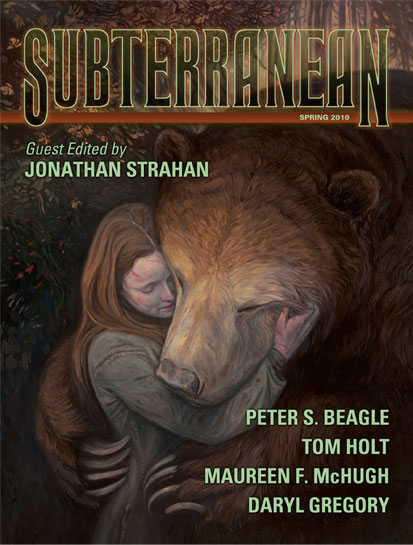
(Cover artist uncredited. Subterranean, Spring 2010.) Who Goes There?
The recent reprint of Maureen McHugh’s debut novel China Mountain Zhang may have raised awareness of this not-too-prolific writer for young readers like myself. McHugh has only written four novels across her 35-year career, and at least one of these, Nekropolis, is a major expansion of her short story of the same name. (Mission Child might also be an expansion of “The Missionary’s Child” but I’m not sure about the connection there.) Despite this, and her short fiction output being sporadic, she’s one of the more respected SFF writers of recent times. China Mountain Zhang was a Hugo and Nebula finalist and is considered one of the unsung classics of ’90s SF, which means a rediscovery may be on its way. “The Naturalist” is sort of a horror story but is more an SF narrative that tackles horror tropes in a rationalistic manner, even if its language is unusually salty. We’re gonna be talking about zombies today.
Placing Coordinates
First published in the Spring 2010 issue of Subterranean Online. Subterranean Press shut down their online magazine nearly a decade ago and so now it’s inaccessible—in the present tense. With the power of the Wayback Machine we can read these issues online and for free, so no excuses! “The Naturalist” was then reprinted in The Best Science Fiction and Fantasy of the Year Volume Five (ed. Jonathan Strahan) and The Year’s Best Dark Fantasy and Horror: 2011 Edition (ed. Paula Guran). It’s also in the McHugh collections After the Apocalypse: Stories.
Enhancing Image
The zombie apocalypse has happened—and been contained, sort of. Unlike most zombie apocalypse scenarios the American government is still around, which is how you know upfront that this will be a very pessimistic narrative. Rather than be allowed to roam the whole country, the monsters have been quarantined and put in “zombie preserves,” where criminals can also be sent; at least that’s my understanding of the situation, since while there is a bit of worldbuilding the machinations of the outside world are a little outside our protagonist’s comprehension. Cahill is our guy and by no means is he a hero, being “too stupid to live, and probably a liability.” He starts out in one of these zombie preserves, with a pack of men who are largely even bigger pieces of shit than he is. Life on the reservation is not good but things get worse when there’s in-fighting one day, capped off with an air strike implied to have been made by the military that sends Cahill off by his lonesome, stuck with zombies and without anyone to rely on.
A few questions. Are thee zombies shamblers or runners? Shamblers! I prefer the former, even though it does strain one’s suspension of disbelief that creatures this fucking slow could take over the world. When they’re not attacking humans the zombies in this story are even slower than the ones in George Romero’s movies, since rather than walk around passively they often just… stay there. Or lie down, like they’re tired. Again I’m not sure how we’re supposed to lose so many people to creatures that are positively glacial in their movement, but also remember that the zombie outbreak has more or less been contained—at least in the US. We’re not really told about what’s happening in other countries. I don’t even remember what city this is supposed to be taking place in; it’s sort of abstract like that. The stakes are also rather low because it’s not like we’re trying to escape the apocalypse or meet up with loved ones here. Cahill doesn’t know anybody and he basically stays in the preserve by choice.
I don’t have too much to say about this story, but I’m not sure if that’s because of the story itself or because I’m extremely jaded with zombie media. “The Naturalist” was published right before zombie media was to reach critical mass and become seriously oversaturated, which is not exactly its fault but it reads like McHugh was riding a trend at the time. We still get zombie media, but it’s hard to overstate how in the latter half of the 2000s through much of the 2010s there was this seemingly infinite barrage of zombie stories across every narrative form possible—except music I guess. The Walking Dead premiered in 2010 and the original comics were already popular. We had just gotten Left 4 Dead and its sequel. World War Z was super-popular and I remember reading it in like 7th or 8th grade; then there was the movie, which had fucking nothing to do with the book. Of all the stock monsters, the zombie must’ve suffered the most from trends and oversaturation in a relatively short period of time. Even the runner, as popularized in 28 Days Later (there were also running zombies in Return of the Living Dead, and maybe there’s an older example I’m forgetting), seemed fresh compared to Romero’s shamblers, but those too grew stale.
Much of the narrative can be thought of as like a road trip, with Cahill making observations during his travels and even coming across a few humans along the way—although those interactions never turn out well, and it’s not clear how much of that is Cahill’s fault. He’s not evil, but he’s certainly a grotesque and a bit of an uncanny figure; the narrator even compares him to Charles Manson at one point, in looks if not behavior. He’s like a mountain man, except his environment is urban decay instead of actual wilderness. I don’t think it’s a coincidence that when describing what Cahill is carrying that McHugh focuses first on the essentials that one would need for surviving in the wild, plus a couple very small luxuries, with the weaponry coming second. Get a load of this:
He had a back pack [sic] now with water, a couple of cans of Campbell’s Chunky soups—including his favorite, chicken and sausage gumbo, because if he got stuck somewhere like the last time, he figured he’d need something to look forward to—a tub of Duncan Hines Creamy Homestyle Chocolate Buttercream frosting for dessert, a can opener, a flashlight with batteries that worked, and his prize find, binoculars. Besides his length of pipe, he carried a Molotov cocktail; a wine bottle three-fourths filled with gasoline mixed with sugar, corked, with a gasoline soaked rag rubber-banded to the top and covered with a sandwich bag so it wouldn’t dry out.
What’s curious is that McHugh did not title this story “The Survivalist,” even though that’s a word that’s likelier to come to people’s minds. Sure, Cahill is a survivalist, but he mainly takes pleasure in observing the behavior of the zombies around him—almost like he’s studying them. Right-wing survivalist narratives have been a thing since at least the ’70s, but the zombie story tends to be the most consistently and outwardly left-leaning out of the stock monsters, showing the failings of capitalism and government and often focusing on the destructive potential of human greed. Indeed, while Cahill does some rephrensible things later, every human he comes across is shown to be untrustworthy at the very least. You’d think the government still being cohesive and active would be a good sign, but we’re also shown quickly that the government has no qualms with killing its own citizens without provocation. This is one of those downbeat narratives where the protagonist is shitty, but the people around them are worse.
There Be Spoilers Here
Some stuff happens.
Okay, there’s more to it than that. The plot is rather episodic; you could cut it done some without removing context for the ending. The third-person narrator is highly colloquial (by that I mean they curse slightly more often than me), but at the same time is tight-lipped about what Cahill could be thinking—assuming he has thoughts. As such it’s ambiguous when Cahill runs into a few people and, with some degree of aggression, traps them and offers them as food for the zombie mob. Cahill is a murderer, objectively, but we’re not sure why he’s doing this since it’s not like he gets a sort of perverted thrill out of these ordeals. What he’s doing does make more sense if you take on the mindset of humans becoming little more “human” than the zombies—or that the zombies aren’t monsters but very dumb animals. Too uneducated and maybe too alienated from everything to work as a scientist, Cahill studies zombie behavior, using other people (who presumably are fellow criminals, since this is a reserve still) as bait.
But then, when he wasn’t asking for it, he gets rescued. “There’d been some big government scandal. The Supreme Court had closed the reserves, the President had been impeached, elections were coming.” These little pockets of disorder are being evacuated and the zombies are now to be killed off in earnest. On a macro scale this is a victory for humanity, and would be a conventional happy ending if it didn’t also mean Cahill’s way of life was coming to an end. It’s doubtful if he can ever return to normal society, and again that pessimism creeps up one last time.
A Step Farther Out
I’ve read very little McHugh before, my main exposure being her Hugo-winning alternate history story “The Lincoln Train.” For what it’s worth, these are very different stories and I’ll probably read China Mountain Zhang next month or in December. I didn’t enjoy “The Naturalist” very much but that may have to do with how extremely tired I am with zombie narratives. We don’t normally judge a story harshly for not breaking new ground, but despite some details that hint at McHugh’s talent for psychology and worldbuilding I got a sense of déjà vu with this one. It doesn’t help that I just don’t think zombies are scary, especially those of the Romero variety (I love Dawn of the Dead, but I wouldn’t call it a scary movie), and this is more effective as science fiction than as horror.
See you next time.
-
Short Story Review: “Nightmare Island” by Theodore Sturgeon

(Cover artist uncredited. Unknown, June 1941.) Who Goes There?
I’ve been itching to cover a Theodore Sturgeon story on here for a long time now, pretty much since I started this site over a year ago. Thing is, if we’re talking strictly short fiction, Sturgeon might be in my top five authors—he’s certainly in my top ten short story writers. He’s most known for his novel More Than Human, because novels have always sold more than short fiction and will continue to do so until the end of time, and while that is a very good novel it doesn’t show the full breadth of his talent. Sturgeon is one of the grand masters of the short story, and this would be true just going by a dozen or so of his very best, never mind the many others. From 1939 until his death in 1985 he stood out as one of the more literary and sentimental voices in the field, not too unlike close contemporary Fritz Leiber. Indeed the two men have a few things in common: they were heavy drinkers, had somewhat hectic love lives, had bouts of either writing a lot or nothing at all, and despite being elegant writers (for their time and place) they never really made it into “the slicks,” despite aspirations.
Sturgeon, despite being most associated with SF, wrote a good deal of horror, especially early in his career. I wanted to go with a story I had not read before and bonus points if it’s a deep cut, which brought me to today’s story. “Nightmare Island” was written during Sturgeon’s first productive period, from 1939 to early 1941; he wrote so much in those three years that he sort of got away with the fact that he wrote not a word of fiction between the summer of 1941 and early 1944. Even though he was only 22 when he wrote this one, he had already gone through several odd jobs while trying to make it as a writer, including a stint as a merchant sailor. Sturgeon’s fiction is sometimes inspired by the various jobs he took on, and “Nightmare Island,” set in the tropics, is about one unfortunate sailor.
Placing Coordinates
First published in the June 1941 issue of Unknown, which is on the Archive. Sturgeon was so prolific at this point in his career that he used a pseudonym or two, although he couldn’t be bothered to keep that a secret. The much less obscure story “Yesterday Was Monday” appeared in the same issue under Sturgeon’s own name. “Nightmare Island” has been reprinted in English only twice, and never anthologized—a bit of a shame. It appeared in the Sturgeon collection Beyond as well as Microcosmic God, the second volume of his complete short fiction. Yeah, get the latter.
Enhancing Image
We start with a rather vague framing narrative in which we have an unnamed American, here on business, and “the governor,” an older gentleman of some position on the island. We’re in the tropics, maybe the Caribbean, but Sturgeon doesn’t give any real clues as to where we are (aside from a reference to the Panama canal) and maybe that doesn’t matter. Getting one criticism out of the way, I would’ve asked Sturgeon for one more rewrite so as to make the framing device less conspicuous, since this is mostly a first-person narrative from the governor’s perspective and we don’t really need the short buildup between him and the American; hell, why not have the reader take the place of the American and have the governor talk to us directly. It’s short, this opening scene, but it’s a bit clunky. We do, however, get introduced to Barry, our protagonist, who at this point lives as a beachcomber apparently in the governor’s employ. Barry is a bit fucked up and we’re about to find out why, since the conflict of the story has already happened.
We then flash back to when Barry was—well, “normal” is not the right word. Sturgeon’s protagonists can be pretty dysfunctional (think of the misfits at the heart of More Than Human), but even by those standards Barry is a hot mess. His main vice is drinking, like an insane amount of booze. He needs only the flimsiest pretext to indulge his alcoholism. “When he had a job he’d guzzle to celebrate, and when he lost one he’d guzzle to console himself,” as the governor says. At the beginning of the flashback we see Barry getting laid off again, and having been laid off he sees it fit to enter another bout of hard drinking. At a bar one night he has the misfortune of meeting Zilio, a shady character who seems to take pity on him and offers him a punch. “The name did not refer to the ingredients of the drink but to its effect.” Big mistake. I’m not sure if it used to be considered common courtesy to accept a drink a stranger offers or if at some point there was more public awareness of getting roofied and stuff like that.
Getting shanghaied in first-world countries is probably much rarer now than it would’ve been a century ago. With the internet and more ways to identify a person it’d be harder to knock someone out and make them work on some tin can against their will, as happens with Barry. He’s a real sailor, and a union man, but that doesn’t help him much as he’s stuck working on an oil vessel with mostly non-seaman for almost no pay and seemingly no way of jumping ship that wouldn’t spell death. Just when it seems Barry’s luck couldn’t get worse, it does—arguably; it certainly gets stranger, as Barry manages to topple overboard during the night, and while most people would drown, Barry does not. Nay, by taking hold of a piece of driftwood, he survives and even washed ashore on an uninhabited island.
It’s here that the fantastical part of the story comes in, because you may have noticed we’re a good third or so in and nothing strictly out of the ordinary has happened. I’m actually not sure if “Nightmare Island” would count as fantasy or science fiction, since the creatures Barry meets could very well be understood in science-fictional terms (no ghosts or anything like that), but it’s framed as a waking nightmare, one of Barry’s “horrors” resulting from his alcoholism, and it’s never rationalized. Fuck it, calling it fantasy will do the trick. I’m also not sure if Sturgeon had read any William Hope Hodgson, especially The Boats of the “Glen Carrig,” although I seriously doubt he had read Hodgson at this early point. I’m saying this because the bulk of “Nightmare Island” reads like one of Hodgson’s seafaring stories, although it doesn’t read the sheer cosmic unknowability of Hodgson.
But I’m getting ahead of myself slightly.
For most people, getting stranded on a small deserted island would be very bad; but for Barry it’s more of an inconvenience on account of having to make his own booze somehow. A much bigger problem presents itself as Barry has to share the island with giant worms, who are big and have tentacles—and are apparently sentient. Or at least one of them is; again, we’re not given a scientific explanation as to where these things came from or how they work. Encountering such creatures would drive people to insanity, but Barry is already insane, never mind perpetually drunk. This is not cosmic horror, and indeed I’m not sure if it’s possible to write cosmic horror if the protagonist is already unhinged and so not terribly frightened of unearthly horrors. While it is downbeat, the tone and genre of “Nightmare Island” are a bit hard to pin down, which might explain why it has never been anthologized.
Something that is easier to understand is the style Sturgeon employs here, which is conversational, even reminding me of what he did in “Microcosmic God.” Makes sense, as he likely wrote the two stories in very close succession, and as far as other early short stories of his go there’s this recurring sassiness in the style, like someone with a mean sense of humor is telling us a story while huddled around a campfire. In the case of “Nightmare Island” this very much makes sense since a character within the story is telling us what’s happening. Because the governor is not the most succinct of narrators, the story is perhaps a bit longer than it ought to be, but at the same time it doesn’t feel dragged out and it’s easily readable. A lot of the stories Sturgeon wrote for Unknown have a comedic streak, or are straight-up horror, but this is an attempt at serious narrative that’s also not too dour. I’m not even sure I’d call it a horror story, although it is fairly spooky and Barry certainly counts as what we would call a grotesque; he’s an outsider who, for a brief time, finds shelter in the company of worms.
One such work is Ahniroo, who is able to mimic human speech )although how sentient it is is unclear) and who speaks for the other works, who for some reason can’t talk to Barry. Through a misunderstanding (because English is so new to Ahniroo that he doesn’t even know what it is) the the friendly worm ends up calling himself and his kind “nightmares,” hence the title. Barry manages to cooperate with the giant worms and make something of a living for himself on the island, with the omly adversary being “the Big One,” a hostile and especially large worm that resides in a crater. Well, you know what they say, this town ain’t big enough for the two of us, so a confrontation in time for the story’s climax is inevitable.
There Be Spoilers Here
With the help of Ahniroo and some almighty booze he had grown himself (it’s unclear how long he’s on this island for, but it could be a few months), Barry’s able to defeat the Big One, in what might be the only time in his life where he comes out a winner. Normally this would be the end of the story, but because the governor is narrating after the fact and we know from the outset Barry is now a lunatic, we know we won’t get a happy ending. Having been exhausted from his fight with the Big One, Barry passes out on the shore, and by the time he awakes he finds himself on a government ship, a mile or two away from the island already. 99% of people would see getting rescused off a desert island as a good thing, but unfortunately Barry is part of the 1% who would rather not be rescused.
Because he sees a sort of demented nobility in Barry, and because he feels some remorse for “saving” him from maybe the only place where he could feel at home, the governor now keeps watch over our shattered protagonist. It’s tragic in the sort of way that Sturgeon, even almost from the outset of his career, was really good at. We get this nugget of a pasage from the governor as he ruminates on the rescue team finding Barry:
They found him there, dead drunk on the beach. It was quite a puzzle to the shore party. There he was, with no footprints around him to show where he’d come from; and though they scoured the neighborhood of the beach; they found no shelter of anything that might have belonged to him. And when they got him aboard and sobered him up the island was miles astern. He went stark raving mad when he discovered where he was. He wanted to go back to his worms. And he’s been here ever since. He’s no use to anyone. He drinks when he can beg or steal it. He’ll die from it before long, I suppose, but he’s only happy when he’s plastered. Poor devil. I could send him back to his island, I suppose, but— Well, it’s quite a problem. Can I, as the representative of enlightened humanity in this part of the world, allow a fellow human being to go back to a culture of worms?
Whether you consider the ending bittersweet or a total downer depends on whether you believe Barry’s alcoholism is terminal. As someone who has had a couple family members destroy their bodies through heavy drinking, I think Barry gets off fine enough; but still, you can’t blame him for missing his worms. Makes you feel sorry for the bastard.
A Step Farther Out
I’ve read about half the stories Sturgeon wrote for Unknown at this point, which is a fair amount because Sturgeon clearly preferred writing fantasy over SF at that early point. “Shottle Bop,” “It,” and the aforementioned “Yesterday Was Monday” have been reprinted fairly often while “Nightmare Island” has not, and I’m not sure why. It could be that tonally it doesn’t quite land on one end of the spectrum, having not the whimsy of “Yesterday Was Monday” nor the sheer terror of “It.” It’s also not easily classifiable as SF or fantasy so I have to flip a coin on that one. Sturgeon wasn’t so much a genre writer as a writer who saw genre (he wasn’t terribly picky about which one) as a great conduit for expressing his thoughts and fears—and boy can Sturgeon be a little fucking neurotic and boy can he try a little too hard at times. Fine. He’s a fabulous writer, one of the best, and while this is still a very early piece it and the other best stories Sturgeon wrote at this time (especially for Unknown, although we can never forget “Microcosmic God”) showed the first inklings of a master.
See you next time.
-
Short Story Review: “Not Our Brother” by Robert Silverberg

(Cover by David White. TZM, July 1982.) Who Goes There?
Given that his career has stretched over half a century, and that he’s still active in fandom, I feel like I shouldn’t have to go much into Robert Silverberg. Author, editor, and fan personality, he’s one of those names that comes up a lot if you’re really getting into the history of the field. He started out in the ’50s and while he was super-prolific early on, it wasn’t until the late ’60s that his writing ascended to another level, earning him several awards in the process. When people talk about Silverberg they often refer to that late ’60s and early ’70s period, when he was at his most intense and experimental, while still being incredibly productive. Arguably his single finest novel, Dying Inside, came out of that fruitful period, and quite shamefully he did not get a Hugo or Nebula out of it.
As revered as Silverberg’s late ’60s/early ’70s period is, I do have a soft spot for ’80s Silverberg—a time when he took a bit of a break from writing novels and focused his passion more on short fiction, seemingly relaxing after the commercial success of Lord Valentine’s Castle. Genre historians don’t pay as much attention to this era of Silverberg, apparently because it’s not as demanding or anguished as his work from a decade prior, but its maturity and often calm self-assuredness is why I like it. “Not Our Brother” is a tale of terror that probably would’ve been more savage had it been written by a younger Silverberg, but it’s still an effective cautionary tale about the parasitic nature of tourism.
Placing Coordinates
First published in the July 1982 issue of Twilight Zone Magazine, which is on the Archive. If you want a source that’s both more readable and legit then good news, “Not Our Brother” was reprinted in Lightspeed, which you can read online for free. So you have no excuse!
Enhancing Image
Halperin is an independently wealthy man (he says at one point he makes money through “real estate,” although it’s unclear if he’s an agent or struck gold on an investment) who is really into collecting masks from exotic cultures. And I mean really into it. He travels to San Simón, a village in Mexico so obscure that Spanish is not even the villagers’ primary language, on the recommendation of Guzmán López, an antiquities dealer who of course shares Haplerin’s fondness for collecting. Guzmán knows the ways of the land and warns Halperin in advance that while the village’s yearly festivities are well worth observing, the village itself is very much not accustomed to outsiders. “Tourists don’t go there,” he says. “The road is terrible and the only hotel is a Cucaracha Hilton—five rooms, straw mattresses.” There is one other thing about the village that Guzmán is not totally upfront about discussing, but the setup is that Halperin is here for a rather unique festival, around the Day of the Dead.
Even for someone who has traveled a fair bit, the trip is still rough going for our hapless protagonist, who up to this point had stayed in more tourist-friendly (i.e., urban) parts of Mexico. To enter San Simón is almost like entering a dark and undiscovered corner of the world—back even to a Mexico that existed in pre-Christian times. “To come out of the pink-and-manicured Disneyland of plush Acapulco into this primitive wilderness was to make a journey five hundred years back in time.” Something Silverberg and I share is our immense fondness for Joseph Conrad, and it’s here that he evokes the metaphorical journey backward in time as written in Heart of Darkness. Now if you’ve read Heart of Darkness then you know it can certainly be problematic, but it’s also an effective and beautifully written anti-colonial tract. “Not Our Brother” smacks of bring written by a privileged white dude, but it’s also clearly working as criticism—possibly even self-criticism—of the affluent white European mindset that the world is your oyster and you’re free to take what you want.
While reading “Not Our Brother” I kept thinking about how indigenous readers would take it, since it reads as anti-colonial but from the colonizer’s perspective. No doubt in an ideal world such a story about a hidden part of Mexico would be written by a Mexican author, but this was 1982 and what the hell, Jews like Silverberg weren’t even considered “proper” white until a ways into the 20th century. You take what you can get. What makes things more difficult is that while the narration is in third-person, it sort of bleeds into Halperin’s thoughts, or maybe it’s the other way around. When Halperin enters the village and struggles to get even a word out of the locals he at one point thinks of them as “alien as Martians.” Then he corrects himself and considers that in this scenario he would be the Martian—a stranger who has come to Earth, but not bearing gifts. Halperin’s xenophobia is a character flaw, but it’s downplayed and not given as much attention as what turns out to be a kleptomania problem.
Sorry, I’m getting distracted slightly.
Getting used to this village seems like a lost cause, but then suddenly we’re introduced to Ellen Chambers, a fellow tourist. “She was about thirty, with close-cut dark hair and bright, alert eyes, attractive, obviously American,” so the narrator tells us, which is true enough; a Canadian would never have snuck up on Halperin like that. Ellen says the villagers aren’t hostile so much as shy around outsiders, since they come by so rarely. What are the odds then that there would be two Americans in this middle-of-nowhere part of the world? Indeed what are the odds. Halperin is a bit of a fool but he’s not totally blind, as he can sense that there’s something unusual about Ellen, thought he can’t put his finger on it. Like your typical horror protagonist, Halperin is a materialist who believes he lives in a world that is essentially godless and devoid of supernatural shenanigans. I myself am an atheist and you, the reader, are probably more or less in the same boat in the sense that you probably don’t believe in ghosts or demons or anything like that. Yet it’s funny: when we read tales of the supernatural we suddenly become god-fearing people—superstitious without skipping a beat. We can infer that something is wrong with Ellen by her behavior and by how inexplicable her appearance is; the difference between us and the schmuck we’re following is that we know we’re reading fiction.
Halperin’s hesitancy around Ellen that he can barely articulate will ultimately save him, but he’s also too unaware that he’s inside a horror story teo take in all the red flags. For one he should really consider the consequences of stealing decorative masks from the hotel. The funny thing about “Not Our Brother” is that the big reveal is so blatantly telegraphed (to the point where it’s impossible for me to not allude to it, even now) that we start to think the thing with Ellen might be a red herring, and thus we look toward the masks as harbingers of doom. We don’t know if the masks are cursed or what, but Halperin has to try to pretty hard to not, say, steal one of these things from his hotel room. Luckily he has a case of conscience. “He was a collector, not a thief. But these masks were gorgeous.” Silverberg rather implicitly is asking us: What’s the difference between a collector and a thief? Is it ever right to take cultural artifacts and put them in some museum hundreds or thousands of miles away, especially without the owner’s knowledge? Taking one of the masks home as a “souvenir” is a bad idea morally, but because we know we’re dealing with a world that involves vengeful or devious spirits that adds another layer to the tension.
The night of the village festival is approaching, and Guzmán tells our hapless protagonist about “amo tokinwan,” spirits who, depending on their mood, can be either benevolent or mischievous—or worse. These spirits are rather ghoulish, and can take on the form of people for one reason or another, during festivities. We of course expect one of these spirits to show up, assuming one hasn’t already appeared already, but most likely hidden under one of many elaborate masks. Amo tokinwan means “not our brother” in Nahuatl, and it not being Spanish (Nahuatl being the villagers’ primary language) only reinforces the notion that these customs are rooted in something that might be even older than Christianity. I’m not sure how much research Silverberg put into this story and I’m not even slightly an expert on this part of the world, so unfortunately I sort of have to take his work for it. If someone who is accustomed to rural parts of Mexico could hit me up and tell me if Silverberg is full of shit, that’d be cool. But now we’re getting to the climax, and just in time!
There Be Spoilers Here
That Ellen is one of these spirits does not come as a surprise; even the cover for this issue of Twilight Zone Magazine alludes to Ellen’s true nature, with her face being iolated and weirdly artificial-looking as if it were a mask. Which in a sense it is. Ellen’s human form is but a mirage, which Halperin finds out almost too late. The reveal is super-predictable, which is my big criticism of this story and something which stopped me from getting too into it, but it does make ironic sense. Of course the one person who presents a threat to Halperin is someone who doesn’t look like she’s one of the natives; that Halperin takes shelter in the one fellow tourist makes his near-death experience with her almost read as karmic. Lucky for him that he merely get into some hot foreplay because Ellen can really have her way with him (and it is both an erotically charged and hallucinatory scene), as Guzmán and a few villagers arrive just in time to scare off the spirit. Apparently the spirit had sucked out the soul of some American woman who had come to the village before and taken on her likeness.
The ending can almost read like an anti-climax given Halperin comes out of it fine, but it’s also made clear that his brush with the supernatural traumatized him and, perhaps, taught him to not tread where he doesn’t belong. “He buys only through galleries and does not travel much any more,” so the narrator tells us at the very end. I’m sure Silverberg considered killing off Halperin at the end, and had he written the story a decade earlier he probably would’ve gone that route; but that would’ve been even more predictable than what we got. Silverberg is not naturally a horror writer and so “Not Our Brother” reads at times more like a science-fictional anthropological study that one would expect from Ursula Le Guin or Chad Oliver. It’s a short novelette of just over 8,000 words, but Silverberg’s descriptions can be so long-winded and yet so readable that it feels a couple thousand words shorter than that.
A Step Farther Out
Is it scary? Not really. Like I said, Silverberg is not by nature a writer of spooky stories, which makes “Not Our Brother” seem more like testing new ground than a master practicing his craft. On top of the possible racism (I don’t think the story is racist, but it could be reasonably construed as that) there is a bit of misogyny thrown in, which—believe it or not, Silverberg used to be worse about that sort of thing. Go back and read his late ’60s/early ’70s material and you’ll notice a toxic mix of male chauvinism and a recurring distrust of women. The Silverberg of the ’80s that I’ve read is better about dealing with things like race and the relationship between men and woman, but that might be simply a product of Silverberg coming into respectable middle age. Yet it must be said that while “Not Our Brother” is unlikely to impress us, especially those well-acquainted with spooky shit, it’s a very readable and thoughtful work.
See you next time.
-
Things Beyond: October 2023
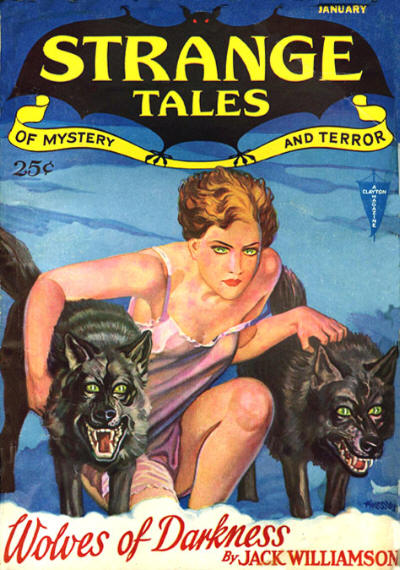
(Cover by H. W. Wesso. Strange Tales, January 1932.) Let me tell you about monsters.
I love monsters of all sizes, although I have to admit I tend to prefer the giants that stalk whole landscapes. The bigger the better, but then “bigger” doesn’t always mean physical size. I love Frankenstein’s monster, especially Boris Karloff’s mildly talkative and rather emo depiction in Bride of Frankenstein, with his hungering for both love and death. I love Max Schreck’s Count Orlock in Nosferatu, who despite being modeled on Dracula seems to be almost more rat than man. I love the blob, especially in the 1988 version of The Blob—a mindless eating machine that digests people while they’re still alive. I love Godzilla, Mothra, Rodan, King Ghidorah, and even Hedorah, the walking turd that might be the strangest of Godzilla’s foes. I love the zombies of George Romero’s Dawn of the Dead and Day of the Dead, the shambling corpses who walk the earth in search of something they can’t put a rotted finger on. I think the creature from the black lagoon deserves a break (which he finally gets in The Shape of Water, a Best Picture winner!) and I think werewolves are SEXY.
Fantastical horror always involves monsters, even if they’re the theoretical ghosts of Henry James’s The Turn of the Screw. As such the stories I pick for review every October (and it will be every October for the foreseeable future) always seem to be monster tales at their core. It’ll be Halloween soon and we’re putting up the decorations. We’ll be seeing vampires, ghosts, zombies, werewolves, witches, black cats, and things from beyond that cannot be easily classified. Because I believe horror, more than any other genre, benefits from brevity, we’ll be doing all shorts again. These are rapid-fire terrors that hopefully will ignite the imagination.
We have the usual suspects: Weird Tales, Twilight Zone Magazine, The Magazine of Fantasy and Science Fiction. Certain outlets have served as safe havens for short horror fiction through the decades, and admittedly I would feel weird if I were to not include a selection from something as foundational as Weird Tales. Some traditions ought to be respected.
Here are the stories:
- “Not Our Brother” by Robert Silverberg. From the July 1982 issue of Twilight Zone Magazine. We’re starting with someone who probably doesn’t come to mind when one thinks of horror, although Silverberg’s work can sometimes evoke existential dread. Having made his debut in the early ’50s and still active in fandom, Silverberg has had one of the longest careers of any writer—inside or outside the field. This is a rare example of him doing straight terror.
- “Nightmare Island” by Theodore Sturgeon. From the June 1941 issue of Unknown. I consider Sturgeon one of the finest short story writers of the 20th century, and a major inspiration. Without Sturgeon and those like him this site probably wouldn’t exist. While most associated with SF, Sturgeon wrote a good deal of horror, including the stories “Bianca’s Hands,” “Bright Segment,” and the novel Some of Your Blood. This one is from very early in Sturgeon’s career.
- “The Naturalist” by Maureen F. McHugh. From the Spring 2010 issue of Subterranean Online. McHugh won a Hugo for her alternate history story “The Lincoln Train,” and her debut novel China Mountain Zhang is one of the cult classics of ’90s SF; but her range goes well beyond alternate history as she has proven herself to be quite versatile over the last 35 years. “The Naturalist” looks to be a rare horror turn from McHugh, having to do with zombies.
- “The Ancient Mind at Work” by Suzee McKee Charnas. From the February 1979 issue of Omni. I had a bad first experience with Charnas a couple years ago, but have been meaning to give her another shot since her reputation is solid and her devotion to the weird is unquestioned. “The Ancient Mind at Work” was Charnas’s first short story, although she already had two novels in print. It would then be absorbed into the fix-up novel The Vampire Tapestry.
- “Pipeline to Pluto” by Murray Leinster. From the August 1945 issue of Astounding Science Fiction. Here we have another surprising inclusion, given Leinster isn’t normally associated with horror. He first started writing genre fiction in 1919, predating even Weird Tales. What’s surprising is that not only did he stay relevant several decades into his career, but he peaked in the ’40s and ’50s, holding his ground against writers a generation younger than him.
- “Brenda” by Margaret St. Clair. From the March 1954 issue of Weird Tales. I covere St. Clair only a few monthss ago, but she’s back already. She wrote a lot in a relatively short span of time (mostly from the late ’40s to the late ’50s), and during that time she was arguably one of the best short story wrriters in the field. Not one to be tied down to any single genre, or even any mode of writing, St. Clair swerved effortlessly between pulpy and more refined prose.
- “Jedella Ghost” by Tanith Lee. From the September 1998 issue of Interzone. One of two returning authors from last October, because honestly I wanna taste more of what Lee has to offer before forming a real opinion; that and she’s such a prolific and consistently spooky writer that her well never runs dry. I’ve read one or two of her stories since our last encounter (which admittedly did not enthuse me) and I think I’m starting to get what her deal is.
- “The Door to Saturn” by Clark Ashton Smith. From the January 1932 issue of Strange Tales. The other returning author from last year’s Spooktacular, and this time it’s because I do love me some Clark Ashton Smith. While he can sometimes phone it in, Smith’s writing is often vibrant, poetic, and deeply enchanting—like a wizard casting a spell. Here we have a story set in his Hyperboria universe, a land where sorcerers and dark gods are in charge.
- “The Last Feast of Harlequin” by Thomas Ligotti. From the April 1990 issue of The Magazine of Fantasy and Science Fiction. We’re ending with what has to be the longest story of the bunch, but it’s by one of those rare modern masters of horror. Ligotti is not the most popular writer in his field, but those who read him hold him in the highest regard. A devout student of Lovecraft, Ligotti’s fiction can be disturbing by way of implication, as opposed to violence.
Won’t you read with me?
-
Serial Review: The Chronicler by A. E. van Vogt (Part 2/2)

(Cover by William Timmins. Astounding, November 1946.) The Story So Far
Michael Slade is a strapping young businessman who would’ve continued to enjoy a normal and luxurious life if not for a car accident that revealed a third eye lurking in his forehead. Using a dubious method of eye therapy, Slade is able to perceive a plane of existence totally separate from and yet existing in tandem with Earth as we recognize it. He meets a fellow three-eyed person, a mysterious woman named Leear who guides him (rather obtusely) toward a city of this new plane: Naze. A city perpetually under siege and whose denizens have a concerning appetite for human blood, Naze is controlled by a man named Geean, who, so Leear claims, must be killed if the city is to be saved at all. Outside the city lurks a group of people who dwell in caves and who seem to be connected with Leear, having come from a crashed ship and who show themselves to be more civilized than the city-dwellers. This is all well and good, but Slade isn’t sure what his role in all this is, and unfortunately for him he’s in an A. E. van Vogt story.
That’s the gist, but there are so many odd little things that happened in the first installment that the recap section reads like a somewhat inebriated person trying to summarize a Thomas Pynchon novel. Van Vogt crams a lot into those thirty pages, and if you think the next thirty-something pages are gonna be any clearer—I’m sorry.
Enhancing Image
I had to take a Tylenol for this.
Like last time I won’t be talking about the plot so much as things taken almost in isolation that stuck out to me, because while I don’t claim to be a master at reading comprehension, I can’t bring myself to understand all of what happens here; more damningly, I can’t bring myself to care enough. The Chronicler is a turkey in a way that bad van Vogt stories specifically tend to be turkeys, which is to say they’re bad in such a way as to be unique to van Vogt’s own failings as a writer. It’s like how latter day Heinlein can be bad in ways that only latter day Heinlein can be bad: the digressions, the lack of plotting, the very odd sexual remarks, and so on. In the case of van Vogt it’s an incoherence of plotting which other writers might only reach if trying to write a van Vogt pastiche. It’s funny because in the anthology Five Science Fiction Novels (ed. Martin Greenberg) I had read and reviewed another inclusion in that book: Fritz Leiber’s Destiny Times Three. I remarked in my review that Leiber almost certainly intended to write a van Vogt pastiche there, and the sad part is that when compared with The Chronicler Leiber beats van Vogt at his own game—not that Destiny Times Three is a masterpiece or anything, just the better narrative.
The first ten pages or so of The Chronicler‘s second installment made me think that maybe things won’t be so bad. Slade, after being saved from the depths of Naze, meets the cave people and this time tries to get to know them. It turns out that these people are not only civilized but have psychic powers beyond even what Slade can do—for now. He falls under the wing of Danbar and Malenkens, who know what Leear is up to but refuse to give Slade more than a little breadcrumb of information, since Leear has plans of her own. The idea is that the eye therapy (which doesn’t work IRL) which allowed Slade to perceive this other plane was only the beginning of what will turn out to be arduous psychic training. As an example, the cave people can turn themselves invisible—or rather mess with other people’s vision so as to make them think they’ve turned invisible. Technology doesn’t much play much of a part in this narrative, as the powers that the characters have are pretty much all psychic—powers that are already dormant, like the third eye, only needing to be awakened via training.
ESP is the flavor of the week, in the case of Astounding/Analog the flavor of, hmmm, some forty years and change. We’re introduced to the niths, one of which we had seen towards the end of the first installment but whose roles are now made more clear: bear-like creatures that are not only sentient but telepathic, opening two-way channels with those they communicate with. Telepathy is not predominant in The Chronicler as some other typical Astounding works, if only because van Vogt turns up the dial so high on ESP generally here that telepathy comes almost as an afterthought. The thing about the predominance of ESP is Astounding/Analog is that most authors used it either as a storytelling tool (nothing inherently wrong with that) or to spice up their piece for Campbell. James Blish tore apart his own serial Get Out of My Sky (under a pseudonym) for cynically incorporating ESP in the back end of that story, which I’m sure will be amusing when we eventually get to that. But van Vogt was one of the few writers in Campbell’s stable who was a true believer—with tragic consequences.
Okay, so. Van Vogt’s writing philosophy was that on average you should scenes of about 800 words and that with each scene there should be at least one plot development. Sounds simple. The result is often that van Vogt’s stories pack a lot of plot into relatively little space, such that even a short-short like “The Great Judge” is just a bit more action-packed and twisty than you would expect. Sometimes this works beautifully; sometimes you get a bunch of shit that fails to cohere. The Chronicler packs a short novel’s worth of plot into a 30,000-word novella and while it could’ve worked if van Vogt was a more elegant writer, elegance is not something he’s known for. People, when taking down van Vogt, say his prose is rather stilted, almost like it was written by someone whose first language is not English. This is true enough, although he can be surprisingly evocative at times, almost in spite of himself, and there are a few scenes in the back half of The Chronicler that work—that are memorable in a good way. There’s a late scene where Slade has a telepathic conversation with a friendly nith that is strongly dreamlike, evoking what Joseph Conrad calls “the dream-sensation,” that struck me as a rare moment here of van Vogt being on the ball.
But holy shit, I’m tired and I could no longer afford to care by the end. It doesn’t help that the climax of this story is extremely confusing, even by the “high” standard it set for itself. We’re given a series of revelatios about Leear and Geean and how they have a shared history, even being part of the same race of immortals (makes sense, given their names are similar). It all has something to do with life-prolonging technology being tossed aside in favor of true immortality achieved with—you guessed it—ESP. There are a couple major twists brought up in, I kid you not, the last couple pages that raise so many needless questions that my head hurt a bit. I wasn’t convinced van Vogt was being 2 smart 4 me so much van Vogt writing something that only made sense to himself. I can see why this hasn’t been printed in English since the ’70s: it’s not very good. It’s the kind of bad that doesn’t offend me but rather deeply weary me; it’s the kind of bad that makes me feel like I’m coming down with a cold, or the flu, and that I ought to take a nap. Sleep is always good, so I suppose you could do much worse.
A Step Farther Out
What’s funny is that I could’ve avoided this—or delayed the inevitable, since given the finite number of serials I would’ve had to cover The Chronicler at some point; but I had read a van Vogt piece a few days before my monthly forecast post with the intention of writing about it, and it was a much stronger piece than this. “Dormant” is a short story I would recommend to anyone curious about post-nuclear SF in the years immediately following World War II, as it’s entertaining, evocative, a little unhinged, and yet coherent for van Vogt. Problem was, too much time had passed between my reading the story and when I was set to write about it. I got cold feet. My metaphorical pen started to run out of ink. There’s much to say about “Dormant,” but I may save it for when I’ll have reread it in a few years, presumably when my thoughts will be more fully formed. Please read that one instead. To quote a letter in the March 1947 issue of Astounding, The Chronicler is “not up to van Vogt’s standards.”
See you next time.
-
Novella Review: “Green Days in Brunei” by Bruce Sterling

(Cover by J. K. Potter. Asimov’s, October 1985.) Who Goes There?
When you think of cyberpunk the first author to come to mind is almost certainly William Gibson, who didn’t invent the subgenre but very much codified it with Neuromancer; after that it becomes a bit of a free-for-all. Cyberpunk goes back to the ’70s, before Gibson started writing in earnest, and you can even see inklings of it in the late ’60s, perhaps most profoundly in Samuel R. Delany’s Nova and Philip K. Dick’s Do Androids Dream of Electric Sheep?, which both have cyberpunk-y elements. But as far as the heyday of cyberpunk goes the author maybe most cited who is not Gibson would be Bruce Sterling—despite the fact that much of what Sterling has written has not been cyberpunk. It could be that Sterling is not as popular as he should be because he’s such a versatile writer, covering seemingly every subgenre under the sun and even ssometimess venturing into fantasy, all while retaining a certain attitude you’d expect from someone who grew up in Austin. He’s a bit of a punk like that.
1985 was a pretty good year for Sterling that also showed off his range, with the vicious short story “Dinner in Audoghast” (alternate history), probably his most popular novel with Schismatrix (space opera), and today’s story, which is………. arguably cyberpunk. “Green Days in Brunei” has a few hallmarks of the subgenre but would nowadays be more likely classified as solarpunk than straight cyberpunk. The “green” of the title refers to money but also green energy. I’ve been on a streak with the past few novellas I’ve covered (not counting serials) and the streak continues here, as this story is pretty cool. It has naught but the skeleton of a plot but it’s a story that much more hinges on characters and speculations about the future.
Placing Coordinates
First published in the October 1985 issue of Asimov’s Science Fiction, which is on the Archive. I actually have a physical copy of this issue, but it’s easier to copy lines of text off a PDF. I ended up with six pages of “notes” for the damn thing, because Sterling packs a lot into this novella. It was then reprinted in Gardner Dozois’s The Year’s Best Science Fiction: Third Annual Collection, which unlike a few of the other early volumes you can find for reasonable pricess online. (Don’t try to collect the first volume unless you have money to burn.) It was later reprinted in the Sterling collections Crystal Express and Ascendancies: The Best of Bruce Sterling.
Enhancing Image
Turner Choi is a Chinese-Canadian twenty-something working officially as an engineer in what is set to be a robot shipyard in Brunei, a very small country on the island of Borneo; unofficially he’s also a computer hacker, although given the limited means he’s not able to do anything fancy. The shipyard in question is supposed to become fully automated, bringing industry back to Brunei with minimal human labor. Brunei is smaller than a lot of American cities, with Brunei Town itself housing only a hundred thousand people, with basically nothing to indicate it as standing in the 21st century. “No cars. No airport. No television.” It’s circa 2020 and a second oil crisis in the ’90s sucked out what little industry the country had before. Now it’s kept afloat with a very small pocket of money—an aristocracy that can almost fit on the head of a pin.
Said aristocracy, however, made a deal with Kyocera, a Japanese corporation (it’s not the ’80s if the Japanese aren’t depicted as economic juggernauts), and that’s where Turner comes in. It’s Turner’s first big job and it might be the toughest he’ll ever deal with, as he and his crew are basically expected to turn shit into sugar. The robot factory for the shipyard is condemned and has been untouched for two decades. This would not be such a problem if not for Brunei’s lacking in metals, never mind that Turner has to do some hacking on the sly to access what we might now call the internet—although here it’s basically just email and chat rooms. His Bruneian contact is also someone not easy to get along with—that being Jimmy Brooke, a former British rockstar, a “deaf, white-haired eccentric,” who came to Brunei years ago and never left. Brooke is curious, as for one he’s the only white character of importance in the narrative, but we’ll elaborate on him later.
There are only a few main characters, the last of these being Seria, a young woman who piggybacks off Brooke’s antics and who is, as it turns out, the sultan’s (rebellious) daughter. Turner hits on Seria one night and it does not occur to him fast enough that getting in with a literal princess might not be the best idea. In terms of personality Seria might be the best character, despite only existing in relation to the men in her life, including Turner, Brooke, her brother (who is mostly offscreen), and her rich dad (who is kept entirely offscreen). Turner and Seria hit it off despite the former looking a little ridiculous with his lumberjack jacket and knee-high boots that his mom bought for him. If not for his Chinese heritage, Turner would look like the typical white Canadian, perpetually gloomy from having lived in Vancouver—which hey, at least it’s not Toronto. In fairness to Turner, his personal life before coming to Brunei was a bit of a mess.
Where to start?
The shadow hanging over Turner throughout the story, aside from the stress of satisfying his employer, is the fact that he and his brother Georgie are kin to a real bastard: Grandpa Choi, now elderly but who back in the ’70s gained infamy as a corrupt cop in Hong Kong. The combined financial success and public scandal of Grandpa Choi seemed to have disastrous results for Turner’s dad, who sank into alcoholism and met an untimely death prior to the story’s beginning. We also find out that Turner’s old college girlfriend (having been separated for a few years now) is a barely functioning drug addict, and the one time we get an interaction between them is pretty uncomfortable. Turner is a classic rebellious hero, especially in the context of cyberpunk, being a romantic who is also trying to escape his past. The little computer shenanigans we see are framed romantically, both in how Turner’s l33t haxing powers are romanticized and how the romance between Turner and Seria is intensified through online messaging.
Something that caught my eye was how Sterling seemed to understand, even in this early period, how online messaging affects relationships differently from in-person talking, be they romantic or otherwise. When communicating via text you open a door to your inner consciousness that would normally be closed when talking with your mouth. Get a load of this passage describing the escalation of Turner’s relationship with Seria and how their texting only heightens their sense of intimacy:
Turner realized now that no woman had ever known and understood him as Seria did, for the simple reason that he had never had to talk to one so much. If things had gone as they were meant to in the West, he thought, they would have chased their attraction into bed and killed it there. Their two worlds would have collided bruisingly, and they would have smiled over the orange juice next morning and mumbled tactful goodbyes.
I need to read up more on what would’ve been computer culture when it was in its infancy. Sterling is known for his fiction, but he has also written extensively on the history of computing and the hacker subculture that spawned from it. 1985 sounds almost impossibly old for discussing such a topic, but remember that Steven Levy’s Hackers: Heroess of the Computer Revolution was published in 1984 and Sterling certainly would have known about it. One of the few quibbles I have with “Green Days in Brunei” is that it falls for what was then the common trap of framing hackers as heroic, noble figures—a pill that would be harder to swallow nowadays. While Turner is written as flawed, with his pride certainly getting in the way, Sterling doesn’t question the nobility of his illicit hacking in contrast with the shadowy bureaucracy of the Bruneian government. That Turner’s antics ultimately do much good might stretch the modern reader’s suspension of disbelief, but then its optimism is overall well-founded.
Turner has fallen in love, which dramatic purposes usually is something that results in disaster—or at the very least conflict. Which it does, as it should. It started as a job he would do before returning to Canada, but now he has a reason to stay in Brunei; mind you, it won’t be the only reason. Sterling makes the most of tropes that nowadays might read as predictable, even going to some lengths to justify the contrivances in the plot. Turner and Seria meeting is highly unlikely, sure, but given the small population it’s not as unlikely as if they were to meet in New York. Even the laughably outdated technology is justified by the fact that Brunei is a backwater, both from lack of industry and deliberate political choices. The Green Party (no, not that one), while kneecapped by the aristocracy, has worked to turn the country into almost one big greenhouse.
Turner, Seria, Brooke, and later Dr. Moratuwa (more on him in a minute) fit into archetypes that will be familiar to cyberpunk fans, but who are elevated above their archetypes through some pretty sharp dialogue. Would “Green Days in Brunei” have benefited from being written by a Chinese or Malaysian author? Maybe. The problem is that Sterling manages to be (somehow) both idiosyncratic and a bit of a chameleon. You can discern a Sterling story by how it’s written, but his willingness to tackle different zones of interest with ease makes it so that while you can try to emulate Sterling’s style, you would be hard-pressed to actually pull it off. I would would say the novella shows its age, given how easy it is to indulge in exoticism with former colonies (this is, after all, a post-colonial narrative), Sterling manages to be sensitive and forward-looking enough that it doesn’t read as exploitative; rather it reads as coming from someone early enough in their career that they’ve honed their skills and have not yet turned reactionary.
There Be Spoilers Here
Despite his appearance and rock-and-roll lifestyle, Brooke knows more about the workings of Brunei than he lets on—even saving Turning when the latter stumbles upon a political prison. It’s here that we meet Dr. Moratuwa, a decrepit former activist who still has some fighting spirit in him; being a devout Buddhist probably helps. It’s also here that we find out the true purpose of the robot shipyard, which is to construct primitive but robust rowboats that can cross the seas without need for electricity. In a way, although Turner’s employer isn’t aware of it, the purpose of the robot shipyard is to bring back the age of sailing—using modern technology to produce ships that are made of simple materials and which anyone with at least one arm can work. And the plan will work, so long as Turner does his job.
But then a wrench gets thrown into the whole thing: Grandpa Choi is on his deathbed. Not that Turner and Georgie have any love for the old man, and indeed in the one scene where Grandpa Choi talks she shows himself to be a real asshole, but it’s during this argument between Turner and his elder that Grandpa Choi, in a moment of devilish joy, reveals that Turner is set to inherit the old man’s considerable (and blood-drenched) fortune. Our romantic leads have now both come to a crossroads, wherein Turner wants to abandon his inheritance and Seria wants to give up her title. The rich suffering a case of conscience and giving up their wealth for the good of the world is a major point here, even given metaphysical significance when Moratuwa says, “Buddha was a prince also, but he left his palace when the world called out.” If only the rich in the real world were capable of feeling remorse or empathy. It thematically ties things together, but our leads’ decision to abandon their wealth in favor of the Green movement is probably not a conclusion a more jaded writer would read—which doesn’t stop the ending from feeling genuinely triumphant.
Sterling makes a few points by way of characters clearly speaking for him, and if I were to go over then one by one we would be here all day. This is a tightly packed narrative that feasibly could’ve been expanded into a novel (add a couple subplots and you’re set), but I much prefer single-minded works like this that are easier to reread. No doubt I’ll only enjoy it more when I eventually get around to it a second time.
A Step Farther Out
I’m not sure if the ending rings as true now as it did back then; at the same time, with the growing prominence of hopeful SF (specifically narratives which speculate on alternatives to capitalism in the future), said optimism may be prescient. I don’t know if the Sterling of today would’ve written this story, because it strikes me as being written by someone who wasn’t much older than the main characters, and who hadn’t yet been broken down by the harsh reality of genre publishing—never mind that it was written before the horrific consequences of the Reagan years fully sank in. “Green Days in Brunei” reads more like a reaction to the oil crisis of the ’70s than the austerity politics of the ’80s, but its attempt to reconcile modern technology with green energy is admirable. It helps that this is about as sincere as Sterling gets, rivaling only that great “romantic gesture” of his, “Dori Bangs,” which might still be my favorite.
See you next time.
-
Serial Review: The Chronicler by A. E. van Vogt (Part 1/2)

(Cover by William Timmins. Astounding, October 1946.) Who Goes There?
It’s not unusual for authors who’ve made it to see their popularity dwindle within their lifetimes, but A. E. van Vogt’s fall from grace is a little weirder and more complicated than average. In the ’40s he was one of the most popular writerss in magazine SFF, easily rivaling Robert Heinlein and Isaac Asimov—until, almost overnight, he wasn’t. Van Vogt debuted in 1939 and wrote a mile a minute until 1951, whereupon he gave up writing fiction from whole cloth in favor of taking the many stories he had already written and stitching them into fix-up novels. This change in work ethic happened, at least in part, because van Vogt got really busy shilling a new pseudoscience that you may have heard of: Dianetics. While he didn’t join the Church of Scientology, van Vogt shilled Dianetics for little over a decade, and by the time he gave up that business and got back to writing in earnest he had lost his prestige—although he still had his fans.
On top of the Dianetics business, van Vogt saw some pretty biting criticism during his heyday, most famously from a young Damon Knight who tore apart the serial version of The World of Null-A. When van Vogt returned in the ’60s his work was not up to the standard of prior material, such that it became easy to assume that van Vogt was never good. It’s a shame, because van Vogt’s best stories are pretty special, with nuggets like “Far Centaurus,” “Enchanted Village,” “The Weapon Shop,” “The Rull,” “The Great Judge,” and of course the stories making up The Voyage of the Space Beagle being well worth reading today. The Chronicler, also reprinted as Siege of the Unseen, does not look to be one of van Vogt’s finer moments, although it’s still far too strange an endeavor to be considered dull.
Placing Coordinates
Serialized in the October and November 1946 issues of Astounding Science Fiction, which can be found here and here. The Chronicler has only been reprinted a few times in English and you’re more likely to find it as Siege of the Unseen. It was first reprinted under its original title as part of Five Science Fiction Novels (ed. Martin Greenberg) and then as one half of an Ace Double in 1959—the other half being John Brunner’s The World Swappers. It has not seen print since the ’70s (in English, that is, since apparently the French love van Vogt) and there may be a reason for that.
Enhancing Image
Normally I would try to do a point-by-point synopsis, but the plot for The Chronicler is nigh undiscernible and so for the sake of my own sanity I’ll be instead focusing on scenes and ideas that caught my attention—for better or worse. A common criticism of van Vogt is that his stories make no sense, and while this is sometimes not the case (the aforementioned “Enchanted Village” and “The Great Judge” have straightforward narratives), it is very much true here. This thing makes no sense. There are some pretty memorable scenes and if van Vogt has a major talent it’s for crafting moments like these, but stringing them together is a different story.
So…
Michael Slade is co-head of a brokerage firm who survives a car accident with his wife at the beginning of the story. He gets cut pretty badly on his forehead, but the injury is nothing compared to what lies under the skin: a third eyeball, lidless but otherwise functional, which hitherto had been dormant since it couldn’t see anything. It’s suggested that the third eye has to do with the pineal gland, which if you’ve read some really old-timey SF (for example, Lovecraft’s “From Beyond”) then you might be familiar with it as a trope. We’re literally two pages in and we’re already being introduced to some Cronenberg-esque body horror and pseudoscience that would’ve been old hat even in 1946. Slade always knew his forehead was soft (something that really should’ve concerned him more than it does), but he didn’t know he had a dormant third eye hiding in there.
But wait, there’s more!
Slade, whose vision in his two normal eyes is poor and in his third eye very bad, goes to see an eye doctor who suggests an alternative method for restoring his eyesight. The doctor is a quack, although he’s framed as perfectly legit in-story, and I’m bringing this up being he employs an actual eye correction method that van Vogt may or may not have also bought into: the Bates method. Named after William Horatio Bates, this is a “theory” that proposes that poor eyesight comes not from something wrong with the eye itself, but with how the brain functions. The idea is that someone will basically go through therapy and relax their mental state such that they’re able to see more clearly, foregoing surgery and prescription glasses. I shouldn’t have to tell you this, but the Bates method has long since been discredited and it was likely already considered bunk by most eye doctors even when van Vogt was writing this story.
Using a method that doesn’t work, Slade is able to not only to improve his eyesight but see things with his third eye that he normally should not be able to, even being seemingly transported to a different location from where he was a second ago. It’s during one of these sessions that Slade finds himelf by a stream, in a place he’s never been before, and he sees a woman who looks like she’s about go skinny dipping, as “except for a rather ornamental silvery belt around her waist, she had no clothes on.” This is an unexpectedly titillating scene, given it was printed in Astounding, but more importantly, Slade and this woman (let’s call her Leear) have a short interaction. The thing that really catches Slade’s attention, aside from the view, is that Leear also has a third eye. What could this mean?
Before I get into what will be the main setting, let’s talk about pseudoscience, as it’s a word that’s come up a few times now. Pseudoscience, which is really an umbrella term that can cover anything from ESP to UFOs to alternatives to Darwinian evolution, has historically played a major part in the conceiving of science fiction—which creates a problem. For decades SF fans and writers have prided themselves on keeping up to date with the latest scientific findings, but if you check the facts you’ll find this rarely the case; and even then, science goes through far more changes than myth. Some writers intentionally fall back on speculations that held water decades ago but have since then been disproved, writing what we’d call recursive SF to achieve a retrograde effect. Nobody with sense would seriously object to someone writing a story set on a swampy Venus in 2023.
The problem is that outdated science is not quite the same thing as pseudoscience—i.e., as fake science, i.e., once more, as science that, when asked for evidence and consistency, fails the test. ESP is fake science. Dianetics is fake science. The Dean Drive is fake science. The Bates method is fake science. Despite John W. Campbell’s proclaiming that Astounding (and later Analog) would print fiction based in real science (or at least credible speculation), the magazine would oftentimes print fiction that takes advantages of fake science, and it would become such a habit that it would persist even after Campbell’s death. One of the differences between Heinlein and van Vogt is that while Heinlein was masterful at incorporating real (for the time) science, van Vogt was equally masterful at incorporating fake science. The result is that van Vogt’s premises are often patently absurd, as is the case with The Chronicler.
One more thing to bring up before we get to “the other plane,” which is that this story swaps back and forth between in-the-moment third-person narration and a series of recorded interviews with different characters that presumably happen after the story ends; saying “presumably” because Slade has apparently died. According to Slade’s wife (or ex-wife, as she leaves him during the eye therapy ordeal), the quack doctor, and a few other people, Slade ATE SHIT, and yet in the third-person half of the narrative he is very much alive. This is an unusual method of creating intrigue and I have to give van Vogt kudos for trying, but I have to think it would also be more effective if I could understand what was happening.
Upon returning to his old family estate outside the city where he normally lives, Slade follows through on a deal made with Leear—that he is to meet her on this farm at midnight on any given day. It works, and through means which not even the omniscient narrator is able to explain, Slade gets spirited away to “the other plane”—a place not so much on a different planet as in another dimension existing in tandem with Earth, thanks to his third eye. It’s here that we’re moved into the city of Naze, a massive shithole which is perpetually under siege and which is host to thousands of… and this is really the best way I can put it… non-supernatural vampires. People who have a bit of an addiction to human blood, much like how we might have an addiction to cocaine or jerking off. The city is home to savages while Leear and her people are civilized folks who live in caves because their spaceship has been put out of commission. Nice little reversal there, huh? The civilized live like barbarians while the barbarians live in the city.
Slade jumps back and forth a few times between Naze and Earth, but mostly he sticks to Naze, and perhaps too quickly he comes to the conclusion that he’s likely to stay here in spite of everything. Slade’s mindsert makes sense to a degree, since he is a three-eyed freak who’s now getting divorced and whose friends won’t return his calls. Something that keps popping into my head while reading this installment, aside from “WHAT THE FUCK’S GOING ON?,” is the possibility that van Vogt had been rereading the John Carter novels at the time. The Chronicler, in some ways, certainly echoes A Princess of Mars. While John Carter astral projects himself to Barsoom (itself a hard pill to swallow nowadays), Slade has more esoteric ways of shifting between the dimensions. Romance also comes up unusually quickly, although I’m not sure if it’s weirder to crush on a female alien who mostly look human but lays eggs or a three-eyed crackhead vampire.
There Be Spoilers Here
It’s hard to spoil something you barely comprehend.
Let me put it another way. This installment of The Chronicler is pretty short, being only thirty pages. Looking at both installments I would say it comes to maybe about 30,000 words—honestly short enough to have been published in one piece as a novella, except there was probably an issue with scheduling and Campbell needed a serial. Despite being objectively short, and despite not being boring (it has other issues, but not that one), reading it can feel like an endurance test. The worst part is that van Vogt crams so much plot development in here, and so little of it connects, that you’d be tempted to read the recap section of the second installment right away just to see what you might’ve missed. Like I said, while there are scenes that work (I’m thinking of a very odd bit wherein Slade considers hitting on Amor, a city dweller and ally to Leear, only for her to ask him if she could have a little taste of his blood), the dots do not connect.
I have many questions and I suspect only some of them will be answered in the next installment. Van Vogt has this thing for flashbanging the reader with an enigma or unexplained revelation at the last minute, which sometimes works, but not so much here.
A Step Farther Out
See you next time.
-
Short Story Review: “Wong’s Lost and Found Emporium” by William F. Wu

(Cover by Frank Kelly Freas. Amazing Stories, May 1983.) Who Goes There?
William F. Wu is almost certainly one of the first Asian-American authors to contribute to genre SFF with any regularity, although despite this he’s now a pretty obscure figure; it probably doesn’t help that he’s written little fiction since the turn of the millennium. Wu got started in the late ’70s and would come out a decade later with some big awards nominations, including a Hugo, Nebula, and World Fantasy nomination for “Wong’s Lost and Found Emporium.” He got another Hugo nomination for his 1985 vignette “Hong’s Bluff,” which I reviewed for Young People Read Old SFF. Thus this is not my first run-in with Wu, and my little exposure to him tells me we share a fondness for Westerns and the romanticized image of the American frontier. I may have to find Hong on the Range.
This is now the second story I’ve covered to get turned into a Twilight Zone episode—this time for the ’80s series.
Placing Coordinates
First published in the May 1983 issue of Amazing Stories, which is on the Archive. It was first reprinted in The Year’s Best Fantasy Stories: 10 (ed. Arthur W. Saha), and collected in the Wu volume Wong’s Lost and Found Emporium and Other Oddities. Since it got adapted for The Twilight Zone it’s only natural that it would appear in New Tales from the Twilight Zone (ed. Martin H. Greenberg). These, sadly, are all out of print, and despite its awards attention this story has not been collected in anything since the ’90s; and mind you, it’s Wu’s most popular story.
Enhancing Image
Wong is a dock worker for a New York Chinatown who also happens to be—let’s call him the substitute overseer of a very strange shop. Of course, Wong didn’t ask for this job and he’s not getting paid for it; the real owners of the shop have gone missing and Wong, for reasons unclear to himself, decided to take their place until they return. If they return. It’s a big place that expands to accommodate its stock seemingly endlessly. “The shop was very big, though crammed with all kinds of objects to the point where every shelf was crowded and overflowing.” There are crates everywhere, even ones hanging from the ceiling, filled with all kinds of junk.
True to what the title would make you think, it’s indeed a lost and found center where people can find lost items—and even belongings of theirs that are far more abstract. The story starts out with Wong helping out a much older woman (she has a name, but it doesn’t matter) look for a lost chance at becoming an artist in her youth—a lost opportunity that has taken the form of a bottle’s contents. The way it works is that if it’s a physical item that has been lost then it can found as a solid or liquid object in one of the many boxes; but if it’s an idea, like a decision not made or a part of one’s personality, then it would take the form of a gas that must be inhaled to take effect. The latter is harder to get a hold of, as once the bottle is opened and the vapors come out, the person has only one chance to capture it. Sadly for the old lady she fumbles her bottle and fails to take in the vapor. This all sounds pretty high-concept, although I have to admit Wu doesn’t do a lot with it in the story itself.
There’s not a lot of plot to go over, as this is little more than a vignette, but let’s talk about the mechanics of the shop since I suspect that’s the reason readers took such a liking to it. Wong has been working and basically living in this shop off and on for the past couple months, living off of food scraps, which would be impossible considering his responsibilities to his real job if not for the fact that time moves differently in the shop. “The dual passages of time in here and outside meant that I had spent over two months here, and I had only spent one week of sick days and vacation days back in New York, on the other side of one of the doors.” Even with that time dissonance, though, he’s just about at the end of his rope, losing his patience with people he helps but also knowing he only has so much time he can spend here. The real problem—the internal conflict, since there’s not much of an external one—is that Wong is a bit of an asshole, despite his “job.”
This comes to a head when Wong gets another “customer” in the form of a nameless young woman (Asian-American, like Wong) who has apparently been hiding out in the shop for some time now, watching Wong and judging (correctly, in all fairness) him unworthy of his position. It’s here that we’re given a reason for why Wong is so callous: growing up a victim of racism made him stone-hearted. On the one hand it now reads as cliched that a person of color gives childhood racism as the reason for their trauma, but it would’ve been novel at the time in magazine SFF to have that background be written by someone who almost certainly experienced the same thing in their own life. This story is a whole forty years old now and having two of the three main characters be non-white was certainly uncommon then, although in that sense it now reads as unexceptional.
One more thing about the shop. You may be asking, “How do you find anything here?” The idea is that there’s a customer and an overseer, and the customer would not be able to find what they’re looking for on their own; but the overseer is guided by a ghostly light which shines on the object of the customer’s desire. In other words, if you wanna find anything, you need a partner. The young woman is looking for something herself—a part of her personality that somehow she had lost, and while she disagrees with Wong’s attitude, she does need his help. The lost part of her personality, as it turns out, is her sense of humor, which makes her a good deal more bubbly—not that that helps Wong much. The back end of the story thus sees a sort of comedic-straight dynamic between Wong and the young woman, or one could think of it as a master-apprentice thing.
There Be Spoilers Here
The roles reverse as, having been helped, the young woman decides to help Wong in return—if only to make him more caring. Wong claims to have lost his sense of compassion, and while he ends up fumbling the bottle for that (mirroring the old lady earlier), he does find two bottles containing other things lost—only he’s not quite sure what’s inside. Had this been a horror narrative it’s at this point that we might be greeted with a horrific part of Wong’s background or personality that had been forgotten, like suddenly remembering a crime he had committed long ago. But this is not horror and what Wong finds is fairly pleasant: the first is a nice memory that he had forgotten, and the other is his integrity. While he didn’t get his compassion back exactly, he did get some of it along with his integrity “in a package deal.” It’s sweet. Wong didn’t think he owned the shop before, but now he feels genuinely responsible for it, even suggesting the young woman should become his assistant. How they intend to make a living off this is anyone’s guess.
Maybe I’m also an asshole, but I couldn’t help but think about how one is supposed to make money with this place. I mean, it’s a lost and found center, but I feel like services this esoteric shouldn’t come free.
A Step Farther Out
Upon reading “Wong’s Lost and Found Emporium” I wasn’t really sure how to feel about it. It’s cute, but despite the neat premise Wu gives us the ends were more banal than I would’ve hoped. We get the slightest hint of something cosmic lurking around the corner, since while the workings of the shop are explained somewhat there is much that is left a mystery, but this is very much not a horror narrative. Admittedly if it did turn out to be horror then I probably would’ve complained that such a premise leading to horror is trite, so I suppose I’m being unfair with it. The problem may be that while I can’t say it has aged poorly, it would probably not catch people’s attention if published as a new story today without a word changed. Urban fantasy, even from POC perspectives, has really taken off since 1983, so that while it was prescient, it has since been surpassed.
See you next time.
-
The Observatory: Damon Knight, Failed Magazine Editor
(Cover by Ed Emshwiller. F&SF, November 1976.) Sometimes the topics for these editorials can venture into “serious” territory, but this one is rather frivolous, being about a little footnote in genre history that nobody living today thinks about—probably not even the likes of John Clute. At the same time it’s such an odd footnote that I had to turn it into a thousand-word essay, so sit back and enjoy your coffee while I talk about one of the most important figures in old-timey American SF and how he, if not mostly for circumstance, could’ve been a very fine magazine editor on the level of Ed Ferman or even Anthony Boucher. There were brief spots in the ’50s, in fact, when Knight got the chance to flex his editing muscles—only he got the plug pulled far too early.
Knight, as you know, started out in the ’40s as a critic—arguably the first serious critic in American magazine SFF. He was a bratty 20-something who made no bones about his opinions, and it was also clear that he was a little more “literary” than the average bear, which would put him in the same boat as Brian Aldiss and fellow Futurian James Blish. Reviewers in the field at the time were sometimes accomplished writers who turned to reviewing, such as Boucher and P. Schuyler Miller, but Knight was a reviewer who then turned to writing fiction—almost as a way of proving that he could do himself what he wanted other writers to do. While his criticism is not what Knight is now most known for, he did win a special Hugo in 1956 for his book reviews, and no doubt his astute breaking-down of other people’s work led him to be just as demanding with his own fiction.
Knight’s success in fiction was not immediate, but 1950 would see two of his most famous short stories in print: “Not with a Bang” in the Winter-Spring 1950 issue of F&SF, and “To Serve Man” in the November 1950 issue of Galaxy. These are not works of great depth, but they are memorable and quite functional, being written very much in the O. Henry mode wherein we’re given a setup and a twist payoff in the span of ten pages or less. Knight would write more ambitious stories in subssequent years, but it can’t be denied that 1950 was a watershed year for him—and not just for his most remembered stories. Working as an assistant under Ejler Jakobsson, Knight got a first taste of what editing a magazine was like with the revived Super Science Stories, and this experience seemed to encourage him to strike out on his own and make a magazine in his own image.
Still only 27 when he would’ve begun work on Worlds Beyond, Knight got to start his new magazine with Hillman Periodicals, who, at a time when the SFF magazine market was about to explode, wanted a hit as soon as possible and had no patience when they didn’t get it. Worlds Beyond hit newsstands in November with the December 1950 issue, and for a first issue its contents certainly catch one’s attention. On top of original works by Fredric Brown, Mack Reynolds, C. M. Kornbluth, and future detective fiction heavyweight John D. MacDonald, we have reprints by a couple unusual names such as Franz Kafka and Graham Greene. Knight’s policy with reprints at first looks like he’s taking a cue from F&SF (which had quite a few reprints at the outset), and he probably was—but the choice in authors is telling. Whereas Boucher and McComas picked pre-pulp authors who generally were known for supernatural fiction, Knight picked authors who are not usually associated with genre fiction.
There was another reprint in the first issue of Worlds Beyond that should catch one’s eyes: Jack Vance’s “The Loom of Darkness,” published earlier that year in The Dying Earth as “Liane the Wayfarer.” Vance was still pretty early in his career, and The Dying Earth initially saw very little attention, being a small collection of connected fantasy stories that really did not read like anything else at the time; but clearly Knight was enamored with it. That issue of Worlds Beyond no doubt introduced some readers to the Dying Earth series. Vance would appear again in the February 1951 issue with “Brain of the Galaxy,” reprinted thereafter as “The New Prime.” Another author who clearly appealed to Knight was fellow Futurian C. M. Kornbluth, who also appeared in two of the three issues—although that latter appearance was reprints rather than original fiction.
Worlds Beyond obviously took after F&SF to a degree, but whereas F&SF started out as a “classy” genre outlet with more emphasis put on supernatural fantasy (it was indeed The Magazine of Fantasy initially), Knight was not afraid to print fairly pulpy science fiction if the actual writing—the substance of the work—met his standards. There was about a 50/50 split between original fiction and reprints, and for something that lasted only three issues there’s a disproportionate amount of notable work here, such as Vance’s “The New Prime,” Kornbluth’s “The Mindworm,” Judith Merril’s “Survival Ship,” William Tenn’s “Null-P,” and Harry Harrison’s debut story (he was already active as an illustrator) “Rock Diver.” Knight also ran the book review column for each issue, which makes sense considering he was already perfectly qualified for that job—and anyway Knight’s reviews are often informative, if caustic. This all seems like a recipe for success.
Worlds Beyond might’ve prospered, or at least survived until the market crunch of 1955, if not for Hillman Periodicals seeing the lackluster numbers for the first issue and immediately pulling the plug. The second and third issues were already being printed when the magazine got the ax, so we’re lucky enough to have three issues instead of just one. Still, it must’ve been a blow for Knight, as he would not return to magazine editing for nearly a decade—but thankfully he would return, if only for a short while again. It’s a bit of an odd coincidence that Knight edited two magazines in the ’50s and they both lasted only three issues under his watch; no more, no less. Of course, If was a reasonably ssuccessful magazine before Knight came along and it would persist long after he left, being something of a chameleon, changing colors depending on who’s running the show—for better or worse. Genre historians often make note of how If reinvented itself under Frederik Pohl’s editorship, but its transformation under Knight was almost as radical, as we’re about to see.

(Cover by Ed Emswhiller. If, December 1958.) For most of the ’50s If was a second-tier magazine that sometimes published very good fiction but otherwise had little to distinguish itself. It began as a pet project for James L. Quinn, published by Quinn’s own company and with him as the editor for most of the decade. If‘s quality under Quinn fluctuated depending on who was working as Quinn’s assistant (i.e., doing much of the heavy lifting) at the time, but in 1958 Quinn let go of the reins (mostly) and gave them to Knight, so that while Quinn still kept an eye on things as the publisher, Knight suddenly had more control of the magazine than if he was “just” an assistant. As with Worlds Beyond, Knight also ran the book review column, which shouldn’t surprive anyone.
The October 1958 issue was the first to have Knight’s name on it, and if we’re being honest it’s a pretty weird issue on its face, just going by the theme. Yes, the October 1958 has a shared theme between the stories, although this was appearently done after the fact (the authors had no intention of their stories connecting somehow) and it was Quinn’s idea, not Knight’s. The idea was that we would get a chronology—let’s call it a future history—of mankind and space flight. It’s an obnoxious gimmick that didn’t actually amount to anything of substance, but there are still a few notable pieces here, including works by A. Bertram Chandler, one of the first stories by Richard McKenna (sadly gone too soon), and one of Cordwainer Smith’s more famous stories, “The Burning of the Brain.” Smith’s piece was part of a future history, but not the cobbled-together one that the issue proposes; instead it’s part of his Instrumentality series.
Something to keep in mind about Smith is that up to this point he had only appeared a few times in the magazines, with his work being a little too eccentric and ambitious for most editors at the time. Indeed his debut story as an adult, “Scanners Live in Vain,” took about five years to see publication, and only then in an obscure little semi-pro called Fantasy Book. Fred Pohl would later take an immense liking to Smith, even calling first dibs on all his work and printing most of it in the ’60s—but before Pohl there was Knight, who must’ve gobbled up whatever Smith had on hand, since every issue of Knight’s If had a Smith story. McKenna also appeared in all three issues, first under “R. M. McKenna” and then under his full name. Other big names include Fritz Leiber, Algis Budrys, Margaret St. Clair, Philip K. Dick, and even an early appearance from David R. Bunch, who would later become much associated with the New Wave.
A rule of thumb with magazines changing editors is that it takes several issues for the new boss to carry about their policy, since they would have a backlog of purchased stories to deal with and, after all, Rome was not built in a day. What’s impressive about Knight’s If is that in only three issues, the magazine was reshaped to fit Knight’s rather quirky parameters, becoming wholly his own by the second issue. The standard of the fiction had gone up, certainly, but combining that with Knight’s review column and his obvious bias with certain authors, I have no doubt that had If kept going like this for even another year or two it could’ve easily surpassed Galaxy, which at this particular point in time was not putting out its best work. H. L. Gold, at one point the finest editor in the field by a considerable margin, had become noticeably fatigued by the end of the ’50s, letting Pohl do a considerable amount of the heavy lifting for him before giving him the reins in light of a car accident that left Gold physically disabled.
Knight would have continued raising the bar for If, but Quinn saw a lack of profits for the magazine and decided to sell it to another publisher, and Knight did not come with the package. It was a loss even more arbitrary than the axing of Worlds Beyond—nothing more than cutthroat publishing industry nonsense. Knight went back to writing fiction, even trying his hand more earnestly at writing novels (not his strong suit), while If skipped what would’ve been the April 1959 issue before returning with the July issue, this time under a worn-out Gold as editor. For those keeping track it must’ve looked like If was on the verge of shutting down unceremoniously before returning in a somewhat regressed state; it would not come even close to the forefront again for several more years. But for a brief moment—all too brief—we got a glimpse of a magazine that started as one step above pulp that could’ve been a real contender.
The experience, of course, was not a total loss: Knight would return to editing again—only this time it was for books, not magazines. The first volume of Orbit appeared in 1966, with Knight expressing a noble mission statement of publishing science fiction that likely would not see print in any of the magazines—fiction that was too experimental, too mature, too literary for magazine editors (in the US, anyway) to touch. The plan worked. The Orbit series saw some very fine work by voices who probably would not have prospered in the magazine market at the time, including Kate Wilhelm, R. A. Lafferty, and most importantly of all, Gene Wolfe, who wrote such memorable stories as “The Fifth Head of Cerberus” and “Seven American Nights” with Knight as both editor and coach. The Orbit series proved the validity of both the New Wave and original anthologiess as an alternative market, and while it did occasionally print nigh unreadable garbage, Knight’s achievement here is hard to overstate.
With that said, I do occasionally think about what we lost…
-
Serial Review: The Reign of Wizardry by Jack Williamson (Part 3/3)
(Cover by M. Isip. Unknown, May 1940.) The Story So Far
Theseus, known as Captain Firebrand the infamous Greek pirate, has landed ashore on the island of Crete, at the time the most powerful empire in the world despite its small size. Separated from Cyron, his right-hand man, along with the rest of his crew, Theseus now stands alone except for a crafty but “minor” Babylonian wizard named Snish. Every nine years games are held in Knossos, the capital palace of Crete, to see if anyone is worthy to succeed Minos as the ruler of the island—and to take his beautiful daughter Ariadne as their bride. Things seem to be going well until Theseus’s disguise breaks at the worst possible moment and he gets taken into prison, to be thrown into the labyrinth and meet his death at the hands of the dreaded Minotaur, known to Cretans as the Dark One.
With Snish’s help once again, Theseus hatches a plan to break out of prison and into Ariadne’s bedchamber, where, for reasons unfathomable to both Our Hero™ and the reader, Ariadne admits her intense love for the Greek pirate and they almost agree to escape the island together—only Theseus still has a job to do. The plan is foiled and Theseus is caught once again, and this time is thrown straight into the labyrinth, naked and weaponless, although not bitchless, as Ariadne still helps him in the few ways she can. Reunited with his beloved sword, Theseus thinks he might stand a chance against the Minotaur, only to be blind-sided by what feels like a horn grazing his side. The Greek pirate seems to be in quite the pickle!
Enhancing Image
Good news: it’s a fake-out. The “horn” belongs to Cyron, who was also tossed into the labyrinth and left to be either killed or die from the elements. The two recognize each other and it’s a sweet reunion—only problem being that they’re still trapped in a maze with no obvious way out. It’s here, however, that we’re given what is perhaps the biggest twist in the narrative, which is that despite a statue of the Minotaur being constructed in the labyrinth, the Minotaur himself seems to be nonexistent—an elaborate ruse devised by Minos centuries ago to keep the Cretans in line. Those trapped in the labyrinth either kill each other, themselves, or die presumably from starvation, for hitherto nobody has escaped to tell of the big lie that has haunted the island for so many years.
This has to be coincidental, but I couldn’t help but think if maybe John W. Campbell had a certain theme in mind, as The Reign of Wizardry was serialized back-to-back against Robert Heinlein’s If This Goes On—, which also covers religious fear and tyrants using the people’s faith to rule over them with an iron fist. In the case of the Heinlein novella there’s a conspicuous aside where we’re told that Christianity is totally fine actually, and that the villains of the story are using a religion similar to Christianity but actually something different. The Abrahamic God also gets off pretty easy in Williamson’s story, but in fariness it takes place in pre-Christian times, so it’s only natural that the religion of evil has nothing to do with what some reader at the time would’ve believed.
The Minotaur turning out to be a fabrication is inherently disappointing, since it deprives the narrative of what could’ve been a gripping cosmic element, but in the context of a work written specifically for Unknown I begrudgingly admit it makes sense. Works published in Unknown generally try to urbanize the creatures of myth, such that they become either as ordinary in the context of the story’s world as a real-life animal, or they turn out to be something that can be easily rationalized. The result is that there’s very little cosmic horror to be found in Unknown, and I think this is compounded by Williamson being such a rational storyteller, although his fast-paced pulp action style of writing at this point in his career can make this rationalism not so obvious. That the Minotaur does not exist in this rendition of the Theseus-Minotaur myth is only fitting for something published in a “rational fantasy” magazine.
What’s not so easy to rationalize is Ariadne’s cooperating with Theseus in overthrowing her father, which only becomes harder to swallow as a couple more twists come our way. I’ve said this before, but I wanna stress that Ariadne is a far worse-written leading lady than either of the female leads in The Legion of Time, which who were not exactly deeply realized themselves but who served clear purposes in the narrative. Ariadne’s seems split between her loyalty for her father and her newfound passion for Theseus—the problem being we have no reason to believe Theseus and Ariadne would love each other. It’s one of those inexplicable romance plots that plagues old-school pulp writing, only here it’s more conspicuous because Williamson is going for something a little more high-concept. Sure, it’s a somewhat neat premise, but the characters are still lacking in psychology; we’re not allowed to understand the why of anything.
Anyway, Theseus and Cyron lead a rebellion against the higher-ups of Crete on the basis that the Minotaur, the thing that supposedly lurked in the island’s depths, is not real, and therefore the power of the wizards is based on a falsehood. It goes pretty well! People are surprisingly quick to believe the guy who has been on the island for maybe three days. But there’s still work to be done. Minos goes down without much of a fight, although Theseus realizes that the old wizard might not be dead after all, as the doppelganger, upon dying, turns into “an old, old woman” whose real identity is unknown—for the moment. The real Minos must be hiding somewhere, but Theseus struggles to articulate this, and for now it looks like the day might be saved. Ariadne, who as it turns out is not much of a fighter, encourages Theseus to escape with her using a flying machine (what?) Daedalus had built, but Our Hero™ refuses. Something is not right.
It’s here at the novel’s climax (which also happens to be its ending, since the story ends right when the action does) that we get back-to-back twists, which I have some very mixed feelings about. The first is that impossibly old lady who died disguised as Minos turns out to be… Ariadne’s mother, who, mind you, was a non-presence up to this point; I honestly thought she was dead already, but apparently she chose to take Minos’s place by the time Theseus appeared on the island. I don’t get any emotional weight from this since we have no clue who Ariadne’s mom is as a character, and we barely even get a glimpse of how Ariadne’s feels about her own now-dead parent. It feeds into the other twist I’m about to give and it does explain “Minos’s” odd behavior before, but I honestly would’ve preferred if they just got some random person to stand in for Minos.
The other twist is that Snish, the real Minos, and Talos are all the same person. Let’s sit around a bonfire and ponder this. Snish and Talos—you know, the giant bronze statue, are both disguises for Minos. Theseus recalls, during this revelation, that he never saw Snish and Talos in the same place, and that Snish and Minos being together can be explained by “Minos” being a fake here. I will say, this is not, strictly speaking, a self-contradicting twist, and it’s also a twist I did not see coming, which would give it a point each—bringing its score to a total of two points. Yeah, otherwise it reads as fucking stupid to me; there’s really no other way for me to describe it, other than it feels dumb somehow. I figured Williamson would dish out a few twists in the name of subverting the myth, but he may have gone too far. It doesn’t help that through all this Ariadne is still a blank slate.
But due to the power of “love,” Ariadne gives Theseus the deus ex machina necessary to defeat her father and end the reign of wizardry on Crete for good. Personally if I was pining for Ariadne I would be concerned by the fact that she played a part in the deaths of both her parents, but Theseus is not so bothered by that detail. It ultimately doesn’t matter, though, as it’s implied that Ariadne dies from… something, going limp in her man’s arms. Maybe she’s just tired. I could take a nap myself. Theseus kisses his dead (or maybe just sleepy) girlfriend and the novel ends. Even if Ariadne is not dead at the end, the chemistry between the two is so inert that Theseus may as well be making out with a corpse.
A Step Farther Out
In a deliberate attempt to extinguish wonder, Williamson replaced it with something of very little substance. I have to think The Reign of Wizardry got a Retro Hugo nod because there wasn’t much competition that year. Jason and the Argonauts it ain’t. I suspect the reason it gets so little wordage in Williamson’s autobiography is because there was little he could say about it, other than that it was his first attempt at writing more “mature” fantasy and that it getting published technically made it a success. While it now only exists as a footnote in a pretty good writer’s oeuvre, it did do good in that it probably encouraged Williamson to write a much better and more unique fantasy story—that being “Darker Than You Think.”
See you next time.
-
Subscribe
Subscribed
Already have a WordPress.com account? Log in now.
 Science Fiction & Fantasy Remembrance