-
Novella Review: “The Earth Quarter” by Damon Knight
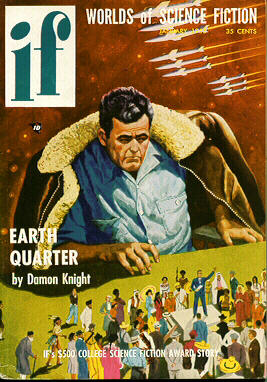
(Cover by Anton Kurka. If, January 1955.) Who Goes There?
While he didn’t write bestsellers, Damon Knight had a pretty substantial impact on the direction American SF would take in the ‘60s, as author, critic, and especially editor. He started out as a critic in the ‘40s—one of the first serious book reviewers in the field—before trying his luck at short fiction. After all, a critic who can practice the art he criticizes has more legitimacy—at least to cranky writers who can’t take criticism. But Knight was pretty good at the short story thing, and nowadays that might be what he’s most known for, although his Orbit series of original anthologies was seminal in promoting the New Wave.
In the ‘40s and start of thr ‘50s Knight wrote some memorable shorts that very much operated in the O. Henry mode (see “To Serve Man”), but as the ‘50s progressed he grew more ambitious. “The Earth Quarter” struck me as maybe being a more substantial effort from Knight—an assumption that proved correct. This is one of the best SF novellas from the ‘50s that I’ve read, not just from the ingenuity of its plot but its depth of character and subtlety of implication. Knight gets a remarkable amount of work done in just under 20,000 words while also giving us one of the few truly anti-Campbellian narratives at a time when readers still treated John W. Campbell like he worked miracles. It’s a subversive and nasty little piece of work, but it reflects a humanism that was not too common in magazine SF then.
Despite its outstanding quality “The Earth Quarter” is a fairly obscure novella, which is why I was stunned to find that I’m not even the first person this month to have reviewed it. James Wallace Harris covered “The Earth Quarter” exactly a week ago for his site, in succinct and enlightening fashion. With that said, he did call it an immensely cynical work and I don’t think “cynical” is the right word here. I do think Knight wants to believe in the good of humanity, but, at least in this story, humanity’s optics are quite bad. It’s a story about the futility of racial supremacy—explicitly human supremacy and, more implicitly, white supremacy.
Placing Coordinates
First published in the January 1955 issue of If, which is on the Archive. Knight later expanded “The Earth Quarter” into a longer novella, “The Sun Saboteurs,” and you’re more likely to find that longer version in book form—made more confusing because that longer version would also be printed under the original (and better) title. Good news is that if you wanna read the original you can do it free and easy on Project Gutenberg, since apparently Knight cared little enough for the original version to let it fall out of copyright. “The Earth Quarter” being in the public domain actually gives me a fun idea, as I will eventually explain.
Enhancing Image
First a word about the circumstances under which this review is being written. It’s Saturday the 9th as I’m writing this and my laptop is still at the repair shop; therefore I’ve had to work on this site via suboptimal means. Unfortunately I don’t have the leisure to write to my heart’s content here, which is a shame because a lot can be said about “The Earth Quarter” and I’ll have to keep things concise—by my standards. I know that won’t mean much if you know me.
Anyway…
Good news: Mankind has not only voyaged out to the stars but come into contact with multiple intelligent alien races. Bad news: Earth itself is now little more than a dustbowl, with those left on the planet living almost like cavemen. Those who journeyed out to space aren’t doing a whole lot better, with little pockets of humanity scattered across planets owned by more advanced alien races and relegated to ghettos. Man has come to find that he is, in fact, at the bottom of the galactic food chain, more being allowed to live on other planets than to own that right.
This brings us to one of these ghettos, the Earth Quarter, “sixteen square blocks, about the size of those of an Earth city, two thousand three hundred human beings of three races, four religions, eighteen nationalities,” under the supervision of the Niori, a docile and bug-like race who nonetheless hold a metaphorical sword over the human refugees. We only see the Niori once and they’re not directly involved in the plot really, but Knight uses them as an example of how alien life can be akin to angels in relation to humanity. This is a story about humans, but I don’t think the point would quite get across if aliens were kept totally offscreen.
We’re introduced to Laszlo Cudyk, a local trader, thoroughly middle-aged and not one to take action himself; actually he’s almost as passive a protagonist as you can get, which normally would be a negative except that Cudyk’s passiveness is very much part of his character—his internal conflict. Cudyk claims to be neutral in a deeply political situation, between those who want to continue living in the Quarter, those who want to return to Earth, and those who want war with the Galactics, but he is ultimately a man at war with himself.
As for taking sides, we have two passionate and charismatic figures, both of whom have radical visions but with very different goals. On one side we have Harkway, who wants to gather people together and rebuild a fragment of civilization on Earth, “a liberal fanatic” as Cudyk calls him—I have to suspect with a bit of irony. In the opposite corner we have “Captain” Rack, a military veteran who clings to his rank despite Earth’s Space Navy having been defunct for two decades. Rack is the story’s villain, and he and his devoted underlings wanna rebuild Earth’s capacity for war—in this case war with the aliens. Not just galactic war but, Rack hopes, extermination of what he repeatedly calls “vermin.”
Let’s stop and think about how we actually don’t have a lot of great villains in old-timey SF. Sure, you have the Mule in Foundation and Empire and Baron Harkonnen in Dune, and if you want a more recent example we have Tomas Nau in A Deepness in the Sky; but pre-2000 SF doesn’t offer much in the way of great individual baddies. SF is more keen on abstractions and systemic terrors, such as tyrannical governments (consider that Big Brother is an iconic idea, but not an actual character), than flesh-and-blood people as antagonists. Had “The Earth Quarter” been a novel I think people would recall Rack as one of the great SF villains, because he such a delicious piece of shit.
Rack is a Jack London-esque figure in that he is charismatic, courageous, larger-than-life, a stone-cold adventurer—and also a violent racist. (London himself thought it a swell idea if whites could exterminate the Chinese and take their land.) Had Rack been in a story written for Astounding he would very likely be the protagonist, but here Knight shows us what a mad bastard like Rack would sound like from an outsider’s perspective. And yet, as Cudyk notes, Rack is technically not without redeeming qualities, for while he is several things, he is certainly not a coward. What makes him an effective villain is that while he is delusional and a genocidal maniac, he can also convince people to do his bidding—even murder those he deems his enemies.
Not that Knight was opposed to submitting to Astounding, as he did just that several times, but it’s clear that it was far from his go-to outlet and that this likely had to do with his ideological opposition to Campbell, who by the ‘50s had only become more of a reactionary. Astounding sort of leaned conservative really since its inception, but that conservatism became more pronounced when left-leaning alternatives (namely Galaxy and F&SF) entered the field, so that with exceptions it gained a reputation as a right-wing stronghold. “The Earth Quarter” reads like a reaction to a specific brand of SF that appealed to Campbell, that being SF which was overtly pro-human and/or pro-military. This reads as obvious now, but it must’ve been doubly so for those in the know at the time. The meaning behind Rack’s characterization is hard to misconstrue.
So the inciting incident of “The Earth Quarter” is Harkway making a speech about his vision for the future at what amounts to a town hall meeting, with Rack and his goons waiting in the wings. Cudyk and Seu, the “mayor” of the Quarter, try to keep Harkway from putting himself at risk, but it’s implied that Harkway has a death wish—that he wants to become a martyr for his cause. He almost gets what he wants, but one of Rack’s goons, in a moment of conflicting loyalties, spares him—if only tenporarily. Hours letter, Cudyk finds Harkway, slain, his face literally in the gutter. Denied a public death, Harkway’s absence allows Rack to make his move.
Before I get to spoilers I do have a few more notes to make, including a couple negative criticisms. Just some quibbles. At one point early on Knight describes one of the Chinese characters in racist language, which is a little puzzling since Knight was not a racist and he would’ve been well aware of how East-Asians have historically been denigrated as akin to rats, never mind that it slightly muddies the story’s anti-racism message. There are also no active female characters, with the single woman of any plot relevance, Kathy Burgess, only getting a line or two in and more acting as symbolism than as a character. This is a far-future tale, but gender relations are still very much of the ‘50s and the men are the people who get to do things.
On a more positive note, while descriptions of the Quarter are sparse, Knight crams in a few telling details, such as signs being in both English and Mandarin since the first humans to live in the Quarter were Chinese. While the main characters are mostly white, Knight makes it clear that this is a multi-ethnic community where people are stuck in the same boat. You could expand this short novella into something longer, as Knight would do eventually, but aside from fleshing out side characters I don’t think expansion would improve it much. This is a tightly packed narrative that knows its limitations and works almost like a stage play, which got me thinking…
Harris said that “The Earth Quarter” could work as an old-school film noir, and on a moderate budget since we stay in more or less the same location the whole time and there’s very little action. I agree, but I would go one step farther and say “The Earth Quarter” could be very feasibly adapted for the stage, to such an extent the novella as-is almost reads like a play written in prose already. Aside from Cudyk’s internal monologuing (which admittedly does add a lot to the narrative, but that can be worked around) you would lose nothing substantial by setting the action on a stage.
There Be Spoilers Here
I’m not a fan of the title “The Sun Saboteurs,” for one because it gives the vague impression that this is an action narrative, which it’s not; but it also hints at a plot development that becomes the story’s crisis point. Rack, having gathered enough followers and off-world connections via the black market, hopes to sneak off-planet and lead a fleet of human ships on what would surely amount to a suicide run. That Rack wants ti do battle with the Galactics is not even the worst part—it’s the fact that he has a nuclear weapon, a “hydrogen-lithium” bomb that, if thrown into a sun, would spark a chain reaction and kill a whole solar system.
The sun-bombing plot is the closest the novella gets to pulpy, and yeah, it’s a bit silly, but as a takedown of Campbellian militarism it makes sense. There’s realistically no way that Rack can restore humanity’s supposed former glory by doing this, but that’s not gonna stop him from taking down billions of intelligent beings with him. Luckily the plot is foiled as not only is the human fleet outgunned, but the Galactics have deployed nonlethal means which the humans could not have anticipated. We’re told all this after the fact, in a rather lengthy expository monologue from Rack. It’s clumsy, but if taken as part of a dramatic play it makes more sense to have us told about this far-off action than to be shown it.
The defeated and battered Rack will not stay down for long, though, and in a last ditch effort he tries recruiting men in the Quarter. The men have none of it. Rack almost gets away, but in a moment of stark conscience Cudyk finally makes a firm decisions and throws himself in Rack’s way, preventing his escape from the mob—and guaranteeing a violent death.
Upon regaining consciousness, Cudyk gets updated by Seu on the mob quite literally tearing Rack apart, and it’s implied that despite his civil demeanor Seu was one of those who played a direct part in Rack’s lynching. “There was a thin film of blood on the skin, and a dark line of it around each finger-nail.” Now isn’t that a lovely little nugget of show-don’t-tell? But the victory is a Pyrrhic one, as the Niori are evidently disgusted by the lynching and order the Quarter shut down, putting the humans on ships back to their ruined home world.
The ending is pretty bittersweet. Cudyk considers the irony of how, had he not been struck by conscience and stuck to his vow of neutrality, Rack would’ve very likely been taken in by the Galactics and the Quarter would’ve been allowed to persist. But then maybe this was a necessary push, for while life was possible in the Quarter, change was not. Life on Earth will be hell, but then maybe… Harkway will get what he wanted. Of course that’s an optimistic reading of the ending; it’s possible Knight intended the lights going out in the Quarter to represent a spiritual defeat for humanity.
But one can hope.
A Step Farther Out
A claim has often been made, even by people who know better, that SF was lacking in social awareness prior to a certain point in history (when that point would be is anyone’s guess), and this is obviously hyperbolic. Sure, SF—especially magazine SF—was not constantly turning out think pieces about racism and labor rights in the ‘50s, but the lack of social commentary only hits one’s nostrils if one takes everything literally; on an allegorical level there was quite a bit of social commentary going on, with a lot of left-liberal authors making their points under thin veils of symbolism and implication. With that in mind, “The Earth Quarter” succeeds as a gripping narrative, but it’s also a success as social commentary.
See you next time.
-
Serial Review: The Reign of Wizardry by Jack Williamson (Part 2/3)

(Cover by Edd Cartier. Unknown, April 1940.) The Story So Far
Theseus, in his quest to end the reign of wizardry in Crete, takes part in the games to see who might be worthy enough to succeed Minos as ruler of the island empire. Disguised as a viking with the help of the Babylonian sorcerer Snish, Theseus persists through the combat trials, going up against men and bulls as they symbolize the Minotaur, the half-man half-bull dark god who lurks in the labyrinth. Having survived the final test, that of “the gods,” Theseus is one step away from taking control of Crete and claiming Ariadne (Minos’s daughter) as his bride when his disguise evaporates at the worst possible moment. Revealed as Theseus, or Captain Firebrand, the Greek pirate with a bounty on his head in Crete, Theseus is thus thrown into jail, where he awaits his death at the hands of the Minotaur. How will he get out of trouble this time, eh?
Know that this review will be short and sweet, in accordance with the installment but also because certain real-life circumstances have made my laptop unavailable for the next couple days, or rather it has been available and I won’t get it back until tomorrow or Friday. Despite this inconvenience, you can’t keep a good dog down, and while I’ve had to write this post in less-than-ideal circumstances, the show must go on.
Enhancing Image
Theseus, if he were acting alone, would surely be toast by now; it’s a good thing he’s not, as Snish, for reasons unknown, continues to serve despite being mistreated. Despite claiming repeatedly to be only the most minor of wizards, Snish’s ability to cast disguises proves to be a life-saver once again, with Theseus this time luring Phaistro (the Creten admiral he had a run-in with earlier) into a trap and switching places with him. Phaistro buying into Theseus’s promise of hidden treasure was ill-advised and a more reasonable man would’ve smelled something fishy, but it turns out that Phaistro was desperate for that treasure. Disguising oneself as a prominent member of Crete’s navy sounds like a good idea until you realize said member also has a crippling gambling addiction.. with debts to pay.
There’s some irony at play here, and unlike the few attempts at humor in Part 1 it’s actually amusing, if in an exhale-through-the-nostrils sort of way. Theseus goes from having a target on his head to having a different kind of target, attributed to a different person (someone whom Theseus normally wouldn’t mind seeing punished) but now aimed at him. Out of the frying pan and all that. Phaistro owes a ton of money to a servant named Amur who apparently is at the end of his paience with the admiral, now offering one last chance for him to pay off his debt: by “making love” to Ariadne, sort of prostituting himself. I suspect that this is the archaic definition of the phrase, since “to make love” used to mean simply to court, which is probably (but I can’t guarantee it is) what Williamson intended, as opposed to the more modern definition. When exactly the definition changed in the English-speaking world I don’t know, but almost certainly the change happened by 1960. Anyway the idea is that Theseus-as-Phaistro will woo Ariadne, who, we need be reminded, is rather a cold bitch.
This seems like it’ll be the end for Theseus, since Snish’s disguise magic evaporates with a kiss, which was how Ariadne found him out in the first place. The good news is that Ariadne’s chamber will be darkly lit, so that with enough luck Theseus will be able to go in and pull a bit of a sleight of hand a la Anton Chekhov’s “The Kiss,” being a touch in the dark that’s nigh impossible to connect with a face. As should be expected, though, the ruse doesn’t fucking work, as at some point Ariadne figures out Phaistro is really Theseus in disguise… and then she goes along with it. It’s here that we get what has to be the most baffling plot development in the novel, which is that Ariadne actually oves Theseus, after seeing him in the games. Despite having known each other for all of two days and being enemies, Ariadne hopes that (so she says) Theseus will take her off the island where they can have a honeymoon in peace. Theseus, for his part, is skeptical about this, which is understandable given Ariadne’s sppsed affection for him makes no goddamn sense. Not that Williamson is a raging misogynist, but his struggle to write women convincingly is most apparent here.
Inevitably, because this is a novel and we still have at least another 45 magazine pages to go, Theseus gets caught yet again, this time courtesy of the real Phaistro; this time Snish is not here to save him. If you went into The Reign of Wizardry knowing it’s about Theseus and the Minotaur, you go in thinking we’ll get an epic fight sequence with them in the labyrinth; we’re not quite there yet, but the back end of Part 2 does see Theseus get thrown, naked and weaponless, into the labyrinth. Good thing modesty is no issue, or at least would be the least of Theseus’s problems. (Something I’ve noticed with the Campbell magazines is that sex rarely ever gets brought up, even implicitly, no doubt due to Campbell being a puritan and also his devoutly religious secretary scrubbing manuscripts of salty language in advance. However, male nudity, even described in some detail, seems to be fair, with there even being several male nudes as Astounding covers. What’s the meaning of this?) I’m getting distracted.
Being thrown into a deadly maze without a weapon or even clothes would drive most people to despair, but not Theseus, who like a true warrior makes the best of what he can… even using human bones as weapons. It’s here, as we approach our encounter with the Minotaur, that the horror of the so-called Dark God takes on an almost Lovecraftian aura, as Theseus sees a statue of the Minotaur and the creature’s voice without ever seeing the creature itself… and then, without seeing what hit him, there’s a horn digging into his side. Had Clark Ashton Smith written this we would’ve gotten more atmosphere and spookiness, especially with the towering idol of the Minotaur, but I’ll take what I can get. It’s fiiiiine.
A Step Farther Out
After the slog that was the first installment we’re on firmer ground, if only because Williamson has far less setup to worry about; could also be that at thirty pages (as opposed to the first installment’s fifty) there’s less room for suffering. Recently getting into Dark Souls again may have also gotten me into the right mindset for this and that I was being unfair to Part 1, but that’s probably not the case. As we approach the third act it’s become apparent to me that this is indeed a short novel, with hardly enough meat on its bones for what we would not consider a modern fantasy novel. I still wish Williamson would take more liberties with what is quite literally ancient source material, but we’ll see how he manages
See you next time.
-
Short Story Review: “Forever to a Hudson Bay Blanket” by James Tiptree, Jr.

(Cover by Jeff Jones. Fantastic, August 1972.) Who Goes There?
The latter half of the ’60s didn’t see too many outstanding new voices in science fiction; a lot of the supposed fresh meat had actually debuted a decade earlier, including Harlan Ellison, Kate Wilhelm, Richard Wilson, Robert Silverberg, and Anne McAffrey. One of the true highlights to emerge from this period was James Tiptree, Jr., real name Alice Sheldon. Tiptree came to the field very late, already being in her fifties when she debuted in 1968, after many years across different jobs, including a stint in the CIA when it was newfangled. That Tiptree was actually a thoroughly middle-aged woman did not occur to anyone at the time, in part because her real identity was kept a tight secret, and also because nobody wrote like Tiptree when she was on the ball. You read Tiptree and you’re bound to get something that’s energized, highly colloquial, and pitch-black. Reading Tiptree is not a great idea if you don’t wanna feel like garbage.
Although Tiptree died in 1987 (in a murder-suicide with her husband), she’s considered one of the quintessential ’70s SF writers, remaining fresh even when the New Wave was on its deathbed. The early ’70s were especially a fruitful period for her, with such classics like “The Girl Who Was Plugged In” and “Love Is the Plan the Plan Is Death” winning her awards. I’m gonna be talking about a more obscure story from this period, and despite being published in Fantastic it really is science fiction, as Ted White all but admits in the introductory blurb.
Placing Coordinates
First published in the August 1972 issue of Fantastic, which is on the Archive. “Forever to a Hudson Bay Blanket” was soon reprinted in Tiptree’s first collection, One Thousand Light-Years from Home, which luckily is still in print and even got a spiffy new edition from Penguin. For anthology appearances the only recent-ish one is The Best Time Travel Stories of All Time (ed. Barry N. Malzberg).
Enhancing Image
Dov Rapelle is a 22-year-old “nice person” (he is Canadian, after all) and burgeoning scientist-to-be who lives in the snowy mountains of Calgary, Alberta. “Calgary has the tallest water-tower on the continent, you know, and all that tetra-wheat and snow sports money.” It’s Christmastime, and things have been going pretty well until Dov gets a weird call from a girl who acts like she already knows who he is, despite the two never having met before—or at least Dov is sure he’s never met this girl before. Another call later with this girl and it’s the same thing. Dov is nice, but he’s not very smart and it doesn’t occur to him that something beyond his understanding may be afoot just yet. Shit’s about to get much weirder.
Before our romantic duo even see each other in person I’m gripped, mostly due to Tiptree’s conversational style that sneaks humor into what would normally be vanilla expositional passages. Reading a Tiptree story is often like listening to someone talk, and I have to wonder what her writing process was such that her writings tend to read like they were dictated—which I mean as a compliment, of course. This would go only so far if the pace was slow, but quite the contrary this is a lightning-fast narrative and there’s a fair bit of ground to cover, what with the time travel and all.
The girl in question is Loolie Aerovulpa, a bratty 16-year-old who is fed up with being kept on a tight leash by her rich dad. Somehow she managed to take a helicopter (no, she didn’t fly it) out to Dov’s cabin, as if knowing where he was in advance. Here she is, a pretty girl Dov’s never seen before, and not only does she act like she knows him, she wants to FUCK. Badly. The consent here is a little questionable, for one because Loolie is so young and also because she is rather pushy with Dov, although the latter gives in quickly enough. (Yes, I was a little distracted by the fact that Dov sleeps with a teenager, but unfortunately if you read enough ’70s SF you have to get used to that sort of thing.) Calling it “love at first sight” may be misusing the phrase. It’s unclear how much Dov comes to feel genuine affection for Loolie, but for reasons given later this may well be part of the tragedy. Like Romeo and Juliet their affection is too strong (at least on one side) to last, and Loolie is about to fail in a noble fashion.
You may be reading the story and thinking, “I know where this is going,” and you’re probably right. This is not the most unpredictable thing ever. I went in expecting a stable time loop and that is what I got—for the most part. Tiptree has a couple little tricks up her sleeve. And again, it’s easy to get wrapped up in her style of narrating even when you’re stroking your chin, confident you know how it’s gonna end. It also helps that while we’ll get our recommended dose of tragedy at the end, the world of the story is also not a hellscape like in a lot of Tiptree stories; but then again, it is set in Canada in the ’70s, albeit with allusions to the future.
Thing is, Loolie did not travel back in time, strictly speaking, although her consciousness did. It’s okay, if you lie on your side and put beer goggles on, that Dov has sex with a 16-year-old because actually that teenager’s consciousness had been momentarily swapped with that of her 75-year-old self. So Dov has sex with an old lady who happens to be in a teenager’s body. I still don’t entirely know what to make of this. It doesn’t help that Old!Loolie tries to tell Dov something important before getting cut off and replaced with her younger self (the reason for this sudden breaking-off is never given), and of course Young!Loolie has no fucking clue what happened. Is this consensual? What does getting bodysnatched by your older self and having sex (and losing your virginity in the process, for what that’s worth) with a guy you’ve never seen before count as? This can’t be right.
Not enough time to think.
Despite what’s happened to her, Loolie grows fond of Dov in a matter of literally minutes, for a reason that’ll be given later but which for now is totally beyond Dov’s understanding. And to make matters worse, the cavalry has arrived. Loolie’s uncle (actually much older cousin) and his enforcer come down in a helicopter as well, “one small hysterical man and one large hairless man” respectively. They were supposed to get Loolie under control before she went off and did a certain something her father had anticipated, as if it were a prophecy, but it’s too late. For better or worse (it’s gonna be for worse), Loolie and Dov are tied together by fate now—a tie that will prove to be both their downfalls, albeit in different ways.
Thinking about it now, it seems that Tiptree wasn’t a big believer in the power of love. True, she married multiple times, admitted to loving both men and women (being the messiest bisexual), and seemed to think the world of her late husband despite what she did to him; but romance, particularly between the sexes, does not thrive in her fiction. More often than not it’s a non-starter. The primary reason is that, for one reason or another, women either live in fear of violence at the hands of the men in their lives or have to suffer it directly. The most stark example of this might be in her novella “Houston, Houston, Do You Read?,” which, without spoiling that story, has what has to be one of the bleakest speculations on the future between men and women in the history of fiction. In the case of “Forever to a Hudson Bay Blanket” the man and woman might be happy together, but something at the core of their relationship dooms them both.
There Be Spoilers Here
Loolie had been conditioned by her father and psychologist to find sex repulsive, as a sort of mental chastity belt. The only way to break the conditioning, as it turns out, is to bite the big toe of the man she’s with, which will not only break the conditioning but slingshot into a sort of love potion effect whereby she’ll be smitten with said man all the rest of her life. Old!Loolie bit Dov’s big toe after they had sex (which weirded him out, but again, nice guy), therefore Young!Loolie got back into her body with the urge to stay with Dov until the end of her days. Dov ultimately can’t complain about this arrangement, marrying a pretty girl from a rich family. He might even come to love her, if given time; unfortunately he will not be. Time-jumping is supposed to be safe, but there’s nothing protecting you from dying in the body of your 62-year-old self. Dov dies, as both a 22-year-old and a 62-year-old at the same time… somehow.
Loolie must be wracked with grief, naturally, but at some point she asks the same question the reader must be asking: “How the fuck did he die now if he doesn’t die for another forty years?” But the time travel experts don’t have an answer, or at least a good one. Even though time-jumping is reserved for the rich and thus only a tiny fraction of people have access to it, time paradoxes have been popping up. The easiest explanation might be that every time someone jumps they enter a different timeline, but this is just speculation, and anyway Loolie eventually goes back in time to her past self to restart the cycle. So it’s a stable time loop—sort of. Loolie knew how to break her past self’s conditioning because she remembers what her psychologist said about the trigger… because she had gone back in time when she already knew what the trigger was… which she only knew because she already had her conditioning broken…
It’s this chicken-and-egg shit that always makes time travel narratives at least entertaining for me. Nothing to get the gears in your head turning like a time loop with no apparent beginning or end.
A Step Farther Out
Well that wass… dark; although by Tiptree standards I would call it bittersweet, if putting more emphasis on the bitter. She takes what’s really a simple premise and adds her own spice to it. “Forever to a Hudson Bay Blanket” could’ve been translated to the ’50s or possibly earlier, but you would have to remove the eroticism, the language, and of course Tiptree’s of-its-time street-smart narration which often shrouds her fiction. The ending still hit me in a way, even if the general aura of tragedy is telegraphed well in advance. It’s not revolutionary, but I would say it’s an accessible entry-point for getting to know Tiptree without jumping straight into her most caustic material—which is a mistake a lot of people make.
See you next time.
-
Things Beyond: September 2023
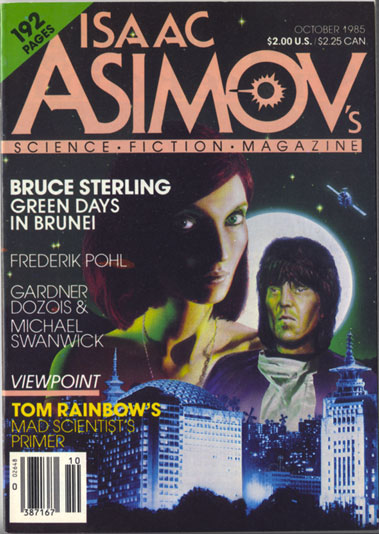
(Cover by J. K. Potter. Asimov’s, October 1985.) It’s now September, or as I like to think of it, the month before October. Yeah, I don’t have anything special in mind for this. Summer is about to end, the kids have gone back to school, and I’m about to head back to work as I’m finishing up this post. As has become typical I’ve toyed around with what I’m gonna review repeatedly, right up to the last minute, because I cannot make up my damn mind sometimes. There’s so much fiction, especially short stories, to cover that I’m constantly going, “Hmm, I wanna check this out. But ohhh, what about THIS?” Much as I want to at times I can’t do everything I want in a day. I’m a slow reader and I don’t give myself the heavy loads of someone who gets paid for review columns.
Speaking of making a good use of your time, I recommend subscribing to a few SFF ‘zines; doesn’t matter too much which ones, although I’m biased and I think Uncanny Magazine and Lightspeed are very much worth supporting. Even buying the latest issues of The Big Three™ (Analog, Asimov’s, and F&SF) would be a much better use of your time and money than a no-good piece-of-shit (HBO) Max subscription.
Apparently Analog and Asimov’s now have their own digital subscription services, to compensate for the Amazon bullshit, so that’s great honestly. Not sure what F&SF is gonna do since, with all due respect, of The Big Three™ they’re the ones most “behind” with regards to adjusting to changing market forces. We’ll see what happens there.
So what reading materials do we have?
For the serials:
- The Reign of Wizardry by Jack Williamson. Serialized in Unknown, March to May 1940. From a historical perspective, Williamson has to be one of the most intriguing figures in American SFF, debuting in 1928 and more or less remaining active until his death in 2006. At his best he also proves to be one of the most gripping and thoughtful “Golden Age” authors. The Reign of Wizardry was Williamson’s first attempt at writing fantasy that was not in the Weird Tales mode.
- The Chronicler by A. E. van Vogt. Serialized in Astounding Science Fiction, October to November 1946. In the ’40s and early ’50s van Vogt was a star among genre readers, about on par with Robert Heinlein and Isaac Asimov—only since then his popularity has waned massively, for several reasons. A direct precursor to Philip K. Dick (by Dick’s own admission), van Vogt’s influence on the field is still discernable but now understated. He remains a divisive figure.
For the novellas:
- “The Earth Quarter” by Damon Knight. From the January 1955 issue of If. As author, editor, and critic, Knight did much to bridge the gap between ’50s SF and the New Wave, with his Orbit series proving the viability of original anthologies. But in the ’50s he was one of the finer short story writers, with such classics as “Four in One” and “To Serve Man.” “The Earth Quarter” was later revised for book publication, but we’ll be reading the magazine version.
- “Green Days in Brunei” by Bruce Sterling. From the October 1985 issue of Asimov’s Science Fiction. Probably the most important writer of cyberpunk whose name is not William Gibson, much of Sterling’s work is actually not cyberpunk—at least in content. If Gibson codified the tropes that would define the movement, Sterling codified the attitude of cyberpunk, emphasizing the “punk” half of that word. Will be one of two Sterling stories I review this month.
For the short stories:
- “Forever to a Hudson Bay Blanket” by James Tiptree, Jr. From the August 1972 issue of Fantastic. Real name Alice Sheldon, Tiptree was one of the thorniest authors to come out of the New Wave, being much discussed for the outward feminism (and pessimism) of her work, the mystery of her true identity, and the tragic circumstances of her death. Tiptree made waves in the early ’70s, but I’m going for a relatively obscure story from that period.
- “Wong’s Lost and Found Emporium” by William F. Wu. From the May 1983 issue of Amazing Stories. Surprisingly, given how obscure a name he is, this is not my first time reading or even reviewing Wu. He must’ve been one of the first Asian-American authors to partake in magazine SFF, and yet he remains to be rediscovered. This story, for one, was up for the Hugo, Nebula, and World Fantasy Award, and it even got turned into a Twilight Zone episode.
Next month is when we’ll be doing all short stories and all spooky shit, so be on the lookout for that. In the meantime my review schedule is pretty normal and I assume nothing will be replaced last-minute.
Won’t you read with me?
-
Novella Review: “Beyond Bedlam” by Wyman Guin

(Cover by Ed Emshwiller. Galaxy, August 1951.) Who Goes There?
Well, we’ve been bamboozled again. I was gonna write a review of A. Merritt’s 1932 novel The Dwellers in the Mirage, but I basically fizzled out halfway through reading that novel; not that it was a bad read, it was more that somehow the timing did not seem right. I was struggling with Jack Williamson’s The Reign of Wizardry at the same time, a novel whose opening stretch is rather tough going, and reading both at the same time with a deadline in mind wearied me. Whereas the Williamson serial did pick up steam in its second half, giving me the energy to persist, I kept putting Merritt’s novel off and on, until I realized I probably wouldn’t have it finished in time. I’ll cover Merritt someday (considering his influence on other writers and how nearly everything he wrote appeared in the magazines), but I found out first-hand that sadly today will not be that day. Thus a shorter alternative was needed.
One thing I said in my review forecast was that only the novellas covered this month would be science fiction, and that remains true because we’re talking about a novella today that is very much science fiction. “Beyond Bedlam” had been in the back of my mind for a minute, because it apparently encapsulates what made the early years of Galaxy so unique and so ahead of the competition. Truth be told I thought “Wyman Guin” was a pseudonym at first, because it sounds like one. Guin did debut in the field under a pseudonym, but then started using his real name; maybe he was hesitant to do that as he already had a respectable day job. Anyway, he didn’t write much, but it was enough to earn him the Cordwainer Smith Rediscovery Award. “Beyond Bedlam” marked Guin’s first story under his own name and it remains his most well known.
Placing Coordinates
First published in the August 1951 issue of Galaxy Science Fiction. It’s been anthologized a few times, as well as collected in Beyond Bedlam, which has all of Guin’s short fiction; sadly these are all out of print, although the latter has an e-book edition. Good news is that you don’t even have to pay to read it in an unambiguously legitimate fashion, as it fell out of copyright and is available on Project Gutenberg.
Enhancing Image
(Before we get into the thick of it, be aware that “Beyond Bedlam” discusses mental illness at length in terms that are outdated; not that the language Guin uses is insensitive, but rather that our understanding of mental illness has, like everything else about ourselves, advanced massively since 1950. For the sake of staying consistent with the story, and for my own sanity, I’ll be referring to the condition described in-story as schizophrenia, even though it’s actually recognized as a different condition today.)
Sharpen your pencils, because class is in session.
It’s the 29th century, and things are… a little different. Sure, we have some future tech that one would expect in old-timey science fiction about “the future,” but the technology is not the focus of the story. No, the people have changed far more radically than the tech. We start out in a classroom, with Mary Walden, who is not the protagonist but who will eventually figure profoundly into the central conflict. Thing is, Mary is only half a person—or rather she’s a whole person, but only gets to use the body she’s in half the time. She shares her body with a filthy brat named Susan Shorrs, whom Mary knows nothing about other than she leaves the body shared with Mary in rough shape whenever the “shift” happens. The problem is that Mary is a schizophrenic, which is actually not a problem because so is everybody else. Schizophrenia, a mental illness that was very much frowned upon by “the ancient Moderns” (i.e., us), became more acceptable in the 20th century once psychiatric drugs started developing and became more accessible, not only treating schizophrenics but ushering them into normal society. “The drugs worked so well that the ancients had to let millions of schizophrenic people out from behind the bars of ‘crazy’ houses. That was the Great Emancipation of the 1990s.” After several generations schizophrenics were so entrenched in normal society that they actually started to outbreed non-schizophrenics, and because the Medicorps (mind the “the”) developed a monopoly on psychiatric drugs, and because said drugs became so accessible, schizophrenics soon had to take their drugs as mandated by law. Cut to 900 years later and you have a society (at least in the US, as we learn shockingly little about life outside of it) where everybody (with exceptions, who are themselves now pariahs) is a functioning schizophrenic. The “normal” person is now a body housing two totally separated and autonomous personalities, each in effect a whole person.
I mentioned earlier that Guin had a respectable day job that did not incentivize him to write fiction prolifically; more specifically he was a pharmacologist and advertising executive, so you bet he knew a thing or two about the latest in psychiatric medicine. The strange result is that the premise of “Beyond Bedlam” is patently ridiculous and whose foundations are a little shaky if you go asking too many questions, but for what the story asks of itself it is remarkably internally consistent. Basically, it works off assumptions made in 1950 (so when Guin wrote the story) about how people suffering from mental illnesses like schizophrenia seem to be growing in relation to the general populace. We know of course that as psychiatry has advanced by leaps and bounds that people with mental illness do not necessarily take up a greater percentage of the population, but that doctors have been able to diagnose people with greater understanding, never mind empathy. It’s a fallacy, but it’s necessary in presenting a distant future society wherein the “lunatics” have literally taken over the asylum.
(I could go on for a long fucking while about how this story’s setup clearly anticipates some of Philip K. Dick’s works regarding mental illness [Clans of the Alphane Moon, Martian Time-Slip, and A Scanner Darkly especially], but I won’t, becaue believe it or not I do value your time. I would just be shocked if Dick didn’t read “Beyond Bedlam” when it was first published as it very much reads as proto-Dickian, and also it’s great.)
So how does this work? You have, say, 10,000 bodies in a town but effectively 20,000 people running it. We’re told that historically there have been bodies with three or even four personalities, but while the word “eugenics” isn’t used, it’s made clear that these abnormal schizophrenics have been weeded out, or at best incentivized to not reproduce. A society wherein you have two personalities for every body would present enough of a problem, so it only stands to reason that more would be worse. People are forced into five-day shifts wherein each personality takes over for that duration, followed by a day of rest, between a “hyperalter” and “hypoalter.” The hyperalter is the so-called dominant personality that can, if they really want, interfere with the hypoalter’s consciousness, even invading their dreams. As such, on top of the drugs taken for compartmentalizing personalities, people are also required to take a “sleeping compound” that’ll prevent hypoalters from dreaming and thus risk invasion from their hyperalters.
The system in place to keep people’s lives in order is regimented and also imperfect, which is where the plot comes in; but we’re not quite there yet. “Aren’t you gonna get the plot already?” Soon. The thing about “Beyond Bedlam” is that the plot itself is straightforward, at least when put up against worldbuilding this dense. It’s like when people talk about Stand on Zanzibar but rarely discuss its main storyline; it’s because we all know the real meat of both of these works is in the background, and I do think “Beyond Bedlam” approaches that level of density. H. L. Gold’s editorial for this issue of Galaxy focuses pretty much entirely on “Beyond Bedlam” and how Guin went about writing it, and with good reason. Not only is this a first-rate story, but it probably could not have materialized in the way it did without the intense back-and-forth between Gold and Guin in refining it. Gold is unclear if Guin always intended this to be a novella, but he says that, with his help, Guin revised and rewrote “Beyond Bedlam” a couple times each, going through 80,000 words of drafts. The effort was worth it; this is a three-dimensional depiction of possible life in the future.
Now for the plot…
Mary is the “assigned” child (as people are not raised by their birth parents) of Bill and Helen Walden, who seem to lead a decent middle-class life, except for a couple things. For one, Bill and Helen’s alters, Conrad and Clara Manz, are also married to each other, which it turns out is very much out of the norm. “Such rare marriages in which the same bodies lived together on both halves of a shift were something to snicker about.” Conrad, being the hypoalter, knows that Bill has been “cheating” by messing with Conrad’s shifts for a few hours, but what Conrad does not know is that Bill has been having an affair with Clara, whom as you know is Helen’s hypoalter. Now, monogamy is not taken too seriously in this future society; people have affairs pretty casually, and the Waldens and Manzs are chill about messing around behind each other’s backs. The problem is that Bill is not only messing with a hypoalter (hypers and hypos are kept strictly apart, and never the twain shall meet) but his own alter’s spouse.
What starts as Bill and Clara worming their way around regulations to have their meet-and-fuck sessions soon snowballs into Bill jeopardizing both his own “life” and Conrad’s, both physically and by tempting the wrath of the Medicorps. This is all made worse by Mary becoming depressed and fed up with being neglected by her parents, causing her to break a different taboo by tracking down Conrad and Clara. Having the story start with Mary is sort of misleading since she only appears sporadically, but the classroom setting at the beginning gives us a healthy dose of exposition while also establishing how people in this future might want to break out of their regimented relationships with their alters. Since this is a strictly drug-induced culture, it’s also emotionally stifled, with the positives being that war is apparently a thing of the past (again, at least for the US) and crime seems to have gone down massively. The result is a more peaceful but also less free society where even one’s emotional spectrum is narrowed.
There Be Spoilers Here
The outcome is not surprising. Bill gets caught and put on trial by the Medicorps for a gross breach of conduct, with a guilty verdict resulting in either hospitalization for life or “mnemonic erasure,” i.e., death of the personality. If you’ve read a few dystopian narratives in your time then you’ve been here before, and you also know that Bill has to lose—to play the role of Winston Smith and John Savage. Yet even during what would normally be a been-here-done-that sequence in a dystopian narrative (the third-act breakdown of the rebellious hero), Guin once again shows off the wonderful density of the world he’s made. Mnemonic erasure will affect Conrad’s life almost as profoundly as Bill’s, as, being a single persona in a body, Conrad can’t just go around like one of the ancient Moderns. He still has his five-day shift, but during what would be Bill’s shift he gets put in deep freeze, so as to not interfere with the world of his late hyperalter. (Again, never the twain shall meet.) While Conrad is sort of pleased to see his alter put to death, since Bill’s been a huge recurring pain to him, there’s a cost to all this. With Bill gone, Conrad will now be sort of an outcast, and he will not be any freer than he was before.
So it goes.
A Step Farther Out
I have a two-part argument about SF and novellas. The first part is that SF is imaginative literature, in that it’s a literature chiefly concerned with ideas; the second is that the novella is the ideal mode for a literature of ideas, and by extension ideal for SF. “Beyond Bedlam” has enough meat on its bones to justify a novel, but it gets its point across in 21,000 words. It’s a densely packed depiction of a future society that, while absurd if considered too closely, does what it ought to do, in that it makes the reader think about how this society may be a distant descendent of ours. Guin does what most SF writers don’t in that he envisions a future that is mostly unrecognizable and yet just recognizable enough that we have context. The result is a nuanced dystopian narrative that does not provide easy answers, nor even an easily discernable perspective. If Orwell clearly sides with the individual in 1984, Guin seems unsure about the seesaw balance between individual freedom and public safety. It’s a haunting and mind-bending story, being one of the finest miniature gems of ’50s science fiction.
See you next time.
-
Serial Review: The Reign of Wizardry by Jack Williamson (Part 1/3)
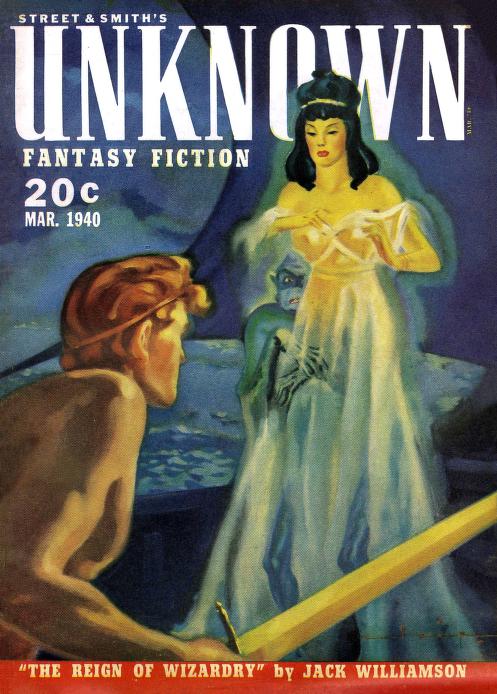
(Cover by M. Isip. Unknown, March 1940.) Who Goes There?
Jack Williamson was the second author to be made an SFWA Grand Master, after Robert Heinlein, and yet he is little read nowadays. Actually, past the first decade of his career, I’m not sure when Williamson would’ve been “popular.” That’s not a knock. This man right here is one of the most respectable old-timey SF writers, never quite reaching the heights of Heinlein, true, but also never sinking nearly to such lows as latter day Heinlein. Remarkably, unlike most writers of his generation, Williamson caught a second wind at such a late point in his career, putting out some pretty good work in the ’90s and 2000s—so, ya know, when he was in his 80s and 90s. He remains, by a good margin, the oldest person to have won a Hugo in any of the fiction categories.
I recently read Williamson’s autobiography, Wonder’s Child (which also won him a Hugo), and I’ve somehow gained an even greater respect for the man. He discusses, to some degree, all the fiction he wrote up to 1980 he thought worth mentioning, although of course the book is more about his life and how he tried balancing that (various jobs, romantic/sexual false starts) with trying to make it as a pulp writer. Curiously, today’s novel only got a single paragraph to itself, and Williamson says little about it even within that space. The Reign of Wizardry was his first published work in Unknown, the fantasy sister magazine to Astounding Science Fiction, and for both readers and Williamson himself it does not hold the esteem of his subsequent Unknown effort, “Darker Than You Think.”
There may be a reason for this.
Placing Coordinates
Started serialization in the March 1940 issue of Unknown, which is on the Archive. It has an e-book edition, wooo. For print versions your best bet would be either the Phantasia Press hardcover (out of print) or the Williamson collection Gateway to Paradise (also out of print). Yeah it’s a novel, but it’s apparently short enough to fit in the latter.
Enhancing Image
The prologue is a curious one, in that while the story to come is unabashedly fantasy, Williamson takes the effort to root it in actual science: in this case archaeology. Crete is an island, still existing today with its own people, off the coast of Greece, but what in modern times (i.e., the 19th century onward) archaeologists uncovered what must’ve been as advanced a civilization as ancient Egypt, during a time when Greece itself would not have been so prosperous. For centuries there were only hints, combined with legends, as to the workings of ancient Crete, whose golden age came to an abrupt end before being occupied by several empires over the centuries. The narrator proposes that the myth of the minotaur and the labyrinth, and the Greek hero Theseus, may have some historical legitimacy in explaining the golden age of ancient Crete coming to an end.
Now we’re on the high seas, with Our Hero™, whom to us is known as Theseus but to other characters as Captain Firebrand—a redheaded pirate who patrols the waters between Greece and Crete. One day, upon raiding a Cretan ship, Theseus and his right-hand man Cyron take in what appears to be a woman of incredible beauty as part of the loot, but who turns out to be an impish Babylonian wizard named Snish; this character, at least so far, seems to be Williamson’s biggest contribution to the myth. Snish is a low-level wizard who, for all his physical weakness, can get through trouble by disguising himself, although the illusion is an audio-visual one that will evaporate if touched and especially if kissed. Curiously the narrator refers to Snish as a “she” when in his female disguise. Anyway, Theseus considers killing the little man, but Snish convinces the crew he’d be of more use in infiltrating the island empire of Crete, at that point the most powerful nation in the Mediterranean—and host to evil wizardry.
While obviously not historically sound, we’re led to believe that Crete is such a powerful nation at this point in history because it is ruled with an iron fist by Minos, the most powerful wizard in the known world. Minos, who apparently is immortal, has ruled Crete for a thousand years, but there is at least theoretically a chance that such a tyrant can be overthrown. We’re told that every nine years (why not ten is beyond me) games are held to test the finest warriors in the land, to see if any survive the trials. “And if any man wins the contests, the old Minos must give up his life, and go down into the dread Labyrinth of the Dark One.” The Dark One being the minotaur—one part bull, one part man, one part god. Being a pirate, Theseus hates authority, and especially authority with magic powers. The games are set to begin in a couple days. If he could get to the shores of Crete, and into Knossos, that magical palace just in time to participate…
I might not be making it obvious, but the first half of this installment (which is really the first quarter of the novel) is messy. The goal is simple: Get Theseus from point A to point B, i.e., from off the island to on the island. Sounds simple, right? But this is a 50,000-word novel and said novel is frontloaded with lore, a few characters who will not matter later, and a couple action scenes that lack the pulpy zest of Williamson’s earlier writing. This was his attempt at writing a “serious” fantasy tale, and I also think there’s a reason why he would only show up in Unknown two more times; in fairness, the second of these three appearances was “Darker Than You Think,” which really is one of the standout fantasy narratives of the ’40s. But whereas that novella captivates with its grimness and psychological implications, The Reign of Wizardry starts out as too convoluted for people not already familiar with what its retelling and yet too shallowly written to be considered a demanding-but-it’s-worth-it reexamination of old material. It’s a remix of a song that barely stands on its own.
But it’s not all bad. A shipwreck puts Theseus on the shores of Crete but separates him from both Cyron and Snish, and this is where the plot goes from a series of random events to something more cohesive. Snish is not exactly Williamson’s best attempt at humor, being the closest we have to a comic relief character, so him being absent for most of the latter half of this installment is no loss. It’s here that we meet Talos, the living statue who serves Minos’s will, although sadly unlike his depiction in Jason and the Argonauts he’s not the size of a goddamn building, just a twelve-foot-tall man with an odd skin condition. He also talks. Then there’s Ariadne, Minos’s daughter, who serves the role of the single female character of any significance. (There’s also a haggard old woman who is implied to be a prostitute, but that’s the closest this novel gets to acknowledging sexuality thus far.) It took a while to get started, but once we’ve met all the key players, including Daedalus, Minos’s right-hand man, it’s time to (quite literally) let the games begin. Took long enough.
There Be Spoilers Here
Entering the games at Knossos under the disguise of a “Northman” (a viking) named Gothung, since apparently Minos was expecting Captain Firebrand to participate, the plot gets funneled into a series of action scenes wherein Theseus proves his might against a series of opponents, first bulls and then other men. This ties into the nature of the minotaur, which as said is part bull and part man, and of course there will be the final trial: judgment by the dark god himself. This section of the novel is the strongest part, but even so the action is not as grippingly written as it would be in a Robert E. Howard or Fritz Leiber fantasy adventure. There’s a bit of gore, but surprisingly it’s not as violent as the back end of the other Williamson novel I’ve covered, The Legion of Time, despite Williamson giving himself the perfect pretext for blood and guts. It could be that in an attempt to write something more dignified he wrote something that’s not as fun.
You may be thinking, “Brian, what are you saying? Violence isn’t fun!” And in the context of real life I agree. Violence, in the real world, is usually horrific and completely unnecessary. As Asimov said, violence is the last refuge of the incompetent—and there are a lot of incompetent people out there. But in fiction, especially when it’s a couple degrees removed from reality, violence can be immensely satisfying. Unfortunately that level of carnage was reserved for the “pulpy trash” of Weird Tales, which John W. Campbell wanted to counter. As such, even in this opening installment’s most gripping moments, it seems underwritten—like it’s afraid to go all out.
Anyway, Theseus succeeds in his trials, and a little too easily at that. This skepticism turns out to be justified as Minos, Daedalus, and the bitchy Ariadne pull a fast one on him and reveal his true identity. It’s implied that Minos knew Theseus would come to Crete in disguise well in advance, and just as it looks like Theseus will take to the throne as the new ruler of Crete, the rug gets pulled out from under him. We know that something like this had to happen, because this is the first part of a three-part serial, but we also know, and are all but told at the beginning, that Theseus will ultimately succeed in ending the Cretan empire’s reign of wizardry (get it?). It’s possible Williamson has a few tricks up his sleeve, but I have to wonder how much he can change given that ultimately he has to abide the trajectory of the myth. Or does he? We’ll have to wait and see… and hope.
A Step Farther Out
Ehhhhhhhhhhhhhhhhhhhhhhh…
At first I wasn’t feeling it, and even by the end of this first installment I wouldn’t say I was onboard. Something is wrong here. It could be that I need to catch up on my Greek mythology, but this seems like a straightforward retelling of a myth that would’ve probably been common knowledge for readers in 1940. That Theseus starts out as a pirate and mostly uses his wits instead of his brawn to get the job done can only go so far. The thing about much of the material published in Unknown is that while a lot of it would now be called urban fantasy, the stuff that wasn’t still had a sense of humor—you could say a lust for life—that defined the magazine. Yet at least so far Williamson’s retelling of the minotaur-and-labryinth routine is humorless, and Williamson is not one for straight-faced action—pulpy action, sure, but not something trying to be this serious.
See you next time.
-
Short Story Review: “Travels with My Cats” by Mike Resnick

(Cover by Dan O’Driscoll. Asimov’s, February 2004.) Who Goes There?
When Asimov’s was practically the be-all-end-all SFF magazine of the ’90s, certain authors were sitting at the very top of that tower. If you asked someone in 1995 who the most popular contributors to Asimov’s were, the two likeliest answers would be Connie Willis and Mike Resnick. Resnick had in fact been around (first as a fan) since the ’60s, but it was his 1988 story “Kirinyaga” that catapulted him to noteriety; ironically said story was published in The Magazine of Fantasy and Science Fiction, but Resnick quickly moved to Asimov’s and took the sequels to “Kirinyaga” there. He would end up with a record-breaking number of Hugo nominations, plus five wins, with today’s story being the fifth winner. This is not something you just do by accident. Resnick clearly had talent and a vibrant charisma that endeared him to readers as author and editor.
What’s strange about Resnick is that despite having died only a few years ago and being generally well-liked among the genre readership (those who still subscribe to magazines), his work reads like it’s—let’s say from a different era. Which is true. The ’90s may not seem like a long time ago in terms of how literature has evolved, but back when Resnick was at the top of his game he wrote for an audience that was damn close to lily-white, and it shows, especially in those aforementioned Kirinyaga stories. “Travels with My Cats” doess not have such a problem… up to a point.
Placing Coordinates
First published in the February 2004 issue of Asimov’s Science Fiction, which is on the Archive. You’d think winning a Hugo (never mind also placing first in the Asimov’s readers’ poll) would guarantee more reprints, but “Travels with My Cats” has been reprinted only a few times. If you want an audio reading then there’s the Escape Pod episode for “Travels with My Cats,” found here. For book reprints there’s the collection Win Some, Lose Some, which collects all of Resnick’s Hugo-winning and -nominated short fiction up to 2012; unsurprisingly it’s quite thick.
Enhancing Image
Ethan, the narrator, reflects back on what would turn out to be a turning point in his childhood, although he could not have known it at the time. As a kid he went to a garage sale, which objectively speaking had nothing unusual—not even in the books section, which like any decent person he checked. There were some fetching books, but they all cost 50 cents each, “and a whole dollar for Kiss Me Deadly,” and Ethan only had a nickel. Well, there was one book that fit his budget: a very old travel book titled Travels with My Cats, authored by Priscilla Wallace. The lack of pictures on the inside at first put Ethan off, but he checked further and saw it was a limited edition—one of only 200 copies. Any self-respecting bibliophile knows a limited edition like that would be a must-buy, especially for a nickel.
It’s here that we get some names dropped, as to be expected of a story that panders to the base. You have the usual: Asimov, Heinlein, Bradbury. Some detective fiction as well, what with Raymond Chandler and aforementioned Kiss Me Deadly. The book Ethan picked up was like none of those, but he ended up enjoying it still as it presented a different kind of adventure, about Priscilla’s globe-trotting travels with her cats Giggle and Goggle, seeing places Ethan could barely comprehend as an 11-year-old. I have to wonder if Resnick had a similar flashpoint in his childhood; maybe he picked up a book at a library, or an issue of National Geographic, and grew fixated on this idea of “seeing the world.” It goes a long way to explaining his fetish for exoticism, which now reads as problematic.
Ethan read Travels with My Cats several times in his childhood, but like all childish things he eventually put it aside, not even giving it a thought until many years later when he has a sort of madeleine-cake-in-tea moment and it all comes back to him. This opening stretch of the story (admittedly this is a story you can read in half an hour), wherein Ethan discovers and then rediscovers Travels with My Cats, is the best part. It could be that I’m a sucker for reminations of the nature of memory, but to Resnick’s credit he makes Ethan a fleshed-out person in those opening pages, perhaps with a bit of autobiography. It’s not hard to imagine Ethan as an alternate version of Resnick, some twenty years younger, who does not go on to “see the world” and become a respected author; instead he becomes a nobody. Ethan, now in middle age, lives a peaceful but unproductive existence, not being in love or fueling a passion that would get him away from his meaningless job. But finding this book again gives him a purpose.
Ethan’s life is basically a series of false starts. He reads all about exotic places but he never travels himself. He forms a sort of fanboy crush on Priscilla (who after all is just an idea to him), but never finds someone in real life who fills this role. He buys what amounts to a log cabin by a lake and that’s the most adventurous he gets—until suddenly he has a mission. How rare is Travels with My Cats actually? Whatever became of Priscilla Wallace, that author only he seems to remember? So like any good bibliophile he ventures out to the library and goes digging. Turns out the book was even older than Ethan had thought. Priscilla died in 1926, age 34. “So much for fan letters, then or now; she’d died decades before I’d been born.” In fairness, given that the current action takes place in 2004, Priscilla would be dead regardless; but the fact that she died so young is a bitter pill. Some people would have the plot be Ethan’s quest to track down the origins of this obscure book from his childhood and leave it at that, and I would even argue that, in the right hands, this might’ve made for a better story.
You may notice that nothing supernatural has happened yet, but that’s about to change when Ethan gets a special visitor at his doorstep. Priscilla is here, along with her cats, looking and acting like a real person.
I have a hypothesis that’s been slowly gaining ground in my brain, and it goes like this: Every author worth their salt will, at some point, write a ghost story, or at least something that can be construed for a ghost story. It’s actually a hard subgenre of fantasy (if you wanna call it that) to avoid. “Travels with My Cats” is a ghost story wherein we’re not sure if what we’re encountering is the supernatural or an elaborate prank the protagonist is playing on himself. Some will call it “magic realism,” but this is a useless label for my money. Anyway, Ethan is awe-struck by the visitation, especially because he had committed the one photo of Priscilla he knew to memory. Here she is, someone who’s been dead for 75+ years, with her two ghost cats, and she’s really just here to talk for a bit.
A few odd things about Priscilla, since she doesn’t act like an ordinary ghost. For one, she knows she’s dead, but she doesn’t know when or how she died. She also doesn’t know what time it is. There’s one other thing, but that’s for spoilers. She appears not once, but several times, coming to Ethan in the night before disappearing. Where she goes is anyone’s guess. In a way I don’t blame Ethan for acting the way he does, because when we meet our favorite authors we’re bound to say some embarrassing shit, like we’re cracking under the pressure of it, but I would be lying if I said his “confession” to Priscilla didn’t make me cringe. The mid-section of “Travels with My Cats” is about their quasi-romantic relationship and it occurred to me at some point that this plot wouldn’t be happening if Priscilla was a man. It could also be that I had read Richard Matheson’s Somewhere in Time only a week ago and that had basically the same problem.
You could argue that “Travels with My Cats” is not a romance, and I’d agree, except it’s obvious that Ethan’s newly revived crush on Priscilla (someone who’s been dead for 75+ years) fuels the plot; it gives his character any reason to grow at all. Heterosexual romances in fiction often strike me as hollow, as they do for a lot of queer people, and I suspect this is because we’re not given a reason for these people to be in the same room together aside from being physically attracted to each other. They would not be friends. I’ve had crushes on several male friends in my life and there’s a profound difference between crushing on someone you like being with simply for the sake of being around them and crushing on someone because your hormones are going turbo and you’re getting funny ideas. Making Ethan and Priscilla’s relationship quasi-romantic (I say “quasi-” because Priscilla doesn’t seem to love Ethan, although she does encourage his behavior somewhat) disappointed me more than a little.
There Be Spoilers Here
One day a raccoon breaks into Ethan’s cabin and tears his copy of Travels with My Cats to shreds. “Pages were ripped to shreds, the cover was in pieces, and he had even urinated on what was left.” The book cannot be salvaged. What’s strange is that while Priscilla has gone, presumably never to return without a copy of the book, her cats are still here. Giggle and Goggle not only look but feel real to Ethan, and he’s convinced these cats have somehow been brought back to life. This can all be written off easily as Ethan losing his marbles, since we never get a third party’s perspective (indeed the world does not seem to exist outside Ethan’s bubble) on the whole thing, but I assume we’re supposed to take the cats existing at face value. But still, Priscilla is gone, and even if she’s just of a figment of Ethan’s imagination, he can’t just wish her back with a thought. All is lost.
Or is it? After much digging, first trying and failing to comb online booksellers (shoutout to AbeBooks), Ethan gets in touch with a guy who knows a guy who can verify even the exitence of Travels with My Cats. True enough, it’s a real book, although it was self-published, only printed 200 copies (not even sold, printed), and didn’t even get an ISBN. To find another copy of Travels with My Cats would take years. Good thing (for him, anyway) Ethan has nothing much to lose. The non-ending of the story sees Ethan hit the road with Giggle and Goggle, using what money he has left to travel cross-country in search of a book that means a great deal to him, if nobody else. I’m sure this has thematic reonsance, what with Ethan finally learning to reach outside his comfort zone by following in his favorite author’s footsteps, but part of me wonders if Resnick ends the story on this open note because he could not figure out where else to take it.
A Step Farther Out
There’s a certain stereotype about Hugo winners, that they’re not demanding reads, but rather crowd-pleasers that play to readers’ emotions. Sometimes this is true. “Travels with My Cats” is one such weepy tale, a bittersweet ghost story with a hint of wish-fulfillment (“What if the dead author I have this weird crush on came to me one night?!”) that’s more rewarding the more familiar you are with Resnick’s reoutine in advance. I’ve read several Resnick stories and have even enjoyed a couple of them thoroughly, but I don’t think “Travels with My Cats” ranks up there. In the introductory blurb, Gardner Dozois claims that Resnick thought “Travels with My Cats” to be one of the three best stories he ever wrote. I don’t know about that.
See you next time.
-
Serial Review: Skull-Face by Robert E. Howard (Part 3/3)

(Cover by Hugh Rankin. Weird Tales, December 1929.) The Story So Far
Stephen Costigan is a drug addict and traumatized World War I veteran spending his days in the Limehouse district of London, wasting away in an opium den, until he is called upon by Kathulos, a strange man who claims to be of Egypt but whose ethnicity is ambiguous. Kathulos frees Stephen of his hashish addiction but instead gets him hooked on a much more powerful drug, an elixir whose ingredients only Kathulos knows. Stephen is hired to carry out a rather strange assassination plot, but he goes to John Gordon of the London secret police and conspires with him to double-cross Kathulos and his gang. Part 2 is concerned with Stephen and Gordon playing detective and discovering both the whereabouts and origin of Kathulos, who had escaped with Zuleika, Stephen’s love interest. Turns out Kathulos is an Atlantean—found in a coffin in the ocean and either awakened or resurrected. The sorcerer’s plan is to overthrow “the white races” and take over the world, with Africans and Asians as his underlings.
Funny thing about the recap section for this installment is that because so little progress was made in Part 2 the synopsis is expanded from the front so that we start with backstory before ending on basically where Part 1 ended. I said this before, but Part 2 really ground the plot to a halt and generally this novella could’ve used an editor’s judgment.
Enhancing Image
This will be mostly a series of notes, since right now I don’t have the motivation to do otherwise. Skull-Face isn’t very good, but it is certainly strange—and baffling, especially for the modern reader.
Let’s consider the following:
- If you thought we were done with Gordon’s monologuing from Part 2, think again. Given he is supposed to be of the secret police, Gordon has no qualms pouring out every little bit of information he knows to Stephen, who after all is a civilian and not even a British subject at that. His eagerness to trust Stephen turns out to not be ill-founded, of course, but it does ring as implausible.
- Speaking of implausibility, Kathulos being from Atlantis and Atlantis being a real place are taken basically at face value, with Our Heroes™ not having a hard time accepting these as fast. I genuinely wonder how many people back in the ’20s believed in the Atlantis myth, but upon reflection it would not surprise me if a good portion of the Weird Tales readership bought into it.
- So let’s talk about how this is sort of a white supremacist narrative. To put it simply, the villain of the story is a non-white person who has kicked off several revolts in Africa and Asia against white colonists, and we’re supposed to believe these oppressed peoples taking back their land is a bad thing. The phrase “white supremacy” is actually used at one point, quite literally, coming out of Gordon’s mouth if I recall correctly. Of course, being a British cop, Gordon has the perfect motivation to back white supremacist interests.
- This is, however, complicated by Kathulos being open about using said revolts and building an empire of non-white people for his own gain. He’s essentially a grifter who has radicalized people into anti-colonialist action so that he can reap the benefits. I’m not sure if Howard did this because he realized that the villain of his story might come off too sympathetically or if he wanted to placate his readership, a fraction of whom would’ve been bona fide white supremacists.
- Further complicated by the Atlanteans apparently viewing whites as little more than barbarians in suits, being still inferior to the Atlanteans who see themselves as the truly supreme race. Genocide against whites would be the cherry on top to Kathulos’s empire, although as he points out, he does not view blacks as any better, with Atlanteans (at least in the old days) thriving on racialized slavery not unlike much of the US leading up to the Civil War. I’m not sure if Howard, who came from a former slave state and who became increasingly aware of his country’s blood guilt as he got older, is making a comment here.
- The story climaxes with Stephen rescuing Gordon from bloody sacrifice and Gordon shooting Kathulos in the chest point-blank, which may or may not have killed him. While I do find it funny that a sorcerer with plans to rule a billion people gets taken down by A GUN, I was also intrigued by the fact that we don’t know if Kathulos died or if he somehow survived both the gunshot and his underground tunnel network getting blown to bits. His body is never found. The ending hints at a possible sequel, but we never got one.
- The romance with Zuleika is about as rushed and unconvincing as you would expect, although for what it’s worth we do get a romance between a white man and a non-white woman that ends happily. As far as I can tell interracial marriage was totes legal in the UK at the time, although the social acceptability of such a union is a different question, especially since Stephen is himself an immigrant.
Reading Skull-Face after having read some later Howard works, it seems like Howard was on the verge of becoming more socially aware of the world outside of lily-whiteness, which is to take most of the world. His sympathies for black Americans would become more pronounced as he aged, to the point where he would get into arguments with Lovecraft and others with regards to white supremacy, but I’m not quite sure when he reached that point. Keep in mind that Howard grew up in a time and place where he would’ve been force-fed pro-Confederacy falsehoods almost from birth. He took more pains than most of his peers to understand people who come from outside the white Southern bubble. Gone with the Wind came out the year of Howard’s death, and for being a thousand pages of Confederacy apologia it won the Pulitzer Prize and became an enormous bestseller.
I realize I sound like I’m excusing the obvious racism of Skull-Face, but to make it clear, I don’t blame anyone for disliking this story on the basis of its problematic elements, which are indeed appalling.
A Step Farther Out
Skull-Face is not something I would recommend unless you’re already a Howard fan and/or a completionist, since it’s not very good, for one, but it’s also likely to alienate readers who are not already familiar with the trajectory of Howard’s writing. Being the oldest Howard story I’ve reviewed, it’s easily the weakest and shows the most signs of having been penned by someone who was still honing his craft; and then there’s the racism. The absurd race war plot is probably what people will take away from it, which does not bode well for how much one can enjoy it. Howard would go on to write a few equally long works and structure them far more ambitiously than here while also justifying that length. He gets better.
See you next time.
-
Novella Review: “Singleton” by Greg Egan
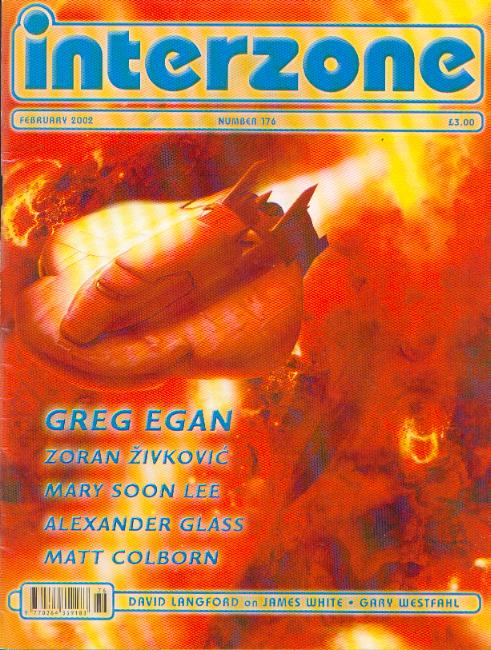
(Cover by Jason Hurst. Interzone, February 2002.) Who Goes There?
He made his debut in the ’80s, but Greg Egan is one of the quintessential voices of ’90s SF—a bridge connecting cyberpunk and transhumanist SF, sometimes wandering well outside the boundaries of either. Egan’s fiction is notorious for its incorporating of biology, computer science, quantum physics, and what have you. Egan started out as a programmer and his work often reads like the product of someone from that profession who also happens to read a lot of detective fiction. The typical Egan narrator, including the one for today’s story, is a rather melancholy white man who struggles with emotional honesty, and as such, depending on your frame of reference, it’s easier to understand Egan’s stories as detective narratives with cybernetics involved, rather than hard science fiction.
Placing Coordinates
First published in the February 2002 issue of Interzone, which is on the Archive. If you have qualms with reading a scan of a 21-year-old back issue of a magazine that you would have to buy used anyway, rest assured you can read this story perfectly legit on Greg Egan’s site, found here. You can also find “Singleton” in The Best of Greg Egan.
Enhancing Image
We start in the now-ancient year of 2003, with Ben, the narrator, a snot-nosed college geek, being witness to what is likely a gang-related beatdown in an alley, with a ton of other people watching. A kitchen hand is getting his ass beat by two guys who don’t seem to be carrying guns but do seem to mean to kill this man with their bare hands. Nobody intends to interrupt the killing. “Keeping your distance from something like that was just common sense.” Something, however, snaps in Ben—maybe a jolt of guilt. He steps in and gets beat for his troubles, but the kitchen hand comes out the situation alive and Ben gets to feel like not just another bystander. Now, for most people an act of heroism like this would be a shining moment in their lives, maybe a fond memory, but the prossibility of not helping the kitchen hand will haunt Ben for the rest of his years.
The details of this first section are the foggiest in the story. We never learn exactly why those goons wanted to beat this man to a pulp, nor do we even learn the man’s name. We’ll never get the full context for some things—even the most important days of our lives. This haziness makes sense when you consider Ben is narrating this many years down the road, reflecting on when he was a teenager and the world seemed a fundamentally different place. Not unlike Marcel Proust in his search for lost time, there details of the past that time has simply devoured.
Ben, while still an undergrad, kicks it off with Francine, who will turn out to be his college sweetheart and life partner. The incident with the kitchen hand had, in the short term, given Ben a confidence that normally would be absent in young scientists, and he’s well aware that it was that incident which probably motivated him to pursue Francine. “There was no denying that if I’d walked away from the alley, and the kitchen hand had died, I would have felt like shit for a long time afterwards. I would not have felt entitled to much out of my own life.” But why shouldn’t they get together? They’re both scientists, albeit in different fields of study. Much of their relationshio will be long-distance due to work, but that will not be unusual in the coming years (as indeed it’s not out of the ordinary now); it may even strengthen their bond, that distance. “Singleton” is, among other things, a love story, and the romance is believable because there’s so little of it.
(A note here: There are several time-skips throughout the novella. We start in 2003 but creep across decades, well into even our own future. “Singleton” was published in early 2002 but it would’ve been written probably a whole year prior, which means Egan did not, for instance, take 9/11 and the War on Terror into account. This is like publishing an SF story in 1946 that was written, evidently, pre-Hiroshima.)
Some years go by and unfortunately the two hit a major speed bump in their relationship when Francine suffers a miscarriage that’s painful both physically and psychologically, possibly caused by Ben handling radioactive dust in a previous job but never confirmed. Regardless the two are not confident about the prospect of producing a child, and while adoption is on the table, their relationship is in enough of a rough patch that they don’t agree right away on the proper course of action. Not to say the romance aspect of “Singleton” is great, because that’s not its main purpose, but I do like how Egan shows the often banal (from the outside, anyway) downside of relationships. Ben and Francine love each other, but there are real-life issues standing in the way of an Eden-like existence, which of course also applies to a lot of real-life couples. Never mind that the idea of becoming a parent, as to be expected, fills Ben with an anxiety that’s both terrible and exhilarating. “I wasn’t ready,” he admits at one point, but for better or worse he would have to wait some more to become a parent after all.
Before we get into the actual science-fictional aspect of “Singleton,” I wanna take a moment to talk about how short fiction may be structured so as to resemble a novel; this is not exclusive to novellas as I’ve also seen it done with shorter works. The time skips and the conservation of detail (achieved via first-person narration, which you may notice is easier to do in that mode than in the third person) give the impression of a story being longer than it is, since it covers enough time and events to fit into a novel. We cover a lot of ground here in the development of Ben and Francine’s relationship, but there’s still plenty of room for Egan to explain, in language that is mostly beyond my dumb-dumb brain, quantum mechanics, the Many Worlds Interpretation, and how they relate to the major action of the narrative—which, to boil it down, is the raising of an AI.
Putting it as basically as I can, Ben builds a device, the Qusp, “the quantum singleton processor,” which basically acts as a funnel for a quantum computer. What separates a quantum computer from a normal or “classical” computer, you may ask? As a layman my explanation would be that while a classical computer can make decisions with incredible speed, it can only make one decision at a time, in other words being a linear thought processor. A classical computer, no matter how intelligent, even if it were sentient as with a true AI, would only be able to comprehend one decision at a time. A quantum computer, meanwhile, is able to see, with the naked eye so to speak, dozens or even hundreds of possible decisions simultaneously. Imagine you’re in a maze and you’re wondering which way to go; if you were a classical computer you would consider each direction one at a time, but as a quantum computer you would have all these decisions superimposed on top of each other, like cutting into a cake and seeing all the layers on the inside. I’ll let Egan explain more in his own words:
The Qusp would employ all the techniques designed to shield the latest generation of quantum computers from entanglement with their environment, but it would use them to a very different end. A quantum computer was shielded so it could perform a multitude of parallel calculations, without each one spawning a separate history of its own, in which only one answer was accessible. The Qusp would perform just a single calculation at a time, but on its way to the unique result it would be able to pass safely through superpositions that included any number of alternatives, without those alternatives being made real. Cut off from the outside world during each computational step, it would keep its temporary quantum ambivalence as private and inconsequential as a daydream, never being forced to act out every possibility it dared to entertain.
As such, a quantum computer that passes the Turing test could, with the Qusp installed, consider decisions simultaneously whilst being able to come to a single result and without being overwhelmed with information. Or so that’s the idea. The Many Worlds Interpretation is of course tied to quantum mechanics, wherein basically (I’m saying that word a lot, I know, but bear with me) every decision has its own branch, resulting in what would probably be billions (or functionally an infinite amount) of alternate universes—many of them very similar, but some very different. Ben and Francine eventually agree to try again at having a child—only this time they won’t make or adopt, but build a child. The result will be a quantum computer with the Qusp as its anchor, wrapped in a plastic human body. A ghost in a shell. Such a child would be tapped into many worlds, being able to consider decisions at a speed and complexity incomprehensible to humans.
What could possibly go wrong?
There Be Spoilers Here
In some robot/AI narratives the intelligence in question would turn out to be malicious, or perhaps too smart to relate to its human creators. Thanks to the Qusp, however, the resulting child, Helen, is not much more intelligent than a smartypants like Ben or Francine. There are certain things that are uncanny about her, such as the variety of plastic shells she can inhabit, but she is by no means an evil AI run amok. It does turn out, though, that of course there would be several issues that are not Helen’s fault. Our Heroes™ have functionally created a synthetic person or android, although it’s made clear that Helen only has her human body for the sake of her “parents.” The introduction of true AI in human form naturally causes a major stir throughout the world, with cultists both pro- and anti-AI popping out of the woodwork to make our characters’ lives worse.
(Another note: I appreciate that the future world Egan conjures is still very much recognizable as our own, albeit with a couple changes. We don’t get rayguns and flying cars, but we do get to see how an invention—in this case adais, or “Autonomously Developing Artificial Intelligences”—would interact with the known world. Aside from the whole pre-9/11 thing this is a plausible depiction of the near future.)
The back end of “Singleton” is concerned with raising Helen and how such a “unique” child poses a problem for Our Heroes™, who after all are doing this more so out of personal trauma than a need to do good. Ben eventually admits that he took on this extended project because he had become consumed by the implications of the Many Worlds Interpretation, with it all going back to that fateful day in the alley when he was but a teenager. The results are somewhat tragic, with Ben’s relationships with Helen and Francine eroding over time, but there is a ray-of-hope ending that hints at something which may bring an understanding between human and AI. If you’ve read enough Egan then you know that he’s in sympathy with transhumanism—more specifically the notion that consciousness can be totally divorced from organic biology. While there are several questions raied about Helen’s inner workings and how she may survive in the human world, what’s not questioned is that she is a thinking creature who deserves to be treated as such, and indeed the story ends with Helen caught in an act of contemplation. For better or worse, the machine is alive.
A Step Farther Out
“Singleton” is a curious novella (or, as I said before, a compressed novel) that would probably hit stronger on a reread—preferably after I’ve done more research on computing. I’ve read several Egan short stories throughout this year in preparation for reviewing a longer work of his, and yet—maybe it’s because I had read short stories from early in his career—”Singleton” is still a more demanding read than I had expected. I recommend it, because I’ve sat on it for a couple days now and it’s left an impression on me that’s hard to articulate (usually a good sign for a work of art), but it’s not what I would recommend for someone just starting to get into Egan; either shorter works or his most famous novels (so I’m told) would do the trick.
My Egan journey has been progressing at a pace where I’ll be getting to his novels, particularly Permutation City and Diaspora, soon enough. I hear the former is the best thing since sliced bread.
See you next time.
-
The Observatory: Why Review Old Science Fiction?
(Before the Golden Age. Cover by Tim Lewis. Doubleday, 1974.) This month’s editorial will be rambling and not straightforward. For one, now is the time to reveal my thought process with regards to how I pick review materials and why I do that; so in a way this will be a bit of a meta post. You’ll get to see how the sausage is made. You see, I’m not a book reviewer who gets paid to receive review copies of upcoming releases and give them my honest (but not too honest) opinions, wrapped in professional plastic and safe for toddlers and small dogs to chew on. There may come a point when I take on a review column for some publication, but that’s not now, nor is it in the immediate future. After all, SFF Remembrance is already time-consuming and it serves a different purpose. This is my blog that I run for the fun of it and I get to review what I want, without some editor breathing down my neck.
This still raises the question: Why do I do it? Why, so far, have I tackled only a handful of stories from the 2010s and nothing from the 2020s (yet) in favor of dusty, pulpy, uncouth genre fiction from the time before my parents were even in diapers? This is a question that actually involves several questions within it, like one of those Russian nesting dolls, especially for someone of my age who does not have the ability to remember any of these stories from when they had that fresh car smell.
We have to ask the following:
- What counts as “old” science fiction?
- What differentiates “old” science fiction from “classic” science fiction?
- Why read the damn things in the first place?
- If we should read them, why should we write about them?
- If we’re to write about them, should it be as a reader or as a pseudo-academic?
- When all is said and done, who would want to read these reviews?
That first question sounds like it has an obvious answer, but it doesn’t; nor does “old” necessarily mean “classic” science fiction, hence the second question. Most old SF is not considered classic by today’s readers. Here’s another way to look at it: Dune is a classic novel, without question. It has been continuously in print since 1965, won awards, and has now received multiple film and TV adaptations. It is a classic by reputation, which really is what makes something a classic; that is to say there’s a collective agreement among a set of people that this work is still worth celebrating. Contrast this with a novel that came out only one year prior, Robert Heinlein’s Farnham’s Freehold, which despite having Heinlein’s name attached to it is often reviled, with even contemporary reviews being unkind towards it; it’s old, but not really a classic. Then again, 1965 is over half a century ago, so surely anything from then would be deemed old by anyone now living—certainly by anyone in my age bracket. There’s a certain point where people can agree that something has gathered enough wrinkles to be considered old—only we don’t always agree on when.
Much like how beauty is in the eye of the beholder, so one could also argue the age of a work of art is relative to the person perceiving it. I mentioned 1965, but let’s turn the dial to the year of my birth: 1995. For some people 1995 was not that long ago—maybe even too recent to be considered old, let alone grounds for now-classic works. I used to think the same way myself, that SF from 1995 is still fairly contemporary; only problem is it’s not. While many of the authors who were active then are still active and producing good work now (Nancy Kress, James Patrick Kelly, Michael Swanwick, to name a few), and while writing techniques have not evolved greatly in the past 28 years (certainly not as jarring a shift as, say, between 1932 and 1960), the recurring concerns and, more importantly, the perspectives of SF writing have changed greatly. Now we see not so much white American writers spouting about other cultures as people of those other cultures having their seat at the table. This is a good change, mind you. While there is still much exciting and fresh fiction from 28 years ago, there’s some dust gathering on the surface, visible to the naked eye.
(To put this in context, and with all due respect, it’s hard to imagine Mike Resnick’s Kirinyaga stories, which won him awards in the ’80s and ’90s, would get such a glowing reception if published today.)
If such fiction now strikes us as a little (or very) dusty, why should we still read it then? I am not referring to the work that still reads as fresh but that which does not read as fresh. These are stories whose style and morals have since been superseded by works that are at least superficially better. Why go back and read Jack Williamson’s The Legion of Time when there have been many time war narratives since then that are more sophisticated and less problematic? Indeed, why do we still read Dune whilst acknowledging that Frank Herbert’s prose now reads as confusing and overcrowded? Surely there are novels that are reminiscent of Dune that are also more delicate with the English language? Why are Heinlein’s books all still in print despite his being a lecherous right-wing militant with a penchant for monologuing? These are not easy questions, nor do they seem to have an “objective” answer that can be gathered via the scientific method.
I’m also asking these questions specifically with regards to old science fiction, and not old fantasy or horror. Nobody asks why we still read Tolkien (although I do) despite his being a lackluster stylist and a puritan. Nobody doubts the immense power and importance of Edgar Allan Poe’s writing despite its vintage and Poe’s own stylistic flaws. Even that most controversial of old-timey horror writers, Lovecraft, is still held as the sun around which cosmic horror orbits, despite efforts (lousy efforts, mind you) over the decades to discredit him. The viability of these fine and flawed gentlemen and their flawed works need not be thrown out the window casually. To be fair, there is a straightforward reason for this attitude that does not carry over to science fiction: fantasy and horror are genres that have not been subjected to change nearly as viciously as SF. Time, who is always a harsh mistress, has devoured entire worlds with SF for the simple reason that SF, far more than its sister genres, hinges on discoveries of the moment. Our understanding of the natural world has changed over time, and so by extension what was considered cutting-edge in the past is now quaint—or even worse, incompatible with current understanding.
Consider that Frankenstein, that most foundational of SF novels, is still widely read and beloved—but not as science fiction. It’s still effective as horror, and as a cautionary tale, but as a narrative supposedly rooted in science it now reads as nigh incomprehensible. Even when I read it for the first time as a semi-literate high schooler I knew that Dr. Frankenstein’s method for resurrecting a corpse, and especially his subsequent fear that the monster would breed deformed hellspawn, made no sense. Mary Shelley wrote in a world that would not know Darwinian evolution for a few more decades, and it shows. Here’s another example: In the 1920s and ’30s there were a lot of stories about “cosmic rays” playing a part in evolution, perhaps best encapsulated in Edmond Hamilton’s “The Man Who Evolved.” This is total nonsense that cannot be taken seriously with a modern lens. Why, then, do people still read Frankenstein but “The Man Who Evolved” will forever be deemed a relic of the super-science era? Probably because, aside from being such a monumental work, Frankenstein can be understood as something other than science fiction, whereas Hamilton’s story can only be understood as a story founded on bad science.
And yet…
(Cover by Frank R. Paul. Wonder Stories, April 1931.) We still see reprints, from time to time, of very old and very dusty SF, and there are several blogs running right now that specialize in engaging with vintage SF. I myself started as part of the online book club Young People Read Old SFF before creating my own blog. Unfortunately said book club has dwindled in number over the past couple years, and outside of it I’ve seen scarcely any interest from people my age in the old stuff. I suspect this is for a few reasons. If you’re a part of fandom and you don’t have the memory capacity of a goldfish then you may recall several incidents in the past decade (most infamously the Sad Puppies fiasco) wherein old folks and reactionaries would rant about how kids these days don’t respect “the classics” and how SF is absolutely 100% for sure on its way out. It’s true that we may be heading into another dark age for SFF magazine publishing, but never before has the field been more inclusive, more niche-filling, and more accepting of ideas that go against heteronormativity, capitalism, etc. And yet there is the grain of truth that young readers (I’m thinking people aged thirty and under) fail to engage with where the field has been.
It’s true also that SF with a fine layer of dust on it does present a problem for young readers—one which reviewers like myself should but are unlikely to solve. You see, you can’t force somebody to enjoy a work of art. You could contextualize art and give it the proper platform for which to be understood, but enjoying something, much like romance or the urge to produce children, is totally beyond rational understanding. Ultimately I have to say I read this or that because I enjoy it, and then try to apply a veil of reason to my desire. Even when I come out of a story not liking it I usually feel joy from thinking and writing about it—because I like to think and write about science fiction as something that has changed over time, as indeed it does. If I wanted to read something and enjoy it in a vacuum I could do that, which is basically how most readers go about it, and true enough when I sit down and dig into a novella or serial installment I’d been anticipating I do it for the same reason as the rest of us: for the pleasure of it. My reviews and other posts are not as professional-sounding as those of my peers, in part because I wanna make it clear that I come from the place of someone who reads because he finds the act of reading pleasurable and thus unbusinesslike; it could also be that I’m from New Jersey, so pardon me on that.
A little bit of a story here.
I have a lot of SF anthologies on my shelves, and almost entirely ones published prior to 2010, which means that inherently these volumes cover pre-2010 material; most of those are from the 20th century, which they cover (necessarily) even older material. There are two books I have that are of particularly relevant note to this month’s editorial, which have a strange amount in common, including their mission statements and the era in which they were published. These are Isaac Asimov’s Before the Golden Age and Damon Knight’s Science Fiction of the Thirties, from 1974 and 1976 respectively. Asimov and Knight are pretty close in age, the former born in 1920 (the official story, that is, although Asimov was probably born in late 1919) and the latter in 1922, and so these two men grew up reading mostly the same fiction. Even so, their temperaments are radically different. Asimov has a nostalgic view of the super-science stuff of the ’30s and his writing technique is a dot that connects perfectly with that era, his prose thoroughly beige (which is not to say dull); then in Knight’s case we have someone who started out as a critic before moving into writing and editing fiction, and thus someone who is more willing to experiment.
Asimov, for his anthology, picked 25 of what he considered the best SF stories he had read during his formative years—stories which he still enjoyed upon rereading as an adult. Knight, for his part, scouts the same time period (1931 to 1938 or thereabouts) but with a more “objective” stance, picking stories he had found whilst digging through old magazine issues that he thinks are worth rediscovering. Asimov’s book is autobiographical while Knight’s serves more as a brief history of short SF in the ’30s, and while I think the latter has stronger fiction on average (there are some truly awful picks in the Asimov), it seems people gravitate much more towards the Asimov because of that copious and shameless subjectivity. Before the Golden Age is a 900-page monster and about a hundred of those pages are Asimov reflecting on both his life and the stories he chose. We’re given, on top of a handful of still pretty good stories and a lot of clunkers, a look into Asimov’s mindset as reader, writer, and, for a brief time, reviewer. It’s an essential anthology, not so much for the stories but in how it argues for the need to return to old science fiction.
Something to think about is that when Asimov and Knight put together their anthologies, these being books deliberately collecting very old and outmoded fiction, the oldest story from was a mere 43 years old when Before the Golden Age was published; and yet the science fiction of 1931 and the ’70s were worlds apart. Time is relative, and merciless.
-
Subscribe
Subscribed
Already have a WordPress.com account? Log in now.
 Science Fiction & Fantasy Remembrance