-
Serial Review: Skull-Face by Robert E. Howard (Part 2/3)

(Cover by C. C. Senf. Weird Tales, November 1929.) The Story So Far
Stephen Costigan is a traumatized World War I veteran and drug addict who’s taken up residence in London’s Limehouse district, at first a slave to hashish and then a slave to the enigmatic sorcerer Kathulos, a strange man of ambiguous ethnicity who draws Stephen into the underworld, promising him new vitality with an elixir that’ll grant him near-superhuman powers—but whose addictive power is lethal. As he gets further ensnared in the underworld Stephen comes across a beautiful woman named Zuleika who, aside from obviously being the love interest, lets Stephen in on how evil Kathulos’s machinations are. Our Hero™ soon gets wrapped up in an assassination plot that (I kid you not) involved a gorilla costume and Stephen allying with John Gordon of the British secret police.
Stephen and Gordon team up to take Kathulos and his goons into custody, but naturally things don’t go well and the skull-faced sorcerer escapes via a secret tunnel, taking Zuleika with him. Both sides have taken a few casualties in the fight, but now Our Heroes™ are left with the question of where Kathulos could’ve gone, what he might be planning, and perhaps most importantly, where the hell he came from.
Enhancing Image
Part 2 is hard to summarize as it’s not only the shortest installment, but very little actually happens in it; indeed, the plot moves hardly an inch forward between the start and end of this installment. Stephen and Gordon, now like buddies in a detective narrative, retrace their steps in an effort to find out Kathulos’s origins, in doing so hoping they can figure out what his endgame is. By the way, if you’re reading Skull-Face I recommend reading the text on Project Gutenberg as it’s not only easier to read but does away with the recap sections. In the case of Part 2 the recap givess away the big revelation in the installment to follow, which frustrated me because a) it made me worry I had missed a big plot point in Part 1 (I did not), and b) it sort of just hits you over the head with something major before you’ve had a chance to read it for yourself and digest it properly.
Gordon, who apparently knew more than he let on, givess us a truly massive infodump about a series of revolts in Africa as of late had had a common element about them, with Kathulos being involved and encouraging unrest among African and Asian peoples. There’s been a prophecy spreading that a man “from the sea” will unite the marginalized ethnicities of the world and overthrow the “white races.” There are apparently multiple white races; be sure to put a pin in that one. So… to make a long story short, Kathulos is not of Egypt like he claims, nor is he from any known country on the planet, but from Atlantis. Kathulos is an Atlantean who mummified himself and lay at the bottom of the ocean, only to be discovered and subsequently either resurrected or brought out of cold sleep. Kathulos doesn’t seem to have a personal desire to topple white supremacy but, it’s implied, is taking advantage of racial strife by crowning himself as emperor of a new society where non-white people are on top.
I have a few questions.
I had heard about the race war plot of this novella in advance, and yet even reading it now I feel like I wasn’t prepared for it. Howard has a rather messy relationship with racism, being a Texan in the early 20th century, but he was also a proud Irishman surrounded by WASPs, at a time when people still made distinctions between “types” of whiteness. Nowadays Jews are often considered white (I say often, but admittedly not always), but this was obviously much more of a point of contention a hundred years ago. At what point were Jews considered white? Evidently not at the time of Howard’s writing Skull-Face. Rather than the huge gelatinous blob with arbitrary boundaries that we now understand whiteness to be, it was like a school with different cliques in Howard’s time, thus in Skull-Face we have “the white races” pitted against several non-white races. This all sounds a bit cracked, but I’m trying to make sense of an understanding of racism that’s totally alien to modern conceptions, except maybe the most backwards parts of the US (i.e., the parts that think the Confederacy meant well).
You may be thinking, “Brian, you handsome devil, how come there’s no content warning for racism that came with this review?” The answer is simply that if you’re reading a Weird Tales pulp adventure from the ’20s, you ought to go in expecting at least some racism. I know this is gonna sound like a bit of a “these darn kids” rant, but I’m peeved whenever people fail to engage with old genre fiction because of the simple fact that values change over time and even left-liberal writers from more than half a century ago generally did not believe in intersectionality. Was Howard a racist? I’m gonna say no. In fact it seems Howard was vocally againsst notions of racial supramcy, at least in his later years. Did he have preconceived notions about race, and did he use white people’s ignorance of other cultures to give his fiction an “Orientalist” appeal? Absolutely to both those parts. I would be lying if I said a good portion of this installment of Skull-Face wasn’t baffling or painful to read, not to mention the plot grinds to a hault. By the end of Part 2 nothing except lore-dumping has been accomplished.
A Step Farther Out
This is a major step down from the first installment. Howard has a knack for writing action and there basically isn’t any here; worse than that, it’s almost entirely dialogue-driven, which I have to admit has never been Howard’s strong suit. It’s short, but even so I started to wonder when John Gordon’s borderline monologuing would come to an end so we can get back to the actual plot. Kathulos and his goons are pushed totally off-stage, and by extension we get zero development with Zuleika, instead being stuck with Stephen, who’s a hot mess of a person, and Gordon, who for this particular part of the novella acts as Mr. Exposition. Hopefully the final installment can bring back the momentum I so dearly missed in Part 2… and, ya know, maybe not make the race war plot as painful to read.
See you next time.
-
Short Story Review: “The Dreaming City” by Michael Moorcock

(Cover by Brian Lewis. Science Fantasy, June 1961.) Who Goes There?
Truth be told I feel almost the same way introducing Michael Moorcock as I did when I introduced H. P. Lovecraft, in that while my feelings on these men as writers is mixed, I have to admit their importance to genre writing (each in his own way) is immense. I get the irony is that Moorcock really dislikes Lovecraft (as both a writer and person) to the point of basically denying his influence on other writers, but… goddamnit, I couldn’t hold back on this for even a few more sentences. I would’ve read more Moorcock by now, especially since I’ve been getting more into heroic fantasy, but the first memory I have of reading Moorcock was not any of his fiction, but his essay “Starship Stormtroopers,” which is a no-good-very-bad piece of work that, among other things, argues Starship Troopers was hand-crafted to appeal to reactionary young men in the pages of Astounding (it was actually serialized in the left-leaning Magazine of Fantasy and Science Fiction but never mind) and that Heinlein and his ilk promoted fascist tendencies in their writing. And he also took pot shots at Lovecraft with points that simply have not aged well. (He does the annoying thing people still do to this day where he seems to think Lovecraft’s views never changed on anything.) So I was not keen on reading more Moorcock.
Still, it must be said that the field would look a fair bit different without Moorcock’s efforts, especially as an editor. Moorcock was a world-weary 25-year-old when he took over New Worlds, which in the ’60s threatened to become a bit stale but which gained new vitality under Moorcock, publishing works that would not have seen magazine publication in the US for being too sexually charged and/or too vulgar. Writers like J. G. Ballard and Thomas M. Disch really let their nuts hang in New Worlds, whereas elsewhere they had to contend with censorship. The result is that we owe the New Wave (both its successes and follies) at least partly to Moorcock, who after all wanted so desperately for science fiction to “come of age.” But before he became a revolutionary editor Moorcock was already a skilled writer, recognized for his Elric saga, being one of the more important heroic fantasy series in the genre’s history. Despite this, “The Dreaming City” marks my first encounter with Elric, although considering it’s the first Elric story (both published and I believe in internal chronology) I think it fits.
Placing Coordinates
First published in the June 1961 issue of Science Fantasy, which is on the Archive. “The Dreaming City” has been included in several Moorcock collections over the decades, but it did not get anthologized in English until very recently, in The Big Book of Modern Fantasy (ed. Ann and Jeff VanderMeer). Actually I’m sure it was that chunky anthology that made me aware of the Elric saga and this story in particular.
Enhancing Image
We’re introduced to a distant and yet alternate past, not unlike the worlds of Robert E. Howard and Clark Ashton Smith, wherein there was an ancient civilization, Melniboné, that lasted thousands of years and yet, at the start of “The Dreaming City,” is on its last leg. Warlords are conspiring around a campfire; there will be a raid on Imyrrir, the titular dreaming city, the last stronghold of Melniboné. Normally these shady characters would be the antagonissts, only they’re helped by Our Hero™, Elric, last of the rulers of Melniboné—and a king in exile. By his own choice, mind you. The opening pages give us something not dissimilar from Howard’s Hyborian Age, but soon we find there are a few major changes, mostly having to do with Elric himself, who is a darker shade of grey than Conan.
Whereas Conan is a beefcake, a tower of Irish muscle, Elric is “a pure albino” whose eyesight is bad and which will only get worse with age, whose physique is not exactly impressive, and who generally would be a weakling if not for his weapon of choice, Stormbringer, a cursed sword passsed down his line that will both make him and probably be the death of him. Can’t say I’m a fan of Elric. Then again, I don’t think we’re supposed to “like” him; he does not have the courage of Conan, nor the comradery of Fafhrd and the Gray Mouser. If Elric lived in the 21st century he would have most likely been a Jordan Peterson fan as a teenager. It’s hard to appreciate now (and I know because I also find it hard to appreciate from this vantage point), but in 1961 Moorcock gave us a sword-and-sorcery “hero” who was subversive in that he was not a model for power fantasies, but a quishy piece of shit who survives because he has the right tools for it. Okay, there still be a bit of power fantasy involved, which I’ll get to in a minute.
Before I get into the plot, which is deceptively simple (although it’s framed rather confusingly at first), let’s talk a bit more about Elric’s character in the context of fantasy heroes. I’ve already told you Elric is a sword wielder, with Stormbringer getting him out of sticky situations, but the kings of Melniboné also have a long tradition of sorcery. In RPG language we might call Elric a red mage or a combat mage, since on top of swordplay he’s also a skilled magic user—although his capacity to work spells is capped “since he did not have the reservoir of strength, either of soul or of body, to work them.” Moorcock, in so many words, calling the “hero” of his sword-and-sorcery epic a bitch baby is not something other authors were likely to do beforehand. Even C. L. Moore’s Jirel of Joiry, who psychologically might be as battered as Elric, is still a naturally strong warrior who earns her keep. It also turns out that Elric does not seem to feel loyal to anyone in particular, since it takes all of about twelve hours for him to bamboozle the warlords he’s conspired with and to follow his own path into the city—his city—where the real villain dwells. “He planned to leave the fighting to those he had led to Imrryr, for he had other things to do—and quickly.”
I’m about to escalate things here and say that the real dramatic hinge of the story is an incestuous love triangle between Elric, his tyrannical cousin Yrkoon, and Yrkoon’s sister Cymoril. Yrkoon is the current ruler of Imyrrir by virtue of Elric leaving his post, but also by force; there’s the strong implication that if not for most of the city’s people being perpetually stoned and sleepy (the city having degenerated into little more than a massive opium den at this point), Yrkoon would’ve been overthrown. Everybody knows Elric is the “rightful” ruler, but Elric sort of disagrees. Whereas in much fantasy the hero’s hometown is looked upon with a nostalgic fondness, Imyrrir is in such a state of disarray and given to such debauchery that like one of the cities of the plain it seems destined to get torched by the hand of God. Getting sacked by a fleet of despots might not actually be the worst thing that can happen to it. Unfortunately because this is a short story and because Moorcock’s descriptions are rather sparse, we get to know extremely little about the city and its people. Then again…
I normally don’t bring up the quality of the prose itself when reviewing stuff here because I’m one of those people who thinks that not everything need evoke Joseph Conrad in its delicate use of the English language. Different writers have different strengths when it comes to crafting narratives; you might have someone who is great at character psychology but who is average at best with constructing plots. Moorcock would’ve been all of twenty years old when he wrote “The Dreaming City,” and while it was not his first story published (he had been around for a few years at that point), “creaky” is a word that keeps coming to mind for me when I think of the prose here. There are turns of phrase here that I personally would not use. I didn’t think the word “frenziedly” would pop up, let alone more than once. There also seem to be a few times where Moorcock uses a word that sounds exactly like another word he intended to use but which is a different word with a different meaning. Not sure how Elric can “steal” himself. Pardon me, I know I’m picking on a story from towards the start of an author’s career and which itself is now older than most people.
Anyway, Elric takes his own boat and sneaks into the port city via a secret passage only he knowss, being intimate with the city’s layout. This move is less to save the city and more to rescue Cymoril from the gross incestuous claws of his cousin (as opposed to Elric’s benign incest). Little aside here, but when Elric finds Cymoril she’s in a druggy slumber, like most of Imyrrir’s populace, and kisses her on the lips while she’s unconscious. Interesting. It’s also never made clear if Cymoril actually reciprocates Elric’s feelings or if she just finds him preferrable to Yrkoon, who after all totally lacks redeeming qualities. We’re also introduced to Elric’s mentor, Tangleboness (what a quirky name), whose death is so telegraphed that if he said he had two more days until retirement it would not have been surprising. Oh, and a raid is about to start, but that’s easy to forget. It’s clever that Elric would help stage a raid so as to distract Yrkoon and his troops, but it’s also a subplot that mostly happens offscreen and whose conclusion is immaterial.
There Be Spoilers Here
Elric, in trying to save Cymoril and then to avenge his mentor’s death (as was all but foretold), kills an impresssive number of mooks—at least partly without even trying. If you’re looking for bloodlust in your fantasy then the central action sequence here will satiate your appetite somewhat. Of course this is only buildup for the duel with Yrkoon, wherein the traiterous cousin pulls out a magical sword of his own and the two combatants are rendered nigh immortal from their sorcery. Elric defeats his cousin, naturally, but tragedy unfolds as a result, for Cymoril has all of two or three lines before getting caught in the crossfire and dying on Elric’s sword. In his dying moments Yrkoon throws Cymoril onto Stormbringer and she dies basically instantly and without saying anything in reaction; it’s such an abrupt death scene that I had to do a double take.
So Yrkoon is dead, Cymoril has done a good job of getting fridged (I do find it funny that Moorcock, an outspoken supporter of Women’s Lib, would kill off the sole female character in the first Elric story so unceremoniously and without granting her actual character), and Imyrrir is basically in ruins. A good day’s work, I think! Not that Elric feels good about it. At the time Elric killing his own love interest by accident might’ve hit differently, but now it reads as almost inevitable—like a job requirement. Truth be told the last quarter of the story could’ve been shortened extensively, since we’ve already hit the climax, both of the action that matters to Elric and the trauma that will probably define future series entries; it’s rather overlong. We do, however, get a meaty passage at the end that could be thought of as the flashpoint of Elric’s superhero (or -villain) origin story, as he contemplates his lopsided relationship with Stormbringer.
Elric brooded, and he held the black runesword in his two hands. Stormbringer was more than an ordinary battle-blade, this he had known for years, but now he realised that it was possessed of more sentience than he had imagined. The frightful thing had used its wielder and had made Elric destroy Cymoril. Yet he was horribly dependant upon it; he realised this with soul-rending certainty. He was an albino—a type rare among animals and rarer still among men. He was an albino, owning no natural reserves of vitality. Normally, he would be slothful, his reactions sluggish, his mind hazed. His eyesight would grow steadily worse as he grew older and he would probably die prematurely. His life would be dependent upon the grace of others; he knew this—he would become this if he lost the runesword’s alien aid. But he feared and resented the sword’s power—hated it bitterly for the chaos it had wrought in his brain and spirit. In an agony of uncertainty he held the blade in his hands and forced himself to weigh the factors involved. Without the sinister sword, he would lose pride—perhaps even life—but he might know the soothing tranquility of pure rest; with it he would have power and strength—but the sword would guide him on to evil paths and into a doom-racked future. He would savour power—but never peace. Never calm, sad peacefulness.
To give Moorcock credit this is certainly a foreboding ending, especially for the time, as Elric has accomplished his goal but ultimately has gained nothing from it. Things probably would have turned out better for certain parties had he not intervened, and Moorcock wants to make it very clear (maybe a little too clear, given how much he harps on Elric’s disability) that Elric is both a weakling and probably a bad person. Still, he’s a more powerful magic user than 99% of humanity and his sword is so good that it literally does the heavy lifting, making sure that for all his personal failures Elric is likely to always win encounters so long as he has Stormbringer. I wouldn’t call him a tragic figure, because true tragedy requires that people fail nobly and despite his royal bloodline I would not call Elric “noble,” but his success and failure being so closely intertwined serves as a fine blueprint for a real anti-hero, as opposed to a tough-but-means-well figure like Conan. That’s right, we have our prototypical incel fantasy hero with Elric.
A Step Farther
I feel like I’m being a little unfair with this, but then am I really? Moorcock would’ve been all of twenty when he wrote “The Dreaming City” and it shows, but at the same time it serves as the beginning of what would become an immense sprawling series that Moorcock would work on, albeit sporadically, up to the present day. A lot can change in 62 years, including (especially) an author’s skill and how they feel towards the series that has defined their career more than anything else. No doubt I’ll be covering more Elric stories in the future, but since the only way is forward I’m comforted knowing I’ll be coming across a more mature Moorcock. On its own I can’t really recommend it. I know it’s not fair to compare a very young Moorcock with mid-career Fritz Leiber, but there’s a creakiness to the wording in “The Dreaming City” that gives the strong impression of someone who was only just starting to hone their writing chops.
See you next time.
-
Serial Review: Skull-Face by Robert E. Howard (Part 1/3)

(Cover by Hugh Rankin. Weird Tales, October 1929.) Who Goes There?
Robert E. Howard is a favorite on this site for a few reasons: he wrote a lot, pretty much all his work was published in the magazines, and he writes action that doesn’t bore me—a real achievement if you know my reading habits. Howard’s career was tragically short-lived but he got started very young and never stopped, debuting in 1924 at the age of 18 and only stopping with his suicide in 1936, aged thirty. Most authors barely get their feet off the ground by the time they’re thirty, but Howard was such a prolific and restless writer that he had accumulated what would be several hefty volumes of fiction when he died, and that’s not even counting posthumous releases. Nowadays Howard is most known for creating Conan the Barbarian (or the Cimmerian, yes I know that’s technically the correct title), which by itself would prove profoundly influential on American fantasy. True, he was not the first American fantasist, but Howard set the standard for a mode of fantasy writing that could not be confused with British fantasy a la J. R. R. Tolkien or Lord Dunsany.
Howard was only 23 when Skull-Face was serialized, but he had already been in the game for five years and his growing adeptness at storytelling shows. At about 33,000 words Skull-Face was also his longest work of fiction up to that point, and the first installment is also the longest. While Howard ran a ton of series and contributed to other people’s series, most notably the Cthulhu Mythos, Skull-Face is a complete standalone work. How does it measure up to his more mature stories? Hmmm.
Placing Coordinates
Serialized in Weird Tales, October to December 1929. You can read Part 1 on the Archive here, and subsequent installments are also available there. Skull-Face was later reprinted whole in the December 1952 issue of Famous Fantastic Mysteries, found here. This was added to Project Gutenberg pretty recently (and by that I mean two weeks ago, I’m not kidding), because as far as I can tell Howard’s work is basically all in the public domain, and you can read it here in the format of your choosing.
Enhancing Image
Stephen Costigan is what you might call a fuck-up, being a shell-shocked World War I veteran from America who now spends his days smoking hashish basically nonstop in a London opium den, called the Temple of Dreams. We start with Stephen recounting one of his hashish dreams, in which he sees what at first seems a skull floating midair but which is in fact attached to a person, yellow skin tightly wrapping it and the skull “endowed with some horrid form of life.” This is totally not the villain of the story and Stephen is totally not gonna meet him later.
For now we’re stuck with Stephen’s daily routine, which is to wallow in London’s Limehouse district, in the aforementioned opium den run by some shady Chinese individual (not the words Howard uses) named Yun Shatu. It’s pretty clear, although the term “post traumatic stress disorder” would not be invented for several more decades, that Stephen has become both an expat and a drug addict in no small part due to PTSD. Howard would’ve been a grade-schooler when World War I happened, but Stephen is at least thirty years old here, having survived No Man’s Land surrounded by mud and corpses. “My body recovered, how I know not; my mind never did.” Stephen’s wartime experiences go to explain his character in at least two ways: by giving context to his vulnerable state at the story’s beginning, and by justifying some rather heroic acts he commits later. Howard had a lot to write in so short a time so that every detail here contributes something to the narrative, for we do not have time to waste.
After a brief dream sequence we’re off to the races—at such a breakneck speed that when I reading I actually did not figure at first that we had transitioned from the dream world to the real one; it doesn’t help that the opium den is called the Temple of Dreams, which admittedly does add to the nightmarish atmosphere about to envelope Stephen. Since Howard’s not gonna stop the plot train, I figure I may as well take a break here and talk about a few things that caught my eye—for better or worse. Apparently in 1929 you couldn’t write about sex past some descriptions of scantily clad women in your pulp fiction, but drug addiction is fine. I find it a bit hard to believe Stephen is this much of a wreck because he smokes too much weed; a shame, in 2023 he could’ve started a YouTube channel as a charismatic stoner. We also know weed is not that harmful, although it’s possible (I’m not sure what first-hand experience he had) that Howard is pointing a finger at what would’ve been an enormous stigma against drug use at the time—for Stephen is about to come across a far worse drug than hashish.
Also, I shouldn’t have to explain this, but I do because I wanna recommend Howard’s fiction to people but not have them be blindsided by remarks that are very much part of the vocabulary of Howard’s time. To quote Walter from The Big Lebowski, “‘Chinaman’ is not the preferred nomenclature.” I do suspect Howard picked London because it’s a locale outside of what his American readership would be familiar with, and there’s undoubtedly a good deal of playing to exoticism with all the non-white characters who are described in racialized terms. For what it’s worth, no, Howard does not use the N-word (at least here), although he makes fair use of “negro,” which was a perfectly innocuous word in 1929 and would actually remain so for several more decades. I’m not sure when “negro” would stop being used by well-meaning white folks but it could not have been earlier than the ’70s. Anyway, there’s also a character whose ethnicity combined with her attire are a little dubious, but we’ll get to her in a minute.
Stephen gets taken by some brute named Hassim to an out-of-the-way part of the opium den, and this is where we’re introduced to the villain of the story (I’m just gonna say it here because why bother), Kathulos, the skull-face (get it) Stephen saw in his dream earlier. Kathulos turns out to be a man—sort of. He’s not a walking corpse, although he has unusual proportions, never mind that despite claiming to be of Egypt his skin complexion doesn’t align with any known ethnicity. It’s clear (at least to us) that Kathulos is a sorcerer of a sort, maybe even a zombie; regardless there’s something about him that pushes him into the realm of the supernatural.
A skull to which no vestige of flesh seemed to remain but on which taut brownish-yellow skin grew fast, etching out every detail of that terrible death’s-head. The forehead was high and in a way magnificent, but the head was curiously narrow through the temples, and from under penthouse brows great eyes glimmered like pools of yellow fire. The nose was high-bridged and very thin; the mouth was a mere colorless gash between thin, cruel lips. A long, bony neck supported this frightful vision and completed the effect of a reptilian demon from some mediæval hell.
Kathulos, seeing potential in Stephen, has a job offer for him, although it’s not out of the “kindness” of his heart. Unfortunately for Stephen the means by which Kathulos keeps him leashed to this new job is an elixir—a drug of such power (indeed life-restoring properties) but so addictive that withdrawal would mean death. Stephen’s hashish addiction is nothing compared to the hell Kathulos is about to put him through; on the upside, the elixir gives him near-superhuman abilities that’ll prove useful. Kathulos’s goons are also not all eye sores, as there’s a woman under his spell: Zuleika. Circassian “by blood and birth” and spending her youth in Turkey before being bought by Kathulos, Zuleika is a bit of a… problem. She’s a bit of a damsel, which for pulp fiction is not unusual, but this is more conspicuous by Howard’s standards, coming from the man who would write some strong-willed women later in his career. It’s also clear from her background and how she dresses (in a mix of “Oriental” and Western fashions) that Zuleika is acting as the exotic woman whom the white man will woo.
Lastly we’re introduced to John Gordon of the London secret police, whose role in things is vague at first but who will prove useful in Part 1’s climax. By the time we get to the back end of Part 1 we have a few parties involved, each other their own goalss in mind and, more importantly, these goals are not made clear to the reader. It’s clear Kathulos wants to use Stephen as his slave, to accomplish a mission whose bigger goal remains utterly a mystery to Our Hero™. What could the skull-face be planning? (By the way, Kathulos sounds a bit like Cthulhu, which, being correspondents with Lovecraft, Howard would’ve been well aware of at the time, though I’m sure it’s just a coincidence.) The elixir Stephen has become horribly addicted to will be both the ssaving and death of him as he takes part in a mission of impersonation, and later murder, that goes amiss.
There Be Spoilers Here
What happens from hereon is a bit much, but it involves, among other things, an assassination plot and Stephen dressing up in a gorilla costume. I’m not kidding about that last part. Stephen explains the situation to Gordon and the two agree to team up with, with Stephen lying about his mission and confronting Kathulos while Gordon and his men surround the opium den so as to block off escape routes. Since these are London cops I assume Gordon and his men plan to apprehend Kathulos using nothing more severe than harsh language. It doesn’t matter, because naturally Kathulos expected Stephen would betray him, and not only that but there’s a secret tunnel the cops could not have anticipated; that said tunnel turns out to be filled with “scores of hideous reptiles” only adds insult to injury.
So bad news, Kathulos has gotten away and he took Zuleika with him; the good news is that Stephen drank enough of that elixir that it should last him a few days before he starts going into withdrawal. The hunt is on, between a shattered veteran and an aloof plain-clothes cop for a sorcerer who is probably even more powerful than what we’ve seen up to this point. Howard wrote his stories with magazine publication in mind and as such he knew how serials worked, with the end of each installment leaving bread crumbs for intrigue but making the reader excited for more. Howard’s writing itself has a drug-like effect wherein it transports the reader to a mindset that is not lucid, but rather based primarily on imagery and action, with anything not action being omitted; as such you have potentially a 50,000-word narrative compressed to 2/3 that length.
A Step Farther Out
Every time I read a Howard story I feel tempted to become one who those nerds who digs up his letters to try to see how his brain worked. Not that Howard was an unparalleled genius whose inner workings would be a treasure trove, a Shakespeare for us to bow to, but more that his interests strike me as so human that reading much of his fiction almost reads like having a conversation for me. There’s a lot to unpack with Skull-Face and we’re only just getting started, so I’ll say for now that I feel the way I ought to feel when it comes to the opening salvo of a serial: that is to say intrigued. I would’ve read it all in one sitting if not for work, which I think again speaks to Howard’s skill with keeping the reader’s attention.
See you next time.
-
Novella Review: “Immigrant” by Clifford D. Simak

(Cover by Frank Kelly Freas. Astounding, March 1954.) Who Goes There?
Clifford Simak is one of my favorite discoveries of the past few years, in that he’s exactly the kind of author I like to show off to people who think so-called Golden Age SF is just this or that. Simak debuted in 1931, which would make him a bit of an oldster by the time John W. Campbell took over Astounding in late 1937; but whereas some authors merely adapted to the new standard and were lucky to do that, Simak actually got better as time went on. He wrote most of the stories that would comprise City in the ’40s, with 1944 alone seeing four of them in print. These were some of the best and most emotionally fulfilling short stories of the era, even surpassing most literary fiction of the time in my opinion. The ’50s then saw a period of immense productivity for Simak, mostly in the pages of Galaxy, where he played well with authors two decades his junior.
“Immigrant” was one of the few major Simak stories in the ’50s to be published in Astounding, and without giving the game away at the start, I can see why it was published there and not in Galaxy. This is a bit of an unusual Simak story in that it takes place entirely away from Earth, as instead we find ourselves on an alien planet with a race of powerful and condescending aliens. It’s also rather foreboding—for the most part.
Placing Coordinates
First published in the March 1954 issue of Astounding Science Fiction, which is on the Archive. It was most recently reprinted in The Shipshape Miracle and Other Stories, which seems to only have an ebook edition. Sigh. You gotta go back to the ’90s for a paperback reprint. The most relevant for me has to be Galactic Empires Volume One (ed. Brian Aldiss), which is not an anthology you’d expect to see a Simak story in.
Enhancing Image
Going into this I thought it would be a coming-of-age narrative featuring a juvenile protagonist; well, it is a coming-of-age narrative in a sense, but there are a few twists. Our Hero™ is Selden Bishop, a 29-year-old genius who, through rigorous testing and passing a certain exam, gained the privilege of traveling to Kimon, apparently the most prosperous and alluring planet in the known galaxy. In this distant future, humanity knows it’s far from the only sentient race in the galaxy, and yet Kimon stands out among its neighbors as being where you wanna go if you wanna make it big; only thing is that a tiny fraction of humans (such that they can only be an extreme minority on Kimon) are allowed to enter.
Kimon was a galactic El Dorado, a never-never land, the country at the rainbow’s foot. There were few who did not dream of going there, and there were many who aspired, but those who were chosen were a very small percentage of those who tried to make the grade and failed.
The other thing is that those who are lucky enough to land on Kimon have been awfully cryptic in their letters to Earth for decades. It’s a shame Simak did not anticipate social media, as it would then be much harder to keep the exact relationship between humans and Kimonians a secret. Anyway, Bishop is here because he earned it, but also to do a sort of job for Morley, his Earth contact, which is to figure out what is actually happening on Kimon and what the humans are supposed to be doing there. No, despite the Kimonians being humanoid and very handsome (akin to tall bronze statues), there’s no implication of cross-breeding between humans and Kimonians; this is still a John W. Campbell magazine, after all. What Bishop discovered will be much more aligned with Campbell’s interests, but that’s for later. Much of the first half of “Immigrant” involves Bishop figuring out the basics and how to get a job, since he still needs one of those.
Like other immigrants from Earth, Bishop is sent to stay at a hotel that’s almost quite literally in the middle of nowhere, with “nothing, absolutely nothing, but rolling countryside” outside the hotel. There are no roads on Kimone, nor do there seem to be cities. While Simak does pander to Campbell somewhat in this story, the pastoralism of Kimon is surely Simak’s treat to himself. Actually the decadent ruralism of the Kimonians reminds me of what became of future humanity in Campbell’s own “Forgetfulness,” wherein mankind, in developing psi powers, forgets how to use technology as said technology becomes no longer needed. The Kimonians themselves are natural psi users, being able to communicate with each other across distances without tech via telepathy and teleportation; naturally, and more creepily, they can also read human minds.
As for the Kimonians themselves, they’re kinda… well, they’re like Vulcans: they’re a bunch of assholes. Not in an actively malicious way, but more in that they clearly think of humans as “cute.” Bishop can’t have a real conversation with them. The good news is that while the number of humans on Kimon is incredibly small, the humans have been clustered together such that it doesn’t take long for Bishop to make at least one new friend, namely Maxine, who to her credit does not exist to be Bishop’s love interest. Maxine has been here for a while now and not only understands the Kimonians to a better degree, but is capable of doing a couple things that normal humans ought not to be able to do. Unfortunately Maxine is also a pessimist who assumes the Kimonians just wanna play an epic prank of their human visitors—not that the Kimonians try hard to disprove this.
To make it in this new world, as surely the Irish and Italians had to in 19th century America, Bishop will have to know a whole new rulebook. “You have to adapt,” he thinks at one point. “You’d have to adapt and play the Kimon game, for they were the ones who would set the rules.” Whatever that game is. Eventually he sucks up his pride and goes to ask for a job, which true enough will have a very healthy paycheck by human standards, though it’s far from glamorous. Occupation? Babysitter.
What I like about “Immigrant” is that it’s too packed to work as a short story but too slight to be stretched to a 50,000-word novel; it’s a fine example of what can be done with the novella mode—specifically the short novella where we’re looking at 17,500 to 25,000 words. I suspect Simak wrote this for Astounding because of the paycheck, but also because Astounding usually ran a novella in each issue, with the only rival to both have such a policy and offer such a healthy paycheck being Galaxy. Still, this is not what I would call “major” Simak. It took me four days to read “Immigrant,” partly due to work but also I was not exactly glued to my screen. It’s hard to call boring, but it also meanders enough that I was not sure, while reading, about the point Simak was trying to make until the end. For those of you who are wary of Simak because of his sentimentality, though, you may be pleasantly surprised at how not sentimental “Immigrant” is.
There Be Spoilers Here
The “babysitting” job turns out to be a lot more taxing than Bishop assumed. For one, the Kimonian children he looks after seem totally capable of taking care of themselves, but worse is that they don’t seem to even acknowledge him as an adult figure; indeed, to the Kimonian children, Bishop is, at best, like a fellow child. When being introduced to the children they give him human names—for the sake of his convenience. “They are approximations,” says one. “They are as close […] as he can pronounce them,” says another. These are Kimonian names which Bishop is not equipped to understand; like with most everything else on the planet it’s a door he’s not allowed to open—at least not yet. Sure, the pay is extravagant, but Bishop finds “babysitting” these kids to be profoundly demeaning.
At first Bishop gets the idea that humans are allowed on Kimon to serve as pets, or at best as playmates for their children, since clearly a Kimonian child is treated as a more advanced being than an adult human with a college education. Most authors writing for most other outlets probably would’ve gone with the “humans are pets” option, predictable as that may sound now, but Simak is not like most authors; he believes, usually, that it’s possible for humans and other sentient races to treat each other with respect. I’m convinced at some point that Simak may have envisioned a downer ending wherein Bishop realizes that he and his fellow humans are mere playthings for the Kimonians—except for the fact that the Kimonians are natural psi users. Now, why would a story published in Astounding depict a “superior” alien race with psi powers while humans come off as a bunch of weaklings? Surely there’s a catch to this—and there is!
While overall I enjoy the previous Simak story I’ve covered, “The Big Front Yard,” (review here) more, I do think the solution to “Immigrant” is more justified, even if it still plays to Campbell’s interest. Simak may well have thought of the ending well in advance of writing the rest of the story; it doesn’t read like a last-minute addition. While I did not know how this story would end, I really should’ve made an educated guess from before the story even officially starts, as there’s a major clue. The opening blurb (probably written by Campbell) is clever in that while with hindsight it’s easy to see as spoiling the whole trajectory of the plot, there’s not enough context given to make a certain guess at the start.
After many years of work, the child graduates from grammar school—and is a freshman, in high school. After more years of work—he gets to be a freshman again. And if he is very, very wise, he might even get to be a
kindergarten student again…Bishop thinks back on a few things, such as Maxine’s ability to teleport (a rudimentary ability by her estimate) and other strange things that have happened, and realizes something: these psi powers can be learned. Over time, and with the right mindset, humans can evolve to read minds, move objects, and yes, teleport to other places, just as the Kimonians do. “But before you could even start to absorb the culture, before you could start to learn, before you ever went to school, you’d have to admit that you didn’t know.” In order to learn these abilities (in which it would take years to do so), Bishop has to, in a way, become a child again. This 29-year-old man with a high IQ has to start his life over, with a new mindset, with the expectation that he’ll have to think as the Kimonians think if he wants to get to their level. But it can be done. The very last line of the story confirms Bishop’s theory: that the humans bright enough to go to Kimon are going back to school—this time to learn psi powers.
A Step Farther Out
I’m not quite sure how to feel about “Immigrant.” This is a story that ultimately plays to Campbell’s obsessions, namely his thing for psi powers and humanity evolving to a higher state of consciousness. I don’t think Simak’s view of humanity is so optimistic as depicted here and in “The Big Front Yard,” although he certainly wasn’t a misanthrope. On the other hand, much as I wanna think Simak may have had a different ending in mind in the event he could’ve sold it to Galaxy, I do think the ending was as intended from the start. It’s a bit of an eerie story, not horror but a little uneasy with how Kimon is depicted, until its swings upward at the end, like someone waving a flag in triumph. I may question the sincerity of it, but as is typical with Simak I respect the swerving-away from what might’ve been a horrific conclusion and instead choosing an ending that bodes well for everyone involved. Simak probably doesn’t believe humans can evolve into telepathic superbeings in a matter of months, but he may well believe that with some hard work and humility, mankind can redeem itself.
See you next time.
-
Things Beyond: August 2023
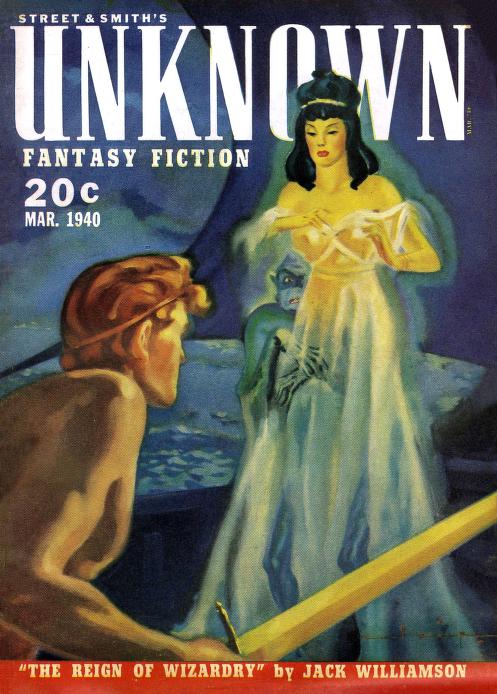
(Cover by M. Isip. Unknown, March 1940.) What the hell, a whole month went by and nothing crazy happened that wasn’t work-related. Well, the SFF magazines are being choked out by big daddy Bezos and Twitter is now no longer Twitter, but aside from that, everything has been pretty normal!
I’m being sarcastic.
To keep your mind off the fact that the short story within the context of genre publishing is an endangered species and that readers can hardly be bothered to support the lifeblood of the field, let’s read some stories! We have a curious set this month, focusing more on fantasy, which is not normally my thing; indeed the only science fiction stories covered this month are the novellas. Much like pushing myself just a little bit when trying a new food, fantasy is a genre I treat, paradoxically, with both caution and enthusiasm. Enough wasting time, though…
For the serials:
- Skull-Face by Robert E. Howard. Serialized in Weird Tales, October to December 1929. Howard wrote for only twelve years, debuting in 1924 and stopping with his suicide in 1936—at age thirty. Most writers barely get their feet off the ground by the time they’re thirty, but not only was Howard a natural-born storyteller, he wrote at a blistering pace such that he still accumulated a vast body of work. Skull-Face is a standalone fantasy, predating Conan by a few years.
- The Reign of Wizardry by Jack Williamson. Serialized in Unknown, March to May 1940. Retro Hugo nominee for Best Novel. This was not published in book form until 1964, a 24-year gap that normally would imply the author had died in the interim—only Williamson was not only alive but had another 42 years left in him. Was not Williamson’s first go at fantasy, but it marked his first appearance in Unknown, a new fantasy magazine with more exacting standards.
For the novellas:
- “Immigrant” by Clifford D. Simak. From the March 1954 issue of Astounding Science Fiction. The review for this will be posted on Simak’s 119th birthday, which is the least we can do for the man. With the wave of “empathetic” and pastoral SF in recent years, especially the works of Becky Chambers, some have looked back to Simak (rightfully) as a direct ancestor. “Immigrant” hopefully will see Golden Age SF’s most compassionate writer in good form.
- “Singleton” by Greg Egan. From the February 2002 issue of Interzone. I was gonna tackle “Oceanic” originally, but that seemed too obvious and maybe not characteristic of Egan’s work. I’ve been quasi-binging Egan’s short fiction as of late, because he interests me. Egan’s one of the major voices in transhumanist science fiction, as well as one of the first Aussie writers to leave a mark on the field. He’s also notoriously aloof; there are no pictures of him on the internet.
For the short stories:
- “The Dreaming City” by Michael Moorcock. From the June 1961 issue of Science Fantasy. I’ve read a couple Moorcock stories before, but truth be told he’s one of those authors I’ve been slow to get around to because of a bad first impression. Let’s just say I’m not a fan of his essay “Starship Stormtroopers.” But still Moorcock has been an earnest chronicler of fantasy for the past six decades, and to celebrate we’re going back 62 years to the start of his Elric saga.
- “Travels with My Cats” by Mike Resnick. From the February 2004 issue of Asimov’s Science Fiction. Hugo winner for Best Short Story. Resnick was one of the most popular and frequent contributors to Asimov’s in the ’90s and 2000s, winning three of his five Hugos there, with his Kirinyaga series being one of the most decorated in genre fiction. I intentionally picked a standalone story because the Kirinyaga stories kinda bug me, and also I like cats. 🙂
For the complete novel:
- The Dwellers in the Mirage by A. Merritt. From the April 1941 issue of Fantastic Novels. During his life and in the years immediately following his death, Merritt was one of the most beloved American fantasists, at least among pulp readers; he even got a magazine named after him with A. Merritt’s Fantasy Magazine. Nowadays Merritt is obscure enough to have “won” the Cordwainer Smith Rediscovery Award. The Dwellers in the Mirage was first published in 1932, but its printing in Fantastic Novels was the first time Merritt’s preferred ending was incorporated, making it the preferred version.
One last thing I wanna mention is that I’ll be revamping my method for reviewing serials. I’ll be writing about the first installment in the same way as usual, but I’ve come to realize that for subsequent installments there are a couple sections of my review formula that are really unnecessary; for example we don’t need an introductory section where I give context to the author if we’re already in the middle of a work by said author. As such you can expect a more streamlined reading experience when we get to the second installment of Howard’s Skull-Face. Things will look a bit different, but this is less a radical change and more like tweaking. Other than that, my review schedule should be back to normal.
Won’t you read with me?
-
Short Story Review: “Little Girl Lost” by Richard Matheson

(Cover by Art Sussman. Amazing Stories, Oct-Nov 1953.) Who Goes There?
This is another case where I have to try to not fanboy out, becaue I respect Richard Matheson a lot and I’ll give anything he writes at least one try. Matheson entered the field in 1950 with a remarkable short-short story titled “Born of Man and Woman,” which instantly made him popular with readers and which remains (impressively for a debut) one of the more reprinted stories in all of genre fiction. Matheson’s subsequent efforts, including “Third from the Sun,” “Dress of White Silk,” “Witch War,” “Through Channels,” and others, were not quite to the level of that first story, but they showed a naturally gifted storyteller who casually wandered across different genres, from science fiction to straight horror. When Matheson turned to novels he proved good at that too, with I Am Legend and The Shrinking Man being two of the most disturbing and thought-provoking SF novels of the ’50s. He would win a Hugo for adapting The Shrinking Man into the 1957 film The Incredible Shrinking Man (the added word is justified, the film is indeed incredible), and Matheson’s new career as a screenwriter was just getting started.
There’s a high chance that if you tracked SFF film and TV in the ’60s that you encountered Matheson in screenwriting mode, including but not limited to the Star Trek episode “The Enemy Within” (really one of the better season 1 episodes) and some Roger Corman productions, including House of Usher and The Masque of the Red Death. The thing Mathesone would associate with the most, though, was The Twilight Zone—the ’60s and ’80s runs but especially the former. Along with Charles Beamont, Matheson contributed quite a few scripts to the original series, second in quantity (although not necessarily in quality) only to Rod Serling himself. Today’s story, “Little Girl Lost,” was itself adapted by Matheson for a Twilight Zone episode, though I have to admit my memory of this one is foggy.
Placing Coordinates
First published in the October-November 1953 issue of Amazing Stories, which is on the Archive. It was then reprinted as a “classic” in the April 1967 issue, which can be found here. It’s been reprinted several times, although not as many as I would’ve thought. The most relevant of the bunch, at least to my interests, would have to be The Twilight Zone: The Original Stories (ed. Martin H. Greenberg, Richard Matheson, and Charles G. Waugh), which, as you can guess, collects the short stories that served as the basis for Twilight Zone episodes. The most recent reprint is Duel: Terror Stories by Richard Matheson, which might still be in print although it’s hard to tell, especially since the quintessential Matheson collection is now Penguin’s The Best of Richard Matheson (which does not include “Little Girl Lost”).
Enhancing Image
Chris and Ruth are a young couple living in a California apartment who one night hear their daughter Tina crying, and like any reasonable man Chris gets up to see what the trouble is. He has to make his way into the living room. “Tina sleeps there because we could only get a one bedroom apartment.” It’s dark, but he can at least hear her. One problem: she’s not on top of the sleeper sofa. Tries reaching under the sofa: she’s not there either. And yet Chris can hear her crying… from somewhere. Tina has to be somewhere in the apartment and yet Chris can’t figure out where she could be. The dog, who’s out on the patio at night, has also started barking like crazy, which doesn’t help. This is a story structured such that it starts off at its most tense and gradually becomes less so, as you’ll see.
Context is important, and we know enough about Matheson to get it. He probably wrote “Little Girl Lost” in early 1953, at which point he was not only a newly married man but father of one (with more to come), and he apparently based the story on struggling to find his daughter one night when she was crying. This is a story about people around my age: a few years out of college, maybe married with their first kid or with one on the way, although Chris and Ruth were not able to buy a house at this point in their lives. I relate to these two, because I also can’t afford a house. Anyway, it doesn’t take long for the young couple to break into hysterics over figuring out where their daughter could’ve gone. She can’t have been abducted, becaue they can hear her, but she’s not in the living room or kitchen, or anywhere else in the apartment they can think of. I heard a criticism somewhere that Ruth is written in the typical “hysterial woman” fashion of the ’50s, but to be fair to her, it would take an iron will to not freak out about this situation, especially if it’s in the middle of the night.
(If you wanna lose some sleep then look up stories about people accidentally locking themselves inside convenience store freezers and being found as corpses in the morning. Have fun with that.)
Chris, instead of calling the police, hits up his friend Bill. “I’d called him because he’s an engineering man, CalTech, top man with Lockheed over in the valley.” Not ideal, but Chris can’t think of a better option in the heat of the moment. Maybe what’s happened to Tina can’t be explained by normal procedure and someone in the sciences ought to be brought in. Because this is a science fiction story and because some of us have seen the Twilight Zone episode beforehand, it’s rather hard to spoil this one. As such, I’ll make a couple more observations before we get into the back end, where there’s not a lot to talk about. This story, after all, is not quite ten pages long and those pages go by at a mile a minute. Matheson’s style is not pulpy but it’s certainly not concerned with fancy language; it goes down smooth, like the average experience of reading a screenplay. I interned as a script reader years ago and the best scripts (or rather the least bad) describe action as economically as possible, with no room given to purple prose antics.
Another thing to consider is that short stories are great for adapting into short films and TV episodes. You may notice that a lot of the shorts comprising Love, Death + Robots are based on short stories, and in those cases the filmmakers can choose to be as faithful to the source material as they want, making the shorts at just the “right” length to cover everything without need for padding. Now, when adapting a ten-page story into a 25-page teleplay, some padding is required. You could easily do the plot of “Little Girl Lost” justice in a short that’s about as long, one page per minute of screentime, but Matheson, when adapting his story for TV, undoubtedly had to make concessions. I don’t remember the Twilight Zone episode too well, but I do remember that structurally it stayed close to the source material; most importantly it retains the climax and tries its best considering it has to work with budget and effects of that era.
There Be Spoilers Here
Eventually the couple let their dog into the apartment, whereupon the dog apparently sniffs out where Tina is and finds what can only be described as a crack in the spacetime fabric that soon sees dog and then Chris fall through it. Chris slips into this other world that’s at once darker than the depths of the ocean and yet filled with blinding lights. “It was black, yes—to me. And yet there seemed to be a million lights. But as soon as I looked at one it disappeared and was gone. I saw them out of the sides of my eyes.” This is undoubtedly the money shot for both short story and TV episode, as we see the mundane apartment replaced with something very different that would strike anyone as alien. The justification for the dimension gap is about as silly as you’d expect, but it at least justifies the story’s escalation into borderline cosmic horror before we earn our happy ending.
The sofa and TV set have now been swapped in the living room so that nobody will be tempted to fall through that crack between dimensions. Call me a zoomer, but I have to look up who Arthur Godfrey is. Actually I’m not ssure if people twenty years older than me know who that is.
A Step Farther Out
It’s short, it’s slight, it’s not exactly deep, but it is evocative and it has imagery in the back end that would translate well to a visual medium. Matheson was a wizard when it came to moving a plot along and while “Little Girl Lost” is simple, it goes down in an even shorter time than its page count would suggest. I was gripped by this extended metaphor for what it’s like to be a young parent and to experience something horrible you’ve probably never thought about before—not until you became responsible for someone’s life. Just remind me to never have kids; a dog sounds better.
See you next time.
-
Short Story Review: “Wolf Pack” by Walter M. Miller, Jr.

(Cover by Leo Summers. Fantastic, Sept-Oct 1953.) Who Goes There?
Walter M. Miller, Jr. is what a lot of people would call a one-book wonder. A Canticle for Leibowitz capped off what had been an impressive streak in the ’50s, earning Miller a Hugo and to this day remaining a much admired and discussed novel; that secular readers take no issue with the novel’s overtly religious themes speaks of its power. Miller served as a bomber crewman during World War II and his wartime experiences compelled him to turn to Catholicism—a turning point in his life that very much explains today’s story. Make no mistake in thinking Miller was some happy-go-lucky convert, though, as he would suffer from depression for much of his life—an outlook that only grew darker as he aged, eventually resulting in his casting aside the Church and committing suicide, leaving his final novel, Saint Leibowitz and the Wild Horse Woman, to be finished by Terry Bisson. We’ll never know what more Miller could’ve contributed to the field had he published even a single new word of fiction between 1960 and his death in 1996, but he seemed to have said all he needed to say.
Placing Coordinates
First published in the September-October 1953 issue of Fantastic, which is on the Archive. It was also reprinted as a “classic” in the May 1966 issue of Fantastic, which can be found here. “Wolf Pack” was reprinted in book form only once, in the anthology Beyond the Barriers of Space and Time (ed. Judith Merril), which has been out of print since the ’50s. This story has not seen print anywhere since 1966, which is criminal to me. Miller’s body of short fiction is small enough that you could gather all of it (minus the Leibowitz stories, of course) together in one (admittedly chunky) volume. Why has nobody done this yet?
Enhancing Image
The sun hasn’t quite come up on the horizon yet, but it’s already time for the bombers to get ready for their shift, dressing in coveralls and bomber jackets, “stuffed candy bars and bail-out kits in their knee-pockets, buckled low-slung forty-fives about their waists,” some of whom will not be returning. Mark Kessel is a capable crewman, having flown 46 missions in a B-25 and so close to earning his leave. We’re not flying over Germany or Japan, but Italy, over the the city of Perugia. “Perugia was a bulge in an artery that fed the Wehrmacht fist.” Pretty standard, heading out to bomb supply routes so as to starve the Nazis. Just another flight for Mark.
But there’s a problem. Actually two problems. The first is that Mark has become detached from his girlfriend back home, whom he hasn’t thought about much while in Europe, and the other is that he’s in love with some Italian woman named La. Thing is, La isn’t real—or is she? Mark has never met La (short for La Femme, and doesn’t sound like ammo for allegory) in person, yet he’s seen her and heard her voice with such clarity—more vividly than one would expect in dreams. Strangely, when Mark thinks of La, the latter does not speak English like you’d expect in a fantasy, but in her native tongue. Mark thinks this is just a symptom of being away from home so long. “He had not seen an English-speaking woman in so long that even the image of La spoke Italian.” Even so, he’s unsure if what he’s dealing with is a product of his own imagination or something else.
Regardless, there’s a job to be done.
Taking a step aside here, as the plot is very simple, let’s talk about Miller’s background and how it justifies the existence of “Wolf Pack.” Like Mark, Miller was a bomber crewman during World War II; he flew over fifty missions and took part in the destruction of an Italian religious landmark: a Benedictine Abbey. Mark is also, like his creator, a Catholic, although it’s unclear if Mark is a convert like Miller or was raised in the faith but that part doesn’t really matter. For both character and author, the cost of war doesn’t seem to be just physical but metaphysical—the loss of mankind’s capacity to be in touch with something greater and more virtuous than itself. Even before we take off, in a “scarred and decrepit” ship called the Prince Albert, there’s a strong hint that Mark is on the verge of suffering a mental health crisis, a crisis of faith, or both. There’s a passage early on that gives us a vivid impression of Mark’s eroding mental state.
I am a machine, he thought. Or a part of a machine. A machine with five human parts geared in with the aluminum, glass, and steel. They screw us into our places and we function like pistons, or cogs, or vacuum tubes. We, who were five, become one, and that beats hell out of the Trinity.
Reading this I was genuinely unsure of when the fantastical element was gonna come into play, since this is after all a genre story. Mark has visions of an Italian woman whom he has probably never met, but this can be easily explained as fantasies—a coping mechanism to help Mark live with the fact that he could get shot down on his next flight, a whole ocean dividing him from his homeland. Indeed you can show “Wolf Pack” to someone without the pretense of reading genre fiction and they would be very unlikely to question it. Part of it has to do with the ambiguity of what’s happening to Mark, but we must also give Miller credit for being one of the finest wordsmiths in ’50s SFF. I assume not every short story he wrote was this poetic, but despite being obscure in an already overlooked oeuvre, “Wolf Pack” reads as deeply personal for Miller—something he wanted to get out there, and without half-assing it.
The plot is simple, sure, but the feelings involved are not. Mark seems to be on the verge of a violent religious awakening, yet like Miller he’s also deeply troubled; these are not men who think of belief in Jesus as saving their souls so much as preventing them from walking off a cliff. A Canticle for Leibowitz is beloved by many readers, most of whom are not Catholic, and I think the reason why the religiosity of that and Miller’s other works (for make no mistake, “Wolf Pack” is a profoundly Christian story) doesn’t alienate people is because it doesn’t pretend that such belief will instantly fix everything. This is not some evangelical preachfest that’s trying to convince people (or, more likely, to reinforce certain beliefs), but a work of art wherein the artist tries to make sense of something terrible that happened to him. It’s autobiographical to an extent, which, as I’ll discuss below, does not frame Miller’s mental health as being the healthiest.
There Be Spoilers Here
The V-shaped squad of bombers, the titular wolf pack, turns inland to do its run, narrowly avoiding “death-blossoms” of anti-air gunfire, and unbeknownst to Mark it’s already too late to turn back—not just from the mission but from something else the planes are about to do. There’s that feeling, that specific feeling you can only parse in French, that makes Mark’s nerves uneasy—because he’s been here before. This place is oddly familiar; not just the feeling of being in a cramped airplane with the same guys after a few dozen missions, but being here, over this land and this water specifically. He hears La again, only this time Mark knows this is not a dream—and that she hates him, for what he’s about to do, as part of his job. The implication here is that La is real, that she’s on the ground, and that she knows who Mark is. “He had flown this mission before. He knew about the lake, and it was the same lake. He knew about her language and her mannerisms. He knew down deep—who she was, and where she was, and what she was.” Mark breaks down and tries turning the plane around, only for his fellow crewmen to stop him—which makes sense from their perspective, since as far as they’re concerned Mark is having a mental breakdown.
And maybe he is.
La gets killed in the bombing run, assuming she really existed. We never get any concrete explanation or evidence as to how these two people could’ve come into contact, which might label “Wolf Pack” as an ambiguous fantasy; it’s certainly hard to argue for as science fiction. Still, Mark never hears La’s voice in his head again, and the ending sees him recovering as someone who suffered a case of “combat fatigue,” or what we now call Post Traumatic Stress Disorder. We could choose to take Mark’s telepathic communication with La at face value, but it’s also easy to read the story as an extended metaphor for PTSD. If what happens in the story and what we know about Miller are to be taken into consideration, it’s easy to read the whole thing as anti-war, stating that war is not only destructive, but ungodly; it drives men to act against God’s will. For Miller, war, no matter how virtuous in its aims, is something that turns men into machines—into mechanized creatures that are no longer capable of spirituality. In a way it reminds me of Terrence Malick’s The Thin Red Line, which frames war as being inherently against Nature (which may as well be God for Malick) and thus horrific.
A Step Farther Out
Why “Wolf Pack” has not been picked up in the past half-century I don’t know; maybe because it’s such a downbeat story, even by Miller’s standards, or that it’s honestly hard to classify as fantastical literature. I’m not sure whether to count it as SF or fantasy myself. It could also be that there isn’t much SFF about World War II written after the fact and by actual World War II veterans, such that it stands out. This is a difficult story, far more of a downer and more depressing than what would’ve been the norm in early ’50s SFF—and yet it’s hard to imagine such a story being published at any other point in time. It has to be one of Miller’s most personal narratives, and yet it has been cited basically nowhere when people discuss Miller. I know few people read my blog, but I do know at least a couple editors in the business who read it, and this last message is for them: Find a way to bring “Wolf Pack” back into print, maybe via a themed anthology. It’s not the best story I’ve read all month (although it’s up there), but it’s the story that I feel most deserves to be rediscovered by modern readers.
See you next time.
-
Short Story Review: “The Goddess on the Street Corner” by Margaret St. Clair

(Cover by Richard Powers. Beyond Fantasy Fiction, September 1953.) Who Goes There?
I’ve read a handful of short stories by Margaret St. Clair at this point, which I understand is not much, but every one of these has something memorable about it. St. Clair got started in the late ’40s and for little over a decade was one of the most prolific female writers in the field—until, so it seems, market forces changed. Although she lived a long life, St. Clair wrote little fiction after 1960, focusing more on novels (and not being a prolific novelist at that) while the intervals between short stories stretched into years. It’s a shame, because her formal talent with the short form is almost unmatched among ’50s SFF writers. “The Goddess on the Street Corner” caught my attention just from its title, but its inclusion in Beyond Fantasy Fiction (H. L. Gold’s short-lived fantasy sister magazine to Galaxy) gave me even more hope. Also, as is typical with St. Clair, this is indeed short and… bitter, actually. I struggled to come up with a review for a bit.
Placing Coordinates
First published in the September 1953 issue of Beyond Fantasy Fiction, which is on the Archive. “The Goddess on the Street Corner” has only been reprinted in English twice, in the St. Clair collection Change the Sky and Other Stories, and in the chunky anthology Masterpieces of Fantasy and Enchantment (ed. David G. Hartwell and Kathryn Cramer). Both are very much out of print.
Enhancing Image
We start with an opening paragraph that I swear has a couple words missing due to a printing error (oh yes, the Gold magazines having shitty copy-editing, home sweet home), but once we get past that we’re introduced to Paul, a street bum, and a mysterious woman who clearly has a supernatural aura about her. It takes Paul a surprisingly short time to come to grips with the fact that the woman is the titular goddess—and that she’s a goddess who’s practically on her deathbed. Even so, a dying goddess has an unworldly beauty, and Paul, like any reasonable hetero man, offers to be her servant. If written today this would be the beginning of a beautiful BDSM relationship, but this is the ’50s so no dice. You think I’m joking, but their relationship quickly takes on a master/pet dynamic.
It’s not clearly immediately that Paul is a bum, but we soon discover the extent of his poverty, in that, being jobless, he get his blood drawn (apparently too often for the local nurse’s liking) for a quick buck. Not only is he single, but he doesn’t rwally have any friends aside from presumably his fellow street bums. The goddess does something unusual in that she asks Paul about his day, about his latest romantic outings, as if such information helps her—although the implication is that it does. The two do not form a romantic bond exactly, but it’s sort of like romance by proxy—except something even weirder happens. To satisfy his goddess’s wants, Paul walks around outside doing nothing in particular, only thinking up stories to tell that would satisfy her. At first I thought this was selfish on Paul’s part, but something to keep in mind that the dude is dead broke; he does not have the money to be asking girls out and eating at restaurants, although the goddess doesn’t seem to understand this.
With what I just said you may be expecting a “liar revealed” plot twist to occur, or for the goddess to call out Paul’s dishonesty; but no, she accepts every word he says without question… maybe because she can’t afford to take them for what they are. It’s depressing, and yet Paul is basically framed as doing right by indulging the goddess’s wants in her last days. If you’ve had elderly members of your family go into hospice or retirement homes, and they might not be all there mentally anymore, you or an older family member might make some shit up when talking to their elders so as to make them feel better, and the elders don’t question it. I remember when my paternal grandma was in retirement care and up to the end we acted like my other grandma (my mom’s mom) was still alive, though she had died a couple years prior. The two were friends, of course. What the old lady didn’t know couldn’t hurt her. Shit, that does sound bad.
I was expecting some commentary on how the Abrahamic religions have driven the old pagan faiths into exile, like in American Gods, and because the goddess is clearly of pre-Christian vintage, but it ended up being a steady downward spiral about a stranger trying to help a fellow stranger whose condition is terminal. The fantasy element reads as allegorical here, as the goddess comes of as an old but still beautiful woman whom Paul loves but is unable to satisfy directly, both becaue of a physical gap and because Paul lives in such abject poverty that he has to steal when he can. This is like if a character in John Steinbeck’s Cannery Row were to, without even thinking twice about it, fall into an urban fantasy tale, although unlike Steinbeck St. Clair doesn’t seem interested in commenting on poverty so much as using a character’s class for the sake of the allegory.
There Be Spoilers Here
The ending is inevitable, and the “twist” is not much less inevitable. Personally I wouldn’t have saved the revelation that the goddess is Aphrodite until the end, because a) it reads as predictable, b) it’s given to us via the omniscient third-person narrator and not either of the characters, and c) the fact that this is the Greek goddess of love doesn’t matter as much as you would think. Sure, it relates to how the goddess wants to hear about Paul’s fabricated love life, but having the deity who’s dying for lack of followers be a love god strikes me as a bit on-the-nose. Does that make it any less depressing when Aphrodite finally goes and leaves Paul alone, destitute, and now an alcoholic? I have to say no.
A Step Farther Out
I feel a little bad about this one. I had read the story (very easily in one sitting) a couple days ago and then proceeded to not put any words to paper about it until the last minute. A minor case of writer’s block. It’s not that this is a bad story; quite the contrary, I was thinking about the implications of the ending long after reading it. Just that with St. Clair’s writing I feel like the quality of it speaks for itself, in a way that’s unencumbered with fancy language. “The Goddess on the Street Corner” is not even the most downbeat St. Clair story I’ve read, but it has an atmosphere that could easily give one the blues. It’s only ten pages long, but it’s not what I would recommend as a casual read. St. Clair can be merciless.
See you next time.
-
Short Story Review: “Captive Audience” by Ann Warren Griffith

(Cover by Jack Coggins. F&SF, August 19953.) Who Goes There?
One of the things that made The Magazine of Fantasy and Science Fiction unique in its early years was its mysterious ability to attract authors who normally wouldn’t be caught dead in one of the genre magazines. In the ’50s, if you were a “serious” short story writer (and wanted the big bucks), you would aim for The Saturday Evening Post, The New Yorker, and even Playboy. Still, you had famous mainstream authors like Ray Bradbury and Shirley Jackson appearing in F&SF without issue. Ann Warren Griffith is another one of these mainstream authors, although she is leagues more obscure (at least now) than Bradbury and Jackson. According to Anthony Boucher and J. Francis McComas’s intro for “Captive Audience,” Griffith was “an actress, a librarian, a shipfitter, a pilot in the WASPS, a Red Cross ‘overseas-type girl,’ an ‘editorial assistant-type girl’ on trade magazines and, of course, a writer.” Griffith was apparently busy in several outlets, but she only wrote two SFF stories, both of them for F&SF.
Placing Coordinates
First published in the August 1953 issue of F&SF, which is on the Archive. To my surprise “Captive Audience” has been reprinted a few times over the decades, including The Best from Fantasy and Science Fiction, Third Series (ed. Anthony Boucher and J. Francis McComas), reprinting what the editors felt were the best F&SF stories from 1953. There’s also Tomorrow, Inc.: Science Fiction About Big Business (ed. Martin H. Greenberg and Joseph D. Olander), which sounds like catnip for those who want SF that satirizes American capitalism. For something that’s more recent and in print we look toward Rediscovery: Science Fiction by Women (1953-1957), edited by… somebody. I wish I knew who this person was.
Enhancing Image
This is gonna be half a review and half an essay on the nature of dystopian science fiction, because frankly I don’t have a lot to say about “Captive Audience” but I do have a fair bit more to say about how it figures into the hitory of dystopian SF. The subgenre goes back a long way—back to Yevgeny Zamyatin’s We, and even further back to E. M. Forster’s “The Machine Stops” and Jack London’s The Iron Heel, although the first of these is often cited as the prototypical dystopian SF work. Regardless, these are stories about Bad Futures™, wherein the author makes an “If this goes on—” kind of statement, in some way criticizing some aspect of what was then their current society. Dystopia is typically defined by taking a current issue and taking it to a logical extreme. For example, Ray Bradbury reacted to what he saw as TV enabling anti-intellectualism with book burnings in Fahrenheit 451, and Aldous Huxley reacted to the rampant hedonism of the 1920s by turning it into a cult of pleasure in Brave New World.
In the case of “Captive Audience” the explosive rise in consumer culture in the years following World War II is taken to an admittedly cartoonish extreme by having advertisements that talk to you constantly. It’s the near-future—so near that it more reads like a slightly altered version of the ’50s—and we’re met with Fred and Mavis, a happy well-to-do couple who in most ways embody the “ideal” affluent American family. Fred is the Assistant Vice President of Sales at MV, short for Master Ventriloquism; like most vapid shitheads he’s into marketing. Fred and Mavis make for almost a perfect couple, except Fred has to deal with a certain in-law. “Fred honestly didn’t know if he would have gone ahead and married Mavis if he’d known about her grandmother.” Grandmother has been in jail for the crime of wearing earplugs, after the Supreme Court ruled them unconstitutional since they obstruct advertising—the freedom of marketing being held higher than freedom of the individual.
I wanna say the Supreme Court would never make so assbackwards a decision, but the past few years have shown us that this is actually the most believable part of the story.
In the America of “Captive Audience,” advertising is not only virtually omnipresent, but quite vocal; even cereal boxes will sing jingles at you, which makes me wonder how these things are profitable, given the tech involved. Going back to Brave New World, advertising has so thoroughly infiltrated the human psyche that people will regurgitate jingles at each other—that they will even think about jingles and slogans as if they’re Bible passages. Both Huxley and Griffith satirize the mindless pleasure-seeking that would’ve been spreading during what were, incidentally, years of huge economic growth in the US especially. Fred and Mavis are total converts of this new pleasure-at-all-costs mindset and are thus totally devoid of humanity; these are not sympathetic characters, although it’d be hard to call them monstrous. The funniest scene hass to be where Mavis has a splitting headache and decides she needs an aspirin, only she can’t pick between the three bottles she has based on their advertising—so she takes one of each. Robert Sheckley would’ve been proud to write this bit.
As for Grandmother, she fits into this weird archetype of the one character in a dystopian narrative who remembers the beforetimes. She is apparently the only person Fred knows who rejects the ad overload of the modern age, and when she gets out of prison her rebellious attitude is liable to ruin Fred’s reputation as an upstanding citizen. Aside from the inherent joke of an old lady being a remorseless “criminal,” I do have to wonder how much time has passed since American society metamorphized into this soulless hellscape that knows not love nor individuality; given the ’50s-isms it’s probable that Griffith didn’t mean the action to take place more than a couple decades into what was then the future. Endless jingles and Muzak pollute the ears of the populace, although strangely I don’t remember television getting more than maybe a few words of attention.
As with a lot of dystopian narratives, the characters are really not the highlight of the story. Grandmother is endearing, but she’s not the protagonist, being little more than a side character who appears so as to act as a reader surrogate; otherwise we would not be able to latch onto goddamn anybody. The closest we have to a real protagonist, the character who’s faced with a problem upon which the story hinges and whose actions matter the most, is Fred, whom as I’ve said is a shell of a man. Remember how John Savage, the “hero” of Brave New World, doesn’t even appear until halfway through the novel? Anyway, while there are a few good jokes here, and while Griffith’s observations are sadly on-point, I didn’t find myself thinking about this one much as I was reading it. “Captive Audience” is socially relevant now, especially since people have become more overtly anti-advertisement and anti-capitalist (again) in recent years. It’s pessimistic in that it assumes the average American is, or will become, incredibly stupid and short-sighted, but it’s sure not boring!
There Be Spoilers Here
Rather than try to change the world or even change her relatives’ minds, Grandmother finds she’s quickly gotten sick of the outside world and opts to return to prison. Again, it’s a little funny, this old lady who’s probably buddies with actual criminals. But the implication is that prison is partly where non-conformists go, those who commit the crime of standing “in the way of progress,” as Fred puts it, although what he means by progress is unclear. The story would be perfectly satisfactory if it were to stop there, but then Fred gets the “bright” idea that Grandmother is a non-conformist because being in prison has not allowed her to adapt to the brave new world. Prisoners aren’t consumers
because they’re basically slavesso there’s the question of what to do about this “problem.” Indeed, what to do…There are several flavors of dystopian ending: there’s the protagonist-gets-their-shit-kicked-in ending, the ray-of-hope ending, the Bolivian army ending, and so on. While Grandmother does not meet a destructive end like John Savage or Winston Smith, it’s implied that she and her kind will at some point be forced to join the crowd—that the skyscraper-high iron of capitalism, a la FLCL, will smooth out the wrinkles, as it were. I say this is a comedy, but it’s a bit of a dark one.
A Step Farther Out
I chuckled a couple times. “Captive Audience” has a grim ending but it’s more or less a comedy, and unfortunately an all-too-believable one. Still I find the problem here to be the same I have when reading Robert Sheckley stories, in that there’s a point being made and I can’t tell if there’s anything beneath that one meaning we’re supposed to take from it. It’s a ten-page story that was clearly meant to be taken a certain way so I can’t fault it much, but it’s just that I tend to like stories that make me think and feel more. The characters being totally superficial was no doubt intentional, but part of me wonders if this would’ve caught my eye more as a satire if it had more of a touch of humanity to it. But hey, it’s funny!
See you next time.
-
Short Story Review: “Paycheck” by Philip K. Dick

(Cover by Malcolm Smith. Imagination, June 1953.) Who Goes There?
Time to fanboy out a bit…
Philip K. Dick started out as a talented and prolific short story writer, honestly one of the field’s best given how old he was and the competition. Dick sold his first story in 1951 but would not get published until the following year (and with a different story), being broke, in his early twenties, having gotten kicked out of UC Berkley, and now getting the bright idea to try writing full-time. By the time of his death in 1982 he had written something like forty novels and 120 short stories, with about a quarter of those being published in 1953 alone. Dick wrote at a mile a minute, which means some of what he wrote was competent but only done to pay the bills. “Paycheck,” today’s story and one that quite shamefully I had never read until yesterday, is a case of Dick boiling the pot, as it were. Despite its banal title, this really is one of Dick’s best short stories. Not waiting to give my opinion on this; it’s just a lot of fun.
Placing Coordinates
First published in the June 1953 issue of Imagination, which is on the Archive. What’s shocking to me is that “Paycheck” has never been anthologized in English, and also that despite being printed in a long-defunked second-rate magazine it’s not in the public domain; if you wanna read it you’ll have to read a magazine scan or find a Dick collection that has it. The good news is that there are many Dick collections and “Paycheck” is likely to be in any one of them, most notably Ballantine’s The Best of Philip K. Dick and The Philip K. Dick Reader.
Enhancing Image
Jennings is your typical working man, now finishing his two-year contract as a mechanic at Rethrick Construction—only he can’t remember what had happened during those two years. Not a minute of it. Nothing about his job, not even what he did outside of his job in all that time. Turns out Jennings got his memory wiped by the company, standard procedure, nothing to see here. This is troubling in itself, but things only get weirder once Jennings receives his pay, which is supposed to be an envelope with 50,000 credits. (I assume this is supposed to equate to a lot for two years’ labor in 1953 money.) Another weird thing, and just as concerning: the money isn’t there. Apparently Jennings, after starting his contract, chose an alternative over the conventional payment, and rather conveniently Jennings doesn’t remember doing that either. Hmmm.
Inside the envelope are seven items which normally would have little to no value: “A code key. A ticket stub. A parcel receipt. A length of fine wire. Half a poker chip, broken across. A green strip of cloth. A bus token.” Why would Jennings, in the past, have picked these specific things over 50,000 credits that he really could’ve needed? This baffles Jennings post-memory wipe, but there’s nothing he can do about it. He gets caught up on how things have changed in the two years since the start of his contract. The US has become a bit more authoritarian, with the Security Police patrolling city streets and keeping a close eye on the populace. This is also a future where I guess commercial flight never took off and instead we have “inter-city rockets,” which is one of those funny things that shows Dick had several talents but predicting future tech is not one of them.
At least Kelly, the company secretary, is nice.
Jennings leaves his job with his trinkets and hardly a minute passes before he gets picked up by SP goons, who are very curious about what he did for Rethrick Construction. Not being much of a fighter, Jennings would tell the cops what he knows—if only he knew anything. The memory wipe seems to have been a security measure for Rethrick, with even its employees being shut off from secret doings. It’s unclear what the SP are gonna do with Jennings, since they can’t get much info out of him, but the outcome will probably be grim; therefore escape sounds like a good idea. Jennings reaches into his pocket and pulls out the wire—of just the right length and material to pick locks and hightail it out of the SP building. But to go where? The SP probably know where he lives. If he’s to survive he’ll have to become a fugitive, or return to Rethrick.
Ah, but that bus ticket…
Bus to where? Does it matter? Possibly. Two of the items have been used and so far they’ve been shockingly useful. Jennings in the past must’ve requested these items for a specific reason, except that Jennings in the present can only guess as to their purpose. Surely it can’t be a coincidence. Something I wanna point out is that “Paycheck” reads like a compressed novel; it’s 13,000 words, a hearty novelette, but there’s enough suspense here to fuel a whole novel, only Dick comes from a generation of SFF writers that doesn’t believe in wasting the reader’s time. The only reason it took me two days to get through it is because I’ve been working since Thursday, so my time has been limited. If I had a whole day to myself I would’ve blazed through “Paycheck” in one sitting. In less than ten pages we’re introduced to a flamboyant future America, a likeable protagonist who’s not movie star material but still talented, and a plot that, once it kicks into motion, never ceases to intrigue me. And we’re just getting started.
Jennings realizes that the only real choice he has is to return to Rethrick Construction—only he doesn’t even remember where his own workplace was; he had been taken to a separate building, far away from the actual plant, to receive his payment. At the very least if he can find where the plant is he might be able to get hired again and hide from the SP, as while the SP can do many things they cannot interfere with business unless there’s an exception. This is an action narrative, but there are still a few nuggets of commentary from Dick, including a rather incisive moment where Jennings ponders that in the modern world it’s no longer the separation between church and state that divides man, but the separation between state and business. “It was the Government against the corporation, rather than the State against the Church. The new Notre Dame of the world. Where the law could not follow.” This rings true especially in the present day, but keep in mind that in the years following World War II Dick and his contemporaries would’ve seen an intense expansion of commercialism in American life. Capitalism had started to hit the fast-forward button.
Of course, as far as both Jennings and Dick are concerned the government is a bigger threat to human freedom than some company, even if said company memory-wipes its employees so that they don’t snitch to the competition or some third party. The memory-wiping thing would probably be used for more foreboding ends if used in a modern narrative, but here it’s little more than a pretext for Jennings to have a conversation with his past self. I won’t say there’s time travel here, but without getting too much into spoilers just yet there is a reason why Jennings is able to use the items he gave himself just when and where he needs them. Clearly these items were obtained in the past, but there’s no way Jennings could have discerned their usefulness without clairvoyance—or a time machine. This raises another question: What the hell could Rethrick be building, especially since they’re so keen on secrecy? The plot only thickens more when Jennings catches up with Kelly, who may or may not be just a secretary.
One more thing before we barrel into the back end of the story. “Paycheck” was published in the June 1953 issue of Imagination, but it was probably written a full year earlier, during the height of McCarthyism. Some editors in the field were squeamish about publishing material that criticized McCarthy and other anti-communism fanatics, but some stories slipped through the cracks. Jennings and Kelly have a bit of an argument where Kelly says that anyone who’s against the SP must be on the side of good, to which Jennings says, “Really? I’ve heard that kind of logic before. Any one fighting communism was automatically good, a few decades ago.” Dick was not a leftist, but he did have several leftist friends; in some ways he was a fellow traveler, although he did have hangups like his misogyny and anti-abortion stance. “Paycheck” does not indulge in misogyny like some other Dick narratives: Jennings is a bachelor, so minus the shrewish wife (or ex-wife) often found in Dick’s works, and Kelly, while not a three-dimensional character, is by no means a pushover.
There Be Spoilers Here
Using the parcel receipt to find the town where the plant is probably near and the green strip of cloth to disguise himself as a plant worker (well, he was a plant worker, after all, if only in the past tense), Jennings is able to retrace his steps and infiltrate the Rethrick plant, which of course is set in the middle of fucking nowhere—like a nuclear testing site. The narrative, which had hints of espionage up to this point, becomes practically a spy thriller once Jennings gets inside the plant with hopes of acquiring photos of schematics and blueprints. He has a theory about what’s being built here, but he needs to know—which might well spell his doom. Admittedly, and I have say unexpectedly, this section of the story is the least engrossing if I had to pick a weak spot, if only because this section reads like something out of a rather non-SF spy thriller and we already have a lot of those. Dick probably could’ve made more money writing spy thrillers, but he was too creative and thoughtful to be tied down like that.
This may be obvious to some, but Rethrick has in fact been working on a “time scoop,” or a time viewer as I’m gonna call it—a machine that can see into the future. “Like Berkowsky’s theoretical model—only this was real.” There are some questions that might arise when reading “Paycheck” if you stop and think, but the big one, how Jennings was able to predict his own future predicament, gets thoroughly answered. You may also be thinking, “If Rethrick has a time viewer then how come they haven’t been able to track Jennings’s movements?” Also answered: the time viewer had been sabotaged—by Jennings. The mad bastard snuck peeks at the machine and then fiddled with it such that even the company’s other top mechanics have so far been unable to get it working right again. His past self apparently had everything thought out; even the poker chip, broken in half, saves Jennings’s skin as he pretends to be a gambler who’s simply lost his way after curfew. Even the big twist, that Kelly is actually the daughter of Rethrick himself and that she planned to betray Jennings this whole time, gets accounted for. Is there anything this man cannot do…?
Turns out Rethrick is a family-owned business, with the ending implying that Jennings and Kelly will marry and that by extension Jennings will eventually take over the company. Kelly, despite being more loyal to her father than to Jennings, is implied to have had a fondness for Jennings when he worked at the plant; and even if that were not the case, I would be so impressed by Jennings’s gambit that I might just marry him anyway. Dick stories often have endings that are bleak, darkly comical, confusing, or all three at once, but “Paycheck” might have the most triumphant ending of any Dick story. I would gripe about the happy ending, as I did when I read Eye in the Sky and found that novel’s ending unconvincing, but here the victory had been alluded to almost from the beginning; indeed Jennings coming out on top is the point of the story. Dick wanted to write a story about how a man can save his own life, and even change it for the better, using everyday items that would seemingly be of no consequence; that he also wrote a great action narrative is the big cherry on top.
A Step Farther Out
Not sure if this is a hot take, but I think “Paycheck” deserved a Retro Hugo nomination more than “Second Variety.” In terms of Dick-penned action, “Paycheck” is a blockbuster only seriously topped by the second half of Ubik. Even when he’s unsure as to where a plot is going, Dick is supernaturally adept at pushing the reader from one set-piece to another with such swiftness that we can often forgive the inconsistencies—only “Paycheck” has to be one of the most tightly knit of Dick’s short stories. In a way it’s a power fantasy par excellence, pitting an unassuming but quick-witted man against a system that struggles to keep up with his maneuvers; in another way it has commentary that foreshadows Dick’s novels while also just so happening to feature a level of badassery that’ll have you cheering. Can’t wait to see how the Ben Affleck movie fucks it all up.
See you next time.
-
Subscribe
Subscribed
Already have a WordPress.com account? Log in now.
 Science Fiction & Fantasy Remembrance