-
The Observatory: A Look Back at the 1953 Hugo Awards

(The Demolished Man. Cover by Martin Herbstan. Shasta, 1953.) Given the amount of fuckshit that’s been going on with this year’s Hugos, a lot of which I can’t even explain properly, and given that it’s the 70th anniversary of the inaugural Hugos, it’s probably apt to do a retrospective editorial on that now-alien time in SFF history. Before I do that, I ought to give a brief explanation of what the Hugos are, what Worldcon is, and how these have been integral to the organization of SFF fandom. I’m not saying this as an expert, but as an enthusiastic young fan who hopes to travel to some corner of the world with a Worldcon membership in the future. (Let’s face it, it’ll probably be Canada.) I may not have all my facts straight, so bear with me. I’d like to thank Unofficial Hugo Book Club Blog for their rundown of what might’ve been nominated at the 1953 Hugos (be sure to put a pin in that “might’ve been”) and Jo Walton for her unabashedly subjective series on the Hugos up to the turn of the millennium.
The World Science Fiction Convention, or Worldcon, is, as you may guess, the world’s leading science fiction (and, more recently, fantasy) convention, held almost every year and in theory an international gathering of writers, artists, filmmakers, and fans, complete with all the usual convention hijinks (except for, as far as I’m aware, the selling of not-safe-for-work body pillows at exuberant prices). Worldcon has increasingly lived up to its premise, but it started out as thoroughly American, with the first five Worldcons being held in the US and the first Worldcon held outside an English-majority country not coming until 1970, in Heidelberg, in what was then West Germany. Indeed there would not be a Worldcon held in a non-white majority country until the one in Yokohama, Japan in 2007. Does SFF, historically, have a whiteness problem? The short answer is yes, but that’s an editorial for another day. Things have gotten better, so there’s that.
The Hugo awards have been consistently a part of the Worldcon experience since 1953, and in the world of SFF they’re often thought of as the field’s equivalent of the Oscars (although if we’re going by voting process it’d be more accurate to call the Nebulas the SFF Oscars). A novel could certainly catch more eyes on bookstore shelves if it had a sticker saying “HUGO AWARD WINNER” on the cover. The Hugo is named after Hugo Gernsback: author, editor, failed businessman, and founder of the first science fiction magazine in the English-speaking world. Gernsback brought Amazing Stories into the world in 1926 and explicitly made it out to be a magazine that would publish science fact and fiction pieces, as opposed to just a magazine that would sometimes happen to publish science fiction. Gernsback held control of Amazing Stories for only a few years before moving on to other projects, but he got the ball rolling and by this point it’s a snowball akin to Godzilla—or more appropriately, King Ghidorah, with its multiple heads and tails. Point being, you may not know who Gernsback is, but if you’re an avid SFF reader then you probably know about the Hugos.
As of now there are 17 Hugo categories, with these encompassing damn near everything from prose fiction to graphic novels to TV show episodes (although curiously the attempt to give video games their own category has not panned out as of yet), and that’s not even getting into fan projects. (Totally not relevant here, but Science Fiction & Fantasy Remembrance is itself eligible for Best Fanzine!) But in 1953 there were only seven categories, and only one of them is still in service. The 1953 Hugos were held at Philcon II, in Philadelphia, and while we can see the primordial slime that would evolve into the awards ceremony we now recognize, a few of the categories now read as utterly disconnected from what modern fans care about or would even be aware of. My thesis is that the Hugos were initially concocted to celebrate science fiction as published in the magazines… and sadly too few people read genre magazines these days.
To list the categories for 1953:
- Best Novel
- Best Professional Magazine
- Best Cover Artist
- Best Interior Illustrator
- Excellence in Fact Articles
- Best New SF Author or Artist
- #1 Fan Personality
The Best Novel category stands out as not only being the only prose category this year, but the only category to still be around (although, like the dinosaurs and the birds, a couple other categories would leave behind close relatives for the modern age). And why not? There will always be demand for novels; frankly it’s impossible to imagine an SFF readership without a continual list of bestselling novels. The winner was Alfred Bester’s The Demolished Man, which incidentally (actually it was quite deliberate) was the first novel I reviewed in serial form for this site. A lot of people would say The Demolished Man is a fine winner, but it’s also a bit of an odd one for a couple reasons. The first is that Bester is not what we’d call a novelist at heart; he had been active as a short story writer for more than a decade prior to this, and aside from his first two novels (the second being the even more revered The Stars My Destination) his best work is arguably his short fiction. The second is that, according to the time for eligibility for this year’s Hugos (basically August 1952 to August 1953), The Demolished Man should not have qualified since it was first published in the January to March 1952 issues of Galaxy Science Fiction. Still, it’s a flawed but intriguing novel that set a standard for both ’50s SF and futue Hugo winners.
What could’ve beat out The Demolished Man for Best Novel? We’re not sure since there was no shortlist put together for this year, but we can make a few educated guesses. The biggest rival would’ve almost certainly been Clifford D. Simak’s masterful “novel” City, which won the International Fantasy Award that year (the only other SFF award of any significance at the time, and rather prestigious in its own right), and which in my opinion would’ve been an even worthier winner than Bester’s novel. Another big contender would’ve been Frederik Pohl and C. M. Kornbluth’s caustic corporate espionage caper The Space Merchants, which was serialized in Galaxy only a few months after The Demolished Man. Other notable novels from 1952 include Isaac Asimov’s Foundation and Empire and The Currents of Space, Robert Heinlein’s The Rolling Stones, and Wilson Tucker’s The Long Loud Silence. While we were seeing more SF novels get hardcover releases, the magazine serial was still a high-profile affair.
Speaking of which, no doubt the success of Bester’s novel contributed to Galaxy tying with Astounding Science Fiction for Best Professional Magazine, which is a little fucked up considering this would be H. L. Gold’s only Hugo win. Of the “dead” categories, Best Professional Magazine lasted the longest, only being replaced by Best Professional Editor in 1973—a good twenty years later. This was done apparently to acknowledge the rising prominence of book editors, with people such as Damon Knight and Judy-Lynn del Rey giving major credence to original anthologies and paperback releases; a bit of a sad joke, because there would not be a non-magazine Best Professional Editor winner until Terry Carr in 1985. Still, it’s hard to argue with what won in 1953, with the two sides of American magazine SF at the time being equally represented—the hardboiled adventure SF of Astounding with the more cerebral and socially aware SF of Galaxy. Of course, there were so many magazines active, and so many of them publishing good material, that it must’ve been hard to not have a tie.
The next three categories I’ll go over in rapid succession, as I don’t have much to say about them, but they’re also anomalies in the history of the Hugos for how much they illustrate the prominence of magazine publishing at the time. Best Cover Artist was a tie between Hannes Bok and Ed Emshwiller, who were at very different stages in their careers. Emshwiller was a hot new artist who would go on to dominate SFF illustrating for the next decade while Bok was, sadly, a burnout who barely did genre illustrations at that point, let alone covers; the latter is certainly meant as career recognition. Best Interior Illustrator went to Virgil Finlay, and this is a hard one to argue with; we’re talking about one of the top three best interior illustrators in SFF history. Then there’s Excellence in Fact Articles, which went to Willy Ley for his science column in Galaxy. Best Interior Illustrator especially strikes me as a dinosaur here, as interiors have become functionally extinct in the field; even Analog and Asimov’s, which did interiors for decades, rarely do them anymore. Most genre magazines now straight-up don’t have interiors, but they were a big deal in 1953.

(Cover by Ed Emshwiller. Galaxy, June 1952.) The last two categories are interesting in that they have obvious descendants in the modern Hugos. Best New SF Author or Artist went to Philip José Farmer, who made his genre debut with “The Lovers” in the August 1952 issue of Startling Stories, and by the time he got his Hugo he had put out a few more stories that certainly helped his exploding reputation. What are the parameters for a “new” author here? I’m not sure. For the Astounding Award (which for some reason is not a Hugo, despite being given at the same ceremony, but which otherwise very much takes after the Best New SF Author or Artist Hugo) we know that authors have two years of eligibility within publication of their debut story. For this category I probably would’ve voted for Philip K. Dick, as he would not only become an 800-pound gorilla of the field, but even by the summer of 1953 he had amassed an impressive body of short fiction. Farmer had already published at least one story well before “The Lovers,” but it was, as far as I can tell, not science fiction or fantasy, and ISFDB doesn’t even mention it. Overall, I understand why Farmer caused enough buzz to win.
The last category is #1 Fan Personality, which went to Forrest J. Ackerman. What the fuck is this? #1 Fan Personality. There’s a lot to unpack here. This is not about the “best” fan, and it’s not even about who is the best fan writer necessarily. My assumption is that someone could have a certain reputation at conventions and fandom meetings and be eligible for this award. Keep in mind that members of what we call First Fandom, those who might’ve attended the first Worldcon in 1939, were extremely clique-y, and I mean to like a toxic degree. Of course, Ackerman was and would continue to be an important chronicler of SFF fandom for decades, so if anyone should get it it’s probably him. Still, this is primitive at best compared to what we now have, which is not one but four fan categories: Best Fan Writer, Best Fan Artist, Best Fanzine, and Best Fancast. Fandom has grown a profound amount in the past seventy years, but it’s also become way more scattered; it’s pretty common now to find earnest SFF readers who do not engage with fandom in any meaningful way.
The fan categories have consistently seen some of the lowest voter turnouts at recent Worldcons, despite Worldcon itself only existing because of fans from around the globe agreeing to make this thing happen. There are many fans who don’t read fanzines or listen to fan podcasts. There are many fans who read little to no short fiction and thus do not engage with magazines at all. There were no Hugos for short fiction in 1953, and even now the short fiction categories very much play second fiddle to Best Novel, which is the one that gets people riled up. It’s also safe to say Hugo voters by and large no longer care about science articles and interior illustrations, and there’s a reason why the Best Professional Magazine category turned to dust half a century ago. Fandom priorities have changed greatly; what they’re changing into I cannot say as of yet.
-
Short Story Review: “The Seven Black Priests” by Fritz Leiber

(Cover by Malcolm Smith. Other Worlds, May 1953.) Who Goes There?
A favorite returns. I reviewed a bunch of Fritz Leiber works last December in time for his birthday, which was a decision I both do and do not regret. It’s demanding to binge an author’s stuff like I did, but the good thing about Leiber is that he’s versatile enough that you can hop around his career and find him in different modes: Fritz Leiber the science-fictionist, Fritz Leiber the adventure fantasist, Fritz Leiber the master of urban horror, etc. He made his genre debut in 1939 and for the next half-century would prove to be one of the most reliable writers of his generation, rivaled (in my opinion) only by Theodore Sturgeon and Clifford D. Simak; and of the three, Leiber is the one I enjoy most for the sheer beauty of his prose. Sturgeon can be overwrought, but Leiber has a hard time writing a bad sentence
just ignore The Wanderer, all while showing humor and social awareness. Nowadays Leiber does not get as much credit as he deserves, with his fantasy series starring Fafhrd and the Gray Mouser (incidentally the stars of his debut story) being almost as integral to the formation of American fantasy as Conan—yet so few people bring up these two lovable rogues now.The early ’50s were an amazing time for science fiction, but not so much for fantasy. There were several attempts to start up hot new fantasy magazines and none of them worked out, folding within a couple years at the most. It’s telling that The Magazine of Fantasy and Science Fiction started out as just The Magazine of Fantasy, but then changed its title after one issue. “The Seven Black Priests” would be the last Fafhrd and Gray Mouser story for four years, and most curiously it saw print in Other Worlds, which was very much an SF magazine. Leiber struggled to get the series published for much of its existence, given that it was a) adventure fantasy, b) rather low fantasy (in that magic doesn’t play much of a part in the world), and c) heavily reliant on short fiction, what with fantasy readers having an irrational fondness for novels that are bloated and meandering.
Placing Coordinates
First published in the May 1953 issue of Other Worlds. “The Seven Black Priests” has never really been anthologized, but it has been collected a couple times and because it’s a Fafhrd and Gray Mouser story it’s been available more or less consistently for the past half-century. The Fafhrd and Gray Mouser volume it’s included in, Swords Against Death, is still in print and is available in ebook and paperback from Open Road Media (if you hate yourself and don’t wanna buy an older edition).
Enhancing Image
We start with Our Heroes™ licking their wounds from having lost the loot of a previous adventure; because I haven’t read every Fafhrd and Gray Mouser story I can’t tell if said adventure is from another story or if it’s just something Leiber made up. Anyway, Leiber assumes, given the episodic nature of the series, that we might not’ve run into the best buddies from Lankhmar before, so we’re reintroduced to Fafhrd and the Mouser, the Mouser “clad all in close garments of gray, even to the hood which shadowed his swart features but could not conceal their pug-nosed impudence,” and Fafhrd, “a huge man with wrists thick as a hero’s ankles, yet lithe withal.” Fafhrd is a barbarian, a red-headed giant from a perpetually cold climate, while the Mouser is the short but quick thief. While they fit into RPG character classes, these are individuals who are difficult to confuse with other fantasy characters, especially from that period.
Speaking of cold, the two rogues are now in the Cold Waste, a wintery landscape that’s about as far from Lankhmar and civilization generally as one can get—only, despite appearances, Our Heroes™ are not alone. Within a couple pages we’ve gotten our first action scene, which indeed gets an interior illustration (courtesy of Michael Becker), as the Mouser faces off with a scrawny but feisty man, who goes toe to toe with the well-armed Mouser with just a knife and loincloth. The man is charcoal-black, although the boys suspect at first he might’ve gotten that complexion from the intense coldness of the area. Our Heroes™ send this knive-wielding lunatic tumbling to his death, but there’s an odd glow at the bottom of that dark pit that makes them uneasy; the man might not be dead after all. The boys continue on their way, not wanting to pay the incident too much mind, but “at least one other eye had seen the pulsing glow—an eye as large as a squid’s and bright as the Dog Star.” We may have to worry about more than just the black priests of the story’s title!

The Cold Waste is mostly snow and frozen vegetation, but there’s also a volcano that provides a bit of heat, along with a green hill by the volcano that houses what the black priests are obsessed over. The boys find, on that green hill, a strange idol with words in an ancient and mostly unknown language, along with (most relevant to our treasure hunters) an eye-like gem that is sometimes described as a diamond but which can’t really be one; it would, however, go for a fair price on the market. This whole thing gives off Indiana Jones vibes and personally I would not touch the damn thing, but given that Our Heroes™ are dead broke, the gem will have to do—even minding the priests who are eager to retrieve it. A couple things to note: there’s a long and not-talked-about-enough marriage between colonialism and treasure-hunting, which if you’re a buzzkill who can’t enjoy well-made entertainment would make characters like Indiana Jones and Nathan Drake less sympathatic. Fafhrd and the Mouser steal something which is not theirs, and it doesn’t help that the priests are from Klesh, a jungle-filled country that’s implied to be African-equivalent.
Leiber narrowly avoids turning the adventure into something that might be deemed too problematic, but I’ll say for now that at least the priests are not described in demeaning language that would normally be reserved for stereotyped black characters; they are, however, the butt of a couple jokes about clerics, which is more understandable. I’m not sure if Leiber was an atheist (he probably was), but there’s some playful ribbing of organized religion here that serves as both entertainment and which illustrates Our Heroes™ as anti-establishment. One of my favorite recurring elements of the Fafhrd and Gray Mouser stories (and this applies to Conan as well) is that hierarchical figures are always viewed as, at best, aloof and untrustworthy. Fafhrd and the Mouser are always looking out for themselves and each other, and maybe their girlfriends if they happen to have those, but they don’t serve any particular authority figure.
For shits and giggles, here’s my favorite exchange:
“The seven black priests— ” Fafhrd muttered.
“The six,” the Mouser corrected. “We killed one of them last night.”
“Well, the six then,” Fafhrd conceded. “They seem angry with us.”
“As why shouldn’t they be?” the Mouser demanded. “We stole their idol’s only eye. Such an act annoys priests tremendously.”
It’s a funny.
“The Seven Black Priests” is the shortest Fafhrd and Gray Mouser story I’ve covered for this site thus far, and it’s both the simplest and most abstract. There aren’t any named characters aside from the boys, and indeed the only actors are the boys and the priests—plus a third party I’ve alluded to but whom I will not get deep into until the next section. The Cold Waste is a bit of a unique location because of the juxtaposition of the snowy landscape with the volcano, but the closest we get to shelter are caves. The plot is also pretty simple, with it being a protracted fight over a gem which itself may or may not have plans of its own. Normally I have a hard time following action in writing, but of the Fafhrd and Gray Mouser stories I’ve covered I actually think this one is the easiest to get invested in if you’re not familiar with the series already; it’s a novelette, so it’s not exactly short, but it’s straightforward and because it has a small cast it shows Our Heroes™ doing what they do best without need for prior knowledge.
There Be Spoilers Here
Fafhrd was the one to take the gem, and since then he’s been acting a little weird at night; as if possessed he talks in a way that’s totally out of character for him, which should send the Mouser warning signs but because this story has to go on a bit longer the Mouser decides to not do anything about it for the time being. Given the known presence of supernatural objects in the world of the series I would’ve just assumed the gem that’s supposed to represent some ancient and evil god is haunted as shit, but that’s just me. One by one the priests get killed off, yet that doesn’t remove the problem of what to do with the gem, which as the story progresses compels Fafhrd to do things that strike the Mouser as unusual. It’s implied from the hieroglyphs on the idol that the priests have journeyed to the Cold Waste to pay respects to their god and prevent it from causing unspeakable mayhem, which if you put it that way makes the boys sound like the real villains, although a) the priests attacked first, and b) the boys could not have known initially what powers the gem had. Sometimes treasure is just treasure.
By the climax of the story it’s become clear that the gem plans to use Fafhrd as its puppet and kill the Mouser to complete its ritual, for “it needs the blood of heroes before it can shape itself into the form of man.” The Mouser is ultimately left with a choice: kill Fafhrd and take the gem for himself, or spare Fafhrd but destroy the gem. It’s a pretty easy choice on paper, actually. What makes Fafhrd and the Mouser heroic is not the fact that they do sometimes save people’s skins, but it’s that their love for each other always pulls them through in the end. Aside from its anti-authority stance, I find myself going back to the Fafhrd and Gray Mouser stories because they present a harsh low fantasy world where friendship redeems. You could even say that, for Our Heroes™, friendship is magic. Leiber rejects the toxic notion that men, in order to prove their “manliness,” must be ruthless and self-serving, instead giving us two undoubtedly masculine men who nevertheless unabashedly love each other. The Mouser destroys the gem and thus kills the mad god who had haunted the Cold Waste for centuries, but more importantly he does it for the sake of his best friend. Unlike most fantasy, male friendship is shown to be a magical power, even for two rogues who are no more wizardly than you and me.
A Step Farther Out
It’s a fun time! Yeah, I don’t have too much to add. This is the shortest and simplest Fafhrd and Gray Mouser story covered thus far and it certainly feels like that. “The Seven Black Priests” must’ve seemed like an odd choice for Other Worlds readers, but it must’ve also been like a puddle in a desert for those who liked heroic fantasy and, in the early ’50s, were getting precious little of it. While it’s not as ambitious as some of the other Fafhrd and Gray Mouser stories I’ve read, or even reviewed, Leiber rarely disappoints with this series and he’s a wordsmith the likes of which we rarely see in old-school genre fiction. It’s guys being dudes in an exotic locale and there’s nothing wrong with that.
See you next time.
-
Short Story Review: “Mother” by Philip José Farmer

(Cover by Jack Coggins. Thrilling Wonder Stories, April 1953.) Who Goes There?
I don’t know what to make of Philip José Farmer, but in my defense his peculiar place in SF history is partly what has secured his legacy. It’d be easy to say Farmer is a New Wave author, but he’s a whole generation older than the New Wavers and indeed his roots are distinctly pre-New Wave, despite getting started late as a writer. Farmer was already in his thirties when his debut story “The Lovers” was published in the August 1952 issue of Startling Stories, and apparently readers went nuts over it. There was nothing in terms of content (although not style) that quite matched “The Lovers,” as it was rejected by both Astounding and Galaxy for its graphic (for the time) depiction of romance between a human man and an alien woman who appears human enough. Samuel Mines, editor of Startling Stories and Thrilling Wonder Stories, knew he had found a special talent, and Farmer’s first few stories (mostly in Mines’s magazines) led him to winning the Hugo (although nowadays it would be the Astounding Award) for Best New Author. In hindsight this can read as a bit odd, considering Philip K. Dick and Robert Sheckley debuted the same year as Farmer, but the old saying that sex sells was and continues to be true.
The author spotlight for today’s story, “Mother,” labels it as Farmer’s second story, although this would not have been true unless it was the second story Farmer had sold—which is quite possible. Mines singles out “Mother” as being even more transgressive than “The Lovers,” and despite the latter being more famous I think Mines is right; not only does it go into more devious territory than “The Lovers,” it’s also the better story! This is a well-structured and more engrossing tale of first contact, and I’m about to explain why it works in conjunction with Farmer’s Oedipal hijinks.
Placing Coordinates
First published in the April 1953 issue of Thrilling Wonder Stories. I had first heard about “Mother” through its inclusion in the collection Strange Relations, not to be confused with the omnibus of the same title that also includes The Lovers (the novel version) and Flesh. I’ve read The Lovers and Flesh but not any of the stories in Strange Relations, which seem thematically related. Because “Mother” is a very good story it has been reprinted quite a few times elsewhere, most notably in the Farmer tribute collections The Best of Philip José Farmer and The Philip José Farmer Centennial Collection. If you like chunky anthologies there’s also The Science Fiction Century (ed. David G. Hartwell).
Enhancing Image
Paula Fetts and her son Eddie start out as the only survivors of a crash, and things only get worse from there. Paula is a scientist while Eddie, who must be at least in his twenties despite early descriptions of him (more on this later), is a famous opera singer. As with any mother-son relationship where the former pampers the latter, the son is a little maladjusted. Had Eddie lived in pre-Freudian times he could’ve lived the rest of his life as a shameless mama’s boy, but this is modernity and Farmer knows that such juicy material should not be passed up. Eddie is a bit of a hot mess, but Paula, wanting to stay close to her boy, pulls some strings so that her son can accompany her on this latest expedition to a charted but uncolonized planet, on the basis that Eddie’s expertise in opera could be used to study the form on human colonies. “That the yacht was not visiting any colonized globes seemed to have been missed by the bureaus concerned.” There are sprinkles of humor throughout the story and they’re surprisingly effective. For example, the sheer morbidity of Eddie not liking to clean up the gibbed remains of the crew (quite literally bones and tissue from the impact) because he doesn’t like the sight of blood.
Eddie is, at least symbolically, a child in a man’s body.
The expedition ends before it can even start, with Paula and Eddie being left stranded on the alien planet and with only some portable tech and rations to keep them going. While we’re still at this very early part in the story, before we get to the aliens themselves, I wanna talk about Paula and how interesting she is in terms of her function in the narrative. It was rare for a woman to be the protagonist of an SF story at the time, especially in the adventure mode as with “Mother,” and true enough Paula ends up not filling the protagonist role; she’s undoubtedly smart and competent, but we’re only gonna be in her shoes for a minute before the narrative’s perspective changes profoundly and Paula is, quite intentionally, pushed off-stage. It’s also this opening section that the story is at its most conventional before it goes off the rails (in a good way), with Our Heroes™ using radio to try to find some beacon on the planet; but it’s not too long before they unwittingly get themselves ensnared by the story’s real star.
Eddie and Paula get separated, with the POV now suddenly changing to Eddie’s, with the man-child being trapped in what resembles a huge egg turned on its side, the interior of which feels “soft and yielding—something fleshlike and womanly—almost breastlike in texture and smoothness and warmth, and its hint of gentle curving.” Farmer does not beat around the bush much here. (Also, take a shot every time Farmer uses the word “flesh” and its variants.) At first unsure of his surroundings, Eddie comes to find that he’s inside a very large and very motherly alien, itself unable to move but having tentacles so as to have a good reach both inside and outside. These aliens, which resemble boulders on the outside, hence Our Heroes™ not being aware of their nature at first, are in fact highly intelligent and communicative creatures, with the Mother (with a capital M) Eddie’s inside of even being able to talk to him via Eddie’s radio tech. The Mothers talk in a certain frequency, like they’re FM radio sets, which will prove to bode both good and ill for the humans.
The Mothers are the things on which the story hinges, so let’s talk about them. Often writers struggle (or simply don’t try at all) to create aliens that are not just humanoids with blue skin and funny ears, even though, in terms of probability, we’re far more likely to encounter alien life that’s akin to either starfish or an amoeba. Farmer seemed aware of this from the beginning, as the tragedy of “The Lovers” relies on the alien woman appearing to be more humanoid than she really is; but “Mother” goes a step farther by speculating on how a human might mate with an alien that, while sentient, does not look or behave like a human at all. The Mothers are a single-sex race in that all of the Mothers are female; there are no males of the species—not even disposable things that exist as sperm banks. How do the Mothers reproduce, then? Well, these aliens catch males of other species, only they’re not thought of as males, but as “mobiles.” A mobile, to a Mother, is a male, who will spend time in the egg chamber before getting devoured and released into the environment where the cycle will begin anew. “Mobiles were male. Eddie had been mobile. He was, therefore, a male.” This would intrigue if I found it in a story published in the current year, but for something published seventy years ago it’s kind of astonishing.
Okay, so Eddie and Paula will at some point get eaten by their Mothers, but think also about how I said that the Mothers aren’t exactly discerning about what is male and female. Paula is being kept in a fellow Mother and is apparently acting as that Mother’s mate, but while this can be construed as lesbianism on the Mother’s part, the Mother does not register Paula as being female. It’s almost like gender lines are blurry or something. That Farmer was messing around with this in 1953 should earn him a medal (it did get him a Hugo), but that he did so while showing that in only a matter of months he had matured as a storyteller gets him my respect. “Mother” is a novelette, nearly twenty magazine pages, but it feels shorter somehow, even though there’s little action once Eddie gets trapped inside the Mother. The degree to which Farmer explores the alien mindset of the Mothers while also injecting this with humor is admirable.
There Be Spoilers Here
Eddie has spent enough time in the Mother by now that he’s almost become accustomed to it; he has even given his Mother a name, Polyphema, as a sort of mythology gag. Eddie and Polyphema are able to understand each other somewhat, but there were still the problems of a) contacting Paula, and b) escaping. The first gets solved when Eddie’s able to negotiate with Polyphema and talk with Paula from across the aisle, so to speak. While the humans will eventually be eaten as Nature demands, being “semantic” mobiles (in that they’re able to talk with their Mothers) gives their respective Mothers significant prestige among their peers. (Again, while the Mothers are unable to move, they can communicate across considerable distances, and are thus quite talkative, even catty at times.) Paula has a plan to get out of her own Mother (she has no qualms about killing an intelligent alien being that is simply acting according to its nature) soon enough, but Eddie still has to figure a way to get away from Polyphema.
Unfortunately for everyone a bit of miscommunication comes in to deprive of us a happy (i.e., boring) ending. Without thinking Eddie tells Polyphema that Paula, the mobile in the neighboring Mother, is his mother. The mobile is herself female, which strikes Polyphema as a paradox. “Her world was split into two: mobile and her kind, the immoble. Mobile meant food and mating. Mobile meant—male. The Mothers were—female.” When Paula does come Eddie’s way, Polyphema takes her and devours her almost instantly, in which has to be the story’s most shocking moment—even if I anticipated something like this happening. What shocked me even more was the very dark joke to follow Paula’s death, which actually had me cackling a bit. I’m not gonna say it here because it would feel ruined without the proper buildup, but when you see you might feel compelled to do a double take. Farmer can be a real comedian when he feels like it.
Having lost his real mother, and without any chance of escape, let alone finding civilization again, something strange happens to Eddie: he starts to regress, not just mentally but even physically. The longer Eddie stays with the Sluggos (i.e., the pups, who will one day become Mothers themselves) in Polyphema’s sack the more alien he becomes.
He was, in a sense, their father. Indeed, as they grew to hog-size, it was hard for their female parent to distinguish him from her young. As he seldom walked any more, and was often to be found on hands and knees in their midst, she could not scan him too well. Moreover, something in the heavywet air or in the diet had caused every hair on his body to drop off. He grew very fat. Generally speaking, he was one with the pale, soft, round, and bald offspring. A family likeness.
At the beginning of the story a nearby clock goes backwards in time when the ship crashes—doesn’t stop, but goes back. Farmer brings back this little nugget of symbolism at the end when Eddie, having seemingly met the end of his tether, goes back in time in nearly every way possible—back, even, to being like an infant in his mother’s womb. I knew in advance that “Mother” would end with the human protagonist inside an alien womb, in a Freudian returning-to-the-womb bit, but having actually read it now, the context makes the ending much more effective; it even becomes eerie, although given the alternatives the ending could be worse for Eddie. While having lost his real mother, Eddie is able to leave behind the psychic trauma of human adulthood and will probably now spend the rest of his days in the care of an alien surrogate—one who also happens to be the mother of his children. And they say old SF is unsophisticated.
A Step Farther Out
“Mother” feels like a breath of fresh air especially after the last Farmer story I had read, which was “Don’t Wash the Carats,” a New Wave-era story from one of those goddamn Orbit volumes that I found nigh unreadable hippie garbage. I’m not against hippie-dippy literature and I’m not even against Farmer when he does it necessarily, being one of the few people in the world who likes “Riders of the Purple Wage,” but I just like my literature to read like it was deliberately constructed. Not only is “Mother” deliberately constructed but it shows that Farmer was on to some weird shit at a time when most genre authors were playing by the old rules. Its style is pulpy, yes, but it’s clearly written in the adventure mode so as to more effectively subvert expectations we have about old-school first contact narratives. Tts subject matter also points toward a grand liberalization of the field that had neither a name nor a shape yet… but it was on its way.
See you next time.
-
Short Story Review: “Night Court” by Mary Elizabeth Counselman

(Cover by Virgil Finlay. Weird Tales, March 1953.) Who Goes There?
When it comes to authors I’ve never read before I always feel a bit nervous when writing this section, because I have to give some context for an artist whose work I have next to no context for. This was not even gonna be my first Mary Elizabeth Counselman story, as I had planned at some point to cover her back in March as part of my Weird Tales tribute, but plans change and now I can’t even remember who I replaced her with. It’s a shame, because while she doesn’t get brought up as nearly as often as H. P. Lovecraft or even C. L. Moore, Counselman was clearly loyal to Weird Tales in its first incarnation, continuing to get published in it up to the bitter end. Doubly a shame because the first Counselman story I ended up reading, todays’ pick, is rather dull, and I don’t have much to say about it—although there are a few points of interest I’ll be sure to write about here. What the hell, I’m not getting paid to do any of this, and this work will not redeem me, nor will it probably turn me into a more understanding person.
Placing Coordinates
First published in the March 1953 issue of Weird Tales, which is on the Archive. I was surprised to find “Night Court” has been reprinted several times, most notably in Witches’ Brew: Horror and Supernatural Stories by Women (ed. Marcia Muller and Bill Pronzini) and Great American Ghost Stories (ed. Martin H. Greenberg, Frank D. McSherry, and Charles G. Waugh). It’s definitely a ghost story, but I wouldn’t call it great.
Enhancing Image
We follow Bob: Korean War veteran, 22-year-old husband-to-be, mostly upstanding citizen, and a bit of an asshole. Bob has the very bad habit of reckless driving—not road rage exactly, but an immense carelessness that, we’re told, has gotten him into big trouble a couple times already. If not for a certain family connection in the local legal system Bob would probably be seeing jail time, but thanks to a powerful uncle he just once again got no more than a slap on the wrist for running over an elderly black man (these are not the words used in-story, mind you). Unluckily for Bob, but perhaps for future potentials victims of his behavior on the road, Bob is about to take a detour against his will… into the Twilight Zone.
Jokes aside, this does read like it could be adapted (and perhaps elevated) into a classic Twilight Zone episode, although more because of its structure and moralism than the quality of the thing. Bob is a one-note character, a good-for-nothing who exists in the context of the story to be taught a lesson, but even so there are a couple things about him that struck me. For one, I’ve read a good deal of ’50s SFF at this point, and shockingly little of what I’ve read directly mentions the Korean War; indeed the only SFF author I can think of off the top of my head who’s a Korean War veteran would be Jerry Pournelle. Mind you that the cease fire would not be declared until several months after “Night Court” was published, so this was very much an ongoing conflict when Counselman wrote it. Also, making the villain protagonist of your story a military veteran pre-Vietnam is certainly a choice. Bob talks about how he’s supposedly a hero for “killing fourteen North Koreans” but is labeled a hazard for accidentally killing a couple people on the road. He may have PTSD, but this is sadly not elaborated upon.
After seemingly having run over a little girl whilst rushing to meet up with his fiancée, Bob gets pulled over by a highway patrolman—only this is not a normal man, going by appearances, his thick goggles obscuring his eyes but also giving him an almost skeletal look. “Bob squirmed under the scrutiny of eyes hidden behind the green glass; saw the lips move… and noticed, for the first time, how queerly the traffic officer held his head.” The officer’s neck is craned as if it had been broken or mangled, yet surely the officer still lives. Things only get weirder (although not that weird) when the officer, ignoring the girl under Bob’s car, takes Bob in to be judged at the night court—which is like normal court but sPoOoOoKy. We have, by this point, pretty thoroughly left the confines of everyday reality, hence the Twilight Zone comparison, although once I realized what kind of story this was I have to admit my mind sort of went on autopilot from hereon out.
I knew nothing about “Night Court” going into it other than that it would be a tale of the supernatural, entailing some kind of judgment, and these were not incorrect assumptions! Unfortunately what I got was also a PSA on how you should watch where you’re going on the road, and it’s like… I get it, this was back before we even had seat belt laws; cars were little more than metal death traps. At the same time, I’m legally blind, so I don’t have a driver’s license, let alone a car myself. You may recall in high school how you were taught about the perils of drunk driving and texting on your phone while driving, that sort of thing. As someone who is faaaaaaaar more likely to be the victim of a hit-and-run than a perpetrator, I feel qualified to say that while this is an important lesson to learn when you’re young in the real world, it does not make for compelling storytelling. We learn that the people overseeing Bob’s trial in the night court are all victims of auto accidents, including the old man he had recently killed, and I get that this makes sense—I just don’t find it that interesting or worthy of study.
In 1953 this was probably seen as more necessary to get across in writing, but after decades of TV PSAs I think we’ve moved well past the point where a story like “Night Court” feels worthy of note.
There Be Spoilers Here
I will say, though, that the twist was not one I was expecting. You would expect the girl Bob had run over to appear at the night court as his most recent victim, but actually the girl does not exist—yet. The judge says that the girl will be born years from now, and if Bob doesn’t change his ways then he will kill this girl somewhere down the line. This gets a single golf clap from me. Less interesting is that said girl is implied to be Bob’s future daughter at the very end, which I don’t think is a necessary touch. I was expecting the story to end in a more predictable but tragically ironic way, like Bob promising to better himself only to get killed in an accident by another reckless driver, but the ending we got was anti-climatic by comparison; not as predictable, true, but it also left me feeling a little empty. Maybe Counselman had become weary of conventional twist endings? I would’ve gone for something more gruesome is what I’m saying.
A Step Farther Out
Not that all ghost stories have to be scary, but when I’m reading one I expect to feel something in connection with the supernatural; not always fear, but often an uncertainty, a sense of mystery at the unexplainable. The Turn of the Screw is not what I would call scary, but it is effective and memorable as a psychological study and as an extended metaphor—a metaphor for what we’re not so sure about. For “Night Court” I felt either detached or a little annoyed at the preachiness of it, which strikes me as old-timey even for 1953. It’s not scary or eerie, certainly, but it also reads like Counselman is wagging her finger at the reader and expecting us to take an important life lesson away from it. I usually don’t like moralism in my fiction (which is funny, given I’m a big Twilight Zone fan), but I’m willing to forgive that if the message is given a humane (not to say delicate) touch—only “Night Court” is not in touch with what I would call the pains of the human condition.
See you next time.
-
Short Story Review: “Watchbird” by Robert Sheckley

(Cover by Mel Hunter. Galaxy, February 1953.) Who Goes There?
The years immediately following World War II saw a profound uptick in humor in science fiction—at least that which was published in the magazines. Almost overnight we went from hard-nosed narratives about scientists solving puzzles to inept military men and Joe the plumber getting more than what they bargained for with whatever the problem of the week was. We saw some very fine court jesters come to prominence in the post-war period, including C. M. Kornbluth, William Tenn, and of course, Robert Sheckley. While he hit the ground running in 1952, submitting to every outlet under the sun, Sheckley quickly became Galaxy‘s comedian of choice, especially during the H. L. Gold years. The two were a perfect match for each other, what with Gold’s desire for more urbane SF and Sheckley being perhaps the most aggressively urbane writer in the field then.
Placing Coordinates
First published in the February 1953 issue of Galaxy Science Fiction, which is on the Archive. As is typical of early Galaxy, this isssue is stacked, with “A Saucer of Loneliness” by Theodore Sturgeon, “Four in One” by Damon Knight, and the last installment of Ring Around the Sun by Clifford D. Simak (I’ll review this last one eventually) being other notable picks. “Watchbird” was soon included in Sheckley’s first collection, Untouched by Human Hands, and nowadays you can find it in the collection Store of the Worlds: The Stories of Robert Sheckley, which has a fancy NYRB edition. Most importantly, for those of you who are too lazy and/or don’t have the cash to spare, “Watchbird” fell out of copyrgith at some point and is available to read perfectly legit on Project Gutenberg, found here.
Enhancing Image
We’re gonna keep this relatively short and snappy, aight?
The central question that kicks off the story is that of murder. Police may be able to catch a suspect in a murder, but they can’t prevent a murder. Solution? Create a machine that can detect acts of aggression from a distance and intercept before a murder can be committed. Gelsen, the closest we have to a protagonist, is a government contractor who helps in the production of “watchbirds,” which are small flying machines that, while not self-aware, are programmed to comprehend a definition of “murder” and to act according to that definition. Of course this is a government initiative, since while the people in the story are not too bright, they’re at least smart enough to know that such a contraption should not be left in the hands of the “free” market. “Like the telephone service, it was in the public’s best interests. You couldn’t have competition in watchbird service.” Thus the US is essentially split into provinces for watchbird manufacturers, all being connected to the federal government but each having a sphere of control.
We’re gonna be following a lot of characters, most of whom are nameless, but Gelsen is the closest to realizing he’s in a Robert Sheckley story; he has a bad feeling that the watchbirds will do more than what was intended, although tragically he’s unable to articulate how this would happen. As I said, the watchbirds are robots, and not terribly intelligent at that; they are, however, able to learn—but not in the way that humans learn things. Because watchbirds are able to communicate with each other over long distances, without input from any human central control, what one watchbird learns will quickly get to others. What happens, then, when a watchbird expands the definition of murder? They all expand the definition of murder—into a shape that the human creators did not anticipate. This is what we might call a comedy of errors, and as is typical with Sheckley, “Watchbird” is very much a comedy, albeit with a lot of death and destruction.
If you’ve read enough Sheckley (and you don’t have to read too much to get the point) then you know he’s a big fan of the “science gone amok” type of narrative, wherein human inventors, apparently lacking common sense, fail to consider the ramifications of their new creation. The purpose of a watchbird is to stun what it perceives as an aggressor before the aggressor can commit murder—but what constitutes aggression? Just as importantly, the watchbird is supposed to help potential human victims, but this turns out to be too narrow a definition for the dumb robots. Watchbirds, while being designed to prevent murder, are also not opposed to killing people by way of omission; they do not consider, for one, that stunning an elderly person or someone with a weak heart might kill them. At first this goes unnoticed. The watchbirds seem to be doing their job, which mind you does not include other types of crime. “Of course, there were still robberies. Petty thievery flourished, and embezzlement, larceny, forgery and a hundred other crimes.” But the murder rate’s gone down! For now…
Gelsen is the closest we have to a protagonist, true, but he doesn’t do much—not that he can do much. The meat of “Watchbird” is the several micro-plots wherein random people are thwarted or ruined by watchbird intereference, including a hitman who’s killed without his would-be victim even being aware of it, a doctor who is forced to watch his patient die because a watchbird mistakes the doctor’s operating for aggression, and other one-off plots that function to show the watchbirds’ evolution—or rather their increased mangling of their prime directive. It’s all morbid and chuckle-worthy, but what’s important in a storytelling context is that Sheckley does not waste time at all here; his prose is on the extreme beige side, with people and places getting basically no description at all. The result is that this is a dialogue-heavy story where the action is conveyed in short bursts. A. E. van Vogt had in mind that a scene should be around 800 words and contain a plot complication; for Sheckley the wordage seems to be boiled down to 300 words a scene. The action escalates quickly, from normalcy to the watchbirds killing almost as many people as they’re saving.
This turns out to be only the beginning.
There Be Spoilers Here
Soon the watchbirds stop trying to prevent the “murder” of just humans. First living animals, then later electrical items like cars and radios—and the watchbirds themselves. The watchbirds come close to achieving sentience but don’t quite get there, which almost feels like a subversion of the classic “robot magically becomes self-aware” trope. These robots fail to understand, for one, that cars are not killed when they’re turned off—that cars are not, in fact, living things. As I said, watchbirds do not comprehend killing via omission (as opposed to commission), thus they don’t realize that by preventing farmers from harvesting crops they’re forcing millions of people to starve. Things escalate to the point where the US’s ecosystem falls into dire jeopardy, with watchbirds preventing predators from killing prey and hunters from killing the hunted. Even killing plant life for the sake of agriculture becomes murder in the eyes of the watchbirds. “No one had told the watchbirds that all life depends on carefully balanced murders.” Again the watchbirds eventually take themselves to be living things, but they lack the intelligence to go against their programming—they can only expand the parameters of their programming and then act on it.
Now, I’m not sure what Sheckley believes in. A gripe I have with the guy is that while he’s a good satirist, it’s hard to get a read on what he’s advocating and even what he’s really against, to the point where it can read as nihilism. I can assume that Sheckley is against the death penalty, but I don’t know that, nor can I really gauge that from reading this story. The watchbirds at first stop a guy from being fried in the electric chair (cool) but later prevent a doctor from saving a patient’s life (not so cool). Aside from a general message about hubris and failing to take into account the consequences of invention I’m not sure if a deeper reading is possible. It doesn’t help that I more or less anticipated the ending, which actually reminded me of an even earlier Sheckley story, “The Leech,” wherein (SPOILERS) the human protagonists find a short-term solution to the problem—only for it to be implied that said solution will cause an even bigger problem in the long run. Sheckley wrote a lot, so naturally he’d resort to a formula.
A Step Farther Out
It’s easy to stereotype early Galaxy as being full of witty satires on post-war American life, and admittedly Sheckley’s work doesn’t help with that; but if you can get past the fact that the humor is of its time, “Watchbird” is a pretty entertaining yarn. Despite being one of Sheckley’s longer early stories, it feels shorter than it is, with the rapid scene changes and punchy paragraphs constantly pushing the reader along until we’ve reached the foreboding climax. The joke does not overstay its welcome. It also helps that we avoid some of Sheckley’s nastier habits, such as his playful misogyny. “Watchbird” is a good introduction to Sheckley’s style but also the kind of SF humor that Gold wanted when Galaxy was at its peak.
See you next time.
-
Things Beyond: July 2023
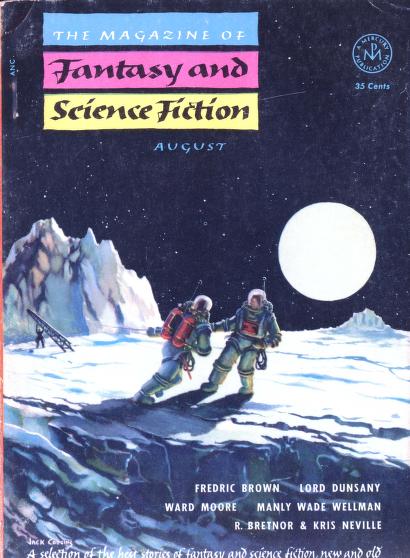
(Cover by Jack Coggins. F&SF, August 1953.) At the beginning of Moby Dick you may recall that Ishmael looks for seafaring jobs whenever he gets hit with one of his depressive episodes. “Whenever I find myself growing grim about the mouth; whenever it is a damp, drizzly November in my soul…” All that. I normally rotate through short stories, novellas, and serials for my reviews, but there are times when the latter two categories weary me deeply, and I wish to take a break from those more demanding tasks. Back in March I restricted myself to just short stories, and from the pages of Weird Tales more specifically. The timing felt right. I’ve come to realize that to alleviate myself of my review schedule I would do short stories only in March, July, and October of each year. Rest assured that I’ll be reviewing spooky stories for October, just like I did last year and will certainly do next year. But what about July? This is a question that’s been dogging me, because while my review roster for this past March had a theme to it, July proved more challenging.
Some months back I wrote an editorial on the state of SF in 1953, seventy years ago, and how it served as a high-water mark for the field, embodying the very height of the magazine boom—a level of fruitfulness that would not be matched until the 2010s. In the US alone there were over twenty SFF magazines running in 1953, versus less than half that a decade later. You could say the first half of the ’50s was one of the field’s summer periods, when there was this sense that life would never be this large again, nor would the market be this inclusive. It’s an argument I think is worth making, but now I think I’ll argue again—only this time by way of demonstration. We thus have nine short stories, all with 1953 dates, and all from different magazines. I couldn’t even include something from Astounding, which anyway was the least interesting of the Big Three™ at the time. I’m gonna be covering a nice mix of science fiction and fantasy, including a couple authors I’ve not read anything by before—plus a few old favorites.
The short stories are as follows:
- “Watchbird” by Robert Sheckley. From the February 1953 issue of Galaxy Science Fiction. 1953 was a boom year for Sheckley, who had debuted in 1952 but who would amass a reputation and a large body of short fiction (something like thirty short stories) in his first full year as an author. Sheckley submitted to every outlet under the sun but he was particularly fond of Galaxy, to the point where he seemed to show up in every other issue of that magazine in the ’50s.
- “Night Court” by Mary Elizabeth Counselman. From the March 1953 issue of Weird Tales. Yes, Weird Tales was still around at this point, even if it was no longer the leading magazine for short fantasy (then again, who was in the lead?). Counselman had debuted in Weird Tales a couple decades earlier and she was one of those authors who stayed loyal to it to the bitter end. I was ssupposed to read my first Counselman story back in March, but plans change. Now we start in earnest.
- “Mother” by Philip José Farmer. From the April 1953 issue of Thrilling Wonder Stories. Farmer came to the field late, already deep in his thirties, but his first story, “The Lovers” (the novella version), made an immediate splash and helped earn Farmer a special Hugo for most promising new writer. “The Lovers” was transgressive as far as ’50s pulp SF goes, and it’s not surprising that Farmer would later fit in with the New Wave writers, what with the sexual weirdness…
- “The Seven Black Priests” by Fritz Leiber. From the May 1953 issue of Other Worlds. Leiber’s one of my favorites, and also one of the most consistent SFF writers of the ’50s and ’60s
just ignore The Wanderer, having debuted in 1939 but staying strong almost to the end of his life. “The Seven Black Priests” is a Fafhrd and Gray Mouser story, a sword-and-sorcery tale that oddly enough saw print in the SF-oriented Other Worlds. The early ’50s were not great for fantasy. - “Paycheck” by Philip K. Dick. From the June 1953 issue of Imagination. I know I covered him only a couple months ago, but what can I say, I’m a Dickhead. Like with Sheckley, Dick had debuted the previous year but really showed what he was made of in ’53, with about thirty short stories published that year and with some of them going on to be classics. As with a good deal of Dick’s work, “Paycheck” would serve as the basis for a (not very good from what I’ve heard) movie.
- “Captive Audience” by Ann Warren Griffith. From the August 1953 issue of The Magazine of Fantasy and Science Fiction. A certain aquaintance (cough cough) had pointed me toward this one. Griffith apparently wrote her fair share of mainstream fiction, but she only wrote two SFF stories, both in the early ’50s and both in the pages of F&SF. Curious how you’d see authors from outside the genre magazine bubble feel comfy with submitting to F&SF.
- “The Goddess on the Street Corner” by Margaret St. Clair. From the September 1953 issue of Beyond Fantasy Fiction. St. Clair is a fairly recent discovery for me, and one who’s quickly becoming a favorite. In the ’50s she was one of the more gifted SFF short story writers—though sadly her sstories are often too short to spend a couple thousand words on. (It gets weird if the review’s length comes close to that of the story it’s covering.) This one does not look so slight.
- “Wolf Pack” by Walter M. Miller, Jr. From the September-October 1953 issue of Fantastic. I could theoretically review all of Miller’s short fiction for this site, though that would take about twenty years at the rate I’m going. Miller is known now for A Canticle for Leibowitz, but he also left behind a fruitful body of short fiction (given this all happened in less than a decade). “Wolf Pack” is one of the more obscure stories in an already overlooked oeuvre; it looked appetizing.
- “Little Girl Lost” by Richard Matheson. From the Octover-November 1953 issue of Amazing Stories. Matheson is a favorite of mine—and unlike most genre authors of his generation he would make it big as a screenwriter in Hollywood, working in the ’50s onward on a variety of projects from Roger Corman movies to Star Trek. “Little Girl Lost” was one of several Matheson stories adapted (by Matheson himself, in this case) into a classic Twilight Zone episode.
It’s not vacation, because I’ll still be reading and writing as usual, but I’ll be taking time off from novellas and serials. For those who are still in school, summer represents a time for hanging out with friends and going to the beach and whatnot; in other words, doing what you love most with the time you have. The art of the short story is a passion of mine and I wanna take the time to cover more that may be of interest.
Oh, and I changed the site’s name partially. The verbosity of the previous name was getting to me and I hungered for something more straightforward; that and this new one better matches the URL. Anyway…
Won’t you read with me?
-
Short Story Review: “The Totally Rich” by John Brunner

(Cover artist uncredited. Worlds of Tomorrow, June 1963.) Who Goes There?
John Brunner is kind of a puzzle box to me: he wrote a whole lot of garbage that was clearly written to pay the bills, and yet there’s a fraction of his output that people I know will swear by as being works of genius. Was Brunner a genius? Maybe. He actually reminds me a bit of Philip K. Dick, whom I do consider a genius, albeit a deeply troubled one. Both men entered the field around the same time and took to writing genre fiction as a full-time thing, which was certainly not the norm in the ’50s, the result being that much of what these men wrote was middling at best. Of course, Brunner was a teenager when he first got published, and his work (what I’ve read, anyway) reads like that of a man who was a decade older than he really was. Today’s story, “The Totally Rich,” is a more mature and downbeat affair than I was expecting—given Brunner would’ve only been 27 when he wrote it. This was not long before he would start work on arguably his magnum opus, Stand on Zanzibar, but even after the Hugo win for that novel his works did not sell. Brunner’s career reads in part like a bad joke.
Placing Coordinates
First published in the June 1963 issue of Worlds of Tomorrow, which is on the Archive. “The Totally Rich” has been collected a few times, most notably in The Best of John Brunner where it serves as the opening salvo (just mind the hideous cover). There’s also the early Brunner collection Out of My Mind, which can be found used and if you’re not up for that there’s an ebook edition—bearing in mind it’s Open Road Media (ugh).
Enhancing Image
The narrator is Derek Cooper, an inventor who normally would be the type to slave away at his work in some basement whilst surviving a shitty day job, but who had the good luck to help a very wealthy (unbeknownst to Derek at the time) man named Roger Gurney. In olden times a landowner would hire an artist for a certain project and act as their patron, providing them food and shelter and whatnot so the work could get done; so the same applies here, although the “shelter” Derek gets turns out to be a lot weirder. Derek moves to the South American fishing village of Santadora—only Santadora is not a real village, without real villagers and real fishermen. Even Derek’s colleagues during his time working on his latest invention turn out to be actors. The woman who’s been overseeing Derek’s project, Naomi, is herself an enigma; even her real name is unknown.
We’re just getting started, by the way.
I had never seen [Naomi] wearing anything but black, and tonight it was a black blouse of handspun raw silk and tight black pants tapering down to black espadrilles. Her hair, corn-pale, her eyes, sapphire-blue, her skin, luminous under a glowing tan, had always been so perfect they seemed unreal. I had never touched her before.
Derek’s project of the last year, so called the Cooper Effect, is only peanuts compared to what Naomi has in mind (she’s the one really running the show, no Roger), which turns out to be nothing less than the resurrection of a human being. Naomi is unspeakably rich; money is not an issue for her. We find that Naomi was, prior to this all this, in love with some man whose name we never learn (she only refers to him as him), who had unfortunately died prior to the story’s beginning. Being rich can get you virtually everything in the world, but it can’t bring back the dead—or can it? It’s hard to describe, but the idea is that Derek must construct, using materials Naomi has given him, a homunculus or robot reproduction of the lost lover. I think that’s the idea, anyway. Truth be told, the parameters of Derek’s new invention in progress are unclear (we’re not given a clear idea, for one, of what is and is not possible until towards the end, and even then…), but then this also seems to be part of the point: Naomi remains, to some degree, unknowable.
When I picked up “The Totally Rich” I thought it would be a more blatant satire of the wealthy, something akin to Roger Zelazny’s “The Graveyard Heart,” but Brunner has something more nuanced in mind. Derek, who is not a rich man himself but who had been basically living in luxury for a year up the time the story starts, is the modern equivalent of one of those painters and sculptors from the Renaissance who would accept patronage. We’re in the future, but it’s not clear how far in the future, the result being that it’s hard to point out something that now reads as dated. Certainly the unlimited credit cards Naomi offers Derek as compensation for his services still sound appetizing to pretty much all of us. Santadora, the propped-up fake village, is itself far from a “futuristic” location, which helps the story fulfill a sense of timelessness. I suspect Brunner intended this effect.
As we know, rich people are capable of some truly outlandish things. “Yes, Santadora had been created in order to permit me to work under ideal conditions,” Derek admits. And the unlimited credit cards. And even the fact that somehow there aren’t any mosquitos in this tropical climate. Naomi is capable of anything—except for one thing, and no, it’s not even being able to bring back the dead. There is something off about Naomi; she’s the mystery that keeps the whole plot going. No Naomi, no story. In a way this could be read as a romance, since while Naomi is trying to resurrect her lover, Derek senses his feelings for this mysterious woman grow—into what? Not love in the traditional sense, although given that these two have been basically working side by side for the past year it’s not like they’ve never talked about. It’s like Derek, who at heart is still the kid who fiddles with a Rubik’s cube, is drawn to Naomi because he doesn’t understand her.
This could easily devolve into cringe-worthy wish-fulfillment if Derek’s narration wasn’t so grounded in—not an average person’s view, but someone who knows what it’s like to create things for money. The artist as a plaything for the rich and idle. Brunner himself so desperately wanted to make a good living off of his writing, if not necessarily to become rich, though one has to think (I say this now, I’ve yet to read Jad Smith’s monograph on Brunner) he wanted to become one of idle class and not one of those who had to scrape by on pumping out mediocre fiction. Maybe he even wanted to be in Derek’s position and have some rich fuck bankroll his passion projects. Derek is a scientist, true, but his role here is much more easily understood as an artist whose patron is also his muse. The climax of the story, and the tragic epiphany contained therein, would not be if Derek was simply repulsed by the almost unbelievable scope of Naomi’s wealth.
There Be Spoilers Here
Something that does not occur to Derek until it’s too late is that there’s a reason why the passage of time in Santadora has seemingly frozen still; why nobody wears a watch and why there are no clocks around. Well, except for the one. Our Heroes™ find, sort of tucked away as if someone had hidden it and then fogot to retrieve it, “a tall old grandfather, bigger than me, its pendulum glinting on every ponderous swing.” It’s a normal grandfather clock, yet this sends Naomi almost into a frenzy, and Derek has to move the damn thing itself and dispose of it however he can. Time, for Naomi, is the enemy. After this event, Derek and Naomi hit the climax of their relationship, going to bed together (a bit of an unnecessary scene), only for Derek to find Naomi missing the next morning. Finally, coming in like a dark cloud or a raven, Roger shows up (he’d been offscreen up to this point) to give Derek the worst news he’ll hear for a long time.
Naomi drowned herself. “She couldn’t swim,” Roger adds. “Of course.” The prospect of wsiting years to see her lover resurrected proved to be too much. The worst part is that it needn’t be that way: Derek had figured out (too late) how he could finish his project in a relatively short span of time. But even then, that might not’ve been enough. Naomi had no time left—or rather she thought she didn’t have time left. She was getting older, though she put so much money and resources into keeping her looks. Some people die for love, but many more die from lack of it. Money can’t buy love, and it can’t buy time either. The rich, who in most ways are masters of the world, live as enigmas, unknowable even to each other. With Naomi dead, Derek’s work is over; he can’t even bring himself to accept those credit cards. There’s disgust (it’s clear that Brunner detests the rich, though this clashes with his desire to become one of them), but there’s also a great deal of pity for this class of people that has all but isolated itself from the human race. I did not think Brunner could do tragedy, but there it is.
A Step Farther Out
I had to reread some passages a couple times to get what was happening, but this is very much a story worth rereading. Brunner demonstrates a subtlety here that I did not previously know, even given the more experimental parts of Stand on Zanzibar. Yet “The Totally Rich” almost reads as allegorical, given its tight focus and leaning toward symbolism—a fact which, aside from a sly remark or two from Derek, passes us by without humor. Despite being very much science fiction the “science” aspect plays such a tangential role that I’m not even sure what the science here is; for one I still can’t recall what the Cooper Effect is supposed to be. This could’ve worked as fantasy, with Derek’s knack for invention replaced with wizardry. But the point I wanna make here is that while I can’t say for certain when Brunner “came of age,” given how vast his oeuvre is, I feel like “The Totally Rich” could serve as a benchmark for “mature” Brunner.
See you next time.
-
Novella Review: “The Oceans Are Wide” by Frank M. Robinson

(Cover by Robert Gibson Jones. Science Stories, April 1954.) Who Goes There?
It’s become unofficially a mission of mine to cover every recipient (all are, as of right now, eligible for review) of the Cordwainer Smith Rediscovery Award for this site. The idea behind the Redicovery Award is that it’s given (nearly always posthumously) to genre authors who have, for one reason or another, been left behind by fandom’s (admittedly fickle) collective memory. Time is ruthless to pretty much all of us. A few authors who were active half a century ago still get talked about in fandom discussions, but most do not. The Rediscovery Award is for those who deserve to be, well, rediscovered. Frank M. Robinson received the Rediscovery Award in 2018, and while I had not read even a word of his prior to this review, his life and varied career are well worth considering. You see, Robinson was one of the first queer authors of magazine SFF, at least in the US.
Like a lot of genre writers round his age, Robinson got his start in the field during the height of the magazine boom in the first of the ’50s; he debuted in 1951. In the case of Robinson this period seemed to serve as a training ground, where he would work his craft at short lengths before (much later, mind you) writing novels in the “technothriller” mode. In between these points in his career as a genre writer he got involved rather profoundly in the blooming gay rights movement in the ’70s, to the point where he was associated with Harvey Milk. The book of his that most interests me has to be Robinson’s memoir, Not So Good a Gay Man, published a few years after his death. Despite not putting himself out there as a public figure he clearly worked to better the lives of his brethren, and for his efforts he was inducted into the Chicago LGBT Hall of Fame in 2009.
Placing Coordinates
First published in the April 1954 issue of Science Stories, which is on the Archive. Not to be confused with Science Fiction Stories. I also wish more magazines from the time had rough word counts in the table of contents. The most recent printing was in 1995. The two most recent anthologies this was in were edited by the same people; okay, but it’s three people. We have Starships and The Mammoth Book of Vintage Science Fiction: Short Novels of the 1950s, both edited by Isaac Asimov, Martin H. Greenberg, and Charles G. Waugh. A fresh reprinting may be in order.
Enhancing Image
Some stories would have the fact that we’re on a generation ship be the twist, but here that’s the name of the game. We’re onboard the Astra, in a search of a habitable planet after a few centuries of being stuck in a huge tin can. We meet Matty, who at the story’s beginning is a whimsical ten-year-old who hangs out by his lonesome and listens to his “sound box” for fun; too bad for Matty that he happens to be the protagonist of this story. Matty’s father is the Director, the leader (perhaps in name only) of the ship, and the Director is on his death bed. Because the Director’s position is inherited, like that of a monarch, Matty is next in line despite being a scrawny kid. Even more unfortunately it takes all of five minutes for Matt’s immediate family, including his uncle Seth, aunt Reba, and cousin Jeremiah, to start plotting his demise once his old man kicks the bucket.
Matty’s nurse recues him while there’s a manhunt going on and points him in the direction of the Predict, a mysterious but supposedly powerful figure who lurks in the forward section of the ship, an “immortal man whom nobody had seen—the stories went—for the last twenty-five years.” Matt will need to survive, and also need to be trained, and the Predict can provide this—at a bit of a price, it will turn out. The opening section of “The Oceans Are Wide” is paced a bit oddly, as I expected there to be more time spent in finding the Predict, but Matty finds his whereabouts so easily that I started to wonder why this mysteriouss man didn’t get more visitors. Oh well. The Predict is the man Matty is looking for, and more. With characters in this story I’ll normally only refer to them by their first names, but in the case of the Predict I’ll make an exception, as his name is Joseph Smith. Hmmm. Be sure to put a pin in this one.
Try not to take this out of context, but Joseph Smith is a bit of an ASSHOLE. Normally in these situations where there’s a wise mentor and a child protagonist the mentor, while sometimes harsh, has the child’s best interests in mind. Not Joseph Smith. “The Oceans Are Wide” is a coming-of-age narrative on its face, but as we’ll see it entails what amounts to the destruction of the individual’s happiness in the name of the greater good. Matty may be safe from his murderous family, but over the years he’ll learn to become a real bastard of a political maneuverer. Something else that’s curious is that much of the narrative sees Matty going under a different identity, being taken in by a foster family and spending the rest of his youth as a supposed nobody, with Matty the Director-to-be being presumed MIA by everyone else. The rightful heir to the throne evades said throne for his safety, only to return when the time is right—except…
I’ve heard elsewhere that Matty, despite rather tenuously having a female love interest (it goes nowhere, don’t think about it) here, is coded as a queer youth who has to hide his true identity for the sake of survivor; but of course it’s not just that. Robinson takes what must’ve been even at the time the standard procedure for politics in generation ship narratives (namely that these stories tend to endorse, actively or unwittingly, authoritarian models of government) and not only paints it a darker shade of grey but also uses the ensuing personal tragedy as a metaphor for growing up as a gay man in a time and place where being that was immensely dangerous. We queer people find that we have to, at some point, betray our own values and even our own sense of self for the sake of survival. Matty has to sacrifice pretty much any chance at personal happiness so that he could take to the throne in the future, which would be bad enough except Joseph Smith is not ambiguous about what kind of leader he wants Matty to be. Smith opposes democracy on the Astra, preferring a more… hands-on leader.
Of course Smith is the one really running the show here; like his father before him Matty will serve as little more than a puppet for the Predict, although according to Smith his late father was a shitty puppet who would not follow orders. Smith is, in most ways, a scoundrel. “Matty realized with sudden insight that he hated the Predict. He hated the remorseless logic, the constant denial of self for ship.” It’s not totally clear if we’re supposed to think of Joseph Smith as a heroic figure or a villain who happens to have a decent goal in mind, but Matty’s occasional thoughts on the man and Matty’s position as a queer surrogate suggest that at best Smith is to be understood as an anti-hero. If this was a Robert Heinlein or Poul Anderson story Smith would probably be rewritten to be more snarky, more outwardly “intelligent,” and framed more as a fine fellow—only that Robinson has other plans in mind. Indeed we get a quote from Machiavelli at one point, which suggests that Joseph Smith’s vision of leadership on the Astra is tyrannical. The creepy part is that Smith believes, all but explicitly, that tyranny is necessary in order to preserve “civilization,” for the greater good.
In fairness to Smith, life on the Astra was already a struggle. The population is strictly regulated, with families being allowed children only if there’s room available and with everyone being forcebly euthanized when they reach the age of sixty (I assume in Earth years). Introducing democracy, even if Smith supported the idea, would probably take generations, as there’s a violently reactionary monarchal system in place, hence the Game of Thrones antics at the beginning. The Astra used to be one of several generation ships coming out of a ruined Earth, but for several reasons the other ships were destroyed or were lost. Smith knows all this due to his incredibly advanced age, despite looking like a thirty-year-old man, a question that will not get answered till much later. While he’s a shady figure, to say the least, it’s not hard to understand why Smith would be preoccupied with saving the Astra, even if it meant breaking a few eggs. Speaking of which…
There Be Spoilers Here
When Matty finally becomes Director, with Seth relinquishing the position on the basis of age, he introduces some radical changes to the ship as it heads to what looks to be a habitable planet. The maximum age of sixty is removed, with the logic being that the shipmates-turned-colonists will need elders to help form civilization on the ground. Sound enough. Despite all the shit he’s gone through and the authoritarian politics Joseph Smith crammed into his head, Matty still shows a capacity for mercy. When they get to this first planet they find it’s… actually pretty welcoming to humans. Not only is there life on the planet but there’s plenty of food and, as far as the colonists can tell, no animals that would prevent a serious threat. Matty has a schedule set for the colonists, since there’s work to be done—only nobody wants to work. Nobody has to work here. “But they didn’t get back to the schedule that week. Nor that month. In six weeks, the schedule was forgotten.” If this was a Ray Bradbury story there might be some secret mischievous alien race at work, but the catch with this planet is that there is no catch.
Joseph Smith suggests to Matty that the planet is no good for colonizing—not for a sensible reason, like how suddenly introducing a thousand alien lifeforms to a lush and defenseless ecosystem would likely destroy it, but because the lack of incentive to work would result in the colonists devolving to savagery. Smith’s argument is simple, if draconian: that a struggle for survivle is necessary to maintain civilization. If the colonists don’t work then they’ll turn into pastoral commies or something. I know a few people who would have a word to say about what Smith posits here, but in the context of a queer allegory this is a very curious point. This become even more curious when we think about the gay rights movement as a movement of people and how it could be connected with other historical movements, such as (here it comes) the early days of Mormonism—although Smith strikes me more as a Brigham Young figure than the real Joseph Smith. Still, Robinson makes his point; he alludes rather heavily to the story being about the survival of a social movement and, more cleverly, how the individual can suffer when trying to support said movement.
Make no mistake, Matty is a tragic figure. As a child he’s stuck with having to choose between death and tyranny, and of course without being able to understand the implications of his future he picks the latter. From the time he chooses to be taken under Smith’s wing to the story’s climax he does not have, as far as we can tell, a single day of happiness; there may be fleeting moments, but no more. Even when nobody can hurt him anymore (so it seems) and he has accomplished his goal of saving as many people on the ship as possible, there’s a darkness that shrouds him. At the end, having served his purpose and after being ostracized by the colonists (with his consent, it turns out), Smith leaves the position of Predict to Matty. The colonists, Smith supposes, will no longer need a dictator with an iron fist but instead a philosopher-king. Smith gives Matty the equipment he uses to maintain his unnatural longevity: the equipment in question is a mysterious drug, complete with a needle. The story ends on a bleak note as Matty takes the drug and “pushe[s] the plunger home.” That the Predict is implied to be a drug addict is only the tip of the iceberg.
A Step Farther Out
The biggest problem I have with “The Oceans Are Wide” is its length, as I think it would’ve been stronger as either a novelette or a full novel; certainly there’s enough material here to supply a story that’s double the length. It also pains me to say this, as I’ve said before that I think science fiction often works best in the novella mode. Robinson probably wrote at the length he did (some 27,500 words) because he was still a fairly new writer and/or because he wrote with magazine publication in mind. “The Oceans Are Wide” is a thematically juicy affair that shows a somewhat rough but very promising talent, especially given that Robinson was one of the very few queer writers working in the field at the time. I have to say I was also impressed that I found this novella a bit disturbing, namely for its implications as an allegory, given its vintage. It’s not a masterpiece, but it’s very much a work of old-timey SF that’s worth being brought back into print. I’ll be keeping an eye on Robinson from hereon.
See you next time.
-
Short Story Review: “Fair” by John Brunner
(Cover by Terry Maloney. New Worlds, March 1956.) Who Goes There?
This introductory section is gonna be a bit long, bear with me. If you’re one of the three people who follows my Things Beyond posts then you would’ve figured I was to review the first installment of John Brunner’s novel The Stone That Never Came Down today, and you’ll also notice that this is very much not that review. Plans change. I did try reading that novel, but truth be told I bounced off of it so hard before getting even halfway through the installment, not to mention I was running out of time (my schedule has been merciless as of late), that I decided to just drop the damn thing. I found the stuff I had read to be both irritating and nonsensical, not helped by the fact that I had just come off of rereading Stand on Zanzibar. For a bit I thought maybe I was just Brunner’d out for the moment, but I think it’s more that going from good Brunner to bad Brunner caused whiplash; so then I was left with a hole in my review schedule that needed filling.
I also considered covering short stories by a different author, but I wanted to be fair to Brunner, so instead I figured that instead of forcing myself to cover a lesser Brunner novel we would get two Brunner short stories that will hopefully show him in a better light; helps that I’ve also been meaning to read some of his short fiction. As such I issued an executive order and today we’ll be talking about a very early but very interesting Brunner story with “Fair,” while the second installment of The Stone That Never Came Down will be replaced with another Brunner short story that’s been on my radar, “The Totally Rich.” As someone who, in recent years, has taken more to short stories and novellas than novels, I consider this move a net positive! Other than that everything else should proceed as normal; just ignore what I’m gonna be saying in July’s Things Beyond post.
The question remains, though: Who is John
GaltBrunner? Depending on who you ask he’s one of the largely unsung geniuses of old-timey SF, and at the same time one of the largest providers of third-rate crap. He wrote a lot of novels that are now forgotten and/or loathed, but he also wrote a handful of novels that are said to be some of the best of their era, the most famous of these being the Hugo-winning Stand on Zanzibar. Brunner started writing as a teenager and would not stop until his death, but his career trajectory was a bit tragic; he did not get along with fellow British writers, being more accustomed to the American SF market and even being confused for an American at times. (I recently talked with an actual SF scholar, and it was not until the middle of our discussion that they realized Brunner was an Englishman.) Brunner was all of 21 when “Fair” was published—the scary part being that he was already five years into his writing career, his first work being published when he was 16.Placing Coordinates
First published in the March 1956 issue of New Worlds, which is on the Archive. You may notice it was initially published under the pseudonym Keith Woodcott, but this was a very poorly kept secret. “Fair” has only been collected three times in English, and has not seen print since the ’80s. It was first collected in the Brunner collection No Future in It, then much later in the Ballantine collection The Best of John Brunner. I personally don’t consider The Best of John Brunner to be part of the Ballantine “Best of…” author series from the ’70s, given it was published much later and does not follow the design pattern of that series; this is one way of saying the cover for it is so bad that I consider it to be non-canon.
Enhancing Image
We start sort of in media res, and Brunner crammed a lot into these dozen pages. We follow Alec Jevons, “ex-test pilot, ex-serviceman, ex-child and ex-husband, ex-this and that, ex-practically everything.” Jevons is deep in middle age, probably in his fifties, and he’s certainly too old to be going to the Fair, a massive playground of the future; but he’s not here for the entertainment. Truth be told, it’s not clear why he’s here, even to himself. He came here knowing that not only is this a Fair but the first Fair constructed—even now the biggest and best of its kind. I would go into great detail as to what the Fair is like, but I’ll say that if you’ve played Final Fantasy VII and remember the Gold Saucer, it’s like that: a highly advanced pleasure park that hosts a variety of attractions, ideally for young people to get lost in, hence the Gold Saucer’s reputation as a time sink in that game.
There’s this cloud of fear hanging over Jevons as he enters the Fair, even though he must know he’s not in any immediate danger; rather the fear comes from the prospect of being outed as an old geezer and picked on by the youths. Context: this is obviously set in the future but not too far in the future, as the Cold War is still going on and there’s a strong whiff of post-war British slang among the nameless youths. Brunner, at this point, was far closer in age to the youngsters than to Jevons, and for most of the story you wouldn’t guess this was the case from how those youngsters are framed as devious and unknowable—and doomed. There doesn’t seem to be a war going on, but there’s the sense that there was a war not too long ago and, more importantly, that war could come again any day now. “A million people a night in this fair alone,” we’re told, a million people a night hiding “from the uncomfortable reality of silence and thought, from the danger of tomorrow, from the waiting death poised above them in the sky…”
Something to keep in mind is that Brunner came from a generation of Britons who were too young to see combat in World War II but old enough to remember Nazi bombers over British skies. While the future of “Fair” is too distant to be set shortly after World War II specifically, it still evokes a post-war England which saw a rise in juvenile deliquency and the shadow of a generation of dead and traumatized British men. When the Cold War began in the years immediately following World War II, you’d have children and teens who grew up in an environment where the possibility of sudden nuclear devastation was very real and very known. Jevons himself served his country but was dismissed due to his Russian heritage, something that he was apparently bullied for in his own youth. While Jevons fears the youngsters at the Fair he also pities them, with the insecure boys and their girlfriends, “tarts before they were twenty, but lost and empty and without a future since they were ten.” At one point Jevons gets hit on by a girl who is probably a third his age and it (rightly) unnerves him.
Let’s talk about style for a moment, because frankly it’s not something I dwell on in these reviews and I think this is a good example of style contributing positively to the substance of the writing. Brunner could’ve easily deployed a “function only” style that got the job done but didn’t stray far from beige, but he must’ve been listening to some records at the time becaue there’s a punchiness and a musicality with how he interweaves the third-person narration with Jevons’s internal monologue, such that it’s not always clear who is saying what. The result is that there’s a bit of confusion, yes, but also a sense of intimacy with how thought and action bleed into each other. Check out this early passage, wherein Jevons ponders his age and his generation’s role in the creation of the Fairs; see how we get two channels, first- and third-person voices, sharing the same space:
The Fair had been less elaborate in his young days. Watch it, Jevons! You’re starting to admit your age. (And why not? Because if you remember that you’ve been around that long, you admit that you were responsible—this was your doing, this mechanical time-destroying hurly-burly, this feverish seeking after temporary nirvana. This was your fault!).
Like I said, Brunner’s writing here is busy, even high-octane, but this was clearly a deliberate choice on his part.
It’s hard to figure out what Brunner likes, but it’s pretty easy to figure out what he doesn’t like. For instance, he clearly despises anything that serves to numb human consciousness, and he also hates the silly business that is capitalism; not to say that Brunner was what we would call a progressive figure, given his standoffish relationship with women, but at least he tried. When I went into this I expected the Fair to be a nightmarish setting, and for most of the story my expectations were supported. The escalator system that gets more intense as you venture closer to the center of the Fair evokes a highway system from hell, and the security guards, dressed like court jesters and called “Uncles,” are not the kind you’d wanna run into if you’re scared of clowns. Yet Brunner does something in the climax that, while I don’t think it was perfectly executed, made me second-guess the story’s intentions. There’s not a lot to spoil since this is a story heavy on mood (with jazzy parenthetical asides that would not look out of place in a much later Brunner tale) and world-building rather than plot, but let’s get to it.
There Be Spoilers Here
The twist is video games. Well, it’s not just that.
Given this was written in 1955, Brunner would’ve had no conception of video games; the phrase would not’ve been part of his vocabulary. Even so, the climax of the story, in which Jevons partakes in several “totsensid” sessions, perfectly reads a highly advanced virtual reality program. “Total sensory identification was what they called it.” Total sensory identification. Identification with what or with whom? With people who are not what you’d call the average Briton, it turns out. First a pilot, which aligns with Jevons’s own experiences enough, but then he becomes one half of a newly married African couple, then later—and this really hits him—one half of a Russian couple. There’s some wish-fulfillment at play, as a sort of necessary evil, but you have these white British youths being thrown into the shoes of non-British non-white people, as a sort of empathy exercise.
The Fair is not just there to entertain, or even to push people’s senses to their limits—it’s there also to try to save the current generation of young people. A switch gets flipped in Jevons’s mind and he has the epiphany that these people are being subliminally trained, in what we would now call VR, to empathize with humans from other countries and cultures. I know people meme about Brunner for his capacity to “predict the future” (a stupid sentiment, to be sure), but I’m still taken aback that in 1955 (when he would’ve written “Fair”) he envisioned the potential of video games as a force for good in people’s lives. The thing is, games (video and otherwise) are always to some degree interactive, which is what makes them different from other mediums. We’re not given much insight into how interactive the totsensid is, but from what we’re told it’s like having your consciousness transferred to another body. Even the purposely unpleasant simulations, like being a Malay diver who’s dying of illness, have their value in how they bend one’s consciousness. “It was not pleasant, but it was real.” It’s enough to convince Jevons to start working at the Fair himself, in what has to be one of the few happy endings for a Brunner story.
I can’t say I’m entirely convinced of the ending’s sincerity, but it did take the story in a direction I very much did not expect. Brunner goes to such lengths to frame the Fair as a hellish place, only to subvert this at the end, that maybe it would’ve come as too much of a shock no matter how delivered. What’s important is that it gave me something to think about. I also feel like I shouldn’t have to say this, but Brunner not only anticipated cyberpunk by a quarter-century but also subverted one of the pet tropes of that subgenre, namely the notion that intimacy with technology via virtual reality or cybernetics would dehumanize people. Samuel R. Delany posited something not too dissimilar in his novel Nova, wherein most people are able to plug in directly to machinery via implants, with the result being that these people are actually more content with their labor than us due to being physically connected with their work. Technology, created with compassion in mind, could save the world. That Brunner put thought into this when he would’ve been barely out of his teens is impressive.
A Step Farther Out
Brunner surprised me with this one, even having heard good things about it in advance. I would’ve expected something more amateurish, given his age, but he already had a good amount of experience under his belt and there’s a spry youthfulness to the style that almost feels like it could fit in with New Wave writings of a decade later. “Fair” is, however, distinctly a Cold War-era story, written at a time when both sides were doing hydrogen bomb tests and when Germany and Berlin had been recently divided. I don’t think this story would’ve made quite as much sense had it indeed been published a decade later, and I’m also not sure if an older (and presumably more jaded) Brunner would’ve believed enough in the happy ending to go with it. “Fair” is a near-masterpiece in miniature that sees one of SF’s mavericks at a very early stage, just experienced enough to know about sentence construction and young enough to throw caution to the wind. This may be setting too high a bar, but it does give me hope for future Brunner readings.
See you next time.
-
Short Story Review: “The Wings of a Bat” by Pauline Ashwell

(Cover by John Schoenherr. Analog, May 1966.) Who Goes There?
Two stories in (today’s pick being the second) and I’m pretty sure I’m a Pauline Ashwell convert. Ashwell debuted in 1958 with two SF stories, one under her own name and the other under the Paul Ash pseudonym (I’m not sure if anyone was bamboozled by this), getting two Hugo nominations the following year—the first for her emaculate novella “Unwillingly to School” and the second for Best New Author (went to No Award, although Brian Aldiss came close). She was one of the first female authors to get Hugo-nominated in any of the fiction categories, but despite this and the quality of her work she remains depressingly obscure; it probably doesn’t help that she wrote exclusively for Astounding and later Analog. Many of Ashwell’s short stories (admittedly there aren’t too many of them) have never been reprinted, and according to a certain insider friend of mine her estate has been basically impossible to get in touch with. Surely an Ashwell rediscovery would be possible if it was easier to reprint her work.
Placing Coordinates
First published in the May 1966 issue of Analog Science Fiction, which is not on the Archive but which can be found on Luminist. It was soon reprinted in World’s Best Science Fiction: 1967 (ed. Terry Carr and Donald Wolheim), and later anthologized in the dinosaur-themed collections Behold the Mighty Dinosaur (ed. David Jablonski) and The Science Fictional Dinosaur (ed. Martin H. Greenberg, Robert Silverberg, and Charles G. Waugh). This shouldn’t come as a surprise, but these are all out of print. The messed up part is that “The Wings of a Bat” might be Ashwell’s most reprinted story, given that the competition is not stiff.
Enhancing Image
We’re down for our second dinosaur story this month, although it’d be more accurate to call it dinosaur-adjacent since pterosaurs are not dinosaurs. I was surprised to find that at no point (to my recollection) does the narrator of the story call the Pteranodon at its center a dinosaur, since that would’ve been (and still is) a common mistake to make. Consider, for one, how a dromaeosaur (or raptor) has more in common with a chicken than a pterosaur, the latter being a flying reptile and an evolutionary dead end. We don’t actually see any dinosaurs in the story itself, although they do get mentioned, making this a tenuous piece of dinosaur media. We get a couple mentions of certain prehistoric animals too, but thankfully Ashwell does not go deep into details, lest the story age woefully.
Where are we? More importantly, when are we? It’s the Cretaceous, and we follow a team of colonists in a mining camp—not mining the land but the waters of the island. The narrator (whose name I don’t think we get) is on paper a doctor assigned to the camp but who in practice spends much more of his time working on the camp’s newspaper—with a readership of less than thirty people. Doc (as I’ll call him from now on) is, like everyone else on the island, very short (the tallest person is 5’7″, as company-mandated), and does not have a soft spot for local wildlife. The location? Lake Possible, a sort of Loch Ness where prehistoric life really had taken over, although curiously, like I said, we do not encounter any dinosaurs directly.
Indeed, unlike most dinosaur media involving humans, the campers are not so concerned with being hunted by predators, but instead focus on their work and try to get along with each other. Conflict in introduced when Henry, a very young co-worker of Doc’s, brings in a wounded baby pterosaur, much to Doc’s distress; for one he’s a people doctor and not a veterinarian, but he also holds a grudge against pterosaurs. “I maintain that my attitude was not unreasonable, or even unkind. I knew no more about the treatment of sick pterodactyls than Henry did—if anything, less.” Had Doc been a veterinarian he might’ve written the pterosaur off as a losst cause, but with a combination of hope and ignorance he takes the fledgling in, first getting her (for it’s identifiably a her I suppose) to eat—not very successfully. This is where the pterosaurs-are-just-scaly-birds things comes into play, with truth be told is the only thing that struck me as overtly anachronistic; mind you, I say this ias an enthusiastic layman and not an expert.
We know now that pterosaurs and birds, while they were contemporaneous and to some degree related to dinosaurs (the birds being directly related to theropods), did not have a lot in common. Fiona, as the baby Pteranodon comes to be called, proves to be resourceful, but the thrust of the narrative is essentially one where a human nurses a baby bird back to health; in reality a baby Pteranodon would’ve probably been even more independent, being able to fly and fend for itself at a very young age. As it is much of the story is concerned with Doc and company working out a way to feed Fiona and later getting her to use her wings. There’s a certain saying that it takes a village to raise a child, and that’s basically true with raising Fiona, which turns out to be a multi-person endeavor. Still, Doc got the ball rolling.
You may wonder why, feeling as I did, I allowed myself to get stuck with the brute. The explanation, though complicated, can be given in one word: Morale. It’s a tricky thing in any community. When twenty-nine people make up the total population of the world and will for the next nine years, it’s the most important thing of all.
Of course the unspoken other reason for Doc agreeing to take care of Fiona is that he’s becoming slowly fond of her, but thankfully the narration does not push this to the forefront. I know that I’m describing “The Wings of a Bat” in such a way that one could think of it as a sappy yarn about some grumpy guy who learns that children are cool and yadda yadda, but trust me, this could be so much sappier. It works, I think, primarily because Doc, for all his capacity to do good, is not a sentimental person; like a lot of real doctors he cares about the lives of others but is not what we’d call an empath. Leonard McCoy he is not quite. Despite the lack of sentimentalism, the momentum of the narration is impressive, with Ashwell taking a bit after fellow British author Eric Frank Russell in that she conveys an energy that could be mistaken for American brashness.
“The Wings of a Bat” is billed as a novelette, but it reads as shorter because Ashwell deals out information at an almost perfect pace—I say “almost” because she does faulter slightly in the last quarter or so, when she apparently felt obligated to inject some “action” into the narrative. This is a story that starts stronger than it ends, but it maintains a youthful lust for the wonders of life that border on cinematic. Not that this would ever happen, but I can imagine a live-action movie adaptation (maybe a short film) that uses mainly puppetry and animatronics to bring Fiona to life—or, as an alternative, motion capture wherein a person, mimicking what might’ve been a pterosaur’s movements on land, is CG’d over. Even something on this humble a scale can charge the imagination in such a way.
There Be Spoilers Here
Unfortunately and without warning, Fiona does leave the nest, so to speak. More importantly, there comes the possibility of a storm—even a hurricane—that could put the whole mining expedition in jeopardy. The camp’s meteorologist falls ill, and somebody has to head out and get her weather readings for her. (We can send people back a hundred million years but evidently our weather machinery can only be so advanced.) Why Doc of all people has to be the one do this is a little arbitrary, but then without it we wouldn’t have an “explosive” climax—although we didn’t need one, this being my only real issue with the story. During his expedition Doc comes across a rather nosey Pteranodon, which of course is supposed to be Fiona but which Doc is unsure about. “This creature was about twice as large as she’d been when I loosed her. Would Fiona be full grown now? I hadn’t the slightest idea.” Oh I think you do, Doc! Henry supposes that Fiona, now grown up, either thinks herself as like a human or thinks of her human foster family as like pterosaurs. Ultimately Doc accepts the reunion.
The ending is a bittersweet one. We never see Fiona again, and her fate is left uncertain; but the camp is left mostly intact and Doc himself was apparently shielded by the now-grown Pteranodon during the storm. The newspaper Doc runs changes its name to include pterosaur-watching. Well that’s sweet. It took me two and a half days to read this one, which normally sounds bad, but in the case of “The Wings of a Bat” my schedule was cluttered and the time I had to read the story I wanted to savor. The last quarter of it is the weakest part (though the ending itself is nice), but it’s still well-paced enough that I didn’t feel my time was being wasted. What I liked so much about “Unwillingly to School,” namely its punchiness and eagerness to suck the reader into a place and particular character’s mindset (never mind that said character has a disability and she does not constantly hate herself for it), is shown here as well. Doc himself is implied to live with dwarfism, and he very much strikes me as (in the hypothetical movie adaptation) being played by Peter Dinklage. By story’s end I feel like I got live on Lake Possible and its environs, despite sparce descriptions of the wildlife and most of the campers being unnamed. Ashwell has the magic touch.
A Step Farther Out
Did not age as much as I had expected; granted, this is partly due to the aforementioned lack of details given about life in the Cretaceous. Ashwell’s style is also about as spritely and youthful as I had expected, despite her being deep in her thirties at this point and writing for the most conservative magazine in the field. I think people act disappointed with Analog in the last years of John W. Campbell’s editorship because he was still capable of backing strong material, and “The Wings of a Bat” is one example. I can see how one’s interest would wane a bit in the last section, once the “action” kicks in and the doctor’s relationship with the other campers and Fiona takes sort of a back seat, but it’s still short enough that my attention span was not tested. This is, despite the prospect of a cute baby pterodactyl, not the excercise in sentimentality I might’ve assumed. Hell, I can see this working as a movie. Just remember that pterosaurs are not dinosaurs!
See you next time.
-
Subscribe
Subscribed
Already have a WordPress.com account? Log in now.
 Science Fiction & Fantasy Remembrance