-
The Observatory: Jurassic Park and the Promise of Science Fiction
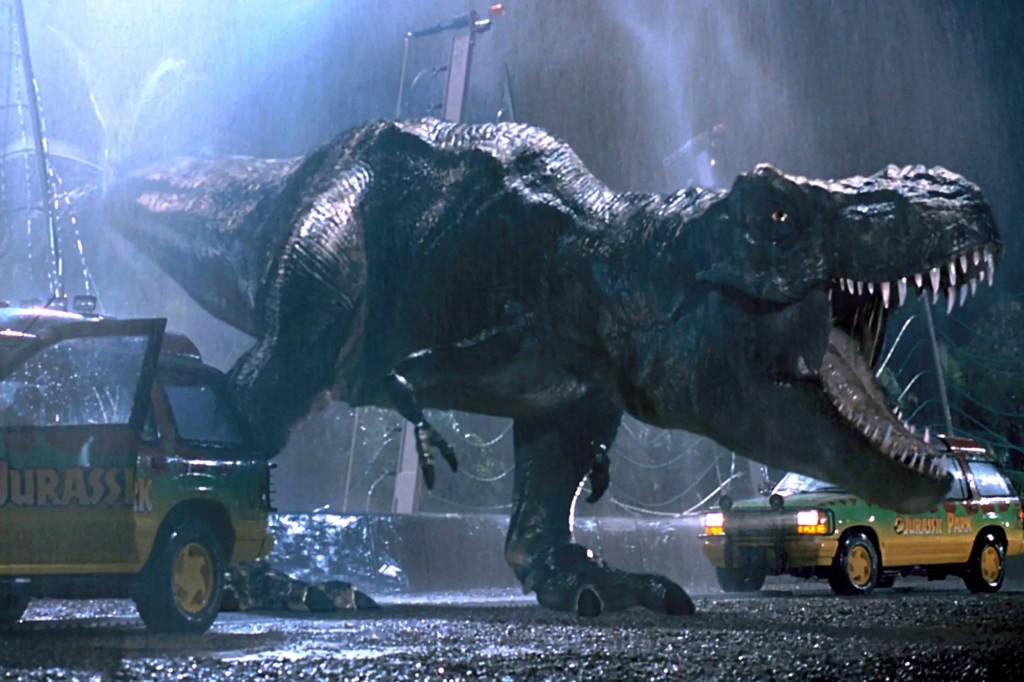
(From Jurassic Park, 1993.) Contains spoilers for a movie that is not only three decades old but one of the most famous movies of all time.
I’ve written about Jurassic Park before, which funnily enough makes it hard for me to figure out how to start this month’s editorial. Choosing the topic was also easy, considering the film’s 30th anniversary was this month, but I also kept searching for some excuse to not write about it; again, it would not be my first rodeo. This is how it is with your first love—with the thing that’s been more or less consistently a part of your makeup since the days when you still believed Santa Claus was real. Only a few works of art can lay claim to influencing how you would perceive other works of art for the rest of your life, and while these don’t necessarily come along in your formative years, being very young certainly helps. I’m pretty sure I saw Jurassic Park for the first time when I was all of three years old and since then I’ve watched it at least once a year. Hell, I saw it twice in theaters (once in 2D and once in 3D) during its 20th anniversary theatrical rerelease.
2013 is already a long time ago.
I don’t talk about movies much here, because this is mainly a literature blog, but I’ve seen a lot of movies (you can see this for yourself on my Letterboxd page); with that said, I still feel weird when I tell people Jurassic Park is my favorite movie. People tend to be very defensive and nostalgic about their favorite movies unless they’re the type to succumb to recency bias. (I know you love Everything Everywhere All at Once, but you should probably let that opinion sit and marinate for a while before telling people it’s your favorite movie ever.) I know people who will swear by movies that I personally don’t care for, but it’s hard (not to mention wrong) to knock passion for a work of art. I know people whose brain chemistry was changed irreversibly when they watched The Matrix for the first time back in 1999, and I know from experience that Jurassic Park had a similar effect on people. No movie in history has inspired more people to become paleontologists than this one. Despite its technophobia (which I’ll get to in a minute), Jurassic Park is about as convincing an argument for the wonders of science as any book written by the likes of Stephen Hawking or Carl Sagan.
This is, of course, a movie that was primarily made to entertain people; it was based on a commercial SF novel in the “technothriller” mode by one Michael Crichton, whose influence on people’s understanding of SF is actually quite understated despite his popularity. Even though Crichton has now been dead for 15 years his ghost continues to haunt even supposedly cerebral SF now being produced, with the much lawded (though, having seen the first season, I was less impressed) show Westworld sharing the basic premise with Crichton’s movie of the same name. Crichton’s first (and arguably best) SF novel, The Andromeda Strain, still serves as a textbook and often-cited example of the theme of man’s folly in the face of nature. Jurassic Park, the novel, reads in parts like a direct line to Crichton’s thoughts on the prospect of humanity fucking around and finding out with regards to meddling with the natural world. Crichton’s avatar, Ian Malcolm, is not a doctor like his creator, nor is he a giant (he is also, unlike both Crichton and his movie counterpart, losing his hair), but he does serve pretty blatantly as a puppet through which Crichton hares his ambivalence about genetic engineering. The cautionary tale is not an ambiguous one.
The novel, published in 1990, was optioned for a movie adaptation before it even saw release, and Steven Spielberg hopped right on it. Spielberg has been, for about half a century now, the biggest architect of people’s cinematic imaginings whose name is not George Lucas, and like Lucas his fondness for science fiction is unmistakable. He did not officially direct an SF movie until Close Encounters of the Third Kind in 1977, but Spielberg’s career from the outset was informed by genre maestros, not least of these being Rod Serling, whose Night Gallery a very young Spielberg worked on, and Richard Matheson, who wrote the screenplay (not to mention the short story) for Duel, Spielberg’s directorial debut. At first glance Crichton and Spielberg seem like they would make an odd couple, given the former’s pessimism and the latter’s notorious optimism, but they’re both undoubtedly gifted entertainers and they both see science fiction as a means to that end. A collaboration between the two was almost inevitable.
For Jurassic Park the film, Crichton co-wrote the screenplay with David Koepp, although from what I can tell Koepp did most of the heavy lifting in turning Crichton’s rather gory novel into a family-friendly script. Koepp, when he was on the ball, had an almost supernatural talent for writing blockbuster scripts that were just intelligent enough while being perfectly structured so as to keep audiences engaged. (Forgive me for using the past tense as if Koepp were dead when in reality he is very much alive, if over the hill.) This may sound controversial, but I think Jurassic Park is one of those film adaptations that largely improves on the source material (with a few concessions made), such that it holds up better overall. I still have a deep fondness for the novel, though I would say The Andromeda Strain and Sphere come closer to being Crichton’s best; it’s more that the novel is weighed down by copious amounts of exposition, along with Malcolm being the type to preach endlessly. Malcolm, on top of being blessed with an all-timer performance by Jeff Goldblum, is made less preachy and abrasive (if also not as clear in regards to his plot relevance) for the film.
The film was shot in the summer of 1992 and finished filming ahead of schedule, despite some issues with the effects. Spielberg originally envisioned the dinosaurs as being animated via stop-motion, but they could not get the dinosaurs to look “realistic” no matter how fluidly animated. Ultimately the stop-motion effects would serve as a useful blueprint for what would turn out to be mostly a mix of puppetry and animatronics, with some computer-generated effects sprinkled in when nothing else would do. The film would be (and still is) remembered as revolutionizing CGI, but the truth is that CGI played a very small part in the final product. The dinosaurs themselves only have something like just under 20 minutes of screentime, a good portion of which is devoted to the T. rex breakout scene, and only a small fraction of that time involves computer effects. The most impressive effect is arguably the fully constructed T. rex animatronic, which can be seen at certain points and which is seamlessly intermingled with CG shots.
More important than seeing dinosaurs, however, is the idea of seeing dinosaurs, and this is where the real magic of Jurassic Park comes into play. Surely this film would not have won three Oscars (plus a Hugo for Best Dramatic Pressentation) and kicked off a perpetually lucrative franchise had it been a two-hour snoozefest with the occasional dinosaur jumping out of a closet. Despite the relatively sparse dino action, the film remains consistently provocative and entertaining. While some critics faulted it upon release for its lack of human drama, the human characters are certainly memorable in their own right, with some of the finest character actors in the industry at the time being recruited: Jeff Goldblum, Richard Attenborough, Samuel L. Jackson, Wayne Knight, Laura Dern, and the criminally underrated Sam Neill, among others. There is a genuine sense of awe when the visitors see a brachiosaurus for the first time—not just because the effects are convincing but also because the actors seem as star-struck as the audience. Ignoring the scientific inaccuracies (we know, for instance, that brachiosaurs did not have teeth), this was the first time moviegoers saw a sauropod that looked and acted like it could be the real thing.
There’s a certain long-running phrase in SF circles that, despite being around for decades and regarded by many as a cliche, has yet to have its stock value plummet: I’m of course talking about “sense of wonder.” SF as a genre can be said to have a special advantage over other genres in that it cranks out more “sense of wonder” moments than any other by far: the stargate in 2001: A Space Odyssey, the giant alien corpse with its chest opened in Alien, Neo dodging slow-motion bullets in The Matrix, the color palette changing as Our Heroess™ enter the Zone in Stalker. Those are just some movie examples, by the way. What exactly is sense of wonder? It seems impossible to quantify, which is probably true, and as such it’s hard to come up with a clean definition, although people know it when they see it. I think of sense of wonder as this: the sensation of opening a door to somewhere you’ve never been before. There is the sense, possibly a mix of joy and anxiety, of sailing into uncharted waters. Science fiction is my favorite genre in part because it’s the most wondrous genre; sense of wonder is its trade.
A work of science fiction need not be a masterpiece to have a great sense-of-wonder moment, since these are ultimately moments and not necessarily indicative of the whole picture, but it’s telling of Jurassic Park‘s magic that it has not one but several of these moments. The visitors seeing their first brachiosaurus is one example, as is (in a darker hue) the T. rex breaking out of its enclosure; then there’s the realization that, due to an oversight with what species of frog is being spliced with dinosaur DNA to fill the sequence gaps, the dinosaurs are actually transsexual and able to reproduce on their own. (That’s right, the movie said trans dinosaur rights.) In the book there’s a sense of foreboding with how the park has totally lost control of the thread, but in the movie this is somewhat replaced by a sense of amazement. Life had found a way, even against human-imposed limitationss. Ultimately it’s still a “man fucks around with nature and finds out” narrative, but Crichton’s pessimism has been downplayed in favor of wonderment at the possibilities of the natural world—to the movie’s benefit.
You could say that’s the promise of science fiction: the possibility of doors to things never seen before being opened. For any SF fan there comes a point, probably early in life, when some work of the genre just so happens to come along and make the promise that this is what science fiction is about and this is what science fiction is capable of doing. The work in question need not be of Shakespearean complexity, nor so involved in the depths of the human spirit, but it does offer an example of something that science fiction does more so than its brethren. I’m sure if you went back to the early 20th century you could find people who were inspired to persue some career path or to take up some social justice cause, or to even become SF writers themselves, because they read H. G. Wells’s The Time Machine when they were kids. God knows I became first enamored with SF as a genre of literature when I read Wells and Crichton in middle school, then later Philip K. Dick. But when I was a kid a certain door had been opened to me, with a certain movie promising me that this is what science fiction can do.
The promise is still being kept.
-
Serial Review: Sos the Rope by Piers Anthony (Part 3/3)

(Cover by Chesley Bonestell. F&SF, September 1968.) Who Goes There?
Maybe Piers Anthony hits the spot if you’re really horny and/or are not a very discerning reader; in other words, if you’re in your teens. I am very much not in my teens anymore (although some of my peers would say 27 is still babby) so Anthony’s writing just kind of osculates between boring and repulsive for me. I hear Macroscope is supposed to be good but that’s one novel from an author who has, over the course of six decades, written dozens—many of them series entries. Speaking of which, Sos the Rope is the first entry in the Battle Circle trilogy, and having just finished the last installment I can see how it would lend itself to a sequel—not that I wanna read more. I was awfully slow finishing this, not because it was a difficult read exactly but because I didn’t like it and I kept putting it off.
Placing Coordinates
Part 3 was published in the September 1968 issue of The Magazine of Fantasy and Science Fiction. You can find used copies of the Battle Circle trilogy as an omnibus if you feel like it.
Enhancing Image
First things first, I cannot tell if there was a printing error in Part 2 or if Anthony somehow forgot to write a whole scene, but the recap section of Part 3 tells us about something that we are straight-up not told about in the previous installment. Last time, you may recall, Sos and Sol enter the battle circle to see who gets Sola and Soli, Sol’s wife and daughter (by way of adoption) respectively, and that is where it ended. We were not told the outcome of the fight at the end of Part 2 (indeed it ended just as the fight was about to start), but before we get to Part 3 proper we’re told that Sos had lost his fight with Sol. I was greatly confused becausse it made me think that I had somehow forgotten what had happened at the end of Part 2, but no, I did not miss anything; we’re just told about a scene in the recap that we did not get to read for ourselves. This is clearly bullshit.
Anyway, Sos lost the fight OFFSCREEN and now, in shame, he goes to “the mountain” to commit ritual suicide. I feel for him. His pet bird Stupid (still not funny) stays with him out of loyalty and sadly freezes to death as they climb the mountain, although Sos himself ultimately just loses consciousness before being rescued. It’s here that we’re introduced to the ssecond major female character of the novel and yet another reminder that Anthony cannot write about women for shit. I’m calling her Sosa now as opposed to later for the sake of my sanity, because you guessed it, she does not have a name at first. Sosa is a very short but very athletic woman who challenges Sos to be his wife, stealing his bracelet and making him work for it. I have nothing against short girls, but I have a creeping suspicion of what Anthony is trying when he repeatedly describes her as childlike and “Elfin,” and I don’t like it. I don’t like fanservice when it’s this creepy and manipulative.
Gonna go on two rants for the price of one here. The first is that I still can’t get over how fucking stupid the naming convention in this novel is. Women do not have names unless they have a husband, whereupon they take the husband’s name, just slightly altered. Is it patriarchal that the custom for marriage in Anglosphere involves the woman taking the man’s last name? Yes, but at last the woman had a name of her own to begin with. How would anything get done in the world of the novel if half the adult population is nameless and presumably unable to own or transfer property? We are told, of course, that things aren’t the same everywhere—that, for instance, things in South America are apparently not as dire; with that said, we’re given such a dim picture of life in this post-nuclear future that it actually strains one’s suspension of disbelief. I know the idea is that “the Blast” sent mankind (at least in North America) back to the stone age, with only small pockets of civilized humanity left, but women were able to carry titles even in the time of Richard III. This future society is untenable, which seems to be the point somewhat, but it’s also utterly implausible.
The other thing is that even if we’re to put the mechanics of the novel’s world aside, Anthony’s third-person narration cannot help but exhibit a profound distrust of women that goes beyond world-building. I sometimes wonder if I’m too easy on misogynistic writing in old-timey SFF, or if young readers are too harsh about such a matter; it’s fine, everyone has a different threshold. With that said, Anthony crosses my threshold repeatedly, to the point where I’m not sure what a defense of it is supposed to sound like. Early on Sos ponders what would’ve happened had that bitch Sola not entered the picture and complicated his totally platonic relationship with Sol, not even Sola in particular but the idea that a woman ruined everything. “It was not the particular girl that mattered, but her presence at the inception.” I wonder if people who complain about Robert Heinlein’s sexism (which is certainly valid to criticize, mind you) would survive if they encountered Anthony. I personally can’t stand this shit; I think it’s grotesque.
Anyway, we’re at the “hero’s lowest point” part of the narrative and so Sos, now weaponless (oh right, he gave up the rope as the result of losing his fight with Sol, ALSO SOMETHING WE WERE NOT TOLD ABOUT UNTIL AFTER THE FACT), has to regain confidence
by fucking the shit out of Sosa, now his wifeby getting to know the people of “the mountain,” which are not exactly crazies but who are considerably more civilized than the nomads who roam the wasteland. Sosa and others convince Sos he has to head back down the mountain, to “come back from the dead” as it were, and claim his spot as the true leader of Sol’s empire. Keep in mind that Part 3 is about twice the length of Part 2 and that despite the difference in length there’s about as much plot meat on the story’s bones; in other words there’s a lot of (bad) dialogue and not much real action here.There Be Spoilers Here
Sos returns and meets up with some of his former homies, having done something I honestly would’ve expected to have seen earlier: go full barbarian class and adopt fists as his weapon in the battle circle. It’s a gamble, but after training Sos is really able to kick ass in the circle, gaining tribes and chipping away at Sol’s ground one battle at a time. Why Sos feels the need to do all this is not made clear, even to himself, which is something Anthony will probably elaborate on in the sequels but which I fortunately don’t have to get into. Sos’s biggest challenge once again is Bog, the big dumb club-swinger from before, who remains the best character simply by virtue of the fact that he likes hitting things and does not care about the big picture. Unfortunately their fight does not go how Sos had wanted and he ends up injuring Bog irreparably by breaking his neck accidentally. “If he survived it would be as a paralytic.” So Bog gets mercy killed.
Sos then narrowly beats Sol in their rematch, with Sol giving Sola over to Sos (as the two are still in love, God knows why) but keeping Soli. Father and daughter wander to the mountain where they may or may not be taking in by the people there. Sos thinks Sosa (whom he had left behind) will gladly accept Soli as an adopted daughter, but I have my doubts. Now if thousands of men at his disposal, both in name and in fact, Sos figuratively looks to the horizon and wonders if this empire of his will prove to save humanity or repeat the old mistakes—if he is “the hero, or the villain.” I mean clearly the villain here is Piers Anthony, but who am I to judge. The back end of Part 3 was a breezy read for me if only because the fight scenes kept going in one ear and out the other, as it were. It could just be that my deep ambivalence to the characters and nature of the novel’s world made the action uninteresting, but if I had a watch I would’ve been glancing at it.
A Step Farther Out
Can I go home now?
Thus far Sos the Rope is the worst thing I’ve reviewed for this site, narrowly beating out Lovecraft’s “The Dreams in the Witch-House” because of the length and because its woman-hating is so rabid. There are many bad serials out there, though, and covering one of those turkeys was inevitable. I went in hoping the experience would change my mind about Anthony and I have to say it really did not. For better or worse the next two entries in the Battle Circle trilogy did not see magazine publication, which means I don’t have an excuse to cover them here or to read them ever. Unfortunately, because Anthony did have a few other novels serialized early in his career, I’ll be at some point compelled (or rather coerced) to cover those…
See you next time.
-
Novella Review: “Time Safari” by David Drake

(Cover artist uncredited. Destinies, August 1981.) Who Goes There?
I don’t know much about David Drake, although if you browse enough of Baen Books you’ll find him a familiar name before long. Drake was one of the original Baen regulars, appearing in the ’70s when Jim Baen was editor of Galaxy Science Fiction, then later became a regular author and editor at Baen Books. As you can guess, Drake is a Vietnam war veteran (he was in the army, specifically) and this experience, like with certain other SF authors of his generation (looking at you, Joe Haldeman), very much informed his writing. Historically Drake is of fine importance as he was one of the pioneers of military SF as we now recognize it. “Time Safari,” while not military SF exactly, does evoke imagery from a certain war.
Placing Coordinates
First published in the August 1981 issue of Destinies, which is on the Archive. You may notice a discrepancy: the people over at the Archive have it listed as the Spring 1981 issue. Truth is that this, the last issue of Destinies, is undated, but the people at ISFDB have it listed as August and, given that’s the month of publication inside the issue itself, I’m going with that; mind you, ISFDB classifies Destinies as an anthology series when really it’s a magazine that simply has an unusual format. Destinies was Baen’s first (and apparently most successful) attempt at a “paperback magazine,” a mass market paperback that has the contents of a magazine, including an editorial, a science department, a book review column, etc., and it even has issue numbers. Anyway, you can find “Time Safari” in the collection of the same name, as well as a few others, most recently the Drake collection Dinosaurs & a Dirigible; and yes, that last one is a Baen publication.
Enhancing Image
The cast of “Time Safari” is a bit crowded, so I’ll get names out of the way first before we get into the action. You basically have the safari staff and the tourists, with the important members of the former being Henry Vickers, Our Hero™, and Don Washman, a helicopter pilot; for the tourists we have the McPhersons, who are siblings and whose first names I don’t think we even get, and then the big ones, Jonathan and Adrienne Salmes, one of the bitterest married couples in all of fiction. The Salmes are a double-edged sword in that they’re more or less responsible for the plot (no Salmes, no story), but I also have issues with how Drake writes them. There’s a lot to say about some of these characters, good and bad.
The premise of “Time Safari” was not new, even in 1981; certain readers may recall L. Sprague de Camp’s “A Gun for Dinosaur” and Brian Aldiss’s “Poor Little Warrior!” from the ’50s, and there are probably examples from even earlier that I can’t think of right now. The idea of going back in time to hunt dinosaurs is basic, arguably problematic, and yet it’s a well that has been returned to again and again over the decades—I suspect because, while it doesn’t challenge the mind, it does lend itself to entertainment. The time travel project at the heart of “Time Safari” is backed by the Israeli government, and I can at least appreciate the move to make said government come off as a little shady. Totally unrelated, but I have to wonder if Vickers (who, mind you, is an American expat) would be as comfortable to work under
a more overtly fascistBen Netanyahu.Vickers himself is a bit of an anti-hero. By his own admission he would’ve been trading ivory in darkest Africa had he lived in the 19th century, and surely the phantom of imperialism goes a way to explain his contentment to deal with whiny upper-class customers in the jungles of the Cretaceous. Of course, basically working in customer service myself, I’m inclined to sympathize with Vickers despite some rather questionable decisions he makes later in the story. Sad the same can’t be said for literally any other character. The McPhersons are fine I guess, but they’re a two-for-one deal and frankly it’s easy to get the two confused. The gunners (there are, if I remember right, two guides, two pilots, and two gunners on the staff) are mostly there to act as boisterous assholes, and the guides and pilots are there to act as Clement-esque figures of reason.
There’s a whole lot of explaining in this novella.
But then there are the Salmes. Jonathan is bad news for everybody pretty much every time he shows up, and he almost certainly suffers from some unnamed mental illness; his wife is not a whole lot better. Adrienne, who unlike her husband seems in total control of her mental faculties, gets the ball rolling by humiliating her husband in front of the whole safari group, being pretty open about the fact that she’s an adulterer. Now, I’m by no means one of those puritans who thinks adultery is a crime, but it’s more that Adrienne’s treatment of her husband is so obviously abusive that the fact that she never gets held accountable for this is a bit troubling. I’m getting ahead of myself here, but Adrienne is the closest the story has to a villain, although strangely Drake does not frame her as being thus.
I guess the more immediate problem is that Jonathan is a cuck with a screw loose who is both a coward and desperate to prove his wife wrong. “But Vickers was irritated to realize that it also bothered him that Don Washman and Mrs. Salmes seemed to be getting along very well together.” Maybe you can see where this is going. The interpersonal drama is the heart of “Time Safari,” which I guess makes sense since this is a 30,000-word novella and we can’t just have dinosaur-hunting action (although that does take up a good portion of the word count), but what holds me back from enjoying it more is that the characters are, by and large, both unlikable and unrelatable. No, I’m not saying every character in a work of fiction has to be a beacon of morality or that a character’s motives have to be totally understandable; it’s more that if you want readers to get invested in your love pentagon or whatever that they ought to get invested in the characters first.
A word on the mechanics of time travel as presented here. This is a case of being able to travel into the past but not into the future; there are no encounters with Eloi and Morlocks, sadly. The safari enters the Cretaceous via an insersion vehicle, a convoluted setup involving a helicopter for airborne shooting plus a couple of “ponies,” which are basically small tanks that can also serve as watercraft. Why the Cretaceous? My guess is that it was the period home to the biggest land carnivores the world has ever seen, plus sauropods in certain part of the world; and yes, we have a tyrannosaur. I say “tyrannosaur” because I don’t think we get a T. rex proper here, but rather a “gorgosaur,” a smaller cousin to the T. rex. Drake uses certain names for dinosaurs which probably referred to specific species circa 1980 but which now read as confusing, due to advances in our undertanding of dinosaurs. As is often the case with dinosaur media, carnivores (especially large theropods) are overrepresented, to the point where there seems to be a carnivore-herbivore imbalance. We have a few tyrannosaurs (which is more than I was expecting) but we also have a pack of “dromaeosaurs,” which we know to be raptors—although they’re not Velociraptors, of course.
Being that this piece of dinosaur media is now four decades old, be prepares for some rather gross inaccuracies. The interiors (the illustrator for “Time Safari” is sadly uncredited) give very much the impression of dinosaurs in the pre-Jurassic Park mode, i.e., as swamp creatures, with theropods being drawn as having upright statures as opposed to the far more practical horizontal orientation of the spine that would become mainstream with Jurassic Park. At the very least Drake does depict the tyrannosaur as a carnivore that would recognize, and probably get most of its nutrition from, carrion. We also get ceratopsians, although not the Triceratops specifically (it’s a Torosaurus if I remember right). We even get a prehistoric crocodile, which like everything else is fucking massive, althoughin terms of physiology it’s very similar to modern crocodiles; be sure to put a pin in this last one.
There Be Spoilers Here
Everything goes to shit when Jonathan Salmes sabotages the helicopter, upon discovering Adrienne’s affair with Washman, and later steals the insersion vehicle—at the cost of his own life. The back end of the story sees Vickers, Adrienne, and Washman separated from the rest of the team as they have to deal with a wrecked chopper, a pissed tyrannosaur, and a good deal of FIRE. Adrienne doesn’t find out about Jonathan’s death until later and it’s not even directly brought up in the short epilogue, which I thought was conspicuous. Vickers and Adrienne have to drag around an injured Washman as they get back to base, where along the way the two get into a weird and not totally convincing affair of their own—not helped by the fact that Washman is RIGHT THERE (albeit unconscious) the whole time. That Adrienne is a terrible person gives Vickers some pause but he relents on the grounds that, despite her bitchery, Adrienne is shockingly good at taking care of herself in the wild. I can’t say I buy Drake’s attempt at making Adrienne appear to be less of a shitty person than she really is.
We actually get two deus ex machinas for the price of one in the climax, as the tyrannosaur that’s been going after the trio gets fucking wrecked by a crocodile that nearly dwarfs it in size. (Well you know what they say, there’s always a bigger fish…) The second and slightly more ludicrous deus ex machina comes when the insersion vehicle gets returned to where it was before, despite Vickers being convinced that you can’t return exactly to the time and place where you last jumped off—something that was vaguely alluded to early in the story but which more feels like a rabbit that Drake has pulled out of a hat. By this point Vickers and Adrienne have taken a liking to each other; if I was in Vickers’s position I would decline, if only because Adrienne’s late husband met a very bad end and, truth be told, I get black widow vibes from her. Still, despite a couple deaths (which I feel like would involve a lot of red tape, but Drake bypasses this), the safari team is rescued and Vickers and Adrienne volunteer to be guinea pigs for the Israeli government’s time travel shenanigans—which I assume is what turns this into an episodic series, but I’m not sure.
A Step Farther Out
I’m curious about reading more Drake, but weirdly I’m not so curious about checking out more of this series in particular. True, the kid in me goes apeshit for anything dinosaur-related by default (even bad and/or woefully outdated dinosaur media), but “Time Safari” is not how I would’ve handled the material personally. If Drake had written his human characters with more empathy I think it would’ve improved the story considerably. If you want dinosaur-hunting action then chunks of the novella will scratch that itch, but it’s also lacking in that sense-of-wonder touch that defines so much of dinosaur media—I suspect intentionally, except that it doesn’t quite venture into the nihilism of, say, Aldiss’s “Poor Little Warrior!” Speaking of which, Aldiss’s story got its point across in half a dozen pages, whereas I do think Drake could’ve streamlined “Time Safari,” namely its cast of characters, and made it a shorter, punchier novella.
See you next time.
-
Serial Review: Sos the Rope by Piers Anthony (Part 2/3)
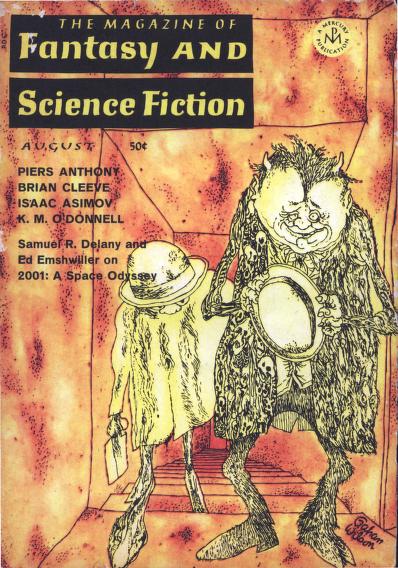
(Cover by Gahan Wilson. F&SF, August 1968.) Who Goes There?
To give Piers Anthony some credit, I’m sure he’s written something good, given he’s been writing continuously for about 60 years now; you know the thing about stopped clocks. With that said I can’t bring myself to read a great deal of Anthony. The last time (actually it was also the first time) I had read Anthony was his 1972 short story “In the Barn,” which was a few years ago and which put me off from reading more Anthony for that span of time. I hear Macroscope is supposed to be good…
Placing Coordinates
Part 2 was published in the August 1968 issue of The Magazine of Fantasy and Science Fiction. I can’t tell if it’s in print or not, but used paperback copies are easy to find. For the morbidly curious, the whole trilogy (all three novels being mercifully short) can be found easily as an omnibus. Why someone would want this is beyond me.
Enhancing Image
As you know I didn’t like Part 1, but I’ll admit Part 2 is an improvement—partly because it’s much shorter. Not much happens and there’s not a lot for me to talk about, so this review will be just as succinct. Last time
on Dragon Ball Zwe had Sol enter the battle circle in an effort to recruit Bog, a big dumb brute who has impressive stamina and is real mean with the club. The match ends in a draw and Bog chooses to not join Sol’s tribe; he simply likes to fight people in the circle for the fun of it. Bog is dumber than a bag of hammers but he’s still the most relatable character in the novel. Sos will run into Bog much later (in the installment) after a time-skip and it’ll be the most enjoyable sequence in Part 2. Did I say “enjoyable”…?Why yes, Part 2 is, surprisingly, not constant pain and suffering; this is due largely to the absence of Sola, who does not reappear until towards the end (regrettably but inevitably) of this installment. Indeed women are mostly absent from the narrative at this point, which is great because Anthony is about as good at writing women as John F. Kennedy was at staying faithful to his wife. The trio that defined Part 1 has dispersed, with Sos reaching the end of his one-year “contract” with Sol and splitting off from the tribe. To do what? Not really sure. He comes to a crazy-run hospital and has a chat with one Dr. Jones, who by all appearances is a normal modern-day doctor. We find out that Sol was an orphan and that he is in fact a eunuch, not that these fact change anything profoundly. It’s here that Sos also finally gets the bright idea to take on a new weapon, and you can guess what it is.
Sos, previously weaponless and bitchless, decides to adopt the rope as his new weapon; it’s not conventional but it functions similarly to the whip, which Dr. Jones points out as a viable offensive tool. “That day Sos gained a weapon—but it was five months before he felt proficient enough with it to undertake the trail again.” That’s right, we get another time-skip! The pacing in this installment is a little too fast if anything, to the point where I struggle to get invested in what’s happening; there’s so little time to get attached to characters and action. The speed at which Anthony pushes the plot forward reminds me, as someone who’s written fanfiction (don’t ask for what) in his time, of competent but underwritten adventure fanfiction you’d find on AO3. The wish-fulfillment element doesn’t help.
Dr. Jones brings up something I had thought of before but which the world of the novel seemingly did not have an answer for, which is the fact that even in the sword family there are many distinct types of sword that require different technique and levels of physicality. Someone who kicks ass with a broadsword may not be so effective with a rapier. Thus Sos uses this loophole to adopt such a niche tool as the rope for his new weapon. What if someone were to use a shield as their weapon of choice? Random thought. The shield is known mainly for defense but it could also serve as a gnarly weapon in a pinch, especially depending on the materials of the shield. I wanna be more interested in the mechanics of the novel’s world-building than I actually am, saying this as a bit of a Dark Souls fan. I’m just saying if combat is the focal point of your story, whether it be literature or a video game, you should put more thought and energy into making that compelling.
There Be Spoilers Here
Eventually Sos runs into Bog again and they have their own match, mainly to test Sos’s proficiency with his set of rope; it’s another draw! Then Bog watches cartoons on a TV set; this is the best part of the installment. Then we’re finally reunited with Sol and Sola… sort of. Sola had gotten pregnant with Sos’s kid at the end of Part 1, and well, it’s been over a year since that happened. It’s a baby girl and her name is Soli. Cute. One problem: even though Sol is perfectly fin with Sos taking Sola as his wife (he’s actually quite happy to get cucked like that), he wants to keep Soli. Admirable that Sol wants to raise a child as a single parents, and it’s not even technically his, but the question is: who does Soli belong to, her mom or her “legal” dad? I feel like this whole situation would be solved with polygamy, what with Sos and Sol respecting each other a great deal and certainly the three of them would agree to share. But oh well, we need drama…
What’s to become of the baby? Will Sos and Sol’s friendship end over this dilemma? Should we care? Stay tuned to find out!
A Step Farther Out
See you next time.
-
Short Story Review: “Exit the Professor” by Henry Kuttner
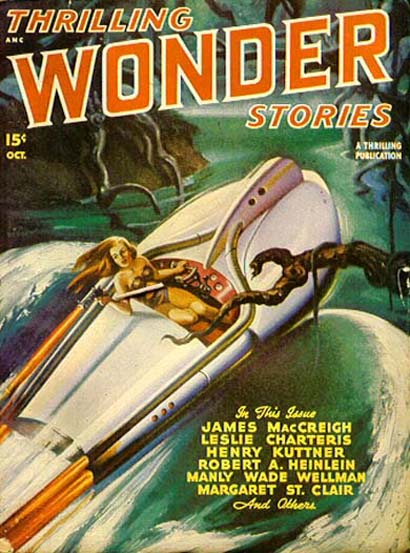
(Cover by Earle Bergey. Thrilling Wonder, October 1947.) Who Goes There?
Henry Kuttner is probably one of the more tragically undervalued writers from the so-called Golden Age of SF. He and his wife C. L. Moore were “co-winners” of the Cordwainer Smith Rediscovery Award. The SF Encyclopedia calls him “a journeyman of genius.” He started in 1936 as a denizen of Weird Tales, as one of the younger members in the Lovecraft Circle, though his early horror seems to take more after Robert E. Howard than Lovecraft, and by the early 1940s he had matured into one of the funniest and most reliable writers contributing regularly to Astounding Science Fiction and Unknown. Kuttner’s years-long collaboration with Moore was so seamless and fruitful that a) people can only make educated guesses as to who wrote what, and b) Moore’s own immense talent would have the doubly tragic effect of undermining Kuttner’s own talent in historical accounts. Kuttner dying prematurely in 1958 (only a month apart from another comedian of the field, C. M. Kornbluth), before he could’ve possibly returned to writing (he was busy getting his Master’s degree) may have also contributed to modern recollections of him being rather foggy.
The reality is that Kuttner’s razor-sharp wit and pessimistic sense of humor, plus a social awareness uncommon in his peers at the time, made him a major precursor to certain SF writerss in the generation following him, including Robert Sheckley, William Tenn, and yes, a mature C. M. Kornbluth. He even had a massive influence on Ray Bradbury, even though the two writers have little in common in terms of worldview. Kuttner, who submitted to every publication under the sun, serves as an unintentional landmark in that his death coincided with a profound shrinking of the SFF magazine market towards the end of the ’50s. He continues to be missed.
Placing Coordinates
First published in the October 1947 issue of Thrilling Wonder Stories, which is on the Archive. “Exit the Professsor” is listed on ISFDB as a collaboration with Moore, but frankly I find this hard to believe; it was initially published under Kuttner’s name alone, was collected in Kuttner-specific collections (including Ballantine’s The Best of Henry Kuttner), but more importantly, it reads like a Kuttner story from start to finish. Anyway, if you want reprints then go for the aforementioned Ballantine volume (I wanna start collecting those at some point, they’re very collectable) and the most essential volume of them all, Two-Handed Engine: The Selected Stories of Henry Kuttner and C. L. Moore. Has been anthologized weirdly little.
Enhancing Image
I hope you like eccentric families, because we’ve got one for the ages here. The Hogbens are what you might imagine to be a stereotypical Appalachian (my girlfriend, a Kentucky native, informs me it’s pronounced App-uh-lach-an) family, the Hogbens, who are very redneck-y… only there’s something weird about all of them. We’ve got Saunk, our narrator, the eldest child of the family; Little Sam, the baby of the group, who has two heads and is supposed to be to telepathic; Paw, the dad, who, either because he chooses to or because he doesn’t know how to turn back, is always invisible; Maw, the mom, who… I actually don’t remember what’s weird about her; Uncle Les, who’s able to FLY on command; and Grandpaw, who speaks pseudo-Shakespearean and who is old enough to have known Roger Bacon—making him at least 700 years old. So yeah, they’re mutants.
The story kicks into gear because the Hogbens have a strange contraption, a “shotgun-gadget” that actually kills a few member of a rival family, though by the Hogbens’ own admission they don’t know how the dingus works. The family has been making a ruckess with this contraption and with people alleging strange things coming from that area, so it’s only a matter of time before a scientist gets involved: Galbraith, the titular professor. As Galbraith explains, “Our foundation is studying eugenics, and we’ve got some reports about you. They sound unbelievable.” When someone says they’re studying eugenics it’s usually a red flag; but Galbraith is here because the Hogbens are suspected (rightly) of being natural mutants, having sustained their genes for centuries now and having kept low-key by living in a rural area.
Given what I said before about Grandpaw it shouldn’t be surprising that the Hogbens’ legacy can be traced back very easily to the UK—hell, not just the UK but the British isles of the Middle Ages. One nitpick I do have is that while it makes sense to hide in a part of the world with few people if one is trying to hide one’s mustations, I’m not sure if rural Kentucky is the best choice. Anyway, Galbraith is curious and also devious enough that once he’s gotten hold of the Hogbens he all but holds them hostage, forcing one of them to either travel to New York with him to be studied or to have a science team come to their place. The Hogbens’ secret must be kept and Saunk is not above committing a little (more) murder, but Grandpaw says that there will be no more killing from this household—not that killing Galbraith would probably help the family in the long run.
What do, then?
Before I get to spoilers (there’s really not a lot to cover), I wanna talk about one thing that may prove a roadblock for some people reading this story, which is how Saunk is a redneck and that he’s the one narrating, which means the story’s action is conveyed with a pho-net-ick ack-sent, like an off-brand rendition of one of Faulkner’s more backwoods-y characters. It’s very readable, mind you; you get used to the accent quickly enough. There is, of course, the question of whether a diehard Californian like Kuttner will render a rural dialogue a) accurately, and b) with sensitivity: the answer to both is probably no. I would take more issue with this if “Exit the Professor” was a more serious story, but it’s not; it is quite mindfully a pure comedy that, had the science-fictional element been changed to fantasy, would’ve fit right at home in Unknown. Indeed it’s the story’s harking back to Kuttner’s comedic fantasies in Unknown that gives me a soft spot for it.
One last thing: there are a lot of great lines here. Saunk is a funny narrator, less because he’s trying to be funny and more because he happens to say funny things at times. When Galbraith sees the shotgun-gadget he pesters Saunk with questions, and, having little idea as to how the thing works, Saunk is very curt about it. “It puts holes in things,” he says at one point. What a lad. The brevity is what makes it funny.
There Be Spoilers Here
So they can’t kill Galbraith, lest they upset Grandpaw, and Saunk can’t go to New York for risk of exposing the family; so what now. Saunk is a bright boy, though, and he comes up with a scheme involving the shotgun-gadget. See, the shotgun-gadget doesn’t just put holes in things. Saunk uses the professor’s curiosity against him by having him mess with the dingus, aiming at a weather-cock “to be safe,” which actually results in a whole lot of toothaches in the village. “I guess half the people in town had gold fillings in their teeth.” There’s a town hall meeting, with people threatening to lynch the professor for his meddling with the shotgun-gadget, but of course, instead of helping the professor out of his problem, the hogbens decide to make it WORSE. This all reads like an epic prank gone wrong.
The dingus removes people’s gold fillings—and also false teeth. And glass eyes. And the chairs in the town hall. And people’s clothes. Kuttner seems of the belief that naked people in public are funny; a wise man he is. So you’ve got a bunch of naked hillbillies chasing after the professor wanting to tar and feather his ass, which leaves him only one option: the Hogbens. The solution the Hogbens have in mind is… a bit odd; don’t think we’re given a scientific explanation for it. Somehow they shrink the professor down to a very small size and keep him stuck in a bottle. “Sometimes we take out the bottle we keep him in and study him.” I can’t tell if this is supposed to be a ship-in-a-bottle scenario (which would be pretty cool, you have to admit) or if they just keep the professor in there and treat him like a doll. I like the climax but I’ll admit I’m not as big on the ending itself, which is abrupt.
Your mileage may vary depending on how much you enjoy snappy jokess in your SF and how much you can tolerate stereotypes for the sake of humor, but for what it’s worth I’d say the Hogbens come out pretty well.
A Step Farther Out
I specifically picked “Exit the Professor” as something that looks lightweight and entertaining before I continue to suffer through Sos the Rope, and that’s what I got! At the same time this shows Kuttner on his own (contrary to what ISFDB tells you) and on his best behavior, channeling some of the whacky humor he’d proven a master of in the early ’40s, with a somewhat plausible science-fictional premise to boot. Unless you’re Appalachian and are easily offended then the hijinks of the story should not offend. This is short and quite chuckle-worthy, to the point where I could just quote several little echanges that caught me off guard—though that wouldn’t help anyone. Of the Kuttner stories I’ve reviewed thus far this one is my favorite. It’s like comfort food: it’s not challenging but it makes you feel good.
See you next time.
-
Things Beyond: June 2023

(Cover by Jeff Jones. Amazing Stories, October 1973.) Ladies and gentlemen? I love monster movies. I know, it’s not very classy or literate to say so, but I love movies about monsters—big and small. I love Godzilla, Mothra, Rodan, King Kong, Frankenstein’s monster, the blob, the werewolf, the creature from the black lagoon, the shape-shifting alien of John Carpenter’s The Thing, and of course the many creatures brought to life by Ray Harryhausen. Among those movie monsters are the dinosaurs and prehistoric reptiles which roamed the earth long before man came along—real-life monsters that were ultimately animals, trying to live their lives like the elephants and giraffes of today. Jurassic Park was probably the first monster movie I ever saw, and as such it was my first dose of what would turn out to be a lifelong addiction. Jurassic Park hit theaters in June 1993, and even now its effects, mostly practical contrary to its place as an innovator in CGI, are mostly seamless and dazzling.
Since now is the time of the film’s 30th anniversary, I figured it’s time to put a couple prehistoric-themed stories on the roster, a short story and novella which predate Jurassic Park but which hopefully will evoke a similar sense of wonder and amazement for Earth’s distant past. Aside from that we’ll be continuing a serial we had started last month, and we have a reliable workhorse in Henry Kuttner returning to the site once again. There is not a whole lot else to say, frankly—except for one thing.
As a young and earnest fan I was stoked to appear as a guest on my first SFF podcast, which actually was uploaded earlier today. I wanna thank Seth over at Hugos There Podcast for giving me the opportunity
to embarrass myselfto discuss a certain obscure and scoffed-at book that I would be unable to review for my own site. I believe I also mentioned a second podcast I’d be guesting on, which sadly was a bust, but depending on when it’ll be rescheduled (I’m really hoping it will be that and not simply trashed for good) it may be uploaded by the end of June.Now it’s time for the stories!
For the serials:
- Sos the Rope by Piers Anthony. Serialized in The Magazine of Fantasy and Science Fiction, July to September 1968. I’m still stunned that we’re covering Piers Anthony—because of his reputation, but also because he was not much of a magazine contributor. Strange as it may sound, however, Anthony wrote much of his early fiction for the ‘zines, with his second novel, Sos the Rope, being written for a contest and first seeing print in F&SF. Anthony was already a Hugo nominee by then, though everyone I know loathes Chthon, the nominee in question.
- The Stone That Never Came Down by John Brunner. Serialized in Amazing Stories, October to December 1973. Brunner was one of the most prolific SF writers of the era, in no small part because he wrote full-time and he had bills to pay. While he wrote a handful of classic novels, most famously Stand on Zanzibar, he seemingly wrote three times as many novels that were much shorter and less demanding than his major ones, The Stone That Never Came Down being one of those minor novels. I picked it because I liked the title.
For the novellas:
- “Time Safari” by David Drake. From the August 1981 issue of Destinies. I’ve said this before, but for the purposes of my site I’m counting Destinies and its ilk as magazines; don’t @ me about this. All I really know about Drake is that he’s a Baen regular as author and editor, being one of many military SF authors to write for Jim Baen and later become a mainstay at Baen Books. “Time Safari” itself ia apparently part of a series, but given that these were published out of order I think it’s safe to assume this is functionally a standalone work.
- “The Oceans Are Wide” by Frank M. Robinson. From the April 1954 issue of Science Stories. I know little about Robinson, but what I do know has my attention firmly held. Like a lot of SF authors of his generation Robinson got started around 1950, during the height of the SFF magazine boom, and wrote a good deal of his SF in the ’50s. More importantly, Robinson was one of the first unequivocally queer SF writers, even being associated with Harvey Milk and later being inducted into the Chicago LGBT Hall of Fame.
For the short stories:
- “Exit the Professor” by Henry Kuttner. From the October 1947 issue of Thrilling Wonder Stories. ISFDB lists this as a collaboration with C. L. Moore, but with all due respect I doubt that very much. Kuttner has the rare misfortune of being overshadowed by his equally (many would say more) talented wife, apparently to the point where Kuttner made jokes about Moore secretly writing stories attributed to him. True, he’s not as refined as Moore, but Kuttner’s humor and pessimism make him prescient, never mind that he was seriously prolific.
- “The Wings of a Bat” by Pauline Ashwell. From the May 1966 issue of Analog Science Fiction. Ashwell is an author I’ve discovered recently in large part thanks to the anthology Rediscovery: Science Fiction by Women (1958-1963) and its related fanzine Galactic Journey. Sadly Ashwell did not write a lot; “The Wings of a Bat” would be her last story for 16 years. Equally peculiar is that she wrote exclusively for Astounding/Analog, being loyal to John W. Campbell and later Stanley Schmidt (for some reason). This one has pterosaurs I think…
Enjoy the serials while you can, because in July we’ll be going without them again. I have a certain idea in mind that may or may not pan out. Hopefully June will not see any dents in my schedule like last month.
Won’t you read with me?
-
Complete Novel Review: Big Planet by Jack Vance
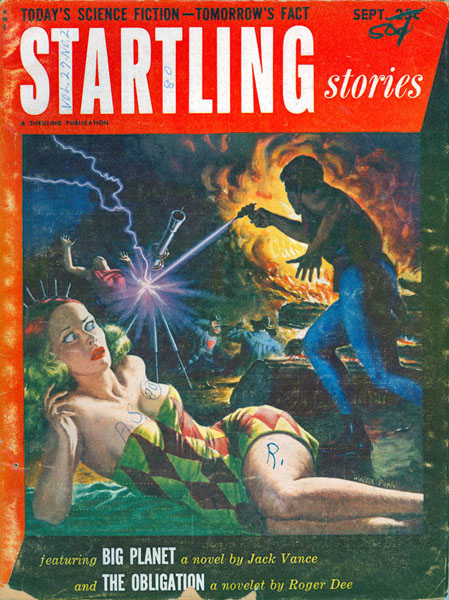
(Cover by Walter Popp. Startling Stories, September 1952.) Who Goes There?
It’s been a while since I’ve reviewed a “complete” novel here, and unlike last time this one is actually complete. Today’s novel, Big Planet, is a rare case where the magazine version of the novel serves as the basis for the definitive text, as opposed to the first book publication. I’m not even sure what Jack Vance’s first novel would be. Wikipedia says Vance’s juvenile novel Vandals of the Void was his first, but this was published after the magazine versions of Big Planet, Slaves of the Klau (magazine version titled Planet of the Damned) and The Five Gold Bands; and then there’s The Dying Earth, which may or may not count as a novel (I personally don’t count it). Thing is, Vance wrote a lot, especially from the ’50s through the ’70s. If you read enough Vance you pick up on certain pet themes of his and certain quirks (we might say limitations) which can grate on one’s sensibilities. I like Vance because he’s convenient to mine for review material.
But Vance is arguably the most important American SFF writer of the 20th century that the fewest people have read; his most famous work, The Dying Earth, has fewer than 10,000 ratings on Goodreads as of this writing. To put this in perspective, The Shadow of the Torturer, the first part of Gene Wolfe’s The Book of the New Sun (ya know, that science-fantasy series nerds will tell you is criminally overlooked) has more than double the ratings. Wolfe fans ought to read Vance at some point, since the former clearly owes a debt to the latter; but this also applies to fans of tabletop RPGs, whose mechanics (particularly those of Dungeons & Dragons) take after Vance’s depiction of magic in the Dying Earth series. Especially for his fantasy, Vance has left a distinct mark on genre fiction in the latter half of the 20th century, although not many people are aware it’s his mark.
Big Planet is science fiction from start to end, though, and unlike The Dying Earth it did not inspire a future trend; rather, what makes Big Planet unique for its time is its dedication to mixing planetary adventure with scientific plausibility, with a strong dash of anthropology. This is a novel where the setting is the main character—that while we find out little to nothing about the human characters propelling the action, we do get many passages in which Vance fleshes out the many locales and societies on Big Planet (for that’s the planet’s name). Because this is a fairly episodic novel, without any real subplots, I won’t be doing a point-by-point rundown but instead will focus on the novel’s ambitions and flaws as an experiment—for it’s certainly an interesting novel, though not a perfect one.
Placing Coordinates
First published in the September 1952 issue of Startling Stories, which is on the Archive. Whereas Startling Stories tended to publish borderline novellas and abridged or easly versions of full novels, Big Planet appears complete here at about 60,000 words, and for a quarter-century (according to Wikipedia) this would be the best version of the novel you could find. The first several paperback editions, including the Avon edition in 1957, were abridged in some way, so keep that in mind if you’re into collecting vintage editions. Nowaodays, though, you can find a complete and in-print version of Big Planet easily, with the Spatterlight Press paperback being your best bet. The Spatterlight Presss edition also comes with an enlightening introduction by Michael Moorcock as he admires both Vance and Big Planet while recognizing the novel’s unusual place in Vance’s oeuvre.
Enhancing Image
We start with a ship that’s heading for Big Planet, a ship containing a commission team from Earth who are supposed to get info on a certain rascal named Charley Lysidder and bring him to justice. Why? Because Lysidder is becoming the biggest warlord on Big Planet, which is a high benchmark because Big Planet is filled with warlords and slave traders. The commission team is headed by Glystra, who will be our protagonist (he doesn’t seem like it in the first couple pages, but watch out), followed by Cloyville, Bishop, Pianza, and some redshirts. We spend about a minute on the ship before everything goes to hell; there’s a spy aboard. The skipper and first mate get their throats cut and the ship crash lands on Big Planet, 40,000 miles from Earth Enclave, basically an embassy and the only safe space for Earthmen. “To land anywhere on Big Planet except Earth Enclave meant tragedy, debacle, cataclysm.” Never mind literally halfway around the world. It turns out that Big Planet bears its name for a good reason.
We get casualties before we’ve even landed on the planet and there are more once we do, including the ship’s stewards and a nun who did not have any lines up to this point and whose body is not even recovered. (Be sure to put a pin in that last part.) It’s bad enough that Glystra and the survivors landed on the other side of the planet, but also they have no means of getting to Earth Enclave in a timely fashion; a trip, assuming they make it, will take weeks. The reason for this is that not only is there no electricity for Big Planet tech, there’s very little metal—to such an extent that metal is measured by the ounce. Big Planet has a wide diameter (yeah, duh), but it manages to have about the same gravity as Earth by virtue of being very poor in metals. Indeed the locals who discover the crashed ship waste no time in tearing it apart for scraps as the materials alone would make them rich.
There are no spaceships or cars on Big Planet—also no birds, for some reason. You’ll have to hoof it, or find a wagon or some alternate means of transport that doesn’t require metal or electricity. This is all pretty near, by the way. Vance goes out of his way to explain why Big Planet is an Earth-like setting, complete with gravity that doesn’t crush the human characters, by explaining that in some ways it is like Earth—only it lacks metals. The energy weapons Glystra and others carry are valuable because they’re powerful and accurate (there’s something called an ion-shine, which I don’t even know what the fuck that’s supposed to look like so I just think of it as a raygun), but they can also be traded for precious resources and information if need be simply becausse of the rarity of the materials. Importing metal to Big Planet is illegal (or rather the Earth federation has enforced a metal embargo on Big Planet) probably so as to not upset the balance—hence one of the reasons why Glystra wants to take Lysidder to Earth authorities.
There’s one other thing: the people on Big Planet don’t fuck around. Glystra and his team will come across bandits, cannibals, despots, and if they’re really unlucky, Republicans. For both better and worse, Big Planet is a sandbox wherein damn near anything is possible so long as you don’t need 20th century technology (or shit, even 19th century technology) to achieve your goals. Any pre-industrial system of government would be possible here. We don’t read about socialist collective farms, but it’s not hard to imagine those existing—successfully—on Big Planet. The whole thing has a whiff of pastoralism about it, not so much in the Clifford D. Simak tradition but in how Vance seems to think that people, if left to their own devices, will gravitate towards feudalism or agrarianism. If you read enough Vance you’ll get the impression that he a) hates cities, and b) is consistently wary about organized religion, which is curious for classic SF.
Oh, one more thing…
The team gets a recruit in the form of Nancy, a Big Planet native who apparently has nothing better to do with her time than accompany a bunch of soldiers and bureaucrats on what amounts to a suicide mission. Nancy is not this woman’s proper name but for the sake of my sanity, and because every other character calls her Nancy henceforth, I’m calling her that. She’s the token woman of the group, which sounds… a bit dubious. I guess it’s better than nothing, but don’t go to Nancy looking for a layered character with a rich interior life, because she will only disappoint you. Then again, Glystra is the most developed character here and that’s by virtue of being the guy who gets to call the shots; if he was in the position of say, Corbus (the ship’s chief engineer, now Glystra’s right-hand man) or Bishop then we would find out basically nothing about him.
Nancy joining the team is inexplicable, and even Glystra can’t help but notice this—though it doesn’t occur to him that Nancy knows something he doesn’t. It could also be that Nancy is attractive and Glystra is too busy getting bricked up in the middle of the mission to think about how this may not be a random encounter for long. Get this:
Something was out of place. Would a girl choose such a precarious life from pure wanderlust? Of course. Big Planet was not Earth; human psychology was unpredictable. And yet—he searched her face, was it a personal matter? Infatuation? She colored.
Is he projecting? Is he dense? Maybe.
Going back through my notes, it’s striking me how many characters show up and how many of them I’ve already forgotten about. There are episodes early in the novel that aren’t exactly Shakespearean; this could be explained by the team being a little overcrowded at first, although it does get whittled down as the novel progresses. Who the hell is Darrot? I don’t remember anything him except that he was on the ship, and then he gets killed off unceremoniously, “his dead face turned up.” There are run-ins with bandits and a very odd scheme involving river monsters that I couldn’t quite wrap my head around, only being able to surmise that it involves locals being tricked into thinking that these beasts are carnivorous. We meet so many people in the first half of the novel that it almost becomes like a joke. “If [Glystra] set about righting the wrongs of everyone they met, they would never arrive at Earth Enclave.” I guess this is a price one has to pay with an episodic structure, because it’s like we’re on a riverboat at a theme park and we’re watching all the sights on the river’s edges but we’re not allowed to wallow in them.
Something I noticed about Big Planet that makes it stick out from most Vance I’ve read is that it lacks the affected language of Vance’s Dying Earth stories—indeed, much of his work in the ’60s onward. This is not merely the result of Big Planet being an early work, because The Dying Earth precedes it and that “””novel””” has some of the most purple prose you’ll find in American fantasy fiction. No, it’s more, I suspect, that Big Planet was written with magazine publication in mind; and yes this was still early in Vance’s career, before he had garnered a reputation as one of genre fiction’s most baroque practitioners. Vance’s tendency to adorn his prose with fancy vocabulary and have his characters in a rather mannered fashion, lacking verisimilitude, can turn some readers off, so those same people might find the straightforward (to the point of curtness at times) language of Big Planet to be refreshing; personally I don’t like or dislike it.
It’s here that we reach the cutoff point, though, because about halfway through the novel we get to the best part and Vance’s purest bit of invention for the novel. We’ve come across a few villages and groups of scoundrels up to this point, but we have not encountered a city—which is where Kirstendale comes in, for the precious few chapters we spend there.
There Be Spoilers Here
The team comes across a trolley service that makes travel a bit less painful, though it’s still no match for cars back on Earth. It’s here that we enter the most memorable location in the novel: the decadent city of Kirstendale. The midpoint and indeed much of the back end of the novel is concerned with Kirstendale, either as a setting or as a carrot on a string for Our Heroes™ since it represents the height of culture and luxury on Big Planet—which naturally means it has a few caveats. Compared to what has been dealt with up to now, though, Kirstendale is a paradise. “It was the largest and most elaborate settlement the Earthmen had seen on Big Planet, but it was never a city which might have existed on Earth.” It’s no wonder that Cloyville decides to stay behind in Kirstendale once the team gets moving again.
The class system in Kirstendale is pretty weird; it’s hard to describe. Not only is metal a precious material here (as expected), but the city and its environs are barren as far as animals fit to be eaten goes. Meat is a luxury that has to be imported, and in a pre-industrial world, without planes or even steamships, you can guess how expensive bringing in meat would be. As such Kirsters (as they’re called) are generally vegetarian, although it’s implied that they will resort to eating bugs if they see it fit. Prestigue in the city is also pretty much entirely performative, in that it’s not your family line or even how much money you have that detemines your status as much as how you carry yourself, such that someone can act as both master and servant in the span of a single day depending on what clothes they’re wearing. As far as I can tell Vance was a conservative, but his playing with class barriers—poking fun at the tenuousness of class division—must’ve tickled Moorcock’s pickle. This is the most entertaining and inventive section of the novel.
If you read enough of this novel you may be wondering where that bastard Lysidder is. Like where he at? The fuck? The man does not even appear, let alone have a line of dialogue, until the final stretch the novel. Glystra meeting Lysidder face to face is one of those moments, like Charles Marlowe meeting Kurtz in Heart of Darkness, where the man has been shrowded in so much mystery as to become a mythological figure. This is made more stark by the fact that once we do get to Lysidder, Corbus and Nancy are the only fellow travelers in the party left—and Nancy turns out to have been working for Lysidder the whole time. Wow, the woman who’s been acting a little suspicious for dozens of pages is the spy! Indeed she was disguised as a nun at the beginning of the book, hence her secrecy and the fact that we never saw the body; she had faked her death, only to take on the role of a simple Big Planet girl once the team sets out.
Glystra takes it easy on Nancy because
she’s a womanher partnership with Lysidder is framed as abusive… or so she says. Glystra and Corbus come up with a different plan for Lysidder and his henchmen, which on a reread surprised me more than it must’ve initially. Having hijacked Lysidder’s “air-car,” Glystra decides to drop the scoundrel off in the middle of nowhere, far out enough where going back to his hideout would probably be suicide—but technically it would be possible to survive in this new environment. “If you stay here, you’ll probably have to work for a living—the worst punishment I could devise,” Glystra tells Lysidder half-jokingly, and that’s the last we see of the novel’s villain. It’s not all a loss for Lysidder, though; if his final argument with Glystra is to make the case that forcing Big Planet under Earth rule would be a mistake then the villain wins, because Glystra and Corbus end up not going to Earth Enclave after all.Precious commissions to Earth Enclave are said to have never returned, mostly probably because they meet a grisly end, but there’s the implication that those who survive don’t come back because they find Big Planet to be a sort of Eden—a garden untarnished by industrialism and imperialism. With the resources they already have, Glystra and Corbus would be rich enough to become landowners, maybe even return to Kirstendale and catch up with Cloyville, and ultimately they decide that’s better than to have Big Planet become yet another satellite for Earth. Sure, conditions are rough, and even at its most decadent it’s not a place for the weak, but Vance seems to be telling us that maybe it really is better to reign in Hell than serve in Heaven. A bit of an unconventional happy ending, but I like it.
A Step Farther Out
So there you have it. In some ways Big Planet is a simple novel; it reads almost like an escort mission in a video game, which if you play your fair share of games doesn’t sound like a good time. True enough it does threaten to get monotonous at times, partly because of the characters being little more rounded than cardboard and coming and going through the narrative as they please, but it also shows Vance refining his craft as a novelist. Its best parts, which could almost work as short stories in themselves, read like episodes in a larger narrative, though this is not a fix-up like The Eyes of the Overworld, the first real novel in the Dying Earth series. In hindsight the episodes blur together with the exception of the first stretch, the episode in Kirstendale, and the finale, which admittedly is a pretty good finale by Vance standards. This is an early work that shows Vance trying to write a conventional adventure SF novel of the period and failing to the degree, which makes it more memorable than some of its peers.
Given the intricacies of what we do see of Big Planet, this is the kind of setting that could serve as venue for a trilogy of novels, each one over 500 pages long; but because Vance came from a generation of SFF writers who believed in not wasting the reader’s time, we’re left with two slim novels. We did eventually get an indirect followup with Showboat World in 1975, but as far as I can tell it doesn’t share anything with its predecessor other than the planet itself—which is just as well. Vance loves exploring settings, but for better or worse he’s not much of a plotter, which would explain why I struggled to recall what happened in Big Planet prior to this reread. No doubt I’ll forget again, but I’ll remember Kirstendale.
See you next time.
-
Serial Review: Sos the Rope by Piers Anthony (Part 1/3)
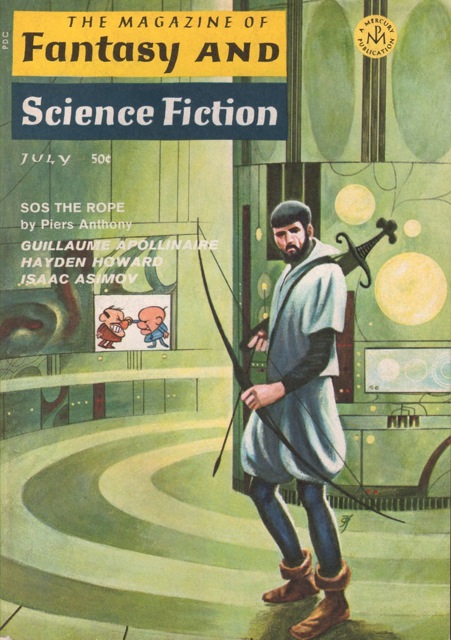
(Cover by Jack Gaughan. F&SF, July 1968.) Who Goes There?
Piers Anthony is a totally uncontroversial and universally beloved author whose genre fiction, often aimed at a younger audience, has inspired generations of readers with wholesome Christian values. Whereas some fantasy authors are content to rely on gore and fanservice to boost sales, Anthony, in the more than half-century that he’s been active, would surely never stoop so low as to pander to a horny and passively misogynistic base of teen boys with boobs as the carrot at the end of the stick!
I cannot keep doing this.
Look, I know that for people of a certain age (i.e., people old enough to have bought Titanic on VHS), Anthony may or may not have been a part of their formative years as young impressionable readers—ya know, when they were not old enough to have acquired taste yet. With that said I have to wonder how promising a guy can be whose books have such lovely titles as Roc and a Hard Place (very funny, Piers) and The Color of Her Panties (I feel dirty just for typing this one). And then there’s the one ecounter I had with Anthony prior to all this, which was “In the Barn,” his story for Again, Dangerous Visions, one of the most disgusting pieces of writing I’ve ever come across. I’ve read Blood Meridian and American Psycho, and I will gladly take those (which are, after all, pretty great novels) over “In the Barn.” When something is compared to “In the Barn” it should serve as your cue to run in the opposite direction. Not a great first impression.
Sos the Rope was Anthony’s second novel, and by this point he was a Hugo finalist for his first novel, Chthon, which everyone I know loathes; well somebody must’ve liked it. I try to be the optimist, but assuming the quality doesn’t change then Sos the Rope looks to be the first bad serial I’ve covered for this site, which I get was inevitable; there are more bad serials than good. Oh, but how bad can it be? It’s not as bad as “In the Barn,” but…
Placing Coordinates
Part 1 was published in the July 1968 issue of The Magazine of Fantasy and Science Fiction. I advise against downloading this one as for some reason the PDF compression messes up this particular issue pretty badly; so I went and used the print copy I already had! Although, as if to warn me of what I was in for, the front cover nearly completely tore off and had to be taped together. There is a somewhat recent paperback edition from Planet Stories (not the magazine), but if you’re feeling brave and wanna read the whole Battle Circle trilogy, you can! There’s an omnibus containing all three novels (which are mercifully short) and while out of print it can be found used for pretty cheap. If you daaaaare.
Enhancing Image
We start with the most confusing of dynamics, in which two men have the same name—Sol—and fight over who gets to keep the name. We have Sol the sword and Sol of all weapons, with the latter proving to be the more skilled warrior and robbing the first Sol of his name and weapon. Let’s retrace our steps a bit. In this far future, adult males in this part of the world base their livelihoods on their ability to beat others in what are called battle circles, “heart of the world’s culture.” The rules are simple: whoever gets thrown outside the circle loses. There are many reasons for these fights and indeed they mirror somewhat the duels noblemen would have in olden times, although from what I can gather fights in the battle circle tend to not be fatal. A man has his name, which apparently he can change in much the way we change shoes (put a pin in this one), and his weapon of choice, which becomes part of his name. Thus, if your weapon is the sword (never mind if it’s a short sword, long sword, etc.), your name might be Sol the sword; or in the case of the Sol who wins the fight at the story’s opening, you’re a jack of all trades who goes by Sol of all weapons.
I have too many questions, but we’ll get to some of those.
Sol, because he’s such a nice guy, not only gives the former Sol a new name but also recruits him to be his right-hand man, despite being weaponless temporarily. Sol wants to build an empire, recruiting dozens of men over a span of months to form a tribe that in time will hopefully form a new civilization; the criterion for recruits is trial by combat. The former Sol is now Sos, and the two men are quickly joined by a woman residing at the hostel they fought at, who “marries” Sol and takes on his status as well as the name of Sola, the “a” at the end denoting her as Sol’s property. There isn’t even a ceremony for a marriage; only a bracelet is required, and it can be removed presumably with the husband’s consent at any time.
Before I go on a rant about how marriage works and how women are treated in the world of the novel, I do wanna give Anthony a point for bending genres here a bit—in the spirit of Jack Vance of all people. Reading the opening stretch, you may think that Sos the Rope is a fantasy novel not too removed from the likes of Vance and Robert E. Howard, but like Vance at times it soon reveals itself to be science fiction masquerading as fantasy, the setting being a post-apocalyptic America a good century after some vague nuclear holocaust. Mankind has devolved back to the stone age, with the only spots of civilization (as far as we know) being hostels that are scattered throughout the land and which are run by “the crazies,” people who somehow are able to remember (probably by way of an oral or written tradition) what the beforetimes were like; but these people keep themselves apart from the nomads who roam the landscape alone or in small groups. The nomads themselves are good survivors but not much skilled otherwise.
Anyway, Sola iss clearly hitched to Sol for his status as future emperor and not because she magically thinks he’s a nice guy; the two do not even seem to like each other much as people, never mind as partners. Sos is frustrated by this, in part because he’s very obviously horny over Sola but is unable to bed her because to bed another man’s wife would be dishonorable. “Could sex mean so much?” A funny question! Actually I have a few questions of my own, such as: If all it takes to change partners is a changing of bracelets then how come Sos doesn’t ask Sol if they could switch up every now and again? It’s not like there’s a signed contract for the marriage. Come to think of it, given the tribal nature of so much of humanity, how come there’s no plural marriage? We have something of a love triangle here (really a lust triangle, since no reasonable person can suppose any of the three parties are in love with each other) whose tension could be resolved by Sos and Sol agreeing to share Sola—with her consent, of course. Why does Sola agree to marry Sol now and not much later when he has proven himself as a leader more? I assume this is so that she doesn’t look like even more of an opportunist than she already does, which still does not help much.
A few more questions not strictly related to the interpersonal conflict of the novel but which I think are worth asking, such as: So women, when hitched, take the names of their husbands and simply add a letter to the end. What if there was same-sex marriage? What if two men got married? Would their names change? There seems to be a pattern that all the adult males have monosyllables for names. What if two women got married? This one is doubly vexing because as far as I can make out, women literally do not have names in the world of the novel if they’re not hitched to some guy. How does that work? How would anything in the legal realm get done here? How would there be a transference of property without names or even agreement in writing? Is there such a thing as property aside from what people are able to carry on their backs? The answer to that last one is probably “no.” No wonder civilization is in ruins, without the concept of property outside the micro scale (for the socialists in the crowd who are wondering, there does not seem to be an overarching government that would allocate land) and with the vast majority of the populace being illiterate.
The misogynistic implications—no, never mind, I wouldn’t even say implications—simply the misogyny deeply embedded in the novel is impossible for me to get around, even as someone who tends to be apologetic with misogynistic writing in old SFF. I know sexism is a problem that has to be called out as such, but I also understand that people from different places and times are often writing under different personal and economic circumstances than what someone reading in [CURRENT YEAR] would have personal context for. The rampant woman-hating in Anthony’s novel is not something I can excuse because not only does it badly skew our understanding of one of the main characters but it also contributes to some incredibly sloppy worldbuilding, such that the novel is built on a shaky foundation of misogyny. Sola is the most rounded character of the trio, even more than Sos (ya know, the protagonist), but she also acts as the malicious temptress who repeatedly and not so subtly tries coaxing Sos into doing something that he’ll most likely regret.
A pet peeve I have with modern reviewers is when they seem to think that a female character being physically active in a narrative must mean then that said female character is well-written. With all due respect to these people, because some of them really are astute critics, this is a lousy line of thinking when it comes to character writing. Sola lacks even a hint of interior life; her goals are all external in that they’re physical, which are a) to one day rule an empire as Sol’s wife/property, and b) to get her pussy licked. Sadly (for both Sola and the reader) these two goals are mutually exclusive, for a reason I have the misfortune of knowing. It’s time to get into spoilers, but I do wanna make one more criticism that may not be as much of a deal-breaker for some people: the action is somewhat boring. I don’t know what Anthony’s status as a writer of action scenes is, but whenever there’s a battle circle fight (and there are a few in the back end of Part 1), my eyes glaze over. Our Heroes™ also have run-ins with creatures of the wasteland such as killer shrews (yeah) and poisonous white moths that are little better to read about. Still better than some of the dialogue, which threatened to kill me.
Okay, enough fucking around, let’s get to spoilers.
There Be Spoilers Here
Particularly I wanna talk about a section in the middle when Sol is out of commission, having been bitten by one of the aforementioned white moths and with Sos having to carry him. It’s here, when the trio are in the badlands (later to serve as a training ground for men in Sol’s tribe), that the sexual tension between Sos and Sola reaches painful levels. A question that had been simmering in our minds (both mine and Sos’s) is why Sola and Sol agree to stay together despite being like oil and water; at first Sos thinks it’s that they’re dynamite in the sack, but it turns out there would not even be a fizzle in their bed. Undressing an unconscious Sol at one point, Sos and Sola discover to their horror that something is wrong with Sol’s junk. “Sol would never be a father. No wonder he sought success in his own lifetime. There would be no sons to follow him.” There’s the implication that Sol is a eunich, although I like to think his cock just looks really funny. In a show of mercy Anthony refrains from describing Sol’s deformity in detail; he also spares us of having to read the inevitable sex scene between Sos and Sola (the latter all but blackmailing the former into it), although that probably has more to do with editorial precaution than Anthony’s own.
For a time Sos is basically the one running the show, and after the trio’s encounter with the shrews (but why shrews) they start recruiting men deemed able enough to join the tribe. Like I said, trial by combat. Sos is intelligent and physically attractive enough to catch the eye of several women (who, being unmarried, are nameless), but turns them down because he is still weaponless; he also has his eyes set on Sola still, in spite of his better judgment. “Possession of a woman was the other half of manhood,” (ech) and clearly Sos’s lack of a weapon would be a metaphor for his lack of manhood (as in his dick). I do appreciate the irony of Sos being quite capable as both a fighter and lover despite being weaponless while Sol, the warrior who can do well with any weapon, is impotent; it’s a shame that this is buried under a shit-colored pile of male chauvinism and treating women as things to be owned. Why Sos has not started training with a new weapon I don’t know. We know that Sos will at some point apparently take on rope (huh) as his new weapon of choice, going by the novel’s title. I assume we’ll get more answers in the next installment, but something tells me thosse answered will be unsatisfying, not to mention there are simply too many holes in the worldbuilding for the ship to not sink.
A Step Farther Out
See you next time.
-
Short Story Review: “Black God’s Shadow” by C. L. Moore

(Cover by Margaret Brundage. Weird Tales, December 1934.) Who Goes There?
Given that her career as an a genre writer was cut short, on account of the premature death of her first husband Heny Kuttner, C. L. Moore’s time in the field was wide-spanning and much lauded. Nowadays (unless you’re a Weird Tales fan) she’s most recognized for her collaborations with Kuttner and the occasional solo story written during their marriage, but Moore gained cred as one of Weird Tales‘s most gifted writers within a year of her professional debut. Her planetary vampire story “Shambleau” was an instant hit and editor Farnsworth Wright cheerleaded her as a force to be reckoned with; within a year she established the two series that would define the first stage of her career, contributing to the planetary romance with Northwest Smith and the fast-growing sword-and-sorcery tradition with Jirel of Joiry. I recommend reading my review of the first Jirel story, “The Black God’s Kiss,” before continuing with this review, since today’s story very much assumes you’ve read what came before it.
Placing Coordinates
First published in the December 1934 issue of Weird Tales, which is on the Archive. Because this is a direct sequel to “The Black God’s Kiss” and thus does not stand on its own, it’s be reprinted considerably fewer times than its predecessor. The good news is that you can still find it readily in Jirel of Joiry and Black God’s Kiss, collections which as far as I can tell are mostly identical and which collect the whole (rather short) series. If you’re British and/or you suck eggs then there’s the SF Gateway omnibus collecting Jirel of Joiry, Northwest Smith, and the short novel Judgment Night.
Enhancing Image
It hasn’t been long since the end of “The Black God’s Kiss,” and yet despite having had her vengeance on the rogue invader Guillaume, Jirel has been tormented by guilt. She had ventured into the dark underworld beneath the castle of Joiry and received the most cursed of weapons: a kiss from a black Buddha-like statue in a temple. Not only did the kiss kill Guillaume but it seemed to send his soul to the underworld, which is the part that’s been troubling Jirel so much. You may recall the ending of “The Black God’s Kiss” was a bit odd, maybe problematic, due to Jirel realizing—too late—that her immense hatred for Guillaume was actually lust (or “love,” but let’s be real with ourselves, what Jirel feels is not love) in disguise.
The first story was almost a subversion on the sword-and-sorcery formula with how it de-emphasized action in favor of describing, in a great detail, an environment totally alien to human experience; call it a Lovecraftian heroic fantasy. Jirel herself is heroic in that she’s quite brave, true, but she’s really an anti-heroine, having no problem with chopping dudes’ heads off if they come into her castle without her consent (this both does and does not feel like a euphemism), and it’s not like she has any virtuous plans for the world in mind. She’s also not a virginal waif who has never seen a man’s drill before, as it’s made clear to us that she’s taken on several lovers before. I’m just gonna say it: she’s a top. The sexual undertones of “The Black God’s Kiss” are more or less absent in “Black God’s Shadow,” though, as Jirel is less concerned now with satisfaction than she is with finding inner peace.
The opening scene focuses on Jirel trying and failing to sleep at night, her castle restored but her faith in herself wrecked. She considers the possibility of Guillaume, in some spirit form, wandering the underworld beneath the castle, calling her out for her act of strange cruelty.
By the power of that infernal kiss which she had braved the strange dark place underground to get as a weapon against him—by the utter strangeness of it, and the unhuman death he died, it must be that now his naked soul wandered, lost and lonely, through that nameless hell lit by strange stars, where ghosts moved in curious forms through the dark. And he asked her mercy—Guillaume, who in life had asked mercy of no living creature.
Jirel knows what she must do: return to the underworld and find some way to put Guillaume’s soul to rest. Pretty simple goal, right? And it is! This is even more straightforward on a plot level than the first story, to the point where it actually becomes a bit hard to talk about. It’s a bit shorter than “The Black God’s Kiss” but feels about the same length because of the density of Moore’s descriptions, compounded by the fact that there’s virtually no dialogue this time around. We have three characters, but without being too specific for fear of spoiling only one of them is both human and alive; therefore don’t expect to read conversations here.
Another thing to take into account is that there’s even less action here than in “The Black God’s Kiss,” with Jirel fighting off strange creatures so much here as battling the strangeness of the underworld and her own psyche, which has taken a hit since the end of the first story. The most we get prior to the (rather prolonged) climax is an encounter with an unseen venomous creature that goes after Jirel’s legs during the underworld’s starlit nighttime—a bit of horrific ambiguity that shows once again that Moore could’ve become a horror maestro on par with Lovecraft and Howard had she kept going down this path. Indeed it’s here in her early fiction that Moore is the most poetic, being preoccupied with capturing places and emotions to an extent that may read to some people as trying too hard but which nevertheless gives the Jirel of Joiry stories a unique weird-adventure atmosphere.
With that said, some of the things I found memorable from “The Black God’s Kiss,” such as Jirel’s encounter with her evil mirror image and the herd of blind white horses, are gone here, replaced with things which do not strike me as eerie or memorable. The temple where the black god dwelled in the first story is no longer on an issland connected to the rest of the underworld by an invisible bridge but is instead at the head of a river. Stuff has changed around without explanation, which I suppose makes sense given the unhuman and eldritch nature of the underworld, but there are still certain rules it abides; for example, Jirel still has to ditch her crucifix in order to see the vast underground realm for what it is.
As far as Jirel’s wandering the landscape goes there’s a bit of “second verse, same as the first” at work, but what makes this one distinct is how it refuses to turn into an action fantasy. Actually I’d go so far as to say “Black God’s Shadow” is considerably more obscure than its predecessor because it almost doesn’t work as a short story—nay, it reads almost more like a prose poem, written by someone who may or may not have survivor’s guilt. I don’t know enough about Moore’s life to speculate, but I do have to wonder what could’ve prompted her to zero in on trauma and overcoming said trauma like she does in the first two Jirel of Joiry stories. There’s a darkness lurking at the core of these stories that makes them hard to grapple with, even from a modern reader’s perspective—a meditation on guilt and the dark side of lust that rings somehow as more personal than is to be expected from a 1930s fantasy series starring a bad bitch with red hair.
I don’t like “Black God’s Shadow” as much as what came before it, but when taking the two stories as two halves of one whole I do think they work better together than each on its own. “Black God’s Shadow” is gloomier and more contemplative than its predecessor, but as I’ll explain it’s also the more uplifting of the two at the end of it.
There Be Spoilers Here
The climax is basically a standoff between Jirel and the black god, the living and demonic statue she made a deal with before, now her adversary. Guillaume’s soul is kept prisoner by the black god and Jirel has to free it while also not being taken prisoner herself. A lot happens… and yet not a whole lot if you think about it. This is a spiritual battle, but it’s more so a psychological one. Jirel has to forgive both Guillaume and herself; in other words, she has two souls to save. While Jirel is unable to resurrect the man she had killed (thankfully Moore does not pull such a deus ex machina), she is ultimately able to free his soul from the black god’s clutches. While Jirel is unsure as to where Guillaume’s soul went, his voice no longer haunts her in her mind and dreams, which means we’ve gotten about as happy an ending as we can expect. Jirel’s victory is hard-won, but she has learned to love herself again, and thus this chapter in her life has now ended.
(I have to wonder how the next story, “Jirel Meets Magic,” follows up on the sheer darkness here, but my assumption is that it won’t, which is fair. A direct acknowledgment of Jirel’s suffering henceforth is unneeded.)
A Step Farther Out
I pulled up the letters column in the February 1935 issue of Weird Tales, which has responses to the December 1934 issue, and was dismayed by how unconstructive responses to “Black God’s Shadow” were. There’s the usual “I really like this and all hail C. L. Moore” stuff, but nothing I could find about how radically different “Black God’s Shadow” is from its predecessor, despite the two very much forming a duology—even more so when we consider that Moore very likely wrote the two back-to-back and had already sold “Black God’s Shadow” to Wright before “The Black God’s Kiss” saw print. The two were printed as separate stories and not part of a serial because, I reckon, there’s a clear divide between them such that they sort of mirror each other, and would not cohere as part of a single narrative. Still, with Jirel having resolved the internal conflict that plagued her since the end of “The Black God’s Kiss,” she was free to go on other adventures, and Moore was free to not return to Jirel of Joiry for several months.
See you next time.
-
Serial Review: All Judgment Fled by James White (Part 3/3)
(Cover by Vaughn Bodé. If, February 1968.) Who Goes There?
James White was one of the more successful British SF authors who did not (as far as I can tell) partake in New Wave antics in the ’60s. His loose Sector General series started in the ’50s and remained steadfast as a conventionally written setting for hospital dramas IN SPAAAAAAAACE, and his novel that I’ve reviewed, All Judgment Fled, is, excepting a couple passages (there’s a bit toward the end of Part 3 that references LSD), a pretty vanilla affair—which is not to say it’s boring. On the contrary, White is clearly a writer who considers the logical implications of his narratives, which naturally then snowball into ethical implications; he also has a sarcastic whit which at no point rang as irritating to mine ears. While my feelings on the novel are a bit mixed I do look forward to future adventures with White, especially since he’s one of those prolific magazine contributors and therefore someone (like Poul Anderson and Jack Vance) I fall back on for emergencies.
Placing Coordinates
Part 3 was published in the February 1968 issue of If, which is on the Archive. I’m not usually a fan of If‘s cover art, but the Bodé covers (we got too few of them, sadly) are very well done and eye-catching, including this one. As for book publication we only have a few editions to work with, for a novel that’s over half a century old, but you can find used copies cheap.
Enhancing Image
Before I get into the installment itself, I wanna talk a bit about what the past week has been like for me. If you’re reading this it means it’s May 22nd and by extention this post is two days late. I set deadlines for myself with these but I found out the hard way that there was just no doing this post on-time. I didn’t even finish reading Part 3 until the night of the 21st. Last week round this time I guested on a certain podcast, which went well and which you can expect to see at the beginning of June, probably back-to-back with my review forecast; that was not the hard part. No, the irony is that going on vacation can make it very hard to do things you normally do in your spare time. I had requested time off work and flew to Chicago (from Newark) on Friday, and only got back Monday. I was there to visit a couple friends I very rarely get the chance to hang out with in person; as such, combined with the brief time window I’d given myself, we crunched a week’s worth of fun times into three days. It was a good time, needless to say, but I also got precious little time to work on this site, hence the delay.
Now that I’ve said that, it’s time to finish this damn serial.
Last time we were with the boys, the mission had gone to hell. Morrison got killed by a Type Two, a tentacled creature with a giant horn and without any capacity to reason with the explorers. As violence has broken out on the Ship, a mysterious object orbiting between Mars and Jupiter, the higher-ups at Prometheus Control have been chastising McCullough (the audience surrogate) and company for their lack of professionalism. The Twos are hostile to the point of seeing the humans as food, which results in much of Part 3 being an all-out skirmish between the explorers and a horde of Twos, making for an extended action sequence that admittedly sort of struggled to hold my interest. A weakness of mine as a reader is that my eyes tend to glaze over when it comes to action, whith it being too easy for me to lose track of who’s dealing with what and who’s still alive and who has bitten the big bazooka. The action in Part 3 is especially confusing, partly (I suspect) deliberately and also because White refuses to give us a clear picture of the ship’s interior. The illustrations do a lot of leg work.
The most egregious example of White’s confusing laying out of action happens at the very beginning, wherein we’re told via narration that Drew has died—somehow. I wondered if I had missed something at the end of the previous installment, made worse because the recap section makes no mention of it—but no, Drew is not dead, he’s actually fine. The logic seems to be that in the heat of battle McCullough thinks Drew is dead, but this turns out to be a false alarm; the third-person narration sharing McCullough’s confusion is a hard pill to swallow, however. A similar case happens toward the end when (not getting into specifics here, because spoilers) a character has apparently died and the narration does not tell us this explicitly (unless I missed something, which is possible) until after the fact. Did he die offscreen? What happened? I’m getting ahead of myself.
We’ve discovered by now that the Ship is, or was, operated in all likelihood by a very small crew, and that the Twos wandering about looking for scraps are either non-sentient or driven (by something) to insanity. We never get a clear answer as to the nature of the Twos, but we do know that they’re an active threat to the explorers. Drew’s maddened call for extermination of the Twos (which is supposed to inform us that the explorers have basically reached rock bottom) does not come off as too unreasonable. Regardless, the mission has degenerated to such an extent that Prometheus Control and the explorers are all but no longer on speaking terms—a relationship that is about to get even rockier, if you can believe it.
McCullough sums it up nicely:
He realized suddenly that although he was terribly afraid for his own immediate safety he was furiously angry about the things they had done and were doing on the Ship. From the very beginning they had no control of the situation. It had been a stupid if well-intentioned muddle. And while they had changed their minds several times when new data became available they had not really used their brains. They had been panicked into things. They had not allowed themselves time to think. And when threatened with danger they thought only of survival.
The higher-ups at one point bring in a woman on the speaker to calm the men and reassure them with an incoming supply drop, but this doesn’t work too well. Keep in mind that said woman, whose name we never learn and who is called “Tokyo Rose” at one point (I get the reference, but it’s also a cute bit of symbolism with how the woman’s reassuring voice functions as and is acknowledged as basically propaganda), is the only female character in the novel; and she’s not really a character at that. From here on it’s all a war of nerves, of the explorers fighting off Twos while trying not to have total mental breakdowns. We do get some relief in the form of a new alien species with the Threes, which are like a cross between a snake and a teddy bear; I know that sounds like a weird combination. The Threes appear to be friendly, but are still not the intelligent alien(s) running the Ship that the explorers are looking for. This is the longest installment, so be prepared for a big third-act blowout and the summit of the conflict.
All Judgment Fled is technically a Big Dumb Object™ story, but that’s desceptive given how close-quarters the novel’s scale is. From start to finish we’re stuck with two small ships from the Prometheus Project and the Ship, which while nearly half a mile long is not spacious like the interior of, say, Rama. Comparisons will inevitably be drawn between White’s novel and Arthur C. Clarke’s undying classic, which depending on your worldview may or may not be favorable. If you’re looking for gosh-wow moments that provoke your inner child (what Rendezvous with Rama does in spades) then you’ll have no such luck with White’s novel. The setting is cramped, paranoid, claustrophobic, verging on inner space rather than outer with how much we’re stuck with the flawed humanity of the characters, but this is still a hard-headed old-school SF tale at the end of the day. McCullough, our lead, never becomes fully human in that his conscience never wanders from the physical problem at hand for long, but the novel still deals with the ethical equations of first contact more than some of its ilk.
It’s respectable is what I’m saying, if also cagey.
There Be Spoilers Here
After losing Drew (for real this time) and Berryman we finally get to have a “chat” with the alien that’s really running the Ship, and it looks—interesting. Another thing I gotta give White credit for is that we do not get any humanoid aliens here, with the different types vaguely resembling Earth animals but having nothing that could be mistaken for human. (I bring this up just so we can rest easy that none of the explorers go chasing lustily after some blue-skinned space babe.) The intelligent—and benevolent, wow how lucky—alien running the Ship is itself nightmarish in appearance to our battered explorers, “a great, fat, caterpillar, an LSD nightmare with too many eyes and mouths in all the wrong places.” Still the two species are able to communicate through visuals, since obviously verbal communication will do nothing, and ultimately we get a sort of cultural exchange.
Since half the human crew is dead there’s now few enough people to accommodate the reduced number of space suits, along with one of the P-ships no longer working. Which is all rather… convenient? If also morbid. I don’t totally buy the happy ending here, but then maybe White is not the kind of writer to totally fuck his characters over. J. G. Ballard would fuck shit up with this premise, which makes me wonder what this novel would’ve been like had it been a more ruthless deconstruction of first contact narratives—a premise that’s started here but not completely fulfilled.
A Step Farther Out
I know a couple people who prefer this over Rendezvous with Rama, and I can see the argument for it even though I ultimately have to disagree, because in some ways All Judgment Fled is the anti-Rama. Whereas the explorers in Clarker’s novel are always up against some tangible external problem that can be solved fine with bruce force or swiftness of speed, the conflict in White’s novel comes largely from the fact that the people heading the Prometheus Project failed to consider the possibility of interacting with alien lifeforms, not to mention explorers who might not be the most rational people; yet All Judgment Fled also feels incomplete somehow, whereas Rama is undoubtedly the complete package. This is a short novel, coming in at no more than 55,000 words, and truth be told it could’ve been 5,000 words longer, much of that devoted to scenery and character moments. The characters are not the flattest, but it can be easy to confuse some of them; half of them lack clearly defined roles but also nuance. White also has this thing for not describing places in any great detail, which made the action-heavy back end of the novel read as too abstract for my tastes.
Next post will be on time, trust me.
See you next time.
-
Subscribe
Subscribed
Already have a WordPress.com account? Log in now.
 Science Fiction & Fantasy Remembrance