-
Serial Review: Under Pressure by Frank Herbert (Part 1/3)
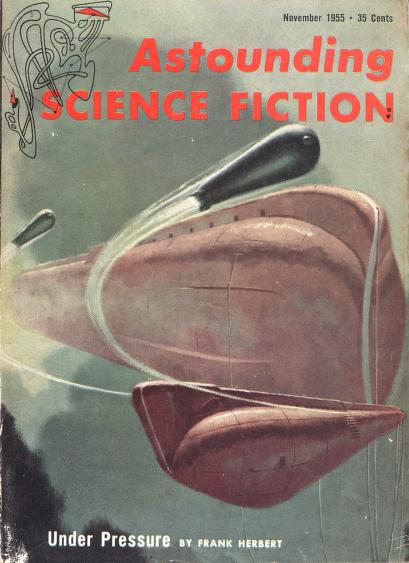
(Cover by H. R. Van Dongen. Astounding, November 1955.) Who Goes There?
Frank Herbert is one of the most famous authors in the whole history of SF, despite the fact that most of his output continues to wallow in obscurity. How did this happen? He was born in 1920 in Washington State, raised Catholic but taking to Buddhism as an adult, served a brief stint (only six months) in the Navy during World War II, this last part being relevant to today’s story. He started out as a journalist and came to writing science fiction relatively late, already being in his thirties when his first SF story was published in 1952. A few years later and we got his first novel, serialized as Under Pressure and published in book form as The Dragon in the Sea. But that’s no what people know Herbert for. When it seemed like he was about to be another second-tier writer, doomed to be forgotten, Herbert struck gold with the serial Dune World, in Analog, which was very popular, along with its sequel serial Prophet of Dune. Both short novels, totaling eight installments, were then fused into one big novel, Dune, which became a bestseller overnight and which took home both the Hugo and the inaugural Nebula for Best Novel. The rest is history.
Of course, it’s not as simple as all that. Herbert had conducted an enormous amount of research for Dune, with this first novel in what would become a wide-spanning series taking years to gestate—unusual for genre SF at the time. Herbert wrote other novels over the next couple decades, but Dune was the thing that kept his name in the papers and on people’s minds, and indeed, even taking its faults into account, Dune was a revolutionary novel for the field. Herbert himself is a figure of some controversy, from his appropriating of Islamic culture to his well-documented homophobia to the question of whether or not he was even a good writer. Did he just happen to get lucky? I have to admit, being a third into Under Pressure, I do think there was at least some talent there.
Placing Coordinates
Serialized in Astounding Science Fiction, November 1955 to January 1956. It was published in book form later in 1956 as The Dragon in the Sea, revised somewhat (the language is a bit saltier, for one) but otherwise the same novel as its magazine counterpart. It’s still in print, I think, although truth be told I’ve never encountered anything Herbert that isn’t Dune-related in the wild. Has anyone seen a copy of this thing?
Enhancing Image
I assume most if not everyone reading this has already read Dune, which means we’re already aware of Herbert’s writing quirks, and you’ll be pleased (or maybe not) to know some of them have already manifested in Under Pressure. Well, the good news is that this is a much smaller novel than Dune, in both length and the scope of the action. We’re not given a whole world to play with, but instead the cramped and claustrophobic world of an atomic submarine—as envisioned in the 1950s, of course. Whereas it takes seemingly forever for Paul Atreides to emerge as the “hero” of Dune, we’re immediately met with our protagonist for Under Pressure in the form of John Ramsey. Ramsey is trained as an electronic officer, but his real job and profession is as a psychologist, an ensign from BuPsych (the Bureau of Psychology) assigned to the subtug whose crew is rated as the likeliest to succeed on an upcoming oil raid. This is important for two reasons: first is that in the 21st century (around what is now the present, actually), oil has become an increasingly precious resource, with the Western and Eastern (they never say “Soviets,” but we’re clearly meant to understand the East as the Soviets) fighting for control of this resource; the second is that of the last twenty Hell Diver missions, with these subtug oil raiders, all twenty missions ended in failure. A subtug crew is very small, only four men, and with the three men aboard this one BuPsych suspects there’s a “sleeper” among them—a spy who sabotages the submarine. So you have three highly qualified men, including their captain, but one of them is (probably) a traitor.
It’s here that we’re introduced to the crew, that being Captain Sparrow and his men Garcia and Bonnett. Sparrow is sort of an Ahab or maybe Nemo figure, whom BuPsych suspects of having a screw loose, but he’s also shown to be a highly capable skipper. Garcia is a Hispanic Catholic, which is curious because I would’ve expected the subtug’s crew to be all white Americans instead of mostly. Then there’s Bonnett, whom Ramsey nails as having an inferiority complex due to being raised in an orphanage. I should mention at this point that Ramsey is a psychologist of the sort you’d expect to see in pop culture in the post-war years, which is to say he’s clearly read a ton of Freud and Jung. Under Pressure is not nearly as aggressively Freudian as some other SF works from the era, at least not yet, although I’m not sure how much of that boils down to censorship from being printed in Astounding. Magazines at the time were generally more prudish than book publishers, but this was doubly the case with magazines John W. Campbell edited. Looking at the magazine and book texts of Under Pressure, there are immediately some small but still noticeable differences. For example, at the beginning in the magazine version, Ramsey calls a snooty secretary a snob, while in the book version he calls her a bitch. Maybe if Under Pressure had been serialized in Galaxy the mildly salty language would’ve stayed, but Herbert’s brand of SF is maybe a bit too hard-nosed for that magazine. Indeed the most impressive part of this novel, aside from Herbert’s estbablishing a setting that is suffocating both physically and mentally, it’s that Under Pressure reads more as speculative fiction than science fiction. Granted that I’m not even slightly an expert on submarines and have only an elementary knowledge of nautical terminology, it’s impressive that Herbert is able to make the reader feel as if they’re learning about subs while at the same time reading a psychologically gripping adventure story.
So Under Pressure is what might be called edutainment, which is a lable I don’t see used often nowadays, but back in the pre-internet days (and indeed in the early days of the internet, i.e., my childhood) there was a whole school of pop science that worked to educate the layman while also being entertainment. Hard SF is arguably a kind of edutainment, with the caviat that hard SF, being still a kind of SF, must out of necessity work on the basis of at least One Big Lie™. The author has to fudge the numbers or put their thumb on the scales to make something SFnal. Hal Clement admitted this much in an essay that accompanied the serialization of Mission of Gravity. Incidentally, a big reason Herbert’s novel works as edutainment is that Ramsey, who for much of this is our eyes and ears, has to learn about the minutia of the subtug at the same time as the reader. He’s given a five-week crash course in being an electronics officer aboard a sub with only four crewmen, all the while reading up on his shipmates so that he can better figure out if one of them is about to crack, or if one of them is the spy the government’s looking for. Not only does Ramsey have to sniff out the spy, but he’s keeping his job as psychologist a secret from the crew. Thus we’re introduced to a game of cat and mouse, made more intense because Sparrow and Garcia are religious men and Sparrow even more so is prone to episodes of Bible-quoting religious mania.
There Be Spoilers Here
The crew discover the tucked-away corpse of the former electronics officer, who may or may not have committed suicide, but otherwise there’s not too much action in this installment. The big realization Ramsey comes to by the end is that he is quite likely to die on this mission, either through sabotage with the subtug or one of the crew killing him outright. The problem with being in a submarine is that you’re hundreds of leagues below the ocean’s surface, so that there’s no such thing as a “small” mishap aboard ship. If you’ve watched Das Boot then you have an idea as to the mortality rates of submarine crews during WWII, and while the future war of Under Pressure is clearly based off the Cold War instead, the risk has not gone down much. This first installment ends with a kind of bewildering nightmare sequence, in which Ramsey’s fears of dying in the dephs of the ocean come to the surface. It’s a reminder that Herbert can be a creepy bastard, and also that despite his tendency to jump between characters’ heads, namely Ramsey and Sparrow’s he understands psychological drama.
A Step Farther Out
As someone who is a bit of a Herbert skeptic, I have to say I’ve been enjoying this quite a bit. We’ll see where it goes.
See you next time.
-
Short Story Review: “The Woman of the Wood” by A. Merritt

(Cover by C. Barker Petrie, Jr. Weird Tales, August 1926.) Who Goes There?
A couple years ago I was supposed to review A. Merritt’s novel The Dwellers in the Mirage, although I couldn’t get far into it before admitting defeat. It could be because I was reading it as it appeared in Fantastic Novels, a magazine with a type size intended for ants and other insects, but I was struggling with it. At the time I knew I would have to give Merritt another shot at some point, not least because of his reputation in the field—or, more accurately, his lack of a reputation nowadays. Abraham Merritt only wrote eight novels and small number of short stories, which for someone who wrote pulp fiction is borderline miniscule, but in fact he had such a well-paying day job that he felt not the need to write much fiction. He worked as assistant editor and later editor of The American Weekly, a Sunday newspaper whose top positions paid a pretty good deal. (Making it as a journalist a century ago meant a lot more than it does now, in the sense that you could afford a house without taking on a second job.) Merritt basically quit writing fiction after 1934 to focus on his lucrative career, resulting in a writing career that lasted not quite twenty years. As with close contemporary Edgar Rice Burroughs, Merritt didn’t start writing fiction until he was in his thirties; but once he picked it up, he found a good deal of success with it as well. Merritt cultivated such a devoted following that he’s one of a very small group of people to have a genre magazine named after him, the short-lived A. Merritt’s Fantasy Magazine.
Yet Merritt’s reputation dwindled in the years following his death in 1943, with naysayers popping up rather early on. In one of his books of criticism, I forget which piece exactly, James Blish calls Merritt a lousy writer. While such an assessment is more often true than not when it comes to once-beloved genre writers from so long ago (E. E. Smith was indeed a pretty bad writer, and his immense influence on the field is thus hard to account for), this judgment of Merritt seems harsh to me. It’s telling that Merritt was one of the first people to be inducted posthumously into the Science Fiction and Fantasy Hall of Fame, then was “awarded” the Cordwainer Smith Rediscovery Award in 2009. His stuff only seems to be kept in print by small independent presses, and I’m actually unsure if even all his novels are in print. He also wrote few short stories, with “The Woman of the Wood” being his only original appearance in Weird Tales. Merritt’s work was frequently reprinted in the genre magazines of the time, but he was originally published in the general pulps, namely Argosy.
Placing Coordinates
First published in the August 1926 issue of Weird Tales, and later reprinted in the January 1934 issue. It’s also been reprinted in the first issue of Avon Fantasy Reader, A Treasury of Modern Fantasy (ed. Terry Carr and Martin H. Greenberg), The Fantasy Hall of Fame (ed. Robert Silverberg and Martin H. Greenberg), and the Merritt collection The Fox Woman and Other Stories. It’s in the public domain now, which means you can read it however, although it’s not been transcribed for Project Gutenberg in the US as of yet. Very little of Merritt’s public-domain work is there.
Enhancing Image
McKay, an American World War I veteran, has come to the mountains of France in need of some fresh air. A pilot in the war, McKay had apparently joined the French forces and later the Americans, once they entered the war; but while he served honorably, the experience left him shell-shocked. “The war had sapped him, nerve and brain and soul. Through all the years that had passed since then the wound had kept open.” This is, of course, Merritt telling us upfront that we ought to take McKay’s testimony of the strange events to follow with a grain of salt. Indeed, McKay not entirely having his mental screws in place is key to the story working, or else it would sound even more ridiculous than it already does. McKay is quite different from his creator, being a war veteran while Merritt was not, but both men are what we might call eccentrics, and both also have green thumbs. McKay would be perfectly happy as a gardener, such that he seems to get along better with plants than people, and like Bob Ross he has a tendency to bestow human personality on the birch and pine trees of the Vosages. He’s staying at a lodge, owned by an unnamed inn-keeper and his wife, on the edge of a lake, with only one other human habitation at that forested lake—that being the house of Polleau and his two sons.
Polleau and his sons are the descendants of serfs who lived off the land generations ago, but they’ve been feuding with their surroundings such that several members of their family have befallen to bizarre tree-related accidents. Now they are the last of their kind. Given that McKay repeatedly equate the trees with royalty and medieval figures, it’s easy to picture the last of the serfs going up against a legion of nobility (or so Merritt/McKay thinks) from centuries past, in a France which has not had a monarch for many years at this point. When one of the sons tries cutting down a birch (the birch trees are given feminine qualities), McKay witnesses something very strange indeed: the trees seem to fight back. The birch, wounded, lies on a neighboring fir “as though it were a wounded maid stretched on breast, in arms, of knightly lover.” Something I’ll say in Merritt’s favor is that while he’s fond of using certain words over and over, he has a knack for evocative imagery that’s a step above most other people submitting to Weird Tales at the time. The cast is small, and it become apparent pretty soon where Merritt is gonna take the plot, but the setting is well-realized, and there’s an intense earthiness to it that reads like a pulpier and perhaps less scary Algernon Blackwood. I have no doubt that Merritt would’ve read his fair share of Blackwood, considering he was big into reading on the occult and both authors have a shared fondness for rural spaces. “The Woman of the Wood” was by no means the first “Nature fights back” story, probably not even the first to be published in Weird Tales that year, but it’s redeemed by Merritt’s knack for setting and tone.
One of the sons lose an eye in the ordeal, which was a bit more violent than I was expecting, but also it’s unsurprising that a) this conflict between man and tree is a bit more literal than would be deemed realistic, and b) McKay sympathizes a lot more with the trees. Later he is tormented, or maybe just haunted, by a small army of birches come to life as ghostly women, which is how I imagine we got the cover for this magazine issue. The trees tempt McKay to “slay” (they keep using that word specifically for a while, which makes the proceedings just a bit hard to take seriously) the Polleau family for them. Since the closest we have to a human woman in the story is the inn-keeper’s wife, who doesn’t say much, the estrogen quota will have to be met in the form of sly and vaguely slutty tree spirits. The spirits of the forest are not exactly evil, nor are they really good, but simply wanting to retaliate against a small but passionate force of deforestation. It does not seem to occur to anyone, even Polleau himelf, that the old man and his sons should probably make plans to move out of the mountains; but then, considering what we see of them, it wouldn’t be surprising that their pride would make moving out of the question. As is typical of weird fiction, and also pulp writing generally at the time, there’s an appeal more to emotions than the brain. That Merritt can delay the reader in thinking about the logical issues of the setting is to the story’s benefit, not really a negative. That McKay himself is shown to be in a fragile mental state to begin with also makes his extreme actions in the climax easier to understand.
There Be Spoilers Here
The really crazy part, which might be the one thing I wasn’t expecting in terms of the story itself (putting style and pacing aside), is that McKay gets away with murder. Yeah, he shivs one of the sons in the goddamn neck, in a kind of tree-induced rage, actually rips out the guy’s throat with the knife (it should be sliced instead of ripped if it’s with a blade, but putting that aside…), and it’s pretty graphic. It’s about as graphic as you could get away with in a dark fantasy magazine with a lot of naked women on its covers in the 1920s. And what’s more, the trees kill Polleau and the other son off-screen, giving McKay enough leeway to get off scott free. The trees don’t even take vengeance on him when he turns down their offer to join them (I assume by giving up his human body to become a tree spirit, I’m not sure), they just seem a little crestfallen about it. But yeah, aside from being shaken from killing a guy and making contact with a bunch of ghosts, McKay gets out of this in one piece. Didn’t expect that.
A Step Farther Out
Merritt’s known more for his novels (not that he’s known much at all these days), but I’m more of a short story fan myself. Why he didn’t contribute more to Weird Tales, I’m not sure. Maybe the pay rate wasn’t enough. At least with Amazing Stories in the late ’20s, Merritt’s lack of original appearances (although he did give the green light on a few reprints) can be explained by Hugo Gernsback being reluctant to pay anybody much of anything. By the time more rivals to Weird Tales, and indeed more genre alternatives to the general pulps, came about, Merritt stopped writing, and then he died about a decade later. It’s a bit of a shame, because it turns out he wasn’t half bad at writing short fiction. “The Woman of the Wood” is a decent bit of rural weird horror that’s aged better than most from the same period, namely due to Merritt’s style plus the lack of racism.
See you next time.
-
Serial Review: A Time of Changes by Robert Silverberg (Part 3/3)
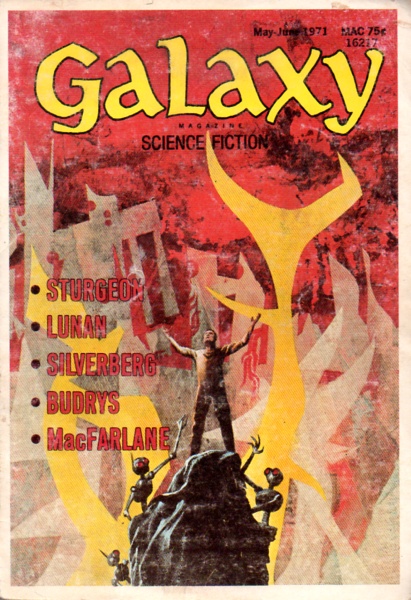
(Cover by Jack Gaughan. Galaxy, May-June 1971.) The Story So Far
Life on Borthan is harsh, probably only marginally less so now compared to hundreds of years ago, when the human settlers came to this planet. Over a period of generations, the settlers constructed a religious creed, called the Covenant, which forbids “selfbaring” and general selfishness, to the point where even referring to oneself in the first-person singular is considered even worse than someone saying “fuck,” “shit,” or “cunt” in public today. This becomes a bit of a problem for Kinnall Darival, theoretically next in line to be septarch of Salla but in practice a nomad who has voyaged to Manneran in the name of settling down: ya know, finding a wife, getting a steady job, that sort of thing. He finds a wife in Loimel, a relative of Halum, Kinnall’s bondsister, who physically resembles Halum to an eerie extent but who otherwise has nothing in common with her. Their marriage is a cold one that soon turns into both parties regularly having affairs, which is not as bad a deal as it sounds; after all, marriage in Borthan is something more often done as a political maneuver than out of love. For some years, life in Manneran goes smoothly for Kinnall, but then of course something has to happen, or else this would be quite a short story.
Through having a connection with the local bureaucracy, Kinnall meets Schweiz, an Earthman who’s come to Borthan on business, and indeed it’s not every day someone from Earth comes to this borderline inhospitable backwater. Kinnall and Schweiz quickly form a bond, which is solidified when the latter procures a “potion” hiterto unknown to Borthan’s people, although this potion turns out to be a mind-altering drug that exchanges the perspectives of those using it. Schweiz convinces Kinnall to take a leap of faith and totally give in to the selfbaring the drug grants. It’s a psychedelic experience, pretty “far out” as the hippies would’ve said at the time, and it flips a switch in Kinnall’s brain seemingly in an instant. Whereas there was some resentment towards the Covenant before (namely that, being bondsiblings, Kinnall is prohibited from having sex with Halum), now it has become a full-on rebellion in Kinnall’s heart. What’s more is that there are others in Manneran who share similar sentiments, such that Kinnall will play a role in this new movement.
Enhancing Image
I hope you weren’t expecting to become attached to Loimel (in fairness, you probably weren’t), because she does not appear in this final installment at all. All we get is a couple mentions. After everything goes to shit and Kinnall gets captured, Loimel has nothing to say to him, as if she had forgotten they were even married in the first place. As for Halum, she makes her final appearance when Kinnall shares the drug with her, although Kinnall had to be convinced to do this, seeing it as a bad idea—a hunch that’s proven to be correct. As if beholden to one of those self-fulfilling prophecies, Kinnall’s reluctance to share the drug with Halum (his concern mainly coming from the fact that he knows she’ll find out about his massive crush on her) only leads her to push for sharing it harder. The experience is so traumatic, however, that Halum opts to commit suicide in a rather odd fashion. It’s been clear up to this point that Halum’s death has haunted Kinnall the whole time he’s been writing this memoir of his, although I have to admit that even with such a dramatic event finally delivered, it didn’t hit me much at all. We don’t get to know Halum very well, and even when she and Kinnall have their mutual drug trip she’s revealed to be basically a virginal angel of a human being. So, of the only two women to feature prominently in the narrative, one walks out of the story by the time the third act comes around, while the other is unable to cope with the awesome new drug her bondbrother is now peddling. One is emotionally distant for no particular reason while the other turns out to be emotionally fragile. Somehow I don’t think this would’ve won points with feminists, although compared to some of Silverberg’s other novels from this period A Time of Changes‘s misogyny is mild.
It would be easy to say this is a novel about how selfishness is a virtue, or about how greed, for lack of a better word, is good, but really it’s a novel about how emotionally connecting with people is, if not strictly necessary for human survival, something that would make living a lot more bearable. The need for human connection is a theme that recurs in Silverberg’s strongest novels from that period where he was supposedly at the height of his powers, see The Man in the Maze, Dying Inside, and “To See the Invisible Man,” a theme so persistent that he seemed to have an obsession with it. Why? I don’t know, I haven’t really looked into why Silverberg had this idea stuck in his head for years on end, despite reading essays, editorials, introductions to other people’s books, interviews, and so on. As with Yasujirō Ozu, who returned to the same basic elements in his later movies with somewhat varying degrees of success, Silverberg did similarly with his writing during the late ’60s and early ’70s, which might explain how he was able to write so many novels and short stories—a level of productivity only topped by his output in the mid-to-late ’50s, although nobody talks about that stretch of his career nowadays. He also tended towards the same character archetypes, because I would be hard-pressed to find anything that distinguishes Kinnall from most of Silverberg’s other protagonists, who likewise all share some qualities with the same person—that, it only stands to reason, being Silverberg himself. Once Kinnall tries and fails to convert Stirron to the drug cult and sits in prison, possibly awaiting execution (or maybe not, Kinnall is vague on what his punishment is to be), I feel like I’m saying farewell to yet another Silverberg surrogate.
By the way, I would bet a kidney (not one of my kidneys, somebody else’s) that Silverberg had read Aldous Huxley’s “The Doors of Perception” and thought it would be neat to turn Huxley’s thesis into a novel. In fairness to Huxley, he wrote that famous essay in the ’50s, and Huxley, it must be said, is a more likable narrator than Kinnall. All the same, considering the SF readership in 1971 must’ve been at least 25% hippie, I think those folks would’ve liked A Time of Changes.
A Step Farther Out
This must be the fifth or sixth Silverberg novel from the late ’60s and early ’70s that I’ve read, and if I were to rank them it would probably land smack dab in the middle. It didn’t offend me like Up the Line did, and Silverberg put more effort (it seems to me) into A Time of Changes than Across a Billion Years and To Live Again. Silverberg wrote these novels at a feverish pace, probably with little in the way of revising. These novels share more or less all the same problems, although some are more severely afflicted than others. (It’d be a hard task to overstate how creepy and misogynistic Up the Line is.) Similarly, the misogyny that permeates A Time of Changes holds it back, but it’s also a novel that reads as being very of its time. Why SFWA members felt it deserved the Nebula more than The Lathe of Heaven, a novel that still mostly holds up to scrutiny (its function as baby’s introduction to Taoism reeks a bit of New Age hippie bullshit, but it’s quite bearable), I’m not sure. Silverberg had written better at this time, but the problem is that I’m not sure if any of his novels (barring possibly Dying Inside) from this period were deserving of any major awards.
See you next time.
-
The Observatory: The Great Science Fiction Novel
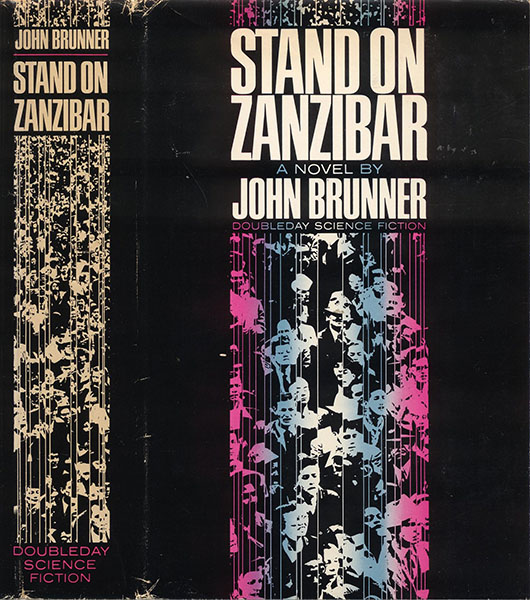
(Stand on Zanzibar. Cover by S. A. Summit, Inc. Doubleday, 1968.) I’ve been in a bit of a rut recently, or rather I’m facing another bout of depression and lethargy when it comes to writing. I considered tackling something serious, but while we will no doubt get to a serious topic one of these days, such a thing requires more time and effort than what I’m currently able to afford. It’s also been a few months since I last did an Observatory piece. I have to admit I’ve slackened a bit when it came to this department. As such, you can think of this editorial as a warm-up exercise; if nothing else it should provide some food for thought. It’s actually a topic that’s been lingering in the back of my mind for a long time now, as like one of those fun little “what if” scenarios that you would not seriously contemplate, but rather would return to occasionally and twist and turn like a safety valve in your mind. It’s something to do as a distraction while there are some serious problems afoot.
I write about what I think of as the big three fantastic or unrealistic genres, those being science fiction, fantasy, and horror, as opposed to genres that historically rubbed shoulders with realism, namely Westerns and crime fiction. Nowadays I tend to read realistic or “literary” fiction (with some nonfiction thrown in there) in my free time a lot more often than genre fiction, in part because I wanna keep my efforts as a reviewer/blogger at least somewhat segregated from my efforts purely as a reader (I know people who review genre fiction for a living who, because of the time and effort required for the job, barely read anything except genre fiction, and that’s not the way I would like to live), but also I must confess I do often enjoy reading literary fiction more than genre fiction. Of course, the line between those two can be pretty blurry. A literary novel can have genre elements, and as you know I’ve reviewed works by authors on this very site who are typically found in literary and not genre spaces: Graham Greene, Robert Graves, G. K. Chesterton, to name a few. You have people like Jack London who are known primarily for their literary fiction, but who also wrote a good deal of genre fiction; and because for some the term “science fiction” hadn’t been coined yet, there was no effort to separate literary from genre. How do you put something in the SF ghetto if “SF” is not a label in your lexicon? But now that the label does exist, and has existed for almost a century at this point, some lines have been drawn in the sand.
Realistic or literary fiction is really an umbrella that could encompass practically every other genre, but only rarely does a work of genre fiction find its way into the literary canon; and in the case of SF, the number of SF works to worm their way into literary spaces is very small. You have 1984, Brave New World, Fahrenheit 451 and The Martian Chronicles, Frankenstein, the early novels and stories of H. G. Wells, The Handmaid’s Tale, and more recently the works of Octavia E. Butler. With the notable exception of Butler, whose reputation has been heightened to almost an extreme in the years following her death, you may notice that the SF works to have entered the so-called literary canon are the usual suspects. Also, with the exception of maybe Frankenstein, these are works that are far more revered for their historical and/or societal importance than for their literary merits. SF that enters literary spaces has historically been treated as more useful than beautiful, as more of a societal good than as an aesthetic achievement. There’s also the problem that SF, at its core, is unrealistic, which is to say it does not and cannot depict the highs and lows of society as they exist in the current year; it can extrapolate on society as it currently exists (and often does), but that’s not quite the same thing. Meanwhile a realistic novel typically tries to capture some facet (or maybe multiple facets) of current (or past, if it’s a historical novel) society. But as I said, a realistic novel can have traces of SF or even fantasy (we tend to call examples of the latter “magic realism,” which rather smacks of whimsy, but it’ll have to do) in its blood, but the genre element is not the focal point.
This brings us to the question of the Great Novel, by which I mean what is typically considered a country’s defining literary achievement. The Great Novel, for a given country or culture, is a work which ideally, through scope and attention to detail, captures a certain time and place with as much fullness as the author could manage. The Great Russian Novel is War and Peace, the Great French Novel is Les Misérables, the Great English novel is Middlemarch or Vanity Fair, and even Ireland has its clearly designated Great Novel with Ulysses. The Great American Novel is more up for debate, to the point where Wikipedia has a rather long list of candidates: to name some (but not all) we have Moby-Dick, The Great Gatsby, To Kill a Mockingbird, Gravity’s Rainbow, Blood Meridian, Beloved, and Underworld. While they vary greatly in length, subject matter, and perspective, it’s easy enough to understand why each of these novels would be a candidate, since they aim to be nothing less than a definitive look at a certain time and place with a certain point of view. Moby-Dick is “the definitive” novel on whaling and American port towns, The Great Gatsby is “the definitive” novel on the excesses and follies of the 1920s, Beloved is “the definitive” novel on black Americans’ traumatic relationship with chattel slavery, and so on. Of course I use quotation marks because these novels (except maybe Moby-Dick, which really did seem to close the door on whaling culture as far as representation in fiction goes) are by no means the only or ultimate statements on their respective subject matter. Also, a novel need not necessarily be of a certain length (The Great Gatsby is a mere 180 pages, after all) to tackle its subject properly, although length does help. The point is that these novels, in both scope and substance, give one an impression of a whole place or culture over a certain period of time.
In genre SF, there didn’t seem to be any concern about writing The Great SF Novel up until at least the 1950s, which makes sense considering the market restrictions of the time (the average SF novel at this time clocked in at about 200 pages or so) and the fact that SF criticism was in its infancy. The field, by the end of the ’50s, had barely crawled out of the primordial slime that was the height of the Campbell era, in which low-paying genre magazines dominated and getting published in hardcover or even in a mainstream magazine was considered the highwater mark for one’s career. In 1950, to be an SF writer and have your story printed in The Saturday Evening Post was basically the most you could hope for. But by the ’60s there was clearly a change in the air, perhaps incentivized by the magazine market shrinking; there were only a half-dozen or so genre magazines active in the US by 1960, such that it would no longer have been viable to make a living just writing short fiction at a mile a minute. Authors turned to writing novels, and it didn’t take long for there to not only be more novels as original paperback releases (and also hardcover), but some of these novels were quite big for the time. Even in its original cut-down form, Stranger in a Strange Land clocked in at just over 400 pages, which would’ve been nigh unthinkable just five years earlier. To think, 400 pages that’s mostly just people talking about sex, religion, cannibalism, and whatnot. The usual. The gambit paid off, though, with Robert Heinlein winning a Hugo for it and with Stranger in a Strange Land becoming one of the most popular SF novels of the ’60s, even gaining a mainstream readership. That Stranger is a huge and overwhelming book, tackling several topics with reckless abandon and often in exhaustive detail, did nothing to halt its sales figures.

(Stranger in a Strange Land. Cover by Ben Feder. G. P. Putnam’s Sons, 1961.) Stranger was not Heinlein’s first mainstream success, for he already had several stories published in The Saturday Evening Post and a whole series of juveniles in a deal with Scribner’s, but Stranger (published by G. P. Putnam’s Sons) showed that an SF novel didn’t have to be just about one or two things, but could in fact have an almost encyclopedic thoroughness while still being a bestseller. In other words, the dam broke. The impact was not immediate, but throughout the ’60s there came a laxing attitude on publishers’ parts towards long and epic SF novels—some of which even threatened to have literary ambitions. I was doing a cursory search of essays and blog posts done on the idea of the Great Science Fiction Novel, and I basically found nothing, at least so far, which is weird to me because it’s so obvious that some authors in the ’60s going forward clearly wanted to write such a thing, whereas no such ambition seemed to exist beforehand. This is not to say there aren’t great SF novels to come out of the ’50s and early, quite the contrary, but typically the great SF novels from prior to the ’60s had scope or depth—not both. Meanwhile, by the end of the ’60s we had gotten Dune, Stand on Zanzibar, The Man in the High Castle, The Left Hand of Darkness, Heinlein’s Stranger in a Strange Land and The Moon Is a Harsh Mistress, and a few others I could name. Dune was so big that it originally appeared as two separate serials, totaling eight installments, and it certainly feels like it. Frank Herbert famously had to go to Chilton to have Dune published in book form, with Chilton not being an SF or even normally a fiction publisher—not that this stopped Dune from selling enormously well. Dune, even being the first entry of a wide-spanning series, is a mind-numbing study of a fictional planet and its ecology, and how mankind might be able to live in such a hostile environment. Herbert’s novel was, at the time of its publication, the most ambitious and plausible hard SF (despite nowadays being marketed as akin to fantasy) novel on the market.
Did Heinlein and Herbert intend to write the Great Science Fiction Novel at the time? I’m not sure. I can think of at least one person who did, though. Clocking in at just under 600 pages, not too crazy by today’s standards but a real mammoth of a book for SF in 1968, John Brunner’s Stand on Zanzibar consciously takes cues from Modernist literature, to the point where it can be considered a late Modernist novel as much as an SF novel. Brunner was known for quantity rather than quality, even writing a few short low-effort novels during the time that he was working on Stand on Zanzibar, which probably made this novel’s scope and complexity come to most if not all readers as a shock. Here we’re presented with a 2010 that is both in some ways similar and dissimilar from the 2010 we actually lived through, in which the world is overpopulated, people are overstimulated, there seem to be mass shootings and terrorist threats every week, there are computers small enough to fit comfortably in one’s home, and it seems to also be the only SF novel of the era to not assume that the Soviet Union would survive into the 21st century. There’s a main storyline, but it’s interspersed with vignettes featuring unrelated characters, as well as advertisements and news stories that give us an idea of what is going on this strange new world. It’s an incredible read, if also exhausting and rather cold-hearted by design. Brunner really transcended himself with it, and the effort paid off—to an extent. Stand on Zanzibar won a Hugo, and remains in print to this day, but was not exactly a bestseller. Brunner wrote a handful of big novels about big topics, including The Jagged Orbit and The Shockwave Rider, but the effort he put into these novels did not result in sales figures to match. Ironically the person who at the time strove the hardest to write an all-encompassing all-consuming SF novel on par with a Moby-Dick or a Ulysses garnered inadequate reception for it, compared to what Heinlein and Herbert were able to accomplish.
The average SF novel remained compact, on average, for a while, but you still got outliers (or abberations, if you hate long novels) with varying degrees of commercial success, not to mention success as attempts at being the Great Science Fiction Novel. The ’70s saw what might be the closest we’ve gotten to a synthesis between the Great American Novel and the Great Science Fiction Novel, in at least two instances: Gravity’s Rainbow and Dhalgren. Thomas Pynchon and Samuel R. Delany, the authors of these respective novels, were borderline prodigies of the form (Delany was 19 when he wrote his first novel), are both of the silent generation, both owing a clear debt to the Modernists, and both being arguably the most fit for taking on the task of writing an enormous and challenging literary novel that could also be taken as science fiction.
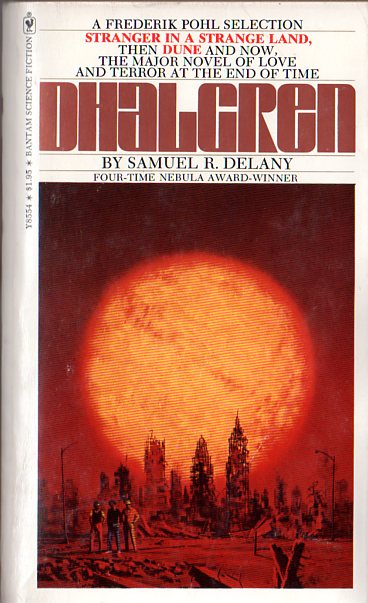
(Dhalgren. Cover by Dean Ellis. Bantam Books, 1975.) Gravity’s Rainbow is… a lot of things. There’s something about a big mind-controlled octopus. Something about a young American having been trained from infancy to anticipate the locations of rocket strikes with his penis. Something about the end and immediate aftermath of World War II in Europe. Something about the extinction of the dodo. There’s a young witch (she says she’s a witch) in training. Totally mind-boggling novel, in that it’s a war novel, a kind of perverted nightmare, a stage musical, and also science fiction. It’s also 760 pages, published by The Viking Press, and was set to win (but was denied) the Pulitzer Prize. It was even nominated for the Nebula for Best Novel, but lost to Rendezvous with Rama. Then there’s Dhalgren, which in hindsight could be argued as the last big attempt at marrying genre SF with “high-brow” literary fiction. Delany pays homage to James Joyce pretty blatantly from the outset, to make it clear to us that this is a Serious™ novel. Well, it’s not that serious. Dhalgren is sort of a hangout novel, in which not much happens, but rather in which the isolated city of Bellona comes alive with quite a few memorable characters. As with Gravity’s Rainbow there’s a pornographic element to it. It’s also a goddamn beast in terms of length, clocking in at 879 pages in the original Bantam paperback edition. When Dhalgren came out in 1975, there wasn’t anything else quite like it in the field, and there also wouldn’t be anything like it thereafter. These two novels sold well, but got extremely mixed reactions, with Dhalgren also being up for a Nebula but losing to the relatively short and conventional (but very good, let’s be clear here) The Forever War.
Folks have typically considered the Nebula to be the writer’s award, which makes sense since it’s members of the SFWA basically voting on each other’s work, and professional authors are presumably more literarily knowledgable than readers. The Nebula going to Rendezvous with Rama and The Forever War over Gravity’s Rainbow and Dhalgren respectively however implies an aversion to works that might be considered too literary. Indeed, in the world of SF, much of the ’70s would be spent on doing away with much of both the good and bad parts of the New Wave while also co-opting just enough of it to give the pages of Analog a PG-13 and occasionally even an R-rated level of spiciness. The New Wave gave us some really bad literature; actually I would say 90% of New Wave SF was bad, but then, to paraphrase Theodore Sturgeon, 90% of everything is bad. At the same time, the New Wave years saw a collective sentiment that great SF that should also be Great Literature™, which is how we even got something like Stand on Zanzibar, or Delany’s earlier novels. The backlash to the New Wave caused SF to swerve in a retrograde direction. As Jonathan Lethem puts it in his article, “The Squandered Promise of Science Fiction”:
Fearing the loss of a distinctive oppositional identity, and bitter over a lack of access to the ivory tower, SF took a step backward, away from its broadest literary aspirations. Not that SF of brilliance wasn’t written in the years following [the ’60s], but with a few key exceptions it was overwhelmed on the shelves (and award ballots) by a reactionary SF as artistically dire as it was comfortingly familiar.
This is not to say great SF novels weren’t published after Dhalgren, obviously, or indeed after The Forever War, which may be the field’s equivalent of The Red Badge of Courage. But at least for a while after, it’d be hard to think of an SF novel that tries even inadvertently to be the Great Science Fiction Novel, which is to say a novel which is both unquestionably SFnal and which also depicts a fullness of human existence as seen in the likes of Stand on Zanzibar and even The Moon Is a Harsh Mistress. There’s Gene Wolfe’s The Book of the New Sun, although it’s a setting that can be easily confused for fantasy—a mix of SF and fantasy that Wolfe deliberately invokes. There’s Neuromancer, which is a sprawling mix of SF and detective fiction, but which nowadays strikes me and some other folks as pretty close to unreadable. There’s Cyteen, which is quite large and even won a Hugo, but I have to admit I’ve not gotten around to it yet. If there’s something like a modern candidate for the Great Science Fiction Novel the problem is that either the novel leans too heavily into SFnal territory or it’s simply a literary novel that happens to have a pinch of SF about it. I could be missing something, of course, and I’d be curious to see if anyone can bring up candidates for the Great Science Fiction Novel post-1975. I don’t read that much recent SF, and even for the sake of my blog I only tackle something like that occasionally; you could say I’m biased in favor of the classics.
-
Serial Review: A Time of Changes by Robert Silverberg (Part 2/3)

(Cover by Jack Gaughan. Galaxy, April 1971.) The Story So Far
Kinnall Darival is writing his memoir, or maybe a confession to his crimes, as he sits in hiding, with the authorities weeks or maybe hours from capturing him. Kinnall has committed a blasphemy in his culture, a society dominated by a religious code called the Covenant, in that he has taken to be selfish, even using first-person singular pronouns. Brothan is a cutthroat planet, settled by a group of humans centuries ago, the humans in questions being basically Puritans IN SPAAAAAAAACE. Selfishness is considered taboo among Kinnall’s people, which includes revealing one’s inner emotions and turmoil to others, with the exception of one’s bondsiblings. Kinnall has (or had) a healthy relationship with Noim, his bondbrother, but he has a strong pseudo-incestuous crush on Halum, his bondsister, which is a problem since bondsiblings are forbidden from having romantic/sexual relations. This tension in their relationship lacks closure, on account of Halum being dead by the time Kinnall is telling us his story. There was another and arguably bigger problem for Kinnall, which is that when he was quite young his father, the septarch of Salla, died unexpectedly in a hunting accident, which made Stirron, Kinnall’s brother, next in line for the throne. Being presumably the person to succeed Stirron and thus the person most likely to be killed, and also not wanting the throne for himself that much, Kinnall does what any of us would do: he goes into exile.
Mind you that I’m recapping the first installment’s plot in chronological order, but Kinnall/Silverberg does not relate this shit to us as such; rather Kinnall’s memoir jumps all over the place chronologically, although the broad strokes of its trajectory are still linear. We know in advance that Halum dies and that Kinnall with meet a man from Earth named Schweiz who introduces him to a certain “potion” which alters his consciousness. Upon leaving his home province of Salla, Kinnall uses nepotism to nab a job as a day laborer, then ditching that for a sailing stint. (There is mention of some modern tech like cars and boats, but Borthan is more or less a medieval futurist landscape, like what Jack Vance was fond of writing about.) At this point there are ripples of discontent in Kinnall’s mind, against his culture’s staunch anti-individualism and the fact that he can’t bust a nut in the one girl he actually likes (a lot of Kinnall’s internal conflict boils down to sexual angst, which for some reason was the norm for Silverberg protagonists), but the dam is about the burst outright.
Enhancing Image
The second installment is primarily concerned with two relationships Kinnall forms at this point in his life, now in exile and living rather comfortably in Manneran. He quickly takes a liking to Loimel, who is either Halum’s cousin or half-sister (depending on which story you wanna belive), and is a dead ringer for her to the point where Kinnall confuses her for Halum at first. Kinnall makes no secret to us, and seems to all but say as such to Loimel herself, that he courts and then married Loimel simply because of the strong family resemblance, regardless of whatever personality Loimel herself has. This turns out to be just as well, since Loimel is shown (at least from Kinnall’s perspective) to be a totally cold-hearted and aloof woman. The result is that Kinnall knows every facet of Halum’s personality but is unable to have a physically intimate relationship with her, while Loimel is physically available but not emotionally. Is this irony? It’s hard to gauge how much of Loimel’s coldness toward Kinnall is true to how she is normally and how much it’s Kinnall projecting, since even when he’s having sex with Halum’s lookalike he’s unable to get to know Loimel as a person. Their marriage is a loveless one, although this is far from unusual in the culture of this world; on the contrary, that Kinnall and Loimel both start having affairs behind each other’s backs is considered business as usual for marriages here. I can’t tell if Silverberg is trying to make a comment on something, but it’s worth mentioning that his first marriage didn’t end until some years after A Time of Changes was published. Just as important, and perhaps unintended on Silverberg’s part, is that we don’t get to know either of the female main characters very well, despite how much Kinnall adores Halum. The men in A Time of Changes are at least knowable to some extent, but their female counterparts come off as slightly less human. I’m tempted to say this boils down to Silverberg (at least at this point in his career) just not being very good at writing women.
Then there’s Schweiz, a visitor from Earth who meets Kinnall through some bureaucratic maneuvering (reminder that Kinnall uses nepotism and charm to live comfortably like he does at this point in the story), who we heard about at the very beginning of the novel, but are only now being introduced to properly. Schweiz is described as being rather physically similar to how Silverberg was at this time, complete with the male pattern baldness, and in terms of personality he could also be said to overlap with Silverberg. This creates a bit of a problem with characterization, since Kinnall is already clearly a self-insert for Silverberg, the result being you have two Silverberg-esque characters in a room together, which sounds like a bad time if you’re not a neurotic compulsively heterosexual white man. We do get at least one good scene out of this, which is indeed the turning point in the novel. You see that Kinnall and Schweiz quickly befriend each other (maybe a little too quickly) and they soon reach that “let’s do drugs together” phase of every healthy relationship, be it platonic or romantic. (Oh what, you don’t try out mind-altering substances with your friends? For shame.) The nifty drug Schweiz brings to the table turns out to be a kind of empathy drug, in which the two participants swap perspectives and not only share each other’s personalities but their memories as well. In the span of what seems like only a few minutes you can get an impression of someone’s whole life story, and vice versa. This is so indicative of when the novel was written (the late ’60s and early ’70s, the age of the hippies) that it hurts. It’s funny because I always imagine Silverberg as one of those squares, like Jack Kerouac, who may dabble in heavy drinking and light drug use, but who seems more content to surround himself with people who are more daring and perhaps more interesting. If anything dates this novel, aside from its gender politics, it’s the optimistic view on hallucinogens.
Of course, I’m not one to talk, as I did weed regularly for a bit until a couple years ago. (Honestly the worst thing about weed, aside from the hunger and dry mouth, is that there’s a 50/50 chance you’ll feel as if you’re being sent off to meet your maker. You’ll either feel at peace with the world or you’ll be scared shitless of some impending doom which does not exist.) Needless to say this mind-altering drug breaks the dam open for Kinnall’s discontent with his society’s restrictions.
A Step Farther Out
I liked this installment more than the first by a good margin, mostly because the plot has settled in by this point and the reader is not being as barraged with backstory that hinders the pacing. I have to also admit I don’t mind Kinnall as much by now, although I would still hesitate to say I like him. It’s also a problem that Kinnall and Schweiz both feel like Silverberg’s self-inserts, and also that their friendship develops in seemingly record-time. When P. Schuyler Miller reviewed A Time of Changes he mentioned that the serial version was a “condensation” of the book, although I’ve not seen any other sources that say the book version is an expansion, and also comparing page counts between the magazine and book versions they seem to clock in at about the same length. Still, I’m cautiously optimistic about where Silverberg takes this story for its final installment, since I’m at least liking it more than most of the other novels of his from this era that I’ve read. We’ll just have to wait and see.
See you next time.
-
Short Story Review: “The Storm King” by Joan D. Vinge

(Cover by Alex Schomburg. Asimov’s, April 1980.) Who Goes There?
Joan D. Vinge was one of the more acclaimed SF writers in the latter half of the ’70s through the ’80s, which makes her retreat from public notice all the more conspicuous. She debuted in 1974 and was one of the post-New Wave crowd, alongside the likes of George R. R. Martin and John Varley. As you can guess, she was also married to Vernor Vinge for much of the ’70s, although they split in 1979, which didn’t stop Joan from ditching Vinge’s last name for her byline going forward. She won a Hugo for the borderline metafictional story “Eyes of Amber,” and she won another Hugo for her second novel, The Snow Queen. After the ’80s her output went down massively, to the point where she disappeared for nearly all of the 2000s. One reason for this is that she suffered a car accident in 2002 that left her unable to write for some years, although that doesn’t explain her relative inactivity in the ’90s as well. She has also, weirdly enough, written about as many novelizations as original novels at this point, including novelizations of (I’m not kidding) Return of the Jedi, Willow, Return to Oz, Cowboys & Aliens, and the ’90s Lost in Space movie. She had written virtually no short fiction since 1990, which makes “The Storm King” one of her later stories, published the same year as The Snow Queen. Unlike most of Vinge’s work, “The Storm King” is fantasy, although it retains Vinge’s propensity for incorporating fairy tale elements.
Placing Coordinates
First published in the April 1980 issue of Asimov’s Science Fiction. It’s been reprinted in Isaac Asimov’s Wonders of the World (ed. Shawna McCarthy and Kathleen Moloney), A Dragon-Lover’s Treasury of the Fantastic (ed. Margaret Weis), and the Vinge collection Phoenix in the Ashes.
Enhancing Image
This will be a short and sweet review, because despite being nearly thirty magazine pages I don’t have much to say about “The Storm King.” I think it’s interesting to point out first that this really is a high fantasy story published in Asimov’s, early in the magazine’s history when such a thing was rare. Granted, Roger Zelazny’s “Unicorn Variation” was published there a year later and was just as much a fantasy story, and even won a Hugo for it. The market for short fantasy fiction, barring a brief period in the 1930s and more so the last decade or so, has never been that good. 1980 saw the death of Fantastic, so that F&SF was the only magazine in town that published a good deal of short fantasy. But Asimov’s, even in its first years, occasionally printed fantasy, and the results tended to be rewarding. I liked “The Storm King” enough, although I didn’t love it.
Lassan-din has a problem—actually he has two problems, but we’ll get to the second one in a minute. He is the heir apparent to the throne in Kwansai, but he’s a prince in exile and he’s willing to do anything to take back what is “rightfully” his, even to go against his homeland’s predominent religion by consulting an old witch. The witch in question and her servant girl, the latter calling herself Nothing, are pagans who work with the elements of Nature. There’s also a dragon who lords over this area called the Storm King, who like your typical Tolkien-esque dragon is an intelligent being who communicates with humans telepathically. Lassan-din wants to tame the Storm King and use its power to retake the throne, but as the witch says, “You don’t fight fire with fire. You fight fire with water.” The witch gives the prince a hint as to how to deal with the dragon and sends Nothing with him, but as she also says, as a kind of warning, “power always has a price.” Nothing will repeat this phrase verbatim much later, which of course means that we’re meant to take it as the story’s thesis. And indeed it is. It becomes clear quite early on that Vinge’s story is a fable about how power corrupts, to the point where it feels a little condescending and wearying; that the plot trajectory goes pretty much exactly the way I expected, going off of the thesis Vinge gives us, also means there’s not much surprising in store for us. Since “The Storm King” doesn’t have any real twists or turns, that forces us to turn to other things in looking for the story’s merits.
In all fairness. while this kind of high fantasy is commonplace now, such that I have precious little interest in modern fantasy writing, it would’ve been more novel in 1980, right after the sword-and-sorcery revival and right before we started getting the super-chunky multi-book sagas that have since dominated the genre. “The Storm King,” for better or worse, would’ve fit right in with short fantasy being published nowadays. There is, of course, also a sexual element, with Nothing being implied to be a prostitute as well as a witch’s apprentice; and while her relationship with Lassan-din never turns romantic exactly, it does get rather steamy. The problem on Lassan-din’s end is that he had suffered some unspecified abuse from his uncle, which has left him impotent, although Vinge is unclear as to what exactly is wrong with him. I thought at first that Lassan-din genitals must’ve gotten damaged, but this turns out not to be the case. There’s an obvious symbolic connection between Lassan-din’s impotence and his having fallen from the throne. Well, the damage can’t be that bad, for Lassan-din and Nothing have sex, and there’s a little something extra thrown into the deal that the former is not made aware of. (You can guess what it is.) The two proceed on their quest, which sees Our Anti-Hero™ finally meet the Storm King himself, and another deal is made. Lassan-din inherits the Storm King’s scales and his control of lightning, but obviously there wouldn’t be much of a story if things ended here.
There Be Spoilers Here
Lassan-din retakes the throne, but he doesn’t become respected so much as feared among his people, not to mention the dragon is still free to terrorize the populace. Lassan-din’s reign becomes so maligned that he too becomes known as the Storm King, by which point he realizes he might’ve made a mistake. He’s unable to reverse the deal he had made with the dragon, being unable to rid himself of those scales; even if the dragon wanted to, he could not undo what has been done. He comes to the conclusion that if he can’t save himself then he can at least save everybody else, so he decides to banish the Storm King from the land. We get what is more or less a happy ending. Hell, there’s even a baby in the mix, with Nothing (now named Fallatha) having a daughter by him. This all reeks a bit of wish fulfillment, at least from a modern perspective. This is a story about how power corrupts, and yet the one whose character is poisoned by power still has enough of a conscience to do the right thing at the end of the day, never mind retaining some of his humanity. Lassan-din is an anti-hero who would be a villain in some other stories, depending on the perspective one writes from, and while this is a nice arc for a character to have, it doesn’t feel real at all. Unfortunately, in real life, someone in Lassan-din’s position is unlikely to have any redeeming qualities of note, nor are they likely to suffer at all from the pain and oppression they bring on other people. “The Storm King” is fantasy due to its setting, but it’s also fantasy because it depicts someone with immense power actually facing consequences for their actions.
A Step Farther Out
Sorry for the delay. Depression and a bit of writer’s block. I was honestly stumped for a bit as to what my thoughts on this story even were, maybe because I tried thinking back on something I had perhaps missed, only to think I really had gotten everything on my initial reading and that I didn’t need to put much thought into it. Maybe not the first Joan D. Vinge story I should’ve written about her first, since in a way it’s an outlier among her short fiction, but it’s also one of her short stories that I’d not read yet that I really wanted to check out. I was mildly disappointed, if only because I expected there to be more to it, but Vinge is not a bad writer. Hell, at this point she was a better writer than her ex-husband. It’s just that “The Storm King” doesn’t show Vinge at her best.
See you next time.
-
Serial Review: A Time of Changes by Robert Silverberg (Part 1/3)

(Cover by Jack Gaughan. Galaxy, March 1971.) Who Goes There?
Robert Silverberg celebrated his 90th birthday this past January, making him one of the last living authors to have been active at least adjacent with the New Wave in the late ’60s. Not only that, but Silverberg had made his writing debut a whole decade earlier, and if you look through certain magazine issues in the early ’50s you might find a teenaged Silverberg in the letters section. He has his faults, but there are few people who’ve been more dedicated to the field for as long a span of time. Even as he announced his retirement from writing fiction about a decade ago, Silverberg still gets involved with fandom events and even writes editorials for Asimov’s Science Fiction to this day. The late ’60s and early ’70s are when SF historians consider Silverberg to have reached his artistic stride, which if I’m being honest is a claim I’ve found to be a little overexaggerated. Certainly the quantity of Silverberg’s output at this point can’t be denied, but the quality of his work from this period is a good deal more hit-or-miss than I’ve been led to believe. A Time of Changes was the only Silverberg novel from this period to win a major SF award; it won the Nebula, beating out Ursula K. Le Guin’s The Lathe of Heaven. Is that victory deserved? Hmmm.
Placing Coordinates
Serialized in Galaxy Science Fiction, March to May-June 1971. It was released in June of that year by Doubleday. I’m not sure if it’s in print in the US at this moment, but there’s an ebook edition from Open Road Media and a paperback from Gollancz.
Enhancing Image
Generations ago the planet Borthan was discovered by spacefaring humanity and thus colonized, although it’s a hostile environment with harsh weather and, like Earth, a great deal of water on its surface. The settlers, who were basically like Vikings, eventually forgot their history, the result being that human culture on Borthan has devolved into a kind of medieval futurism. You’ve got lords and barons and the like, complete with a peasant class, but more importantly this is a society that is so rooted in selflessness that it’s taboo even to use first-person singular pronouns in conversation. Everyone is supposed to look out for everyone else, to the detriment of the individual. This is important context to get out of the way first, because otherwise you might think the setting is more or less your typical Tolkien-esque fantasy realm. There are bits of modern tech, such as automobiles, but technology plays little role in the story. A Time of Changes is ostensibly SF, but it’s actually closer to being science-fantasy along the lines of The Book of the New Sun, to the point where I wonder if Gene Wolfe had taken some inspiration from Silverberg’s novel. To put it another way, it’s the kind of setting Jack Vance was fond of inventing, in which you have what is basically a medieval fantasy world but with an SFnal twist.
Of course, another thing A Time of Changes has with Wolfe’s series is the characterization of its narrator, the anti-hero Kinnall Darival, as what we’re reading turns out to be Kinnall’s memoir—or maybe it’d be more accurate to call it a bit of confessional writing. In a few reviews I’ve written before I’ve taken issue with what are depressingly common fallacies when it comes to writing first-person narration, which is why I’ve not been a fan of it myself on the occasion I’ve been able to write fiction. There are too many questions that can be potentially raised when dealing with a first-person narrator, of the sort that would distract from the reading experience; but thankfully Silverberg gives us a pretty clear reason up front as to why he wrote the novel in this way. Not only is Kinnall writing a tell-all account of his apparent rise to becoming a rebellious figure, but he writes in first-person specifically as a middle finger to his society’s aversion to the concept of selfhood. Kinnall is kind of a selfish asshole with some psychosexual hang-ups, but at least he doesn’t try to make excuses for some questionable past behavior. I mean a big part of Kinnall’s personal trauma is the fact that he clearly wanted to have a romantic/sexual relationship with Halum, his bondsister, only that Halum died years ago, tragically young.
Right, so the people of this world do not have familial relations in the traditional sense. You don’t have a pair of loving parents to whom you’re related to blood, and you also potentially two sets of siblings: blood-related siblings and bondsiblings. Everyone has bondbrothers and bondsisters, who are basically step-siblings. So Kinnall has some pseudo-incestuous feelings for Halum, and even if she were still alive this is something he’s unlikely to confess to her. There’s also Noim, Kinnall’s bondbrother, who proves useful in getting him out of the country when the political climate becomes risky. To make a long story short, Kinnall is son to the prime septarch of Salla, one of Borthan’s provinces. (I just realized it’s called a “septarch” because there are other monarchic figures who share rule of the province.) The problem is that Kinnall has a blood brother, Stirron, who becomes septarch instead of Kinnall. Mind you that the brothers are very young when this all happens, as the septarch dies unexpectedly during a hunting expedition. Now, if you know anything about the history of monarchy as form of government then you know it can be perilous to be king/queen/whatever and have siblings waiting in the wings; or, just as perilously, you might be the sibling in question. It becomes clear that Stirron is overburdened with being prime septarch (which is to say the one the other septarchs have to get approval from) of Salla, and yet Kinnall resents the structure of this society too much to become a leader of it.
The result is a picaresque, of sorts. Kinnall gets the hell out of Dodge and becomes a day laborer in another land, for a time, before becoming a sailor by the end of this installment. Something odd about A Time of Changes is that while its plot trajectory is broadly in chronological order, Kinnall can’t help but allude to future events and characters that haven’t come along yet, such as Schweiz, an Earthman whom Kinnall befriends, and whom we hear about way before we actually meet him. We hear about Kinnall being introduced to a mind-altering “potion” that Schweiz gives him way before this event happens in-story. Characters are mentioned as having died while they’re still alive in Kinnall’s recollection of them. As such, I can already tell that this is a hard novel to spoil. The unusual structure and diction can be explained by the fact that Kinnall’s never written a book before, let alone a first-person narrative, and so he’s still new to this whole confession-writing ordeal. Still, it’s awkward, not helped by Kinnall himself being a thorny character in the way that Silverberg’s protagonists tend to be. I’m gonna be brutally honest and say that maybe with a few exceptions Silverberg’s protagonists all more or less act and think the same way, which is to say they’re dreary and neurotic heterosexuals with both high sex drives and psychosexual angst. They’re also very male. Granted that the objectifying of women here is not as bad as in some of Silverberg’s other novels, one still finds a few cases of “she breasted boobily.”
There Be Spoilers Here
I dunno.
A Step Farther Out
As has happened to me almost every time when reading a Silverberg novel from this era, my feelings are mixed. It took me two days to read this installment when really it should’ve only taken one, and part of my slowness is that there are sequences I find way more engaging than others; or, to put it another way, there are sequences where Silverberg strains my patience. At least far it’s doing better than, say, Up the Line, or Across a Billion Years, which are novels that make bad impressions early on and do little to nothing to fix things. Some of Silverberg’s bad habits (namely his tendency to sexualize every female character he introduces) are on display, but as of yet there’s nothing too egregious. I think the more pressing issue is that despite being one-third into the novel now, I feel as if the plot has only barely just started kicking into gear. The pacing is “deliberate,” which is to say it’s slow, and given this is a short novel it’s a slowness that Silverberg really can’t afford. But he’s gonna make us wait.
See you next time.
-
Novella Review: “The Lady Who Plucked Red Flowers Beneath the Queen’s Window” by Rachel Swirsky

(Cover artist not credited. Subterranean, Summer 2010.) Who Goes There?
Rachel Swirsky has been around for nearly the past twenty years, as a writer but also as an important figure in modern SF fandom. She was the founding editor of PodCastle back in 2008. She has also been open about issues of disability, cultural Judaism, and feminism, which are some of many topics permeating 21st century SFF that were not as prominent (except for feminism) half a century ago. The irony is that her social media presence seems to be oddly miniscule for a modern SFF writer. She won two Nebulas early in her career, for the 2013 prose poem “If You Were a Dinosaur, My Love,” and earlier for the 2010 fantasy novella “The Lady Who Plucked Red Flowers Beneath the Queen’s Window.” Maybe not the win, but for my money the nomination was certainly warranted. When it comes to choosing what fiction to review I sometimes fear that I might not have enough to say about the work to warrant its own post (a fear that has come to fruition a few times before), but thankfully this is a meaty novella that almost begs to be given the analysis treatment.
Placing Coordinates
First published in the Summer 2010 issue of Subterranean Online, which nowadays you can only access via the Wayback Machine. It’s been reprinted in The Best Science Fiction and Fantasy of the Year Volume Five (ed. Jonathan Stran), The Year’s Best Science Fiction & Fantasy: 2011 Edition (ed. Rich Horton), Heiresses of Russ 2011: The Year’s Best Lesbian Speculative Fiction (ed. Steve Berman and JoSelle Vanderhooft), and the Swirsky collection How the World Became Quiet: Myths of the Past, Present, and Future.
Enhancing Image
In the Land of Flowered Hills, Naeva is a sorceress and also Queen Rayneh’s favorite—as both a sorceress and a lover. This is not cause for scandal at all; on the contrary, lesbianism is treated as compulsory in this land. The Land of Flowered Hills, from Naeva’s view, is virtually paradise, being a matriarchal society where women rule and men are treated as an underclass, even being called “worms” regularly. Childbirth is so frowned upon that women who get stuck with the thankless job of having kids are also treated rather with disdain, being called “broods.” There’s a stringent hierarchy based on gender, and to a lesser extent on class, this being a kind of Social Darwinist nightmare in which the strong abuse the weak without hesitation or regret. This all sounds dystopian, and also ridiculous, like how a misogynist would imagine a matriarchal society in a work of satire, so as to take the piss out of feminism’s more unsavory notions, namely political lesbianism. For women, heterosexuality is universally frowned on, to the point where women who have children willingly with men are labeled perverts. I’m not sure how such a society is supposed to survive in the long run; but then again, given what happens in this story, it doesn’t.
Naeve, for all her loyalty to the crown, gets caught in the crossfire between Rayneh and her daughter Tryce, the latter wanting to take the throne as she believes her mother is unfit to defend the land against an oncoming army of barbarians. The barbarians are, of course, male, which is perhaps the biggest slight for these women, on top of the fact that they breed naturally and have been building their numbers with frightening speed. To make a long story short, Naeve is convinced to turn her back on Rayneh, but this costs her dearly, in that she is hit with a magic arrow and is thus put in a state where she is both alive and dead. She is rendered effectively immortal, but this is on the condition that someone is able to summon her from her coma, and also to provide a vessel for her soul to inhabit, on account of her original body being very much dead. People’s souls in the world of the story can be swapped to other bodies, with the caveat that the owner of that body will die when the new soul departs. That’s the original method transferring souls, anyway. So while the feud with Rayneh and Tryce takes up the first section of the novella, Naeve’s life-death state lasts from years to decades to centuries, so that before long she starts jumping (or rather she is summoned by different people periodically) ahead long after Tryce has died and the Land of Flowered Hills has fallen. Naeve becomes one of a small group of people, called “Insomniacs,” who are stuck in a perpetual state of magic-induced hibernation and revival.
The basic challenge of this novella (whose full title I don’t feel like repeating) is that Naeve herself is rather a horrible person, and the story is told exclusively through her perspective. I’m always kind of intrigued by the thought experiment of knowingly telling a story through the eyes and voice of someone who is thoroughly unlikable; it’s really a tightrope act, which for the most part I think Swirsky pulls off here. This is a story about bigotry and future shock, and I think Swirsky does something ambitious here in that she tries to put us in the mindset of someone who is an active bigot. Naeve’s fierce misandry ends up causing problems for herself and virtually everyone she meets, yet throughout the story she doesn’t change so much as come to the conclusion that she hasn’t changed. Normally in a narrative that’s at least novella-length, such as this, we expect the protagonist to go through some kind of change, to have a revelation or some epiphany, so that something about their character has altered by the end. They had learned a valuable lesson, or have suffered a certain trauma that makes them reevaluate how they understand the world. Yet despite being highly knowledgeable about magic and being considered one of the wisest members of her society, Naeve refuses to change her opinion on the status of men throughout the story, even when she befriends a man named Pasha briefly (and I do mean briefly, he’s barely in it before being killed off), a friendship that she writes off as being an exception that proves the rule. By the time Naeve gets resurrected for the last time, at the hands of a nerdy but cute scholar named Misa, she has not really aged or even changed as a person at all while literal centuries have passed by her.
Swirsky plays with fantasy conventions quite a bit here, mostly to good effect, although I have to admit I don’t really care for the whimsical-poetic prose style she goes for. After having read and reviewed a decent amount of fantasy over the years I can say that when it comes to English-language literature there are basically only two schools of fantasy writing: British and American. These are not mutually exclusive, and indeed someone who is British or American will not necessarily write in their respective nation’s school of writing; this is especially true with American writers, who to this day have a bad habit of copping notes from the British. In the British school the key forerunners are J. R. R. Tolkien, C. S. Lewis, William Morris, and Lord Dunsany. In the US you have Robert E. Howard, H. P. Lovecraft, Edgar Rice Burroughs, and Fritz Leiber. One of these clearly has more of a stranglehold on modern fantasy writing, even among Americans, than the other. The Land of Flowered Hills itself even has a vaguely Lord Dunsany-esque ring to its name. With all due respect to Swirsky, because her issue is by no means unique to her (if anything it’s far too common), trying to capture Dunsany’s exquisiteness of style is a bit of a fool’s errand; too often it comes off as cutesy and cloying.
There Be Spoilers Here
Naeve is summoned in the body of a straw dummy, which makes things awkward when she and Misa inevitably have a sexual/romantic relationship. Misa lives in and for academia, and being a scholar she is naturally taken by Naeve’s antiquity and knowledge regarding magic, although she’s disgusted by Naeve’s misandry. There’s that joke where you have a seemingly liberal white woman and her disgustingly racist boyfriend whose bigotry she just kind of, ignores? Enables? I think we’re supposed to sympathize with Misa here, but it’s hard to sympathize with someone who, perhaps against their better judgment, falls for someone as unlikable and toxic as Naeve. Generally, and this could be because we’re stuck in Naeve’s shoes the whole time, Swirsky seems to think that we out to at least take pity on Our Anti-Heroine™ for her inability to
become a decent personadapt with the changing times. One might take pity on Naeve the same way one might take pity on an older family member whose brain has clearly been fried from watching Fox News nonstop and utterly failing to question the basic evils of our society, but personally I don’t feel sorry for these people. I simply can’t. Why? Because bigotry kills. Bigotry is as much a tool used in the violence and tyranny that terrorizes marginalized groups, except because it’s invisible and immaterial it’s something that people are willing to give a pass. But this mindset is put to the test when the academy and its environs are threatened by a plague, which is apparently magic-induced, and (surprise, surprise) Naeve just so happens to be the only one who knows a way to cure it. But, aha, she refuses to give this cure to the male members, condemning about half the populace to a painful death.This is abhorrent. I mean there’s really no excuse made for why Naeve should have the right to condemn hundreds and even thousands because of her stupid and childish prejudices, but Misa and her colleagues fail to question Naeve’s stupidity seriously before basically mind-raping her for the cure. The results are disastrous. Everyone around Naeve is horrifically injured and even having gotten the cure, they come to the conclusion that she’s too dangerous to keep awake. The whole back half of the story is quite interesting, as much for what isn’t said (or maybe what Swirky did not intend) as what is. The idea is that you have a conservative who is quite literally ancient, thrust into a small society of liberals, the result being that neither side is willing to budge, nor is anybody willing to articulate their own position without coming off as an asshole. I see this as a critique of the kind of liberalism that takes hold in academia, in that these scholars take pride in the idea of multiculturalism, but are unwilling to challenge positions that are tangibly harmful for society, especially for those who are in some kind of second-class position. For reasons that are never given, Misa and her colleagues are totally incapable of explaining to Naeve just why it is that egalitarianism is important for a society to survive, which might be the point. Unfortunately the climax gets the wind knocked out of its sails by virtue of the ending, or rather the lack of an ending. Naeve is put into hibernation, before being awakened by some god-like entity. We’re told that we have reached the end of this universe, and that Naeve and her fellow Insomniacs will be carried over to the new universe—only as what is not made clear.
What the fuck is this? Nothing is resolved, Naeve’s character hasn’t changed much at all, and now I’m wondering, since she will apparently lose her consciousness in this new universe, how she is even telling this story to us. It’s a fallacy of first-person narration that even seasoned professionals are prone to making, but still it’s annoying. Why and especially how is Naeve telling us this story? Who is she talking to? We never get an answer to these questions, and they’re questions that didn’t need to be asked in the first place, only I couldn’t help but wonder about them.
A Step Farther Out
Its pacing is a bit lopsided, its ending comes off like a wet fart, and I did not fall in love with the style like I’ve seen some other reviewers do; but with that said, this is a fascinating and even harrowing read. It has a few obvious flaws, which seem to come from someone still being early in her writing career (Swirsky would’ve only been 26 or 27 when she wrote it), but it’s impressive enough on its face that I understand the awards attention. Hell, I appreciate that people actually paid attention to a novella that was published in a magazine and not as a chapbook, in the year 2010. This was before Tor Books (by that I really mean Macmillan) started monopolizing on chapbooks, so that virtually every SFF novella that hopes to find a decent readership nowadays will have to come to us in the form of a flimsy and overpriced chapbook. For $15 you can buy a slim hardcover that you can read through in a couple hours, compared to $10 for a magazine issue that has at least twice as much fiction between its covers! Sorry, I’m a little bitter. Point is I do recommend Swirky’s story.
See you next time.
-
Things Beyond: August 2025

(Cover by H. R. Van Dongen. Astounding, November 1955.) So I had read Anne McCaffrey’s “The Weather on Welladays,” and I didn’t like it. I’ve read Dragonflight and The Ship Who Sang, plus one other novel and a few short stories now, and I’m still not really sure what McCaffrey’s appeal is (I say this as someone who jumps to defend A. E. van Vogt’s early work). “The Weather on Welladay” isn’t bad, but it’s seriously hampered by being a novelette where the perspective shifts several times so that we have a few protagonists, when ideally we should have only one. I also just don’t think McCaffrey is that good a writer when compared with some of her peers, who were (and still are) not as popular. It’s nice that McCaffrey was the first woman to win both a Hugo and Nebula for fiction, but I wish those honors had gone to better writers. That’s the gist of how I felt about it, in case you’re wondering where my review post for it is.
The funny thing is that I had too good a time during the couple of days I normally would’ve spent on reading and writing for this site, which is ironic. I struggle to write here either when my personal life is at a peak or when it’s deep in a valley. I have to admit to you, the five of you who actually read these posts, that I sometimes resent writing—well, really anything, but especially for SFF Remembrance. Sometimes I just don’t feel like writing anything, but the problem is that if you stop writing then it can be a real challenge to start again. Writing (if you’re “a writer”) is like brushing your teeth, in that ideally it should be a daily activity. But I also don’t like writing that much; yet at the same time I can barely do anything else that would be considered “productive.” I work a service job. I pay my bills and my rent and my taxes like a “good American,” but I feel like I don’t create anything. I have this urge, or maybe this sense of obligation, to create something that is of any value, but I can’t do it. I hate myself and this country I am forced to live in. The environment is hostile, for creativity but also just for human decency. It’s like that Godspeed You! Black Emperor song: “We are trapped in the belly of this horrible machine, and the machine is bleeding to death.” I hate being here, and yet I’m not sure where I could be that’s better. I hate that this is a culture that worships money and productivity. We must have infinite growth, even if the destination is oblivion.
Putting aside that I’m forced to live in this body, and in this third-rate backwater country called America, things are going well for me! Maybe that’s the problem: on a personal I’m doing well, for the most part, but I get the sense that this contentedness will not last, because the world around me is dying. My surroundings are transient. There will surely come a point where the workers of the world will have their revenge and the last politician is strangled with the entrails of the last capitalist; but I’m convinced that I will not live to see any of this happen. Not even the beginning of it. I will have made my way for the exit before this play called The Downfall of Capitalism will have even gotten to its prelude. The curtains will not have risen and we will not see the stage, let alone the actors. There is a future on the way, but something tells me I won’t take part in it.
…
This is getting to be a bit much.
What’s the holdup? After all, it’s a packed month, as far as my review schedule goes, and I’ve really been meaning to get to some of these works for a hot minute. I’m also taking advantage of the loophole I had made for myself and so I have a serial from Galaxy, on top of a novella. We’ve got one story from the 1920s, one from the 1940s, one from the 1950s, one from the 1960s, one from the 1970s, one from the 1980s, and one from the 2010s. This might be my most diverse roster yet, in terms of when the works were published. Well, let’s get to it.
For the serials:
- A Time of Changes by Robert Silverberg. Serialized in Galaxy Science Fiction, March to May-June 1971. Nebula winner for Best Novel. When Galaxy changed editors in 1969, readers at the time as well as historians are prone to say the change was a downgrade. One major plus, however, of Ejler Jakobsson taking over was that we got several Silverberg novels in the magazine as serials in rather quick succession. Despite the acclaim he was earning, A Time of Changes was the only Silverberg novel from this period to win a major award.
- Under Pressure by Frank Herbert. Serialized in Astounding Science Fiction, November 1955 to January 1956. Also titled The Dragon in the Sea, this was Herbert’s first novel, after he had been in the field for a few years already with now-forgotten short fiction. Herbert’s legacy pretty much solely rests on his Dune series, to the point where it might surprise the reader to find any Herbert that isn’t Dune-related in the wild. I’ve heard from a friend or two that this is actually supposed to be one of Herbert’s best, but we’ll see about that.
For the novellas:
- “The Lady Who Plucked Red Flowers Beneath the Queen’s Window” by Rachel Swirsky. From the Summer 2010 issue of Subterranean Online. Nebula winner for Best Novella. More controversially Swirsky also won a Nebula for her story “If You Were a Dinosaur, My Love.” She was also the founding editor of PodCastle, which is crazy to me because she was like, 26? She’s written a good deal of short fiction and poetry over the years, plus one novel so far.
- “A Tragedy of Errors” by Poul Anderson. From the February 1968 issue of Galaxy Science Fiction. It’s been a minute since we last covered Anderson, made more conspicuous because he wrote a truly staggering amount of fiction. Of Anderson’s several series the most ambitious might be his Technic History, a centuries-spanning saga tracing the rise and fall of a galactic empire. “A Tragedy of Errors” takes place toward the end of this future history’s timeline.
For the short stories:
- “The Storm King” by Joan D. Vinge. From the April 1980 issue of Asimov’s Science Fiction. Not quite as well-known as her late ex-husband, Vernor, partly on account of the fact that she hasn’t written much over the past four decades, but Joan D. Vinge was one of the most promising new writers of the post-New Wave era. She’s more known for her SF, but “The Storm King” is fantasy.
- “The Woman of the Wood” by A. Merritt. From the August 1926 issue of Weird Tales. In the ’20s and ’30s Merritt was one of the most popular pulp writers, even getting a magazine named after him. I was set to review one of Merritt’s novels a couple years ago, but I could not get far into it. Well, now it’s time to correct things a bit. Curiously Merritt didn’t write much short fiction.
For the complete novel:
- The Sorcerer’s Ship by Hannes Bok. From the December 1942 issue of Unknown. Bok was known far more for his artwork than his fiction, which is understandable given that he was one of the most gifted and recognizable SFF artists of the ’40s and ’50s. You kinda know a certain magazine or book cover is a Bok work just from looking at it. That Bok died relatively young and in poverty, after having all but retired from illustrating, is tragic. Of course, we might not even know about Bok in the first place if not for Ray Bradbury acting as cheerleader for his early material. Bok was really one of the few mavericks of SFF from that era, being a semi-closeted gay man with some niche hobbies, who was also a perfectionist when it came to his art. The Sorcerer’s Ship was Bok’s debut novel and was published complete in Unknown, but would not see book publication until after his death.
Won’t you read with me?
-
Short Story Review: “Eeeetz Ch” by H. H. Hollis
(Cover by Dember. Galaxy, November 1968.) Who Goes There?
This might not be surprising, but H. H. Hollis is a pseudonym for one Ben Neal Ramey, who like a lot of people in the field used a pseudonym to separate his SF work from his well-paying day job. Hollis never wrote a novel, and there has never been a volume collecting what little short fiction he wrote, although it would not be hard to print a one-volume edition containing all of Hollis’s SF. He got two Nebula nominations, actually in the same year, but nothing else as far as awards attention goes. He’s honestly an ideal candidate for the Cordwainer Smith Rediscovery Award in the future, since he’s very much a forgotten writer when he probably should not be that obscure. I’ve read a couple Hollis stories and they certainly have their points of interest. “Eeeetz Ch” (what a title, huh) is one of quite a few SF stories about cetaceans that rather conspicuously started popping up in the ’60s. There was Arthur C. Clarke’s Dolphin Island. There was Margaret St. Clair’s The Dolphins of Altair. There was Gordon R. Dickson’s “Dolphin’s Way.” There’s even the story I’ll be reviewing in a couple day which also involves cetaceans. Not to say there was zero interest beforehand, but there was clearly a sea change in popular interest in cetaceans that happened in the early ’60s, culminating in what now feel like totally inexplicable crazes like the album Songs of the Humpback Whale.
Placing Coordinates
First published in the November 1968 issue of Galaxy Science Fiction. It has never been reprinted in English, which I have to say reeks of bullshit considering there are way worse stories than “Eeeetz Ch” that have gotten reprinted multiple times.
Enhancing Image
Ramon Coatle is a senator from Hawaii who has been given I suppose the unenviable task of surveying the Caribbean Research Station, an off-shore American research facility specializing in—you can guess by this point—the intelligence of dolphins. Specifically they’re studying dolphins as a kind of substitute for computers, since dolphins, as it turns out, are highly intelligent, albeit of the calculating variety. A dolphin, even if given the tools, is unlikely to understand the philosophical complexities of, say, Hamlet. As one of the scientists puts it:
“[F]rom a man-centered view of reality all that happens is that, like a computer, they have much faster access to stored information than we do, and much faster manipulation of it. But creative, intuitive use of it? Not in human terms. If that is the measure of true intelligence, then these big, seagoing cats are not very intelligent. They’re just better equipped to handle information.”
The scientists compares the dolphins to cats, but really they’re more like rats, both in their intelligence but also in the tests they’re subjected to at the facility. There are several human characters in “Eeeetz Ch,” but of course the most memorable character is Eeetz ch himself, who is the main dolphin being tested, by virtue of being the first. Eeeetz ch has the intelligence of a well-adjusted human adult, although (as will become a cliche with writing uplifted dolphins in SF) he is rather mischievous. Coatle and the others communicate with the dolphins through a computer translator, since the dolphins are physiologically incapable of human speech; meanwhile Eeeetz ch is hoping his human companions will try to learn his language, his own name as given being an approximation of what it would be in dolphin tongue. There’s a bit of a language barrier, and also the fact that these are two intelligent races who previously had not been able to have a conversation. Dolphins and their close relatives are indeed the closest we have to alien life on Earth, is what Hollis seems to be implying.
In the ’60s, and even for a while after, there seemed to be a reluctance in SF to introduce advanced robotics and unmanned drones, despite the obvious advantages in terms of saving human life and such—or maybe it’s because of these advantages that writers were slow to hop on robot-controlled spaceships and exploration units, until it became too glaring a thing to deny. It would be like denying Darwinian evolution in [the current year], in that normal people would immediately raise their eyebrows with suspicion. As such, in the world of “Eeeetz Ch,” the folks at NASA and elsewhere seem to think investing in uplifted dolphins that can control spaceships remotely would be more feasible than to have artificially intelligent robots do the same damn thing. As mentioned before, the people at the research facility already think of the dolphins there as like lively and quirky computers with fins. This all sounds a bit far-fetched, made more glaring since “Eeeetz Ch” would be published less than a year prior to the moon landing. In-story the prospect of landing on the moon is still treated as theoretically, which is something that would date the story in almost record-time. Another thing that dates the story is the treatment of its sole female character of note, Marguerite, who is one of Eeeetz ch’s human companions, and who honestly comes off as a bit of a shrew; her tendency to be on the emotionally volatile side is certainly conspicuous compared to her male colleagues’ reasonableness, although she does seem to mean well.

(Interior by Dan Adkins.) The stranger aspects of the research regarding Eeeetz ch, such as prosthetic hands being developed for his fins (this being illustrated uncannily, courtesy of Dan Adkins), now strike me as almost proto-cyberpunk. This is not just because of the topic of cybernetics with how the uplifted dolphins (and conversely the human who swim with their test subjects) are being at least slightly mechanized to better fit their environment, but also (and this is almot certainly a coincidence) the fact that there’s a similarly uplifted dolphin in a certain seminal work of cyberpunk. I’m talking about William Gibson’s “Johnny Mnemonic,” which features a drug-addled hyper-intelligent hacker dolphin that floats in a tank. (It is a weird story, for sure.) Eeeetz ch and his ilk are given prospethic hands that take advantage of the fact that cetaceans’ finsss are basically mammal finger joints that have been webbed together; meanwhile Marguerite and her partner have metal plates in their chests, machines meant to give them a kind of gills surrogate. Coatl is understandably disturbed by this at first, but after several days he gets used to the humans and dolphins meeting each other halfway like this. Actually he might be getting to like the strange dynamics of the facility a little too much, as the ending shows.
There Be Spoilers Here
This is a hard story to spoil, on account of nothing much dramatic happening. I was a bit taken aback by this myself initially, since I was expecting some kind of dramatic climax, only to realize the story just—ends. Not to say it’s that abrupt an ending, or that it just stops in its tracks, since there is at least some change implied at the end. Coatle leaves the facility for home, wondering if he can even express to his colleagues in Washington what he had seen, never mind how he might convince them of the facility’s non-military utility. Not much may have actually changed throughout the story, in that the stakes were never those of life and death, but something has changed (or maybe been revealed or uncovered) in Coatl’s spirit. “His chest itched, and he scratched it gently. Senator Ramon Coatl knew what his chest itched for: he wanted one of those brass adaptor plates set in it, so he could wear gills.” It’s a bittersweet sentiment that doesn’t become overblown or overstay its welcome, which is nice.
A Step Farther Out
Well, this was an oddly cozy read. “Eeeetz Ch” is curious, not least because it feels both of its time and also ahead of its time. The proto-cyberpunk elements and speculation on dolphin intelligence butt heads with what was clearly an America still licking its wounds from the Apollo 1 tragedy. As far as I can tell there isn’t any anthology collecting SF stories revolving around cetaceans, which on the one hand is a bit odd, but also the fascination with cetaceans in pop culture was such a hippie New Age thing (later examples Ecco the Dolphin and David Brin’s Uplift series notwithstanding) that if such an anthology were to be put together then it would’ve happened at least half a century ago. The moment has passed.
Unless, of course, I became an editor myself.
See you next time.
-
Subscribe
Subscribed
Already have a WordPress.com account? Log in now.
 Science Fiction & Fantasy Remembrance