-
Serial Review: Sunfire by Francis Stevens (Part 2/2)
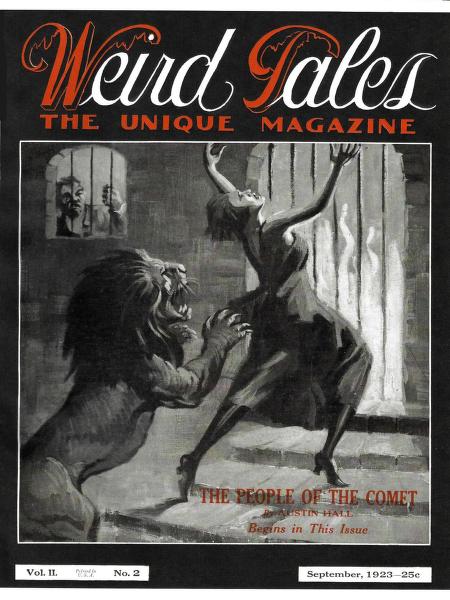
(Cover by R. M. Mally. Weird Tales, September 1923.) The Story So Far
A group of five
stupid white menexplorers have ventured deep into the Brazilian jungle, along the Rio Silencioso, in search of a piece of ancient South American architecture which may hold immense riches. They do find what they’re looking for—and also a good deal more on top of that. The pyramid is “hollow,” and also seemingly abandoned. The only sign from the outside that there might be people here is a seaplane in the river, in working order but also abandoned. The explorers consider this now at least in part a rescue mission, starting with the one living person they find: a pretty young white girl, who does not give her name and who will not or cannot talk with the explorers. The extremely racist and apparently hormone-addled men practically trip over their own dicks in order to please the girl, or to understand her at all, but she makes it clear she’s not to be understood on their terms. The girl uses “Pan’s pipes” to charm the obligatory monster of the story, a giant snake-centipede creature, whose biological origin remains unexplained, although between that and the giant diamond at the center of the pyramid, the “Sunfire” of the title, this is a story that rings as nominally SF rather than fantasy. It could also be considered an early example of horror-comedy, albeit not an effective one. The explorers seem to have gotten this far on sheer idiot luck, since they repeatedly exhibit a lack of professionalism and competency. The question then is, how will they get out of this? Who is the girl, really, and what does she want? Who gives a shit? Certainly not me.Enhancing Image
I started reading King Solomon’s Mines yesterday and am already about a third into it; it’s a rather short novel, but it’s also addicting. While H. Rider Haggard’s novel is certainly “problematic,” and has gained sort of a reputation for being such, it’s still nowhere near as racist as Sunfire, or indeed many of the “lost race” pulp adventures that Haggard partly inspired. Sunfire really is not unique in any way, compared to other pulp writing of the 1910s and ’20s, except maybe that it infuses more humor than the norm, and also the fact that Stevens was a woman. In fairness, there is a hint of proto-feminism here, although Stevens does little to advance it. While not technically the protagonist, the girl (we find out her name is Enid Widdiup) is the sun around which the rest of the story revolves, and ultimately, once she’s been broken out of her trance, she ends up being more competent and well-spoken than the explorers. Enid in fact turns out to be an aviator, which would make her one of the very first female aviators in history; she’s also an explorer herself, and she had actually come here on the seaplane the men had seen earlier. This is all rather curious, and it would be much more than just a curiosity if Stevens hadn’t waited until damn near the end of the story to tell us. If Sunfire has an major issue, aside from the dump truck’s worth of racism, it’s that it feels generally undercooked, being a novella with a cast of characters that’s mostly unmemorable and interchangeable. I neglect to mention the explorers’ names because they really don’t matter much. Because of the somewhat comedic tone, the stakes get deflated before Stevens can lay on some really juicy weird horror.
There’s also the villain, or rather villainess, named Sifa, who barely figures into things—another example of Stevens presenting us with something that would be curious, but only just that, as it stands. She only appears in the back end of Sunfire and ends up not being much of a threat. I was reading Bobby D.’s review of Sunfire, to see if he might’ve noticed something I did not, although given that his work tends to be focused around H. P. Lovecraft it was not as much about the story itself as I would’ve hoped; but still he said that Stevens’s story borders on being a parody of what was then a dominant form of pulp writing, although unfortunately it doesn’t go far enough. She has some fun with her incompetent “heroes,” but their rampant bigotry is more played for laughs than something that Stevens actually criticizes. Even for someone who was probably on the liberal side circa 1920, white supremacy was less of a threat to the wellbeing of mankind and more of perhaps a nuisance. The explorers are basically the white trio (so minus the fascinating and surprisingly progressively portrayed Umbopa) of King Solomon’s Mines, but without most of those men’s virtues and with their more unsavory characteristics turned up a notch or two. This may have been intentional on Stevens’s part, but then probably not; from the little pulp fiction of the era that I’ve read it’s not unusual for the protagonists to come off as, let’s say flawed to the point of obnoxiousness. Indeed despite being the literary generation to come after the likes of Haggard and Robert Louis Stevenson (who, make no mistake, wrote “popular fiction” and not what was then considered of the “literary” sort), the field that Stevens wrote seemed more stilted and narrow-minded. Even the most acclaimed of the early 20th century pulp writers, namely Edgar Rice Burroughs and A. Merritt, now strike us as semi-literate and offensive. Reading such fiction feels like seeing an ancient fly trapped in amber.
On a positive note, I do like the “author’s note” at the end, in which Stevens treats the characters as if they’re real people, and gives a kind of “where are they now” epilogue that one often sees at the end of the movies that are “based on a true story.” It’s cute.
A Step Farther Out
I’ve read from more than one person that Sunfire is really not where one ought to start with Stevens, which is a shame since it’s the only story of hers that’s eligible for review on this here website. Stevens wrote for the general pulps in the 1910s, before the likes of Weird Tales and other “modern” genre magazines came along, and one does get the sense that she wrote for that earlier market rather than what was then the new generation of pulp fiction. In that sense I feel bad, since I know I’ve been treating her a bit harshly by way of tackling something which she herself seemed to have thought so little of that she let it sit on her desk, or on some shelf, collecting dust for a few years before it was finally published.
See you next time.
-
Short Story Review: “When the Bough Breaks” by Henry Kuttner and C. L. Moore

(Cover by William Timmins. Astounding, November 1944.) Who Goes There?
I know Valentine’s Day is still a few days off, but now is as good a time as any to return to two of my favorite old-timey SFF writers: Henry Kuttner and C. L. Moore. Kuttner and Moore both made their debuts in Weird Tales in the ’30s, with Moore being a few years older than her future husband and also having entered the field a few years earlier. Moore quickly became one of the most beloved writers on the market, such that Kuttner, himself very young and new to writing, sending her fan letters. The two found that they were both California denizens, and the mutual admiration between the writers soon budded into romance. They married in 1940, and stayed so until Kuttner’s untimely death in 1958, just short of his 43rd birthday. Apart they were very fine writers, each in his or her own way, but together they synthesized such that there’s continued speculation to this day as to who wrote what (or how much) of most of their collaborative fiction. Nearly all of the fiction they wrote together was published either under a few pseudonyms or Kuttner’s name alone. (I have to assume using Kuttner’s name was partly institutional misogyny and also the result of unfortunate timing, since while Farnsworth Wright of Weird Tales loved Moore’s work, he also retired from the magazine before dying shortly thereafter in 1940. Other editors of the period were not so egalitarian.) Today’s story, “When the Bough Breaks,” was first published under “Lewis Padgett.”
Placing Coordinates
First published in the November 1944 issue of Astounding Science Fiction, with its iconic Timmins cover and featuring one of Theodore Sturgeon’s most famous stories. “When the Bough Breaks” has been reprinted quite a few times, in Beyond Time and Space (ed. August Derleth), The Astounding Science Fiction Anthology (ed. John W. Campbell), Tomorrow’s Children (ed. Isaac Asimov), Some Things Dark and Dangerous (ed. Joan Kahn), The Great SF Stories Volume 6 (ed. Isaac Asimov and Martin H. Greenberg), and the Kuttner-Moore collection Two-Handed Engine.
Enhancing Image
Joe Calderon and his wife Myra are normal white middle-class parents, raising their 18-month-old son Alexander—the difference being that Alexander not only has unusual body proportions (namely a bigger head than normal), but also that he’s been exhibiting higher intelligence than the average baby. Things get suddenly much weirder when Joe and Myra are visited by a group of rather short men in weird costumes, who all have similar proportions to Alexander but as adults. The men, who claim to have come from the future, explain that they’ve come here actually on Alexander’s orders—the adult Alexander of the future, that is. The idea is that Alexander is a superman, an “X Free super,” with enormous mental powers, including (of course) ESP. Indeed Alexander is supposedly the first of this forthcoming generation of “homo superior,” which is destined to overtake “homo sap.” But that’s in the distant future. The time-traveling men have come back to give the still-infant Alexander an education, since Alexander of the future apparently laments that he had not been able to tap into his powers when he was very young; so rather than wait, he opted to have his baby self taught ahead of schedule, as it were. Joe and Myra will serve as babysitters for the, well, baby, less teaching him and more making sure he doesn’t accidentally stick a fork in an electrical socket. The time travelers understand that changing the past like this will have a kind of rubber band effect on the future—or so they claim. What actually happens is a lot more unexpected—to the characters, if not the reader.
You can sort of see where this is going, not least because we’re so accustomed to time-travel stories that try every which way to put a twist on the basic premise that we’re conditioned to expect some kind of paradox, and as such this is a difficult story to discuss without talking about the ending, which despite being predictable is pretty memorable. Then again, “When the Bough Breaks” feels more like a Kuttner story than a Moore story, and one of the things Kuttner is very good at is showing characters get their comeuppance, or rather he’s fond of indulging in sadistic cases of cause-and-effect. If you’re even a little shitty as a person you’ll probably not come out unscathed in a Kuttner story, especially if you’re the hero (or rather anti-hero). Luckily for Joe and Myra they are not on the receiving end of Kuttner-Moore’s wrath ultimately, but still unfortunately for them they have to take a beating first. I’ll get to the question lingering in the back of all our minds later, but for now let’s talk about the immediate problem of raising a superbaby: the fact that said superbaby has superhuman powers, but has not yet developed the capacity for morality or empathy. The time travelers teach Alexander how to make use of his powers, but they see no point in teaching him some basic things, such as how to get along with other people or understand them at all, for they see something like that as beneath “homo superior.” If the time travelers and Alexander tell us anything it’s that this future breed of humanity may be objectively more powerful than normal human beings, but they seem to have the emotional maturity of children. What if you gave some tech billionaire who never engaged with the humanities when they were in college ESP? You can probably guess.
“When the Bough Breaks” could be considered a slightly less serious companion to Kuttner and Moore’s more famous story “Mimsy Were the Borogoves,” which similarly is about children unexpectedly coming into contact with something from the distant future; but whereas the inciting incident in “Mimsy” was a freak accident, in “When the Bough Breaks” it’s quite deliberate. I think it’s also worth mentioning that Kuttner and Moore, especially when writing together, wrote a fair deal about something that rarely went shown or even implied in Campbellian SF: the relationships between parents and their children. There are quite a few Kuttner-Moore stories about raising children, which is a bit ironic given that they were childless (not for lack of trying). But then Yasujirō Ozu, who was also childless and a lifelong bachelor on top of that, was perhaps the greatest of all filmmakers when it came to depicting parent-child relations. (As an aside, one of my pet peeves is parents who act as if raising children blessed them with some innate wisdom or maturity, considering how many fascists [especially Christofascists] I’ve met who call themselves “proud parents.”) “Mimsy” and “When the Bough Breaks” are both somewhat satirical but also somewhat foreboding stories, about normal people in then-contemporary times (the 1940s), who find themselves faced with science that almost comes across as magic. Indeed “When the Bough Breaks” is vaguely fantastic, despite officially being SF, as well as Biblical, what with Joe and Myra sounding a lot like Joseph and Mary—a connection I’m sure Kuttner and Moore had intended. But if Alexander is a Christ figure, which really is how the men from the future treat him, then he’s a Christ without even a hint of ur-socialism, which is to say he has no concern for other people’s wellbeing. As you can guess, this can only end well.
There Be Spoilers Here
Alexander, having become more attuned to his ESP but also more of a monster around the house, has been fiddling with some kind of egg-shaped gadget. Since the third-person narration is thoroughly grounded in Joe and Myra’s perspectives, we know about as much about the gadget as they do, which is to say nothing. The gadget, however, does turn out to do something—although not what Alexander or the time travelers would’ve hoped. There’s a blinding white light and then where Alexander once was he is no more; and while at first the parents think maybe he teleported like before (because he can do that), it seems he just… vanished. Or that he never existed. Kuttner and Moore were both pessimists, which you can figure out once you’ve read even a bit of either of their work. I myself am also a pessimist, so I relate to their dim view of the human condition. One of the basic tenets of philosophical pessimism is that it is perhaps better to not have been born than to live, which should be construed with the notion that it’s better to commit suicide than to live; although of course some pessimists (I’m immediately thinking of Philipp Mainländer) do end up committing suicide. My point is that the “solution,” or at least the resolution, of the story is the time paradox that probably popped into your head much earlier, which is that if Alexander messed with the past via teaching his past self at a point in time earlier than what would’ve compelled Alexander to do this in the first place, then if the past Alexander “succeeds” the Alexander of the future no longer exists. Since the future Alexander no longer exist, neither does the Alexander of the past. Time “corrects” itself: Alexander was never born. From Kuttner-Moore’s viewpoint this is probably for the best. On the one hand, Joe and Myra’s troubles are over, but unfortunately for them they still have memories of their son who once existed but now never did.
A Step Farther Out
I have to admit my enjoyment of this one was marred slightly by the mediocre proofreading for Two-Handed Engine, which seems to be even more so with this story than some others in that collection. Thinking on it, however, it’s hard to deny its effectiveness and memorability as old-timey SF writing. While you can anticipate the ending, it’s still a really bittersweet conclusion that feels perfectly logical, given what Kuttner and Moore had set up for it. Granted, if you’re already a Kuttner-Moore fan then there’s a good chance you’ve already read this one, in which case I need not try to convince you. I am glad that I finally got around to it, though.
See you next time.
-
Serial Review: Sunfire by Francis Stevens (Part 1/2)
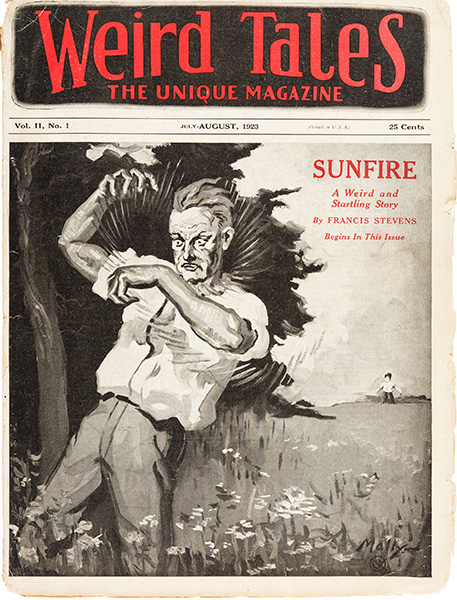
(Cover by R. M. Mally. Weird Tales, July-August 1923.) Who Goes There
Francis Stevens is the androgynous-sounding pseudonym of one Gertrude Bennett, who, for just a handful of years, wrote prolifically for pulp magazines such as Argosy and Adventure, that generation of cheap fiction magazines which preceded the first proper “genre” magazines (in the US, anyway) such as Weird Tales and Amazing Stories. Stevens wrote fiction at a mile a minute for the same reason a lot of authors did in those days: it helped pay the bills. She apparently wrote to help with her ailing mother, although once her mother finally passed on she stopped writing fiction full stop. She was one of the first female pulp/genre writers in American literature, making her one of the true pioneers; but she was (and still is) such an obscure figure that it took many years to verify when she actually died, not helped by the fact that she seemed to vanish off the face of the earth for the last quarter-century of her life. Unfortunately, Stevens’s story is not unusual among pre-New Wave female writers in this field. Sunfire was the last Stevens story published, by a few years, although it wasn’t necessarily the last one she wrote. Somebody, maybe Stevens herself, took it off the shelf, dusted it off, and submitted it to the newfangled Weird Tales, for one last paycheck. The result is a story (it’s really a novella) that feels more in line with pulpy adventure fiction that would’ve been popular in the 1910s than the occult horror and dark fantasy of Weird Tales.
Placing Coordinates
Serialized in the July-August and September issues of Weird Tales. It would not be reprinted in any form until it got a chapbook from Apex International in 1996—73 years after its original pubilication. It would get a more adequate reprint in the Stevens collection The Nightmare and Other Tales of Dark Fantasy. Despite what that title might make you think, I would consider Sunfire to be nominally SF.
Enhancing Image
Five stupid white men have ventured deep into the Brazilian rainforest, along the Rio Silencioso (“the River of Silence”), in search of a mythical island amidst the jungle depths, known as Tata Quarahy, “Fire of the Sun.” The trip had started out with the help of a local guide, named Petro, plus four other locals who go unnamed and who assisted with the boating, as the waters and their environs are indeed treacherous. Prior to the story’s beginning, Petro and the other locals had all died from what amounted to food poisoning, with the adventurers being spared on account of having taken their own separate meals, which is a funny way of saying the white men have only gotten this far because of some ridiculously good luck. The fact that five people have already died from this adventure doesn’t seem to bother the survivors much, probably because the ones who’ve died were non-white. Incidentally, at least in this installment, we don’t encounter a single non-white person within the “screen” of the action, with Petro only occasionally being quoted from beyond the grave. The irony of this story’s flippant treatment of its indigenous characters (or rather, how it keeps said characters totally offscreen via the grim reaper) is that the white men are for the most part interchangeable in character. These fuckers more or less act and talk the same as each other. As a compromise I’ll only be mentioning individual names when it’s needed to make sense of the plot, which paradoxically both is and is not hard to follow.
The adventurers have miraculously come upon the island, which is quite small but which hosts a pyramid, implying the existence of a tribe here. However, since this is a pulp adventure story written in 1920 at the latest, the presence of a pyramid must mean that something malicious is brewing. Indeed, Our Heroes™ find a seaplane on the water, close to the island and still seemingly in working condition, but abandoned. Somebody from the “civilized” world had been here recently, although whether they’re still alive is another question. They suspect, correctly, that if they’re to find answers that they would be inside the pyramid, which, much like with some real-life pyramids (and also Super Mario 64), is a lot bigger on the inside than the outside. A few complications arise, though. The first is that through all their searching outside the pyramid, the only other person they can find is a young white girl, probably in her teens, who either will not or cannot talk to the white men, despite obviously not being native to this dark little corner of the world. The other is a giant monster, somewhere between a snake and a centipede, large enough to kill a man, but which the woman, with the power of Pan’s pipes, is able to hyponotize.
The thing had the general shape of a mighty serpent. But instead of a barrellike body and scaly skin, it was made up of short, fiat segments, sandy yellow in color, every segment graced—or damned—with a pair of frightful talons, daggerpointed, curved, murderous. At times the monstrous, bleached-yellow length seemed to cover half the floor in a veritable pattern of fleeing segments.
This is all haphazardly written, of course, in a way that would have been the norm for pulp fiction of the time but not “literary” fiction. Stevens, like most if not all of her peers, wrote for money, and writing with a paycheck as the first (probably only) incentive does not encourage fine-tuning one’s prose. Oh, it’s quite bad, but that part of the deal is unsurprising. Even the king of the pulpsters, Edgar Rice Burroughs, whom genre writers in the following generation or two treated as a demigod, was by no means a good writer by the metrics of what we now call good writing. If Stevens can be commended for anything it’s what she decides to not write, as opposed to what’s on the page, namely with how she treats the mysterious girl. Whereas we’re stuck with five nigh=interchangeable buffoons for the whole ordeal, the girl Our Heroes™ are determined to rescue (because they find her attractive, and also [they mention this several times explicitly] because she’s white) comes off as an enigma. She saves the adventurers from the giant monster but then basically traps them inside the pyramid. The reader is thus presented with two conflicts: how the adventurers are to get out of this mess, and also what they ought to do with the girl, who seems prone to either helping them or endangering them depending on her mood. There is also the larger mystery of the pyramid, but that’s really secondary.
Readers who are unfamiliar with the low standards of early 20th century pulp prose may survive said prose in a vacuum, but will have a much harder time coping with Sunfire‘s almost cartoonish levels of racism. The racism is almost, for better or worse, very much a staple of that generation of pulp writing, in the days before “science fiction” even came about as a term. I’m still a layman, so I’m not sure why, even by the standards of the time, pulp fiction comes off as especially bigoted, since the literary fiction of the time, while certainly guilty of racism and perhaps most notably antisemitism (ask F. Scott Fitzgerald why he wrote a Jewish caricature in The Great Gatsby), tended to not be nearly this outward with its WASP-y insecurities. The closest I can think of as an explanation is that pulp fiction of the time, having been written to serve the short-term intrigue of people who may not have the time or education to invest in “the good stuff,” emphasizes the exotic, which means Orientalism. Anything outside the Anglosphere is different, which usually means it’s fascinating but in some way defective, if not downright evil. One of the adventurers, when recalling a piece of advice the late Petro had given them, notes that Portuguese, at least in context of Brazilian speakers, is a “simple” language. There’s a “comedic” scene in which, inside the pyramid, two of the adventurers, Sigsbee and Tellifer (the latter nicknamed “TNT”), fall into a dark pit and get covered head to toe in black soot. Sigsbee, with a giggle, says the two of them resemble black people like this, although he doesn’t say “black people.”
This is the kind of material I’m working with.
There Be Spoilers Here
Not only are the adventurers trapped here, and TNT having nearly fallen to his death in a black pit, but the soot on their bodies takes on a much more sinister (and I do have to say genuinely creepy) turn when it’s revealed that that the big prize of the pyramid, what seems to be a huge diamond, is used as a lens, or rather like a big magnifying glass when the sun strikes through the top of the pyramid at a certain angle. Whatever is caught in the black pit when this happens will be burned to a crisp, with only soot left behind as the remains are dumped or perhaps fed to the giant monster. The diamond, the “Sunfire” of the story’s title, is what the adventurers must seek after aside from the girl, but also the thing most liable to kill them. How will they get out of this sticky situation? What is the deal with the girl? Why do I torture myself by reading something so bad?
A Step Farther Out
Well, sometimes you have to read trash in order to better appreciate the gold; or in this case, read a laughably racist and single-minded adventure yarn that the author neglected to publish for a few years.
See you next time.
-
Novella Review: “The Glowing Cloud” by Steven Utley
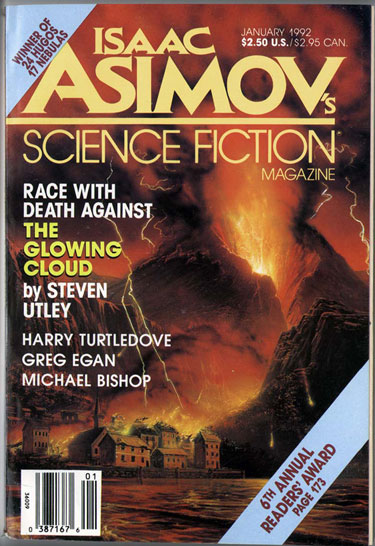
(Cover by Bob Eggleton. Asimov’s, January 1992.) Who Goes There?
Steven Utley would probably be more known today had he taken to writing novels, but he was one of those exceedingly rare writers who never got into novels, preferring to stick purely to short fiction and poetry. Utley was born in Kentucky, at Fort Knox (he was a military brat), and understandably his family moved around when he was young before he settled in Texas (Austin) as an adult, then later Tennessee. He’s partly responsible for the discovery of fellow Austin weirdo Bruce Sterling. He was one of those authors who came about during the post-New Wave period, in the early ’70s, and he wrote prolifically during that decade before falling pretty much silent during the ’80s; then, for reasons I’ve not been able to look into, he came back to writing SF in the early ’90s and basically didn’t stop until his death in 2013. I must have read a few Utley stories before, just because he was a frequent presence in Asimov’s in the ’90s, but I’m struggling to think of their titles off the top of my head. I shouldn’t have such an issue with “The Glowing Cloud,” which, while a little bloated, is a harrowing time-travel story about one of the most horrifying natural disasters of the 20th century: the eruption of Mount Pelée and the destruction of St. Pierre.
Placing Coordinates
First published in the January 1992 issue of Asimov’s Science Fiction, almost on the 90th anniversary of the disaster. It’s only been reprinted twice, in The Year’s Best Science Fiction: Tenth Annual Collection (ed. Gardner Dozois) and the Utley collection Where or When.
Enhancing Image
Everyone knows about Pompeii; to this day it remains the most famous case of a whole town getting buried by volcanic eruption. In 79 CE Mount Vesuvius erupted and killed everyone who was in Pompeii on that day, and the city remained undisturbed and seemingly unnoticed for some 1,500 years until archeologists rediscovered it. Up to 20,000 people died from Mount Vesuvius eruption, but the case of the Mount Pelée eruption of 1902 is in some ways even more remarkable, for it being a relatively modern and well-documented tragedy, for having an even higher body count (nearly 30,000 people), and for the fact that such a disaster could have been easily minimized, yet it was not. St. Pierre (or Saint-Pierre as it’s also called) was a French settlement on the island of Martinique, densely populated and apparently brimming with night life, nicknamed the “Little Paris” of the West Indies. However, a minor character, one Father Hayot, in Utley’s story also calls it “Little Sodom,” which both indicates what the priest sees as a moral vacuum in the city, but also alludes to its imminent destruction—at the hands of Nature, if not a vengeful God. In his introductory blurb, Gardner Dozois says this story “was directly inspired by Gordon Thomas and Max Morgan Witt’s book The Day the World Ended,” and one does get the impression Utley did a good bit of research on the topic before he really began work on “The Glowing Cloud.” This is a story that’s effective at a couple things, not least sparking interest in its subject.
The actual plot is more of a standard cat-and-mouse time-travel thriller, although this is not necessarily a bad thing. Medlin is a time-traveling agent who’s been sent back to St. Pierre, not quite on the eve of its destruction but a little too close for comfort, in search of Garrick, a fellow agent who has gone rogue and apparently has been hiding out in St. Pierre. Another agent, Ranke, was supposed to accompany Medlin to this point, but so far is nowhere to be seen; not that this troubles Medlin too much, given that he has a rather strong dislike for Ranke and indeed it’s the latter’s arrival that the reader is supposed to dread. This manhunt has a couple complications, one being that Garrick is an older woman, a veteran of the profession, and also that she’s the one who had mentored Medlin in the first place. Medlin knows he’ll have to capture or kill Garrick, neither of which he really wants to do. So, there’s the internal conflict, but there’s also an invisible timer to make things more tense, because Medlin has about a week to bring back Garrick (dead or alive) before Mount Pelée engulfs the city, that final explosion and the “glowing cloud” of the story’s title. At this point the volcano has been belching and its environs have already gotten a taste of volcanic ash. The sky has mostly been blotted out. The townspeople are aware that the volcano will erupt, but also that St. Pierre is at a safe distance from what would be lava flow; unfortunately, what Medlin knows about the the townspeople don’t is pyroclastic flow. In case you forgot, pyroclastic flow is the worst that can happen in the event of a volcanic eruption, in which volcanic matter can hurtle downhill at hundreds of miles an hour. It would be impossible to escape on short notice.
Medlin already knows that everyone in town (there are only three people on record who had witnessed Mount Pelée’s eruption and lived to tell the tale) will die soon, which doesn’t help matters any. Conditions have become semi-apocalyptic, even as the government and businesses try to act like everything will turn out fine. Consider this:
It quickly became obvious to [Medlin] that the situation was not only as bad as Father Hayot had said, but becoming steadily worse. Groups of people stood about who seemed to have no place to go, no idea of what to do. These, too, had that unmistakable look of refugees; the authorities must have stopped confining them, but had not decided as yet what else to do with them. Livestock wandered loose. They seemed to be dropping dead faster than the soldiers could haul away the carcasses. Asphyxiated birds lay everywhere. The fountains were fouled with black mud.
“The Glowing Cloud” is indeed about a mini-apocalypse, which at least on a metaphorical level feels… timely. This is made more so because both Utley and Dozois make it clear that the disaster was itself inevitable, thousands of lives could have been spared had the local government evacuated the city—only they decided not to. Local news outlets (which in those days basically meant only print media), being in cahoots with the government, have been indulging in misinformation so as to disincentivize people from leaving St. Pierre. There’s an election going on, and also there seem to be genuine misunderstandings about the severity of the volcanic activity. The most infuriating instance, for both Medlin and the reader, happens much later in the story, when the mayor of St. Pierre has a speech plastered on public bulletin boards. Consider the following:
The occurrence of the eruption of Mount Pelée has thrown the whole island into consternation. But aided by the exalted intervention of the Governor and of superior authority, the Municipal Administration has provided, in so far as it has been able, for distribution of essential foods and supplies. The calmness and wisdom of which you have proved yourselves capable in these recent anguished days allows us to hope that you will not remain deaf to our appeals. In accordance with the Governor, whose devotion is ever in command of circumstances, we believe ourselves able to assure you that, in view of the immense valleys which separate us from the crater, we have no immediate danger to fear. The lava will not reach as far as the town. Any further manifestion [sic] will be restricted to those places already affected. Do not, therefore, allow yourselves to fall victims to groundless panic. Please allow us to advise you to return to your normal occupation, setting the necessary example of courage and strength during this time of public calamity.
Does this remind you of anything?
St. Pierre itself is an interesting locale, even if we get to know only a few of the locals. It’s a French settlement, founded way back in 1635, during the first age of European colonialism, and given its placement in the Caribbean Medlin notes that many if not most of the population is actually non-white, being black or biracial. There’s Madame Boislaville and her young daughter Elizabeth, who give Medlin shelter during the days spends searching for Garrick. (I assume Madame and her daughter are characters of Utley’s invention.) That’s about it, at least without getting into spoilers. Given that it’s a decently sized novella, the plot of “The Glowing Cloud” is rather straightforward and its cast rather small. Its length comes in no small part from it being such a chatty novella, with a few choice characters waxing philosophical about the nature of time travel and whether it’s ethical to try saving the lives of thousands, or even a few individuals, when history dictates these people are supposed to die. History will of course not be defied here, at least in broad strokes. Garrick herself is not trying to alter history, but rather went AWOL by stealing a special drug that would make time-traveling easier and less painful for the traveler, the result being that she can really leave whenever she feels like it. This is a bit of an anticlimax for such a long story, and unlike the other anticlimax it doesn’t feel deliberate on Utley’s part. It could be that while he at some point imagined Garrick as the villain, he simply could not fit her in that role, even thought she does come off as callous. I like Garrick less as a character and more how she compares with Medlin and Ranke, with Medlin being at a crossroads between agents who are more sociopathic than him, to varying degrees. This is ultimately a story about the capacity for human empathy.
There Be Spoilers Here
By the time Ranke shows up, it’s the day before St. Pierre’s appointment with annihilation, so he’s a bit late to the party. Right away he’s shown to be a bit of a hothead, never mind a threat to both of his fellow agents. Utley has been building up Ranke’s arrival for most of the story, so when he finally gets here, appearing as the closest “The Glowing Cloud” has to a human villain, he doesn’t disappoint—for all of the five or six pages he’s here. The most violent and surprising scene in the whole novella is when Ranke, apparently having bitten off more than he could chew with the locals, gets quite literally cut down by an angry mob “as if he were merely some obstinate jungle growth,” mere hours after landing in St. Pierre. By far the most “macho” character of the lot gets his just desserts rather promptly, and even Garrick points out that Ranke’s tough-guy act wouldn’t work.
So there’s that.
Just as curiously is that when it seems everything’s going to hell, Medlin gets rescued at the last minute by a group of fellow time-travelers, although evidently they’re not from the same organization; rather they’re a team of volcanologists from the future (even ahead of Medlin and Garrick’s future), here to observe the eruption of Mount Pelée from a safe distance. This is certainly what we call a happy coincidence, although it also makes sense for time travelers to go back and study a natural disaster like this first-hand, in a time when volcanology wasn’t a discipline yet. Medlin convinces Garrick to take Madame and Elizabeth, so that he might rescue just a couple people from the impending disaster, although the very end of the story is ambiguous if Our Heroes™ actually succeed in evading the glowing cloud. Utley opts (I suppose wisely) for a cautiously optimistic final note, which still feels like a happy ending given how grim this story is.
A Step Farther Out
I’ve seen people react to the current situation in the US like things can’t get much worse. Oh, they can get worse, it’s just a question of how much. Was totally not thinking about that while reading “The Glowing Cloud.” I wonder how many anthologies there are about SF involving natural disasters? I’m a bit surprised this story hasn’t been included in any.
See you next time.
-
Things Beyond: February 2025
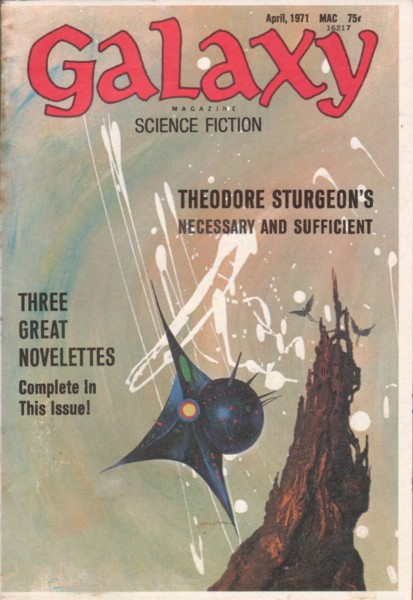
(Cover by Jack Gaughan. Galaxy, April 1971.) We seem to be living in a world of shit, or at least it’s easy to think that way. The irony is that the people who think this the most are also probably (being queer and disabled I’m actually not sure how I’m gonna turn out) the ones most likely to come out of all this bullshit unharmed—in body, if not in soul or mind. But, the show continues. I thought I had more to say for this month’s forecast, and at this point I think it’s fair to say my Things Beyond posts have become like actual weather forecasts (I predict, but that doesn’t mean the thing will 100% happen); but still, aside from a couple things I’m sure we all know about already, the past month has been uneventful. I got my purchases for Worldcon at basically the last minute, so I’ll be seeing what I can see of the con virtually if not in person, and with any luck I’ll even be on a couple panels, as one of those inside-a-computer people. I’ve been slowly but surely moving “up” in the world of fandom.
Anyway, for decades we’ve got two stories from the 1920s, one from the 1940s, one from the 1970s, one from the 1990s, and one from the 1890s. As for the stories themselves, we have…
For the serial:
- Sunfire by Francis Stevens. Serialized in Weird Tales, July-August to September 1923. Francis Stevens is the androgynous-sounding pseudonym of one Gertrude Bennett, who for just a few years wrote prolifically for the pulp magazines, apparently to help pay the bills. Once her sickly mother died, she stopped writing fiction, with Sunfire being the last story of hers published. It would take more than seventy years for this story to appear in book form.
- A Story of the Days to Come by H. G. Wells. Serialized in Amazing Stories, April to May 1928. First published in 1899. Wells is perhaps the most crucial pioneer of science fiction; aside from maybe Edgar Allan Poe he stands as arguably the genre’s nucleus. This is made more remarkable since Wells wrote his most famous work over the span of only about a decade. This story comes from said decade of greatness, but I guess due to its length it remains overlooked.
For the novellas:
- “The Glowing Cloud” by Steven Utley. From the January 1992 issue of Asimov’s Science Fiction. Utley was born in Kentucky, at Fort Knox (he was a military brat), before moving to Texas (Austin), and then finally Tennessee. He wrote prolifically in the ’70s, all of it short fiction, as one of the post-New Wave generation. He then fell mostly silent in the ’80s before reemerging in the early ’90s.
- “To Fit the Crime” by Joe Haldeman. From the April 1971 issue of Galaxy Science Fiction. Haldeman, like Utley, came about during the post-New Wave era; he had spent the New Wave years in college, and then in Vietnam, where he got damn near killed. Once his wounds healed enough he got to work writing SF. This story here is the first in a loose series, starring Otto McGavin.
For the short stories:
- “When the Bough Breaks” by Henry Kuttner and C. L. Moore. From the November 1944 issue of Astounding Science Fiction. Retro Hugo nominee for Best Novelette. I had missed the boat on reviewing Moore solo last month, and I can’t review Kuttner solo next month either; so together here they go. Kuttner and Moore were of course married, and they’re also two of my favorite writers.
- “The End of the Party” by Graham Greene. From the December 1950 issue of Worlds Beyond. First published in 1932. Greene was famous in his day as both a serious novelist and a writer of espionage thrillers, although the two were not mutually exclusive. He also occasionally dabbled in supernatural horror, with this story being one of his own personal favorite works despite its age.
Won’t you read with me?
-
Serial Review: Citizen of the Galaxy by Robert Heinlein (Part 4/4)

(Cover by Frank Kelly Freas. Astounding, December 1957.) The Story So Far
Thorby, once a slave a Jubbulpore, a city where slavery is alive and well, then taken in and educated by a “beggar” named Baslim, has since grown up to become a surprisingly intelligent (albeit not wise) young man. He joined the Free Traders for a time, under the foster care of Captain Krausa and the tyrannical matriarch Grandmother, only for the latter to die and Thorby to leave the Free Traders. A philosophical dialogue with Dr. Mader, the only passenger aboard the Free Trader ship Sisu (also probably my favorite scene in the whole novel, it’s at the end of Part 2), convinces Thorby he had left one kind of slavery only to enter another. After some digging on Krausa’s part a few things come to light for both parties: that Baslim was a colonel in the Terran Hegemony’s space navy, who covertly partook in anti-slavery operations, and that Thorby is not descended from the Free Traders but instead is the son of the presumably deceased former owners of Rudbek and Associates. Thorby’s birth name is Thor Bradley Rudbeck (get it? Thor Bradley? Thorby?), and since his parents are missing or dead that makes him the legal heir to the company, with all its money and influence. Small problem: John Weemsby, an in-law to the Rudbeks, has been in charge of the company for years, with his stepdaughter Leda thus being the heir prior to Thorby’s unexpected reappearance.
Enhancing Image
So, Thorby and Leda are cousins, of a sort; they’re not actually blood-related. Given that Leda is supposed to be only a bit older than Thorby, and given the strange chemistry between them, it must’ve taken Heinlein an exceeding amount of willpower to not indulge in some pseudo-incest. Of course this isn’t even the first time in Citizen of the Galaxy that pseudo-incest (I say “pseudo-” because for my money’s worth I say it’s only the real deal if they’re related enough by blood) is a bullet that Thorby dodges, although, as with Mata on the Sisu earlier in the novel, Thorby’s total lack of interest in sex “saves” him. We know that this is not how most teen (or maybe by the end of the novel he’s in his earlier twenties) boys think, but a) Thorby is not like most teen boys, and b) it’s implicitly accepted as part of the deal when reading a Heinlein juvenile. Actually, as far as the Heinlein juveniles that I’ve read so far go, Citizen of the Galaxy might be the least realistic in that it takes the most breaks from reality, but also it’s the least concerned with hard science. Part of the reason for Heinlein writing these novels in the first place was to teach young readers some facts (or what Heinlein considered facts, which is not the same thing) about space and other things. Some of these novels, despite being aimed at teenagers, border on what we now call hard SF. Citizen of the Galaxy is pretty
flaccidloose with its science; if you went in worried about having to deal with numbers and calculations, don’t be, because there are basically none to speak of. Spaceships in this novel go however fast they fucking feel like, and time dilation seems to be a non-issue. Space as we understand it is a non-factor in the characters’ problems, which even for 1957 is pretty soft.Instead this novel is concerned with other things, like the slave trade, and also, strangely enough, the minutia of running a business. Business majors (the few business majors who have any interest in reading real literature) will get a kick out of the last installment of this book. Citizen of the Galaxy switches gears a few times throughout, from far-future thriller to planetary advneture to, finally, a sort of legal drama. Readers in 1957 were probably not expecting this novel to end up where it does, for better or worse. Truth be told I found it to get a bit worse as it goes along, or rather I think it peaks when Thorby is with “the People” and then gets bogged down from there. Whereas the first two installments gave us some intriguing characters, from the enigmatic Baslim (even if he is clearly a stand-in for Heinlein) to the tough-minded but feeble-bodied Grandmother, the cast of the novel’s latter half is more of a mixed bag. Leda is a curiously hard-nosed young woman and one of Heinlein’s more compelling female characters, in a novel that might actually have his strongest roster of girls/women, but Weemsby is a weak villain—if you can even call him that. He’s obviously not a good person, and also is an opportunistic businessman (but then aren’t they all) who profits off the slave trade, but he never does anything particularly bad onscreen, or… on-page. The back end is chiefly concerned with what is basically a battle of wills (or rather a will, sorry for the pun) between Thorby and Weemsby, which is not as compelling (as least to me) as it sounds. Some readers will get more out of it, but a common gripe with this novel is that the ending is weak, as indeed it is, tapering off as soon as Leda hands over the business to Thorby on a silver platter. The implication is that Thorby and Leda may after all engage in some pseudo-incest, but only after the book has ended, so as to spare young readers’ virgin eyeballs.
Let’s talk about the cheery topic of slavery, and how Heinlein clearly opposes it but also tries to reconcile abolitionism with capitalism. This is heavy subject matter for a novel aimed at young readers, but then again Heinlein was not above covering dark subject matter in some of his previous juveniles. The catastrophe that happens in the back end of Farmer in the Sky might be the single bleakest stretch of writing out of Heinlein’s whole career, and again this is a novel written for high schoolers. With Citizen of the Galaxy the strange thing is more that slavery, which in this spacefaring future has made a big comeback, at least in some societies, is presented as a problem that requires a solution, as opposed to what slavery apologists tend to argue, which is either that slavery is really not that big an issue or that sure, slavery is a big issue, but it’ll inevitably get phased out on its own and we really shouldn’t do anything about it. As with most if not all right-wing beliefs, the defense of slavery, as with the defense of racism, or homophobia or transphobia, is founded on a contradiction or series of contradictions. Slavery apologists, both in Heinlein’s time and today, will very rarely argue that slavery, as it existed in the CSA, should still be around, and they may even be “happy” that it is no longer a thing; but then they’ll say that actually it should have been “left up to the states,” or that the Union (which did have a couple slave states on its side, mind you) should not have fought the CSA over slavery (although the CSA had technically fired the first shot), or even (actually this might be the most common argument) that the Civil War was not about slavery at all but about some other bullshit. So “of course” slavery is bad, but according to apologists it’s not bad enough to abolish.
Heinlein was nothing if not a man of contradictions. He started out as a progressive in the ’30s before shifting farther right, especially upon marrying Virginia, his third and last wife. One of the few things that remained consistent throughout Heinlein’s adult life was his fierce individualism, which also happened to conflict with his lifelong adoration of the military—not just the US military but the idea of the military. He served in the US Navy for five years, albeit during peacetime so it’s not like he saw combat, so he certainly had a rose-tinted view (despite the chronic illness) of such things. He also became increasingly a fierce capitalist, although truth be told he always had a quite cheritable view of capitalism, even from his earliest published stories. One of Heinlein’s more memorable characters is D. D. Harriman, the man who sold the moon, a legendary businessman who is responsible for landing the first people on the moon’s surface, despite being unqualified to go there himself. (No doubt Elon Musk sees himself as a Harriman-like figure, and he’s explicitly and repeatedly paid homage to Heinlein, although for what it’s worth I’m not sure Harriman would have been a screaming antisemite and transphobe, not to mention a cuckold.) Citizen of the Galaxy ends with Thorby, having now claimed what is “rightfully” his, vowing to do what he can to disrupt the slave trade, having already made the order to pull Rudbek and Associates out of it. This now reads as a little overly optimistic. It’s also a bit contrived that Thorby just so happens to have descended from what amounts to royalty; it’s like how Rey starts out as a peasant girl in The Force Awakens but then discovers she’s Palpatine’s granddaughter. We feel cheated somehow because we’ve been denied our working-class hero.
A Step Farther Out
Given its reputation I have to say I was a bit disappointed with Citizen of the Galaxy, as it might not even be my second favorite of the Heinlein juveniles I’ve read (I prefer Between Planets and Farmer in the Sky). I would also have to look into if Heinlein had written it with the hope of a serial run, since it does split pretty neatly into four parts; unfortunately those parts are also rather disjointed. Heinlein’s juvenile’s are beloved among older readers to this day in part because they’re some of his least problematic/uncomfortable works, and while Citizen of the Galaxy does walk a fine line with its subject matter, it does handle it better than many SF novels from the same period; indeed, it handles the issue of slavery and individual freedom better than some of Heinlein’s adult novels. As I’ve gotten older and my politics and reading tastes have shifted I’ve become more conflicted on Heinlein—but then so does everyone who isn’t a moronic sycophant.
See you next time.
-
Short Story Review: “The Census Takers” by Frederik Pohl
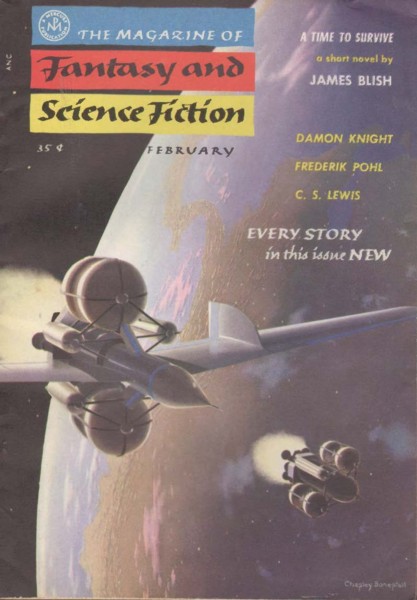
(Cover by Chesley Bonestell. F&SF, February 1956.) Who Goes There?
I’m not sure if anyone can claim to have a more varied career than Frederik Pohl, who across a career of seven decades took part in the field as a writer, editor, critic, and literary agent, such that he understood basically every step of the writing and publication process. He made his debut in the late ’30s, and early on he was most active as a fan and editor, being in charge of a couple low-budget genre magazines which nevertheless acted as a training ground for some very important writers, such as Isaac Asimov and C. M. Kornbluth. Whereas some great authors specialize in one or two things, going off the rails when they deviate from their specialties, Pohl was much more of a jack of all trades. He’s one of the few people who’s won Hugos for both writing and editing. His memoir, The Way the Future Was, is a surprisingly vulnerable and self-critical account of his early days in SF fandom and making it as a professional. He was already a magazine and anthology editor of renown when he took over If and Galaxy Science Fiction in the ’60s, having already assisted H. L. Gold for some years at that point. His Hugo-winning novel Gateway is still one of the best of its kind, being a deep character study, a gripping space adventure/mystery, as well as a vicious and black-hearted critique of capitalism. Pohl died in 2013, at the age of 93, making him one of the last of the old guard to leave this realm.
Now, you may recall I was set to review a different Pohl story; actually it was a novella, called “In the Problem Pit.” Due to outside circumstances not having to do with the story itself I could barely even begin to read it, let along write a review about it. I may yet read it and write about it in the future, eventually, but that day is not today. Still, I did not want a repeat of what happened when I read C. L. Moore’s “Jirel Meets Magic” earlier this month, so I was determined to read and review a Pohl story, even if it wasn’t a novella. I dug up “The Census Takers,” which comes from a quite different period in Pohl’s career, and it was Anthony Boucher’s introductory blurb for it in F&SF that caught my attention. Boucher calls it “one of the most extraordinary jobs of effective conciseness in all of science fiction,” and I have to say I do think that praise is pretty much warranted. “The Census Takers” is brief, but it’s a dense and mean little bastard of a story, one I would consider something of a hidden gem.
Placing Coordinates
First published in the February 1956 issue of The Magazine of Fantasy and Science Fiction; incidentally this was also Pohl’s first appearance in F&SF. It was then reprinted in The Best from Fantasy and Science Fiction, Sixth Series (ed. Anthony Boucher), Nightmare Age (ed. Frederik Pohl), No Room for Man: Population and the Future Through Science Fiction (ed. Ralph S. Clem, Martin H. Greenberg, and Joseph D. Olander), and the Pohl collections The Case Against Tomorrow and The Best of Frederik Pohl.
Enhancing Image
The narrator is Area Boss of a team of some 150 Enumerators, who over the course of six weeks are supposed to take the yearly census of a given area, called a Census Area. The story takes place somewhere in the US, although Pohl is vogue as to where (Denver gets mentioned at one point, so maybe it’s Colorado), and he’s also vague as to when this is taking place. It’s definitely the future, but there are basically no references to technology, such that the story doesn’t easily date itself. The narrator is also unnamed (sort of, we’ll get to that later), but for the short time we’re stuck with him it doesn’t take long to figure out the kind of person he is: a real no-nonsense asshole type. Manager material. The story is concerned with an incident that happened with one of the narrator’s Enumerators not too long ago, Witeck, who’s also a good friend of the narrator. “We were Enumerators together, and he was as good a man as you ever saw, absolutely nerveless when it came to processing the Overs.” Of course, one day he cracked. Supposedly. The problem is that whereas in our world a census taker’s purpose is simply to help estimate a certain area’s population, the census takers of this story have to verify if a CA is Over or Under—and if there’s even one Over in a CA then it’s a problem. A CA’s population can’t be Over or Under according to Regional Control, and if someone if Over it’s implied they get executed (an Enumerator’s “processor” is actually a gun, although this is not revealed to us right away). So two problems arise, the first being that Witeck claims to have picked up a guy without an ID or blue card who in turns claims to be some ambassador—from the interior of the planet. On the narrator’s end, he has to deal with a father and his wife and five kids, who have attempted to “Jump,” i.e., move out of the CA before the Enumerators come in.
In case you couldn’t tell, the future America of Pohl’s story is some kind of Malthusian nightmare in which the government keeps the population strictly controlled on an area-by-area basis. A CA’s population should not be Under but it especially should not be Over. Having children has apparently become seen as a necessary evil, as people on the census team are not allowed to have children and the narrator, with rather open disdain, calls parents “breeders,” regardless of whether they have one child or five. (As I was reading it I kept thinking of how some queer folks, back in the day, would call people in heterosexual relationships “breeders” as a derogatory thing, although I’m not sure if this was a thing in urban queer spaces in the ’50s, complicated further because Pohl absolutely would’ve been aware of such spaces.) Malthusianism, named after 18th century economist Thomas Malthus, is basically the belief that resources cannot keep up with population growth, i.e., there ain’t enough room in this world for all of us and at some point the bottom will fall out. In the ’50s and ’60s the belief that population growth was some big fucking problem was pretty popular among intellectuals, even left-leaning ones, resulting most famously in SF novels such as Harry Harrison’s Make Room! Make Room! and John Brunner’s Stand on Zanzibar. Aldous Huxley, in the last decade or so of his life, became pretty vocally concerned about overpopulation and people took this seriously. I’ve read enough of Pohl’s non-fiction to get the impression he didn’t agree with such a worldview, but even if I hadn’t done the homework in advance, one gets the feeling just from reading “The Census Takers” that he had a bone to pick with Malthusianism. The census takers in-story are basically border patrol, or ICE, which is to say they’re inhuman monsters who, at best, split a family apart if something is out of order; so they’re border fascists, or rather population fascists. For such a short story, this is quite bleak…
Speaking of bleakness, in most stories the narrator would probably be the villain, but here Pohl puts us in his shoes and makes us walk around in them for a bit. This dude is a prick, not that he claims to be a beacon of kindness and selflessness. His treatment of Witeck is understanding, at first, but he quickly loses patience and tells the man to do his job, regardless of the possibility of his claims being true or even if he really is having a mental breakdown like the narrator thinks. Then there’s Carias, the narrator’s “right-hand man,” who doesn’t do much better, especially once he starts backing up Witeck’s claims. The narrator has no patience for such things and he’s already trying not to “process” the father who tried Jumping with his family where he stands. The narrator and Witeck have, by this point, killed or at least deported hundreds, if not thousands of people over the years of census-taking, and it seems today might be the day everything breaks. Mind you that Pohl was always to some degree on the left, certainly more progressive than the average liberal of the time—ironic, considering he would later cry out against the New Wave. Both politically and literarily Pohl gets a lot of work done with so few words, implying more often than stating things outright while also establishing the world of the story. Some points are left ambiguous, intentionally, but we get what Pohl is going for, which is to show the inherent inhumanity of playing border patrol, or playing population control. Of course, the most ambituous (indeed, the closest to mirror the world of “The Census Takers”) Malthusian project in the real world would be China’s one-child policy. One need only extrapolate a bit further beyond that accursed policy to see where Pohl is taking us. In the ’50s, the SF market was broad enough that a dark little nugget like “The Census Takers” could see print, and thank goodness for that.
There Be Spoilers Here
The situation with the “ambassador” gets to the point where Witeck feels the need to call the narrator by his first name: Jerry. “It was the first time in ten years, since I’d been promoted above him, that Witeck had dared call me by my first name.” This convinces Jerry that Witeck really has lost it, relieving him of his post and processing the so-called ambassador, who in turn, as if putting a hex on Jerry, says that the people on the surface of the globe will be wiped off the face of it. The people living at the Earth’s core will have their day. This is implied to be the case (or it could just be a few coincidences) when a series of natural disasters, from a tsunami to a volcanic eruption to geysers in Yellowstone Park, delay Jerry going on vacation. Witeck dies soon after being let go, supposedly a suicide, although as Carias points out he didn’t use his gun on himself. Strange. There are one or two loose ends, or rather dark corners that Pohl intentionally refrains from shining a light on. The effect is a little nightmarish.
A Step Farther Out
When I found this story I knew nothing about it, not least because it hasn’t been in print since the ’90s and thus remains sort of a hidden gem. I didn’t think it would read as timely as it did. Of course, it’s true that since the 19th century, even before the tightening of the US’s immigration policy in the 1920s, immigrants and migrant workers have had a tough lot in this country. The ruling class, serving patriarchy and white supremacy (what counts as “white” has expanded quite a bit over the past century), sees migrants as cheap and easily exploitable labor; and if there’s an issue, if someone were to raise a fuss, then that can be easily dealt with. Pohl was one of the great social commentators of ’50s SF, in a decade that seemed to be blessed with almost a surplus of great social commentators. “The Census Takers” is, as told from the oppressor’s (the capitalist’s, the white supremacist’s, the Zionist’s) point of view, a shot out of hell, a cry of impending vengeance on the part of the migrants and other dispossessed peoples; because at some point, sooner or later, such people will have no choice but to have their revenge or die under the oppressor’s boot. It’s only a matter of time before we too, in our world, see those we treat as subhuman, be they “south of the border” or halfway around the world, have their day of justice.
See you next time. And remember, fuck ICE!
-
Serial Review: Citizen of the Galaxy by Robert Heinlein (Part 3/4)
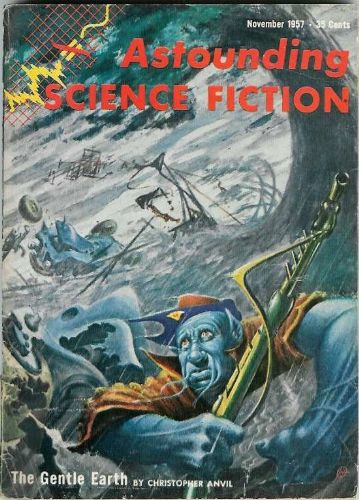
(Cover by Frank Kelly Freas. Astounding, November 1957.) The Story So Far
Thorby is a teen boy with no last name and of unknown heritage who, in the first installment, got sold off to an old beggar named Baslim—the twist being that Baslim is no beggar, but a wise man with far more resources and connections than he lets on. At the end of Part 1, Thorby was separated from Baslim, who died offscreen, having been cornered by the Sargon’s goons and opting to kill himself rather than be interrogated and then executed. Part 2 saw Thorby on a ship, the Sisu, captained by a man named Krausa but really run by Grandmother, the ship’s matriarch and chief officer. Grandmother is quite old, to the point of being bedridden, but she’s quite a bitch, and much of Part 2 is concerned with Thorby adapting to life on the ship but also being caught in the crossfire between Krausa and Grandmother, in a battle of wills. One side wants to keep Thorby onboard as a useful mathematician, Thorby having been given a crash course in maths (as the Brits say) by Baslim, while the other wants Thorby married off to some girl on the ship as soon as possible so that he becomes a proper member of “the People,” that is to say the Free Traders, a cluster of nomadic peoples who roam the stars in the name of freedom and fair trade. Thorby, as is typical for a Heinlein juvenile protagonist, isn’t very interested in girls despite his age, which doesn’t stop him from befriending a younger girl, Mata. The tragic part is that Mata has a crush on Thorby and Thorby can’t just go with any girl, but rather has to marry someone who, like him, was adopted by the ship; for someone who was “adopted” to marry someone who was born on the ship would be taboo. The higher-ups, fearing Thorby might reciprocate Mata’s feelings, decide to ship the latter out.
Enhancing Image
Before getting into the plot of Part 3, let’s talk about what Citizen of the Galaxy is, aside from being a planetary adventure novel aimed at teen boys in the latter half of the ’50s. I’m not sure if Heinlein wrote this novel with the hope of it getting serialized, on top of getting Scribner’s to publish it in book form, but it does read as if intended to be taken in installments; or maybe I’m just saying this before I’ve not yet read it as a book. The thing about Citizen of the Galaxy, which makes it rather unique among Heinlein’s juveniles but also somewhat to its detriment, is that it’s overtly a picaresque novel. For those of you who forgot, a picaresque novel is a kind of narrative, typically comedic, in which a boy or young man goes out to see the world and gets into a series of adventures (or more often misadventures). It was a popular form in 18th and 19th century English literature, probably in no small part because novels in the UK and France were often first published as serials, and the episodic and amorphous structure of the picaresque novel was built well for serialization, in which readers could catch up with their favorite rascal month after month. By the time Heinlein wrote Citizen of the Galaxy the picaresque form had long since fallen out of fashion, I suspect because of the decline of serialized novels in magazines, and also the lack of seriousness associated with the form (I wouldn’t call it a genre). There were still some notable examples around this time, like Saul Bellow’s The Adventures of Augie March and John Barth’s The Sot-Weed Factor, the latter being consciously written as an homage to 18th century picaresque novels like Tom Jones. Citizen of the Galaxy itself pays homage to one of the last of the “classic” picaresque novels, Rudyard Kipling’s 1901 novel Kim.
So we have a novel about one boy’s education and quest for self-discovery, although it’s worth mentioning that up to this point Thorby has not been very active in shaping events in his life. Three quarters into this novel and my major problem, if I had to say I had one, is that Thorby himself is not a very interesting protagonist; but then who the hell is interesting at 16 or 17? When you were in high school you barely fucking qualified as a sentient mammal, let alone as a person. No, instead it’s the people around Thorby, mostly the adults in his life, who draw our interest. In Part 1 we had the walking enigma that was Baslim, as well as the well-meaning old lady Mother Shaum who briefly looks after Thorby before he hops aboard the Sisu. Since then we’ve been left with Captain Krausa, Grandmother, and Dr. Mader, the last acting as an exposition machine but also a viewpoint that would land closest to the reader’s, so that we have someone relatively normal who can explain to both Thorby and us the ways of the Free Traders. Grandmother and Dr. Mader are unusual for Heinlein and especially unusual for genre SF of the time in that they’re strong-willed women who don’t take shit from anyone while also staying bachelorettes (although in Grandmother’s case that’s more because she’s very old and an invalid). But because this is the third installment and the novel’s trajectory is rather spotty, with Heinlein picking up Thorby from one situation and then putting him down in another, Our Hero™ has to be separated from the adults in his life somehow. First thing is that Grandmother dies. This in itself is not unusual, even for a Heinlein juvenile, since if you read enough of these things you start to realize adult characters who play mentor to the teen protagonist tend to not be long for this world; rather it’s how we’re told of Grandmother’s death that’s a bit shocking. The old bitch dies her sleep while the Sisu has docked on the planet Woolamura, but what’s unusual is that we’re told of her death several pages before the characters find out for themselves. Is this dramatic irony? It’s an odd choice from Heinlein, to tell us of a character’s death before it actually happens, but somehow it works.
Grandmother’s death is also convenient because it means Thorby is no longer in danger of getting married to some girl on the ship (and by extension the Sisu) any time soon. This then leads to another problem, though, that being that Krausa discovers that Thorby is, in fact, not descended from the Free Traders; he’s also found, via messages from Baslim as recited by Thorby (the old beggar having conditioned the boy to repeat these messages in specific circumstances), that he is no longer to be foster father to the boy. The Free Traders are super-capitalists, but they’re also “honorable” in that they follow through on a favor (although they call it a “debt”) to the letter. Thorby’s business with the Sisu is reaching its end. It turns out that Thorby is not one of the People, but the lost heir to a goddamn upper-class family, his “true” name being Thor Bradley Rudbek. Truth be told, I’m not keen on this twist, for one because it turns Thorby from just another kid into suddenly a member of the ruling class, albeit someone who is very much open to exploitation. But there’s also with how Heinlein reveals this, which really shows the novel’s episodic structure to its detriment. We feel, by the end, like we’re reading a different novel than what we started with. It’s also in the back end of Part 3 that we’re introduced what seems to be a human antagonist, in the form of John Weemsby, whichm given that we’re more than halfway through the novel at this point, is a bit odd. Between Part 2 and 3 a couple years have apparently passed and Thorby is now at least old enough to have become a guardsman for the Terran Hegemony, while secretly running for an anti-slavery operation. (I think more so than a lot of Heinlein novels, and especially for something published in Astounding, this book really hates slavery. Wonder what the very racist John W. Campbell thought of that.) I do feel it’s during this stretch where the novel loses me a bit, although it does pick up again by the end of the installment.
A Step Farther Out
Three quarters in and I’m not sure I would call Citizen of the Galaxy my favorite Heinlein juvenile so far. The plot is not as cohesive as, say, Between Planets, nor is the conflict as urgent here as in that novel. Thorby is a bit of a cypher, although I understand that’s probably the point given how he’s been railroaded by higher powers up to this point, and indeed this railroading is part of the conflict. Heinlein was working within the constrains of genre SF writing of the period, although he also helped broaden horizons via his deal with Scribner’s. In the ’40s and ’50s he was, while certainly being open to criticism, at the very least a more ambitious storyteller than nearly all of his contemporaries. Citizen of the Galaxy is flawed, but it’s also (so it seems clear to me) one of the most ambitious of Heinlein’s juveniles—even more than the written-for-adults Double Star.
See you next time.
-
The Observatory: On Depression, Science Fiction, and the End of World War II

(Cover by Alejandro. Astounding, February 1948.) Here it is, another Observatory post that’s a couple days late, along with a short story review that’s nowhere to be found. This case is especially painful for me because I respect C. L. Moore a lot, and I irked myself when I read her Jirel of Joiry story “Jirel Meets Magic” and found that I had not read it deeply enough to write a review that’d be worth a damn about it. Unlike the last time this happened, however, it really was because I felt unprepared to deal with Moore’s level of writing, since it must be said she was a better prose stylist than most of her contemporaries, especially in the ’30s. Since I don’t feel qualified to review more Jirel stories, at least for the foreseeable future, I do hope instead to cover a Kuttner-Moore story in February, as a way to return to both of those authors whom I like a great deal. For now, let’s talk about something else. This is a sequel to the Observatory post I wrote last month, “The Origins of Depression in Science Fiction,” which is actually one of my favorite editorials I’ve written thus far, even if it was not what you’d call a “pleasure” to write—rather it was a post I felt I had to write. Turns out that despite the aforementioned post being over 2,000 words long, I still have much more to say on the topic. When I wrote that earlier editorial I did it as a way to talk about my own struggles as a manic-depressive, but I also made an argument which boiled down to this: that the massive uptick in discussing mental illness through genre SF corresponded with, or perhaps was sparked by, the end of World War II, more specifically the use of atomic bombs on Hiroshima and Nagasaki. What had previously been only treated as theoretical suddenly became a harsh reality for SF writers, which caused a sea change for the field.
The strange thing about all this, if you think about it, is that while the Allies won World War II, vanquishing a few fascist regimes in the process, such a sense of victory did not show itself in SF writing in the months and years following the war’s end. Why weren’t these people happy? They won! Not only did they succeed in defeating the Nazis, but long-held speculations about the possibility (even the inevitability) of nuclear weapons had been vindicated overnight. It was the closest, at least up to that point, that science fiction had come to actually predicting the future and getting it right. Perhaps the person mostly keenly aware of this change in the moment was John W. Campbell, who famously got into some hot water with some federal agents because of a story he had published in the March 1944 issue of Astounding Science Fiction: Cleve Cartmill’s “Deadline.” Now, having read “Deadline” for myself, I can say it’s frankly not a very good story; but then it didn’t need to be. Cartmill, who at the time was a new writer, had, much with Campbell’s assistance, written a story that serves as a rather unsubtle allegory about the use of nuclear weapons against the Axis powers. It wouldn’t take a genius to figure that the US government was working on the atomic bomb, or at least some weapon of mass destruction, and that both the Axis powers and even America’s own allies (namely the Soviet Union) were keen on finding out what these scientists were cooking. The March 1944 issue of Astounding would’ve been on newsstands in February, a whole 18 months before the US dropped an actual atomic bomb on actual human beings. Compared to Street & Smith’s other magazines, Astounding did not have a big readership, but it would be their only genre magazine to survive the wartime paper rationing and I suspect Astounding‘s power for prophecy was a big reason why it was spared.
Despite the newfound vindication, however, it seems that a savage gale had swept across the ocean of science fiction with the war’s end, and Astounding, which up to 1945 tended to published some of the most optimistic fiction in the field, took on a darker hue. This change in mood was by no means unique to Campbell’s magazine, of course: every American SF magazine at the time, be it Starling Stories or its more juvenile sister magazine Thrilling Wonder Stories, got at least a bit darker in editors’ speculations and what fiction they were willing to print. During the war years, specifically 1942 to 1945, it was not uncommon to find what you might call a propaganda story in an issue of Astounding, about a character or group of characters going up against either an obvious analog (aha) for the Nazis or just the Nazis outright; and naturally these stories are about how we will or at least should beat Hitler and his goons. Off the top of my head I’m thinking of A. E. van Vogt’s “Secret Unattainable” and J. Francis McComas’s “Flight into Darkness.” Yet following the war’s end there came, over the next handful of years, a bunch of stories in Astounding and elsewhere that could not have been reasonably published (or indeed thought of) during the war, partly because of how bleak these new stories are, including but not limited to C. M. Kornbluth’s “The Little Black Bag” and “The Marching Morons,” T. L. Sherred’s “E for Effort,” A. E. van Vogt’s “Dormant,” Theodore Sturgeon’s “Memorial” and “There Is No Defense,” Jack Williamson’s “With Folded Hands…,” Arthur C. Clarke’s “History Lesson,” too many Ray Bradbury stories from this period to count, and about half of the stories that would comprise Clifford D. Simak’s City. Perhaps the most downbeat of all these post-war stories, in fact one of the darkest stories in the genre’s whole history (which is saying a lot), is Edmond Hamilton’s “What’s It Like Out There?,” which appeared in the December 1952 issue of Thrilling Wonder Stories. The kicker here is that Hamilton had written an early draft of this story a whole two decades earlier, but could not get it published then; but it found a home, seven years after World War II and in the midst of the Korean War.
(Funny aside about Sturgeon’s “There Is No Defense,” published in the issue of Astounding pictured above: Campbell, in the previous issue’s Of Times to Come section, had to tell readers that the upcoming Sturgeon story “is not about atomic bomb warfare,” despite what the title would naturally make people think. However, the Alejandro cover, which does not illustrate a particular story and which Campbell calls “purely symbolic,” showing an Olympian figure splitting the atom with what seems to be a pair of lightning bolts, tells me that “atomic bomb warfare” must’ve been on somebody’s mind. Given the timing, it’s not hard to see why.)
One could argue the latter half of the ’40s to the early ’50s marked a crucial turning point in the development of genre SF, as a kind of uniquely American form of fiction writing. Oh, there was of course SF written outside the US, before and after World War II; after all, arguably the biggest point of inspiration for Amazing Stories, when it launched in 1926, was H. G. Wells. There was another profoundly influential work of SF from the UK that arrived just in time to coincide with the collective turn toward depression and pessimism that American SF was seeing: George Orwell’s 1984. Rather than celebrate the defeat of Nazism, 1984 warns what was then the western side of the so-called Iron Curtain about totalitarianism—both of the Soviet variety and a more capitalistic American and British fascism. Orwell, in the wake of the war’s end and the start of the Cold War, saw not a new dawn for democracy in the “civilized” world but, to paraphrase him, a man (as in humanity) getting his faced stomped on by an authoritarian’s boot, forever. You know who seemed to agree with Orwell’s post-war pessimism? C. M. Kornbluth, and William Tenn, and Robert Sheckley, and Philip K. Dick, and Henry Kuttner, and so on. These are authors who either only debuted after the war’s end or had gotten lucky during the war years. (Kornbluth is a funny example in that he is both technically a pre-war writer and someone who, after taking a break from writing for several years, returned to a market that had changed drastically so as to better suit his perpetual bitterness.) We still got stories of daring invention and adventure, of man’s destiny as the owner of the universe, but we also got a good helping of stories that Campbell would not have approved. By the early ’50s the market had broadened such that even something as nihilistic as Tenn’s “The Liberation of Earth” got published in a pulpy magazine.
I’ve made it no secret that I find genre SF in the late ’40s through the ’50s very interesting, and not for the reasons people tend to idolize that period of American history. Sure, there was economic prosperity—for some people. The US quickly rose to the occasion as the leader of the Western allies, by virtue of largely of having escaped World War II unscathed compared to the UK and France. But there was racial strife, a revived paranoia that there’s a filthy communist lurking under ever bed, not to mention a forced marriage between Christianity and capitalism. As the Cold War kicked into high gear it was no longer enough to just be a good Christian in America (God forbid you were not a Christian to begin with), you had to also be a good capitalist, the problem being that worship of Christ and worship of the dollar make for uneasy bedfellows. Philosophically the two are like oil and water. Sadly, for almost eighty years at this point we’ve had to live with the suffocating, murderous reality of worshipping the dollar, seeing the rise of neo-liberalism and Christofascism, watching them spread and tangle like weeds in one’s garden. What’s not to be depressed about? The future is looking bleak. As famous as they are, generally optimistic writers like Robert Heinlein and Isaac Asimov are nowadays plagued by controversy, or even simply ambivalence from the modern SF reading crowd. It’s not uncommon to find an earnest SF reader under the age of forty nowadays who thinks Asimov is boring, or that Heinlein is too problematic; but these people would probably connect much more with someone like Kornbluth or Kuttner. Given that we’re constantly at risk of being torn down and obliterated by depression, since it seems clear to at least some of us that we’re living in the last days of industrial capitalism (or so we hope), we might not need a Heinlein or Asimov, but someone… darker.
-
Serial Review: Citizen of the Galaxy by Robert Heinlein (Part 2/4)

(Cover by Ed Emshwiller. Astounding, October 1957.) The Story So Far
On the planet Jubbul, in the city of Jubbulpore, a boy is sold at auction. Thorby is a slave, in a distant future where slavery has made a big comeback, of unknown ancestry, but luckily for him his buyer is the beggar Baslim, who takes the boy in as if he were a son. Of course, Baslim only appears to be a beggar, for he turns out to be a very wise and well-connected man, who has a lot more resources than he lets on. Baslim teaches Thorby the ways of acting a beggar, which involves knowing several languages, as well as how to get what you want through morally grey means; but considering Baslim is just one man he provides the boy with a very fine education. Aware that his death is imminent, however, given his connections to the abolutionist movement, Baslim nudges Thorby in the direction of a skipper who commands one of the so-called Free Traders, ships that roam freely throughout the galaxy in the name of pursuing trade, not to mention abolitionist causes. After one of his courier jobs, Thorby finds out that Baslim is dead, having been cornered by police but opted to commit suicide via poison rather than be “shortened.” Eventually Thorby finds one Captain Krausa, of the Sisu, a Free Trader, and he gets smuggled aboard the ship, presumably never to see Jubbul again. This brings us more or less up to speed.
Enhancing Image
A new setting means a new cast of characters, and Heinlein does not disappoint. The Sisu is a much cleaner but more cramped space than Jubbulpore, which means everyone knows everyone else. Despite his education under Baslim, Thorby quickly finds that the social dynamics of the ship are totally out of his realm of expertise. The ship’s crew is like one big foster family, and that’s not even really an exaggeration: everyone has a rank on the ship, but also everyone has familial relations to each other, which can make things confusing. You might outrank someone, but be of lower familial standing. Most of Part 2 of Citizen of the Galaxy is Thorby getting acquainted with his new foster family, namely Captain Krausa, Grandmother Krausa, Jeri Kingsolver, Jeri’s sister Mata, and Dr. Margaret Mader, the only non-relative aboard the ship and a fluent speaker of Expositionese. If you really wanted to you could certainly do a feminist reading of this novel and put together the jigsaw puzzle of how women figure into Thorby’s life, often as guiding authority figures, because there’s a surprising number of them for a Heinlein story. Heinlein had a, let’s say complicated relationship with women: he was by no means a feminist, but at the same time he wrote women in authority positions at a time when this was decidedly uncommon in genre SF. This had some real-world precedent, considering that when Heinlein met Virginia, his third and final wife, she actually outranked him in the military (needless to say she was not in a combat position), and it can hardly be doubted that Virginia would influence her husband in a few ways, not least with her conservative politics.
In the first installment Thorby took shelter with the help of Mother Shaum, after Baslim’s death, and in the second installment he has at least two new women to lord over him, namely Grandmother and Dr. Mader. While Captain Krausa is skipper and at least on paper in charge of the ship, he goes through Grandmother and she is effectively the ship’s matriarch. It would be fair to say that while Captain Krausa ranks top in terms of ship’s rank, Grandmother is the highest ranking member of the ship’s family. There’s kind of a push-pull seesaw effect with the ship’s hierarchy that Thorby has to learn to live with if he wants to at some point become an honorary member of “the People.” When it comes to joining the People and really entering the life of a Free Trader there are a few ways of doing it, such as marrying a member of the People, or being born on a Free Trader ship, or you have exceptions like Baslim who are considered honorary members despite not doing either of the aforementioned things. Thorby is somewhere in his teens, and while he’s not quite ready to be looking for a wife, it’s an idea Grandmother and Captain Krausa put in his head. As is typical of Heinlein’s juvenile protagonists, Thorby is not only ignorant of romance and sex but doesn’t seem to have any initiative with them, which as we all know is a totally realistic mindset for a teen boy to have. (There are teen boys who find that they’re asexual, which is perfectly valid, I’m simply saying that the vast majority of dudes between the ages of fourteen and eighteen are terminally horny scoundrels.) What makes Thorby’s dilemma different from most of his fellow juvenile heroes is that the question of romance/sex comes up in the first place, whereas normally Heinlein (lest he provoke his editor’s wrath) would leave such matters to the wayside.
Another preoccupation of Heinlein’s that normally would stay completely out of his juveniles is the topic of incest, but Citizen of the Galaxy does delve into the topic. Granted that no “real” incest is featured here, something that complicates the prospect of Thorby finding a wife among the People is that he can marry a girl who was taken aboard ship as a foster child, like himself, but he can’t marry someone who was born into it. Mata was born into it, which means she’s one of the girls who would be off limits for Thorby—a problem for Mata, if not Thorby, given that she’s also formed a crush on him. The solution the top brass on the Sisu come up with is to ship Mata out, as they consider it too much a risk for her to stay, even if separating her from her brother is a sadistic choice. Thorby has been so oblivious to Mata’s yearning for him that he has no idea something is amiss until it’s too late, and there’s nothing he can do to get Mata back. Normally Heinlein’s juvenile heroes having a total blind spot for romance does nothing to hinder them in their journeys, but in the case of Thorby it’s played for tragedy. Reading Heinlein’s juveniles in order, one gets the impression that he was gradually becoming frustrated with the restrictions his editor at Scribner’s imposed on him, to the point where Starship Troopers, which was originally meant to be another entry in this series, went off the rails. By 1957 he has been writing these juveniles long enough that he maybe sensed he stood in danger of repeating himself, or slipping into formula. Not only are there little subversions in the plot’s trajectory, but by the end of Part 2 we’re hit with hard questions about slavery and freedom that one would not expect from a novel aimed at teenagers.
A Step Farther Out
The plot loosens up a bit, as this installment serves first and foremost to introduce us to a new setting and group dynamic; but by the end, or about halfway through the novel, it’s become clear that Heinlein has something else in mind than just, say, an SFnal retelling of Kim. Reading Citizen of the Galaxy on an installment-by-installment basis, I would also say Part 2 starts off rather shaky, since it is such a switching of gears after Part 1, but that it ramps up such that I have to say I was genuinely engrossed by the end of this installment. Let’s see where it goes.
See you next time.
-
Subscribe
Subscribed
Already have a WordPress.com account? Log in now.
 Science Fiction & Fantasy Remembrance