-
Short Story Review: “The Princess and the Physicist” by Evelyn E. Smith
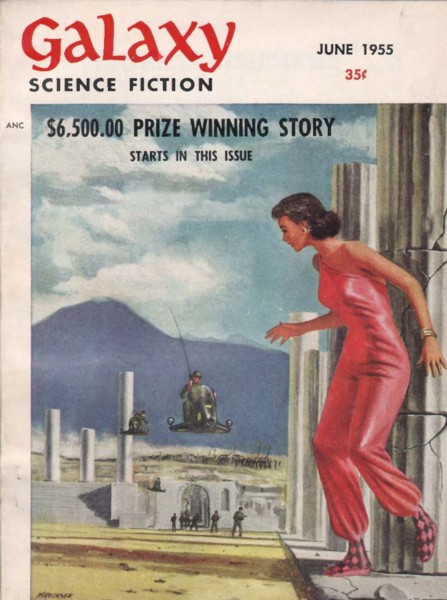
(Cover by Kirberger. Galaxy, June 1955.) Who Goes There?
What do we know about Evelyn E. Smith? She was born in 1922 and died in 2000, so she lived a pretty long time. She was apparently a lifelong New York denizen. She had a spurt of productivity with writing short stories in the ’50s, but by the mid-’60s had given up short fiction in favor of novels. The last years of her life were spent writing a series of mystery novels, starring Miss Melville. Given that she wrote a couple non-fiction books on witchcraft and spiritualism (under a pseudonym), and that such things figure into some of her short fiction, it’s possible that like her close contemporary Margaret St. Clair she may have converted to neo-paganism. I’m not sure. Her short SF and fantasy has rarely been collected over the years, and seems to be in enough neglect that much of it has fallen out of copyright. This is all a shame, because from what I’ve read of Smith she was one of the funniest SFF writers of the ’50s, having the sharpness of wit and enough silliness that she fell right in with other satirists of the period such as Robert Sheckley and C. M. Kornbluth. It would make sense, then, that more than half of her short stories appeared in Galaxy and its short-lived sister magazine Beyond Fantasy Fiction. Being a New Yorker with an irreverence for post-war societal norms, she was just the kind of writer H. L. Gold wanted. Her work still remains to be given the reevaluation it deserves.
Placing Coordinates
First published in the June 1955 issue of Galaxy Science Fiction. It would not appear in book form until Rediscovery: Science Fiction by Women (1953-1957) (editor not credited), in 2022. I mentioned that many of Smith’s stories have fallen out of copyright, and “The Princess and the Physicist” is one of them. You can read it on Project Gutenberg.
Enhancing Image
Centuries ago, spacefaring humans came to the secluded planet of Uxen, which had been home to only a single sentient lifeform: Zen. Zen the Terrible, Zen the All-Powerful, Zen the Encyclopedic, etc. Smith tells this story from the perspective of Zen, who is a corporeal and quasi-omniscient being who, despite technically having a body, we get few descriptions of. When the human settlers came, they struck a deal with Zen, such that the lonesome alien would basically do their bidding—a deal he ended up not being too happy about. Since then, the culture on Uxen seems to have evolved into a cross between steampunk (I’m specifically thinking the world of Final Fantasy VI) and medieval, despite the presence of spaceships. There’s a monarchy, complete with a king and the king’s beautiful daughter, Iximi, along with a religious faction. The Uxenach have only a loose connection with Earth, with an Earth ship only coming in on occasion; but still, there are murmurings of wanting independence from Earth, which Iximi is even sympathetic to. Two Earth scientists, Alpheus Kendrick
Lamarand his assistant Peter Hammond, are the latest visitors, who are looking to stay for a time with their robot servamt.Soon we have a battle of wills, between the princess, the scientists, and Zen, who as a third party looks upon the situation and wonders if there might be something for him in all this. The king explains to the scientists that Zen is “Uxen’s own particular, personal and private god,” which is his way of saying Zen is their almighty errand boy. Smith satirizes the relationships societies have with their dominant religious beliefs: she posits that had the God of Abraham been corporeal and able to speak at any time, it’s unlikely that his worshipers would treat him all too well. Tons of people being needy, and complaining about goddamn everything. And yet, it’s not all bad. Society on Uxen has, over the course of almost countless generations, built up a belief system around Zen, who after all is an alien and not really a god. Indeed he’s like one of those energy beings that show up a little too often in Star Trek; there are so many different races in the Star Trek universe that are semi-corporeal, with reality-warping powers, that one sometimes wonders how said universe has not collapsed in on itself. Where Zen came from is, perhaps wisely, never answered; he may well be the only member of his race. Something else that goes unexplained is how the Uxenach practice their religion, since they have their own little quirks and ways of respecting (or paying begrudging homage) their deity, including salutes for different contexts such as “the secular xa” and “the high xa,” which Smith does not describe. It’s a nicely set-up world wherein Smith doesn’t linger on anything not directly related to the plot. I also somehow doubt that someone who believes in an all-merciful and all-loving God would have written a story this ambivalent about religious practices.
“The Princess and the Physicist” is a short novelette, actually shorter than I was expecting, and it does fly by quickly. The plot is simple: the Uxenach sabotage the scientists’ robot so that they have no choice but to take on a local for the role, which they’re justifiably ambivalent about. Thus Iximi will pose as a beautiful local girl in the hopes that the scientists hire her so that she may spy on them. There’s a pretty funny scene in which the scientists are judging the women who’ve applied for the job, and Kendrick points out that someone as prim and proper as Iximi would probably make a poor housekeeper, since her beauty and neatness imply she is not used to doing the unforgiving work of looking after a couple of slobs. Guj, the prime minister of Uxen, tries desperately to convince the scientists to take in Iximi, which eventually works out, although it ends up not being that simple, what with Zen also having conflicting loyalties. On the one hand he admires the scientists for their reverence and lack of neediness with him, but he also figures that if the Uxenach don’t get their way then that’ll become his problem as well. One thing Zen really likes that the Earthmen have brought with them is tobacco, which if smoked provides a nice “incense.” While Zen spends much of his time as like a fly on a wall, he still has needs, ya know. There’ve been notable examinations of man’s relationship with gods and godlike figures via genre fiction, from Star Trek to (God help us) American Gods, but a more accurate title for “The Princess and the Physicist” would’ve been “God Needs Prayer.” The princess and scientists, while important, are still only secondary to the grumpy alien that watches over them. It’s a lot of fun. This is a pessimistic but not too serious satire about a petty god and his equally petty followers.
There Be Spoilers Here
Turns out the assistant, Peter Hammond, had figured out quickly that something was off about the princess, by virtue of—get this—seeing a portrait of her in the kingdom’s hallways prior to the hiring. Iximi admits her cover was a pretty easy one to blow. The good news is that Kendrick, despite his appearance of being smart and learned, is actually quite slow on the uptake. Even better news is that Hammond only mentions this after Iximi infiltrates the scientists’ lodging because he sympathizes with the people’s wish to be rid of Earth influence. In a moment that I have to admit feels implausible, and which I would take bigger issue with if the story wasn’t a comedy, the princess and the physicist admit both their love for each other and their loyalty to cause of independence. This last stretch of the story is pretty abrupt, which does make me wish it were longer, more fleshed out. Just a little bit. Zen also steps in and proposes an ultimatum with the young lovers, so that the independence of Uxen benefits him as well. What we then have is a kind of satirical recreation of bits from the Old Testament, in which God agrees with the Israelites to have six days of work, followed by a day of rest. In the case of Zen and the young lovers the idea is that the people of Uxen will have to work without Zen’s intervention for six days, and then on the seventh (actually it’s a Thursday), Zen will do whatever his followers ask. It seems like a fair deal.
A Step Farther Out
When I reviewed Smith’s “The Agony of the Leaves” last year, I bemoaned the fact that it was the first story of hers I had read, and that I ought to check out more of her stuff. Sadly I’ve not done this very much, in no small part because collections of her work (her stories were never collected in her lifetime, despite how long she had lived() are not exactly easy to find. Incidentally “The Agony of the Leaves” and “The Princess and the Physicist” appear in the same anthology. However, enough of her short fiction is on Project Gutenberg that you could do a crash course if you really wanted. And you probably should. Smith was pretty funny, in a kind of proto-feminist way that her male peers were not.
See you next time.
-
Short Story Review: “The Big Trip Up Yonder” by Kurt Vonnegut

(Cover by Mel Hunter. Galaxy, January 1954.) Who Goes There?
Kurt Vonnegut is one of the most important authors in American history, despite having origins which might lead one to believe he would’ve ended up like most SF writers: forgotten, if sometimes admired. He served in World War II and famously wound up as a POW in Dresden, being there when the Allies bombed that city. His wartime experiences and subsequent PTSD would be dramatized in his novel Slaughterhouse-Five. But long before that novel, which cemented Vonnegut as America’s satirist of most distinction in the years following World War II, he made his SF debut in 1952 with his novel Player Piano, a much more conventional bit of ’50s satirical SF, which on its own did not indicate the lustrous future its author was to have. Vonnegut was ambivalent about being called a “sci-fi” writer, and indeed some of his novels, like Mother Night and God Bless You, Mr. Rosewater, are not SF at all; but still, at least half his novels are certainly SF, as are some of his most reprinted short stories. “The Big Trip Up Yonder” is not one of Vonnegut’s more well-known stories, it must be said not without good reason (it’s fine, but it’s nowhere near the man at the height of his powers), but it does showcase Vonnegut’s savage wit and his keenness of perception when it comes to post-war American culture.
Placing Coordinates
First published in the January 1954 issue of Galaxy Science Fiction. It’s since been reprinted in Assignment in Tomorrow (ed. Frederik Pohl) and the Vonnegut collection Welcome to the Monkey House. I guess he didn’t renew the copyright, because it’s on Project Gutenberg.
Enhancing Image
The Fords have gathered round the patriarch of the rather large family, Gramps, who’s on his death bed—not from old age, but because Gramps has decided he’ll be taking “the Big Trip Up Yonder” soon, which is to say he is choosing to die. In the year 2185, nobody dies of old age anymore, at least in the US, thanks to a miraculous invention called anti-gerasone, which, if taken regularly as instructed, would make it so that one could live virtually forever, and look young doing it. This has led to a quasi-dystopian future in which overpopulation has run rampant, since far fewer people die now, to the point where whole families are crammed together in apartment buildings, with basically no privacy to speak of. Gramps’s bedroom would be totally normal in our world if not for the fact that he has the luxury of keeping his own bedroom, whereas everyone else in his family must huddle together like rats. As a certain Goodreads reviewer pointed out with this story, one has to wonder how, what with the lack of privacy, anyone has sex or jerks off in this world. There are many questions raised implicitly from what few detailed Vonnegut gives about this future society, and for better or worse he doesn’t really answer any of them. Anyway, it’s time for Gramps to read out and revise his will—again. He’s done this many times before. Lou, Gramps’s grandson, was due to become the new patriarch of the family, but this time he gets cut out of the will, “causes for which were disrespectfulness and quibbling.” This is not an exaggeration. Gramps cuts people out of his will and puts them back in depending on how he’s feeling at the moment, which you could say makes him a tyrant. It’s hard to feel bad for him when we discover that Mortimer, Gramps’s great-grandnephew, is conspiring to send the old man off the grave a bit prematurely by diluting his anti-gerasone. Lou sees this scheme, but is conflicted as to what to do about it, since he’s not exactly fond of the old man either.
Thus we have our conflict.
Much of “The Big Trip Up Yonder” is concerned with Lou and his wife Emerald. Lou looks to be a man of about thirty, but is 103; his father Willy looks only slightly older, but is 142. Gramps himself is close to 200 years old, but looks to be in his seventies—not young like the rest of his family, on account of already being old when anti-gerasone was invented. Apparently anti-gerasone is like the polio vaccine in that if you already have polio, oh well, what’s done is done. It stops aging, but doesn’t reverse it. For reasons I’ve not much bothered to look into, overpopulation became a major “concern” for a lot of
white middle-to-upper-class peoplepeople in the post-war years, such that there seemed to be a Malthusian bug going around. While nowadays overpopulation is typically treated as a right-wing concern, much like with eugenics this was more or less a bipartisan things back in the day. (The number of left-wing intellectuals who supported eugenics in the early 20th century is, let’s say disconcerting.) Vonnegut was a leftist, of a sort, being a socialist and also a philosophical pessimist; but this didn’t stop him from having worries about there being (supposedly) too many damn people on this planet. In fairness to Vonnegut, the problem of overpopulation in “The Big Trip Up Yonder” has not to do with race or class, but simply man’s fear of dying from old age. Vonnegut himself would’ve only been about thirty when he wrote this story, but even at that time he seemed to be thinking quite hard about the prospect of aging, and the inherent feebleness that comes with old age. Gramps certainly comes off as antagonistic, but to be fair to him, he is surrounded by his much younger-looking family, day in and day out, in a world that seems to be only getting more cramped each day. It’s a story that is perhaps half-baked, in that it doesn’t follow through on all the ideas it presents, nor does it do much to develop its characters (not that Vonnegut usually cared to make his characters all that human), but it does hint at a fierce intellect and future greatness.There Be Spoilers Here
Unexpectedly, Gramps has left his bedroom—indeed he’s gone off the reservation, so to speak. He left a note behind, with the final revision of will, and with the implication that he’s gone off to commit suicide, having gotten fed up with his family. His will says that there will be no new patriarch, but that the Fords will instead “share and share alike,” which confuses and worries members of the family. What the hell could this mean? Soon a fight breaks out, which then turns into a literal riot in the streets. The Fords are arrested, but really they shouldn’t feel too bad, since jail, at least in some ways, turns out to be better than the outside world. After all, each person gets their own bed, in their own cell, which would come off as a luxury after what they’ve had to deal with. Turns out Gramps also faked his death, since he returns to the apartment, after the arrests, with a gentle and oddly youthful smile on his face. A new version of anti-gerasone is about to hit the market: at just a bit of a higher cost, someone can now reverse their aging! You could say it’s a happy ending, since everyone involved gets more or less what they wanted: the Fords each get to have spaces of their own, at least for a time, and Gramps gets to take a break from his pesky family. Mind you that Vonnegut’s sentiments when it comes to family are, I suppose in keeping with his other views, pretty pessimistic. There’s a story of his, might’ve been “The Big Space Fuck,” in which children can actually sue their parents for having allegedly ruined their lives—not through actual abuse, but just lousy parenting. For someone who raised quite a few children (both biological and adopted), Vonnegut didn’t think much of the nuclear family model—a pessimism towards post-war (sub)urban life that would’ve fit right in with Galaxy in the ’50s.
A Step Farther Out
It was hard for me to be objective with this one, since I do have a nostalgic attachment to Vonnegut. I remember reading Slaughterhouse-Five for the first time when I was 13; it was one of the first “serious” novels I’d ever read of my own volition. However, I’ve not actively read Vonnegut since college, for reasons that can be hard to parse. It could be that I’ve moved on from Vonnegut’s cartoonishly misanthropic view of humanity (I’ve instead moved on to an even darker sort of pessimism, somehow), or that I find his less savory qualities, like his tendency towards misogyny, more grating now. It could also be that Vonnegut intentionally wrote in a beige style, with short, punchy paragraphs, and vocabulary that a 5th grader could understand. He’s both simply and complex as a writer, in a way that would endear him to a mainstream literary audience. My relationship with him is more mixed now, which is reflected in my mild ambivalence towards “The Big Trip Up Yonder.” I probably would’ve loved it years ago, when I was less mature and also less familiar with ’50s SF.
See you next time.
-
Short Story Review: “A Bad Day for Sales” by Fritz Leiber

(Cover by Ed Emshwiller. Galaxy, July 1953.) Who Goes There?
Fritz Leiber is one of the great chameleons of 20th century genre fiction, being more or less equally talented in writing SF, fantasy, and horror, with Leiber’s use of the genres not being mutually exclusive. That he was also one of the great prose stylists among genre writers in his lifetime is made more impressive by the fact that he was one of the “old guard,” having debuted in the field in 1939. He had a short but intense correspondence with H. P. Lovecraft shortly before the latter’s death, making him one of the last members of the Lovecraft circle to have known the man himself; and indeed Leiber wrote a few Cthulhu Mythos stories. His jack-of-all-trades approach, combined with his prolificity and longevity, make him a favorite on this site. I will never even come close to running out of Leiber stories to talk about. Today’s story, “A Bad Day for Sales,” is brief but potent, being grim but still humorous social commentary of the sort that H. L. Gold, the first editor of Galaxy, loved. Leiber had a streak of productivity in the early ’50s that coincided with Galaxy’s launch and arguably its very best years, even appearing in the first issue. This is quite a short story, only about 2,250 words, so I won’t keep you long today, but I very much recommend it.
Placing Coordinates
First published in the July 1953 issue of Galaxy Science Fiction. It’s been reprinted in Shadow of Tomorrow (ed. Frederik Pohl), Second Galaxy Reader of Science Fiction (ed. H. L. Gold), Fifty Short Science Fiction Tales (ed. Isaac Asimov and Groff Conklin), Nightmare Age (ed. Frederik Pohl), Science Fiction of the Fifties (ed. Martin H. Greenberg and Joseph Olander), The Arbor House Treasury of Science Fiction Masterpieces (ed. Martin H. Greenberg and Robert Silverberg), Robots Through the Ages (ed. Bryan Thomas Schmidt and Robert Silverberg), and really too many times to count. It’s also out of copyright, so you can read it on Project Gutenberg.
Enhancing Image
New York City in the future is different, but not so much; really in some ways it’s more recognizable to us now than it would have been in 1953. In Times Square, advertisements take up the whole sides of buildings—only they’ve gone digital, with people “watching the fifty-foot-tall girl on the clothing billboard get dressed, or reading the latest news about the Hot Truce scrawl itself in yard-high script.” That “Hot Truce” will come into play later, although given the brevity of the story one is unlikely to forget about it. In the first few paragraphs we’re introduced to three major themes in Leiber’s fiction: sex, death, and post-war consumerism. Then there’s the latest advancement in advertising technology, a
Roombarobot named Robie, a sentient vending machine with legs—or rather treads. Robie is not humanoid, but rather looks like a tortoise had sex with a tank. “The lower part of Robie’s body was a metal hemisphere hemmed with sponge rubber and not quite touching the sidewalk. The upper was a metal box with black holes in it.” Robie is the first in what may become a line of sales robots like himself, assuming the investors are impressed enough; he doesn’t go around selling cars or property, but small things, including fashion items and even candy for children. A crowd quickly gathers around Robie and this is where the action is set, as if on a stage. Leiber’s background in theatre figures into several of his stories, most notably his Hugo-winning novel The Big Time, but “A Bad Day for Sales” also feels like a one-act play.
(Interior art by Ed Emshwiller.) Robie offers treads to come kids who come by, a boy and a girl at different times, although in maybe the funniest bit in the story Robie, apparently unsure at first as to the girl’s gender, offers her a nudie magazine. Also a “polly-lop,” which at first I thought was a typo but it’s repeated a few times consistently so I guess not. The girl’s mother is looking for her. Robie’s attempts at appealing to his customers depending on age and gender very much feel like a precursor to what have become “personalized” ads in the internet age. Companies asking to know your age, gender, tracking your location so they know where you are on the map, etc. It’s creepy, no doubt, but also Robie is by no means a malevolent robot; he’s merely doing what he was programmed to do, which is to pull in customers. Certainly he’s not as invasive of people’s privacy as his real-world descendants would become. This portrait of NYC is, on the one hand, very of its time, but it also tracks rather closely with how consumerism will progress (or maybe devolve) in the US, with an increasing reliance on AI and machinery, because I guess for companies it costs less time and money in the long run to do things this way than to hire real people. Leiber’s doing what conventionally a good SF writer ought to do, which is to observe cultural trends in his own time and place, and then extrapolate on them.
It’s hard to talk about this story too much without getting into spoilers, or more specifically the abrupt change in tone it goes through—although tonally it’s not that big of a change. What started as a satirical slice-of-life narrative soon turns into something quite different, which honestly I should have expected but somehow did not. The title clearly has a double meaning, since for one Robie has a hard time selling his junk to people in the crowd, but also his day (or rather the day of everyone around him) is about to get much worse. Leiber’s very clever about all this.
There Be Spoilers Here
Leiber does something he could’ve done in 1953 but probably not 2003 (because he was dead by then, but also because of 9/11): he bombs New York. Specifically the “Hot Truce” mentioned at the beginning apparently fell through, because the enemy (whoever it is) has a nasty surprise for these New Yorkers. Get a load of this:
(But way, way up, where the crowd could not see, the sky was darker still. Purple-dark, with stars showing. And in that purple-dark, a silver-green something, the color of a bud, plunged down at better than three miles a second. The silver-green was a newly developed paint that foiled radar.)
And yes, it is in parentheticals, the only paragraph in the story to be designated at such. I’m not sure if the bomb is a nuke or not, but it does enough damage that Times Square gets turned into rubble seemingly in an instant, with Robie being surrounded by the bodies of the dead and dying. Robie himself is fine, of course, albeit damaged. The little girl mentioned earlier is fine too, thankfully. “A white dress and the once taller bodies around her had shielded her from the brilliance and the blast.” This is… grim. At least she’s reunited with her mom at the end, so it’s not totally bleak. There are a few survivors, a rescue team arrives at the very end, and a little inconvenience like a bomb dropping on Manhattan doesn’t stop Robie from doing what he does best—indeed the only thing he knows how to do. Even with fewer customers, on account of mass murder, the machinery of modern capitalism will keep trudging onward.
A Step Farther Out
The fact that I very rarely see Leiber books in the wild, even in used condition (a lot of his books, from what I can tell, are out of print), is depressing. The conventional narrative is that Leiber wasn’t as good an SF writer as he was with fantasy and horror, but once we take out The Wanderer (it’s quite bad), Leiber was still one of the best SF writers of his time. He had a sense of humor and a keenness of perception, along with a fluidity of style, that put him head and shoulders above most of his peers. (This sharp eye for cultural trends shows through even when he isn’t writing SF, see “The Girl with the Hungry Eyes,” which is ostensibly horror but reads as kin to his socially conscious SF.) “A Bad Day for Sales” is a very good introduction to what Leiber’s SF—a view of the future that continues to feel bleak, specifically because it feels true.
See you next time.
-
Short Story Review: “The Snowball Effect” by Katherine MacLean
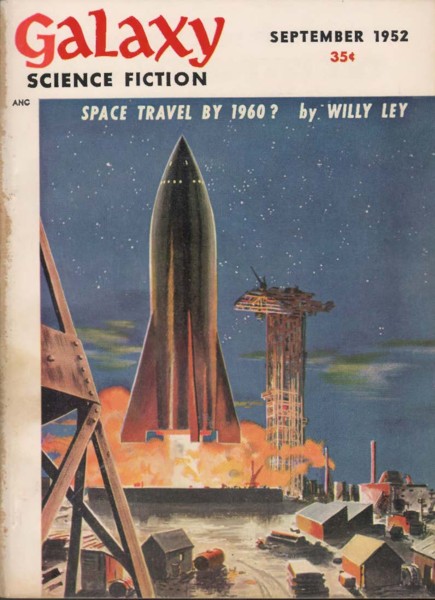
(Cover by Jack Coggins. Galaxy, September 1952.) Who Goes There?
Katherine MacLean was born in 1925 and died relatively recently, in 2019, making her one of the longest-lived SF writers. Despite her longevity, though, MacLean wrote little fiction, and much of what she wrote was published in the ’50s, when she was quite young. This could be because the market for short SF saw a bubble that decade the likes of which it wouldn’t really see again until the 2010s. Clearly novels were not her preference, as she only wrote two solo novels, one of which (The Missing Man) is a fix-up. But in the ’50s MacLean was one of the most rigorous writers in the field, indeed one of the codifiers of hard SF, although her early stuff can be less defined by the hard sciences than the soft. She went to grad school for psychology, and today’s story is about sociology. “The Snowball Effect” might strike you as being only nominally SF; certainly it’s not SF of the robots-and-spaceships sort. But it’s definitely speculative fiction, which is not a label I like to use (I tend to see “speculative fiction” as a cop-out term), but this is a rare instance where it’s applicable. MacLean had made her debut in Astounding, but the newfangled Galaxy was a much better fit for her brand of satirical soft SF, so mostly she would stay there.
Placing Coordinates
First published in the September 1952 issue of Galaxy Science Fiction. Reprinted in Second Galaxy Reader of Science Fiction (ed. H. L. Gold), The Penguin Science Fiction Omnibus (ed. Brian W. Aldiss), The Great SF Stories #14 (ed. Isaac Asimov and Martin H. Greenberg), The Ascent of Wonder: The Evolution of Hard SF (ed. David G. Hartwell and Kathryn Cramer), The Big Book of Science Fiction (ed. Ann and Jeff VanderMeer), and the MacLean collection The Diploids. The copyright ran out on it, so you can read it on Project Gutenberg with no issue.
Enhancing Image
Halloway is the president and dean of a university—somewhere. It’s unclear where exactly this university is. He’s dealing with a bit of a renegade professor, one Wilton Caswell, the head of the Sociology Department, which risks being gutted on account of a lack of interest from “the big-money men,” i.e., wealthy donors who actually keep the college running. Sociology doesn’t really appeal to them. “To them, sociology sounds like socialism—nothing can sound worse than that,” says Halloway. This is both a funny little bit of social commentary and perhaps some foreshadowing as well. You may recall about a year ago I reviewed MacLean’s “Pictures Don’t Lie,” which I liked quite a bit, especially with how it handled its twist ending. “The Snowball Effect,” which like the aforementioned story got adapted for X Minus One (I do recommend the X Minus One version of “The Snowball Effect,” by the way, it’s pretty faithful and in some ways more vividly depicts what MacLean was going for than what she could accomplish on paper), and both stories feel very much like they could be produced as stage plays, or for radio. Much of our time is spent either with just Halloway and Caswell or Halloway more or less by himself, as he keeps track of Caswell’s project. Caswell has a solution for his department, which comes down to a bet: Caswell can show his theory about the snowball effect for an organization and chart out said organization’s growth and lifespan over a six-month period. Sociology is, after all, the study of societies; but then damn near anything can count as a society—even a women’s sewing circle. By the end of the six months the Watashaw Sewing Circle, run by one Mrs. Searles, should have grown so as to vindicate Caswell’s studies, according to the plans and laws he laid out. “If Caswell’s equations meant anything at all, we had given that sewing circle more growth drives than the Roman Empire.”
Four months later and Halloway checks in on the Sewing Circle, only to find that such an organization does not exist anymore, and indeed has not for a minute; instead it’s been replaced by the Civic Welfare League, also run by Mrs. Searles. At first it seems like Caswell’s project had fallen through horribly, but quite the opposite has happened, with the former Sewing Circle having metamorphized and grown into a formidable charity organization seemingly overnight. The miraculous thing is that the CWL sprouted from the Sewing Circle without actually changing or amending the rules Caswell had laid out for the Sewing Circle, although the implication is that Caswell had designed the Sewing Circle so that it would, out of necessity, become something else so as to grow rapidly in numbers. He knew what he was doing. Halloway is more clueless, not helped by his struggling to get in touch with Mrs. Searles, who despite her importance to the plot remains a marginal figure. One reason I suspect MacLean was one of the few women to appear in Astounding (later Analog) with any regularity is that her style and preoccupation with male characters could be considered masculine. Certainly she stands out as distinctly pre-New Wave, being a generation (literarily, if not physically) apart from the second-wave feminist writers who would most forcefully bring the battle of the sexes to science fiction. Women both do and do not figure strongly into “The Snowball Effect,” because on the one hand the only characters with substantial dialogue, and whose perspectives we have any real insight to, are men; but then also you have the CWL, which at first is an all-women organization, and MacLean seems to be making a point about women’s roles in political activism, as historically women’s contributions to liberation movements and anti-war protests, have been quite profound. And then there’s Caswell, who despite having devised the project in the first place, is content to just watch it play out; you could say he only got the snowball tumbling downhill.
“The Snowball Effect” is a good deal less serious than “Pictures Don’t Lie,” indeed being the kind of social satire that Robert Sheckley would make his bread and butter (Sheckley made he debut the same year MacLean’s story was published); but while Sheckley had a misogynistic streak, MacLean’s story is slyly feminist in a way that male readers of the time probably would not have found too confrontational, while at the same time these readers would be subjected to some big ideas under the guise of a sci-fi comedy. Also by centering her story on men, with women being peripheral but at the same time pervasive, MacLean avoids what would become a bit of a stereotype with lady authors in the field during the pre-New Wave years, that being the centering of women’s roles as caregivers in what was being a middle-class sprawl. James Blish, in one of his books of criticism (I forget which one), makes the misogynistic but incisive comment that these lady authors, who tended to gravitate toward The Magazine of Fantasy and Science Fiction rather than Galaxy, were the “housewives” of the field. They wrote about women who lived day to day as moms and/or wives, their own existences hovering around the men and/or boys closest to them. An SFnal conflict may arise because the female protagonist’s idiot husband wants something, or her bratty son wants something, or maybe she herself wants something that she thinks will impress her husband or son. While women were literally at the center of such stories, their relationships with the male gender also took just as much center stage—mind you that the authors often did this with social commentary in mind, to say something about what it’s like to live as a (presumably) white middle-class woman under patriarchy. But while the dual protagonists of MacLean’s story are men, they end up being observers to a women-driven phenomenon, with the women in question mostly acting apart from their male peers.
There Be Spoilers Here
The CWL proves to be a huge success once the six months are up—if anything it might be too successful. What started as a ladies’ club has blossomed into something like an egalitarian democratic socialist society, a kind of mini-government whose chief concern is welfare. It’s the kind of thing the Fabians would’ve wanted. The CWL has gone well beyond Watashaw and by the end of the story they’ve opened up a branch in New York, open to women and men, be they rich or poor, handsome or ugly, yet still acting on the guidelines Caswell had set up for the Sewing Circle. Halloway’s jaw hits the fucking floor as he charts the rate of growth. “After the next doubling, the curve went almost straight up and off the page.” Caswell calculates that at the rate things are going the CWL will have effectively become a world government in about twelve years. There is a problem, of course, in that the project was set up such that once it stops growing for a long enough period it will dissolve. The implications are not exactly great, as presumably once this future world government reaches as many people as it can possibly recruit it will start crumbling. But by the time that happens it won’t be Caswell or Halloway’s problem anymore. The business will have gotten too big by then. Despite involving only a few characters and feeling like a stage production with how insular it is, the ending is comically large-scale.
A Step Farther Out
Sorry, I was supposed to post this yesterday, but there was an issue with WordPress that seemed to have to do with Google Chrome so I couldn’t fucking log into my account. (Thank you, Google, very cool.) I guess it was the kind of mishap that befits a comedy of this sort, although unlike my real-life experience with writing about “The Snowball Effect” I do certainly recommend the story itself. Being concerned with both social commentary and the soft sciences, it’s just the kind of story H. L. Gold wanted for his magazine, and it’s the kind of story one would have a hard time finding in Astounding, which was Galaxy‘s most direct rival. I should also read more MacLean—not that she wrote a lot.
See you next time.
-
Short Story: “Self Portrait” by Bernard Wolfe

(Cover artist uncredited. Galaxy, November 1951.) Who Goes There?
For someone who wrote so little SF, Bernard Wolfe (no relation to Gene Wolfe) is very much someone worth rediscovering, if for no other reason than that he brought a worldview to the table that was quite rare in his lifetime, and which has since become only somewhat less so, even as the field has become more progressive in its collective politics. Wolfe trained as a psychologist, and seemed to be one of the few proper Freudians of his time to have written SF; he had even himself undergone psychoanalysis in 1950, about the same time he would’ve written today’s story. He was also a leftist, specifically a Trotskyist, to the point where as a young man he even acted as a bodyguard for Leon Trotsky for several months, although he had left his post over a year prior to the latter’s assassination. While Wolfe would come to no longer identify as a Trotskyist, no doubt at least in part due to the red scare in the years following World War II, he seemed to remain committed to the causes he thought were worth fighting for. On top of being a psychologist he also made some extra money teaching at university; and while he only wrote one SF novel and a handful of short stories, he did write a decent amount of work that wasn’t SF. ISFDB can be frustrating with not cataloging an author’s non-genre work, since here it gives the impression that Wolfe had vanished from the face of the earth between 1952 and 1960. Most notably he wrote a fictionalized account of Trotsky’s last days titled The Day the Prince Died, or The Death of Trotsky.
Wolfe made his SF debut with “Self Portrait,” whose themes he then expanded upon for his sole SF novel, Limbo, published the following year. “Self Portrait” is densely packed, maybe too much for its own good, but it’s fascinating, there’s a good deal to unpack, and it’s a good example of the kind of socially aware SF that H. L. Gold wanted for Galaxy, his newfangled magazine that was already forever changing the way we understand the genre. You can see why Harlan Ellison, when commissioning stories for Again, Dangerous Visions, was eager to nab a Wolfe story (he ended up getting two of them), despite the latter’s inactivity.
Placing Coordinates
First published in the November 1951 issue of Galaxy Science Fiction. It’s been reprinted in The Robot and the Man (ed. Martin Greenberg, not to be confused with Martin H. Greenberg), Second Galaxy Reader of Science Fiction (ed. H. L. Gold), Tomorrow and Tomorrow (ed. Damon Knight), and We, Robots (ed. Simon Ings). It seems to have fallen out of copyright in the US, so you can read it on Project Gutenberg.
Enhancing Image
Oliver Parks has recently been assigned to Princeton University, to work in its cybernetics department. The story is set over the course of a few months, in the fall of 1959, which was then the near-future. Parks has taken on the hefty task of designing a life-like robotic leg, after his boss was impressed with his “photo-electric-cell” insects, often referred to as bedbugs—little robotic bugs of Parks’s design that look and more importantly act like real bugs, not because of the exterior but what goes on inside. The nerves. Prosthetic limbs are by no means new; in fact, if you think about it, basic prosthetic limbs have been around since at least the golden age of piracy. Wooden pegs for legs and all that. But then there’s the issue of developing a limb that can look and act like its real human counterpart. Perhaps even better than the real thing. Thus we have Parks’s subject, named Kujack, a Korean War veteran who had both of his legs blown off. (It’s worth noting that Wolfe probably wrote “Self Portrait” in the fall of 1950, so that the Korean War had only been going on for maybe a handful of months, making it surely one of the first SF stories to mention that conflict.) There’s also Parks’s assistant, Goldweiser, who despite his position is openly an egomaniac, and I do have to wonder if it’s a coincidence that Goldweiser reminds me of the similarly named H. L. Gold. Gold, for better or worse, worked closely with his writers, and he quickly gained a reputation for being a control freak. I have little doubt that Wolfe would’ve found Gold a pain in the ass to work with.
And then there’s Len Ellsom. Parks and Ellsom go back quite a bit, not least because there’s the implication Ellsom had “stolen” Marilyn, who was Parks’s fiancée. Ellsom also has a habit of calling Parks “Ollie,” which irritates him, although it’s unclear if Ellsom is doing this innocently or not. Ellsom is not a cyberneticist; instead he’s working on a supercomputer that can beat even the best human player in a game of chess—a computer so smart and tactically oriented that it could win a war all by itself. This was written in the days long before the microprocessor, and before the real-world evolution of the computer that was designed to play chess against professional opponents. You might have a fuzzy memory of the supercomputer Deep Blue playing against world champion Garry Kasparov. In case it wasn’t obvious, we’re talking about machine learning, which nowadays tends to be just called AI, although calling it AI isn’t really being accurate. Deep Blue was not able to write poetry or commit suicide (after all, being able to write poetry and commit suicide are the two biggest signs of human-like intelligence), but it was able (indeed designed) to think strategically. There was a problem that needed solving (a game of chess) and Deep Blue could solve it. Parks considers machine learning to be easier than constructing an artificial limb because while Parks has to replicate the human leg, Ellsom is “merely” working with learning machines, which can replicate a certain function of the human brain, but not all of it.
That’s why the robot-brain boys can get such quick and spectacular results, have their pictures in the papers all the time, and become the real glamor boys of the profession. They’re not asked to duplicate the human brain in its entirety—all they have to do is isolate and imitate one particular function of the brain, whether it’s a simple operation in mathematics or a certain type of elementary logic.
There’s some evident jealous in Parks’s tone: it might be the thing Marilyn, but it could also be the fact that Ellsom has the more glamorous job. Things are not as straightforward as they seem, though, not helped by Parks being a bit of an unreliable narrator. “Self Portrait” is told as a series of diary entries from Parks, so that we’re hit with a double whammy of a first-person narrator who’s also bitching about his colleagues in real time. It also goes to explain Wolfe’s rather informal style here, since presumably Parks is writing these entries without the expectation of them getting published, and thus we see a side to him other people would not.
One night Parks and Ellsom have a bit of a night on the town, and Ellsom gets quite drunk; but then of course, he confesses he’s been drinking more than he should. The reason? “I saw a machine beat a man at a game of chess.” Three years ago. Machine learning is apparently a bit farther along in development than Parks had thought, and despite being involved in the development himself Ellsom is rather disturbed by it. He has a friend, Steve Lundy, who lives in Greenwich Village. “He’s a bum, you see, but he’s got a damned good mind and he’s done a lot of reading.” Lundy is pessimistic about the development of a supercomputer that can beat a man in chess, and it becomes hard to not see why. Incidentally Lundy is also a leftist, having fought in the Lincoln Brigade during the Spanish Civil War. It seems to me that of the characters featured in “Self Portrait” that Lundy might resemble Wolfe the most, the irony being that we don’t actually see him until the end. Speaking of Greenwich Village, Ellsom brings up Marilyn again, apparently guilt-ridden, and explains to Parks, in so many words, that he shouldn’t feel too bad about having lost Marilyn, on account of her being a huge slut who had fucked every man in the Village who would have her. In the Village she tried being an artist, like every other bohemian, but apparently gave that up to go back to doing a tech job at IBM. Despite her sluttery, Marilyn is said to be a very intelligent woman, and there’s the hint that Parks still sometimes thinks about her. “You know,” he says, “she helped lay out the circuits for the first robot bedbug I ever built.”
If it seems like a lot is going on without my ever feeling the need to go through the plot beat by beat, that’s because it is. “Self Portrait” is about 9,300 words according to the Gutenberg text, making it a solid novelette, but even so it feels squeezed in, almost like the abridged version of a much longer and deeper narrative. I would have preferred if Wolfe had doubled the length and turned it into a novella, which would’ve given his ideas more room to breathe. If contemporary reviews are anything to go by his novel Limbo, which expands on the ideas presented in “Self Portrait” but not the plot, suffers from the opposite problem: at some 430 pages it’s freakishly long for a ’50s SF novel. Wolfe is a lot more cerebral (not to mention left-leaning) than some other ideas-heavy SF writers of the period like A. E. van Vogt, but he still has the problem of not being a very good storyteller. It strikes me as apparent that “Self Portrait” probably should’ve been narrated by Ellsom, not Parks, although it’s possible that by sticking us in his shoes Wolfe wanted to make a point about the kind of person Parks, which is to say a square. A conformist. Ellsom calls him a Boy Scout, which Parks takes as an insult. Something you realize about Parks is that he’s kind of an asshole, and also prone to lying for the sake of keeping up appearances. Not to get ahead of the plot a bit, but the ending solidifies Parks’s status as anti-hero, in that he is anti-heroic. The only reason he doesn’t come off worse is because Goldweiser is more openly unlikable; and anyway, while Parks is not exactly a good person, Wolfe posits that the likely future, in which the US builds a computer that can conduct a whole war, is leagues worse than one petty cyberneticist. It’s bleak, if you think about it.
There Be Spoilers Here
Parks finds out that Ellsom’s recklessness has gotten to the point where he’s not only hanging out with Kujack, but sharing government secrets with him. This is a development that mostly happens offscreen, which can make the reveal of Ellsom and Kujack both technically traitors a surprise in the sense that the reader simply would not have expected such a development to occur. It feels random. There is, of course, a bit of foreshadowing, about how something is off about Kujack, and there’ve been mentions of Ellsom’s alcoholism; but then both counts can be dismissed, or at least downplayed, on account of us only being told about this through Parks’s rather biased perspective. The implication of the twist and the two men’s subsequent arrests (although in a humorous sequence of events Kujack isn’t arrested until after the team gets to show to the public that Parks’s artificial leg is a success, for the sake of PR) is that Ellsom may have turned to hard drinking out of a crisis of conscience, given that he’s been helping with a project that could potentially lead the US and Soviet Union ending the world. (Less of a Dr. Strangelove and more of a Fail Safe situation, by the way.) Ellsom had also been yapping about the project with Lundy, who in turn has been running an anarchist magazine named after the supercomputer Emsiac. Things end badly for about half the cast (there are too many characters here, really), although not Parks, who comes out unscathed and is even able to reunite with Marilyn at the end. The conformist lives happily ever after; meanwhile the characters who are framed as more sympathetic, indeed those whom Wolfe likes more, are punished.
A Step Farther Out
I would be curious to read Limbo, since it seems like the kind of overly ambitious mess that was sadly rare in ’50s SF. “Self Portrait” is the only Wolfe story to appear in a genre magazine; all the others would be published either in mainstream outlets or anthologies. This story doesn’t count as cyberpunk, mind you, but it does feel like a distant precursor to the movement, by a good thirty years, in that it deals with cybernetics (well, duh), but also its thematic concerns anticipate the anti-capitalist and anti-war stances of most classic cyberpunk writing. In that sense Wolfe was ahead of his time, although he wrote so little SF and from what I can tell he could never quite tap into his own talent to produce a masterpiece.
See you next time.
-
Things Beyond: March 2025

(Cover by Ed Emshwiller. Galaxy, March 1956.) Let’s talk about where genre SF was at in 1950, because this year, perhaps more than any other year in the field’s history barring maybe 1926 (the launch of Amazing Stories) and 1953 (the year the magazine market reached critical mass). Changes in the field tend to come gradually; it’s not like, for example, one day you have a market that’s 95% WASPs and then the next it’s much more racially diverse. These things happen in movements, like the rest of history, or indeed like the waxing and waning of the tide. There really was a profound difference between how genre SF looked at the beginning of 1950 and how it looked by the end of the year. There were multiple changes happening at once, and not all of them were good. The less said about Dianetics the better. But you also had the publications of Isaac Asimov’s I, Robot and Ray Bradbury’s The Martian Chronicles, two “novels” (they’re really short story collections) that not only garnered acclaim from the usual suspects but even managed to break into the mainstream. This was practically unheard of at the time, to have science fiction that “normal” readers admitted to caring about. 1950 also saw the publication of other major SF books, like Robert Heinlein’s Farmer in the Sky, Theodore Sturgeon’s The Dreaming Jewels, A. E. van Vogt’s The Voyage of the Space Beagle, Asimov’s Pebble in the Sky, and the book version of Hal Clement’s Needle. Notice that with the exception of the van Vogt book, all the ones I just mentioned were aimed at younger readers—as in teenagers, those who might grow up to be SF enthusiasts.
A revolution, of a sort, was happening.
In the world of the genre magazines, things were shaking up at least much, even putting Dianetics aside. The Magazine of Fantasy and Science Fiction, which had launched in the fall of 1949, was finding its footing. There were signs of the coming deluge of new magazines, on top of the current rivals to Astounding, and the biggest of these new arrivals, by far, was Galaxy Science Fiction. Galaxy first hit newsstands with its October 1950 issue, which means it would’ve been available in September. Under the editorship of H. L. Gold, who had already proved himself a capable writer, this was a magazine that would do what Astounding could not, namely be socially conscious, with a focus on science fiction that was rather urbane and literate, while still being very much focused on science. But whereas Astounding was all about the hard sciences, Galaxy would focus just as much on the soft sciences, such as psychology and sociology. Being more socially conscious, there would also thus be much more of a focus on social satire, and one stereotype that would come to haunt Galaxy in the ’50s is that too many of its story would be misanthropic hehe-haha comedy pieces, aimed at the middle-class urbanites it was satirizing. As with The New Yorker around the same time (and indeed The New Yorker now), Galaxy ran the risk of coming off as incessantly liberal and middle-brow. This is a legitimate criticism, but it was also a risk one had to accept when changing the field this radically. To this day a lot of SF being published seemingly either takes after Galaxy under Gold’s editorship or Asimov’s Science Fiction under Gardner Dozois’s. There’s a third, more conservative (because Galaxy was kinda “woke” for its day) brand of SF writing that wants desperately to turn back the clock to a pre-Galaxy world, to a time before white people cared about things like social justice, but you can’t put the genie back in the bottle.
I had to think really hard about what stories and authors to cover this month, because the truth is that Galaxy at its peak had individual issues whose sheer quality and star power would put whole novels to shame. Nearly every story in a given issue would be a banger, or at least a fine read. There are people who wrote for Galaxy during its first decade that I had to leave behind, at least for the moment, including Theodore Sturgeon, Margaret St. Clair, Robert Sheckley, Philip K. Dick, Isaac Asimov, Clifford Simak, Cordwainer Smith, Poul Anderson, Ray Bradbury, and many others. But still we have a mix of usual suspects, as in those who regularly contributed to the magazine during this time, as well as a few lesser known authors. Of course I couldn’t have it all be now-famous selections.
Anyway, for the stories:
- “Self Portrait” by Bernard Wolfe. From the November 1951 issue. If Wolfe is little known in the field, it could be because he wrote very little SF, putting out only one SF novel and a handful of short stories. Wolfe was a trained psychologist who also was a committed leftist, specifically a Trotskyist; he even knew the man himself personally, in the years right before Trotsky’s assassination.
- “The Snowball Effect” by Katherine MacLean. From the September 1952 issue. I’ve covered MacLean before, actually not too long ago, but seeing as how her most prolific era was when she wrote for Galaxy in the ’50s, why not? She lived a very long time, although she didn’t write that much, making her debut in Astounding in 1949 before (for the most part) switching over to Galaxy.
- “A Bad Day for Sales” by Fritz Leiber. From the July 1953 issue. Leiber is one of my favorite writers of old-timey SF, although he was also quite skilled (maybe even more so) in fantasy and horror. He debuted in 1939, and thus was one of the old guard, but he adapted to changes in the market with a chameleon’s touch. I picked this story specifically on a friend’s strong recommendation.
- “The Big Trip Up Yonder” by Kurt Vonnegut. From the January 1954 issue. Vonnegut is one of those few authors who needs no introduction, but here it goes. He broke onto the scene in 1952 with his novel Player Piano, which was SF, as would be about half of his other novels. Despite not wanting to be pigeonholed as a “sci-fi” writer, he also occasionally appeared in the genre magazines.
- “The Princess and the Physicist” by Evelyn E. Smith. From the June 1955 issue. We don’t know a lot about Smith, which unfortunately is not unusual for women in pre-New Wave SF, and incidentally she had mostly stepped away from the field by the time the New Wave and second-wave feminism kicked in. In the ’50s she wrote by far the most prolifically for Gold’s magazines.
- “A Gun for Dinosaur” by L. Sprague de Camp. From the March 1956 issue. As with Leiber, de Camp was perhaps more adept at writing fantasy than SF, but then in the ’50s there wasn’t much of a demand for the former. He too was of the old guard, and was able to adapt to the changing times. He also lived an extremely long time, indeed having one of the longest careers in the field.
- “Prime Difference” by Alan E. Nourse. From the June 1957 issue. Nourse is one of the lesser known of the original “hard” SF writers, and indeed the vast majority of his short fiction appeared in the ’50s when he was a very young man. He mostly stopped writing SF probably because he got a very well-paying job as a trained physician, but his work remains to be rediscovered.
- “Nightmare with Zeppelins” by Frederik Pohl and C. M. Kornbluth. From the December 1958 issue. Pohl and Kornbluth were good friends for many years, but in the ’50s they collaborated on several novels and short stories, the most famous being The Space Merchants. Sadly Kornbluth died in early 1958, making “Nightmare with Zeppelins” one of the last stories he would’ve finished.
- “The Man in the Mailbag” by Gordon R. Dickson. From the April 1959 issue. Dickson was born and raised in Canada (he’s from Alberta), but moved with his family to the US when he was a teenager. He’s most known for his regular collaborations with Poul Anderson, as well as his long-running and ambitious Childe cycle. He was one of the pioneers of what we now call military SF.
Won’t you read with me?
-
Serial Review: A Story of the Days to Come by H. G. Wells (Part 2/2)

(Cover by Frank R. Paul. Amazing Stories, May 1928.) The Story So Far
London, circa 2100. The world has in some ways changed radically since Wells wrote this story in the 1890s, but in other ways it has not. Class division persists, and has somehow gotten even more pronounced. People, at least in the UK, have mostly abandoned the countryside and huddled together in cities, with the cities becoming more vertically oriented. The richest folks live on the top floors of skyscrapers while the poorest of the lot live on the ground. Denton, an attendant on a commercial flying machine, has love affair with the upper-class young lady Elizabeth, whose father very much disapproves of their courting. The father, Mwres (descended from a man named Morris, an upper-class twit like himself), would prefer his daughter go with Bindon, a colleague of his, and he even hires a hypnotist to wipe Elizbeth’s memory of Denton so that she forgets all about him. Denton eventually undoes the conditioning and the two lovers escape the city, in the hopes that making it in the countryside would be preferable. It’s not really. The end up chapter three, or the first installment, sees the lovers returning to the city, but without much means of enjoying even a middle-class existence. Life will continue to be grueling for a bit yet.
Enhancing Image
The fourth chapter, “Underneath,” sees the young lovers at the bottom of the socio-economic ladder, at least in London. I mean I suppose it could be worse: they could be immigrants, for one thing. Truth be told, my eyes glazed over for much of this chapter, if only because much of it is like a Socratic dialogue, and sad to say Wells’s dialogue is not very memorable here. The humor and wry observations on the future often come through in the narration, which is quite a different thing. More memorable is the final chapter, “Bindon Intervenes,” which introduces us to the failed suitor in earnest, after only really hearing about him up to this point. Despite only coming around near the story’s climax, Bindon stands as the most developed character here, which strikes me as backwards. It’s clear that Wells intended Bindon to serve as Denton’s dark reflection, a man who is similarly romantic in a world that has left romance to the wayside, but who lacks Denton’s working-class charm; in effect he is like Denton if he was a proto-incel. Despite ostensibly being the antagonist, having conspired with Elizabeth’s dad, there’s something pitiable about Bindon that makes him a somewhat tragic figure. Not helping matters is he finds out he terminally ill, with not long to live. It would’ve been nice had Wells given us insight into Bindon’s character much earlier in the story beyond hearsay. As it stands this gear-switching in the final chapter comes about too little, too late, and like other parts of the story it feels undercooked.
Oh, and the ending sucks. I understand that it’s supposed to be ironic, but it’s bad storytelling to have your heroes get what they want through no real action or effort of their own. Bindon dies and Elizabeth inherits his fortune, on account of the cucked man having a change of heart as he’s come to realize he would die soon anyway. The conflict basically takes care of itself and Our Heroes™ get their happily-ever-after. This is unspeakably lame; I almost always hate it when writers pull this shit, and in 1899 Wells would’ve known better than to end on such a note.
A Step Farther Out
Sad to say this is not a hidden masterpiece or a semi-forgotten classic in Wells’s body of work, although it does have its points. A Story of the Days to Come feels like a microcosm of Wells’s chief concerns as both a satirist and a genuine speculator on the future, but it’s too long to have the punch of his best short stories and too short to be given the same depth of ideas as his best novels, or even the similarly-lengthed The Time Machine. Wells was one of the few true pioneers of science fiction, in the sense that he wrote about things that had never actually been put to paper before and broadened people’s horizons more than most of his descendants; but being on the cutting edge also meant that sometimes he, well, got cut. It’s the price one must pay for innovation.
See you next time.
-
Short Story Review: “The End of the Party” by Graham Greene

(Cover by Paul Callé. Worlds Beyond, December 1950.) Who Goes There?
To say today’s author is an outsider to the field might be an understatement. Graham Greene was one of the most beloved English writers of the mid-20th century, even being nominated for the Nobel Prize multiple times. He’s known chiefly for his novels, which he divided into two groups: the serious (often Catholic-themed) novels and the “entertainments.” The former could be entertaining and the latter could at times be deceptively serious; they were not really mutually exclusive. You get the sense that The Power and the Glory and Our Man in Havana were written by the same man, despite them being in some ways very different novels. Greene was an atheist in his adolescence but converted to Catholicism when he was in college, making him one of the few adult Catholic converts who isn’t a fucking weirdo about it. Despite his strong sense of metaphysics and moral seriousness, he was at the very least a fellow traveler when it came to leftist politics, a fact that, given the Church’s allying with several fascist regimes, made his relationship with his faith a fascinatingly complicated one. Similarly today’s story, which Greene wrote in 1929, and which was apparently a personal favorite of his despite being from so early in his career, has a touch of religion about it; but if so, it’s a dark touch, showing Greene at his most cruel. “The End of the Party” isn’t exactly a supernatural horror story, although its uncanniness does push it at least to the borderline, if not there outright.
Placing Coordinates
“The End of the Party” was first published in The London Mercury in 1932, before being reprinted in the December 1950 issue of Worlds Beyond. It has since been reprinted in Children of Wonder: 21 Remarkable and Fantastic Tales (ed. William Tenn), The Sixth Fontana Book of Great Horror Stories (ed. Mary Danby), The Light Fantastic: Science Fiction Classics from the Mainstream (ed. Harry Harrison), Perchance to Dream (ed. Damon Knight), among others, along with the Greene collections Twenty-One Stories and Complete Short Stories. This story, being one of Greene’s most popular out of his short fiction, is not exactly hard to find.
Enhancing Image
Peter and Francis Morton are identical twin brothers, both ten years old, and while they do look very similar, they are in other ways very different. Peter is the “normal” one, while Francis seems to have lagged behind in terms of maturity—or perhaps it’s something else. Despite his age, at which points children would be more courageous, Francis is still deathly afraid of the dark, and even has a nurse chaperone him, which is embarrassing for someone his age. He also doesn’t understand social interactions very well, especially with those of the opposite sex. Girls make him uneasy, which is not by itself unusual, except he doesn’t seem to do much better with people of his own gender. Speaking of uneasiness, we know from the opening scene that something bad is on the horizon, because Francis had a dream that he was dead. And today is the yearly party at Mrs. Henne-Falcon’s place. Both brothers dread this, although Francis more so, given he has to suffer more directly. It’s at this party, every year, that the adults turn off all the lights and the children play a game of hide-and-seek. Peter doesn’t like this, if only because it scares his brother so much.
[Francis’s] cheeks still bore the badge of a shameful memory, of the game of hide and seek last year in the darkened house, and of how he had screamed when Mabel Warren put her hand suddenly upon his arm. He had not heard her coming. Girls were like that. Their shoes never squeaked. No boards whined under the tread. They slunk like cats on padded claws.
Francis feigns ill, but his parents don’t buy it. They’re all going to the party, because it’s one of those family obligations. It’s like if you hate weddings, but oh a relative of yours is getting married so you “have” to goooo. It’s horrible. This is the kind of horror that would most strongly work on people who find themselves in either Francis or Peter’s shoes, which is to say I found it a pretty effective exercise in escalating dread. This story is nearly a century old, and I haven’t been officially diagnosed myself, but Francis is very likely autistic. He might also have some kind of PTSD. The two are not mutually exclusive. There is something not right about the boy. On the one hand Greene is clearly setting up a bad fate for Francis, but he also writes him from a just as clearly empathetic standpoint, as if Greene understands the boy’s anxieties and that the act of writing this story was also an act of sado-masochism. It must have hurt to write it, but at the same time it might’ve been a kind of pain that really does strengthen one’s own character (unlike most pain, which is “malignantly useless”), hence I think why Greene continued to have a soft spot for it. “The End of the Party,” which mind you Greene would’ve written when he was only 24 or 25, marked a bit of a turning point for him as a writer.
Like a lot of great short stories, “The End of the Party” is loaded with details, some of which are arguably problematic. There’s a pervasive misogyny that’s baked into the narrative, both what happens and the symbolism behind it, such that it only makes sense as a story when one considers the misogynistic elements. With the exception of the nurse, who, like Peter, serves to keep Francis out of danger, every other female character acts as an antagonist, including the twin boys’ own mother, who tells Francis that he “must go” (italics mine) to the party, with “the cold confidence of a grown-up’s retort.” The young girls who will be at the party, who are up to a few years older than the boys, are even more scornful. And then there’s Mrs. Henne-Falcon, whose very name is somehow a combination of two birds, a hen and a falcon—both a “gossiping hen” and a bird of prey. Danger. Greene is a great writer, maybe one of the best of the 20th century, so it’s no surprise that even when his ends might be disagreeable, the means are usually not. He knows what he’s doing. You could, of course, reason that since this story is told from the perspective of two young boys (the exact perspective shifts back and forth between Francis and Peter), the misogyny should be assumed to be more a flaw of the characters than the author; and after all, having been raised as a boy myself, I can tell you that boys, almost without exception, hold a strong primordial distrust toward girls.
There is also the context in which Greene wrote “The End of the Party,” it being subtextually a post-war narrative. Something to remember about World War I is that there was a profound difference in post-war experiences between the American and British sides, the Americans, having barely fought in the war to begin with, having come out of it relatively unscathed; but for the British it was a very different story. Greene was born in 1904, so he was too young to have served, even if he wanted to, but he grew up in the shadow of a generation of damaged men—the ones who had come out of the war alive, that is. He could not understand too vividly the sufferings of the generation of British men that preceded him, so with this story he did something rather intriguing and profound, in that he seemed to transfer some of that war trauma to the generation that came after him. Remember that Francis and Peter are ten years old, and assuming the story takes place roughly when it was written, this means they would have been born very shortly after the end of World War I. While the war, to my recollection, never comes up directly in-story, something big hangs over the boys’ heads—something much bigger than just awkward social interaction. Of course, for someone neurodivergent like Francis, awkward social interaction might well represent what World War I represented for a lot of people during that war’s duraction: the apocalypse.
There Be Spoilers Here
The party happens and so does the game of hide-and-seek, and there’s no way Francis can get out of it, as if fate has ordered this series of events. Or maybe God did it. God comes up a few times in this little story, and if the God of Abraham does exist (as Greene believed), then He seems to have it out for Francis, and for no discernable reason. Francis’s destiny, be it for good or ill, will not be deferred. Of course, this all could’ve been prevented had the adults taken Francis’s disability into consideration, but, having forced him to be like the neurotypical kids they’ve tried to fit a round peg in a square hole. It’s during the game that Peter and Francis, after having been separated, are reunited, although they can’t see each other. It’s also at this point, during the story’s climax, that the perspective shifts back to Peter, after having us mostly be stuck with Francis. If you’ve read the story then you may have already forgotten that we were in Peter’s shoes at the very beginning, and so here we are again at the end. There’s a reason for this. Peter sees his brother as a reflection of himself, both physically and symbolically. Peter finds Francis in hiding and touches his brother’s face, which is how he knows it’s him, before taking Francis’s hand in his. Francis doesn’t say anything after this point, not even after the game has ended and the lights have come back on—because he’s dead. He died, apparently from sheer fright, when he felt Peter’s hand on his face, as if it were the hand of God which emerged from the blackness. Peter would’ve noticed something was wrong sooner, but he’s so intimately connected with his twin, as if there were a psychic link between them, that he could not at first separate the two.
Peter continued to hold the clenched fingers in an arid and puzzled grief. It was not merely that his brother was dead. His brain, too young to realize the full paradox, wondered with an obscure self-pity why it was that the pulse of his brother’s fear went on and on, when Francis was now where he had always been told there was no more terror and no more darkness.
Not that there are many happy endings in Greene’s fiction, but this is surely one of the bleakest and unsettling.
A Step Farther Out
Greene struggled with mental illness throughout his life, namely depression, which I think often shows through in his novels; but with “The End of the Party,” one of his most reprinted short stories, it’s like a tiny but all-devouring neutron star. It’s a black hole of pessimism, on almost a cosmic scale despite its small size. I was under the impression, going in, that this was a ghost story, although it ended up not being that; actually it doesn’t even have any overt supernatural elements to speak of. What it does have is a strong sense of the uncanny, and of impending doom. It’s a story of two young boys, both of whom are troubled, each in his own way, who have spent their whole lives by each other’s side up to this point, until suddenly they’re separated, as if God had cut the tape between them with a pair of scissors. It’s scary, but also tragic. I love it.
See you next time.
-
Serial Review: A Story of the Days to Come by H. G. Wells (Part 1/2)

(Cover by Frank R. Paul. Amazing Stories, April 1928.) Who Goes There?
Herbert George Wells was born in 1866 and died in 1946, just short of his 80th birthday but just long enough to have seen the end of World War II. Wells is one of the most important writers of SF to have ever lived—maybe the most important. To be an SF fan and not read at least a bit of H. G. Wells would be like being a horror fan and not having read any H. P. Lovecraft, or being an English major and not engaging with Shakespeare or the King James translation of the Bible at all: it’s basically unthinkable. Wells’s influence is made more remarkable when you consider that SF was by no means the only genre he wrote in, although his non-SF work has been thrown into the dustbin of history, and also that he wrote pretty much all of his most important work in the field in the span of about a decade, between 1895 and 1905. While he was still writing, albeit very little SF at this point, in the 1920s, Wells’s presence in the earliest genre magazines, namely Weird Tales and Amazing Stories, was entirely through reprints. Indeed he seemed to appear in nearly every issue of Amazing Stories while Hugo Gernsback had control of that magazine. A Story of the Days to Come was first published in 1899 as five related stories, which then became its chapters. This is a novella, about as long as The Time Machine, but it’s nowhere near as well-known as Wells’s most famous novels or even short stories, I suspect because while it’s certainly ambitious, it lacks the iconic characters, ideas, and even plot momentum of those other works. This is a story that will be rather hard to talk about in terms of plot beats, so that, combined with depression (it took me nearly an hour to get out of bed this morning), made writing about this story a bit of a challenge.
Placing Coordinates
First published as five stories in 1899, in Pall Mall Magazine. It was then serialized in the April and May 1928 issues of Amazing Stories. It’s also been reprinted in The Science Fiction Century (ed. David G. Hartwell) and the Wells collections Tales of Space and Time and The Complete Short Stories of H. G. Wells. Tales of Space and Time has been in the public domain since forever, so you can read it on Project Gutenberg.
Enhancing Image
We start with less of a character and more of an archetype, in the form of Mr. Morris, of the late Victorian era, and his distant descendant, Mwres, who are both perfectly conservative and upstanding men of their times and shared place—that being London of the 19th and 22nd centuries, respectively. Morris/Mwres is totally unconscious about class, cares nothing for the poor, attends church regularly but without passion, and can hardly be bothered to read anything. Indeed Mwres uses a “phonograph,” which here functions like a laptop or audiobook, to consume information, rather than reading the newspapers like his ancestor. Nobody reads anymore. Mwres meets with a hypnotist so that he might do something about his daughter Elizabeth, who is 18 at the story’s beginning and thus of marrying age. Mwres wants Elizabeth married off to a colleague of his, Bindon, a much older man, “plain little man, you know, and a bit unpleasant in some of his ways, but an excellent fellow really.” But Elizabeth, being a romantic and having indulged in many “romances” (tales of adventure), has set her sights on Denton, “a mere attendant upon the stage on which the flying-machines from Paris alight,” who like Elizabeth is a romantic in a future society which has all but abandoned things like poetry and romance of the lovey-dovey sort. Also, both Elizabeth and Denton can read and write, which bothers Mwres. The hypnotist thus messes with Elizabeth mind such that she forgets all about the young man she’s so smitten with, and it’s up to Denton to figure out why his girlfriend doesn’t recognize him the next time the two of them cross paths and how to undo the hypnotism.
As you can see, this is rather satirical. Morris/Mwres is a obviously dig at the conformist, or the “moderate conservative,” someone who might vote Labour but only so long as the party doesn’t get too woke. Wells was a socialist; more specifically he was a Fabian, or what we’d now call a democratic socialist. He was also a technophile, although his feelings on the possibility of technological progress bettering mankind soured as he grew older. Even in A Story of the Days to Come there’s an ambivalence about technology’s place in human progress, although as we’ll see, the “primitivist” option is also shown to be inadequate. If anything tech is shown to be more or less neutral here, more a tool that worsens an already-existing problem—that being the problem of capitalism and class division. This whole fucking plot gets going because the upper-class Mwres, who despite being rich is shown to be an ignoramus, sees the middle-to-lower-class Denton as unfitting for his daughter; and of course Elizabeth has no real say in the matter. Hypnotism, or mesmerism as it was also called at the time, was treated as a big deal in the 19th century, such that in Wells’s story it has become such an advanced practice as to render psychology obsolete. Mind you that psychology as one of the soft sciences was only in its infant stage when Wells wrote A Story of the Days to Come, such that Freud’s The Interpretation of Dreams hadn’t even been published yet. The automobile had also not yet become commercially viable enough at the time to be a common presence, and you can sort of feel its absence in this story. Conversely, “flying-machines” have become a preferred mode of commercial travel in-story, despite the first working airplane still being a few years off in the real world. Granted, people had speculated on flying-machines for literally centuries at this point, and Wells would even see the beginnings of commercial flying in his lifetime. My point is that while this story takes place circa 2100, it still reads as if written from the perspective of someone living in 1900—which may very well be the point. The narration, while ostensibly third-person, is very much targeted at a Victorian readership.
This is all intriguing, after the fact, but one issue I had while actually reading A Story of the Days to Come is that from a plotting standpoint this is far from Wells’s best work. A rule of thumb with writing short fiction is that you wanna stick to one perspective: it could be a first-person narrator, or a bird’s-eye-view third-person narrator, but the idea is we should stuck in the head of only one character. You can get away with changing perspectives in a novel, but for short fiction it’s a dangerous game. Wells violates this rule by switching us between at least three perspectives in these first three chapters (the first installment), between the omniscient third-person narrator, Mwres, and Denton. It makes scene and chapter breaks surprisingly confusing, made worse because Mwres and Denton meet the same hypnotist at different points. By the way, it is massively convenient that Denton, after having been dismayed by Elizabeth apparently forgetting all about him, goes to the same hypnotist that Mwres had consulted to brainwash Elizabeth in the first place. Of course Denton uses a little man-handling to get what he wants and make the hyptotist undo the conditioning on Elizabeth, so that the two can be together again—the new problem now being that there’s no going back. They’ve gone against Mwres’s wishes and will not have to live almost like fugitives, since Elizabeth only has as much as what her old man lets her and Denton doesn’t have many prospects of his own. They live at Denton’s place, for a bit, but having become disillusioned with city life, and also being very low on cash, they decide to hit the road and head out to a place very few people live in now: the countryside. It’s a shame Wells didn’t live long enough to have read Clifford Simak’s City, he probably would’ve been very keen on it. Then again, I’m not sure how much SF Wells actually had read, since he seemed irked by the newfangled label.
There Be Spoilers Here
The England of the future is somewhat dystopian, and one way Wells implies this is the fact that “countryside” has mostly been reclaimed by the natural world. Where once there were whole societies of peasantry in the English countryside, now there’s only the stray farmer or shepherd. As with Clifford Simak’s fiction, humanity is shown as being in decline by virtue of having cut itself off from the natural world; man seems to be degrade further the more “unnatural” he becomes. A shepherd meets Denton and Elizabeth as they start their new lives as would-be farmers, and tells them (correctly) that they won’t last long in the countryside; they simply weren’t raised to adapt to this kind of lifestyle. But they do give the whole thing the good old college try, as it were, and honestly the attempt could’ve turned out worse. They both could’ve died easily, between the elements and wild animals; but what finally pushes them to move back to the city is the issue of trespassing, and damn near getting killed by a pack of dogs. (Wells, given his politics, wasn’t keen on private property.) It’s at this point that the first installment ends, with Our Heroes™ having lost the battle, but maybe not the war. We’ll have to wait and see about that. I do wish I cared more about Denton and Elizabeth as people, although obviously I do wanna see them overcome a system that has been built up over generations to keep them apart. With Wells, his characters tend to serve his ideas, rather than the other way around, which is how SF has mostly been written for the past century.
A Step Farther Out
I’m a bit ambivalent about A Story of the Days to Come so far, although David G. Hartwell thought it enough of a hidden gem that he says so in his introduction for it in The Science Fiction Century. The problem is that it works better as almost a fictionalized essay rather than a “story.” Wells at his best is still no Shakespeare when it comes to style or developing characters, but he can be really good at plotting and hitting the reader with ideas that, at least in the last days of the Victorian era, they might not have ever considered before. Wells wrote with the primary purpose of opening people’s minds to a whole new realm of possibilities, which he believed in as both an SF writer and a socialist. That the politics of genre SF (we’re talking about the views of authors and editors) during its early years, from the 1920s to about 1950, would be a lot more reactionary than Wells, is beside the point. You could argue A Story of the Days to Come is SF in its purest form, that being it’s devoted to speculating on the future, and cannot be confused for any other genre. For better or worse.
See you next time.
-
Novella Review: “To Fit the Crime” by Joe Haldeman

(Cover by Jack Gaughan. Galaxy, April 1971.) Who Goes There?
For the past fifty-odd years, but especially from the ’70s to about the turn of the millennium, Joe Haldeman has been one of the most acclaimed “war” writers in SF, although war is far from the only topic he’s written about (see today’s story). He was one of those authors who, before he could even start his career as a writer, got drafted and thrown into the Vietnam War, where he saw action as a combat engineer. He got injured, damn near killed apparently, and sent home, and it was as he recovered from his wounds that he took up the pen (or probably typewriter) in earnest. His first story was published in 1969, but it wasn’t until the following year that multiple Haldeman stories saw print, and within a handful of years he made his way to the top of the totem pole. I need not tell you about his Hugo- and Nebula-winning 1974 novel The Forever War, which to this day remains one of the most beloved and widely read SF novels of its type—it might even be the most universally beloved military SF novel of all time. Haldeman would write a lot more novels and short fiction, including the fix-up “novel” All My Sins Remembered, which contains “To Fit the Crime.” This is an SF-detective hybrid with a rather strong trace of noir.
Placing Coordinates
First published in the April 1971 issue of Galaxy Science Fiction. It has only been reprinted as part of All My Sins Remembered.
Enhancing Image
The stories that comprise All My Sins Remembered (it’s classified as either a novel or a collection, depending on the source) star Otto McGavin, an agent working for the TBII whose gimmick is that he goes under a variety of disguises, which require him to not only get covered in “plasti-flesh” but also adopt someone else’s personality via “hypnotraining.” We can now infer, with the gift of hindsight, that Otto will come out of the case of the week in one piece, although in fairness, readers would not have known this at the time. The case in question has to do with some mysterious deaths out of the indigenous population on Bruuch, a prospecting planet that’s basically run by a single company, and on which the natives are put to work either in the fields or mining in the planet’s depths. Otto is an operator, which is to say he’s a very special agent at the TBII, and two operators have already gone missing (presumed dead) on Bruuch, investigating the same case. No answers as to what’s going on as of yet. The idea, then, is to have Otto go undercover as Dr. Isaac Crowell, a renowned scientist who’s studied the Bruuchians enough to speak their language, to an extent. Crowell has not actually been on Bruuch in many years, though. Otto is 27 years old but playing a man in his sixties, with the biggest strain being the pounds of plasti-flesh and what have you, as well as the difference in gravity on Bruuch. He’s wearing a highly advanced fat suit, is what I’m saying.
There are really three mysteries in “To Fit the Crime,” which have to do with why the Bruuchian miners have been dying more often as of late, what happened to the other two operators, and less urgently but just as importantly, what “stillness” means for the Bruuchians. Mind you that Haldeman doesn’t describe the Bruuchians much, but they’re supposed to be at least humanoid enough, and that culturally they seem to have something in common with ancient Egypt and certain Native American peoples. In terms of alienness they barely count as such, clearly being stand-ins for real-world people of color who’ve had to live under European or American colonialism. Bruuch is a prospector planet, as I said, in that it’s like one of those company towns that’s run arguably more by a monopoly than the local government, or rather government and capital are most intimately in cahoots with each other. Again, because we now can figure that Otto survives and presumably solves the case of the week, spoiling this story borders on impossible. It doesn’t help that even without the foreknowledge of this being the first entry in a series it’s not exactly unpredictable. This is a problem the detective genre tends to run into anyway, but it’s compounded when combined with SF because SF gives you a nigh-infinite number of tools you could use to solve a crime that one can’t have in real life. You have the issue of the reader being able to foresee the solution well before the detective does, but you also have the issue of said detective being able to solve the case and get out of trouble any which way the author chooses. The only reason Otto even gets as far as he does is because he has technology available to him that we (both in the 1970s and now) don’t. Also, aside from Otto the only character who appears in maybe two scenes is Dr. Waldo Norman, who becomes his closest ally while on Bruuch. Conversely the villains (there’s more than one) only appear long enough so that the reader gets a good idea, right away, that these men have been doing something with the miners.
Not that “To Fit the Crime” is bad by any means; it’s a perfect decent detective story. It helps that it’s a rather short novella, maybe 19,000 words, and for that sort of story it doesn’t overstay its welcome. The third mystery I had mentioned is also the most intriguing, for its ambiguity and also it being the most SFnal element. See, as I was reading “To Fit the Crime” I was wondering if I had somehow pissed a passage as to what “stillness” means, because it’s a ritual the Bruuchians perform on their dying and it’s something Dr. Crowell (the real guy, not Otto) had studied before; yet Haldeman doesn’t give us an explanation until very late in the story. This is also an early example of a certain type of detective story, at least in SF, although it does have roots in earlier detective novels and film noirs. I’m thinking of the story wherein a white male detective investigates the murder or disappearance of a person of color. You may be thinking of The Last Wave, or Bad Day at Black Rock, or more recently Killers of the Flower Moon. It’s a progressive-minded narrative that has a hint of the white savior about it, and in the case of “To Fit the Crime” this is not helped by the Bruuchians being more human than alien. But fret not, because while the villains are exactly who you think they are (who can honestly be surprised that the evil money-grubbing white man turns out to be a murderer on top of being greedy), Otto is one of the good white people. It does its job, given the time period (I suspect also there may be subtext with how overt racism played into the then-ongoing Vietnam War, even towards the South Vietnamese, our “allies”), but there’s also a reason Martin Scorsese deconstructed this sort of narrative in Killers of the Flower Moon. Maybe it’s wishful thinking that one good man can save a whole village and punish the guilty in the process.
There Be Spoilers Here
There really isn’t much to give away here, except for what stillness actually is. So, one would think this is something biologically unique to Buuchians, but they can also perform it on humans, including the bad guys. It’s basically a state of half-life in which the person’s body freezes up and they enter a kind of cold sleep, except without the actual freezing. They may as well be dead, but they don’t technically die and they certainly don’t decay. It’s like a perfect embalming. It’s supposed to be a death ritual the Bruuchians typically reserve for members of their own community, although how they’re able to do it and what the evolutionary benefit of such an ability could be are not clearly stated. It’s fine, we don’t need to know.
A Step Farther Out
Mind you that this is very early Haldeman, so it’s fair to say he was still finding his legs as a writer. Still, not bad, if rather standard. I would be curious to see the other Otto McGavin stories in All My Sins Remembered, since that seems to be the only damn way you can read all of them. I also liked Haldeman enough already that no doubt I’ll be covering something much later of his… eventually.
See you next time.
-
Subscribe
Subscribed
Already have a WordPress.com account? Log in now.
 Science Fiction & Fantasy Remembrance