-
Novella Review: “The Organleggers” by Larry Niven

(Cover by Gray Morrow. Galaxy, January 1969.) Who Goes There?
In the latter half of the ’60s there were basically two factions among genre SF writers: the New Wavers and the old school. Lines were drawn along literary but also political lines, although it was by no means a clean split, since while the New Wave was considered generally left-wing there were a few notable right-wing New Wavers, including Gene Wolfe and R. A. Lafferty. But the old school was for the most part steadfastly right-wing, including among those who were actually not old enough to have been part of the “old” school. One of the best and brightest of these new recruits to the anti-New Wave side was Larry Niven, who is still very much alive and who had made his debut in 1964, being one of Frederik Pohl’s biggest discoveries. At a time when hard SF ran the risk of becoming irrelevant (Analog was easily the most anti-New Wave magazine, and while its sales numbers were good it was also the least relevant of the big SF magazines in the late ’60s.), Niven emerged and made it seem cool again. Early Niven was snappy, wondrous, had a knack for concocting strange alien beings and cultures, and was not afraid to mix and match different genres. “The Organleggers” is an SF-mystery hybrid, and the first entry in a series starring the ARM detective Gil Hamilton. Niven, who would’ve been barely out of his twenties at the time, gave himself the challenge of writing a compelling SF mystery that would work as both science fiction and a mystery.
Placing Coordinates
First published in the January 1969 issue of Galaxy Science Fiction. It would be titled “Death by Ecstasy” thereafter. For reprints we have World’s Best Science Fiction: 1970 (ed. Terry Carr and Donald Wollheim), Supermen (ed. Isaac Asimov, Martin H. Greenberg, and Charles G. Waugh), and several Niven collections, the most pertinent of these being The Long ARM of Gil Hamilton.
Enhancing Image
Gil Hamilton has been called in to investigate an unusual death—not as a detective, but as the deceased’s next of kin. He finds Owen Jennison in his apartment, sitting in his armchair, grinning, and very much dead. Starved to death. Jennison must have been in his apartment by himself for weeks, starving to death and smiling the whole time. Hamilton and Jennison are old friends; they used to be asteroid miners together, which, says Hamilton, would make two men about as close to each other as one can get while still being platonic. In a rather proto-cyberpunk move for the time, Jennison has an implant in his skull, that would explain the uncanny grin: at least in the last weeks of his life he’d become a “current” addict, which is to say the pleasure centers of his brain would’ve been stimulated until he couldn’t think straight, indeed couldn’t really do anything else. Some people get addicted to drugs or drinking (or, shit, you could get addicted to just about anything under the right circumstances), but in the year 2123 there are also those get a “droud,” a cylinder implanted in their skull that gets them addicted to current. The rule of thumb is that current addicts have only themselves to blame since they can’t get a droud installed without being aware of the inevitability of addiction. They become like zombies, that is to say barely functional human beings. But they asked for it. Addiction is what you’re signing up for. At the same time none of this sits right with Hamilton. Why would Jennison choose to end his own life in such a way? It’s strange, and very drawn out, although in fairness it would not have been painful from Jennison’s point of view.
So something fishy is going on, and there we have our mystery. Either Jennison killed himself (Hamilton sees this as unlikely), or someone had gotten him addicted to current and hooked him up such that he could not escape. Unsurprisingly somebody wanted Jennison dead. There are a few factors that make this case a science-fictional one, that both make Hamilton’s job easier and hinder him. Had this been a normal mystery set on the Earth of today it would’ve been half the length, but Niven spends a good deal of time establishing both Hamilton’s backstory and the world in which he works, because this is not the Earth of today. It’s here that I should bring up the issue of organlegging, since it forms the crux of the mystery. For reasons I don’t really understand Niven seemed to have a hyperfixation on organ transplants at this time, since as how he had just written another story about this topic, “The Jigsaw Man,” for Dangerous Visions. The first successful heart transplant happened in December 1967, several months after Dangerous Visions was published, and Niven probably wrote “The Organleggers” around the same time. He seemed to be concerned with the practical issue of where to get these organs, of how much demand there might be and who would be able to meet such a demand. In the world of “The Organleggers” demand has risen to what I have to admit sounds like a ludicrous degree, with people requesting organ transplants even when they don’t need them—often just wanting younger organs for themselves, presumably so they can live longer. The government’s response to this is to make the death penalty a sentence for rather minor offenses, so that you have more criminals whose organs can be harvested. Yet this is still not enough, as there’s also a fruitful black market for illicit organ-harvesting.
There’s quite a bit to unpack with the political implications of the world Niven has set up, not least because Niven himself is a conservative. I suspect he gave up on the Gil Hamilton series by the early ’80s because it must’ve become clear to him that the future he depicted, in which human life is valued based on the condition of one’s organs and that people would be scrambling to get organ transplants, did not and would not come to pass. I mean, that’s good news for real-world people, but I can see how that would knock the wind out of one’s sails as an SF writer. (Of course that doesn’t stop right-wing nutjobs from coming up with conspiracy theories about how Planned Parenthood harvests the body parts of aborted fetuses for some black market, or what have you.) So conditions are a bit dystopian. So what? Our conditions are about as dystopian. The right to own property and capital are held to a higher priority than, say, having breathable air. This is all complicated by Niven probably supporting some form of the death penalty, which is strange to me because, given Niven’s right-libertarian sentiments, the government being able to murder basically whoever it wants strikes me as very not libertarian. But, it’s not all bad. Psi powers have become somewhat commonplace, to the point where Hamlton and Julie, his connection to ARM HQ, have them, Hamilton having a limited but very useful telekensis while Julie is a wide-ranging telepath. Niven is funny about ESP; he seems to think it’s the cat’s meow. One of the small ironies of old-timey SF is that Niven never appeared in Campbell’s Analog, despite at least theoretically the two being perfect for each other. Apparently the reason Niven did not appear in Analog until after Campbell’s death is that the two just didn’t get along on a personal level, which is funny to me. So, ARM is an acronym, and it’s kind of a forced joke on Niven’s part because it also refers to Hamilton’s invisible third arm, which is telekinetic.
Niven gave himself the challenge of writing a murder mystery that could not be done in a realistic setting, and I do think he more or less succeeded, albeit with the caveat that at least with “The Organleggers,” the mystery itself is the least interesting part of the equation. This is a problem SF mysteries have had at least since the time of Asimov’s The Caves of Steel, where similarly the set-up and resolution of the mystery are the weakest links of that novel. Writing a good SF story and writing a good mystery are two different skills, and while there have been authors who were able to do both, they usually did so by writing the two genres totally separately. You may have noticed that up to this point I’ve mostly neglected to get into the actual plot of “The Organleggers,” and that’s partly because there isn’t as much of a plot in the strict sense as you would expect out of a novella, but also I have to confess I’ve been horribly depressed these past few days. I had a respiratory infection for about a week, which would’ve lasted longer had I not been proactive in seeing a doctor and getting prescriptions for it; but then, once I started to emerge from my sickness-and-meds-induced haze, I found that I’ve become even more susceptible to “the humors” than usual, which is saying a lot. I really had to coax myself into writing this review, which I wasn’t even sure I could hand in by the deadline (today) at first. The words simply would not come to me for a while. Even the experience of reading Niven’s story now feels to me like a haze, although that really couldn’t be pinned on the story, since I’ve been reading a lot recently and yet I’ve been getting little to no pleasure out of anything. Barely anything feels good to me at the moment. A dark cloud has been hanging over me.
So I’m sorry that this is not quite the review you were hoping for. In all fairness, even without the depression, I still would’ve focused more on the world-building than the plot, since I believe that’s what Niven gave priority, and anyway he does a pretty good job of it. I can poke fun at his politics, and if I really wanted to I could poke holes in the gender implications of this story (I mentioned Julie earlier, but she’s off-screen the whole time and otherwise it’s a bit of a sausage fest), or how it doesn’t hold up when taken as predictive; but science fiction doesn’t exist to be predictive. What matters most is that Niven, especially early in his career, had a formidable imagination, such that he could make things that are totally implausible when one steps back and thinks about them (his Known Space stories have quite a few goofy ideas, but they’re still “hard SF”) seem likely, or even inevitable. It’s a talent most SF writers don’t have. It helps also that Hamilton, while being a somewhat morally grey agent for the UN (ARM is a UN organization, not part of the US), fits the bill of the smooth-talking noir detective. Had Raymond Chandler lived long enough and tried his luck at writing SF he could’ve conceivably come up with the Gil Hamilton series. It’s a shame Niven has spent much of his career up to this point complaining about liberals and environmentalists.
There Be Spoilers Here
See the above.
A Step Farther Out
I could have gone into this with skewed expectations, for one because I had already read a later entry in the series, “ARM,” which I do think is stronger, namely for its heavier reliance on worldbuilding and its less obvious conclusion. There’s also the aforementioned problem of my depression, which has decided to creep more thoroughly into my life in the past couple days, for seemingly no other reason than to make up for the fact that I’m no longer feeling the worst of my respiratory infection. Physical sickness replaced by mental sickness; in most cases the former is preferable. At the same time it’s a shame Niven only wrote four Gil Hamilton stories; but then he also stopped the series around the same time people agree he jumped the shark (circa 1980), so maybe it was for the best. I’m sorry, I wish I had more to say on the story itself.
See you next time.
-
Serial Review: Citizen of the Galaxy by Robert Heinlein (Part 1/4)

(Cover by H. R. Van Dongen. Astounding, September 1957.) Who Goes There?
The story of how Robert Heinlein came to be one of the most important (and controversial) figures in American science fiction borders on mythology, not helped by the fact that Heinlein came pretty close to not pursuing a career as an SF writer. Born in 1907, in Missouri, Heinlein had a stint in the Navy for five years, during peacetime, although he would be relieved from duty due to chronic illness (such illness would torment him off and on pretty much for the rest of his life), then getting involved in democratic socialist politics in Califonia during the Great Depression. By the time he made his debut in 1939 it was on the eve of his 32nd birthday and he had already, unbeknownst to everyone, written a full novel, although it would go unpublished until after his death. While he was a true believer in SF and enjoyed reading it since before the term “science fiction” was even coined, Heinlein had to be coaxed into writing more by Astounding‘s young new editor at the time, John W. Campbell. Heinlein seemed to doubt the financial viability of writing for a living, let alone writing SF, but Campbell paid on acceptance rather than publication and the paychecks were good, all things considered. In some ways the two men were very different, Campbell being an authoritarian and a puritan while Heinlein was philosophically a libertarian at heart and, it must also be said, a bit of what we used to call a man-whore; but they were undoubtedly intelligent men who managed, if only for a limited time, to bring out the best in each other. This relationship would eventually turn sour, but that’s a story for another time—the point being that Heinlein was here to stay.
Heinlein’s rise to fame in what was admittedly a very insular field at the time was so fast that after only two years of being published he appeared as the guest of honor at the 1941 Worldcon, the last one held before Worldcon went on its World War II hiatus. Early Heinlein still reads well for the most part; not all of those stories were winners (for one I think “Waldo” is overrated and undeserving of its Retro Hugo win), but the best ones showed a talent not quite like anyone else. Heinlein arguably reached the height of his craft when, following the end of World War II, he signed a deal with Scribner’s wherein he would write a “juvenile” SF novel every year or so, aimed at teen boys. These constitute Heinlein’s most universally beloved work, and after reading a few of them I find it easy to see why: they combine plausible (which is not to say always accurate) scientific prompting with a surprising emotional dexterity, not to mention the restrictions Scribner’s imposed on Heinlein mean his worst habits are basically left off the table. Citizen of the Galaxy was one of the last of these juveniles, and is also one of those I’ve not been able to read before.
Placing Coordinates
Citizen of the Galaxy was serialized in Astounding Science Fiction, from September to December 1957, pretty much simultaneously with its book publication. This is one of Heinlein’s most popular juveniles, if Goodreads numbers are anything to go by, so it’s a bit strange to me that aside from an ebook edition it seems to be out of print. The last English paperback release was from Pocket Books, in 2005.
Enhancing Image
The opening stretch of this novel is both simple and not so much, in part because the very beginning is both masterly in its set-up and rather dense. The first line of Citizen of the Galaxy is one of the most famous of any Heinlein novel, with good reason, such that I won’t bother to repeat it here, only to say that Our Hero™ is Thorby, a frail and beaten youth who’s being sold at auction. In the future world (or worlds) of the novel, chattel slavery has apparently made a big comeback; and while some other writers may only have this serve as background flavor, or just as a way to kick off the plot, the topic of chattel slavery indeed seems to be what drives the whole plot. Thorby is an uncivilized young boy with no last name, who has gone through a few owners before, with scars on his back to show for it. He has quite the temper, and understandably has a hard time getting along with adults, seeing as how everyone he has known in his short life thus far has taken advantage of him. That all changes today when Baslim, a beggar with one eye and one leg, buys Thorby at a very low price; but while Baslim claims to be a beggar and looks the part, he soon reveals to Thorby that the act is simply that: an act. Sure, his disabilities are genuine, but Baslim is a lot more resourceful, along with having a lot more resources, than an actual poor man on the street. Having bought Thorby his freedom, Baslim takes the boy as his adopted son and wastes no time in a) teaching Thorby to be at least a bit civilized, and b) teaching him the ways of the “trade.” Thorby, while starting off much worse than other Heinlein juvenile protagonists, starts on an arc similar to those of his brethren in that he receives an education—only here it also involves being a runner for Baslim.
I should probably point out the elephant in the room and say that Heinlein was very much indebted to Rudyard Kipling, and that influence is especially transparent with Citizen of the Galaxy, which aims in part to be a riff on Kipling’s 1901 novel Kim. Now, it’s been a minute since I’ve read Kim, and truth be told when I did read it I found the dialogue a bit too impenetrable at the time, what with Kipling’s use of colloquialisms and cultural references to an India that would now be alien to all of us. Similarly the dialogue in Heinlein’s novel is more colloquial than is the norm for this author, in that while yes, Baslim is very much a mentor figure of the sort that Heinlein was a little too fond of writing, he’s shown to care genuinely about Thorby. Of course, the old man has both personal and political reasons for treating the boy as both a son and a pupil: he’s teaching Thorby to be street-smart, but it helps that Baslim turns out (unsurprisingly) to have anti-slavery connections. Heinlein, before he went off the deep end with later novels like Stranger in a Strange Land and Time Enough for Love, seemed content to present perfectly uncontroversial opinions in his work, especially his juveniles where his editor at Scribner’s would be watching him like a hawk. The previous Heinlein novel to run in Astounding, Double Star, was one of his “adult” novels (it also, incidentally, won him his first Hugo), but it had the unassuming message that racism is bad. Similarly Citizen of the Galaxy has the ice-cold take that chattel slavery is bad. (Of course, given how many politicians in US congress, both now and at the time of this novel’s publication, are Confederacy apologists, maybe it’s not that cold a take.) Mind you that this was written in the midst of Jim Crow and the Voting Rights Act was still a ways off. It may seem a little straightforward now, but the world of this novel is murky enough that I’m not too surprised it was basically marketed as both for teen readers in book form and for adults in Astounding.
But still this is, on top of being a space adventure (we start off on the planet Jubbul, which is clearly taking after a Kipling-esque India of the 19th century), a bildungsroman, or a novel of education. Baslim teaches Thorby to be a citizen of the galaxy in that he teaches Thorby multiple disciplines in a maybe implausibly short amount of time. This feeds into Heinlein’s idea of the competent man, an idea which has long since become a cliche in hard-nosed SF writing and I think justifiably derided in some circles. The idea goes that a man (it’s typically a man) should be a jack of all trades, or have competent (if not expert) knowledge in as many fields of study as he can muster. Heinlein’s competent man should know his multiplication tables, how to cook a meal, how to fish on the high seas, how to trade in the stock market, how to replace a flat tire, how to haggle, and so on. He should be able to name animals as if he were Adam in the garden. As he works with Thorby, though, Baslim seems acutely aware that, being a mentor figure in a Heinlein juvenile, his days are numbered. He not so subtly prepares Thorby for the worst, as if waving a big sign saying “I WILL DIE SOON,” but the boy tries not to take the hint. So, the old man comes up with an idea, which will turn out to be a final job he has for the boy, in which Thorby is to meet one of five contact, doesn’t really matter which one. Baslim, sensing that his death is imminent, basically puts down a bread crumb trail for Thorby wherein the boy meets one Captain Krausa, who, like Baslim, is secretly working against the slave trade in this part of the galaxy.
There Be Spoilers Here
I feel little like covering the back end of this installment, for one because a combination of my recent illness and my prescriptions for said illness have made it such that I’ve been struggling to think straight, truth be told; but also it’s not hard to figure out the roles of Thorby, Baslim, Captain Krausa, and even the bitchy old woman Thorby befriends before he leaves aboard the Sisu at the end. Baslim dies offscreen; he was to be “shortened,” or executed by police, but he had apparently opted to take Socrates’s lead and killed himself via poison before they could torture answers out of him. This is a fun read for the whole family. I would just like to take a moment and say that, going forward, both with this serialized review and generally covering Heinlein going forward, that while I still respect the man a ton, despite his many faults, I cannot stand to be around most of the people who claim to be his fans. It doesn’t help that the most famous of these right-wing Heinlein fans is also the richest man on the planet, a total rube who absorbs and then messily regurgitates every reactionary and outright fascist viewpoint that comes his way as if he were a human sponge. I think you pitiful fucking wastes of human flesh and bone ought to feel ashamed of yourselves—or maybe feel ashamed of something, if not necessarily your own character. Feel ashamed of the fact that nobody in your personal life really wants to spend time with you, because everyone you know at least secretly finds you repulsive. Maybe feel ashamed of the fact that you are one of the reasons why Heinlein is gradually being treated more and more like a black sheep, or that creepy uncle nobody likes to talk about, in SF fandom despite his monumental important. Consider for a moment that I don’t like you and that I would prefer you not keep reading this.
A Step Farther Out
Unfortunately I was not able to give this the deep-read treatment I wanted to, on account of a respiratory infection for close to a week now. Rest assured however that I’ll be good as new and looking forward to the next installment, which I should be able to write more about.
Most importantly, right-wing Heinlein fans can FUCK OFF.
See you next time.
-
Short Story Review: “Checkerboard Planet” by Eleanor Arnason
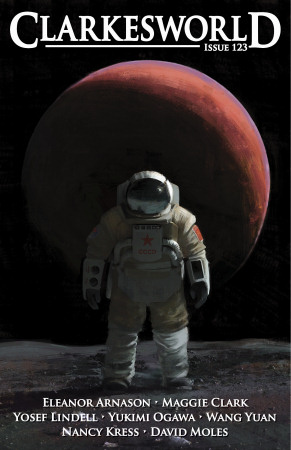
(Cover by Maciej Rebisz. Clarkesworld, December 2016.) Who Goes There?
One might think at first glance that Eleanor Arnason is a relatively new writer in the field, given how prolific she’s been as a short fiction writer for the past decade; but no, she has in fact been around for a long time. Arnason was born in New York in 1942, but her family moved several times before finally settling in Minnesota. She made her fiction debut in 1973 with “A Clear Day in the Motor City,” and was one of those post-New Wave writers who brought her own idiosyncratic worldview to the table, namely feminism and a focus on labor rights that would make her at the very least a fellow traveler to leftist causes. Evidently, going by today’s story, Arnason did not give up her radical views in favor of a mellowed-out and defeated liberalism (or even worse, a shift towards reactionary politics), like so many of her contemporaries, but continues to hope for a future in which humanity is freed from socio-economic tyranny. As to why she has written more short fiction in the 2010s and into the 2020s as opposed to the previous few decades, the answer is surprisingly straightforward: she retired from her day job in 2009 and decided to focus on writing. For those of you wondering if it’s too late to start writing, just know it isn’t.
Placing Coordinates
First published in the December 2016 issue of Clarkesworld, which you can read online. It has been reprinted only once, in The Year’s Best Science Fiction: Thirty-Fourth Annual Collection (ed. Gardner Dozois).
Enhancing Image
Since “Checkerboard Planet” takes place in a long-running series about location scout Lydia Duluth, we can infer that Lydia will come out of this ordeal in one piece—as to whether that applies to anyone else is a different question. The first scene is the weakest, if only because of the fact that it’s pretty much all exposition, and also Arnason refrains from describing the scene in any real detail. It could be that she expects us to know what’s already going on if we had read an entry in this series beforehand, but for the first-time reader it’s a bit confusing. Lydia converses with what appears to be an AI named Mantis—an AI in the true sense of the word, that is to say a sentient computer, rather than an LLM or something like that. The AIs have taken off to the point where they’re not only considered their own faction but have a good deal of power in intergalactic politics. Officially Lydia works as a scout for Stellar Harvest, a production company that does holo-vids set in exotic locales, but the AIs are asking her to also do a bit of corporate espionage. The planet of the story’s title has an unusual property, in that like the biomes in Minecraft (this is a stupid comparison, sorry), it has “bio-systems” that are cleanly divided into squares, and are so big that they can be seen from space. They also seem to be organic, despite this being an impossibility; they’re organic squares, but they must’ve been crafted by some sentient force. A corporation called Bio-Innovation has paid good money to explore this planet and has turned it into a “company planet,” like in the old days of the frontier where whole towns would be upraised for the purposes of farming resources, run by companies rather than government or the workers. In other words, it’s becoming a capitalist hellhole.
The idea is that Lydia will infiltrate and get her boots on the ground posing as a Bio-In (it’s usually shortened to that) employee, which is surprisingly easy to do, and once she’s there, merely to observe. Take notes. She has an AI implanted in her skull that she talks to, and which can record everything she sees and hears. Of course, when she actually lands on the planet it doesn’t take her long to get another job from company higher-ups (Bio-In, not Stellar Harvest) in which she is supposed to spy on Hurricane Jo Beijing, who runs a nail parlor but whom the top brass at Bio-In suspect is secretly a labor organizer. Unsurprisingly, the work on this planet under Bio-In is not unionized. Lydia and Jo know each other: they used to be friends, and they were even at different points in a relationship with the same man. Lydia is also well aware that Jo is an old-school labor rights fanatic who now lives on the checkerboard planet under an alias. It’s possible Jo could’ve left her protesting days behind her, but Lydia suspects not. Then there’s the mystery of what could be making the square bio-systems in the first place. There are a few threads here, and also the seed for a nice internal conflict for Lydia in which her personal loyalties are put to the test. She’s given two jobs which end up being mutually exclusive, not to mention ratting out Jo would make her a scab of sorts. Which comes first, her job as an explorer or her sympathy for her fellow workers? Then there’s her complicated relationship with Jo. One thing I feel I should point out, because it is a quibble I have with the story, is the treatment of Jo’s queerness. You see, Jo is very butch, to the point where she used to work as a lumberjack; she’s also a trans woman, although Lydia’s treatment of this is a bit more crass than prederred, saying a few times Jo “used to be a man.” This would’ve been fine a few decades ago, but now it reads as erring on the side of insensitive.
On the one hand this is an old-fashioned story about planetary exploration, about finding what could be giving the environment a single strange characteristic, but it’s also a pretty overtly left-leaning narrative about labor rights and the inhumanity of working without representation. It’s easy to tell Bio-In will emerge as the villain long before the climax, but what’s more curious is how Arnason tries, in the interim, to illustrate the connection between workers’ rights and animal rights. Lydia’s jobs are mutually exclusive because one involves observing nature while the other involves ratting out someone who cares about the same thing, and she can’t do one without compromising the other. The AIs merely want to understand native life on the checkerboard planet (so noninterference) while Bio-In is aiming to profit off said native life. (Of course, with the ongoing discussions about LLMs and such things in the past few years, “Checkerboard Planet” now reads a bit differently than it would have on publication, with Arnason’s optimistic framing of the AIs now seeming a bit overly optimistic. Funny how much a story can show its age after just a decade.) Despite that thing about the AIs, though, as well as the language surrounding Jo’s queerness (for what it’s worth, Jo herself is a totally sympathetic character) this is otherwise is a very forward-looking story, in which Lydia realizes that, though she would be endangering her own life, she must betray the company she’s come in to work for in order to keep her integrity. The conclusion is obvious from the reader’s perspective, but then, nobody said sticking it to “the man” would be easy. On paper Lydia’s choice is an easy one, but we would probably feel differently if one of us was put in her shoes.
There Be Spoilers Here
Since we know in advance that Lydia will come out of this particular pickle fine, and because it’s not hard to figure out who the bad guy is, this is rather a hard story to spoil. It turns out, however, that the native lifeforms on this planet are actually extensions of a single vast intelligence, which has been gaining (via mimicry) sentience at an exceedingly fast rate. This is convenient for Lydia and Jo, who convince the vast alien intelligence to take care of the bad guys for them. I was reminded of another short story’s twist with this one, although I won’t say what it is, only to say it’s a Michael Swanwick story that I almost reviewed but decided not to. Incidentally I feel pretty much the same about both stories, in that I enjoyed them but am unlikely to remember much about them. In Arnason’s favor, the leftist politics of “Checkerboard Planet” do make it more memorable.
A Step Farther Out
I respect Arnason’s attempt at marrying an old-school planetary narrative with a call for workers’ rights, considering that historically science fiction in the US has been quite hostile to organized labor. I can say, since we have at least one reliable source for tracking representations of labor in SF, that even more left-leaning writers like Isaac Asimov seemed to assume the worst of unions. This is unfortunate. I should read more Arnason, probably her older work since she’s been active since the ’70s.
See you next time.
-
Things Beyond: January 2025
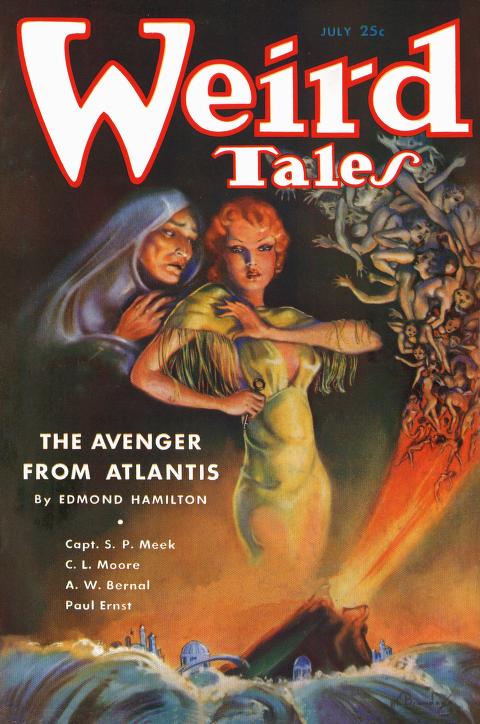
(Cover by Margaret Brundage. Weird Tales, July 1935.) Happy New Year. Blow confetti. Get drunk. Maybe kiss and cuddle a friend or significant other of yours. Although of course you would’ve done that last night. A lot of stores are closed today, because work sucks and the reality is that with a few notable exceptions nobody really wants to work. I hope this message finds you well. There will be a couple changes to this site, which mind you does not mean bad news at all. Frankly those of you who frequent here might not even notice the one “negative” change, that being the fact that given my current life circumstances I can no longer guarantee that a post will be finished on the date I expect it to be. For two years I kept to a pretty strict release schedule with my posts, but after moving into my own place, with all the pros and cons that come with that, I would expect more posts to get delayed by, say, a day, if I were in your position. Occasionally I might not even be able to post a review that I said I would; this happened a few times actually, since November, and I think it’s time to acknowledge that while I try to be prolific, I can only do so much, from a mix of life changes and depression. Also that’s why I’m reviewing a story I was supposed to write about in November, but never got around to even reading it, that being Eleanor Arnason’s “Checkerboard Planet.”
Now, in good news…
The serials department is back, after I had announced at the start of last year that I would only be covering short stories, novellas, and complete novels in 2024. I had thought about what would be the first serial to commemorate the department’s coming back from hiatus, and ultimately I figured it had to be something big. Thus I went with a Robert Heinlein novel I’ve not read before, and truth be told Heinlein’s juveniles are a bit of a blind spot for me in my knowledge of his work; I’ve read a few of them, my favorite probably being Between Planets, but I should certainly read more. It’s also been too long since I last covered Heinlein here.
In other good news, we have another magazine to pay tribute to this year, albeit not on quite the same scale as what I did with F&SF. As you may or may not know, Galaxy Science Fiction launched with the October 1950 issue, making October (or September, depending on how you look at it) of this year its 75th anniversary. Along with F&SF, Galaxy played a pivotal role in reshaping who and what got published in genre SF following Astounding‘s near-stranglehold on the field the previous decade. Especially in the ’50s, a disproportionate number of now-classic stories and novels first saw print in the pages of Galaxy, under the ingenious (if also tyrannical) editorship of H. L. Gold. Unfortunately Galaxy had a bit of a rough history after its first decade, going through a few editors and experiencing declining sales before finally being put out of its misery in 1980. It only lasted thirty years, which admittedly is still better than what most SFF magazines get, but during that time it was arguably the finest magazine of its kind. So, in March, July, and October, as with last year, I’ll be reviewing only short stories, this time from the ’50s, ’60s, and ’70s respectively, and all from Galaxy. I’ll also be reviewing one short story, novella, or serial from Galaxy every month apart from that. This should be a good deal of fun.
Now what do we have on our plate?
For the serial:
- Citizen of the Galaxy by Robert Heinlein. Serialized in Astounding Science Fiction, September to December 1957. Heinlein is that rare author who really needs no introduction, but who no doubt deserves one. He made his debut in 1939, at the fine age of 32 but having already entered the field more or less fully formed as a writer; it helps that he had already written a novel, albeit one that had initially gone unpublished, at this point. From the late ’40s to the end of the ’50s he wrote a series of “juveniles,” which helped lay the groundwork for we would now call YA SF. Citizen of the Galaxy was one of the last of these juveniles, and as far as I can tell its serialization occurred more or less simultaneously with its book publication.
For the novellas:
- “The Organleggers” by Larry Niven. From the January 1969 issue of Galaxy Science Fiction. Reprinted thereafter as “Death by Ecstasy.” One of those old-fashioned planet-builders who appeared just as the New Wave was getting started, Niven very much follows in the footsteps of Poul Anderson and Jack Vance. “The Organleggers” is the first in a series of SF-detective stories starring Gil Hamilton.
- “In the Problem Pit” by Frederik Pohl. From the September 1973 issue of The Magazine of Fantasy and Science Fiction. Pohl is one of those people who can claim to have taken part in pretty much every aspect of SF publication, from author and editor to literary agent. He edited Galaxy and If in the ’60s, to much acclaim, but in the early ’70s he gave up editing returned to writing fiction regularly.
For the short stories:
- “Checkerboard Planet” by Eleanor Arnason. From the December 2016 issue of Clarkesworld. Judging from her rate of output you might think Arnason a more recent author, but in fact she was born in 1942 and made her debut back in 1973. She’s been an activist for left-liberal causes since the ’60s but did not start writing full-time until 2009, hence her recent uptick in productivity.
- “Jirel Meets Magic” by C. L. Moore. From the July 1935 issue of Weird Tales. Moore might not be a mainstream figure in genre fiction, but she and her first husband, Henry Kuttner, have a strongly passionate following among older readers. With justification. She’s a favorite of mine. It’s been almost two years since I reviewed the first two Jirel of Joiry stories, which is far too long a wait.
Won’t you read with me? Or try to.
-
Complete Novel Review: Hard Landing by Algis Budrys

(Cover by Ron Walotsky. F&SF, Oct-Nov 1992.) Who Goes There?
This is it, the last post of the year, and also the last entry in my year-long tribute to that classiest of genre magazines: F&SF. I felt it only fitting to tackle a work by someone who was a long-time contributor to F&SF, and also from what I can tell this might be the only “complete novel” ever published in the magazine, all the others being serials. Algis Budrys enjoyed a long and productive life, and even got his start in the field early, being barely out of his teens when his first story was published in 1952. He was born in 1931 to Lithuanian parents, in what was then East Prussia, which later became German and then Russian territory. The family moved to the US when Budrys was five years old, and he spent some of his childhood in New Jersey (my home state), which no doubt played a part in the setting of today’s story. English was presumably his second language, which didn’t stop him from picking up the pen at a very young age and proving himself, over the course of just a few years, to be one of the finest wordsmiths in ’50s SF (for however much that’s worth). By the time he turned thirty he had already written such acclaimed novels as Who? and Rogue Moon, which, while flawed, are some of the most philosophically demanding reads of the pre-New Wave era, gaining him a reputation as a writer’s writer.
By past the early ’60s, Budrys’s output went down considerably, to the point where after that decade he would write only two novels: Michaelmas in 1977 and Hard Landing in 1992. While he wrote little short fiction, he kept busy and stayed a presence in the field in other ways, namely as critic and editor. He at first did the review collumn for Galaxy, before moving to F&SF, where he would stay for about 15 years. Also, around the same time Hard Landing was published, he staerted editing the ambitious semi-pro magazine Tomorrow Speculative Fiction. More controversially he was also a judge for the Scientology-backed Writers of the Future contest, and a long-time editor of the annual anthologies that organization put togehter, although Brudrys was not himself a Scientologist. Hard Landing was not the last work of fiction of his published in his lifetime, but it feels like a farewell to something, on top of being Budrys’s most formally complex novel, even if at about 45,000 words it barely counts as a novel.
Placing Coordinates
While its publication date is sometimes given as 1993, Hard Landing was first published in the October-November 1992 issue of The Magazine of Fantasy and Science Fiction. Unless Kristine Kathryn Rusch was lying or mistaken, this version is “the entire text” of the novel. The only way you can get it in-print is from Gollancz, either as an ebook or as part of a paperback omnibus with The Iron Thorn and Michaelmas.
Enhancing Image
We open with a document delving into the accidental death of a mysterious man, one by the name of Nelville Sealman, who got electrocuted at a railway station. To make a long story short, Sealman is one step short of being a John Doe, as his documentation turns out to be forged: he seemed to have borrowed the name of another Nelville Sealman, who had died in infancy in 1932, and he has no friends or next of kin. Nobody came to identify him. Authorities would only have the foggiest notion of who he was based on what he had on his person, which is not much. Doing some basic math tells us the story, at least at the time of Sealman’s death, is set in 1975. Of course, Sealman is not really Sealman, nor is he even a human being, but a humanoid alien named Selmon, who had crash-landed on Earth, in New Jersey, in the late 1940s, along with four others of his kind, although one of them had died from his injuries shortly after the landing. The deceased’s alien idenity is only made clear once an autopsy is performed and the National Registry of Pathological Anomalies (NRPA) enters the picture. Think The X-Files, which is funny because Hard Landing‘s magazine publication preceded that show’s premiere by mere months. Speaking of funny things, there’s a local pathologist named Albert Camus, which must be awkward for him since I assume the famous French writer was still a thing in this novel’s universe. (How come you never meet anyone named Abe Lincoln?) There’s also a certain Dr. William Henshaw, who appears to be a minor character at first but who will figure majorly into the plot.
The plot, such as it is, is not really the novel’s focus, for there isn’t much of a linear beat-by-beat plot but rather a Cerberus or hydra of plot threads, which happen in tandem with each other and which all sprout from the same seed. The “hard landing” of the novel’s title would have far-reaching ramifications, not least for the four (then three) survivors, especially Arvan (human name Jack Mullica) and Ravashan, with the third, Eikmo, mostly staying off-screen to do whatever business he does. Budrys ignores Eikmo, or rather refrains from giving us his perspective, for pretty much the entire novel; but this turns out to be quite deliberate rather than an oversight. As for Mullica (I’m calling him that for the rest of the review) and Ravashan, they serve as dual protagonists, being the two perspectives we shift to the most frequently. I say “the two perspectives” because despite this novel’s brevity, there’s a surprising number of those, including a fictionalized version of Brudrys himself. The, I guess you could say “gimmick” with Hard Landing is that it’s framed as a mix of fiction and non-fiction, between first-person accounts, documents, and interview recordings. It’s also not always clear who the POV character is, such that much of one’s effort when reading this novel goes into putting the pieces together—and of course these narrators are not always reliable. On paper there’s little (aside from some salty language) that would not be able to see print in, say, the years when Budrys was in his prime as a fiction writer (the ’50s and pre-New Wave ’60s), but the way in which Budrys goes about telling his story is decidedly postmodern.
Mullica and Selmon meet in 1975, in which the latter really does die in a railway accident. The rest of the novel mostly recounts how we got to this point, with the two main perspectives because Mullica’s and Ravashan. We find out early on that Mullica, despite being an alien, had gotten married a while back—he and Eikmo both, “Eikmo and his fish-store lady,” although Selmon and Ravashan remain bachelors. Mullica and Ravashan are like the plot threads of this novel in that despite starting at the same place (the crashed ship), they go in very different directions. One thing that stands out obviously with Hard Landing, and which people (on the rare occasion that anyone talks about this novel, for despite getting a Locus poll spot and Nebula nomination it’s quite obscure) are a little too quick to point out, is that it’s a dramatization of the immigrant experience—specifically the white European immigrant experience in the first half of the 20th century. Mullica and company are of course not of white European ancestry, but they pass for white, and Margery (Mullica’s wife) even mistakes him for a Soviet defector when they first meet. That Mullica and the others have rather unusual “equipment” on the inside (which does become plot-relevant) is beside the point. If readers nowadays seem indifferent to Hard Landing, or those few who read it in the first place, it’s because of two things: that Budrys’s use of multiple narrators is a smokescreen for what is really a simple and ultimately old-fashioned narrative (even in 1992 the idea of aliens landing and mixing in with everyday humans was not new), and I would also say the more unfair sentiment that the narrative of the continental European immigrant in America is no longer relevant.
There’s much debate as to how autobiographical a work of fiction can be. The idea that the author or creator puts at least a bit of themself into their work is in itself a relatively new one, in terms of understanding art, so it stands to reason that, for instance, when we read Hamlet or Macbeth we’re peeking into the mind of an Englishman who’s now been dead for over 400 years. But then there are authors who unabashedly project themselves onto their work, sometimes brazenly, to such an extent that the work really does become semi-autobiographical. Philip Roth basically made a career out of blurring the line between his real life and the lives of his main characters; there’s even a fictionalized version of himself in a few of his novels, most famously The Plot Against America. Even in the realm of genre SF there was a precedent for fiction-as-autobiography when Budrys wrote his final novel, namely with the case of Philip K. Dick. I decided to find out for myself, and Budrys had indeed reviewed Dick’s famously (or infamously) loopy novel-tract hybrid VALIS, for F&SF, although I was disappoint to find that he had very little to say about the novel as a reflection of what was clearly Dick’s mental illness and his attempt to cope with his condition. Maybe it was something one could not say in a book review that presumably thousands of people would read, including possibly Dick himself. But, whether he was genuine about it or not, Budrys’s assumption that VALIS was an attempt on Dick’s part to form a new Gnostic Christian sect was a tragic misreading of that book. Similarly it would be a tragic mistake to overlook that with his final novel, Budrys, as the son of immigrants, was writing about what it was like to be assimilated into American culture.
Mullica strives and eventually succeeds at basically living a normal life, albeit with a brush or two with low-level crime thanks to Margery’s brother (there’s the implication he runs drugs or dirty money, but not much comes with it, maybe intentionally on Budrys’s part), while Ravashan’s path is a lot more… let’s say ambitious. He gets involved with the US military and even starts to work for an unnamed and amoral congressman he calls “Yankee,” and he even founds NRPA. Yes, the department that investigates alien sightings and other anomalous activities was started by an alien. It’s called irony. Ravashan also believes he won’t be able to consult a physician for his problem, on account of keeping his alien nature a secret, so he gets the bright idea to see a veterinarian instead—who happens to be Henshaw. One of my quibbles with this novel is that its brevity and economy of words work as much against it as for it, particularly with character relationships. There’s quite a bit you could do with Ravashan and Henshaw’s interactions, but Budrys doesn’t do as much as he could’ve. Think about it: Ravashan, who by the back end of the novel has become unspeakably powerful, albeit preferring to work behind the scenes, is able to hide the fact that he is not technically a white man—that is to say he’s able to pass as a white man. But Henshaw is black. I bring this up now because Budrys brings it up. Henshaw is a well-educated black man, and is indeed the only POC in a cast of lily-white folks. On paper he’s potentially the most interesting character in the novel, but, perhaps because he feared he would screw things up, Budrys makes only step above minimal use of him. This is especially a shame because it turns out that Henshaw is one of the narrators, although this is not revealed until late. Hard Landing suffers, if anything, by being too short.
There Be Spoilers Here
It’s implied that Ravashan has contracted AIDS, at a time when the Reagan administration had not yet made it publicly known, which is how he goes out. In the strangest and maybe most provocative scene in the novel Ravashan pulls an As I Lay Dying and tells us the scene of his own death, and Henshaw subsequently burning his body so as not to leave evidence of an alien having lived on Earth. How this could be relayed to us is mysterious at first, but later we find that Henshaw has tried to write a novel based on his experiences with Ravashan and NRPA, although he’s not able to finish it. Murrica, depending on how you look at it, is not as lucky. Remember Eikmo? He’s back. He apparently got news of Selmon’s death and assumed the worst, because he tracks down Mullica to his home and thinks he had killed their mutual friend. After an altercation, both are dead, Mullica killed by Eikmo and Eikmo in turn killed by an enraged Margery. And then there were none. The scene plays like a fucking tragic play, although the exact facts of the exchange are called into question. The reality is that there is no objective viewpoint, and at the very end of the novel Budrys perhaps overplays his hand by his fictionalized self saying: “In fact, I could have made up the whole thing, couldn’t I?” Either he has a moment of doubt about whether his readers got the message or he’s mocking the obviousness of the narrator (or narrators) being unreliable. The latter is more likely, but either way I’m not a fan of the very end of this novel.
A Step Farther Out
That’s it, my last review of the year. I’ve come to realize that my ability to deliver reviews on time has been slipping as of late; partly this is because when I write, I write a lot, which takes time. I’m also quite lazy. I had finished reading Hard Landing almost a week ago but did not start working on my review until yesterday. I do, however, have a fun announcement to make in my forecast post tomorrow. Stay tuned.
See you next time.
And if I don’t see you again, Happy New Year.
-
Short Story Review: “Strata” by Edward Bryant

(Cover by Gahan Wilson. F&SF, August 1980.) Who Goes There?
Edward Bryant was born in New York, but raised in Wyoming and even went to college there; and it was the latter’s desolate landscape that very much inspired today’s story. Bryant made his professional debut in 1970, just as the New Wave was hitting its peak before going downhill, such that he would be one of the more acclaimed post-New Wave writers of the ’70s. He never wrote a novel solo, although he did collaborate on a few; but it was the short story that Bryant was really keen on, such that he managed to win back-to-back Nebulas for “Stone” and “giANTS.” Similarly “Strata” also garnered a Nebula nomination. Bryant also has, I suppose you could say the honor of having a hitherto unpublished story appear in The Last Dangerous Visions, although whether the wait was worth it or not is unclear. Bryant died in 2017, and The Last Dangerous Visions came out in 2024. While known for his SF, Bryant also wrote his fair share of horror; he did, after all, appear in the seminal horror anthology Dark Forces. “Strata” is an SF-horror hybrid, albeit leaning more into the latter genre.
Placing Coordinates
First published in the August 1980 issue of The Magazine of Fantasy and Science Fiction. It was then reprinted in Best Science Fiction Stories of the Year: Tenth Annual Collection (ed. Gardner Dozois), A Spadeful of Spacetime (ed. Fred Saberhagen), Fantasy Annual IV (ed. Terry Carr), Dinosaurs! (ed. Jack Dann and Gardner Dozois), Strange Dreams (ed. Stephen R. Donaldson), and the Bryant collections Wyoming Sun and Particle Theory.
Enhancing Image
“Strata” is a novelette, but feels shorter and smaller in scale than it is, which is mostly a good thing. I have to admit that the first few pages made me worry, since I think Bryant gets us started on the wrong foot, namely with the problem that the opening is loaded with exposition, most of which will turn out to be quite unnecessary. We’re introduced to a group of four friends, who in a flashback are celebrating their high school graduation: Steve Mavrakis, Carroll Dale (“It became second nature early on to explain to people first hearing her given name that it had two r’s and two I’s.”), Paul Onoda, and Ginger McClelland. Steve is our POV character, more or less, so it’d be fair to call him the protagonist, although he’s not a hero by any means—not to say he’s an anti-hero, but rather he’s mostly an average dude who’s also heavily implied to be autistic. Paul is the only non-white member of the group, being Japanese-American, and indeed his parents had spent time in an internment camp during World War II. There are implications with how Bryant uses Paul as the token non-white character that I don’t like, or which at least show the story’s age, but I at least understand the symbolic purpose behind using someone who comes from a persecuted racial minority. This is a story about the ugly side of American history, namely racism and colonialism, indeed the side of this country’s history that continues to reverberate in the present. It’s also a story about the baby boomers, of which Bryant and his characters are members, and how this generation, which would have come of age in the ’60s and ’70s, ran into a certain problem.
On the night of their graduation, the four kids ran into something, while hanging out and “necking” right outside Shoshoni, which I found out is a real town in Wyoming (I also recently discovered that human beings do in fact live in Wyoming, albeit not many), although it’s not something any of them can easily describe. While Paul is the token POC of the group, Steve is the token neurodivergant member, which seems to give him supernatural powers not too unlike Stephen King’s shining; his dreams are strange, even by the standards of most dreams, and no doubt they have a prophetic quality to them. Steve is shown to have a keen intelligence, but is reported as being a mediocre student, and he also has trouble interacting with people. How he then grew up to become a journalist I’m not sure. The writing of autistic characters and characters with various mental illnesses has a long and rather bleak history, since the public treatment of people with such conditions has only become to improve relatively recently, and those who have written on such persons are mostly looking from inside a glass house. It’s not unusual for neurodivergant characters in classic literature to be depicted as different in a way that implies the supernatural, one of the most famous (or infamous) examples being Benji Compson in William Faulkner’s The Sound and the Fury, who seems to experience the past and present simultaneously. Similarly when Steve has visions of the prehistoric past bleeding into the canyons of present-day Wyoming it’s like a layer of film superimposed on top of another. The most memorable and eerie of these visions, which naturally happens during one of his dreams, is Steve imagining himself as an animal with fins instead of hands. This is strange at first, but it only gets stranger when the four friends reunite fifteen years later.
The canyons of Wyoming are haunted, although by what is unclear at first. “Strata” attempts, through some exposition on Paul’s part, to provide an SFnal explanation for the things the four friends see, but it’s ultimately a ghost story; there are ghosts in the quite literal sense, but there’s also the ghost of the American frontier’s bloody past. I can see why this got a Nebula nomination, less so for the execution, which I find to be a bit clunky, and more for the ideas Bryant plays with; he’s hunting some intellectual big game here, although I think the story could’ve used another draft. Steve and company run afoul of malign spirits, although they’re not the spirits of dead indigenous peoples, but instead animal life that lived in this part of the country (although, as Steve points out, it would’ve been an ocean depending on the time period) over a hundred million years ago. In particular there’s what seems to be unnamed ancient marine reptile, large, carnivorous, and with big fins, which stalks the group. I had heard this was a story that involves dinosaurs, which I can now say is a bit misleading, not least because ancient marine reptiles were not dinosaurs. We also see at one point what looks to be a pterosaur, which mind you is also not a dinosaur. Bryant does something curious in that he clearly wants us to think of these ghostly animals as stand-ins for the wrong indigenous people who still live in that region of the country; meanwhile the actual indigenous people Steve and company come across remain on the margins of the story, barely mentioned, let alone given a chance to connect explicitly with the ghosts. But while textually something is lacking, subtextually what Bryant wants us to think about still worms into our minds.
Bryant and his characters are boomers, in the proper sense that they were born around or following the end of World War II, with Bryant himself being born about a week before Japan surrendered. The boomers are now typically derided by members of younger generations for being exceedingly selfish, short-sighted, and unwilling to take responsibility for how they may have negatively impact the world. Whereas the silent generation grew up in the shadow of the Great Depression, the boomers were born into an America which was rapidly on its way to becoming the world’s leading superpower, and with an economy and expanding middle class to show for it. World War II was a pyrrhic victory for the British empire, which came out of the war more or less in shambles, and having to resort to a kind of soft coddling welfare-socialism in order to rebuild itself. The Soviet Union came out second place, having fought back the Nazis in an impressive show of force, albeit suffering almost inconceivable losses of life in the process, showcasing a very different (and much more brutal) kind of socialism from the British. So the US became, almost overnight, the crowning beacon of capitalism for all the world to see. The boomers, growing up, probably thought this prosperity (for white people, anyway) would last forever—the only problem, at least according to a lot of boomers, being that it didn’t. The dream had, at some point, been pawned, and for what? It’s a problem that lurks in the minds of Bryant and his characters, and I don’t think it’s a coincidence that “Strata” is about boomers who would not only have come of age but would been in their early-to-mid thirties.
There Be Spoilers Here
It’s ambiguous just how much the ghosts are able to interact with the world of the living. At one point we see a deer that’s been bisected, but we’re not sure what did it; could’ve been a car, or it could’ve been something else. The encounter with the giant marine reptile in the climax is also ambiguously framed, but nevertheless the car goes offroad and crashes, and Paul dies as a result, his neck “all wrong.” Indeed something must have gone wrong a long time ago, for the spirits of the dead in this region to be so vicious. The survivors at the end are left wondering if they’re in some way responsible for the hauntings of the land, or if there’s even still time to turn back. The land has had its vengeance, not for the first time and probably not for the last time either. It’s an ominous ending, somewhat ambiguous, which I think sends off the story on a much stronger note than how it started. Paul dying and leaving the lily-white characters to fend for themselves leaves sort of a bad taste in my mouth, but this might’ve been intentional.
A Step Farther Out
I liked thinking about this one more than I liked reading it, which may or may not be a good thing considering you might spend more time thinking about something than reading it.
See you next time.
-
Short Story Review: “Skulking Permit” by Robert Sheckley
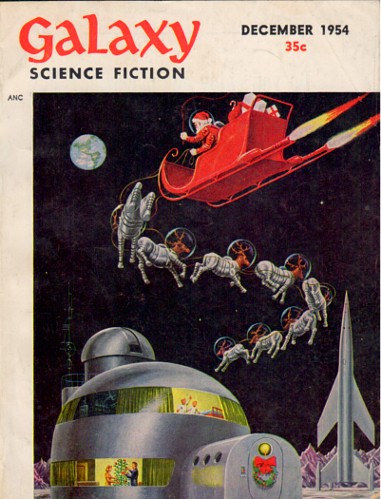
(Cover by Ed Emshwiller. Galaxy, December 1954.) Who Goes There?
Happy Christmas Eve, you fucking losers.
Robert Sheckley debuted in 1952, the same year as Philip K. Dick and Algis Budrys, and quickly established himself as one of genre SF’s court jesters, especially in the recently launched Galaxy, which would print a good portion of Sheckley’s work throughout the ’50s. It was practically a match made in heaven: Galaxy was rather liberal and socially conscious, with a lot of fiction about average middle-class working people, and Sheckley was (or at least got pigeonholed as being) quite the urbanite. Galaxy leaned towards social commentary and Sheckley was only too happy to provide some social commentary of his own. He’s also an easy writer to dig into, in that one need not think too hard when writing about a Sheckley story. Once you’ve read a few Sheckley stories you can figure out a pattern of his that he was prone to, at least in his early years. Sheckley’s work at its best is major enough that he’s actually one of the few genre SF writers to have gotten a volume in NYRB Classics. Because he wrote a lot, he sometimes wrote bland or just plain bad stuff, for the sake of a paycheck, although “Skulking Permit” shows Sheckley at perhaps his most fun-loving.
Placing Coordinates
First published in the December 1954 issue of Galaxy Science Fiction. It was reprinted the following year in the Sheckley collection Citizen in Space, and would seemingly be included in every Sheckley collection going forward except for The Store of the Worlds: The Stories of Robert Sheckley. It would also be anthologized in Overruled! (ed. Hank Davis and Christopher Ruocchio). It also has an X Minus One adaptation.
Enhancing Image
The planetary colony of New Delaware has been doing pretty well for itself, except for the fact that contact with Earth has been cut for several decades—indeed, the people of New Delaware have had to fend for themselves for the past 200 years. But then one day, miraculously, contact is regained between the settlers and the government of Earth. This is not necessarily great news. Tom Fisher is a perfectly average fisherman and law-abiding citizen (but then there are no laws to break), who suddenly has found himself with a new job to do. See, the problem is that the apparently sole superpower on Earth has, after a couple centuries, become a totalitarian shithole, being overtly against free speech, democracy, and “aliens.” The people of New Delaware don’t even know what an alien is, although the planet does seem to have indigenous (albeit non-sentient) life of its own. Earth is gonna send an inspector, or rather the Inspector, with some armed men, to see that the people of the colony have conformed to Earth standards of living. The problem, then, is that there is no problem: New Delaware, while a small village and rather agrarian, is also something of a socialist utopia. There’s a mayor, simply called the Mayor, so presumably there’s a local government, but there’s no prison, nor are there
pigscops; and there’s no prison and no police because there’s no crime. There’s not been a murder (or at least a recorded one, for all we know) on New Delaware in 200 years. This is indeed the problem, because one of the ways the colony is supposed to conform to Earth standards is that there must be police, which means there must also be crime. But the village doesn’t have a criminal class.The Mayor designates Tom as the village’s legalized, bona fide criminal, complete with a skulking permit—an authorization from the Mayor, in writing, to commit crimes. Yes, that includes murder. What could possibly go wrong? In the early years, there are basically two types of Sheckley story: humanity encountering a problem and only making the problem worse by trying to solve it, and humanity encountering a paradox in social norms and trying (in vain) to untangle this paradox. “Skulking Permit” very much fits in the latter category, but it’s a lot of fun. Sheckley pokes fun at the idea of a human civilization that is bereft of crime, and much more pointedly he pokes fun at the increasing militarization and paranoia in the US following the end of World War II. The Earth authority of the far future has gone down the rabbit hole of McCarthy-era anti-socialism (in other words, the rabbit hole we still find ourselves facing), to the point where the government of Earth has become actively genocidal and is looking to exterminate any intelligent alien life it can find. “Conformity” is the word of the day. The people of New Delaware must conform if they wish to regain partnership with the Earth authority, but conformity means actively making life in the village worse. In order to help the village meet standards for the Inspector, Tom must steal, cheat, skulk in places “of ill repute,” and yes, even kill (although thankfully sexual assault is not part of the deal), which are all things he has never done before. How do you introduce something as heinous as murder to a place that has never even known the word, among people who have never killed anything intelligent? Sheckley was one of the most persistent social critics among genre SF writers in the ’50s, although, probably intentionally, he never seemed to suggest an alternative to what he clearly saw as a slippery slope of totalitarianism in the US. New Delaware is not a valid alternative because, in true utopian fashion, it is by its nature impossible. The colonists, for some reason, have taught themselves over the course of generations of be as about as harmful to each other as baby birds. It’s more like Eden than a real place.
The convenient thing about Sheckley from a reader’s perspective, but not so from a reviewer’s, is that Sheckley was not what you would call a deep writer. His stories can be read almost like one can eat very good potato chips: they taste nice and provide some nice sodium, depending on your blood sugar, but they’re not terribly complicated. “Skulking Permit” has a loose plot and a cast of basically one-note characters, but this is fine—for one because it’s a comedy, but also the characters, while one step above cardboard, would be pretty colorful cardboard. Tom being an everyman works in service of the plot, since he is a totally unassuming guy who has to do some unsavory things for the sake of his village. Also, I’m not sure why he did this, but Sheckley gave characters last names that are professions; sure, you might think nothing of it at first, with Tom Fisher, but then you see Billy Painter, Ed Weaver, the Carpenter brothers, and so on. It’s a fucking cartoon, but for a quick read (or about as quick as you can be at 25 pages), I have to admit I chuckled quite a few times. The point of a Sheckley story is often to be funny, first and foremost, which I thought this was. It helps that, continuing with the cartoon comparison, some absurd things happen, such as the local tavern becoming more popular once it becomes known as a “place of ill repute,” or that the villagers aren’t even sure what a prison is supposed to look like, or that a group of villagers cheer like they’re at a baseball game when Tom finally steals something, or the fact that Tom “must” kill one of his fellow villagers but lacks a real motive to do so, being too friendly with everyone. It’s morbid, at least on paper, but in practice it’s perfectly upbeat, in typical Sheckley fashion.
There Be Spoilers Here
Of course, Tom can’t do it. He tries killing the Mayor, and actually comes pretty close, but the Mayor has recently gotten kicked upstairs to the position of General (a rank he doesn’t understand as the village doesn’t have a military) and tells Tom that since he’s a military figure now, to kill him would count as mutiny and not murder per se. Sure, whatever you say. Tom can’t even bring himself to kill the Inspector, someone he has never met and who’s basically an ambassador for a fascist hellscape; but even then, he simply doesn’t have that killer instinct—indeed none of the villagers have it. Seeing that the villagers are unable to kill and thus useless as would-be soldiers in an interplanetary war, the Inspector and his goons decide to just leave the planet and its “uncivilized” people in peace. This is an unusually happy ending for Sheckley, although in a bit of irony, since he was unable to prove himself as a killer, Tom sleeps “very badly” that night. New Delaware fails at becoming a “proper” society, but may have succeeded at retaining its innocence. There’s a lot you could unpack with what Sheckley is implying, but I’m sure he wanted us to enjoy it for what it is: a comedy.
A Step Farther Out
It’s a good fun read, that’s all I can really say.
See you next time.
-
The Observatory: The Origins of Depression in Science Fiction

(James Tiptree, Jr., real name Alice Bradley Sheldon [right] with her second husband, Huntington Sheldon [left]. Dated 1946.) (Note: I shouldn’t have to say this, given the title of today’s post, but I’ll be discussing depression, mental illness generally, and suicide, including some real-life cases that have haunted our field.)
I was set to review Clare Winger Harris’s story “A Runaway World” today, but as you can see, this is not a review. I was also set to write my Observatory post for the 15th, but that didn’t happen either. Well, I’m doing it now. The truth is that when I read “A Runaway World” a couple days ago, two things occurred to me: that it wasn’t a very good story (in my opinion), and that I wasn’t sure what I would even write about it. This was a problem, because normally, even with stories that are sort of dull or not good, I’m able to articulate something such that I’m about to get at least a thousand-word review in; but this time I found myself pretty much totally divorced from the material I was supposed to be thinking and writing about. It then occurred to me that I was mentally unable to engage with the material. This is not to say that Harris was actually too “smart” a writer for me or that I had somehow missed the point of the thing, but that I was too much plagued with what a few centuries ago was called “the humors” to focus on what I was reading. I was too depressed. For the past four or five days, or almost a week at this point, I’ve slipped into a manic or depressive episode at least once during the day which left me basically unable to do anything except wish to crawl into a dark hole and cry in solitude, or to take my own life. I’m a manic-depressive. My therapist, whom I’ve been seeing for just under a year now, suspects I have bipolar disorder, specifically type II, which basically means that my mood shifts, for better or worse, tend to last a short time, a few hours instead of a few days like bipolar type I.
I was a fan of science fiction long before I was aware that there might be something “wrong” with me. One of the first books I ever read outside of the classroom was Kurt Vonnegut’s Slaughterhouse-Five, which in hindsight should have been a red flag. I read quite a bit of Vonnegut in high school: Slaughterhouse-Five, The Sirens of Titan, Mother Night, Cat’s Cradle, and even Breakfast of Champions, that really weird one that barely counts as a novel (not to be confused with Timequake, which isn’t really a novel at all). Breakfast of Champions especially stuck out to me when I read it at the time, for its weirdness but also Vonnegut’s candidness about his own long-term battle with depression, his family’s history of depression (the fact that his mother had killed herself), his PTSD, his disgust with the glorification of war in American culture, and so on. Vonnegut would live to a ripe old age, despite his “best” efforts (he somewhat jokingly claimed to smoke unfiltered cigarettes over many years as a way of killing himself), although it wasn’t cancer or a heart attack that got him but a trip down the stairs. It’s almost comedic, in a way I’m sure he would’ve approved of. Vonnegut ultimately won against his war with depression, in the sense that he allowed circumstance to take him rather than his own hand—for the difference between victory and defeat for every depressive is the question of whether to kill yourself or to leave your fragile little existence in the hands of the gods. Indeed, according to Albert Camus, the question of whether to kill yourself may be the only important question. Camus himself was not suicidal, on the contrary having a real lust for life; and yet as William Styron points out in his short but telling memoir, Darkness Visible, Camus became a passenger with someone he knew to be a reckless driver, in the car accident that would kill him, “so there was an element of recklessness in the accident that bore overtones of the near-suicidal, at least of a death flirtation.” Styron wrote Darkness Visible as a way to cope with his clinical depression, but like Vonnegut he chose to reject suicide.
Some other writers, including several prominent ones in the history of science fiction and fantasy, did not reject suicide. Robert E. Howard, James Tiptree, Jr., Walter M. Miller, Jr., Thomas M. Disch, H. Beam Piper, and some others I could mention, gave into some kind of psychological malady that had been pushing them to the brink. Howard is probably the most famous example out of all of them, and he was only thirty when he died. Supposedly Howard hated the idea of aging such that he wished not to live to an old age, which for someone so young is not in itself an unusual line of thinking. One has to admit that there’s also also an increasing sense of melancholy and foreboding in terms of tone, with Howard’s writing as he got closer to the day he chose to put a gun to his head; but this, by itself, is also not enough of a sign to have caused worry in those who knew Howard at the time. Sure, “Beyond the Black River” is a much more melancholy entry in the Conan series than “The People of the Black Circle,” which was published a year prior, but conveying melancholy through fiction is by no means a sign that the author is suicidal. As you may know, especially if you’re a fan of pre-Tolkien fantasy, Howard had a history of being sort of a moody fellow, but what pushed him into a more extreme mindset was his mother’s long-term illness and her impending death. There have been attempts to analyze Howard’s relationship with his mother, some of them in poor taste, but I’ll just say that what we know for certain is that Howard struggled to imagine a life for himself without his mother in it. As his mother’s illness reached its bitter end, Howard, like a lot of suicides who go through with the act, gave little clues to those closest to him as to what he was planning. But nobody took the hint until it was too late.
Howard’s suicide would haunt the pages of Weird Tales, his most frequent outlet, for years, not least because reprints and unpublished work from Howard would appear in that magazine after his death; and indeed hitherto unpublished work by Howard would appear sporadically over the next few decades, as if unearthed or discovered in some dusty tomb, giving one the sense that despite having been dead for almost ninety years now, we still feel the ripples of this man’s decision to cut his life and career short. Of course, while Howard suffered from insecurities, having to do with masculinity and other things, he was not (at least as far as I can tell) a long-term depressive; rather his suicide came about from a mix of material circumstances and something gone amiss in his own mind. Mind you that when I discuss depression here I am not exactly referring to depression in a clinical sense, like how a therapist or psychiatrist would use the term; rather I am using the word as laymen would have understood it for centuries for now, or for as long as the idea of depression has been understood in recorded history. By this I mean that depression at its core is the sense that the outside world, the material world, seems to shrink and become insignificant as one’s own sense of self-worth declines—a kind of self-loathing narcissism, or a snake eating its own tail. People who are unsympathetic to depressives (i.e., people who to some degree lack empathy for others) will say something along the lines of: “People with depression are so self-centered.” In a way this statement is true, although probably not in the way the empathy-deficient person imagines. The problem with depression is that due to the nature of the illness, there is be a barrier between the depressive and the people around them, who presumably are not also depressives. The result is that the depressive feels that they have no choice but to gaze inward, and to see an abyss; it’s self-obsession, but also self-hatred.

(Robert E. Howard in 1934, two years before his death.) The other problem with depression, particularly those like myself who are depressives and also fans of SF, is that depictions of depression in SF seem to be nonexistent prior to maybe the 1950s. You can find a few examples, very scant and spread apart, but the exceptions if anything prove the rule. This is especially true of genre SF, in the American tradition, which does bring me back to the story I was supposed to review today. To make a long story short, “A Runaway World” is about Earth and Mars mysteriously being jettisoned from the solar system, in a scheme that has to do with radio waves and making alien contact. Or something like that. It’s an early example of a natural (or in this case, rather unnatural) catastrophe narrative that also runs adjacent to the Big Dumb Object™ narrative. It’s confusingly written and Harris’s prose is pulpy, to say the least, such that other than the fact that it’s apparently the first story by a female writer published under her own name in a genre magazine, there’s really nothing special about it. “A Runaway World” does serve, however, as a perfectly fine example of the kind of SF that normally saw print in the ’20s and ’30s, when genre SF saw print in Weird Tales and Amazing Stories; and, if we’re being perfectly honest, this technology-driven (i.e., material-driven) breed of SF would continue during the “golden age” of Astounding Science Fiction under John W. Campbell’s editorship. These stories are not really concerned with spirituality or even psychology, but are instead about people doing things, so in this way they are strictly materialist. There’s a material problem that requires a material solution. Now is not the time to ponder one’s own neurosis, or even the feelings of others. Something is to be done, physically. Characters in these old pulp stories can now strike us as weirdly inhuman, and while flat characterization is the surface criticism one should make, the lack of psychological depth is intrinsically tied with that characterization. These characters feel like cardboard because there’s nothing inside. As Gertrude Stein said, “There is no there there.”
Surely at least some of the authors who contributed to the early years of genre SF felt depression, anxiety, PTSD, and so on; but if they did in their personal lives then they dared not express such troubles in their fiction. Characters in the early stories of E. E. Smith, Murray Leinster, Raymond Z. Gallun, Isaac Asimov, and Robert Heinlein are (at least as far as the authors seem to think) perfectly reasonable and mentally fine-tuned fellows. Hal Clement, who made his debut during the height of Campbell’s powers, might be most “guilty” of this, as his characters, while being ostensibly human, do not have any human (in the psychological, Shakespearean sense) concerns to speak of. Mental illness and even just moments of mental disorder (say a nervous breakdown or an anxiety attack) were simply not things one was to write about if one wrote for the magazines in those days. Between the years of 1926 (when Amazing Stories launched and, incidentally, when “A Runaway World” was published) and circa 1945, one simply did not write or talk about mental illness anywhere near science fiction; and if you felt tempted then it was something between you and your therapist. Or God. Whichever you preferred. Yet in 1926 there were people, in the “literary” world, who wrote about their own mental illness, if only when projected onto their characters. The first examples to come to my mind are Virginia Woolf (suicide by drowning) and Ernest Hemingway (suicide by gunshot), who were both haunted by an inner sickness, among other things. But there was no one even close to a Woolf or Hemingway in the early days of genre SF—not just in writing skill but also giving a language to the array of mental pains that afflict far too many of us in the real world. I did, however, mention before that this streak of psychological emptiness in SF lasted from about 1926 to 1945, and there’s a reason for that.
World War II happened, and with it came a number of profound changes in the field. The once-hypothetical scenario of nuclear weapons became very much a reality overnight. Entire cities on fire. The enemy of the week went from being fascism to Soviet communism. There was the vast moral quandry of the Holocaust. There were also quite a few men who served in the war who came home, and decided to start writing science fiction. Kurt Vonnegut was one such veteran, whose experiences as a POW and subsequent PTSD inspired Slaughterhouse-Five. There was Walter M. Miller, who served as a bombardier, and who also suffered from PTSD and depression. There was C. M. Kornbluth, who saw action near the end of the war and whose already-weak heart was further weakened by the strain. Those who saw the horrors of World War II firsthand, and indeed those who grew up in the war’s aftermath (Philip K. Dick, Robert Sheckley, Robert Silverberg, etc.), seemed to take a much dimmer view of the human condition than the first generation of genre SF writers. Hal Clement served in the way and didn’t seem particularly bothered by his wartime experiences, but I see that as the exception that proves the rule. I have a bit of a hypothesis, although obviously you’re free to disagree with it: that one of the ways World War II impacted SF is how it made those us in the field aware that some of us, individually, are damaged inside. Before and during World War II the sentiment of the average SF story was, “There’s something wrong with the world,” but after the war it got amended to say, “There’s something wrong with the world, and me as well.” It’s hard to imagine a novel like A Canticle for Leibowitz, or Do Androids Dream of Electric Sheep?, or the stories of James Tiptree (possibly the most disturbed of all SF writers), could have been published in a landscape where depression were treated as if it did not exist.
At least we know we’re not alone, now.
-
Novella Review: “Recovering Apollo 8” by Kristine Kathryn Rusch

(Cover by Dominic Harman. Asimov’s, February 2007.) Who Goes There?
Kristine Kathryn Rusch has had a far-ranging career over the past 35 years, as both author and editor, even winning a Hugo for the latter in editing The Magazine of Fantasy and Science Fiction. I feel bad that not being fond of today’s story, as I know Rusch can at times be a pretty good writer, and her contributions to the field have been pretty considerable, albeit understated. Before she took on editorship of F&SF (in so doing becoming that famously egalitarian magazine’s first female editor), she edited the experimental book-magazine hybrid Pulphouse: The Hardback Magazine, which printed a wide range of genre fiction, including early stuff by those who would later break into the literary “mainstream” like Jonathan Lethem. She’s also been writing fiction, mostly SF but occasionally horror as well (the latter sometimes also bleeding into the former when it comes to Rusch), since the late ’80s, making her one of those people in the field who can say she’s adept at judging other people’s works while also submitting her own. She can take as good as she gives. Today’s story is uncharacteristically optimistic for Rusch, which unfortunately is to its detriment.
Placing Coordinates
First published in the February 2007 issue of Asimov’s Science Fiction. Despite the awards attention, this has been reprinted in English only twice so far, in the Rusch collection Recovering Apollo 8 and Other Stories and as a chapbook from WMG Publishing.
Enhancing Image
As you may or may not know, Apollo 8 was the first manned space flight to reach the moon, although not to land on it. The mission happened around Christmastime, as the astronauts Frank Borman, James Lovell, and William Anders orbited the moon ten times before turning to Earth. They spent that year’s Christmas in what from today’s perspective looks to be a giant tin can. The mission was of course a success, as it had to be, this being not quite two years after the tragic Apollo 1 accident which killed its crew, as well as nine months after the no-less tragic death of celebrated Soviet cosmonaut Yuri Gagarin. “Recovering Apollo 8” then asks the simple question of what might happen had the Apollo 8 mission failed, that there had been a miscalculation that resulted in the ship missing the moon’s orbital pull, and that the men on board would be left presumably to die. There is no rescue attempt as NASA does not have the technology yet, so the men’s fates are sealed. A young Richard Johansenn, a character of Rusch’s own invention, witnesses the mission go wrong and vows to spend the rest of his life contributing to the rescue of these men—or what’s left of them. His secondary goal is to do what he always wanted to do, which is to voyage out into space. He’s the sort of person who does a thing once he’s set on it.
“Recovering Apollo 8” is such a cheery fucking thing that I’m surprised it wasn’t printed in Analog. Richard is a basically well-meaning fellow who, so the third-person narrator tells us early on, also happens to be a genius. He’s such a genius, in fact, that he’s able to put his skills to use and patent them, becoming unspeakably rich in the process, with seemingly little effort. This is rather pernicious. The first thing that struck me (in a negative way) about this story is that it’s more or less a retelling of Robert Heinlein’s “Requiem,” which itself is not exactly an original narrative. For those of you who forgot or don’t know, “Requiem” is about D. D. Harriman, an unspeakably rich genius (not unlike Richard), who in his old age hires a couple of guys illegally to get him to the moon in a tin can, since due to regulations he himself had a part in he’s unable to get a flight to the moon the proper way. Harriman is also the protagonist of the later story “The Man Who Sold the Moon,” although that one takes place before “Requiem.” Anyway, Heinlein’s story is easily superior to Rusch’s, for a number of reasons, and admittedly at least one of those is to neither author’s fault or credit. See, when Heinlein wrote “Requiem,” the moon landing was still thirty years away; NASA hadn’t even come into existence yet. It was reasonable to think that maybe if humanity was to reach the moon that it might be accomplished through some determined rich fellow rather than the government. That this prediction ended up being totally wrong isn’t Heinlein’s fault.
The problem for “Recovering Apollo 8” is that not only is Rusch’s anticipation of entrepreneur-driven space exploration dead wrong, but it was arguably wrong even in 2007. Her speculation on a diverging timeline in which a single rich guy with the right connections essentially keeping public interest in space exploration alive after the point (the ’70s) where in our timeline such interest would’ve died off strikes me as deeply wrong-headed. I’m not sure what Rusch’s actual politics are, but within the confines of this one story they are quite bad. The person Rusch imagines in Richard simply does not exist in the real world, but as if to rub salt on the wound, the closest we have as analogous to Richard is… Elon Musk. Musk, who is transphobic, antisemitic, sociopathic, and at the very least a fascist sympathizer, is, like Richard and Harriman, a “genius” (I’m using heavy quotation marks here) who is obsessed with getting humanity into space. Unfortunately in the past decade or so of our timeline it has become increasingly evident that the space-loving technocrats idolized in Heinlein’s work, as well as a lot of old-timey SF, are, at least in practice, little more than endlessly greedy, conniving, self-centered man-children. Technocracy itself, a model of society idolized ever since the term “science fiction” was invented, back in the Gernsback days, has become a totally hollow shell. Technological progress without human empathy is, if anything, more likely to destroy humanity than help it. But Rusch tells us that ultra-capitalists like Richard, really the apex predators of a society that values property and capital above human life, really do have our best interests at heart. Please.
While I do find the story’s politics to be rubbish, and Richard himself a rather empty perspective character, it’s not all bad. Despite being a novella, about 20,000 words, “Recovering Apollo 8” does feel shorter than it is. We’re given the most important parts of Richard’s life, from the time that he’s a boy to when he’s a very old man, and while there’s no subplot to distract us, this is the kind of narrow-minded-story-of-one-person’s-life deal that one can get away with specifically in a novella, rather than a short story or novel. At least on a sentence-by-sentence level, Rusch clearly knows her stuff; she’s a much less clunky writer than Heinlein, although I must say that even when taken on its own, going off of just what we know about him in “Requiem,” Harriman is a much more likable protagonist than Richard. This is due in no small part to “Requiem” starting in media res, indeed at the tail end of Harriman’s life; we miss all the money-grubbing climbing-to-the-top because we start out at the top. It’s easier to think of Harriman as someone who actually cares about other people rather than as the money-grubbing ultra-capitalist he objectively is because it’s easier to forget he’s the latter, whereas Richard does not have that “luxury.” We watch as Richard spends literally decades of his life retrieving the bodies of the lost astronauts, one by one, getting obscenely rich and basically changing the world in the process. This story’s politics are impossible to ignore since it is filled to the brim with capitalist propaganda, maybe the most annoying example being the insinuation that because he’s so smart, Richard almost accidentally becomes rich. You can become rich, if you’re smart enough. Of course, we know a lot of rich people are fucking morons.
There Be Spoilers Here
Getting back to positive things to say for a moment, the Apollo 8 mission failing is by no means the only point of historical divergence. The Soviet Union collapses in 1979, about a decade ahead of schedule, and a decidedly not-so-Maoist China soon emerges as the US’s chief rival on the world stage. There’s a bit of espionage involved as at one point Richard has to meet an embassador in China with regards to a contact who may have traced the location of one of the astronauts—assuming the contact isn’t lying. As we jump farther into the future, past our own timeline, things get a bit more far-fetched, but nothing patently ridiculous—except for the fully functioning colony on Mars, which is running by the 2060s. Apparently also due to advances in medicine people live longer now, to the point where Richard is over a hundred years old by the story’s climax and still in good enough physical shape to rescue the final astronaut himself. As you may have guessed, Richard is also basically responsible for the Mars colony starting up. Elon Musk. The narrative does briefly question of Richard’s lifelong pursuit of these dead men was worth the work, or if maybe he should use his virtually infinite wealth to, say, better mankind in a material fashion; but ultimately we’re supposed to believe that what Richard has been doing really is for the best. What a crock of shit.
A Step Farther Out
Would not recommend.
See you next time.
-
Short Story Review: “It Takes a Thief” by Walter M. Miller, Jr.

(Cover by Ralph Joiner. If, May 1952.) Who Goes There?
It’s been a long-term goal of mine to review every single one of Walter M. Miller’s short stories and novellas, since all of them were published in the magazines—yes, even the stories that would make up A Canticle for Leibowitz. While he is known now for pretty much just that novel (it is, after all, the only novel he managed to finish in his lifetime), Miller wrote short fiction fairly prolifically, from his debut in 1951 until he began work on the Leibowitz stories. Those first few years, incidentally when the genre magazine market was seeing a huge bubble, were especially productive for him. Miller served as a bomber crewman during World War II, an experience that seemed to give him profound mental health issues as well as compell him to convert to Catholicism, and indeed he falls into one of my favorite kinds of writer: the depressed Catholic. Despite being active in the field for only about a decade, before going into a hybernation from which he would never truly emerge, Miller was honored with two Hugos. He killed himself in 1996, after the death of his wife and having apparently given up on the Church. He left the long-anticipated follow-up to A Canticle for Leibowitz, Saint Leibowitz and the Wild Horse Woman, to be finished by Terry Bisson, whom Miller had personally chosen and provided with notes. “It Takes a Thief” is the earliest and easily the weakest of the Miller stories I’ve covered, but it’s still a fine read and has several points of interest.
Placing Coordinates
First published in the May 1952 issue of If. It has, so far as I can tell, never been anthologized in English, but it’s been included in seemingly every Miller collection over the years, including The View from the Stars and Dark Benediction. Miller let some of his stories fall out of copyright, including this one, so you can read it on Project Gutenberg.
Enhancing Image
Asir is having a bad day, namely that he’s been crucified, spikes through his wrists like Christ, as punishment for being a thief—not a thief of material things, but of specific, secret phrases. “A ritual-thief caused havoc in the community. The owner of a holy phrase, not knowing that it had been stolen, tried to spend it—and eventually counter-claims would come to light, and a general accounting had to be called.” This is not Earth in distant past, and Asir is not the thief who hung dying next to Christ as written in the Gospels, but on Mars, in the future. Humanity has colonized Mars, but seemingly in the process lost its way. Time has been flung backwards as with a slingshot. The crucifixion is not the punishment either, but merely the prelude to the real punishment, either something relatively minor (losing a finger) or death, Asir not knowing which. His “accomplice” (it’s actually ambiguous what their relationship is supposed to be), Mara, is supposed to have gotten word back to him as to his punishment, but it seems she may have betrayed him. This turns out to not be quite the case, but Asir is still very cross with her when he’s finally let down from the crucifix and his arms bandaged. Mara had slept around a bit in order to lighten Asir’s punishment, although the elders say it’s due to his very young age: the punishment is banishment from the village. Asir is to venture out to hills, which doesn’t bother him much given that he was born there. But he has other plans.
“It Takes a Thief” is basically an adventure narrative who conclusion is obvious—maybe not as obvious in 1952, but who’s to say? It has some of the trademarks of a “gritty” ’50s SF adventure, including commentary on the prospect of nuclear destruction, and a hard-as-nails anti-hero who, if we’re being honest, is kind of a shithead. Asir is not secretly a nice person under his grizzled exterior; indeed the only thing that makes him better than the village elders is that he cares about helping humanity at large, even if on a micro level he’s a mean son of a bitch. Why someone who was raised “by a renegade” of a father, in the hills, apart from what civilization is left on Mars, would care so much about restoring humanity to its former glory, is unclear. It’s also unclear why Asir and Mara are together, since the former goes so far as to even threaten to kill the latter. (Asir is clearly an abusive partner, but never sees repercussions for his behavior, nor does Mara seem to mind much ultimately that Asir had threatened her life.) If this story has an Achilles’s heel, it’s the general unlikability of the few characters who take center stage. For what it’s worth, Asir’s slut-shaming of Mara is kept to a minimum, and the latter’s sleeping around is framed as a pragmatic move that “had to be done.” (I’m reminded of Miller’s oddly sympathetic treatment of sex workers in “The Lineman.”) The idea could be that Mars society has devolved into a dog-eat-dog world, such that even the most well-meaning of people have a dark side to them, but there’s also not enough psychology present for me to relate to these people.
Despite its ruggedness and pulpy style, though, this is still at its core a Walter M. Miller story, which means it’s about life and death, and especially man’s capacity to destroy or redeem itself. Indeed the quest Asir and Mara go on to enter the vaults, a forbidden place outside the village, guarded by a mysterious creature named… Big Joe (well that’s a bit silly). The quest to rekindle humanity’s thirst for knowledge and technology strikes me as a half-formed, more juvenile version of what Miller would explore in A Canticle for Leibowitz. I’m pretty sure that “It Takes a Thief” is by no means the only protoype in Miller’s oeuvre, of course, as from what I’ve read his short fiction writing progressed such that he was setting himself up for his big novel. I liked “The Darfsteller” and “The Lineman,” and really liked the much-overlooked “Wolf Pack.” “It Takes a Thief” is not as good as the aforementioned stories, due in part to its roughness of style and characters, its brevity, and the feeling that Miller was still working well within the constraints of pulp SF writing. At the same time it’s easy to see by the time we get to the back end of the story that while he was still quite young (about my age, which does give me a pinch of existential anxiety) and early in his writing career, Miller was on his way to becoming one of the most morally serious SF writers of his generation.
There Be Spoilers Here
A theme that clearly haunted Miller on a personal level, and which would inform a great deal of SF in the ’50s, is the problem of nuclear annihilation. This is especially pertinent for an at-the-time devout Christian like Miller, as it poses a troubling question: If Christ had suffered and died so that humanity may be saved, then why do we now have the ability to destroy ourselves with the push of a button? As Mara quips, once she and Asir have gotten past Big Joe via an elaborate floor puzzle, “The ancients weren’t so great.” They venture into the depths of the vaults and see, on a wall, an engraving of our solar system—only here they see something they do not recognize: a planet between Venus and Mars. Earth. Many years ago man had destroyed Earth and it became an asteroid belt between its neighboring planets. This is the most effective moment in the story, and it’s genuinely haunting, the kind of punch to the gut that Miller can be really good at. It may be obvious, the revelation that Earth got blown to bits, but it’s an image that feeds into the tug-of-war between Miller’s anxiety and depression over humanity’s future—or possible lack of it.
A Step Farther Out
I have to admit I picked this one because it was free to read online, and also I was intrigued by the premise, though it ended up not being as good as I had hoped. Do I regret this? Of course not, I was gonna review this story at some point, as like I said I hope to review all of Miller’s short fiction. This will probably take… a couple decades. Assuming this site still exists in twenty years, or if I still will. The future is foggy, and caked in mud. I personally don’t think I’ll be able to review them all.
See you next time.
-
Subscribe
Subscribed
Already have a WordPress.com account? Log in now.
 Science Fiction & Fantasy Remembrance