-
Novella Review: “Witch of the Demon Seas” by Poul Anderson
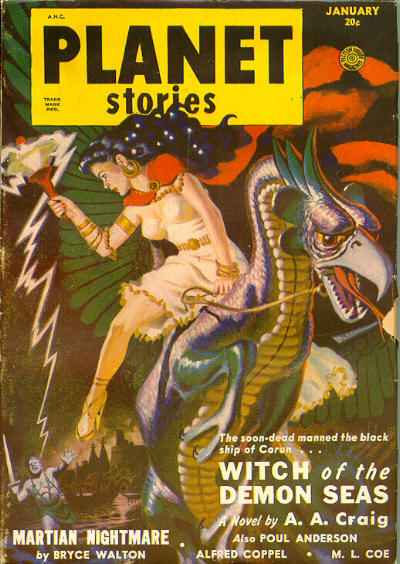
(Cover by Allen Anderson. Planet Stories, January 1951.) Who Goes There?
During his lifetime, Poul Anderson was one of the most prolific and respected genre SF writers, winning seven Hugos for short fiction (a number I think only met by Harlan Ellison’s wins) and three Nebulas. He was a made a Worldcon Guest of Honor at a rather young age, although by that point he had already been active for little over a decade. Anderson was born in 1926 to Danish immigrants, and he and his family even lived in Denmark for a short time when he was very young—his Danish heritage being something that comes up rather often in his fiction. Vikings and generally people roaming the seas pop here and there, such as in the Hugo-winning story “The Longest Voyage,” and even in “Witch of the Demon Seas,” which is much earlier and less refined, there’s this sense that Anderson saw the sailor’s life as something to admire. The ship as a microcosm for human society would be used more famously in his novel Tau Zero, with the depths of space as a stand-in for the ocean. This is one of several recurring themes with Anderson, who over the course of half a century wrote too many novels and short stories to count across several series, not to mention all the standalone titles. He studied physics at the University of Minnesota, but took up writing full-time as soon as he graduated.
I was supposed to review a different Anderson novella, “A Tragedy of Errors,” months ago, but I never got around to it, and indeed I still haven’t read that story. I should, at some point. The thing with Anderson is that he wrote so much, the vast majority of which was published in the genre magazines, that he’s a good go-to author for when I’m feeling low on inspiration with review material. Anderson wrote so much, in fact, that a lot of his work has not been reprinted that frequently, if at all. In the case of today’s story its obscurity can be explained by its length, the fact that it was originally published under a pseudonym (there’s an Anderson story under his own name in this same issue, the more often reprinted “Tiger by the Tail”), and also it being on the weak side by Anderson standards.
Placing Coordinates
First published in the January 1951 issue of Planet Stories. It has since been reprinted in Swords Against Tomorrow (ed. Robert Hoskins) and the Anderson collection Swordsmen from the Stars. It has fallen out of copyright, so you can read it on Project Gutenberg.
Enhancing Image
There’s a procession going on in Achaera, showing off the captured pirate king Corun and his band of men. Corun of Conahur used to be a legitimate warrior, and a widely respected man, who turned pirate and roamed the seas. As the sorcerer Shorzon puts it, the man may be executed, but he deserves to be put “in a decent tomb.” Shorzon’s granddaughter, the young witch Chryseis, seems to agree with the old man, and even appears to be taken with Corun upon simply seeing him. The whole public affair is theatre, of course: Corun is to be locked away in a cell, apart from his men, and executed in due time. Of course, this is before Shorzon has anything to say on the matter, in which case the sorcerer has an offer to make with Corun. The idea is simple, that Corun is to accompany Shorzon and Chryseis with a small army to the Demon Sea, an infamous territory home to the Xanthi, an intelligent race of reptile-like humanoids who take to water like swans, and who are infamous for their capacity to overwhelm the forces of men. Corun was called upon not just because he’s supposed to be one of the finest warriors in the land, but because he’s one of the few people to have actually voyaged to the Demon Sea and lived to tell the tale.
So Corun has two options, either certain death at the hands of the law, or probable death at the hands of the Xanthi. The correct choice is obvious. “In any case—to live! To die, if he must, under the sky!” It also helps that he has immediately fallen for Chryseis’s beauty and elusive charm, which I’m sure will not come back to bite him.
Now you may be thinking, “Witches? Sorcery? I thought this was science fiction.” Well, it’s nominally science fiction. “Witch of the Demon Seas” is a planetary romance with a rather heavy emphasis on the fantasy half of the science-fantasy equation; there’s an SFnal twist late in the story, but for the most part the only thing that would identify it as SF is the fact that the action is set on a planet that is decidedly not Earth, and at the same time is not one of those secondary worlds a lot of fantasy works use. This is an alien planet, home to a wide breadth of alien life, including Chryseis’s pet “erinye,” a stranged winged beast. First and foremost it’s a maritime adventure set on the high seas, with the final destination being a black castle on an otherwise desolate island. In a way it’s all more reminiscent of The 7th Voyage of Sinbad than even Leigh Brackett’s planetary adventures, from which Anderson clearly took some inspiration. Brackett and Planet Stories had almost become synonymous with each other through the ’40s and ’50s, but while Brackett was prolific, she could not be there to provide a novella or novelette for every issue; hence there were other wirters, including Anderson very early in his career, who wrote what you might call Brackett Lite. Anderson is competent at providing such material for the magazine, but this is clearly not what he would ultimately excel at.
On the voyage, aboard the Briseia, we meet Captain Imazu, maybe the most sympathetic figure in the whole story, and certainly the one who seems most aware of what kind of story he’s in. He can see right through Shorzon’s scheme and knows intuitively that Chryseis figures into it somehow, but Corun is too
hornystar-struck to listen to reason. (By the way, you may notice that Corun has a similar name and even backstory to a certain Celtic warrior we all know.) The sequence when we’re on the Briseia, which includes a thrilling action scene when some of the Xanthi try boarding the ship by force, is also my favorite. What can I say, it takes advantage of my weakness for maritime stuff. (Also, as a final aside, I couldn’t help but notice Anderson using “larboard” to refer to “port,” as in the port side of the ship, using what was even in 1950 a very outdated nautical term. He obviously would’ve been aware that port had long since replaced larboard in the seaman’s lexicon, so I wonder why he did this.) There’s also the burgeoning romance between Corun and Chryseis, which is about as arbitrary as it is fast-moving (they’re implied to have sex after about maybe a few days of knowing each other), so I’m not too thrilled about that part. Mind you that we eventually get a plot-relevant explanation for why Corun falls head over heels for this girl he just met, but that doesn’t mean I like it.There Be Spoilers Here
Sorcery is, psi powers?? No way.
A Step Farther Out
Was sort of dragging my heels to write about this one, although real-life circumstances also contributed to the delay. Anderson is a curious writer in that for how much he wrote over the decades, rarely does one catch an Anderson story that’s outright bad. Weak Anderson is still often better than what a lot of his contemporaries were doing, even those who arguably had higher highs in their output. “Witch of the Demon Seas” sees Anderson near the end of his apprentice phase, a period that undeniably came to end by the time he was writing the magazine version of Three Hearts and Three Lions and the serial version of Brain Wave a few years later. But aside from the fixation on piracy (a profession Anderson seemed to have some sympathy for even later in his career, see The Star Fox) and the nomadic anti-hero, this is a story one can skip when studying Anderson.
See you next time.
-
Serial Review: Dorsai! by Gordon R. Dickson (Part 3/3)
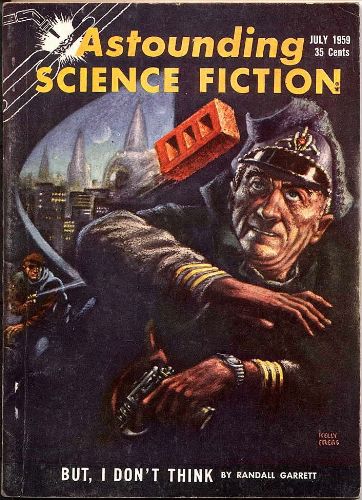
(Cover by Frank Kelly Freas. Astounding, July 1959.) The Story So Far
Donal Graeme has begun to make a name for himself rather quickly after graduating from the academy, even with a few obstacles in the way. Chief among these is Prince William of Ceta, one of the most powerful individuals in the known universe—a real feat, given that there’s something like over a dozen human-colonized worlds across multiple solar systems. William keeps Anea under his thumb, in a contract the latter cannot destroy without risk of being put to death. One-on-one contracts like this are not unusual; actually they’re pretty common, especially in Donal’s line of work. Donal is of the Dorsai, a society of people born and raised to become professional soldiers, indeed the finest soldiers and military strategists money can buy. The Dorsai fight not for patriotism or some other abstract thing, but simply because it is their trade and how they make a living. Soldiers are their chief export. Nearly every planet (except for something like Dunnin’s World, which is still in the early stages of being settled) has some specialized trade that it exchanges with other worlds in the form of specialized workers. Anea herself is young, but she’s been raised to become the Select of Kultis, Kultis being one of the Exotics, a group of planets whose cultures excel in genetic engineering. As to what a “Select” is or its importance, we’re only told in the final installment, which seems a bit late to me.
Beyond the episodic narrative of Donal hopping from job to job, including narrowly surviving a spaceship disaster and hiring a psychopath (by his own admission) named Tage Lee in one of those private contracts, the rivalry between Donal and Williams is far-off but inevitable. There’s also been some bad news in the family. Kensie, Donal’s uncle, has died, and Ian, Kensie’s brother, has become emotionally compromised, distraught over his brother’s sudden death. Ian may be depressed, even suicidal, but he’s still a Dorsai, and Dorsai don’t leave each other behind. Donal, despite being much young, has already risen above his uncle in the ranks and so decides to take him in, putting him in a position where he can do minimal harm. Speaking of family, it’s been a long time since Donal has been able to get in touch with his brother Mor, surely this will not come into play regarding the novel’s climax. We’ve followed the ups and downs of Donal’s career for the past two installments, but now it’s time for the novel to
have a pointbecome more focused in its plotting, maybe even more action-packed. Dickson has gotten away with mostly withholding thrills from the reader, in no small part because the minimal amount of violence makes sense for Donal’s character, but now shit is getting serious.Enhancing Image
Before getting into the final plot revelations, I would like go into the treatment of Ian as character, since it falls on the side of prescient. Ian, Donal’s uncle, is a side character who unfortunaely doesn’t get much of a chance to speak for himself, but what’s telling is how Donal treats his uncle’s mental illness, in that he takes said mental illness seriously. Granted, the scientific explanation we get for Ian’s condition reads as bogus, i.e., Ian and Kensie were a gestalt wherein one cannot function at full capacity without the other. It’s the “modern” equivalent of the long-standing superstitious belief that twin siblings share a single soul, which is fine for Edgar Allan Poe but not as fine for science fiction. Still, Donal cares for his uncle and doesn’t hold his mental illness against as some kind of moreal failing. This is unusually humanistic for something printed in Astounding, and it’s not even that unusual in the context of the novel, but rather feeds into the overarching theme Dickson’s playing with here.
As for the plot, it’s become clear by now that William will either find some way to put Donal under his thumb or have him assassinated. William is a shithead, but he understands Donal is too smart and too talented to have as an enemy, and at the same time too dangerous. By this point some five years have elapsed since the last time they met, and by extension the last time Donal and Anea saw each other. They’re in their twenties now, and not exactly kids anymore. There’s some romantic tension that has gone unresolved, not helped by the fact that Anea has spent years resenting Donal and misunderstanding his intentions. It would be a stretch to say Dorsai! has a villain in the mustache-twirling sense; it’d be more accurate to say there are a few characters who give Donal an especially hard time, with William being like the final boss of a video game. William, when we finally do sit down with him and figure out what he wants with the colonized worlds, comes off as more melancholy than anything. Of course, he’s about to become even more like that once Donal sends his ships and does what is considered by everyone to be impossible: he conquers a civilized world. With the help of Ian, Lee, and friends, he captures Ceta.
The victory is not all sweet, however. The final confrontation between Donal and the defeated William is a strange one, not least because we’re sudduenly introduced to what seems to be a psi power Donal has with basically no explanation, albeit it’s something the novel has alluded to before (if only vaguely). Dickson’s priorities with explaining the mechanics of his future worlds are slightly skewed, in that we’re subjected to paragraph upon paragraph of exposition about different cultures, but not so much about how genetics factor into people’s lives and individual psychologies. Hell, sex is basically not discussed at all, which might be a result of this being printed in Astounding, Dickson’s own prudishness, or both. This aversion to sex becomes most conspicuous when we’re given the explanation at the tail end of the novel that (and I’m not kidding) Anea is genetically predisposed to fall in love with the most powerful man in the known universe, which would be either Donal or William. Yeah, I can’t defend that. For how much more reactionary Starship Troopers is on the whole it is, strangely enough, more forward-thinking than Dorsai! when it comes to gender relations. On the other hand I have to give Dorsai! credit for its emphasis on compassion and aversion to bloodlust typical of military SF.
A Step Farther Out
What an oddly paced book, and with a mish-mash of different viewpoints. This is somewhat early Dickson, but you can see clearly what would make him different from even close contemporaries of his like Poul Anderson. No doubt the eugenics and (only vaguely explained) psi powers appealed to John W. Campbell, but while Dorsai! is in some ways a prototypical military SF novels, it’s far less hawkish and, conversely, more compassionate than what the subgenre would become known for. There’s a lot of tell-don’t-show here, and Dickson is not that elegant a stylist, no matter how many times he pays homage to Rudyard Kipling; but then, sometimes (indeed, often this is the case with old-timey SF) the style is not the thing, but the substance. I’d hate to think of reading the first book version, which was an abridgment and the only way to read Dorsai! for some 15 years, since even the magazine version strikes me as a bit too short.
See you next time.
-
Short Story Review: “The Halfling” by Leigh Brackett
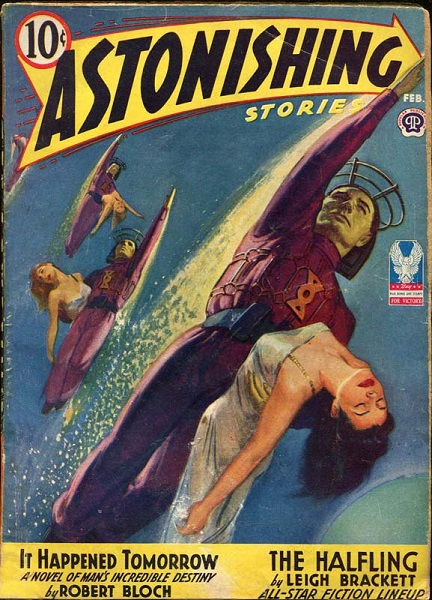
(Cover by Milton Luros. Astonishing Stories, February 1943.) Who Goes There?
Leigh Brackett was born in 1915, in LA, the city where she seemed to feel at home for the rest of her life and whose ethos she captured far better than pretty much any SF writer of her generation. She made her genre debut in 1940, in Astounding, but soon moved to other magazines despite them paying less by the word; evidently there was conflict between the kind of SF John W. Campbell wanted for his magazine and the kind Brackett was really interested in writing. Much of Brackett’s short SF could be considered science-fantasy in the Edgar Rice Burroughs tradition, although I think it’s fair to say Brackett soon came to be a finer and more compelling writer than her main inspiration. I say “main” inspiration, because it becomes apparent that Brackett had also taken a sharp interest in the crime fiction Raymond Chandler early on, which may have influenced her to write her first non-SF novel, No Good from a Corpse, published in 1944. Brackett’s interest in crime fiction, as well as her skill with writing it, goes to explain how she landed a job as co-writer of the screenplay for The Big Sleep, Howard Hawks’s film adaptation of Chandler’s famous novel. (Incidentally, a fellow writer on the script was William Faulkner—yes, that William Faulkner.) Writing for film and TV in Hollywood probably paid better than selling to pulpy magazines, but still, Brackett wrote SF consistently through the ’40s and most of the ’50s, until the market virtually imploded.
Placing Coordinates
First published in the February 1943 issue of Astonishing Stories. It has since been reprinted in Shot in the Dark (ed. Judith Merril), The Great Science Fiction Stories Volume 5, 1943 (ed. Isaac Asimov and Martin H. Greenberg), and the Brackett collections The Halfling and Other Stories and Martian Quest: The Early Brackett.
Enhancing Image
Jade Greene is the middle-aged owner of a carnival, specializing in performers from other worlds—not humans, but real aliens. We’re on Earth, specifically in California (Brackett’s homeland), but evidently we’re far enough into the future that not only have we made first contact with alien life, but the aliens have even decided to bring their parties to us. Of course, this being Brackett, our solar system seems to be densely populated with alien life, from Mars and Venus and even the moons of other planets. They all live on Earth just fine, despite the differences in gravity and air content. “The Halfling” leans more SFnal than the planetary romances Brackett would become known for, but it plays things a bit loose even by the standards of ’40s SF. Then again, instead of playing into the fantasy half that tends to comprise the planetary romance, Brackett’s decided to take cues from the burgeoning world of American crime fiction, in the mode of Raymond Chandler and Dashiell Hammett. Specifically this is a story told in the first person, and it’s hard to ignore Brackett’s implementation of a certain voice when writing Jade’s viewpoint.
Take this early passage where Jade meets Laura Darrow (she’s actually just called “the girl” for a while) for example:
It’s hard to describe a girl like that. You can say she’s five-three and beautiful, but you can’t pass on the odd little tilt of her eyes and the way her mouth looks, or the something that just comes out of her like light out of a lamp, and hooks into you so you know you’ll never be rid of it, not if you live to be a thousand.
Said passage actually does a fair bit of work, since we can infer right away that a) Jade is smitten with this girl, and b) there’s something different about her, although Jade can’t put his finger on it in the moment. (I say “in the moment,” but Jade is telling all this in the past tense, so presumably he knows how his own story ends, yet he acts ignorant of future events.) We can also infer, by way of a sixth sense known as being the reader of a story, that this Laura will somehow be involved in a conflict which looms on the horizon. Things are about to go wrong.
There are a few other notable members of the carnival, including Sindi, a Martian woman who has been Jade’s exotic dancer of choice, and who Laura wants to replace; and then there’s Laska, a “cat-man” from Callisto who’s another one of Jade’s most prized performers. Important thing about Laska and other members of his race are that they should not be given caffeine under any circumstances, since it’s like a hard drug to them and a cup of strong coffee can drive one into a berserk rage. (We’re told about this early on, conveniently, so that it can come into play later.) As for Sindi, it’s a simple case of jealousy: Laura has a certain knack for dancing that Sindi doesn’t, so that soon the two become rivals. There is also the implication that Sindi might have feelings for Jade, but if so, Jade doesn’t reciprocate them, with him instead being intensely smitten with Laura, despite the fact that, by his own admission, he’s old enough to be her dad. I’ve read enough Brackett at this point that I have to raise an eyebrow at how often she writes romances between young girls and considerably older men. It’s worth mentioning that Brackett married Edmond Hamilton, who was 11 years her senior, although Brackett was about thirty at the time.
It could, of course, be that the censorship typical of genre magazines of the era mandated restraint when it came to matters of sex, but it seems to me that Jade’s infatuation with Laura come less from love and more from lust, what with the many ways he describes her and with Laura herself being sort of a femme fatale figure. We figure that her story about being born between two planets and thus having a sticky situation with immigration law can’t be entirely true, or at least that there’s a crucial component she’s omitting. This is all fine, but predictable. Just as predictable is when one night there’s a murder at the carnival, and Sindi is the victim, just barely alive still when Jade finds her—her throat slashed, as if with giant cat claws. It’s so obvious that Laura is in some way responsible for this that I’m not even counting her playing the femme fatale role as a spoiler. Arguably the real twist comes later anyway, although that is also not too surprising. While I wasn’t terribly invested in Jade and Laura’s relationship and the growing mystery, I did find myself impressed by Brackett’s ability to evoke that hazy LA cityscape narration that would come to define the classic film noir. You can see what Howard Hawks saw when he read Brackett’s first crime novel, and indeed, more so than with other stories of hers that I’ve read, that lingo bleeds into “The Halfling” while feeling natural.
There Be Spoilers Here
Everything goes to hell so quickly that it becomes almost parodic, but it’s still gruesome enough that you sort of have to admire it. There’s a brutality here that will come to figure in a lot of Brackett’s work, a penchant for the hardboiled. The big twist, which you can anticipate if you have more than two brain cells to rub together, is that while Laura appears human, this is all a disguise. The girl Jade has fallen head over heels over is quite literally an illegal alien (bad joke, I know), and also she has an appetite for killing. Indeed she says she’s open to killing everyone in the carnival—everyone except for Jade, whom she’s taken a genuine liking to, although God knows why. This all ends about as well as you’d expect.
Isn’t Jade kind of an odd name for a dude? At most it’s androgynous, which might be a bit of a joke on Brackett’s part, since Leigh is also an androgynous name and there’s a decidedly masculine bent to Brackett’s style, never mind that her protagonists tend to be men.
A Step Farther Out
Despite the Retro Hugo nomination, “The Halfling” has not been as reprinted as some of Brackett’s other early short stories, I suspect in large part because it’s set on Earth and there’s not much in the way of swashbuckling action. It’s a bit of a mixed bag, in that Brackett doesn’t do a very good job of setting up her mystery (or mysteries), but it does at least point the way towards two distinct modes Brackett would become quite good in, namely the detective story and the “mature” SF she would be writing about a decade hence. This is a story I would recommend for those looking to take a deep dive into ’40s SF that goes way outside the rather strict boundaries set by Astounding.
See you next time.
-
The Observatory: The Among Us Show Is (Somehow) One of the Best Sci-Fi Series in Recent Years
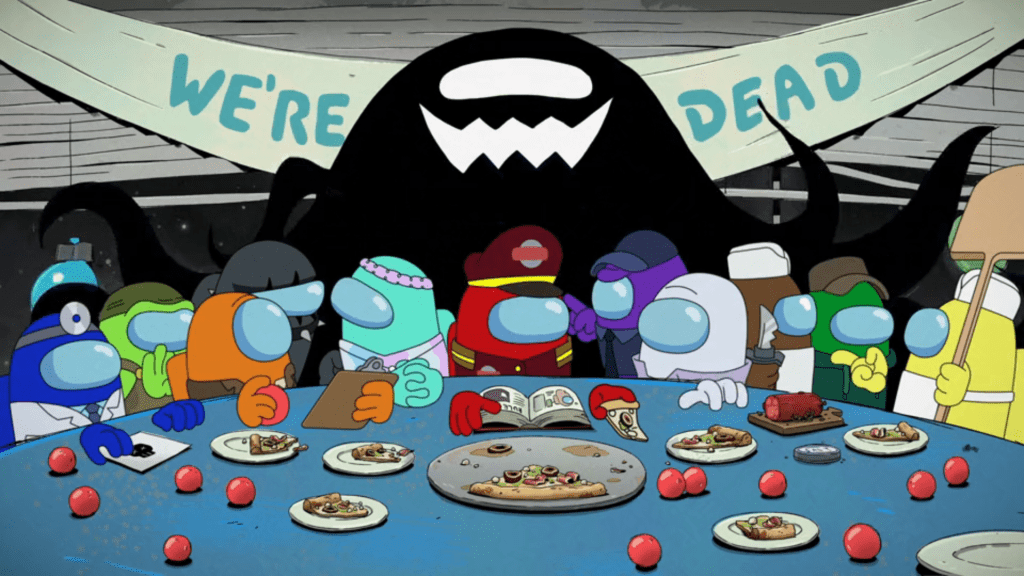
(Among Us, 2026. Introduction for the first episode.) Rule #213: Reassure crew with the phrase, “No Biggie.”
Rule #214: Aliens are real and they like to kill.
It’s hard to know where to start with this one, in part because the show’s very existence is so unexpected. This is despite the fact that an Among Us animated series, based on the video game of the same name, had been announced way back in 2023, and in fact had been finished for nearly two years before being dropped unceremoniously on Paramount+ just earlier this month. In a way the delay is fitting: the game came out in 2018, but didn’t see a serious boost in traffic until 2020. (I wonder what happened that year.) It’s fair to say the folks at Innersloth, a small-time developer, didn’t expect their little multiplayer-focused game to become a cultural phenomenon, with celebrities and even at least one US congressperson streaming their sessions, not to mention at least one notable film appearance. (Remember Glass Onion, that first sequel to Knives Out? I thought it was pretty good.) The game became obscenely popular, so maybe some kind of movie or TV adaptation was almost an inevitability. Even so, it sounds at first like a bad joke, because how much can you do with a game without any discernable plot or characters, and whose reputation in the years since its catapulting to fame has become decidedly a mixed bag? I think I’ve seen more Among Us memes than actual footage of the game in recent years, and I myself haven’t played it in a hot minute. Being color-blind and having only so many friends who would be down to play this particular game with me is an easy recipe for such a situation. It is what it is.
The premise of the game is simple and thus easy to learn but hard to master. You’re on a spaceship as some thing that’s like a cross between a bean and a trash can, as a part of a crew. Most of the crew are who they claim to be, but there’s at least one among you who is an alien in disguise. Your objectives differ depending on whether you’re a genuine crewmate or an impostor. The only way to get rid of an impostor is to call for a vote, and there is of course a chance of ejecting an innocent crewmate into the vacuum of space. There are bells and whistles we could get into, but that’s the gist of it. Every session naturally involves trust, cooperation, and most of all, paranoia. Everyone aboard looks the damn same except for color and attire, being, as Orange in the show puts it, “equally mediocre formless non-sexual beings who are very, very ugly.” There’s a bit of “lore,” but there’s no plot or concrete cast of characters—only what the players are able to invent for each session. (There’s the apparently story-driven Among Us: On Guard, but that game’s not out yet.) The game has a kind of old-school simplicity that would make it accessible to people across multiple age groups, which goes some way to explain its mainstream success. This simplicity also makes Among Us arguably ideal for fandom input, including art, music, fanfiction, and even fan-made animation. Oh, and the memes.
And then there’s the animated series, created by Owen Dennis and backed by a small army of writers, including at least one veteran (Alex Horab) from Infinity Train, Dennis’s previous show. Speaking of people who also worked on Infinity Train, Ashley Johnson, who played the lead in that show, has returned as Purple, the closest the Among Us show has to a protagonist. Aside from Johnson we have a surprisingly solid cast of veteran actors and comedians along for the ride, including Debra Wilson, Elijah Wood, Phil LaMarr, Wayne Knight, Yvette Nicole Brown, “special guest star” Patton Oswalt, and others I’ll be sure to mention. While I said Purple is effectively the series protagonist, this is very much an ensemble effort, although due to Among Us being a murder mystery and with a growing body count as the show progresses, some characters inevitably get less time to shine than others. Who lives and who dies, and in what order? That would be telling. Now, it would be very hard to discuss this show and sing some praises for it without giving away any plot turns, so I’ll only be talking explicitly about what happens in the first three episodes. I think that’s a good compromise. Hell, you can watch the first episode for free on YouTube right this second, which I obviously recommend—BUT ONLY AFTER HAVING READ THE REST OF MY REVIEW, PLEASE.
As for the plot, we have two newcomers, Green (Wood) and White (Oswalt), aboard the Skeld, on route to deliver a shipment of Ore Plus to the planet Industria. MIRA, the corporation that owns the Skeld, makes bank by mining Ore Plus from asteroids and selling this spiffy new substance as as a precious and efficient fuel source. It’s a long trip, with a rather colorful (and dysfunctional) crew, so that there’s drama even before the first body hits the floor. We have Red (Randall Park), the captain of the ship and a certified company bootlicker who seems to have gotten his job by kissing the right asses. There’s the aforementioned Purple as security officer, although as they’re quick to point out, MIRA gave the Skeld very little to work with in terms of preventing crewmates from dying horribly. (The cameras around the ship do not record, and also they shoot in black-and-white, which is a big problem when crewmates are identified mostly by their body colors.) There’s Blue (Dan Stevens), the ship’s doctor, who is adored (and sexualized) by literally everyone. There’s Lime (Knight), the terminally paranoid engineer, who claims to also be “an ordained minister.” We have Yellow (Wilson) and Brown (LaMarr), the ship’s cooks, a couple of besties and blue-collar socialists. We have Black (Liv Hewson) and Cyan (Kimiko Glenn), a geologist and a gemologist respectively. Finally there’s Orange (Brown, as in Yvette Nicole Brown, not Brown the character), an HR person from MIRA who’s supposed to give Green and White a tour of the ship. It takes one episode for everything to go wrong.
An accident involving an asteroid (by that I mean an accident Red caused by giving White control of the ship for a few minutes, on account of White being here because they won some contest [and on account of Red being very bad at their job]) throws everything into jeopardy. But don’t worry, with some teamwork and a whole crateful of rubber balls, the day is saved! Until later, when White comes into the cafeteria with a serious illness known as having their head sliced cleanly from the rest of their body. (Farewell, Patton Oswalt.) It’s a bloody mess, and more importantly, there’s presumably a killer on the loose. Red is not convinced of this at first, or at least they act like they’re not convinced of a killer being on the loose. Sure thing, buddy. We know, of course, that someone among the crew is an impostor—possibly even (wait for it) an alien impostor.
The game is afoot, as it were. The problem is that there’s no Sherlock Holmes figure on the case, or even a Sam Spade. Purple works in security, but they’re stuck with crummy equipment and only got the job in the first place because Red, who used to be friends with Purple (why they had a falling out would be going a little too into spoiler territory), vouched for them. Red themself can barely be trusted with commanding a ship, let alone solving a murder on said ship. A great deal of the conflict, then, comes from interpersonal drama rather than direct threats from the alien, although the alien shows itself to be both cunning and vicious. Despite being rated TV-PG on Paramount+, there’s a lot of gore to be found in Among Us, to the degree that it honestly makes the video game (which has its own share of blood and bone) look tame by comparison. Surely it would be unthinkable to rate this show as something ostensibly for kids if the bean creatures being gutted and decapitated were humans instead. There’s also some mild swearing, and there’s a scene that happens in the fifth episode that I would struggle to describe, even if I wasn’t giving away a major spoiler with it. The point is that while the animation is clean and cutesy (courtesy of Titmouse), and the tone mostly comedic, this is still a genuine murder mystery with high stakes. The Among Us show is like a stew with Alien, The Thing, Knives Out, and Looney Tunes cartoons as some but not all of the ingredients.
A major positive that comes from telling a mystery story, which is to say a tale of detection and deduction, is that it’s possible to make the viewer feel as if they’re collaborating with the author by deducing from facts alongside the characters, such that one can correctly figure out the killer before the characters draw the same conclusions. Granted that the viewer has a bird’s-eye view of the story, and thus is able to make connections that none of the characters would be able to make individually, much of the fun in going through a detective story is the sense of interactivity, even if it’s ersatz-interactivity like in the case of a movie or novel. In Among Us the video game, the player really does get to play detective—unless the player is the one who’s supposed to evade detection, obviously. The problem that looms over every instance of a video game getting adapted to a non-interactive medium, namely the loss of that interactivity, is softened a good deal in the case of Among Us, since the show invites the viewer to look for clues, and like every good detective story the clues are hiding in plain sight, only waiting for an especially discerning viewer to gather them. Said clues become more apparent on rewatching, but the subtleness which with Dennis and company do their foreshadowing gives the show a good deal of rewatch value anyway. There are also red herrings, false leads, sabotaged equipment, cases of the alien taunting the crew, crewmates pointing fingers at each other. Ya know, the good stuff. It’s also pretty funny.
I said that the tone is mostly comedic, which is to say that some of these characters are meant to be taken more as caricatures rather than as people with unique interior lives. White is the most obvious caricature of the lot, being a clueless and unrepentent capitalist (“What’s a capitalist?” asks Green at one point, to which White responds happily, “ME!”), so of course he’s the first to get the ax. There are members of the cast who are given more room for interiority, though, and there’s even a moment or two of pathos that comes from a character who otherwise seems to be there just to fill out the roster—yet these moments do not totally come out of nowhere. At the same time the show takes a rapid-fire approach to humor that’s not gonna win everyone over, in the sense that it takes a quality-over-quantity philosophy with its jokes. This is understandable, given that each episode only runs about 13 minutes on average and Among Us has to function as both a comedy and a murder mystery. The quality of the average joke is pretty good, though, and while I didn’t find myself laughing constantly (although there are certain bits I keep going back to), even the worst jokes are inoffensive. It helps, too, that while there are a few references sprinkled in there, including one to Henry Stickmin of all things, many of the jokes come from how quippy and at times absurd the dialogue can get, along with line delivery. Even with a cast like this you’d think at least some of the actors would phone it in, but this is not the case. My favorite here might be Wayne Knight as Lime, who has so much goddamn fun with his role.
Finally, and this is something I’ve alluded to before, but this show is pretty woke. There’s a strong anti-capitalist sentiment among both the characters and the larger themes of the story, given that MIRA is indirectly responsible for every bad thing that happens, whether it be the lack of decent security equipment, putting someone as unqualified as Red in the captain’s chair, or making Green do grunt work as an unpaid intern and sending them into what turns out to be a bloodbath. There aren’t any escape pods or even a proper airlock system—just a trash disposal unit. Yellow is absolutely right when they say Green is being exploited for their labor, being both non-union and only compensated with “experience” on their resume. Also, you may have noticed that I keep using “they” and “them” to refer to all the characters, and this is accurate: every character aboard the Skeld is non-binary, or maybe genderless, with everyone using they/them. (Incidentally Liv Hewson, Black’s VA, really is non-binary, so that’s nice.) Everyone also seems to be bisexual without much of a preference when it comes to gendered appearances, with a running gag being that everyone finds Blue attractive. Then there’s the Scene™ I mentioned before but could not (and indeed cannot) describe, but believe me when I say it’s something.
What we have with Among Us the show is sort of a miracle. It’s easily one of the best video game adaptations in the business, and unlike, say, The Last of Us (season 1, anyway, I’ve heard mixed things about season 2), which captures the story and characters of the source material well but not really how it feels to play The Last of Us, if I’m making any sense to you. With Among Us, on the other hand, it does feel like a particularly intense session of the game, albeit with a team of professional writers and voice-actors instead of your friends. We probably won’t get a second season, nor does the show call for one; there are possible scenarios for a follow-up, sure, but the story told in the show is so tightly wound and self-contained that it seems as if Dennis and company worked on it with the mindset that they would never get to do another show quite like it again. It’s short as is, which is maybe my one lingering gripe, in that all told it runs just over two hours, so that at times it does come off as the tream trying to cram a lot into a small space. But what we did get serves as a new gold standard for translating the excitement and interactivity that comes with gaming into another medium.
And remember, FUCK PARAMOUNT.
-
Serial Review: Dorsai! by Gordon R. Dickson (Part 2/3)
(Cover by H. R. Van Dongen. Astounding, June 1959.) The Story So Far
In the 25th century, mankind has not only voyaged beyond our solar system but long since colonized a multitude of planets. Aside from Earth, Mars, and Venus (that last one being famous for its technological advancements, which is ironic considering we know Venus to be an uninhabitable gaseous shithole), there are others such as the predominantly Catholic St. Marie, the twin planets Harmony and Association, the backwater Dunnin’s World, and the planet where Donal Graeme hails from, the Dorsai (for some reason it’s the Dorsai), another backwater whose chief export is its fighting men and women. See, the planets trade amongst each other mainly in people with certain skills, and these people are trained for said skills partly through positive eugenics, such that someone can be made to be the best, say, carpenter, or diplomat, quite literally from birth. The Dorsai (the people) have honed themselves over generations to be the best fighters and military strategists money can buy. I’m not even exaggerating when I say that, since rather than go fight battles on other worlds with some nonsensical patriotic notion in mind, the Dorsai join other worlds’ armies and even command said armies primarily for money. Donal happens to be a bright young commander even by the standards of a culture renowned for its cunning, but this doesn’t mean everyone (with the exception of Hendrick Galt, a marshal and a fellow Dorsai) trusts him by default.
Quite the contrary…
Not long after graduating from the academy and looking for his first assignment, Donal gets involved with Anea Marlivana, a Select of Kultis specially bred for the job, who wants him to destroy a contract she had made with Prince William, one of the most powerful men in the known universe. Not only would it be nigh-impossible to destroy the contract physically, but doing so would mean the death penalty. Clearly Anea must be off her rocker to jeopardize both her own life and Donal’s. Or is she? What’s going on with William and why would the girl, who is not much older than Donal, want to get out of her contract with him? Hugh Killien, a commandant who ends up serving under Donal, has eyes on Anea while also secretly being a way for William to watch over Donal. Well, this is inconvenient. In the heat of battle (or maybe not so hot, as there’s very little action described), in the back end of the first installment, Donal has Hugh executed on somewhat trumped-up charges—or rather, the charge on paper is legitimate, but the real reason Donal has Hugh killed off is to spite William and keep Anea safe. He finds himself unable to explain his rationale for this after the fact, though, with Anea assuming Donal got rid of Hugh out of jealousy. It’ll be a long time before they see each other again. In the meantime, Donal has a reputation to build and money to make.
Enhancing Image
Let’s talk about Donal as a person, because I’m not sure how much of his characterization was what Dickson had intended or if maybe Dickson had calibrated his protagonist to be agreeable to the prudish John W. Campbell. Sex, needless to say, is off the table, although the fact that Donal brings up attraction to women (or more accurately, his conspicuous lack of attraction) is worth discussing. First we have his romantic tension with Anea, which at least for the time being goes nowhere. Later he sparks a friendship with Elvine Rhy, Galt’s niece, but Elvine takes such a fierce liking to Donal while Donal feels not even the slightest attraction toward her, despite her being a conventionally attractive woman—a conspicuous absence that troubles him. Granted, Dickson also writes Elvine as shrewish and possessive, so it’s not hard to blame Donal for wanting to go to space rather than deal with more of her. The misogyny in this novel is mild, but almost pervasive. Back to Donal himself, his interactions with other characters, namely his tendency to be blunt and to take things literally, on top of the aforementioned awkwardness regarding romance, point to him being on the autism spectrum, although I seriously doubt Dickson had thought of this. Public understanding of autism has changed so radically in just the past few decades, never mind a novel from 1959, and unfortunately we still have a long way to go. Still, Dickson may have inadvertently written a sympathetic autistic protagonist for what is one of the first military SF novels.
We’ve come to expect certain things from military SF, a subgenre that’s been a codified thing for about half a century now, and because Dorsai! is such an early example there was not yet a formula for Dickson to abide. People going in expecting action will probably come out disappointed; if anything Donal’s great gift is his ability to win battles without even really starting them. The climax of the second installment sees Donal gain control of Zombri, an otherwise barren moon which happens to be strategically important for Harmony and Association. He does this by deceiving the enemy commander, whom we’re told is a skilled and respectable man but who has a gambling problem, with his fleet of ships, and the two agree to peace. Virtually no casualties, and Donal’s bosses get an outpost on Zombri. This is part of a recurring theme with Dickson, as someone who’s read a decent amount of his work, which is that the best kind of victory is that which involves the fewest losses on either side. I’m not saying Dickson was a pacifist, because I’m pretty sure he wasn’t; but I do think, in connection with him serving his adopted country in WWII, that Dickson had a better idea as to the loss of human life in times of war than most SF writers of his generation, who stayed civilians during the war. Donal’s superior, a religious zealot who was looking to escalate things to the point of genocidal lunacy, doesn’t take kindly to Donal’s quasi-pacifistic method of capturing Zombri. Donal is too smart, and too good with a gun, to not have seen this coming. The good news is that there’s always another contract to be made.
A Step Farther Out
The end of the second installment is a thrilling and fitting closer, although I have to wonder how the last third of the novel is supposed to pan out. It seems like Dickson was so preoccupied with introducing the reader to a vast future setting, which indeed he’ll spend the next few decades of his life fleshing out, that he did not take much time to formulate a plot. Everything is anchored by Donal, who’s a curious choice for a protagonist, if only Dickson can refrain from playing the whole “superman” thing straight as an arrow. Miraculously Donal has won every combat scenario thrown at him so far, even with some obstacles in the way, but his interpersonal troubles will or at least should provide some genuine conflict for the rest of the novel. The problem is that a lot of stuff here just happens. There’s almost a randomness to it. This is yet another similarity Dorsai! has with Starship Troopers, which was published just a few months later, in that both novels have episodic plot structures that could benefit from some subtle trimming. Of course, this is all one big coincidence. I’m enjoying Dorsai!, but while it’s more agreeable than Heinlein’s novel, the controversial (some would say fascistic) parts of Starship Troopers are also very memorable.
See you next time.
-
Novella Review: “The Diploids” by Katherine MacLean
(Cover by Jack Coggins. Thrilling Wonder Stories, April 1953.) Who Goes There?
Katherine MacLean was born in 1925, in New Jersey, and she took to writing SF rather young, in the late ’40s while working as a lab technician. MacLean arriving at the scene corresponded with those of quite a few other authors of her generation, as the magazine market was about to form a bubble the likes of which would not be seen again until decades later. When the bubble burst in the mid-’50s, MacLean’s output declined, to the point where she didn’t write that much after the ’50s, and after the ’70s had virtually retired from writing. The result is that despite living a very long life, only dying in 2019, MacLean now feels like an artifact of an almost ancient era of SF, of which she was one of the better practitioners. Despite typically being regarded as “hard SF,” the stories I’ve read from MacLean lean much harder into the soft sciences, and at times just pseudo-science (namely having to do with ESP, which she seemed to believe genuinely in); but clearly it’s her attitude and not the material itself that gives her the label. She could be considered a successor to A. E. van Vogt, working to fill a niche van Vogt had left when he stopped writing SF in the early ’50s. She can be considered, alongside van Vogt and Charles L. Harness, to be part of a school of SF writers who play fast and loose with scientific plausibility, and yet who treat this looseness with much seriousness.
Placing Coordinates
First published in the April 1953 issue of Thrilling Wonder Stories. It’s only ever been reprinted in the MacLean collection The Diploids.
Enhancing Image
The last time I wrote about MacLean was with two of her best and most reprinted stories, “Pictures Don’t Lie” and “The Snowball Effect.” These show MacLean in top form, and incidentally they were also published in Galaxy, despite Astounding (I think) having printed more of MacLean’s work. “The Diploids” definitely leans more toward the Astounding type of narrative, for reasons I can’t get into without spoiling, although it appeared in the less prestigious but in some ways more permissive Thrilling Wonder Stories. Unfortunately “The Diploids” is lesser MacLean, which doubly sucks because it’s longer than both of the aforementioned stories combined. Forty magazine pages doesn’t sound like a whole lot, but between the formatting of this specific magazine (a lot of wordage per page) and there being so much expository dialogue, it was a bit of a slog.
Paul “Mart” (short for Martian) Breden is a 28-year-old patent attorney who has a problem—actually two problems. The first is that Devon, a mad scientist and scorned would-be patent inventor, has taken it upon himself to get at Paul by any means, include a stray shot with a handgun in broad daylight. For better or worse Devon is unstable, a paranoid, and also a raging moron, one who is convinced Paul is an alien. We know from the outset that something is different about Paul, on account of him having six fingers on each hand, but to make things freakier, he also had a third eye hidden in the back of his head. (He wears his hair long so nobody would see it, which begs the question of what would happen if Paul suffered from male pattern baldness.) Aside from the fingers Paul has adnormalities about his body that he’s able to hide in public, but his close encounter with Devon results in him coming out to Nadine, his sort-of girlfriend. (Their relationship is kinda messy, not helped by Nadine being offscreen for most of the story.) Upon revealing the third eye, the first time he’s ever done this as an adult, Paul starts to wonder if maybe he really is an alien like Devon said. I feel like I’m not spoiling much by saying that this turns out to not be the case. Paul is indeed a human, born and raised on Earth and to human parents; but his parents whom he’s known his whole life had adopted him while his biological parents are unknown, so his lineage remains a mystery.
There are some bewildering character moments and interactions that make me wonder if maybe MacLean should’ve done another rewrite, including but not limited to Paul just casually shrugging off taking a bullet graze to the neck and Nadine being seemingly unable to make up her mind if she wants to start a family with Paul or not; more conspicuously, the third-person narrator tells us that Paul is slow to anger, yet multiple times in-story we see this informed bit of characterization being contradicted. In practice Paul is shown to have a short fuse, although in his defense he’s about as quick to stop being angry as he is to start. Devon is ostensibly a villain, but he’s played almost as a joke and it becomes easy to forget about him once Paul starts on the quest to find more of his own people, who are called diploids and who he thinks are “mutants” like himself. (This ends up not being quite right, but more on that in a minute.) Safe to say the pacing of this novella is strange and rather lopsided. It takes about a third of the way in for the intrigue to start building in earnest, and there is a whole cast of characters we don’t meet until the second half. There’s also some use of coincidence in order to get the plot moving: Paul just so happens to see an ad, which we’re later told only gets put up once a year, that leads him down the rabbit hole to not only tracing his lineage but finding other folks like himself. This is unusually sloppy storytelling for MacLean.
There Be Spoilers Here
In fairness to MacLean, she does put a little twist on a story which at first looks to be just a variation on van Vogt’s Slan. No doubt MacLean was thinking of Slan, which at this point was one of the most popular novels in the field. Indeed there used to be many fans of van Vogt, but they’re all dead now. Anyway, Paul is not a mutant in the strict sense that his abnormalities occurred by genetic accident; rather they were put there, intentionally, with the “accident” instead being that Paul was not supposed to have made it beyond the fetal stage. There’s a somewhat convoluted backstory involving a laboratory that experimented on human embryos much like how cosmetics companies experiment on animals, only for some of these embryos to be illegally sold off to the highest bidder and allowed entry into human society. Paul is one of the “E-2” line, in that on top of his weird but useful physical quirks he has also been gifted with high intelligence. (MacLean, as I suppose was common among folks at the time, treats IQ with a totally straight face. Anyone who has an IQ of above 140 is presumed to be a genius.) The big revelation, of course, is that rather than being a freak, Paul has won the genetic lottery, which the story treats as very good news for his and Nadine’s hopes of having children. The “diploids” are indeed a very small but special sub-race of supermen (and women).
A Step Farther Out
Well, that was a bit of a dud. It’s something you have to expect when reading SF of this vintage, though, even when it’s from someone of above-average skill like MacLean. I’m not sure if MacLean buys into the genetics mumbo jumbo she puts out in “The Diploids,” considering we know she bought enough into the notion of psi powers that she had apparently taken an interest in Dianetics in the ’50s. (The number of SF authors to have bought at least somewhat into L. Ron Hubbard’s pseudo-science at this time is depressingly high.) “The Diploids” is unusual for MacLean in a few ways, being it’s one of her longer stories, that it doesn’t have to do so much with sociology nor is it all that socially conscious, and also the debt she paid to van Vogt as an influence is at its most overt here. Like I said, though, there’s also a sloppiness with pacing and characterization that tells me MacLean had submitted it to a higher-paying magazine, namely Astounding, only for it to get rejected. But that’s just a theory.
See you next time.
-
Serial Review: Dorsai! by Gordon R. Dickson (Part 1/3)
(Cover by H. R. Van Dongen. Astounding, May 1959.) Who Goes There?
Gordon R. Dickson was born in 1923, in Canada, but moved with his family to the US when he was 13. He studied at the University of Minnesota and, unlike his close friend and fellow writer Poul Anderson, served in WWII, in the army. Despite being a few years older than Anderson, Dickson did not make his genre debut until a few year after Anderson did, and his earliest years as a writer were not as notable. By the late ’50s, however, Dickson had devised a series that he would work on sporadically over the next few decades, and which would become his life’s work: the Childe Cycle. Sadly left incomplete at the time of his death, in the sense that he never got around to fleshing out the lore as much as he had planned, the Childe Cycle is comprised of novels and shorter fiction, each story standing more or less on its own. Some of Dickson’s most beloved fiction comes from this series, and he even won two Hugos because of it. Again unlike Anderson, who became a noted hawk (albeit with a strong libertarian bent) as the Cold War escalated, Dickson’s views on war are more nuanced, maybe having been influenced by his own wartime experiences. With Dickson there is almost a paradoxical combination of his respect for the soldier as a profession and his seeming belief that peaceful negotiations are ideal whenever possible. His aliens, perhaps most memorably the bear-like Dilbians, are charismatic and sympathetic, if also eccentric.
1959 turned out to be a watershed year for military SF, a subgenre which had precursors but was not really “a thing” as of yet, since it saw the magazine appearances of Dorsai! and, much more (in)famously, Robert Heinlein’s Starship Troopers. Heinlein’s novel won a Hugo while Dickson’s came in second place. Both novels, incidentally, take a philosophical approach to the question of the soldier’s place in society, although it becomes evident that Dickson and Heinlein have very different feelings on the matter. Heinlein had also served in the military (in the navy, to be more specific), but during peacetime, so that he came away with a rose-tinted view of his time in the service. Dickson is considerably less jingoistic, although this is not to say Dorsai! is without its problematic elements. Even so, I’m quite liking what I’ve read so far (about a third of it).
Placing Coordinates
Serialized in Astounding Science Fiction, May to July 1959. It was then printed in book form the following year as The Genetic General, but with a good deal of the original text removed and with a much dumber-sounding title. The magazine version is apparently what got the Hugo nomination. Both the magazine text and title were eventually restored in 1976, and this is now the definitive version of the novel.
Enhancing Image
Dorsai! could be considered a bildungsroman, that being the story of a young man’s education—not his literal in-school education, since actually the novel begins with Donal Graeme graduating from military academy, a fresh-faced eighteen-year-old ready to cross that shadow-line from youth into adulthood. We’ve just started and already Dickson’s novel had skipped over what would become a well-worn trope in science fiction and elsewhere, that being the episode of the protagonist’s life in which they’re schooled on whatever special abilities they’ve either been given or had to learn. Even Starship Troopers has scenes set in the classroom. But Dickson, perhaps wisely, glosses over Donal’s scholastic life at the beginning and instead focuses more on Donal’s personality, or rather how other people understand him. While he is no doubt gifted and highly intelligent, yet both his teachers at the academy and members of his own family doubted him. There’s something “odd” about Donal, yet nobody can put a finger on it.
His courage was unquestioned, his word unblemished. He had headed his class. His very blood and bones were the heritage of a long line of great professional soldiers. No blot of dishonor had ever marred that roll of warriors, no home had ever been burnt, its inhabitants scattered and hiding their family shame under new names, because of some failure on the part of one of the family’s sons. And yet, they doubted.
This is made all the stranger because Donal had quite literally been born and raised to become a soldier. He might go and do something else as an adult, like become a farmer or go into business, enjoy civilian life, but military training was predestined for him and it would always form a part of his character. This is the way of the Dorsai. See, in the 25th century humanity had long since ventured beyond “the Mother Planet” and even our solar system, colonizing planets elsewhere. Humanity has splintered into cultures that specialize in different things, and this specialization is done via a form of eugenics. People, across different cultures with different ends in mind, are selectively bred and nurtured so as to max out certain skill attributes. On Dorsai, people are fine-tuned from even before birth, down to the genetic level, to become the finest soldiers in the known universe. The Dorsai is not someone who will necessarily be the smartest, the wisest, or the most compassionate person, but rather they will be the best-equipped to work as a soldier on other worlds. They will be trained and disciplined specifically in the art of warfare. The Dorsai is a perennial soldier-for-hire, or mercenary, whose job almost by default is to command men from other worlds, with prestige and a paycheck as part of it.
The Dorsai being renowned (if also sometimes contested) abroad makes up for the fact that life on Dorsai itself seems to be rough and impoverished. This is the price the Dorsai pay for what they consider absolute freedom—sort of an anarchist way of life, as free from coercion as humanly possible. (Interestingly, this novel has never even been nominated for the Prometheus Hall of Fame Award, and the Libertarian Futurist Society seems to have neglected Dickson’s work as a whole. It could be because while the Dorsai way of life is noble, in a way, it’s also shown to not be utopian by any means, even from what little we see of it in the first installment of this one novel.) One would think that a culture based not only in eugenics but the preeminence of the soldier would slip very easily into fascism or at least rub shoulders with it, a la Starship Troopers, but Donal and his family are not warmongers. They hold no animosity towards any of the neighboring human worlds, and they don’t glorify the practice of war. There’s no innate bloodlust. Rather, they place war at the center of their lives because they’re very good at it, like it really is an art form for them.
(As a side note: It’s subtle, but mankind of the future seems to be multi-racial, with Donal himself even being implied to have some mixed ancestry, despite being described in-story and even illustrated as light-skinned. His father’s middle name is Khan, which hails from central Asia, although his first name is Eachan, which is Scotch-Irish.)
The actual plot of the novel, at least at the outset, is somewhat episodic. The first real conflict comes when Donal, barely out of the academy, gets an assignment from a girl not much older than himself named Anea Marlivana, the Select of Kultis, who wants him to destroy a contract written up between her and Prince William of Ceta. There’s an immediate problem, in that not only would it take something special to destroy the contract physically (even a conventional incinerator, we’re told, will not do the trick), but to do so would also mean the death penalty. It practically a suicide mission, and yet Anea herself and her situation are so curious in their contradictions that Donal can’t help but side with her—if only to get closer to William and figure out what this is all about. Donal is trained to command, but he lacks real-world experience, hence my saying this novel could be considered a sort of bildungsroman. There’s an awkwardness and an unusual forwardness about Donal in conversation that implies he might be neurodivergent, but he’s also quite cunning. (I have some more in-depth thoughts to give on this matter, assuming the novel goes where I think it’s going.) He even does what any of us would do in his situation, in the name of getting cozy with higher-ups: that’s right, he lies on his resume, in a sense. This “bare-faced impudence” actually endears him to a major named Hendrik Galt, who happens to be a fellow Dorsai. There will be a few more cases similar to this throughout the installment, in which Donal gets what he wants through rather unconventional means.
Now, putting aside the obvious dubiousness of multiple human civilizations in which a kind of positive eugenics is a social bedrock, there’s also some light misogyny peppered in there. I guess it should not come as a surprise that the only notable female character as of yet is also shown to be easily the most emotionally unstable of the cast. In fairness, there’s a bit of chuckle-worthy (at least to my taste) comic relief with Anea, but this is very much a man’s story about gruff military men. One or two references to “womanly” irrationality in there. Less having to do with whatever may be “problematic” about the novel (truth be told, compared to Starship Troopers it comes off as pretty agreeable), there is also the issue of the ton of exposition that Dickson dumps on the reader regarding the several disparate human cultures and how they interact with each other. It’s a lot to take in for not quite fifty magazine pages, but maybe this will lighten up or at least become easier to digest as the novel progresses. It’s hard to say.
There Be Spoilers Here
Please stay tuned.
A Step Farther Out
Going back to SF of this vintage, one can expect to find things that have aged not so well, but at the same time there’s a chance you’ll find elements in a now-familiar form being subverted before said form has even learned to walk on its own two feet. Dorsai! looks to be a more straightforward example of military SF than Starship Troopers, but this isn’t saying much. Donal’s awkwardness is not what you’d expect from a protagonist in such a novel, despite the larger narrative ensuring us that this young man is destined for great things. There’s very little action. Mostly it’s just people talking, or just as often arguing. There’s a noted lack of patriotism, with the relations between characters being grounded in conflicting beliefs over what would be best for everyone on an international—err, interplanetary scale. I have my own theory about Donal, but let’s wait and see.
See you next time.
-
Things Beyond: June 2026
(Cover by Allen Anderson. Planet Stories, January 1951.) A change is coming to this site, and unfortunately it’s not for the better. I was supposed to review Leigh Brackett’s The Big Jump last month, but while I had finished reading the novel on time, I could not bring myself to write anything all that substantive about it. It’s fine, basically. It’s a short novel that is sort of spacefaring but decidedly unlike the swashbuckling planetary romances Brackett had made her bread and butter. Novels, for the most part, were also not really her strong suit, which makes her 1955 novel The Long Tomorrow all the more an outlier. I wanted to write about Brackett still, though, so this month we’ll be downsizing and looking at a short story of hers from earlier in her career, “The Halfling,” which got a Retro Hugo nomination. It’s also not a planetary romance, though; instead Poul Anderson, who for a time early in his career wrote some Brackett-esque science-fantasy, will take up that mantel. Incidentally I was supposed to write about an Anderson novella sometime last year, but never got around to it, so I’ll be making up for lost time.
The increasing habit I’ve made of missing out on pieces I had set out to cover has made me think this site could use some downsizing of its own. Thankfully not much will change except, sad to say, I will no longer be covering “complete” novels, i.e., stories 40,000 words or longer that are printed whole in magazine issues. This was a niche department to begin with, which I would only make use of a few times each year, but it seems with my life circumstances in mind that such a department is no longer viable. Of course, I’ll still be covering novels in serial form (indeed we have one such novel for this month), but the Complete Novels section you see at the top of the page of now dead. Those reviews will be kept up, because why not, but I will no longer be updating that department for the foreseeable future. Instead I will simply not post anything on the 31st of the month going forward, which gives me a bit of extra time to relax as well as the previous post more time to marinate at the top of the page. Really I think this is the best move for everyone, and I also think the price for no longer reviewing such stories is a rather small one.
July will see all short stories from Amazing Stories, but for this month it’s pretty much just more of the same. Nothing unusual here. Aside from Brackett and Anderson, authors I’d meant to cover earlier but couldn’t, we have the serial version of Gordon R. Dickson’s first major novel, as well as a novella from Katherine MacLean and an out-of-left-field SF-horror yarn from the now-obscure Raymond F. Jones. I had temporarily forgotten about my thing of reviewing as least one piece from Amazing Stories this month and almost replaced Jones with a Bruce Sterling Omni story. But Sterling is gonna have to way a bit, probably a few months.
We’re leaning vintage this month, with one story from the 1940s, three from the 1950s, and one from the 1960s.
For the serial:
- Dorsai! by Gordon R. Dickson. Serialized in Astounding Science Fiction, May to July 1959. Born and raised up to a point in Canada, but moving with his family to the US when he was 13, Dickson can now strike one as oddly mild-mannered and sympathetic for being a major forerunner of what we now call military SF. The Childe Cycle, which contains the Dorsai stories, would encompass his life’s work, although he never lived to give it a proper ending. Dorsai! was not the first story in the cycle, but apparently the second, as well as the first novel. The magazine version was nominated for a Hugo.
For the novellas:
- “The Diploids” by Katherine MacLean. From the April 1953 issue of Thrilling Wonder Stories. MacLean was one of the last major discoveries John W. Campbell had made, and indeed she would appear regularly in Astounding/Analog over the course of many years. Despite living an exceedingly long time (she died in 2019), she mostly stopped writing after the 1970s. She trained in psychology and had apparently taken in interest in Dianetics at one point.
- “Witch of the Demon Seas” by Poul Anderson. From the January 1951 issue of Planet Stories. Anderson was another Astounding/Analog regular, although he also appeared basically everywhere else. Born American but raised by Danish immigrants, there’s a strong sense of the “Nordic twilight” in Anderson’s writing, especially but not exclusively his later work. Early in his career he followed in the footsteps of Leigh Brackett and wrote some planetary romances.
For the short stories:
- “The Halfling” by Leigh Brackett. From the February 1943 issue of Astonishing Stories. Retro Hugo nominee for Best Novelette. Instead of reviewing a novel I guess we’ll settle for something more small-scale. Brackett had made her debut in 1940, in Astounding, but she quickly turned to other magazines despite the lesser pay. She would eventually find much success as a screenwriter.
- “Stay Off the Moon!” by Raymond F. Jones. From the December 1962 issue of Amazing Stories. Born and raised in Utah, Jones seems to have been the first Mormon SF writer of note, so in that sense he was ahead of his time. He was active through much of the ’40s and ’50s. Fans of Mystery Science Theater 3000 may recognize him for having written This Island Earth (the novel, not the movie).
Alright, let’s do some reading.
-
Short Story Review: “Always” by Karen Joy Fowler
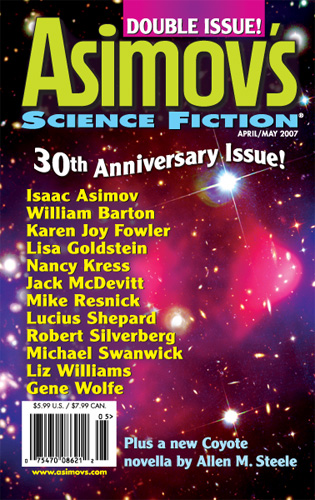
(Cover by NASA. Asimov’s, April-May 2007.) Who Goes There?
Karen Joy Fowler was born in 1950, in Indiana, but her family then moved to California. She came to writing in her thirties, with a flurry of short stories in the latter half of the ’80s; looking at her bibliography, it looks like she wrote about half of her short stories over a five-year span. Fowler is almost certainly the most high-profile talent to have made her debut in the annual Scientology-backed Writers of the Future anthology series, although to my knowledge she is not a Scientologist. (Incidentally today’s story is centered around a cult.) Over the past few decades she’s found success writing both SFF and non-genre fiction, with her 2004 novel The Jane Austen Book Club becoming a mainstream bestseller and the audience for it probably being unaware that most of what Fowler’s written (at least at short lengths) has been science fiction and fantasy. Speaking of which, she hasn’t written too much short fiction since the early ’90s, but funnily enough what she began to lack in quantity she made up for in quality. “Always” won the Nebula for Best Short Story and got nominated for the Theodore Sturgeon Memorial Award, despite the lack of a Hugo nomination. It marked Fowler’s first appearance in Asimov’s in ten years, and is not science fiction at all but rather a drama with an unexplained fantasy element.
Placing Coordinates
First published in the April-May 2007 issue of Asimov’s Science Fiction. It’s been reprinted in Science Fiction: The Best of the Year, 2008 Edition (ed. Rich Horton), Year’s Best SF 13 (ed. David G. Hartwell and Kathryn Cramer), and the Fowler collection What I Didn’t See and Other Stories.
Enhancing Image
Something that only occurred to me after the fact is that we never get the narrator’s name in this. The narrator, who at least started out as a 17-year-old girl, gets kicked out of her mom’s house and decides to hit the road with Wilt, her sort-of-friend-sort-of-boyfriend who’s nearly a decade older than her, and the two make their way to Always. This is in 1938. Always is a commune that was founded in the 1920s by one Brother Porter, who’s of indeterminate age of who is at least old enough to have a 14-year-old son. “I can’t tell you how old Brother Porter was, because he always said he wouldn’t give an irrelevant munber the power of being spoken out loud. He was a fine-looking man though. A man in his prime.” Right away we’re given the impression that Brother Porter is a suspicious man, who claims the ability to grant immortality (in the sense that people do not age) despite not having any apparent means of doing so, and more importantly the fact that he keeps the men and women (even the married couples) of the town in separate dorms and solicits sex from the latter group. Apparently the men are supposed to take some vow of celibacy. Homosexuality is not allowed. Drinking’s not allowed either, although less as a rule and more something that’s treated as a social taboo. So Always is a dry town. The townsfolk work jobs, but are supposed to give Brother Porter their paychecks, which begs the question of what the point of money here is. This is not a utopian socialist commune, but rather a society based in religion.
Indeed there’s very little that can be considered utopian about Always, even just from the first few pages of what is always a brief story. A society in which both hard drinking and free love are taboo, and yet one in which money is still a thing, is surely not a society that can be worth much of a damn. There’s also the fact that most of the people in town are much older than the narrator, ranging from middle-aged to elderly. A society predominantly comprised of people who are of retirement age or close to it surely can’t be much to write home about either. The husbands who live here are also strangely fine with getting cucked by the resident cult leader, and said cult leader (so we’re told by a few characters) also just so happens to be very good at sex. This all sounds implausible, but then you could look at just about any cult that’s taken off in the real world, whether it be Heaven’s Gate or the Church of Scientology, and wonder how any mature and rational person could buy into such a thing. Yet it has happened and continues to happen, despite our rationality telling us that this can’t be. “Always” is partly about cults and how a cult might sprout from the filthy mud of some person’s imagination, but it’s more focused on the alienation that seems to happen inevitably between cult followers and the rest of the world. In real life this alienation takes the form of a subtle change in personality, in a person’s outlook, but here Fowler treats it more literally. Consider, for one, the narrator’s anxiety about not aging:
At first. Brother Porter discouraged field trips, and then later we just found we had less and less in common with people who were going to die. When I complained about how old everyone else at Always was, Wilt pointed out that I was actually closer in age to some seventy-year-old who, like me, was going to live forever, than to some eighteen-year-old with only fifty or so years left. Wilt was as good with nmnbers as he was with cars and he was as right about that as everything else.
Once the townsfolk become convinced they will live forever they start perceiving time in a different and strange way, and the narrator is not immune to this. Of course, another question is why you would want to live forever if you’re already elderly and with one foot in the grave. Surely nobody would want to be old for the rest of eternity. There’s an old lady here, Winnifred Allington, who constantly complains about her arthritus, something that will never go away no matter how long she lives. Imagine having your joints ache and burn for a hundred years. This doesn’t sound like a very good deal to me. Wilt eventually agrees, because he leaves Always in 1941, when the US gets directly involved in WWII, and never returns. He seems to have the right idea. It would be ironic, at least, if Wilt were to get killed in the war, but instead he comes out of it just fine. The narrator, meanwhile, goes through a change, her mind not so much eroding as slowing down to the slowness of glacier—not that she becomes dumber, but rather she stops caring about normal human things. She stops getting attached to the animals at the zoo. She stops reading books and listening to music for fun. She even stops partaking in Always social life, since she stops seeing her fellow immortals as people and more as machines that are programmed to do and say the same things each day. There’s nearly a whole page of her just listing things the immortals repeat on a regular basis, probably without realizing how dull they themselves are.
I’ve seen reprints and other reviews called “Always” science fiction, but I’m not sure how it qualifies. It barely even counts as fantasy, never mind SF. The immortality trick Brother Porter pulls is never given an explanation—neither an SFnal nor supernatural one. The only maybe-supernatural thing that happens is that maybe the narrator doesn’t age over the course of several years; but the passage of time is vague enough, and we’re given so little as to the narrator’s own appearance, that we’re not sure if she’s still physically a teen girl by the end. Never mind that it’s off-putting that Brother Porter takes her on as a sexual partner despite being at least old enough to be her dad, and nobody in-story questions this. There is, in fact, very little that the characters come to question or wonder about. The only speculation that occurs is how the story observes the narrator’s changing mentality, in that Fowler speculates on how even the assumption of immortality might change someone’s attitude toward life over a period of years. Why act fast if you have more time than you could possibly know what to do with? Here’s a memorable passage detailing the narrator’s mindset, in a story that, to its credit, has its share of zingers:
I talked less and less. At first, my brain tried to make up the loss, dredging up random flashes from my past—advertising slogans, old songs, glimpses of shoes I’d worn, my mother’s jewelry, the taste of an ant I’d once eaten. A dream I’d had in which I was surrounded by food that was bigger than me, bread slices the size of mattresses, which seems like it should have been a good dream, but it wasn’t. Memories fast and scattershot. It pleased me to think my last experience of mortahty would be a toothpaste commercial. Clood-bye to all that.
Then I smoothed out and days would go by when it seemed I hardly thought at all. Tree time.
She becomes less like a human being, but unlike her fellow immortals she becomes more like a tree rather than a machine. She becomes more connected to nature. For all the strangeness of Always, the locale is very nice, as it’s located near the California coast and people are allowed to venture outside the town. So that’s something.
There Be Spoilers Here
Nothing lasts forever—not even the town where the people are supposed to live forever. It shouldn’t be surprising that the party must end, although how it ends is a bit funny. One of the more eccentric immortals, Frankie Frye, got the bright idea to test Brother Porter’s immortality by poisoning him. She didn’t do this out of malice, mind you, but as a genuine act of faith. “[Frankie] was so worked up and righteous, she made the rest of us feel we hadn’t ever had the same faith in Brother Porter she’d had or we would have poisoned him ourselves years ago.” Of course, it’s hard to feel bad for the man, since he was like a less pedophilic David Koresh. Being immortal, it turns out, does not mean you can’t be killed. The result is sort of a chain reaction, in which some more immortals get killed in horrible and inexplicable ways. The faith the collective had held had been broken. Ultimately the only person who decides to stay in Always is the narrator—a fact that she doesn’t seem to mind much. She has the trees and mountains for company, after all. (I guess this is supposed to be a bittersweet ending.)
A Step Farther Out
I wasn’t a fan, sorry. When it comes to fantasy fiction I’m fine with the lack of a “why” in the storytelling, but at some point the deliberate ambiguity the author invokes as to what is happening is supernatural or not that wearies me such that I stop wondering at all. Instead I start wondering about other things, these things having to do with the logic of the story, and that’s when it stops being fun. You can certainly poke holes in the fabric of “Always,” even with it being so concise, but the problem is that I should not feel compelled to poke holes in the story if I’m enjoying it enough. I feel as if Fowler had an idea, and something of a vignette to go with the idea, but it’s so lacking in “why” and “how” that it threatens to evaporate. I’m a little confused as to the Nebula win, as well as why multiple sources call it science fiction, because it seems as if we had read different stories. In fairness to Fowler, she’s quite good at dialogue and internal monologues, which I already knew from other short stories of hers I’ve read—just that in the case of “Always” I feel like this talent was in service of slight material.
Oh, well.
See you next time.
-
Novella Review: “Two Dooms” by C. M. Kornbluth
(Cover by Ed Emshwiller. Venture SF, July 1958.) Who Goes There?
The ’50s saw a profound influx of new talent in magazine SF, which coincided with the magazine market itself experiencing a bubble. While C. M. Kornbluth was one of the best and most vicious of these talents to ride the bubble, and was indeed not much older than newcomers like Philip K. Dick and Robert Sheckley, he had in fact made his debut at the tail end of the ’30s. Kornbluth was born in 1923, and started writing fiction of professional quality when he was all of 15 years old, making him one of the few real prodigies in literature. He was a member of the Futurians, a New York-based left-leaning (but more on how that relates to Kornbluth later) group of fans, some of whom would go on to revolutionize the field at large. Its membership was pretty stacked, including but not limited to Frederik Pohl, Judith Merril, Donald Wollheim, James Blish, Isaac Asimov, and Damon Knight. Pohl especially was close friends with Kornbluth, and even as editor of a couple low-paying magazines got much of the latter’s earliest work printed. Maybe the best of these early stories, 1941’s “The Words of Guru,” is not science fiction at all but instead horror of a particularly nasty stripe, and despite Kornbluth being all of 17 when he wrote it it’s a story that still holds up pretty damn well to this day.
About half of Kornbluth’s short stories were published between 1939 and 1942. He got drafted into the war, and even saw action at the Battle of the Bulge as part of a heavy machine gun crew. This experience in the war seemed to have exacerbated a weak heart, which eventually led to his early death in 1958. It’s tempting to think of what might’ve happened had Kornbluth lived to a proper age, not least because on the day of his death he was due to interview for the editorship of The Magazine of Fantasy and Science Fiction. Robert P. Mills was managing editor of F&SF and editor of its sister magazine, Venture Science Fiction, and was due to meet with Kornbluth. But this meeting never happened. Instead Mills replaced Anthony Boucher as editor of F&SF, in what ended up being a few of the magazine’s strongest years. Mills was a very capable editor, but still, one has to wonder what F&SF under Kornbluth would’ve been like. According to Pohl, Kornbluth sent “Two Dooms” to F&SF, as “The Doomsman,” but for reasons never given it was published in Venture instead. It may have been the last story Kornbluth himself had sent out for purchase.
Placing Coordinates
First published in the July 1958 issue of Venture Science Fiction. It was reprinted sometime later that year in the Kornbluth collection A Mile Beyond the Moon, although there’s at least one edition that doesn’t have this story. There’s also The Best of C. M. Kornbluth and His Share of Glory: The Complete Short Science Fiction of C. M. Kornbluth. As for anthology appearances we have Great Short Novels of Science Fiction (ed. Robert Silverberg), Hitler Victorious: Eleven Stories of the German Victory in World War II (ed. Gregory Benford and Martin H. Greenberg), and The World Treasury of Science Fiction (ed. David G. Hartwell).
Enhancing Image
There have been so many “Hitler wins” alternate history stories over the decades that frankly there are too many. The earliest example a lot of people think of would be Philip K. Dick’s The Man in the High Castle, but “Two Dooms” predates that novel by a few years, and may have possibly been a point of influence for Dick. Incidentally both stories involve some sort of mysticism, although both the means and ends are different. “Two Dooms” starts in our world but soon shifts over in time, not just into an alternate timeline but also about 150 years into the future. Edward Royland is a 23-year-old scientist, fresh out of college, working at Los Alamos. The year is 1944, and so far “the Bomb” is on its way to being tested but has yet to find a use in the war. Royland suspects that the atomic bomb might never be used at all, and he doesn’t know if this is good or bad. Really he’s come to hate his job, working under Oppenheimer, having heat rashes under his arms and sweating in what is quite literally a desert. After work one day he drives over to the hut of a friend of his, Nahataspe, a Hopi Indian who has something that might expand Royland’s mind—or maybe crack it like an egg. Royland takes some magic mushrooms which Nahataspe calls “the God Food,” wondering if he’s in for a mean trip. Well, he does go on a trip, of a sort, but it’s far beyond anything expected.
After an intense blackout Reynolds wakes up to find the hut empty. Both Nahataspe and his possessions are gone. This is bad enough, but what Raynolds finds once he leaves the hut is worse:
He went to the village well and found it choktxl with dust. It was while he stared into the dry hole that he first became afraid. Suddenly it all was real; he was no more an onlooker but a frightened and very thirsty man. He ransacked the dozen houses of the settlement and found nothing to his purpose—a child’s skeleton here, a couple of cartridge cases there.
The settlement had at some point been emptied of human life—by force, it seems. This is the first creepy moment in a story that’s full of such moments, although it must be said that not all of these may have been intentional. The immediate problem for Royland is that all of a sudden he finds he’s become terribly thirsty, and with the village well run dry he sets out on the road (barefoot, since the jeep he took has also disappeared) like a man already half-dead. First he hitches a ride with Martfield, a “Paymaster Seventh” who gives him some water, and who takes Royland back to civilization. Unfortunately for Martfield he’s reprimanded for “harboring a fugitive” (the assumption is that Royland had escaped from a German or Japanese labor camp) and expected to report himself, with the implication that he’s to be executed. Yet the German military men who take Royland in for examination find his story too outlandish and his very existence too open of a question. They interrogate him (at gunpoint, naturally), and Royland explains his job and WWII—the problem being that WWII, as these Germans understand it, did not happen. There was instead “the War of Triumph,” which lasted a decade longer than WWII did, and with Japan continuing to fight long after the Third Reich had fallen, giving the remnants of the Nazi regime time to take back control and beat the Allies.
That’s the short of it, anyway.
There’s a lot to unpack in what ends up being a protracted expositional scene, so let’s get to it. Not only had the War of Triumph ended, but it’s been over for over a century at this point. The Germans and Japanese have since taken control of the US, sharing ground not along broad regional lines but instead working quite literally side by side. This is very similar to how things work in The Man in the High Castle, although not quite. Let’s talk about Adolf Hitler. In Dick’s novel, Hitler remained in power for a time before the Reich higher-ups decided to lock him up in a mental institution, his brain having been eroded by late-stage syphilis. In “Two Dooms” Hitler never even became head of the Reich, but instead an “early Party agitator” who plotted to assassinate “the Leader,” who turns out to have been Joseph Goebbels. Instead of blowing his shit smooth off in his bunker, Hitler was executed during the War. There’s some irony here. Kornbluth makes some implausible predictions in creating his alternate timeline (it’s hard to believe the Japanese would’ve kept fighting for a whole decade after 1945), but the one big prediction he makes that rings true is the notion that Nazi Germany would’ve existed even without Hitler—indeed, Germany did not need Hitler per se in order to turn fascist, just a Hitler-esque figure. Maybe not even that. The ingredients for a fascist Germany were all there, in the years following WWI. Strictly speaking, “Two Dooms” is not an example of a “Hitler wins” story, but it at least follows the rules close enough.
Now, in order to engage with any story with such a premise we have do some suspension of disbelief, just right off the bat. Stories in which the Axis powers invade and then occupy the US are implausible for a few reasons, not the least of them being that neither Germany nor Japan considered such an operation to be practical. It’s improbable, if not outright impossible, that either of the remaining Axis powers would’ve orchestrated bombing campaigns against the US mainland, let alone set boots on the ground. Some savvy writers have found some alternative to this when writing such alternate history. Memorably in Philip Roth’s The Plot Against America the US threatens to turn fascist from within, thanks to Nazi sympathizers under the leadership of Charles Lindbergh, although this “plot” gets deferred (disappointingly, it must be said) at the last minute. In Robert Harris’s Fatherland, the victorious Reich looks to have friendly diplomatic relations with a susceptible America. These are both more believable than what Kornbluth and Dick had envisioned, but then it’s worth noting that those two did not have access to information about the war effort that would’ve still been classified. As to be expected of such an early example of the subgenre, “Two Dooms” is a victim of dated history, and unfortunately Kornbluth didn’t even live long enough to have read Dick’s novel. This in itself would be fine, but “Two Dooms” shows its age in other ways, and those ways happen to be a lot harder to stomach.
Royland escapes from some Nazi doctor asshole and makes way for the countryside once again. Too bad this is New Mexico. He meets a drunken Chinese man (he somehow guesses correctly that the man is Chinese just from looking at him, and also he does not say “Chinese man”) named Li Po. (Apparently this is supposed to be a reference to the ancient poet Li Bai, but sources must’ve transliterated it as Li Po at the time.) Li Po is a drunkard as well as in the midst of killing himself by drowning, to reclaim his honor, but Royland saves him and they become friends. The village Li Po belongs to is more ethnically diverse than you’d expect: “[The villagers] were a mixed lot of Chinese, Hindus, Dravidians and, to Royland’s surprise, low-caste and outcaste Japanese; he had not known there were such things.” Worryingly, however, white people are not allowed here, but Li Po manages to get Royland in on the basis of a great big lie. Over the next month or so, Royland goes native, in a sense, working the land as a farmer until his skin darkens and it becomes possible to mistake him for, say, a Latino. He has the right hair and physique for it. He comes to adjust to rough ways of the village, being on the brink of but not quite starving as he works. He even comes to acquire a fiancée, a submissive Indian (as in from India) woman. There is, sad to say, a joke or two about curry.
Speaking of which, there is some abhorrent racism in “Two Dooms,” at least some of which can be pinned on Royland’s own prejudices, but at some point you have to wonder how much Kornbluth agrees with his Orientalist and not-all-that-bright protagonist. Royland is shown to be a bit of a proto-otaku in his irrational admiration for Japanese culture, a country that would eventually be on the receiving end of the very weapon Royland has a part in developing. But Li Po and the other villagers, including (indeed especially) the young woman Royland is set to marry, are caricatures. The samurai (yes, complete with a sword) who comes to the village one night and cuts off Li Po’s head is another caricature. As he leaves the village for the last time Royland goes on a dazed rant about how these people need to stop having children “irresponsibly,” pointing towards the long-standing racist view that China and India are host to hordes of unwashed masses who can’t be trusted to take care of themselves. Royland’s racist tendencies are never seriously challenged in-story, and Kornbluth doesn’t comment on them. The only time these prejudices are challenges, in which Royland stops and has a thought, is when he remembers Bloom, a European Jewish refugee (the name might be a shoutout to Leo Bloom of Joyce’s Ulysses) who came to America. Bloom talks with a funny accent, but he’s at least given a bit more dignity than the non-white characters in the story.
There Be Spoilers Here
Before we get to the end, let’s talk about Kornbluth’s politics. I said before that the Furutians were a left-leaning fan group, ranging from liberals to card-carrying CPUSA members. Well, that was before the end of WWII anyway; needless to say people were quick to distance themselves from party politics once it became clear that the Cold War was underway. Kornbluth was one of the younger Futurians, and while he was friendly with some who were decidedly quite on the left end of things (namely Frederik Pohl and Judith Merril), his own politics are rather hard to gauge. The problem, or rather a limitation of Kornbluth’s writing, is that he seemed incapable of taking his own work all that seriously, at least when working on his own. There’s a jokiness with a lot of Kornbluth’s short fiction, even with the absence of proper jokes, and even when things take a turn for the morbid. Kornbluth can be thought as a somewhat more socially conscious (and more geared towards writing SF) counterpart to Robert Bloch. Both were part of the same generation, both were prodigies, both were culturally but not religiously Jewish, both were urbanites (Kornbluth from New York and Bloch from Chicago), both had a very dark sense of humor, and both were shrewder than their fiction often makes one assume. They were also, for better or worse, seemingly incapable of taking their own work all that seriously. There’s a deep-running disdain for the human condition that results in either writer sometimes coming off as reactionary.
Unsurprisingly Royland is able to find some of “the God Food” that got him into this alternate timeline in the first place and so, by simply repeating the process, is able to wake back up in our time. What’s curious is that there’s no firm reason to believe what Royland experienced was actually an alternate timeline and not just a psychoactive drug trip gone sideways. The implication, which Kornbluth may or may not want us to take at face value, is that Royland dipped into a timeline in which the US never dropped the atomic bombs on Japan, thereby resulting in a protacted war and the Third Reich eventually returning. This, of course, can’t be allowed to happen. The conclusion Royland reaches, which Kornbluth may or may not agree with, is a bit of an odd one, even for 1958, and on account of how Kornbluth wrote about nuclear weapons in other stories of his. Hell, not too long ago I wrote about a collaboration he did with Pohl, “Nightmare with Zeppelins,” which takes an unambiguously anti-nuclear stance. But was that more Pohl or Kornbluth’s idea? Pohl’s politics are much easier to gauge, not least because Pohl was pretty candid when writing about his evolving worldview and we have a lot more autobiographical material from him. It’s just one of those things you have to wonder about.
A Step Farther Out
I’m not sure how to feel about this one. At the very least “Two Dooms” is worth looking into as a pioneering example of a certain type of alternate history narrative, but much like other works of art that run on the cutting edge it has some issues. There have also, needless to say, been variations on this idea since then have been done better and with more depth, although I can’t imagine there are too many “Hitler wins” stories that are worth a damn to begin with. It’s such a tired idea now. But that was not the case when Kornbluth wrote it. I do suggest reading shorter stories from Kornbluth first, if you’re new to him.
See you next time.
-
Subscribe
Subscribed
Already have a WordPress.com account? Log in now.
 Science Fiction & Fantasy Remembrance