-
Serial Review: Final Blackout by L. Ron Hubbard (Part 3/3)
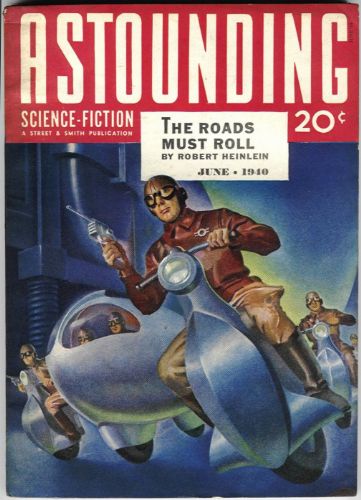
(Cover by Hubert Rogers. Astounding, June 1940.) The Story So Far
The Fourth Brigade is less a proper brigade and more a ragtag bunch of hardened war veterans from several different countries. The Lieutenant (the L is arbitrarily capitalized starting with the final installment, so I’ll capitalize it here as well for consistency’s sake) is like a father to his men, making sure they’re well provided for and given resources which have become awfully scarce in the closing days of this latest war. The Lieutenant and his men have been ordered to return to GHQ, an underground fortress in France where a small upper crust of leaders and officers lord over the starved soldiers who have taken refuge in this large and yet labyrinthine bunker. The idea is to strip the Lieutenant and effectively put him under house arrest, while his brigade gets absorbed into another unit. This plan goes very badly, though, for the men in charge of GHQ, as the Fourth Brigade is still well-manned, well-armed, and well-fed, while the opposing troops don’t put up much in the way of resistance. What the Lieutenant’s men lack of raw numbers, they more than make up for in loyalty to their commanding officer. There are some casualties for the enemy, but miraculously the Fourth Brigade makes it out without any on their end.
Up to now the UK has been isolated from the rest of Europe, due to a combination of a contagious and fatal disease call soldier’s sickness and a plague of insects which helps spread said disease. The UK itself has become a communist one-party state, with the BCP and its leader Hogarthy being in charge. None of this sounds like good news for the Lieutenant, except that he and his men have become immune to the disease; those who didn’t, died. Having been separated from their homeland (although for some it’s not their homeland at all, but then mainland Europe is so scarred from endless war that there’s really nowhere else to go), the Fourth Brigade now makes way for England, by way of several boats. Overthrowing Hogarthy and restoring order will be difficult, or so it seems.
Enhancing Image
The amphibious assault on the beaches of England, which takes up the first stretch of this last installment, also ends up being something of an anticlimax. It’s pretty compelling, however, in terms of both how it reads in a post-WWII world and the politics Hubbard (perhaps inadvertently) injects into it. There’s a fundamental irony in a bunch of soldiers under British leadership, some of whom never even lived under the British flag before, making headway against a severely weakened British home front that also had turned communist years ago. I mentioned much earlier, I think in my review of the first installment, that in the world of Final Blackout the UK and Russia have basically traded places, with Russia now working under a monarchy and with a functioning but by now fatigued military. Time works like a flat circle here, with Russia here being in a similar position to how they were during WWI. I also mentioned that while SF historians and fellow reviewers have pointed out Final Blackout‘s strange relationship to WWII, it’s clear that Hubbard was taking cues from that war’s predecessor. Like Russia in the final days of WWI, the leader goes down almost without a fight. The Lieutenant’s men capture Hogarthy, who I’m not sure even has a line of dialogue, whereupon the Lieutenant orders the man to be executed without a trial. This is a bit of cold-bloodedness that aligns with what Our Anti-Hero™ has done thus far, but it also anticipates a broader ugliness that will come to reflect the novel’s political philosophy.
In seemingly no time the Lieutenant becomes the dictator of the UK, with the country having gone from a communist dictatorship to a nominally capitalist (I say “nominally,” more on that in a minute) dictatorship with a military junta in control. There is also a symbiotic partnership struck up with another despot, a “man who styled himself King of Scotland,” who like in the very old days ruled over that part of the UK while the Lieutenant lords over England. Partly this was done for practical reasons, since not only does the Lieutenant not have any political experience, but he’s given himself the Herculean task of rebuilding a country which has long since been brought nearly to destruction by a combination of never-ending war and government mismanagement. The Lieutenant, moreover, doesn’t really have politics of his own in the sense that he doesn’t support a specific ideology; but on the other hand, he makes it clear what he doesn’t support. The Lieutenant’s (and I think it’s safe to say also Hubbard’s, by extension) worldview is a conservative one, in the sense that he doesn’t like to get involved in politics as this “other” thing, with its own rules and experts. The novel’s conservative bent was apparent long before this, but it’s here in the last stretch that Hubbard articulates his feelings on government the most clearly. The UK under the Lieutenant becomes, over the span of a couple years, a largely agrarian society run on the philosophy of Social Darwinism. The land has been depopulated, but the people and even the plants and animals that remain are said to have built up a resistance to both soldier’s sickness and the swarms of ravenous bugs. The “weak” have since been weeded out, making for a stronger and better (so we’re told) England.
British society under the military junta, in which only the “strong” have survived, falls in line with some of Hubbard’s other pre-Dianetics fiction I’ve read, most especially his short novel To the Stars. If Hubbard can be said to have a consistent political stance, it’s a belief in the possibility of a “superior” man, having been created either via eugenics or trial by combat like in Final Blackout. This is by no means a unique position in magazine SF of the ’40s, but it’s notable in how pronounced it is here, as well as the fact that Hubbard would take this idea far enough as to create a religion around it. The Church of Scientology is and has always been a bourgeois church, in which a rather large number of its membership is comprised of the rich and famous. It might be the first religion ever to have been created with the aim of appealing to the ruling class, a church both by and for the rich—that exceedingly small group of “superior” (if only by way of money and property ownership) men and women. You’ll find a liberal Scientologist, but you’d be hard-pressed to find a Scientologist who’s a socialist or anarchist. I’m sort of convinced that such a thing doesn’t exist. Hubbard, at his best and most entertaining, is able to use this deranged belief in Social Darwinism to create openly fantastical and not terribly serious power fantasies. On the opposite end he was also able to create some of the most harrowing visions in magazine SF of the era. For ever Slaves of Sleep or Typewriter in the Sky there seems to be a Fear or a Final Blackout. These are two extremes, but they also strike me as two sides of the same coin.
The climax of Final Blackout involves a very strange political situation which, surprisingly, makes sense within the context of the novel. After a couple years of rebuilding his country, the Lieutenant is met with a war ship, the USS New York, as well as a recon plane from that ship. The Americans have arrived. In any other SF story from that time this would be meant as good news, but not so in Hubbard’s novel. This might be the only time in Campbell’s Astounding, at least when the magazine was at its peak, that the Americans are framed as the villains. What’s even more surprising is that it’s not a moustache-twirling kind of villainy, but instead the kind that would prove to be prophetic of how the US would conduct itself on the world stage following the end of WWII. The US, having steered clear of the countless wars in Europe, has spent the decades obtaining colonies in South America and Africa. Despite the apparent left-leaning bent of the American government, with the “Social-democrats” and the capital-S Socialists having replaced the Republicans and Democrats as the two dominant parties, the US has gone full imperialist. The degree to which Hubbard predicted a power-hungry US is creepy. So, the people of the UK are left with two options, both of which are unsavory: either a military dictatorship under the Lieutenant, or as a satellite state under the US. The conclusion clearly favors the former, but the result is still violent and at best bittersweet. I feel like I should stay away from giving away specifics about the ending, but let’s say this is not a feel-good type of story.
A Step Farther Out
Final Blackout is not quite as thrilling as the best of Hubbard’s fantasy and horror from around this time, and there’s also the sense that getting it published just a few years later, once the US entered WWII properly, would’ve been more difficult. There’s a lot to discuss with the political position Hubbard seems to take here—if only more people in living memory had read this novel. There used to be quite a few fans of Hubbard’s early fiction, but they all seem to be dead now. Even so, taking its faults and pretty dubious politics into account, it’s hard to find anything quite like Final Blackout in the pages of ’40s magazine SF. The fact that it ran in Astounding almost feels like an accident, and may have only happened because Hubbard and John W. Campbell were chummy with each other. This is one of the darkest and bloodiest SF novels of its era (hell, it might be the darkest and bloodiest), and on that front alone I would have to recommend it. Just be aware of what you’re getting into.
See you next time.
-
Short Story Review: “The Persecutor’s Tale” by John M. Ford
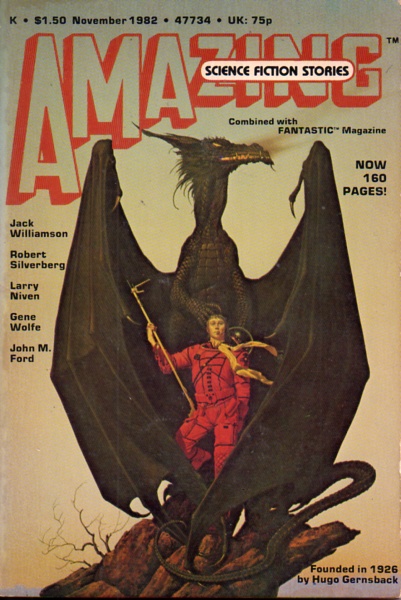
(Cover by Michael Whelan. Amazing Stories, November 1982.) Who Goes There?
John Milo Ford (his friends called him Mike) was born in 1957 in Indiana, but later became a Minneapolis denizen. He was one of those rare literary prodigies, having made his first sale when he was only 18 and with his debut novel, Web of Angels, published when he was only 23. Unlike a lot of authors who specialize in one or two modes of writing, Ford was more of a jack of all trades, writing novels, short stories, poetry, speculative articles, and even designing tabletop games. It could be this versatility, combined with the fact that Ford’s work can at times be demanding by genre fiction standards, that might explain his perpetual obscurity. Not helping things was the years-long question of who owned his work, since apparently nobody had gotten in touch with the next of kin after Ford’s death, and so for over a decade his work was allowed to fall out of print. It was only since 2019 that Tor, Ford’s publisher, was able to contact the estate and gradually bring his books back into print. Sadly Ford died young, at just 49, after a long battle with chronic illness, including having to get a kidney transplant; this chronic illness also goes to explain why he wrote rather little in the last decade or so of his life. Even with Tor’s recent efforts, Ford will probably always remain an object of small but passionate interest.
In the late ’70s through the early ’80s, Ford appeared frequently in Asimov’s, while George H. Scithers was editor. The two had such a good partnership that when Scithers left and became editor of the cheaper and less prestigious Amazing Stories, Ford started appearing there as well. “The Persecutor’s Tale” is one of Ford’s longer short stories, which isn’t saying a whole lot, but as with his novels, it’s a little on the dense side. It’s also very rewarding. This is an allegorical fantasy yarn about justice in a quasi-medieval world where the God of Abraham seems to have gone out for lunch. As is typical with Ford at his best, it demands a second reading.
Placing Coordinates
First published in the November 1982 issue of Amazing Stories. It’s only been reprinted twice, in Another Round at the Spaceport Bar (ed. Darrell Schweitzer and George H. Scithers) and the Ford collection Heat of Fusion and Other Stories. Both are out of print.
Enhancing Image
In the days of the Empire, a group of travelers are forced to stop at a mountainside inn for the night, and not just any night but Midwinter’s Eve. The story is vague as to where or when we are, but certainly it can’t be Earth’s history as we know it. We have cars and electric lighting, but also centurions and a pair of mules dragging the run-down car to a stable. There’s also at least one profession that simply does not have a real-world equivalent, but we’ll get to that in a moment. The narrator claims to be a journalist, just another inoccuous observer who’s interested in other people’s stories. The other people in the group include a centurion, a Guardsman, an electrical engineer, a “chymist” (this suggests alchemy being a legit practice in the world of the story), and a justice and her two clerks. The justice, strangely, dons a blindfold, while her clerks help her move about and whisper things to her. It’s a literal take on the old saying that justice is blind. There is one last member of the group, though, a gaunt man who claims to be a persecutor. This bums out everyone else, including the innkeeper, who says the persecutor revealing his own profession as such is “unjust.” It’s not clear right away what a persecutor is, but we can tell from characters’ reactions that it’s not a well-liked job, even if it’s backed by the state. The innkeeper convinces the gaunt man that he owes them a story.
The gaunt man spends much of the story recounting the tale of a young man who, along with his lover, committed a horrid act that was however beyond the reach of the law, and “deeds were done in darkness, and things were thrown into deep water.” It’s just as vague as to what this horrid act could’ve been, or why the state police would be unable to reprimand the young man for it. Still, it was a job for the persecutor, who is not a cop or even secret police, but something else. Soon the persecutor is on the young man, hounding him, even in his bedroom in the dead of night. The young man realized that someone had betrayed him and that the persecutor would now follow him wherever he went, maybe hound him into suicide. “And sometimes, on his cot, in the deepest night, snakeskin would brush his cheek, and the persecutor’s bone mask would hover above him.” Whether the persecutor is actually there or not would be missing the point, since the effect is meant to be more psychological than physical. No matter where the young man goes, even if he changes his name and clothes, he still sometimes sees, even in broad daylight, the cloak and skull mask of the persecutor. Driven nearly mad, the young man at one point “maimed himself, in a bloody and dreadful manner,” which might be alluding to castration. It’s probably best that we don’t get the details.
So the tale ends. The young man is still out there, somewhere. Has he paid for his crime? The persecutor posits that maybe he hasn’t. Certainly the young man had paid with blood and flesh, but as the persecutor says, “Blood is nothing, flesh is nothing. Flesh and blood are wracked with iron, in the halls of physical justice. But iron cannot touch the spirit that sets itself above justice.. So, the persecutor is not a cop or the blindfolded justice at the inn, but instead the justice he seeks is spiritual. There’s a spiritual debt that the young man has not yet paid.
Reading back through passages of “The Persecutor’s Tale,” I do have to wonder if Ford was a Christian, as it very much has the ring of Christian allegory. More specifically I was thinking of the more allegorical stories of Gene Wolfe, whom Ford certainly would’ve read, and incidentally Wolfe also admired Ford’s fiction. Even more specifically I’ve been thinking of Wolfe’s “The Detective of Dreams,” which is ostensibly an eerie mystery yarn, but which ultimately reveals itself to be (and indeed can be best understood as) an extended metaphor for Wolfe’s idea of Catholic fear and forgiveness. There’s a long-running tradition among Christian authors, from Dostoevsky to Flannery O’Connor, with exploring the implications of justice in a world where not every crime will be punished and not every criminal will fall into the jaws of the law. There is, of course, “the law,” and then there is God’s law, as in the God of the Bible. Granted, it’s also possible Ford explored this subject matter less as a believer and more in the name of hunting intellectual big game. I’m not a Christian myself, or even religious at all, but I would not say such material would be off the table. This is the same guy who wrote The Dragon Waiting, which is set in a decidedly unchristian Europe where Julian the Apostate lived to overthrow Christianity as the dominant religion of Rome. (Also there are vampires, but read the book to find out more about that.) Similarly the world of “The Persecutor’s Tale” is one where something had changed, so that you have this intermingling of modern and archaic technology, bordering on steampunk.
Ford understood the assignment when writing this story, in that he knew what kind of story he wanted to write and how much he wanted to flesh out the details around the central allegory. None of the characters have names, and the time and place of the action are kept rather unspecified. The details of the world around the story don’t really matter. There’s some question over whether “The Persecutor’s Tale” counts as science fiction or fantasy; for myself I think of it as belonging to the latter genre. Sure, Amazing Stories was primarily an SF magazine, but after its sister magazine Fantastic folded in 1980 there was an opening for fantasy in its pages. It probably also helps that by 1983 TSR was publishing Amazing Stories. (That’s right, the Dungeons & Dragons company.) Ford doesn’t speculate on humanity’s future here so much as invent a somewhat outlandish altered Earth for the sake of providing a backdrop for an allegory about the need for justice. Historically, one thing that’s separated SF and fantasy is that the former tends toward the literal while the latter leans toward the metaphorical. The most popular works of fantasy fiction, going back to Shakespeare’s The Tempest and even the Book of Revelations (it is a work of allegorical fantasy, sorry), have been either understood as extended metaphors or as stories much given to metaphor and symbolism. “The Persecutor’s Tale” seems, at first, to be about the need for a vengeful Old Testament God, the God who allowed Job to be tortured and his family killed; but Ford has a neat little trick up his sleeve that throws this interpretation into question.
There Be Spoilers Here
There are a couple signs early on that the narrator is not who he appears to be, but the reader is unlikely to pick up on these signs, such as a tan line on the ring finger and the narrator’s tendency to stroke two of his fingers together in a specific gesture. It’s only after the gaunt man has finished his story and everyone’s gone to bed that the narrator reveals himself to be, in fact, the very persecutor the gaunt man was posing as. He takes a cloak and skull mask out of his bag and goes to stalk the gaunt man in the dead of night. It’s become apparent by night that the gaunt man and the young man in the tale are the same person, and that it’s actually no coincidence that the “journalist” and the gaunt man shared a car on their way to the city. The haunting of the young/gaunt man never ended—the good news being that it’s about to. With a “tiny silver pipe” in his throat to disguise his voice and a “heavy silver ring with its swirling fire opal” on his ring finger, the persecutor gets to work. What happens next is what really makes reading this story worth the effort, in that it’s both strange and very symbolic. At the same time there’s a bit of pathos with the ending. Even in this section I don’t feel like giving the whole game away. You should take twenty or so minutes out of your day and read it for yourself.
A Step Farther Out
Yeah, this is a good one, but then I also expected that. Nearly everything I’ve read by Ford has impressed me, or at least given me the impression that a second reading would be well worth the effort. It’s funny, because both Ford and Wolfe are known to be difficult by genre standards; but whereas Wolfe has long since found a passionate (if at times annoying and even fascist) following, there does not seem to be such a crowd among today’s readers for Ford. It could be because his novels are all either one-offs or media tie-ins (he actually wrote a couple Star Trek novels), because he died young, because for more than a decade his work was all out of print, or maybe the fact that while he certainly was active (very much so) in fandom, SFF fandom nowadays is so different than when Ford was alive that it all feels like a time capsule. At the same time there’s a reason why so many of his fellow writers admire his work, and similarly I’m championing him.
See you next time.
-
Serial Review: Final Blackout by L. Ron Hubbard (Part 2/3)
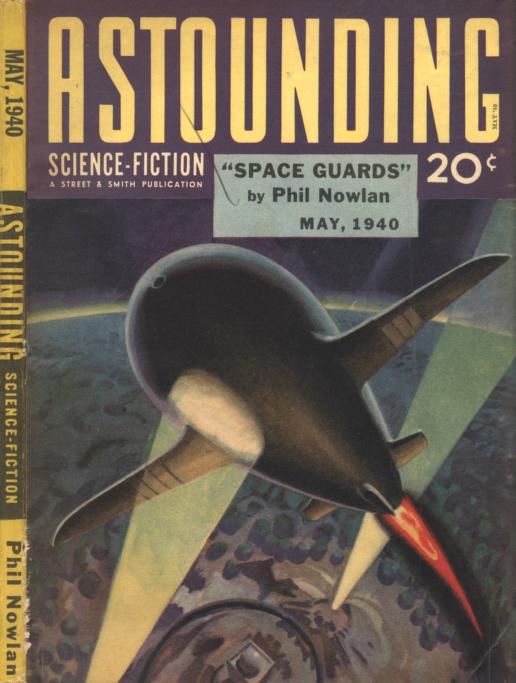
(Cover by Hubert Rogers. Astounding, May 1940.) The Story So Far
The lieutenant is a good soldier, as he should be, considering he was literally born and raised in the midst of warfare. War has been ravaging mainland Europe for so many years that civilization as we know it has been partly wiped out, and even the military is on its last legs. Great Britain and Russia have been at war for control of the continent, with the UK having gotten rid of its monarchy (cool) and turned to Soviet-style socialism (maybe not as cool), meanwhile the USSR has crumbled and there’s once again a monarch as head of the Russian government. Where did this fucker come from? We’re not given an answer. What’s important is that the lieutenant and his men have been cut off from home, with the official reason being that “soldier’s sickness” (like a version of the black plague) has become widespread in the British Isles, so the UK’s become quarantined from the rest of Europe. No one can get in or out. (It’s funny, this happens almost verbatim in 28 Years Later, in which Britain [and maybe also Ireland] has become a no-go zone on account of a devastating virus.) The lieutenant’s been given orders to return to GHQ, which is stationed in France.
While published during World War II, Final Blackout is much more inspired by the battlegrounds of that war’s prequel, namely trench warfare and the rural no-man’s-lands of that era. Even the desolate villages, seemingly always on the outer reaches of France and a hundred or a million miles away from Paris. Chemical warfare has even made a return, which is understandable in a sense because anything more destructive has become infeasible. The tanks, aircraft, and even artillery units of years past have turned to rust, on account of oil and materials having run low. The factories that once produced tanks and bombers are no more. The tensest moments in the first installment come from close quarters and small-arms fire. A “duke” who got kicked out of his village makes the lieutenant and company aware of said village’s location, but not without getting a bullet in the chest and then the head for his troubles. He might’ve just had a cough, or it might’ve been soldier’s sickness, was the lieutenant’s reasoning. The soldiers stay overnight in the village, having threatened the townsfolk with poison gas; but while this meeting is peaceful at first, it also turns bloody in a minute. And ultimately there’s still the question of getting to GHQ.
Enhancing Image
I have to admit, I was taken aback by how short this installment is, to the point where I was susprised when the “TO BE CONCLUDED” showed up at the bottom of the page. This is just over twenty magazine pages, which is not really a criticism of the novel; after all, the book version is only about 160 pages. The second installment is chiefly concerned with the lieutenant arriving at GHQ, the one British fortress left in mainland Europe—amd indeed it is a fortress, especially when compared to the wasteland around it. GHQ is mostly underground, having been constructed some years ago as a massive bomb shelter. The good news is that it’s impervious to bombs and small arms fire, but it can also be thought of as one giant coffin. Rather than “the enemy,” one’s biggest threats here are disease and starvation; such is the case with the soldiers living in these cells and tunnels. General Victor is in charge at GQH, with a ring of officers to back him; meanwhile for the troops, food and clothing are strictly rationed. If life outside GHQ is like hell on earth, then life inside GHQ can only be considered marginally better. For the lieutenant things are only about to get worse as well, since the higher-ups see it fit to strip him of his command. The idea is that Captain Malcolm will take over and the lieutenant’s brigade is to be absorbed into another unit, with the lieutenant being left with nothing.
Something I should mention that I find interesting about Final Blackout is how much it sticks out as an example of right-wing pessimism in Campbell-era SF, in that it’s politically right-wing and philosophically pessimistic. The UK turning communist is framed as being the culmination of every bad political decision in the book, but also General Victor personifies the malevolent uselessness of bureaucracy that was often (sometimes justifiably) associated with Soviet-style socialism at the time. God knows I’m not a fan of the Bolsheviks myself. The lieutenant, however, is framed as the “ideal” soldier, in that he is a born warrior who seems to know no other peace than that which comes with a won battle. In contrast with other macho heroes typically found in Astounding at this point, who are men with big ideas and fetishes for numbers, the lieutenant is a man of action and relatively few words. If anything he has more in common with any given sword-and-sorcery protagonist (well, let’s say anti-hero) than those found in science fiction of the day. The lieutenant makes no secret of his ambivalence toward the BCP (British Communist Party), but then the implication is that he also sees such a power structure as transient—that is to say, temporary. The BCP will inevitably give way, like every political party before it. But (so Hubbard posits) the soldier, as an idea, will still be around. After everything else has turned to ash, warfare remains.
Despite the higher-ups at GHQ stripping the lieutenant of his command, at least with words and even on paper, they find out the hard way that they can’t strip away the loyalty the lieutenant’s men feel for him. And why not? They’re well provided for, all things considered, being about as comfortable as one could reasonably be in the middle of No Man’s Land. The lieutenant works to keep his men fed and clothed, not to mention minimizing casualties. Indeed, the troops are more loyal to this one man than to all of England (whatever’s left of it) at this point. The brigade revolts, which is easier in practice than it sounds, considering the fortress troops are underfed and low on combat experience. Captain Malcolm finds all this out the hard way when he takes a bullet to the back of the head, in what has to be the most violent scene in the novel so far, both for how bloody it is and how suddenly it happens. Sex and foul language were big no-nos in Astounding, but you can get away with describing people getting killed in rather graphic detail—even more graphic, in this case, than I was honestly expecting. Nearly all of this installment takes place inside GHQ, which boils down to the lieutenant reuniting with his men, although strangely he decides to spare General Victor. We’re looking at about twenty pages of tension and action, and if it’s weaker than the first stretch of the novel that comes down to the change in locale and greater focus on plot.
A Step Farther Out
The one question I have upon finishing close to two thirds of this novel is where the hell the characters are supposed to go from here. The idea seems to be England, but then what? What will the climax look like? Final Blackout is not so predictable a novel, in part because it plays fast and loose with plot and also because it tackles very different subject matter than most SF of the era. Sure, there would be WWII-era stories published later, especially once the US entered the war; but these stories tended toward the propagandistic, and I don’t think Hubbard (putting aside his future as a swindler and cult leader) meant to write propaganda here. The bleakest of the whole thing has a disquieting effect, even if you’re accustomed to reading less pulpy and more graphic fiction. This is a novel that really commits to “the bit,” as it were, which is to say it has yet to cop out. We’ll see quite soon where this dark road will lead us, but (and it pains me to say this) it looks like Hubbard had yet another winner on his hands.
See you next time.
-
Novella Review: “The Giants of the Violet Sea” by Eugenia Triantafyllou
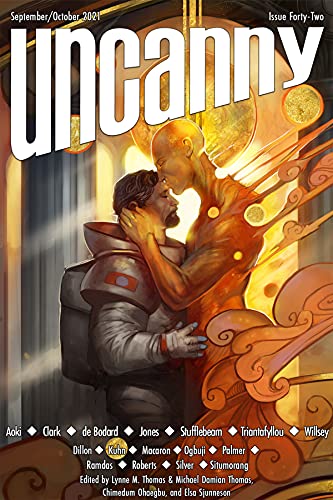
(Cover by Julie Dillon. Uncanny, Sept-Oct 2021.) Who Goes There?
Eugenia Triantafyllou made her debut in 2017, and within a few years was writing some evocative and award-winning short fiction. She has yet to write a novel, or maybe she doesn’t have one in mind—not that she’s obligated. (More importantly, we’re still waiting on a collection of her short fiction.) The online magazine boom of the 2010s made it easier for authors from outside the Anglosphere to at least have their work translated into English and published in the US; and while Triantafyllou was born and raised in Greece, she writes her fiction in English. Her debut also nearly coincided with the launch of Uncanny Magazine, where she’s been a regular contributor ever since. This is actually not my first time reading Triantafyllou, since I did also read (although I don’t remember it vividly) her Hugo-nominated story “Loneliness Universe.” Unfortunately “The Giants of the Violet Sea” left me feeling rather cold, which is weird because on paper this is the sort of thing that should appeal to me: it has dolphins (of a sort), themes exploring colonialism and environmentalism, and even a murder-mystery plot. But I will try to explain myself.
Placing Coordinates
First published in the September-October 2021 issue of Uncanny Magazine. It has yet to be reprinted anywhere.
Enhancing Image
Themis is the prodigal daughter, having returned to the remote seaside village of Tafros, the place of her childhood, after some years. It’s too bad that the circumstances for her return could not have been better. Her brother Melas has died, or rather been killed. Poison ink, courtesy of a venedolphin. This is unusual, because not only was Melas a venedolphin tamer who worked with the big animals (the titular giants) regularly, but these animals are simply not known to do such a thing. Themis knows this. “This isn’t the first time they have killed people. But not tamers like Melas. Never tamers. Some poachers in the past, and rightfully so. A couple of stupid kids a long time ago, who did not have the gift my brother had.” The venedolphins are known for their ink sacks, which are harvested when the animal reaches a certain age by a tamer, without killing it. Poachers, on the other hand, don’t care so much for the animal’s wellbeing. Melas had apparently gotten himself caught in a net and poisoned, and he died a slow and very painful death. It doesn’t take long, upon a doctor examining Melas’s body, for us to figure that it was not a venedolphin, but (drum roll) foul play. Somebody had injected Melas with the poisonous ink while he was stuck in the net. But why would someone do such a thing? This will be the biggest question driving the rest of the (very long at 27,000 words) story.
A few things are going on here. Themis, despite not being a detective, wants to avenge her brother, and at the same time she has mommy issues, on account of not staying in Tafros and taking up her mother’s profession of tattooing the dead. There’s also this fellow Clem, a humanoid alien (the fact that he’s not human matters in terms of how Themis and others interact with him, but not that much) from “the Central Colony” who’s been working with Melas on this planet. To complicate things further there’s also Pirros, a fellow villager who is functionally Themis and Melas’s adopted brother, since their family has found him when he was an orphaned child. There are at least three people who have a personal connection to Melas’s death, which means (so detective-story logic dictates) at least one of them has a motive for killing him. In a classic detective story the killer and the victim tend to have a shared history, a trope that applies here as well. Themis immediately suspects Clem is up to something fishy, on account of her own xenophobia and because of Clem’s business with the colony. While she ends up being right about Clem having an ulterior motive for being here, she’s not right in the way she was thinking. Clem doesn’t really help his own case, since he’s awkward around humans and even has to wear a pressure suit while on this planet, he and his people not being adapted for it.
This is all well and good, but I struggled to stay invested in “The Giants of the Violet Sea” for two major reasons. The first is that this is about as long as Hemingway’s The Old Man and the Sea, yet it reads as longer. The pacing is all out of sorts, with some scenes being almost constipated in length, and the final stretch being so protracted that there came a point where I almost forgot we were supposed to be looking for the son of a bitch who killed Melas. I should thereotically be able to read through a story of this length in one, maybe two sittings, but I simply could not. The bigger issue has to do with grammar and typos, which are not issues I tend to bring up when reviewing literature. Maybe it’s because I’m not a professional editor or some academic, but I don’t get too fussed over ungrammatical sentences, and actually I think it’s fine to be a little ungrammatical if you as the writer are aiming for a certain effect. With that said, I can’t imagine why (and I don’t recall this being an issue in “Loneliness Universe”) Triantafyllou would so frequently resort to sentence fragments and obvious run-on sentences in this story. I also don’t understand why she uses the semi-colon maybe a handful of times throughout the whole thing, refraining from using it even in cases where it’s easily a more sensible option than a comma or a period. There’s a truly incessant number of sentence fragments and comma splices, so that sentences suddenly stop and start, or sentences where the whole is awkwardly stitched together with a comma, or maybe the lack of a comma where there should be on.
I’m gonna give a couple examples, so you can see what I mean. The first is from a scene in which Themis sees a young boy from the village swimming too close to some venedolphins.
Here it goes:
I try to summon my mother’s voice. Or what my mother might have sounded like if she ever needed to raise her voice to make me feel like dirt. The child doesn’t seem to care, instead he dives back into the mucky darkness and before I realize it, I am waist deep in the water, paddling my way through flotsam. The guttural noise of the venedolphins rises up. Like an underwater storm. I can’t find the kid anywhere.
Not that I’m a professional, or that I know the game of writing better than Triantafyllou, but if I were to do some minimal rewriting, that paragraph would come out like the following:
I try to summon my mother’s voice, or what my mother might have sounded like if she ever needed to raise her voice to make me feel like dirt. The child doesn’t seem to care; instead he dives back into the mucky darkness. Before I realize it, I am waist deep in the water, paddling my way through flotsam. The guttural noise of the venedolphins rises up, like an underwater storm. But I can’t find the kid anywhere.
It’s at least 90% the same, but I’ve merged some sentence fragments together to create whole sentences, fixed a comma splice, fixed a run-on sentence with a period and thus created two sentences, and finally I tweaked that last line so that it sounds slightly more dramatic. The result is a passage that (I should think) is easier on the eyes.
Here’s a shorter and more mild example. This is from a later scene, in a subplot where Themis and Clem visit the Alimniots, a group of human colonists with a culture similar to that of Themis’s people. The big difference is that the Alimniots have an omnivorous diet, and they’re not opposed to killing venedolphins for their meat.
Here:
They are less rigid than us. No wonder they eat the beasts. It’s a very thin line though, between this and poaching, maybe they have already crossed it. Or perhaps it was never there but we didn’t know.
The passage can just as easily look like this:
They are less ridig than us. No wonder they eat the beasts. It’s a very thin line, though, between this and poaching; maybe they have already crossed it, or perhaps it was never there but we didn’t know.
You now have a comma where there should probably be one, as well as the comma splice being fixed by turning the comma into a semi-colon, thus making a less awkward connecting bridge between the two halves of this sentence. You seen what I mean, right?
Then there are the typos and inconsistencies, of which there are a few. I’m used to seeing typos in magazine stories, especially old ones, but there is a degree of sloppiness here that begs the question of how much the editors were handling Triantafyllou’s story. Something that especially irked me was whether Mother/Father should be capitalized in a certain context, as Themis refers to her mother and (deceased) father as Mother and Father respectively—but not always. “Mother” and “Father” are titles and thus capitalized, like when you say President Harry Truman or whatever. Ah, but except for when it’s the mother, or the president. But Triantafyllou or the editors do not take this into account. Also, while it’s perfectly natural for there to be a typo or three in a manuscript, like a misspelled word, these should be scrubbed out before publication. Nobody’s perfect, of course, but there are several instances in Triantafyllou’s story where there’s, say, a missing quotation mark, and in at least one case there’s a word that’s clearly misspelled. What sucks is that I have no other version of this story to compare it with, as it has yet to find a home in book form. Surely part of the reason for the lack of reprints is the length, which is awkward for an anthology, and also there’s no collection of Triantafyllou’s work as of yet.
It seems like we don’t think about how a magazine editor might play with the text of a story they’ve bought, or about the collaborative nature between the editor and the author. The job is not just to buy and reject stories that have made it past the slush pile, but to work with the author. Some of the most famous/beloved SF stories in the “canon” only turned out the way they did because of some judicious and even inspirational editing. Sure, he was an asshole with some very bad opinions, but John W. Campbell really set the gold standard by writing detailed rejection letters to his writers. What I’m saying is that (and it pains me to say this) it feels like Triantafyllou’s editors failed her here. “The Giants of the Violet Sea” needed an editor’s helping hand, and for some reason it didn’t get one. You can trim the length quite feasibly, but also there are frequent lapses of inelegant sentence structure that read as almost unprofessional. Hell, I even spotted a few cases of tense slippage, since this was written in first-person present tense (not a mode I’m a fan of, but to each their own) and occasionally Themis slips into the past tense to describe a current action.
There Be Spoilers Here
We learn early on that the venedolphins didn’t kill Melas, and it turns out the poachers (who I don’t think we ever even encounter within the story) didn’t kill him either. It was Pirros. Well, he was one of about two viable suspects. I do like how this is revealed, though, with Themis seeing Pirros torture an immature venedolphin in extracting its ink sack. She deduses that while Melas was not as perfect person, he was too experienced a tamer to let someone get the upper hand on him—unless it was someone he knew and trusted. Pirros himself being a poacher is kind of an obvious twist, not helped by his vibes being kinda off throughout the story, but I feel like I should give credit where it’s due.
A Step Farther Out
I feel like an asshole for not liking this one, and also for going on a rant about editing. Clearly the professionals who make up SFWA disagreed with me, though, because “The Giants of the Violet Sea” got a Nebula nomination. On the one hand, it’s nice (and all too rare) for a novella published in a magazine to get awards attention in our current era. Not only are chapbooks in vogue, but Tor have taken it upon themselves to take a truly obscene slice of the market, to the point where they have virtually a monopoly on SFF chapbooks and by extension on stories of novella length. I wish I could recommend this one, but I honestly can’t, as it’s far too unpolished, to such an extent that it may well have gone through zero editing between the manuscript arriving in the (virtual) mail and the story being published in Uncanny Magazine. It’s a real shame.
See you next time.
-
Serial Review: Final Blackout by L. Ron Hubbard (Part 1/3)
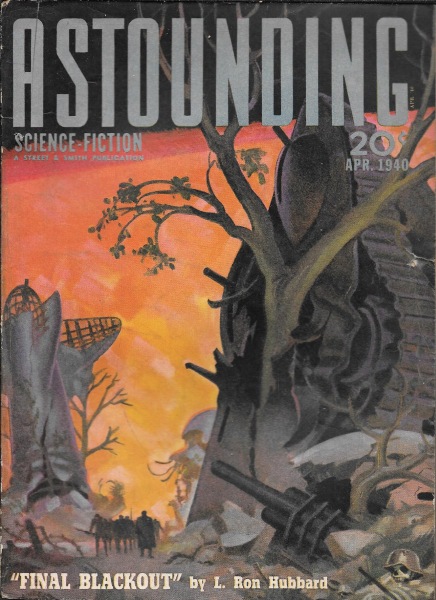
(Cover by Hubert Rogers. Astounding, April 1940.) Who Goes There?
Lafayette Ronald Hubbard was born in Nebraska in 1911, and spent his early years between that region of the US and traveling abroad. He attended but did not graduate from George Washington University, where he met Paul Linebarger, better known to SF readers as Cordwainer Smith. Both Hubbard and Smith could be understood as mavericks in the field later on, in that they were men with rather unique and fiery imaginations; but whereas Smith spawned a passionate cult following, Hubbard quite literally became a cult figure. But more on that in a second. For much of the ’30s, Hubbard wrote Westerns and other non-SFF pulp fiction, but he made he SFF debut in 1938, in Astounding, being part of that first wave of writers John W. Campbell nourished when he took over the magazine. Hubbard and Campbell quickly struck up a symbiotic partnership, although said partnership eventually soured. I could’ve sworn I had read somewhere that Hubbard was the most prolific contribot to Unknown, Astounding‘s sister magazine. He was quite popular at the time, if reader polls are anything to go by; but unlike Robert Heinlein, who reinvented the wheel with his Future History series, or Isaac Asimov, or who wrote one of the most famous SF stories of all time with “Nightfall,” Hubbard’s work did not leave such a lasting impression as that. Instead he can be thought of as a successor (one of a few likely candidates) to Edgar Rice Burroughs, in that he wrote high-octane science-fantasy in the pulp tradition. And in the late ’30s through the early ’40s he was very good at it.
Unfortunately, Hubbard’s gift for storytelling became severely misdirected by the late ’40s, when he began writing a series of articles that would ultimately result in Dianetics. Maybe the “great” pseudo-scientific text of the 20th century, Dianetics sold—as in it sold a lot. Campbell was also pushing for Dianetics with his editorials in Astounding at this time, and indeed the aforementioned partnership between Hubbard and Campbell was crucial for both men’s descents into shilling woo-woo nonsense. By the early ’50s Hubbard stopped writing fiction (or at least literature marketed as fiction) to focus on something even bigger than a bestselling book: the founding of a new religion. Turns out, if you have the right connections and lure in enough people, and (it must be said) have such an amount of charisma, you can get rich off of founding a new church. The Church of Scientology was founded in 1952, and it stands out as the religion to have emerged from the irradiated depths of the 20th century. It’s still going strong to this day, although that could be because a disproportionate number of its ranks are the rich and famous. Indeed Scientology seems to have been engineered from the beginning as a bourgeois religion, whose lifeblood is comprised of a cocktail of money and secrecy. Those who belong to the Church have a funny habit of being averse to discussing their faith in public, although that doesn’t stop them from trying to sell said faith.
Hubbard took a thirty-year hiatus from writing fiction to focus on his new religion, and when he finally did return to writing with Battlefield Earth in 1982, he had apparently forgotten how to write a novel. Whoever was responsible for editing the manuscript at St. Martin’s Press seemingly decided to take the week off, without taking a hacksaw to the novel’s immense bloat, or even checking for basic errors. Nowadays Hubbard’s fiction is printed by less respectable publishers, namely houses like Galaxy Press that are backed by Church dollars. The irony of all this is that not only are you unlikely to find any of Hubbard’s fiction outside maybe Battlefield Earth, but it looks like Hubbard’s own people have been doing a poor job of preserving his pre-hiatus fiction. This is a bit of a shame, because I do have a soft spot (you might say a guilty pleasure) for early Hubbard, which includes probably his most notable SF story from those days, Final Blackout. 1940 was unquestionably Hubbard’s annus mirabilis, as it saw the publication of not only Final Blackout but also the short novels Fear and Typewriter in the Sky. These three stories, taken collectively, show someone who honestly could’ve become one of the greats.
Placing Coordinates
Serialized in Astounding Science Fiction, April to June 1940. It wouldn’t see book form until 1948, and in fact is one of the few works of Hubbard to be published in book form pre-Dianetics. Aside from an added dedication at the beginning and some small textual revisions, it’s the same novel. I’m not really sure if it’s in print right now.
Enhancing Image
We’re far enough into the future that not only has World War III happened, but so have several more conflicts on such a scale. Mainland Europe has been rendered one giant tombstone for the millions of civilians and soldiers killed. The result is a post-apocalyptic landscape, in which warface has evolved (or maybe devolved) such that only the infantry unit has remained really useful. Tanks, aircraft, and even artillery have been rendered obsolete, if only because the industrial power needed to make them, never mind the fuel needed for them, is no longer feasible. Centuries from now, politics have naturally changed for certain countries, but in funny ways. The UK has seen its monarch assassinated and the government went through “every known kind of political buffoonery culminating in Communism.” Russia, meanwhile, has turned away from Soviet socialism and once again fallen under the rule of a czar. (We’re not given any details as to how such a monarchy came about, which is odd considering what happened to the last czar in the real world.) So the tables have been turned. The UK and Russia have been at war for God knows how long, but by the time the novel starts it’s become clear that this war is about over. There simply aren’t enough fighting men left on either side for things to go on much longer. It doesn’t help that the British troops are prohibited from returning to their home turf, the official cause of this being an epidemic of “soldier’s sickness” that’s been ravaging Great Britain. But maybe there’s an ulterior motive.
And then there’s the lieutenant.
In his review of Battlefield Earth (a pretty negative review, made more damning because he sympathized with Hubbard to an extent), Algis Budrys mentions the lieutenant of Final Blackout as an example of a “superbly detailed caricature,” alongside the likes of Sherlock Holmes and Tarzan. This is to say (and Budrys means this in a positive sense) that the lieutenant is not to be understood as like a real person with interiority, but rather as a mythical figure whose first impression made upon us will turn out to be consistent with his characterization throughout the rest of the story. Like so many figures in the Bible and classical mythology, the lieutenant is not so much a person as maybe a stand-in for several people. There probably was no such historical man who fit the lieutenant’s shoes, and it’s a very deliberate (and clever) choice on Hubbard’s part that not only are we not given the lieutenant’s name, but he doesn’t even seem to have one. The leader os a brigade of hungry but fiercely loyal men, the lieutenant is told of as being fearless, pragmatic, and very well versed in warfare, having been born and raised quite literally in the midst of it. He is, in his heart, a true warrior, in that his home is the battlefield. The duality of the lieutenant is that he is kind towards his men and wishes to see as few casualties on his side as possible, yet he’s quick to put a bullet in someone’s brain if they’re shown to be a small threat to his men. He is, in a sense, the ideal soldier, although calling him heroic might not be accurate.
I’ve read enough SF from the Campbell era that I can say Final Blackout is very different from other material being published in Astounding at the time. People who are used to reading SF of this vintage and having stuff like spaceships and psi powers forced upon them will be surprised that no such far-future staples exist in this novel. Hubbard wrote the novel in 1939, on the eve of war starting in Europe (again); but while reviewers have taken Final Blackout as a “warning” story, and while it no doubt works well as one, it also takes after WWI and its immediate aftermath. France, as depicted in Hubbard’s novel, far more resembles the war-torn rural stretch of the country in WWI and the Nazi-occupied country of that war’s sequel. The Russians, like in WWI, are under the rule of a czar, and there’s even a contagious and deadly illness sweeping across the land like the flu epidemic of 1918. To get even more specific, the lieutenant’s men use chemical warfare (gas attacks) to coax out enemy troops and unfriendly civilians. The lack of armored vehicles on the battlefield is another connection, although in the case of Final Blackout it’s because the tech and resources are no longer there. The only things left are the soldiers and their guns, with ammunition now being precious and the bayonet being preferred. We do get a few characters with names, and even personalities, although they don’t amount to that much. We have Captain Malcolm, who rivals the lieutenant for command of his brigade. More memorably we have Bulger, the brigade’s cook and sort of a bloodhound with how his nose works.
The plot of this first installment is rather loose, but that’s what I like about it. We’re given time to soak in the dire atmosphere and living conditions of the troops, as well as given some backstory on the conflict. Any story of this stripe should have a goal for the protagonist, though, and in fact the lieutenant has two of them, a short-term and a long-term goal. The short-term goal is to find food and shelter for the men, which is no easy task since villages and townsfolk have become scarce. The long-term goal is to return to GHQ, as the lieutenant’s brigade has been recalled. Without vehicles, they’ll have to make the trip on foot. Splendid. Is this realistic? Not really, but then it seems to be that Hubbard intended Final Blackout to be understood as a dark fable rather than as a “realistic” depiction of warfare. This is far from the norm with SF printed in Astounding at the time, since Campbell wanted fiction that was both plausible and “realistic,” i.e., things are meant to be taken literally. Symbolism and metaphor were not strictly excluded, but Campbell also didn’t encourage such a mindset when writing. As such, there is very little actual science in Final Blackout, at least with this opening stretch. You could call it speculative fiction, but it doesn’t take notes from the hard or even soft sciences; this is for the best, because Hubbard was not rigorous about the sciences at all. His fast and loose approach doesn’t work so well for his SF, but Final Blackout is an exception.
There Be Spoilers Here
The climax of this installment involves the brigade forcing their way into a French village, where tensions are high, not least because the troops had deployed gas and the lieutenants makes it clear he’s not above killing a few villagers if they become too inconvenient. One of the few able-bodied men left in the village finds this out the hard way: a bullet turns his head into a goddamn bowl of spaghetti. It’s not the first killing we see in the novel (a “duke” [so he claimed] informed the troops of the village in the first place, and got summarily executed for his troubles), but it’s the most sudden and graphically described so far. Even more disturbing is the reveal that the villagers had secretly been keeping more than a dozen soldiers from a different brigade as slaves. In just a handful of pages Hubbard shows us how cutthroat this ruined world has become, in which conditions for both soldiers and civilians have become dire. There’s really so little left here that’s worth saving. In his introductory blurb, Campbell (I assume Campbell wrote it) calls Final Blackout a novel “of grim and desolate power,” and it’s easy to see where he’s coming from. Things are not looking good for the lieutenant and his men, although we can gather from the exposition dump at the beginning that the lieutenant is destined for greatness—or at least something bigger than a ragtag bunch of half-starved men.
A Step Farther Out
It took eight years for Hubbard’s novel to be published in book form, which was not unusual for Campbell-era SF. By the time Final Blackout found its way to hardcover, WWII had both come and gone, and Hubbard himself had gone through a rather embarrassing stint in the navy. Even reading this novel, I get the creeping feeling that the person who wrote it had not seen combat at the time, and indeed probably would not after the fact. It’s such a heightened reading experience, though, that the lack of realism is easy enough to forgive. Like with the equally effective novel Fear, Hubbard taps into the dark corners of the human spirit, unflinchingly, so that Final Blackout is looking to be one of the bloodier SF novels of its era. I blazed through much of this first installment, despite the seeming lack of plot progression, and I await more.
See you next time.
-
Things Beyond: May 2026
(Cover by Ed Emshwiller. Venture SF, July 1958.) We are now knee-deep in spring, which means last month I narrowly survived a fit of allergies. (I’m not really exaggerating, I got hit with what the doctor called postnasal drip, and for some days it was difficult to even breathe, let alone sleep at night.) In terms of weather this might be my least favorite time of year, because of said allergies. In better news, it’s also time for applying for memberships at the yearly Worldcon, if you’re interested. This one is happening in LA, which is unfortunate because it’s the other side of the country for me and I don’t have any connections who live close enough to where the action’s happening. I have a few friends in California, but as you know, California is a big state. (That’s not even getting into people from outside the US who want to attend in person. It’s rough.) I did end up getting a WSFS membership, I think for the third year in a row. I mainly do this for all the free stuff you get, a very good I would say given it’s only $50. You get ebooks of novels and short fiction, and you even get files for the movies up for Best Dramatic Presentation.
As for what we’ll be reading this month, for the first time in a long while we have a complete novel, which I have to get around to this time. (Unlike last time.) We also have a novel in serialized form, by someone whom I’m sure will not raise any eyebrows. Incidentally, two of the stories here are related to World War II, although one was written on the eve of the war in Europe while the other is an early example of a “Hitler wins” alternate history. Such a scenario is pretty tired today, but it was not so when C. M. Kornbluth came up with it back in the ’50s. Another funny connection is that both Kornbluth and L. Ron Hubbard served in WWII, the former in the army and the latter in the navy. Hubbard’s time in the navy was respectable, and I’m sure nothing untoward or embarrassing happened when he was at sea. Unfortunately for Kornbluth, his time in the army caused a weakness in his heart that would later see him die quite young.
Anyway…
We have one story from the 1940s, two from the 1950s, one from the 1980s, one from the 2000s, and one from the 2020s.
For the serial:
- Final Blackout by L. Ron Hubbard. Serialized in Astounding Science Fiction, April to June 1940. Where do we even start with Hubbard? One of the most controversial figures in not just SF but also modern religion and pseudo-science. Hubbard had Dianetics published in 1950, and in 1952 he founded the Church of Scientology, one of the most successful (if only because of the disproportionate number of rich people in its ranks) cults in recorded history. Before all that, he was a fairly respected genre writer, with the late ’30s and early ’40s marking his peak for both quality and quantity. Final Blackout is probably the most well-received of Hubbard’s SF novels, after the much more famous but also more controversial Battlefield Earth.
For the novellas:
- “The Giants of the Violet Sea” by Eugenia Triantafyllou. From the September-October 2021 issue of Uncanny Magazine. Born and raised in Greece, and indeed currently living there, Triantafyllou writes her fiction in English. Her personal website says she has “a flair for dark things.” She made her debut in 2017, and so far has only written short fiction. This here novella is the longest work of Triantafyllou’s to have been published up to that point.
- “Two Dooms” by C. M. Kornbluth. From the July 1958 issue of Venture Science Fiction. Kornbluth is maybe one of my favorite SF writers to have really flourished during the ’50s magazine boom-and-bust, although he had made his debut long before that. He was a prodigy whose earliest work was published when he was a literal teenager. Unfortunately he also died very young, at just 34, from a weak heart, robbing the field of one of its most incisive writers.
For the short stories:
- “The Persecutor’s Tale” by John M. Ford. From the November 1982 issue of Amazing Stories. Speaking of very good writers gone too soon, Ford also made his debut when only in his teens, but he picked up on the trade pretty quickly. A writer’s writer, the best way to read a Ford novel is the read it twice. Sadly he died in 2006, at just 49, having not quite completed his final novel.
- “Always” by Karen Joy Fowler. From the April-May 2007 issue of Asimov’s Science Fiction. Nebula winner for Best Short Story. Believe it or not, there’s an L. Ron Hubbard connection here. Fowler is maybe the most high-profile author to have made her debut in the annual (and Scientology-backed) Writers of the Future anthology series, although Fowler herself is not a Scientologist.
For the complete novel:
- The Big Jump by Leigh Brackett. From the February 1953 issue of Space Stories. While Brackett’s first few stories were published in Astounding, she soon moved to other magazines that were more open to her brand of space adventure SF. By the end of World War II she’d come to be associated most with Planet Stories, in a mutually beneficial relationship. Indeed, after Edgar Rice Burroughs, Brackett can be considered the leading writer of planetary romance. She married fellow writer Edmond Hamilton in 1946, but they almost never collaborated. Nowadays she’s best known as a successful screenwriter, and for her grounded SF novel The Long Tomorrow, which is quite different from what she most often wrote. The Big Jump is a short novel, apparently published in magazine form unabridged, and later as one half of an Ace Double along with Philip K. Dick’s Solar Lottery.
Well, let’s get to it.
-
Short Story Review: “Timberline” by Brian W. Aldiss
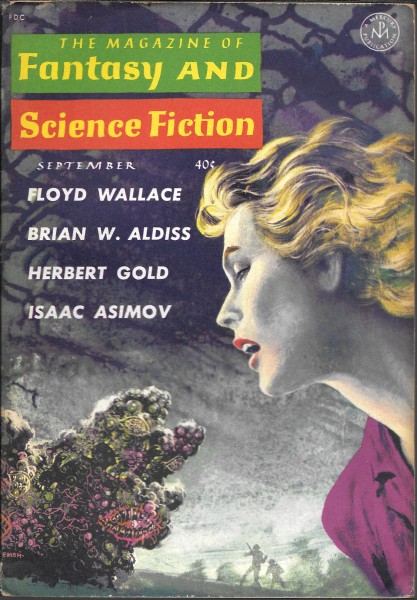
(Cover by Ed Emshwiller. F&SF, September 1961.) Who Goes There?
Brian Aldiss was born in England in 1925, and he actually lived a very long time, dying literally one day after his 92nd birthday. He starting writing SF in the mid-’50s, being a generation younger than that first wave of British authors to write magazine SF like Arthur C. Clark and John Wyndham, and yet also a generation older than the New Wave crowd he would later fall in with. And whereas Clarke and Wyndham wanted popularity, preferably on both sides of the Antlantic, Aldiss had other ideas. Unfortunately by the late ’50s, when Aldiss’s work was appearing in the US, the magazine market was in the midst of a collapse; but the good news was that The Magazine of Fantasy and Science Fiction was thriving and also the perfect outlet for his fiction, said fiction being sort of dark and literary. The Hothouse stories, which were published in F&SF throughout 1961, were probably Aldiss’s most ambitious project up to that point. The series (but not the fix-up novel, which in the US was actually a bit shorter than the UK and magazine versions) won him a Hugo. It’s only been, what… ten months since I reviewed the previous entry in the series? Seems like only yesterday. We’re almost done here, since “Timberline” is the penultimate story. It’s also, unfortunately, the weakest entry in the series so far.
Placing Coordinates
First published in the September 1961 issue of The Magazine of Fantasy and Science Fiction. It’s never been reprinted outside of Hothouse, which makes sense because if you were to hop into this story without having read what came before it, you would be lost.
Enhancing Image
Remember Poyly? Maybe not. She died near the end of “Undergrowth,” and rather unceremoniously, despite having been Gren’s love interest for a minute. Gren himself doesn’t seem too troubled or grief-stricken by this. In fact, I’m struggling to recall if “Timberline” mentions her at all. Of course, the team of humans already had a spare girl, in the form of Yattmur, who becomes Gren’s new girlfriend seemingly overnight. The two are accompanied by four tummy-belly men, who are short, hair, and cowardly by nature. Also dim-witted, not that Gren and Yattmur are all that intelligent. Arguably the only reason they’ve even made it this far is the help of the morel, a sentient and indeed highly intelligent fungus, on Gren’s head. The morel acts as like a second brain, although given the conflict it has with Gren the relationship they have is more like Eddie Brock and the symbiote. They will need all the help they can get, though, since humans are scarce, and for maybe the first time in history, plant life totally rules the world. There are also large carnivorous insects, but those don’t play much of a factor in “Timberline.” Instead, vegetable life has evolved to such a point as to replace practically all fauna on land.
It could be because Gren is the POV character (I hesitate to call him the “hero”), but the way Aldiss writes women in the Hothouse series really leaves something to be desired. Women are treated as disposable, and already we’ve seen multiple fridge-stuffings. This doesn’t even align with what would make sense in such a world: you’d think women would be treated as more valuable, in a world where mankind is endangered and has also become a prey animal, but no, their deaths are treated with as much (or rather with as little) gravity as when the men die. And that goes for the ones who don’t make it. As for Yattmur, she spends virtually all of “Timberline” sulking and complaining about Gren being mean to her, which is understandable on its own, but then she doesn’t do much of anything—not that Gren proves to be much better in that regard. Generally Aldiss’s view of humanity seems to be a dim one, which sometimes works, but sometimes it also results in some fatigued storytelling. It’s strange, and a bit funny, that the most active character in “Timberline” is a parasitic fungus.
The boat Our Heroes™ took at the end of the last story ends up crashing into an iceberg, but that’s okay, since all six survive and even make it onto an islet, in which there is enough food and shelter for the time being. Hell, there aren’t even any enemies here worth mentioning, so that for once Gren and Yattmur are able to have a good time. Maybe too good. The central conflict of this story is that the morel wants to keep moving, since it knows the team can’t stay here forever, while Gren is content to sit back and soak in the sun. This is all framed as serious, but it’s really not as serious as it sounds. The morel wants to progress the plot while Gren doesn’t. Both have valid arguments for their points of view, namely that yes, supplies will eventually run out on the islet, but also getting off the islet will be its own challenge, on account of the boat being wrecked. Meanwhile Gren becomes grumpier because of this, to the point where he becomes borderline abusive with Yattmur. The tummy-belly men are of no help whatsoever in all this; actually their so useless and whiny that it’s a wonder why Gren doesn’t just opt to murder them. Being both stupid and submissive, it’s not like the tummy-belly men would’ve resisted much on that front.
There is a somewhat humorous digression when Our Heroes™ uncover a (I’m not sure how else to put this) centuries-old robotic bird whose purpose seems to be to spew political slogans. That the bird is still in working order after all this time would strain one’s suspension of disbelief, if not for this being a world where Earth and its moon have become interlocked via a kind of plant-constructed elevator. And also there’s one half of the world where the sun always shines, while the other half lies in eternal darkness. Naturally Gren and the gang don’t even try to make sense of what the bird (which they name Beauty) is saying, since not only is there no such thing as “Monkey Labour” anymore, the physical land of India probably no longer exists. Politics, like human life in general, is transient. I said before that Aldiss strikes me as a pessimist, and the comic relief with Beauty is a case of that pessimism being used to inspire good writing. Beauty is an operational but now totally obsolete and worthless piece of machinery whose election-year ramblings are lost on the characters, who indeed would have nothing to gain from it even if they understood it.
There Be Spoilers Here
Their ticket off the islet turns out to be a species of bug-like vegetable called a “stalker,” a giant long-legged veggie that’s sort of like the tripods from H. G. Wells’s The War of the Worlds. It’s a nice image, but unfortunately this sequence of Gren and the others riding atop the stalkers goes on for half an eternity. Another good image that sadly gets drawn out is the moment they cross the “timberline,” i.e., the shadow-line separating the sunlit world from the land of night. Mind you that “Timberline” is about as long as “Hothouse,” so it’s a rather meaty novelette. For the first time in the series I feel like there’s some filler that could’ve been cut.
A Step Farther Out
Hopefully it will not take me another ten months to get to the final Hothouse story. Maybe eight. I do feel like returns on this series have been diminishing somewhat, but then maybe I wouldn’t feel that way if I was reading these stories in novel form. I have to assume the short passages of exposition at the beginning, which would strike the reader as obvious if they were to read these stories in quick succession, were removed for the novel. I remember James Blish got his panties in a twist over the world of Aldiss’s series being absurd, in that it’s really science-fantasy rather than properly SFnal, but the strange world of Hothouse is its selling point. Certainly the characters are not much to write home about, although the morel is a very fine creation. We’ll have to see how this all turns out.
See you next time.
-
Serial Review: The Skylark of Space by E. E. Smith and Lee Hawkins Garby (Part 3/3)
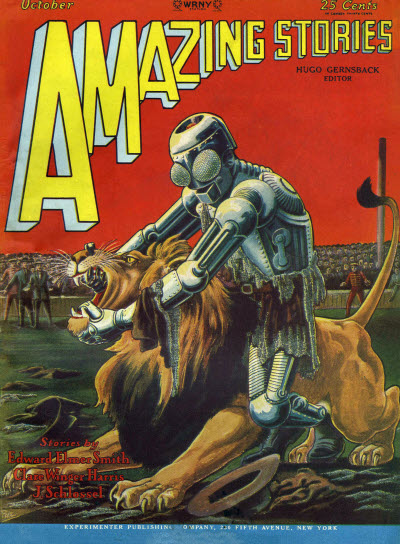
(Cover by Frank R. Paul. Amazing Stories, October 1928.) The Story So Far
The rivalry between Dick Seaton and Marc DuQuesne has escalated to the point where the latter plots to kidnap Dorothy, Seaton’s fiancée, along with Margaret Spencer, the daughter of a scientist whose research the Steel Trust had stolen. The plan goes sideways, though, as the ship DuQuesne’s team had built takes off by accident and the three, along with Perkins, a crooked detective DuQuesne had hired, are thrust into the deep dark reaches of outer space. This should’ve killed them all, but instead it just renders them unconscious, with DuQuesne even managing to halt the ship before passing out, despite several Gs of thrust. He’s just that tough. What started as a kidnapping has turned into a rescue operation, as Seaton and his good buddy Martin Crane take the Skylark out in search of the other ship. DuQuesne kills Perkins, which is actually a good thing for everyone since the detective had gone practically insane by this point. In fact, once we reach outer space, DuQuesne, who is ostensibly the villain of the novel, more or less stops doing villainous things. In fairness, he’s a practical-minded man and he knows he’s both outnumbered and outgunned in this situation. Once everybody’s come together on the Skylark he takes the important position of the crew member nobody likes or trusts. It would be easy enough to toss the man out the door, but Seaton reasons that while he is certainly treacherous, DuQuesne is too brilliant and useful to kill right now.
The crew have to find their way back to Earth, but they also need materials for the Skylark, namely copper and the fictional metal called X. After a couple false starts on different planets, including run-ins with some beasties and a highly intelligent and telepathic alien lifeform, the ship lands on the planet Osnome, where they’re treated as guests by Nalboon, leader of Mardonale. The Osmonians are a humanoid race split into two factions, those being the Mardonalians and the Kondalians. These are basically humans with a different coat of paint, and with some customs that aren’t even that unusual by human standards. The strangest thing is that while the Mardonalians have some pretty advanced technology, having to do with electricity, they’re unaccustomed to simple things like matches and firewood. Indeed, wood-based technology seems to be foreign to them. This is the most interesting thing we learn about them without delving into negative criticisms toward the novel. Nalboon welcomes Seaton and company, but Our Hero™ gets the sneaking suspicion that something is not right with these Mardonalians—a suspicion that is soon proved correct.
Enhancing Image
Unfortunately The Skylark of Space stumbles in the last third, although the fact that it took this long for me to start getting tired of it is something maybe worth praising. I could not get into Triplanetary for the life of me, but I have to admit that this novel does a much better job of pulling in the reader, along with the cast of characters being more likable—up to a point. The introduction of the Osmonians ends up being the point where the novel sort of loses me. For one, this was in the days before Stanley G. Weinbaum, where it became reasonable to expect really alien aliens in one’s magazine SF. The Osmonians, regardless of faction, can hardly be considered alien at all. There are also some customs of these people that both the humans and authors let slide by uncritically, namely their fondness for slavery and war. The Kondalians, despite ostensibly being “the good guys” in that they side with the humans, see no issue with slavery or genocide. They’re also polygamous. Are they supposed to be Space Mormons? Having multiple partners is fine (as it should be), but also warmongering and racism are cool. Very strange. The humans don’t question any of this except, funnily enough, the polygamy. I have to say this is very telling of the authors’ politics, although it also pains me to say that such views were not uncommon, even among left-leaning Americans, in the early 20th century. Being that this novel was the first space opera on such a scale, it makes sense that it also set the standard for shitty politics often found in the subgenre.
The good news, I guess, is that there’s a double wedding. After rescuing Dorothy, Margaret, and DuQuesne, Crane immediately takes a liking to Margaret—and why not, she’s the only woman aboard who’s available. Having also rescued themselves from the Mardonalians’ clutches, and now safely with the Kondalians, the humans think now is the time to get married. With Seaton and Dorothy this makes sense enough, since they were already engaged and there’s no guarantee they’ll survive their voyage home; but with Crane and Margaret it’s much harder to take. Margaret was introduced earlier in the novel as a pretty strong-minded young woman, out to get revenge against the Steel Trust for what they did to her father; but as the novel has progressed, she has inexplicably softened. What these two see in each other, I’m not sure; they have the chemistry of two dead fish being smacked against each other. I had read that Garby was responsible for the romance subplots and the dialogue therein, but while I have to think Smith would’ve done a worse job with the same material, I hesitate to call the romance good. (Dorothy, like Margaret, has similarly taken a backseat in the narrative.) There’s also the problem of the fact that I swear these two had just fucking met. The passage of time in this novel is rather vague, but between the beginning of the second installment and the double wedding it seems like only maybe a week has passed. There’s a shotgun wedding, and then there’s this. Well, good for them.
This is all on the eve of the Kondalians waging total war against the Mardonalians; it’s also right as Seaton and company are working to rebuild the Skylark, which had been badly damaged while in the Mardonalians’ hands. (As a side note, both in-text descriptions and interiors drawn for the serial version make out the Skylark to be a big metal sphere, similarly to the ship constructed in H. G. Wells’s The First Men in the Moon. It’s a little hard to take seriously.) What follows is the epic climactic battle in which the “good guys” try and indeed succeed in annihilating the enemy civilization. I’m not terribly interested in this, which is not necessarily the novel’s fault, as action in prose often makes my eyes glaze over. What’s more the fault of the authors is that the only difference between the alien factions, in the context of the story, is that one supports the “heroes” while the other doesn’t; otherwise they both seem like rather horrid cultures. We are told that one side is good and the other is bad, but this is not convincing at all. The Skylark of Space loses juice in the final stretch because it starts relying on what now reads as been-there-done-that spaceship action, but also the narrative (probably unintentionally) starts to stink of fascism. This same stink will, of course, hover over space opera like an invisible cloud for decades to come. There’s a dissonance between what we’re expected to think of as good and what now reads as draconian reactionary nonsense.
As for DuQuesne, who survives this whole battle and even comes aboard the Skylark for the return trip, it’s awfully convenient that he figures out a way to escape once they reach Earth before Seaton and Crane can figure out what to do with it. There is no logical reason for why DuQuesne should still be alive by the end of the story, but for sake of the readers it’s a good thing he lives to fight another day, as he is easily the novel’s most memorable character. Hell, if E. E. Smith came up with only one really good character in his entire writing career (which might be true, for all I know), then DuQuesne is that figure. He is simply too good to not return for a sequel—which is exactly what we got, just two years later, although I’m not sure if Smith had already intended to write a sequel.
A Step Farther Out
Is The Skylark of Space good? Not really, certainly not by the standards of, say, even twenty years after its publication. Is it stupid? Oh yes. Is the science laughably outdated? You bet. Are its politics questionable at best? Absolutely, and I say this while having a high tolerance for reactionary politics in old-timey SF. Is it entertaining? For the most part, surprisingly yes. Smith was not a very good writer, plainly put. Even comparing him to Edgar Rice Burroughs, who would’ve been his closest contemporary, he doesn’t have the gift for fluidity of storytelling and action that Burroughs does, nor does he ignite one’s imagination in [the current year] like Burroughs still sometimes does. He also suffers in comparison to the best of the early magazine SF writers like Edmond Hamilton, Jack Williamson, and David H. Keller. But with some effort, one can see beneath all the dirt and rust what would’ve made readers in 1928 lose their shit.
See you next time.
-
Novella Review: “Death in the Promised Land” by Pat Cadigan
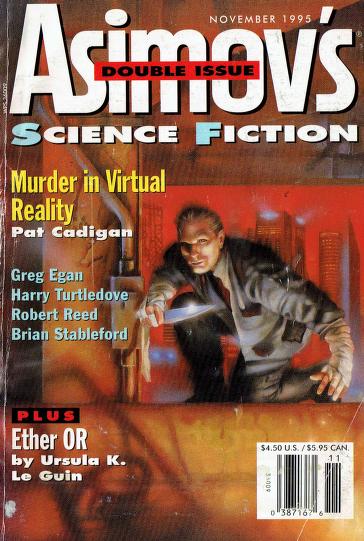
(Cover by Bruce Jensen. Asimov’s, November 1995.) Who Goes There?
Pat Cadigan could be considered the queen of cyberpunk, as while she wasn’t the first woman to write it (that honor arguably goes to Joan D. Vinge, whose novella “Fireship” was indeed one of the first real examples of cyberpunk), she would become one of the major architects of the movement in the ’80s, alongside William Gibson and Bruce Sterling. Throughout that decade she made a name for herself with her short fiction, whereas Gibson and Sterling focused more on novels, which may go to explain their wider appeal with readers. (And also, you might say, the fact that they were men.) Her debut novel, Mindplayers, was well-received but didn’t become a bestseller. Another thing I’ve noticed with Cadigan is that, at least earlier in her career, she seemed fond of cannibalizing her short fiction for her novels. For example, her novella “Fool to Believe” was later turned into Fools. Today’s story, “Death in the Promised Land,” would itself later form part of the novel Tea from an Empty Cup, which might be why the novella version has only been reprinted a few times. Like “Fool to Believe,” this is at its core a detective story, in the fashion of Raymond Chandler and his ilk (incidentally Chandler also liked to cannibalize his short stories for the sake of his novels), so I was predisposed to enjoy it at least somewhat. And I did!
Placing Coordinates
First published online in the March 1995 issue of Omni Online, which I don’t think you can even access with the Wayback Machine. The first physical appearance of “Death in the Promised Land” was the November 1995 issue of Asimov’s Science Fiction. It was reprinted in The Year’s Best Science Fiction: Thirteenth Annual Collection (ed. Gardner Dozois) and The Mammoth Book of Extreme Science Fiction (ed. Mike Ashley).
Enhancing Image
Artificial Reality is, for a lot of people, even better than the real thing—to the point where what happens in AR can feel totally real, both the good and the bad. Dore Konstantin’s most recent case puts this whole idea to the test, as a teen boy has been murdered, both in AR and, seemingly at the same time, in real life. The kid’s had his throat slashed, a death made stranger because his “persona” in AR suffered the same fate. The persona’s name is Shantih Love while the kid’s name is Tomoyuki Iguchi, although that can’t be his “real” name since the kid is not Japanese. I don’t think we ever find out his “real” name, not that it matters too much. It’s an unusual case: you have a kid with two fake names, one of which is copyrighted and which the killer seemed to have hijacked—a mask to be worn in AR. This is the eighth such case of someone being murdered while in AR in as many months, and yet the law has not been able to connect these killings to each other. Konstantin really has her work cut out for her, despite having been a detective for a dozen years at this point. She also basically has no experience using AR herself, which I have to admit is a point that does strain my suspension of disbelief a bit. How is it possible for her to have so much experience while a) still being squeamish about blood, and b) still being a “virgin” who doesn’t know the rules of AR? But I’m getting slightly sidetracked.
We don’t get to know a great deal about life outside of AR, but what we do learn implies the real world has really gone to shit, which tracks for cyberpunk. Konstantin herself barely seems to be getting by on her salary, having until recently shared a little hole in the ground with her partner, now called her ex. Actually we’re gonna be reminded, incessantly, that Konstantin is going through a recent breakup, to the point where she’ll be mentioning her ex on almost every single page of this novella. Having gone through a serious breakup a couple months ago myself, I can confirm that at least this part of her character is quite believable. She also does some classic detective work, like watching surveillance footage of Shantih Love’s final moments in AR and interviewing a few people who work at the building that holds this AR cubicle—people who, for the most part, would rather not talk to her much. Something they don’t tell you that’s a quintessential part of the detective experience (at least in fiction, but probably also in real life) is being sort of a public nuisance. The coroner and the cops on the scene are also not a great deal of help, not that there’s too much that can be said for the kid. He apparently has his throat slashed with some kind of knife, and also, much more strangely, he’s apparently married. He got killed just ten minutes into what was supposed to be a 260-minute session (Konstantin remarks that just being in AR for that long, over four years, would be unhealthy on its own) and nobody knows who did it.
“Death in the Promised Land” is a product of its time when it comes to how it deals with the possibilities of VR (inexplicably called AR here), and in a way it feels outdated even for 1995. Characters have this preoccupation with Japanese culture, to the point where “turning Japanese” is a phenomenon (see again the kid taking on a Japanese name), which would raise an eyebrow but not be unexpected had this story been published a decade earlier. Japan being treated as an economic and cultural power on par with the US is a pretty old cyberpunk trope, indeed being part of the package almost from the movement’s inception; but by this point, in 1995, the bubble had burst and Japan was no longer on top of the world. Why Cadigan decided to use this trope and take it at face value several years after its possibility in the real world came to look remote, I’m not sure. Granted, Japanese pop culture has left an irremovable mark on America well up to [the current year], since anime and manga are big cash cows here, but you don’t see white people cruising around dressed in kimonos in public. But then again, writing speculative fiction means speculating on the future, and speculating on such a thing means nine times out of ten you’ll be wrong. Still, the story’s attitude toward race and cultural appropriation is a bit strange. This is not helped by there, at least to my recollection, not being a single Japanese character past maybe a mention as part of the backstory. This issue seems to have been rectified for the novel version.
The novella can be basically split into two parts, those being the setup, which takes place in the real world, and the payoff, which takes place in AR, in a simulated world called post-apocalyptic New York City. Sorry, “Noo Yawk Sitty.” Her only hint to finding the killer lies in someone named Bodi Sativa (Get it? Like Bodhisattva?), or rather that’s the persona’s name. Bodi Sativa has a reputation in post-apocalyptic Noo Yawk Sitty as a kind of religious figure, which should be obvious given her name. Religion comes up, rather unsubtly, before we’ve even started reading the novella—just look at that title. But while Cadigan makes allusions to Buddhist and Abrahamic practices, it’s not something you’re rewarded for much if you choose to linger on it. Rather, the allusions are a means to an end, the end having to do with the blurry line between reality and simulation. Even for 1995 it’s not a new theme for cyberpunk, and even Cadigan had explored this theme more strikingly in the past. To be fair, though, in a vacuum it’s effective enough. Konstantin throws herself into the world of AR, specifically Noo Yaw Sitty, a shared hub world for people who wear headsets and so-called hotsuits (often simply called ‘suits), these ‘suits allowing them to better immerse themselves in the virtual world. There’s the line between your real body and your virtual body, and then there’s the line between your real-life persona and your virtual persona. We would now call these personae avatars, and like in modern video games these personae are things you can buy and own—unless you happen to get hijacked in AR, or if you died.
There Be Spoilers Here
The way Cadigan goes about solving the mystery at the heart of this story is a little anticlimactic, maybe by design. Combining the detective narrative with SF has presented an age-old problem and with many authors over the decades coming up with solutions to said problem. How do you write a compelling mystery in, for instance, a world where surveillance is practically omnipresent and the detective has a theoretically infinite number of tools at their disposal? What would be the mindset of the consummate criminal in such a world? In the case of “Death in the Promised Land” the solution is to throw the detective into a world whose rules are foreign to her and where the killer can be hiding in plain sight. The results are mixed. I assume this is not the case with Tea from an Empty Cup, but Noo Yawk Sitty feels a bit underdeveloped. We’re introduced to things like icons, which are basically equippable NPCs, but only have a faint idea of what an icon does. We barely get perspectives from other people Konstantin interacts with while in AR; instead she spends much of the time talking to guides, who like icons are not people but part of the program. Indeed, Konstantin spends a lot of time having stuff explained to her, which isn’t a bad thing in itself, but I was hoping for more action in the back end of the story. I came away feeling like I was reading the work of a very capable writer (as I know Cadigan is), but that the story wasn’t firing on all cylinders.
A Step Farther Out
This feels like minor Cadigan, if only because it covers similar ground to earlier cyberpunk work of hers while lacking the intensity of a masterpiece like “Pretty Boy Crossover.” I read the whole thing across two sessions, and while I would say it’s an easy enough read, I couldn’t help but feel that the pacing was uneven (we don’t spend that much time in AR) and that there’s some questionable character logic whose rationale is unclear. There are some questions regarding backstory that get left unanswered, although maybe this is not the case with the novel. Konstantin herself is weirdly timid and gullible for someone with her level of experience, not to mention her fixation on her ex as a major point with her characterization that never gets resolved. But still, it’s a decent time.
See you next time.
-
The Observatory: Pulp, Slick, and Popular Writing

(Cover by Philippe Halsman. The 28 June, 1952 issue of Collier’s, where Ray Bradbury’s “A Sound of Thunder” first appeared.) When Robert Heinlein’s “The Green Hills of Earth” appeared in the 8 February, 1947 issue of The Saturday Evening Post, there was cause for celebration. Heinlein had just returned from a four-year hiatus, having spent much of that time helping with the war effort, and when he got back to writing it was as if he had never left. In the years immediately following the war, in which the US immerged as a superpower, there was a burgeoning suburban middle class, and therefore a burgeoning suburban middle-class readership. The Saturday Evening Post was, for much of its existence, a weekly tabloid-format magazine that had already been around for over a century; but by the immediate post-war years it had reached the absolute height of its popularity. By 1948 something like 10% of American adults were reading the Post, which was and still is a ridiculous circulation. The Post was a “slick” magazine, although it didn’t use slick paper; rather it was slick in the sense that it paid well for articles and stories, and the lucky author would enjoy a wide readership. It was a mainstream magazine that occasionally printed genre fiction. When several of Heinlein’s stories appeared in the Post in the late ’40s, corresponding with a book deal he had made with Scribner’s, he knew he had hit the big time.
Heinlein’s experience with gaining mainstream traction was not totally unique to him. There were some other writers of his generation, and even more of the following generation, who started out writing pulp fiction before moving to the slicks. Ray Bradbury, Elmore Leonard, John D. MacDonald, Raymond Chandler, Harlan Ellison, and even Stephen King had their first stories published in pulp magazines. King, in the introduction to his story collection Night Shift, thanks (among others) Robert W. Lowndes, who was editor of the cheap and now-forgotten magazines Magazine of Horror and Startling Mystery Stories. Lowndes had also bought King’s first two stories, when the latter was barely out of his teens. Evidently the apple hasn’t fallen too far from the tree.
Science fiction has infested practically every facet of modern life, so it can be hard to appreciate the fact that it used to be quite a niche interest. We’re constantly being flooded with bestselling novels that are SF, and a disproportionate number of the highest grossing movies ever are SF. For better or worse (it’s easily for the worse) we’re at the mercy of technocrats who grew up reading SF. But going back to the 1940s and ’50s, SF was mostly constrained to magazines with ultimately low circulations, not to mention all the B-movies. Even before that, SF was steeped in the pulp tradition, which is to say being published in pulp magazines. While science fiction as a codified genre became a thing in 1926, with the launch of Amazing Stories, the pulps went back to the tail end of the 19th century, and some fiction from these older pulp magazines even found their way as reprints in Hugo Gernsback’s newfangled “scientifiction” magazine. The pulps started proliferating in the 1900s thanks to a few big publishers, maybe the most famous of them among old SF fans being Street & Smith, who would later print Astounding Stories. By the time Amazing Stories launched, you already had popular pulp magazines that sometimes printed science fiction and fantasy, including Argosy, Adventure, and Blue Book. Most famously there was Weird Tales, which while focused on horror and fantasy also regularly printed SF.
The “pulp” label is easy enough to understand, although it’s not totally consistent. As a rule of thumb, a pulp magazine in the early 20th century had such-and-such dimensions, but more importantly it had to do with the quality of the paper, which was rough and brittle. Sometimes the edges were untrimmed. These magazines were cheaper to buy than their slick counterparts, but correspondingly they also paid less by the word. Also, in terms of class politics and age demographics, it must be said that while the likes of The Saturday Evening Post and Harper’s Weekly appealed to bourgeois readers, adults who while part of the workforce weren’t exactly getting their hands dirty, the pulps appealed more to working-class adults and adolescents. Granted that it’s unwise to generalize a whole era of popular fiction like this, the stories in these magazines tended to be heavy on action and plotting, and with at least a tinge of wish fulfillment. As I said, these stories did not pay well on a word-by-word basis, but if one could crack the code of what a magazine’s editor is looking for, and how to write a reliably solid adventure story, there was some money in it. The luckiest of these pulpsters was Edgar Rice Burroughs, who had taken on writing relatively late in life, already being deep in his thirties and with some odd jobs behind him. In 1912 alone Burroughs cracked the code with such gusto that he basically changed the face of American pulp fiction, with the one-two punch of A Princess of Mars and Tarzan of the Apes, both appearing in the pulp magazine The All-Story (which later merged with Argosy, it’s confusing). Burrough’s literary reputation is up for contention, but the cultural impact he continues to have is hard to deny.
Most of the authors who appeared in these pulps are now totally forgotten, and in fact got tossed into the dust bin of history decades ago. At the same time, some of the most important American writers of the 20th century got their start writing for the pulps, be they SFF magazines or other genres. Black Mask, founded in 1920, was a crime-oriented pulp magazine that would publish works by such future giants of crime fiction as Dashiell Hammett and Raymond Chandler. The best of these authors eventually moved on from the pulps in favor of better-paying markets, such as getting into novel-writing, but the strictness of magazine protocol encouraged discipline over raw imagination. In the introduction for his collection Trouble Is My Business, Chandler recounts his experiences with writing stories for Black Mask and other pulps in the ’30s as follows:
If the formula had been a little less rigid, more of the writing of that time might have survived. Some of us tried pretty hard to break out of the formula, but we usually got caught and sent back. To exceed the limits of a formula without destroying it is the dream of every magazine writer who is not a hopeless hack.
Chandler describes a push-and-pull effect with writing for the pulps that’s by no means unique to crime fiction—in fact it applies to every other genre of magazine fiction, including what appears in the slicks. Editors have their biases, no matter how benign they appear, and there were restrictions regarding censorship in those days that made it so that the language could never be too salty or the sex appeal all that explicit. (The sexiest a fiction magazine could get was Weird Tales, which you have to admit had some pretty erotically charged covers in the ’30s, but even that came with some legal trouble. Pick a random issue of Weird Tales from the year 1935 and juxtapose it with a random issue from 1939 or 1940: you’ll see the difference.) These restrictions encouraged writers to develop formulae that could get their work accepted with more ease, depending on the market. The work itself might not be masterful, but these markets did serve as training grounds for promising writers.
The years between the world wars saw the height of the pulps, but America’s involvement in World War II demanded everyone tighten their figurative belts, including a need for paper. The paper shortage during the war saw the deaths of several pulp magazines, maybe the most lamented of them being Unknown, Astounding‘s fantasy-oriented sister magazine. Astounding itself barely survived the paper shortage, being the only one of Street & Smith’s genre magazines to have made it. Even the ones that did survive, including Weird Tales and Amazing Stories, fell on hard times during and immediately after the war, with the former eventually closing its doors (not for the last time) in 1954. This is not to say good fiction wasn’t being published in these magazines, especially in the case of Weird Tales which continued strong more or less until the end, but these were struggling magazines with small (if also devoted) readerships. By the early ’50s the pulp format was on its way out, with former pulps switching over to digest. It didn’t help that there were newfangled magazines at this time, including Galaxy Science Fiction and The Magazine of Fantasy and Science Fiction, which were printed in digest format from the beginning. These magazines were not quite slick, as they were still aimed at the small world of genre readers; but they had decent quality paper, they paid well enough, and they (namely F&SF) even sometimes reprinted material from the slicks.
(Cover by Clinton Pettee. The All-Story, October 1928. This issue ran Tarzan of the Apes in its entirety.) Of course, pulp writing, along with the format associated with it, is dead, and in fact has been dead since before my parents were even born. Analog Science Fiction, formerly Astounding, is now the only genre magazine still standing which had begun its life as a pulp magazine. What little remains of the pulp years has long since found its way into book form, as novels, story collections, anthologies, what have you. The 1950s saw the extinction of the pulp magazine, with the last of these to have stuck with the format, Science Fiction Quarterly, ending with its February 1958 issue. The digest format, a sort of happy medium between the unsophisticated pulps and the decidedly bourgeois slicks, continued. Now, while the pulps were gone, they were by no means forgotten. If you love Star Wars, Indiana Jones, Tarzan, or a good film noir, just know that these things have their roots in the pulps. Hell, H. P. Lovecraft had much of his fiction published in Weird Tales, and indeed that lurid magazine was often the only market that would take his work. Given that the rates were poor, the paper was brittle, and the readership either very young or not too thoroughly educated, pulp fiction left quite a legacy. And within a couple decades there would be a book counterpart to the digest magazines—that is to say, popular fiction in book form that’s sort of pulpy but also sort of slick. There soon came a mode of writing that would embody the best (and worst) qualities of both its parents, and in part is has to do with paperbacks outselling magazines.
The market for genre magazines has evolved radically over the decades, so that the most successful ones running today are online, subsisting on either Patreon subscriptions or simply donations. There’s no debate, however, that the book, and more specifically the paperback, enjoys a far wider readership than any magazine you can name in [the current year]. Go to any bookstore, be it a Barnes & Noble or that indie place you frequent just around the corner, and you will find rows upon rows of paperbacks and hardcovers; meanwhile there may be a couple stalls for magazines, if any, and only a fraction of those will be magazines focusing on fiction. Now, it’s not exactly cheap to buy a paperback novel, unless you have a publisher’s line of paperbacks, like Oxford World’s Classics or Barnes & Noble Classics, that focus on printing “classic literature” at very reasonable prices. But most paperbacks will cost you something. My paperback copy of R. F. Kuang’s Babel (to use an example of a recent novel that a lot of people have read and liked) ran me $20, which feels almost as if Kuang herself (or rather her publisher in this case, HarperCollins) had beaten me over the head with a stick and called me ugly. Kuang is independently wealthy, even if she weren’t a popular writer; surely she (or rather HarperCollins) didn’t need my $20. Still, she writes for a broad audience, as in she writes popular fiction, and evidently she’s doing something right.
You know who else writes popular fiction? George R. R. Martin. One of our most famous living writers, regardless of genre. I’ve covered a few of his short works on this very site, and will do so again eventually. Martin’s A Song of Ice and Fire series is very popular, both in how many people read these books as well as the demographic Martin writes (or wrote) with in mind. But was that always the case? Did you know that the Daenarys chapters of A Game of Thrones first appeared as a novella in an issue of Asimov’s Science Fiction, just a few months before A Game of Thrones found its way to bookstore shelves? If you were one of the relatively few people to have been subscribed to Asimov’s in 1996, you would’ve gotten a sneak peek at what has since become one of the most famous and controversial series in all of fantasy. Asimov’s is a digest magazine with, as I said, a healthy but ultimately modest readership. It’s not pulpy, but you also wouldn’t call it slick or popular. It’s sophisticated, but not that sophisticated. Martin himself has made no secret of being influenced by pulp fiction from the days of yore, namely SF published in Astounding before it became Analog. Indeed Martin’s biggest aspiration as a writer at the outset of his career was to get published in Analog, which he succeeded at. Nowadays people tend to overlook Martin’s pre-ASoIaF SFF, maybe because said fiction was not aimed at a general readership for the most part. I do suggest doing some digging and, for instance, reading the short fiction collected in Martin’s Dreamsongs.
Popular genre fiction takes the broad demographic and image of respectability from the slicks and combines that with the juvenile adventurousness of the pulps. The problem we’re now facing is that with the pulps long gone and the slick magazines not much more relevant, the options you have for reading some good SFF have narrowed. This is made worse by the phasing-out of the mass market paperback, which for a few decades served as like a book equivalent to a pulp magazine issue, in terms of paper quality, garishness, and affordability. The mass market paperback is smaller and cheaper than the trade paperback, but the latter has has finer and more flexible paper, not to mention an air of respectability. You can still find Martin’s old books as mass market paperbacks, but the same can’t be said for Kuang, or indeed other SFF authors of her age or even a generation older. Publishers used to get by on selling mass market paperbacks at $9 a pop, or magazine issues at the same price; but now they want your $20 for a trade paperback edition novel you might already have. Pulp and slick writing have merged, or maybe fallen together into a boiling pot, to create popular fiction, but this Frankenstein monster is itself a victim of capitalist greed. Clearly there’s a big audience for fancy trade paperbacks and even fancier hardcovers, but the problem (and I’m sort of paraphrasing Oscar Wilde here) is that audiences tend to be stupid.
My point is that I worry about the future.
-
Subscribe
Subscribed
Already have a WordPress.com account? Log in now.
 Science Fiction & Fantasy Remembrance