-
Serial Review: The Skylark of Space by E. E. Smith and Lee Hawkins Garby (Part 2/3)
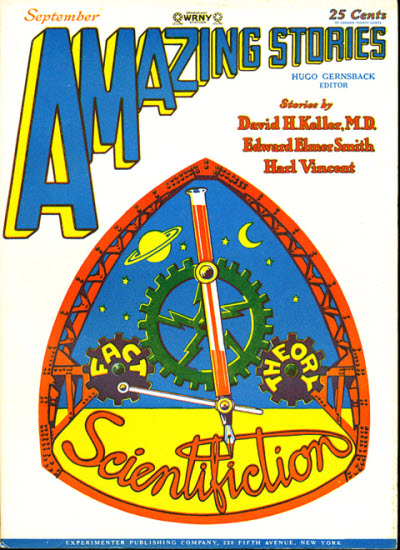
(Cover by Frank R. Paul. Amazing Stories, September 1928.) The Story So Far
Dick Seaton has discovered a desposit of the very rare and unusual metal known only as X, and has wasted no time in testing this metal. Combining X with copper and running them through an electrical current has the very strange and incredible effect of anti-gravity. The experiment damn near kills Seaton, and it was by luck that it didn’t. It’s also very lucky of Seaton that he has a small wealth of this precious metal in store and that he has the resources for working with it—first at the Bureau of Chemistry, then with the help of his rich friend Martin Reynolds Crane. Once it becomes clear that Seaton’s dreams no longer lie at the Bureau, he and Crane decide to start a business together. This is all well and good, but Marc DuQuesne, a fellow chemist at the Bureau, has been eyeballing Seaton’s experiments and has enough ambition and lack of morals to steal that research for himself. Like Seaton, DuQuesne is connected with a party that can provide the money for his machinations, this being Brookings, head of the Steel Trust, a corporation with a few skeletons in its own closet. What entails is some corporate espionage, ranging from sketchy to murder in broad daylight. Shiro, Crane’s loyal servant, narrowly survives an assassination attempt when DuQuesne flies in on the Crane estate’s airfield. I should mention here that these men are scientists, as well as trained gunmen and aviators. Between Seaton, Crane, and DuQuesne, there’s hardly a talent none of them has. Oh, they’re also handsome and charismatic.
The two parties are at a bit of a crossroads. An attempt on DuQuesne’s part to replicate Seaton’s formula for the solution failed disastrously, and even killing Seaton or Crane would not mean getting’s one’s hands on the formula. DuQuesne thinks it best to sabotage the ship Seaton and Crane have been building, with the help of Perkins, an amoral detective, but Seaton and Crane get the idea to construct a second ship that’s in full working order. This ship gets christened the Skylark. When all else has failed, DuQuesne thinks it’d be a good idea to kidnap Dorothy Vaneman, Seaton’s fiancée. (Seaton is somehow engaged, despite seeming to not have much interest in sex or even romance.) There’s also the problem of Margaret Spencer, a young woman who’s been spying on the Steel Trust so as to one day avenge her father, whose research the corporation had stolen. All of these people, including Perkins, are projected for a head-on collission with each other, as the Skylark is about ready for take-off and DuQuesne’s gotten a spaceship of his own. I had neglected to mention Perkins and Margaret when writing about the first installment before, although in my defense the latter will play a much bigger role in the second installment.
Enhancing Image
DuQuesne’s plan to kidnap Dorothy goes horribly wrong for everyone involved, as the four of them (DuQuesne, Dorothy, Margaret, and Perkins) get into a skuffle onboard and the ship takes off by accident. By all rights the absurd amount of acceleration should’ve crushed everyone to death, but not only does everyone survive, DuQuesne’s even able to retain consciousness long enough to put on the brakes. For being a chemist with a stuffy job, it seems that DuQuesne (this also applies to Seaton) keeps himself in better shape than the average man. The ship has also somehow, in a matter of minutes, ventured far enough into the cosmos without hitting anything that not only have they lost sight of Earth, they don’t even seem to be in the Milky Way anymore. This all reads now like second-rate fanfiction with how implausible and theatrical it all is, such that even by the time The Skylark of Space first saw book publication in 1946 I suspect readers would’ve had a hard time taking its science seriously. It’s only maybe marginally more scientific than the heroes of Jules Verne’s From the Earth to the Moon shooting themselves out of a cannon. At the same time it’s an incredible moment in how it juxtaposes with what was, up to this point, an earthbound narrative. We’ve gone to space in SF before, even in stuff published in Amazing Stories at this time, but not this far out.
Now, if we were to put on our thinking caps, our Literature Reviewer™ hats, there are a lot of holes one can pioke in this thing. It’s convenient that Seaton and Crane, in the Skylark, are able to track the ship the other four had gotten lost in, and it’s just as convenient that Perkins, having served his purpose in the plot, gets shot to death by an remorseless DuQuesne. So we’re down to five, then, and minus one ship, as DuQuesne’s ship gets swallowed up by what would now be called a neutron star—indeed what seems to have been be the first appearance of a neutron star in SF. Meanwhile, this misadventure leads to all five sharing space aboard the Skylark, which also, in a matter of great convenience, happens to be stocked with food and bedding for everyone. Being stuck in a cramped environment with the novel’s villain sounds like a bad time, but while DuQuesne has nefarious shit in mind for Our Heroes™, he’s also pragmatic enough to cooperate while outnumbered and outgunned. I think I brought this up in my last review, but DuQuesne might be the first great villain of magazine SF. He is intelligent, cunning, vicious, very proud of his own abilities, in a way being Seaton’s mirror image. This is not a madman who simply wants world domination or the hero’s head on a pike, but someone who comes off as a thinking individual. The other characters are not as impressive, in no small part due to the shoehorned romantic tension between Crane and Margaret. I will admit as a positive that Dorothy and Margaret are surprisingly well drawn for being women in a 1920s pulp novel: they, like their love interests, are assertice, no-nonsense, and at least one of them even knows how to handle a gun. I wonder who’s responsible for this moderate egalitarianism.
The gang scouts for planets that are not only habitable but which contain the right metals for the Skylark, namely X and copper. There’s a strange run-in with an intelligent alien who communicates via telepathy, and who also is keen on the humans “dematerializing” so that they can be absorbed into the race’s thoughts—a race that is incredibly quick-witted, if condescending, but at the expense of not being very physically imposing. Eventually Our Heroes™ (and villain) land a planet that’s rich in metals, and home to another intelligent race, this one being more benign—or so it seems. Nalboon, the leader of Mardonale, treats the humans as guests, even inviting them to a delicious dinner. Mardonale is a decadent society where slavery has apparently stuck around as the norm—not slavery based on race or skin complexion, mind you, but more slavery as in ancient Egypt and Rome. The attitude Seaton and company have to getting slaves as servants is casual to the point of being disconcerting, if we’re being honest. You might say, well, when in Rome and all that, but the issue of slavery only sparks a panic button in Seaton’s brain once it occurs to him that he and his friends may well become prisoners on this planet. This all plays out like a classic Star Trek episode, wherein Captain Kirk and his landing party are introduced to a cultured and seemingly friendly alien of the week on their home turf—only to find something malicious is brewing.
A Step Farther Out
If The Skylark of Space has aged better than its reputation suggests, it’s because it still reads compellingly as adventure fiction, if not as science fiction. Much of this installment focuses on the changing relationships between the five main characters, and this focus on character would’ve probably come off much worse without Garby’s part of the equation. It still reads at points stiffly and melodramatically for the modern reader, who is more sophisticated than Smith by a good margin, but the dialogue is surprisingly robust. It also helps that this novel is short by modern standards, such that I ended up reading the middle chunk of it in just two sessions. I have to admit I would be totally in the dark as to how this novel could end, except for the fact that it has a few sequels. There’s a degree of unpredictability here that must’ve had an intoxicating effect on readers in 1928. I’m enjoying all this more than I had initially expected.
See you next time.
-
Short Story Review: “Dumb Martian” by John Wyndham
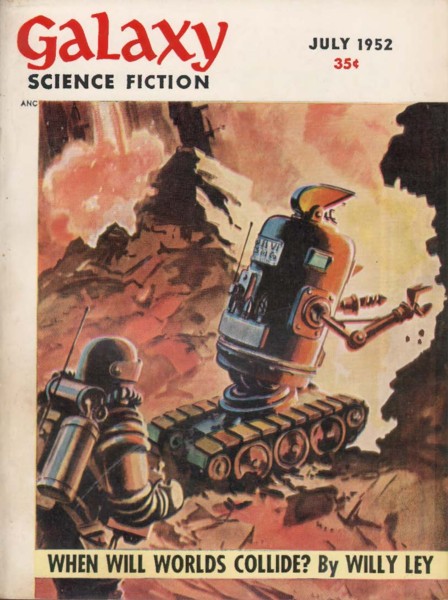
(Cover by Jack Coggins. Galaxy, July 1952.) Who Goes There?
In the 1950s, an exceedingly small number of SF authors got lucky and gained some mainstream traction. These were people who gained book deals with mainstream publishers and were having their work adapted for film, TV, radio, and so on. Some, like Ray Bradbury, seemed to have spent years honing their skills and forming the right connections for such exposure, but John Wyndham becoming one of the bestselling SF writers of the ’50s must’ve come off as an unexpected development. Wyndham was born in 1903, in England, his full name being John Wyndham Parkes Lucas Beynon Harris. He had, in fact, already been writing SF for about twenty years when his 1951 novel The Day of the Triffids became a mainstream hit, with it even getting serialized in The Saturday Evening Post. This decade saw Wyndham on a hot streak, as over the next decade he also wrote The Kraken Wakes, The Chrysalids, and The Midwich Cuckoos, that last one getting adapted into Village of the Damned. Wyndham set the standard for a particular sort of SF, that being rather folksy and British, not to mention being informed by the traumas of a haggard post-war England.
While Wyndham’s novels from this period are some of the best that ’50s SF has to offer (at a time when the novel as a form was evolving rapidly in the field), his short stories are no joke. “Dumb Martian” has a title that might make you think it’ll be comedic, but this is a serious and thorny tale of racism, misogyny, and domestic abuse. It just so happens that the woman at the story’s center is an alien.
Placing Coordinates
First published in the July 1952 issue of Galaxy Science Fiction. It’s been reprinted in Gateway to Tomorrow (ed. John Carnell) and the Wyndham collections The Best of John Wyndham and The Seeds of Time.
Enhancing Image
Duncan Weaver is set to work on a wayload station on Jupiter IV/II, a small satellite near Callisto. Five-year contract, tax-free, and by the end of it he’ll be looking at quite a lot of money. The problem is that it’s a one-person job and it’s totally possible to lose one’s mind in such an environment before the term is up. Before Duncan has even arrived at the station he’s run into the problem of paying for company, in the form of Lellie (no last name), a young Martian girl who legally becomes Duncan’s wife. This is all to get around red tape, though, since for all intents and purposes Duncan will be using Lellie as a maidservant—even as a slave girl. But don’t call it that. “Anti-slavery regulation,” the agent in charge of this whole transaction says. Duncan is supposed to be merely buying Lellie’s services from her parents. Lellie herself has no real say in all this, for one because her English is rudimentary and secondly because even if she had a better grasp on the language, she would still be at the mercy of her parents. Overall the “marriage” deal runs Duncan $2,310, which must’ve been a big amount to people in 1952 but which now amounts to a month’s rent.
When it comes to protagonists in old-timey SF, they range on a spectrum from decently benevolent to Mussolini 2.0, with an uncomfortable number of these “heroes” now reading as more suspect than the author had intended. In the case of Duncan there’s no question about his status: he’s a certified shithead. Of course, it also doesn’t take long to figure that he’s supposed to be a shithead, and that Wyndham has something special in mind for—well, you can’t even really call him an anti-hero. Duncan is a racist who sees the “Marts” as inherently feeble-minded and off-putting, despite them being humanoid, and thinks of Lellie as being an especially poor specimen. But it was the best deal he could get. We don’t get much info on life outside of what pertains to Duncan’s job, but we can infer relations between humans and Martians are not that unlike between white settlers and indigenous peoples in North America. There aren’t too many SF stories of this vintage that are about racism, and when they do tackle race it’s usually by way of allegory—of using aliens as stand-ins for real-life marginalized peoples. This is not necessarily a bad thing, especially in the case of “Dumb Martian” where the allegorical angle is pretty surely justified. Wyndham wants us to think of Lellie as more downtrodden woman than Martian.
The third-person limited narration puts us in Duncan’s shoes for pretty much the whole story, and Wyndham walks a bit of a tightrope by making us stick to this man like glue. It’s risky to have someone so loathsome as both your protagonist and perspective character, even if it’s on purpose. What’s uncanny about “Dumb Martian” is how Wyndham’s able to tap into the mindset of someone who is both hateful and incurious, but not cartoonishly so. There are some activities one can do at the station, to pass the time, but for instance the station’s small library is totally wasted on Duncan. He’s one of those blue-collar types who has an irrational distrust of reading—a flaw in his character that’ll come back to bite him later. He also has no interest in learning about Lellie’s own language or culture, instead trying to coach her to talk better English and to act like “a real woman.” To give some small credit he does try to play games with Lellie, with the few that are on board, like chess, but he finds that once she got the rules down she can beat him quite handily at any of them. The fact that Lellie is shown to be easily a better player than Duncan foreshadows a depth of intellect that Duncan is either unwilling or incapable to acknowledge. He thinks these games naturally favor her somehow, almost as if she were cheating. While she doesn’t say much, his “wife” is not as dumb as she appears.
All these little moments build up over the months to when Alan Whint stays at the station for a time, and while Duncan doesn’t understand this in the moment, Whint’s involvement will mark a point of no return. I thought for a second that Whint would fall in love with Lellie, as he quickly becomes more interested in her than the rocks on Jupiter IV/II, but their relationship not only remains platonic, but once Whint leaves he’s never heard from again. But his impact on Lellie is profound, as he’s an open-minded fellow who sees the Martians as worthy of basic respect, and Lellie herself as worthy of basic respect as a woman. Duncan makes no secret of resenting the scientist for “putting ideas in her head,” but there’s only so much he can do about it. Whint leaves both the station and the narrative before too long, which is a good thing because if the walking problem that is Duncan is to be solved, Whint should not be the one solving it. While he’s disgusted by the way Duncan treats Lellie, including a bruise on her cheek that has not faded entirely, the most he can do is give Lellie just the right amount of nudging so that she can take matters into her own hands. It’s satisfying, even from a modern perspective, because we get to watch Lellie dive into the same books Duncan shuns, and we watch her become rather shrewd and assertive over the course of several months.
There Be Spoilers Here
By the story’s climax Lellie has become so well versed in English and reading that she’s become a better bookkeeper than Duncan—not that he wants to admit this. He also doesn’t wanna admit that it really wouldn’t take much, being stuck here on a big rock in space, for him to die—be it in an accident, or in foul play made to look like an accident. He doesn’t consider the possibility of Lellie being both spiteful and knowledgable enough to take revenge on him. He doesn’t consider any of this, until it’s too late. And a good thing, too! What Lellie does is objectively cold-blooded, but after all the abuse Duncan’s put her through it’s hard to feel sorry for the receiving end of her business. Good for her. The perspective flip at the very end, after Duncan dies, comes almost as a shock, but it’s well earned.
A Step Farther Out
The gender politics of SF of this vintage can often be iffy, but there were some with a feminist tinge, and there were even a few of those that were written by men. (The ’50s saw a serious uptick in women writing SF, with themes and subject matter to go with this demographic shift.) I’m not sure I would call Wyndham a feminist ally, if only because despite having read a few of his novels I’m not really sure of his politics. Unmistakably there’s an anti-racism streak in “Dumb Martian,” but the feminist angle might not be as deliberate. Regardless, this is a good one. Wyndham appeared a few times in Galaxy during those early years of the magazine’s life, but it’s a shame he didn’t contribute more, as they were a very fine match for each other. H. L. Gold, Galaxy‘s editor, wanted material that was ideally both slick and socially conscious, and Wyndham provided both.
See you next time.
-
Serial Review: The Skylark of Space by E. E. Smith and Lee Hawkins Garby (Part 1/3)
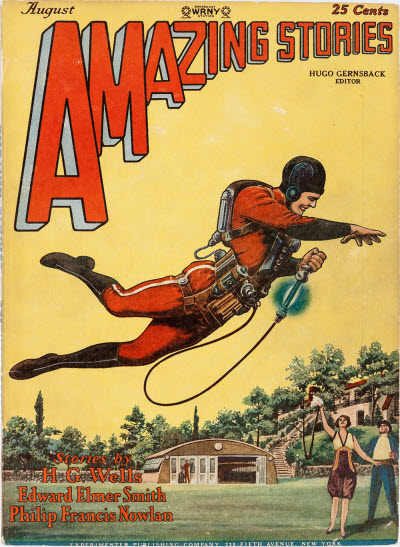
(Cover by Frank R. Paul. Amazing Stories, August 1928.) Who Goes There?
Edward Elmer Smith was born in 1890 in Wisconsin, and until he was about 25 he didn’t seem to have even a thought as to becoming a writer. Instead he trained to become a chemical engineer at the University of Idaho, eventually earning his PhD there. During World War I, but before the US became officially involved, Smith did some brainstorming with Carl Garby, a college friend of his, and Lee Hawkins Garby, Carl’s wife, as to the possibility of man-made space flight and life on other planets. Smith and Lee would end up writing much of The Skylark of Space throughout 1915 and 1916, with Smith doing much of the work and Lee writing a good portion of the dialogue, as well as being responsible for the female characters not being completely made out of cardboard. Eventually Smith finished the novel by himself in 1920, but he was unable to find a publisher for it. There was a near miss with Argosy in 1922, who almost accepted it; but while Argosy did sometimes print science fiction, Smith’s novel was considered a bit too heavy on the scientific end of things. It wasn’t until Amazing Stories launched in 1926 that Smith found his outlet.
Despite its publication being delayed by nearly a decade, The Skylark of Space was a smash hit with readers when it finally appeared. Smith, who previously didn’t have much ambition in the way of making it as a writer, became a sensation with a niche but passionate readership practically overnight. He didn’t waste time in writing a sequel, although he never worked with Lee again. Carl Garby died unexpectedly the same year Smith’s novel was serialized, and this was apparently a big reason for Lee staying out of the fledgling magazine SF scene for good. Speaking of delays, The Skylark of Space didn’t see book publication until 1946, and its history in book form is more than a little convoluted. While initially credited to both Smith and Lee, Smith took it upon himself to scrub out Lee’s contributions, so that later editions were credited to Smith alone.
Placing Coordinates
First published in Amazing Stories, where it was serialized in the August, September, and October 1928 issues. It first appeared in hardcover in 1946, with some revisions, and then was revised again in later editions. Since the magazine version has been in the public domain for a minute, you can read it on Project Gutenberg without issue.
Enhancing Image
Like a lot of great discoveries, the one at the beginning of this novel is made by accident. Dick Seaton is a brilliant but single-minded chemist who’s been working with “X,” an unknown metal which has not yet been added to the periodic table. Even more rare than radium, and perhaps even more dangerous, Seaton had come upon a wealthy deposit of X by sheer luck, and has wasted no time in toying with it. One day he mixes the strange metal with copper and effectively discovers a method of anti-gravity—if also damn near killing himself in the process. People who know their really old-timey SF may recall a similar thing happening early in H. G. Wells’s The First Men in the Moon, which Smith and Garby may well have been thinking of. In the early 20th century there seemed to be a recurring sentiment among the scientifically literate that some hypothetical anti-gravity device would take men to the stars, rather than developments in rocketry. Anyway, the problem Seaton soon runs into is that if you aren’t quite sure how to achieve a certain result in the first place then that would make it all the harder to replicate. Seaton knows it’s a combo of copper, X, and an electrical current, but when trying to repeat the anti-gravity effect to his colleagues he fails. His job at the Bureau of Chemistry is coming to a close, him being seen as an eccentric, but luckily he has connections…
Like every creative type I’m sure, Seaton is able to fall back on a rich friend of his, by the name of Martin Reynolds Crane. On his own Seaton isn’t able to accomplish very much, but his partnership with Crane quickly leads to the two men extrapolating on the solution Seaton had originally made. Seaton is the inventor, the pure creative, while Crane (aside from being quite wealthy) is more accustomed to worldly matters. It’s strange, for one, that Seaton has a fiancée, Dorothy Vaneman, since he’s borderline neglectful of her and doesn’t seem to be all that knowledgable of romance. (It’s worth mentioning that Smith, himself freshly married when writing the novel, admitted to lacking in confidence with regards to writing women and the relations men and women naturally have. Heterosexual men are so funny.) Still, the two buddies found the Seaton-Crane Company, with the hopes of developing a “space-boat” with X, as well as a power plant. As you can tell from this novel’s title and its reputation, we’ll be heading out into the reaches of space—eventually. But not in this installment. While this is one of the space stories that codified space opera, if not being the one to invent that subgenre outright, nobody in the novel has yet to call a spaceship a spaceship. It’s either a “space-boat” or a “space-car.” I think there’s a slightly catchier word that’ll do the trick, fellas. The Skylark of Space sets a few standards for classic spacefaring SF, one of them being the duo of an ambitious scientist and a benevolent capitalist. Unfortunately for Seaton and Crane, a nefarious competitor has been keeping eyes on their business.
A good story requires a good villain (usually), and we do get one in the form of Marc DuQuesne. Like Seaton, DuQuesne is a brilliant chemist who starts out at the Bureau, but unlike Seaton he has nothing in the way of a conscience. Indeed, much like the CIA, DuQuesne is not above murdering a few people in cold blood to get what he wants—a point that’s made in the very chapter where he’s introduced. And like Seaton, DuQuesne strays from the Bureau to have a covert partnership with Brookings (I don’t think we get his first name), head of the Steel Trust or “the Corporation.” Seaton has the solution but not the equipment for a spaceship at the moment, while DuQuesne has the equipment but the not the solution. This is a pretty robust hero-villain dynamic, possibly the first of its kind to arise out of magazine SF. Certainly there were villains in magazine SF, on top of the usual pulp heroes, but the rivalry between Seaton and DuQuesne holds all the action together rather than feeling like an accessory to it. It helps that these two fellows didn’t like each other even before the discovery with X, so that their rivalry has a personal element. Despite the two not really interacting at all during this first installment, we still get a good idea of the stakes and what each man sets to gain (and lose) from this solution. A chemist the Corporation had hired gets pretty unlucky trying to synthesize the solution and blows not only himself up but some 200 innocent people—just a whole frontier town off the map. Not that DuQuesne is bothered by this; it’s a small setback, and there will be more dead bodies to come.
The astute reader might’ve gathered that the first stretch of Smith’s novel reads less like spacefaring SF and more like an espionage thriller, albeit with an SFnal twist. X is a totally made-up element, and by the end of this installment we have a working spaceship that smacks more of steampunk than modern rocketry, but otherwise the narrative is grounded enough. Mind you that the spy genre was also in its infancy at the time, since novels like The Thirty-Nine Steps and The Man Who Was Thursday would’ve been fairly recent literature at this point. Smith doesn’t go into the pure action of the former or the strange metaphysics of the latter, but instead takes a pragmatic cloak-and-dagger approach. Reading about the accident with DuQuesne’s chemist, it becomes apparent to Seaton and Crane that somebody close to them was eyeing Seaton’s research, and had even gotten their hands on some X. They figure DuQuesne is the only person who has both the means and the motive for stealing Seaton’s reserch, but they have no hard evidence to use against him. For his part, DuQuesne isn’t too fond of getting his own hands dirty, but will resort to “direct action” if he feels the need. There’s a memorable and rather violent scene in which Shiro, Crane’s loyal servant, gets nearly killed alongside a couple bodyguards when DuQuesne raids the estate’s airfield (yes, they have an airfield, complete with a biplane) while in disguise. I should also mention that Shiro, the token non-white person in this novel thus far, comes off surprisingly well, despite being subjected to a particular racial slur.
There Be Spoilers Here
As I already said, we have a working spaceship by the end of the first installment, although it took a lot of resources and a failed attempt at sabotage. The lengthy descriptions we get of the ship’s mechanics are night incomprehensible to the modern reader, so I’ll stop there and say it was a smart choice to end the installment on this note. We have a good idea of what’s coming next, but Smith and Garby have been edging the reader and building intrigue at a good pace—honestly much better than I was expecting, considering this was Smith’s debut novel.
A Step Farther Out
Is this novel good on a prose level? Does the Pope shit in the woods? That’s not why we’re here. Admittedly, even by the time it saw book publication in 1946, Smith and Garby’s style must’ve struck readers as creaky. On the one hand this can be boiled down to a combo of poor timing and the novel becoming a victim of its own success, but at the same time it still reads unconventionally. This is not a totally predictable wish-fulfillment fantasy, but instead a melding of genres that was so ambitious in the early 1920s that there literally wasn’t a market for it at first. I’m a third of the way in and I’m not that sure as to the novel’s trajectory from this point, which has to be worth something. It’s also a lot more gripping than Triplanetary, the last Smith novel I tried to read.
See you next time.
-
Novella Review: “Half-Past Eternity” by John D. MacDonald
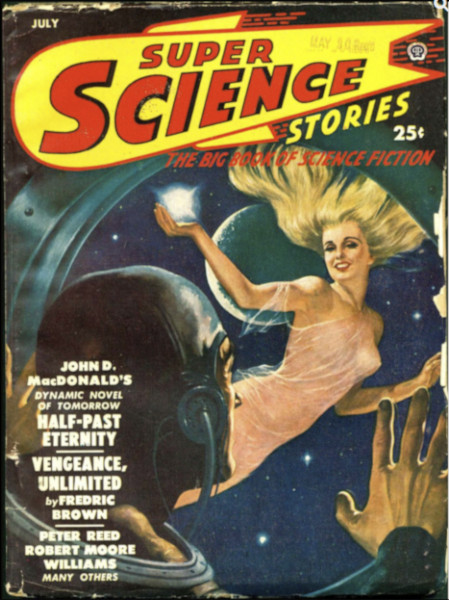
(Cover by Lawrence. Super Science Stories, July 1950.) Who Goes There?
Did not think this post would get delayed by almost a week, but I got hit with the double whammy of being sick (some repiratory deal, like a chest cold), which I’m still dealing with, and more importantly being without internet at my apartment for four fucking days. This all happened over Easter weekend, so it felt like just bad luck. Apologies.
Fans of classic crime fiction will know John D. MacDonald for his prolific and popular Travis McGee series of novels, starring the titular detective, with some 21 novels published over a span of about as many years. MacDonald apparently wrote the first handful of Travis McGee novels in rapid succession, slowing down a bit after but still writing at an impressive speed. He’s also famous for his standalone crime novel The Executioners, which you would know better as Cape Fear. He earned the Grand Master Award for lifetime achievement from the Mystery Writers of America in 1972—by no means a small feat, especially given that he had only been writing crime fiction for not quite twenty years at that point. But before all this, before even Cape Fear, MacDonald cut his teeth by writing for various magazines from the late ’40s through much of the ’50s. He wasn’t very picky about what genres he would dabble in, although much of the fiction he wrote in these early years was sports stories, non-genre adventure stuff, and of course science fiction. The magazine market for SF was going through a renaissance at the time, which MacDonald capitalized on. “Half-Past Eternity” is one of MacDonald’s longer SF stories, being about 20,000 words, and in a way fitting for MacDonald it has a mix of SF, crime, and sports fiction. Like sure, why not combine all three?
Placing Coordinates
First published in the July 1950 issue of Super Science Stories. It’s only been reprinted twice, in The Human Equation (ed. William F. Nolan) and the MacDonald collection Other Times, Other Worlds.
Enhancing Image
Dr. Garfield Tomlinson goes to make a bet on a boxer, “the kid,” who in fact is in his early thirties and a loser with a soft swing. Tomlinson bets the kid will knock out his opponent in the first round, with an amount of money that surely would’ve been considered suicidal circa 1950. The bookie, Nat February, accepts the bet, but is really puzzled—both by how much money Tomlinson has put on the table and how confident the old doctor is that he’ll win. Which he does. The kid’s swings are unnaturally fast and swing, to the point of breaking his opponent’s jaw, on top of the first-round knockout. Despite the story starting with their perspectives, neither Tomlinson nor Nat is the protagonist (we never even see Nat again after this opening stretch), but instead Sam Banth, an ambitious and amoral con-man who makes it his mission to track down the doctor. He’s street smart, but he’s also smart enough to do some digging at the local library and find Tomlinson’s name, and even where he lives. The doctor had studied longevity in geriatrics, but his most recent research has to do with speeding up time for the young rather than slowing it down for the old. The short of it is that time is partly subjective, in that how each person understands the passing of time involves metabolism, reflexes, etc. For a swift boxer, time seems to move slowly, even if that’s not the case in reality. If you’re an athlete in the heat of the moment, time seems to stretch out like a rubber band, while conversely your reflexes are tuned as if every second counted.
More importantly, Sam realizes that athletes with such an enhancement could make him a fortune. But first, he has to get through to the doctor, along with Linda, Tomlinson’s daughter. Sam is quite a bastard; he would fit right in as the protagonist of a crime story of the sort that focuses on the criminal. He all but coerces Tomlinson into forming two companies with him: Research Laboratories, Inc and Champions, Inc.The idea is basically to “train” athletes who normally would have few prospects with the help of the old doctor’s method of time distortion, thus heightening reflexes and making these losers into stars. Of course, the angle for Sam is to scrape the profits off these athletes, along with having big shares in the company. You might say using such research to make superhuman athletes would be cheating and even rendering these demanding sports monotonous, and you’d be right! Not that Sam is all that concerned about what’s right or wrong. Meanwhile he’s getting smitten with Linda, who by her own admission wants enough money to “smother” herself with. Despite their initial hostility toward each other, since Linda’s well aware Sam wants to take advantage of her father, the two end up having a fair bit in common. While Sam already owns a large stage in the company, the ownership being split three ways, he gets the idea that maybe if something unfortunate were to happen to the old doctor, and also if Sam were to marry Linda, well…
The scheme at the center of “Half-Past Eternity” is a good deal of fun to read, even if we can guess that the whole thing will come crumbling down at some point and in some way. We don’t expect Sam to come out on top, nor do we want him to; but it’s the getting-to-that-point that’s fun. I’m reminded of one of the all-time quintessential noirs, Double Indemnity, that classic premise of a coniving woman and her lover plotting to get rich off her husband’s life insurance. This is all well and good, although the story does suffer a bit from MacDonald’s need to either pad out the word count or give us more of a perspective on the athletes being “trained.” There’s a B-plot involving Wally Christopher, a young man who has a passion for baseball but no future in it at the pro level, on account of not being very good at it. He starts having an affair with the much older Barbara Anson, a respected former tennis player who had quit the game on account of a leg injury. This plot thread ultimately doesn’t go anywhere much and sort of just fizzles out before the climax of the story proper, but we do at least get some insight on what it’s like to live day to day with these heightened reflexes. People who’ve gone through this treatment become so quick, in fact, that they become jittery, and have to train themselves to take things slow—for the sake of appearing normal to the outside world. The catch, like I said, is that the body is actually aging faster than it normally would, so that for someone like Wally time really go by quicker for them and slower for everyone else. I’m sure this will not factor into the story’s climax at all.
I don’t know how far back performance-enhancing drugs were treated as an issue in professional sports, but “Half-Past Eternity” deals with this subject in an SFnal manner, wherein instead of real-world drugs we’re given a vaguely explained time-distorting treatment. Of course, cheating has been a thing in sports for all recorded human history, or for as long as there have been sports with rules. I mentioned that MacDonald, very early in his career, wrote quite a few sports stories, although I’m not sure if you can find them in print anywhere. MacDonald’s short fiction is generally obscure compared to his novels. “Half-Past Eternity” is at an awkward spot where it’s too long to fit neatly in a short-story collection and too short to be honestly called a novel—despite what the front cover of Super Science Stories says. Certainly he could’ve shaved the word count down so that it fit more neatly as a novelette, namely by doing away with the aforementioned subplot. Even with the fat on it, though, this is a fast-moving yarn.
There Be Spoilers Here
Up this point the story has been nominally SFnal, but things are about to take a very Philip K. Dick direction, to the point where I wonder if by chance a young Dick had picked up this issue of Super Science Stories. Sam and Linda plot to kill the latter’s dad, and plan goes off without a hitch. If anything the plan succeeds a little too well. Sam, who himself has sociopathic tendencies, is disturbed by the ease with which Linda is able to get over having a part in her own father’s murder. Maybe it would be best to kill her as well, and take her stake in the company for himself. This plan both succeeds and fails. By the time of his death, Dr. Tomlinson had constructed an “iron maiden,” a portable chamber that would subject the lucky (or unlucky) person inside it to time distortion. If someone were to be trapped in this chamber, though, time for them would speed up such that they would die from a combination of thirst and old age—in just a matter of minutes. They had already seen this effect on animals, through testing, but a human being had never been put in the chamber and killed like this. Yet. Sam succeeds in killing Linda via the iron maiden, but is himself thrown inside and only narrowly avoids dying by breaking out. Having stripped himself of his clothes to escape, Sam is now alone, naked, and most strangely now, in a world where time has all but stopped for him. This is where “Half-Past Eternity” gets really fun. The final stretch of the novella sees Sam moving so fast that subjectively he’s stumbled into a world where everyone and everywhere has almost frozen solid. Even water has effectively turned into a solid, and MacDonald is happy to tell us the convoluted means by which Sam has to eat and drink anything. By this point the sports and crime tropes have fallen to the wayside, with the SF knob being turned all the way up.
In his introduction for this story in Other Times, Other Worlds, Martin H. Greenberg singles out the final chapter of “Half-Past Eternity” as impressive in its handling of “difficult material.” I thought this meant in the sense of graphic or “serious” stuff, but actually he meant something very different. Sam gets away with his crimes, in a sense, and he even lives to old age—all in the span of one day. By the end of his life, at which point mere hours have passed in the objective world, he’s become like Robinson Crusoe, a raggedy old man with long hair. This is a very strange punishment, but at the same time it’s not all bad for Sam, as he effectively becomes ruler of the world, being able to do whatever he wants—or at least anything that doesn’t get him killed. He even kills a man, by accident, early on and gets away with it. Even if the novella wasn’t exactly great up to now, I do think the final chapter is worth the price of admission.
A Step Farther Out
John D. MacDonald is the kind of author you’d think wouldn’t appear on a sci-fi/fantasy review blog more than once, but he wrote quite a bit of SF in just a handful of years, and I do like to cover SF by authors from outside the field sometimes. The last time I wrote about MacDonald was the magazine version of his novel Wine of the Dreamers, which I thought was middling. “Half-Past Eternity” is a marked improvement, in part because it plays more to MacDonald’s strengths. It’s hardboiled and no-nonsense, and the climax, while outlandish and maybe hard to believe if you think about it too long, is a lot of fun. It all goes by quickly, despite being a novella. Given that it’s not been reprinted ever in my lifetime, it’s safe to call this one a bit of a hidden gem. Just don’t take it too seriously.
See you next time.
-
Things Beyond: April 2026
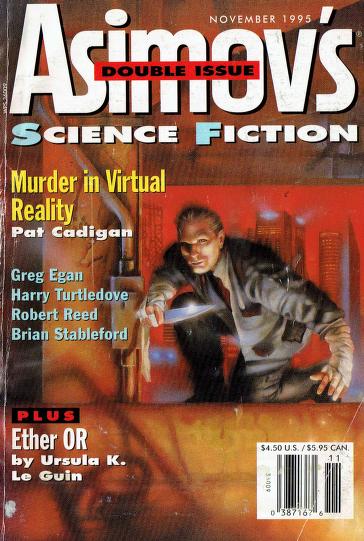
(Cover by Bruce Jensen. Asimov’s, November 1995.) March was a bit of a marathon here at SFF Remembrance, but truth be told I had more fun writing about that very old and dusty science fiction than in the past few months. I had been suffering from fatigue, along with some real-life stuff that was getting to me and making it hard to sleep at night. Now I feel somewhat rejuvinated. I feel good enough about reviewing stuff here again, in fact, that I’m bringing back the two-short-stories two-novellas deal, although I’m still keeping it to one serial for the month. The serial in question is a three-parter, being the first appearance of one of the most important SF novels ever written—and yet one that has been totally lost to the sands of time. You might find references to The Skylark of Space if you’re a Star Wars fan, as a point of trivia, since it was this novel that in part invented the space opera subgenre. Edmond Hamilton was writing space opera at shorter lengths around the same time Smith made his debut, but there was nothing on the scale of Smith’s novel before it. Smith “revised” it for its eventual book publication, removing co-author Le Hawkins Garby’s contributions, but we’ll be reading it as it appeared in Amazing Stories. This was a long time coming for me.
For the dates of stories, we’re looking at one from the 1920s, two from the 1950s, one from the 1960s, and one from the 1990s. Both of the stories from the ’50s are from the first half of that decade, which was an incredibly productive period for magazine SF.
For the serial:
- The Skylark of Space by E. E. Smith and Lee Hawkins Garby. Serialized in Amazing Stories, August to October 1928. When Smith studied chemistry at the University of Iowa, he didn’t think he would later become one of the pioneering authors of space opera. He didn’t even think he would write fiction, until he talked science fiction with Lee Hawkins Garby and her husband, who were friends from college. This was in 1915, before “science fiction” had even been coined as a label. The Skylark of Space took some years to gestate, but when it appeared in 1928 it made Smith a sensation among the then-niche SF readership. Garby’s contributions were later removed when the novel appeared belatedly in book form.
For the novellas:
- “Half-Past Eternity” by John D. MacDonald. From the July 1950 issue of Super Science Stories. Fans of classic crime fiction will be familiar with MacDonald, at least by reputation. His Travis McGee series is one of the most prolific and widely read detective series ever. In 1972 he was given the Grand Master Award by the Mystery Writers of America. He also wrote a good deal of SF from the late ’40s through the early ’50s, along with nearly every other genre.
- “Death in the Promised Land” by Pat Cadigan. From the November 1995 issue of Asimov’s Science Fiction. It was first published in the March 1995 issue of Omni, but that magazine had gone purely online by that point and the Asimov’s printing marked its first physical appearance. Cadigan is arguably the queen of cyberpunk, going back to the ’80s. She’s not as famous as William Gibson or Bruce Sterling, but she really should be more read than she is.
For the short stories:
- “Dumb Martian” by John Wyndham. From the July 1952 issue of Galaxy Science Fiction. It’s surprising to think that Wyndham had made his SF debut in the early ’30s. His career peak came later than it does with most authors, since he was deep in his forties when The Day of the Triffids was published. The ’50s were a great time to be John Wyndham, between his novels and short stories.
- “Timberline” by Brian W. Aldiss. From the September 1961 issue of The Magazine of Fantasy and Science Fiction. This is the fourth installment in Aldiss’s Hothouse series, which was then published as a novel. The series of stories, rather than the novel version, won Aldiss a Hugo, which was certainly a confusing move. It’s been almost a year since I reviewed the last Hothouse story, so here we go.
Hopefully you’ll be reading along with me.
-
Short Story Review: “Shifting Seas” by Stanley G. Weinbaum
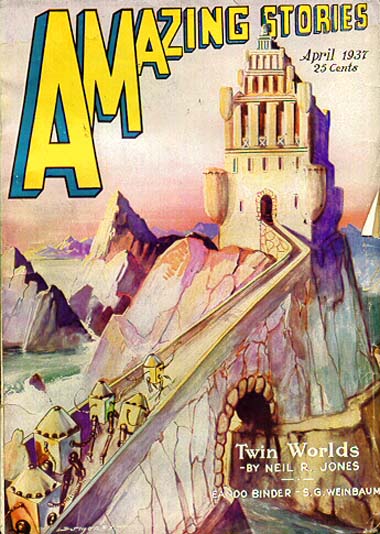
(Cover by Leo Morey. Amazing Stories, April 1937.) Who Goes There?
When Stanley G. Weinbaum died from cancer in December 1935, at the age of just 33, he was maybe the most beloved author in the field at the time, only rivaled by E. E. Smith and maybe John W. Campbell under his Don E. Stuart pseudonym. Certainly his rise to prominence was speedy and brilliant as could only have been challenged by Smith’s debut. Weinbaum made his own SF debut (he had written some non-genre work before this) with “A Martian Odyssey,” in the July 1934 issue of Wonder Stories, this one story basically rewriting the book on alien life in SF. With this story and its sequel, “Valley of Dreams,” Weinbaum became like a god to the niche world of magazine SF practically overnight. He wrote prolifically for the magazines, especially Astounding, over the next year or so, so that despite having been active in the field for a shockingly brief amount of time he had written a thick volume’s worth of short fiction. Reading Weinbaum now, he comes off as “quaint and quirky,” as Alexei Panshin put it in his review of The Best of Stanley G. Weinbaum; but there’s a childlike appeal to Weinbaum that serves as an alternative to the super-serious and downbeat SF that has saturated the market in the decades since his death.
Funnily enough, Weinbaum never appeared in Amazing Stories during his lifetime, presumably because even by 1935 it thoroughly played second fiddle to Astounding. I’m not sure when T. O’Conor Sloane got his hands on “Shifting Seas,” as while it took Sloane an infamously long time between him receiving a story and doing anything with it, I doubt Weinbaum himself had sent this story to this particular magazine. Several of Weinbaum’s stories, including a couple novels, were published after his death, but I’m not sure how his estate would’ve handled his work. The thing with Weinbaum is that his magazine stories can be more or less put into one of two categories, as either a contemporary “gadget” story or a space adventure having to do with exotic aliens. “Shifting Seas” is an outlier in that it doesn’t fit into either of these categories, but is instead a climate catastrophe story with a good dose of political intrigue. It’s interesting and a bit odd, but it’s certainly not what I would suggest for one’s first Weinbaum.
Placing Coordinates
First published in the April 1937 issue of Amazing Stories. It was first reprinted in the Weinbaum collection The Red Peri, and has since also appeared in the collections The Best of Stanley G. Weinbaum and A Martian Odyssey and Other Science Fiction Tales.
Enhancing Image
Ted Welling happens to be at the right place and at the right time, in the sense that he’s in the air, in a “Colquist gyro,” taking aerial photos when disaster his the isthmus connecting North and South America. Had he been on the ground when that lethal combo of earthquakes and volcanic activity hit, he would’ve died along with the million and a half people who ended up perishing. This incident, which is quite literally earth-shaking and would go down as one of the worst natural disasters of the 20th century, will have geological and even political implications in the long run. Even with his flying contraption, Ted barely makes it out of the whirlwind of smoke and ash, landing in Honduras (still a British colony at the time) and realizing that the strip of land, the isthmus, had sunk into the sea. The short-term consequences of this are apparent enough, but it’s only once the world’s attention has turned to this catastrophe and scientists have studied this literal sea change that an even bigger problem emerges. The sinking of the isthmus has changed the trajectory of the Gulf Stream, which, to make a long story short, spells very bad news for the British isles and mainland Europe. While North America will come out of this mostly unaffected, Europe is looking at a sort of ice age, to the extent that millions will die if they don’t evacuate. But to where? That is the main conflict.
There are actually two conflicts in “Shifting Seas,” but before I get to the second one, I wanna talk about the unusual politics and racism of this story. Something I think worth mentioning is that Weinbaum was white, but he was also Jewish, at a time when Jews in America (and Europe, it should go without saying) faced persecution on a systemic level. I think it was Sam Moskowitz who said Weinbaum was the first Jewish magazine SF writer to get published under his own name—a little factoid that’s pretty easy to take for granted now. There’s some racism in “Shifting Seas,” but I’m unsure how much of it is really just Weinbaum depicting the average WASP’s way of thinking or if it reflected his own racism. The deaths of over a million Hispanics at the story’s outset is treated by the white cast as bad, but not that bad, while, in the midst of discussing countries capable of housing European refugees, India’s dismissed as “hopelessly overcrowded.” The stereotype of India being a hive of unwashed masses and too many babies to feed goes back a long way. On the other hand, these countries of the third world are also counted as “civilized” by the third-person narrator, and for reasons that have since been totally lost to time, Japan is put on about the same level as the European empires. I assume this story is set in the 1930s, but that does raise some questions, like, How come no mention is made of the Nazis? Or Italy having turned fascist? Obviously Weinbaum would’ve been aware, which makes their absence all the more conspicious. Maybe this all takes place in a similar but alternate timeline.
Now, as for the love story, because there is one. The large-scale problem is with half of Europe freezing to death, but the small-scale problem is between Ted and Kay, his British wife-to-be. By the standards of ’30s SF, Kay is actually a well-drawn female character, if only because she isn’t helpless, nor is she hopelessly obsessed with her fiancé. She’s a fairly independent woman who unfortunately has been handed the worst of scenarios, seeing as how her home country and family there are facing extinction levels of crisis. She can marry Ted and stay in America, but that would be like a band-aid or splash of disinfectant on a gunshot wound. The crisis of immigration and moving some 200 million people, with countries’ allegiances changing in all this, understandably strains their relationship. Sure, Kay is highly emotional and says some rather strange things, especially as we reach the story’s climax, but it’s hard to blame her, given the circumstances. As for Ted, he—well, he exists. He’s a pretty vanilla pulp hero, although he’s by no means an action star. Hell, there’s not really any action in the conventional sense; instead it’s people talking in a bunch of rooms, plus passages about the worsening climate as if ripped from newspaper clippings. Of course, we’re not here for the characters, and even the romance drama between Ted and Kay is merely there to give us a more on-the-ground perspective of the larger conflict. Weinbaum is not very good at writing human characters: he’s better at describing places or aliens. We don’t get aliens here, but we do get a radically different version of life on Earth.
There Be Spoilers Here
Part of me was hoping there would be no easy solution, but Weinbaum, for better or worse, has a knack for meeting his strange SFnal problems with equally strange SFnal solutions. The ice age ravaging much of Europe ends up being short-lived, at least in the grand scheme of things. Indeed the issues of immigration and xenophobia that Weinbaum raises are way more intriguing than his playing with tectonic plates, ocean currents, and all that. “Shifting Seas” is a fine story, but it would’ve been even better had its author paid more attention to the real-world political issues he raises. Like how does Russia being communist (well, “communist”) relate to its treatment of refugees, or its hostile relationship with imperial Japan? The latter only gets mentioned in passing, and honestly you could read this story that was written circa 1935 and have no idea the USSR was a thing. Or Nazi Germany. The lack of a Nazi Germany or any mention of Hitler still strikes me as strange and inexplicable. I would’ve loved to get Weinbaum’s reasoning for these decisions, but not only has he been dead for almost a century, he was already dead when “Shifting Seas” was published. We don’t even have any interviews with Weinbaum; the only thing of real substance we have by him about himself is an autobiographical sketch.
Reading said sketch, which is included in A Martian Odyssey and Other Science Fiction Tales, Weinbaum comes off as well-read, shrewd, somewhat cynical, and quite intelligent. A passage that stuck out to me is the following, where Weinbaum talks about magazine SF:
[Science fiction] can criticize social, moral, technical, political, or intellectual conditions—or any others. It’s a weapon for intelligent writers, of which there are several, but they won’t practice its use.
Oh, a few have tried it. Dr. [David H.] Keller does it well occasionally, and Miles J. Breuer did it magnificently once or twice. Dr. Bell (John Taine) touches on it at times, but won’t descend to practical suggestions. And by far the most of this sort of writing, when couched in the usual form of satire, is heavy, obvious, and directed at unimportant targets. No one has attempted it on the scale of [Edward] Bellamy, who actually did criticize world social conditions in the form of a science fiction story, and presented a sort of solution.
“Shifting Seas” seems to criticize Europe’s xenophobic streak, and how said xenophobia (its collective persecution of Jews especially would’ve struck Weinbaum as no doubt concerning) might contribute to another war on that continent (something Weinbaum would be sort of right about, although he died years before World War II), but unfortunately it stays at the level of implication without much in the way of exploration. Even more unfortunate is the fact that while Weinbaum was prolific, he also died young, through no fault of his own, before he could hone his craft much. He wrote SF professionally for only a couple years, so that if anything “Shifting Seas” reads like a rough draft of a more ambitious and mature work we never got to see. The solution here is too clean, given how messy the problem is, which indicates a talent that’s promising but still in need of failures and trials. We never got to see that with Weinbaum.
A Step Farther Out
If “Shifting Seas” commits a huge sin at all, it’s that it doesn’t show Weinbaum quite in his natural habitat. What made Weinbaum so unique among his peers was that he wrote aliens who could think and act as well as humans, but who were decidedly not human in any recognizable sense. Or in his less serious stories, those set on Earth, he introduces a nifty gadget or puts a new spin on an idea that went back to H. G. Wells. Jack Williamson or Edmond Hamilton could probably not have written “A Martian Odyssey” or “The Lotus Eaters,” but a Williamson or Hamilton could have feasibly written “Shifting Seas.” As such, this is an outlier both in its subject matter and where it was first published. Maybe the next time I write about Weinbaum I’ll do something more in-character for him.
See you next time.
-
Short Story Review: “Devolution” by Edmond Hamilton
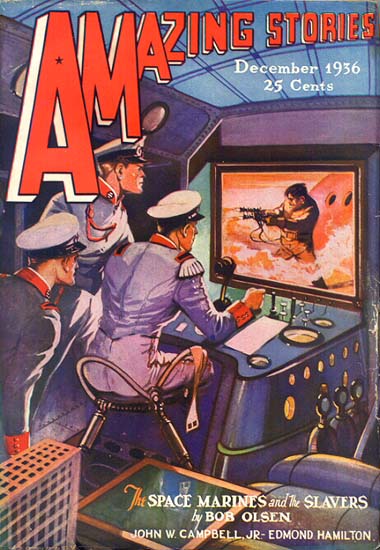
(Cover by Leo Morey. Amazing Stories, December 1936.) Who Goes There?
I have to admit, I fucked up. I was supposed to write about Leslie F. Stone’s “The Human Pets of Mars” for today, except I realized that it was too long to cover as a short story. It’s actually a short novella, and for some reason I had assumed it was shorter. A replacement would have to do. Fret not, I’ll be writing about Leslie F. Stone in the not-too-distant future. I figured that instead I should go for something “safe,” maybe something I’ve read before but haven’t in a while. I was then reminded of Edmond Hamilton’s “Devolution,” which I know for a fact I’ve read before, because it’s in the Orson Scott Card anthology Masterpieces: The Best Science Fiction of the Century. Incidentally this is a story with a similar premise to George Allan England’s “The Thing from—’Outside’,” but with a different tone and quite a different ending. Of course, it makes sense to cover Edmond Hamilton in a marathon of pre-Campbell magazine SF, since he was one of that era’s major architects, made even more sensible as he stayed clear of Astounding and found Campbell too picky an editor.
Hamilton was in 1904, in Ohio, although he later moved to Pennsylvania and then finally California. He made his debut young, in the August 1926 issue of Weird Tales, when he was just 21. He stayed committed to Weird Tales even into the post-war years, when that magazine’s popularity was waning, and he was probably its most consistent contributor of SF. Some of Hamilton’s SF was tinged with horror, whether it appeared in Weird Tales or not, in those pre-war years. Some of his early work also codified the space oprea subgenre, alongside the work of E. E. Smith. But while Smith took his space action to greater heights and longer lengths, Hamilton was easily the more capable writer. By 1950, Hamilton had matured into a thoughtful and pretty reliable writer, while Smith was respected as a relic of a bygone age. “Devolution” is pulpier than Hamilton’s later work, for sure, but it also shows a darkness and pessimism regarding the human condition that would appear much later in a more refined style.
Placing Coordinates
First published in the December 1936 issue of Amazing Stories. I actually have two reprints of this story in my library somewhere, Before the Golden Age (ed. Isaac Asimov) and Masterpieces: The Best Science Fiction of the Century (ed. Orson Scott Card). “Devolution” also has the honor of being reprinted in Amazing Stories as a “classic” more than once, in the April 1961 issue and then in the May 1979 issue.
Enhancimg Image
Ross, an aviator who claims to have seen some very strange creatures in the French-Canadian wilderness, had brought along Gray and Woodin, a couple biologists, with him for this expedition. But it’s been four days of camping and canoeing and so far nothing on these jellyfish-like creatures Ross says he saw from the air one day. Contrary to how the story starts and whose POV we get at first, Ross is not the protagonist here; indeed, him being framed as such is kind of a red herring. Instead the protagonist is Woodin, the older and more even-tempered of the biologists. Not that these three men are all that different from each other in their personalities, but the subversion of the pilot-adventurer not ultimately being the “hero” of the story is the first of a few ways in which Hamilton goes against what would’ve been pulp reader expectations. The setting, a forest in Quebec, also seems ripe for adventure, but ultimately this is not an adventure narrative, as there won’t be much in the way of action. The England story I mentioned involves a similar setting, along with an encounter with an all-powerful alien force, but Hamilton goes in a different direction. When the aliens here do show themselves one night, Woodin’s in for quite a surprise.
“Devolution” plays with a couple super-science ideas that were making the rounds in the ’30s, and which in fact Hamilton had played with before. The first is the notion that evolution of life on Earth got kickstarted because of radiation, which we know now is very much not true. Hamilton had used this evolution-via-radiation idea in an earlier story, “The Man Who Evolved.” This was all in the pre-war years, when atomic weapons were purely theoretical and SF writers took it upon themselves to devise some strange and implausible uses for radioactive elements. (You may recall that Jack Williamson’s take on radiation’s effect on the human body, in “The Metal Man,” was even more outlandish.) Another super-science idea that would end up having a longer shelf life is the notion of “ancestral memory,” in which the human brain can be plundered for locked-away memories, not just of past human lives but those of organisms predating mankind. The aliens in “Devolution” just so happen to have an easy way of diving into Woodin’s ancestral memories, but more on that in a minute. It’s easier for a modern reader to understand at least the narrative appeal of the latter concept, if not the “science” behind it. “Devolution” deliberately goes against the narrative of Darwinian evolution—yet the alternative it presents is a far cry from what we call Intelligent Design.
Woodin is awakened to find Ross and Gray dead—killed by a group of blobular aliens. These aliens, who call themselves Arctarians, are a salvage team who have come to Earth in search of the fate of some colonists who had come here billions of years ago. The Arktarians are flabby and physically unimposing, but they’re exceedingly intelligent, with enough brain power that they can kill a man (as they just did) with a mere thought. Ross and Gray tried using their guns against the aliens, in a moment of blind fear, but it was no use. The aliens had merely acted in self-defense, for they belief aggression is beneath them. In a way the Arktarians are like Vulcans, but blobular instead of humanoid, with reason and mindfulness having top priority in their culture; at the same time they’re like so many energy beings we find in Star Trek, who have the powers of demi-gods. They can even communicate with Woodin telepathically with ease, which is how we get a massive exposition dump on where the Arktarians came from and why they’re here. There’s also the so-far unanswered question of what had become of those Arktarian colonists, which can only be answered by unlocking Woodin’s ancestral memories. The Arktarians find that Woodin, despite being a scientist and a reasonable man, is stupid and small-brained enough that they can crack his mind open easily.
As you can tell, the outlook of this story is decidedly grim. In fact it wouldn’t be out of place for an H. P. Lovecraft story, and that’s before we even get to the big twist, which itself is rather Lovecraftian. While the Arktarians talk and act in such a way that they may well be super-smart humanoids (think again of Vulcans), they certainly don’t look human at all. They also take Woodin’s wellbeing into account only insofar as his ancestral memories would prove useful to them, for they think very little of having killed his colleagues. Indeed, they think of humans like how we think of mice and other animals in a testing lab. Such an intelligent and competent alien race would surely have a hard time appearing in the pages of Campbell’s Astounding some years later, at least without facing the wrath of an even more competent and ingenious human race. Yet it was not that unusual to find alien races in pre-Campbell magazine SF that were so much more advanced than mankind that we’d struggle to comprehend them. This is all well and good, but the twist Hamilton goes for, while maybe appearing obvious to the reader by now, pushes things over the edge, thus making “Devolution” a memorable story.
There Be Spoilers Here
Digging into Woodin’s mind, we discover that billions of years ago, when Earth was just another rock in the midst of black space, a group of Arktarian colonists had come to our planet, after their homeworld had become degraded. Unfortunately, radioactive materials in Earth’s makeup had a slow-burning degenerative effect on the colonists’ biology. The impact wasn’t immediately, but over the case of many generations and millennia, the super-intelligent and bodily weak aliens’ descendants became dumber and less mentally capable, while at the same time becoming physically adaptive to our planet’s unforgiving climate. Unicellular organisms became multicellular, then these invertebrates formed skeletons and even started crawling onto dry land. Amphibians, then reptiles, then mammals. Evolution, but not as we know it. By the time homo sapiens came around, the brain power the Arktarians possessed had been practically extinguished, giving way to a violent and savage race of primates. Yes, mankind is a distant descendant of these boneless and limbless aliens. The realization disgusts the team of alien explorers, compelling them to abandon both Woodin and Earth as a whole. Our planet, as far as they’re concerned, is uninhabitable. The knowledge that not only is he related to these aliens but is considered a genetic failure by them drives Woodin to suicide.
A shared assumption of both many religious people and those who idolize the hard sciences, albeit for different reasons, is that mankind is the logical end point of a long game regarding life on Earth. For better or worse, homo sapiens is capable of “special” things—things even our closest relatives and ancestors could scarcely begin to fathom. Hamilton, in “Devolution,” posits that mankind might represent an end point after all—just such in a way that means bad news for us. The twist rejects both the implied divinity given to mankind in Intelligent Design and the evolutionary exceptionalism put out by champions of Darwinian evolution. Rather, this is a misanthropic story whose darkness is only cushioned by the awkwardness and weigthy exposition of Hamilton’s style. If James Tiptree, Jr. taken the same premise, plot, whole thing, but recreated it in her image, it would surely be one of the bleakest stories in all of SF. The big reveal even echoes that of Lovecraft’s more famous “The Rats in the Walls.”
A Step Farther Out
In his afterword to Hamilton’s story in Before the Golden Age, Isaac Asimov writes about how teenage him had been impressed by “Devolution,” especially its ending. He writes:
On the whole, I am an optimistic writer, and my heroes generally win out in the end and the world is saved. Yet, for years I had noticed that stories with sad endings, or ironical ones, or paradoxical ones struck me harder than those with conventionally happy ones, and stayed with me longer.
And, every once in a while, it seemed to me that the downbeat was better and was even necessary in my own usually upbeat stories. It was remembering stories like “Devolution” that gave me the courage to try such endings.
Hamilton took a cosmic horror premise, gave it a super-science rationale, and then proceeded to put a little twist on it. Why it stayed out of print for 25 years before appearing in Amazing Stories once again, I’m not sure. It could be that while “Devolution” might’ve gone well with readers had it appeared in Weird Tales, where downer endings are not uncommon, more would’ve appreciated it initially; but in Amazing Stories, the more scientific and optimistic magazine, readers would espect solutions to problems. While Hamilton was no stranger to resorting to formula (he was, after all, the chief creative force behind Captain Future), he was more versatile and had a darker view of the world than most of his peers.
See you next time.
-
Short Story Review: “The Lost Language” by David H. Keller
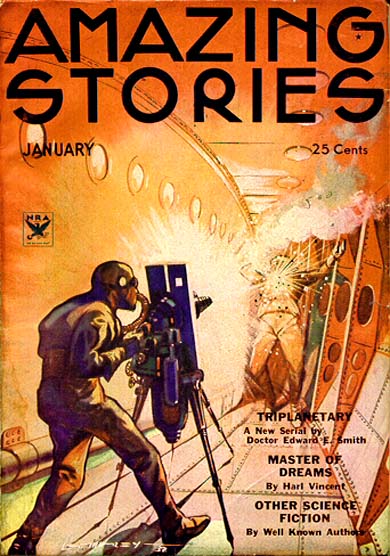
(Cover by Leo Morey. Amazing Stories, January 1934.) Who Goes There?
David H. Keller was one of the oldest authors to have started writing in the field at the time Hugo Gernsback launched Amazing Stories. He was born in 1880, in Philadelphia, and long before he started writing genre fiction he was already a trained physician with an MD, having studied at U Penn. The most formative of Keller’s experiences as a doctor seemed to have been serving in the Army Medical Corps in World War I (like his contemporary and fellow doctor-writer Miles J. Breuer), where he treated that generation of American soldiers suffering from what was called shell shock. He later rejoined the Army Medical Corps for WWII. First-hand experience with the horrible aftermath of a new kind of warfare had a profound effect on Keller’s view of the world, which by several accounts became very pessimistic and reactionary. When he got to writing fiction, as a thing to do on the side, he contributed prolifically to both Amazing Stories and Weird Tales, his SF often having a dark side to it, or in many cases he simply wrote horror. While Keller remained somewhat active when John W. Campbell took over Astounding and reshaped the field in his image to an extent, he remains an artifact of the pre-Campbell years.
Strangely enough, “The Lost Language” does not have the roughness or scare factor of a typical Keller story; on the contrary, it’s quite humane by his standards. Keller’s work as a doctor (especially as a psychiatrist) informs the premise of a boy who grows up forming his own unique language. The story’s sympathetic depiction of a neurodivergent child, while rooted in an SFnal premise, will resonate with modern readers a lot more than so many other SF stories about similar cases, even some written decades after Keller’s. It’s sort of a hidden gem, and has aged pretty well.
Placing Coordinates
First published in the January 1934 issue of Amazing Stories. It wasn’t reprinted at all until the July 1971 issue of Amazing Stories, 37 years later. It also appeared in Science Fiction of the Thirties (ed. Damon Knight) and Young Mutants (ed. Isaac Asimov, Martin H. Greenberg, and Charles G. Waugh). Not that Keller’s stories have been reprinted all that often generally, but “The Lost Language” might’ve been especially neglected on account of lacking Keller’s trademark tinge of horror.
Enhancing Image
David Phillips III is the first boy of David Phillips, Jr. and his wife, after having had three daughters. This was a joyoud occasion, but gradually things soured for the family, since by four years old little David would say a single word. Not even a grunt or whine of displeasure. “Even when he was four they would not admit that he could not,—because all of his relatives, even some of the physicians they consulted, were sure that he could talk if he wanted to.” He was not “mentally deficient,” in fact he otherwise grows up as a bright and healthy boy, able even to take care of himself and be more self-sufficient than a lot of kids his age—except he will not talk. By age five it’s clear to the adults that this is a problem, and a rather unique one. Now, for those of us who are autistic or more generally neurodivergent, it’s not so strange to have grown up not learning or for some reason not choosing to talk until you were of kindergarten age. Maybe your parents took you to a speech therapist, like mine did. Think of all the ways autistic people continue to be discriminated against, in everyday conversation and even on a systemic level, and think about how Keller wrote his story nearly a century ago. Consider how much worse the mental health profession and how less empathetic it would’ve been in those days. The good news is that David’s parents are both patient and wealthy; had David grown up in a working-class family there’s a good chance he would’ve been locked in a cage.
“The Lost Language” is as much about the life of an autistic child as it is about language—how language forms and how the first speakers of a language might feel alienated from their fellows. The only way Daniel communicates with others is through a language of his own invention, this being an entirely written language with no oral component. Soon because something of an international attraction and language specialists from around the world drive or fly thousands of miles to see the boy at work, in a vain effort to understand him. As one specialist says, Daniel’s way of forming language is backwards from how it has historically been done, in that he has developed a language without any sound involved.
To quote said specialist:
“For centuries the human race has communicated with each other, first by sounds, and later by writing. Writing is simply a mode of sound. I admit that people learn to read silently, but even then they transpose the typed symbols into sounds subconsciously and thus obtain the meaning of the printed line and page. The dot and dash of the Morse code simply replaces letters which, in proper combination, have definite sounds, and those sounds for centuries have had definite meaning. This boy forms his own symbols. There is no doubt they mean definite things to him. You have shown me that, and my experiments with him have convinced me that you are right. But his refusal to adopt the symbols of the herd, to learn the alphabet, to follow the lines of communication used by his ancestors and his associates, stamps him at once as abnormal.”
David’s mother rushes to explain that the boy is strange, but he’s certainly not “feebleminded.” This is true enough, but for “the herd” that is society “abnormal” and “feebleminded” amount to the same thing. When David grows up he will be a curiosity for others at best. Because he doesn’t share a common language with the rest of mankind, and refuses to learn, he’ll always be an outcast. And yet, the language he does have turns out to be internally consistent. He has words (or rather symbols) for specific things. He can write “I want an egg,” which granted is a simple sentence, in his language. With time and effort, someone can learn to understand this language. But still, it has no oral equivalent. David and his father end up traveling to London to meet with an inventor, who had already created the “vibrowriter,” a speech-to-text machine. (This is, of course, something your smartphone can do with ease.) The idea is that if human speech can be translated to text, then maybe the reverse is also possible. If David were to have a special typewriter built for his set of symbols, then…
This is all conveyed in a style that strikes me as a mix of documentary-like and akin to a fable. Most of the characters are given names, but their names are mostly incidental; what really matters is the roles they play, in relation to David as either professionals or family members. The style writers often used in pulp SF at the time was of the sensationalist kind, with exclamation points and lots of active voice. The emphasis tends to be on action. Yet there is no action or adventure in “The Lost Language.” There’s not even much of a sense of wonder for Keller to invoke. It reads, in a way, like a much more modern SF story, being focused on an innocuous scientific anomaly—one which at least sounds plausible. There are no world-ending stakes, or even stakes other than on the emotional level for a single family. The years pass, and one of David’s sisters even trains to become a psychologist, “because she loved her little brother.” Ultimately it’s a story about the adults in David’s life wanting to understand him, despite the instinctive urge to cast him out as an “abnormal.” This is incredibly refreshing coming from a story that’s now over ninety years old, more so because Keller doesn’t seem like the kind of person to write something so empathetic.
There Be Spoilers Here
One of the scientists studying David’s language claims it might have something in common with an old and niche Welsh dialect, that Granny Lanarch, an old lady in Wales, would know. Unfortunately when David and his father arrive in Wales, they learn Granny Lanarch is dead—has been dead for a couple years, in fact. The one key to finding an shared lineage for David’s language is gone. There is no surprise victory. “The good guys” do not win in this instance, although Keller assures us this is not much of a loss ultimately, since the aforementioned sister wants to dedicate her work to understanding her brother’s language. For no other reason than that she loves him and doesn’t want to see him totally on his own in the world. The ending is anti-climactic, seemingly by design, but I don’t mind it at all. For once there is no miraculous solution to the characters’ problems, with science treating but not curing the malady.
A Step Farther Out
Truth be told, I may have read this one before, in Damon Knight’s book Science Fiction of the Thirties. I do have that on my shelf, and I certainly remember seeing “The Lost Language” in its pages, complete with Leo Morey’s interior that came with its original appearance. I don’t remember if I had read start-to-finish before, but I’ll certainly remember this reading of it. “The Lost Language” is an example of how pre-Campbell magazine SF wasn’t all spaceships and rayguns, even if a lot of it was that. There’s some 1930s super-science stuff here, but it’s grounded in a world that’s otherwise pretty similar to ours. This was one of Keller’s last notable stories before he stepped away from writing SF for the most part, which is a shame. I’ll be reviewing more of his work at some point.
See you next time.
-
Short Story Review: “Omega” by Amelia Reynolds Long

(Cover by Leo Morey. Amazing Stories, July 1932.) Who Goes There?
Both Wikipedia and the SF Encyclopedia have little to say about Amelia Reynolds Long. She apparently lived a long but quiet life, born and died in Pennsylvania. She lived her whole adult life in Harrisburg, specifically. She got both her BA and MA from U Penn, and incidentally she earned her MA the same year “Omega” was published. Long was part of that first generation of women to write for the genre magazines, and along with Clare Winger Harris she had her work published under her full name. She wrote short SF somewhat prolifically from the late 1920s through much of the ’30s, but by the ’40s she turned away from SF to focus on writing mystery fiction. ISFDB is very useful for tracking authors’ writings, for the most part, but the folks in charge tend to neglect listing non-genre works, even with there being a non-genre section. Long stopped writing mystery fiction in the early ’50s to focus on writing poetry and editing textbooks. “Omega” is a pulpy but somewhat prescient SF-horror tale, seemingly written in homage to Edgar Allan Poe but with that touch of 1930s super-science that dominated the field until the tail end of the decade. Long challenged herself by telling a story of the last days of mankind without using time travel.
Placing Coordinates
First published in the July 1932 issue of Amazing Stories. It’s been reprinted in Avon Fantasy Reader No. 10 (ed. Donald Wollheim), Amazing Science Fiction Anthology: The Wonder Years 1926-1935 (ed. Martin H. Greenberg), and Beyond Time: Classic Tales of Time Unwound (ed. Mike Ashley). Sorry, it doesn’t seem to be public domain yet.
Enhancing Image
Professor Michael Claybridge is giving us a testimony of a pretty unusual event, that being an experiment in which a man, under hypnotic suggestion, took on the persona of the last man to live on Earth—tens of thousands of years in the future. This was an experiment conducted by a friend and colleague of Claybridge’s, Professor Mortimer, and the subject was a man named Williams. From hereon I’ll be summarizing the plot in the present tense, but we can gather from Claybridge’s tone and choice of words in the beginning that this experiment was successful—maybe too successful. The session is a way to test what Mortimer calls “mental time,” his theory that there are two ways in which we understand time: materially and mentally. More importantly, he argues that the latter is just as legitimate and has as much bearing on human perception as material time. Mortimer had already tested this on a willing subject who claimed to have experienced life in the time of Napoleon, but Claybridge is understandably skeptical about this. It’s one thing to claim to have lived, for a moment in your mind’s eye, in a different country a century ago, but what about the future? What about the end of the world as we know it?
People who know their classic horror should immediately think of Poe’s “The Facts in the Case of M. Valdemar,” which on top of being horror is also arguably an example of proto-SF. Hugo Gernsback certainly thought so, even printing it in the inaugural issue of Amazing Stories. Both “The Facts in the Case of M. Valdemar” and “Omega” are examples of SF having to do with hypnotism, or mesmerism as it’s also called, a topic that doesn’t come up so much nowadays but which can be considered a soft science. Hypnotism tends to be written off these days as pseudo-science rather than soft science, not helped because its most prominent influence on the real world in living memory is its connection with Dianetics and the Church of Scientology. Indeed, what Mortimer’s been testing with “mental time” sounds like a more inoccuous precursor to what L. Ron Hubbard and his followers would be doing just a few decades later. Going back to Poe’s story, that one has to do with the titular Valdemar, an old man, who is put under hypnosis while on his deathbed, with the results being disconcerting, to say the least. Williams, a man who is on the run from the law on account of murder, but who is unable to kill himself despite a guilty conscience since his religion “forbids suicide,” signs up for Mortimer’s experiment.
Mortimer (rightly) suspects the experiment, like in Poe’s story, will go sideways somehow, so he has Williams sign a waver and with a hefty cash reward of $5,000. Where Mortimer got the money from, I’m not sure, especially this supposed to be in 1926 (when the story is set) dollars. You may also be wondering how Claybridge contributes to this experiment: he doesn’t really. Well, on a metatextual level Claybridge is there so that we have a “grounded” and journalistic viewpoint on what sounds like a bunch of quackery. In-story the justification is that despite his better instincts he’s become morbidly curious about what Williams might say while under hypnosis. The scene of the action is a room that’s been cleared out for this purpose, described as follows:
It was windowless, with only a skylight in the ceiling to admit light and air. Aside from the chair in which Williams sat, there was no furniture save an instrument resembling an immense telephone transmitter that a crane arm held about two inches from the hypnotized man’s mouth, and a set of ear phones, such as a telephone operator wears, which were attached to his ears. But strangest of all, the walls, floors, and ceiling of the room were lined with a whitish metal.
Basically we have a white metallic cube with only a skylight for air and light, said skylight figuring into the story’s ending. While under hypnosis Williams is made to recount the last six days (in “Biblical time,” as in Genesis) of life on Earth, from the perspective of man—not any specific man, but sort of the inverse of ancestral memory. In a voice that isn’t his own, Williams gives us the story of the last days of mankind, and a planet that has gone very hot and very wet, before finally the seas dry up and the last lifeforms on Earth wither. For the record, as someone who’s read Genesis a couple days, I’m not really sure what Mortimer means by this way of keeping time. There’s material time and mental time, but then there’s Biblical time. If you’ve read even a few books from the Old Testaments, the unknown authors of these books had some pretty funny ideas about how time works. Anyway, we’re given a tour of life, more than 40,000 years into the future. It’s here that Claybridge as both narrator and character evaporates, to say nothing of Mortimer and Williams, as the story turns away from plot and even character to focus on what I have to think is honest speculation.
There was some dying earth SF prior to “Omega,” albeit not a lot of it. Pretty memorably the hero of H. G. Wells’s The Time Machine travels millions of years into the future in the climax of that novella, to find an Earth that’s become all but inhospitable. There was also William Hope Hodgson’s The Night Land, from 1912, which itself would prove quite influential on science fiction and fantasy about Earth in its twilight years, not least of them being Jack Vance’s own The Dying Earth. Long’s way of getting around having to send her characters forward in time in order to give us a glimpse of Earth in such a state also anticipates John W. Campbell’s “Twilight,” which has been reprinted far more often and is in some ways the less dated story. Campbell’s technique is more fluid and “mature” than Long’s, although it must be said Long’s story doesn’t have the unfortunate bits of anti-black racism that crop up in “Twilight.” This is a nice way of saying “Omega” now reads as stilted and rather basic, although it would not been taken as such in 1932. The dialogue especially can be hard to stomach now, but that part mostly goes out the window once Williams tells his story.
There Be Spoilers Here
Not only does Williams feel psychological agony from the hell of Earth’s distant future, but Mortimer isn’t even able to pull him fully out of his hypnotic state. Much like how poor Valdemar is able to keep talking even after death (sorry for spoilering a story that came out 180 years ago), Williams is unable to break out of this “last man” persona. Things go from bad to worse when on “the sixth day” something totally unexplainable happens: as Williams’s persona dies, the man himself seems to get atomized, with only his charred clothes remaining. The skylight from above killed Williams like how sunlight typically kills a vampire. Well, at least those $5,000 would presumably go to his sister.
A Step Farther Out
By the time “Omega” was published, Amazing Stories was no longer the top dog in the small world of magazine SF. Hell, Astounding was a couple years away still from holding that title. Keeping in mind that we’re reading a story from a magazine that had gone from being a pioneer to second-rate in just a handful of years, “Omega” ain’t half bad. It’s simple, and ultimately isn’t trying to say anything all that meaningful about the future of mankind, but its simplicity and egalitarian attitude are to its credit. I said before that Campbell’s “Twilight” takes a similar premise and executes it perhaps more memorably (readers certainly thought that was the case), but “Omega” doesn’t have that certain awkwardness of Campbell’s story which makes it hard to recommend these days.
See you next time.
-
Short Story Review: “The Gostak and the Doshes” by Miles J. Breuer
(Cover by Leo Morey. Amazing Stories, March 1930.) Who Goes There?
Miles J. Breuer was born in Chicago in 1889, to Czech immigrants. It’s worth noting that quite a few people involved in the early days of Amazing Stories were either immigrants (Hugo Gernsback was from Luxemburg, Frank R. Paul from what was then the Austro-Hungarian empire) or the children of immigrants. Breuer even wrote for Czech-language publications in the US. But first and foremost he worked to become a medical doctor, earning his MD (a degree that got stapled to his name in bylines) and running an office alongside his father. During the not quite two years America was involved in World War I, Breuer went to France as part of the Army Medical Corpse, where presumably he would’ve encountered in soldiers what soon became known as shell shock. Once the war ended he returned home and once again became a regular physician. Breuer didn’t start writing science fiction until nearly a decade after the war’s end, and even then he didn’t write much SF: only one solo novel, plus a couple dozen or so short stories. It’s clear that writing SF was just a side gig for him, as he had a demanding but well-paying day job. He wrote most of these stories in the late ’20s and early ’30s, before dying at just 56 in 1945.
“The Gostak and the Doshes” might be Breuer’s most reprinted story, and with good reason. This is a bit of a rough gem. It’s the finest story I’ve reviewed this month so far. It’s pretty clearly inspired by H. G. Wells, who after all appeared regularly in Amazing Stories and whose work served as a template for the kind of SF Gernsback wanted to print. This is a story about language, being one of the very first American SF stories to tackle linguistics, but it’s also about the frequent meaninglessness of war, having been written in the wake of America’s pointless involvement in WWI. The point Breuer makes is unfortunately still relevant.
Placing Coordinates
First published in the March 1930 issue of Amazing Stories. It’s since been reprinted in Avon Fantasy Reader No. 10 (ed. Donald Wollheim), Science Fiction Adventures in Dimension (ed. Groff Conklin), Great Science Fiction by Scientists (ed. Groff Conklin), The Arbor House Treasury of Science Fiction Masterpieces (ed. Martin H. Greenberg and Robert Silverberg), Amazing Stories: 60 Years of the Best Science Fiction (ed. Isaac Asimov and Martin H. Greenberg), and A Sense of Wonder: A Century of Science Fiction (ed. Leigh Ronald Grossman). Since it’s in the public domain you can also find it on Project Gutenberg and Wikisource.
Enhancing Image
“The Gostak and the Doshes” is a parallel-universe story rooted in subjectivity and language, in which one is able to traverse between universes along a fourth axis. A recurring phrase that will become very relevant here is the nonsensical sentence “The gostak distims the doshes.” You may be thinking, “What’s a gostak? What the hell is a dosh? What does it mean to ‘distim’ something?” The narrator of Breuer’s story wonders the same thing. I was surprised to find this is not a sentence of Breuer’s invention, and that the book he cites at the beginning was a real book on linguistics: The Meaning of Meaning, by Charles Kay Ogden and Ivor Armstrong Richards, published in 1923. The quote actually comes from Andrew Ingraham, who’s uncredited in the story, and the saying goes like this:
Let the reader suppose that somebody states: “The gostak distims the doshes.” You do not know what this means, nor do I. But if we assume that it is English, we know that the doshes are distimmed by the gostak. We know that one distimmer of the doshes is a gostak. If, moreover, doshes are galloons, we know that some galloons are distimmed by the gostak. And so we may go on, and so we often do go on.
The idea is that while we can infer the syntax of a sentence, the subject, object, etc., this does not bring us any closer to the inherent meanings of the words included. You can say “The gastok distims the doshes” or “The doshes are distimmed by the gastok,” but you still won’t know what the hell it means. Indeed, these are made-up words. Words lacking a definition we can attribute to them, or a picture we can point to, sounds like a bit of a stretch, but remember that the flavor-of-the-month “6 7” joke does not seem to have an origin or inherent meaning either. It sort of just is. This is something the narrator finds out the hard way.
Anyway, the narrator (I don’t recall us getting his name) is a college professor who’s chatting with Woleshensky, an eccentric colleague. Woleshensky has a hypothesis that has to do with being able to travel across universe, or rather to make it so that our universe appears fundamentally different to us, by toying with what he calls the x, y, z and t axes. The t axis in particular will prove useful for this purpose, replacing the z axis with it. The trick is not to change the universe around us, but our perception of it. It boils down to a way of thinking. The introductory scene in which Woleshensky lectures his friend on his hypothesis is a bit long-winded, but it’s necessary to set this all up so that we can get to the good stuff.
Our hapless protagonist decides to put Woleshensky’s idea to the test, which it turns out isn’t even that hard to do. This dimension-hopping would be called an example of psi powers, had “The Gostak and the Doshes” been published a decade later. In the blink of an eye the narrator finds himself in a different college campus, which seems recognizable enough, except that the architecture is said to be of Victorian rather than modern design. (I assume “modern” by 1920s standards.) Everything seems to have gotten more dated, as if the narrator had gone back in time a few decades; but no, this still looks like the present day, just different. Luckily, to the point where it does strain plausibility a bit, it’s easy for him to find someone who speaks perfectly good English, and just as quickly to find a professor on-site who manages to take his problem seriously. Viben is this universe’s equivalent of Woleshensky, and he becomes the narrator’s biggest ally on this side of the dimension shenanigans. The problem is simple: How the hell does the narrator get back to where he belongs?
It takes him several months to even begin answering that question. Life in this alternate universe is too good for him. Not only does he make a few friends, including John, a young man working in life insurance, but he even lands a job on the campus where he had arrived rather easily. He notes that society here is maybe more similar than different from where he had come from, although there’s an “old-fashioned” sensibility about everything. There are automobiles, but horses have not yet gone out of fashion, and even John, a well-paid man, drives “a little squat car with tall wheels, run by a spluttering gasoline motor.” It’s possible this is a version of early 20th century America where Henry Ford hadn’t revolutionized the auto industry. The Model T is never mentioned, and presumably doesn’t exist here. From what we’re told this seems like if the Gilded Age of the 1890s lasted longer than it did in our universe—for both good and ill. For someone with a conservative (in the sense of not liking systemic change) sensibility, like our narrator seems to have, this all sounds well and good.
But that sentence said at the beginning, “The gostak distims the doshes,” comes back, this time in big bold letters. The narrator hears it first on campus, and then when he’s having dinner with John and his family the young man exclaims it like a slogan that’s gotten stuck in his head. A newspaper headline reads, “THE GOSTAK DISTIMS THE DOSHES.” The narrator can gather from contaxt that this sentence is meant to inspire patriotic fervor, something pro-American, or conversely as a declaration of aggression against a perceived enemy. Patriotic pro-war slogans were not a new phenomenon, even at the time Breuer wrote this story. The German military, from the time before Germany became a unified country up until the time of the Nazis, had “Gott mit uns” as a slogan. “God is with us.” Italy had also by this point succumbed to fascism under Mussolini. Even in the supposedly democratic US, support for the war effort in WWI was mandated by the federal government. But whereas “Gott mit uns” has a discernable meaning, “The gostak distims the doshes” does not. Nobody can explain to the narrator what these words mean.
There Be Spoilers Here
War is looking to be on the rise, and then it happens. Perhaps deliberately the details of this war are kept vague, except it has to do with fighting in Europe. Why the US entered this war is never made clear, only that “The gostak distims the doshes” catches like wildfire and becomes a battle cry for patriotic young men like John. Despite his comfy day job, John goes off to the front, where he’s declared MIA—presumably killed in action. (In WWI, so many bodies of the dead were never recovered. Rudyard Kipling came up with a phrase to be used on the gravestones of these unnamed soldiers: “Known unto God.” His own son had been killed in the war.) Eventually the military runs low on enlistments and more people get draft notices, including the narrator, who very much is not the fighting type. It’s less his opposition to war generally and more the fact that he literally cannot gather the reason for why the US has started this war.
As he says:
There seemed to be no adequate cause for a war. The huge and powerful nation had dreamed a silly slogan and flung it in the world’s face. A group of nations across the water had united into an alliance, claiming they had to defend themselves against having forced upon them a principle they did not desire. The whole thing at the bottom had no meaning. It did not seem possible that there would actually be a war; it seemed more like going through a lot of elaborate play-acting.
What follows is an exaggerated version of what really happened to anti-war protesters during WWI. The narrator rejects his draft call, claiming to be a conscientious objector, but the government, while normally reserving jail time for such an “offense,” goes a step farther and subjects the narrator to a kangaroo court. The verdict? Execution. It’s only by repeating what he did to get to this alternate universe in the first place, replacing the z axis with the t axis and forcing a change in perspective, that the narrator’s able to avert this fate, and at the last minute! To think he narrowly avoided dying for a war whose meaning he literally couldn’t grasp. In a bit of humor at the very end, Woleshensky seems nonplussed about his friend’s miraculous near-death experience. Well, it’s a happy ending.
A Step Farther Out
Recently the US started an air war against Iran, in collaboration with Israel, under the pretext of regime change and nation building. This war may or may not escalate into sending boots on the ground, but regardless it’s a war wherein the Iranian government (what’s left of it) sees little reason to surrender and a few good reasons not to. It’s a war that didn’t and indeed does not have popular support among American voters, and it all seems to have started thanks to a rogue executive branch and at the behest of Israel, America’s favorite sugar baby. This is all about as absurd as the war the US starts in “The Gostak and the Doshes.” I’m not really sure what Breuer’s politics were, but the story has such an unmistakable anti-war slant that I have to wonder if Breuer would be shaking his head in disappointment if he lived today and saw far we haven’t come in the past century. Even putting the themes aside, I have to recommend this story as a rare piece of Gernsbackian SF that’s still quite fun to read.
See you next time.
-
Subscribe
Subscribed
Already have a WordPress.com account? Log in now.
 Science Fiction & Fantasy Remembrance