-
Novella Review: “The Region Between” by Harlan Ellison
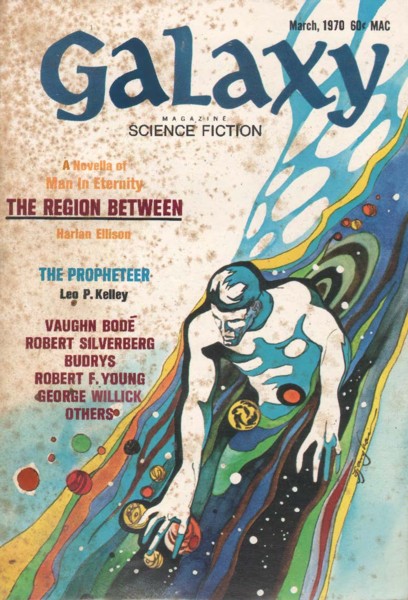
(Cover by Jack Gaughan. Galaxy, March 1970.) Who Goes There?
Harlan Ellison has a complicated legacy, and we can say “legacy” confidently now, given that he died in 2018. Ellison is one of the most (in)famous American genre writers of the 20th century, for his writing but especially for his personality, which was a double-edged sword in that being the kind of person he was got him TV interviews and even his own segment on the Syfy Channel back in the day, but also got him into hot water repeatedly. He also garnered a lot of criticism and jokes with his mishandling of The Last Dangerous Visions, which only saw publication in kind of a neutered Swiss-cheesed state years after his death. This doesn’t matter too much, because for all the criticism, he’s still one of the most important short-story writers of the past fifty or sixty years. The run he had from 1965 to 1975 alone would probably have permanently secured his status, but he also continued to write some great short fiction even well into the ’90s. He rejected the term “science fiction” and didn’t consider himself to be a “sci-fi” writer, which in a way is fair since much of his work falls into fantasy and/or horror rather than SF. If anything “The Region Between” is an outlier, for being (almost) pure SF and also for being pretty long by Ellison’s standards. Still, despite clocking in at about eighty magazine pages, that page count is deceptive, since its publication in Galaxy is littered with illustrations and “calligraphy,” which is to say typographical experiments.
Let’s talk about the gimmick behind “The Region Between,” or rather the gimmick behind what made Ellison write it in the first place. There was an anthology book called Five Fates, in which five authors are given the same page-and-a-half prologue (probably written by Keith Laumer), about a schmuck in the future named William Bailey who at the beginning is at the Euthanasia Center, having opted for assisted suicide. Why he does this and what happens after he supposedly dies is left up the imaginations of Laumer, Ellison, Frank Herbert, Poul Anderson, and Gordon R. Dickson. Most of these stories were published in different magazines as standalone works in advance of the book’s publication. As such, you can read “The Region Between” on its own just fine.
Placing Coordinates
First published in the March 1970 issue of Galaxy Science Fiction. Aside from Five Fates it’s also been reprinted in The Mammoth Book of Extreme Science Fiction (ed. Mike Ashley) and the Ellison collections Angry Candy and The Top of the Volcano: The Award-Winning Stories of Harlan Ellison. Despite placing first in the Locus poll that year, as well as getting Hugo and Nebula nominations, it hasn’t been reprinted much, although the magazine version is arguably the best way to read it.
Enhancing Image
Bailey is dead, to begin with—only not quite. While William Bailey’s body may have perished in the Euthanasia Center, his soul went to a totally different place, or rather was snatched out of his body at the decisive moment, by an alien being called “the Succubus.” This is a bit of an odd choice for a name, since the Succubus is supposed to be male, but the idea is that this alien is a “soul-recruiter,” someone who takes the souls of beings deemed to have certain abilities that would be useful to the highest bidder. We’ve read about bodies getting snatched before, but now there’s soul-snatching, which as the Succubus points out is its own kind of graverobbing. Of course, Bailey was about to die anyway, so his consciousness getting spared and sent into someone else’s body shouldn’t make him too unhappy—or at least that’s the idea. Over the past sixty years the Succubus has cultivated unique ways of farming souls from several intelligent races, under the guise of having blessed these races with “gifts.” One alien race has started what amounts to a death cult while another had been given proof of the afterlife. As for humans, they got Euthanasia Centers, a neat and painless method for ending one’s life. These are intelligent beings who willingly risk or give up their own lives, and in doing so unwittingly provide “prime” souls for the Succubus’s trade. This is the shortened version, as the worldbuilding here is pretty densely packed. We’re introduced to a universe with an SFnal rationale for the existence of the soul, which is typically reserved for the realm of religion, if not fantasy. Ellison, who was a vocal atheist, didn’t actually believe in some spiritual afterlife, so this metaphysics is him showing off more than anything.
The plot of “The Region Between” is rather simple, although you wouldn’t think it from the combination of shifting perspectives and how Ellison plays with the text itself, to a degree that must’ve been mind-blowing for Galaxy readers in 1970. It also must’ve been a nightmare to print. To accommodate the strange typography, the text here is single- rather than double-column, which means there are fewer words per page right from the get-go, but this also makes it easier for full-page illustrations courtesy of Jack Gaughan. As for Bailey, “He was fired by hatred for the Succubus, inveigled by thoughts of destroying him and his feeder-lines, wonderstruck with being the only one—the only one!—who had ever thought of revenge.” Upon becoming pure soul, Bailey becomes pretty much omniscient, being quickly gifted (or maybe cursed) of knowledge of the past from all corners of the universe. In the decades that the Succubus has been essentially conning all these races for their souls, nobody has resisted him. It’s a bit contrived, because I do find that hard to believe, but it works fine. Of course the theme of rebelling against authority is a bit of a recurring one for Ellison, most famously in “‘Repent, Harlequin!’ Said the Ticktockman.” This anti-authoritarian streak isn’t so much a political move (although Ellison was left-leaning), but rather it more comes from Ellison’s temperament. He was someone who really didn’t like to take orders, and so it shouldn’t be surprising that he supported the New Wave, as a way to revitalized what had risked becoming a stale and safe field. Bailey, a sad fuck with a failed marriage and some war-induced PTSD behind him, is about as thorny as your typical Ellison protagonist, but then the role he plays here is less conventional.
“The Region Between” might be Ellison’s most New Wave-y story on a formal level, in that he plays with everything from how chapters are numbered to how Bailey communicates with the aliens whose bodies he inhabits and even how flashbacks are communicated to the reader. There is a good deal of what you might call fuckery on the page, which I imagine would be fun to play with if you had a physical copy of the magazine in your hands, turning it sideways and upside down to read some of these passages. This is showmanship of a sort one sees very rarely, even in modern short SF writing, not that it’s the kind of thing you wanna see done too often. (One reason I distrust audiobooks, aside from their passive nature, is that they don’t give you the idea of how text might look on the page. There are cases, albeit not too often, where the formation of the words themselves can only be understood if one were to read them.) The plot, with Bailey jumping across a couple bodies on different planets, most memorably Pinkh, a soldier taking part in a manufactured war between religious factions, is more classic sci-fi compared to how the plot is conveyed. This is by no means Ellison’s darkest or most graphic story, even up to this point, although there’s some profanity and mentioning of sex. There’s also a cosmic scale and an allegorical element to it that makes me think it might’ve been a precursor to Ellison’s more famous “The Deathbird,” which is one of my favorites of his. Bailey on his own is not too interesting a character, but then he’s not the focus for much of it, and ultimately the story is about something almost unimaginably larger than him. This is a novella (it’s only about 20,000 words, if I had to guess) about the universe as we know it.
There Be Spoilers Here
At one point Bailey gets put in the body of what seems to be a microscopic organism, this being the last major episode before the Succubus puts him in storage—for the time being. The good news, for Succubus, is that he’s able to figure out that something is off with Bailey, who’s been manipulating his hosts, but unfortunately for the Succubus, and indeed the universe as we know it, reawakening Bailey “one hundred thousand eternities later” is a mistake. He has let the evil genie out of the bottle, so the speak. By the end of this story, after having inhabited many bodies and “lived” apparently for millennia, Bailey has ascended to godhood, or more accurately to the position of a demiurge—a makeshift, destructive god. This is explained in the story’s last and more mind-bending typographical experiment, which I’ll just show here. You have to see it for yourself:
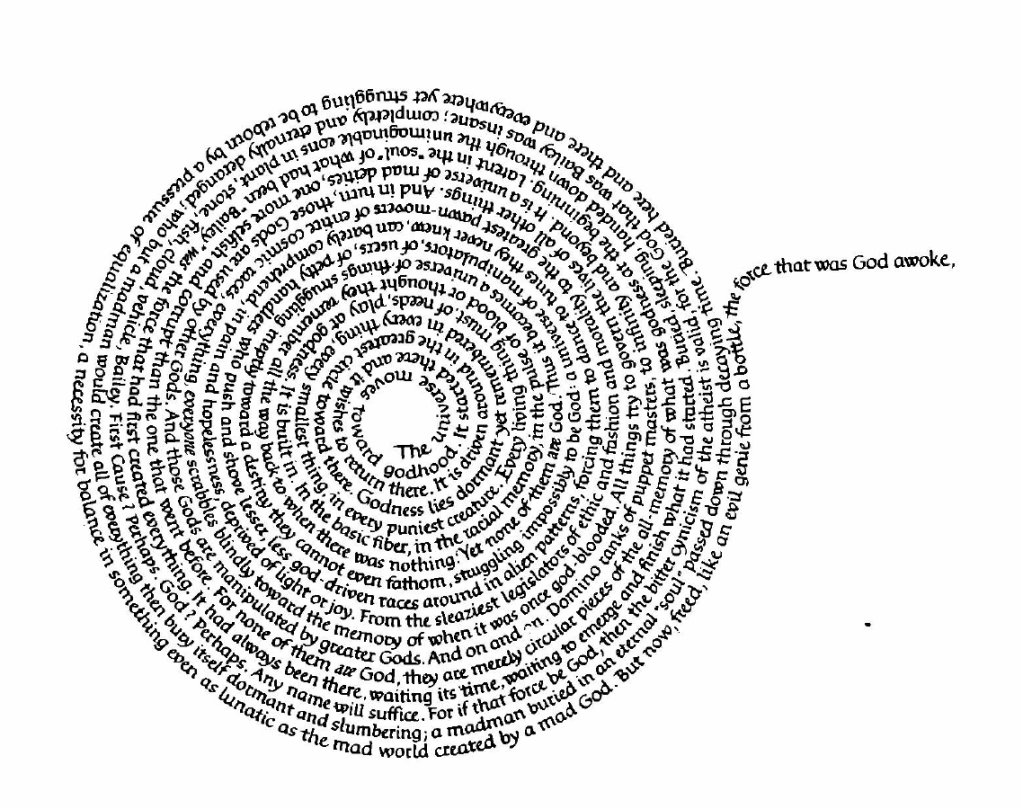
Yeah, imagine seeing this at the time. This is like something you’d see in House of Leaves thirty years later. It’s showy, but the circular shape of the passage quite literally illustrates (according to Ellison) the circular nature of the universe. The universe had started, at some point, with a cause or perhaps even a maker. Out for revenge while also wanting to put himself out of his misery at last, Bailey uses the means at his disposal and ends the universe, killing himself (his soul) in the process. Typically bleak for Ellison, but again I find it curious as a maybe unintended precursor to “The Deathbird,” which also involves death on a cosmic scale. Ellison didn’t believe in the God of Abraham, though he was raised Jewish, but he at least found the idea of such a God dying or going insane to be one worth exploring. Some atheists will say, maybe well-intentioned or maybe not, that it’d be nice if there was such a God as in the Bible, but Ellison supposes we’re lucky to live in a universe where God has seemingly gone silent.
A Step Farther Out
Sorry for the delay. I had read “The Region Between” several days ago, but unfortunately I had also been sick for about four days there, despite which I still had to go to work. I could hardly do a damn thing, except ironically go to work, on account of the person who would normally cover for me also being sick. Be sure to wash your hands and get your necessary shots as flu season is upon us, is maybe the lesson here. But also, Ellison’s story is a hard one to write about; indeed it’s one of those stories where the best way to go about it is simply to read it for yourself, especially if you’re already familiar with his work. I also recommend tracking down the magazine version since it comes with Jack Gaughan’s illustrations.
See you next time.
-
Serial Review: Inferno by Larry Niven and Jerry Pournelle (Part 2/3)
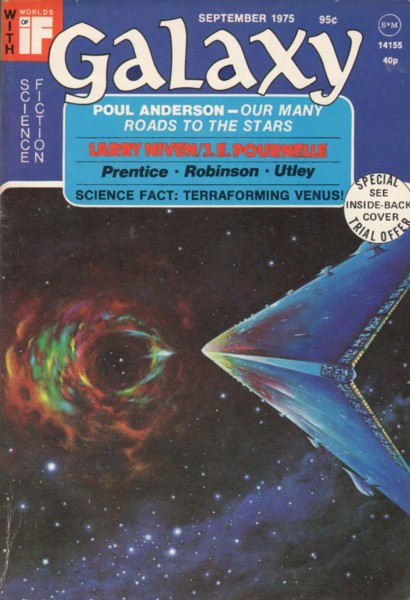
(Cover by Stephen Fabian. Galaxy, September 1975.) The Story So Far
Allen Carpentier was once a bestselling if not very respected science fiction writer, but in the world of the living he recently became a mesh of blood and bones on pavement. At a sci-fi convention he decided to impress some fans by doing a drinking challenging on a window sill, only for Isaac Asimov to come in at the last second and steal his thunder. Even if Asimov had not done what he did best, Allen still would’ve fallen to his death, in what is perhaps one of the more embarrassing ways a person can go. Almost without skipping a beat, Allen regains consciousness, soon finding himself in the Vestibule of what he comes to call Infernoland. The good news (or maybe not so good) is that he has company in this strange room, in the form of Benito, a fat balding man with a weird accent and an even weirder sense of zealotry that the agnostic Allen finds suspicious. Still, Benito has been here for a hot minute, and he’s come up with a plan for how the two of them might get out of Hell—for of course it is Hell as Benito understands it. This place is modeled after Dante Alighieri’s The Divine Comedy, and with Benito as the Virgil to Allen’s Dante, the two of them set out to escape Hell by going straight through it, ever downward, circle after circle. One of the problems here is that Allen, being a committed rationalist, isn’t even convinced that he is in Hell, but rather thinks this is all an extremely elaborate (and far-fetched) science-fictional scenario.
Benito theorizes that Hell is one giant funnel, with the end of it being at the bottom. This sound simple, except that Allen and Benito have go through the circles of Hell, each one more painful (and weirder) than the last. So we have a start point and an end point, with a simple goal, the result being that this is a quest narrative. Allen, who doesn’t done anything particularly bad in his life, must find a way out of Hell while also figuring out why Hell (or Infernoland) is the way that it is. He meets one or two friends along the way, as in people who had died and been sent to Hell for seemingly minor infractions. We also meet a variety of cartoon characters, from food diet freaks to anti-nuclear activisits—so, in other words, the kinds of people a couple of right-wing authors wouldn’t like. It’s more complicated than that, not least because while these people the authors don’t like are being tortured, the torturing itself seems wildly disproportionate with what wrongs these people committed, and Allen himself points this out. As he says, in what has to be the most memorable line in the whole novel (if only because it gets repeated more than once, like a mantra): “We’re in the hands of infinite power and infinite sadism.” Not that there aren’t sympathetic characters in Hell, and Allen is not left alone with Benito all the time, namely that the two acquire the help of Corbett in building a glider. Unfortunately the glider doesn’t work out, so walking it is, then.
Enhancing Image
We’ve come to the scene in Inferno that’s probably the most (in)famous, in that it comes up as a first example of Niven and Pournelle’s biases, but it’s also an encapsulation of the novel’s leaning on bitchy SF fandom hijinks. At some point Kurt Vonnegut died in-story and got sent to Hell, although unlike every other character we’ve met so far he specifically gets special treatment, being locked up in a big monument, like he was one of the pharaohs. A sentence, one of Vonnegut’s most famous lines, is quoted ad nauseum, “SO IT GOES.” It nearly drives Allen crazy, both from the realization that he himself really is dead and in Hell, and also that Vonnegut, a fellow SF writer whom he didn’t like, has this big tomb dedicated to him in Hell. Vonnegut is not named, but it’s very clearly meant to be him. Real-life figures who appear in Inferno are generally people who’d been dead in Niven and Pournelle’s world for a good minute, whereas Vonnegut was very much alive still; but at some point after Allen went over to the other side, so did he. On the one hand, they clearly have a bone to pick with the man (as Allen says, ““If you must know, I was writing better than Vonnegut ever did before I left high school!”), but as Benito and Corbett point out, there’s also some palpable jealousy, which may or may not be reflective of the authors. Vonnegut had become a highly respected literary figure by the ’70s, and while Niven and Pournelle would write a few bestselling novels, they never even came close to that level of acclaim and acceptance.
Now, one can go on a whole tangent about Kurt Vonnegut, his troubled relationship with SF, and also his outspoken atheism and leftist viewpoint, with how Niven and Pournelle would find all of those objectionable. But I’m not going to. Okay, maybe a little bit. I kinda have to, since I did read a lot of Vonnegut in high school and college, and he’s one of those authors who played a big role in my formative years as an avid reader, even if I don’t read him much nowadays. Keep in mind that a few of Vonnegut’s early stories appeared in the very magazine Inferno was serialized in, and also that while he tried distancing himself from SF as a literary ghetto, this didn’t stop him from appearing in Again, Dangerous Visions. To a seasoned reader who hopefully has read their fair share of “classic” literature, not just classic SF but the likes of Faulkner and George Eliot, Vonnegut can now come off as maybe too simplistic and cloying, both in his style and how he tries to boil complex morality down to simple statements. Along with John Steinbeck he’s probably the first openly leftist fiction author a young American reader would encounter. Of course, in Inferno it’s less about Vonnegut’s politics and more his mocking of religion.
Anyway, we do meet a couple other historical figures in this installment, including a guy who claims to be Billy the Kid. The big revelation Allen has, aside from already being dead, is that nobody in Hell can die again. For better or worse. You can be put through all kinds of hideous and bloody torture, even having your skin and meat literally melted off your bones, and you will still come out of it alive; not only that, but you’ll heal so rapidly that you won’t even get to taste the sweet release of death temporarily. Allen’s party does grow over the course of this installment, although Corbett leaves and starts crawling his way back to a higher circle in Hell. You can’t really blame him, since going through this shit means, among other things, wading through a swamp of burning hot blood and being stalked by Geryon, a mythological fishman with webbed hands and feet. There are some humanoid creatures in Hell that are decidedly not human, including literal demons (black-skinned as opposed to red-skinned, though), which are scary, sure, but which also poke holes in Allen’s theorizing about “the Builders” and Hell being one giant theme park. I wanna mention that while being rather tame at first, Inferno by this point has gotten more graphic and unforgiving in its depiction of Hell. There’s gore that’s described in stomach-churning detail, and there’s even (unusually for magazine SF at the time) some pretty salty language, including a “fuck” or two. I thought at first that maybe the magazine version of Inferno is censored compared to the book version, but this doesn’t seem to be the case.
A Step Farther Out
You could definitely pick apart this novel, especially from a modern left-leaning perspective, but I think it’s fun! I’m willing to forgive right-wing tendencies in art if a) it achieves its goals as art, and b) there was clear thought put into it. It would be hypocritical for me to say I still love reading Yukio Mishima and Rudyard Kipling while also trashing Niven and Pournelle’s grudge against people who are really into health foods. If the novel were not entertaining and occasionally thought-provoking, things would be different. There is good right-wing art and there is bad right-wing art, although we’ve gotten so much of the latter, corresponding with the former shrinking, in recent years, that it’s easy to say all right-wing art is bad. This is understandable, especially since it seems like with a few hand-picked exceptions we simply don’t have any good right-wing artists anymore. Inferno really does feel like a novel from a different era, in that it is dated, but also it’s unserious in a way that most science-fantasy novels dare not be nowadays, or so it seems to me. I could be biased.
See you next time.
-
Short Story Review: “The Old Nurse’s Story” by Elizabeth Gaskell
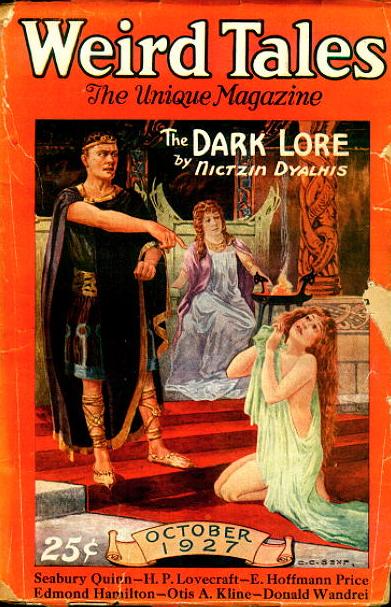
(Cover by C. C. Senf. Weird Tales, October 1927.) Who Goes There?
Here we have one of the most respected Victorian writers, if also perhaps underread to this day, with Mrs. Gaskell. A lot of her work was, even after her dead, accompanied with the byline of “Mrs. Gaskell,” but Elizabeth Gaskell was very much her own woman. She was born in 1810 and was close contemporaries with the likes of George Eliot and the Brontë sisters, to the point of being close friends with Charlotte Brontë and writing the first major biography of her. Gaskell was also an accomplished novelist, in part helped by her friendship with Charles Dickens at a time when Dickens was the most popular author in England. “The Old Nurse’s Story” was itself first published in the Christmas 1852 issue of Household Words, a magazine Dickens was editing at the time. While she’s not as popular now as Eliot or the Brontë sisters nowadays, her novels, especially Cranford, North and South, and the sadly unfinished (on account of Gaskell dying suddenly just before she could write the ending) Wives and Daughters, are very well-liked. Her biography of Charlotte Brontë, whilst now being acknowledged as a biased account, also guarantees her a spot in Victorian literature that will probably always be considered worth remembering.
Gaskell, aside from writing novels about social justice (namely the downtrodden lives of those living in the newly industrial parts of England) and more personal topics, partook in what was becoming a fine tradition among British (and to a lesser extent American) writers: the ghost story. In the years long before Fortnite and even the internet, long before even the horror story got walled off and put in its own genre ghetto, it was quite common for “literary” authors in the Anglosphere to write spooky tales of the supernatural, especially with the intention of them being read aloud at Christmastime. Ya know, for the fun of it. “The Old Nurse’s Story” is a very good example of such a tale, as well as being a Gothic narrative in the most classic sense. While the Gothic novel had waned in both popularity and works being written by the 1820s, the Gothic short story picked up the pieces a couple decades down the road.
Placing Coordinates
First published in 1852 and reprinted in the October 1927 issue of Weird Tales. It’s also been reprinted in The Fontana Book of Great Ghost Stories (ed. Robert Aickman), The Gentlewomen of Evil: An Anthology of Rare Supernatural Stories from the Pens of Victorian Ladies (ed. Peter Haining), Minor Hauntings: Chilling Tales of Spectral Youth (ed. Jen Baker), The Valancourt Book of Victorian Christmas Ghost Stories (ed. Tera Moore), The Penguin Book of Ghost Stories: From Elizabeth Gaskell to Ambrose Bierce (ed. Michael Newton), and the Gaskell collection Curious, If True. Because it’s very old and very public domain, you can find it online easily.
Enhancing Image
Hester, the titular nurse, relates to us (in the position of Rosamond’s children) the story of a particularly strange and traumatic series of events in both their lives. Rosamond, now a grown woman and a mother, was once a child in Hester’s care, at first part of the time and then full-time, following the deaths of both of Rosamond’s parents. Her father died of fever while her mother died shortly after childbirth, to a stillborn baby which would’ve been Rosamond’s younger sibling. (Sounds dramatic, I know, but it would not have been so unusual back in those days.) On her deathbed the mother makes Hester promise to look after the little Rosamond, although really she didn’t have to say anything about that, for “if she had never spoken a word, I would have gone with the little child to the end of the world.” Hester, herself barely an adult at this time, is made to be both Rosamond’s nurse and surrogate mother whilst the two are taken in by the Furnivalls, that is Rosamond’s mother’s relatives. After that slightly convoluted prelude, we find ourselves at Furnivall Manor, the big spooky mansion where the rest of the action is to take place. Given that the framing device sees Hester and Rosamond alive and in good health, we can safely assume that they will come out of these spooky happenings more or less fine, but then we’re not reading this story for the question of if Our Heroines™ will persevere, but rather how. That Hester is also telling us this story in first-person, in a conversational tone, gives the impression that this is a story one should read aloud to an audience, perhaps on the night before Christmas.
(Of course, I say “conservational,” but this is by the standards of mid-Victorian speech, which is more verbose and long-winded than what we’re used to nowadays. Let’s say that Gaskell, in a way not untypical for her time, likes to abuse the semi-colon.)
Furnivall Manor is home to four old farts, namely Grace Furnivall, her maid “and companion” Mrs. Stark, and James and his wife Dorothy. The only exception is Agnes, the one servant in the house who does not have a close relationship with anyone else. As for the current Lord Furnivall, he’s always away from the manor, and I don’t think we ever see him. The west drawing-room is open, but the east drawing-room is locked shut and nobody ever goes in there, for reasons Ms. Furnivall refrains from giving. It doesn’t take long at all for us to find that this mansion has a dark family secret, and we can infer this straight from the fact that Ms. Furnivall had an older sister who died many years ago, from decidedly unnatural circumstances. There’s also eerie organ music that plays in the halls at night, despite there being no one playing the instrument and everyone having gone to bed. Oh yeah, “The Old Nurse’s Story” wastes no time in getting to the good stuff. In fact, despite its length, this is by no means slowly paced, but rather is as long as it is because of Gaskell’s style that she uses here, where there’s no stone left unturned and paragraphs tend to go on for nearly a page at a time. There’s a whole family history delved into here, in a story that’s only about 25 pages, much like in Poe’s “The Fall of the House of Usher.” But whereas “Usher” has to do with a rich family dooming itself via an incestuous streak, the Furnivalls are cursed from a combination of pride and jealousy. Just how exactly these sins play into the ghostly proceedings, we will soon see, for as I said, it’s a question of how the manor is haunted.
For one, we know (or rather are told) that Old Lord Furnivall loved music, both to hear and to play it, and also that he was quite the bastard when he was alive. He apparently mistreated his two daughters, Maude and Grace, although just to what extent we can’t say for sure. We know that the Furnivalls are dominated by pride in their wealth, or at least the appearance of wealth, even in the living relatives, to where James can’t help but look down on his wife Dorothy a bit for having been a farmer’s daughter. Rosamond’s own mother, despite being from a high-born family, had chosen to marry a man of the cloth (I believe it was Anglican, not Catholic, kinda goes without saying), who while virtuous also didn’t make much money. Class figures greatly into “The Old Nurse’s Story,” both thematically and even how it plays a major role in the underlying conflict. This is unsprising, given that Gaskell, like Dickens, was politically progressive, despite being actively religious (specifically she was a Unitarian Christian). The idea that one can be both a practicing Christian and decidedly on the political left may sound far-fetched now, but believe it or not, such strange creatures can occasionally be found in the wild to this day. As for the characters in the story, religion doesn’t play much of a role; but still there’s a palpable class tension between the modest Hester and Rosamond and the rather haughty upper-class Ms. Furnivall and Mrs. Stark. And then there are the ghosts, who are a different matter entirely. There’s Old Lord Furnivall at his organ in the dead of night, and more distressingly there’s a child, slightly younger than Rosamond, who prowls the frosty manor grounds…
(It’s worth mentioning that Hester says winter has hit the manor when it’s only October, which sounds weird, but it’s also worth mentioning that in the northernmost part of England the murderous chill of winter would have set in quite early in the year.)
The first big scare, and the most effective (mostly because it’s something that can happen in real life), is when Rosamond goes missing one day, and it’s both frightfully cold and snowing outside the manor. Hester nearly scares herself to death with fright in trying to find Rosamond, who herself is only rescued thanks to a farmer who lives not too far from the manor, the child nearly frozen to death. Yet strangely Rosamond is not scared of what she found in the snowy outdoors, namely a child who beckons Rosamond to come play with her. The child is obviously a ghost, and is implied not to be leading Rosamond to her death out of malice, but rather out of loneliness, not being fully aware of what she’s doing. It’s unclear if the ghost child is even aware that she’s a ghost. But between the ghost child and the ghost of Old Lord Furnivall, there are a few spirits lurking at the manor that have not yet been laid to rest. Ms. Furnivall has been keeping a secret all these years, and despite being somewhere in her seventies and being deaf enough that she has to use a horn, she’s not too feeble to confess a wrongdoing of the past. Again it’s worth observing that Rosamond is saved by a man of low stature, and that Hester, being merely a nurse-maid, is unequivocally the most heroic figure in the story—which is not to say that all the low-born characters in the are story are virtuous. Gaskell generally sides with the working class, but her view of individual virtue and how it relates to class conflict is more nuanced, as we are about to discover.
There Be Spoilers Here
Back when they were young, Maude and Grace Furnivall were the starlets of the manor and two fine ladies from that part of the country. Old Lord Furnivall wanted nothing less than the best for his daughters, although when I say “the best” I specifically mean the best in terms of status. Only a man with high enough status is deserving of either of these sisters, which doesn’t stop the ladies from having ambitions of their own. There was a time when a “dark foreigner” would visit the manor from abroad once a year, being a talented musician but naturally also one who was not rich. Old Lord Furnivall admired the man’s talent, and also loved to have the foreigner listen to his own playing, but he probably would not have approved of the musician marrying one of his daughters. This didn’t stop the musician from “walking abroad in the woods” (going on walks between man and woman was like going on a date) with each of the sisters at different points. The musician and Maude got married in secret and the musician knocked her up. Maude managed to hide her pregnancy and even to raise her daughter, under the guise that the child was a charity case from some working-class home. But the musician had skipped town, never to return, and Grace was the only other person who knew the secret; so, in a moment of fiery jealousy, she ratted out her sister to their father, who was not pleased. Maude and her child were evicted from the manor, with her later being found under a tree, crazed and nearly frozen to death, her child dead in her arms. Maude died not long after that, and the guilt never left Grace.
Hester coming to the manor with Rosamond reopened a wound that seemed to have nearly healed, or at least would have probably died along with Ms. Furnivall. The climax is theatrical, and if I had a gripe with this story I think the final confrontation is a bit overblown, compared to what came previously, although the very end is haunting. Having confessed to what she had done to Maude, Ms. Furnivall has lifted the curse from the manor and placed all on her own shoulders. There’s peace for everyone else, but not for her. She dies in her bed shortly after, in agony, with the words: “Alas! alas! what is done in youth can never be undone in age! What is done in youth can never be undone in age!” It’s a pretty bleak ending, the only thing preventing it from being a total downer being that Hester and Rosamond come out of the ordeal in one piece. If we can infer from the framing device, Rosamond (although we hear not a word from her adult self) has not repeated the mistakes of her relatives.
A Step Farther Out
I had read this one only yesterday, and part of me wishes I got to sat it on longer. This is a story that requires some retracing of steps and understanding the whole of it in order to better appreciate. The syntax Gaskell uses here also takes some time getting accommodated with, but this is coming from the perspective of someone who hasn’t read that much Victorian literature. While the walls of text and the convoluted family dynamics can be a bit intimidating, I do very much recommend seeking out “The Old Nurse’s Story,” especially if you’re into ghost stories by the likes of Robert Aickman and M. R. James.
See you next time.
-
Serial Review: Inferno by Larry Niven and Jerry Pournelle (Part 1/3)

(Cover by Ames. Galaxy, August 1975.) Who Goes There?
Niven and Pournelle had similar temperaments and politics, but their career trajectories were a fair bit different. Larry Niven emerged as arguably the best new hard SF writer of the ’60s, after being discovered by Frederik Pohl, winning a Hugo for his story “Neutron Star” and appearing in Dangerous Visions. Despite being just the kind of writer John W. Campbell would want, at least on paper, Niven stuck to Pohl’s magazines, and even appeared several times in F&SF. Niven’s biggest contribution to SF is undoubtedly his Known Space universe, in which mankind inhabits the galaxy alongside several intelligent alien races, most famously the Kzinti, a warmongering catlike race that are technically also canonical to the Star Trek universe. Niven’s most famous novel, Ringworld, also won a Hugo (and a Nebula), and served as an influence on the Halo franchise. (The titular halos are basically like Niven’s ringworld, but smaller and serving a different function.) Jerry Pournelle took a bit longer to go pro than Niven, despite being a few years older. He had been active as a fan since at least the early ’60s, but didn’t appear professionally in the field until 1971, just in time to have his first stuff bought by Campbell’s before the latter’s passing. Pournelle has his own ambitious universe, called the CoDominium universe, involving a future history that very much takes after those by Robert Heinlein and Poul Anderson. Eventually Pournelle stuck more to writing nonfiction rather than fiction, although he still collaborated with Niven sometimes, with their novels often being bestsellers.
At the time that Inferno was published, it came between two of Niven and Pournelle’s biggest successes, those being The Mote in God’s Eye (set in the CoDominium universe) and the massive standalone Lucifer’s Hammer. Despite being much shorter than these novels, Inferno is considerably more obscure, maybe because it’s harder to get a read on in terms of its genre. It’s been labeled at different times as SF and/or fantasy, being serialized in Galaxy (granted that Galaxy occasionally published fantasy) and with Jim Baen himself calling it SF, but with other sources calling it a fantasy novel. So, let’s call it science-fantasy. Obviously this is a riff on Dante’s The Divine Comedy (says someone who has not read The Divine Comedy yet), but also with a heavy metatextual element. Contemporary reviewers in the genre magazines also ignored Inferno, inexplicably, which didn’t stop it from getting Hugo and Nebula nominations.
Placing Coordinates
Inferno was serialized in Galaxy, August to October 1975. It was published in book form the following year, supposedly expanded although I can’t imagine by much. It seems to still be in print.
Enhancing Image
Allen Carpentier is dead, to begin with. Allen (I’m gonna be calling him by his first rather than last name) has died, in what has to be one of the more embarrassing ways someone can die. In life he was a bestselling (although not that respected) science fiction author, and the first scene he recounts is that at some unspecified science fiction convention. By the way, his real last name is Carpenter, but he added the i so as to appear more distinctive on book covers, although even in his internal monologue he refers to himself as Carpentier. Well, he was an author, and historically there’ve been a lot of hijinks at conventions like these, some more innocuous than others. Allen takes part in a bet, or you could say it’s a drinking game. He’s to finish a fifth of rum while sitting on an opened window sill, some eight stories above ground level. Not only does he fail the bet, falling to his death, but nobody even sees him do so, since the crowd got distracted by Isaac Asimov (I’m not kidding) entering the scene and naturally hogging all the attention. That Asimov is depicted as an egomaniac is accurate enough, although his penchant for sexual harassment (something which at this point was kind of an open secret) goes unmentioned.
For a while Allen finds himself miraculously conscious but without any of his senses. He is somehow nowhere at no particular point in time, but soon he really wakes up to find himself in the Vestibule, in Hell. Well, it’s supposed to be like Hell, although Allen is not convinced that it’s the real deal. He would be totally lost if not for the help of a fat, balding, middle-aged, and “Mediterranean” man who simply calls himself Benito. Both Allen and Benito are very much aware of Dante’s epic poem, although Allen is irreligious while Benito seems to be some flavor of zealous Christian, and as such they have very different interpretations of the situation. Benito thinks that they’re really in Hell, of course, as modeled after Dante’s version of it, whereas Allen thinks they’re in a man-made reproduction of said version, which he decides to call Infernoland. Allen takes on the position of Dante (the self-insert character, not the author) while Benito takes on the role of Virgil. This implies a couple things: that Allen is himself a self-insert for the authors, and that Benito, like Virgil, is a real historical figure. I’m gonna hold off on saying it outright, but who Benito is supposed to be has to be this novel’s most poorly kept secret. It’s apparently supposed to be a twist, but I’ve seen at least one reviewer casually give that away. It’s not hard to figure out, though, and knowing the answer makes Benito’s interactions with other characters, along with the authors’ implicit view of him, a lot more… let’s say awkward. I have some thoughts.
Similarly to Allen thinking of Infernoland as like a theme park, the novel itself feels like a darkly funny theme park ride, rather than a serious novel. Actually, from what I can tell, it seems like people who’ve read Inferno have a bad habit of taking it a little too seriously. More understandably your enjoyment of this novel will depend on a) your sense of humor, and b) how much you can tolerate Niven and Pournelle’s “I just wanna grill, for God’s sake!” conservatism. Just like how the real Dante used his epic poem to rag on people and historical figures he didn’t like, Niven and Pournelle use the setting of their novel as a pretext for taking potshots at certain types of people, and even occasionally named individuals. Granted that I’m only a third in so far, I was expecting worse. Some of the authors’ targets are what you’d expect from a couple of right-wingers (there’s a scene where they poke fun at treehuggers), but their targets aren’t always people on the so-called left (scene with said treehugger also depicts a real estate yuppie type just as unflatteringly). The people that Allen and Benito find in Infernoland are not necessarily “bad” people either, but often people who simply indulged in one of the deadly sins too much. While in the circle for gluttons they meet Jan Petri, whom Allen was friends with in life, Petri having died suddenly some years before. Petri is a decent guy, except he’s also one of those people who’s neurotic about dieting, which, as Benito (if I remember right) points out, is its own kind of gluttony. There’s also the first circle of Infernoland the two men go through, which the inhabitants see as purgatory, and indeed it’s not half bad an existence. The first circle includes people who died without having heard of The Word™, as well as unbaptized children. Allen is understandably disturbed by all this, but he’s also of the mind that really these people are robotic doubles of real people.
At this point, Inferno could be considered fantasy but as envisioned by writers who normally write science fiction. Allen writes (or wrote) SF, and being a rationalist he tries to find a non-supernatural explanation for Infernoland—even if the explanations he comes up with may as well be magical. He thinks of Infernoland as an incredibly ambitious theme park, one not made for entertainment but for the sadistic pleasure of “the Builders.” Allen doesn’t seem to believe in the God of Abraham, but rather he finds it easier to believe that Infernoland was made by a kind of demiurge, or a team of human-hating demigods. The absurdity of Allen trying to find a “natural” explanation for Infernoland when a supernatural explanation would do just as well says something about the religious stances of the authors, although it’s a bit complicated. Pournelle was a practicing Catholic while Niven is an atheist, but both men took a materialist stance on things, with Pournelle (as far as I can tell) keeping his religious beliefs walled off from his nonfiction writing. It’s worth mentioning that Pournelle, along with being friends with Niven, was also good friends with H. Beam Piper, who was also an outspoken atheist. Of course, science fiction has a long history of authors who are, if not agnostic or atheistic outright, prone to keeping their religious leanings on the sidelines when it comes to their work. Obviously there are some notable exceptions, but the idea that one need not be a Catholic or even a Christian to “get” Inferno.
There Be Spoilers Here
The back end of this installment is basically a quest, in which Allen and Benito try to build a glider from scraps that they might fly a high rim wall, by which they might be able to escape Hell. Assuming there’s anything “outside” the wall. How this will turn out, we don’t know—or at least Allen doesn’t know. We can safely guess the glider will not work, because we still have two installments to go. This is like when a movie tries tricking you into thinking it’s about to end, but you’re watching it on streaming or home video so you can look at the time stamp and know it’s LYING. At least the making of the glider, including Benito conning a not very smart desk worker (there is, of course, bureaucracy in Hell), is fun.
A Step Farther Out
I’ve seen some pretty mixed opinions on Inferno, but I’m enjoying it so far. Not sure why Niven and Pournelle felt it necessary to write a sequel thirty-odd years later, given that this feels like very much a standalone. While the setting is big, there’s also only so much you can do with it, at least with these two particular characters. You can only do the “sci-fi author doesn’t believe he’s in a fantasy world” routine for so long. For a comedy, which Inferno more or less is, you don’t wanna overdo a joke. I can see why the book version’s only about 240 pages, compared to the behemoths that came before and after it, since it’s meant to be more lightweight.
See you next time.
-
The Observatory: Carnival of Souls, Purgatory, and Mental Illness

(The title card for Carnival of Souls, 1962.) (This post will be discussing spoilers for Carnival of Souls, including the twist ending, so if you haven’t seen the movie already I suggest you do just that before reading any further.)
I was supposed to write a review two goddamn days ago, except I realized that I had made a mistake and somehow gotten my own schedule wrong. I had read the first installment of Larry Niven and Jerry Pournelle’s Inferno, except I was actually supposed to read Arthur C. Clarke’s “Against the Fall of Night.” So, no review happened for the 3rd or the 4th. With any luck I’ll get around to Clarke’s novella sometime this month, and of course you can expect my review of Inferno (the first stretch) very soon, as in tomorrow or the day after. For now, let’s content ourselves with an editorial I had in mind for last month but couldn’t find the time or proper motivation for at the time, a not-review of a certain cult classic. Carnival of Souls is one of the best horror movies of the ’60s, almost in spite of itself, being made on a very low budget by a crew comprised of people who had not worked on a feature film before, and whose cast was similarly comprised of non-actors and people (including its lead actress) who would not have a future in movies. There’s a lot to say about it, but one can only say so much without giving away the whole plot, so it’s best to start at the ending and then slingshot back to the beginning. It’s that kind of movie.
Mary Henry is dead, to begin with. We start with a logo for Harcourt Productions, which I have to think was made specifically for this movie, since this is the only movie ever to be produced by this company. Before said logo can even fade to black we’re met with a jarring (maybe deliberate, maybe not) shift in the form of the opening scene: an impromptu drag race between two cars, one filled with dudes, the other filled with Mary and her gal pals. A few things are going on in this first scene, which seems to me an effort in disorienting the viewer. At the very beginning here, Mary doesn’t say anything, and she has kind of this quizzical expression on her face, as if she’s unsure about the race but is too shy to discourage her friends from taking part. Her skepticism is more than justified, since it takes all of about one minute for the race to go wrong, as the cars go across a rickety bridge and the girls’ car tips over into the river below. You would think the girls, if not killed from the impact, would at least drown, and you’d be right. A rescue team comes in, more to salvage the car than anything, and if you pay attention to the dialogue you can hear that they’ve been looking for three hours. Obviously nobody can be alive still.
Except for Mary—or so it seems.

(The film’s director as a ghostly visitor.) Wet from the river and caked with mud, Mary walks dizzily out of the water, as if some kind of ghoul emerging from a swamp, quite miraculously to everyone around her. It’s telling that when asked about what happened Mary can only say, “I don’t remember.” It’s her first line of dialogue, and in a striking formal decision it’s spoken offscreen. From this scene to the next there’s an unexplainable gap in time, and it’s only then that we see Mary talk for the first time. Having apparently recovered from the accident, Mary takes up a job as an organist for a church in Utah, despite being irreligious herself. The man at the organ factory doesn’t mind Mary’s disposition much, but the minister at the church where she’ll be working is more concerned. (We know that this must take place in fantasy land because somehow Mary is able to afford rent with a non-job like “church organist.”) Interestingly, the only woman of note that Mary interacts with throughout the rest of the movie is Mrs. Thomas, her landlady; otherwise she’s beholden to a handful of male figures. These men fall on a spectrum that ranges from uselessly benevolent to openly hostile, but the point is that they either try and fail to help her or are looking to make her day worse. The worst of these might be John, the neighbor in the apartment building, who unsubtly creeps on Mary and tries to get her in his bed at all costs. If this movie took place in modern times, John would be an incel and/or one of those guys who follows macho influencers for “dating advice.”
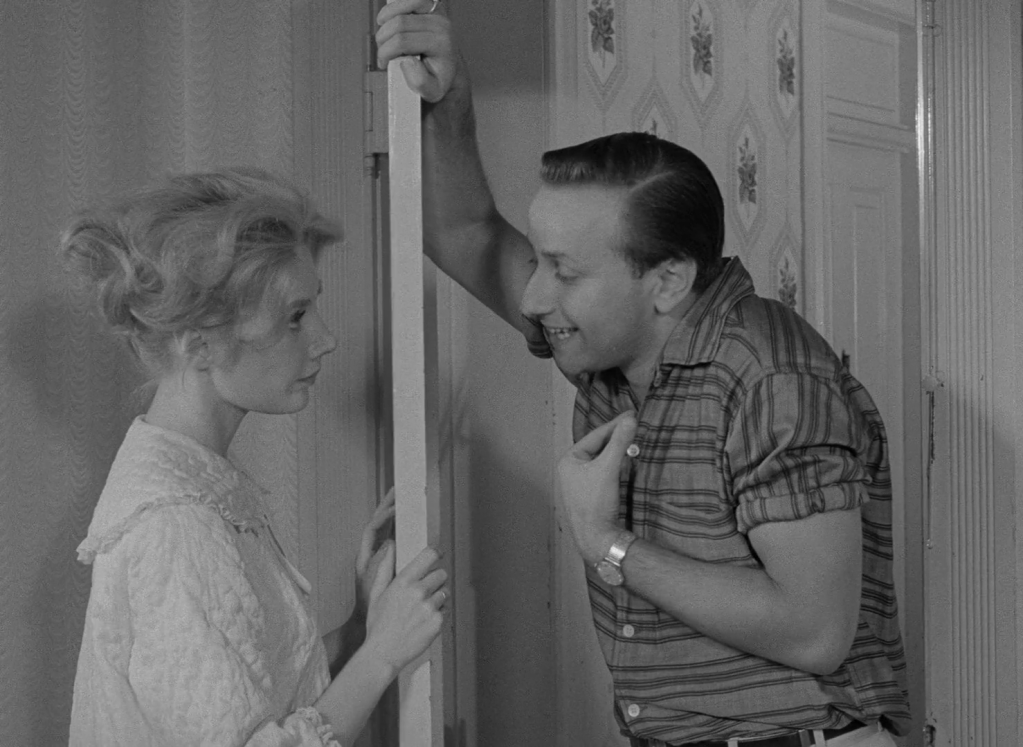
(Mary and a typically pushy John.) Let’s take a step back to talk about the acting and directing, since this is a movie that does a lot with only a few resources, and also where a lot happens despite clocking in at just under 80 minutes. The director, Herk Harvey, had experience as a filmmaker from making PSA-type shorts about urban and industrial areas, with Carnival of Souls being his first and only narrative feature. He directed, produced, worked on the script with John Clifford, and even plays a major role as an actor here, as a pale-skinned ghostly man who stalks Mary throughout the film. Like I said earlier, the people acting in Carnival of Souls have never been in a movie before, with maybe an exception or two in there. This is quite a surprise with Candace Hilligoss as Mary, since she gives unquestionably one of the defining lead performances of ’60s horror, and her presence gives one the impression that she could’ve been in a hundred movies. The way she often stares off into the distance, dissociating, or sometimes how she cranes her neck like a flightless bird, gives one the impression of Mary being like a confused animal. The closest reference point I can think of with Hilligoss’s performance is Elsa Lanchester’s performance as the bride in Bride of Frankenstein, where similarly Lanchester plays a worried and at times frightened animal in human skin. Lanchester as the bride only shows up for a few minutes in her movie, nevertheless leaving a mark on people’s imaginations; but luckily for us we have a whole movie to spend with Hilligoss as Mary.
Harvey and his crew shot on location in Utah, on a budget of just over $30,000 in 1962 money, and since they obviously couldn’t afford sets they shot the scenes of the titular carnival at the Saltair Pavilion (specifically Saltair II), a resort that hit hard times during the Great Depression and which wss finally abandoned a few years before Carnival of Souls was shot. Securing a permit for shooting at Saltair II was cheap and easy. There are a few scenes set in urban locations, namely Salt Lake City, but the most memorable stuff in this movie has to do with the shabby apartment building Mary lives in and the industrial shithole just out her window, namely the abandoned carnival that haunts her dreams. The lack of sets, combined with harsh lighting and industrial locales, gives one the feeling that maybe David Lynch had taken notes from this movie during the long process of making Eraserhead. Mary, being a ghost unbeknownst to herself, lives in a world that itself comes off as ghostly. Of course, it is not the abandoned carnival which turns out to be haunted, but rather Mary. I have a soft spot for ghost stories in which a person instead of a place is haunted, either because the person is a member of the undead or attracts the undead like a magnet. Harvey and Clifford took inspiration from the Ambrose Bierce story “An Occurrence at Owl Creek Bridge,” which (spoilers for a short story that’s over a century old) is similarly about someone who seemingly survives being killed, only to find out afterward that they are a ghost. So we have a ghost who unwittingly haunts people, and who herself is haunted by a dead (abandoned) place. I know it can be a little hard to believe, given its cheap and grimy aesthetics, but this is an intelligently crafted film.
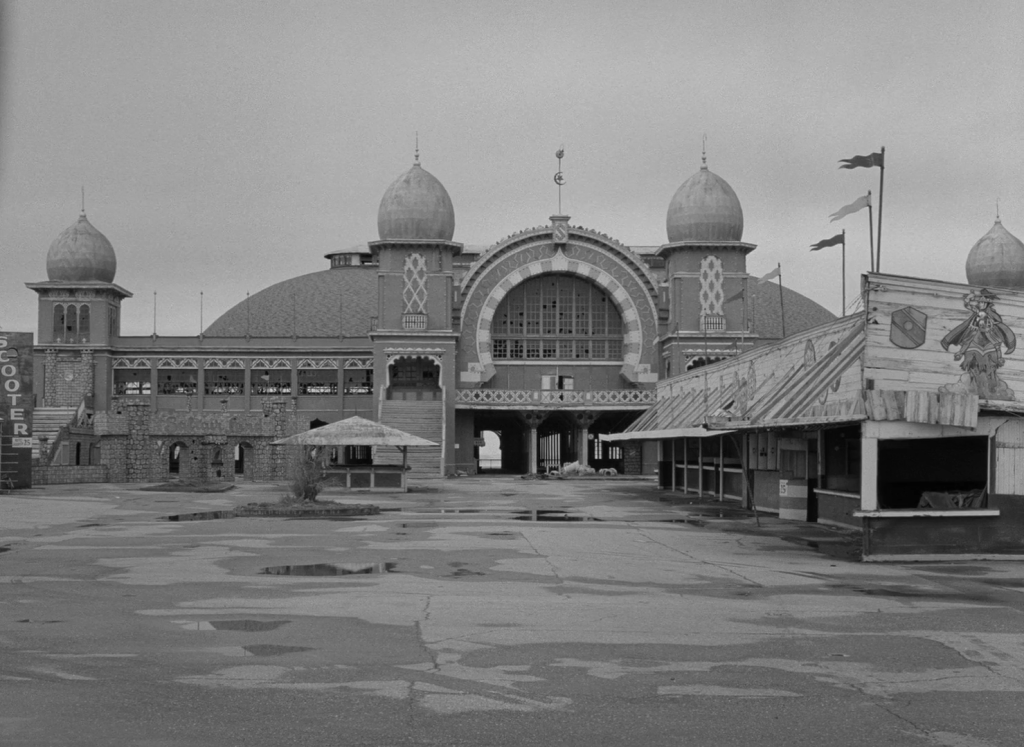
(An exterior shot of Saltair II.) If taken literally, Carnival of Souls is a spooky story about a woman who thinks she has cheated death, but if you try even slightly you’ll find that this is a resonant and prescient study of a woman suffering from some undiagnosed mental illness, trying to live in a world dominated by “normal” people. It is at the very least explicitly about a woman who, following her accident, lives in a permanent state of disconnect from the rest of humanity, a kind of switch being flipped in her brain which she may or may not be able to flip back the other way. It’s ambiguous if Mary’s unusual mental state is something she had before the accident or if it’s brought on from trauma, but regardless she acts as if being around people for longer than short controlled bursts is a burden on her—to other people’s dismay. As the minister says during their first meeting, “But my dear, you cannot live in isolation from the human race, you know.” At first Mary is content to live on her own, with her crummy job and not having any friends, but eventually the loneliness does get to her; but at the same time she has some unwanted company, with John from the side of the living and the pale man from that of the dead. She quite literally phases in and out of reality at a few points in the movie, where people can’t see or hear her and she fully becomes a ghost. She’s stuck in a liminal position, between wanting but being unable to socialize with the living while also being scared of the ghosts she sees dancing at the carnival at night. During the daytime the carnival just a normal industrial area, totally empty of human life; but while there’s no ghost who can torment her here during the day, it’s eerily missing that human touch. It shouldn’t come as a surprise that the sequence at the halfway point of the movie, where Mary explores Saltair II, might be my favorite.
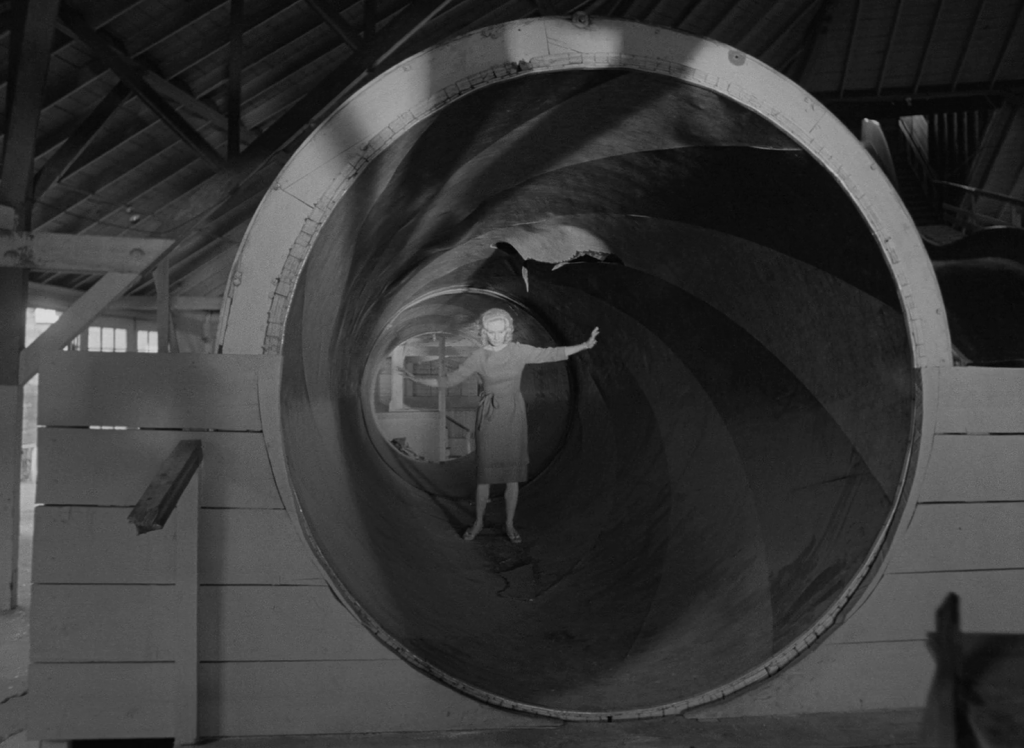
(Mary in a huge pipe, in one of the more memorable shots.) The most helpful character is Dr. Samuels, a psychologist who just so happens to run into Mary during one of her daytime scares. (How is she paying for this? Is she paying for it? Does Samuels put their first session on the house? We don’t ask these questions when watching a movie.) The best thing he does is allow Mary to articulate her state of mind, especially her strange (to other characters) indifference to intimacy with those of the opposite sex. The language wasn’t around at the time, but the idea is that Mary is queer, by virtue of being asexual and possibly also aromantic. This quirk with her sexuality is treated as unusual, but not harmful, which for a movie of this vintage is pretty forward-thinking. Indeed what modern viewers might appreciate most about Carnival of Souls, more than what it’s able to accomplish on a tight budget and its capacity for genuine chills, is its sympathetic depiction of someone who is both mentally ill and outside the realm of cisgender-heterosexual normality. We have a complex figure with Mary, helped by Hilligoss’s nuanced performance, a woman who is tormented by men who either shun her or try to coerce her into unwanted sex—and that’s not even going into the literal ghouls following her. The ending of the movie is obviously meant to be taken as eerie, but Mary’s ultimate fate, as a ghost who gets dragged screaming into the afterlife, also has a tragic aspect. The “dead all along” twist has arguably been done with more elegance in one or two other movies, but the inevitability of it in Carnival of Souls is crushing.
Carnival of Souls is not a perfect movie by any means; on the contrary it’s pretty rough around the edges. Actually the whole movie is rough. The lighting is amateurish at times, the acting is a mixed bag (understandably), there are a few shots I can think of that could’ve used another take, and of course someone watching this today would find the twist to be pretty obvious—although this was not so much the case back then. As typically goes with B-movies, it languished in obscurity for a couple decades, until it was revived thanks to late-night TV airings and being discovered by the international arthouse crowd. Roger Ebert wrote a positive review of it in 1989. It’s now in the Criterion Collection. I’ve seen three or four times myself over the years, and each time I’ve found more small and subtle things about it to like. This is a pulpy exploration of mental illness via supernatural horror, which nowadays feels almost overdone as one of the genre’s many modes. But trust me, it’s a good one.
-
Things Beyond: November 2025

(Cover by Jack Gaughan. Galaxy, March 1970.) A short and sweet review forecast for this month, partly because I’m running behind on my writing a bit and so am pressed for time, but also because I don’t have a particular theme in mind here. Of course, if you thought I was gonna take a break from reviewing spooky fiction altogether after last month, you’d be mistaken, as both of the short stories due for November are horror pieces. We’re still deep in autumn, after all, and honestly my thirst for spooky shit has not been quenched.
Another thing I just randomly decided to throw in there is that both of the serials are novels written in collaboration, by authors who gained a good deal of acclaim and presumably money from working together. In one case there’s decades-long besties Larry Niven and the late Jerry Pournelle, who shared similar politics and also writing philosophies. There’s also the husband-wife duo of Henry Kuttner and C. L. Moore, perennial favorites on this site, who wrote most of their novels together, although for decades Fury has been erroneously credited to just Kuttner.
We’ve got one story from the 1850s (the oldest I will have reviewed thus far), two from the 1940s, two from the 1970s, and one from the 2000s.
For the serials:
- Inferno by Larry Niven and Jerry Pournelle. Serialized in Galaxy Science Fiction, August to October 1975. Niven had quickly established himself as one of the major hard SF writers by the end of the ’60s, but Pournelle had a longer road to success, first being active as a fan and then not writing his first stories and articles professionally till he was deep in his thirties. In the ’70s and ’80s Niven and Pournelle wrote several successful novels in collaboration.
- Fury by Henry Kuttner and C. L. Moore. Serialized in Astounding Science Fiction, May to July 1947. Kuttner and Moore wrote so much, both together and each solo, that they resorted to a few pseudonyms, one of them being Lawrence O’Donnell. Fury takes place in the same universe as the earlier Kuttner-Moore story “Clash by Night.” Despite Fury historically being credited to Kuttner alone, Moore claimed years later to having been a minor collaborator.
For the novellas:
- “Against the Fall of Night” by Arthur C. Clarke. From the November 1948 issue of Startling Stories. Clarke is one of the most famous SF writers ever, to the point that by the ’60s he had become, along with Isaac Asimov and Robert Heinlein, a media personality. He collaborated with Stanley Kubrick on the script for 2001: A Space Odyssey whilst writing the novel version parallel to it.
- “The Region Between” by Harlan Ellison. From the March 1970 issue of Galaxy Science Fiction. Ellison is similarly a pretty famous (if more controversial) figure, being just as notorious for his real-life antics and combative nature as for his writing. This novella, one of Ellison’s longest stories, works as a standalone but was commissioned as part of a series which features the same main character.
For the short stories:
- “The Old Nurse’s Story” by Elizabeth Gaskell. From the October 1927 issue of Weird Tales. First published in 1852. Now here’s a name you probably didn’t see coming. For someone who gained notoriety as one of the finest novelists of the mid-Victorian period, as well as being Charlotte Brontë’s first major biographer, Gaskell also wrote a fair amount of supernatural fiction.
- “I Live with You” by Carol Emshwiller. From the March 2005 issue of The Magazine of Fantasy and Science Fiction. By this point Carol had outlived her late husband, Ed Emshwiller, by over a decade, but she had long since made a name for herself. The last Emshwiller story I wrote about was from the late ’50s, but nearly half a century later we still find her seemingly in her prime.
Time to get some reading done.
-
Short Story Review: “The Pear-Shaped Man” by George R. R. Martin
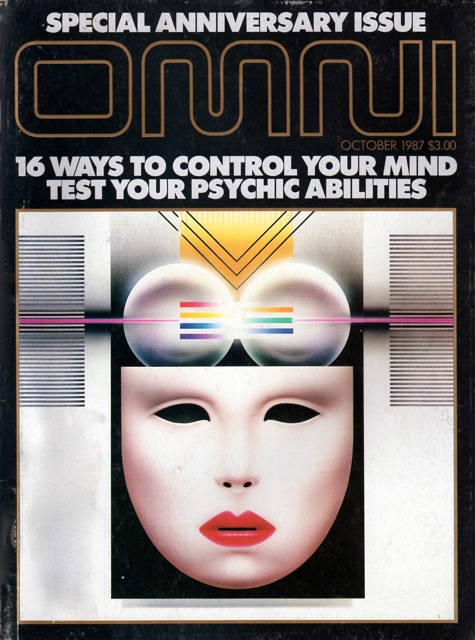
(Cover by Stanislaw Fernandes. Omni, October 1987.) Who Goes There?
Happy Halloween, ghouls and gals!
George R. R. Martin is now one of the most famous American authors alive, but this was not always the case. When he made his professional debut in the early ’70s he was just another post-New Wave writer who wanted desperately to be published in Analog, as he idolized (and still idolizes, really) John W. Campbell. In a bit of a cruel twist of fate, Martin didn’t make his first sale to Analog until right after Campbell’s death, but that didn’t stop him from appearing in that magazine regularly throughout the ’70s and ’80s. Martin started his A Song of Ice and Fire fantasy series in 1996, but prior to that his career was a lot more winding—one might say directionless, but I prefer to think of the first couple decades of his career as showing Martin at his most versatile. He wrote science fiction, fantasy, and horror in more or less equal measure, although he’s admitted to being perhaps a horror writer by instinct. This is easy enough to believe, even for someone who only knows Martin for his big series, considering the monsters, zombies, ghouls, and remorseless killers which populate A Song of Ice and Fire. For better or worse (he has his reactionary/boomer moments), Martin is our biggest connection to an era of genre writing that is long past us, to the point where a lot of current readers have no personal memory of it and no passion to dig up its bones. He’s the one living author I know who has enough clout to make young readers check out the works of Jack Vance.
My experiences with Martin have been a bit mixed over the years, since I have to admit I’m not keen on his big fantasy series from what little I’ve read of it; but at the same time I do like his early SF and horror a lot more. This month has been kind of a wash for me, as far as getting my spooky shit on goes, with movies and also reads, even what I’ve been reviewing here as of late. The good news is that we’re going out on a high note, because “The Pear-Shaped Man” is a darn good tale of paranoia and suspense, being quite effective while also seeing Martin on his best behavior. Understandably it won the Stoker for Best Long Fiction that year, although at maybe 13,000 words it’s not that long.
Placing Coordinates
First published in the October 1987 issue of Omni. It’s been reprinted in The Year’s Best Fantasy: First Annual Collection (ed. Ellen Datlow and Terri Windling), Omni Best Science Fiction Two (ed. Ellen Datlow), The Horror Hall of Fame: The Stoker Winners (ed. Joe R. Landsdale), and the Martin collection Dreamsongs: Volume I.
Enhancing Image
Jessie is freelance book illustrator (the narrator jokes that this is not a “real” job) who’s moved into an apartment recently, and so far everything has been going about as expected. She has a few friends and she gets enough work that she won’t be homeless in a week. There is one problem, though, which has to do with the man who lives in the apartment building’s basement. The man, as far as anyone can tell, does not have a name, for even the tenants who have lived here for years don’t know what it is, despite all of them having interacted with him at some point or other. “All of them, every one, called him the Pear-shaped Man. That was who he was.” He’s a man of unusual proportions, being certainly chubby, but with his torso being (predictabtly) pear-shaped: narrow at the shoulders, yet with a real dump-truck of an ass. His head is described as like a small pear on top of the big pear that is his body. Nobody in the building really likes him, but he’s someone who generally keeps to himself, even with his strange habit of seeming to only eat cheese curls of a specific brand and drink Coke. This would be considered par for the course with YouTubers and Twitch streamers in the current year, but it would’ve been strange back in the days when people cared about balancing one’s diet. The Pear-shaped Man lives right below Jessie and her roommate Angela, but while the latter is chill about the man’s eccentricity, Jessie quickly finds a bone to pick.
“The Pear-Shaped Man” is example of what we would call apartment horror, which sounds specific but actually has some room for a variety of fun (or maybe not-so-fun) times. It could have to do with getting a roommate who turns out to be a psychopath, neighbors who are secretly murderous cultists, neglectful management (as if there’s any other kind), or some combination. Maybe there’s a Lovecraftian monstrosity lurking in the water pipes, or maybe (to take from a certain Lovecraft story) the air conditioning stops working on the worst of days. It’s a kind of horror that could’ve only sprouted in a post-industrial urban society, and the more people are packed together like sardines the better. Apartment horror stands on the diametrically opposite end of the spectrum from rural horror, since whereas rural horror often goes into a sense of isolation and what little human company there is being off, apartment horror tackles terrors that are unique to the urban experience. It’s also an example of another kind of horror story, albeit more a twist on it than a straight example: the tormented-woman story. I wish there was a better name for it, but it’s a very old and proud tradition in the genre, in which you have a woman (it’s usually a woman) of questionable mental stability who finds herself suffering at the hands of an antagonist, sometimes unseen but other times hiding in plain sight. Here, the supposed antagonist tormenting Jessie is a man whom everyone in the building already knows about, and who to all appearances hasn’t done anything except act in a way that doesn’t abide social norms; the worst thing he’s done is be kind of a weirdo.
Now, I say this is a twist on the tradition, because Jessie really ends up being her own worst enemy, to the point of being a Karen. She is clearly in the midst of a psychotic break, but she also acts entitled—not that the people around her are exactly innocent. She repeatedly has dreams about having a weirdly sexual encounter with the Pear-shaped Man, and her obsession gets to the point where she unconsciously paints his features in an illustration, which her boss doesn’t take too kindly. This is the kind of thing one would seek professional help for, but not only does Jessie fail to consider this, but her friends and acquaintances actively choose to make the situation worse once or twice. Martin walks a bit of a tightrope here, because on the one hand Jessie is not the most likable of protagonists, being bitchy, whiny, and something of a Greenwich Village-type hipster, but also she seems to be suffering from some undiagnosed mental illness. She talks with Selby, the apartment manager, in trying to persuade him to dig up the Pear-shaped Man’s lease so that he can be identified, which as Selby’s justified to point out is a big invasion of the man’s privacy; and yet the fact that he doesn’t seem to even have a lease should in itself be concerning, never mind that he only ever pays rent with cash, and single-dollar bills at that. (This feels like a plot point that could’ve only been plausible at least thirty years ago, since nowadays rent is fucking astronomical unless you live in the middle of bum-fuck nowhere.) It doesn’t help that even though he hasn’t done anything, the Pear-shaped Man stood outside watching Jessie’s place for an uncomfortable amount of time on one occasion, and during the few times they interact he wants her to come see his “things.” Nowadays this would be considered stalking and/or harassment.
There’s a sexism angle to “The Pear-Shaped Man” that goes unsaid, which is probably for the best since my experience with Martin has taught me that he can be unreliable on feminist issues. So much the better that Jessie’s plight being elevated by men who by and large don’t take her seriously is kept as subtext, then. Really, what’s impressive about this story, considering Martin’s habits as a writer the pop up now and again, is that’s both subtle in a psychological sense while also building tension at just the right pace. This is a novelette, like I said about 13,000 words, but it feels a bit shorter than that. Early in his career Martin was prone to writing mood pieces, stories in which not much actually happens and there’s a focus on character and vibes, but with “The Pear-Shaped Man” he found a right balance of character and action. Previously I’d only written about Martin early in his career, whereas this story shows someone who is both a seasoned professional and in his element. He can be as gory and erotic as he wants later, with A Song of Ice and Fire, but with his earlier fiction, mostly printed in magazines, he feels the need to restrain himself at least a little bit. The descriptions of the Pear-shaped Man as this grotesque figure, his skin unnaturally pale and his fingers like worms or maggots, spark one’s imagination and may even gross you out a bit, but Martin doesn’t overdo it.
There Be Spoilers Here
Not a negative criticism, but the ending is a very strange one. I was unnerved a bit, but also confused. I don’t even wanna give it away here, both because I’m not entirely sure what happened (it’s clearly meant to be taken as metaphorical rahter than literal, but that doesn’t help much), and because I do recommend this story quite a bit and I think a first-time reader should go into it blind up to a point.
A Step Farther Out
Recently I had read Martin’s Fevre Dream, which is one of his few standalone novels and certainly the most well-known novel of his that isn’t part of that series; and while I enjoyed it, I also kept wishing it was about a hundred pages shorter, with the third act being tightened up massively. Martin, like any writrr with two brain cells to rub together, writes for money, and the horror market in the ’80s called for novels that were unnecessarily large and horizontally challenged. With short fiction, though, one still had the restraints one needed to write something that could be frightening and chilling, sure, but also calculated. I very much recommend “The Pear-shaped Man” as an introduction to George R. R. Martin the horror writer, as opposed to George R. R. Martin the fantasist, assuming you haven’t already read “Sandkings,” which sees Martin in both horror and SF mode. I do love “Sandkings,” by the way.
See you next time.
-
Short Story Review: “Day of Judgment” by Edmond Hamilton

(Cover by Pete Kuhlhoff. Weird Tales, September 1946.) Who Goes There?
Born in 1904, Edmond Hamilton was, along with friend and close contemporary Jack Williamson, one of the last of the classic SF pulp writers, and one of the few of that type to survive the raising of standards for SF writing that came about during the World War II years. He tried but failed to strike a business relationship with John W. Campbell, but found Campbell’s criteria to be too exacting and finicky, so he was to appear regularly in just about every genre magazine of the era that Campbell wasn’t editing. In the pre-war years Hamilton was known for his quite literally world-shattering space opera, being one of the pioneers of that subgenre; but whereas E. E. Smith captured readers’ imaginations with his novels, Hamilton stuck to the short story and novella early in his career, and he also deliberately mixed horror elements in with his SF. It shouldn’t be surprising, then, that he had made his debut in Weird Tales, and was maybe the most consistent contributor of “weird-scientific” stories for that magazine. He remained loyal to Weird Tales until it shut down (not for the last time) in 1954. So we have a story today that’s not really horror at all, but rather is SF that could’ve just as well have been published in Startling Stories or Thrilling Wonder Stories at the time. This is also one of those cases where I checked out the story based on the nifty magazine cover it inspired.
Placing Coordinates
First published in the September 1946 issue of Weird Tales. It’s only been reprinted twice, in The Last Man on Earth (ed. Isaac Asimov, Martin H. Greenberg, and Charles G. Waugh) and the Hamilton collection The Best of Edmond Hamilton.
Enhancing Image
As you can guess from the cover, this story involves anthropomorphized animals, or more accurately animals that have been unintentionally uplifted via atom-bomb-induced mutation. Hahl and his comrade S’San, a dog-man and a cat-man respectively, are minding their own business when a star passes over them, passing so close in fact that it crashes in the Crying Stones, an island that is forbidden to the Clans. The Clans are of course communities of different humanoid animals, including dogs, cats, foxes, and even horses. These beast-people are akin to those poor mutilated creatures in The Island of Doctor Moreau; but whereas the beast-folk in that novel are in a state of constant agony, their equivalents in “Day of Judgment” don’t have too bad a life—even barring the nuclear devastation they’ve been born into. Hahl, being a dog, if one that walks on two legs, is curious about this fallen star, going against S’San’s warnings. Naturally the fallen star turns out to be a spaceship that’s landed on the island, home to two humans, a man and a woman. When I reviewed Peter Phillips’s very good (and chilling) “Lost Memory” not long ago I went into some detail about how humankind getting back into contact with one of our robot or animal companions might turn out badly, but this is not so much case with the humans in Hamilton’s story. For one, it’s been long enough since the nuclear holocaust wrecked the world (several dog generations we’re told) that the radiation has long since died down. Also, while the humans are outnumbered, they do have futuristic weapons, whereas the beast-folk have not yet gotten past the stone-and-spear phase. Still, their first meeting is a rough one.
Unfortunately “Day of Judgment” is not very interesting on its own, although it is interesting when taken in the context of a certain strand of SF that proliferated in the years immediately following WWII, that being the tale of nuclear anxiety/depression. I wrote an editorial on this topic some months back, because it’s a topic that informs a great deal of SF published from about 1946 to 1960. There were stories beforehand that speculated on the use of a theoretical nuclear weapon, but following the atomic bombs being dropped on Hiroshima and Nagasaki there came along a new subspecies of SF story, written from an American or at least Allied perspective, about a world in which humanity has disfigured or destroyed itself with atom bombs. There are too many examples to count, but some notable ones include Ray Bradbury’s “There Will Come Soft Rains,” Judith Merrill’s “That Only a Mother,” Theodore Sturgeon’s “Memorial,” A. E. van Vogt’s “Dormant,” and perhaps the ultimate post-nuclear story of the era, Walter M. Miller’s A Canticle for Leibowitz. These are at times melancholy and outright pitch-black stories in tone, and it’s strange to think these are coming from people who were on the winning side. Hamilton himself was a hawk who supported America’s involvement in WWII and later (more regrettably) Vietnam, although he was not the the screaming cold warrior that Robert Heinlein was. Even someone with Hamilton’s politics could see that the proliferation of nuclear weapons would likely be a losing game for everybody. The human couple in “Day of Judgment” have returned from a failed Venus colony, only to find Earth has been bereft of human life for a hot minute now, replaced by intelligent beast-people.
The immediate question is what ought to be done with these humans, as they could well present a threat to the Clans, but the thematic question is whether humanity, in the wake of the nuclear age, deserves a second chance. This is Hamilton, who for how dark he can be at times is not as much a pessimist as his wife (Leigh Brackett), so you can guess.
There Be Spoilers Here
A trial ensues among the clans, with the humans being in a position where they might be executed; of course they won’t be, which is a bit of a shame, since a bleaker ending would’ve elevated this story a bit. I’d like to take a moment to talk about a gripe I have with Trondor, the leader of the horse clan, and his ilk: these fuckers stand on their hind legs, which are hoofed. This simply doesn’t work. Humans are able to walk on two legs because of a lack of a real tail, and more importantly we have feet with flexible toes which are good for keeping ourselves balanced. If someone loses even one toe on one of their feet they find it more difficult to stay balanced when standing, so imagine not having any toes on your feet. I can take cat and dog furries, but I draw the line at horse-people with hooves instead of clawed or fingered toes. Anyway, that was my TED talk.
A Step Farther Out
I would say I’m sorry for the delay, but I didn’t have too much to say about this one and I’m not sure how many cared to hear what I had to say. This is the second time I’ve reviewed Edmond Hamilton and the second time I’ve come away feeling rather indifferent, which sucks because I’ve read enough of his work outside the confines of this site that I know he’s capable of a good deal better. Then again, he wrote a lot, and since he wrote as a way to make a living, he didn’t spend much time on revising his work. He’s a relic from a bygone era, but I don’t mean that in an insulting way.
See you next time.
-
Short Story Review: “Reckoning” by Kathe Koja

(Cover by Ron Walotsky. F&SF, July 1990.) Who Goes There?
Kathe Koja started getting professionally published in the late ’80s, as part of a generation of new horror and SF writers, appearing more or less fully formed with her short fiction. It didn’t take long for her to write her debut novel, The Cipher, which I’m actually in the middle of reading as I’m reviewing today’s story. Koja’s fiction is a lot more colloquial and more visceral than the work of close contemporary and fellow Michigander Thomas Ligotti; whereas Ligotti unabashedly owes a debt to Lovecraft, Koja can be considered more in line with the movies of David Cronenberg. The first decade of Koja’s career saw her often mixing horror with SF in a way that still feels novel, if only because there’s also a distinctly ’90s grunge sensibility with her early work. After a hiatus, she switched gears to writing YA and historical fiction, which might go to explain why it’s rather hard to find her stuff in bookstores these days. The Cipher and her third novel, Skin, recently got brought back into print thanks to a certain independent press, but her early work remains sadly obscure. “Reckoning” itself has hints of speculative fiction, but while it’s primarily horror, its top priority is to function as a domestic tragedy.
Placing Coordinates
First published in the July 1990 issue of The Magazine of Fantasy and Science Fiction. It’s only been reprinted once, in the Koja collection Extremities, which itself is very out of print.
Enhancing Image
Drew is a down-on-his-luck artist, or more accurately he’s a bit too lazy and a bit too much of a drunkard for his own good. His relationship with his girlfriend Lucy turns from bad to worse as she dies in a car accident shortly after the two have a major fight. As sadly happens too often in real life, their final interaction is a bitter one, and this combined with Lucy’s death sends Drew into a beer-tinged spiral. Just when it seems like he has a chance to at least get back on his feet professionally, with an art commission, he does everything except work on said commission, including sleeping in his car on the side of the road. With his car parked outside an abandoned shed/garage (it’s not made clear which), Drew has a chance encounter with a woman who reminds him of a certain someone he knows, except she puts her hands on him seemingly with the goal of suffocating him. This ends up not being the case, though, as the woman is Lucy, suddenly alive and well again—except for the fact that her skin is a bit paler than before, and more conspicuously her eyes are now solid silver in color.
But hey, nobody’s perfect.
The reanimated Lucy, aside from looking a bit off, is otherwise the Lucy Drew had known in life. Indeed she and the others who live in the woods here can only be considered zombies by virtue of the fact that these are all people who have died before, and who all similarly have pale skin and the silvery “angel eyes.” Norah, who for all intents and purposes is the leader of the group, talks in fluent Expositionese, explaining to Drew that a) he himself is still very much alive, and b) the undead retain both their memories and personalities from before. These are not raging bloodthirsty monsters, but simply people who have gone through something pretty strange and unexplainable. The only exception is Wesley, the only man of the pack, being stanoffish and “obviously seriously strange,” but this is explained by him being a suicide, and generally he prefers to keep to himself. We’re led to expect at first that Wesley might become the story’s villain, but this is a red herring; he’s barely in it to begin with. The three main characters are Drew, Lucy, and Norah, and even then the crux of the whole story is Drew and Lucy’s complicated relationship. What do you say to someone who used to be the love of your life and who has not only been dead (from your POV) for eight months but someone you remember hurting deeply the last time you two were together?
“Reckoning” is a horror story, but only nominally; it’s not like Koja’s chief goal here is to scare or unnerve the reader. The subject matter is morbid, and in a way this is a story about zombies (although Lucy and the others explicitly don’t call themselves that), but it’s at least as much a love story. Well, it’s not a happy love story, but then how many upbeat love stories worth a damn are there? Drew and Lucy have sex maybe one too many times in such a short span, but in a way I get it. I mentioned that there’s a viseral edge to Koja’s writing, which includes candid descriptions of physical intimacy. Sex for Koja, as with Cronenberg, plays a major role in tandem with the horror, both for the sake of eroticism and also to be juxtaposed with the grimness of the surrounding material. Drew is arguably having sex with a corpse, never mind that Lucy’s angel eyes are uncanny. The eyes themselves apparently give the undead second sight, like in The Dead Zone (oh hey, it’s Cronenberg again, albeit adatping Stephen King), although Lucy and Norah are at odds as to whether these eyes let one see into the future. Believe it or not, of her early stories I would say “Reckoning” is on the tamer end. The eroticism here is pretty vanilla, compared to “Angels in Love,” the last Koja story I wrote about, which does go into fucked-up territory.
I will say that Koja’s style is not for everyone, being rather vulgar and snappy in a way that may have resulted from both the first wave of cyberpunk (already come and gone by the time Koja made her debut) and the incoming grunge era. There’s something about Koja’s early ’90s work that screams flannel and faded jeans. For better or worse, Drew being a fuck-up with no money and no direction in life sort of encapsulates the existential malaise Gen X Americans at this point in time. That Lucy and the others have each other’s company but very little else, living on the fringes of society and afraid to go out amongst “normal” people for fear of being discovered, works as like a collective counterpart to Drew’s individualistic problems. Both the individual and the group are in a rut, a post-Reagan point of post-nut clarity as the Cold War is ending with the US winning over the Soviets and yet nobody being happier for all this.
There Be Spoilers Here
Drew and Lucy’s relationship is tragic, first because of the circumstances of the latter’s death and second because the former is still alive. The bulk of “Reckoning” sees Drew caught between two worlds which happen to exist on the same land, the world of the living and the much smaller world of the undead. At some point, something will have to give: either Drew leaves Lucy and the others behind for the sake of returning to a life that was not a very good one anyway, or he dies. It’s obvious which option Koja will take, although I have to say I’m not keen on how she gets there. Word has gotten around about the not-zombies, and a small gang of young hunters goes looking in the woods, thinking they’ve gotten one when they shoot Drew dead, only to find he does not have the angel eyes they had heard of. I have a question as to what’s supposed to happen with these characters Koja pulled out of thin air, considering they committed a murder and they don’t act too concerned about having done such a thing. I also have to wonder what the hell they could expect to do if they had caught one of the undead. Is there prize money? Would they get it taxidermized? It’s still a person, so I feel like there would be a huge legal problem. These questions are none of Drew’s concern, of course, on account of him being dead at the end—or rather undead. It’s a nicely bittersweet ending, but I feel like Koja could’ve gotten us to this point more elegantly.
A Step Farther Out
This was a decent read, although it doesn’t show Koja at her best. When it comes to reprints of genre stories by women, from the time before the internet or even when the internet was in its infancy, there’s an unmistakable tendency for anthology editors to underrepresent female talent. It can be hard to gauge what’s the really good stuff in advance and do the necessary weeding-out when it comes to women writing SFF up until the past couple decades. In the case of “Reckoning” it’s understandable why it’s only been reprinted once since its initial publication, since there are at least a few Koja stories I recommend reading first.
See you next time.
-
The Observatory: Dark Forces, 45 Years Later

(Dark Forces. Cover by One Plus One Studio. The Viking Press, 1980.) Something I don’t typically get to write about here is the topic of original anthologies, which is to say anthologies of short fiction comprised of material never before published. Of course, said fiction could later be reprinted in magazines, as has happened many times, but the implied purpose of an original anthology is fundamentally different from that of its sibling, the reprint anthology. Both involve similar work, with an editor trying to procure stories from authors or authors’ estates, as well as reading dozens upon dozens of stories, most of which end up not being worth printing. There’s the question of how many words/pages can be crammed between two covers. There’s the question of pricing, because an anthology will pretty much always be more expensive than a single magazine issue. Nowadays anthologies and magazines fill respective niches and try not to step on each other’s toes, since it’s no longer a problem of what can be printed in magazines, whereas in the days before Fortnite and even the internet there was the (true, at least up to a point) conventional narrative that editors and publishers of original anthologies were allowed to be more risqué than their magazine counterparts.
When Dangerous Visions hit shelves in 1967, its key appeal (at least for American readers) was that it was jam-packed with stories that could not be published in magazines of the era, on account of being too edgy, experimental, etc. You had a thick book (over 500 pages) from a mainstream publisher (Doubleday) with an all-star cast of authors, all of whom at least claimed to be putting forth their most mind-bending and transgressive material yet. You had such top talents as Philip K. Dick, John Brunner, Samuel R. Delany, Roger Zelazny, and so on, and commissioning this stuff could not have been cheap. The gambit paid off in spades, though. Dangerous Visions sold very well, remains in print to this day (a rarity for an anthology, especially an original one), and it even won a special Hugo. That Harlan Ellison, the editor, never quite recaptured that lightning, is beside the point. Not every story was a winner, but Dangerous Visions was the right book that entered the market at just the right time, serving as a harbinger of the New Wave. Just as importantly, publishers realized that there was some money to be made with original anthologies—maybe not on the same scale as Dangerous Visions, but rather cheap paperbacks of maybe half the size and half the number of stories; and maybe these books wouldn’t try to reinvent the wheel like their inspiration did, but instead took on more humble mission statements. You can have editors who are maybe not as discerning as Ellison was, who would also get the work done in a timelier fashion. It was a matter of quantity over quality.
There a meteor shower, or maybe a oversaturation, of original paperback anthologies from the late ’60s through much of the ’70s, until that particular bubble burst. These were books that often focused on science fiction, rather than fantasy or horror, although there was a trickle-down effect with those other genres. Still, standards had dripped, in large part (although he was not the sole offender) due to Roger Elwood’s extremely prolific tenure as editor for a few different publishers; the number of anthologies he edited between 1972 and 1976 alone is staggering. While he was able to procure work from big names, this work ran a good chance of being mid- to low-tier stuff that would’ve likely stayed on the shelf. A major exception was Epoch, which Elwood co-edited with Robert Silverberg, a lavish and well-received book, placing first in the Locus poll that year; but this is indeed an exception that proves the rule. By the end of the ’70s the market for original anthologies had inevitably gone into decline.
Meanwhile, in the waning days of the original anthology, Kirby McCauley made his living as a New York-based literary agent with some big talent on his hands. By 1980 he had already edited one well-received original horror anthology, with 1976’s Frights, which won the World Fantasy Award for Best Anthology/Collection. Frights was a hardcover original from St. Martin’s Press with a nice wraparound cover, but while McCauley procured stories by some of the top talent in horror at the time, including Ramsey Campbell and Robert Aickman, he found that he wanted to go one step further. The introduction for Dark Forces makes McCauley’s intentions with this bulky new anthology clear. McCauley’s inspiration was twofold, between August Derleth’s work as head of Arkham House and wanting to make a horror-themed counterpart to Dangerous Visions. Arkham House in its prime printed hardcover volumes with exquisite covers, all these being focused on horror, SF, and dark fantasy, from reprints of H. P. Lovecraft’s work to collections of never-before-published fiction by fresh young writers. McCauley grew up on books of horror that Derleth had edited, so in that way he overtly pays tribute to a fallen (Derleth had died in 1971) master of the field. The relationship that Dark Forces has with Dangerous Visions is more complicated, however, as there are a few major differences in how these books’ respective editors went about their businesses.
Consider that when Harlan Ellison edited Dangerous Visions, a process that took about two years, he was coming at it from the perspective of a reasonably successful author, which is to say he was a writer, first and foremost, as opposed to an editor or agent. This lack of experience with editing eventually came back to bite Ellison in the ass, with the shitshow that was the making of Again, Dangerous Visions, and far more infamously with The Last Dangerous Visions; but in the ’60s, it was novel for a writer with practically no editing experience to work with his fellow writers in such a way. Conversely, McCauley had already proven his ability with an original anthology, plus a couple reprint anthologies, and he was enough of a professional that he understood how to work with writers as people, and not just as practitioners of a certain craft. In the introduction he recounts his encouraging relationship with Stephen King while the latter wrote (first as a novelette, then ballooning into a long novella) The Mist. He also recounts having a get-together with Isaac Bashevis Singer in the latter’s apartment (they were both New Yorkers, and thus there had to be some inherent sense of kinship there), just months before Singer won the Nobel Prize for Literature. King and Singer are radically different in just about every way, in work ethic, style, and worldview, the former a flaming-liberal New Englander and the latter a conservative Polish-Jewish immigrant; yet McCauley makes it appear easy to work with both.
You may have noticed also that Singer is not a name that comes up much, if at all, in horror circles, because while a good portion of his fiction involves the supernatural, he’s not a “horror writer.” Thus we have another big difference between Dangerous Visions and Dark Forces, because while Ellison reached out to everyone in the SF field he could get his hands on, McCauley reached outside the field of horror and dark fantasy, the result being that there are authors in Dark Forces who are not primarily horror writers, and there are even a few who are known to be “literary” types. It’s not so unusual today, but back in 1980 it was a novelty for acclaimed novelist (and prolific tweeter) Joyce Carol Oates to appear in a horror anthology. You have some of the usual suspects of horror from that period (King, Campbell, even Robert Bloch late in his career, etc.), but you also have a really left-field choice like Davis Grubb, who was known at the time as author of The Night of the Hunter. You have writers like Edward Bryant and Joe Haldeman who, while they have sometimes written horror, are much more known for writing science fiction. You have a surprise appearance from Ray Bradbury, who by 1980 had long since entered the literary mainstream, and who also didn’t write much of anything at this point in his career. One can have gripes with who made it in and especially who didn’t (there are only two female authors here, Oates and Lisa Tuttle), but I can readily believe McCauley when he says he tried getting stories from everyone.
It’s also worth mentioning that McCauley didn’t construct Dark Forces with the intention of it being a boundary-pusher for the field of horror (he even explicitly says he didn’t want it to be “as revolutionary” as Dangerous Visions), and this ends up being to its benefit. True, there are a few stories here that may have been transgressive for 1980 (I’m thinking of Theodore Sturgeon’s tale of venereal agony, “Vengeance Is.,” and if I had a nickel for every “pregnant man” story in this book, I would have two nickels), but being extra-gross or what have you was not the name of the game. What might be Dark Forces‘s secret weapon and the biggest reason for its having aged pretty well is how its contents cover pretty close to the whole span of short horror literature up to circa 1980. While we don’t have much dark fantasy a la Robert E. Howard’s weird Conan stories, or the “extreme” horror that would start making the rounds in the proceeding years, there’s a great deal of variety in these 500 pages. We have traditional ghost stories such as Singer’s “The Enemy,” a rendering of the Sweeny Todd narrative with Robert Aickman’s “Mark Ingestre: The Customer’s Tale,” a cautionary tale of one unlucky busybody and a nest of vampiric creatures with Campbell’s “The Brood,” some rural “redneck” horror with Grubb and Manly Wade Wellman’s stories, and so on. There are also a couple non-supernatural tales of terror, as with Oates’s “The Bingo Master” (a personal fave of mine) and Bloch’s “The Night Before Christmas.” There are even a couple stories that fall into a certain genre that’s become rare in recent decades, that being the Christian allegory, with Gene Wolfe’s “The Detective of Dreams” and Russell Kirk’s “The Peculiar Demesne.”
And then there’s The Mist.
A story that “gets away” from the author, as it were, can sometimes be a bloated abomination, but in the case of The Mist we have one of King’s best and most tightly wound stories. Indeed King’s bad habits are pretty much absent here, and the fact that he’s able to reconcile ’50s B-movie monster action with genuine eeriness shows the level of craftmanship he’s capable of when he stops fucking around and focuses on what really matters. While the movie adaptation has a radically different ending (one that many, including King himself, prefer), I do have a soft spot for the novella’s ambiguity and cautious optimism. It was a simple choice for McCauley to put the longest story last, making The Mist the grand finale of Dark Forces, but it’s an example of how sometimes the simplest choice is also the best. Unlike the King collection Skeleton Crew, which sees The Mist as the protracted opening salvo, its position as the closing story of Dark Forces gives one the impression that the whole book had been building up to this moment. It was risky to include such a long story here (it takes up about 1/4 of the book), since if it failed then it would majorly tarnish what is otherwise a good read and leave a sour taste in the reader’s mouth; thankfully The Mist was a success, and has become one of King’s most beloved stories.
Dangerous Visions has, as far as I can tell, never gone out of print, although sadly the same can’t be said for Dark Forces. Anthologies, and especially original anthologies, have a bad tendency to have one or maybe two print runs, then go out of stock until the end of time. The only time Dark Forces has been reprinted this century was a super-expensive limited edition from Lonely Road Books in 2007. Bantam apparently did a paperback printing of Dark Forces in the early ’80s, but otherwise it’s only ever been published in hardcover in the US. It could be that Dangerous Visions was such a monolith at the time of its release, and has gone down as such an important entry in SF history, that its status (despite understandable attempts to knock it down a peg, especially as it continues to show its age more and more) has been more or less secured for the foreseeable future. Dark Forces is arguably a better book and set a better precedent (it served as an inspiration for Clive Barker to get into writing horror, and as we all know, the rest of that is history), but it also now reads, with hindsight, as one of the last big gasps for short fiction as a significant player in the realm of horror. Starting in the ’70s, both novels and movies started taking larger slices out of the pie in terms of what “mattered” for innovation and trends in horror, a field that historically largely hinged on the short story and novella. There would be major practicioners of the short horror story (see Barker, also Thomas Ligotti) to come after 1980, but Dark Forces celebrated (again, with hindsight) the short story as a form with authors who are, by and large, happiest and at their best when writing short stories and novellas.
-
Subscribe
Subscribed
Already have a WordPress.com account? Log in now.
 Science Fiction & Fantasy Remembrance