Who Goes There?
As far as the gap between the ’50s SF boom and the New Wave era of the late ’60s and early ’70s is concerned, Philip José Farmer can be considered a missing link. Stylistically, at least early in his career, he was inconspicuous compared to many of his peers; but rather it was his willingness to explore sexuality in SF writing for magazines which was only rivaled at the time by Theodore Sturgeon. And whereas Sturgeon was a small-r romantic by nature (nothing graphic happens in his queer story “The World Well Lost”), Farmer’s treatment of sex was, from the outset, more blunt and candid. His debut story, “The Lovers,” was rejected by Astounding and Galaxy, before finding a home in Startling Stories. No doubt the first few years of Farmer’s career would’ve been rockier had he not found an ally in Samuel Mines, who edited Startling Stories and its sister magazine Thrilling Wonder Stories. The effort paid off, since it won Farmer a Hugo for Most Promising New Writer, but his troubles with getting published were only just beginning. A mixture of censorship and plain ol’ bad luck made it so that Farmer’s debut novel (but not the first novel he wrote) wasn’t published until 1957. Despite all this, and despite not writing in earnest until he was in his thirties, Farmer went on to enjoy a very long and prolific career.
When I reviewed “Mother” I was hoping to get to its sequel in maybe a year’s time, in keeping with how long it took for “Daughter” to appear in print, but real life and other things got in the way. It’s a sequel, in that it takes place on the same world and follows the same alien race as its predecessor, but it’s not strictly necessary to have read “Mother” first. I liked “Mother” quite a bit, which was a pleasant surprise at the time because my experiences with Farmer have been very mixed, and I’m happy to report “Daughter” is about as good, if also quite different in some ways.
Placing Coordinates
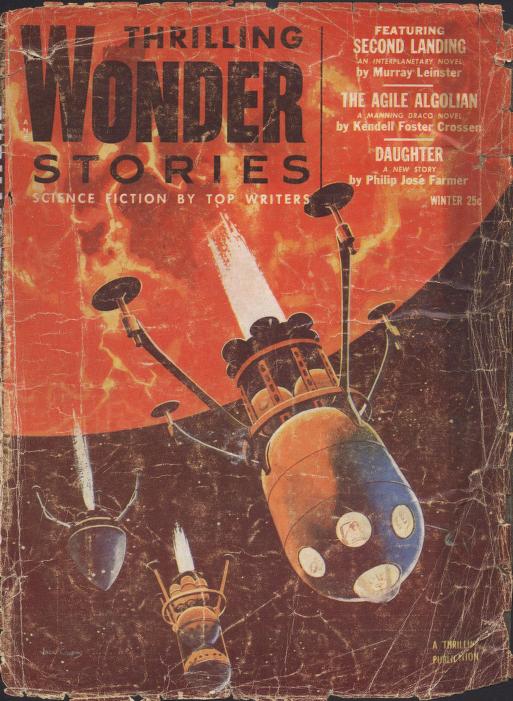
First published in the Winter 1954 issue of Thrilling Wonder Stories. It was reprinted in the Farmer collection Strange Relations, which also has “Mother.” The weird part is that there’s an omnibus volume also titled Strange Relations, which contains the titular collection as well as The Lovers (the novel version) and the novel Flesh. These are all thematically related, but they don’t take place in the same continuity.
Enhancing Image
As I said, we return to the setting of “Mother,” but not, it seems, the same set of characters. You may remember (or like me you had to reread the story or my review to refresh your memory) there was Eddie, the mama’s boy and would-be planetary colonist who becomes the mate, or “mobile,” of a Mother he names Polyphema. We meet neither of these characters again and we’re not sure what becomes of them. It’s not even clear if “Daughter” actually takes place before or after “Mother.” Instead we’re introduced to Hardhead, a Mother herself and our narrator. That’s right, the protagonist is not a human at all, but an alien—not even a humanoid alien at all, but something very much its own beast. There is a human in the story, simply called Father, whose real name we never learn and who seems to not be Eddie. From what we learn of him, Father, unlike Eddie, is an emotionally stable man who also knows a thing or two about science and medicine. He’s also indirectly responsible for much the plot and the resolution, but he’s inactive, on account of being inside Mother’s womb most of the time. He can communicate with the Mothers and “virgins” (those who have not reached maturity) with a radio, however.
Let’s take a step back and explain some details about the Mothers, since while “Daughter” does have some exposition, and you can gather some things via context clues, Farmer assumes you’ve read “Mother.” The Mothers are large tentacled omnivores that, when mature, become immobile and use protective shells for defense. They’re a single-sex race; every Mother is a female. They reproduce by taking a mobile, which really can be an organism of any sex, but which the Mothers perceive as always male, and basically use the mobile as an assistant in spawning larvae before eventually devouring it. So, they reproduce asexually, but a Mother can’t reproduce on her own. A Mother eats things with an iris that works almost like an octopus’s beak. They’re able to communicate with each other through radio waves, which is how Eddie and later Father are able to talk with them. At the same time it’s unusual for a mobile to be “semantic,” i.e., for it to talk with its mate. The mobiles are, as you can guess, typically not keen on the whole making-larvae thing, but Father continues to live inside Mother because he’s able to consent. They are, or at least were, proper mates.
Hardhead recalls that when Father wanted to speak with his daughters without Mother catching on he would use “Orsemay,” which is clearly Morse code. A question that only occurred to me after I’d finished the story was how Father’s radio is able to work for so long. Is it battery-operated or hand-cranked? This is not a question Hardhead would be able to answer, and it’s not exactly relevant to the story, but it makes you think. Also, while we have to assume Father is indeed a man, it’s worth remembering that the Mothers do not perceive mobiles as anything other than male; to say a Mother has a female mobile would invoke a paradox, which is actually a key plot point in “Mother.” Nothing so dark as the conclusion of that story happens in “Daughter,” which itself is if anything a more conventional adventure narrative—once you remove the fact that Our Heroine™ (it was rather uncommon for the protagonist of an SF tale to be female at the time) is like a giant hermit crab with tentacles. Think of it: Hardhead is a woman (sort of), and also an alien of such a sort that one would have to be pretty determined to see her as a sex object.
The idea here is that “Daughter” is a coming-of-age story, in which Hardhead recounts she and her sisters moving out, so to speak, which is to say Mother ejects them from her womb after some delay. It’s time for the adolescent Mothers to build up strength, gather nutrients, and survive so they can fulfill their biological role. The good news is that these adolescents, who are squishy like slugs (Father even calls his daughters “Sluggos”), can move around easily enough—the bad news being that they’re prey. While the Mothers are too big and armored to have natural predators, young ones fresh out of the womb are vulnerable to what is called the olfway, a cross between a wolf (as you can guess by the name) and a spider. Quite vicious, persistent, and cunning. Hardhead and her sisters can construct shells out of minerals, with Glasshead making a shell of glass and Woodenhead a shell of cellulose. What follows is a kind of a cat-and-mouse hunt between the olfway and the sisters, with Hardhead’s sisters unfortunately falling victim to the beast. If you’re reading “Daughter” you may have, at this point, come to think of a certain story about three pigs and a wolf. This is deliberate, although not exactly spelled out, but while making the connection early means you can anticipate the ending, that’s not a bad thing.
There Be Spoilers Here
A curious ability the olfway has is that it can synthesize chemicals so as to break through shells of certain elements. It does this by breaking off a bit of a virgin’s shell and taking it back to its hidey-hole, where it can work for a combination that lets it break through the material. The lesson of “Daughter,” if there is one, is that slow and steady wins the race, or that patience is a virtue. Hardhead’s sisters scramble for hill spots where they can fortify, but they choose poor materials for their shells and pay for it. In working to counter the olfway’s special ability, Hardhead has to suffer in the short term, but this suffering pays off in the long run. She’s able to counter the olfway and even (barely) devours it. This all works out like a fairy tale, which makes sense in more ways than once, given that Hardhead is relating this story to an audience, and also the fact that Father had taught her about the story of the wolf and the three pigs. It’s a scientific fairy tale, which in keeping with the tradition is a bit dark and has a moral. It’s also, like a lot of classic fairy tales, aimed at kids but is not childish at all.
A Step Farther Out
“Daughter” is shorter than “Mother,” and is also easier to predict, especially if you catch what Farmer is doing before the climax. It’s still very good, and even unconventional by the standards of ’50s SF. If “Mother” was Farmer attempting to shock and disturb the reader with a very unusual human-alien relationship, not to mention an unusual alien race, then “Daughter” is proof of how you can take that setting and craft a satisfying adventure story out of it. Not sure why it’s never been anthologized in English, or indeed why it’s only ever seemingly appeared in Strange Relations and nowhere else. You don’t need to have read “Mother” to understand it, although that story does do more to flesh out the setting.
See you next time.



 Science Fiction & Fantasy Remembrance