-
The Observatory: How The End of Oak Street Makes Dinosaurs Cool Again
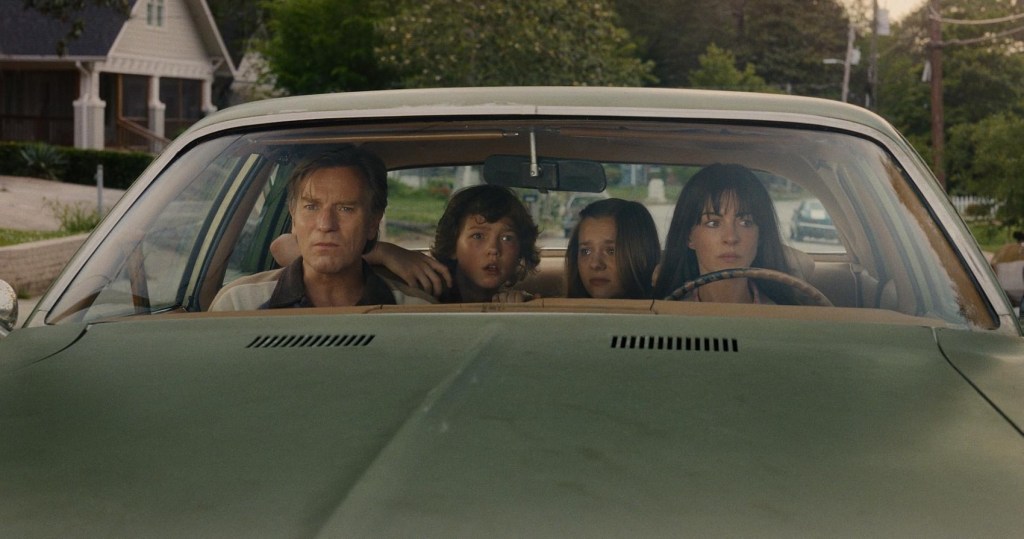
(The Platt family finds something has changed about their neighborhood.) (I’ll be discussing some minor spoilers for The End of Oak Street, but rest assured I will not be going into the film’s controversial ending or anything in detail about the third act.)
There’s a pretty well-known J. G. Ballard quote, taken from his final novel, Kingdom Come, and it goes like this: “The suburbs dream of violence. Asleep in their drowsy villas, sheltered by benevolent shopping malls, they wait patiently for the nightmares that will wake them into a more passionate world.” This is a sentiment that can be found in a lot of Ballard’s work, and it’s this same sentiment that David Robert Mitchell, writer and director of The End of Oak Street, has latched onto with his latest movie. That much is obvious. The whole thing is “obvious,” really, if you’ve seen any of the trailers for it. A little slice of Reagan’s America getting jettisoned into the past and overrun by prehistoric creatures is such a blunt metaphor that I’m surprised it has never been done before, at least in film. It seems like an idea that Mitchell has had tumbling around in his mind since he was in his teens, and I do mean that as a point of praise. Maybe he saw Jurassic Park in theaters 33 years ago and thought of something, or rather seeing Jurassic Park sparked something in him, as it still does with a lot of people. Despite having people running away from dinosaurs as a commonality, though, Mitchell’s latest is quite a different ordeal. The result is a movie that reads in places like Jurassic Park, but also those ’80s movies Steven Spielberg produced but didn’t direct, like Gremlins and The Goonies.
The End of Oak Street is Mitchell’s first movie in eight years, since he directed the career-killing spectacle that was Under the Silver Lake in 2018. Mitchell had originally gained a good deal of traction with It Follows in 2014, a sort of ’80s throwback (complete with Richard Vreeland’s synth-driven score) which stood out as one of the most acclaimed horror movies of its year. But Under the Silver Lake, which is not a horror movie, although it does come off as like a hallucinatory voyage gone sour, got mixed reception at Cannes, with A24 basically dumping it in the woods like some horrifically deformed infant in medieval times when it came time for a theatrical release. It made no sense and made no money, as the saying goes. Now, nearly a decade later and thanks in part to J. J. Abrams as a producer, Mitchell has made his one-for-them theatrical comeback with The End of Oak Street. Reviews have been pretty positive, actually, but the box office numbers have been so-so. It has made back its $85 million production budget, but is unlikely to make up for the marketing costs (rule of thumb is that a theatrical film’s marketing budget is about the same amount as its production budget). What we have here is probably a cult classic in the making, in that it may find its “real” audience a decade or two down the line.
Mitchell’s past three movie’s show a love-hate relationship with America’s past, namely in regards to American pop culture and the ways in which the younger generation have been screwed over by those in power. It Follows puts a twist on the sexually reactionary and anti-feminist/homophobic bent of a lot of ’80s horror movies, especially those of the slasher variety, while Under the Silver Lake is about Hollywood’s (both the film industry and greater Los Angeles) ouroboros-like cannibalizing of its own past. The End of Oak Street returns to the same ’80s well It Follows had gotten water from, but it goes about things in a very different way. For one, we’re now literally thrown back to the ’80s (It Follows intentionally muddies the waters as to when it takes place), more specifically a Michigan suburb in 1982. Also different is the music: gone is Richard Vreeland, which is a bit of a shame. One of my gripes with this movie is that while Michael Giacchino replacing Vreeland makes sense for the film’s ’80s Spielberg vibes, this is not one of Giacchino’s more memorable scores. There’s also the rating, as this is Mitchell’s first movie to not be rated R; but don’t let that fool you, as The End of Oak Street is the most violent PG-13 movie you’re likely to see in theaters all year. Hell, I’m pretty sure it has more on-screen blood than The Odyssey, which was rated R mostly for the (not very bloody) violence.
So, what is the idea here? It’s a premise so simple and juvenile that (and again, I do mean this affectionately) it seems to have emerged from a teenage boy’s imagination, albeit filtered through a mature person’s point of view. The Platts are ostensibly a happy white middle-class family. Denis and Greg have two kids, a fenced-in backyard, and even a dog named Starbuck. The son, Brian (Christian Convery [I have to stop in my tracks for a split second every time, being as we have the same name]), has a bow (complete with a quiver of arrows), a group of friends he hangs out with, and oh yes, the neighborhood bully who’s looking to make mince meat out of his ass over some grievance. There’s the daughter, Audrey (Maisy Stella), who’s sort of tomboyish and, in a way unusually subtle for this movie, is implied to be a burgeoning lesbian. Both are in their teens, although Audrey is a bit older and a good deal more capable in tough situations than Brian. Speaking of characters who are implied to be some flavor of queer, there’s Denise (Anne Hathaway), the mom, who’s been secretly working on a semi-autobiographical novel, as a way to vent about her disappointment with her domestic life. Greg (Ewan McGregor), Denise’s husband, has been recently been laid off from his well-paying job, although his hasn’t told Denise about this, instead secretly (except Brian knows about it) working as a pizza delivery driver so as to scrounge some money together.
Now you may think this all sounds implausible, cliched, and kinda dumb—and you’d be right. There’s also the issue of the fact that The End of Oak Street is at least half a decade late to the party, that being the rampant fetishization of ’80s pop culture we saw in the 2010s (think Stranger Things, Ready Player One, etc.) whose sloppy seconds we’re still dealing with in the 2020s. For better or worse, much like an HPV-induced lip sore, ’80s nostalgia has a weird way of going away, only to pop up again periodically. It’s the gift that keeps on giving. Mitchell had indulged in said nostalgia a decade ago and now he’s back at it again; and yet somehow, against all odds, The End of Oak Street finds new ways of tackling well-worn material. On paper I should not give a single fuck about Denise’s put-upon-housewife routine, and yet her dilemma is elevated by Anne Hathaway giving a career-best performance—even better, dare I say, than her likely-to-be-Oscar-nominated performance in The Odyssey. Hathaway gives Denise a depth that’s not necessarily in the script almost sheerly through her physicality. Rarely do I see an actor use her whole body, especially her face, to convey emotions in a mainstream movie like this. There are some moments in this movie that would be difficult to pull off seriously, but Hathaway somehow does it. There’s a palpable sense of loneliness and alienation with her character, in how she really does feel disconnected from the rest of her family, that makes Denise one of the best movie heroines I’ve seen recently.
I could talk more about the human performances, but I know why you’re here, and I’m sure you know why I went to see The End of Oak Street in the first place, aside from being one of those cultish defenders of Under the Silver Lake who waited patiently for what Mitchell might cook up next. We’re here for the dinosaurs, and also some other prehistoric reptiles who decided to join in on the fun. Most heavily marketed of the bunch might be the somewhat fluffy (all the dinosaurs have at least some fur on them) allosaurus, which I’ve seen some folks erroniously call a T. rex despite the very wrong head shape and the fact that it has more than two claws on each hand. A couple (by no means all, since I’d rather not give away everything) other hightlights include a spinosaurus with what might be the ugliest mug of any big-budget movie dinosaur (I have to think the spinosaurus looking so scuffed has to be a joke about how it’s the mascot for what used to be the most widely derided Jurassic movie), as well as some kind of sauropod, two of which treat us to what might be the (at least intentionally) funniest sex scene of 2026. Yet strangely, the most memorable animal of them all is not a dinosaur, nor even a pterosaur (although we do get those as well), but a giant fucking snake that’s first seen emerging out of someone’s backyard swimming pool early in the film. Unlike every other prehistoric beast, even of the most carnivorous of which are simply doing as Nature commanded them, there’s something oddly malicious about this phallic-looking thing with teeth the size of bone saws, as if it had come less out of the past and more out of someone’s nightmares.
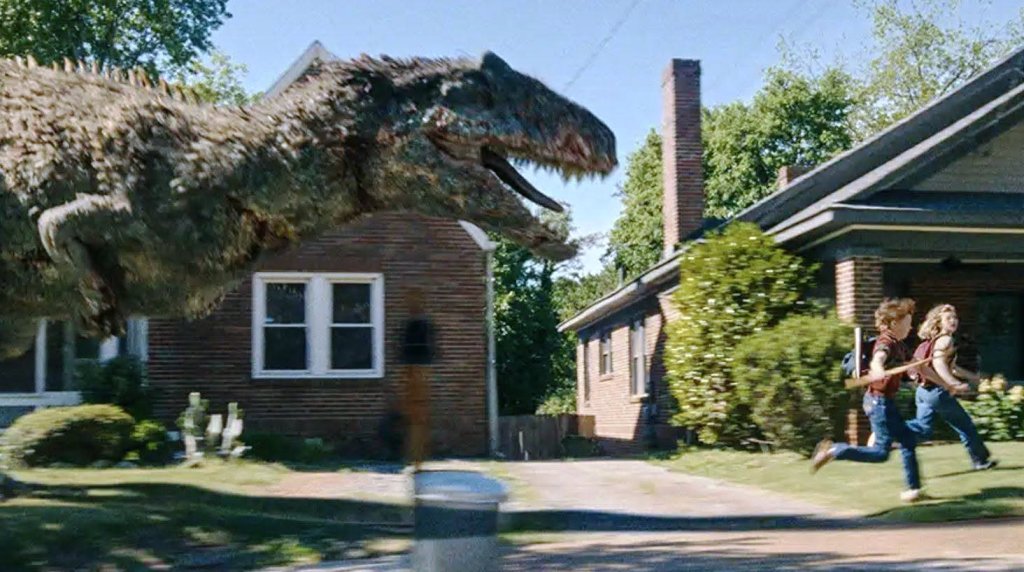
(A somewhat fluffy allosaurus is on the hunt.) As you can guess, the animals (and I insist on calling them animals as opposed to monsters) are made possible with the use of CGI, the fidelity of which is good but not exactly exceptional, except for the fact that the production budget was less than half that of the latest Jurassic World movie. The special effects, despite the sheer number of them, are surprisingly not the film’s biggest selling point; at no time did I stop mentally during my watch to consider the mechanics of a certain action sequence, or the detail of a certain dinosaur’s computerized skin (or, well, scale) texture. Even when watching Jurassic Park, which I may add is my favorite movie of all time and which I must’ve watched nearly a hundred times over the course of my thirty years, I can’t help but think about the incredible work that went into blending practical on-set effects with CGI. Unfortunately, we now live in a cinematic landscape where so much of that cloud of unknowing behind the process (and the process, as I had read somewhere, is ultimately part of the end product) has been demystified. We know too much now. The power of CGI has gone to answer questions that should’ve remained open. It’s a good thing, then, that much of the visual splender of The End of Oak Street comes not from the effects themselves, but from Mitchell’s direction and Mike Gioulakis’s cinematography (Gioulakis had worked as DP on It Follows and Under the Silver Lake as well). I’ve seen people complain about the use of split diopter shots here, especially one scene in particular that’s almost nothing but split diopter shots, but those people are too weak to survive the coming winter. But that’s just my opinion.
More so than the visuals themselves, what makes the creatures in this big ol’ creature feature captivating, if also a little too unorthodox to take for some viewers, is how they act. Not since the original Jurassic Park has a dinosaur movie committed this hard to depicting said dinosaurs as animals first, monsters second. The End of Oak Street is on the short side by modern blockbuster standards, at only an hour and forty minutes, but in that time we see a wide variety of behavior from different prehistoric species. We see big and small carnivores go after the Platt family, sure, but these same carnivores are quick to give up on the hunt if the humans prove to be too much of a hassle; that most of the humans we come across prove easy prey is beside the point. We see dinosaurs eating, grazing, messing around with human stuff like trash cans, sleeping, shitting, and of course, mating. Aside from the aforementioned sex scene with the sauropods (this got by far the most laughs out of the [admittedly small] audience I saw the movie with), it’s telling that before we’ve even seen our first dinosaur in the flesh, the first sign that something big and prehistoric has started lurking abaout is a giant pile of shit (it’s basically a recreation of that one scene from Jurassic Park, you know the one) in the next-door neighbor’s backyard. Mel Jacobs (P. J. Byrne), the neighbor in question, immediately blames the Platts, as he has a vendetta against them because of Starbuck leaving little accidents on his lawn—but of course, we know better.
The behavior of the dinosaurs and their cousins strikes a balance between what was the common scientific and cultural assumption about dinosaurs for decades, that being that dinosaurs were dumb brutes who could barely find their way to a watering hole, and the more recent tendency in fiction to depict dinosaurs as (equally implausibly, I might add) freakishly intelligent and determined serial killers in lizard form. There’s a well-done action sequence set at night in which the spinosaurus is chasing a couple of the Platt members, but once it’s become clear these pesky humans are more trouble than they’re worth, Big Spino gives up and opts to find some water to drink for the time being. This scene works as a cute nod to the fact that Big Spino was an aquatic predator who would’ve preferred large fish and reptiles over some scrawny mammals, but it also works to demystify dinosaurs, in a media landscape where too often dinosaurs are shown to be more like movie monsters than animals that really lived on this planet millions of years ago. What makes the dinosaurs in The End of Oak Street scary, if anything, is the reality that humans are small, slow, and squishy, with little in the way of natural defenses. We have not had any natural predators since at least the last ice age because of our ingenuity and our use of tools; and even then, a cowboy-style lever action rifle doesn’t do much against the thick scaley coat of an allosaurus. Even Mel, who apparently has a six-shooter on standby, isn’t able to do much against a flock of hungry pterosaurs. There’s a lot of death and carnage in this PG-13 movie.
An unspoken rule with dinosaur movies, especially the Jurassic movies (even the original film [but not the novel] abides this), is that certain types of people are not to be eaten by dinosaurs. Children, of course, are off-limits, as are the very old, and of course nobody who is too sympathetic is to be taken as a snack. The original Jurassic Park, to its credit, does mess with this formula a bit by sacrificing Robert Muldoon, one of its coolest characters; but otherwise when you watch a Jurassic movie you can rest assured that certain characters will be wearing plot armor. This is not so much the case with The End of Oak Street. Our first on-screen death is a nice old lady who seemed to be one of Denise’s few friends in the neighborhood, and we even see that she’s had some of her throat torn out by some small carnivore (again, this movie clings to its PG-13 rating for dear life). We see dead bodies of nearly all ages on the streets and in houses, and in at least one case it looks as if some poor woman had opted to commit suicide in her car, following the dinosaur outbreak. It’s even implied that small children, that most heavily armored of demographics when it comes to these movies, are not safe from the jaws of hungry carnivores. Perhaps most alarmingly, and a point which doesn’t exactly get spelled out, is the fact that the neighborhood never comes together at any point; it really is a case of every man for himself, as people shut themselves up in their houses and families try to escape the suburbs—only to find that there is no escape. Without electricity or even running water, this little pocket of human civilization is trapped in the past forever, and there’s really nothing to be done.
The End of Oak Street is by no means a perfect movie—if anything you could argue it’s a technically sound movie that purposefully tries to be “bad.” We have a schlocky B-movie premise, possibly inspired by The Twilight Zone or The Outer Limits, with a cliche-ridden family drama at the center. Aside from Hathaway, who really should (but will not) get an Oscar nomination for her turn here, the performances range from good to sort of stilted, as if Mitchell was making some of the actors think they were performing in a different kind of movie altogether. The ending has already proven divisive, even among people like myself who generally go to back for this movie, although I personally think it throws a few wrinkles into what could’ve been all too straightforward. But what makes The End of Oak Street special, and indeed worthy of what will probably be cult classic status some ways down the line, is that it manages to be fun as all heck while being just strange and sinister enough that you wouldn’t confuse it with other ’80s throwback projects, which we’ve gotten too many of over the past decade or so. Instead of being coy about its indebtedness to Jurassic Park and other Spielberg movies, it makes its homages quite deliberate while throwing in a twist of its own. This was supposed to mark Mitchell’s return to mainstream filmmaking, but its true audience is of the sort that’s more receptive to cult classics like Carnival of Souls and Roger Corman movies.
-
Short Story Review: “The Horror of the Heights” by Arthur Conan Doyle
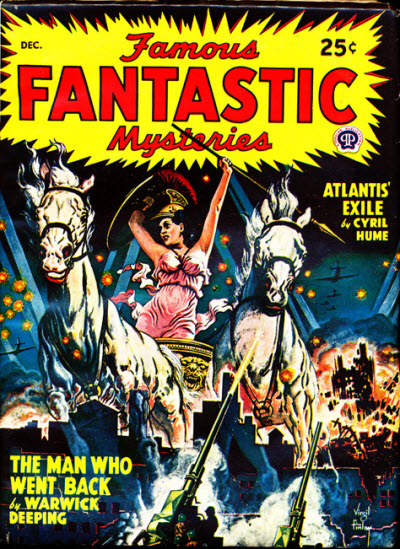
(Cover by Virgil Finlay. Famous Fantastic Mysteries, December 1947.) Who Goes There?
Arthur Conan Doyle was born in 1859 in Edinburgh, Scotland, where he also studied to practice medicine. Ultimately Doyle didn’t pursue a career as a doctor, but his medical knowledge would come to be very useful for his actual career as a writer. He started quite young, which his earliest short fiction being published when he was just barely out of his teens; but it was with his 1887 novel, A Study in Scarlet, that Doyle created the two characters who would secure his legacy, to the point where he at times resented their popularity. Taken on its own, A Study in Scarlet is not very impressive, being a detective novel where nearly half the wordage is spent on a flashback sequence that does not involve the two main characters at all. It’s unevenly paced, and there’s the sense that while Doyle may have done good work at short lengths, he was (at least for now) uncomfortable as a novelist. The two main characters in question are Sherlock Holmes and Dr. John Watson, as you probably already know. This marked the beginning of one of the most famous literary franchises in history, although Doyle didn’t start sending Holmes and Watson on adventures in earnest until 1890’s The Sign of the Four. Over the next few years we saw 24 Sherlock short stories, before Doyle “killed off” the world-famous detective, having grown tired of him. However, there came a point where rent was due, or in any case Doyle’s creative batteries had time to recharge.
Of course, Doyle wrote much more than Sherlock, although the titanic success of his prized character overshadows his other work. He was not the first writer of detective fiction (he credited that to Edgar Allan Poe), but he did more to popularize the genre than any other author, setting a standard that would be bent and stretched but not tossed away for decades after. Agatha Christie has sold more books, but then Christie was primarily a novelist, whereas Doyle tended to show his best self when it came to short stories. On top of detective fiction, he also wrote a good deal of historical fiction, as well as horror and SF (even if even “science fiction” had not been coined yet when Doyle was in his prime). His most famous SF story is the 1912 novel The Lost World, but most of his SF was relegated to short lengths, including today’s story. “The Horror of the Heights” reads as predictable now, but it was surely one of the first notable stories to be written about the airplane, following its invention.
Placing Coordinates
First published in the November 1913 issue of The Strand Magazine. It later appeared in the December 1947 issue of Famous Fantastic Mysteries. There’s no shortage of reprints, including The Seventh Fontana Book of Great Horror Stories (ed. Mary Danby), The Best of British SF 1 (ed. Mike Ashley), Strange Tales from the Strand (ed. William Patrick), The British Way (ed. James E. Gunn), and frankly too many Doyle collections to count, including Danger! and Other Stories, Tales of Terror and Mystery, and Gothic Tales. It’s also in the public domain, so there’s that.
Enhancing Image
The bulk of the story is the “Joyce-Armstrong Fragment,” a mostly intact notebook recovered after the disappearance of Joyce-Armstrong, a renowned pilot who was looking to break the height record. Unfortunately the last page of the notebook seems to have been torn out, but otherwise we have an in-depth account of the last flight the pilot ever took. Now, truth be told my favorite part of “The Horror of the Heights” is the introductory section, in which the narrator (presumably a fictionalized Doyle) recounts the discovery of the notebook and the context for Joyce-Armstrong’s flight. This account seems to be written in what was then the near-future, maybe the 1920s, since there’s a reference to airplanes having been around for “more than twenty years,” but obviously this would not have been true in 1913 (it would’ve been more like ten). However, aviation had come along enough since the Wright brothers’ experiments that the Royal Aero Club had been founded in the UK a few years prior to this story’s publication, and the narrator also references a flight school on Salisbury Plain that was founded around the same time. It’s clear that Doyle wrote this story as sort of an ode to the first generation of aviators, some of whom would see their skills come to very good use in World War I soon enough. If this is an ode to a group of brave men and women, however, it’s also meant to be taken as a cautionary tale, of the sort that borders on cosmic horror.
A day laborer had found the notebook just outside Withyham, which incidentally is where Joyce-Armstrong lives (or lived). There have been too many odd deaths and disappearances with pilots as of late, and one of these hotspots for strange shit also just so happens to be the upper atmosphere above Withyham and its environs—areas of sky that seem to be home to “jungles of the upper air,” as Joyce-Armstrong calls them. Well, he’s decided to take his fewfangled monoplane and see if he can climb to above 30,000 feet, maybe even 40,000 feet, to see what he can find. Despite flying solo, he’s come more than reasonably prepared, taking a shotgun as a sidearm and with a handy notebook to record the prelude to the flight. As he says, in a bit of a funny moment (Doyle is good at these), “If I don’t [survive] this note-book may explain what I am trying to do, and how I lost my life in doing it. But no drivel about accidents or mysteries, if you please.” Much of the story is not even so much about the flight itself as Joyce-Armstrong’s preparation for it, as well Doyle describing the mechanics of climbing in a propeller plane up a higher and higher altitude. This must’ve been thrilling to read at the time, before commercial flying had become a thing and indeed when a very small number of people were qualified to even board a plane, let alone fly one. I don’t wanna say “The Horror of the Heights” has aged poorly, because that would be misleading, but it has simply lost the capacity to thrill the modern-day reader like it would have a century ago, through no fault of Doyle’s own. Sure, some people will always have a phobia of flying, but this story would not be classified as SF if published today; instead it would most likely appear in an outlet for weird fiction.
When giving background on Joyce-Armstrong, the narrator describes the esteemed pilot as something of a poet and a dreamer; that second part is true enough, but I wouldn’t call Joyce-Armstrong a poet. Neither is Doyle, for that matter. Doyle’s gift is for storytelling, humor, and crafting some pretty memorable characters. Joyce-Armstrong is a no-nonsense adventurer type of the sort that can be found in both genre and non-genre pulp fiction from early in the 20th century. Doyle is more literate and self-aware than, say, Edgar Rice Burroughs, but no doubt he was getting paid by the word. If anything about “The Horror of the Heights” should try the reader’s patience, it’s the sheer length, relatively little of which can be attributed to action or plot revelations. In my copy of Gothic Tales, it comes to fourteen rather dense pages with small type, but it could easily have been a few pages shorter. This less has to do with Doyle’s flaws as a writer necessarily (although he does have those) and more to do with (as I said) the fact that what would’ve fascinated readers in 1913 might now read as obvious. You could say the story is a victim of its own success, because it does a very good job of giving a plausible and detailed account of one man’s journey into an “air-jungle,” a place that does not actually exist; and yet Doyle handles his material with a kind of journalistic integrity. It works well, if not entirely, because Doyle takes his own story quite seriously.
There Be Spoilers Here
This is a hard one to spoil, since the ending is all but given flatly away at the beginning, so I won’t go into it.
A Step Farther Out
Did Doyle believe there are creatures lurking in the mists of our upper atmosphere? Probably not. He did come to believe in some screwy shit after the end of WWI, most infamously an obvious hoax about fairies. Doyle’s turn to supersition can be explained by the trauma of losing his son Kingsley in the war, but it should also be noted that Doyle (along with damn near every British public figure at the time) steadfastly supported the UK entering said war. Family tragedy can sometimes renew one’s artistic energy, as happened with Doyle’s close contemporary Rudyard Kipling, who wrote some of his finest and most deeply felt short stories and poetry following his own son’s death in the same war. “The Horror of the Heights” was one of Doyle’s last stories he wrote before the war period, and as such it was one of the last to come out before what is often regarded as Doyle’s artistic decline, even putting aside the fairy stuff. The story itself works best as a snapshot of aviation in its early years, when you had your first flight schools and masters of flying but before these incredible machines were to be used as weapons of death in WWI. It’s hard to believe Doyle would have written the same story even a couple years later.
Anyway…
I’ll see you in about a month, aside from a couple editorial posts. That’s right, I’m taking a “vacation” from this blog. Not the first time I’ve done this. I’m a slow reader and a temperamental writer. Even so, I’ve averaged about 200,000 words a year for this blog for the past four years, because unfortunately, like Doyle, I tend to not be very concise. I do, however, wanna write two or maybe even three Observatory posts during my “vacation,” so you can expect to see one of those every week to ten days. When I come back swinging in October, we’ll be doing a marathon of horror stories, with one coming from the pages of Amazing Stories. Amazing is not a horror-centric magazine, and at the same time I always get into the mood for spooky stuff when October comes around.
I’ll see you then.
-
Serial Review: Space Viking by H. Beam Piper (Part 4/4)
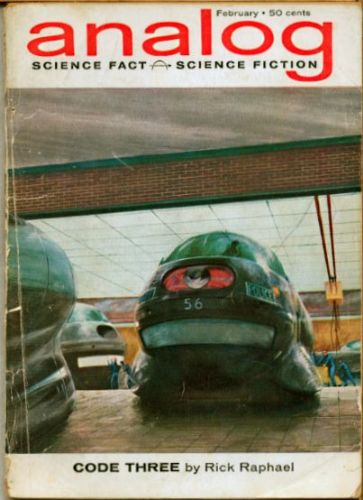
(Cover by John Schoenerr. Analog, February 1963.) The Story So Far
A space battle with the Enterprise (which conspicuously does not have Andray Dunnan aboard when it’s destroyed) leaves the Nemesis damaged, as well as a newly allied ship stuck on its home planet for repairs. Said ship belongs to Marduk, one of the most civilized planets in the Old Federation, as they not only have a functioning and reasonable form of government (a constitutional monarchy) but a space navy that’s well-equipped to defend the planet. Lucas Trask has some rather sour feelings about how business gets done on Marduk, but he’s found a new ally for his Tanith project, and he even comes to befriend some of people, most notably Prince Simon Bentrik. He has some lofty ideas about the role of government, but Bentrik is by no means a softy or a coward; if anything he’s eager to learn, with Trask as both a friend and mentor figure. Trask has the notion of using the Old Federation worlds as trading partners to help build Tanith, without any involvement from the Sword-Worlds. Gram, Trask’s homeworld, is becoming increasingly mired in tyranny (Duke [now King] Angus has apparently gone mad with poower), but Trask has no interest in returning. After several years of being a Space Viking and having formed good relations with some of the Federation worlds, Trask seems to have “gone native,” as it were. Just as well, since he still needs to hunt down Dunnan.
There’s also the more immediate problem of Marduk, which sees its government inadvertently take after the last days of the Weimar Republic. There’s a new populist figure on the rise. Zaspar Makann was a nobody just five years ago, but now he’s the head of an increasingly popular political party, called the People’s Welfare Party. Makann has become so popular in the past year, with an increasingly discontent voting populace, that there’s a decent chance he’ll become Chancellor. God knows what sort of hell will break out if that happens. Makann seems to be running on economically left-leaning but socially right-leaning policy, using nationalism and racism (using the Gilgameshers as scapegoats, since they’re already a deeply unpopular minority group) to rile up the masses. This all sounds rather familiar, as Trask has been doing some reading on old Earth history. There was something about the Weimar Republic and the Nazi party. There was also something about a Reichstag fire in 1933…
Enhancing Image
It’s in the final stretch of Space Viking that Piper’s pessimism becomes most overt, and where it also ties together with a coherent message. The idea (I’m paraphrasing a bit from a passage here) is that everything that can happen has already happened somewhere, at some point in humanity’s past. There is nothing new under the sun. Trask has been doing some reading, and he comes to suspect that given the speed of Makann’s rise to power, there must be someone even more powerful backing him. This “big lie,” which is really a long shot to get Trask’s allies to mobilize, turns out to be true—quite conveniently so. It’s been a hot minute since we had last since seen Dunnan, and indeed it’s been since the second installment that we had last even heard from him. By this point, Dunnan’s become a Space Viking himself and built a fleet of crazed followers, and has been secretly using Makann as a puppet to establish power on Marduk. The old saying goes that as a Space Viking one can’t conquer a civilized planet, which might be true as far as the usual tactics go, but what about conquering a civilized world from the inside? Suppose Dunnan were to use Marduk’s own democratic processes against it? Piper’s not very subtle about how he feels about democracy, since he has Bentrick (who, in his defense, had just narrowly escaped being captured and killed) say this near the end of the novel:
“There’s something wrong with democracy. If there weren’t, it couldn’t be overthrown by people like Makann, attacking it from within by democratic procedures. I don’t think it’s fundamentally unworkable. I think it just has a few of what engineers call bugs. It’s not safe to run a defective machine till you learn the defects and remedy them.”
As Trask (and by extension Piper) is quick to retort with, however, feudalism is pretty far from ideal as an alternative. Trask is formerly a Sword-Worlder, and the Sword-Worlders are pretty confident in their being more civilized than the rough-edged Old Federation worlds; but ultimately the novel makes the point that the line between “civilized” and “uncivilized” is a pretty blurry one, if not utterly arbitrary. By the end of the novel, Gram has become somewhat decivilized, having succumbed to despotism, while Tanith is said to be on the rise. I say “said” and not “shown,” because there’s a lot of telling in this novel with relatively little to show for it. The paperback comes to about 190 or 200 pages, almost a novella by today’s standards, but there’s a good 400 pages’ worth of plot and maybe 50 pages’ worth of description. As with a lot of SF novels of this vintage, Space Viking feels like an abridged version of itself, somewhat to its detriment.
I mentioned before that Piper has a sort of kinship with Robert E. Howard, and that’s aside from their tempraments, their tragic deaths, and even the fact that they were only a couple years apart in age (one has to wonder if they might’ve interacted, had Howard not died as young as he did, given they would’ve been close contemporaries). There’s also this shared belief that the “natural” state of mankind is barbarism, or rather the belief that civilization, good as it might be, is only transient. Going back to that conversation Trask and Bentrik have, there’s a telling (if rather blunt) little speech Trask goes on that sums up the novel’s ideas:
“It may just be […] that there is something fundamentally unworkable about government itself. As long as Homo sapiens terra is a wild animal, which he has always been and always will be until he evolves into something different in a million or so years, maybe a workable system of government is a political science impossibility, just as transmutation of elements was a physical-science impossibility as long as they tried to do it by chemical means.”
Man is basically an animal, and when an animal contracts rabies it has to be put down. So goes with Dunnan, who seems to be delusional enough, even years later, that not only does he still think Elaine is alive but that she means to marry him; it’s unclear if Dunnan is aware he had even shot Elaine back then, but it doesn’t matter. The final onslaught on Marduk ends up being an anticlimax, since Makann gets killed offscreen (sitting on the king’s throne with half his head blown off) while Trask summarily executes Dunnan after having smoked out his few remaining goons. Dunnan himself puts up no real fight, and Trask, despite having waited years for the moment, comes to not think much of it. “It had been like shooting a snake, or one of the nasty scorpion-things that infested the old buildings in Rivington. Just no more Andray Dunnan.” The original reason for Trask giving up his old life and going on looting as a Space Viking now feels inconsequentiall, as nobody is likely to remember who Dunnan even was. Trask’s revenge is framed as more or less justified, but it’s not glorious. Piper’s attempt at giving Trask a happy ending after all is said and done reads as a bit disingenuous, but then this would otherwise be too despondent.
A Step Farther Out
Sure, there are some problematic elements (it’s hard to believe people will be casually smoking pipes in spaceships a few centuries from now), but it holds up better than some novels of the era I can name that are easier to find in the wild. Most of the novels to be serialized in Astounding/Analog which garnered a lot of love and attention from fans at the time have long since fallen to the wayside, but Space Viking is an example of a pretty solid novel to not have gotten much attention at the time either. ISFDB lists only a couple contemporary reviews for it, and it’s totally possibly it got overshadowed by Piper’s paperback originals, especially Little Fuzzy. It being also probably Piper’s darkest novel would doubly make it hard to sell someone on it. But I would call Space Viking an almost-classic from that dark period between the ’50s boom-and-bust and the New Wave era. Piper fascinates me too much as a pulpy but serious-minded writer.
See you next time.
-
Novella Review: “The Araqnid Window” by Charles L. Harness
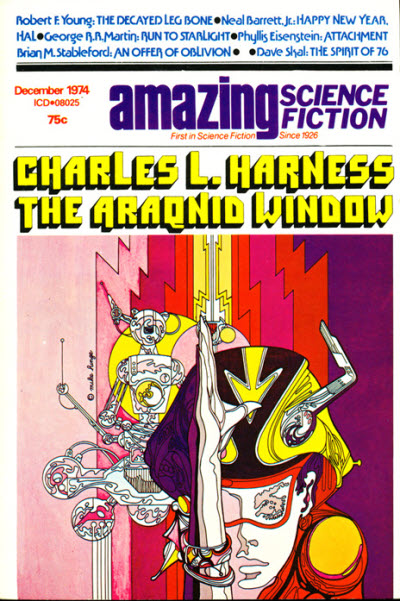
(Cover by Mike Hinge. Amazing Stories, December 1974.) Who Goes There?
Charles L. Harness was born in 1915, in Texas, and came to writing science fiction relatively late, already being in his early thirties when his debut story, “Time Trap,” was published. He appeared sporadically in the late ’40s and early ’50s before going silent for more than a decade. It’s here that I should issue something like an apology, since the last time I reviewed a Harness story, his very weird and very enjoyable novella “The Rose,” I said that the reason Harness took a break from writing after 1953 stemmed from his difficulty in getting “The Rose” published. (It’s true enough that “The Rose” would not see print in the US for several years, first appearing in the second-rate UK magazine Authentic Science Fiction and being stranged there for over a decade.) Apparently, in one of the volumes of Orbit, Harness explained that the reason for his lapses of silence had to do with raising his family, as well as focusing on his day job, which itself proved more than lucative enough that writing for money was unnecessary. Harness had studied law and worked as a pattent attorney for over thirty years, eventually retiring in 1981. It’s no coincidence that Harness’s most productive period as a writer aside from that initial burst came in the ’80s.
Between his infrequent appearances and the fact that his style is maybe too willfully odd and unscientific (he comes off as a somewhat more literate A. E. van Vogt, or conversely like a more off-putting close contemporary with Katherine MacLean) to get mainstream traction, Harness seemed destined for the status of a cult favorite—sometimes admired but rarely read. He did live long enough to be named an Author of Distinction by the SFWA in 2004, and the same year “The Rose” garnered a Retro Hugo nomination for Best Novella. He got collect a few of the flowers due him, before dying just short of his 90th birthday in 2005. “The Araqnid Window” was published at almost the halfway point of Harness’s career, and was one of only two stories by him published in the ’70s, the other being the short novel Wolfhead. This is not what I would call major Harness, in part because of its length, but also it shows a sensitibility that would’ve been old-school even in 1974. In his introductory blurb, editor Ted White calls this story “daringly ‘old-fashioned’ science fiction,” but if anything it’s Harness’s own quirks that redeem it, as opposed to its retrograde attitude.
Placing Coordinates
First published in the December 1974 issue of Amazing Stories. It’s only been reprinted once, in the Harness collection An Ornament to His Profession.
Enhancing Image
Professor Speidel, a 70-year-old archeology teacher who’s on the eve of bein forced into retirement, is not the protagonist of this novella, but he is very important to the coming events. Speidel has two dreams as an aging digger on the brink of retirement: of finally discovering Araqnia, and of becoming famous by doing so. He’s traveled to the planet Algol, which had been discovered only a few decades prior, and if the lost city of Araqnia is to be found anywhere then it’s here. The problem is that despite historical allusions to the city, there is not even one brick of physical evidence of Araqnia having existed. Obviously it is no more, and must’ve been quite literally devoured by the sands of time for many moons; but then even with lost-and-found cities there are remnants. As Speidel explains in one of several lectures (he’s a bit of a yapper, when it comes to archeology, even despite being quite old and with a case of the common cold) during the expedition some pages later:
“Civilizations have come to an end before, of course. The Babylonians destroyed Nineveh in 612 B.C., and it never rose again. But at least the ruins are still there. Rome destroyed Carthage, but at least we know the site, and how it happened. Knossos fell beneath a combined earthquake and tidal wave. Ankor Wat has been deserted for a thousand years, but we know where the city is. The Mayan cities of the Yucatan are long deserted, but at least we know they are there, and we can see and touch the buildings and temples. Not only do we not know where Araqnia is, we don’t know why it disappeared. Was it flood? War? […] Disease? Some nasty virus such as I have?—God protect them!—It might well have been a genocidal epidemic.”
Mind you that he does not mention Pompeii, maybe the most famous case of a “dead” city that’s been fossilized, in which the unlucky denizens were smothered by volcanic ash and pyroclastic flow. Pompeii had been totally covered and seemingly forgotten about for over a thousand years, until it was rediscovered and found to be in impeccable shape, once the excavations began. This absence of mention is a bit conspicuous on Seidel’s part, but it almost certainly works as a kind of odd foreshadowing on Harness’s end, in that we’re prompted to think of Pompeii based on it not being mentioned in-story. A less subtle use of foreshadowing is how Seidel brings up his cold as a means by which intrusive settlers in North America and elsewhere unwittingly killed indigenous peoples by the dozens, as the latter group had no immunity to such innocuous illnesses. The Araqnids are presumably long dead, if they ever existed, and yet Harness nudges the reader and posits that somehow Seidel’s sickness will be made relevant. After all, why else would he bring it up multiple times?
Meanwhile we have the real protagonist in John Thorin, who majored in instrumentation and who doesn’t have much of an interest in archeology. “Even though he was majoring in instrumentation, he needed this 3-hour credit in ark. He had to finish this field trip.” Said “field trip,” of course, will end up being a life-or-death adventure for Thorin. The one upside is that he’s here with Coret, his wife, although she too will get way more than she could’ve possibly bargained for with this trip. There’s also the immediate problem of antagonism between Thorin and Speidel, since Speidel is a grouch who clearly doesn’t respect Thorin as a hanger-on while Thorin dislikes the professor’s borderline egomania and penchant for going on exhaustive tangents. Then there’s Coret, who unfortunately doesn’t have much of anything going on. I wouldn’t go so far as to say “The Araqnid Window” has a misogyny problem, since even the male characters are not that developed to begin with, but Coret very much functions as The Woman™ in the story, never mind that she ends up spending a lot of it as naked as God had made her. But then, of course, the characters are obviously not the point of all this; if anything, in keeping with the story’s “old-fashioned” leanings, the characters exist in service to the ideas Harness presents us with. This is a fun, if also rather slight, slice of adventure SF about a lost alien civilization.
There’s some more not-very-subtle foreshadowing. Speidel disparages Thorin for having brought a handgun (it even comes with a stun setting, like in Star Trek) to the expedition, but we understand on a sort of intrinsic lizard-brain level that at some point this handgun must come back around. Indeed Thorin’s gear, which it seems like he had packed too much of, will prove useful for a turn of events he could not have possibly foreseen. One day, while taking her morning bath, something happens to Coret. Thorin finds her naked and running away in a frenzy, like a decapitated chicken, with “something horrid and bristly on her back.” This, naturally, is an alien, and a chase commences. Through what was initially a mistake on his part, Thorin discovers an underground network that may lead to the lost city of Araqnia—if only he can find Coret and hopefully save her life first. Up to this point, about a third into “The Araqnid Window,” nothing that surprising had happened; if anything Harness is keen on prepping the reader for a big revelation coming. It’s not unusual to see a race of aliens, even for 1974, that lives by attaching itself to the back of a larger species, as you may be thinking of Robert Heinlein’s The Puppet Masters or (if you wanna go for a schlockier example) the creepy crawlies in The Tingler. It’s also not very inventive to have an ancient alien civilization buried under the figurative sand, as the “lost world” kind of story goes back to even before when Harness was born. It also takes a good deal of wordage to get to this point, and at about 19,000 words but with a premise more fit for 12,000 words this story could’ve benefited from a fair bit of trimming.
I can’t be too harsh, though, especially with the benefit of hindsight. Harness may not be the best when it comes to writing characters (you sort of get a hunch that he hails from a more hard-headed and less literarily inclined generation of SF writers), but what he (along with his immediate predecessor, A. E. van Vogt) has a knack for is sparking a sense of mystery and wonder. The solution to the mystery is not always sensical, but in the case of “The Araqnid Window” I think the payoff is quite good. Funnily enough, the story this reminds me of most is not anything by van Vogt, but instead P. Schuyler Miller’s “As Never Was,” one of the shiniest gems to have come out of Campbellian SF. There is the obvious connection of both being about archeology and alien artifacts, but there’s also the alarming similarity of time travel and the possibility of a stable time loop. How this relates to “The Araqnid Window” might be obvious to some, and no doubt some can see the revelation from a mile away, but I’m saving the specifics for the spoilers section. The point I wanna make here is that this story does escalate to a satisfying climax, even if it takes longer than would’ve been ideal to get there. It’s a decent, if rough, novella, coming from someone who specializes in flawed but intriguing SF.
There Be Spoilers Here
The network of tunnels Thorin pursues his wife through are such that there would be no hope of escape, if not for the equipment Thorin has on him that will orient him out of the tunnels; but these are electrically powered, and if they run out, then, well shit. Eventually he discovers a great chamber, home to a balcony and a peculiar window—you could call it the titular Araqnid window, a time viewer that looks out on the city as it was some 3,000 years ago, before the calamity. The dying alien on Coret’s back alludes to “the Death-One” and something about the window, but this is all kept vague at first. Thinking about it now, I really should’ve seen the twist with “the Death-One” coming, the being supposedly responsible for the extinction of the Araqnids. In a cruel (but arguably bittersweet) twist of irony, the one destined to bring down Araqnia and thus make the present possible is Professor Seidel—the man who, if anything, has an obsession with preserving every scrap of Araqnia he can find. In what is admittedly a convoluted turn of events, Seidel irreversibly (it’s one-way and so there’s no means of rescuing him) steps 3,000 years into the past, via the balcony area, where he will kill incalculable numbers of Araqnids with his easily treatable cold. One has to wonder what Seidel must’ve felt, once he inevitably realized he was responsible for the destruction of a race he so admired, and that it was too late, that there was nothing to be done about it. Indeed, this is how things must play out, for the good of the future. It’s a creepy realization, but there’s also a heavy dose of tragedy.
As Speidel says, and which Thorin appropriates at the end: “Archeology is a process of destruction.” Historically, archeology has been the practice of uncovering relics of the distant past, but it’s also involved destroying those same relics. Instead of using dynamite to unearth a tomb in Egypt, the destruction here takes the form of time-travel shenanigans and a wise but somewhat unraveled professor who’s at the end of his rope and who has nowhere to go, professionally speaking. It’s possible, given what he says in the first half of the novella, that Speidel is passively suicidal and thus doesn’t mind stepping 3,000 years into the past (thus becoming 3,000 years dead in Thorin’s present), but we don’t know for sure. If there’s a bright side at all, it’s that, aside from the few items the team are able to take with them, Coret had her brained filled with valuable information by the Arachnid (probably the last living Arachnid) who had taken to her parasitically. This is a bit of gosh-wow pseudo-science that would’ve probably fit more in the pages of Analog than Amazing, but whatever.
A Step Farther Out
As I’ve found is often the case when it comes to reading Amazing Stories, I have a hunch “The Araqnid Window” appeared here and not in a better-paying magazine because those editors had passed over it, maybe for it being too rough around the edges. No doubt another revision, with an emphasis on tightening the word count, would’ve helped it. Harness was not a very refined writer, but then he also cut his teeth on a writing environment (the late ’40s) where it was commonplace to turn in second- or even first-draft work and expect it to find publication somewhere. Like Seidel, who Harness may have related to in some way (both being aging men in fields that no longer see them as essential), he’s showing his age a bit. I say this as a criticism of “The Araqnid Window,” but it’s not entirely negative criticism, since the mind-bending climax succeeded in its intended effect. Even this deep into his career, Harness still had the ability to amaze, even if he wasn’t quite the same man who wrote “The Rose.”
See you next time.
-
Serial Review: Space Viking by H. Beam Piper (Part 3/4)
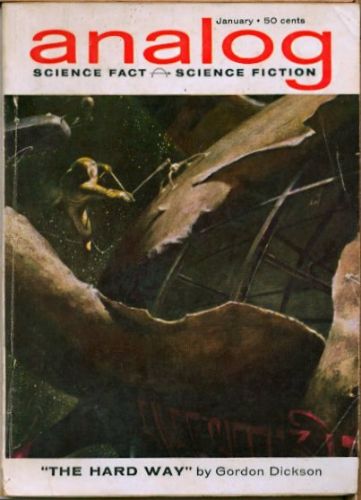
(Cover by John Schoenherr. Analog, January 1963.) The Story So Far
Baron Lucas Trask was once set to be the happiest man on Gram, with his wife Elaine Karvall; but their marriage was cut tragically short (indeed on the night it started) by the insane and yet oddly clever Andray Dunnan, Duke Angus’s nephew. As historically has been the case with nobility, and even the very rich of modern times, severe mental illness is allowed to go unchecked. Dunnan kills Elaine and hijacks the Enterprise (no, not that one), a prized ship, with a bunch of his most loyal followers. In a sense, Trask dies too that night, as he makes the decision to leave his barony behind and take up the mantle of a Space Viking, alongside Otto Harkaman, who’s friendly enough and liable to show Trask the ropes. Among the Sword-Worlds, of which Gram is one, the Space Vikings have a largely negative reputation attached to them—not a totally unjustified reputation either, since the Space Viking make their riches by plundering the semi-civilized Old Federation worlds. Looting, murdering, “the usual atrocities,” although curiously rape is punishable by death. Our Anti-Heroes™ decide to start setting up a base on the mostly depopulated world of Tanith, in which through some catastrophe most of the people had died out, yet their architecture remained in good condition. Trask’s original goal was simply to catch and kill Dunnan, after which he would probably commit suicide, but with Tanith he has found a new and more productive goal. The problem is that you can’t make an omelet without breaking some eggs, and the same goes for rebuilding a civilization. The cost of rebuilding will be a high one.
With a newly outfitted ship, christened the Nemesis, plus a few fellow Space Viking ships like the Space Scourge, Trask looks to gather resources, between simple plundering and diplomacy with other cultures. There is also, of course, some political backstabbing thrown into the mix. Indeed trading becomes preferrable to plundering, not least because of Trask’s traumatic first experiences with on-the-ground combat and the use of some insane firepower (a “hellburner” can literally turn a whole city into a scorched crater, and nuclear weapons are treated relatively flippantly in this setting), but also because it would be more practical to trade resources between Old Federation worlds. Some worlds are rich in metals or agriculture while others, like Beowulf, are rich in “fissionables,” needed for nuclear power and weapons. Ultimately everyone involved will benefit, such that (in an unlikely turn of events) Trask’s group makes peace with the Beowulfers despite having attacked and plundered them before. Gram has also become involved in the growing enterprise that is rebuilding Tanith, with Duke Angus becoming King Angus of Gram and Trask becoming Prince (prince to whom?) Trask of Tanith. Meanwhile, Dunnan has not only become a Space Viking himself, but has begun building his own fleet. At the beginning of this whole ordeal, Trask had nothing left to lose, but after six years he’s become worried about losing his pet project; on a more metaphysical level, he’s also become convinced that he will not see the pearly gates when he dies—probably true enough, given his numerous crimes.
Enhancing Image
Much of the third installment is concerned with, of all things, discussions over politics and economics. In case you’ve never read anything by Piper before, the overt right-wing slant can feel as though it comes out of nowhere; and yet unlike his close contemporary Robert Heinlein (who by the ’60s had become a Goldwater Republican), Piper is not so convinced of any “ideal” system of government—not even the so-called benevolent despots that Trask himself favors. (It’s worth remembering, as if it were possible to forget, that Trask is keenly aware of his own evil deeds, such that he regularly loses sleep over it.) Piper could be considered something of a right-wing anarchist, although his belief (or rather active disbelief) in government puts him on more similar ground with Robert E. Howard than Heinlein. Of course, Piper and Howard were both deeply pessimistic about humanity’s future, and both ended up shooting themselves. Finally, there’s a character introduced here who ends up reading as eerily prescient, although it’s sort of obvious who Piper would’ve been thinking of when he wrote this novel. But anyway, more on that whole business in a minute.
When talking about Marduk, the planet introduced in this installment, let’s talk a bit more about the Old Federation worlds and how, despite being segregated from the more advanced Sword-Worlds, they were by no means created equally. Some, like Beowulf and Gilgamesh, are technologically advanced enough that a few of the fellow Space Viking captains considered attaching the former to be taboo, because “you didn’t raid civilized planets, not and get away with it.” The subsequent battle with Beowulf proved this to be pretty sound advice, even if things worked out in the long run. Marduk is another one of these well-advanced Old Federation worlds that could be reasonable confused for one of the Sword-Worlds, although instead of feudalism the people opted for basically a constitutional monarchy—you might even call it a democracy. This doesn’t enthuse Trask at all. And yet Prince Simon Bentrick of Marduk, who Trask saves in the heat of a space battle and who befriends him despite their differing worldviews, turns out to be one of the most (indeed he’s one of the few) sympathetic characters we’ve met thus far, even if his belief in constitutional monarchy is framed as naive. The government is apparently bureaucratic as hell, and there’s even (in one of the novel’s few humorous moments) a deliberately convoluted explanation as to how things work on Marduk.
There is, however, a growing problem on this otherwise peaceable planet, which is the wannabe despot Zaspar Makann and his faction, the People’s Welfare Party. The best way to describe Makann politically would be that he seems economically left-leaning but socially very right-leaning. Textually he’s compared to Adolf Hitler (obvious, if also sensible comparison), but read this passage about him and try not to think of a few relatively modern figures in politics. It feels a little too accurate:
Makann was a raving lunatic, and all the followers he had were a handful of lunatics like him. He might be a lunatic, but he had a dangerously large following. Well, not so large; maybe they’d pick up a seat or so in the Assembly, but that was doubtful—not enough of them in any representative district to elect an Assemblyman. He was just a smart crook, milking a lot of half-witted plebeians for all he could get out of them. Not just plebes, either; a lot of industrialists were secretly financing him, in hope that he would help them break up the labor unions. You’re nuts; everybody knew the labor unions were backing him, hoping he’d scare the employers into granting concessions. You’re both nuts; he was backed by the mercantile interests; they were hoping he’d run the Gilgameshers off the planet.
Incidentally, there was already historic precedent in the US for a figure who ran on a similar platform to Makann, who was himself arguably a fascist. Huey Long was Governor and later a Senator for Louisiana, who may have even succeeded at a run for President, had he not been assassinated in 1935. The controversy over the extent of his borderline despotism (he all but ruled his state with an iron fist) and whether he really counted as a fascist (in terms of eceonomic policy he actually ran to the left of FDR), continues to this day, but no doubt Piper would’ve thought very dimly of him. (And yes, this is the part where I bring up Trump, namely in the coaxing of both anti-labor rich assholes and socially conservative trade unionists. The secuding of trade unions for what is ultimately an anti-labor fascist movement is unfortunately a reality we have to deal with.)
A Step Farther Out
Obviously we’re heading for something terrible with Makann and his goons, and this will somehow tie into Trask’s rebuilding of Tanith. The introductory blurb for the final installment alludes to Tanith being the success story that Trask will go down in history for, despite all the blood spilled for it. The political implications here are—let’s say curious. No doubt John W. Campbell was taken by Piper’s shared ambivalence toward democracy, not to mention their dim view of organized labor; but at the same time Piper’s politics were a lot more libertarian than conservative. There’s a distrust of both politicians and “the people,” and yet rather than put the feudalism of the Space-Worlds on a pedestal Piper posits that this system, too, will not last. So much in this world is transient already. Stylistically Space Viking fits well enough in Analog in the early ’60s, but there’s a palpable bleakness that sees it anticipating the overtly pessimistic SF we would start seeing late in the decade. I have to wonder what Piper would’ve done or how he would’ve reacted to the New Wave movement, which hadn’t quite started yet at the time of his death. It’s one of those little near-misses in the field’s history. I’m also curious how the final installment here will play out.
See you next time.
-
Short Story Review: “Sunken Gardens” by Bruce Sterling
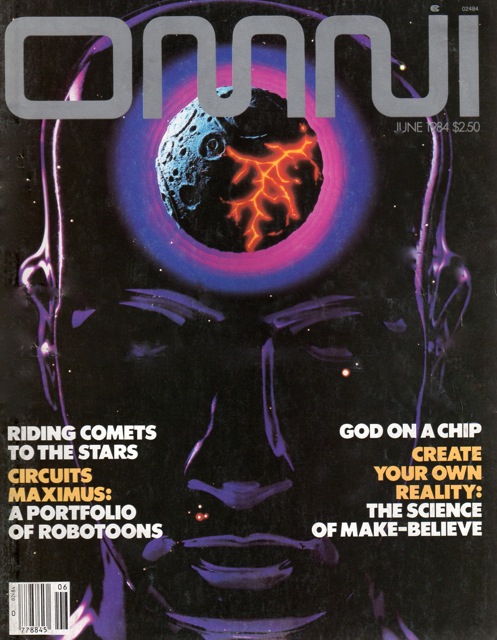
(Cover by Bruno. Omni, June 1984.) Who Goes There?
Bruce Sterling was born in 1954, in Brownsville, Texas, but later moved to Austin, because that’s the thing to do if you’re at least a little eccentric. I had stated somewhere before that Sterling genre debut was the novel Involution Ocean, but actually the short story “Man-Made Self” predates it by a year. While these two works were published in the ’70s, it wasn’t until the early ’80s that Sterling started to become prominent in earnest. He didn’t write another short story for six years, but when he did, it was the Hugo- and Nebula-nominated “Swarm,” the first entry in his Shaper/Mechanist future history. “Swarm” is still probably Sterling’s most reprinted story, but more importantly, it introduced a series that can be considered akin to post-human space opera, although Sterling insists on calling the Shaper/Mechanist stories cyberpunk. These stories appeared over the next few years, each garnering awards attention and marking the end of Sterling’s apprentice phase, with the series culminating in the novel Schismatrix, considered by some to be Sterling’s best.
“Sunken Gardens” is the penultimate short story in this series leading up to Schismatrix, and appropriately it takes place late in the future history. While it works just fine on its own, it’s better appreciated within the larger context of the series. While there’s a fair amount of explaining for the first-time reader’s sake, there are nuggets of worldbuilding that are likely to fly over your head. The plot, however, is rather simple. As with other entries in the series, “Sunken Gardens” earned a major award nomination in the form of a Nebula nod, and it’s well-earned.
Placing Coordinates
First published in the June 1984 issue of Omni. It’s been reprinted in The Year’s Best Science Fiction: Second Annual Collection (ed. Gardner Dozois) and the Sterling collections Crystal Express and Ascendancies: The Best of Bruce Sterling. You can also find it by picking up Schismatrix Plus, which contains all of the Shaper/Mechanist stories.
Enhancing Image
The Shapers and Mechanists are factions of humans that have gone in radically different directions, each with its own offshoot. Mirasol, the heroine of this story, is a Patternist, an offshoot of the Shapers. While the Shapers are people who’ve adapted to outer space and on other worlds through genetic engineering, the Patternists have engineered their brains so as to be better at (you guessed it) forming and recognizing patterns. They have a knack for invention, but this comes at a cost. Because of their “cerebral asymmetry,” the Patternists also inherited some “grave weaknesses” like “autism, fugue states, and paranoia.” Well, this is unfortunate in its phrasing. On the plus, “Sunken Gardens” is a rare SF story of its vintage to have an explicitly autistic protagonist; and while the aforementioned traits are framed as flaws, Mirasol is still made out to be a decent person. Incidentally, the Patternists and similar factions who toy with the human mind reminds me a bit of one of Philip K. Dick’s lesser novels, Clans of the Alphane Moon. What if we had a society totally populated with and run by neurodivergent people? What if a furry convention was a country, or at least a town? The Patternists and others like them live in so-called redemption camps, isolated from each other and indeed from the Regals in Terraform-Kluster (calling it T-K from now on), a society of rich assholes orbiting Mars.
Typically in stories about efforts to terraform Mars there are a couple factions, but “Sunken Gardens” puts a twist on this by making the fight between factions a sort of battle royale. The short of it is this: The Regals have chosen champions from six factions, of which the Patternists are one, and with Mirasol being their champion. This is not a kill-everyone sort of battle royale, but instead the champions are given a set time to begin terraforming pockets of a large crater, called the Ibis Crater. The winner of this competition is to go “up the Ladder” and become a Regal. The Regals themselves are backed by the Investors, “those star-traveling reptiles of enormous wealth.” We don’t see the Investors in this story, and we have only a meager idea as to what the Regals are like; but then again, what we do find out about them isn’t promising. Mind you that the Regals have spent the past century hammering Mars with huge chunks of ice, turning the planet into a kind of winter wonderland. I’m not kidding. It’s an icy shithole, and the idea now is that there must be a batter alternative. The ramifications of Mars getting iced over a long period of time (although by terraforming standards, a hundred years isn’t that long) will only be gradually revealed, but for now it’s important that Mirasol wins—if only because winning means being uplifted to become like the Regals.
Tellingly, we’re told little about what happens in the competition. We’re not told much about how Mirasol dealt with her little pocket of the crater, and we’re told very little about her rivals. I don’t think we even get any of their names. The only other named character of note is a Regal, Arkadya Sorienti, Incorporated (I’m not kidding), “a member of T-K’s ruling oligarchy.” In case it hasn’t become apparent by now, Sterling’s anti-capitalist sentiments (he’s decidedly on the left, and quite open about it) are made clear. Rather than cooperate, the factions are incentivized to work against each other in the name of prestige. “The Regals had held [these competitions] for decades as an objective test of the skills of rival factions. It helped the Regals’ divide-and-conquer policy, to set the factions against one another.” The Regals have the Investors and the so-called Lobster King on their side, while the human factions don’t even have each other for support. The situation is bleak. To make things just a shade darker, one of the six competitors never shows up to the final briefing, and their territory gets forfeited. Wisely Sterling doesn’t tell us why the sixth competitor didn’t appear. The sunken gardens of the title are the isolated patches of land each competitor has to play with—to work as a “gardener.” “Sunken Gardens” plays with the idea of terraforming on almost a micro level, which I don’t think is something I’ve seen much in SF written even after this point.
The pacing here is a bit odd. There’s a lot of backstory for something that only totals about fifteen pages—mind you that “Sunken Gardens” is about tied for the shortest of the Shaper/Mechanist stories. The plot is straightforward enough, but there isn’t actually much of it, or at least not much we’re told about. Very feasibly Sterling could’ve turned this into a novella, what with the density of the dynamics between the different factions and the Regals, but he chose not to. This also seems to be the only entry in the series where Mirasol appears, but then it also takes place late in the timeline. My big gripe, I guess, is that I wish it was longer, which is a rather positive-sounding complaint to have about something. There’s also the pleasure of Sterling’s style, which is more literate than the average bear’s, such that I’ve pulled more quotes here than usual.
There Be Spoilers Here
So, Mirasol wins the competition, but it comes at a cost—not to herself personally, but to the people who, it turns out, were already living in her sector of the crater. Something kept secret from the competitors was that there was was already a human population, small and semi-civilized but quite intelligent, lurking in the crater. And, inadvertently, Mirasol had killed them. The Regals had apparently been meaning to kill anyone on Mars who’s run the risk of becoming too technologically advanced—God forbid they discover one of the Investors’ great secrets, without their help. This sparks a crisis of conscience for Mirasol, but “her corporate ladyship” will have none of it. There’s a faint glimmer of hope at the very end, since Mirasol has earned her way up the Ladder and as such will come to have a modicum of power, but it’s hard to say if anything will come of it. Personally I could’ve done without that last-second attempt at optimism, but that is a very small quibble; otherwise this is a haunting ending.
A Step Farther Out
I’ve read “Swarm” and “Sunken Gardens,” which makes me think I should probably get to it and read Schismatrix (or rather Schismatrix Plus, since that’s the edition in print nowadays and it’s the one I have) already. Partly this is because I’m sold on the Shaper/Mechanist series, but also this is a case where reading any one of these stories in isolation doesn’t give one a full impression as to the setting. Only after having gone through everything will I finally get the picture, as it were. Sterling said he intended to leave the series be after Schismatrix, a stance he makes perfectly clear in his introduction to Schismatrix Plus. This means that the centuries-spanning saga of the Shapers and Mechanists comes to about… maybe 400 pages. I sure miss when SF tended to be concisely written.
See you next time.
-
Serial Review: Space Viking by H. Beam Piper (Part 2/4)

(Cover by John Schoenherr. Analog, December 1962.) The Story So Far
Lucas Trask is dead, in a sense. He died when trying to save Elaine Karvall, his wife-to-be, from Andray Dunnan, a mad nobleman who’s convinced Elaine wants to marry him instead of Trask. Unfortunately for everyone, Dunnan is allowed free roam despite his mental illness being well-known, for he is Duke Angus’s nephew and that gives him a lot of leeway. Nobility and title matters a lot in this far future, where despite the prevalence of spaceships and robots, humanity has slipped back into feudalism. The worst part is that this is for the Sword-Worlds, which are relatively well-off. You could do worse and journey to one of the Old Federation planets, whose peoples have slipped even further into cultural backwardness. Civilization, in the world of Space Viking, is hard to build and easy to undo. Trask himself is a baron, set to connect with the industrial might of the Karvall family through Elaine; but Dunnan kills her and hijacks the Enterprise, a prized ship, with some devoted supporters of his. Within just an hour, Trask’s whole world has fallen apart, and now the only thing he cares about is catching and killing the son of a bitch who ruined his life.
Even with the help of Otto Harkaman, a veteran Space Viking, the question of tracking down the Enterprise soon proves to be a hard one. The Space Vikings are not so much a group of people as a certain lifestyle, which many would say is odious, if also requiring of bravery. The Space Vikings are used to plundering and setting up bases on Old Federation worlds, where the people may be backwards, but where certain planets may be rich in materials needed for, say, the hyperdrive. (These forgotten planets with their “primitive” cultures generally don’t have spaceships, and even if they do they don’t have ones capable of FTL travel, hence the hyperdrive being very important.) Trask decides to become a Space Viking himself in pursuit of his goal, although he has some very harsh life lessons to learn. With a new ship, christened the Nemesis, Trask and Harkaman think they’ve found the Enterprise, but instead find the Space Scourge and the Lamia, home to fellow Space Vikings, near the planet Tanith. Some unknown calamity had mostly depopulated the planet, which makes it perfect for building a base. Task comes to the conclusion that since chasing Dunnan all over space would be impractical, it might be better to spend years building a base on Tanith and wait for the party to come to him.
Enhancing Image
To say Trask is an anti-hero would be putting it a bit mildly. Space Vikings are, by their “code,” self-serving and not heroic in any sense. Trask, being new to this whole thing, is convinced to send the Nemesis down on Khepera, a planet whose people only have semi-modern fighting equipment. Building a base means farming resources, and for a Space Viking farming resources means plundering neighboring worlds. The battle on Khepera is rather one-sided. Trask and Paytrik Morland, a fellow nobleman, land and see some of the carnage first-hand. There’s a passage that’s pretty haunting, not to mention brutal, in which we see a local man cradling a dead woman, presumably his wife, “half her head […] blown off.” What Trask does next is disturbing and telling. See here:
“Poor devil,” Morland said, and started forward.
“No.”
Trask stopped him with his left hand. With his right, he drew his pistol and shot the man dead. Morland was horrified.
“Great Satan, Lucas! Why did you do that?”
“I wish Andray Dunnan had done that for me.” He thumbed the safety on and holstered the pistol. “None of this would be happening if he had. How many more happinesses do you think we’ve smashed here today? And we don’t even have Dunnan’s excuse of madness.”
The “fighting” and subsequent sacking of this city and the following one on Khepera alone would justify a war crimes tribunal, but there doesn’t seem to be such a thing in the world of the novel. Trask and his men can take what they want with little in the way of repercussions, aside from the predictable casualties on their end. This brutality is something Trask is vividly aware of, to the point where he has latent attacks of conscience on some nights in the midst of sleep—nightmares and visions of his dead beloved staring at him in stark horror. Yet there is no stopping or averting it. Trask figures he will go to Hell when he dies, if there is such a thing; on some nights he’s convinced he’s convinced he has already died and gone there. Nowadays we would probably call Trask passively suicidal.
Of course, nowadays we would call Space Viking “grimdark.” It might be one of the earliest examples in the field. Reading it I’m reminded of Warhammer 40,000, albeit without that franchise’s fantasy elements and very dark (as you would expect) sense of humor.
Now, the business of gathering resources isn’t all bad, or at least horrific. There are, in fact, some cultures in the Old Federation where it’s possible to negotiate, and even trade, rather resorting to brute force. The most curious of these more “civilized” cultures introduced in this installment would have to be the Gilgameshers, a non-aggressive “theo-Socialistic” people who have bartering and haggling as pillars of their culture. They have spaceships, but not FTL travel. They’re also religious zealots, and look on non-believers as somewhat barbaric at best. In other words, they’re a pain to deal with, but at least they don’t pose a direct threat to Trask’s project. (I should mention here that Piper was an avowed atheist whose ambivalence towards organized religion was surprisingly overt for 1950s America. This was another thing he had in common with John W. Campbell, although, of course, they made sure not to have any badmouthing regarding Christianity in the text.) The opportunity to not wipe entire cities off the map actually means a lot in this future, where apparently nuclear weapons are sort of commonplace. Like I said, this reads as grimdark.
By the end of this installment, six years have passed since that fateful night, almost in the blink of an eye. Also by this point, Trask and his crew have killed thousands, probably well over a million people through bombings alone, never mind the boots-on-the-ground sacking of cities. This is all in the name of one day encountering a single man, who, rumor has it, has been gathering resources on his own end and staying in hiding, not wanting to meet Trask head-on. All the more reason to build up Tanith’s might. Have I mentioned this novel is bleak?
A Step Farther Out
When reading Piper, it can be tempting to read into things and find “clues” about what was apparently his deteriorating mental state. In the case of Space Viking this is all too much a temptation, since this is looking to be one of the most hopeless SF novels of its era. It may turn out to be Piper’s darkest novel, and the fact that it finished serialization less than two years before his death doesn’t help. I’m halfway through it now, and while I’m enjoying it quite a bit, it’s not an easy novel to recommend. I’m curious as to how the plot is gonna progress past this point, given the second installment’s somewhat episodic structure and constant grimness.
See you next time.
-
Novella Review: “The Color of Neanderthal Eyes” by James Tiptree, Jr.
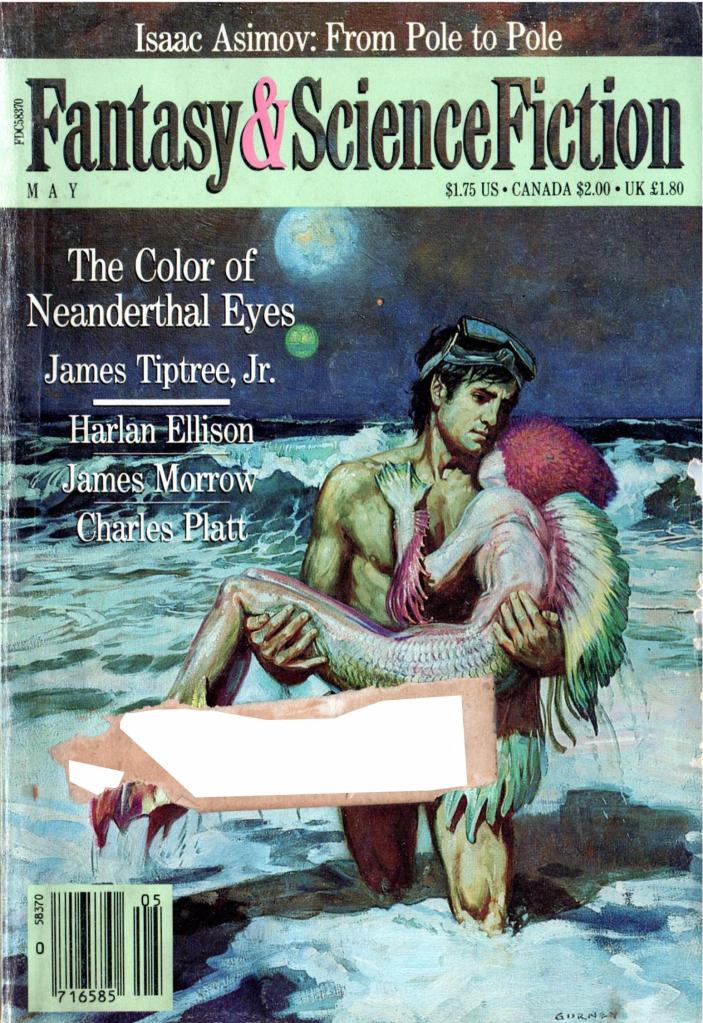
(Cover by James Gurney. F&SF, May 1988.) Who Goes There?
James Tiptree, Jr., real name Alice Sheldon, born Alice Hastings Bradley, is one of the darkest and most turbulent figures in American SF, as well as one of the most acclaimed. She had gained notoriety well before she was even an adult, being the heroine of a duology of travel books aimed at young readers, as written by her mother. Alice apparently didn’t appreciate this now-obscure bit of fame, although her travels in Africa as a child did inspire at least one of her classic stories, “The Women Men Don’t See.” As an adult she dabbled in writing herself as early as the ’40s, but it wasn’t until 1967 that she made her SF debut, as well as introducing the Tiptree pseudonym. By the time she made her first appearance in the field she had already done a stint in the Army Air Forces, then later in the newfangled CIA, and had even earned a PhD in psychology. She had also married twice, taking up the last name of her second husband, Huntington D. Sheldon. As you can see, she was already in her fifties by the time the Tiptree persona was born; and although her career in the field only lasted twenty years, she (as Tiptree) had emerged pretty close to fully formed.
Despite winning multiple awards and much praise for her short fiction, Tiptree never appeared at conventions or gave interviews; she corresponded and formed friendships with people who had no clue what she even looked like, and indeed would not know for several more years. The truth came out in 1977, or rather some very clever fans had discerned the truth, although she kept using the Tiptree byline until the end. The conventional narrative goes that Tiptree wrote her best work right up until her true identity was revealed, but some major short fiction did get published at this point. By 1987, however, both Tiptree and her husband were very old and in frail shape. This, combined with Tiptree’s long-running battle with depression, compelled her to do something that to this day makes her a controversial subject, even among her fans. She took a gun, went to her then-bedridden husband, and shot him. She then called her attorney to confess to the killing, before finally lying in bed next to Huntington and shooting himself. The two had at some point years prior agreed to go through with a suicide pact, were they were to become too feeble in the future. The question of whether Huntington gave his wife consent on that final day is unfortunately one we’ll never get an answer to.
Tiptree had admitted as early as 1976 (her true identity still a secret) to planning to end her own life at some point, and the suicide note the authorities found at the scene had apparently been dated 1979. As with most suicides, the final decision was not a spur-of-the-moment thing, but rather something which had been contemplated months or even years in advamce. Following her death, a handful of new stories were published, as tends to be the case with authors who are as prolific as Tiptree was. “The Color of Neanderthal Eyes” was published almost exactly a year after Tiptree’s death; and according to David G. Hartwell’s note in Meet Me at Infinity, it was the penultimate story she wrote to completion. Despite being one of the last she wrote, and indeed written well after what is considered Tiptree in her prime, this novella is very much classic Tiptree. It may not be as violent or transgressive as her most (in)famous stories, but thematically it falls well in line with what came before. Even as she started succumbing to her inner demons, she knew what she was doing.
Placing Coordinates
First published in the May 1988 issue of The Magazine of Fantasy and Science Fiction. It was first reprinted as one half of a Tor Double, with Michael Bishop’s “And Strange at Ecbatan the Trees.” It was then reprinted in the Tiptree collection Meet Me at Infinity, which compiles previously uncollected stories and nonfiction. It’s also set to be collected in a Library of America hardcover volume of the best of Tiptree’s short fiction, although that’s not set to come out until next year.
Enhancing Image
Tom Jared is a telepathic scientist (the fact that he has psi powers is made out pretty casually) who’s come to the planet Wet in the name of making Second Contact, as a follow-up mission to the previous (and first) human visitor. Not much is known about life on this planet, which is still better than nothing. To use Jared’s own words here:
Wet has been visited only once before, by a loner named Pforzheimer, who stayed only long enough to claim a First Contact. His notes in the Ephemeris say that there are humanoid natives, confined to the one small continent, or large island, on the other side of the planet from me. Besides that, what land there is consists of zillions of small islands and islets, mostly atolls, long, looping chains of them everywhere, archipelagoes forming necklaces around friendly seas.
So, it’s almost entirely water. Yet there’s still humanoid life—in fact there seem to be at least two humanoid races, although the second one had not been made contact with before. Much like Japan, itself a cluster of islands and islets, the humanoids here live an amphibious lifestyle, holding up their end of the bargain by subsisting on fish and other sea life. Conveniently Jared’s telepathy allows him to communicate with these people, despite the fact that they shouldn’t have even a single word of common language. Even more conveniently (if ultimately played for tragedy, as Jared at the very beginning has us know), he’s been split from the rest of his landing party and thus meets an alien who also happens to be on its own. I say “its,” but the gender of the alien is soon revealed to be female, although curiously Jared admits to feeling attracted towards this humanoid whilst at the time assuming her to be a he. This bit of queerness of not really touched on again, but it’s still refreshing to have a male protagonist who seems to be bisexual. Worth mentioning here that Tiptree herself bisexual, although she identified as a lesbian who sometimes fell hard for men.
The alien’s name is Kamir, and immediately we get two things: the first is that Kamir will die, since Jared told us right at the beginning that this is her fate; and the second is that Jared and Kamir are meant to fall in love, as if the cover for this issue of F&SF doesn’t make it obvious enough. This premise is all very Tiptree, both in its pessimism (we know upfront that the two lovers will not get their happy ending) and its usage of rather old SF ideas. Even for 1988, this human-meets-alien tragic love story was not new, and indeed it made me think of Philip José Farmer’s “The Lovers,” which was published a whole 36 years earlier. Despite being published a few decades later, Tiptree’s story is not much more graphic than Farmer’s. There’s a sex scene early on, but as Jared says, “It isn’t Human, but exciting beyond words, and finally, somehow, fulfilling.” If anything Farmer’s novella is more erotically charged, and the aftermath more surprising. To spoil the ending of “The Lovers,” if you wanna cover your eyes for a second, another similarity is that Kamir is not only able to produce offspring with her human mate, but she is biologically doomed to die during or right after delivery. This is also an idea Tiptree had explored before, most famously in “Love Is the Plan the Plan Is Death.” But whereas in “The Lovers” the death-from-childbirth incident is a big twist, in “The Color of Neanderthal Eyes” it’s established as a reality much earlier, to the point where it can’t really be considered a spoiler. We can put two or two together and assume this is how Kamir will meet her end. This is a classic doomed romance.
Of course, Kamir is not so sad about the prospect of dying, since she was expecting this—in fact, she was hoping for it. She thinks of herself as ugly by the standards of her race, namely because of her perceived weight; but with her people it’s the fact that she’s too skinny, rather than too fat, that makes her unattractive. The women are supposed to put on weight, in preparation for mating and getting pregnant, as it’ll make the whole process smoother and better ensure the survival of the babies. Given that Kamir is of about average weight and curvature for a human woman, her weight problem doesn’t trouble Jared at all—except for when it comes to the problem of getting her pregnant. Funnily enough, the possibility of contracting some horrific space disease through unprotected sex does not occur to either of them. It was a different time. Anyway, the first half of the novella deals with the meeting and then budding romance between the two—a relationship that would not have been possible had Jared not been a telepath. The fact that he breaks a few rules (something like the Prime Directive if you know your Star Trek) by falling for and then fucking Kamir is presented as a problem, but it’s unclear what the consequences for fucking a sexy alien babe with webbed feet and arms would be. Given that Jared is telling us this story after the fact, it can be assumed nothing too bad had happened; never mind that because Jared is telling us this story now (although for some reason he narrates in the present tense), there can only be so much tension. It must be said he’s luckier than most Tiptree protagonists.
There Be Spoilers Here
We come to learn more about the webbed people, who are friendly almost to the point of naivete, taking in Jared as if he were one of their own. Being Kamir’s mate certainly helps. (Something I couldn’t but wonder as I was reading this is the passage of time. How many months has Jared been on Wet? Long enough to impregnate Kamir and for her to deliver two healthy babies [there was a third fetus, but it does not survive and has to be cut out of the “womb”], but we’re not given dates or anything. I feel like restructuring the story as a series of diary entries would’ve made the passage of time clearer, and maybe also a chance for Tiptree to not write a story in the present tense for once.) However, it’s not enough to mourn the inevibility of Kamir’s death, so we also have to have an impending skirmish between the webbed people and the “goldskins,” a fellow humanoid race on Wet who are landlubbers. Since the webbed people are not used to fighting outside of hunting in the waters, the goldskins see them as easy prey; they especially, for some reason, have an appetite for the webbed people’s children. Jared is not a peacemaker at all, and he can’t even find a common ground in language between the two peoples. The worst case scenario, thus, is genocide, if for no other reason than that the webbed people have suffered too much by the climax to be interested in peace. Jared ultimately comes to be like, and indeed see himself as, a Promethean figure, introducing the webbed people to the art (and disgrace) of warfare. In wanting to survive, these people lose much of their innocence.
As is typical with Tiptree, everything is at best transient. The webbed people are basically good, but this goodness will not last. Jared and Kamir’s love is genuine, but this love won’t last either. The title itself alludes (and the story proper puts this a little too bluntly) to the rather mysterious extinction of the Neanderthals, close relatives to our direct ancestors. The Neanderthals were a burly big-headed race of humanoids who lived and died less than 50,000 years ago—not even a blip in the grand evolutionary scheme of things. Some people today, primarily those hailing from mainland Europe, have a sliver of Neanderthal DNA in their makeup. We know that some Neanderthals and Cro-Magnons (our ancestors) would have mated and allowed this mixture to happen; no doubt at least some of it was through rape, but one also has to think there may have been, even in those brutal years of the last ice age, that thing we call love. Jared’s devotion to Kamir results in the survival of their offspring, even as Kamir dies, a withered husk of her former self. For Tiptree, nothing is permanent and death is everywhere; but then there are also little remnants of the dead past. There are ripples in the water. Things might start and end, but there’s always change.
A Step Farther Out
Tiptree’s view of the world, including human relationships, is akin to a black hole; yet at the same time there’s a romantic undercurrent in a lot of her fiction, including this story, written less than a year before her death. There’s a deep longing, and at the same time a profound fear of the possibile negatives of forming a connection. “The Color of Neanderthal Eyes” is one of Tiptree’s most accessible stories, in that while it ends in a minor key (something we’re told will happen right at the start), there’s far less hostility towards relations between men and women than in, say, “Houston, Houston, Do You Read?” (one of the darkest and most misanthropic SF stories ever written) or “The Women Men Don’t See.” It’s unusually tender for Tiptree, even if it borders on utter hopelessness. I’d recommend it if you’re either skeptical about Tiptree or have read all her most “classic” work but are looking to dig a little deeper.
See you next time.
-
Serial Review: Space Viking by H. Beam Piper (Part 1/4)

(Cover by John Schoenherr. Analog, November 1962.) Who Goes There?
Henry Beam Piper is surely one of the more unusual characters to emerge on the scene right after the end of World War II, and incidentally he died right before the coming of the New Wave. He was born in 1904, but didn’t make his debut until 1947, with the story “Time and Time Again.” Over the next decade his output was sporadic, as he had a day job as railroad security; but once he was let go from that job he started writing full-time, and so his output in the past half-dozen years of his life hiked impressively. The early ’60s saw a late bloom for Piper of the sort that doesn’t come to most writers. Despite all this, there was trouble in his midst. He married late in life, and by all accounts his marriage was both short-lived and miserable. His agent also died suddenly, without having informed him of the sales of several of his works, which led him to believe his career was floundering. Being behind on payments from his writing, without a regular job at this point, and being reluctant to ask those who knew him for financial assistance, Piper decided to take one of the many guns he owned and commit suicide in November 1964. He left behind several unpublished works, including the novel Lord Kalvan of Otherwhen and two sequels to Little Fuzzy. His career had in fact reached a high point, but he didn’t know it.
Space Viking is a standalone novel set in a larger future history, sharing the setting with Little Fuzzy and The Cosmic Computer, among others. Piper had established two expanded universes that supposedly are tied together, although I’ve yet to find clear evidence of this. One is the Federation future history, of which Space Viking is a part; the other is the Paratime Police series, which is older in origin and which contains Lord Kalvan of Otherwhen. The Piper I’ve read tends to be set on Earth (most of the Piper I’ve read is from the Paratime series), but Space Viking is decidedly a space opera. Only a quarter in, but I’m rather interested.
Placing Coordinates
Serialized in Analog Science Fiction, November 1962 to February 1963. It first appeared in book form as an Ace paperback later in 1963. Like most of Piper’s work, Space Viking is in the public domain, so you can read the serial version on Project Gutenberg. There are a few exceptions to this: some rascal (I think John F. Carr) keeps a grip on what little of Piper’s fiction that has not since fallen out of copyright.
Enhancing Image
In the distant future, humanity has conquered the stars, fallen into disrepair, and then recovered—somewhat. We are evidently on the other end of a long galactic dark age, what with the Old Federation and all that. Mankind, in its somewhat rejuvenated state, has collectively come to the conclusion (or at least the most powerful people have) that Space Feudalism™ is the way to go. Barones, dukes, and whatnot, are BACK. This is important context, since Lucas Trask is himself a baron, set to marry Elaine Karvall, the daughter of a big (like multi-planet) industrialist. Lucas thinks this is about to be the best day of his life, but he’ll be proved tragically wrong in a minute. See, since the aristocracy has made a huge comeback, you have people with titles, prestige, and positions of power they’re totally unqualified for. Andray Dunnan is one such person, being Duke Angus’s nephhew, and he’s convinced Elaine is in love with him despite the fact that they’ve barely interacted and Elaine’s betrothal to Lucas being well-known. He’s full of paranoid delusions, and yet he’s convinced that his own reality supercedes objective reality. “Yes, in his own private dream-world, a world of fantasy that had now become Andray Dunnan’s reality, in which an Elaine Karvall whom his imagination had created existed only to love him. Confronted by the real Elaine, he simply rejected the reality.” You may be wondering how such a clearly dangerous man (his condition is notorious enough that several people, including Sesal, Elaine’s dad, try steering him away) could amass a number of people who follow his orders. This is a question we’re still trying to figure out in the real world. Alex Gorram, a shipbuilder, even asks why Andray has not been put in psychiatric care, but we’re not given an answer.
Unfortunately today is the day where what’s little of Andray’s self-control snaps, and it doesn’t help that Elaine makes the mistake of trying to break through his delusions to his face. What ensues is a shootout in which Elaine gets mercifully fridged; to add insult to injury, Lucas’s attempt at saving her, but tackling and trying to cover her, may well have (through no fault of Lucas’s own) put her directly in Andray’s dodgy line of fire. Not only does Andray kill Elaine, but he and his goons steal the Enterprise (no, not that one), Otto Harkaman’s prized ship. This is a mistake one Andray’s part, considering Otto is a Space Viking, one of those nomadic roving spacemen who, like their namesake, are fond of plundering and pillaging. Space Vikings are not an ethnic or cultural group, but rather to become a Space Viking means a certain lifestyle and worldview. Anyone with the guts and metal can become a Space Viking. (I should mention here that some characters have rather unusual names, and that it’s easy to asssume that like with Piper’s other Federation stories, mankind in this future is decidedly multi-racial.) Lucas decides to take up with Otto and become a Space Viking, with a new ship of his own to match. He considers naming this new ship after Elaine, but rightly comes to conclusion that this would be a bad idea. He goes through a few names (I think Vendetta is the best one), but decides that Nemesis will be the right name for such a ship. He will, after all, be using said ship to hunt down Andray to the ends of the universe.
Something I couldn’t help but think about while reading the opening stretch of Space Viking is how in some ways it reads similarly to Dune—not Piper’s fault, or Frank Herbert’s fault, since the two were writing these novels around the same time, and indeed Dune World (the first chunk of the first novel) only appeared in Analog about a year after Piper’s novel. You have a spacefaring humanity with a weirdly retrograde form of government, although unlike the world of Dune there are robots in Space Viking. You have a young man who comes from nobility, but whose life gets turned upside down when someone close to him gets killed by a fellow noble. There young nobleman then follows a path to becoming an anti-hero, or maybe even a villain, all in the name of revenge. Eugenics (characters are being quite literal when they talk about “the best Sword-Sword genes,” although in-context that also works as metaphor) is treated as gospel. There’s generally a retrograde attitude about everything, despite the laser-guns and spaceships, what with the Sword-Worlds being named after famous swords (Excalibur, Durendal, Flamberge, etc.). There’s even a major character with a last name that sounds similar to Harkonnen. It borders on what some call Raygun Gothic, although I’m not sure how to feel about that label. Also like Dune (and I mean this as a positive), the values and tech in Space Viking combine to make a setting that doesn’t take obvious cues from any one time period or place; in that sense it’s aged better than most of its peers.
There Be Spoilers Here
The Nemesis is unable to keep up with the Enterprise, in no small part because these are sister ships, with near-identical designs, and there’s no way for one to outrun the other. Eventually it becomes a question as to where the bastard could’ve gone. Lucas and Otto decide to land on the planet Tanith, a planet that used to be “civilized” but which has since been driven back almost into the primordial soup from whence the whole world came. The buildings are still there, for the most part, but the city they come to has been largely depopulated. How did this happen? Only theories. Tanith is one of those planets in the Old Federation, so in other words the sort of planet that’s been left behind or scorned. I said before that the world of Space Viking doesn’t follow a linear progression with how people act or what tech they have access to, but in keeping with Piper’s right-wing pessimistic view of the world, civilization seems to wax and wane, like the tides. “Civilization,” as we understand it (and after all, what is civilization? and how do we know when we see it?), is surprisingly easy to undo, according to Piper. All it might take is for the wrong people to be removed from the equation, or for de-civilization via something like a plague.
To take Otto’s words:
“It takes an awful lot of people, working together at an awful lot of jobs, to keep a civilization running. Smash the installations and kill the top technicians and scientists, and the masses don’t know how to rebuild and go back to stone hatchets. Kill off enough of the masses and even if the planet and the know-how is left, there’s nobody to do the work. I’ve seen planets that decivilized both ways. Tanith, I think, is one of the latter.”
Of course, Piper does that old-timey SF thing where planets are treated like countries, countries are treated like cities, and so on. It’s an easy trap to fall into; but still, we’re not given that vivid an idea as to the scale of all this. I’ll get used to it, if only because it’s a problem one often finds with space opera so there’s not much of a point in harping on it, but you can do more with it than what Piper does here.
A Step Farther Out
Probably not the best choice for first Piper Federation story, although this is not my first rodeo with this future history—just the longest so far. Actually with Piper and the Federation universe I recommend tracking down the collection Federation, or rather the stories in that collection, since I think they’re all in the public domain. Unlike most Piper I’ve read up to this point, Space Viking stays true to its title by being both spacefaring and unsparing in its violence. Also, unusually for Piper, there doesn’t seem to be a woman in sight who lasts longer than five minutes. The Nemesis is very much a boys’ club, and landing on the semi-wild Tanith is not looking to change this. Still, I’m liking it a fair bit so far. Piper isn’t a wordsmith exactly, but he’s an earnest speculator of the sort John W. Campbell would’ve liked, and he’s a more fluid storyteller than most of the authors who appeared in Astounding/Analog at the time.
See you next time.
-
Things Beyond: August 2026

(Cover by Virgil Finlay. Famous Fantastic Mysteries, December 1947.) I was thinking of taking a break from this blog for this month, but maybe I’ll save the vacation for September. Funnily enough it was easier to come up with a review forecast, with stuff I’m interested in checking out, than it was to announce a month-long break. This is what happens when you’re a compulsive reader.
Anyway, we’re back to our usually programming, although we have a serial novel in a whopping four installments (although Space Viking is not as long as the installment number would have you think), as well as a reprinted SF-horror yarn by one of the most famous British authors of all time. Of course, with the exception of Arthur Conan Doyle, these are all authors I’ve covered before. I figured that if I’m gonna keep myself busy, even going against my own expectations, I may as well keep things “safe” for the time being. At least with Bruce Sterling this is earned, considering I was set to write about another short story of his many moons ago, only to not get around to it. Consider this a second attempt.
I’m keeping this post short and sweet. Not much to report on my end, aside from recently acquiring a second cat. (Cats are easy to adopt, like they just kinda let you pick them up, get them their shots, sign a paper, badda-bing badda-boom.) I also have maybe one too many books on my plate at the moment (incidentally none of them are genre fiction), so I hope to whittle that down, make things more manageable.
As for the stories, we have one from the 1910s, one from the 1960s, one from the 1970s, and two from the 1980s.
For the serial:
- Space Viking by H. Beam Piper. Serialized in Analog Science Fiction, November 1962 to February 1963. Piper was born in 1904, but didn’t start writing SF until he was in his forties, making his debut in 1947. The next decade or so was productive enough for him, including the non-SF mystery novel Murder in the Gun Room. Said novel, while not SF, does pay tribute to fandom in the years following World War II. Space Viking was one of several novels Piper had written in quick succession in the last few years of his life, along with The Cosmic Computer, Little Fuzzy (and its sequel), and Lord Kalvin of Otherwhen. Sadly, after a failed marriage and with the belief that his writing career was floundering, Piper took his own life in 1964.
For the novellas:
- “The Color of Neanderthal Eyes” by James Tiptree, Jr. From the May 1988 issue of The Magazine of Fantasy and Science Fiction. Tiptree is one of the most acclaimed authors of her generation, although despite being typically considered part of the New Wave she was actually a decade or two older than most of her peers. Her life story is a dramatic one, worthy of a Hollywood biopic, and the circumstances of her death remain controversial to this day.
- “The Araqnid Window” by Charles L. Harness. From the December 1974 issue of Amazing Stories. Harness’s career as a writer spanned six decades, although it came in fits and starts. He stepped away from writing in the ’50s to focus on his job and raising his family, only returning after a decade. “The Araqnid Window” itself is one of only two Harness stories published in the ’70s. His job as a patent attorney goes to explain his low output.
For the short stories:
- “Sunken Gardens” by Bruce Sterling. From the June 1984 issue of Omni. Sterling was born in Brownsville, Texas, but later became an Austin denizen. Unusually he made his fiction debut with a novel, Involution Ocean, published when he was very young. His first ambitious project, though, was the Shaper/Mechanist universe, comprising the novel Schismatrix and some short stories.
- “The Horror of the Heights” by Arthur Conan Doyle. From the December 1947 issue of Famous Fantastic Mysteries. First published in 1913. While Doyle did not invent the detective story (he rightly credits Edgar Allan Poe with that), he did codify the genre and became quite rich and famous off of it it. Doyle also wrote in other genres, though, including horror and science fiction.
Now let’s do some reading.
-
Subscribe
Subscribed
Already have a WordPress.com account? Log in now.
 Science Fiction & Fantasy Remembrance