-
The Author Index
Aickman, Robert
Aldiss, Brian W.
Anderson, Poul
- Three Hearts and Three Lions (Part 1/2)
- Three Hearts and Three Lions (Part 2/2)
- We Have Fed Our Sea (Part 1/2)
- We Have Fed Our Sea (Part 2/2)
Anthony, Piers
Arnason, Eleanor
Ashwell, Pauline
Baker, Kage
Ballard, J. G.
Bear, Elizabeth
Bear, Greg
Beaumont, Charles
Bester, Alfred
Bishop, Michael
Bisson, Terry
Blish, James
Bloch, Robert
Bradbury, Ray
Brackett, Leigh
Breuer. Miles J.
Brown, Rosel George
Brunner, John
Bryant, Edward
Budrys, Algis
Bujold, Lois McMaster
Butler, Octavia E.
Campbell, Ramsey
Carter, Lin
Chandler, Raymond
Charnas, Suzee McKee
Chesterton, G. K.
Clement, Hal
Counselman, Mary Elizabeth
Davidson, Avram
Davis, Dorothy Salisbury
De Bodard, Aliette
De Camp, L. Sprague
DeFord, Miriam Allen
Del Rey, Lester
Delany, Samuel R.
Dick, Philip K.
Dickson, Gordon R.
Disch, Thomas M.
- Camp Concentration (Part 1/4)
- Camp Concentration (Part 2/4)
- Camp Concentration (Part 3/4)
- Camp Concentration (Part 4/4)
- “Descending”
Doctorow, Cory
Dorman, Sonya
Drake, David
Egan, Greg
Ellison, Harlan
Emshwiller, Carol
England, George Allen
Etchison, Dennis
Farmer, Philip José
Flynn, Michael F.
Ford, John M.
Gaskell, Elizabeth
Godwin, Tom
Grant, Charles L.
Graves, Robert
Greene, Graham
Griffith, Ann Warren
Guin, Wyman
Haldeman, Joe
Hamilton, Edmond
Hand, Elizabeth
Hansen, L. Taylor
Harness, Charles L.
Harris, Clare Winger
Heinlein, Robert
- Citizen of the Galaxy (Part 1/4)
- Citizen of the Galaxy (Part 2/4)
- Citizen of the Galaxy (Part 3/4)
- Citizen of the Galaxy (Part 4/4)
- If This Goes On— (Part 1/2)
- If This Goes On— (Part 2/2)
Henderson, Zenna
Herbert, Frank
Hollis, H. H.
Howard, Robert E.
- Beyond the Black River (Part 1/2)
- Beyond the Black River (Part 2/2)
- “The Black Stone”
- “The Cairn on the Headland”
- The People of the Black Circle (Part 1/3)
- The People of the Black Circle (Part 2/3)
- The People of the Black Circle (Part 3/3)
- Red Nails (Part 1/3)
- Red Nails (Part 2/3)
- Red Nails (Part 3/3)
- Skull-Face (Part 1/3)
- Skull-Face (Part 2/3)
- Skull-Face (Part 3/3)
Hubbard, L. Ron
Jackson, Shirley
Jacobs, Sylvia
Jemisin, N. K.
Jingfang, Hao
Kanakia, Naomi
Keller, David H.
Kelly, James Patrick
Kessel, John
King, Stephen
Kipling, Rudyard
Kirk, Russell
Knight, Damon
Kornbluth, C. M.
- “The Mindworm”
- “MS. Found in a Chinese Fortune Cookie”
- “Nightmare with Zeppelins” [with Frederik Pohl]
- “Two Dooms”
Kress, Nancy
Kritzer, Naomi
Kushner, Ellen
Kuttner, Henry
- “The Big Night”
- “Clash by Night” [with C. L. Moore]
- “Don’t Look Now”
- “Exit the Professor”
- Fury (Part 1/3) [with C. L. Moore]
- Fury (Part 2/3) [with C. L. Moore]
- Fury (Part 3/3) [with C. L. Moore]
- “What You Need” [with C. L. Moore]
- “When the Bough Breaks” [with C. L. Moore]
Larson, Rich
Laumer, Keith
Le Guin, Ursula K.
Lee, Tanith
Leiber, Fritz
- “A Bad Day for Sales”
- Destiny Times Three (Part 1/2)
- Destiny Times Three (Part 2/2)
- “The Hound”
- “The Moon Is Green”
- “The Oldest Soldier”
- Rime Isle (Part 1/2)
- Rime Isle (Part 2/2)
- “Scylla’s Daughter”
- “The Seven Black Priests”
- “Ship of Shadows”
- You’re All Alone
Leinster, Murray
Ligotti, Thomas
Liu, Ken
London, Jack
Long, Amelia Reynolds
Long, Frank Belknap
Lovecraft, H. P.
MacDonald, John D.
MacLean, Katherine
Martin, George R. R.
- “The Lonely Songs of Laren Dorr”
- “The Pear-Shaped Man”
- “The Storms of Windhaven” [with Lisa Tuttle]
- “With Morning Comes Mistfall”
Matheson, Richard
McCammon, Robert
McHugh, Maureen F.
McKenna, Richard
Merril, Judith
Miller, Walter M.
Mills, Samantha
Moorcock, Michael
Moore, C. L.
- “The Black God’s Kiss”
- “Black God’s Shadow”
- “Clash by Night” [with Henry Kuttner]
- “Daemon”
- Fury (Part 1/3) [with Henry Kuttner]
- Fury (Part 2/3) [with Henry Kuttner]
- Fury (Part 3/3) [with Henry Kuttner]
- “What You Need” [with Henry Kuttner]
- “When the Bough Breaks” [with Henry Kuttner]
Niven, Larry
- Inferno (Part 1/3) [with Jerry Pournelle]
- Inferno (Part 2/3) [with Jerry Pournelle]
- Inferno (Part 3/3) [with Jerry Pournelle]
- “The Organleggers”
Norton, Andre
Nourse, Alan E.
Oates, Joyce Carol
Oliver, Chad
Pangborn, Edgar
Phillips, Peter
Pinsker, Sarah
Pohl, Frederik
Pournelle, Jerry
- Inferno (Part 1/3) [with Larry Niven]
- Inferno (Part 2/3) [with Larry Niven]
- Inferno (Part 3/3) [with Larry Niven]
Rocklynne, Ross
Quick, Dorothy
Quinn, Seabury
Rambo, Cat
Raphael, Rick
Reed, Kit
Resnick, Mike
Rice, Jane
Roanhorse, Rebecca
Robinson, Frank M.
Robinson, Kim Stanley
Rusch, Kristine Kathryn
Russ, Joanna
Shea, Michael
Sheckley, Robert
Shepard, Lucius
Silverberg, Robert
- “Not Our Brother”
- A Time of Changes (Part 1/3)
- A Time of Changes (Part 2/3)
- A Time of Changes (Part 3/3)
- The Tower of Glass (Part 1/3)
- The Tower of Glass (Part 2/3)
- The Tower of Glass (Part 3/3)
Simak, Clifford D.
Smith, April
Smith, Clark Ashton
Smith, Cordwainer
Smith, E. E.
Smith, Evelyn E.
St. Clair, Margaret
Sterling, Bruce
Stevens, Francis
Sturgatsky, Arkady
Strugatsky, Boris
Sturgeon, Theodore
Swanwick, Michael
Swirsky, Rachel
Tenn, William
Tiptree, James
Triantafyllou, Eugenia
Tuttle, Lisa
Utley, Steven
Van Vogt, A. E.
Vance, Jack
Varley, John
Vinge, Joan D.
Vinge, Vernor
Vonnegut, Kurt
Wagner, Karl Edward
Weinbaum, Stanley G.
Wellman, Manly Wade
Wells, H. G.
White, James
- All Judgment Fled (Part 1/3)
- All Judgment Fled (Part 2/3)
- All Judgment Fled (Part 3/3)
- The Dream Millennium (Part 1/3)
- The Dream Millennium (Part 2/3)
- The Dream Millennium (Part 3/3)
Wilhelm, Kate
Williams, Walter Jon
Williamson, Jack
- The Legion of Time (Part 1/3)
- The Legion of Time (Part 2/3)
- The Legion of Time (Part 3/3)
- “The Metal Man”
- The Reign of Wizardry (Part 1/3)
- The Reign of Wizardry (Part 2/3)
- The Reign of Wizardry (Part 3/3)
- “Wolves of Darkness”
Willis, Connie
Wolfe, Bernard
Wolfe, Gene
Wong, Alyssa
Worrell, Everil
Wu, William F.
Yu, E. Lily
Wyndham, John
Zahn, Timothy
Zelazny, Roger
-
Short Story Review: “There Shall Be No Darkness” by James Blish

(Cover artist uncredited. Thrilling Wonder Stories, April 1950.) Who Goes There?
James Blish is one of the defining practitioners of ’50s SF, although his legacy is sort of a mixed bag and he has not retained nearly the level of popularity of, say, Isaac Asimov or Ray Bradbury. Like Asimov, Blish spent his formative years as part of the Futurians, a left-leaning New York-based fan group (although Blish’s politics were much murkier). Thus, Blish hung out with the likes of Frederik Pohl, Judith Merril, Donald Wollheim, and C. M. Kornbluth. The Futurians would have an incalculably large impact on the history of the field, and like Kornbluth and others, Blish got his professional start in the early ’40s writing for Astonishing Stories and Super Science Stories. Also like Kornbluth, Blish would go on hiatus during America’s involvement in World War II, and would not return until the tail end of the ’40s, by this point having metamorphized into his “mature” phase.
1950 was an especially important year for Blish, as he started his epic Cities in Flight series with the novelette “Okie,” in the April 1950 issue of Astounding Science Fiction. That same month (although technically it would’ve been a month prior) we got “There Shall Be No Darkness,” one of the most notable SF-horror efforts of its era. The story was considered major enough (or at least fit enough for adaptation, and I would agree on that) to be made into a film, titled The Beast Must Die. But whereas as the source material is more concerned with rationalizing lycanthropy in scientific terms (it is, as I’ll explain, totally SF and not fantasy), the film looks to be more of a straight murder mystery. The Beast Must Die remains the only film adaptation of Blish’s work, which is a big shame because something like “A Work of Art” or “Surface Tension” could work great as a short film—maybe in the next season of Love, Death & Robots?
Little bit of trivia: Blish’s A Case of Conscience is so far (assuming they bring back the Retro Hugos) the only story to have won the Hugo twice, as the novel version won the Best Novel Hugo in 1959 while the novella version (which from what I’ve heard is the first third of the novel) won the Retro Hugo for Best Novella. This is also if we’re not counting Asimov’s Foundation trilogy, which won both a special series Hugo and a couple Retro Hugos.
Placing Coordinates
First appeared in the April 1950 issue of Thrilling Wonder Stories, which is on the Archive. Was later reprinted in the January 1969 issue of Magazine of Horror, also on the Archive. Unless you have a real phobia of two-columned writing (in which case you should not be reading old-fashioned SFF magazines like yours truly), it’s pretty easy to find online. Ah, but those book reprints! Because “There Shall Be No Darkness” is a somewhat famous story we have some options here. Firstly there’s A Treasury of Modern Fantasy by Terry Carr and Martin H. Greenberg; as I said in my review of C. L. Moore’s “Daemon,” this and Masters of Fantasy are the same anthology. There’s also The Fantasy Hall of Fame, edited by Robert Silverberg, which seems to have a pretty loose conception of “fantasy” but whose contents are nonetheless of exceptional quality.
For single-author collections we have some good ones. If you’re a collector then I would suggest The Best of James Blish, as part of the Ballantine/Del Rey Best Of series from the ’70s and ’80s; these babies are old but gold, and their covers all range from good to excellent, making them fine collectors’ items. More recent, and even being in print, is Works of Art, which strives to be a more comprehensive collection of Blish’s short fiction. It’s a fancy hardcover from NESFA Press and it’s reasonably affordable (if you consider $30 to be reasonable). This is definitely one of that more reprinted stories I’ve reviewed thus far.
Enhancing Image
We start at a house party, the people therein being functionally the entire cast; there are something like eight or nine people at the party, but only six of them are plot-crucial, so I’ll focus on those. We’ve got Paul Foote, Jan Jarmoskowski, Doris Gilmore, Chris Lundgren, and Tom and Caroline Newcliffe, the host and hostess respectively. Tom and Caroline are filthy rich, and it’s not a coincidence that all the guests have to do with the arts and sciences—Painter being a painter, Jan and Doris being pianists (Doris actually being a former student of Jan’s, though they’re only seven years apart in age), and Chris being a psychiatrist as well as the story’s resident Mr. Exposition. Paul is the protagonist by virtue of the fact that he’s the POV character for most of it (I say most, put a pin in that one), since he’s not much of a hero; he’s more or less an ordinary guy who thinks, right from the beginning, that there’s something suspicious going on at the party.
There was another person in the room but Foote could not tell who it was. When he turned his unfocused eyes to count, his mind went back on him and he never managed to reach a total. But somehow there was the impression of another presence that had not been of the party before.
Jarmoskowski was not the presence. He had been there before. But he had something to do with it. There was an eighth presence now and it had something to do with Jarmoskowski.
What was it?
What is off about Jan, exactly? For one, his index and middle fingers are the same length, which admittedly is a little weird. Paul also notes that throughout dinner, Jan keeps stratching the palms of his hands (which also look unusually hairy), and, perhaps most telling, his canines are more pronounced than one would expect. If you’re in a werewolf story and you’re aware that you’re in a werewolf story, these all sound like very obvious signs that the person is a werewolf, but Paul is working off a hunch here—a hunch he acts on when he thinks the time is right. Unfortunately for Paul, he does something you’re very much not supposed to do in a horror story: confront the person who is probably (i.e., almost certainly) the killer by himself. I’m not sure what compelled Paul to do all this in the first place, as it’s not implied that he believed in werewolves before all this, though we soon find out that a certain other character knows a lot more than he lets on.
When Paul interrogates Jan, silver knife in hand (it has to be silver), we get what is very much not a twist but which feels like it could be one in another writer’s hands, which is Jan’s transformation. From what I’ve heard, The Beast Must Die tries really hard to save the werewolf reveal until the third act, but in “There Shall Be No Darkness,” there is no such stalling; we get a confirmation of Jan’s lycanthropy less than a third into the story, and frankly, it was telegraphed pretty strongly in advance. If you’re looking for a straight murder mystery, you’ll be let down, but Blish is clearly going for something else here. This is not, contrary to my initial expectations, a rehash of John W. Campbell’s “Who Goes There?” The reveal of Jan as the werewolf is not what the story is about; rather, the reveal of the werewolf serves as only the beginning of what makes this story so interesting: its science-fictional rationalization for lycanthropy.
Normally we would waist a lot of time with Paul trying to convince the other guests that there’s a werewolf on the property, but not so! Doris happened to catch a glimpse of Jan in his wolf form, mistaking him at first for one of the mansion’s dogs, though Jan is a big black wolf with red eyes. It’s a cool design, and it’s no surprise that Virgil Finlay would use it as inspiration for his badass interior art—ya know, the thing that convinced me to pick up this story in the first place. Finlay sure can get it.

Now, about how lycanthropy works in this story, because while it is inventive, and Blish’s attempt is an ambitious one, he can’t make it work 100%. Firstly, lycanthropy is treated basically like a physical illness with psychological ramifications, like a combination of tuberculosis and epilepsy. Like with TB back in ye olden times, someone with lycanthropy is rendered an outcast, even if the people casting them out can’t quite articulate what’s wrong with them. There is a truckload of technobabble Blish employs to make it sound like it makes sense, but basically a lycanthrope is able to manipulate organic matter to such an extent that they’re able to morph into animals whose skeletal structures are similar enough—at will! Hence, a lycanthrope can change into a wolf. This even extends to their clothes, assuming the clothes are made of organic material like cotton or what have you.
A lot of questions are raised with regards to how lycanthropy works here, and while Blish doesn’t answer all these questions, the mechanics behind lycanthropy are surprisingly not the most far-fetched thing in this story. But we’ll get to that in the spoilers section. Point being, werewolves are a bit different in “There Shall Be No Darkness,” but there are consistencies that will strike horror veterans as familiar; for one, Paul was right to confront Jan with a silver weapon, as lycanthropes are in fact weak to silver. They’re also weak to wolfsbane (called wolfbane in-story) and related plants, which was actually what made Jan scratch himself and act irritable—he was having an allergic reaction to the plants around the mansion.
We get all this information from Chris Lundgren, who, on top of being an apparently highly respected psychiatrist, is also experienced in dealing with lycanthropes. It’s not surprising, then, that he’s the first to believe Paul’s claim that Jan is a werewolf; what is surprising is that despite having known Jan for some time, Chris remained unaware of his lycanthropy while Paul, the average dude, had his suspicions. Regardless, without Chris the story would be standard horror as opposed to horror-tinged sicnec eifction, which is certainly unique; rarely is a story’s genre dependant on a single character. None of these characters is written with too much depth, and like I said, Chris is Mr. Exposition, but it says something of Blish’s vision and storytelling prowess that things remain very much engaging.
The question then becomes one of how to deal with Jan. Silver would work great, but the only silver Our Heroes™ have that could be used for weaponry is knives and candlesticks. They try melting some of the silver to make homegrown bullets, since the Newcliffes are hunters and have some guns to go around, but these prove to be woefully inaccurate, never mind possibly dangerous to the shooter. Ambushing Jan would be incredibly unlikely, due to his agility, so a hand-to-paw fight would probably not end well. Not helping matters is a snow storm which eventually turns into a blizzard, essentially trapping everyone on the property while Jan is on the prowl. “Why doesn’t he just go off somewhere and never be seen again?” Well, the explanation is a weird one: basically, Jan specifically has Doris in mind for his next victim, or at the very least is drawn to her, since during the first stretch of the story he imagined a pentagram on her hand which marked her. The obsession with the pentagram apparently last seven days, which is why Jan doesn’t escape right away.
Blish is very fond of putting science and religion in the boxing ring and seeing who wins, and while it certainly doesn’t go as in-depth as A Case of Conscience, there’s a bit of science-versus-religion with “There Shall Be No Darkness.” It’s all but said that Jan is a Christian, and a particularly superstitious one at that. According to Chris the vision of the pentagram is a hallucination lycanthropes have might compell them to unleash beastly violence (hence my earlier comparison to epilepsy, what with afflicted people having visions because of their seizures), but Jan probably believes the pentagram carries real metaphysical weight. Indeed, the larger effort to understand a mythical creature like the werewolf in scientific terms seems to be Blish trying to reconcile science with supernatural forces.
There Be Spoilers Here
What to do about the silver bullet problem? You’ll never guess. I said before that the Newcliffes are a rich couple, but what happens strains suspension of disbelief so hard that it actually put ths werewolf technobabble in perspective. Tom Newcliffe orders a shipment of guns and silver bullets to be FLOWN IN OVERNIGHT, DURING A SNOW STORM. This would be hard enough to take if the story was set in modern times and Tom had an Amazon Prime account, never mind the cartoon shit that we get here. Perhaps more than anything else, this passage tells me that Blish could’ve had a masterpiece on his hands if he had so much as gone through one more rewrite; alas, this was the ’50s (or more accurately the late ’40s) and people writing for the pulps were not inclined to revise too much.
I wanna take this moment to talk about where and when “There Shall Be No Darkness” was published, because I think it explains the story’s unique but unrefined nature. Thrilling Wonder Stories was, along with its sister magazine Startling Stories, a second-rate SFF magazine in an era when Astounding was king; there was no question that Campbell’s magazine paid the most and had the most prestigious image. Which is not to say there weren’t alternatives! Albeit not many, especially for a horror tale like Blish’s. Weird Tales was still going, and you could argue “There Shall Be No Darkness” is what could’ve been called a “weird-scientific” tale, but it’s totally possible that Weird Tales paid an even lower rate at this point than Thrilling Wonder Stories. I wouldn’t know off the top of my head. It almost certainly would not have appealed to Campbell, whose tastes were starting to narrow, and who very soon would unleash a cataclysm upon the field: Dianetics.
Maybe it was for the best that Blish’s story ended up where it did.
A lot happens in “There Shall Be No Darkness,” much of it best experienced without having the whole thing spelled out, so I won’t delve too much here. It’s a long and complex story; ISFDB erroneously cites it as a novella, when really it comes out to about thirty book pages, but that mistake says something about its density. I’ll zero in on the climax, which I think actually leans closer to tragedy than horror. Following the deaths of a couple characters, and with Jan nowhere to be seen, Paul contemplates what might happen if Jan were to escape off the property and spread the disease of lycanthropy far and wide (lycanthropy being an infectious disease, not unlike our modern conception of zombies). We arrive at perhaps the most Blish-esque passage, which seems to forecast one of Blish’s chief concerns during his mature phase: mankind’s metaphysical place in the universe.
Maybe God is on the side of the werewolves.
The blasphemy of an exhausted mind. Yet he could not put it from him. Suppose Jarmoskowski should conquer his compulsion and lie out of sight until the seven days were over. Then he could disappear. It was a big country. It would not be necessary for him to kill all his victims—just those he actually needed for food. But he could nip a good many. Every other one, say.
And from wherever he lived the circle of lycanthropy would grow and widen and engulf—
Maybe God had decided that proper humans had made a mess of running the world, had decided to give the nosferatu, the undead, a chance at it. Perhaps the human race was on the threshold of that darkness into which he had looked throughout last night.
But Jan comes back—to Doris. Perhaps he hasn’t killed her yet because he loves her, and she’s had a crush on him for years; if not for the current circumstances, they might be perfect for each other. Like something out of the book of Genesis, Jan tempts Doris by making her an offer, and a pretty simple one: he bites her, “infects” her with his disease, and they run off together, two lycanthropes who will have nothing except each other. Despite what Paul suspects, lycanthropy is a genetic dead end; it can only be spread via infection, and lycanthropes, no matter where they go, will be treated as pariahs. Could two lycanthropes also breed in order to continue this pseudo-species? Probably. Blish isn’t very clear on that, but then, oddly less so than the earlier Jack Williamson novella “Darker Than You Think,” “There Shall Be No Darkness” is not really concerned with sex. Regardless, lycanthropy sounds like a fine recipe for succumbing to madness, then death.
Paul, who we’re told has a habit of eavesdropping, uses his habit for good this time when he stops by Doris’s room and catches the two talking, and… well, you can get what happens next. Not that Jan seems to mind dying too much; for him it would either be that or living an impossible dream with Doris. Think living day after day as a werewolf would be cool? Think again! Of course, it seems like in werwolf media a person’s life expectancy whittles down to a fraction of what it would normally be if they become a werewolf; if authorities or werwolf hunters don’t get them then their own inevitable self-loathing will. Damn near every werewolf narrative I can think of is ultimately a tragic one, in the sense that we get a grim end that comes about because of a combination of circumstances and the main character’s flaws. In the context of the story, lycanthropy may as well be a terminal illness, and Jan no longer wants to be treated—he just wants it to end.
A Step Farther Out
I would highly recommend “There Shall Be No Darkness,” even though I think it’s obviously flawed in parts. A problem I’ve often encountered with Blish (except for “A Work of Art,” which I think is a masterpiece) is that his prose does not quite match up with the breadth of his ideas. You could make that criticism with a lot of old-timey SFF authors, especially guys like Philip K. Dick and A. E. van Vogt whose raw prose does not do justice to what they’re writing about, but Blish was heavily inspired by the modernists of all people! He was a big fan of James Joyce! He thought Joyce’s “The Dead” was the best short story ever written. Clearly he wanted to be like Joyce, or at least a D. H. Lawrence, but like most SFF writers (especially from that period), Blish was not a poet; he did not have a delicate ear for the English language. I say all this because “There Shall Be No Darkness” is a very good story that feels like it could’ve been a truly great story, and in that it feels both deeply satisfying and disappointing at the same time.
Well, that’s spooky month for you. Despite the fact that I’ve covered three vampire stories this month, I have to admit I’m more fond of werewolves; it’s just a shame that there don’t seem to be as many werewolf stories as vampire stories. I can think of several reprint anthologies wholly dedicated to vampire stories, but werewolves don’t get that much love. If you’re looking for some vintage but inventive werewolf action, then today’s story will almost certainly do the trick. I’m quite fond of it.
See you next time.
-
Short Story Review: “The Idol of the Flies” by Jane Rice

(Cover artist uncredited. Unknown, June 1942.) Who Goes There?
The story of Jane Rice is one of the more quietly tragic in the history of fantasy and horror fiction—but not because of her personal life. Actually, Rice seemed a pretty well-adjusted woman, and it’s not like her career took a nosedive on the part of some grave career error; she did not, for instance, get wrapped up in Dianetics or something like that. Rather, Rice’s career as a writer was forever hampered by the fact that historically speaking, the magazines have been a poor market for fantasy; there just has never been that much demand for fantasy in the magazines. When John W. Campbell launched Unknown, Astounding‘s fantasy-leaning sister magazine, in 1939, he went out of his way to publish fantasy that was a lot more than just occult horror and heroic fantasy, like in Weird Tales; its scope was far more ambitious. Rice made her debut in Unknown in 1940, and a good third or so of her total output would be published in this magazine, in the span of just three years, despite her career spanning more than half a century.
And no, she’s not to be confused with Anne Rice, nor are they related in any way, although you may be tempted to confuse one with the other!
Rice’s fiction (from what I’ve read of it anyway) is unique, even among the Unknown stable of writers, for its often rural locales, being inspired by Rice’s Kentucky upbringing, and for a mean streak that would almost make Flannery O’Connor blush (almost!). Her werewolf story, “The Refugee,” appeared in that magazine’s final issue, and has been (rightly) reprinted quite a few times over the years. Unfortunately, Unknown‘s sales were never high, despite being issue-for-issue stronger than Astounding, and when Street & Smith, the publisher for both, pulled the plug on the former because of wartime paper rationing (Astounding itself barely survived World War II), several stories which had been purchased were left stranded. At least one, Anthony Boucher’s “We Print the Truth,” would see print in Astounding, but what would’ve been Rice’s debut novel, Lucy, not only did not get published, but it got lost in Street & Smith’s files; it’s been lost media for nearly eighty years. The loss must’ve been devastating, and except for a spat of short stories in the ’80s, Rice would never be nearly this productive again.
Placing Coordinates
“The Idol of the Flies” was first published in the June 1942 issue of Unknown, which is on the Archive. The weird thing about this one is that there aren’t any reprints that are in print, and only some are reasonably cheap; you’d actually be better off finding the older sources. Perhaps the anthology of most interest here is Witches’ Brew: Horror and Supernatural Stories by Women, edited by Marcia Muller and Bill Pronzini. Another curious anthology reprint is Children of Wonder: 21 Remarkable and Fantastic Tales, edited by William Tenn of all people, with Rice’s story appropriately falling under the section called “Terror in the Nursery.” There’s also the single comprehensive collection of Rice’s short fiction, The Idol of the Flies and Other Stories, but unfortunately it’s a collector’s item; the copies I see on eBay go for over a hundred bucks, which even for me is ridiculous.
Enhancing Image
Pruitt is seemingly a normal boy, except for the fact that he’s an orphan, now living with his spinster aunt and having a private tutor. Pruitt’s parents died… somehow, and now the boy mostly goes off and does his own thing: in his case this “case” tends to involve torture of some kind. A sadistic kid might bully his little sister, or pull the legs off a bug one but one, but Pruitt’s brand of sadism is amplified by him seemingly having the power to order flies to do his bidding. Dozens of them. Hundreds of them. And his tutor, Ms. Bittner, is deathly afraid of flies. Personally I find flies to be way more annoying than scary, but to each their own.
Most of the fantasy published in Unknown is not horror, but “The Idol of the Flies” most certainly is; if the stuff with the flies doesn’t creep you out enough, then Pruitt doing things any normal child can do almost certainly will. Not only does he pull epic pranks on the adults in the house, but he also bullies a local man with severe scoliosis (or something like that), physically tormenting him to the point where I actually wondered if Pruitt might kill him. Oh, and if that’s not enough for ya, read about what Pruitt does with a toad and twig—or maybe don’t, it’s not for the faint of heart. What makes these things so disturbing is that you don’t need anything supernatural in order to make them possible, and indeed much of the story reads like non-supernatural horror. How does the whole controlling-flies thing figure into it, though? Because of course something fantastical has to be going on, and there has to be an explanation for how Pruitt is able to use all these flies for his schemes.
The interior artwork for the story (which I’ll get into more in the spoilers section) shows Pruitt with an idol he’s made out of coal tar and which resembles a fly. Where did Pruitt get the idea to do this? I don’t remember us being given a clear answer on that, but that doesn’t matter too much. You might think he’s an incarnation of the devil like it’s The Omen or something, but I’ll just say right now it’s not that. It would be one thing if Pruitt was a demon in a human’s skin, but he’s just a normal-ass child; he does what he does because he loves nothing more than to hurt others, as if he were a child’s innate desire to destroy taken to its logical extreme. I suppose he’s like the kid from Jerome Bixby’s “It’s a Good Life,” though God help us if he had reality-warping powers.
We don’t get much of a line into Pruitt’s mindset, but when we do, it’s pretty ugly. He comes off like a Flannery O’Connor character in that rural grotesque way, though this was published several years prior to O’Connor’s first story. I’m sure O’Connor never read a Rice story in her life, but I can’t help but feel like there’s a connection…
Pruitt scuffed his shoe on the stone steps and wished he had an air rifle. He would ask for one on his birthday. He would ask for a lot of impossible things first and then—pitifully—say, “Well, then, could I just have a little old air rifle?” Aunt would fall for that. She was as dumb as his mother had been. Dumber. His mother had been “simple” dumb, which was pretty bad—going in, as she had, for treacly bedtime stories and lap sitting. Aunt was “sick” dumb, which was very dumb indeed. “Sick” dumb people always looked at the “bright side.” They were the dumbest of all. They were push-overs, “sick” dumb people were. Easy, little old push-overs.
Come to think of it, one of the few things that gives me the creeps is one of tried-and-true staples of horror: creepy children. Maybe it’s because someone young like me probably has anxiety about the prospect of parenthood, or maybe it’s because it feels so unnatural for a child, who after all has experienced so little of the world, to do things that are so heinous, or maybe it’s just because human children are the least adorable children in the world (consider that a baby crocodile is cuter than a human child) and they just suck, but creepy children will almost always get me to some extent. Pruitt is exceptional, even in the pantheon of bastard fictional children (let’s not forget Village of the Damned while we’re at it), in he seems to do everything of his own volition; it’s not like he’s brainwashed or being controlled by a demonic overlord, although that is a possibility. Thankfully, for how dastardly her pint-sized villain protagonist is, Rice has something just as dastardly in mind for her creation.
There Be Spoilers Here
So we’ve had animal abuse and Pruitt ruthlessly bullying a disabled man, but just how evil is he? He hasn’t actually killed another person, has he? He’s like six or seven years old, he can’t be that bad! Well…
We’ve heard before that Pruitt is an orphan, now living with his late dad’s sister, his parents appearently killed in an accident—which, as it turns out, was no accident. Pruitt’s been a little shit to his aunt and tutor, and also basically everyone else, up to this point, but we’ve not quite plumbed the depths of his sadism until now, in this tangential but horribly revealing passage wherein he reminisces (pretty happily, mind you) on the death of his parents—or more accurately, how he killed them:
This was the way he felt when he knew his father and mother were going to die. He had known it with a sort of clear, glittering lucidity—standing there in the white Bermuda sunlight, waving good-by to them. He had seen the plumy feather on his mother’s hat, the sprigged organdy dress, his father’s pointed mustache and his slender, artist’s hands grasping the driving reins. He had seen the gleaming harness, the high-spirited shake of the horse’s head, its stamping foot. His father wouldn’t have a horse that wasn’t high-spirited. Ginger had been its name. He had seen the bobbing fringe on the carriage top and the pin in the right rear wheel—the pin that he had diligently and with patient perseverance, worked loose with the screwdriver out of his toy tool chest. He had seen them roll away, down the drive, out through the wrought-iron gates. He had wondered if they would turn over when they rounded the bend and what sort of a crash they would make. They had turned over but he hadn’t heard the crash. He had been in the house eating the icing off the cake.
I was expecting, at some point, for there to be a reveal that Pruitt is the way he is because he’s possessed by some demon or supernatural power, but no, it seems he’s been this way for as long as he was able to conceive of such horrid acts. I think what’s scary about all this is that while they are extremely rare, children (especially as young as Pruitt) who are so malicious do exist in the real world—only they don’t worship an idol made of coal tar. It’s also disquieting how (like a real child) Pruitt uses his youth and presumed innocence as a weapon, playing puppydog with other people so as to deflect blame; sure, they think, he might be a bit of a rascal, but ultimately he’s just a child! Except that children are perfectly capable of doing horrible things—they’re just too ignorant to know better.
If I do have a problem with this story, it’s that the climax is rather abrupt, though I suppose it’s easy enough to anticipate if you know your demonology. The twist is also pretty strongly alluded to in the story’s interior artwork, courtesy of Kolliker.
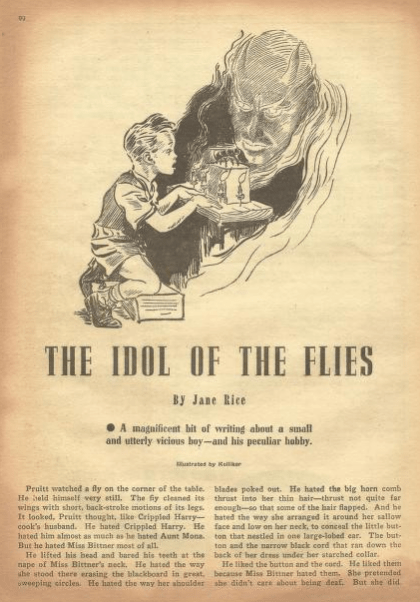
What happens when you deal with the devil for your fly-manipulating powers? Eventually the devil comes to collect. He’s called Beelzebub here, which, ya know, lord of the flies and all that, though the story’s title seems to refer to both Beelzebub and the coal tar idol Pruitt uses. Anyway, despite his single-digit age, Puitt gets sent to HELL, which is pretty epic. Normally I’d be disturbed by such an outcome, but Puitt is shown to be such an irredeemably evil creature that in the context of a story’s world where the devil (and presumably God) exists, maybe it’s best to kick this kid off the top of the highest mountain.
While I take issue with how the climax is paced, I find the ending immensely satisfying. How often does a child in a story (particularly of this vintage) get killed off, and on top of that said child is also the protagonist! Truth be told, it would’ve been too dark if Pruitt had gotten away with everything, so as weird as it is to this, it’s fitting that Rice give him the fire-and-brimstone treatment. I also think it may be too on-the-nose for Bittner, in the final scene, to be reading a textbook entry on Beelzebub (perhaps in worry that readers might not get who “Asmodeus” is), but the dramatic irony of her being unaware of Pruitt’s fate is also satisfying. If what we’ve been reading prior to the climax was discomforting, watching this little shit doing all these things and not get punished for it, then the ending is worthy compensation.
A Step Farther Out
Did not think one of the oldest stories covered this month would also be the scariest, but I’m gonna say “The Idol of the Flies” is thoroughly disquieting. Ironically the demonic climax might be the least scary part of the whole ordeal, if only because the protagonist is devilish enough on his own. Pruitt has to be one of the most evil children in literature, and he’s arguably the most evil main character we’ve come across—yes, even more than Kornbluth’s Mindworm, which is more amoral than sadistic. Just letting you know that if you haven’t read it already, expect some animal torture and abuse of the disabled; this thing doesn’t mess around, all the more remarkable given its vintage. I can’t say I’m totally surprised, though, as the quality of the average Unknown story is much higher than average; really I would say the average Unknown story beats out the average Astounding story nine times out of ten. Rice showed herself to be a master of horror in the making, and it’s a shame that because of Unknown‘s premature death and the loss of her debut novel made her career as a fantasist screetch to a halt.
If you’re looking for a horror story about how children are vicious little monsters just in time for Halloween, boy do I have a recommendation!
See you next time.
-
Short Story Review: “Grail” by Harlan Ellison
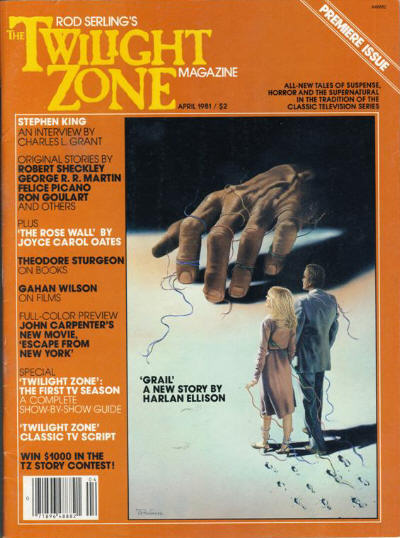
(Cover by Jim Warren. Twilight Zone Magazine, April 1981.) Who Goes There?
Where to start with Harlan Ellison? He resented being called a science fiction writer, but in his defense, he wrote a lot more than just SF; he was one of the most important and most productive writers of genre fiction from the second half of the 20th century. SF, fantasy, horror, things not so easily categorized? Ellison did it. He got his start in the ’50s as a middling young author along the lines of Robert Silverberg at the start of his career, but the ’60s saw a profiund step up for him as he began refining his craft, not only putting out award-winners like “I Have No Mouth and I Must Scream” but also writing for shows like Star Trek and The Outer Limits. Of course, things are not nearly as simple as that. Ellison’s involvement with Star Trek proved a fiasco, and when he was not being unprofessional (his degree of procrastination was legendary) as a writer, he was being a thorn in a lot of people’s sides as a fandom personality.
Perhaps the most memorable controversy with Ellison, for me, is his inability to finish (or seemingly even to start) what was to be the concluding entry in a trilogy of anthologies, The Last Dangerous Visions. Dangerous Visions was a landmark original anthology, as was its sequel (said to be superior at least in some ways), Again, Dangerous Visions, both edited by Ellison, but Ellison’s lack of initiative with working on TLDV (which was announced in 1972 but never published) has spawned many justifiably vitriolic reactions. While some stories that were sold to Ellison have since been published elswhere, the majority of the stories submitted for TLDV have yet, after all these decades, to be released to the public in any capacity. With Ellison’s death in 2018, followed by his late wife Susan’s in 2020, not only will we never get TLDV as Ellison envisioned it, but it looks like the Ellison estate has been thrown in disarray recently.
With all this said, and taking all of Ellison’s shortcomings as a writer (not to mention as a person) into account, he’s still one of the Big Names™ of short fiction in modern times, not just in SFF but outside of it. “Grail,” as I’ll elaborate on shortly, is a good example of Ellison’s vigorousness as a storyteller, as well as someone who (I say this in a good way) wears his emotions on his sleeve.
Placing Coordinates
First published in the April 1981 issue of Twilight Zone Magazine, which is on the Archive and which also happens to be that magazine’s inaugural issue. Twilight Zone Magazine is exactly the kind of publication that would get some TLC on my blog, as it’s a bit quirky, a bit out of left field, and most importantly, it didn’t last that long. Oh, TZM did fairly well, and for the first half of its existence it was edited by T. E. D. Klein (this is like if you gave Thomas Ligotti a horror magazine), who while not the most prolific of authors proved quite the reliable editor. Unfortunately, despite some high-quality fiction and fancy packaging, and despite its numbers never tanking, TZM did not quite survive the ’80s. Another story I recgonized from this issue is George R. R. Martin’s “Remembering Melody,” which I will absolutely get around to reading/reviewing… at some point.
Where else to find “Grail”? There are Ellison stories which have been reprinted many times (frankly too many times), but “Grail” is not one of them—not helped by the fact that, for some reason, it has become considerably harder to find Ellison books in the wild in recent years. I don’t know what happened. It looks like even the most essential Ellison collection have gone out of print; you can find them on the second-hand market, but you won’t find new editions, and even used copies are inexplicably harder to acquire. Still, there are a few options. “Grail” was reprinted in the Ellison collection Stalking the Nightmare, which is very much out of print but thankfully is not hard to find used. If you like Ellison like I do then you may be interested in The Essential Ellison, which is a massive volume that collects short fiction and essays and which comes in two distinct editions. The older edition is easier to find, but it’s still something of a collector’s item.
Enhancing Image
Christopher Caperton (which sounds like a name someone made up) is a shy kid who grows up desperate to seek adventure, and seek it he does. From the time he’s a child and for the rest of his life, Chris is deeply concerned with one question: What is love?
Baby don’t hurt meNot just familial love or even romantic love, but True Love, that most elusive of abstractions. What does it look like? Does it have a face? Is it possible for Chris to find The One? Despite his life experiences, and despite reading the works of every author under the sun on subject of love, he’s no closer to finding True Love. As an aside, I find it funny that apparently John Cheever knows even less about love than our protagonist, as I’m not sure if Cheever’s turbulent personal life and bisexuality were public knowledge in 1981 (probably was for the former but not the latter). Speaking of which, queerness doesn’t really come up in-story; it’s alluded to, but the narrator makes it very clear to us that Chris is, to paraphrase the protagonist of Silverberg’s Dying Inside, drearily heterosexual. Oh well.As a young man Chris finds himself in Vietnam in the late ’60s running drugs with a woman named Siri, who is not as normal as she seems. The two become lovers as well as partners in crime, and when all is said and done this is probably the happiest relationship Chris ever has; unfortunately it doesn’t last long. A random artillery strike kills Siri, but before she dies, she spends an impressively long amount of time explaining to Chris this artifact that’s supposed to represent True Love, an artifact which Siri had been looking for for years but had sort of given up on recently. She didn’t find True Love, but she found the next best thing. Siri is an interesting character because she’s one of those story figures who doesn’t get much screentime (or pagetime?) but whose plot relevance is immense; in this case she’s the one who basically kicks the plot into gear and sends Chris on his quest. Of course her dying words do not just encompass “This thing exists, now go get it,” as she also gives Chris some very specific and very unusual instructions.
More on that in a minute.
Something I wanna say right now is that when I picked “Grail” as part of my spooky short story lineup for review, I was under the impression that it would be straight horror. Not so! There’s a bit of horror, primarily having to do with a certain character, but overall it much more reads as an adventure narrative with a philosophical bent. Still, it’s spooky enough to serve as the first cover story for Twilight Zone Magazine, and more importantly, it’s good enough a story to earn that position. I can’t properly explain it, but the vigor that’s apparent in Ellison’s writing makes even his lists (and there are a few times where he basically just lists things in “Grail”) engaging to read. You could theoretically write a 300-page novel with “Grail” as a blueprint and the novel would not feel stretched thin, but Ellison zeros in on only the most relevant of info, resulting in what almost feels more like a compressed novel than a short story.
In my review of C. M. Kornbluth’s “The Mindworm” I noted Kornbluth’s use of compression and how he was able to cram a lot of history and worldbuilding into a tight space, and Ellison does basically the same thing here—only maybe even more impressively. Get this, the bulk of the artifact’s history as Siri understood it:
Between 1914 and 1932 the object—while never described—turned up three times: once in the possession of a White Russian nobleman in Sevastopol, twice in the possession of a Dutch aircraft designer, and finally in the possession of a Chicago mobster reputed to have been the man who gunned down Dion O’Banion in his flower shop at 738 North State Street.
In 1932 a man visiting New York for the opening of the Radio City Music Hall just after Christmas reported to the police who found him lying in an alley on West 51st Street just below Fifth Avenue that he had been mugged and robbed of “the most important and beautiful thing in the world.” He was taken to Bellevue Hospital, but no matter how diligently he was interrogated, he would not describe the stolen article.
In 1934 it was reputed to be in the private art collection of the German architect Walter Gropius; after Gropius’s self-imposed exile from Nazi Germany it was reputed to have passed into the personal collection of Hermann Goering, 1937; in 1941 it was said to be housed with Schweitzer in French Equatorial Africa; in 1946 it was found to be one of the few items not left by Henry Ford at his death to the Ford Foundation.
Its whereabouts were unknown between 1946 and February of 1968. But Siri told Chris, her final love, that there was one sure, dangerous way of finding it. The way she had used originally to learn the hand-to-hand passage of the artifact that was True Love from the Palace of Minos to its present unknown resting place.
So now we get to the spooky character in “Grail,” which is the minor demon Surgat. Siri left instructions so that Chris could not only summon Surgat (supposedly a demon who can pick any lock) but also stay protected from the demon’s treachery. Because a demon doesn’t want to help you, it’s more like a form of indentured servitude. There’s a bit of a deal-with-the-devil narrative here, although it’s more a case of two people who clearly hate each other’s guts but are forced to work together. The first time Chris summons Surgat he’s naturally unnerved about the whole thing (How often does one get to draw pentagrams and summon demons?), but given the very recent death of Siri and everything that’s happened this marks the start of his evolution into a badass. Surgat opens the trove that contains Siri’s most secret things, having to do with her search for the artifact, but before he fucks off he takes Siri’s body as a… treat.
The implications are a wee bit concerning.
From here on out, Chris is on his own. The man who started out as a bit of a wimp is now on a quest to find True Love, and if there’s one thing he’ll do anything for, it’s love. It’s at this point that we get a few time skips (remember what I said about the compressed novel thing), jumping from the late ’60s through the ’70s as Chris wanders the globe, “a nameless, stateless person, someone out of a Graham Grene suspense novel.” Again I’m taken back by how Ellison is able to squeeze so much in here, making years pass by in mere words without making us feel like we’re missing out on too much. It helps, too, that while Chris is not the most complex of characters, his mission, his want, is deeply relatable, and we’re given enough context about his life to see why this would be so important to him.
There Be Spoilers Here
Even more than a decade of searching, Chris has tracked the artifact to what seems to be its most recent resting place, in the hands of some super-rich mogul (I don’t think we even get his name), who also happens to be on his deathbed. The mogul has the artifact locked behind a ridiculously convoluted security system (it would make Mission: Impossible look like a documentary), but this doesn’t stop Chris from summoning Surgat again and revealing the artifact anyway. The artifact, which is indeed a grail, reveals in its liquid the face of True Love, but it’s not what Chris has been expecting all these years. The final twist of the story is subtle, yet deeply tragic, and shows Ellison twisting the knife that he’s just thrust into us; he’s very good at that.
This is not the very end, technically, but it’s enough:
He looked down into the loving cup that was True Love and in the silver liquid swirling there he saw the face of True Love. For an instant it was his mother, then it was Miss O’Hara, then it was poor Jean Kettner, then it was Briony Catling, then it was Helen Gahagan, then it was Marta Toren, then it was the girl to whom he had lost his virginity, then it was one woman after another he had known, then it was Siri—but was Siri no longer than any of the others—then it was his wife, then it was the face of the achingly beautiful bride on the cover of Esquire, and then it resolved finally into the most unforgettable face he had ever seen. And it stayed.
It was no face he recognized.
Years later, when he was near death, Christopher Caperton wrote the answer to the search for True Love in his journal. He wrote it simply, as a quotation from the Japanese poet Tanaka Katsumi.
What he wrote was this:
“I know that my true friend will appear after my death, and my sweetheart died before I was born.”
I’m gonna keep it real with you: I thought this was devastating. Ellison has done sadistic endings many times before, his protagonists sometimes being defeated outright or achieving a sort of Pyrrhic victory, but “Grail” mixes that sadism with a genuine tragedy. When I say “tragedy” I mean it in the proper sense of the word, which is to say Chris, due to a combination of circumstances and his own flaws, fails nobly. When people call something tragic they simply mean to say something bad has happened (don’t worry, I do this a lot too), as opposed to what it really means, but Ellison understands real tragedy. These are words coming from a man who, due in part to his own personality flaws, had loved and lost over and over. His famous novella, “A Boy and His Dog,” perfectly captures Ellison’s brand of wounded-dog misogyny (that’s right, it is a misogynistic story, but it’s a psychologically arresting story specifically because of its apparent distrust of women), but “Grail” achieves a similar effect without the blatant woman-hating.
I can believe that “Grail” is a middle-career piece from Ellison, because I don’t think the Ellison who wrote “I Have No Mouth and I Must Scream,” the Ellison who was younger and not as adjusted to his fame, could have written it. This story, and especially this ending, reads to me as by someone who still has a lot of fire in his belly but who also has been in the game long enough to pair that fire with real craftsmanship and insight. Even “The Deathbird,” which might still be my favorite Ellison story, and which still reads as totally experimental, does not distill its disquieting effect as succinctly as “Grail” does. This story made me feel something.
A Step Farther Out
I was shocked to find that “Grail” is only ten pages long; mind you, this is in TZM, which is not only two-columned but has frustratingly small type. What impresses me is that Ellison is able to tell what is basically a man’s whole life story in that span, and it doesn’t feel rushed or like we’re missing important information. Like sure, it’s compressed, the whole thing is an exercise in compression, but it’s a fully developed tale of one man’s search for the impossible. Chris starts out as a socially awkward nobody before tragedy sends him on a path to becoming a globe-trotting badass, but at the cost of something he can’t put his finger on. The question of finding true love is an ages-old but still deeply relevant one for most people, including myself, and personifying it as something akin to the Holy Grail is probably not new either, but it’s how Ellison gives it its own history, its own sense of weight, that makes the ending tragic. Indeed the ending would be an existential nightmare, were it not so sad and relatable.
I was expecting something more horror-centric, but I can’t say I was disappointed with what I got. Ellison is, if nothing else, an emotionally potent writer (sometimes to the point of edgy tedium), and “Grail” is an example of the mature Ellison flexing his muscles. On the one hand I’m a little surprised it didn’t get more awards attention (though it was up for the coveted Balrog Award), and also that it hasn’t been reprinted more often. Oh sure, “‘Repent, Harlequin!’ Said the Ticktockman” can be reprinted literally a hundred times, but an objectively better and more layered story like “Grail” is apparently deemed a minor work by virtue of its lack of exposure. Well I’m gonna change that! Maybe not “change,” but I do wanna tell more people about this one; I think it’s a bit of a hidden gem.
See you next time.
-
Short Story Review: “The Horse Lord” by Lisa Tuttle

(Cover by Rick Sternbach. F&SF, June 1977.) Who Goes There?
Lisa Tuttle came about in the early ’70s, as part of a new generation of horror authors, though unlike Stephen King and Anne Rice, who would build their reputations as novelists, Tuttle devoted much more energy to her short fiction. She debuted professionally when she hadn’t quite turned twenty yet, and despite having only put out a couple short stories (none of which were up for awards), she would share the second
John W. CampbellAstounding Award for Best New Writer with Spider Robinson (the only time so far that this award resulted in a tie). She also won a Nebula for her 1981 story “The Bone Flute,” under controversial circumtances (not because of Tuttle herself but because of a certain fellow nominee, it’s a bit of a story), but her most lauded (and probably most popular) work was done in collaboration. In the ’70s and early ’80s Tuttle worked with George R. R. Martin on what would become something of a fix-up novel, Windhaven, based on two earlier novellas, both of which were Hugo and Nebula nominees.While Tuttle’s involvement with SFF has been long-running, she seems to be first and foremost a practicioner of horror, especially of the supernatural variety. Due to changes in the market, with how horror novels have thoroughly superseded horror short stories (in influence, if not in quality) for the past four decades, Tuttle’s short fiction has gone relatively underexamined. Even so, her dedication to the genre has not wavered; for the past half-century she has kept the faith.
Tuttle celebrated her 70th birthday last month.
Placing Coordinates
First published in the June 1977 issue of The Magazine of Fantasy and Science Fiction, which is on the Archive. “The Horse Lord” has three notable reprints, two of them being single-author collections: first we have A Nest of Nightmares, which collected Tuttle’s horror fiction up to about the mid-’80s, and it’s still in print! We also have a real collector’s item, Stranger in the House: The Collected Supernatural Short Fiction, Volume One, which is a limited edition hardcover and which will cost you a pretty penny if you can even find the damn thing. For anthology sluts like myself we have a meaty volume edited by Stephen Jones, confusingly published under three titles, The Mammoth Book of Terror, The Anthology of Horror Stories, and The Giant Book of Horror. Out of print, but it’s easy to find used.
Enhancing Image
Marilyn and Derek are both writers who have, along with their five kids (partly from Derek’s previous marriage and partly from a tragedy involving a relative), moved to a farm in upstate New York that one of Derek’s ancestors owned once upon a time. I don’t know why horror authors tend to have writers be their protagonists. What’re they trying to tell us? (I’m half-joking, don’t kill me!) The place is a shithole, but supposedly the rural and secluded atmosphere will help with the couple’s writing (they write separately, it’s sadly not a Kuttner-Moore situation). Despite being responsible for getting us to the farm in the first place, and despite it also having been owned by an ancestor of his, Derek is not the protagonist—actually he barely registers as more than a footnote, all things considered. Marilyn is our POV character, which is probably for the best since she’s the one most reluctant about living in this maybe-haunted locale and therefore the one most likely to generate conflict.
“The Horse Lord” is a haunted house story, except it’s not the house itself that’s haunted—it’s the horse stable, which hasn’t been used in many years. The ancestor who had owned the farm in the late 19th century, James Hoskins, was apparently killed by Indians, along with his wife, while his daughter went missing and was never found. Does this sound like the start of The Searchers to anyone? I also find it funny that Kelly, the oldest of the children, is a horse girl, because let’s face it, nothing good ever happens with horse girls. The very first thing we’re told about Kelly is that she loves horses and my first thought was, “This does not bode well for the parents.” I wasn’t wrong, but I’ll get into that in the spoilers section.
The farm would be shrouded in mystery, but luckily (or unluckily) for Marilyn there’s a series of a memoirs written by one of Derek’s uncles about his family history, and there are dusty hardcover copies of these memoirs right in the house. How convenient! The memoirs, which are of course biased, speculate that Hoskins and his wife had been killed by Indians, but if Hoskins’s own words are anything to go by it was not the local indians that got him; maybe it was the spirit which lurked on that plot of land, the genius loci (a phrase I’ve grown fond of very recently) that has had dibs on it for a pretty long time. Hoskins does not take the Indians’ advice, and admittedly if you were in his position you would probably not listen to them either, though probably more from a sense of modern materialism (or lack of superstition) than because your homie Jesus got your back.
Get this:
“The land I have won is of great value, at least to a poor, wandering remnant of Indians. Two braves came to the house yesterday, and my dear wife was nearly in tears at their tales of powerful magic and vengeful spirits inhabiting this land.
“Go, they said, for this is a great spirit, as old as the rocks, and your God cannot protect you. This land is not good for people of any race. A spirit (whose name may not be pronounced) set his mark upon this land when the earth was still new. This land is cursed—and more of the same, on and on until I lost patience with them and told them to be off before I made powerful magic with my old Betsy.
“Tho’ my wife trembled, my little daughter proved fiercer than her Ma, swearing she would chop up that pagan spirit and have it for her supper—which made me roar with laughter, and the Indians to shake their heads as they hurried away.”
“The Horse Lord” indulges in a trope I’m not terribly fond of, and while I assume Tuttle means well, I expected a bit better: it’s the Wise Indians Who Know Better™ trope. It’s especially conspicuous here because Hoskins has no legitimate reason to believe the locals, since they don’t back up anything they say with hard evidence—indeed, it comes off more as several layers of hearsay. Even so, despite being a materialist herself, Marilyn is discomforted by the farm’s history, by the grisly and mysterious deaths of Derek’s ancestors, and by the possibility that something otherworldly owns the abandoned horse stable—something which, if disturbed, might just fuck everyone’s shit up. But since the stable is locked and since surely no one wants to enter it, things will be fine this time, right? Marilyn is a rational and educated person, even if she’s frazzled by the fact that she has to look after five kids, something she did not even imagine until recently.
But will history repeat itself? Let’s see…
There Be Spoilers Here
I appreciate that the stable is not haunted because it was built on an Indian burial ground or something; no, it’s haunted by something else. Marilyn reads more about the doomed James Hoskins and finds that he had been warned by the Wise Indians Who Know Better™ about the genius loci that owns this very particular spot of land, and in typical stupid white man fashion he failed to listen. I feel like even by the ’70s the whole Indian burial ground thing must’ve become a worn-out cliché (which did not stop people from continuing to use it, mind you), so I appreciate the subversion, even if it still relies on writing Indian characters as more symbols of wisdom than actual flesh-and-blood people.
The children have been acting weird lately. As Marilyn becomes more paranoid at the prospect of the horse stable being haunted for realz, she’s not helped when she and Derek find a peculiar chalk drawing in the now-opened stable. Get a load of this:
It was not a horse. After examining it more closely, Marilyn wondered how she could have thought it was the depiction of a wild, rearing stallion. Horses have hooves, not three-pronged talons, and they don’t have such a feline snake of a tail. The proportions of the body were wrong, too, once she looked more carefully.
Derek crouched and ran his fingers along the outline of the beast. It had been done in chalk, but it was much more than just a drawing. Lines must have been deeply scored in the earth, and the narrow trough then filled with some pounded white dust.
Do the adults take the drawing of the horse-like creature as a warning and get the hell out? No, of course not. So you have an idea as to what happens next. Of course, since Our Heroes™ don’t have any horses themselves, the thing that happened to James Hoskins can’t happen to them too, right? Well sort of, no. The story has a twist up its sleeve at the very end, and I have to admit it’s… a little silly. The children, who have started gravitating towards this genius loci which rules over the stable, are then possessed by it, despite not being “animals.” Except according to the story’s logic, or at least something Marilyn speculates right before her presumed demise, children are animals! Very scary. I mean normal children are scary enough, imagine possessed children that (inexplicably) now have super-strength. Not to toot my own horn, or to give the wrong impression, but I would’ve beaten the shit out of those kids easy. Like realistically, fuck them kids. It asks too many logistical questions for me, but I do think the ending have a haunting quality about it, not unlike a similar story I’ll bring up in a moment.
The ending makes me think about the story’s strongest theme, especially for someone like me who’s in his mid-20s, which is the fear of parenthood. Tuttle herself must’ve only been 23 or 24 when she wrote “The Horse Lord,” and right from the beginning there’s Marilyn as the put-upon young woman who suddenly finds herself the mother of five. Things only get worse from there! Like something out of a Shirley Jackson story, the children are depicted as being, at best, sort of distant from their parents, and more often as acting as if they live in another dimension—and it’s not a nice dimension. But whereas Jackson seemed to write about the nightmare world of being a parent from day to day (her child characters often being demons in human skin), there’s more the fear of becoming a parent in “The Horse Lord.” Yeah, I think I can do without raising kids for a long time.
A Step Farther Out
There came a point when I was getting a sense of déjà vu with “The Horse Lord,” and I think I know why now: this is basically a ghostly rendition of “Zero Hour” by Ray Bradbury. Ya know, children unwittingly bringing doom to their parents and all that. Structurally it also hits the same beats as Bradbury’s story, using the same chess board but with different pieces. I do think, in Tuttle’s defense, there’s a lot more to chew on thematically with “The Horse Lord,” even if I am deeply weary with the whole Wise Indians Who Know Better™ trope. I suppose I had an experience here similar to another horror story I’ve read recently: “Pig Blood Blues” by Clive Barker. I love me some Barker, but I would not consider “Pig Blood Blues” to be his finest hour by any means, mostly because I struggle to find a spooky farm animal scary. Spooky, sure, and “The Horse Lord” has a good amount of spookiness, but it’s not as scary as it could be.
I admire Tuttle juggling a few themes here, though, in the span of just a dozen pages. We’ve got American colonialism, the mistreatment of indigenous peoples, mistreatment of the environment, reconciling one’s attempts at artistry with one’s personal life, fear of parenthood, a few of these now being old chestnuts for modern horror but which were comparitively fresh at the time. I’m interested in reading more of Tuttle’s solo work, but I also wanna catch her at a later, more mature stage.
See you next time.
-
Short Story Review: “Daemon” by C. L. Moore
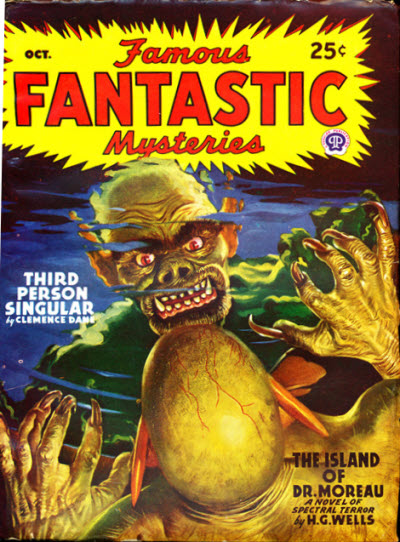
(Cover by Lawrence. Famous Fantastic Mysteries, October 1946.) Who Goes There?
When I reviewed Clark Ashton Smith’s “Genius Loci” some days ago, I said that Smith, H. P. Lovecraft, and Robert E. Howard were the defining authors during the “classic” period of Weird Tales, in the ’30s. This is not entirely true. I omitted a fourth name because I knew I was gonna get to her very soon, and now she’s getting her own introduction. C. L. Moore was one of the great practicioners of SFF in the ’30s and ’40s, and her rise to prominence was swift in a way that most authors’ are not. Her first professional sale, “Shambleau,” was published in Weird Tales in 1933, and it instantly made her a big deal to that magazine’s readership. During this early period, Moore created two series, both set in the same continuity (though this was not immediately known), named after their protagonists: Northwest Smith and Jirel of Joiry. The former leans toward planetary romance while the latter leans toward heroic fantasy, and this duality was a line Moore would walk for the rest of her career.
Things get complicated when Moore marries a fellow author, Henry Kuttner, in 1940, after the two had already collaborated on a story or two. Kuttner was a few years younger than Moore, and was a big fan of her work, soon exhanging letters with her and assuming (erroneously) at first that she was a man. Once misunderstandings were out of the way, they formed inarguably the biggest power couple in old-timey SFF, collaborating prolifically throughout the ’40s and writing together so seamlessly that they could not tell apart each other’s writing, and neither can anyone else. To this day there’s no agreement as to who wrote what or how much one contributed to the other’s writing, even when a story is credited to only one of them. “Daemon” is credited to Moore solo, and for reasons I’ll get into I believe firmly enough that Kuttner had basically nothing to do with its creation.
Placing Coordinates
First printed in the October 1946 issue of Famous Fantastic Mysteries, which is on the Archive. FFM was primarily a reprint magazine without zeroing in on a specific genre, covering science fiction, fantasy, and even non-supernatural horror. In the October 1946 issue alone we have reprinted stories by H. G. Wells (a presumably abridged version of The Island of Dr. Moreau) and Bram Stoker, but “Daemon” was an original story. One need not look far to see why Moore would submit her fantasy-horror story to a reprint magazine: the magazine market for fantasy was quite small in the ’40s, with the only other notable outlet being a now past-its-prime Weird Tales. Now, why, when reading these stories for review, do I always try to read the original magazine version? Partly this is because sometimes there are revisions made between the magazine publication and the book publication, but also, there’s flavor when reading anything within the confines of a magazine issue. Take, for instance, Virgil Finlay’s interior illustration for “Daemon,” which as usual is stunning, and which we would not have gotten in a book reprint.

When it comes to reprints of “Daemon” we’re talking quality over quantity; none of the reprints seem to be, well, in print, but these volumes are both good collector’s items and easy enough to find. First we have The Best of C. L. Moore, part of a best-of series by Ballantine Books (Henry Kuttner also got one), and boy do I wanna get these two together. Then we have A Treasury of Modern Fantasy, edited by Terry Carr and Martin H. Greenberg, which might be the same book as Masters of Fantasy; it’s edited by the same people, and unless I’m missing something the contents are also the same. If you’re fond of Moore and Kuttner, at some point you have to get your hands on Two-Handed Engine: The Selected Stories of Henry Kuttner and C. L. Moore, a mammoth tome that collects all the essential short fiction by both authors, solo as well as in collaboration.
Enhancing Image
“Daemon” is a deathbed confession (not a spoiler, our narrator is upfront about this) told by Luiz o Bobo, his title apparently coming from his simplemindedness. Luiz, despite his own admitted lack of intelligence, has a special gift that may well be more of a curse: he sees these things that accompany other people, calling them daemons when they could just as easily be called ghosts. According to Luiz, everyone has a daemon on his shoulder—everyone except him. At the outset of the story we’re far more planted on the horror end of the horror-fantasy spectrum which “Daemon” plays with, and there’s some delicious eeriness at work here. “Do you know who stands beside you, padre, listening while I talk?” says Luiz at one point. The daemons themselves don’t seem to do anything exactly; they don’t have voices, they don’t talk, they can’t interact with the material world—at least not directly. As we’re to find out later, though, it’s maybe possible for a daemon to take possession of its host.
Luiz recalls the death of his grandmother, for a long time the only earthly person who treated with decency, and how her daemon changed as she was dying; it was an unusual event, as the daemon grew brighter, radiating a brightness that threatened to blind Luiz, before finally disappearing once his grandmother’s spirit has moved to—somewhere else. What this could signify, the daemon changing colors as its host nears the end of their life, we’re not given a clear answer on, but then Luiz is no rocket scientist. Actually, let me take a moment to talk about Luiz’s characterization, because this is easily the most interesting part of the story for me: Luiz is obviously neurodivergent. While “Daemon” is on its face a dark fantasy yarn about a man who gets shanghaied and then stranded on an island with a bunch of magical creatures, it’s more potently a tale of alienation, about a man who is unable to relate to other people in the conventional sense, who quite literally sees something “normal” people have that he lacks. Make sure to put a pin in this one.
Oh right, getting shanghaied. Luiz has a bad night at a saloon and finds himself an unwilling passenger on a trading vessel. As you do. The fact that Luiz is not very smart, and can’t even read, makes him an easy target. It’s here that we come across the closest the story has to a villain: the captain of the ship. The captain, who normally would not be the happiest or kindest of men, seems to have his violent urges heightened by a suitably evil-looking daemon which follows him around. The causal relationship between host and daemon is not clear, but it’s quite possible that a daemon’s disposition influences its host, with the captain’s daemon being a particularly nasty example. The captain’s daemon’s uncanniness is not helped by the fact that not only is it blood-red, it doesn’t seem to have eyes.
Now, most men have shapes that walk behind them, padre. Perhaps you know that, too. Some of them are dark, like the shapes I saw in the saloon. Some of them are bright, like that which followed my grandmother. Some of them are colored, pale colors like ashes or rainbows. But this man had a scarlet daemon. And it was a scarlet beside which blood itself is ashen. The color blinded me. And yet it drew me, too. I could not take my eyes away, nor could I look at it long without pain. I never saw a color more beautiful, nor more frightening. It made my heart shrink within me, and quiver like a dog that fears the whip. If I have a soul, perhaps it was my soul that quivered. And I feared the beauty of the color as much as I feared the terror it awoke in me. It is not good to see beauty in that which is evil.
Luiz does find one ally on the ship, called the Shaughnessy (we don’t get his actual name), a dying man from “a foreign land called Ireland” who apparently also comes from a very well-to-do family, and who stands as the only thing between Luiz and oblivion. The captain hates his guts and there will come a point when the Shaugnessy will not be around to protect him. This early-middle section of the narrative, with Luiz on the ship, is probably my favorite part; it’s atmospheric, exceptionally brutal, it’s set on the high seas (which I have a fondness for), and it elaborates on the disconnect Luiz feels with other people. It’s not so much that Luiz befriends the Shaughnessy as he sees the Shaughnessy as a guardian figure, since the most Luiz can hope for, realistically, is not be treated like garbage by others. This is not to say Luiz is a blank slate or a totally passive protagonist; nay, he’s quite active, even if he doesn’t articulate his internal anxieties vocally.
It’s here that Moore does something seemingly clever and really plants the seeds of doubt for us, as to whether Luiz is right or if he’s just delirious. The ship’s water gets tainted, which is pretty bad. “A man can pick the maggots out of his salt pork if he must, but bad water is a thing he cannot mend.” Not helping things is that a particularly brutal encounter with the captain results in Luiz getting what is probably a skull fracture (saying he heard his skull crack, which sounds horrific), and it’s amazing he doesn’t simply die on the ship. Hell, dying at this point might not be so bad. Luiz contemplates suicide, which in his predominantly Catholic homeland of Brazil would be deemed a mortal sin, but Luiz rationalizes that he can’t go to Hell if he doesn’t have a soul, but virtue of not having a daemon. Checkmate, Christians! But no, he does not kill himself, and it’s about here that things get very weird indeed.
Before we get to the spoilers section, I wanna return to something I said earlier, which is that “Daemon” is pretty discernibly a solo Moore effort and not a collaboration. Not that I want to downplay Kuttner’s talent (which happens too often, such as on ISFDB where works under just Kuttner’s name are far more likely to be listed as collaborations than with Moore), but I can’t find any Kuttner-esque elements here. More tellingly, this has the tone and polish of a Moore tale, in the sense that it’s deeply melancholy, even humorless, yet there is a real humanity to Luiz’s character that makes him relatable. I’m not sure why, but Moore tends to sympathize with the underdog, not in a self-congratulatory way, but in a genuinely empathetic way, where she manages to convey a character’s fears and aspirations. Kuttner was an excellent humorist, but Moore was almost like a poet, and “Daemon” reads in parts almost like a poem. Moore wears her emotions on her sleeves, which feels prescient given how often old-timey SFF authors are demeaned (sometimes rightly) as emotionally inept Tough Guys™.
There Be Spoilers Here
You may be thinking, what does that Virgil Finlay illustration have to do with the story? Well…
Luiz and the Shaughnessy get stranded on an island and it’s not some ordinary Robinson Crusoe island: it’s a magical island. The Shaughnessy kicks the bucket, but not before giving Luiz some instruction that he doesn’t do a good job explaining. That’s fine, since, probably unbeknownst to the Shaughnessy, Luiz is not left all lonesome after the fact; he quickly finds some friends. Luiz had aludded to nymphs, or as he called them, “ninfas” (I’m not joking when I say I had first misread it as ninjas), at the start of his confession, but now we’re actually getting to those. Finlay’s illustration shows one of these nymphs, called the orlead (who actually talks with Luiz), and a unicorn. Yeah, there’s a unicorn. This place fucking RULES. Admittedly, I don’t buy into the Eden-like nature of the island, as this pure place where there’s no pain (the Shaughnessy is pretty chill about dying), as it feels too idyllic, not to mention it casts doubt on Luiz’s story despite the fact that he’s telling the truth.
But soon there’s trouble in paradise, and the captain has landed in search of his castaways, most likely to do away with them. With the Shaughnessy already dead he need only worry about one now, but Luiz has the fantasy creatures of the island on his side. Okay, I should be a bit more specific here: these are, at least in part, Greek mythological creatures, hence the appearance of the humanoid goat-footed god Pan who comes in as a sort of deus ex machina. I have to admit the image of Pan chasing the captain (who can now see him, apparently) literally around the island until the captain, thoroughly exhausted, runs back to the place he started at, is funnier than it’s supposed to be. It’s weird, sure, and it’s not boring, but it’s a touch goofy.
I said before that a person’s daemon grows brighters as that person’s death nears, and while I’m not a fan of the turn towards action in the climax, I have to respect just how creepy the captain’s final moments are. We’re not totally sure what happens, because Luiz averts his eyes, but it’s clear that the captain, in the last moments of his life, becomes aware of the red-hot daemon that had been stalking him the whole time, and the way Moore writes his death is the closest the story comes to being genuinely scary, as opposed to just eerie.
Some knowledge deeper than any wisdom warned me to cover my eyes. For I saw its lids flicker, and I knew it would not be good to watch when that terrible gaze looked out at last upon a world it had never seen except through the captain’s eyes.
I fell to my knees and covered my face. And the captain, seeing that, must have known at long last what it was I saw behind him. I think now that in the hour of a man’s death, he knows. I think in that last moment he knows, and turns, and for the first time and the last, looks his daemon in the face.
I did not see him do it. I did not see anything. But I heard a great, resonant cry, like the mighty music that beats through paradise, a cry full of triumph and thanksgiving, and joy at the end of a long, long, weary road. There was mirth in it, and beauty, and all the evil the mind can compass.
After a detour into fantasy we’ve swung back around into horror, almost of the cosmic variety. There are things people are not supposed to see—like their own daemons. Weirdly, I find this aspect to be the least involving, as the scope of the story has by now thoroughly gone beyond Luiz’s psychology and grappled onto something that’s quite “spooky” by not very scary. For me “Daemon” works better as a horror-tinged character study than a straight horror yarn, and likewise I don’t find the stuff with Pan and the nymphs to be totally convincing, although Moore’s lyrical hand stays steady, and I have to admit there’s a bit of a sense of wonder with the island and its fantastical secrets. This isn’t pulp horror but rather something in the Unknown tradiction, and hell, “Daemon” could’ve been published there had it not gone bust in 1943. My point is that Moore can sure as hell write, even when she does something that conceptually I don’t think is the most interesting thing ever.
A Step Farther Out
After I finished “Daemon” I did something I’ve not done before for these reviews, and it’s really something I ought to do again: I looked up readers’ reactions. Not modern reviews of the story (I haven’t even checked if there are any), but FFM‘s letter column, which, as it turns out, was fairly active. Not on the same level as Planet Stories, mind you, but still, we’ve got some yays and nays from the peanut gallery! As far as I can tell reception to “Daemon” was pretty damn positive, although there is one comment that I found interesting, made by some bloke named R. I. Martini, in the February 1947 issue:
Miss Moore’s name is all too seldom in your table of contents, but when listed she inevitably brings forth a new and unique situation. “Daemon,” in that respect, held to standard, though somehow it didn’t have the scope or pimch anticipated. It was when she came to the “ninfas” that disillusionment as to its cIassic qualifications set in. Albeit the atmosphere was there, so saving whatever was left of the day.
I really loved the first half or so, when Luiz is on the ship, whereas I merely liked the second half, when he’s on the island. I think I get where Martini is coming from, because I can’t help but feel like something is lost once the nymphs come into play, and it’s basically spelled out that what happened to Luiz had to be fantastical and not a big hallucination as the result of, say, the brain damage he had undoubtedly suffered. Which is not to say my earlier evaluation of Luiz was rendered invalid by the second half, because I think his character still very much works on an allegorical level; I just wish the literal level was a bit more satisfying. Moore is still a strong writer on a sentence-by-sentence level, her penmanship bordering on the poetic—indeed I wouldn’t be surprised if her lyricism influenced George R. R. Martin’s early work. “Daemon” doesn’t feel like it comes from the ’40s, but rather feels a bit more timeless than that, like Moore is tapping into a study of human loneliness that remains relevant, and for that I admire it.
See you next time.
-
Short Story Review: “Genius Loci” by Clark Ashton Smith

(Cover by Margaret Brundage. Weird Tales, June 1933.) Who Goes There?
Clark Ashton Smith was, along with H. P. Lovecraft and Robert E. Howard, one of the defining contributors to Weird Tales during its “classic” period. Smith and Lovecraft had come into contact early on, circa 1922, when both were little more than amateurs with regards to their short fiction craft; the difference is that Smith had already been a published author for a decade, having a book of poetry published while still in his teens. Indeed, Smith was a poet first and foremost, although the subject matter of his poetry (often fantastical and cosmic) was by no means unconnected with his short fiction. Like Lovecraft, Smith was a bookworm who was also often plagued by illness, and like Lovecraft he resented being published in pulp magazines like Weird Tales and Wonder Stories, thinking of himself as more of a serious artist. Still, Smith turned to writing short stories as a way of pilling the bills—and he would need that money too, taking care of two elderly parents without a stable income. As such, Smith’s short fiction output between 1930 and 1937 is staggering, a real meteor shower of stories that dwarfed what came before and after.
In the early to mid-’30s Smith wrote prolifically, running the gamut from high fantasy to horror-tinged science fiction; his output was, it must be said, more varied than Lovecraft’s. Whereas Lovecraft loved to return to his pet themes over and over again, a Smith story cannot be tied down so easily. Sadly, once both of his parents were dead, the financial burden lifted, Smith would virtually stop writing short stories; by 1937 he had become once again what he had started as: a poet. Having been in touch with Lovecraft for so many years and having contributed to the newfangled Cthulhu Mythos, it’s possible that Lovecraft’s death that same year also demoralized Smith. A shame. While he would continue to write poetry (and venture into sculpting), it’s Smith’s short fiction that keeps his legacy alive today.
Placing Coordinates
First published in the June 1933 issue of Weird Tales, which is on the Archive. Incidentally this was also the first issue to don what might be the most famous logo design in SFF magazine history, and hey, you gotta love that lurid M. Brundage cover artwork. “Genius Loci” was first reprinted in Genius Loci and Other Tales, and for a long time would not be reprinted often. The past decade or so has been a pretty good time for this story, though, as it’s been reprinted in three major collections. We have American Fantastic Tales: Terror and the Uncanny from Poe to the Pulps, edited by the late Peter Straub; it’s a Library of America hardcover, so that’s how you know it’s important. We have The Weird: A Compendium of Strange and Dark Stories, a monstrously big anthology edited by Ann and Jeff VanderMeer. Finally, we have the most recent of the single-author collections for Smith, The Dark Eidolon and Other Fantasies, edited by S. T. Joshi. The latter two are well in print and you can get The Eidolon and Other Fantasies pretty easily; hell, I accidentally got two copies of that one, long story.
Enhancing Image
We have two lead characters, Murray and Amberville, a writer and a painter respectively. Murray owns a ranch and invites his friend Amberville over, with Amberville working on his paintings while Murray works on his novel. We have a classic horror trope with the narrator/protagonist being a writer, although Murray being a writer doesn’t really matter outside the fact that he’s an artist; he could be a sculptor or musician and nothing else would change really. Not a problem! Amberville is the more interesting character anyway, in no small part because we’re not allowed to completely understand what his deal is. If the narration was in third person then I would complain about the lack of streams of consciousness, but given that Murray is just some guy and that he himself is trying to make sense of events as he recounts them, I would say less is more here.
Indeed, the thing that makes “Genius Loci” work most is that we’re unable to understand fully what is happening. We don’t get to know much about old Chapman, a neighboring rancher whose death prior to the story’s beginning is left mysterious in its circumstances. We aren’t given a history of the Chapman ranch or much explanation for the meadow Chapman kept, or the kind of power it seems to hold over people who gaze upon it. Certain other writers would spend several pages dishing out Expositionese regarding the setting and some spooky events that had happened previously, but Clark Ashton Smith is not one of them. Amberville wanders the landscape and soon becomes obsessed with Chapman’s meadow, producing several paintings based on it, and at first we’re not sure why he would do this.
A little warning about Smith’s writing. You know I like to quote whole lines from stories I’m reviewing; I think these quotes give something of a proper taste as to an author’s style, on top of illustrating plot beats. Smith is a hard writer to quote without slicing and dicing his lines because he’s about as fond of long winding paragraphs as I am of parenthetical asides (which is to say he’s very fond of them). Even in a piece as low-key (by Smith’s standards) as “Genius Loci” one gets the impression that, like Lovecraft, Smith has a penchant for the flamboyant, which, also like Lovecraft, makes his style easy to poke fun at. Personally I think it works, at least here, partly because our leads are artists, and thus probably used to articulating their thoughts, and partly because their efforts to make sense of the meadow only reinforce its elusive nature—the strange notion that it might be somehow alive.
Take this bit, for example, when Murray confronts Amberville about his fascination with Chapman’s meadow and the pond especially:
“What’s wrong?” I ventured to inquire. “Have you struck a snag? Or is old Chapman’s meadow getting on your nerves with its ghostly influences?”
He seemed, for once, to make an effort to throw off his gloom, his taciturnity and ill humor.
“It’s the infernal mystery of the thing,” he declared. “I’ve simply got to solve it, in one way or another. The place has an entity of its own—an indwelling personality. It’s there, like the soul in a human body, but I can’t pin it down or touch it. You know that I’m not superstitious— but, on the other hand, I’m not a bigoted materialist, either; and I’ve run across some odd phenomena in my time. That meadow, perhaps, is inhabited by what the ancients called a Genius Loci. More than once, before this, I have suspected that such things might exist—might reside, inherent, in some particular spot. But this is the first time that I’ve had reason to suspect anything of an actively malignant or inimical nature. The other influences, whose presence I have felt, were benign in some large, vague, impersonal way—or were else wholly indifferent to human welfare—perhaps oblivious of human existence. This thing, however, is hatefully aware and watchful: I feel that the meadow itself—or the force embodied in the meadow—is scrutinizing me all the time. The place has the air of a thirsty vampire, waiting to drink me in somehow, if it can. It is a cul-de-sac of everything evil, in which an unwary soul might well be caught and absorbed. But I tell you, Murray, I can’t keep away from it.”
Something I like about “Genius Loci” is that the supernatural potential of the meadow is left ambiguous for most of it; actually, for a while you could be made to think that nothing supernatural is going on at all. There’s a quote from Smith himself that I’ll get to later, regarding the kind of story he was writing and how different it must’ve been for him, but while he doesn’t cite the dude by name, I can’t help but wonder if Smith was inspired more by Henry James than his usual inspiration, Lord Dunsany, when writing “Genius Loci.” James isn’t often known for his ghost stories, despite “The Turn of the Screw” being his most famous story at any length, but James’s other (also more concise) ghost stories similarly play on the notion that a ghost may or may not be pulling an epic prank on our protagonist. Maybe supernatural, maybe psychological. Maybe both! Something about the meadow draws Amberville to it, compelling him to try to capture its essence in his art, like it’s a kind of dark muse.
I’m talking about Amberville more because despite being the one recounting events, Murray’s kind of a passive character; he doesn’t do much. This is not necessarily a bad thing, since the crux of the conflict is Amberville. Would the story have been improved by Amberville being the narrator and not Murray? I would say no, simply because if we were stuck in Amberville’s head the whole time, we would know too much. With horror my philosophy is that usually (NOT ALWAYS), one’s imagination is scarier than the things that are revealed. Lake Mungo is not a perfect movie, but it might be the scariest fucking movie I’ve ever seen because while it’s a simple ghost story on paper, we’re only allowed to see little slivers of the ghost that seems to be haunting the family at that movie’s center. So with “Genius Loci” we have a ghostly meanace whose intentions (if it has intentions) and boundaries are ill-defined. The scary part is that Murray doesn’t know how to help his friend because he’s not totally sure of what is happening.
In a slow, somnambulistic manner, without giving me a second glance, he began to work at his painting, and I watched him for a while, hardly knowing what to do or say. For long intervals he would stop and peer with dreamy intentness at some feature of the landscape. I conceived the bizarre idea of a growing kinship, a mysterious rapport between Amberville and the meadow. In some intangible way, it seemed as if the place had taken something from his very soul—and had given something of itself in exchange. He wore the air of one who participates in some unholy secret, who has become the acolyte of an unhuman knowledge. In a flash of horrible definitude, I saw the place as an actual vampire, and Amberville as its willing victim.
Admittedly when I saw Murray comparing the meadow to a vampire, I felt like tearing my hair out. I had already reviewed three vampire stories (in a row!) before this, and I was under the impression “Genius Loci” would break the streak—which in a way it does. I wouldn’t consider it to be a vampire narrative exactly, although “vampire” and “vampiric” being attributed to the meadow makes sense; it’s like a siren, seducing Amberville into a place of no return. You know something bad is gonna come from all this, but you’re not sure how, because the meadow is ultimately just a meadow; it can’t suddenly grow hands and strangle Our Heroes™ as far as we know.
But more on that in a minute.
On the one hand I find it hard to be spooked by Smith’s indulgences in typical Weird Tales-style pulp writing, talking of unholy secrets and dark rituals and all that, yet I also find what he chooses not to write about to be pretty effective—namely that none of the things he writes about are alien per se. Normally Smith writes about places he had invented, be they fantasy settings or other planets, but there’s almost a pastoral angle to “Genius Loci” with its rural locale. While Murray is concerned about his friend, he also admits that there is a desolate beauty to the Chapman ranch and the meadow especially, something about it that may even draw him into its clutches…
There Be Spoilers Here
So Murray invites Avis, who is apparently Amberville’s fiancée, to his ranch in the hopes that Avis will be able to convince him to leave. Unfortunately, both for the characters and for Smith (as he dabbles in some light misogyny when characterizing Avis here), it doesn’t work. The final scene is, while eerie and horrible, also tragic. I’ll just have Smith, or rather Murray, do the talking for me here.
Avis and Amberville were floating together in the shallow pool, with their bodies half hidden by the mantling masses of alga. The girl was clasped tightly in the painter’s arms, as if he had carried her with him, against her will, to that noisome death. Her face was covered by the evil, greenish scum; and I could not see the face of Amberville, which was averted against her shoulder. It seemed that there had been a struggle; but both were quiet now, and had yielded supinely to their doom.
It was not this spectacle alone, however, that drove me in mad and shuddering flight from the meadow, without making even the most tentative attempt to retrieve the drowned bodies. The true horror lay in the thing, which, from a little distance, I had taken for the coils of a slowly moving and rising mist. It was not vapor, nor anything else that could conceivably exist—that malign, luminous, pallid Emanation that enfolded the entire scene before me like a restless and hungrily wavering extension of its outlines—a phantom projection of the pale and death-like willow, the dying alders, the reeds, the stagnant pool and its suicidal victims. The landscape was visible through it, as through a film; but it seemed to curdle and thicken gradually in places, with some unholy, terrifying activity. Out of these curdlings, as if disgorged by the ambient exhalation, I saw the emergence of three human faces that partook of the same nebulous matter, neither mist nor plasm. One of these faces seemed to detach itself from the bole of the ghostly willow; the second and third swirled upward from the seething of the phantom pool, with their bodies trailing formlessly among the tenuous boughs. The faces were those of old Chapman, of Francis Amberville, and Avis Olcott.
We then end on this foreboding note of Murray contemplating returning to the meadow someday, despite him being aware of the risks. It’s foreboding because again, the story ends on this elusive note; we’re not sure what’s to become of Murray, but things are not looking good. It was typical for horror writers of the period to have their narrators write about their stories in an insane asylum or something, having gone mad from some revelation and being the only one to survive and tell the awful tale of the week. Not here. Murray is an effective (or at least refreshing) narrator for this type of thing because despite the terrible things that happen to people he cares about, he remains lucid enough to not go insane. Is still finding the cursed meadow alluring itself a kind of insanity, though? Hmmm.
A Step Farther Out
Given the restraint and discipline of his vision here, it’s weird to think Smith didn’t have much faith in “Genius Loci.” Smith was used to writing far-out tales on other worlds, whereas this was a comparatively “realistic” haunted house-type narrative that could happen in someone’s backyard. In a letter to August Derleth regarding the story’s publication, Smith wrote:
“It was all damnably hard to do, and I am not certain of my success. I am even less certain of being able to sell it to any editor—it will be too subtle for the pulps, and the highbrows won’t like the supernatural element.”
Of course Smith’s concern was unwarranted; Farnsworth Wright, the veteran editor over at Weird Tales, bought it without asking for revisions. It’s a damn good starting point for Smith, though I had read a few Smith stories beforehand and I wouldn’t say it’s totally characteristic of his writing. But then what is? “Genius Loci” feels like a classic ghost story—feeling less like 1933 and more like 1893, but I mean that in a good way. While Murray refers to the cursed pond as vampiric several times, this is not really a vampire story except maybe in the abstract sense, being about an artist who gets pulled in by an eerily beautiful location with a ghostly allure. That Murray ultimately becomes obsessed with the pond, albeit not the extent that Amberville is (though the ending hints at the obsession becoming just as deadly), could also reflect Smith’s lifelong fascination with the weird. The story itself has a haunting quality to it, and shows an artist normally known for his flamboyance zeroing in on a delicious little slice of atmosphere. It’s definitely spooky, and even a touch scary. I approve.
See you next time.
-
Short Story Review: “Bite-Me-Not or, Fleur de Fleu” by Tanith Lee

(Cover by Joe Burleson. Asimov’s, October 1984.) Who Goes There?
Tanith Lee debuted in the ’70s and kept it up as a one-woman writing factory until her death in 2015. Her output, on sheer quantity alone, is formidable. Not really a practitioner of SF, Lee made fantasy her game at a time when the market for fantasy publishing was just starting to pick up. Interestingly, her short fiction seemed to appear more often in Asimov’s Science Fiction (under Shawna McCarthy and later Gardner Dozois) than in, say, The Magazine of Fantasy and Science Fiction. As both a novelist and short story writer, she was dauntingly prolific and her vision seemingly never wavered, running the gamet from sword-and-sorcery to weird fiction. She has the rather unique honor of winning both the World Fantasy and Bram Stoker awards for Life Achievement, these wins being emblematic of her immense contribution to what we now call dark fantasy.
As a side note, I asked on Twitter sometime ago about authors who’ve gotten more than one tribute issue in the magazines. Fritz Leiber was the only example I knew of then (he got tributes in Fantastic and F&SF), but wouldn’t you know it, Lee also got two! On top of being a frequent contributor to Asimov’s in the early days, she also appeared in the revived Weird Tales (or one of its revivals anyway, it’s a long story), which ran at least one issue dedicated to her. Might also be responsible for the second, but I wish I could dig up that one Tweet and confirm it easily. Oh well. Regardless, Lee is undoubtedly one of the big names in horror and dark fantasy. Which makes it all the more a shame that I didn’t like the first story of hers that I’ve read.
Placing Coordinates
First appeared, fittingly enough, in the October 1984 issue of Asimov’s, and yes, it’s on the Archive. The most convenient reprint I can think of is The Penguin Book of Vampire Stories, also simply titled Vampires, edited by Alan Ryan. I’ve cited this anthology before (it’s a useful volume), but don’t worry, I think this is the last time I’m bringing it up. I want to talk briefly about the weird history of Asimov’s as a tertiary fantasy magazine, despite its name. Gardner Dozois would notoriously nab a lot of stories that would otherwise have been published in F&SF, or even Realms of Fantasy, reinforcing what was in hindsight a stifling borderline monopoly on the part of Asimov’s in the ’90s. The tendency for Asimov’s to venture outside SF did not start with Dozois, though, as Shawna McCarthy, during her brief but impactful editorship, also occasionally picked up raw fantasy, “Bite-Me-Not” being just one example. Funnily enough, McCarthy would later become the fiction editor for Realms of Fantasy, a position she held for much longer, though her earlier editorship remains more often cited by far.
Enhancing Image
I said upfront that I’m not fond of this damn thing, but most of the qualms I have with “Bite-Me-Not” belong in the spoilers section. Things start off well enough. We have a castle which has shut itself off from the rest of the world, with a duke (known as the Cursed Duke) who keeps everyone within practically held prisoner, though we’re not immediately told that conditions are this dire. Why is this castle shut off? Why is nobody allowed to enter? What are they so afraid of? There’s an air of mystery and even a bit of the macabre, although very quickly we run into my chief issue with “Bite-Me-Not,” which is Lee’s Frank Herbert-esque style of third-person narration. What I mean by this is that we aren’t planted in the perspective of a single character, or even stay with one character on a scene by scene basis, but rather change perspectives abruptly, paragraph by paragraph. This is a problem that gets worse as the story progresses, but things start simple enough. We have the Cursed Duke, and we have Rohise, a young maid whose relationship with the Duke is sort of enigmatic.
Is the Duke the protagonist? Is Rohise the protagonist? The latter is certainly closer to the correct answer, but we get to know very little about Rohise and indeed she doesn’t have many lines, all things considered. Lee’s style of narration reads like an old-style fairy tale to an extent—it’s very telly, if that makes any sense. We get descriptions of character actions and we’re told about character motives as filtered through the third-person narrator, but we don’t actually get to read these characters’ thoughts. What Lee does much better is scenery, and there’s a lot of it. The castle is this grand and yet desolate thing, like a corrupted Eden, and there’s this passage early on about a vast garden, so encompassing that the Duke even has lions in captivity. The garden is the most important location in terms of action, but it also holds the closest the story has to a MacGuffin: the Nona Mordica, otherwise known as the Bite-Me-Not.
At the furthest, most eastern end of the garden, there is another garden, sunken and rather curious, beyond a wall with an iron door. Only the Duke possesses the key to this door. Now he unlocks it and goes through. His courtiers laugh and play and pretend not to see. He shuts the door behind him.
The sunken garden, which no gardener ever tends, is maintained by other, spontaneous, means. It is small and square, lacking the hedges and the paths of the other, the sundials and statues and little pools. All the sunken garden contains is a broad paved border, and at its center a small plot of humid earth. Growing in the earth is a slender bush with slender velvet leaves.
The Duke stands and looks at the bush only a short while.
He visits it every day. He has visited it every day for years. He is waiting for the bush to flower. Everyone is waiting for this. Even Rohise, the scullery maid, is waiting, though she does not, being only sixteen, bom in the castle and uneducated, properly understand why.
Personally I think the Duke is wasting his time by not growing marijuana plants in this big fucking garden of his, but to each his own. The Bite-Me-Not is a curious invention of Lee’s, as it’s a plant with implied supernatural powers, or at least a profound aesthetic quality that it makes it highly valuable, and yet nobody knows for sure what makes it grow. The bush is the only one of its kind that we see, and how it’s described leads us to believe it has something to do with vampirism; this is a red herring. The Duke is also presented at first as a tragic figure, given his solitude and the loss of both his wife and daughter, but this too turns out to not be the whole story. Why we’re not simply anchored in Rohise’s point of view, I don’t know; she’s the more relatable character, despite not being written that vividly, and her ignorance would only add to the mystery. Imagine living in a castle your whole life and how that might affect your personality. The story would practically write itself, but no, we have to make due with this.
It’s at this point that we change locales and are introduced to a raced of winged humanoid creatures that live in the mountains and caves, being weak to sunlight and only going flying once the sun has gone away. We’re told that the Duke’s daughter had been killed by one of these creatures years ago, and since then they’ve been biding their time, waiting for the perfect time to infiltrate. The Prince of this tribe of vampires, Feroluce, is our second true protagonist, although, being a non-human creature, he doesn’t have any dialogue. Even so, Feroluce is the most thoroughly characterized of our trio of main characters, which says something about his human counterparts. The vampires subsist on blood (and water, but that’s not important), and unlike many vampires they don’t just feed on human blood, though human blood is something of a delicacy to them. I always wonder why vampires in most fiction feel the need to only go after humans, and I appreciate that here they basically function like any other animal.
Speaking of animals, Feroluce’s first victim in-story is not a person, but one of the lions the Duke keeps as part of his menagerie. Feroluce breaks a window in one of the turrets and ventures into the castle in the dead of night. We get two big action set pieces in “Bite-Me-Not,” and the first is when Feroluce fights one of the Duke’s lions, which turns out to be a closer battle than Feroluce had anticipated, yet the brutality of it turns out to be very much to his liking. There are certain tropes deeply associated with vampires: one of them is vampirism as a metaphor for sex. With a few exceptions (the vampires in I Am Legend are totally asexual, if I remember right), a vampire hungering for and/or taking a victim is conveyed at least subliminally in sexual times, the vampire being both a dietary predator and a sexual predator. Take how Lee writes this fight between Feroluce and the lion, for instance, how Feroluce somehow gets an erotic thrill from the ordeal:
To the vampire Prince the fight is wonderful, exhilarating and meaningful, intellectual even, for it is colored by nuance, yet powerful as sex. He holds fast with his talons, his strong limbs wrapping the beast which is almost stronger than he, just as its limbs wrap him in turn. He sinks his teeth in the lion’s shoulder, and in fierce rage and bliss begins to draw out the nourishment. The lion kicks and claws at him in turn. Feroluce feels the gouges like fire along his shoulders, thighs, and hugs the lion more nearly as he throttles and drinks from it, loving it, jealous of it, killing it. Gradually the mighty feline body relaxes, still clinging to him, its cat teeth bedded in one beautiful swanlike wing, forgotten by both.
Truth be told, I would find this all a little weird, if not for the fact that Feroluce, despite his humanoid appearance, is closer to a highly intelligent bird than a person; as such, his mentality is quite different from ours. Replace both parties with a typical human vampire and a typical human victim, though, and you see what I mean. Unfortunately for Feroluce, the fight has injured him more than expected, to the point where he can barely move, let alone head deeper into the castle in search of human prey. Unlike the typical vampire, which is conditionally immortal, the winged people can age and die like any other animal, not to mention they’re highly photophobis. In hindsight, Feroluce not actually getting to kill anyone aside from some animal in-story seems like an easy way out, a convenient way for us to sympathize with him more, but I’m getting ahead of myself a bit. Naturally Feroluce gets caught and, not being strong enough to combat the people in the castle, is held captive quite easily.
I imagine there’s an alternate timeline very similar to ours where “Bite-Me-Not” is a shorter, more concise, more psychologically driven story, where we actually get direct insight into the minds of these characters, and where the episode with Feroluce in the castle is basically the second of three acts. Unfortunately we’re not in that timeline. Feroluce getting caught and imprisoned sounds like it’s setting up the third act, when in actuality there’s a whole damn second half of the story that we’re about to get into. I don’t wanna spend all day on the second half, but I’ll just let you know now that I’m gonna be a little mean about it.
There Be Spoilers Here
The second half of “Bite-Me-Not” really blows. I don’t know how else to say it. Not that I would call the first half all that scary (but then I’m not sure if Lee was necessarily going for horror here), but whatever was intimidating about the winged people before has now been thrown out the window. Feroluce has gone, literally overnight, from a foreboding and somewhat deviant creature of darkness to a thing of pity. The thing is, he could still be a foreboding creature even when held prisoner; a fox is most dangerous, after all, when it’s cornered. You’d think that the people of the castle would have Feroluce killed outright, but this is not so; the Duke is convinced that blood from one of the winged people will feed the Bite-Me-Not and make it bloom. I’m not sure how the Duke could possibly know this (and actually it turns out he’s not even right about that), but more importantly, why does Feroluce have to be put on display on the garden for everyone to see, making a big show out of his would-be execution? Couldn’t they just kill him first and then harvest his blood if that’s what does the trick?
For reasons that at least at first are totally elusive to us, Rohise stops the execution, grabbing a sword and actually killing one of the castle guards before freeing Feroluce. This came as a total surprise to me, but not for good reasons. For one, Rohise has been such a passive character up to this point that her suddenly taking control and doing something so outrageous felt totally out-of-character. I would understand the suddenness of it better, too, if we actually got to understand Rohise’s mentality, but we’re just sort of told about how she feels about some things. Rohise rescuing Feroluce and all but falling in love with him at first sight is baffling, and could theoretically make sense, but as is I can’t make sense of it. I especially hate how the perspective is constantly shifting during this scene. Anyway,nce Rohise and Feroluce escape the castle, something else unexpected happens: Feroluce doesn’t immediately kill Rohise and drink her blood. Indeed the two are now a bit of pairing, surviving in the wilderness together, and we get this one paragraph about their newfound relationship that really pushed a button of mine.
They are not alike. No, not at all. Their differences are legion and should be unpalatable. He is a supernatural thing and she a human thing, he was a lord and she a scullery sloven. He can fly, she cannot fly. And he is male, she female. What other items are required to make them enemies? Yet they are bound, not merely by love, they are bound by all they are, the very stumbling blocks. Bound, too, because they are doomed. Because the stumbling blocks have doomed them; everything has. Each has been exiled out of their own kind. Together, they cannot even communicate with each other, save by looks, touches, sometimes by sounds, and by songs neither understands, but which each comes to value since the other appears to value them, and since they give expression to that other. Nevertheless, the binding of the doom, the greatest binding, grows, as it holds them fast to each other, mightier and stronger.
I almost find this paragraph insulting. There is so much heavy lifting the narrator tries to do here that could’ve been far better used actually developing the characters. We are told, not shown, why Rohise and Feroluce are such opposites and why opposites attract, or at least bond in a hopeless situation. Having been presumed dead, Feroluce is no longer the Prince of his tribe; they now see him as at best a nuisance, and worst as a new food source. The two are now forbidden from both the castle and what Feroluce used to call home, and if other vampires don’t get them then the elements probably will. I would care more, but we’re still kept at arm’s length, not being able to dive deep into the minds and emotions of these characters. On the one hand it makes sense that there wouldn’t be much dialogue at this point, since Feroluce can’t speak, but we could at least get some internal monologues, right? Some streams of consciousness? Anything beneath the surface? I feel like I’m grasping at air here.
But that’s not the worst of it.
Do you wanna know what makes the Bite-Me-Not bloom? Do you really wanna know? It’s not the blood of a vampire: it’s love. Supposedly. I find this about as believable as the moon being made of cheese. That there’s a distant epilogue which explains (via a third party who was not alive during the events of the story) the Duke’s motivation for keeping Rohise around, along with the true nature of the Bite-Me-Not, only adds salt to the wound. I struggle to think of a short story I’ve read recently whose conclusion is more poorly conceived and whose third act is more poorly structured. And the disingenuousness of it! If we’re to believe that the bond between Rohise and Feroluce is true then we ought to be shown it, as opposed to being told, “Nah, trust me on this one.” Admittedly I was expecting a much darker ending, or at least something less straightforward, but it’s all framed so romantically as to become diabetes-inducing. I expected better.
A Step Farther Out
“Bite-Me-Not” has the dubious honor of being the first story I’ve reviewed for this blog that I just plain didn’t like. It’s not terrible. Tanith Lee clearly has a style worked out for herself, even though her constant perspective-changing is maddening. I think what really bothers me about this, conceptually, is that its attempt at old-style romanticism is so bogus, so unearned, so saccharine that it almost feels like a joke. I feel like surely there must be something more substantive here that I’m missing, but I can’t find it. While the winged vampires whose diet consists entirely of fluids is somewhat original, the originality is wasted on an invented species which is not presented as all that scary, nor all that plausibly pitiable. In a classic murder mystery, the killer needs opportunity, method, and motive to have a plausible connection with the victim, and much the same can be said for character writing. While we’re given a bit of opportunity and method with the Duke, Rohise, and Feroluce, we’re basically not given any motive, despite a last-minute effort on the all-seeing narrator’s part to do so. Much like a fancy-looking meal that provides very little nutritional value, “Bite-Me-Not” looks nice but seems to have next to nothing beneath the surface.
Obviously this will not be the only Tanith Lee story I’ll ever read. Her position in fantasy is too prominent and her output is both legion and varied; it would be unfair to write her off based on a story that may or may not represent her at her strongest. Still, I have to admit I’m a little wary. I talked with a friend of mine about stories I’ll be reviewing for this month, giving her a list of works, and she said the only author of the bunch she had read previously was Tanith Lee—and she’s not a fan. I think I get why now.
See you next time.
-
Short Story Review: “Hungry Daughters of Starving Mothers” by Alyssa Wong

(Cover by A. J. Jones. Nightmare Magazine, October 2015.) Who Goes There?
Alyssa Wong is one of the fresh young writers of fantasy and weird fiction to have come about in the past decade. They immediately made an impression with their first short story in 2014, “The Fisher Queen,” which garnered Nebula and World Fantasy nominations, and they would spend the next few years getting published in Uncanny Magazine, Nightmare Magazine, Lightspeed, and elsewhere. “Hungry Daughters of Starving Mothers” is a good example of Wong’s ingenuity, adding a couple twists to the vampire tradition while also resulting in a tragic narrative. Fortunately for Wong but unfortunately for us lovers of SFF short fiction, they would go on to write prolifically in a different and probably more lucrative field: comics. Perhaps more interestingly they also worked on Overwatch, though apparently are not attached to the sequel.
Despite having a small body of short fiction thus far (and not having published in the past few years, apparently caught up in other modes of writing), Wong has earned a disproportionate amount of award wins and nominations. Whereas many authors I cover for Remembrance are those who frequent the magazines, Wong is not one of them, with at least half their work first appearing in original anthologies instead. One can only hope that they’ll someday return to writing short fiction, as while comic books and video games are almost certainly more profitable, the long-undervalued art of the short story could always use its most promising practicioners.
Placing Coordinates
First published in the October 2015 issue of Nightmare Magazine, which, ya know, is free, and online. But if you’re old-fashioned like me and you like to read your fiction on paper, we’ve got options. There’s Jonathan Strahan’s The Best Science Fiction and Fantasy of the Year: Volume Ten, Steve Berman and A. M. Dellamonica’s Heiresses of Russ 2016: The Year’s Best Lesbian Speculative Fiction, and Peter S. Beagle and Jacob Weisman’s The New Voices of Fantasy. These are all in print (I think?) and easy enough to find. I didn’t even know there was a series of anthologies dedicated to Joanna Russ, but you learn something new every day.
Enhancing Image
Jen (or Jenny, or Meimei as her mom calls her) is on a date and on the prowl. The guy she’s picked up at the beginning is a real treat, and look, he’s even got a Tesla! As is typical of Elon Musk fanboys, Harvey, the guy in question, has a homicidal streak, and normally this would be cause for alarm—but for Jen, his wretchedness only makes him tastier. Jen is a telepath, and a vampire; she can read a person’s thoughts and calculate their emotions and intentions, and it seems like the more heightened someone’s emotions are (be they positive or negative) the more nutrition they provide. Because this is all told from Jen’s POV and because Harvey’s a scumbag with zero redeeming qualities, the opening scene feels less like horror and more like a small instance of karmic retribution; it does a good job, however, of establishing Jen’s character, and we get some juicy vampire action from the outset.
After her “date,” Jen meets up with Aiko, coworker and seemingly her best friend (or maybe her only friend). From an outsider’s perspective the date was a disaster, but for Jen it was easily the best she’d ever had; actually, the problem is that Harvey might’ve tasted too good. All I’ll say is that it’s a good thing, I suppose, that incel culture hadn’t quite taken off when Wong wrote this story, or else Jen would be absolutely having a feast for herself with all the lonely and resentful white dudes she could pick up.
“He should have bought you a cab back, at least,” says Aiko, reaching for a bowl of red bean paste. I fiddle with the bag of pastries, pretending to select something from its contents. “I swear, it’s like you’re a magnet for terrible dates.”
She’s not wrong; I’m very careful about who I court. After all, that’s how I stay fed. But no one in the past has been as delicious, as hideously depraved as Harvey. No one else has been a killer.
I’m not sure if this means Harvey’s killed someone before or if it just means he has strongly murderous intentions. I have to assume he’s a serial killer because he drives a Tesla, and also because I think about choosing violence all the time and I feel like Jen wouldn’t find me very tasty. Much like the Mindworm in C. M. Kornbluth’s story I reviewed the other day, Jen is a vampire that feeds off of emotions, and she can also read other people’s minds. Unlike the Mindworm, who always kills his victims, it’s possible for a vampire here to feed off someone just enough to not kill them—although, as we find out later, there’s no guarantee they’ll be able to stop themselves before the final blow is struck. Part of me wishes we got to see Harvey return much later in the story, as a sort of Chekhov’s gun, seeing as how his fate is left ambiguous at the end of the opening scene, but I get that this would also be too contrived. Harvey more just serves as an early example of what vampires can do in this story and why they act the way they do, i. e., why they would choose to feed off of violent thugs and other criminals.
Jen only has a few people in her life, namely Aiko and her mom, and Aiko is a perfectly nice normal girl while Jen’s mom is a shut-in for reasons we’re not told about until later. The ramifications of “eating” Harvey are making themselves known, though; Jen finds that she’s only gotten hungrier after having such a uniquely delicious meal. We’re not told how vampires are made in-story, or if one can even turn into a vampire (maybe it’s hereditary, like a mutation), but vampirism is a blessing and a curse. You’re a telepath, and you can at least theoretically live for a very long time, but you must feed. Feeding for vampires is at least threefold: it’s nutrition, addiction, and eroticism. Because is it really a vampire story is there isn’t at least some eroticism in the mix? But Jen soon finds herself addicted, and her mom lives like a burnt-out addict as well, shacked up with jars of “food” to keep herself alive (people’s emotions being extracted as fluids, it seems), which of course Jen doesn’t wanna see herself become.
That’s when I turn my back on her, pushing past the debris and bullshit her apartment’s stuffed with. I don’t want to die, but as far as I’m concerned, living like my ma, sequestered away from the rest of the world, her doors barricaded with heaps of useless trinkets and soured memories, is worse than being dead.
Generational trauma certainly plays a role in the narrative, with Jen’s relationship with her mom being far from ideal, and her mom having made a mistake in the past that Jen fears she’ll also make with Aiko. The story’s Wikipedia article says that vampires here feed off negative emotions, but that’s not strictly true as the same also goes for positive emotions—like love. For Jen, love can prove to be even more dangerous than hate as she starts catching feelings for Aiko, though the word “love” is never used. It’s hard to say if Jen’s growing attraction to Aiko is due strictly to hunger or if she’s actually forming a crush on her friend, but I like to think it’s more the latter, though Jen doesn’t really talk about her attraction to people in romantic or sexual terms. For a vampire, it seems, hunger stands in for love as we understand it, which causes some problems later.
Oh, and as Columbo would say, one more thing…
When a vampire eats someone, they take on that person’s appearance, becoming their doppelganger. I don’t know why this is or how it works, frankly, except it serves a rather far-fetched plot use towards the end; even keeping that in mind, I think the story could’ve done well without the transformation bit, as it raises questions of the logical kind and not the spooky kind.
There Be Spoilers Here
In her efforts to find new avenues for her feeding, Jen comes across Seo-yun on a dating app, Jen’s usual method of picking up meals. Again I’m not sure if Jen is bisexual or pansexual or if she simply judges other people’s “attractiveness” based on how tasty they are, but whatever. Jen and Seo-yun go on a date and this is where the tension ramps up a bit. Now, you may recall that vampires are telepath; however, they’re one-way telepaths, which is to say that they can read other people’s minds but can’t sense when someone is projecting onto them. Vampires can’t communicate telepathically, which means that what happens comes as quite a surprise to Jen.
“So, I’m curious,” murmurs Seo-yun, her breath brushing my lips. “Who’s Aiko?”
My eyes snap open. Seo-yun smiles, her voice warm and tender, all her edges dark. “She seems sweet, that’s all. I’m surprised you haven’t had a taste of her yet.”
I back up so fast that I knock over my teacup, spilling scalding tea over everything. But Seo-yun doesn’t move, just keeps smiling that kind, gentle smile as her monstrous thoughts lap delicately at the tablecloth.
“She smells so ripe,” she whispers. “But you’re afraid you’ll ruin her, aren’t you? Eat her up, and for what? Just like your mum did your dad.”
It’s the closest the story comes to being scary, because up to this point Jen has been perfectly hidden, the only fellow vampire she knows of being her mom, and being discovered like this would naturally throw her for a loop; little does she know it’s about to get worse. Seo-yun invites Jen to a party with some fellow vampires, who have apparently found a way to get the most bang for their feeding buck while still remaining hidden. At first it looks like Jen will get a happy ending, having found a community of like-minded people who would understand where she’s coming from, but as she’ll find out a community of vampires will be closer to a pack of animals than humans. Personally I always find it a bit hard to believe that a group of vampires would be able to prosper, in small packs or especially as a civilization. Flawed as it is, the movie Daybreakers logically concludes that a world run by vampires would quickly and inevitably run into a food source problem. I also have to wonder how many vampires there are supposed to be. Like how common is this mutation? How often do vampires eat each other, knowingly or knowingly?
Anyway, Jen attends a vampire party with Seo-yun and it things are looking up. She’ll be with others of her kind and she’ll get quite a meal out of the affair. There’s just one problem: the meal turns out to be Aiko.
Jen and other vampires make no big deal out of devouring people who have done enough bad things, or if they’re people that supposedly no one would care about, but this is different. Aiko loves Jen, or at least is very fond of her, and Jen clearly has come to love Aiko, yet the person she loves most is the person she also wants to eat the most. This is why I say the vampirism of the story is based on strong positive emotions along with negative ones, because otherwise it would make no sense for Jen to find Aiko of all people so appetizing, or why Jen’s mom would have eaten Jen’s dad (who may or may not have been a vampire himself, we’re not told about that) presumably by accident. The tragedy of the story is that Jen, who wants to better off than her mom and who wants to be with someone who will love her, has a condition which highly incentivizes her to reject love and stick to east targets: people who are hateful, people she doesn’t care about. Seo-yun sucks Aiko’s essence out of her, and while Jen is able to stop Seo-yun with Aiko’s help and even devour the bitch entirely, it may be too late.
The story ends with Jen, having totally eaten Seo-yun and taken her form, regurgitates her essence (if you think vomit is the grossest thing ever then boy do I have something to tell you about human babies) and tries to find Aiko’s emotions so that she can be revived. If she can be revived. The ending is somewhat open-ended, and personally I think it’d hit harder if it was a straight-up downer. Sure, it’s tragic that Jen’s growing hunger would possibly result in Aiko’s death, but having her fate be more concrete would heighten the tragedy in the proper sense of the word, since it’d be Jen’s main character fault that brings her to this point, i. e., her all-consuming need to be loved that costs her the person she cares for most. Since Jen ends up in a purgatorial state and since we don’t get a proper conclusion, the ending comes off a little too soft, or rather not willing enough to embrace the tragic aspect of its lead character. For me, if “Hungry Daughters of Starving Mothers” doesn’t last as long in the mind as it could’ve, it’s because of this deficiency.
A Step Farther Out
I’ll be asking the same question with every one of these Halloween stories: Is it scary? Nah. Is it spooky even? Not really. When I think spookiness I think of atmosphere, of setting, of locations, but there are next to no descriptions of the setting or atmosphere. This is not entirely a bad thing. “Hungry Daughters of Starving Mothers” works better as tragic character study than as horror, but then it seems to aim more for the former than the latter anyway. Wong acts on the (correct) assumption that vampire lore is largely old, dusty, overused, and nonsensical in parts, instead opting to play fast and loose with Jen and others like her only being identified as vampires by their parasitic hunger. Of course it wouldn’t be a vampire story with at least a little eroticism, and readers will be pleased to know this one is very queer, the physical hunger and the erotic hunger (or maybe it’s love?) being almost indistinguishable for vampires in-story. The result is a race of people who are pariahs by virtue of the fact that, despite being capable of love, they’re unable to love others without putting them at serious risk.
I didn’t intend it like this (reading these stories blind and all), but it feels like “Hungry Daughters of Starving Mothers” is a good counterpoint to Kornbluth’s “The Mindworm,” as if Wong took the animalistic vampire of that story and made him human—all too human.
See you next time.
-
Short Story Review: “The Mindworm” by C. M. Kornbluth
(Cover by Paul Calle. Worlds Beyond, December 1950.) Who Goes There?
C. M. Kornbluth stands as one of the most gifted and emblematic practictioners of ’50s SFF, a connection made more tragically profound by the fact that he died almost at the time when that decade ended, at the age of 34. Despite dying so young, Kornbluth had a fairly long and productive career, making his first sales when he was only 16 or 17, and by the time he went off to serve in WWII he already had a considerable amount of short work under his belt, though unsurprisingly Kornbluth’s early work is considered minor. Cut to 1949 and Kornbluth, still only 25 but seemingly having learned the do’s and don’t’s of short story writing from his pre-war experience, has returned a more mature writer, and he would stay a fixture of the field until his death in 1958. The back-to-back deaths of Kornbluth and Henry Kuttner marked a dark point for SFF as a vehicle for social commentary, having lost two of its best satirists, but it also lost two of its best short story writers. With Kornbluth gone, the field would never quite be the same again.
On top of the many short stories and several novels he wrote solo, Kornbluth also collaborated with fellow Futurians Frederik Pohl and Judith Merril, the former on a few notable novels (including The Space Merchants) and the latter on a couple of less notable but competently written novels. The Futurians were a largely left-leaning New York-based fan group that included Kornbluth, Pohl, Merril, James Blish, Isaac Asimov, Damon Knight, Donald Wollheim, among others. Pohl, himself barely out of his teens, was made editor of two second-rate but historically important magazines, Astonishing Stories and Super Science Stories, in the early ’40s, and Pohl filled these magazines with amateur works from some of his fellow Futurians, including Kornbluth. In his mature phase, Kornbluth would be associated with the two most lauded SFF magazines of the ’50s, Galaxy Science Fiction and The Magazine of Fantasy and Science Fiction.
Placing Coordinates
“The Mindworm” was first published in the December 1950 issue of Worlds Beyond, that magazine’s first issue. Worlds Beyond is the perfect kind of magazine to talk about for my blog, because it’s forgotten now and it had a dreadfully short run, despite the quality of its fiction. Edited by a young Damon Knight (whose experience as assistant editor for the revived Super Science Stories seemed to encourage him to start his own magazine), and featuring new fiction by some of the most promising young voices in the field as well as a considerable amount of reprints by notable forerunners (Franz Kafka, Rudyard Kipling, etc.), Worlds Beyond looked to be a somewhat pulpier but much worthy counterpart to F&SF. In the first issue alone we have stories by C. M. Kornbluth, Mack Reynolds, Fredric Frown, Jack Vance, Franz Kafka, and Graham Greene. The Vance is especially notable because while “The Loom of Darkness” may sound unfamiliar to one’s ears, it would ring a lot more bells with its book title, “Liane the Wayfarer,” as part of The Dying Earth.
As for “The Mindworm,” it’s pretty easy to find. The December 1950 issue of Worlds Beyond is on the Archive, and it was reprinted in the November 1955 issue of Science Fantasy (possibly its first UK publication), also on the Archive. It’s also been collected fairly often, appearing in The Penguin Book of Vampire Stories (also titled simply Vampires, but if it’s edited by Alan Ryan then it’s literally the same anthology) and, of course, His Share of Glory: The Complete Short Science Fiction of C. M. Kornbluth. Both are in print and, needless to say, essential if you’re a fan of Kornbluth and/or vampire fiction.
Enhancing Image
We start with a chance encounter between a nurse and a j. g. (I don’t know what this abbreviation stands for) and are told, in so few words, that they hook up one night and the nurse gets pregnant as a result. Being young and aspiring, and in a time when abortion was pretty risky, the nurse drops her newborn son off at a “well-run foundling home” before getting the hell out of there. The son, who’s only called the Mindworm in-story, grows up to be quite the troublemaker, though this is not immediately apparent. We find out early, although nobody makes the connection outright, that the Mindworm can read people’s minds; he’s a telepath, but that’s not the end of it. Telepathy was already a well-worn SF trope by the time Kornbluth wrote “The Mindworm,” and the vampire story would’ve been much older and even more worn out, but I’m not sure if anyone up to this point had combined telepathy with vampirism. The result is a different kind of vampire story that still feels modern, kept even more fresh by Kornbluth’s snappy and highly condensed method of storytelling.
A few things to note. How much “The Mindworm” could be considered SF and how much it could be considered horror is somewhat up for debate; it seems to have been anthologized more often in horror anthologies than SF anthologies. While the Mindworm being telepathic is unquestionably SF, we’re not given a science-fictional explanation for his powers—indeed we’re not given an explanation at all, except for the faintly implied explanation that the Mindworm is a mutant, but more on that later. What’s impressive here is that Kornbluth lays out a man’s entire life in about a dozen pages while also giving us characters who, while not characterized with too much depth, are written vividly enough that we at least get a strong impression of them. Kornbluth may not be the most philosophical or humane of writers (actually he’s sadistic quite a bit of the time), but he does have an intimidating sense of economy, turning potentially a novel’s worth of story into a dozen pages that need not have one page added to them.
Take the following paragraph, for instance, which sums up most of the Mindworm’s boyhood (a series of events that you could dedicate a whole chapter in a novel to, or even several chapters) so neatly and so quickly while also making things just a little ominous.
The boy survived three months with the Berrymans. Hard-drinking Mimi alternately caressed and shrieked at him; Edward W. tried to be a good scout and just gradually lost interest, looking clean through him. He hit the road in June and got by with it for a while. He wore a Boy Scout uniform, and Boy Scouts can turn up anywhere, any time. The money he had taken with him lasted a month. When the last penny of the last dollar was three days spent, he was adrift on a Nebraska prairie. He had walked out of the last small town because the constable was beginning to wonder what on earth he was hanging around for and who he belonged to. The town was miles behind on the two-lane highway; the infrequent cars did not stop.
The Mindworm is a drifter, a bastard who doesn’t lurk in a castle but rather haunts highways and alleys, who doesn’t live in seclusion away from civilization but rather uses civilization as a feeding ground; in other words, he’s a modern vampire. I’m not a scholar on the history of vampire literature, although I’ve not a total ignoramous on it; I’ve read Dracula and “Carmilla” and some of the other classics, and of course I’ve seen my fair share of vampire movies. I can’t imagine there was much of a market for vampire fiction in the late ’40s or early ’50s, what with Weird Tales being on its last legs, Unknown having gone under years prior, and the newly created F&SF not having much space for horror. I’m also not sure if there are any vampire novels from this period of significance; I certainly haven’t heard of any. Yes, there’s Richard Matheson’s famous short novel I Am Legend, but that would not come out for a few more years. I say all this because “The Mindworm” must’ve struck Damon Knight, a man who would turn out to have an appetite for the weird and experimental, as a real breath of fresh air.
The Mindworm himself is an interesting spin on the vampire because he’s one of the few vampires I can think of off the top of my head who’s closer to a beast than a human, and to make things more interesting he’s physiologically totally human. A beastly vampire tends to be just as beastly in a physical way, but the Mindworm looks like a normal guy—he’s even described, in adulthood, as resembling a few of-the-time movie stars. Yet the Mindworm seemingly exists only to feed, being a parasite like his name implies, not forming any human connections or having any even remotely human aspirations. The terror of the Mindworm is twofold: his method of killing is unseen, almost esoteric (we’re not really told how these people die), and also he can’t be reasoned with. You could be sitting in your living room, watching Deep Space Nine, minding your own business, when the Mindworm, having probed your mind from just outside your window and gotten info on the things you care about most, barges in and fucks your shit up.
Eventually the Mindworm takes up residence in one of those West Virginian-type industrial towns, where he continues to wreak havoc. Unbeknownst to the Mindworm, however, there are some in town who have been tracing his steps, waiting for the opportunity to catch him in the act…
There Be Spoilers Here
“The Mindworm” is hard to spoil, not least because the blurb at the beginning pretty much gives away the ending already, which I’m not a fan of. Get a load of this:
You might think of him as an ascetic, for he lived on nothing more substantial than human emotion. Or you might call him a sadist, for the deaths of other men were his life. The coal-town Slavs he despised had another, simpler name for him; and a very simple, very ancient remedy for the terror he brought.
Explains too much, especially after having read the story. We’re told what the Mindworm does, what he feeds off of, and that he’s gonna get his comeuppance at the end. The how of the Mindworm’s demise is less predictable, but if you know your classic vampire lore then you can figure that out easy enough. I’m not sure who writes these blurbs, honestly, if the authors write them of if the editor does it, because I can’t imagine Kornbluth would give himself away like this; if he did, that’d be disappointing. Never mind that the phrasing in the blurb makes it sound like the Mindworm is just another pest, like a rat, as opposed to a serial killer who’s killed at least a dozen people (probably dozens more off-screen) in-story. Of course much of the fun of reading “The Mindworm” is the different perspectives we get in so short a time, all the people the Mindworm comes across and how everyone is totally clueless as to what’s happening except for a small group of people. Eight people are killed in a dark movie theater and nobody can figure out what happened—nobody except the vampire hunters.
The Mindworm gets caught because for one, despite being a telepath, he’s not very smart and he doesn’t cover his tracks well, but he’s also unable to read the minds of people who think in languages other than English. Sure, he can technically read those minds, but he can’t understand them, which gives the Eastern European vampire hunters a sort of camouflage. My favorite scene actually comes toward the end and doesn’t involve the Mindworm but rather the vampire hunters, the “other town” that operates outside of public law. As I’ve said before, Kornbluth does a lot with few words, and there’s a lot of history here that’s implied but not said outright. This comes after the Mindworm has taken another victim, a young girl who presented herself as a prostitute but who apparently had no experience, and who apparently was related to the vampire hunters in some way.
The countless eyes of the other town, with more than two thousand years of experience in such things, had been following him. What he had sensed as a meaningless hash of noise was actually an impassioned outburst in a nearby darkened house.
“Fools! fools! Now he has taken a virgin! I said not to wait. What will we say to her mother?”
An old man with handlebar mustache and, in spite of the heat, his shirt sleeves decently rolled down and buttoned at the cuffs, evenly replied: “My heart in me died with hers, Casimir, but one must be sure. It would be a terrible thing to make a mistake in such an affair.”
The weight of conservative elder opinion was with him. Other old men with mustaches, some perhaps remembering mistakes long ago, nodded and said: “A terrible thing. A terrible thing.”
The ending, which follows this scene, is incredibly brief. The hunters barge into the Mindworm’s room once they pick up his telepathic projections (how they’re able to do this is not explained) and do what you do with vampires, the whole stake-and-scythe routine. The Mindworm’s death is treated quite casually, as if he was a big pimple being popped, which I suppose backs up the blurb’s description of the Mindworm being like a pest even if it downplays the threat. I also like this notion that while the Mindworm is a mutation, he’s not the only one of his kind; in other words, he’s not that unique, and that his exaggerated image of himself as this totally unique thing contributed to his downfall. A shame he never picked up a copy of Dracula, or like… anything vampire-related.
A Step Farther Out
Despite being uncharacteristically horror-tinged for him, Kornbluth’s bitterness and penchant for satire still shines through in “The Mindworm.” The victims are largely shown to be obnoxious and feeble-minded Americans whose vanity makes them easy prey. The ending is brought about not by the boys in blue but by a third party, a band of immigrants who know better and who have delt with this problem before; it’s one of those things that makes me wonder where Kornbluth falls on the political spectrum. Certainly an anti-capitalist (or at the very least anti-corporate) streak runs through much of Kornbluth’s fiction, but there are also sentiments in there that come off as proto-libertarian. His 1953 novel The Syndic postulates that the US may be better off in the hands of old-style gangsters than with a conventional government and a mixed economy, and I get a similar impression with the immigrant vampire hunters in “The Mindworm.” State law enforcement proves totally inept about dealing with the vampire problem, so it’s left up to a small grassroots organization to take care of things.
Is it scary, though? I’m not the best person to answer that, just because the vast majority of horror (yes, even the good stuff) fails to spook me, and I can’t say I was sufficiently spooked with “The Mindworm.” I do think, however, that it is effectively written horror with an SF bent, with a mature Kornbluth evidently having come into his own as a sharp-tongued craftsman. I dare say that I prefer “The Mindworm” over another early “mature” work of Kornbluth’s, “The Little Black Back,” which itself is also an effective and inventive (not to mention violent) yarn which borders on horror, but which is not as economically told as the subject of today’s review. “The Little Black Bag” ends on a stronger note, but “The Mindworm” feels more modern, more transgressive, more literary, and I don’t think it’s a coincidence that the former was published in Astounding Science Fiction while the latter saw print in a much newer and more literary-minded magazine. Kornbluth may have started at the tail end of the ’30s, but his vicious wit and sheer crastsmanship at short lengths made him a harbinger of things to come for ’50s SFF.
See you next time.
-
Subscribe
Subscribed
Already have a WordPress.com account? Log in now.
 Science Fiction & Fantasy Remembrance